On this page
Rama has cut the night-walkers’ weapons until they were like sesame seeds, and his own arrows have gone out. They fly, fearsome, as if they were many hissing serpents. Ahead lie three brothers who promise death by their own hands to any of their host who flee. Ahead too are warriors cut into a hundred pieces who rise again, and gods made afraid by fourteen thousand against one.
Ghouls gather skulls, vultures fly with entrails, and ten shafts go into the breast of every chief. Then Rama works a marvel. Each foe sees the other as Rama, and they die fighting, with his name on their lips. Lakshmana brings Sita back, and she gazes at Rama with eyes that are not sated. Seeing Khara and Dushana’s smoke, Shurpanakha goes to Ravana. She recites policy to him in anger, sets down six things not to count small, and lies weeping in the assembly. Ravana asks for her story. She tells him of two brothers, of the name Rama, of the woman with them, and of a whole army killed in a moment. Hearing that Khara, Dushana, and Trishira have been slain, he burns in every limb. He boasts of his strength, goes to his palace in worry, and finds no sleep all night.
Three brothers, and Ravana
The main figures in this episode
- Rama who rages in the battle and whose sharp arrows cut the warriors down, and they rise again. Checking their arrows in a moment, he sends ten shafts into the breast of every chief. Seeing the gods and sages afraid, he works a marvel. The foes then see one another as Rama, fight, and die. He wins the battle, holds to his heart the one who falls at his feet, and lives on at Panchavati. In Shurpanakha’s report to Ravana he is the home of beauty, Rama by name.
- Lakshmana who brings Sita back once the battle is won. In Shurpanakha’s report he is the younger brother who cut off her ears and nose.
- Sita whom Lakshmana brings back after the victory. She gazes at Rama’s dark, soft body with great love, and her eyes are not sated. Shurpanakha describes her to Ravana as a young woman, a mass of form shaped by the Creator.
- Khara one of the three brothers who grow angry when their warriors flee. The commentary names the three. They promise to kill with their own hands any who leave the battle. Seeing his host distraught, he turns with Trishira and Dushana. Shurpanakha sees his smoke and Dushana’s, and Ravana hears of his slaying.
- Dushana the second of the three, named with Khara in the smoke Shurpanakha sees. At the news of his slaying Ravana burns in every limb.
- Trishira the third of the three, who turns with Khara and Dushana at the sight of their host distraught. His slaying reaches Ravana with theirs.
- Shurpanakha who sees Khara and Dushana’s smoke and, going to Ravana, urges him on. She speaks in great anger, recites policy to him, and names six things not to be counted small. She laments and lies weeping in the middle of the assembly. Asked by Ravana, she tells of two sons of the king of Ayodhya. She tells of the young woman with them and of an army killed in a moment.
- Ravana whom Shurpanakha urges on. Lying distraught in the assembly, she speaks to him, weeping. He asks her to tell her story and to name the one who cut off her nose and ears. At the news that Khara, Dushana, and Trishira are slain, all his limbs burn. Consoling her, he boasts of his strength in many ways. He goes to his palace deep in worry, and no sleep comes to him all night.
Arrows, as if serpents hissed
Then the fearsome arrows flew. It was as if they were many serpents, hissing. Rama raged in the battle, and very sharp shafts flew.
Whoever flees the battle
At the sight of the keen arrows the night-walker warriors turned and fled. The three brothers grew angry, Khara, Dushana, and Trishira in the commentary’s naming. “Whoever flees from the battle, we will kill him with our own hands.”
Resolved in their minds to die, the warriors turned back. Face to face, they struck with weapons of many kinds.
A hundred pieces, and up again
Knowing the foe in a great rage, and fitting arrows to his bow, Rama loosed many iron arrows. The fierce ghouls began to be cut down. The commentary reads these ghouls as the rakshasas. Breasts, heads, arms, hands, and feet fell here and there on the ground. Struck by the arrows, they shrieked, a sound the commentary likens to an elephant’s trumpeting. Trunks fell like hills.
The warriors’ bodies were cut into a hundred pieces, and by their wiles they rose again. Many arms and heads flew in the sky. Headless trunks ran. Birds, kites, crows, and jackals clattered, harsh and fearsome.
Jackals clattered. Ghosts, spirits, and ghouls gathered skulls, or filled their begging bowls in the commentary’s second reading. Vetalas beat time on skulls, and yoginis danced. Rama’s violent arrows hacked the warriors’ breasts, arms, and heads. Trunks fell here and there. Rising, they fought, and raised a fearful cry, “Seize him, seize him.”
Fourteen thousand, and one
Vultures flew holding the entrails, and ghouls ran holding them in their hands. The commentary gives one end to the vultures and the other to the ghouls. It was as if many boys, dwellers in the city of battle, were flying kites.
Many warriors were struck and thrown down. Many lay groaning, their breasts torn. At the sight of their host distraught, Trishira, Khara, Dushana, and the rest turned.
Countless rakshasas in a rage hurled arrows, spears, lances, axes, pikes, and swords at Rama all at once. In a moment, checking the foes’ arrows and challenging them, Rama loosed his shafts. He struck every rakshasa chief in the breast with ten shafts.
The warriors fell to the ground and, rising, closed in. They did not die, and they worked very dense maya. The gods were afraid at the sight of fourteen thousand spirits, the rakshasas in the commentary’s reading, and the one lord of Ayodhya.
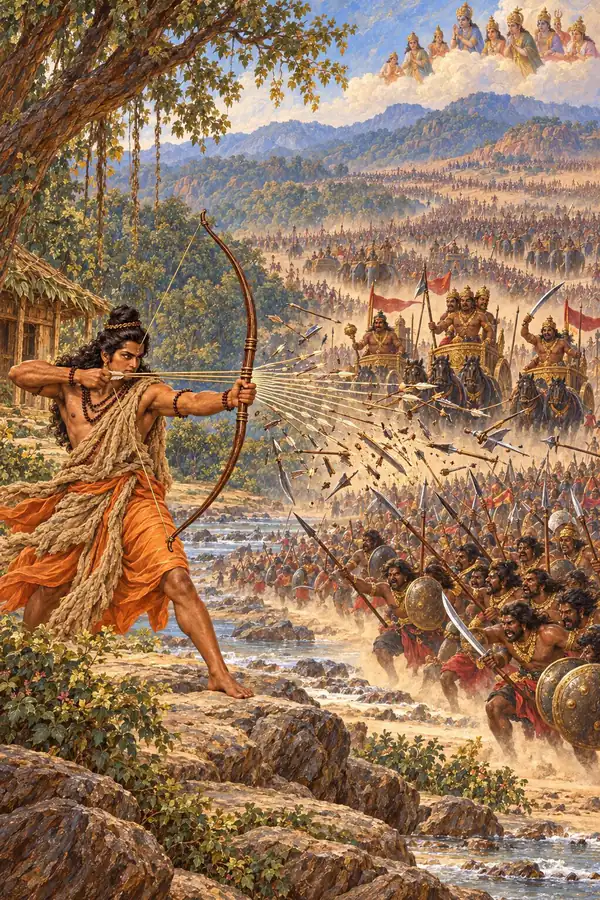
Seeing the gods and sages afraid, Rama, the lord of maya, worked a great marvel. The foes saw one another as Rama. Making war, their host died fighting.
Saying Rama, Rama
Saying “Rama, Rama,” they left their bodies and reached the state of nirvana, release. The commentary adds in a bracket what they were saying with the name, “This is Rama, kill him.” By this means Rama, the treasure of mercy, killed the foes in a moment.
The gods, glad, rained flowers, and drums sounded in the sky. Praising again and again, they all went away, shining in many vimanas, chariots that travel the sky.
And then Sita comes back
When Rama had won the battle, the fear of all, gods, men, and sages, was gone. Then Lakshmana brought Sita. Rama gladly took to his heart the one who fell at his feet. The commentary reads that one as Lakshmana.
Sita gazed at Rama’s dark, soft body with great love, and her eyes were not sated. Living at Panchavati, Rama did deeds that give happiness to gods and sages.
At the sight of the smoke
At the sight of the smoke of Khara and Dushana, Shurpanakha, going to Ravana, urged him on. The commentary reads the smoke as their ruin. She spoke in great anger. “You have forgotten your land and your treasury.”
The policy a sister recites
Shurpanakha went on. “You drink, and you sleep day and night. You have no thought that the enemy is over your head. Kingship without policy, wealth without dharma, good deeds without an offering of them to the Lord, and learning without discernment. The fruit of the reading, the doing, and the gaining is toil.”
Shurpanakha went on. “An ascetic perishes by company, a king by ill counsel, knowledge by pride, shame by drink. Love without humility, and the gifted by arrogance, perish quickly. Such is the policy I have heard.”
Lying in the middle of the assembly
Shurpanakha went on. “An enemy, a sickness, fire, sin, a master, and a snake are not to be counted small.” So saying, and lamenting in many ways, she began to weep.
Lying distraught in the middle of the assembly, Ravana’s in the commentary’s reading, she spoke in many ways, weeping. “While you live, Ravana, should such a state be mine?”
Who cut off your nose and ears
Hearing her, the courtiers rose distressed. They consoled her and, taking her by the arm, raised her. Ravana spoke. “Tell your own story. Who cut off your nose and ears?”
Shurpanakha answered. “The sons of Dasharatha, king of Ayodhya, lions among men, have come to play in the forest. From their deeds I have understood that they will rid the earth of rakshasas.” The commentary reads their play as hunting.
Shurpanakha went on. “By the strength of their arms, Ravana, the sages have become fearless and roam the forest. To look at they are boys, and they are like Death. They are most steady, bowmen, and of many virtues.”
Rama, that is his name
Shurpanakha went on. “The two brothers are of matchless strength and might. They are bent on killing the wicked, and they are givers of happiness to gods and sages. One of them is the home of beauty, and Rama is his name. With them is a young woman.” The commentary reads the young woman as a young beauty.
Shurpanakha went on. “The Creator shaped her a mass of form. A thousand million Ratis would be offered up for her. His younger brother cut off my ears and nose. Hearing that I am your sister, they laughed at me.” The commentary names Rati as Kama’s wife.
The night no sleep came
Shurpanakha went on. “Hearing it, Khara and Dushana began to cry out. In a moment he killed the whole army.” In the commentary’s reading they heard her cry and came to help.
Hearing of the slaying of Khara, Dushana, and Trishira, Ravana burned in all his limbs. Consoling Shurpanakha, he boasted of his strength in many ways. He went to his palace deep in worry. The commentary sets the worry in his mind. No sleep came to him all night.
The arrows, the means, and Ravana’s night
Rama’s arrows go out as if they were hissing serpents, and the rakshasa host turns and flees. The three brothers threaten death to any who run, and the warriors come back resolved to die. Cut into a hundred pieces, they rise by their wiles. Jackals clatter, ghosts gather skulls, and vultures fly holding entrails. Rama strikes every chief with ten shafts, and the warriors do not die. The gods see fourteen thousand against one and are afraid. Rama works his marvel. The foes see Rama in one another, fight, and die saying Rama, Rama. The gods rain flowers, and drums sound. Lakshmana brings Sita back, and her eyes are not sated as she gazes at Rama. Shurpanakha sees the smoke, urges Ravana on, recites policy, and weeps where the assembly sits. She tells him of Dasharatha’s two sons, of the name Rama, and of the woman in their company. Khara, Dushana, and Trishira are slain, and the news burns Ravana in all his limbs. His night in the palace passes without sleep.
The same story, elsewhere: Valmiki’s Ramayana, chapter 12: Panchavati, Shurpanakha, and the Slaying of Khara and Dushana, and chapter 13: Maricha, the Golden Deer, and the Abduction of Sita.
Source: the Gita Press edition of Tulsidas’s Ramcharitmanas, Aranyakand, the chhands before doha 20 (a), and doha 20 (a) to 22, read with Hanuman Prasad Poddar’s Hindi commentary.