On this page
In his palace a night has passed without sleep. Who but the Lord, Ravana asks, could have killed Khara and Dushana, who were as strong as he? If the Lord has taken avatar, he resolves, he will make enmity with him by force and, leaving his life by the Lord’s arrow, cross over becoming. If the two are a king’s sons in human form, he will carry off the woman, winning them in battle. And when Lakshmana has gone into the forest for roots, fruit, and bulbs, Rama tells Sita to dwell in fire until he destroys the night-walkers.
In this episode of the Ramcharitmanas Ravana sets out alone in his chariot for the shore where Maricha lives. Sita enters the fire and leaves her reflection there, and even Lakshmana does not know the secret. Ravana bows his head to Maricha, and Parvati is told how painful the bowing of the low is. Maricha worships him, asks why he has come alone, and is told to become a false deer. He speaks of a headless arrow that struck him and of the hundred yojanas he came in a moment. He asks if one so mighty can be a man. Ravana burns and abuses him. Maricha counts nine it does no good to oppose and sees his death either way. He goes with Ravana, very glad in his mind, and he does not let Ravana know it. The false deer takes its shape in the next episode.
Ravana, Maricha, and the hut at Panchavati
The main figures in this episode
- Ravana who holds that no one is a match for a servant of his. He asks who could have killed Khara and Dushana, his equals in strength, other than the Lord. He resolves his course for both cases and goes alone in his chariot to Maricha. He bows his head to him, tells him the whole story with pride, and orders him to become a false deer. When Maricha tells him to go home, he burns and abuses him. Maricha goes with him, and the gladness in Maricha’s mind is kept from him.
- Maricha who lives on the shore of the sea. He worships Ravana, asks why his mind is troubled and why he has come alone, and hears the order. He answers that the one in human form is the lord of the moving and the unmoving. He tells how a headless arrow struck him, and how he came a hundred yojanas in a moment. He asks whether one who, having taken the lives of Tataka and Subahu, broke Shiva’s bow and killed Khara, Dushana, and Trishira, can be a man. Abused, he reckons that opposing nine brings no good, sees his death both ways, and looks to Rama’s refuge. He goes with Ravana, his love for Rama’s feet unbroken, and glad that today he will see the supremely loving one.
- Rama who, when Lakshmana has gone to the forest, speaks to Sita, smiling, and tells her to dwell in fire until he has destroyed the rakshasas. The deeds he devises are a secret even to Lakshmana. In Maricha’s words he is the one whose headless arrow struck Maricha.
- Sita who, when Rama has explained everything, enters the fire holding his feet in her heart, and leaves her own reflection there.
- Lakshmana who is away in the forest, fetching roots, fruit, and bulbs, when Rama speaks to Sita, and who does not know the secret. He is one of the two brothers Maricha sees wherever he looks.
- Shiva and Parvati the teller and his hearer. Shiva turns to Parvati at the device Rama makes, and again at Ravana’s bow to Maricha.
- Khara, Dushana, and Trishira the three whose killing Maricha counts among Rama’s deeds. Ravana holds that Khara and Dushana were as strong as he was, and asks who but the Lord could have killed them.
After Khara and Dushana, a firm resolve
In the commentary’s reading Ravana began to think it over in his mind. “Among gods, men, asuras, nagas, and birds there is no one who is a match for a servant of mine. Khara and Dushana were as strong as I. Who but the Lord could kill them? If the Lord, who gladdens the gods and breaks the earth’s burden, has taken avatar, then, going to him, I will make enmity by force. Leaving my life by the Lord’s arrow, I will cross over becoming. Worship will not come from this body of darkness. In mind, deed, and word this is my firm resolve. If they are some king’s sons in human form, I will carry off the woman, winning the two in battle.”
Alone in his chariot, and the device Rama made
Ravana set out alone, mounted on his chariot, for the place where Maricha lived, on the shore of the sea. Shiva, telling the story to Parvati, says, “Of the device Rama made here, hear, Parvati, that pleasing story.”
When Lakshmana had gone to the forest
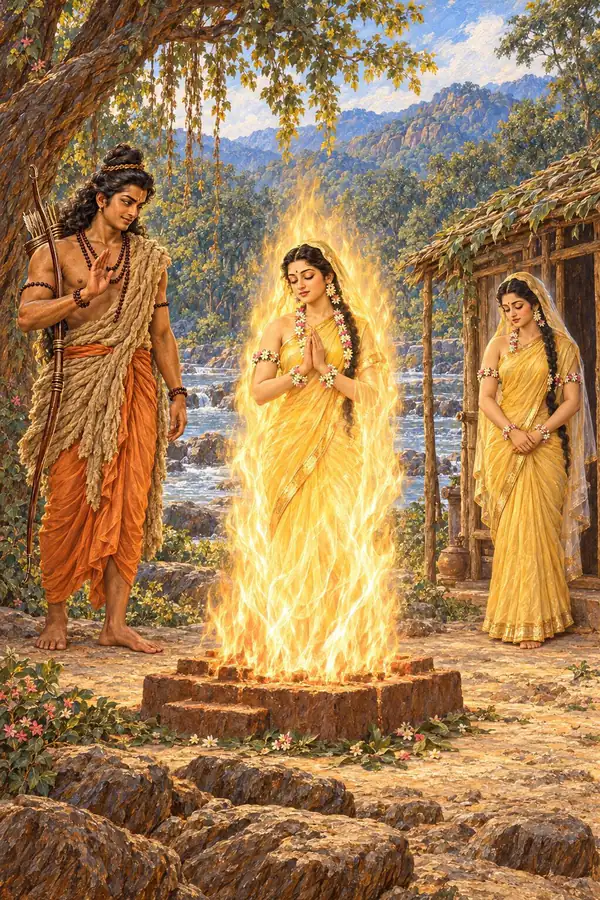
When Lakshmana had gone into the forest to fetch roots, fruit, and bulbs, Rama spoke to Sita, smiling, alone with her in the commentary’s reading.
“Listen, beloved, bright in vow and good of nature. I will perform some lovely play in human form. Dwell in fire until I destroy the night-walkers.”
Into the fire, and what was left there
As soon as Rama had said everything, explaining it, Sita, holding his feet in her heart, entered the fire. She left her own reflection there, like her in conduct and form, and as humble. The commentary calls the reflection a shadow-image.
What even Lakshmana did not know
Even Lakshmana did not know this secret, the deeds the Lord had devised.
Ravana went to where Maricha was and bowed his head. He was a low man, bent on his own ends.
The bowing of the low is very painful, like a goad, a bow, a snake, and a cat. The pleasant words of the wicked give fear, like flowers out of season, Parvati is told.
Maricha worships him, and asks
Having worshiped him, Maricha then asked with respect, “For what cause is your mind greatly troubled, and why have you come alone, dear one?”
The ill-fated Ravana told him the whole story with pride. “Become a false deer that deceives, by which means I may carry off the king’s wife.”
Maricha’s answer, and the hundred yojanas
Then Maricha said, “Listen, Ravana. He is the lord of the moving and the unmoving in human form. Do not make enmity with him, dear one. By his killing one dies, and by his giving life one lives. The prince went to guard the sage’s sacrifice. Rama struck me with a headless arrow. In a moment I came a hundred yojanas. There is no good in making enmity with them.” The commentary names the sage as Vishvamitra.
Maricha went on. “I have become like the bhringi wasp’s worm. Wherever I look, I see the two brothers. If they are men, dear one, still they are very great heroes. Opposing them will not come out well. Having taken the lives of Tataka and Subahu, he broke Shiva’s bow, and he killed Khara, Dushana, and Trishira. Is one so mighty a man?”
Abuse, and the nine
Maricha went on. “Go home, considering your line’s welfare.” Hearing it, Ravana burned and abused him greatly. “Like a guru, senseless one, you instruct me. Say, who in the world is a warrior like me?”
Then Maricha reckoned in his heart. “There is no good in opposing nine. One who bears arms, one who knows secrets, a master, a fool, a rich man, a physician, a bard, a poet, and a skilled cook.”
Death both ways, and a choice
Maricha saw his own death both ways. Then he looked to Rama’s refuge. In the commentary’s reading he judged that his good lay in going to that refuge.
The commentary sets the next words in his mind. “If I answer, the ill-fated one will kill me. Why should I not die struck by Rama’s arrow?”
Knowing this in his heart, he went with Ravana, his love for Rama’s feet unbroken. There was great gladness in his mind, and he did not let Ravana know it. “Today I shall see the supremely loving one.”
He whose anger gives nirvana
The commentary reads what follows as Maricha thinking to himself. “Seeing my own dearest beloved, and making my eyes fruitful, I shall gain happiness. I shall set my mind on the feet of the house of mercy, with Shri and his younger brother. He whose anger gives nirvana, whose bhakti binds the unbound one, that sea of happiness, the Lord, fitting an arrow with his own hand, will kill me.” The commentary reads nirvana as release, Shri as Sita, and the unbound one as the Lord, who is under no one’s power.
Maricha went on in his mind. “The Lord will run after me over the ground, holding bow and arrow. Again and again I shall turn to gaze at him. There is none as blessed as I.”
Ravana’s resolve, and Maricha’s choice
Ravana settles on two conditions, one if the Lord has taken avatar and one if they are a king’s sons. In his chariot he goes alone to the shore where Maricha lives. While Lakshmana is away for roots, fruit, and bulbs, Sita enters the fire at Rama’s word. Even Lakshmana does not know it. Ravana goes to Maricha and bows his head. Maricha worships him, hears his whole story, and is ordered to become a false deer. He counsels Ravana against enmity with Rama, and speaks of the headless arrow and the hundred yojanas. Hearing it, Ravana burns and abuses him. Then Maricha counts the nine it is no good to oppose, sees death either way, and looks to Rama’s refuge. With his love for Rama unbroken he goes along with Ravana, and his gladness is kept from him. In Valmiki’s telling Sita herself is carried off, and the fire comes after the war. In the Lankakand, after the war, it is the reflection that burns in the fire.
The same story, elsewhere: Valmiki’s Ramayana, chapter 13: Maricha, the Golden Deer, and the Abduction of Sita.
Source: the Gita Press edition of Tulsidas’s Ramcharitmanas, Aranyakand, doha 23 to 26, read with Hanuman Prasad Poddar’s Hindi commentary.