TulsidasRamcharitmanasthe third sopan
The forest of the sages’ hermitages becomes the place from which Sita is carried away, in eleven episodes.
In the third sopan of the Ramcharitmanas, Rama has been living at Chitrakuta. He reckons that everyone has come to know him and that a crowd will gather. Taking leave of all the sages, he and Lakshmana set out with Sita. The three go on from sage to sage: Atri, Sharabhanga, Sutikshna, Agastya. At Agastya’s order they settle at Panchavati, in a leaf hut near the Godavari. There Shurpanakha comes, and after her the army of Khara and Dushana. Ravana has Maricha become a golden deer. It draws Rama off after it, and Ravana carries Sita away on the sky-road. Jatayu gives him battle and falls. The brothers go on seeking Sita through the forest. Rama strikes down Kabandha, comes to Shabari’s hermitage, and goes on to the lake of Pampa. There Narada visits him, and the sopan closes.
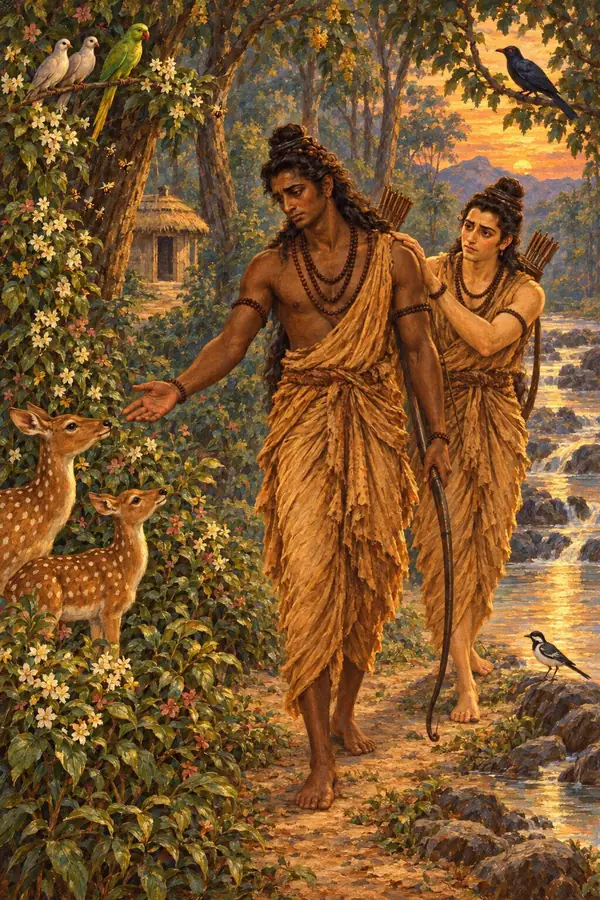
Each of the eleven episodes has a page of its own. There Tulsi’s chaupais, dohas, sorthas and chhands, read with Hanuman Prasad Poddar’s Hindi commentary, are told as a story in English prose.
Read it episode by episode
- Jayanta’s Offense, Atri’s Hermitage, and Anasuya’s Teachingdoha 1 to sortha 6 (b)
Jayanta, in a crow’s guise, strikes Sita’s foot, and the Brahma arrow runs. In all the worlds no one asks him to sit, and Narada sends him to Rama, who lets him go with one eye. Atri praises Rama in twelve stanzas and asks that his wit never leave Rama’s feet. Anasuya, on a pretext, tells something of a woman’s dharma. - Sharabhanga, the Bones of the Sages, and a Vowdoha 7 to 11
Sharabhanga says he was on his way to Brahma’s abode when he heard that Rama would come to the forest. He has watched the road for him day and night. Farther on, Rama sees a heap of bones. The sages tell him that hosts of night-walkers have eaten all the sages. Rama raises his arm and vows to rid the earth of rakshasas. Then Sutikshna, Agastya’s disciple, runs to meet him. Rama watches him from behind a tree and appears in his heart. The sage sits still in the middle of the road. - Agastya, Panchavati, and the Lakshmana Gitadoha 12 to 16
Sutikshna says he will go with Rama to his guru, and that it is no favor to Rama. At Agastya’s hermitage Rama asks for counsel on how to kill the sages’ foes. The sage smiles. He tells Rama of a place named Panchavati and asks him to live there. Rama thatches a leaf hut near the Godavari and lives there. One day Lakshmana asks about knowledge, dispassion, maya and bhakti, and Rama answers him. - Shurpanakha, and the Army of Khara and Dushanadoha 17 to 19 (b)
Shurpanakha, Ravana’s sister, comes to Panchavati and goes from one brother to the other. She shows a fearsome form, and Sita is afraid. At Rama’s sign Lakshmana cuts off her nose and ears, as if a challenge were sent to Ravana by her hand. She goes weeping to Khara and Dushana. Their army comes with her at its front, and Rama sends Sita with Lakshmana to a mountain cave. - The Slaying of Khara, Dushana, and Trishiradoha 20 (a) to 22
Seeing fourteen thousand against Rama alone, the gods are afraid. Rama works a marvel. The rakshasas see each other as Rama, fight, and die. They leave their bodies saying his name, and gain liberation. Lakshmana brings Sita back. Shurpanakha goes and urges Ravana on. Hearing that Khara, Dushana, and Trishira are slain, he burns in every limb. He consoles Shurpanakha and boasts of his strength in many ways. Then he goes to his palace deep in worry and cannot sleep. - The Golden Deer and Marichadoha 23 to 26
Ravana resolves that if the Lord has taken avatar, he will make enmity with him by force. Leaving his life by the Lord’s arrow, he will cross over becoming. If the princes are men, he will carry off the woman, winning both in battle. He sets out alone for Maricha on the sea’s shore. Meanwhile, with Lakshmana away, Rama tells Sita to dwell in fire until he has destroyed the rakshasas. She enters it, leaving her reflection there. Maricha sees his death either way and chooses to die by Rama’s arrow, with a gladness he does not let Ravana know. - Sita Taken, and Jatayudoha 27 to 29 (a)
Maricha becomes a deer of gold set with gems, and Rama runs after it. Dying, it cries out Lakshmana’s name. Sita tells Lakshmana to go, and he goes to Rama. Ravana, seeing the empty moment, comes near in an ascetic’s guise and carries Sita off on the sky-road. Old Jatayu gives him battle, fells him from his chariot, and loses his wings to Ravana’s sword. Ravana keeps Sita under an Ashoka tree. - Rama’s Lament, and Jatayu’s Passingdoha 29 (b) to 32
The hermitage on the Godavari’s bank stands empty of Sita. Lakshmana consoles Rama in many ways. Rama goes on asking the creepers, the trees, the birds, the beasts and the bees whether they have seen her. Ahead, Rama sees Jatayu lying fallen. Jatayu tells him that Ravana has carried Sita off toward the south, and leaves his body. Rama does his rites with his own hands. - Kabandha, Shabari, and the Ninefold Bhaktidoha 33 to 35
The two brothers go on searching for Sita through a thick forest. Rama strikes down Kabandha on the path, and Kabandha tells of the curse Durvasa laid on him. At the sight of Rama’s feet, he says, that sin is gone. At her hermitage Shabari gives Rama bulbs, roots and fruit. He tells her the ninefold bhakti, naming each of the nine in turn. She tells him to go to the lake of Pampa, where there will be friendship with Sugriva. - Separation, and the Three Mighty Enemiesdoha 36 to 40
Rama leaves that forest too and sets out, grieving like one parted. He tells Lakshmana that the birds and beasts are all with their mates, as if they reproached him. The does, he says, tell the fleeing deer that these have come searching for a golden deer. Then he names to Lakshmana the three mighty enemies, lust, anger and greed. Rama comes on to the lake of Pampa. - Narada’s Visit, and the Close of the Kanddoha 41 to 46 (b)
Rama bathes in a bright pool and sits with Lakshmana in a tree’s shade. Narada comes, veena in hand, and asks a boon for the name Rama. Then he asks why Rama did not let him marry, when Rama set his maya on him and deluded him. Rama answers, and tells him the marks of the saints. Narada goes to Brahma’s world, and the third sopan ends.
Tulsidas’s Rama story
The ground of every episode here is Tulsidas’s Awadhi Ramcharitmanas, written in the sixteenth century. Valmiki’s Sanskrit Ramayana, written long before it, can be read whole, in its own right. Many episodes are in both poems, and their color, their order and sometimes their detail differ. What is told here is what the Manas tells.
Source: the Gita Press edition of Tulsidas’s Ramcharitmanas, the third sopan (Aranyakand), read with Hanuman Prasad Poddar’s Hindi commentary.