On this page
Yoga Vasistha · Story 9
Prahlada: Devotion, Self-Inquiry, and the Return to Rule
Prahlada, eldest son of the demon king Hiranyakashipu, watches his father die under the claws of Narasimha and his people sit in the ashes of their city like figures in a painting. The one refuge he can find is the god who ruined them. Devotion carries him into self-inquiry, and inquiry into an absorption that lasts thousands of years while Patala, with no one on its throne, tears itself apart. Vishnu, waking on the Milky Ocean, must decide whether a liberated man should be called back at all, and Prahlada, once woken, must answer a harder question: what does freedom require when the body and its responsibilities still have a future?
After Hiranyakashipu
Vasistha turned to the prince who sat before him in Dasharatha’s court, the prince who had asked why anyone should go on living in a world that only takes away. "Listen, Rama, to the story of Prahlada, lord of the demons, who became an adept by his own intuition." In the infernal regions below the earth there had lived a demon called Hiranyakashipu, as valiant as Narayana himself. He had driven the gods and the demigods from their homes, taken the treasures of the world out of Hari’s own hands the way a swan crowds a bee off a lotus leaf, and ruled the three worlds as an elephant rules a lotus bed after it has chased the swans away. In time he begot many sons, as spring brings out the shoots of trees, and they grew into men whose prowess reached across earth and sky like the rays of so many suns. Among them the eldest, Prahlada, was made regent, and he stood out among his brothers as the Kaustubha gem stands out among jewels. His father delighted in him as a year delights in its spring. Then, with a son like that on one side and all the force and treasure of the three worlds on the other, Hiranyakashipu swelled with pride, and like the suns of the final dissolution he drew every drop of moisture out of the earth with taxes no one could bear. The gods, the sun and the moon found him as intolerable as a bully is to the boys who have to play with him, and together they went to Brahma and asked for his destruction.
What came was Hari in the form of Narasimha, half man and half lion. His nails clattered like the tusks of an elephant and his roar filled the hollow of the world the way the elephants who hold up the quarters of heaven bellow on the last day. Nails and teeth flashed like lightning. The light of his earrings ran in curling flames through the whole sphere of the sky. Mountains cracked open along their sides, a tempest tore the great trees up and ripped the vault of heaven, and the winds that came from his mouth drove whole ranges before them. His eyes burned with a fire that was about to consume the world, his mane shook with the glare of sunbeams, and every pore of his body threw sparks like the mouth of a volcano, while arms shot out of him in every direction. He took the giant demon on his tusks and gored him to death as an elephant bores through the body of a horse. The fire from his eyes burned down the city of the demons, the breath of his nostrils drove everything before it like a hurricane, and the clapping of his arms broke on the empty shores like surf. The demons fled from him as moths from a flame and went out like lamps in the glare of the day. When the city had burned and the demons were scattered, the netherworld lay as empty as the earth after its last devastation, and the Lord, having cut down the race of the demons at the close of their age, vanished with the thanks of the assembled gods.
It was Prahlada who brought the surviving sons back to the ruin, as a shower of rain brings the migrating birds back to the dry bed of a lake. They wept over the bodies of their dead, mourned everything they had lost, performed the funeral rites and burned the corpses of their kin, and then sent word to those who had saved themselves by flight that they could return to their deserted homes. After that the Asuras and their leaders sat with broken minds and disfigured bodies like lotuses beaten down by frost. They made no effort and no attempt at anything. They sat as figures sit in a painting, with no more hope of rising than a withered tree or an arbor struck by lightning. Prahlada, brooding in that underground dark over the destruction of the Danavas and their homes, spoke what the rest of them could not. "What is going to become of us, when this Hari is set on destroying the best of us, like a monkey nipping off every new shoot on a tree? I cannot find a Daitya anywhere, on earth or down here, who is left in possession of what was his. They rise only to fall, like the beat of a drum, like a wave in the sea. We see the gods, who were servants at our father’s feet, sitting in his kingdom, as if timid deer had taken the lion’s place in the forest. Our friends sit slumped and listless, like lotuses with their petals gone. The houses of our giants are full of dust and frost blown in by the wind day and night, and their inner rooms stand open without doors, with barley sprouting from the floors like blades of sapphire. Our women crouch like deer at the rustle of a leaf, afraid of the enemy’s darts whistling through the open air. The gods have carried off our kalpa trees, the trees that gave us whatever we asked, and planted them in their Nandana gardens. The women of the gods and Gandharvas we once held captive have been snatched back and set on Meru like transplanted heavenly plants, while our captured girls are mocked by the nymphs of heaven, who dance over our disgrace. The girls who fanned my father with their chowries now wait in servile toil on the thousand-eyed Indra. And the worst of it is that one Hari did all this. The old world that our strength was about to pull down now rests on his blue arms the way the vault of heaven rests on the sky. He held the gods up as they were going over the edge of perdition, as the great tortoise held up Mandara when the mountain was sinking into the Milky Ocean during the churning. He has been fighting our forefathers since the first wars, when they tore up rocks and flung them at him. He is not going to be afraid of us."
Then the thing that no one in that hall expected. "I have thought of one expedient, and only one, against the rage of Hari. I can find no other way to safety. Let us go to him, as fast as we can, with our hearts and our understanding fully contrite, because that god is the true refuge of the pious and the only resort of everyone. There is no one greater than him in the three worlds. I know now that Hari alone is the sole cause of the creation, the sustaining and the destruction of the world. From this moment I will think of nothing except that unborn Narayana, forever. I will rely on that Narayana who is present in every place, who fills all space, and who is full in myself. Let obeisance to Narayana be my faith and my profession, and may that faith stay in my heart as the wind stays in the midst of empty air." And he taught himself how to hold the god he had chosen. One who worships Vishnu by thinking himself to be Vishnu finds himself assimilated to his god, and so Prahlada said to himself: "My ego is the immeasurable spirit of Hari, and my inborn soul is full of Vishnu." He built the god in his mind at the scale of the world. Vishnu filling all space. Garuda as the sun, his claws the rays. Four arms. Lakshmi at his side with her chowri, risen from the Milky Ocean. Maya at his side, and Jaya, Victory. The sun and the moon for his eyes, the blue sky for his body. Panchajanya the conch and the lotus in his hands, Sumeru for his club, the sun for his discus, fire for his sword Nandaka, the rainbow for his bow Sharnga. The firmament for his belly. The earth for his footstool. Sapphire blue, in a yellow mantle, mounted on the eagle. He bowed to that Viraj form, the god in the shape of the universe. Then he made an image of Narayana and, by the rite that gives breath to an image, invoked the spirit of Vishnu into it: the god seated on Garuda, four arms holding conch, discus, club and lotus, eyes like the sun and the moon, the bow Sharnga and the sword Nandaka resting on his shoulders.
He resolved to worship this image with everyone who depended on him. First in his mind, where a king’s treasury has no bottom, he laid before the god gems and sandal paste, incense and lamps, ornaments, wreaths of Mandara flowers from the gardens of paradise, golden lotuses and garlands from the kalpa trees, and flower after flower of every kind that grows. He worshiped in the inner apartment of his house, and then outwardly in his holy temple, and he did this every day. What began as the reaction of a bereaved prince became the daily order of his mind and his household.
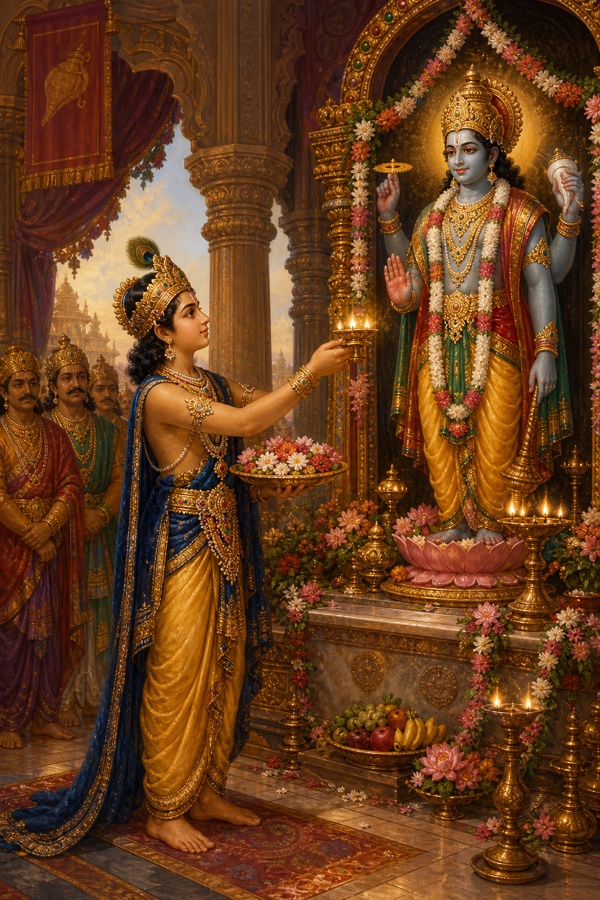
The Daityas watched the eldest son of their defeated line bow to the god who had torn his father open, and they followed him. Every one of them became a Vaishnava after their king. In the city and in its temples the race that had fought Hari since the beginning of the ages now worshiped Hari.
The news reached heaven. The Devas, and Indra with the Rudras, could not believe it, and they went down to the Milky Ocean where Vishnu lay on his serpent couch and asked him to explain. "Lord, how is it that the demons, who have always been against you, have come to embrace your faith? To us it looks like magic, or like hypocrisy. The Vaishnava faith is gained only after many transmigrations of the soul, and these are the ones who used to break down rocks and mountains in their rebellions. The rumor that a clown has become a scholar is as welcome as it is doubtful, like news of blossoms budding out of season. Nothing is graceful out of its proper place. A rich jewel loses its value when it is set among worthless pebbles. Every animal has the disposition that goes with its nature. How can the pure faith of Vishnu agree with the doggish natures of the Daityas? It hurts us less to be pierced with thorns and needles than to see things of opposite natures joined together. Whatever belongs to its time and place looks right there. The lotus has its grace in water, and none on dry land. Where are the vile Daityas, bent on their misdeeds at all hours, and where is the Vaishnava faith, whose merit they will never understand? We can take no pleasure in hearing that a bed of lotuses has been left to parch in the desert, and we can take no pleasure in the thought that the race of demons will put its faith in Vishnu, the lord of the gods." The lord of Lakshmi answered them in a voice like rain clouds answering the thirsty screaming of peacocks. "Do not marvel at Prahlada’s faith in me. It is by virtue of the virtuous acts of his past lives that this pious prince is entitled to his final liberation in this present life. He will never again be born from the womb of a woman, or reproduced in any form on earth. He will stay aloof from regeneration, like a fried pea that does not germinate anymore. A virtuous man who turns impious becomes a source of evils, certainly. An unworthy man who becomes meritorious has taken a step toward his better being and his blessedness. You gods, who are so happy in your blessed seats in heaven, must not let Prahlada’s good deserts be any cause of uneasiness to you." With that he became invisible, like a feather floating off on the surface of the waves. The immortals went back to their heavenly homes the way particles of sea water are carried up to the sky by the breeze, and from then on they were at peace with Prahlada, because a mind is never suspicious of someone who has the credit of its superiors.
A Boon That Requires Work
Prahlada went on with the daily adoration of his god, contrite in heart, in the set forms of spiritual, spoken and bodily service, and in the course of that service the felicity that comes from right discrimination and self-resignation began to settle on him. He took no delight in anything that could be enjoyed. The company of his consorts gave him no pleasure. He shunned it as a stag shuns a withered tree and the company of men. He did not walk in the ways of the ungodly, and he spent his hours on nothing except religious discourse. His mind would not rest on visible things any more than a lotus will grow on dry ground. It found no delight in pleasures, all of which are threaded with pain, and longed for a liberation that is whole in itself and attached to nothing, like a single pearl without a hole bored through it. And yet, drawn away from his enjoyments and not yet settled in the trance of final rest, that mind swung between the two states like a cradle rocking both ways.
Vishnu, who knows all things, saw the unsettled state of Prahlada’s mind from his seat in the Milky Ocean. He was pleased with the firmness of the prince’s belief, and he came. He traveled by the subterranean route, the road under the waters that joins his ocean to the netherworld, and stood confessed before Prahlada at the holy altar, in the house of worship where the image had stood every morning until now. Seeing his god manifest before his eyes, the lord of the demons worshiped him with twofold veneration, laying before him far more than his usual offerings, and then, glad beyond anything he had known, he praised him for deigning to appear in his house. "I adore you, my lord Hari, unborn and undecaying, blessed receptacle of the three worlds, who dispel all darkness by the light of your body and are the refuge of the helpless and the friendless. I adore my Hari in the complexion of blue lotus leaves and the color of the autumn sky, whose body has the hue of the dark bee, who holds in his arms the lotus, the discus, the club and the conch. I worship the god who dwells in the lotus hearts of his devotees like a swarm of dark bees, holding a conch as white as a lotus bud, with earrings that ring like the humming of bees. I take shelter in Hari’s sky-blue shade, lit by the starlight of his long nails, his face a full moon of smiling beams and his breast rippling like the surface of the Ganga under the gems that hang on it. I rely on the god who slept on the leaf of the fig tree when his spirit floated on the waters, who contains the universe in himself in his stupendous form of Viraj, who is neither born nor grown and is always whole in himself. I take refuge in Hari, whose chest is dusted red with the pollen of the new-blown lotus, whose left side is graced by the blushing beauty of Lakshmi, whose body is mantled in red and smeared with red sandal paste like liquid gold. I take my asylum under Hari, who is the killing frost on the lotus bed of the demons and the rising sun on the opening buds of the gods, the source of the lotus-born Brahma and the receptacle of the lotus seat of our understanding. My hope is in Hari, the blooming lotus of the triple world, the only light in the darkness of the universe, the principle of intelligence in the midst of gross matter and the one remedy for all the evils of this passing life."
Hari, with the goddess of prosperity at his side, heard the demon lord through and answered him as lovingly as deep clouds answer the cries of peacocks. "Jewel on the crown of the Daitya race, receive from me the boon you desire, for the relief of your worldly afflictions."
Prahlada did not reach for anything of his own. "What better blessing can I ask of you, my Lord, than that you instruct me in what you yourself think your best gift, above all the other treasures of the world, the gift that can answer all our wants in this miserable life?"
"Sinless one," the Lord answered, "may your right discrimination of things lead you to your rest in God and to supreme felicity, once your earthly cares and the errors of this world have been scattered."
That was the whole of the boon. The prince who had asked for the god’s best gift had been handed a task. As soon as the words were spoken Prahlada fell into a profound meditation, so deep that the breath in his nostrils roared like the gurgling of the sea, and as Vishnu passed out of his sight he threw handfuls of flowers and rich gems and jewels of every kind after the departing god.
Then he sat down on his high seat with his legs folded over one another in padmasana, chanted his hymn, and began to reason with himself. "My deliverer from this sinful world has told me to use my discrimination. So I must set myself to discriminate between what is true and what is false. I must admit that I am in a dark world, and I must look for the light of my soul. And first: what is the principle that makes me speak, walk and take the trouble to earn a living? Who is it that does these things?"
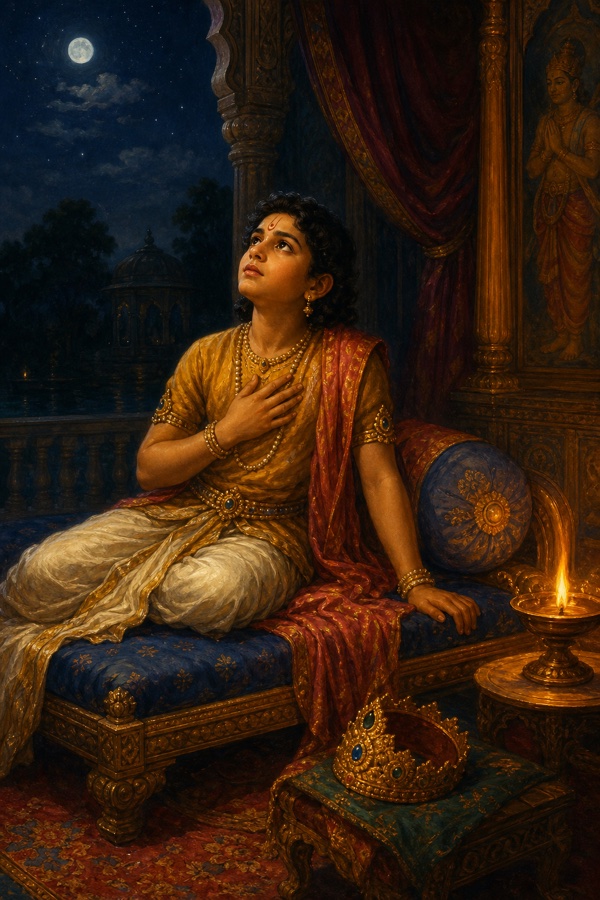
He started with what was nearest and crossed it off. "It is nothing of this external world, nothing like its green trees or its hills. External bodies are all of a gross nature, and my I is a simple and pure essence. I am not this insensible body, dull and dumb, made to move for a moment by the vital airs. It is an unreal appearance of a passing existence."
"I am not sound, which is an empty thing produced in empty space, caught by the hole of the ear and gone as fast as air. I am not the insensible organ of touch, and I am not the momentary feeling of contact. I find myself to be an inward principle with the faculty of intellection and the capacity to know the nature of the soul. I am not my taste, which is confined to the relishing of certain things and to the organ of the tongue, a trifling and restless thing that sticks to the inside of the mouth and moves about in it. I am not my sight, which is employed on visible things only, weak and decaying, never lasting in its power, and incapable of seeing the invisible spirit. I am not the power of smelling, which belongs to the nose only and deals with fragrant things for a short moment, since fragrance is a fleeting thing."
"I am pure intelligence, and none of the sensations of my five outer organs of sense. I am not even my mental faculty, which is forever frail and fruitless. Nothing belongs to me and nothing partakes of my true essence. I am the soul, an indivisible whole. I am the I, the intellect without the objects of its intellection, the thinking principle freed from its thoughts. My I pervades all things, inside and out, and shows them to the view. I am the whole without parts, pure without foulness, everlasting. It is my intellection that shows me this pot and that painting and brings every other object to my knowledge by its pure light, as the sun and a lamp show everything to the eye." A pot. A painting. The two ordinary objects in the room where he sat had become the last witnesses in an inquiry that had already dismissed the body, the senses and the mind, and the light by which he saw them was the one thing left that could not be dismissed.
The Knower of Every Change
"Ah. Now I remember the whole truth. I am the immutable and all-pervading Spirit, shining in the form of the intellect." Once that was seen, everything he had crossed off came back in its proper place. "This essence unfolds itself into the faculties of sense, as the fire inside a thing unfolds into flash and flame and sparks and visible light. It is this principle that spreads itself into the organs of sense, the way the heat of the hot season shows itself as a mirage over the sand. It is this that makes the substance of every object, as the light of a lamp is the cause of the colors of things. It is by this one unchanging intellectual light that we feel the heat of the sun and the coolness of the moon, the hardness of rock and the flow of water. This is the first cause of everything we go on perceiving in the world, and it has no cause before it. It is this formless cause that is the prime cause of every secondary and shaping cause, Brahma the creator among them. The gods Brahma, Vishnu, Rudra and Indra, who are the causes of the world’s existence, all owe their origin to this prime cause, which has no cause of its own. Everything else stands to it as a mode stands to its substance, and sinks into it as a property into its spirit. Whatever this inner, intelligent soul wills to do is done everywhere. Nothing besides it exists anywhere in reality. Whatever the intellect means to do takes on a form of its own, and whatever the intellect thinks undone dissolves back into nothing. These countless worldly objects, this pot, this painting, are shadows cast on the immense mirror of empty space, and they swell and shrink under the light of the soul as shadows lengthen and shorten in the sunshine."
Then the prince who had never been anything except a Daitya in a Daitya body began to say what he was. "This I of mine wanders the sky in the body of the shining sun, and in other forms too, as air in the running winds. The sky is the azure body of my Vishnu, with his conch, his discus, his club and his lotus in the clouds, which are the signs of plenty by their blessed rains. I find myself identical with that god, sitting here in padmasana, in this samadhi, having come to my perfection in stillness. I am the same as Shiva, the three-eyed god, with his eyes rolling like bees over the lotus face of Gauri, and it is I who, in the form of Brahma, hold the whole creation inside me as a tortoise draws its limbs into itself. I rule the world in the form of Indra, and as a monk I command the monastery that has come down to me. I am both the male and the female, both the boy and the girl. I am old in my soul, and young in my body, which is born and renewed again and again. I am the grass and every plant on the earth, and I am the moisture that grows them, as my thoughts grow in the ground of the intellect, as herbs grow in hollows and wells by their damp. I have gained a boundless empire over all the worlds without seeking it or asking for it, without subduing it as Indra once did, without crushing the gods with my arms."
And from that height he looked down on his own house. "How foolish and short-witted my forefathers were, who left this spiritual domain to wander as mortal beings in this frail and miserable world. How grand is this sight of the immensity of Brahma, and how mean are these creeping mortals with their high aims and ambitions and all their splendors of royalty. Cursed be the wicked demons who are so ignorant of their souls that they run for the safety of their bodies to strongholds in woods and hills and ditches, like the insects that live there. Ignorance of the soul leads a man to serve the dull, ignorant body with food and clothing, and that is how our ignorant elders pampered their bodies for no lasting good. What good did my father Hiranyakashipu reap from his prosperity of a few years in this world? What did he gain that was worthy of his descent from the great sage Kashyapa? A man who has not tasted the blissfulness of his own soul has enjoyed no true blessing in a long reign of a hundred years. A man who has gained the ambrosial delight of spiritual bliss, and nothing of the passing blessings of life, has gained something that is always full in itself and has no end until the end of the world. Only a fool gives up this infinite joy for the passing delights of the world, like the foolish camel who leaves his fodder of soft leaves to browse on the thorns of the desert."
"There is no happiness to be had on this earth that would make us wish to be sovereign over it. All happiness consists in the peace of the mind, and that is what it concerns us to seek. It is the calm, quiet, unaltered state of the mind that gives us true happiness in every condition of life. It is the virtue of sunlight to light up everything, and of moonlight to fill us with its ambrosial draughts, and the light of Brahma transcends them both, filling the three worlds with a glory brighter than sunbeams and cooler than moonlight. Shiva’s power reaches over the fullness of knowledge, and Vishnu’s over victory and prosperity. Speed is the character of the mind, force the property of the wind, burning the nature of fire and wetness of water. Every thing has its nature, and the one Intellect ordains all of them. But the intellect fouled by its own wanting does not see the soul in a clear light, as a hooded eye has only a dim sight of the world. An intellect dirtied by desire and dislike is stopped in its heavenly flight like a bird caught in a snare. Those who have fallen into the snare of delusion by their ignorant choosing of this and that are blind birds falling into the net in search of their prey. Tangled in the meshes of desire and shut in the pit of worldliness, our fathers were barred from this unbarred sight of spiritual light and endless delight. In vain our forefathers flourished for a few days on the face of the earth, only to be swept like gnats by a gust of wind into the ditch." And then the voice turned, from argument into thanksgiving. "I have long thought upon you and sought after you, and I have at last found you rising in myself. I have chosen you from all others, and whatever you are, I hail you, my Lord, as you appear in me. I hail you in me, lord of gods, in your form of infinity within myself and in the shape of bliss within my enraptured soul. I bow to that cloudless light shining in me like the disk of the full moon, to that selfsame form which is free of every predicate and attribute. It is the self-risen light in me, the felicitous selfsame soul I find in myself as my other self."
The inquiry had reached its ground, and now the ground spoke. "Om is the proper form of the One, free of every diminishment. That Om is all this, everything contained in this world. It is intelligence, without flesh or fat or blood or bones. It abides in all things and it is what lights the sun and every other shining body. It warms the fire and wets the water. It gives the senses their sensing and enjoys everything in the manner of a prince. It rests without sitting and goes without walking. It is active in its inactivity and does everything without touching anything. It is the past and gone, and the present and the now, and the next moment and the far future; it is everything fit and proper and everything unfit and improper too. Undaunted, it produces all productions and spreads the worlds one over another, and it keeps the worlds turning, from the sphere of Brahma down to the grass. It moves the minds of men as the wind shakes the leaves of trees, and it directs the organs of sense as a charioteer manages his horses. The Intellect sits as the lord of this bodily mansion, which the senses carry about like a chariot, and sitting there at its ease as sole monarch it enjoys the fruits of what the body does. It is to be sought and meditated on and praised at all times, because only by this can a man be released from the pains of age and death and the evils of ignorance. And it is easily found, as easy to make friends with as a friend. It lives like the humble bee in the recess of the lotus heart of everyone. I am that I am, without attributes, like the clear air unsullied by flying dust, like lotus leaves untouched by the water that holds them up. A rolling stone gathers no moss, and nothing touches or bears on my airy mind. The pain and pleasure that overtake the body cannot touch my form as the inner soul. The soul is like a gourd, which takes no harm from the rain beating on the hard crust outside it, and the intellect is like the flame of a lamp, which no rope can tie down. Who has the power to grasp empty space or to confine the mind? You may cut the body into a thousand pieces, but you cannot divide the invisible and indivisible spirit rising in me. A pot may be broken or bored or carried off, and the air it held and the air that held it lose nothing. So the body may be destroyed and no damage is done to the unconnected soul. I feel in myself neither the wish to go on with worldly enjoyments nor a desire to give them up altogether. Let what may come to me, and let whatever may pass away from me. I have no expectation of pleasure and no aversion to the suffering of pain. Let pleasure or pain take me or leave me as they will, without my attending to either, because I know the restless desires to be forever rising and setting in the sphere of my mind."
"It is by the favor of Vishnu, and by virtue of my pure Vaishnava faith rising in me of itself, that my ignorance is now wholly dispelled and the knowledge of the True One is revealed to me. My knowledge of the truth has driven my egoism out of my mind as they drive a spirit from its hiding place in the hollow of a tree. The grove of my body has been set free of the Yaksha, the egoism, that squatted in it. Now it is a sacred grove blooming with heavenly flowers, free of the ignorance, the penury and the vain wishes that infested it before. Loaded with the treasure of sacred knowledge I sit here as one supremely rich, and knowing all that is to be known I see the sights that are invisible to others. I have got the thing in which nothing can be wanting. My chill and frigid ignorance has melted in the light of knowledge, the hot mirage of my desires is quenched by my quiet, and I see a clear sky on every side without mist or dust and rest in the cool shade of the tranquility of my soul. I remember Vishnu as the great Spirit and the eternal Brahman in his nature, while my egoism is confined like a snake in the holes of this organic frame, which is wholly the land of death. It lies tangled in the pricking thorns of its desires, in the tumult of raging passions and a thousand other broils of this world, in a conflagration of calamities, ringed with flames of sharp pain, going up and down with fortune, born and dying again and again out of its interminable desires. That is the great enemy that has always deceived me, my own egoism." And he turned, as to a friend who had been in the room all along, and bowed to his own soul. "I bow to you, my inmost soul, who are a stream of bliss to me, clear water with none of the mud of egoism in it. I hail you, my soul, who are an ocean of joy with no sharks of sensual appetite in it and no submarine fire of the latent mind under it. I prostrate myself before you, quick soul of mine, mountain of delight without the hovering clouds of egoistic passion and the wildfires of gross appetite. I bow to you, soul in me, heavenly lake of Manasa, blooming with lotuses of delight and without the billows of care. I greet you, inner spirit, who float as a swan on the Manasa lake of every mind and live in the hollow of the lotus skull with your wings of consciousness outspread. All hail to you, full and perfect spirit, undivided and immortal, who appear in your several parts of mind and senses as the full moon holds all its digits in its whole self. Obeisance to the sun of my intellect, always in the ascendant, dispelling the darkness of my heart. I bow to my intellectual light, an oilless lamp of benign effulgence that burns in full blaze inside me with no wick. Whenever my mind is heated by the fire of desire I cool it with the cold hard intellect, as they temper red-hot iron with a cold hammer. I am winning my victory over all things by killing my egoism with the great Ego, by making my senses and my mind destroy themselves. I subsist solely as the transparent spirit, by killing my mind with the great Mind and driving out the unreal with the one Reality. I wonder to think what I had been all this time, bound fast by my egoism in the strong chain of my personality. I think myself a newborn being today."
"I thank you, lord and great spirit, who are beyond all things and are found in myself by my good fortune. I have no other friend in the three worlds except you, who deign to embrace me and look on me when I pray to you. It is you who preserve and destroy everything and give everything to everyone. It is you who make us move and work and praise your holy name. Now you are found and seen by me, and now you go away from me. You fill every being in the world with your essence, you are present in every place, and where have you fled and gone from me? Great is the distance between us, as great as the distance between the places of our birth, and it is my good fortune, friend, that has brought you near me today and set you before my sight. It is a usage of words that makes a distinction between you and ourselves, and it is as false an impression as the difference between waves and the water they are made of. As heat and cold are known by touch, as the fragrance of a flower is felt in the oil it is mixed into, so I feel your presence when you touch my heart. As music enters the heart through the ears and makes the heartstrings thrill and the hair stand on end, so your presence is felt in our hearts. As the tip of the tongue carries a taste to the mind, so my heart feels your presence when you touch it with your love. Fortunately you have become myself, and I have become one with yourself. I am identical with you and you with me, and there is no difference between us." Then he turned the same voice on himself, as a king addresses a subject who has just come into an inheritance. "Forsake, my soul, the pride and anger of the ignorant, and all the foulness and cunning of your heart, because the high-minded never fall into the faults of common people. Think over and over on the actions of your past life, on the long series of your wicked acts, and then sigh and blush to think of what you had been before, and never do such things again. The bustle of your life is past, and the days are gone when you were wrapped on every side in the net of your tangled thoughts. Now you are a monarch in the city of the body, with the desire of your mind set before you, beyond the reach of pleasure and pain and as free as the air, which no one can grasp. You have subdued the unruly horses of your bodily organs and the indomitable elephant of your mind, you have crushed your enemy, worldly enjoyment, and now you reign as sole sovereign over the empire of your body and mind. You have become the glorious sun, to shine within us and without us day after day." The hymn closed on itself. "I exult now and am calm again. I move and am still afterwards. I am victorious and I live to win my liberation by your grace, and so I hail you, who are myself. When you are seated in me, my soul is freed from every trouble and feeling and passion and set in perfect rest. There is no more fear of danger or difficulty, of life or death, and no craving for prosperity, when I am absorbed in everlasting bliss with you." And having said it, he was.
Thousands of Years in His House
Prahlada, who had broken armies, sat on in that posture, in that divine meditation, absorbed in his entranced rapture and in a stillness that nothing could reach, for a long time. His soul had gone back to its original state of unalterable ecstasy and left the body as immovable as a rock in a painting, a figure carved in low relief on a stone. The hours ran into days and the days into years, and he sat in his house as unshaken as Meru is fixed on the earth.
The great Asuras of his palace tried to rouse him and could not. His deadened mind was as deaf to their calls as a solid rock, as impassive as a parched grain under a shower of rain. He stayed intent on his God with a fixed and steady gaze for thousands of years, and in all that time he moved no more than a sun carved on a sundial moves. He had reached the state of supreme bliss, and the sight of unhappiness had vanished from his view as it is unknown to the supremely happy being.
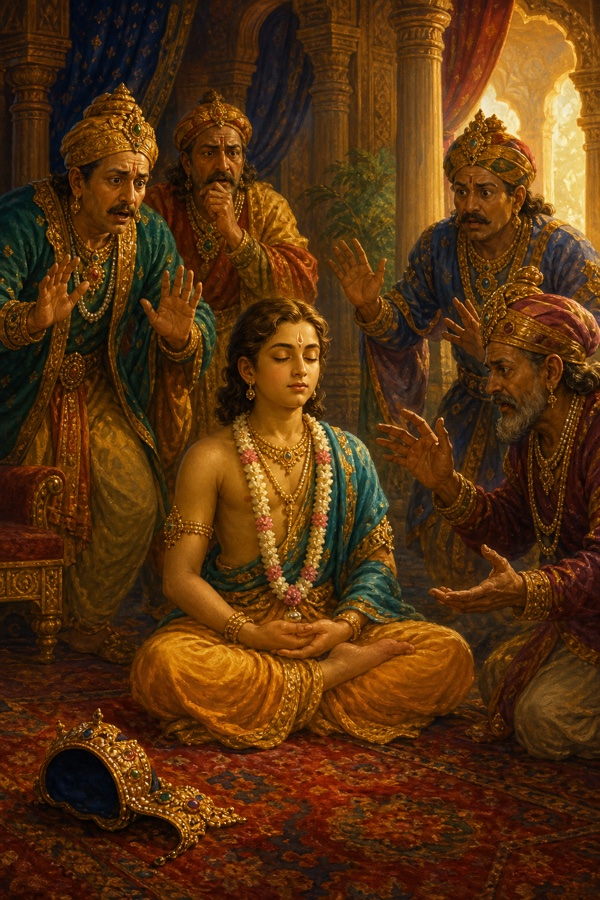
During those years the whole circuit of his realm fell under anarchy and oppression, the law of the fishes, where the big ones eat the small. After Hiranyakashipu was killed and his son had given himself to asceticism there was no one left to rule the realms of the Asura race. The Daitya chiefs pleaded with the seated figure and the oppressed people cried out to it, and nothing roused him. The enemies of the gods grieved for the lord who was not among them as bees grieve for the lotus that has closed up at night. They found him as sunk in his meditation as the world is sunk in deep sleep after the sun has gone below the horizon. Then the sorrowful Daityas went away from his presence, wherever each of them liked, and roved about at random, as men do in a state with no government.
The netherworld became in time a seat of anarchy and oppression, and honest dealing left it all at once. The houses of the weak were robbed by the strong. The restraints of law were set at nothing. People oppressed one another and stripped the women of their robes. There was crying and wailing on all sides, houses were pulled down in the city, houses and gardens were robbed and spoiled, and outlawry and rapacity spread over the whole land. The Asuras sank into deep sorrow, their families starved without food or fruit, disturbance and riot rose everywhere, and the face of the sky was dark on every side. The young ones of the gods laughed at them. Vile robbers and envious animals came in. Houses were stripped of their goods and left waste and empty, and the Asura realm became a scene of horror, of lawless fighting over other men’s wives and property and the wailing of men robbed of their wealth and their wives, so that it looked like the reign of the dark Kali age, when marauders are let loose to lay the whole earth waste.
Prahlada knew none of it. The agitation of a kingdom could not enter the absorption in which his own pleasure and pain, his office and his danger had all gone silent. Meanwhile the consequences of his absence kept piling up above him in the ruined streets.
Far above, in his watery mansion in the Milky Ocean, Hari slept on his couch of the snake, Hari whose delight it is to preserve the order of all the groups of worlds. He woke, as he does every year, at the end of the rainy season, to see to the business of the gods, and looked into the course of the world in his own mind. In a single glance of thought he surveyed the triple world of heaven, earth and the regions below, and then he turned his attention to the affairs of the demons’ country under the earth. He saw Prahlada sitting there in his deep meditation, and he saw the growing prosperity of Indra’s palace.
Sitting on his serpent couch, the conch, the discus, the club and the lotus in his four hands, he thought in his brilliant mind, in padmasana, about the state of the three worlds, as a hovering bee looks into the state of a lotus. He saw Prahlada sunk in his trance, the netherworld without a leader, and a world about to be emptied of the Daitya race. And he thought that this lack of demons was likely to cool the military ardor of the Devas, as a lack of clouds dries up the waters of the earth.
Vishnu’s Cosmic Calculation
He followed the chain to its end. "With no one to fight, the gods will be at rest and content in themselves, and there will be no need of sacrifices and offerings to please them. That will end in the extinction of the gods, who are fed on the butter and the fat of the sacrifices. When the religious and sacrificial rites die out among mankind, impiety will bring on the destruction of the human race, and the earth will lie desolate. What is the good of my providence if I let this plentiful earth go to ruin through my neglect? And what would I have to do, in an empty void of a world after every created being had gone to nothing, except turn my active nature to cold inactivity and lose myself in the insensibility of final liberation?"
"I see no good in the untimely dissolution of the order of the world, and I would have the Daityas live to its end. It is because of the struggles of the demons that the deities are worshiped with sacrifices and rites, for their protection of the earth, and so the demons are necessary for the continuance of those practices. I will have to visit the netherworld and restore it to its right order, and set the lord of the demons to the observance of his proper duties, as the season of spring comes back to make the trees bear. If I raise any other Daitya to the chieftainship of the demons and leave Prahlada in his meditation, that one is sure to trouble the Devas, with no obedience to them at all, because no demon can get free of his demonic nature as Prahlada has." Any other king in Patala would be a demon on the throne. Prahlada was the one Daitya alive who could rule the demons without being one.
"Prahlada is to live to old age in his sacred person, and to stay in it to the end of the kalpa age, in this very body, without passing through death and transmigration. So it is determined by Destiny, the divine goddess who overrules us all: Prahlada will go on reigning to the end of the kalpa in this very body of his." Knowledge had ended the prince’s possessiveness toward the body. The body’s course had not ended, and the god who keeps the order of the worlds was not going to let it be thrown away early.
"So I must go and wake the Daitya chief from his trance, as the roaring cloud rouses the sleepy peacocks on the hilltops and the riverbanks. Let that self-freed prince, lost in his samadhi, reign over the Daitya race without concern, as a pearl, knowing nothing, reflects the colors of whatever is set beside it. By this means both the gods and the demons will be preserved on the face of the earth, and their contention for superiority will give occasion for the display of my prowess. The creation and the destruction of the world are nothing to me. Its continuance in the primordial order is of great concern to others, if not to my untroubled self. Whatever is alike in its existence and its non-existence is alike in its gain and its loss, and any effort to have anything is foolishness, since addition and subtraction presuppose one another. I will hurry to the infernal region and wake the Daitya prince to the sense of his duty, and then I will take up my calm again, and not play about on the stage of the world like the ignorant."
Thinking this, Hari set out from his home in the Milky Ocean with his companions, and moved like the unmovable Mandara mountain moving with everything that belongs to it. He entered Prahlada’s city, which was the equal of Indra’s capital, by the subterranean passage that lies under the waters of the deep. There he found the prince of the Asuras sitting under a golden dome in his trance, like Brahma sitting in his meditative mood in a cavern of Sumeru. The Daityas, their bodies touched by the bright rays of Vishnu’s person, fled far from him like a flock of owls from the beams of the rising sun, and with two or three Daitya chiefs who stayed, Hari entered Prahlada’s apartment as the bright moon enters the pavilion of the evening sky with two or three stars beside her. He sat there on his eagle, fanned with Lakshmi’s flapper, armed with his weapons, with the sages around him hymning his praise.
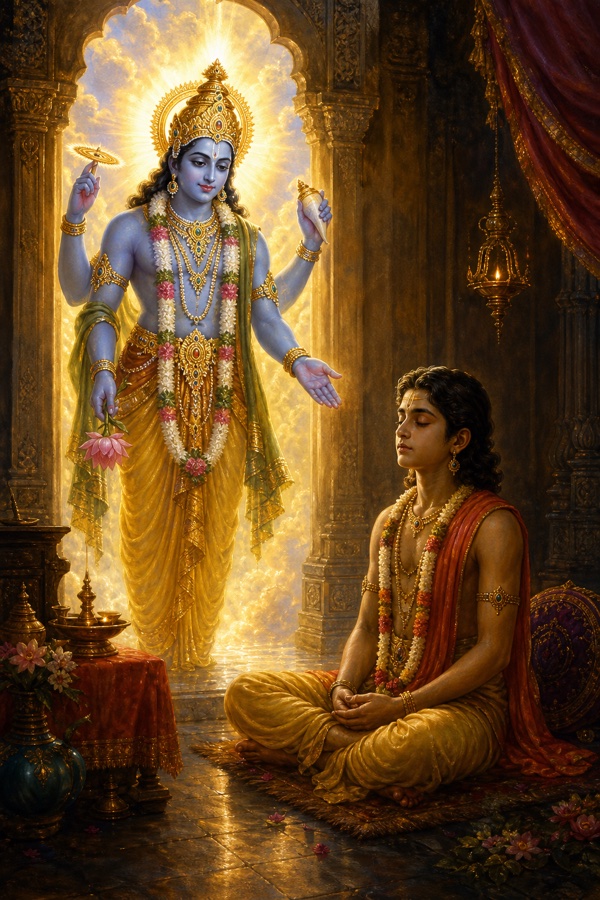
"Great soul, rise from your trance," he said, and blew Panchajanya.
The peal of the conch, blown by the breath of Vishnu, resounded through the vault of heaven. It roared at once like the clouds of the sky and like the waves of the great deluge coming on with redoubled force. The Daityas, terrified at the sound, fell flat and fainting on the ground, as flocks of swans and geese are stunned by the thunder of clouds. The party of Vaishnavas heard it without a trace of fear and flushed with joy, like Kurchi flowers that bloom at the sound of the clouds in the rains.
The lord of the Danavas was roused from his sleep slowly, as kadamba flowers open their florets by degrees between the showers. By an effort of breathing he brought down the vital breath that had been shut up in the membrane at the crown of his skull, and it came down the way the Ganga gushes out of the high hill and mixes and flows with the whole body of waters down to the sea. In a moment the vital breath ran through the whole of Prahlada’s body, as the sun’s beams spread over the whole world the instant they leave the disk at sunrise. The breath entered the cells of the nine organs of sense, and his mind became capable of sensation, receiving it through the organs of the body as a mirror receives reflections. The intellect, wanting to know its objects and relying on the reflections of the senses, took the name of mind, as the reflection of a face in a mirror is thrown back again to the eye. The mind having opened, his eyelids were ready to open of themselves, like the petals of the blue lotus opening by degrees in the morning. The breath carried sensation to the body through the veins and arteries and gave it the power of movement, as a current of air moves the lotuses, and the same breath strengthened the powers of his mind in a short time, as the swell of a river gains force when it is full. At last his eyes opened, and his body shone with life from its mental and vital powers, as a lake blushes with blooming lotuses when the sun comes up over the horizon. At that instant the Lord told him to wake at once at his word, and he rose as a peacock rises at the roar of a cloud. Seeing his eyes shining with luster and his mind strong with everything it had known before, the lord of the three worlds spoke to him in the way he had once spoken to the lotus-born Brahma himself.
Freedom With Work Remaining
"Holy youth, remember your great dominions. Bring your youthful form and figure back to mind, and then think, and consider why you have thrown yourself into this torpid state for no cause. You have no good left to desire and no evil to shun, and you look on want and plenty in the same light, so you must know that whatever God has destined is all for your good. You will have to live here, in the living liberated state of your mind and in full possession of your dominions, for the period of a kalpa, and you will pass that time in this body of yours without any anxiety or earthly trouble whatever. Even when the body has decayed you will still abide in your greatness of soul to the end, until the body breaks like an earthen pot and the life in it mixes, like the air a pot holds, with the common air of the void. This body of yours, liberated in its lifetime, is to endure in its purity to the end of the kalpa and watch the generations pass before it without any diminishing of itself. The end of the kalpa, the day of doom, is still far off, when the twelve suns will shine together, the rocks will melt and the world will burn to ashes. Why then do you waste your body now? The winds are not raging. The world is not old and gray and covered with ashes. The marks are still on the foreheads of the immortals. Why waste your body before its time? The lightning of the deluging clouds is not flashing and falling like asoka flowers. The skies are not pouring out rain to drown the mountaintops, and they are not bursting into fire to burn them to ash. The old world has not dissolved into vapor or fused into smoke. The deities have not all gone out, leaving only Brahma, Vishnu and Shiva behind. The earth is not sunk under water with only the high mountains showing. The sun is not splitting the hills with its heat and the clouds of the deluge are not rattling in the middle of the sky. None of it has come, so why do you waste in vain a body that is not marked to die? I wander everywhere on my eagle and look after every living being so that none dies before its time, and I do not like this neglect of yourself. Here are we, and there are the hills; these are other beings and that is yourself; this is the earth and that is the sky. All of these are separate entities, and each must last out its own time. Why then do you neglect your body? Why not live like the living?"
"I will tell you who hails his death. The man whose mind is deluded by gross ignorance and who is the target of afflictions. The man who is too weak and too poor and too ignorant, and who is forever troubled by thoughts of that kind. The man whose mind is chained in the trap of greedy desires and shivers between its hopes and its fears, who is hurried and carried about in pursuit of his greed and is never at rest in himself. The man whose heart is parched by the thirst of greed, his better thoughts choked by it as worms destroy the sprouting corn. The man who lets the creeping passions of his heart grow as big as palm trees and overshadow the forest of his mind, bearing their fruit of pain and pleasure without end. The man whose mind is festered by cares as thick as the hair on his body and who is subject to the incessant evils of life. The man whose body burns with the fire of disease and whose limbs are slack with age and weakness, to whom death is a remedy. The man tormented by ardent desires and raging anger as by the poison of a snakebite, who stands like a withered tree and invites instant death for his release. It is the soul’s quitting the body that is called death, and that is unknown to the man of spirit, who is indifferent to whether the body exists or not. Life is a blessing to the one whose thoughts do not rove beyond the confines of himself, and to the wise man who knows and investigates the true nature of things. Life is a blessing to the one who is not given to egotism, whose understanding is not darkened by untruth, and who keeps his evenness in every condition of life. Life is a blessing to the one who has inward satisfaction and a cool understanding, who is free of passion and enmity and looks on the world as a witness only, concerned with nothing. Blessed is the life of the one who knows what he desires and what he detests and lives aloof from both, with all his thoughts and feelings held within his own heart. Blessed is the one who sees all gross things as nothing and whose heart and mind are absorbed in his silent, conscious soul. Blessed is the one who has his sight and holds it back from the affairs of the world as unworthy of him. Blessed is the one who neither rejoices nor grieves at what is good or bad for him, and is content in every state of his life. The one who is pure in his life and keeps company with the pure, who spreads purity around him and shuns the impure, is as graceful to look at as the white swan among the fair birds of a silver lake. Blessed is the one whose sight and memory, and the mention of whose name, give delight to everyone. Know that man’s life to be truly happy, lord of the demons, whose lotus face is as delightful to the bee-like eyes of men as the full moon is to the world."
"It is the soundness of the body that men call life, and the quitting of this body for another that they call death. You are released from both of these states, high-minded youth, and have nothing more to do with your life or your death. I tell you what life and death are made of only so that you know them, and so that you will never have to live or die the way other living beings do on this earth, in pain and misery. Though you are seated in a body you are as unembodied as the disembodied spirit, and though you are set in a frame of empty space you are as free and fleet as the wind, because you are not attached to it. Your perception of things by touch seems to prove you an embodied being, and the soul is said to be the cause of that perception, as the open air is said to be the cause of the growth of trees because it puts no obstacle in their way. But the perception of outward things is no proof that they are material, any more than the sight of things in a dream proves that they are substantial or that the dreamer who sees them has a body. All things are comprehended in yourself by the light of your intellect, and your knowledge of the only One in all comprehends everything in it. How then can you have a body either to take up or to throw away? Whether spring comes or does not come, whether a hurricane blows or dies down, it is nothing to the pure soul, which is clear of every connection. Whether the hills fall headlong, or the flames of destruction eat everything, or the gales rip the sky, it is nothing to the soul, which rests secure in itself. Whether the creation exists or not, whether all things perish or grow, it is nothing to the soul, which subsists of itself. The lord of this body does not waste when its frame wastes, and is not strengthened when the body is strong. It does not move with the body’s movements and it does not sleep when the body and its senses are lost in sleep. So where does this false thought come from, that you belong to the body and are an embodied being, and that you take up and hold and quit this mortal frame at different times?"
"Give up the thought that you will do such and such after doing this and that. Those who know the truth have given up such desires and vain expectations. Everyone who is awake and alive has something or other to do in this world, and reaps the results of what he does. The one who does nothing is not called an agent, and has nothing to expect. He who is no agent of an action has nothing to do with its consequence, as the one who does not sow the grain does not reap the harvest. When action and its fruit have ceased, a quiet comes on, and when that quiet has become habitual and firm it receives the name of liberation. All intellectual beings and enlightened men, all who lead pure and holy lives, have everything within their comprehension, so there is nothing left for them to learn anew or to reject. It is for limited understandings and limited powers to grasp one thing or leave out another. For men of unbounded capacity there is nothing to take in and nothing to leave out. When a man is set at ease after the relation of possessor and possession has ceased for him toward every outer thing, and when that sense of having no relation has become a permanent feeling in him, he is said to be liberated in his lifetime. Great men like yourself, placed in this state of perpetual unconcern and rest, go about the discharge of their duties with as much ease as if they were asleep. When a man’s desires are drowned in his reliance on God, he sees the existing world shining in his own spiritual light. He takes no delight in the pleasing things around him, and he does not grieve at the afflictions of others, since all his pleasure lies in his own soul. With a wakeful mind he meets every affair that concerns him with his spiritual unconcern, as a mirror receives the reflections of things without being stained by them. Waking, he reposes in himself; sleeping, he reclines in the drowsy world; in his actions he turns about like a frolicsome boy, and his desires lie dormant in his soul. Great soul, go on enjoying your supreme bliss in this way for the period of a kalpa, a whole day of Brahma, resting your mind on the victorious Vishnu and enjoying the prosperity of your dominions through the exercise of your virtues and good qualities."
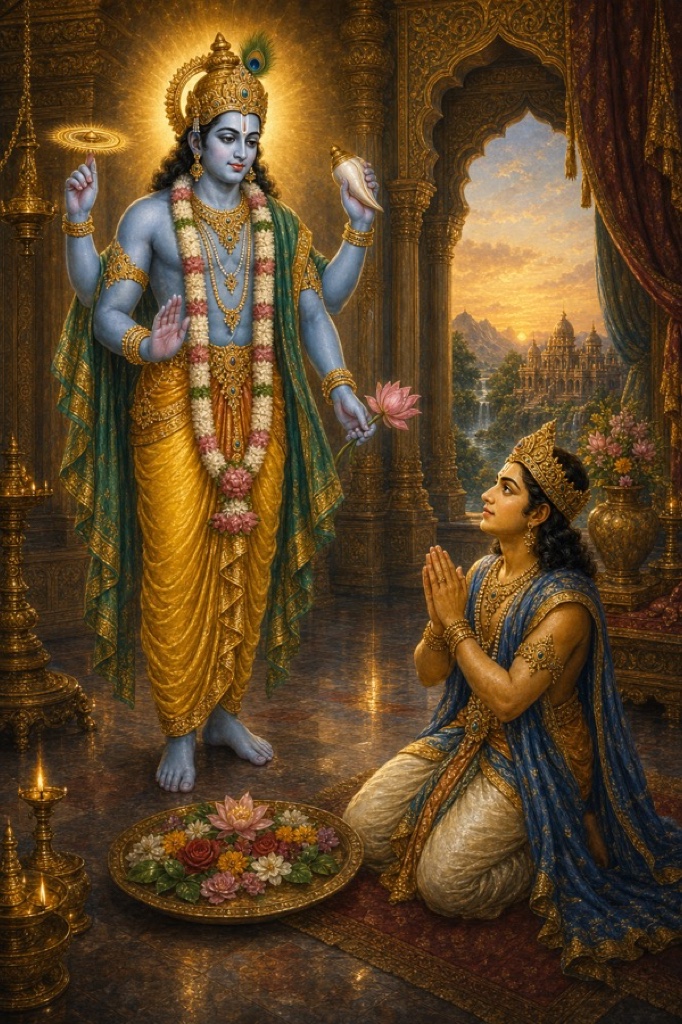
When Hari, who holds the three worlds and sees everything that passes in them, had finished that lucid speech, as cooling as moonlight, Prahlada’s body came into full bloom and his eyes opened like lotuses, and he spoke in full possession of his powers. "Lord, I was very tired. There were so many affairs of state, and so much thinking about the welfare and the sorrows of my people. I have found a little rest from my labor now. It is by your grace, my lord, that I am settled in myself, and whether I am in my trance or in my waking state I have the tranquility of my mind at all times. I always see you seated in my heart with the clear sight of my mind, and it is my good luck that I have you now before me and outside me as well. All this time I was sitting without a thought in me, mixed up like air in air in my mind’s inner vision of you. I was not driven by grief or by dullness. I was not infatuated by any zeal for asceticism or any wish to be rid of my body. When the One All is present in the mind there is no room in it for grief at the loss of anything else, and no care for the world, no caution for the body or for life, no fear of any kind can stay in his presence. It was simply by a pure desire for holiness, rising of itself in me, that I had been sitting in that saintly state."
"You may suppose, my Lord, that I am sick of this world and long to lay down its cares, together with all the alternations of joy and grief that rise by turns in the minds of the unenlightened. I am not. I do not think our embodied state is subject to misery, or that being freed from the bonds of the body is the cause of our release. It is worldliness that is the venomous viper in the breast, and it torments only the ignorant. The sage it leaves alone. It is the ignorant whose minds swing between the thoughts that this is pleasure and that is pain, that I have this and I lack that. The ignorant man thinks of himself as a person distinct from another, and so every living being without knowledge of the truth entertains and exults in its egoistic thoughts. The wrong idea that some things are acceptable to me and others are not serves only to delude the ignorant. The wise take whatever comes. All things being contained in and situated in my all-pervading spirit, how can we accept one thing and reject another as distinct from the selfsame One and undesirable to it? The whole universe, whether real or unreal, is a manifestation of Omniscience. We do not know what in it is desirable or detestable, what is to be taken up or rejected. It is only by discriminating the natures of the viewer and the view, and by reflecting the Supreme Soul in oneself, that the mind receives its rest. During my trance I was freed of the consciousness of my being or not being, and of whatever is desirable or detestable to anyone, and I continue in the same state of mind now that I am awake. That state being familiar to me, I see everything in the spirit within myself, and I act as it pleases you. Lotus-eyed Hari, you are adored in all the three worlds, so receive my adoration too, offered in its proper form." With that the lord of the Danavas set his platter of arghya before the god, as the mountain of the moonrise pays its offering to the full moon. He worshiped Hari first, together with his weapons and his vehicle Garuda, and then the bands of gods and Apsaras who had come with him, and the three worlds contained in him.
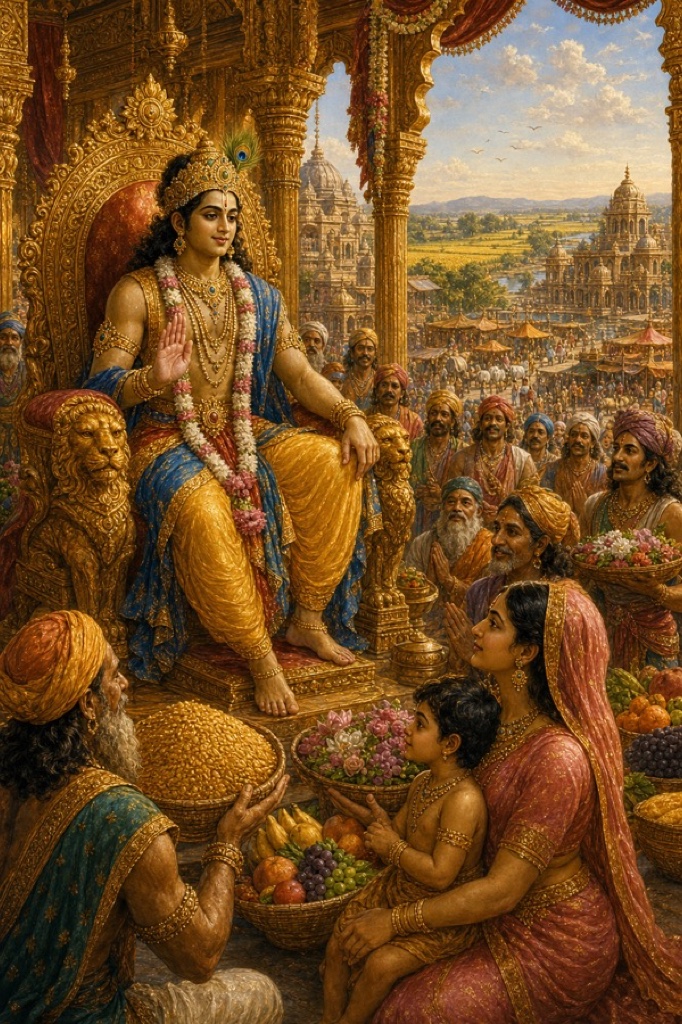
When the worship of the lord of the worlds, with the worlds inside him and outside him, was done, the lord of Lakshmi spoke. "Rise, lord of the Danavas, and sit on your throne, so that I can perform your inauguration this very moment." Hari blew Panchajanya again, and this time it summoned the five races, the gods, the siddhas, the sadhyas, men and Daityas, to attend the ceremony. The lotus-eyed god set him on the throne he deserved and made him sit there the way a cloud rests on the summit of a mountain. Then Hari had him make his sacred ablution with the waters of the Milky Ocean and the other oceans, and of the Ganga and the other holy rivers, which were brought before him. Whole bodies of Brahmins and Rishis, companies of Siddhas and Vidyadharas, and the Lokapalas, the regents of the quarters, attended and assisted. Hari, the immeasurable Spirit, anointed the great Asura king of the Daityas, and the Maruts, the winds, praised him as they praise the hymns of Hari in heaven. Blessed by the gods and applauded by the Asuras, Prahlada greeted every one of them in his turn, and then the slayer of Madhu spoke to him for the last time.
"Reign here as sole monarch for as long as Mount Meru stands on the earth and the sun and the moon shine in the sky, and be full of every praiseworthy virtue of your own. Govern your realm without any interested motive of your own and without showing any sign of anger or fear, and keep your moderation and a tolerant spirit in all your affairs. May you never have any disquiet in this realm of excellent soil and plentiful provision, and never create any disturbance to the gods in heaven or to men on the earth. Conduct yourself in your proper course in every event that comes to you, at any time or place, and never let yourself be led astray by the caprice of your mind or the freaks of fancy. Keep your spiritual being in mind, abandon your egoism and your selfish views altogether, and by managing your affairs in one even tenor, in want and in prosperity alike, you will escape all the vicissitudes of fortune. You have seen both the ways and dealings of this world and measured the immeasurable depth of spiritual knowledge. You know the state of everything in every place, and you need no advice from anyone. Since you are now perfectly free of anger, passion and fear, there is no more chance of further broils between the gods and the Asuras under your rule in future. No more will the tears of Asura women wash the paint from their faces, and no more will the rivers rise as high as the trees with the floods of their weeping. The end of the hostilities between gods and demons will leave the earth as quiet from this day as the ocean after Mandara had churned it. The wives of the gods and of the demigods will no more be led away in captivity by one another, and will rest fearless under the roofs of their husbands from now on. Let your hopes rise now from the sleep of so many long dark nights and be crowned with success and prosperity, and enjoy, son of Danu, your unconquerable royal fortune in the company of your charming consort."
Having said this much to Prahlada, the lotus-eyed Hari left the Asura’s house with the whole concourse of gods, Kinnaras and men who had come with him. Prahlada and his companions threw handfuls of flowers on the departing god as he mounted the back of the king of birds. He crossed the heavenly Ganga, reached the Milky Ocean, and took to his serpent couch as a black bee settles on a lotus leaf, sitting there with as much ease as Indra sits in heaven among the assembly of the gods. And the lord of the demons sat in the infernal region, wholly free of every care.
The Sound, Grace, and Self-Effort
Vasistha let the story settle in the hall. "I have now told you the whole of it, Rama, how Prahlada came back to his senses from the state of insensibility, and this account is as charming to the holy listener as cool moonbeams are refreshing to a tired traveler. The man who ponders in his mind the manner of Prahlada’s return to life is regenerated in that felicitous state and out of the sinfulness of his former condition. A cursory rehearsal of this story wipes off the sins of men, and deep consideration of its spiritual sense leads to eternal salvation. The ignorant are released from their ignorance by it and the deep thinker from his sins, so do not neglect to ponder it well, for the remission of all your sins. The man who considers well how Prahlada came by his proficiency gets a remission of all the sins committed in his repeated previous states of life." Rama had been listening with a question. "Tell me, sir, how the sound of the Panchajanya conch roused the mind of the devout Prahlada from its immersion in holy meditation."
"Know, Rama, that there are two states of liberation that attend on sinless persons. One is the emancipation of a man in his embodied state, in this life. The other comes after his departure from here. The embodied liberation means that a man continues in his living body, with a mind freed from its attachment to worldly things and released from the desire for the fruit and the reward of all his meritorious acts. The disembodied liberation is reached after the soul is released from the body and settled in the Supreme Spirit, and it is a release from the recurrence of future life and birth in this mortal world."
"The man liberated while living is like a fried grain, whose power of sprouting has been parched inside it, and the desire of his heart is purified of every expectation of future reward or rebirth. He stays in the pure, holy and magnanimous state of his mind, resigned solely to meditation on the Great Soul, and continues as if asleep in both his living and his waking states. Entranced in that inward meditation, he can stay torpid for a thousand years, and he wakes again to his senses if he is allowed to live on long after that period. So Prahlada remained, with his holy thoughts held inside himself, until the shrill sound of the conch roused him from his trance. And Hari is the soul of all beings, and the one who assimilates himself to that god in his thought becomes identified with the supreme soul, which is the cause of all. No sooner did the god think that Prahlada should come to his senses than his sensation came to him at once, at the divine will. The world has no cause except the divine Spirit, which takes different forms on itself with the help of the causal elements at the time of creation, so it is the spirit of Hari that constitutes the world."
"The worship of God in spirit presents Hari to the spiritual sight, and the worship of Hari in his outward form presents his figure to the soul and the inner mind. Rama, put the visible sights out of your view and look at the inmost soul within yourself. Once you are used to spiritual meditation you will soon have the sight of your God. The world is a scene of gloomy rainy weather, with showers of woe falling on every side, and it is likely to freeze us in ignorance unless we look to the sun of our reason. It is by the grace of God that we escape the delusions of the world, as we escape a goblin by a spell. It is at the will of the spirit that the thick darkness of the mind is dispersed in time, and the world is a net of delusion that the breeze of reason scatters like smoke."
Rama had caught the two halves of that and wanted them reconciled. "Sir, your knowledge of all truths and the light of your holy discourses have gratified me as much as cool moonbeams gratify the healing plants. Your gentle and purifying words are as welcome to my ears as sweet flowers are to the senses. But if the exertions of men, as you said, are the causes of their success, how was it that Prahlada came to be enlightened without any effort or attempt of his own, without study and without the help of a teacher?"
"Yes, Rama. It was by his own manly exertion that the high-minded Prahlada acquired his divine knowledge, and there was no other cause of his knowing and having whatever he knew and possessed. The soul of man is the same as the spirit of Narayana, and there is no difference between them, as there is none between the oil and the sesame seed, or between the cloth and its whiteness, or the flower and its fragrance. Vishnu is the same as the soul of man and the soul of man is the same as Vishnu. The two are one thing under two names, as a plant and a vegetable are. Prahlada came first to know the soul by himself, by his own intuition, and it was afterward, by means of his intellectual power, that he was led to persuasion and made many converts after his own example. It was by his own desert that Prahlada obtained his boon from Vishnu, and it was by the exercise of his own reasoning that he came to the knowledge of the eternal Mind. Sometimes the soul is awakened of itself, by one’s own intuition, and sometimes it is roused by the grace of the personal god Vishnu, through one’s faith in his person. But though this god may be pleased with a man’s long service and devout worship, he is unable to confer spiritual knowledge on one who has no reasoning faculty. So the primary cause of spiritual light is a man’s own intelligence, which is gained by the exertion of his mental powers only. The secondary causes may be the blessing and grace of a deity. I want you to prefer the former for your salvation."
"Exert your manliness first, then, to keep the five organs of sense under proper control, and train yourself with all diligence to cultivate your understanding and your power of reasoning. Know that whatever gain anyone makes at any time, he gains it by his own endeavors only, and by no other means whatever. It is only by relying on your manly powers that you can get over the insurmountable barriers of your sensual appetites, and then cross the ocean of this world and reach the far shore of supreme felicity. It takes no exertion and no manly effort to see the figure of Vishnu, but the mere sight of the image is not enough to save you, or else the birds and the beasts would all be saved by looking at it. If it were in the power of the spiritual guide to save his foolish followers by his preaching, then the drivers of camels and the herders of cattle could save their herds in their future lives. It is in the power of the mind alone to gain anything good for oneself. Neither the favor of Hari nor that of Hara, nor the influence of money, can bring anything about. It is by constant practice, with self-resignation and self-control, that a man is able to accomplish anything, and whatever he cannot do by these means he cannot do by any other in the three worlds. Look to the spirit in the spirit, adore the spirit in your own soul, see the supreme soul in yourself and hold the universal soul in your own, and stay with it."
"Fools who run from the study of the sastras, from the practice of self-devotion and the exercise of reason, have taken the Vaishnava faith to themselves as a path to their better being. Practice and diligence are the steps to self-edification. Rites and ceremonies are secondary courses, resorted to for want of the former. While the senses are refractory, what good are ceremonial observances? And when the senses are under control, there is no use in observing the ritual. Without rationality and dispassion of spirit it is hard to have Hari, and when the cool, calm reasoning of the mind is there, it is as useless to have the idol of Hari as to put a lotus in the hand of a dead man. When you have abstraction and composure of mind, consider that you have everything in yourself. With these in your possession you are an adept. Without them you are a wild ass of the forest. Men are eager to find favor in the sight of the gods and the great, and they never seek the favor of their own hearts and minds, which could give them every blessing they look for elsewhere. Vishnu, the indwelling spirit of the body, is seated in the inmost soul of every person, and it is only the ignorant fool who leaves the innermost Vishnu and seeks the outer form to lead him to the inner one. The consciousness that lives in the cavity of the heart is the true body of the everlasting spirit, and the outward form of Vishnu holding the conch, the club, the lotus and the discus is a false representation of it. He who forsakes the real form and follows the fictitious one lets the nectar run out of his hand in pursuit of some promised sweet. He who is not settled in the charming scenery of his spiritual meditation lets his frantic mind rove after every object that presents itself. He who has no abstract knowledge of the soul in himself is under the subjection of his infatuated mind, and worships the image with conch, discus, club and lotus in its hands as the supreme Lord and God. It is true that by continued austerity and a prolonged worship of that deity the devotee’s mind becomes purified in the course of time and is rid at last of its turbulent passions. But the daily practice of self-control and abstract meditation gives the mind the same purity, and like the mango it gains its accompanying virtues one by one. So the soul is said to gain the virtues of peace and contentment and the rest by the external adoration of Hari, and that is the reason the practice of image worship is prescribed in the sastras, as a preparatory step. He who obtains his boon from the all-powerful god gets it as the reward of his merit, as the fruit of the tree of his long practice. It is mental labor that is the foundation of every improvement and of all lasting good in life, as cultivated soil is the cause of a good harvest. Even the digging of the ground and the pulling of the hill, the hardest bodily labor there is, produce nothing without the application of the mind. Men may pass through a thousand transmigrations and wander the earth in all kinds of births and shapes and still find no rest or composure of mind. They may worship Brahma, Vishnu and the Rudras forever, and gain their favor too, and still have no salvation, because their minds are disturbed."
"So leave off worshiping the visible form or image of Vishnu, or of any other god, whether inwardly in your mind or outwardly before your eyes, and put an end to your transmigration by meditating on your consciousness alone. See the unsullied form of the one infinite God in your conscious self, by forsaking everything it is conscious of. Taste the sweet essence of the one real entity, Rama, and cross the ocean of repeated births in this mortal world."