On this page
Yoga Vasistha · Story 10
Shukra’s Journey Through Bodies
Shukra’s body remains beside his father on Mount Mandara while desire opens an experienced heaven, measured ages of pleasure, and a succession of earthly lives within his mind. When Bhrigu wakes after one thousand divine years and finds a skeleton, embodied Time leads him toward the son who is still living under another name.
The World That Opened Behind Closed Eyes
Rama asked Vasistha how a universe of immense extent could exist in the mind. Vasistha answered with the history of Shukra, whose first body stayed in one place while his experience acquired heaven and earth, duration and consequence, love and death. The story would show how a mental construction can become a continuous world for the one who inhabits it.
The sage Bhrigu was practicing austerity on a flower-covered summit of Mount Mandara. He had entered nirvikalpa samadhi, an absorption in which conceptual divisions have fallen silent, and sat with the stillness of a figure cut from stone. His son Shukra was then a boy. He attended to his father, lived on the mountain, and moved through its groves and places of worship.
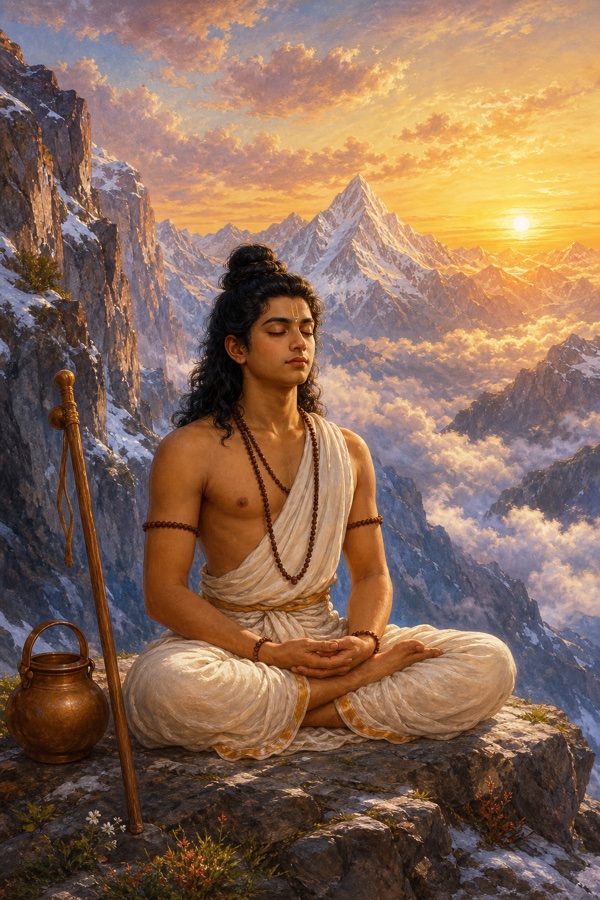
The mountain held both discipline and beauty. Flower beds, gold and silver altars, and great swings belonged to the precincts in which the boy moved. Bhrigu’s absorption made the relationship outwardly quiet. Service kept Shukra near his father, while the unsteadiness in his own understanding left his attention open to the next powerful impression.
Shukra’s understanding had reached an unstable threshold. He had some recognition of the Self, yet the ordinary conviction that the visible world was solid and desirable still held him. Vasistha compares his condition to Trishanku suspended between earth and heaven. The insight was present; the dispositions that could redirect his attention had not subsided.
One day, while Bhrigu remained absorbed, Shukra saw an apsara traveling through the sky. Mandara flowers rested in her hair and around her neck. Their eyes met. Desire arose in each of them.
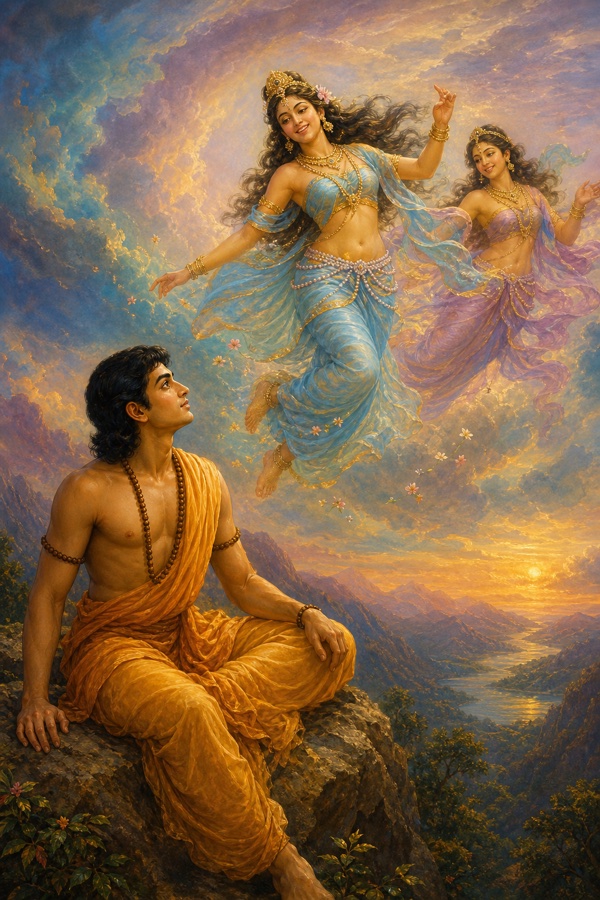
Shukra checked the movement of his physical body. He closed his eyes, stayed near his father, and followed the woman’s image with complete attention. Physical restraint left the inward movement untouched. The same capacity for concentration that could have settled upon the Self now gathered around a desired form.
Vasistha calls what followed a mind-created domain. Shukra performed no rite of departure from the body, and the body on Mandara went nowhere. Within his closed eyes, however, he experienced himself pursuing the apsara into Indra’s heaven. The experience supplied a coherent place, inhabitants, relationships, and time. For Shukra, it carried the authority of a lived world.
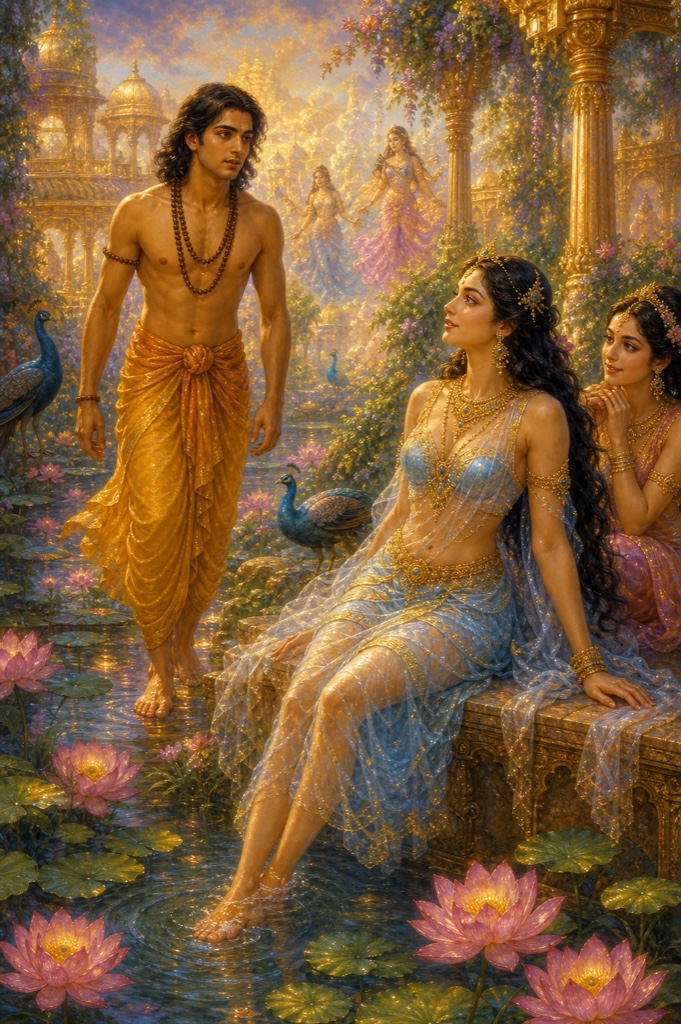
He saw gods with their consorts, celestial musicians and perfected beings, aerial vehicles, the great elephant Airavata, and the rulers of the cosmic regions. Golden lotuses opened in the Mandakini, the celestial river. Flowers lay across the paths of Nandana grove; music accompanied the dancing of the apsaras; and the trees of heaven seemed to carry the radiance attributed to wish-fulfilling gems.
Narada and Tumburu were among the musicians heard there. Charanas and kinnaras, celestial orders associated with song and praise, belonged to the same populated world. Parijata breezes carried the fragrance of flowers, and the movement of gods through their gardens gave the place a social order as detailed as its landscape. Shukra’s mind did not present isolated images. It furnished a realm in which ceremonial welcome, recreation, status, and desire could unfold in sequence.
At the center of this order sat Indra, king of the gods. Shukra approached and saluted him. Indra rose, received the young ascetic with honor, took his hand, and seated him nearby. He invited Shukra to remain in heaven. Every element of the reception supported the next, and the mind supplied no visible break between the mountain, the ascent, and the court of the gods.
Shukra’s body was still seated before Bhrigu. His attention had already entered another history.
Vishvachi and the Measured Heaven
After resting with Indra for one muhurta, a traditional division of the day, Shukra saw the same apsara again. Kala would later identify her as Vishvachi. Their mutual desire returned with greater force. In that celestial domain, a settled intention produced its corresponding condition without delay.
Shukra wished darkness to cover the part of Nandana where the apsaras had gathered. The light receded, Vishvachi’s companions withdrew, and she approached him alone. She told him plainly that desire had overcome her. She asked for protection, acceptance, and a place in his heart. The affection was mutual, and the darkness itself had arisen from Shukra’s resolve. Together they entered the chamber his mind had prepared.
Vishvachi’s appeal joined desire to the duty of receiving someone who had sought refuge. She described the delight of beloved company as greater than the sovereignty of the three worlds. Her words belong to the value system of the celestial scene Shukra was experiencing: mutual longing had become a complete claim upon attention. The encounter therefore altered the whole direction of the domain. Indra’s court receded from the center, and the life shared with Vishvachi became its organizing history.
Their life extended through many celestial regions. They moved along the Mandakini and through Nandana; they visited the parijata groves and Chaitraratha, Kubera’s garden. Their course reached Sumeru, Kailasa, Gandhamadana, and the distant region of Lokaloka. Each place belonged to the geography of the experienced heaven and each carried its own interval of pleasure.
Shukra and Vishvachi spent sixty years in mind-made temples in the cool regions of Mandara. They remained for half a Satya Yuga beside the Ocean of Milk among the people of Shvetadvipa. Their later residence together in heaven lasted eight chaukadis. These measures belonged to Shukra’s experienced order while the first body remained beside his father.
At length the merit sustaining the celestial condition was exhausted. Garlands faded, radiance diminished, and the fear of falling entered the world they inhabited. Shukra and Vishvachi descended from heaven. Their subtle forms entered moonlight, became dew, and passed into rice.
The descent preserves the causal texture of the imagined heaven. Enjoyment had depended upon merit, and the depletion of merit produced its own signs before the fall. The subtle passage through lunar rays, dew, and grain then connected the celestial condition with conception on earth. Vasistha relates these stages as experienced transitions within one mental course, each accepted by Shukra as the world in which he now lived.
A Brahmin in Dasharna ate that grain. Shukra then entered birth through the Brahmin’s wife and grew as their son. The company of sages turned his attention toward austerity. He went to a deep forest on Meru and practiced tapas, disciplined spiritual exertion, for one manvantara. The long celestial attachment still survived as conditioning, a disposition capable of directing experience after its original scene had disappeared.
Vishvachi had meanwhile taken the form of a doe through a curse. Through her, Shukra fathered a human-shaped son. His concern for the child grew into a consuming wish for the boy’s wealth, virtue, long life, and success. Concentration weakened. When Shukra died, the wish for his son’s prosperity occupied his mind and carried the succession forward.
He was born as the son of Madra’s ruler and later governed Madra himself. He lived into old age. As death approached, his thought turned from kingship toward forest retirement and austerity. That disposition led to birth as the son of an ascetic. He became an ascetic in turn and eventually reached the Samanga River. There, after a course that had ranged through desire, parenthood, rule, and renunciation, the mind settled into deep absorption.
On Mount Mandara, the first body had received none of this history. It collapsed near Bhrigu and dried under sun, wind, and rain. The holiness of the hermitage and the absence of the scent of passion kept carnivores away. Small creatures entered its empty spaces, webs formed among the ribs, and skin and bone remained where a young man had once served his father.
Wind moved through the empty cavities and produced a faint sound. Rain repeatedly wet the remains, and gusts shifted them against the rocks. The eye sockets and hollow abdomen became shelter for small life. Vasistha holds this physical process beside the immense inward itinerary. One body returned gradually to the elements while the mind identifying itself as Shukra accumulated centuries of memory elsewhere.
Two accounts were now unfolding around the same name. One was the weathered body on Mandara. The other was the experienced continuity that had crossed heaven, rice, kinship, rule, and the bank of the Samanga.
Bhrigu Faces Embodied Time
Bhrigu opened his eyes after one thousand divine years. He expected to find his son nearby. Instead, he saw the skeleton.
The sight reached him before yogic vision did. He assumed that Kala had ended Shukra’s life before its appointed limit, and paternal grief became anger. Bhrigu prepared to curse the power that governs change and death.
Kala appeared in embodied form. He carried a sword and noose, wore armor and earrings, and bore the symbolic order of the year: twelve months were figured in his arms and six seasons in his faces. His presence represented time as an intelligible cosmic power. He addressed Bhrigu without hostility.
The sage’s son, Kala explained, had not been taken through a private choice. Kala himself acted within mahaniyati, the great cosmic order. Fire rises, water descends, and formed things pass through change according to their conditions. Personal liking and resentment supplied no motive for Shukra’s course. A curse aimed at Time would spend the force of Bhrigu’s austerity against an impersonal operation.
Kala’s response also returned Bhrigu to the discipline expected of a knower. The sight of a ruined body had made one explanation appear complete: Time had destroyed his son. The missing history changed the meaning of that evidence. Kala urged him to examine the entire course before assigning agency and blame. This was a correction of judgment grounded in facts Bhrigu could verify through his own yogic capacity.
Kala then directed Bhrigu’s attention from the skeleton to the experiencer. The teaching describes two bodies for this purpose. The gross body is physical matter, vulnerable to weather, injury, age, and dissolution. The inward body is made of mind. It carries intention, memory, identification, and vasana, the conditioning trace through which one experience prepares another. The physical form can be discarded while this inward sequence continues.
Mind treats a form as “my body,” gives it a history, and organizes action around it. Kala compared the process to a child forming and breaking figures from clay. Determination gives mind the role called intellect; identification gives it the role called ego. Its wishes and convictions make a world of experience, and its clear recognition of its own ground releases the grip of those constructions.
The distinction does not make physical events irrelevant within ordinary life. A gross body can hunger, age, or fall according to the conditions through which embodied experience proceeds. Kala’s point concerns the claimant that joins those events into identity. The mind says “I am weak,” “I am unhappy,” or “I am this rank and body,” and then interprets the field before it through that conviction. When the conviction changes, the perceived biography changes with it.
Kala used the image of an ocean and its waves to carry the inquiry further. A wave may judge itself small, large, warm, cold, rising, or broken. Every such description concerns a form of water. In the same way, bodies and worlds differ within experience while their ground remains consciousness. This understanding does not erase the experienced distinctions required for conduct. It reveals the basis on which those distinctions arise.
Shukra’s body on Mandara had become a skeleton. His mind had gone far along the path opened by its own desire. Kala named Vishvachi, recounted the celestial life, and told Bhrigu that his son was still practicing austerity in another body on the Samanga.
He also supplied a wider itinerary than the immediate sequence Vasistha had narrated earlier. In this expanded account Shukra had been a Brahmin in Dasharna, a king in Kosala, a fisherman in Mahatavi, a swan on the bank of the Ganga, and a king of Paundra in the solar line. In Saurashalva he became a mantra-siddha teacher, one whose disciplined use of mantra had attained its stated power. That earlier practice later matured in a Vidyadhara existence lasting one kalpa.
Kala’s list included further conditions produced by persistent vasanas: a Kirata in the Vindhya region, another Kirata in Kaikata, a subordinate ruler in Sauvira, a donkey in Trigarta, a bamboo clump in Kirata country, a deer in a Chinese forest, a snake associated with a palm tree, and a deer associated with a tamala tree. He named them as a compressed register, without expanding each form into a separate episode or giving a total number of births.
At the end of the Vidyadhara kalpa, twelve suns of cosmic dissolution burned that body. During the interval without a formed world, the residual disposition had no field in which to take another body. In the next Satya Yuga it appeared as Vasudeva, a Brahmin boy. This Vasudeva studied the Vedas and had remained in tapas beside the Samanga for eight hundred years.
The immediate sequence and Kala’s wider list serve different moments in the telling. Vasistha first traces the causal line from celestial desire to the ascetic on the Samanga. Kala later opens a broader view of the conditions traversed by the same mind-stream. Their compressed links cannot be rearranged into a newly invented chronology.
Kala invited Bhrigu to look for himself. The sage entered yogic vision and saw the complete course in one instant. His anger subsided. He acknowledged that affection for the body before him had narrowed his judgment and that Kala had acted without personal malice.
The dialogue then widened from one son’s history to the structure of experience. Mind receives pleasure and pain, projects bodily identity, and carries action through its dispositions. Practical responsibility continues wherever agent, action, and result are experienced. At the highest level, their apparent divisions arise within one consciousness. The day of Vasistha’s teaching assembly ended during this discussion. He resumed the account for Rama and the gathered sages on the following morning.
Kala placed scriptural inquiry within this middle ground. A mind sunk completely in inertia does not yet seek such guidance, while a mind whose delusion has ended no longer depends upon it. Teaching serves the person whose destructive tendencies have weakened and whose intelligence has awakened enough to investigate. Shukra’s passage shows both sides of that work: conditioning can elaborate a single image into ages of experience, and inquiry can expose the process without denying what was endured within it.
The Ascetic on the Samanga
Kala and Bhrigu descended from Mandara and traveled toward the Samanga. They passed mountain groves, streams, hermitages, settlements, villages, and cities before reaching the river. Flowers moved upon its water. On the bank sat Vasudeva, lean from eight hundred years of austerity and absorbed beyond the movement of thought.
His hair was matted, rudraksha bracelets encircled his wrists, and his senses had withdrawn from their objects. He sat without the alternating movements of decision and doubt. The body showed the length of his discipline, while the mind had reached a quiet that none of the earlier lives had supplied. The name Vasudeva identifies this Brahmin ascetic alone in the episode. It does not refer to Krishna or to a separate king.
Kala pointed to him and said, “This is your son.” Then he called, “Wake.”
The summons gradually reached the ascetic’s life and mind. Vasudeva opened his eyes, saw two radiant visitors, rose, and honored them. He offered them seats upon a rock. Although learned in the Vedas and established in profound quiet, he did not recognize Bhrigu as his father or Kala as embodied Time. His present life was clear to him; the personal memory of the earlier bodies remained covered.
Bhrigu asked him to remember himself. Vasudeva closed his eyes and turned inward. In one brief interval he saw the succession of heavens and bodies, pleasures and sorrows, human roles, animal and plant conditions, dissolution, and the long austerity beside the river. The figures before him entered that recovered continuity. He recognized Bhrigu and Kala.
The recovery did not require a new external account to be imposed upon him. Bhrigu’s instruction directed attention toward a history already carried within the mental stream. Places that had once seemed separate lives became visible together. Vasudeva could now understand the father before him, the Time who had summoned him, and the first body awaiting them on Mandara within a single field of memory.
Vasudeva said that the range of experience had been exhausted and that his mind now rested in the Self. He wanted to see the first body left on Mandara. The three traveled through the sky to the mountain and stood again before the dry remains.
Addressing the skeleton, Shukra remembered the care once given to it, the sandalwood paste and ornaments, the gardens and beloved company it had experienced. Its sockets and cavities now housed small creatures. Its surface carried dust. The restless mind no longer animated it with hope, fear, pride, possession, or grief. The object that had once seemed inseparable from identity lay open to weather and time.
Rama interrupted Vasistha with a precise question. Shukra had passed through many bodies. Why did this one move him so deeply?
Vasistha explained that the Bhrigu-born body held the first and strongest bodily impression in this cycle. It had received the rites belonging to Shukra’s birth and remained connected to a course of action that had yet to finish. Other bodies had appeared and passed within numerous dispositions. This one retained a special practical relation to the work ahead.
The response also clarified the conduct of a person who knows the Self. Affection, tears, courtesy, and the performance of proper rites may still appear. Binding attachment begins when the mind makes such feeling into a renewed claim of identity and possession. Shukra could regard the former body with tenderness while seeing its actual condition. Knowledge allowed the feeling to arise and pass without rebuilding the bondage that had carried him through the earlier succession.
The Body That Still Had Work to Do
Kala told Shukra to relinquish the Vasudeva body and enter the earlier body born to Bhrigu. Through that restored form, he was to continue tapas and complete the course already assigned to him. In time he would become teacher of the Daitya kings and receive authority as a planetary lord. The restored body would remain until the end of Brahma’s day, a span of one thousand chaturyugas. After that limit, no further embodiment would be required.
The instruction joined realization to unfinished action. Vasudeva’s study and eight hundred years of austerity had brought the mind to clarity. The Bhrigu-born body still carried a ripened practical destiny. Shukra accepted Kala’s direction and withdrew from the ascetic form beside the Samanga.
The Vasudeva body fell lifeless. Shukra entered the dry body on Mandara. Presence had returned, yet the bones and emptied channels required restoration. Bhrigu took water from his vessel, consecrated it with mantra, and sprinkled it over his son.
Kala’s role in the encounter was complete once he had declared the remaining course. The restoration itself belonged to Bhrigu’s action and Shukra’s return. The steps remained distinct: Shukra left one form, entered the other, and Bhrigu’s mantra-consecrated water made the long-abandoned structure capable of embodied life again.
The channels filled, flesh returned, breath began, and the body recovered youth and radiance. Shukra opened his eyes, saw his father, and bowed at his feet. Bhrigu embraced him. The greeting completed a passage that had begun before one thousand divine years of meditation, crossed another body’s eight hundred years of austerity, and returned with both memory and knowledge intact.
Father and son then performed the funeral rites for the relinquished Vasudeva body. It had served as the field of study, tapas, and realization. Cremation honored the accepted order of conduct without turning the discarded form into a continuing possession.
Bhrigu and Shukra lived as jivanmuktas, people liberated while still living. Their bodily lives continued through changing circumstances, while knowledge of the Self remained steady. In due time Shukra received the offices foretold by Kala: Shukracharya, teacher of the Daityas, and planetary lord. The selected episode supplies no further biography of those roles.
Vasistha closed by returning to Rama’s question. Attention had gathered around the remembered apsara, projected a world, and moved through its directions and bodies. Recognition revealed the ground of the whole succession. Memory could then return, the remaining course of action could be accepted, and the first body could be used without becoming the limit of the Self.