On this page
Of the seven sopans of the Ramcharitmanas, the seven steps down into the lake Tulsidas made of his poem, this is the fifth. In it the story walks with Hanuman. Rama stays on this side of the sea throughout, and the kand is read under his servant’s name. Sixty dohas long, it is the sopan households read aloud on its own. The reasons sit in the verse: the story moves fast, the exchanges are short and sharp. And among them Tulsidas sets down lines that went on to live as sayings.
Each of the nine episodes has a page of its own. There Tulsi’s chaupais and dohas, read with Hanuman Prasad Poddar’s Hindi commentary, are told in English inside the story they belong to. For a first reading, begin with the Ashoka grove or the burning of Lanka.
Read it episode by episode
- The Crossing of the Seadoha 1 to 2
Mainaka touched and rest declined. Surasa sent by the gods over the water, a mouth that grows by the yojana. And Hanuman suddenly very small before it. - Into Lanka, and Vibhishanadoha 3 to 7
A golden rampart, Lankini standing at the gate, a single punch. And inside the city Vibhishana’s house, where fresh tulsi was growing. - The Ashoka Grovedoha 8 to 11
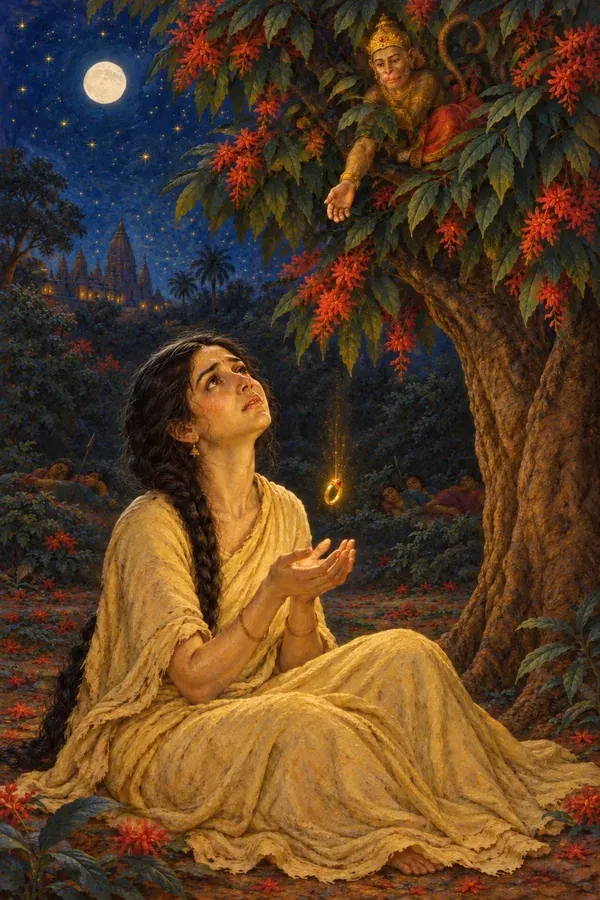
Inside Lanka there is a garden where Ravana stands with his sword drawn. The woman seated before him answers from behind a blade of grass. - The Ring and the Messagesortha 12 to doha 17
On the night Sita asks for fire, Rama’s ring drops out of the tree above her. Tulsidas walks her from that ring to trust one chaupai at a time. - The Grove Laid Waste, and Ravana’s Courtdoha 18 to 23
The leave was for fruit, and the trees came down too. Then came the warriors, a prince, Meghanada, and a weapon of Brahma. Hanuman, bound, stood in Ravana’s court and spoke. - The Burning of Lankadoha 24 to 27
Fire tied to a tail, forty-nine winds. And in the burning city Vibhishana’s house, which the fire never touched. - A Crest-Jewel, and the Thing Better Left Unsaiddoha 28 to 34
The Madhuvana is stripped. Sugriva reads the complaint as good news. On a crystal rock Rama asks how Sita keeps her life, and hears his envoy stop short of one thing. - A Kick, and a Heart Left Opendoha 35 to 49 (b)
In Ravana’s full court Vibhishana says what is good for the king and is kicked for it. On this side of the sea Rama takes him to his heart and gives him refuge. - The Bridge and the Seadoha 50 to 60
Lakshmana says dry the sea. Rama sits three days on kusha grass entreating it. In the end the sea itself comes ashore and tells how it can be bound.
Tulsi’s own telling
Valmiki’s Ramayana can be read whole, in its own right, and the two poems are best kept apart. Tulsidas was writing in Awadhi in the sixteenth century. Valmiki wrote in Sanskrit long before him. Many of the episodes are in both, and their color, their order, and at times their detail differ. Every scene in these nine episodes is told as Tulsi tells it.
The credit refused
One of the Sundarkand’s teachings sits in a quiet passage on a crystal rock. With Lanka burned, Hanuman puts out his tail and takes his small form again. He stands before Sita once more, hands joined, before he crosses back. Across the sea, on that rock, Rama tells him that no one who bears a body, god, man, or sage, has done him such service. And that, having thought it over, he cannot clear the debt he owes him. He looks at the monkey again and again, water in his eyes. Then he asks how Hanuman burned Lanka, Ravana’s formidable fort, and Hanuman answers free of pride. The whole manliness of a creature of the branches, he says, is to go from one branch to another. His leaping the sea, burning the golden city, killing the bands of night-walkers, and laying the grove waste were all his Lord’s might. “Lord, there is no greatness of mine in it.”
Source: the Gita Press edition of Tulsidas’s Ramcharitmanas, Sundarkand, doha 1 to 60, read with Hanuman Prasad Poddar’s Hindi commentary.