On this page
The troop-leaders have come to Pravarshana in their companies, monkeys and bears of many colors and measureless strength. Rama has told Sugriva to make ready to march. The road runs to a sea, and across that sea is a city one monkey has already burned. It is ruled by a king who laughed at that monkey’s counsel and will laugh again at his wife’s.
There is one more person in that city whom this kand has met twice. He woke in a house marked with Rama’s weapons and told the envoy that he lived in Lanka the way a tongue lives between teeth. He walked into the court while the rakshasas were running to kill that envoy and said that an envoy is not killed. He is Ravana’s younger brother, and in this episode he speaks once more. What he gets for it is a foot.
What follows is two long arms, a seat close by, sea water called for, and a tilak on a rakshasa’s forehead. The episode is named for the kick and for the heart that took the man in.
Lanka, and Rama’s camp
The main figures in this episode
- Rama who answers his friend’s doubt with a vow, and takes the man doubted into his arms and then into a kingdom.
- Vibhishana Ravana’s younger brother, who tells the court what is good for the king, holds the feet that kick him, and crosses the sea.
- Ravana who laughs at his wife and kicks his brother, and loses his splendor, Tulsi says, the moment he abandons the brother.
- Mandodari his queen, who falls at his feet in private with counsel steeped in good sense, and is left holding a worry.
- Malyavan the one minister who seconds Vibhishana, is ordered out with him, and goes home.
- Sugriva the king of the monkeys, who counsels binding the stranger and is sent to fetch him either way.
- Hanuman whose burning of the city is the fear Lanka cannot put down, and who rejoices when he hears Rama’s vow.
- Lakshmana named by Rama as the one who could kill every night-walker in the world in an instant, and silent through the episode.
- Sita who knows of the march by the throbbing of her left side.
The day of the march
They bow their heads at Rama’s feet, and the bears and monkeys of great strength roar. Rama looked over the whole army and, in grace, let his lotus eyes rest on it. By the strength of that grace the best of the monkeys became like great mountains that had grown wings. Then Rama set out, glad, and many auspicious omens came.
For one whose fame is made entirely of good fortune, omens at his setting out are the rule. The commentary calls it the propriety of his play. Across the sea Sita knew of the march. Her left side throbbed again and again, as if telling her something, and the commentary finishes the sentence: that Rama is coming. The woman who set a month on her own life the last time this kand saw her learns from a twitch. The one she waits for has started walking. And every omen that was good for Sita was an ill omen for Ravana.
Then the march, past all describing: bears and monkeys beyond counting, roaring. Their nails are their weapons. They carry hills and trees and go where they please, some by the sky and some over the earth, as the commentary divides them. They roar like lions, and the elephants that hold up the quarters of the world stagger and trumpet.
At that trumpeting the verse changes meter. The earth rocks, the mountains shake, the seas churn. The gandharvas, gods, sages, nagas, and kinnaras are glad that their sorrows are over. Tens of millions of monkey warriors run shouting victory to Rama. Beneath the earth the king of serpents, Shesha in the commentary, cannot bear the weight. He grips the tortoise’s hard back with his teeth again and again, as if scoring the story of Rama’s march onto its shell.
On the shore
In this way Rama came down to the shore of the sea, and the bear and monkey heroes began eating fruit wherever they were. After the shaking of the earth, the first thing recorded of the army at the water is that it ate.
It is the sea this kand began with, which one monkey crossed in a leap. The army’s own crossing lies past the last doha of the Sundarkand.
The fear left in Lanka after the fire
In Lanka, ever since Hanuman burned the city and left, the night-walkers had lived in fear. In their own houses, every one of them, they reason it through and arrive at the same place. There is no saving the rakshasa line now, no remedy left, the commentary adds.
Their reasoning is one line long, and sound: “One whose envoy’s strength is beyond telling: when he himself comes, what good can come of it?” From the women messengers who carried the townspeople’s words, Mandodari heard it, and was greatly troubled.
Mandodari’s plea
In private, with her hands joined, she fell at her husband’s feet and spoke words steeped in good sense. In the Ashoka grove this same queen, there called Maya’s daughter, talked him out of a drawn sword in half a line.
“Beloved, give up your quarrel with Rama. Take what I say as wholly for your good, and hold it in your heart. He whose envoy’s deeds, remembered, make the wives of the night-walkers miscarry: call your minister. Send his wife back with him, my lord, if you want any good for yourself.” When the envoy roared as he left, the rakshasa women miscarried at the sound. In her plea the memory of his deeds does the same. “Sita has come to the lotus forest of your line like a winter night. Hear me, lord: unless Sita is given up, even Shiva and Brahma can do you no good.”
Her doha sets serpents against frogs. “Rama’s arrows are like a host of serpents, and the hosts of the night-walkers are the frogs. Before they are swallowed, give up your stubbornness and find a remedy.”
The fool, famed through the world for his pride, heard her and laughed hard, and his jab was aimed at her. “Woman’s nature is truly timid,” he told Mandodari. “You are afraid even in the middle of good fortune. Your mind is very raw.” Then the larger taunt: “If the monkey army does come, the poor rakshasas will feed on it and live. The one at whose terror the guardians of the worlds tremble, his wife is frightened: that is a joke worth laughing at.”
So saying, laughing, he took her to his heart and went off to court with his attachment made larger. A show of greater fondness, the commentary reads. Behind him Mandodari worried in her heart that fate had turned against her husband. She asked for a remedy and is left holding a diagnosis, the one the houses of Lanka reached before her.
The court, and the laughter
He sat down in court. The news that met him there was that the whole army, the enemy’s whole army in the commentary’s words, had arrived across the sea. He asked his ministers for fitting counsel. They all laughed and told him to keep quiet. What is there in this to take counsel on, the commentary has them mean.
Then their reason, flattery dressed as calculation. “You conquered the gods and the demons, and it cost you no labor. Men and monkeys: in what reckoning do they count?” It is said to a king who has just been told in private, by his own wife, how much one monkey counted for.
Minister, physician, guru
“Minister, physician, and guru: if these three speak to please, out of fear or out of hope, then kingdom, dharma, and body are quickly destroyed.” Tulsi stops the story to state this law in his own voice. The commentary fills in the fear and the hope, fear of displeasure and hope of gain. It names what such speech leaves out, the word that would do good. And it pairs each loss with its speaker: the minister with the kingdom, the physician with the body, the guru with dharma.
Vibhishana comes, seeing his moment
That same help, the next line says, has come about for Ravana: his ministers sing his praises in his hearing, over and over. And into that singing, knowing the moment, Vibhishana came, and bowed his head at his brother’s feet.
Then he bowed again, sat on his own seat, and only with the king’s leave did he speak. “Since you have asked me about the matter, dear one, I will say what is for your good, as far as my understanding reaches.” He promises only what his understanding allows. What he promises is the good, the word the commentary set against the pleasing in the doha just before.
The moon of the fourth night
“Whoever wants his own good, master, and fair fame, good sense, a good end, and joys of many kinds. Let him give up the brow of another man’s wife the way one gives up the moon of the fourth night.” The commentary explains: people do not look at the moon of the fourth night. So a man should keep from looking at another man’s wife’s face.
Then two rules that reach further: even the sole lord of the fourteen worlds cannot stand if he sets himself against living beings. And a man who is an ocean of virtues is called good by no one if there is even a little greed in him.
Then the doha lines up four. “Lust, anger, pride, and greed: all of them, lord, are roads to hell. Give them all up and worship Rama, whom the saints worship.” Counsel on conduct passes into worship without a seam.
Who Rama is
“Dear one, Rama is king of more than men. He is the lord of all the worlds and the Death of Death itself, Brahman, unborn, the Lord, without beginning or end.” The commentary opens the word Lord into the six things it holds: majesty, fame, fortune, dharma, dispassion, and knowledge. “He has taken a human body for the good of the earth, the brahmins, the cows, and the gods. He delights those who serve him, breaks the wicked, and guards the Vedas and dharma.”
“Give up your enmity and bow your head to him. He breaks the pain of those who come to him for refuge. Give Sita to him, and worship Rama, who loves without a cause. When one comes to him for refuge, he does not abandon even one on whom the sin of enmity to the whole world has settled. He whose name destroys the three torments has himself appeared. Understand this in your heart, Ravana.” What he tells his brother about the one who comes for refuge is the sentence he will soon find true of himself.
The doha after it is all entreaty. “Again and again I fall at your feet, Ravana, and beg you: give up pride, delusion, and arrogance, and worship Rama.” And a second doha: “The sage Pulastya sent this word by his disciple. Finding a good moment, dear one, I have told it to my lord at once.”
Pulastya is the sage in whose line Ravana and his brothers were born, as the first sopan says when it tells of their birth. The envoy who stood bound in this hall told Ravana to be no stain on the moon of Pulastya’s spotless fame.
Malyavan agrees, and is sent off
Malyavan, a minister of great wisdom, heard those words and was deeply pleased. “Dear one, your younger brother is an ornament of good sense. Take to heart what Vibhishana is saying.”
Ravana answered the two of them. “These two fools are reciting the enemy’s greatness. Is anyone here to remove them?” The verse lets the order fly without a speaker. The commentary supplies Ravana. Malyavan went home, and that is the whole of his part. Vibhishana joined his hands and spoke again.
Where good sense lives, where ill sense
“Good sense and ill sense live in every heart, lord. So the Puranas and the Vedas say. Where good sense is, there are riches of many kinds. Where ill sense is, calamity is the end of it.” The law has a kindness in it: both live in every heart, his brother’s included. Then the hardest thing he says: “In your heart a perverse ill sense has made its home. You take what is good for you as harm, and the enemy as a friend. She who is the night of death to the night-walkers’ line, on her your love is heavy.”
“Dear one, I hold your feet and beg this of you: keep your fondness for me. Give Sita to Rama, so that no harm comes to you.” The commentary reads the plea for fondness as a younger brother asking an elder to indulge him as one indulges a child. These last words, said holding the feet, are for his brother’s own sake, and they will be answered with a foot.
The kick
Vibhishana had set out good sense in words the learned, the Puranas, and the Vedas approve. Hearing them, Ravana rose in a rage. “Villain, death has come near you now,” nearly the words he said to the bound envoy in this hall. “You have always lived, fool, kept alive by me,” fed on my grain, the commentary opens it. “And the side that pleases you is the enemy’s. Tell me, villain: who is there in the world I have not conquered by the strength of my arms?”
“You live in my city and your love is for ascetics. Go and join them, fool, and teach your good sense to them.” So saying, he struck him with his foot. And the younger brother took hold of those feet, again and again. The kick is half a line, and the other half is the answer: the kicked man’s hands go to the feet that kicked him.
Here Shiva turns to Parvati. “Parvati, this is the greatness of a saint: when harm is done to him, he does good.” Then Vibhishana speaks. “You are like a father to me, and it was well that you struck me. Your good, lord, lies in worshiping Rama.” Kicked for the counsel, he gives it once more, taking the kick as a father’s.
Taking his ministers with him, he went by the path of the sky, and as he went he spoke for everyone to hear. “Rama is the Lord whose resolve is truth, and your court is in the grip of Death. I go now to Rama’s refuge. Lay no blame on me.”
Hopes all along the road
The moment Vibhishana left, speaking those words, all of them lost their span of life. The commentary makes them the rakshasas, their deaths now fixed. Shiva turns to Parvati again: “Parvati, the slighting of a saint at once destroys all welfare.” The same phrase stood over the burning city two episodes ago.
In the very moment Ravana abandoned Vibhishana, that unlucky man was stripped of his splendor. The king is still in his court, and the splendor went with the brother. Vibhishana went glad toward Rama, making wish after wish as he went.
The wishes are all one. “I will go and see his lotus feet, red and soft, that give joy to those who serve them. The feet whose touch carried the rishi’s wife across, and which made the Dandaka forest holy.” The woman of stone in the first sopan, Ahalya in the commentary, came forth at the touch of those feet. “The feet that Sita has laid in her heart, that ran over the earth after the false deer. The lotus feet that rest in the lake of Shiva’s heart: what fortune is mine, that I will see those very feet.”
“The feet whose sandals Bharata has set his mind on, those feet I will see today, with these eyes.” Bharata set those sandals on the throne of Ayodhya, as the second sopan tells. Every thought on the road is of the feet. He is about to find out that the people on the shore have been thinking of something else.
This shore, and a doubt
Thinking these loving thoughts, he soon came to this side of the sea, the side where Rama’s army was, the commentary marks. The monkeys saw him coming and took him for some special envoy of the enemy. They kept him where he was, under guard, the commentary says, and went and told Sugriva all of it.
Sugriva went to Rama, as the commentary has it, and said: “Listen, Rama: Ravana’s brother has come seeking to meet you.” Rama said: “Friend, what do you make of it?” Sugriva said: “Listen, lord of men: the maya of the night-walkers cannot be known. This one changes his shape at will, and who knows for what purpose he has come.”
The story bears him out: Ravana came to Sita disguised as an ascetic. And this army’s own envoy went into Lanka the size of a mosquito and met this very man in a brahmin’s form.
“My vow is to take away the fear of those who come for refuge”
Sugriva went on: “The fool has come to learn our secrets. To me it seems best that he be kept bound.” Rama answered: “Friend, you have thought out sound policy. My vow is to take away the fear of anyone who comes to me for refuge.” Hearing Rama’s words, Hanuman rejoiced: the Lord is tender to those who come for refuge. The commentary makes those words he said to himself, and reads the tenderness as a father’s. In Lanka he had told Ravana as much.
Then Rama went on, the commentary marks, and the doha is his. “Men who, reckoning their own harm, abandon one who has come to them for refuge are vile and full of sin, and even to look at them is a loss. One on whom the killing of ten million brahmins has settled, if he comes for refuge, I do not abandon even him. The moment a being turns to face me, the sins of ten million births are destroyed.”
“It is a sinner’s nature that worship of me never pleases him. If this one were wicked at heart, could he have come before me? One whose mind is clean finds me. Deceit and trickery do not please me. And if Ravana has sent him to learn our secrets, even then, Sugriva, there is no fear and no loss in it.” Then, in the one line of the episode that names Lakshmana: “Friend, however many night-walkers there are in the world, Lakshmana can kill them all in an instant. And if he has come to my refuge in fear, I will keep him as I keep my own life.”
The doha closes both cases with a laugh. “Bring him, either way,” said Rama, laughing. And with a cry of victory the monkeys set out, Angada and Hanuman with them. The commentary names Sugriva as the one who went.
In the Lankakand, when Ravana hurls a spear at Vibhishana, Rama will remember this vow, put Vibhishana behind him, and take the spear himself. Here he speaks it on the shore, to a friend who had counseled binding the man.
The first sight
Placing him in front with respect, the monkeys went back to where Rama was. Respect is the verse’s own word: the man who was held under guard now walks ahead, escorted. From far off he saw the two brothers, a joy to the eyes.
Then, looking at Rama, he stopped where he stood and stared without blinking. Long arms. Eyes like red lotuses. A dark body that frees from fear those who bow to it. Shoulders like a lion’s, and a broad, shining chest. A face that would steal the minds of countless gods of love. Water came into his eyes, his whole body thrilled, and then, steadying his mind, he spoke softly.
What he says first is who he is, and he says the worst of it. “Lord, I am Ravana’s brother. Protector of the gods, I was born in the line of the night-walkers. Sin is dear to me by nature, and my body is of darkness, as the dark is dear to an owl.” He told Hanuman the same in his own house, and here he adds the owl. Then his doha: “I have come because my ears heard your fame, that you break the dread of worldly existence,” the round of birth and death, the commentary says. “Save me, save me, remover of the pain of the afflicted, Rama who gives joy to those who come for refuge.”
Save me, save me, is the cry Hanuman gave when he fell at these feet on the crystal rock. The doha closes on refuge and on Rama’s name, the two things he spoke of from the sky when he said where he was going. He has arrived where he said he would.
He took him in his long arms to his heart
Saying this, he went down flat on the ground, and Rama, seeing him prostrate, rose at once with special joy. Hearing his humble words, Rama’s mind was pleased. And then the half line: taking hold of him with his long arms, he drew him to his heart.
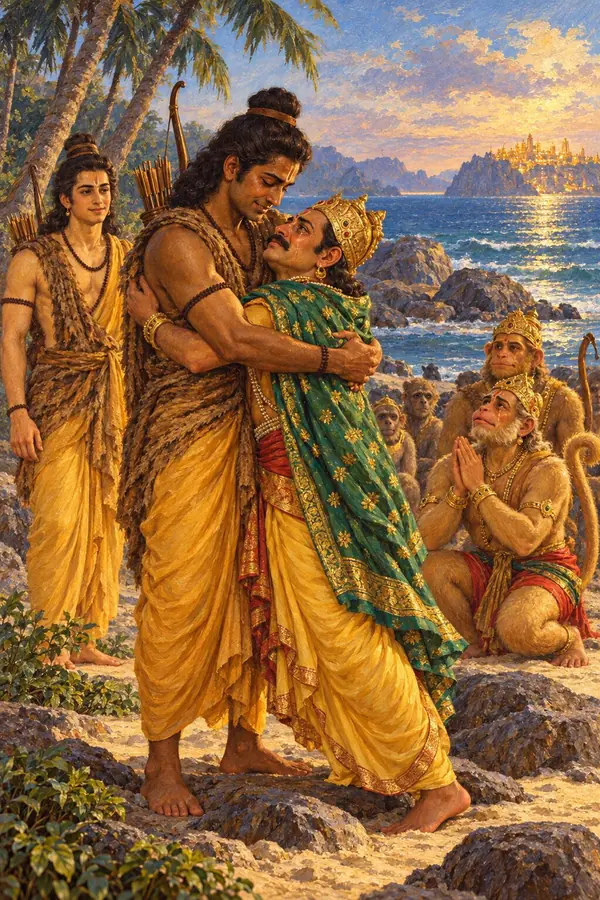
In the hall he had just left, he bowed twice, took his seat, and spoke only when given leave. Here nothing was asked of him before the arms closed.
Having embraced him, Lakshmana with him, Rama seated him close by and spoke words that take away the fear of those devoted to him. Lakshmana is in this meeting by the verse’s own word. And the first thing Rama says to the rakshasa: “Tell me, lord of Lanka, how you and your family fare. Your dwelling is in a bad place.” Lord of Lanka: Rama gives him the title in his first sentence, three dohas before any water is called for from the sea. To a man who left that city under a kick five dohas earlier.
A good man in a bad place
“Day and night you live among the wicked. Friend, how does your dharma hold?” And before the man can answer, Rama answers for him. “I know all your ways. You are very skilled in right conduct, and injustice does not please you.” Told in Lanka that he lived on his brother’s grain, he is told here that all his ways are known. “Dear one, it is better to live in hell than that the Creator should give a man the company of the wicked.”
Vibhishana’s answer begins with faring well. “Rama, now that I have seen your feet, I am well, since you have shown me mercy, knowing me for your servant.” Then he turns the word into a law: no being has welfare, or rest even in a dream, until he leaves desire and worships Rama. Greed, delusion, envy, pride, and conceit live in the heart until Rama lives there with his bow. Attachment is a dark night that comforts the owls of liking and loathing until the sun of Rama’s glory rises. A few lines ago he likened himself to an owl that loves the dark. Now he names the owls, and the sun that ends their night.
“Now I am well, Rama. My great fears have gone. The one you favor is untouched by the threefold torment of the world,” from within, from the gods, and from other beings, the commentary spells out. “I am a night-walker of very low nature and have never done a good deed. And he whose form does not come even into the sages’ meditation has gladly taken me to his heart. Boundless is my fortune: with my own eyes I have seen the feet that Brahma and Shiva serve.”
“Listen, friend, I tell you my nature”
Rama answered him. “Listen, friend: I will tell you my own nature, which Kakabhushundi knows, and Shiva, and Parvati.” The three witnesses belong to this story’s own telling: Kakabhushundi the crow, who tells it to Garuda, and Shiva, who is telling it now to Parvati. “Were a man the enemy of everything that moves and stands, if he comes to my refuge in fear, giving up pride, delusion, and deceit of every kind. I make him at once the equal of a saint.”
He calls it his nature, and it has one condition. The man’s part is to come and lay those things down, and making him a saint’s equal is Rama’s. Then he begins a list that runs over into the next line: mother, father, brother, son, wife, body, wealth, house, friends, family. Ten ties, and the sentence they belong to keeps every one of them.
One cord twisted from the threads of attachment
“Gathering up the threads of attachment to all of these and twisting them into one cord, he binds his mind with it to my feet.” The commentary puts the figure plainly: he makes the Lord the center of every worldly bond. “He looks on all with the same eye, he has no desire of any kind, and joy, grief, and fear are gone from his mind.”
“Such a good man dwells in my heart the way wealth dwells in a miser’s heart.” A bold likeness for Rama to use: he compares himself to a miser. “Saints like you are dear to me. I take on a body for no other’s sake.” No one’s claim obliges him to take a body, the commentary reads, and the line before has named who is dear to him.
Then the doha, with four marks and a verdict. “Those who worship the Lord in his form, who are given to the good of others. Firm in right conduct and in their vows, and who love the feet of brahmins: such men are as my own life to me.” Before the stranger arrived, Rama said he would keep him as his own life. Here the measure becomes a rule, and then the rule is applied. “Listen, lord of Lanka: all these virtues are in you. That is why you are so very dear to me.” Hearing it, the whole host of monkeys cried out, “Victory to Rama!” The monkeys who held him under guard are cheering.
The anointing
Hearing Rama’s words, nectar to his ears, Vibhishana could not have enough of them. Again and again he took hold of the lotus feet, the same “again and again” Tulsi used when he held the feet that kicked him. A love beyond measure would not fit inside his heart.
“Hear me, master of all that moves and stands, keeper of those who bow to you, knower of what is inside every heart. There was some desire in my heart before. It has been carried away in the river of love for your feet.” The commentary leaves the wish as he left it: some desire. “Now, merciful one, give me your pure bhakti, the bhakti ever dear to Shiva’s mind.” Hanuman asked for bhakti on the crystal rock, and this request is answered with the same word. Saying “So be it,” Rama at once asked for water from the sea.
“Although, friend, you have no wish, my sight is never without fruit in this world.” So saying, Rama marked him with the tilak, the royal tilak in the commentary’s word. From the sky fell a rain of flowers without end. Bhakti was asked for and a kingdom was given, and the reason Rama gives is his own sight, which never goes without fruit.
Then two dohas. The first says that Vibhishana was burning in the fire of Ravana’s anger, made fierce by the wind of his own breath. He was saved, and given an unbroken kingdom. The commentary names Rama as the one who saved him and makes the breath Vibhishana’s own words: the counsel he gave fanned the fire he was burning in. The second doha weighs the gift. “The wealth that Shiva gave Ravana for the offering of his ten heads, that same wealth Rama gave Vibhishana, shyly.”
In the Ashoka grove, Trijata told the rakshasis her dream, in which Lanka seemed to have passed to Vibhishana. In Ravana’s court the bound envoy told the king to hold Rama’s feet in his heart and rule Lanka unshaken. That kingdom now goes to the younger brother, given shyly. The dream told in the grove is a tilak on a forehead on this side of the sea.
A kingdom given before the first arrow
The war has not begun, and Rama has already given Lanka to Vibhishana, with sea water and a tilak, before an arrow has been loosed. What Lanka’s court lacked was an ear that could take an unwelcome word.
The episode is built on three counsels and what each earned. A wife, in private, at her husband’s feet, earned a laugh and an embrace. A minister, in public, earned an order to leave, and left. A brother, in public, at his brother’s feet, earned a kick, held the feet, and said once more what he had come to say. The same man was kicked and given the royal tilak in one episode. Between the two lay one sea and one sentence: my vow is to take away the fear of anyone who comes to me for refuge.
At the center is what the episode is named for, a heart that stayed open. A rakshasa kicked by his brother comes to the one of whom he himself said, in the court, that he abandons no one who comes for refuge. The long arms close. The owner of that heart tells him who lives in it: the one who gathers every thread of attachment into a single cord. He ties his mind with it to these feet. All his thoughts on the road, before he heard the rule, were of the feet. The kick is what the court gave him for saying what was good. The heart is what was waiting on this side of the sea.
The same story, elsewhere: Valmiki’s Ramayana, chapter 23: The Surrender of Vibhishana.
Source: the Gita Press edition of Tulsidas’s Ramcharitmanas, Sundarkand, doha 35 to 49 (b), read with Hanuman Prasad Poddar’s Hindi commentary.