On this page
The court of Lanka has heard the envoy out. Bound in the serpent noose, in a hall that filled to watch him, Hanuman has counted out the strength of the one he serves. He has made his plea with joined hands, asked Ravana to give Sita back at his word, shown him the road of pardon. And he has ended on a vow and an invitation: give up the pride that grows from delusion, and worship Rama, the ocean of grace. Ravana has heard every word. What he does with that counsel, in the first two chaupais of this episode, will decide whether the envoy leaves Lanka at all, and in what state.
His answer is a laugh, and from there the talk in the court comes down from argument to sentence. The rakshasas will run to kill. The king’s brother will come in with the ministers and bow his head, and the hall will agree with him. And Ravana will pronounce a sentence he explains to the court as if it were a clever discovery, and the sentence is about a tail.
From that sentence to the quenching of the tail Tulsidas spends ten chaupais and three dohas. Beside the flames he writes three things: the fire’s cause, its one exception, and the moment the fire on the tail is put out. The cause he names is the slighting of a saint. The exception is one house. And the tail is put out. And the body is made small again, before the envoy stands with joined hands in front of the one person in Lanka he crossed the sea for. In Tulsi’s chaupais the fire is a fruit, and he names its seed in the same line.
A laughing court, a burning city
The main figures in this episode
- Hanuman Rama’s envoy. Bound, he goes on with his work, and when the fire catches, his first act is to become small.
- Ravana who laughs twice in this episode, once at the envoy’s counsel and once at his brother’s. Each laugh brings the fire a step nearer his city.
- Vibhishana Ravana’s brother, who comes in with the ministers, bows his head, and says that an envoy is not killed.
- The people of Lanka who come out to watch, kick the bound envoy, clap to the drums. Before the episode is over they cry out for their fathers and mothers.
- Sita before whom the envoy, with all of this done, comes and stands once more with his hands joined.
- Shiva and Parvati the two between whom the story is told. In one chaupai Shiva turns to Parvati and gives the reason the fire did not burn the one who carried it.
The good counsel, and the laugh that met it
Though the monkey had spoken words of great benefit, the chaupai begins. It counts what they were steeped in: bhakti, discernment, dispassion, and right conduct. Tulsi writes the quality of what was said before what it earned, so whatever follows is charged to the listener.
Then the result. That great egotist laughed aloud and spoke. A laugh is what a man gives when he has decided to stop listening. And what he said had a truth in it that slipped past him: “We have found a great and learned guru in this monkey.” The commentary hears the sarcasm. But the one standing bound before him had just given him, with joined hands, counsel steeped in all four. The king named him for exactly what he was in that hour, and laughed the name away.
Then the threat. “Villain, your death has come near. Low one, you have taken to instructing me.” Hanuman‘s reply is level and short. He simply turns the sentence the right way round. “The opposite of that will happen.” The death that has come near, the commentary fills in, is the king’s. Then the diagnosis: “That is your delusion, and I have seen it plainly.” The commentary calls it a mind turned about. He speaks from what he has seen in Lanka: this king drawing a sword over a woman who answered him from behind a blade of grass. And the gods standing in this court with their hands joined in fear. He is reporting.
An envoy is not killed
Hearing the monkey’s words, Ravana was enraged. His anger came out as an order dressed as a question: “Why do you not take this fool’s life at once?” Hearing it, the night-walkers rushed to kill him.
And in the second half of that same line, another door opens: Vibhishana arrived, with the ministers. Tulsi puts the running rakshasas and the arriving Vibhishana in one line, as if danger and remedy came in a single breath. The man walking in is the master of the house marked with Rama’s weapons, where fresh tulsi grew. He woke with Rama’s name on his lips and saluted a stranger in a brahmin’s form. He asked whether he was one of Hari’s servants or Rama himself. That stranger is the envoy standing in the noose.
His posture comes first, his argument after. Bowing his head, with much entreaty, he said: “To kill an envoy is against right conduct. It is not done. Master, let some other punishment be set.” He speaks to his brother in his brother’s own language, and asks only for what he can get. Then everyone said: “Brother, this counsel is good.” The whole hall agreed with him. The decision stayed with Ravana.
Maim him and send him back
Hearing them, Ravana laughed and spoke. This is the second laugh: the first met the envoy’s counsel, this one meets his brother’s. “Maim the monkey, then, and send him back.” He has taken the counsel at its word: no killing, and some other punishment, which is all Vibhishana asked. The king chooses what it will be.
One more word sits in that short sentence: send, which the commentary opens as send back. Ravana wants the envoy to leave Lanka, and to be seen leaving. Soon he will say who the sight is meant for.
Oil, cloth, then fire
“I say this to all of you, and I explain it: a monkey’s love is for his tail. Soak cloth in oil, bind it on, and then set fire to it.” Tulsi’s verb for that explaining is the one for making people understand. Ravana has worked out a theory of monkeys and lays it before his court: strike where the attachment lives.
Then three acts in order: soak, bind, light. It is an arrangement, unhurried, and an arrangement takes materials and people. In the chaupais that follow, both move toward the fire: the rakshasas who make the preparations, the cloth, ghee, and oil of a whole city. And the crowd that comes out to watch.
Ravana’s own reckoning
“When this tailless monkey goes back there, the fool will bring his master here.” Ravana states the purpose of his punishment himself: it is to bring the envoy’s master to Lanka. The burned tail is meant as a message, and the message is an invitation.
Then what he wants from the visit: “Those whose greatness he has praised so much, let me see their power for myself.” A little earlier the envoy counted that power out in this court, from the strength by which maya makes the worlds to the killing of Khara, Dushana, Trishira, and Vali. Ravana heard it to the end and now wants that strength to come and stand in front of him. Lanka’s invitation is sent by Lanka, and the sender calls it a punishment.
And the monkey smiled to himself
Hearing this, the monkey smiled in his mind. The one whose body the sentence is passed on is smiling, and the smile stays inside him: a smile of recognition. He tells himself what he has recognized, in words the commentary marks as spoken within: “I know it now. Sarasvati has lent her help.” The commentary explains: Sarasvati had a hand in giving Ravana this idea. The Manas has shown her hand at work before, in the Ayodhyakand, when at the gods’ pleading she turned the mind of Kaikeyi’s maid. The envoy in the noose knows whose hand this is, and smiles at it.
Meanwhile the order is already being carried out. Hearing Ravana’s words, the foolish rakshasas began to make that very arrangement. Tulsi’s word for it is a building, a construction, and what they are building will set their own city alight.
No cloth, ghee, or oil left in the city
No cloth, ghee, or oil was left in the city. The same line gives the reason: the tail grew, and the monkey made a game of it. The commentary spells it out: so much went onto the tail that the city ran out of all three. Every length wrapped on made the tail longer. Lanka carried its stores out of its houses with its own hands and wound them onto one tail. The fire had still not been lit.
Then the city itself comes into the scene. The people came to see the spectacle, the same word Tulsi used when the night-walkers ran to the court for the show. And what they did when they came is the half line to keep in mind for all that follows: they kicked him, and laughed at him a great deal.
The sentence said soak, bind, and light. Kicking a bound creature and laughing at him is what the city added on its own account. When Tulsi gives the cause of the fire a few lines later, it will be a slight done to a saint, and this is one.
Drums, clapping, and the round of the city
Drums are beating and everyone is clapping. It has become a festival. Then they paraded him round the city, and then they set the tail alight.
Note the order: first the round of the city, then the fire. Tulsi gives the parade no purpose. A bound monkey with a city’s worth of oiled cloth on his tail is led through Lanka to the beat of drums, and Lanka claps. The streets he is led through are the streets that will burn.
The moment the fire caught, the smallest form
Seeing the fire burn, Hanuman at once took a very small form. The first thing he does with a fire on his tail is shrink. The bonds had been fitted to one size, and when the size changed they held nothing.
Slipping free, he climbed onto the golden terraces, the upper stories of Lanka’s houses. Seeing him there, the commentary says, the rakshasa women were afraid. The fire is still on the tail alone and the houses are standing, and the fear has already reached the city.
The forty-nine winds
The doha’s first words are its largest: “Prompted by the Lord, at that moment the forty-nine winds began to blow,” all forty-nine, the commentary counts. The winds were sent, and Tulsi names the one who sent them before he names the winds. Even for Hanuman, whose birth is bound to the wind, this wind is not counted as his own doing.
Then what has been held back since the parade began is let go. With a great laugh he roared, and grew until he touched the sky. A moment ago he was very small. Now he stands against the sky. Both times the work set the size: very small to get out of the bonds, sky-high to run across a burning city.
A huge body and a light step
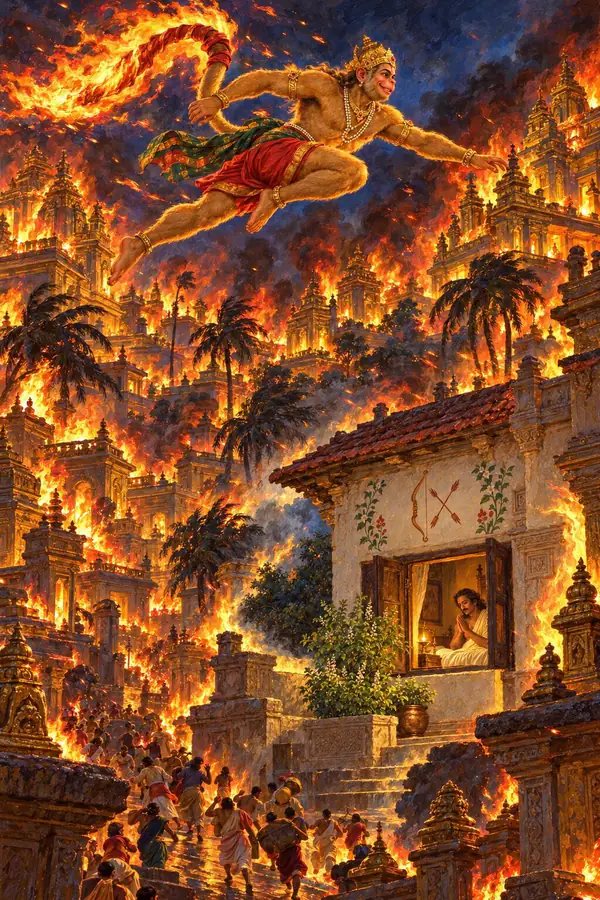
The body is enormous and very light, and quick, the commentary adds. The picture that follows needs both: running, he leaps from mansion to mansion. The fire travels along the top of the city, roof to roof.
The city burns, and its people are in misery. Tens of millions of terrible flames leap and snatch. The verb is the one for a pounce: in this chaupai the fire hunts.
“Father, mother”
“Father! Mother!” That cry is heard from every side, the commentary says. Tulsi gives the burning city a voice, and that keeps the episode from becoming a show of flames. The city that clapped to the drums a few lines ago is calling for its parents.
“At this hour, who will save us?” The question rises from the city whose master the gods stood before with joined hands. And in the next line the city overturns its own laughter: “We said so before: this is no monkey. This is some god who has taken a monkey’s form.” These are the people who kicked him and laughed, and now, as their city burns, they call him a god.
Such is the fruit of slighting a saint
Such is the fruit of slighting a saint: the city burns like a city with no master. This is the line the episode was written for. Tulsi gives the cause of the fire, and Ravana, Hanuman, and every weapon are left out of it. The word is fruit. A punishment is handed down by someone. A fruit grows of itself from what was planted. Tulsi has shown the planting: an envoy laughed at in the court, then kicked and laughed at in the streets. Lanka has a master, and at that hour, for the city that slighted a saint, he is nowhere to be found.
He burned the city in a single instant. Then comes the half line that settles the whole account of this fire: one house, Vibhishana’s, did not burn.
That half line is about justice before it is about fire. A city burns in the time it takes to blink, and in the middle of it one house stands untouched. Tulsi gives no account of how the flames went round it. He writes the exception and moves on. It is the house marked with Rama’s weapons, with fresh tulsi growing at it, where this same envoy was honored. The city that kicked him burned, and that house stood in the same fire. Earlier in this kand Trijata told her dream aloud in the grove: a monkey had burned Lanka, and Lanka seemed to have passed to Vibhishana. This chaupai has the fire of that dream, and the one house it leaves is Vibhishana’s.
The envoy of the one who made fire
“He is the envoy of the one who made fire. For that reason, Parvati, he did not burn.” Here the teller turns to his listener and answers the question anyone would ask: why did the one with fire tied to his tail not burn? Shiva’s answer is a relation, and nothing more: fire was made by his master, and so it leaves the master’s envoy alone.
Turning it over and over, he burned all of Lanka, from one end to the other, the commentary says. Then he leapt into the sea.
The leap ends the burning. The city is burned, the work is done, and the fire on his own body has served its purpose. The sea he leaps into is the one he crossed at the start of this kand, the sea that asked Mainaka to give him rest. The next doha opens with the tail put out.
Tail quenched, hands joined
The doha holds four acts, in order. He put out his tail. He shed his weariness. He took the small form again. And then he stood before Sita with his hands joined. The weariness is worth a pause. At the start of this kand, when Mainaka was to take his weariness away, he touched the mountain, bowed, and refused to rest until Rama’s work was done. Here, with Lanka burned behind him, he sets the weariness down before he goes to her.
The one who has just burned a city leaves that city’s fire behind before he comes to the one he was sent to find. The fire goes out first, the tiredness is set down, the body is made small, and then the hands are joined.
And see how he stands before Sita. Someone who comes back from a great deed usually comes back a little larger than he left. This one has made even his body small, and Tulsi writes that smallness into the doha.
Give me a token, mother
“Mother, give me some token, as Rama gave me one.” It is an envoy’s practical sentence, and a tender one. On the day the search set out, Rama called him close, touched his head. Knowing him for his own servant, he gave him the ring from his hand. That ring came over the sea and fell before her out of a tree. He will carry a sign back the same way, so the message has one manner at both ends.
She took off her crest-jewel and gave it to him, and Hanuman took it with joy. He came with a ring and a message. He will go back to the far shore with her words and a token Rama will know.
My salute, and the name he is known by
The first thing in her message is a salute. “Dear one, give him my salute, and say this to him: Lord, you are complete in every way.” The commentary opens the word: he has no wish of any kind. The woman about to ask him for something says first that he needs nothing for himself.
So what is her plea to rest on? The next line says. “Remember your birad, kind to the lowly, and take away, master, this heavy trouble of mine.” A birad is the name a lord is known by and is bound to live up to. The commentary adds the clause she leaves unsaid, and I am one of the lowly. She pleads on the strength of his name and sets her own suffering second. What she asks is that he be the one he is called.
Jayanta’s story, and the month’s term
“Dear one, tell him the story of Indra’s son, and remind him of the might of his arrow.” The commentary gives the son’s name, Jayanta, and the Manas has told that story at the opening of the Aranyakand. At Chitrakuta Rama once made ornaments of flowers with his own hands and, seated on a crystal rock, put them on Sita. Indra’s son, wanting to test Rama’s strength, took the form of a crow, struck her foot with his beak, and fled. When the blood ran, Rama fitted a reed to his bow, charged it with a mantra, and the reed ran after him. The crow took his own form and went to his father, and Indra would not keep him. He fled through Brahma’s world and Shiva’s and every other, weary and afraid. No one so much as asked him to sit, until Narada, out of pity, sent him to Rama. He seized Rama’s feet, and Rama let him go with one eye. Tulsi’s doha in that story calls Rama most merciful, always loving the lowly, the very name Sita has just asked the envoy to recall. The story is her reminder of the might of an arrow that once answered a wound to her foot.
Then the sentence after which time becomes a figure in the story. “If he does not come within a month, he will not find me alive.” A month is the term Ravana set in this grove over a drawn sword, while this same envoy lay hidden in the leaves. Sita takes the span her captor named and lays it on herself. There is no threat in it. It is a reckoning, done against her own life.
How shall I keep my life
“Tell me, Hanuman, how am I to keep my life? You too, dear one, now speak of going.” Of everything in her message this is the hardest, because the loneliness that had rested for a little while speaks again. She asks the one person who cannot answer, since he is the one leaving.
“Seeing you, my breast was cooled. And now, for me, the same day and the same night again.” What changed for her when he came goes back with him when he goes. The fire on his tail was put out in the sea. What this line carries has no water near it.
Comfort given, a head bowed at her feet
He reasoned with Sita and gave her courage in many ways. Tulsi records none of the words, only that the comfort came in many ways. Anyone who has had to console someone knows why the doha says many.
Then a bow at the close. Bowing his head at her lotus feet, he set out toward Rama. The one who burned Lanka leaves this grove with his head bowed. Two heads bow in this episode: Vibhishana’s in the court, asking that the envoy be spared. And the envoy’s here, at the feet of the woman he was sent to find. Between those two bowed heads Tulsi sets the whole fire. The next episode opens with his roar as he leaves and the leap back across the water.
How a great deed is closed
From outside this looks like a grand scene: Lanka in flames, a body grown to the sky, forty-nine winds. What Tulsi writes is the fire’s cause, its limit, and the hour it was put out. The cause is a slight done to a saint. The limit is one house. The hour is the moment the work was done.
Then there is the house that did not burn. Tulsi gives no reason. The commentary says only that Hanuman did not burn that house. And the reader remembers that in the court, when the rakshasas ran to kill, the master of this house bowed his head. He said that an envoy is not killed.
And there is what to carry away. The moment the work was finished, Hanuman put out his tail, set down his weariness, made his body small, and only then stood before Sita. He left the deed outside. Most of us carry what we have just done into the room with us, and its weight spoils the work we came in to do. This part of Sundarkand shows how a great deed is closed: the tail quenched, the body small, the hands joined. And a head bowed on the way out of the grove.
The same story, elsewhere: Valmiki’s Ramayana, chapter 22: The Burning of Lanka, and the Return.
Source: the Gita Press edition of Tulsidas’s Ramcharitmanas, Sundarkand, doha 24 to 27, read with Hanuman Prasad Poddar’s Hindi commentary.