On this page
Night was coming down, and the city ahead blazed with the light of its golden rampart. Hanuman stood alone on a hilltop, and the wall of gold ran away into the distance in front of him. The sea was behind him now, and Surasa, and the night-walker in the water who caught the shadows of flying creatures. Ahead was the hardest thing yet to cross: a city awake, with millions of guards posted on every side. One captive woman was somewhere inside it. He had to find her without the city learning that he had come for her.
On the far shore the host of bears and monkeys sat on the sand living on roots and wild fruit, as he had asked. They were waiting for him. Sampati had told them where to look: Lanka, and in Lanka a grove of Ashoka trees, and in that grove Sita, sitting lost in her thoughts. The whole search had come down to one monkey on a hilltop who had to get inside those walls.
Tulsi first shows the whole city: the rampart, the crossroads, the markets and lanes, the elephants, horses, mules, and chariots. The wrestling grounds and stepped wells, and an army he says cannot be described. Then, inside that same city, he leads us to a house with nothing golden about it. It is marked with the signs of Rama‘s weapons, and fresh tulsi grows there. That is the shape of the episode: a rampart of gold on one side, a few young tulsi plants on the other. What Hanuman needed was waiting beside the tulsi.
Lanka that night
The main figures in this episode
- Hanuman who takes three forms here: a body the size of a mosquito, the same tiny form moving through the city, and at the last the form of a brahmin.
- Lankini the rakshasi at the gate of Lanka, whose work is to stop whoever comes in. She calls thieves her food, takes one punch, and, once down, remembers something Brahma told her as he was leaving.
- Brahma who gave Ravana his boon and, as he left, told Lankini the sign by which the end of the rakshasas would be known. He appears only in her memory, and there he speaks.
- Ravana whose palace is too strange to describe, and who is found asleep. His whole part in this episode is his sleep.
- Sita Janaka’s daughter, for whose sake all of this is happening. She is not seen in this episode. Tulsi records her absence in half a line: in the palace, Sita was not seen.
- Vibhishana who lives in that city of rakshasas, in a house marked with Rama’s weapons. He wakes and says Rama’s name, and by that name Hanuman knows him.
- Shiva and Parvati, Garuda and Kakabhushundi the two pairs through whom the story is told. Now and then Shiva turns to Parvati, now and then the telling turns to Garuda. In this episode both turns come exactly where the poet wants to keep the credit from going to Hanuman.
The golden city seen from the hill
There was one more creature in the sea. A night-walker lived in the water and hunted by a trick of maya. She watched the water for the shadow of anything flying overhead, and seized the shadow. Then the creature could fly no further (and fell into the water, the commentary adds). That was how she always fed. She tried it on Hanuman. He saw through her at once, killed her, and went on across the sea. Tulsi gives her five lines and no name. Surasa was a test sent by the gods and was answered with a bow. This was a trap set for food, and it was answered the way a trap is answered.
On the far shore he came down into a forest and looked at its beauty: bees humming, greedy for honey. Trees of many kinds bright with fruit and flowers, flocks of birds and herds of beasts. The sight pleased his mind. A huge hill stood ahead. He put fear aside and ran up it.
Here Shiva, who is telling the story to Parvati, turns to her in the middle of the climb: “Parvati, there is no greatness of the monkey’s own in this. It is the Lord’s glory, which devours Death itself.” Then the sight. From the top of the hill Hanuman looked at Lanka. Tulsi’s first word about it is that it cannot be described. A fortress beyond anything, very high, with the sea on all four sides and a golden rampart giving off a tremendous light.
Then Tulsi drops out of the chaupai into the faster chhand, because a sight this size will not fit the chaupai’s walking pace. Things arrive one after another like a count, the way someone looking down from a height talks without stopping for breath. A golden rampart set with strange gems, and inside it many fine houses. Crossroads, markets, handsome roads and lanes, a city adorned in every way. There is no word of fear in it. Tulsi shows Lanka as it is, a rich, orderly, crowded capital, and that honesty gives an edge to what follows.
Elephants, horses, troops of mules, foot soldiers, and companies of chariots: who could count them? Bands of rakshasas who take many shapes, an army of great strength beyond describing. The poet who measured Surasa’s mouth in yojanas a doha ago gives up twice in two lines.
The chhand runs on. Woods, orchards, gardens, flower beds, pools, wells, and stepped wells. Daughters of men, nagas, gods, and gandharvas, whose beauty would turn the minds of sages. In places wrestlers with bodies like hills roar in the wrestling grounds, grappling and daring each other on. Millions of fearsome warriors keep careful watch from all four directions. And at the end of this bright picture comes the line that turns it over: in places wicked rakshasas are devouring buffaloes, men, cows, donkeys, and goats.
Closing the chhand, Tulsidas speaks in his own name. He has told their story only briefly, he says, because they will surely leave their bodies at the holy place that is Rama’s arrows, and gain the highest state. With that sentence the city changes color. What looked like an enemy fortress is, to the poet, a crowd gathered at a place of pilgrimage. Lanka’s destruction comes later in the poem. What it will mean is settled here.
A thought, of night and of smallness
The first decision is made in the mind. From the hill Hanuman looked first at the guards, so many of them. What the sight drew from him was a quiet reckoning: I will take a very small form, and enter the city by night.
Two words in the doha settle everything that follows, small and night. The one who has just leapt a hundred yojanas of sea decides to become small and wait for dark. It is the manner of a workman who knows his work. He has come for news. Jambavan’s charge was to see Sita, come back, and bring word of her. For someone carrying news, being seen too soon is the surest way to fail. So where showing his strength would have been easiest, he takes the smallest form he can. The same order comes back again and again in this kand: first become small, then do the work, and let the size show last.
A form the size of a mosquito, and Lankini at the gate
After the thought, the doing, and in four quick lines he takes a form, sets out, is stopped, is challenged, and answers. Hanuman took a form the size of a mosquito and set out for Lanka, remembering Rama, God playing his part in a man’s shape. A rakshasi named Lankini lived there, at the gate of the city, the commentary says. She stopped him: “Where do you think you are going, slighting me, without so much as asking?” The figure who stood on the hilltop a moment ago is now a speck on the night air.
And even at that size he was seen. The watch on Lanka is so close that a mosquito cannot pass the gate unquestioned. The one who stops him is the gate’s own keeper. The outermost line of the city’s watch is the first to break.
“Fool, you have not understood what I am. Every thief there is, every one, is my food.” In one sentence she tells us who she is. Everyone who comes in is a thief to her, and every thief a meal. That is her mistake: the one in front of her has come to search.
Hanuman’s answer was a fist. He struck her one blow, and she rolled on the ground vomiting blood. One blow: Tulsi gives the number, and the number measures the hit. Becoming small had only hidden his strength.
The sign Brahma gave
Lankini gathered herself and got up. Tulsi’s word for it is the one he used on the hill above the shore, where Hanuman steadied Rama in his mind before the leap. She steadied herself, and rose. Then fear came. She joined her hands, and the keeper who had just been naming her food began to plead.
When Brahma gave Ravana his boon, she said, he told her something as he was leaving. It was a sign, the commentary says, by which the ruin of the rakshasas would be known. “When you are left helpless by the blow of a monkey, know that the rakshasas are finished.” On the day Lanka received its boon, the mark of its end was written down too. It was kept at the gate in the memory of the woman who sat there.
Now that day had come, and the words she spoke were the words of someone blessed. “Dear one, great is my merit, that I have seen Rama’s envoy with my own eyes.” A moment ago she called him a fool. Now she calls him dear one. Nobody explained anything to her. A blow landed, and Brahma’s old word woke inside her. Some truths lie in us the same way, and it takes a jolt to bring them back.
And the first in Lanka to recognize Rama’s envoy was the first to be struck. The city is full of warriors, Ravana is asleep, the army knows nothing. It is the city’s watch that knows him, while its king sleeps on.
The scale of satsang
Still on her feet, hands still joined, she spoke a doha that readers of the Manas know by heart. It is worth remembering whose voice it is: a woman just up from the ground with blood in her mouth, speaking to someone no bigger than a mosquito.
“Dear one, put all the joys of heaven and of liberation in one pan of a scale. And together they do not weigh as much as the joy of one lava of satsang.” A lava is a sliver of a moment, and satsang is the company of the good. Heaven and liberation in one pan, a sliver of a moment in the other, and the scale tips toward the sliver.
Why say it here? What just happened at the gate looked nothing like satsang: no story told, no name sung, only a fist. Yet Lankini counts this meeting as her satsang, because the one she met was out on Rama’s work. The worth of company is set by the name that lives inside the one you meet.
From this point the fortress of Lanka begins to break from the inside. The gate is where it was, the wall is still gold, the guards are still at their posts. And the power at the gate has changed sides.
With Rama in the heart
Then the gatekeeper did something stranger than praising the one who struck her. She told him how to go in. The barrier had become the guide. “Enter the city and do all your work holding Rama, the king of Kosala, in your heart.” Her method says nothing about which lane to take or which guard to avoid. It is about whom to carry inside you as you go.
The next line counts what happens to the one who does this. Poison turns to nectar for him, enemies offer friendship, the sea shrinks to the size of a cow’s hoofprint, and fire turns cool. What was going to kill him saves him, and what could never be crossed is crossed in a step. The second of these is happening as she speaks. The enemy who stopped him at the gate is giving him a friend’s counsel.
“And Garuda, for the one on whom Rama has once looked with grace, Mount Sumeru becomes a grain of dust.” The listener here becomes Garuda, to whom the crow-sage Kakabhushundi tells this story, so that what is about to happen will not go to the credit of the envoy’s strength. On the climb up the hill Shiva told Parvati that the greatness was none of the monkey’s. Now, at the gate, Garuda is reminded whose glance is at work.
Hanuman took a very small form and, remembering Rama, entered the city. It is the second time in the episode he takes a small form, first to reach the gate and now to go inside. Each time, right after, comes an act of remembering. For Tulsi, becoming small and remembering go together.
The search, house by house, and Ravana asleep
Now comes the part the story gives the fewest words and the night gives the most hours. He searched house by house, and everywhere he saw warriors past counting. Tulsi doubles the word for house, so the line walks the way the search did. One house, then the next, armed men on every side, asleep or on guard. And the envoy passing among them unreported. Much of the courage in this kand is of this patient kind.
Then he reached the greatest house of all, Ravana’s palace, so strange it cannot be described. The poet says of it what he said of the rampart. Tulsi leaves Ravana’s splendor at its full size.
Hanuman saw him lying asleep. And in the palace, Sita was not to be seen. It is the driest line of the night and the most important. The one who set all this in motion sleeps in peace while his enemy’s envoy stands inside his palace looking at him. Tulsi adds nothing. He sets two things side by side, the one’s sleep and the other’s absence, and moves on.
Then another fine house came into view, and in it a temple of the Lord built apart. Here the story turns. The search had been climbing toward the biggest house in the city, and that house gave up one sleeping man. What he was looking for was in a house after it, known by a temple built apart from the rest.
A house marked with Rama’s weapons
Now the doha the whole episode rests on. The house was marked with the signs of Rama’s weapons, the bow and arrow in the commentary’s reading, and its beauty cannot be described. Seeing clusters of fresh young tulsi growing there, Hanuman was glad. Tulsi introduces the house by those two signs alone.
Before the rampart, the poet said the city could not be counted, because of its gold, gems, markets, and army. Here there are marks of a bow and arrow and a few tulsi plants, and he says again that it cannot be described. He gives up twice, for different reasons. Before the rampart there was too much. Before this house there is very little, and it is everything. Greatness is not measured by counting.
And look at who is glad. The one who felled the gatekeeper of Lanka with a punch and walked into the palace where Ravana slept is made happy by a few young tulsi plants. In the whole city, this was the one thing that felt like his own.
Then gladness met judgment. Lanka is the home of the rakshasa hordes, he thought. Where could a good man live here? He went on reasoning this way. The doubt is fair. In a city of armed men, a few marks and plants are thin grounds for trust. An envoy’s work is to test what he sees. While he was still turning it over, someone in the house woke up. Tulsi’s phrase is “at that same moment.” The doubt and its answer touch.
Rama, Rama, and a man awake
The man who woke was Vibhishana, and the first thing he did was remember Rama. Tulsi gives it as the name itself, “Rama, Rama,” and the commentary hears it spoken aloud. Hanuman heard it and knew him for a good man, and his heart was glad. No one asked his family, his caste, or his office. The first word out of his mouth on waking was enough.
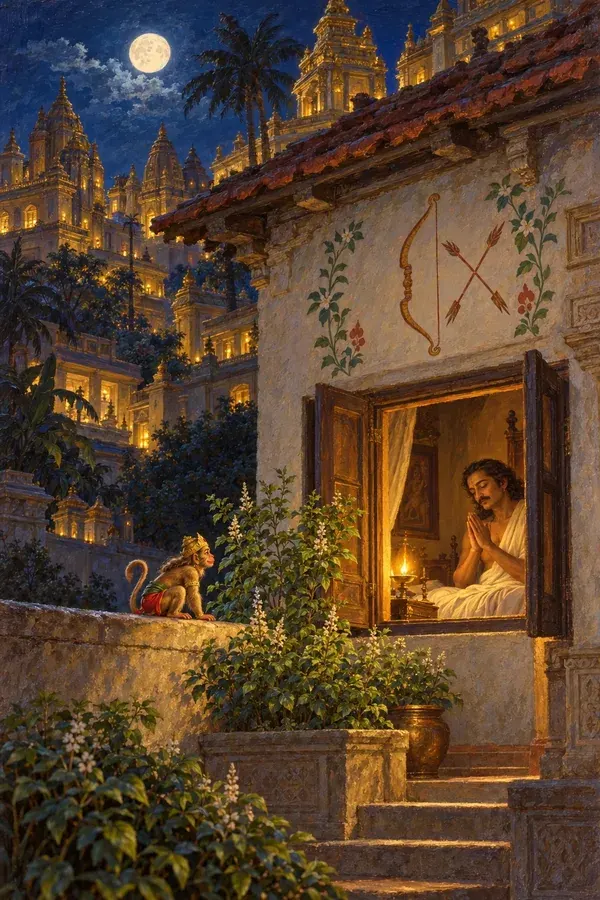
And this is in the middle of Lanka, the city Hanuman had just decided had no room for a good man. Tulsi introduces Vibhishana by his sleep and what came out of it, and leaves his brother and his rank for later.
Then Hanuman made a decision that cut across the night’s plan. I will make myself known to him, he thought, and press it on him myself, because a saint does no harm to the work. Whether the other man asks or not, Hanuman will make the first move. A spy’s first rule is to stay hidden, and he sets it aside at the one door where he judges the risk worth taking.
The brahmin’s form, and Vibhishana’s two questions
Hanuman took the form of a brahmin and called out to him. Hearing the voice, Vibhishana rose and came to where he was. He bowed, asked after the visitor’s welfare, and said: “Brahmin, tell me your story, and make it plain to me.” It is the episode’s third form: the mosquito, the very small body in the city, and now a brahmin. The smallest body for hiding, and for talking, a form before which even in a city of rakshasas a man will join his hands.
The order of Vibhishana’s welcome tells you the man. A stranger has turned up at his house in the night, in a city where every stranger is an enemy. He is bowed to and asked how he is before he is asked who he is.
Then come two questions. “Are you one of Hari’s servants? For my heart is filling with love. Or are you Rama himself, who loves the lowly, come to make me a man of great fortune?” The commentary hears in that last phrase a fortune brought to his own door. Both questions rest on one piece of evidence, the love rising in his heart. He tested the stranger from the inside.
The hope in the second question is the most touching thing in the episode. A man living in a city of rakshasas asks a stranger at his door in the night whether he might be the one he has been waiting for. Whoever has waited a long time for someone hears that person in every knock at the door.
Then Hanuman told him the whole story of Rama, and gave his own name last. As he told it the hair rose on both their bodies, and remembering Rama’s virtues, both their minds were lost in it. One is of the rakshasas’ line and one of the monkeys’. One lives in this city and one has come to learn its secrets. And the thrill ran through both of them at the same moment.
The poor tongue between the teeth
Now Vibhishana tells his own story, and the picture he draws of his life is one of the most memorable likenesses in the Manas. “Hanuman, hear how I live. I live here the way the poor tongue lives among the teeth. Dear one, will Rama ever be kind to me, knowing I have no one?”
The tongue spends its whole life between the teeth and stays whole, and what keeps it whole is a watchfulness that never rests. It neither fights the teeth nor runs from them. That is Vibhishana: in Lanka, of Lanka, and with his heart elsewhere. So his question is the smallest he could ask: whether a glance will ever come his way from the other side.
“This body of mine is tamasic, made of darkness, and no spiritual practice comes of it, and in my mind there is no love for those lotus feet. And yet, Hanuman, I have come to trust now, because without Hari’s grace one does not meet the saints.” The man who said a moment ago that his heart was filling with love now says the love is missing. Those who truly have it never count it as their own.
His proof comes from outside himself: this meeting, happening in his house in Lanka. That a saint has come is proof that grace has already come. He asked whether Rama would ever be kind to him, and answers himself before he has finished.
Rama’s way, and a low one counted
“Since Rama has been gracious,” Vibhishana said, “you have pressed this sight of yourself on me.” Hanuman answered: “Listen, Vibhishana. This is the Lord’s way: he always loves his servants.” The word for pressing comes round a second time. Hanuman had told himself he would press himself on this man. Now Vibhishana counts that very move as grace.
What follows is a second man setting himself down, lower than the first. “Tell me, what great family am I from? A restless monkey, low in every way. Whoever says our name at daybreak goes without food that day.” It is his reply to the body made of darkness, and he gives it by placing himself lower still.
Tulsi puts that line about the bad omen in his own hero’s mouth. The one who leapt the sea says that speaking his kind’s name in the morning costs a man his food for the day. Only someone entirely sure of where he stands can speak from that low.
“Friend, listen: that is how low I am, and Rama has been gracious even to me.” And as he said it, remembering Rama’s virtues, his eyes filled with water. The commentary makes clear they are Hanuman’s eyes. Vibhishana had called him dear one. Hanuman calls him friend. In a few lines the way they speak to each other has come down to level ground.
At the end the words run out and tears come. Even to me: that small phrase carries the episode. The one who counts himself low is counting how far grace has reached, and finding his own name on the list, his eyes fill.
Setting down one’s greatness
Two houses stand out in this episode. One is Ravana’s palace, too strange to describe, its master asleep in peace. The other bears the marks of a bow and arrow and has fresh tulsi growing at it. Hanuman reached both. The first gave him Ravana asleep and no sign of Sita. The second gave him a companion.
And his way in was smallness and remembrance from start to finish. On the hill he decided to become small and wait for night. At the gate he threw one punch, and only when his way was barred. Inside, he searched house after house with patience, and where there was talking to be done he changed his form to suit it. His strength was with him the whole time, and it came out exactly as often as it was needed.
Things often happen in this order in our own lives. The place that stops us is usually the outermost one, at the gate. The truth that changes us is usually already inside us, and comes back with a jolt, the way Brahma’s word came back to Lankini. And the companion we find is often in the house we took for one more house along the way.
The thing most worth learning is what two people do in the same hour. Vibhishana says he has nothing of his own, and Hanuman calls himself humbler still. As he says it his eyes fill. When two people set their greatness down at the same moment, a space opens between them, and a third name comes and sits in it. Inside the golden rampart of Lanka that night, this was the one house where that could happen.
The same story, elsewhere: Valmiki’s Ramayana, chapter 20: Entering Lanka, and the Sight of the City.
Source: the Gita Press edition of Tulsidas’s Ramcharitmanas, Sundarkand, doha 3 to 7, read with Hanuman Prasad Poddar’s Hindi commentary.