On this page
Suta turned toward the sages and said, “Now I will tell you the glory of that jyotirlinga of Kashi known as Vishveshvara, the one that destroys even the gravest of sins. To understand why one city on this earth should hold such a thing, you have to go back further than the city, and further than the earth. Settle your minds and listen closely.
Everything that appears before the eyes on this earth is nothing other than Brahman, the eternal and changeless reality whose very nature is being, consciousness, and bliss. Before there was anything at all to appear, there was only that. That one supreme Self, at rest in its own undivided awareness, was stirred one day by a single wish: to become many out of the one. Nothing outside it prompted the wish, there being nothing outside it. So that same supreme Self took on form and quality and was called Shiva. That Shiva then appeared in two forms, male and female. The one who became male took the name Shiva, and the one who became female was called Shakti. Everything that happens after this happens between those two.”
A City Set in the Void
Suta went on, “Those two, Shiva and Shakti, whose nature is consciousness and bliss, stayed unseen themselves and out of their own being fashioned two conscious principles, Prakriti and Purusha. Made, and left standing in an emptiness with no landmark anywhere in it. Yet the two of them found no mother or father before them, and they fell into deep bewilderment. At that very moment a voice from the formless Supreme came down through the sky, the first sound that emptiness had ever carried: let the two of you perform tapas, austerity, for from that tapas the highest and most excellent creation will unfold.
Prakriti and Purusha folded their hands and said, ‘Lord, there is no place anywhere for tapas. Where, then, are we to sit at this hour and perform the austerity you command? There is no ground beneath us and nowhere to set a foot.’
Then the formless Shiva, from the very essence of his own splendor, fashioned an auspicious and beautiful city, five kos across in every direction. That city was his own form, and it was stocked with everything one could need, so that nothing in it would ever have to be asked for. Having made it, he sent it to Prakriti and Purusha, and the city drifted through the sky and came to rest beside Purusha. It was the first place there had ever been, and it had no earth under it either.”
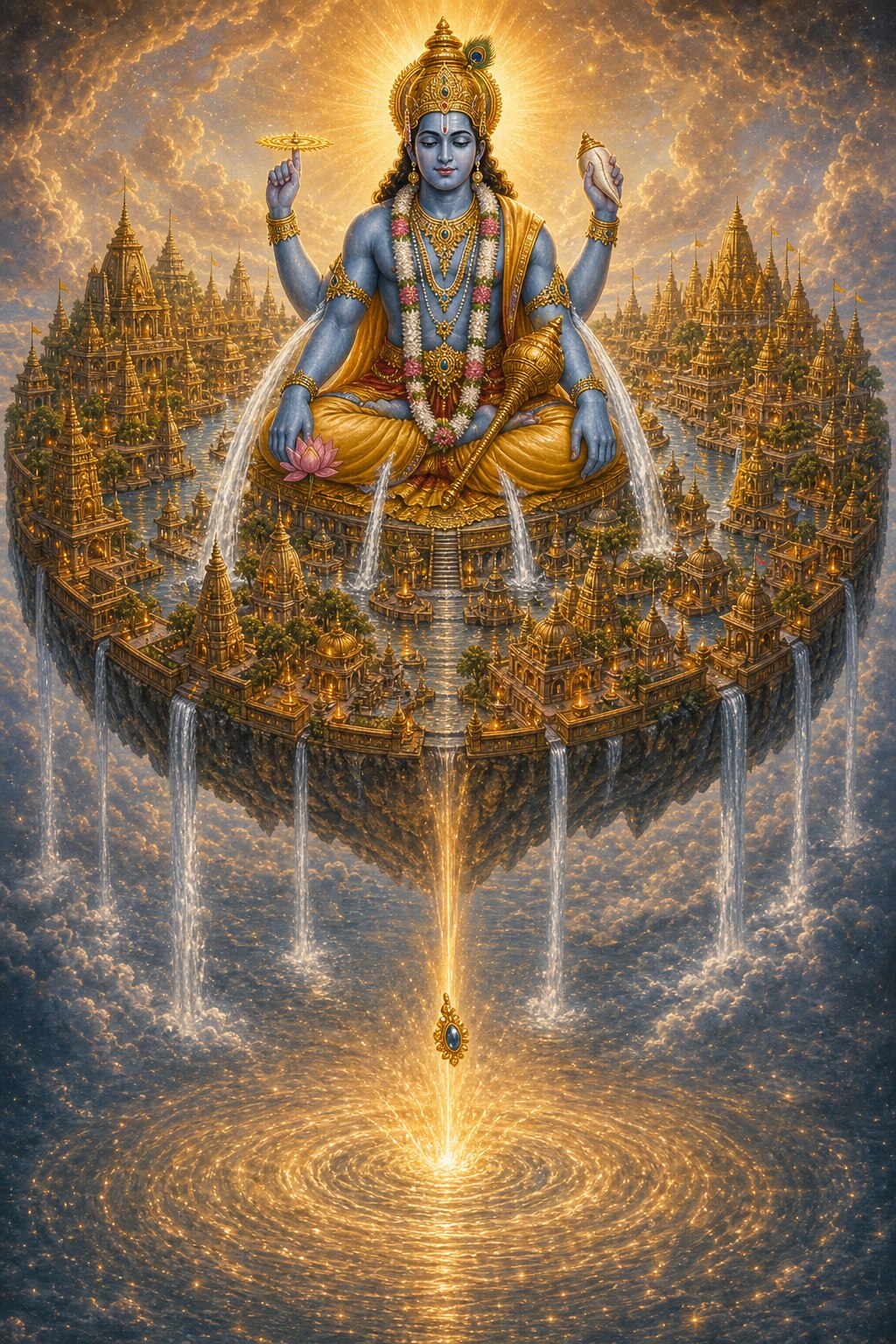
Purusha, who is Srihari, sat within that city and, longing to bring forth creation, began to meditate on Shiva. His austerity ran on for many years, in a city with nothing outside its edge to mark the passing of them. From the strain of it, countless streams of white water burst from his body, and they filled the whole empty sky until nothing else could be seen. Watching this astonishing sight, Srihari marveled within himself and began to shake his head, and with that motion a jewel from one of his ears slipped loose and fell. Where the jewel came down, that very spot became the great sacred pool known as Manikarnika. A pilgrim standing at its edge today stands where an earring landed before the earth existed.
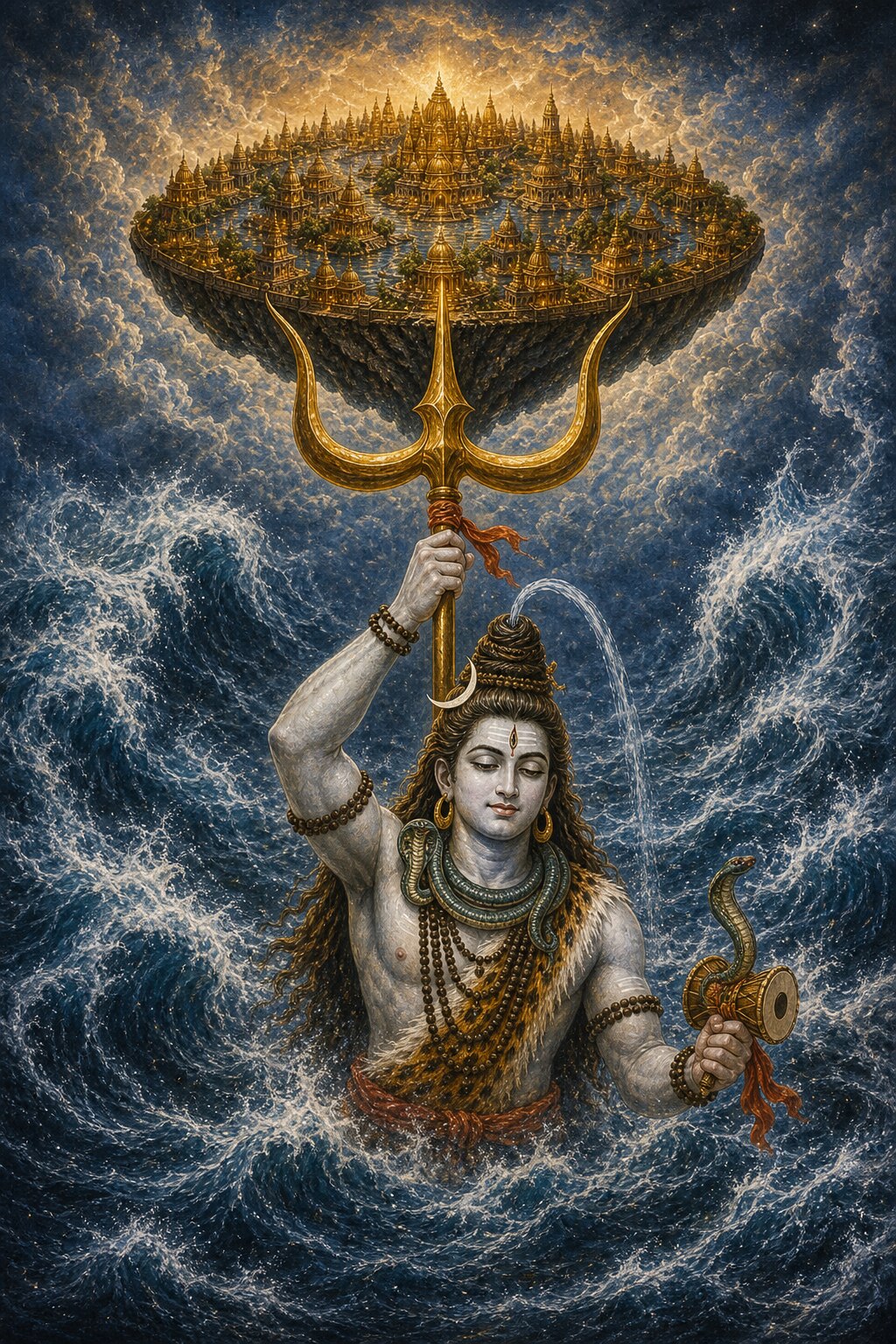
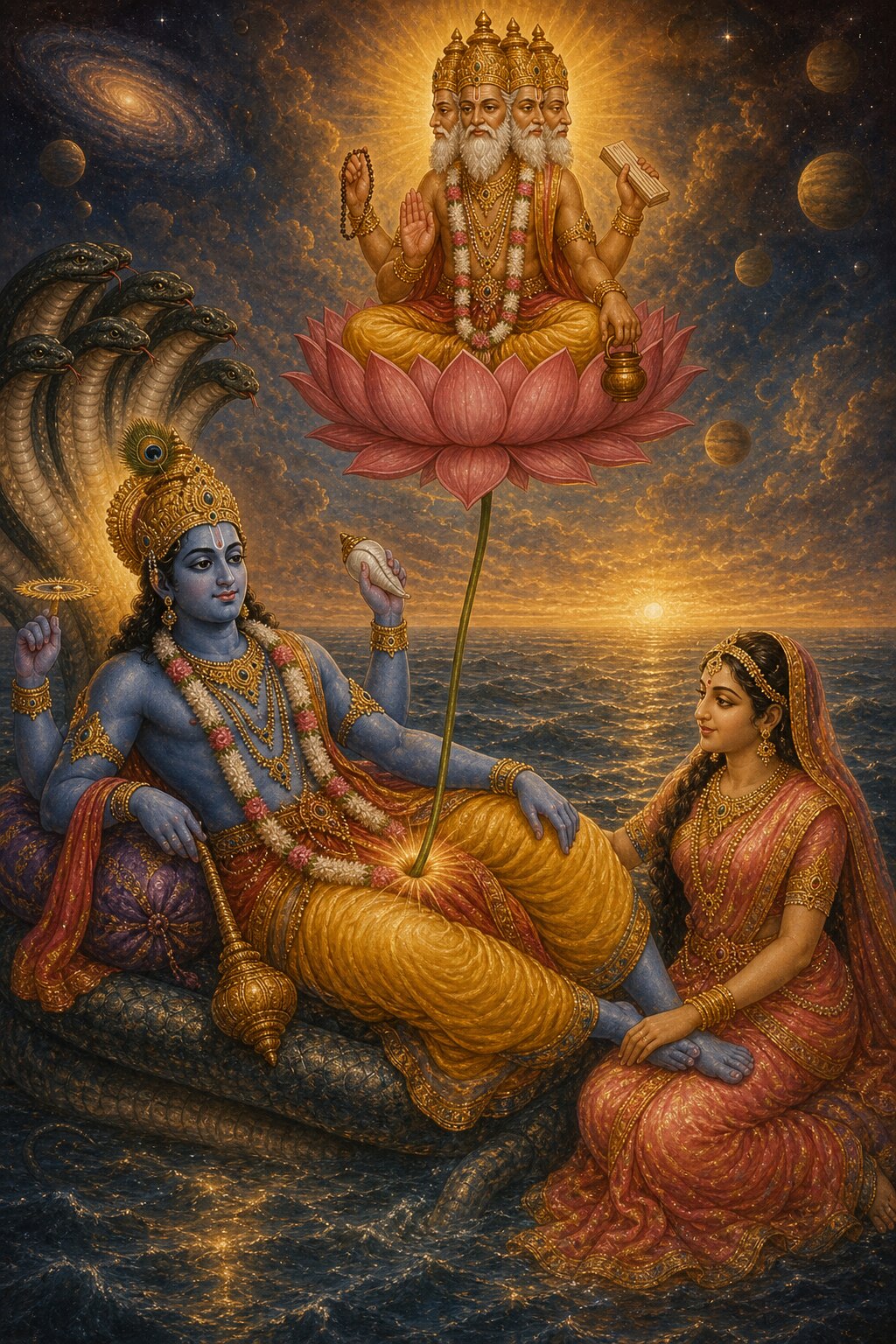
Now that same five-kos city began to sink and drift away in the swelling flood of water. Seeing this, the formless Shiva swiftly lifted it up onto his trident and held it above the flood on the three points of it. Meanwhile Srihari lay down to rest there with his consort Prakriti. From his navel a lotus then rose, and from that lotus Brahma was born, and in this too the command was Shankara’s alone. Having received Shiva’s order, Brahma began his wondrous work of creation, settled the fourteen worlds within the cosmic egg, and that cosmic egg spread across fifty crore yojanas, while the city that had come before all of it kept its own five kos.
Then Lord Shiva reflected, ‘The creatures bound within this cosmic egg by the noose of karma, how will they ever find liberation?’ With that thought he took Kashi down from his trident and set that liberating Panchakroshi, the five-kos city, here in this very world, and he told those born of his own parts that this place was never to be abandoned by them.
What Even the Deluge Cannot Destroy
Suta said, “When a single day of Brahma comes to its end and the whole world dissolves in deluge, even then this city of Kashi is not destroyed. The water takes everything else. At that hour Lord Shiva takes it up once more upon his trident, and when Brahma shapes a new creation, he sets it down again on this same earth, in the same place, as though nothing had happened to the world at all. Because it draws away the burden of one’s deeds, this city came to bear the name Kashi. Within it the Avimukteshvara linga is forever enthroned, planted there by Shiva himself, and it grants liberation even to the worst of sinners.
Great sages, all the other holy places that grant liberation give only the lesser freedoms, salokya and the rest, a home in the god’s own realm, a place near him, a likeness to him. In Kashi alone the highest liberation of all, the one called sayujya, union with the divine itself, comes to living beings with ease. For those who have no refuge anywhere else, this Varanasi is their refuge. This Panchakroshi, brimming with immense merit, wipes away the sin of crores of killings. Here even the gods long to die, so what need is there to speak of anyone else. Brahma praises this city, and so do the siddhas, the yogis, the sages, and Vishnu himself.”
The Enthroning of Vishveshvara
Then the lord of all creatures, sattvic within and tamasic without, renowned by the name Valagni Rudra, who though formless is none other than Shiva made manifest in form, bowed again and again and said, “Vishvanath, Maheshvara, we are yours alone, of this there is no doubt. Be merciful to your son, and let the mother Parvati be here beside you. Master, for the good of the world, remain here always. We beseech you: stay here and deliver all living beings.”
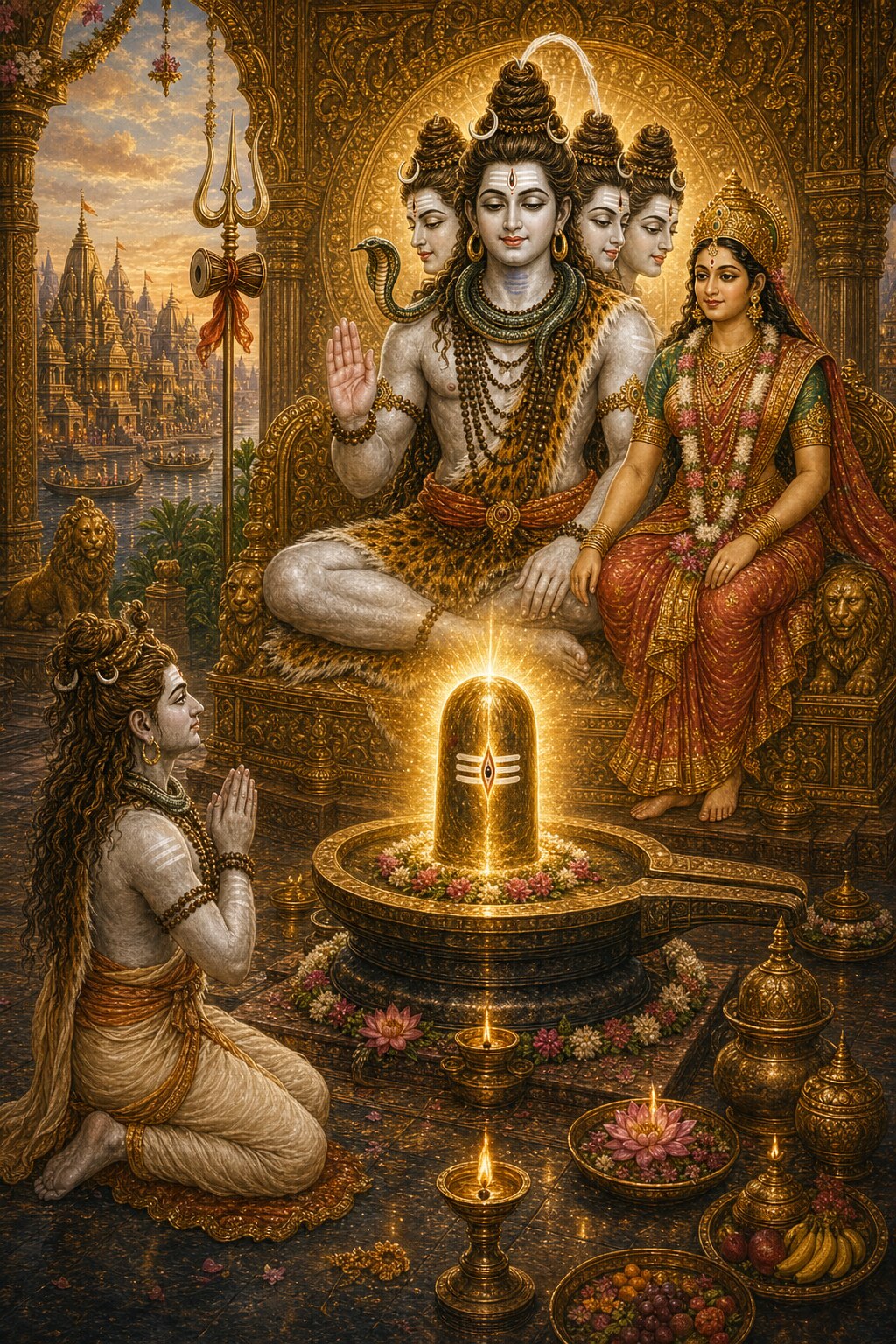
Avimukta, whose mind and senses were mastered, wept as he asked, and asked again, and would not leave off asking; seeing this, Lord Shiva was filled with delight. Then Avimukta said, “God of gods, Mahadeva, you are the master of all three worlds, and Brahma and Vishnu and the rest attend upon you. Lord, accept this city of Kashi as your capital. We, the Avimukta ones, will sit here forever in steady meditation upon you, seeking liberation. You alone grant release and fulfill every desire; there is no other. And so, Supreme Lord, be seated here always with Uma. Sadashiva, carry every living being across the ocean of worldly existence. Do this work for those who love you. I ask it of you again, and again.”
When Vishvanath had been petitioned in this way, Lord Shankara took his seat there for the welfare of the world. He it was who became Vishveshvara, he who was called Vishvanath, and there, for all time, he became the supreme goal of every living being. From the day Shiva came to Kashi, Kashi became the first place on earth.
The Secret of Kashi
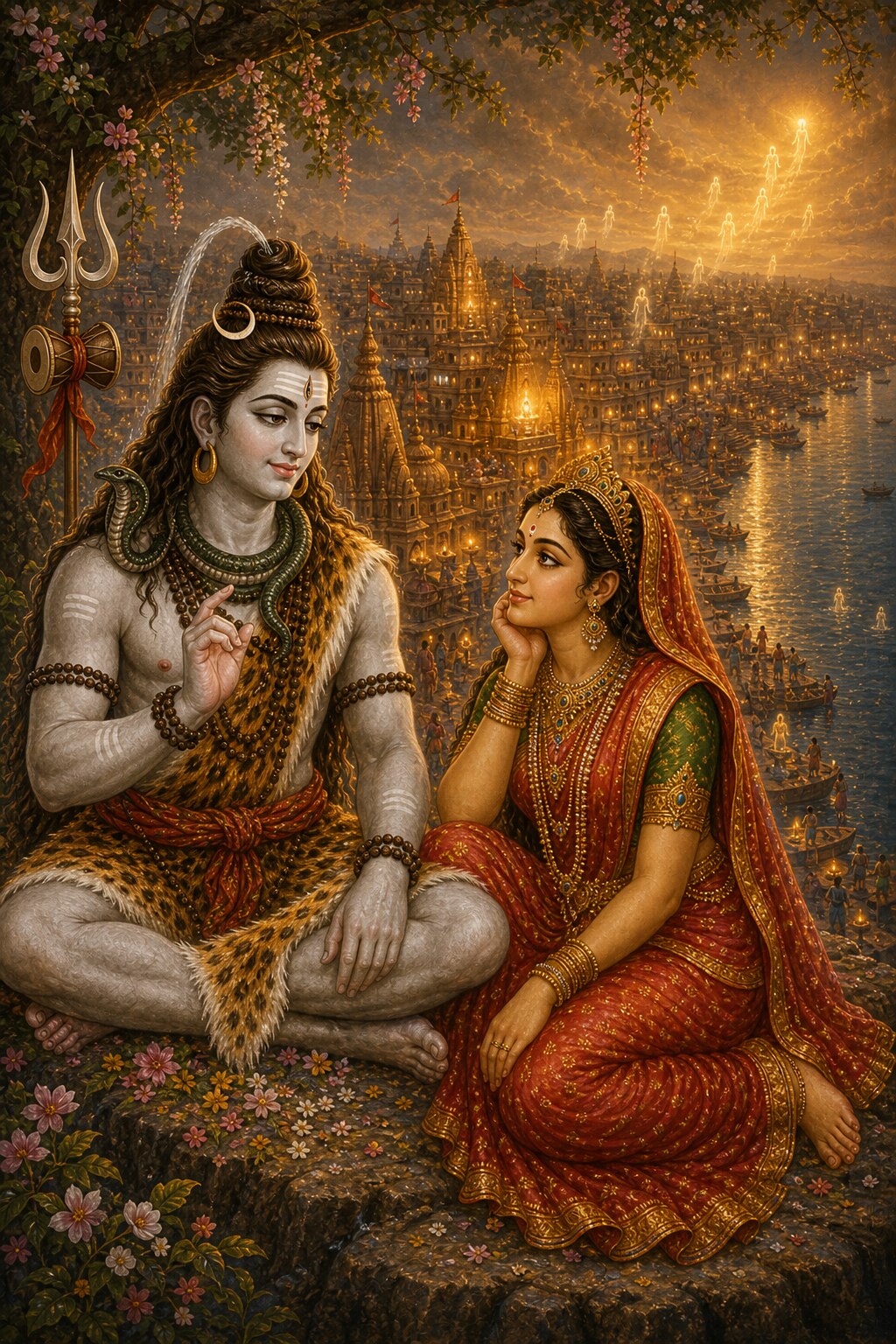
Once Lord Shiva himself confided this secret to Uma: “Maheshvari, dwelling in the city of Varanasi has always been dear to me. Varanasi is my hidden shrine, and it sets people free by every road there is. Hear the reason I leave all else and live in Kashi. The one who is my devotee and the one who knows my essence, both alike surely come into their share of liberation. For them no pilgrimage is needed. Deeds prescribed and deeds forbidden weigh the same for them. Know them to be liberated while still alive. Wherever they lay down the body, they attain liberation at once. That word is mine, and it is settled.
Devi, listen with a settled mind to one special truth of this Avimukta tirtha. People of every varna and every stage of life, whether child, youth, or elder, if they give up their breath in this city, are freed without fail, of this there is no doubt. A woman, pure or impure, unmarried or wed, widowed or barren, suffering in her season or newly delivered of a child, whatever her condition may be, if her death comes within this region she surely becomes worthy of liberation. Born of sweat, born of egg, sprung from the soil, or born of the womb, the lice and the birds and the trees and the beasts and the men of this place alike, every creature that dies here attains the goal that is found nowhere else.
The one who dies here needs no knowledge and no devotion, no ritual works and no charity, no sacrament and no high birth, no meditation, no repetition of the names, no worship, no breeding. Whatever manner of death comes to the person who dwells in this region of ours, liberation is certain. It is better to commit a thousand sins and walk this city as a ghost than to perform a thousand sacrifices elsewhere and reach heaven having never once come here. Beloved, this divine city of ours is more secret than the most secret of things. Even Brahma and the other gods do not know its glory. The essence of dharma is truth, the essence of moksha is equanimity, and the essence of all regions and all pilgrimage places is this very Avimukta.
In this city of Kashi the devotees of Shiva have set up many a shivalinga, and every one of them fulfills each wish of the heart and grants liberation. The region that spreads five kos in each of the four directions is the one called Avimukta, the same five kos that once rode the void with nothing under it. Should a person free of sin come to their end here, liberation reaches them at once. But the sinner who dies here first passes through the ordeal of the kayavyuha, the reconstituting of the body, lives out the life of a child, and only then, somewhere further along, attains liberation. And the one who commits sin within this very Avimukta region wins release only after enduring the torment of Bhairava for thousands of years, once the full fruit of the sin has been suffered. A person should realize how this goes, and worship Avimukta properly.
Even if a hundred crore kalpas pass, no one is released without first tasting the fruit of the deeds they have done. Deeds that are only evil bring hell, deeds that are only good bring heaven, and the two together bring birth as a human being. An abundance of good deeds earns a fine birth, an abundance of evil deeds a lowly one, and when both good and evil deeds wear away together, the living being wins true liberation. The deeds that bind are of three kinds: the store heaped up out of earlier lives, the deeds a person is doing now, and the portion already ripening, which is the life being lived at this moment. Only the one who has already, at some earlier time, taken darshan of Kashi with reverence comes here to meet their death. Whoever comes here and bathes in the Ganga destroys the karma being made in the present and the store piled up behind it, though what is destined by past deeds cannot be shed without being lived through, and this is certain. Yet for the one whose end comes in Kashi, even that destined burden wears thin. Every other tirtha on the earth is easy to reach; Kashi is hard. So much so that whoever brings even a single Brahmin to dwell in Kashi will himself, when the chance to dwell in Kashi comes, gain liberation.”
Suta said, “Sages, in this way I have told you the vast glory of Varanasi and the Vishveshvara linga, which bestows great merit and grants both worldly enjoyment and liberation. A hundred years of telling would not come to the end of it; this much I have been able to say.”
Source: Shiva Purana (Gita Press, Sankshipta Shivapurananka), Kotirudra Samhita