On this page
The sages looked toward Sutaji and said, “Sutaji! You have just told us the wondrous story of the Shivalinga called Mahakala, protector of his devotee, and hearing it has only sharpened our hunger for these lights. Now, of your kindness, introduce us to another Jyotirlinga. Tell us the tale of how the auspicious Lord took form as the linga who dwells at the Omkara shrine, the one that destroys the sins of whoever comes to it.”
Omkareshwar: Vindhya’s pride and his penance
Sutaji spoke, “Listen with love. This is a matter of long ago. The divine sage Narada went to Shiva at a place called Gokarna and began to serve him with deep devotion. When some time had passed, he left there and traveled to the mountain-king Vindhya, whose range lies across the whole land and holds the north apart from the south, and out of whose slopes the rivers come down. Vindhya honored him with great respect and worshiped him. Yet a certain notion had settled in the mountain’s mind, that in his own domain everything was present and nothing was ever wanting. Carrying this pride, he came and stood before Naradaji.”
Hearing Vindhya’s boastful words, Narada, who unmakes pride, drew a long breath and stood there in silence. He said nothing at all, and the nothing did more work than an answer would have. The mountain asked, “What lack have you found in my domain, that you sigh so heavily?” Naradaji said, “Brother! It is true that you have everything here. And yet Mount Meru rises far higher than you. The spread of its peaks reaches to the very worlds of the gods, while no part of your summit ever comes near that height.” Having said this, Naradaji went back by the same road he had come, leaving the sentence standing where he had set it down.
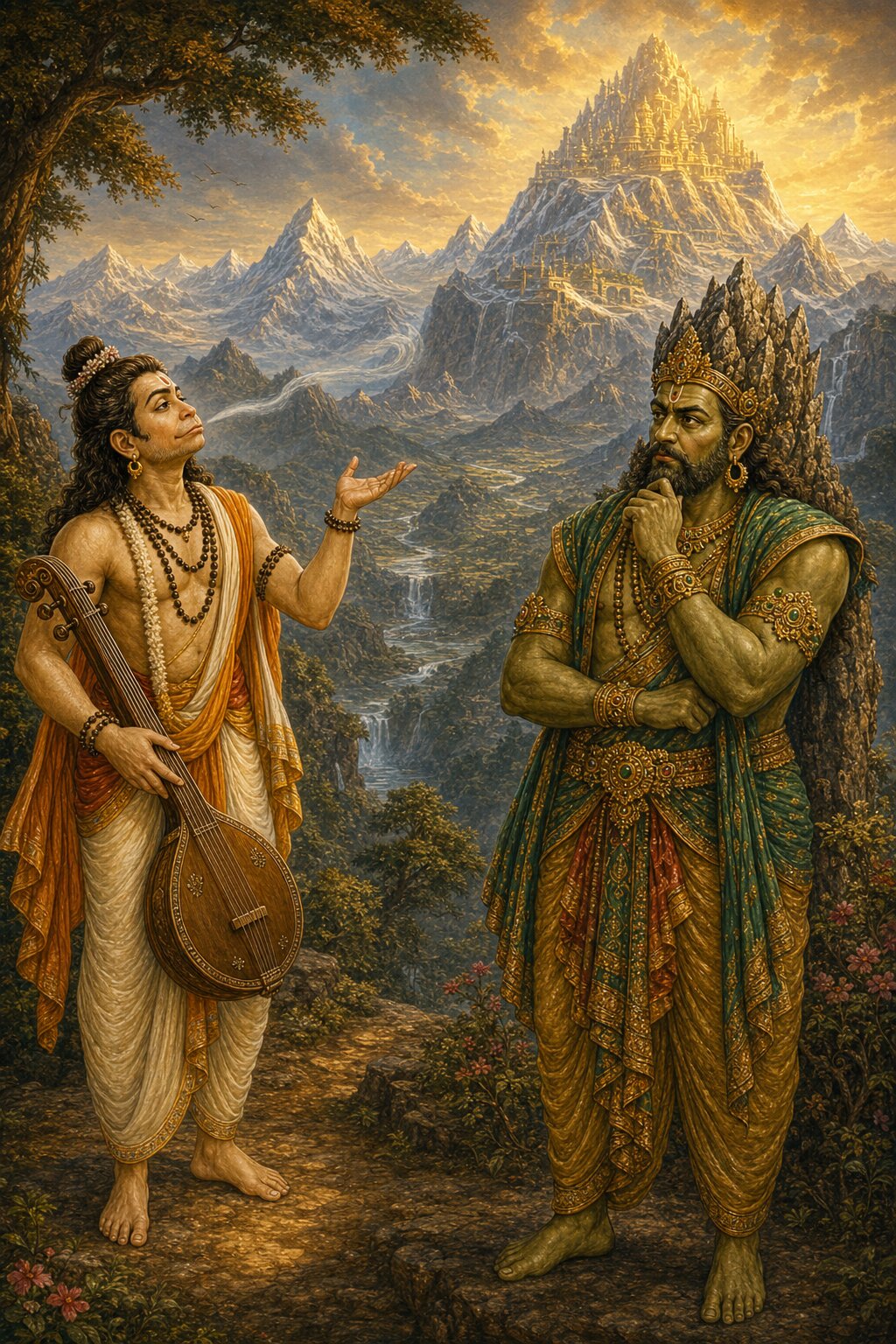
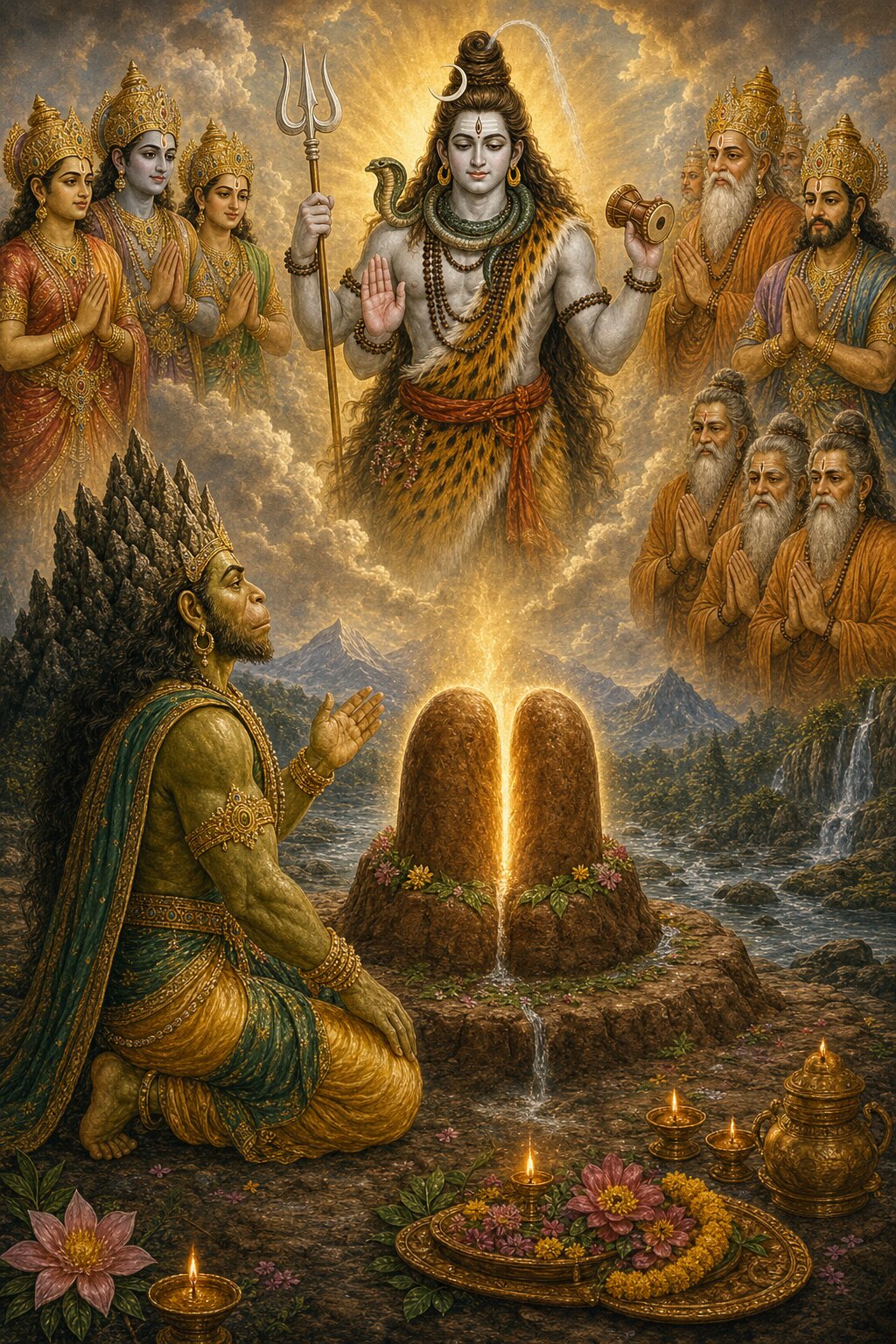
Vindhya burned with grief in his heart. “A curse upon this life of mine,” he kept thinking. Then he resolved, from the depth of his heart, that he would now practice penance in worship of Vishwanatha Shambhu. He went with a glad heart to the very place where Omkara himself abided, fashioned there an earthen image of Shiva with his own hands, and for six months stayed so absorbed in the worship of Shambhu that he did not stir from his spot. A mountain does not move in any case; this one had found the single thing worth not moving for. Seeing Vindhya’s penance, the Lord of Parvati was pleased. He revealed to Vindhya that form which even yogis rarely attain, and said, “Vindhya! We are pleased with your penance. Ask any boon your heart desires. We grant our devotees whatever they long for.”
Vindhya said, “Lord of the gods, Shambhu! You are ever tender toward your devotees. If you are pleased, grant me the intelligence that will bring my purpose to fruition.” Shiva weighed those words before he answered them. This mountain’s mind is clouded, he thought, and what he asks for is the kind of gift that gets turned against other people; what shall I give him, so that the blessing lands on him and the harm lands nowhere? Lord Shambhu gave him that excellent boon even so, and said, “Mountain-king! Do as you wish.” At that very moment the gods, and the sages of pure heart, arrived there. They worshiped Shankaraji and prayed, “Lord! Stay fixed here and dwell among us.”
Hearing this prayer of the gods, the supreme Lord Shiva was pleased, and for the happiness of all people he gladly did as they asked. The single Omkara linga that stood there divided into two forms. The Sadashiva who dwelt within the sacred syllable Om became renowned by the name Omkara; and the linga established in the earthen image took the name Parameshwara, which is also called Amaleshwara. In this way Omkara and Parameshwara, these two Shivalingas, became granters of their devotees’ desired ends, giving both the good things of this world and release from it. The gods and sages worshiped them both, received their boons, and returned each to his own abode; and Vindhyachala, its longed-for purpose accomplished, was content for all time, and the despair he had carried away from that conversation with Narada left him. The one who worships Shankara in this manner never again enters a mother’s womb and attains the end he desires, of this there is no doubt.
Popular tradition ties Omkareshwar to King Mandhata; the samhita told here traces the shrine to Vindhya’s penance.
Kedareshwar: the worship of Nara and Narayana
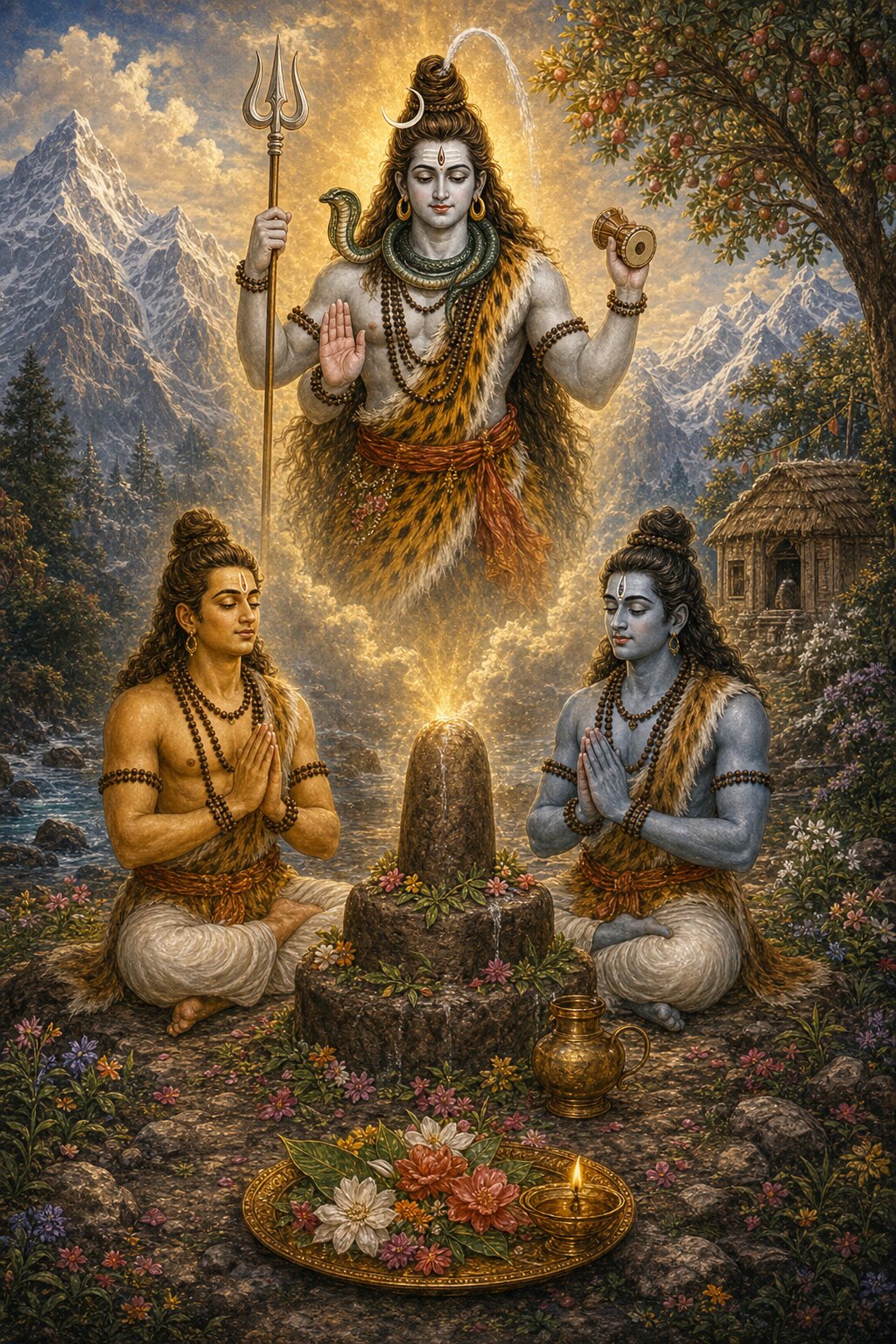
Sutaji says, “Brahmins! The two incarnations of Lord Vishnu named Nara and Narayana practice penance at the Badarikashrama shrine in Bharatavarsha, high on the Himalaya where the snow begins. The two of them fashioned an earthen Shivalinga and prayed to Lord Shambhu, asking him to abide within it and accept their worship. Shiva, who yields to his devotees, came each day into that earthen linga out of love for the two of them and received their worship. Day after day, and for a very long stretch of days, the god came when he was called.”
So many days passed in this way. One day the supreme Lord Shiva, well pleased, said, “We are greatly content with your worship. Ask a boon of us, the two of you.” The two who could have asked for anything at all asked for nothing of their own. Then Nara and Narayana, wishing the welfare of all the worlds, said, “Lord of the gods! If you are pleased and wish to grant us a boon, then take your place here to receive worship in your own form, and abide here always to give your devotees darshan.”
The Lord accordingly stayed there, known by the name Kedareshwar, seated on the Himavat in the form of the Jyotirlinga. To the devotee who sees and worships him with faith, he grants the object of that devotee’s longing, and he takes away the miseries and the terrors such a person carries in. For the one who worshiped Kedareshwar with a heart full of devotion, sorrow grew scarce even in dreams. The gods and the sages of long ago worship him there still and get what they came for, and the people of Badarikashrama have their wishes from him every single day, which is why he is called the one who never fails a devotee’s desire. The devotee who, near the Shivalinga there, offers a band marked with the form of Shiva (a bracelet or bangle) sees that band-adorned form, is freed of all sins, and becomes liberated while still living. The one who makes the pilgrimage to the Badari forest also attains liberation in life. Beholding Nara-Narayana and Kedareshwar, a person becomes an heir to moksha, of this there is no doubt. Those who set out on the pilgrimage with devotion to Kedareshwar and give up their lives along the way also attain moksha; for them the road itself finishes the work. And the one who reaches the Kedara shrine, worships Kedareshwar with devotion, and drinks the water there is never born again. For this reason one should make the pilgrimage to Nara-Narayana and Kedareshwar in this Bharatavarsha with a heart full of devotion. He is the lord of the whole universe, and the lord of this land in particular.
The story of Kedar that most people know is the one joined to the Pandavas; this samhita traces the shrine’s origin to the worship of Nara and Narayana.
Bhimashankar: the end of Kumbhakarna’s son
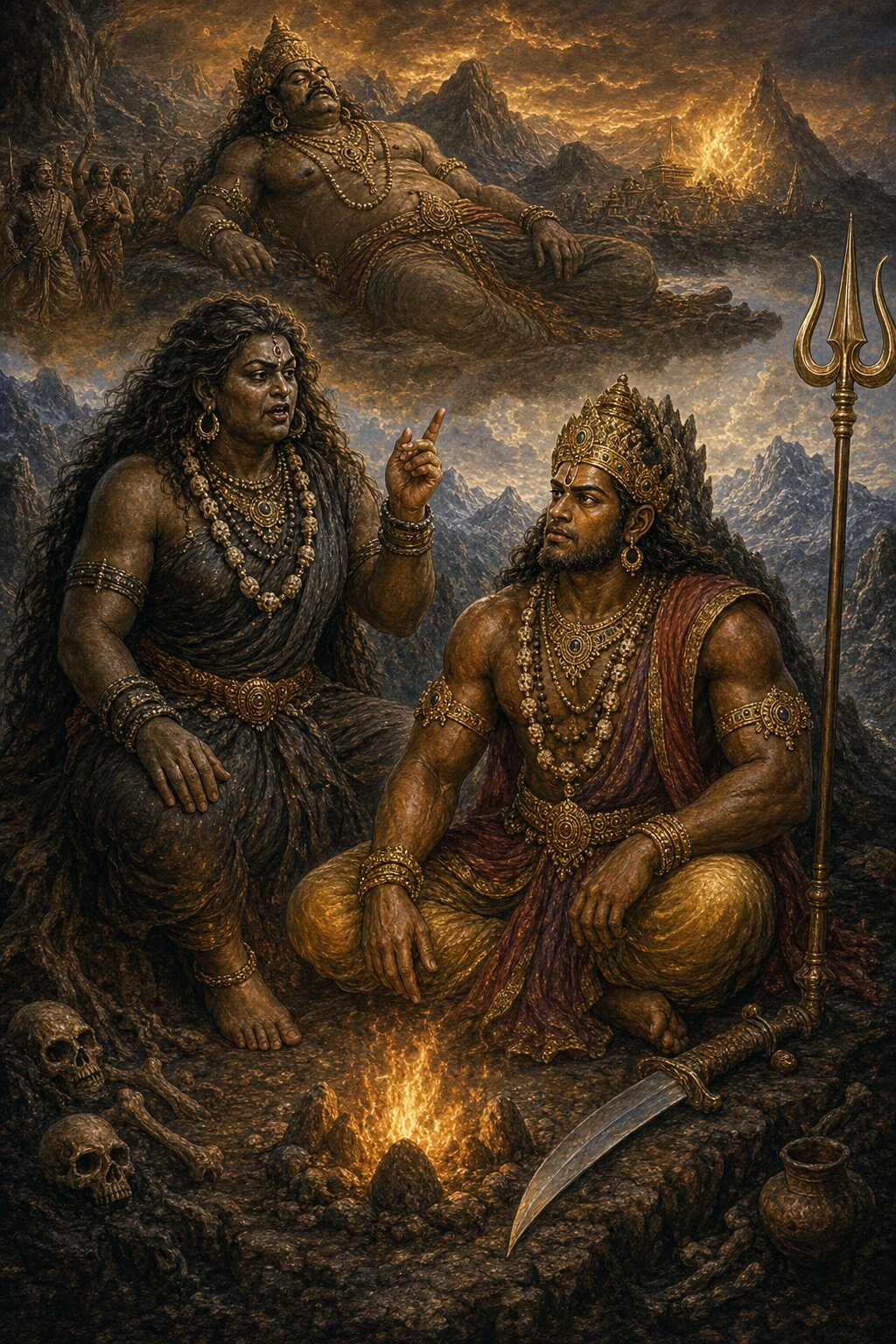
Sutaji spoke, “Now we tell the glory of the Bhimashankar Jyotirlinga. In the days of old, a rakshasi named Karkati lived alone upon the Sahya mountain. Her son was Bhima, terrible and mighty in valor, a boy growing up on a mountainside with no one to look at but her. While he was still a child he asked his mother, “Mother! Where is our father? Why do you live alone? I wish to know the truth of it.””
Karkati said, “Son! Kumbhakarna, the younger brother of Ravana, was your father. That warrior of great strength was killed by Shri Rama along with his brother. My father’s name was Karkata and my mother’s name was Pushkasi. Viradha was my husband, whom Rama killed in an earlier age. When my lord was gone, I lived with my parents. One day the two of them went to make their meal of Sutikshna, a disciple of Agastya. He was a great ascetic and a noble soul; in his anger he burned my parents to ash. From that time I began to live alone upon this mountain in sorrow, with nobody left anywhere who was mine. In that same season the mighty Kumbhakarna came here, took me by force, left me where I lay, and went back to Lanka, a city these eyes have never seen. After this you were born. You too are great in strength and valor, like your father. Now I pass my days here with you as my only support.”
Hearing Karkati’s words, Bhima grew enraged and began to think, “How should I deal with Vishnu? He killed my father, my grandparents died at the hands of his devotee, and he killed Viradha as well. If I am truly my father’s son, I will surely bring pain to Shri Hari.” Resolving thus, Bhima went off to perform fierce penance. He practiced austerity for a thousand years to please Brahmaji, and all the while he meditated in his heart upon his chosen deity. He stood on one foot with both arms held over his head and his eyes fixed on the sun. As the years ran on, a fire came out of his head and began to scorch the gods where they sat, until they went to Brahma and begged him to go and give the demon whatever he asked for, before heaven itself was burned through. Then Brahma, grandsire of the worlds, came to give him a boon and said, “Bhima! We are pleased with you. Ask whatever boon you wish.”
Bhima said, “Lord of the gods! You who are seated on the lotus! If you are pleased, grant me today such strength as has no equal anywhere.” Brahmaji gave him this desired boon and returned to his abode. His head turned by the boon, the rakshasa came home, bowed to his mother, and said, “Mother! Now see my strength. I will bring great suffering upon Indra and the other gods, and upon Shri Hari, who comes to their aid.” Saying this, Bhima first conquered Indra and the other gods and drove them out from their several stations. When Shri Hari came at the gods’ prayer to take their side, Bhima defeated him too in battle. The gods had bought their own defeat, and they had bought it to keep from being singed.
Then he set about conquering the whole earth with all his might. First he marched against Sudakshina, king of the land of Kamarupa. A terrible battle was fought there, and by the power of Brahma’s boon the wicked Bhima defeated Maharaja Sudakshina, a devotee of Shiva and a great hero in his own right whom nothing short of that boon could have brought down. He seized the king’s entire realm and all he owned, bound him in fetters, struck him, and cast him into a solitary prison. Even there the righteous king fashioned a fine earthen image of Shiva for the Lord’s pleasure and gave himself to worship and hymns. He praised the Ganga and made his ablutions in her name, a cell having no river in it, and he would meditate upon Shiva in due form and recite the five-syllable mantra joined to the pranava, and no hour of his day was ever left over for anything else; and his virtuous queen Dakshina too worshiped that earthen linga with great love. The two, husband and wife, remained devoted with undivided hearts to the worship of Shankara.
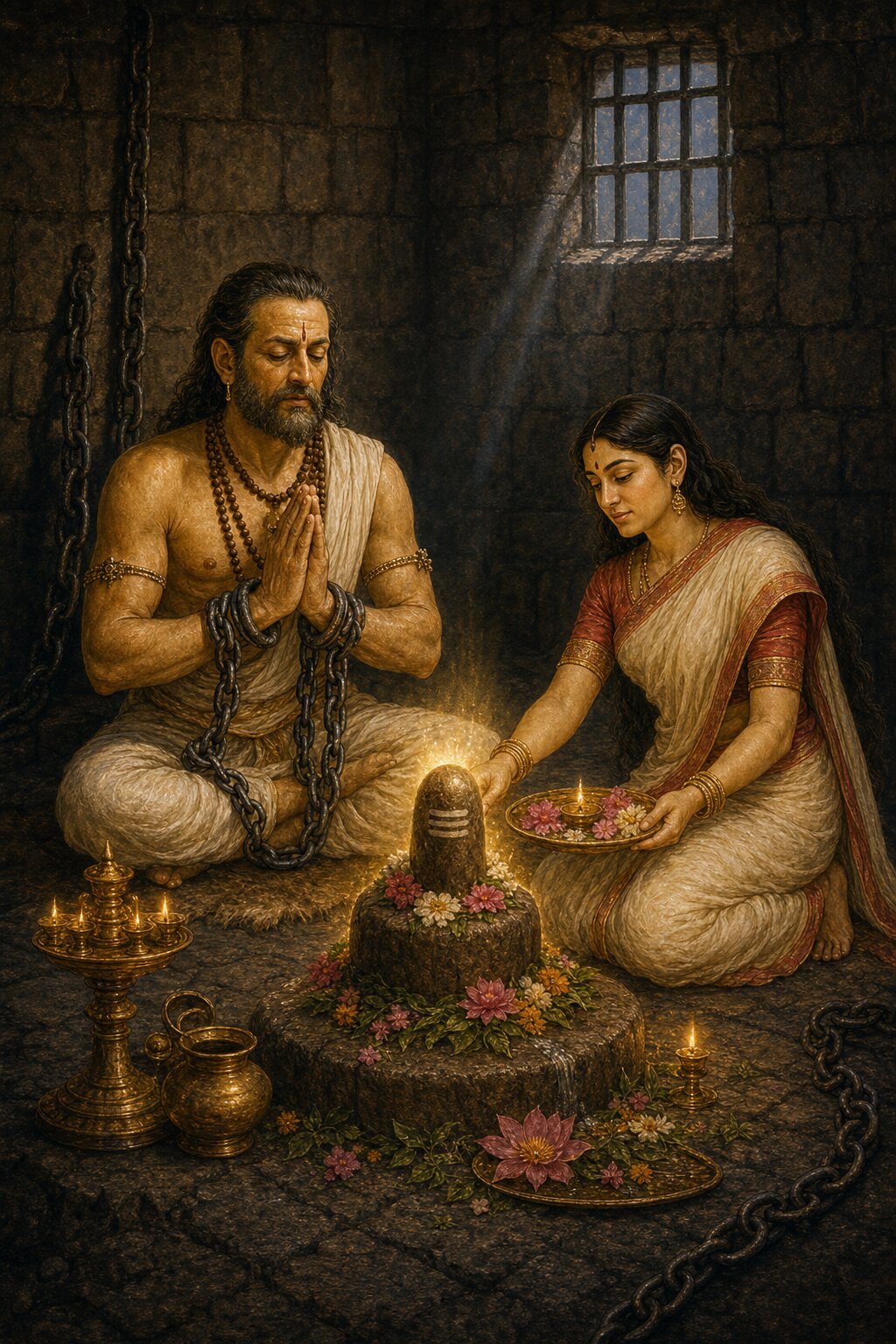
Meanwhile the rakshasa, sunk in the pride of his boon, began to abolish yajnas and all the other duties of dharma, telling everyone, “Whatever there is, give it all to me.” Every offering that had ever gone up to a god was to be handed across to him instead. He took a vast army of rakshasas and brought the whole earth under his sway, and wiping out the dharma taught by the Vedas, the shastras, the smritis, and the Puranas, he began to enjoy everything for himself. Indra and the gods were harried, the sages were driven into misery, and the brahmanas were pushed out of the world altogether. Then the afflicted gods and sages, with Brahma and Vishnu at their head, went to the bank of the Mahakoshi, made an earthen image there, and began to worship and praise Shiva. Lord Shiva, well pleased, said, “Gods and great sages! We are pleased. Tell us, which task of yours shall we accomplish?”
The gods said, “Lord of the gods! You are the inner ruler of all; nothing is unknown to you. Yet you have asked, and so we will say our grief out loud, and you will look at us with a merciful eye. Bhima, the mighty son of Karkati begotten by Kumbhakarna, has grown powerful through Brahma’s boon and torments us without cease. Of your grace, destroy this rakshasa who brings us such misery, and do not delay.” I shall kill him, Shambhu said. Then he said, “Sudakshina, king of Kamarupa, is our finest devotee. Carry a single message from us to him, and your whole task will soon be done. Tell him this: King! Go on worshiping us with love; the wicked Bhima, grown strong through Brahma’s boon, who has insulted every one of you, we shall surely slay, of this there is no doubt.”
The gods, well pleased, delivered that message to Maharaja Sudakshina, and in their joy returned each to his own hermitage. Lord Shiva, for his part, together with his ganas, stayed there in secret near the king, for the welfare of the world and the protection of his devotee. The king never learned how close his help was standing. He went on meditating before his earthen linga, entrusting the burden of his protection to Shiva, saying, “We worship only Lord Shiva, master of all that moves and does not move.” In the meantime someone went and told the rakshasa that the king was performing some rite of purashcharana to bring about his death.
Hearing this, the rakshasa seized a sword and rushed at the king, and standing over him he demanded to know what was being worked there. The king gave him the truth and nothing besides: I worship Lord Shiva, who protects his devotees. At that Bhima spoke harsh words of contempt against Lord Shankara. Your Shiva is known to me, he said, his body shaking with rage; my own uncle kept him about the house as a servant. Put these images away, or I will lay my hand on this lord of yours. The king told him that he would never forsake Shiva and that Shiva would never forsake him. So the rakshasa laughed, threatened him, and swung his sword at Shiva’s earthen linga. The sword had not even touched the linga when Lord Hara himself appeared out of it and said, “We are Bhimeshwar, and we have appeared to protect our devotee. It has long been our vow that we always protect our devotee.” Saying this, Shiva broke the rakshasa’s sword into two pieces. When the rakshasa then hurled his trident, Shambhu shattered that trident into hundreds of pieces. After this there followed so fierce a battle between him and Shankara that the whole world was thrown into turmoil.
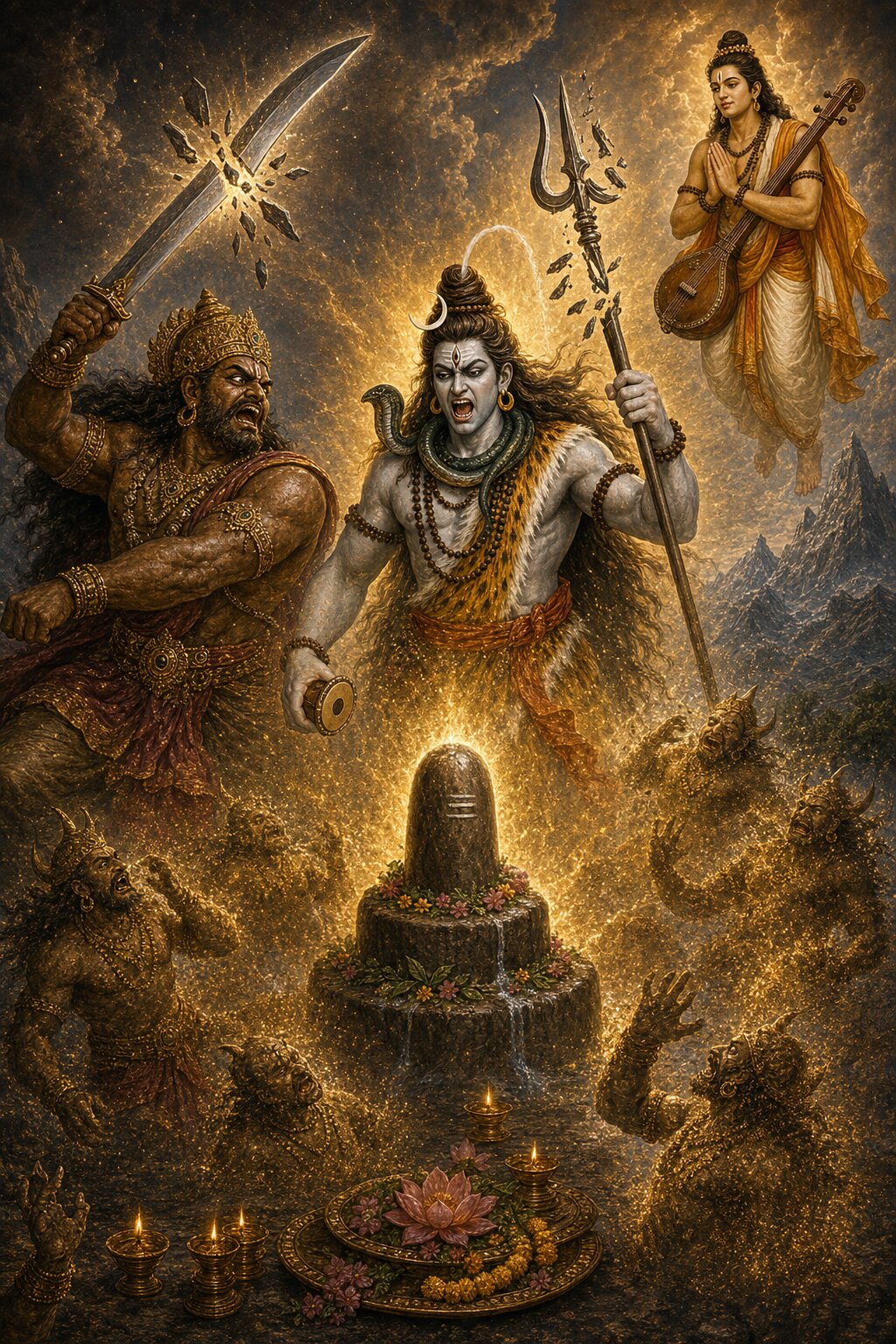
The earth shook, the seas and the mountains heaved, and the gods who had asked for all this began telling one another that their prayer to Shiva had been wasted. Then Naradaji came and prayed, “Maheshwara, you who cast people into illusion! My Lord! Forgive me. What need is there to swing an axe to cut a blade of straw? Destroy this creature at once.” At Naradaji’s prayer, Lord Shambhu with a single roar, the sound Hum and nothing else for a weapon, burned Bhima and all the rakshasas to ash in that very instant. Afterward not even the ash of Bhima could be found, and the fire of that anger ran on from forest to forest. Then by Shankara’s grace, Indra and the other gods and the sages found peace, and the whole world was made well again.
At that time the gods, and the sages in particular, prayed, “Lord! Dwell here always to give happiness to the people. This country is held to be an ill-favored one, and those who come here mostly meet with sorrow. But by your darshan the welfare of all here will be secured. You shall be renowned by the name Bhimashankar and will fulfill everyone’s desires. This Jyotirlinga of yours shall be forever worthy of worship and shall ward off every calamity.” Hearing their prayer, Shiva, benefactor of the world and tender toward his devotees, gladly took his place there. He had come into that country for the sake of one king in one cell, and he stayed for everyone who would ever walk through it.
Source: Shiva Purana (Gita Press, Sankshipta Shivapurananka), Kotirudra Samhita