On this page
A Hundred-Year Drought on Brahmagiri
In the south rises a mountain called Brahmagiri. There the great sage Gautama had sat in tapas for ten thousand years, his supremely devout wife Ahalya beside him. In those days a drought so terrible fell upon that country that for a full hundred years not a single drop of water came down. Nowhere across the land could you find so much as one damp leaf with any juice left in it. When water, the very foundation of life, vanished from sight, the sages, the people, the beasts, the birds, and the deer all began to wander in every direction. Those who stayed put spent that horrible time sitting in meditation, holding their breath, there being nothing else left to hold.
Gautama undertook six months of severe tapas and won the favor of Varuna, lord of waters. Varuna appeared and told him to ask for a boon. The sage prayed for rain. Varuna said, I cannot send rain against the will of the gods; ask me for something else and I will grant it. Then give me water, Gautama said, since water is the one thing that is yours to give: divine water, everlasting. Dig a pit here, said Varuna. Gautama dug one a single hand deep, and Varuna filled it with water that would never run dry.
Varuna spoke over that small pit before he left. Let the water in it never fail, he said; it will carry your name across the earth, and every gift, rite, penance, and offering made here will be imperishable. From that inexhaustible water, rice and grains of every kind sprang up and swayed all around Gautama’s hermitage. Hearing the news, sages came from distant places and settled there with their wives, sons, and disciples. The forest that had lain empty through the years without rain grew green and lush once more. Men who are kind, free of pride, generous, and masters of their senses are made this way; they cannot bear the suffering of others. Four such men are the pillars that hold up the earth.
Deceit, a Cow, and Cow-Slaughter
But where does happiness ever stand still? It began at the water. Gautama’s disciples came to the pit with their pots and the wives of the other sages pushed in front: we are the wives of sages, we draw first. Ahalya came herself, quieted them, and carried the water to her husband, and the women went home and told their husbands a version of the morning with very little of the morning in it. So some of the sages who had settled there fell under the sway of their wives and burned with envy at Gautama’s standing. They worshiped Ganesha and asked for a boon: that by some means Gautama be driven out of the hermitage. Ganesha, the lord, said, Sages, what you are doing is not right. To wound, without cause, one who has done you a kindness is to summon your own ruin. In the days of famine this man arranged water and kept you alive; to deceive him now can never be proper. Ask for some other boon. But they would not relent. Then Ganesha, bound by the will of his devotees, said, What you have asked will come to pass; whatever is fated to follow will follow. Saying this, he vanished.
Gautama knew nothing of any of it. He went on with his rites and his days, his mind at ease. Then one day, into Gautama’s field where the rice stood ripe, Ganesha himself came in the form of a frail cow, staggering and faltering, and began to graze on the grain. Gautama happened by. Moved by kindness, he took a handful of straw and shooed the cow away. The straw had barely touched her when the cow dropped where she stood and gave up her life. The sages and their wives hidden behind cover cried out the instant they saw it, what has Gautama done. Gautama too stood speechless. He called Ahalya and said in sorrow, Devi, what has happened here, the sin of cow-slaughter has fallen on me; Shiva himself must be angry with us, and where are we to go now?
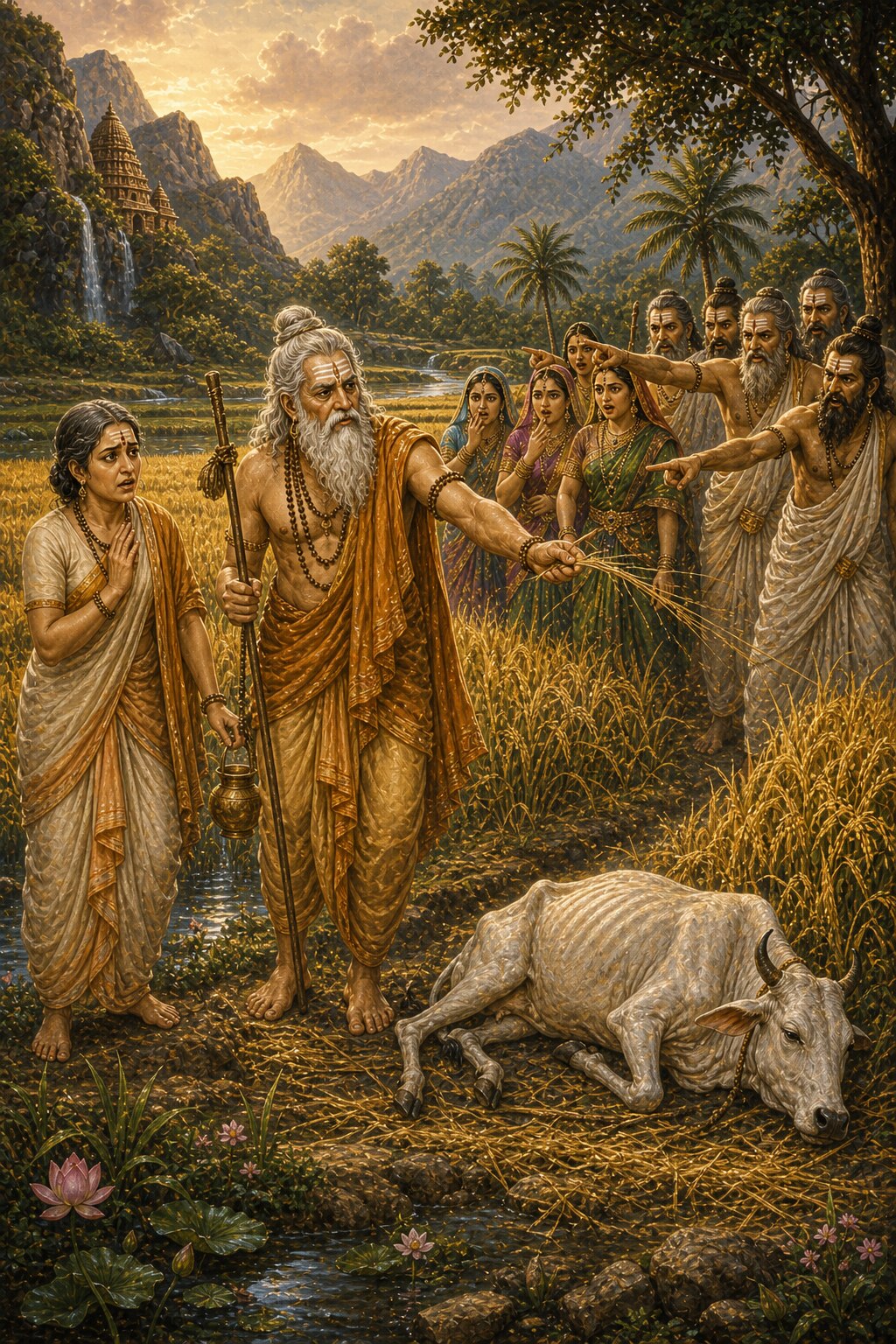
Now those wicked Brahmins turned their harsh words on Ahalya as well, and stones came with the words. Your face is not fit to be looked at, they told him; a man who sees a cow-killer’s face has to go and bathe in his clothes. Sinner, killer of the cow, take your family and go elsewhere from here; as long as you remain in this hermitage, neither the fire nor the ancestors will accept the offerings we make. Gautama moved off a kos away and built a new hermitage with their leave, yet even there they kept forbidding him to perform yajnas and rites. He carried it for half a month. Then he stood at a distance, bowed, and asked with great humility for a way to purify himself. They said nothing at first, drew apart to confer, and came back with this: Proclaim your sin aloud and circle Brahmagiri; then bring the Ganga here and bathe in her waters; fashion ten million earthen lingas and worship Mahadeva; only then will you be delivered.
The Ganga Descended, Tryambak Appeared
Gautama bowed his head and accepted this hard decree. With his wife he fashioned earthen lingas and performed tapas so intense that Lord Shiva appeared, Parvati and his ganas with him. Shankara, bearing his trident, said, Great sage, your devotion pleases me deeply; ask for a boon. Gautama clasped his feet and had one thing to ask: Lord, make me sinless. You are blessed, Shiva said, and sinless already; these knaves cheated you. How would a man be a sinner when the sight of him makes others sinless? Then the sage spoke up for the men who had ruined him. They did me a great service, he said; without it, how would I ever have come to see you? Lord of the gods, whatever the council of elders pronounces cannot be undone, so what has happened has happened; if you are pleased, give me the Ganga and do this world a great service. Shiva called him blessed and said that those deceitful sages would never attain deliverance.
Then Shankara gave Gautama the essential waters of earth and heaven, along with all that remained of the water Brahma had poured at his own wedding. That water took the form of a woman of surpassing beauty and stood before him. Gautama praised her and said, Ganga, you have purified all the worlds; now purify me too, for I am falling into hell. Shiva said to the Ganga, Devi, purify the sage. I will wash him and his people clean and go home again, she answered, and that is the truth I am telling you. Then Shiva said, do not return at once; stay here until the twenty-eighth Kali Yuga of Vaivasvata Manu. The Ganga said, Maheshwara, only if my glory is greater than that of all rivers, and if you too remain here with Ambika and the ganas, will I stay upon this ground. Shiva said, Ganga, I am not apart from you; even so, as you have asked, I will remain fixed here.
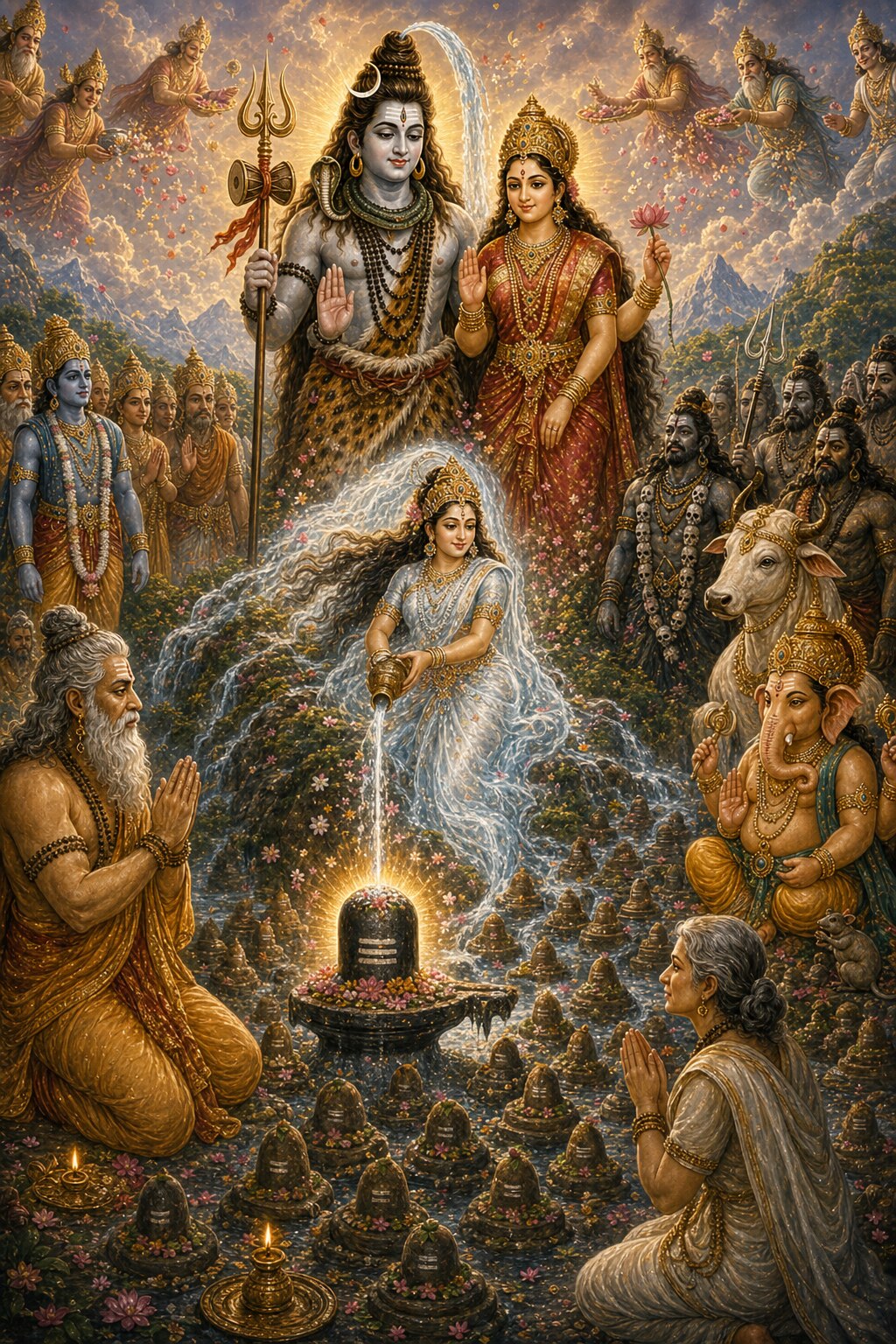
At that moment the gods, the ancient sages, and many sacred tirthas arrived. Raising cries of victory, they worshiped Gautama, the Ganga, and mountain-dwelling Shiva, and when they were told to ask for a boon they prayed that the two of you remain here forever for the good of both worlds. Prove me greater than all of you, said the river. So the gods gave their word: whenever Brihaspati enters the sign of Leo, all the tirthas, lakes, rivers, and gods would come to the bank of the Gautami to bathe. For eleven years they take on the sins of everyone who bathes in them, and this is the water they would come to for their own washing. While they are here, the places they left behind lose their sanctity until they return. So this Ganga became famed by the names Gautami and Godavari, and the radiant linga of Shiva was called Tryambak. Whoever with devotion beholds, worships, and salutes this linga is freed from every sin.
Vaidyanath and the Pride of Ravana
Now hear the story of the Vaidyanatheshwar linga. Ravana, king of the rakshasas, of the line of Pulastya, who forever paraded his own arrogance, at first worshiped Shiva on Kailasa. He kept at it a long while and Shiva was not pleased. So he went south of the Himalaya, dug a deep pit in the earth, installed a fire in it, set Shiva beside him, and gave himself over to a threefold penance: through the summer he sat between five fires, through the rains he lay on bare ground, through the winter he stood in water. None of it moved Shiva. So Ravana began to worship with his heads, cutting them off one at a time and offering them into that fire; when nine were gone and his hand was on the tenth, Lord Shiva appeared as a mass of splendor, set every severed head back without pain, and gave him strength no one could match. Winning that grace, Ravana folded his hands and said, Lord of the gods, be pleased; I will carry you to Lanka. Fulfill this wish of mine, for I have come to your shelter. Shankara, in some hesitation, said, King of the rakshasas, hear my weighty words: carry this excellent Shivalinga home with devotion, and wherever you set it down upon the ground, there it will become fixed; of this there is no doubt.
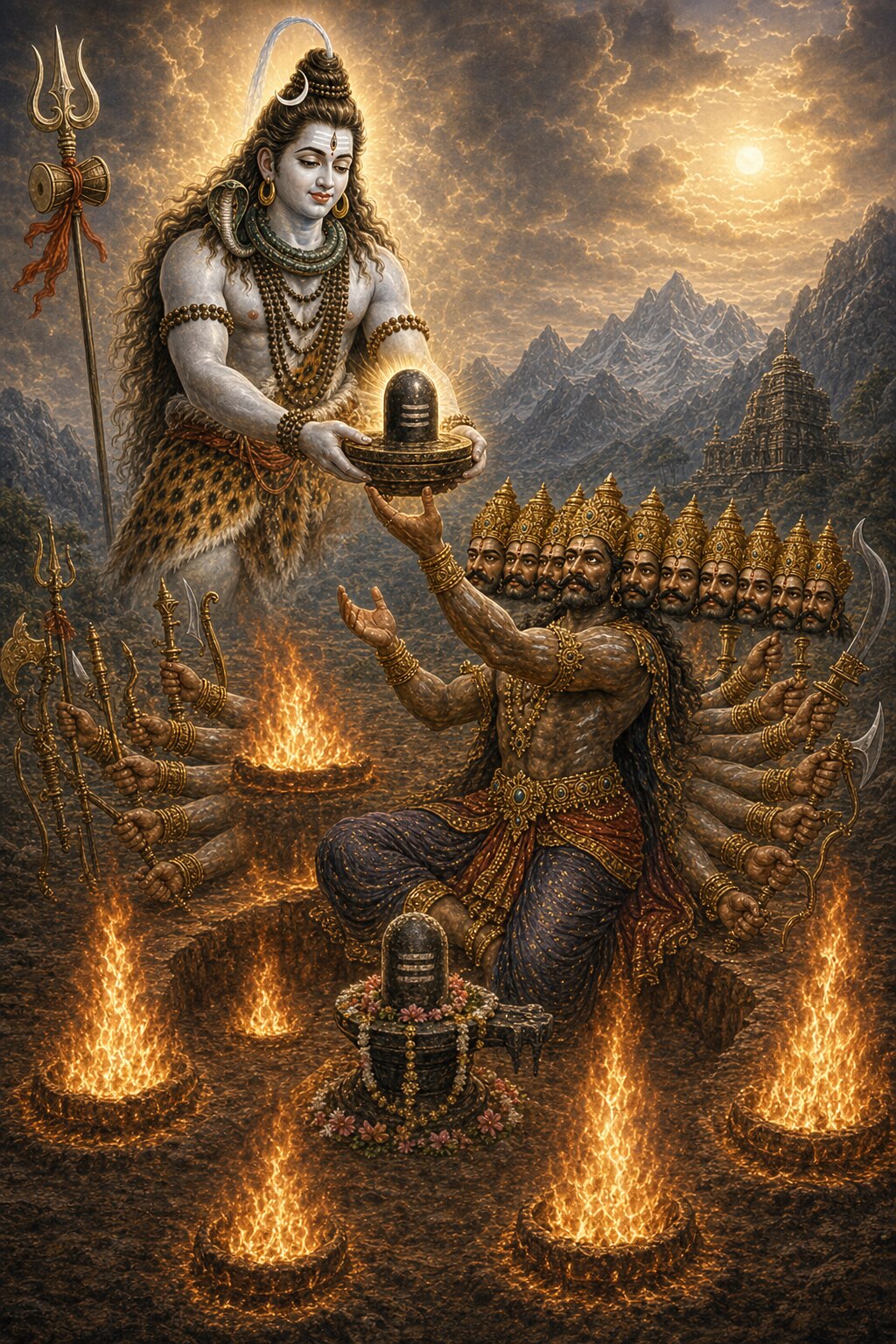
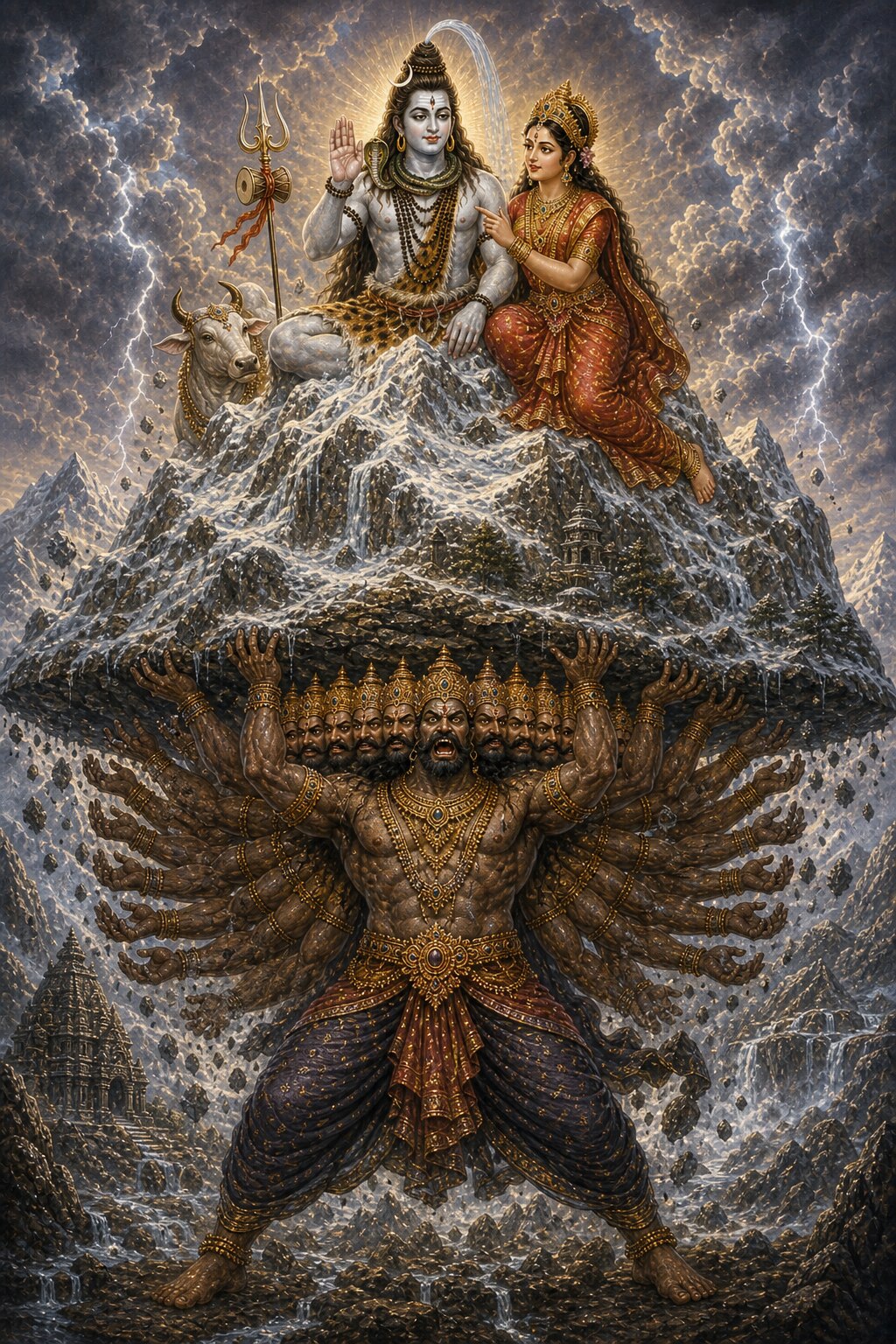
And so it happened. This divine linga, for the good of all the worlds, became fixed on that very spot. Brahma and Vishnu and the gods came down to it, worshiped it, consecrated it, and gave it the name Vaidyanath, the lord of physicians, for the physician’s work he had done on those ten heads; then they bowed to it and went back to heaven. Ravana, having won Shiva’s finest boon, returned home. There he joyfully told Mandodari all that had passed. Hearing the news, Indra and the other gods grew alarmed at what this enemy of the gods might now do with Shiva’s boon. They sent Narada. Narada said to Ravana, if Shiva’s boon has truly borne fruit, then lift up Kailasa and see. The idea appealed to Ravana. He wrenched Kailasa up from its base, and the mountain shook, and everything standing on it was thrown about and mixed together. Then, at Girija’s word, Mahadeva, knowing Ravana for the proud creature he was, cursed him: this vast conceit in his strength is worthless; a hero who will crush the arrogance of these arms will soon descend into this world. Even hearing this, Ravana went home content. The episode of the boy that circulates among the people does not appear in the abridged telling followed here; the linga simply becomes fixed on the spot and is called Vaidyanath.
Nageshwar: Daruka and Supriya
Last, hear the tale of the Nageshwar linga. On the shore of the western sea lay a rich forest sixteen yojanas across. Parvati had entrusted its care to a rakshasi named Daruka, whose boon was such that wherever she went, the whole forest went with her, its earth and its trees and all. This Daruka lived there with her powerful husband, the rakshasa Daruka, and spread terror among living creatures. These evildoers roamed about destroying yajnas and dharma. The afflicted people went to the great sage Aurva and told him their sorrow. Save us, they said, or the wicked Daruka will finish us; the light of Shiva burns in you like a fire, and the rakshasas run at the sight of you. Aurva pronounced a curse: if these rakshasas harmed living beings on the earth or wrecked yajnas, in that very instant they would lose their lives.
When they heard of this curse, the gods marched against the rakshasas. The rakshasas were caught in a bind: if they fought, the curse would kill them; if they held back, they would be defeated and killed all the same. Then Daruka the rakshasi said, by Bhavani’s boon I can carry this whole forest wherever I wish. Saying this, she raised a cry of victory to the goddess, rose like one of the winged mountains of old, and plunged the entire forest, just as it was, into the sea. Now the rakshasas, fearless beneath the water, set about tormenting living creatures. They did not set foot on the earth again, for fear of the sage’s word, and the terror that had been on the land moved onto the water.
One day many boats full of people passed that way. The rakshasas seized them all, bound them in chains, and cast them into prison. Among those captives was a vaishya named Supriya, the leader of that company and a supreme devotee of Lord Shiva. Wearing sacred ash and rudraksha beads, Supriya would take no food without first worshiping Shiva. Even in the prison he taught his companions the worship of Shiva and the making of the earthen linga, and those who knew nothing of the rite simply chanted Namah Shivaya and meditated on Shankara. Six months went by like this in that cell. Supriya even began to receive the darshan of Shiva, and knew that what he offered was being taken. One of Daruka’s people saw that shining form standing there and carried the report back. Learning of this, Daruka the rakshasa came in a fury and sent his rakshasas rushing to kill Supriya. Distraught with fear, Supriya, meditating on Shiva with steadfast love and chanting his name, cried out, Lord of the gods, Shankara, protect me; you are everything I have.
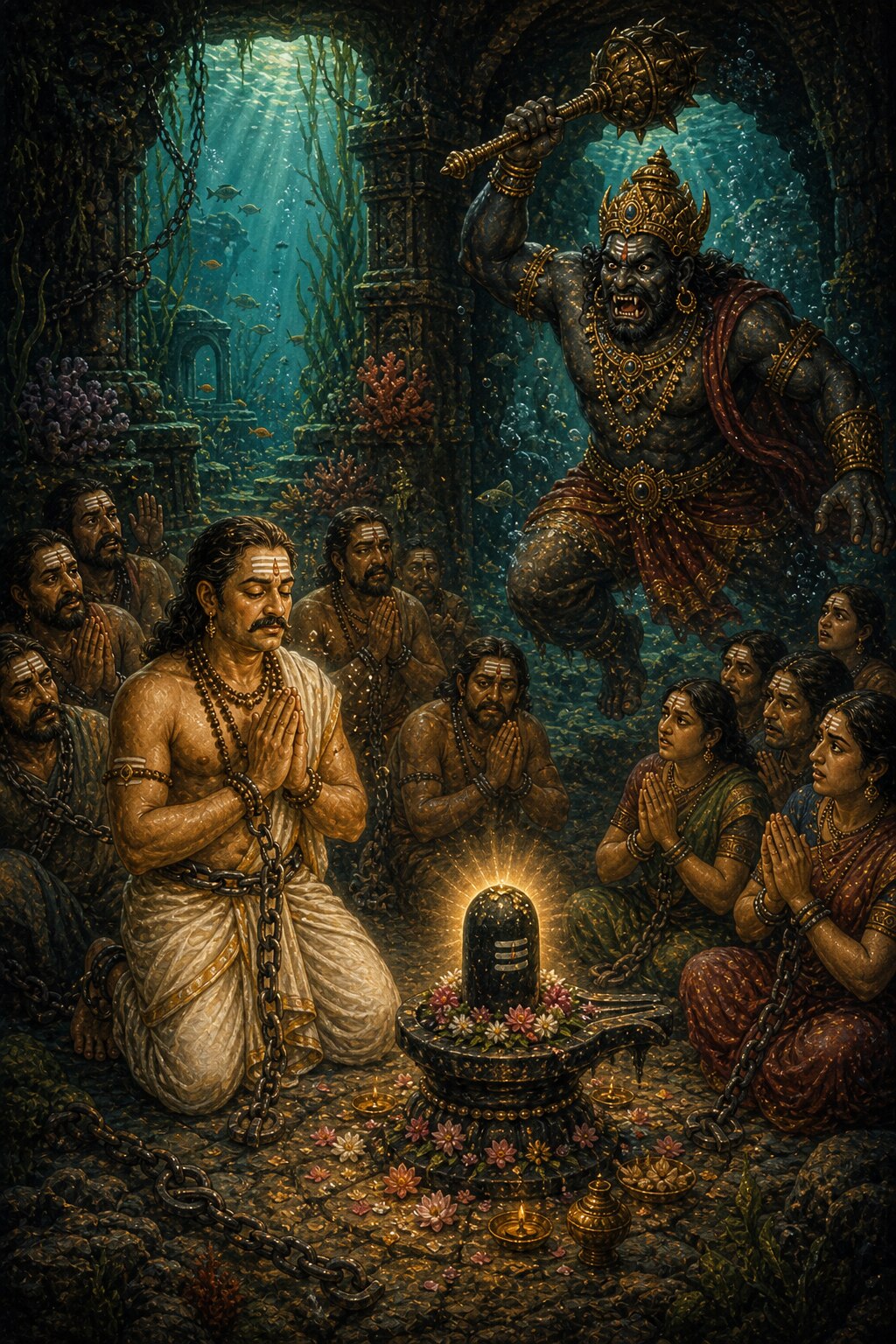
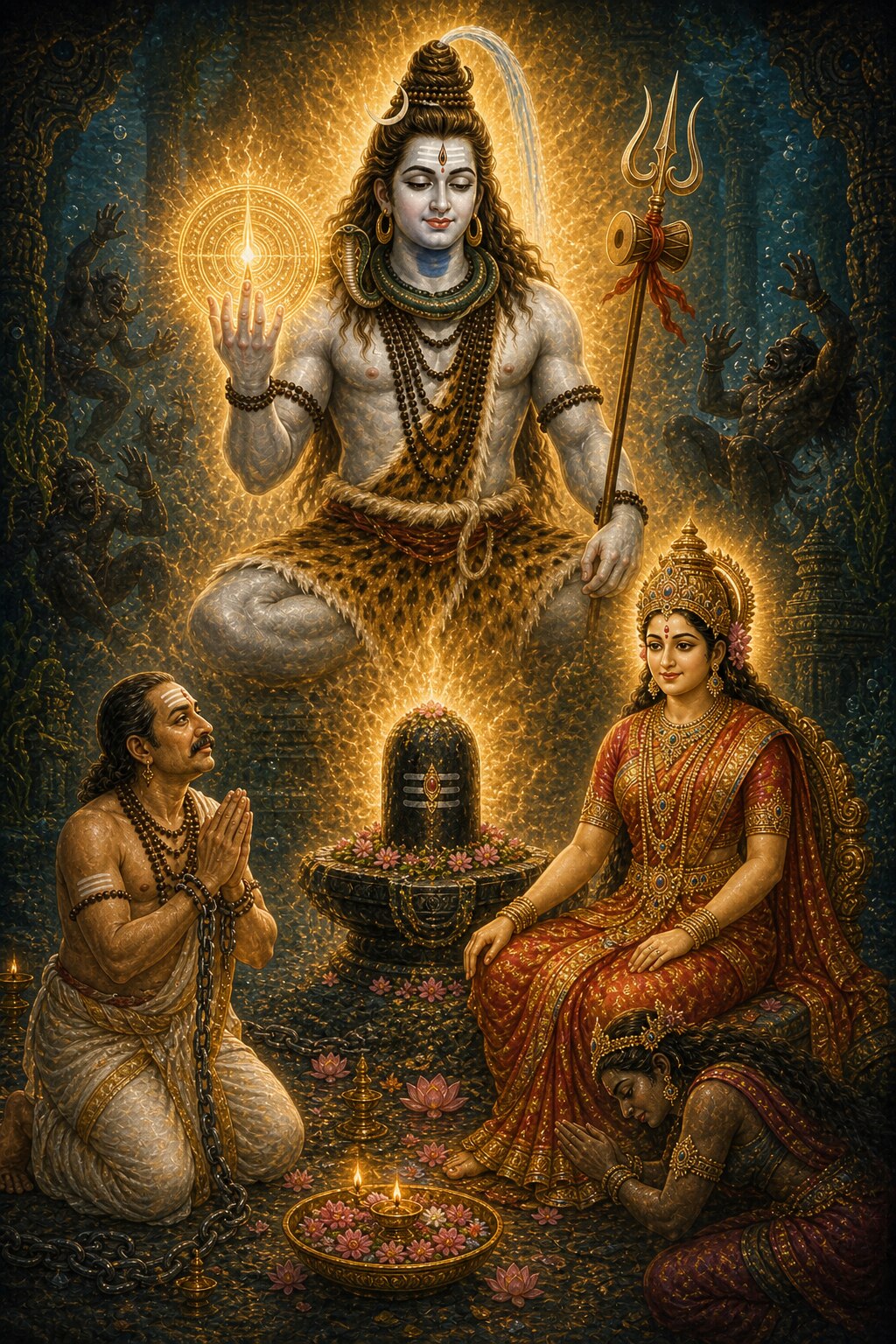
Shambhu, pleased, came up out of the ground with a temple of four doors around him, appearing in person bearing the Pashupata weapon, destroyed the chief rakshasas and their servants at once, and saved his devotee. Then he granted the forest a boon: from this day let the dharma of all four varnas be observed here, Brahmin, kshatriya, vaishya, and shudra; let noble sages dwell here, and let no rakshasa steeped in tamas ever remain. At that moment Daruka the rakshasi, humbled, praised Parvati. When the Devi was pleased, she prayed that her sons might settle in this very forest. Your word will be true at the end of this yuga, Parvati told Shiva; until then let the tamasic ones remain, for otherwise the dissolution would have to come now. This Daruka is my own Shakti, the strongest of the rakshasis; let her rule the rakshasas, and let their wives bear their sons and live here together. Shiva said, beloved, if this is your wish, hear my word. To protect my devotees I too will live in this forest; whoever observes the dharma of his varna here and beholds me with love will become a chakravartin. At the end of the Kali Yuga and the beginning of the Satya Yuga, Virasena, son of Mahasena, will come here, and the instant he beholds me he will become a chakravartin emperor.
So, at their divine play, the two of them took their place there, the matter settled between them. Mahadeva in the form of a jyotirlinga was called Nageshwar there, and the goddess Shiva became famed by the name Nageshwari. Whoever with reverence hears each day of this manifestation of Nageshwar attains everything he wishes for, and even his gravest sins are burned to ash.
Source: Shiva Purana (Gita Press, Sankshipta Shivapurananka), Kotirudra Samhita