On this page
Yoga Vasistha · Story 17
Indra and Ahalya: The Persistence of a Mental Impression
In Magadha, Queen Ahalya hears the old tale of a sage’s wife and the god who desired her, and fixes her heart on a young rake of her own city who happens to carry the god’s name. What follows survives a king’s punishments, a sage’s curse, the death of both bodies, and birth after birth. Bhanu, the Sun, tells the story to Brahma to show what a samskara is: an impression seated so deep in the mind that no one except its owner can remove it, though a curse can kill the body it lives in.
Bhanu’s Answer to Brahma
The story reached Rama at the third remove. Vasistha had it from Brahma, and Brahma had it from the Sun. Brahma had been troubled by ten Brahmins, the sons of Indu, ordinary men who had sat down to meditate on Brahma until each of them became Brahma and each held a whole world inside his mind, ten worlds in all. Brahma asked Bhanu, the Sun, what need there could be for him to create anything further when these ten already stood. Bhanu told him that only the one who makes worlds with his mind can see them as they are; eyes alone cannot settle whether such worlds were created or were never made. The ten worlds were the work of no ten separate Brahmas, as Brahma had supposed. They were mind, and nobody had the power to destroy them while they sat so firmly in the minds that held them.
“It is easy to destroy what a hand has made,” Bhanu said, “and easy to shut the objects of sense out of our perception. Who can annul what the mind has settled on? A belief rooted deep in a living being’s mind cannot be removed by anyone except its owner, by his changing his mind or forgetting. Whatever the mind has grown used to believing, no curse can take out of it, though a curse can kill the body. The principle rooted in a man’s mind stamps him in its own shape, and there is no way to make him otherwise, any more than you can make a rock bear fruit by watering it at the root like a tree. The mind is the maker and master of the world; the mind is the first and highest Person. What the mind does is what is done, and the acts of the body count for nothing. Look at what the mind can do in the case of the sons of Indu, ordinary Brahmins who became Brahma by meditating on him. A man who thinks himself a body is open to every accident that bodies suffer. A man who knows himself bodiless is free of every evil that goes with a body. Look outward and you feel pain and pleasure; the yogi who looks inward does not notice what his body suffers or enjoys. It is the mind that causes every error in this world. You can see it in the case of Indra and his Ahalya.”
Brahma heard the two names. “Tell me, Bhanu,” he said, “who this Indra was, and who this Ahalya, so that hearing it my understanding may see clearly.” In every legend those names belonged to the king of the gods and to the wife of the sage Gautama. Bhanu had another pair in mind, and he began with a king.
The Queen Hears a Name
In former times, Bhanu said, a king named Indradyumna reigned at Magadha, and he was the equal of his famous namesake in prowess and in fame. His wife was as fair as the full disk of the moon, with eyes as lovely as lotuses. Her name was Ahalya, and she was like Rohini, the one the moon favors above all the rest.
In the same city lived a young man, the son of a Brahmin, who stood at the head of all the rakes of Magadha, a schemer and a seducer with a gift for getting into houses, and he went by the name of Indra.
One day the queen heard the old tale told: how the first Ahalya, wife of the sage Gautama, had desired the god Indra. The tale came to her at a certain hour and found her open to it. Hearing it, this Ahalya conceived a passion for the other Indra, the one in her own city, and from then on she could not bear his absence. She thought of nothing except how he might be made to come to her.
She faded like a tender creeper torn loose and thrown onto desert sand. Her women laid her on beds of cool lotus leaves and plantain leaves, and she burned on them from inside. Surrounded by every enjoyment of her royal state she pined like a fish stranded on the dry bed of a pond in the summer heat. She lost her modesty along with her self-possession, and in her frenzy she kept saying, “Here is Indra. There, he is coming to me.”
There had been no courtship. A tale heard at a certain hour and a name that matched had done all of it, and the queen’s body was burning for a man who had never yet come near her.
A lady of the palace saw the state she was in and took pity on her. “I will bring Indra safely before you, my lady,” she said, “and soon.”
At the words “I will bring you what you desire,” Ahalya’s eyes opened wide with joy and she fell at the woman’s feet, as one lotus falls before another. The day wore out. When night had covered the face of everything, the lady hurried to the house of Indra, the Brahmin’s boy. She was clever, and she used every persuasion she had, and she succeeded. She brought Indra back with her through the dark streets and presented him to her royal mistress at once.
Ahalya had made herself ready with pastes and paints and wreaths of fragrant flowers, and she led her lover into a private apartment, where the two of them took their fill of each other. The youth had put on his jewels and his necklaces for her, and his caresses delighted her the way spring renews a garden with its sweet sap. From that night on the ravished queen saw the world full of the figure of her Indra, and all the excellences of her royal lord, her husband, meant little to her. Indra was as lost in her as she was in him, every sense in him enraptured, and he could not stay a moment in any place without her.
It was some time before the great king came to know of the queen’s love for the Brahmin Indra, and he learned it from her face. Whenever she thought of her lover her face glowed like a lotus in full bloom opening to the beams of her moon. Then the painful news reached him of their affection for each other, and of their meetings and their talk together at all hours, hidden from no one. He saw many signs of it with his own eyes. He reprimanded them, and he punished them as they deserved, and when that changed nothing he punished them again.
The King Tests Their Resolve
It was the cold season. The king had the two of them thrown into the cold water of a tank and left there. They gave no sign of pain. They stood in the freezing water and smiled at each other as if they were at play.
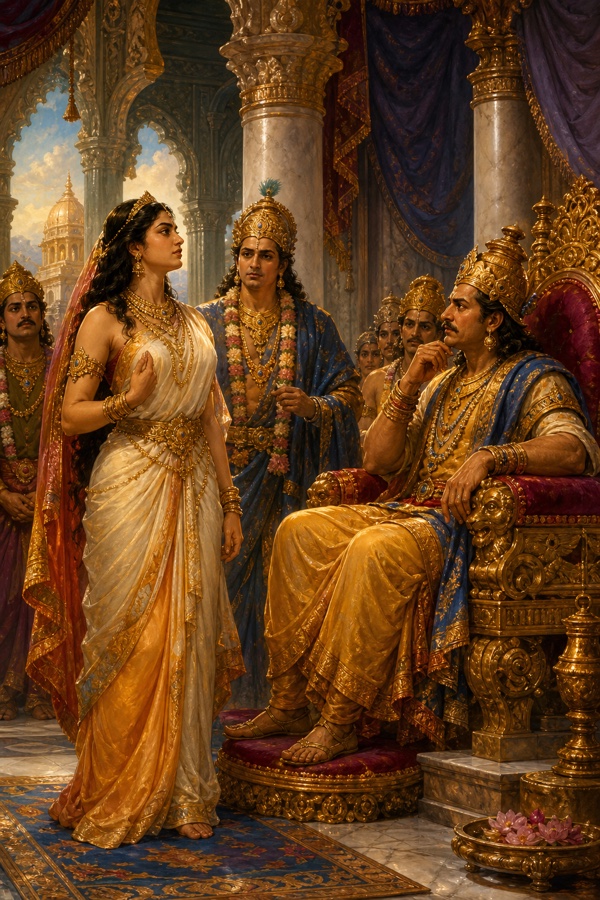
Indradyumna ordered them taken out of the tank and brought before him, and he told them to repent of their crimes. The infatuated pair did nothing of the kind. They answered him together.
“Great King, as long as we go on contemplating the unblemished beauty of each other’s face, we are lost in that contemplation, and we forget we have bodies at all. Your persecutions are a delight to us, because no torment can separate us from each other. We are not afraid of being parted. You can part our souls from our bodies, King. You can part nothing else.”
The king had them thrown into a frying pan set over a fire. They lay in it unhurt and called out, “We rejoice, King, in the delight our souls take in thinking of each other.” He had them tied to the feet of elephants to be trampled. They came out uninjured and said, “King, we feel our hearts’ joy at the remembrance of each other.” He had them lashed with rods and straps and with every other kind of scourge he could devise, day after day.
Brought back from the scourging ground and asked how they had suffered, they gave the same answer as before. Cold, fire, the elephants’ feet, the lash: each one changed the state of their bodies, and none of them reached the place where the two of them were living.
Then Indra went further and spoke to the king on his own. “This world is full of the form of my beloved,” he said. “And your punishments give her no pain either, because she sees the whole world full of me. Every punishment you lay on the body gives no pain to the mind, and the mind is my true self; it is the person who dwells in this person. The body is an idea with a shadow’s look to it. You can pour your punishments on it for a while, and it comes to no more than beating a shadow with a stick.”
“Nobody can break a firm mind. So tell me, great King, what do the powers of the mighty come to? What disturbs the steadiness of a resolute mind is a false conception of outward appearances. Punish the bodies that mislead the mind into error, if you like. The mind that holds to its fixed purpose is firm forever. More than firm: it becomes the very thing it keeps constantly in its thoughts. Being and nonbeing are words for bodies; they do not apply to the mind, since what is positive in thought cannot be made negative in any way. The mind cannot be moved by any effort, as moving bodies can. Nothing from outside can enter it, and neither your anger nor your favor has any effect on it. Men of strong resolve can change the course of their actions. Where is the man strong enough to change the current of his own thought?”
“You could as soon move the mind from its fixed support as a herd of young stags could shift a mountain off its base. This black-eyed beauty is the fixed support of my mind. She sits in the high temple of my mind as the goddess Bhavani sits on Mount Kailasa, and as long as I see her before me, the preserver of my life and my soul, I fear nothing. I could sit in the fire of a burning mountain in the heat of summer and stay cool, shaded by the raincloud of her, wherever I stand or fall.”
“I think of nothing except that one object of my thought and my wish, and I cannot persuade myself that I am anyone other than Indra, the lover of Ahalya. Constant association has made me believe this of myself, and I cannot think of myself as anything other than what my nature is. Know this, King: the wise hold one and the same object in their thought and in their sight. The mind is Meru. Threats do not move it and pity does not move it. The body is what you can tame by the one or the other. The wise are masters of their own minds, King, and there is no one and nothing that can turn them from their purpose.”
“Know this too for certain, King. Neither these bodies around us nor our own bodies and sensations are real. They are shows of truth, and they do not move the mind. It is the other way around: the mind supplies the bodies and the senses with their power to act, as water supplies the trees and their branches with the sap that makes them grow. People take the mind for a passive thing, driven entirely by the impressions the senses bring in. In truth the mind is the active principle, the mover of the organs of action, because every sense goes dormant when the mind stops acting, and the whole creation would stop its work without the activity of the one Mind.”
The Sun did not dress any of this up for Brahma. He called the two of them infatuated, fascinated, a pair sunk in sensual delusion, and he kept to those words. Their love was an error of the mind, and nothing in Magadha could shake it, and the second fact was the one he wanted Brahma to see.
Bharata’s Curse
The lotus-eyed king, defied to his face by this perverse Indra, turned to the sage Bharata, who was sitting beside him in the court hall. “Lord,” the king said, “you know the whole of morality. You see this ravisher of my wife, and you hear the arrogant speech he makes before our faces. Great sage, pronounce your curse on him without delay. To spare the wicked is as much a breach of justice as to hurt the innocent.”
Bharata, best of the wise munis, weighed in his mind the crime of this wicked soul Indra, and then he pronounced his curse. “You reprobate sinner, meet your destruction soon, together with this sinful woman who is so faithless to her husband.”
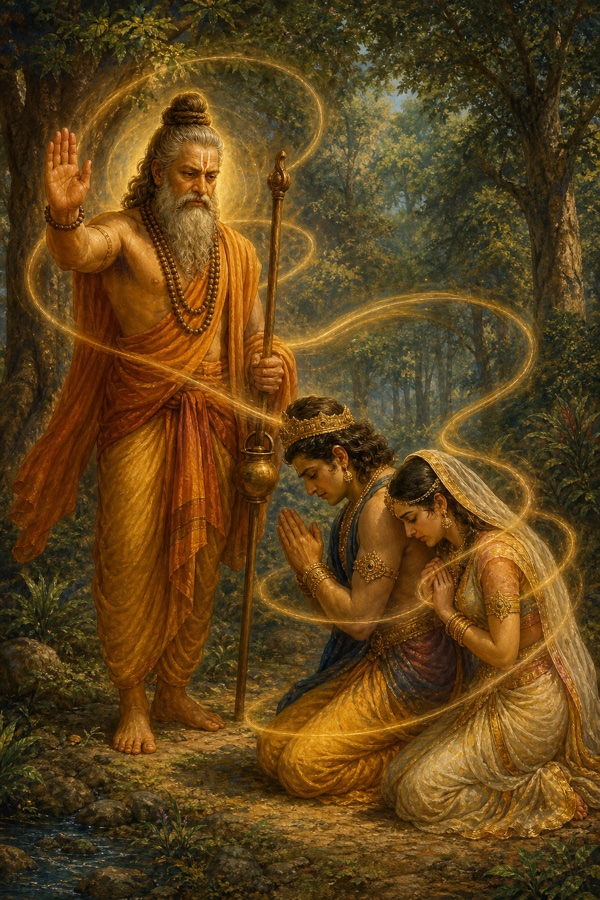
The two of them answered the king and his venerable sage together. “What fools you must be, to have wasted your curse, the great gain of all your devotion, on our two heads. The curse you have pronounced can do us very little harm. Our bodies may fall. It cannot touch our inward minds and spirits, which do not change. The inner principle of the soul can never be destroyed, by anyone, anywhere, because its nature is subtle, hidden, and intellectual.”
Their answer carried the same insolence as their answers to the king, and it rested on the same claim: that a curse earned by austerity could reach the body and nothing deeper. They promised nothing and predicted nothing. They simply refused to be afraid.
Then the fascinated pair, in love over their heads and ears, fell down under the force of the denunciation, the way lopped branches fall to the ground from the parent tree. Two bodies lay on the floor of the court. What had lived in them was already on its way.
Deer, Birds, and Human Birth
Subjected to the torment of transmigration, the two were born as a pair of deer, still attached to each other, and after that as a pair of turtledoves that would not be parted.
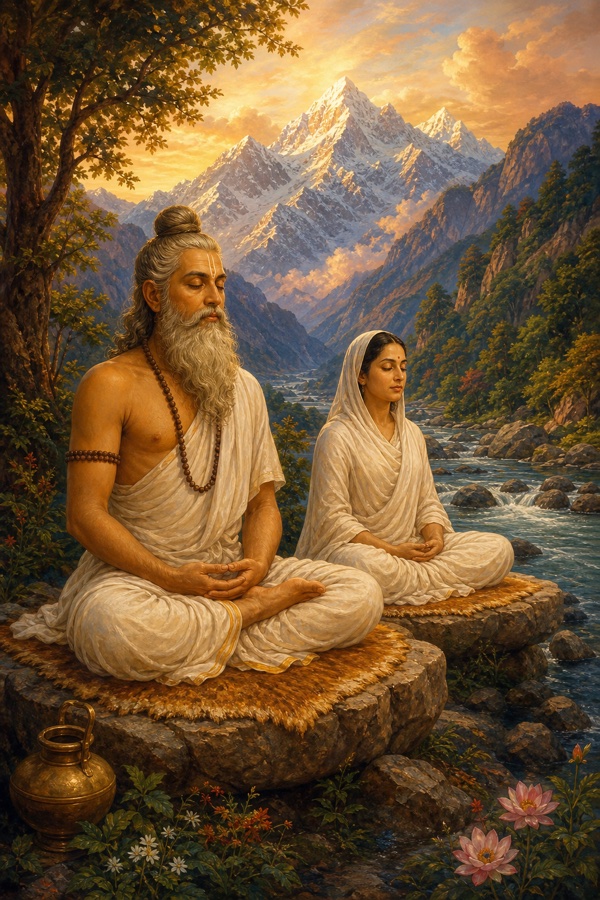
Afterward, Bhanu told Brahma, the loving pair were born as a man and a woman, and that man and woman practiced austerities, and by those austerities they were born again at last as a Brahmin and a Brahmani. Four births Bhanu counted for Brahma, the deer, the doves, the man and woman, the Brahmin couple, and in each of them the two found each other.
So Bharata’s curse had been able to transform their bodies, and it had never once touched their minds or their souls. Those continued in their unshaken attachment through every change of shape. Wherever the two of them came to be reborn, in whatever form, their delusion and their reminiscence always made them a male and a female pair. The thing the king had tried to freeze and burn and whip out of them traveled intact through a deer’s body and a dove’s, and arrived in a Brahmin’s house with nothing lost.
Seeing the true love that lived between this pair in the forest, the trees too fell in love with the other sex of their own kinds.
The Limit of External Force
“So I say, my lord,” Bhanu said to Brahma, “that the mind, like time, is indestructible by its nature. Even the sage’s curse, which nothing could turn aside, could not alter its course.”
“And so it is not right for you, great Brahma, to destroy the ideal fabric of the air-drawn world of the sons of Indu. It is improper for great souls to put a check on the fancies of others. Let each one delight in his own vision.”
Brahma had asked what need there was for him to create further worlds when ten already stood. Bhanu turned the question back on him.
“What is there, lord of lords, that you lack in this universe of so many worlds?”