On this page
Knowledge, austerity, and giving: Vyasa and Maitreya
Yudhishthira had three goods in front of him and wanted them ranked. Knowledge, austerity, giving: which of the three stands highest? He asked his grandfather plainly, the way a man asks who intends to act on the answer. Bhishma answered with an old conversation between Maitreya and Vyasa, the island-born sage whom men also call Krishna. In those days Vyasa was walking the world unrecognized, and his road brought him to Varanasi and to the door of Maitreya, who came of a family of munis. Maitreya knew at once who had arrived. He gave him a seat, honored him with every rite due to such a guest, and set excellent food before him. It was wholesome food, satisfying in every way, and when Vyasa had eaten he was so delighted that, sitting there in another man’s house, he laughed aloud.
Maitreya would not let the laugh pass. “Tell me what makes you laugh,” he said. “You are an ascetic who commands his own feelings, and yet a great joy has plainly come over you. I bow my head to you and ask what the power of my austerities is, and what that high blessedness is that belongs to you. What I do is different from what you do. You are already free while you still draw breath, and I am not yet free. Even so, I think there is little distance between us, and I have my birth to distinguish me besides.” Vyasa told him where the wonder came from. “It comes from an ordinance that sounds like exaggeration, and from a teaching the people are given that sounds like a paradox. The Veda seems to say what is untrue, and why would the Veda say what is untrue? Three tracks, it is said, make up a man’s best vows: he should never injure, he should always speak the truth, and he should give. The rishis of old declared this, following the Veda. It was heard in ancient days and it binds us in ours. Even a small gift, made as the rule requires, bears great fruit. You gave a little water to a thirsty man, and gave it with a sincere heart. Hungry and thirsty yourself, you gave me this food, and by that one act you have won many high worlds, the worlds a man wins by many sacrifices. Your gift delights me, and your austerities delight me too. Your strength is the strength of righteousness, your look is the look of righteousness, and the fragrance of righteousness is about you. I believe that everything you do is done by the rule. Giving stands above bathing in the sacred waters and above the completion of every Vedic vow. It is more auspicious than every sacred act, and none of the Vedic rites you praise comes up to it. The track laid down by those who give is the track the wise walk. Those who give are counted givers of life itself, and the duties that make up righteousness are lodged in them. As the Vedas well studied, as the senses held in check, as a life of complete renunciation, so is giving, with its very great merit. You have taken up the duty of giving, and you will rise from joy to greater joy; any man of understanding who takes it up does. We have seen it with our own eyes many times: fortunate men gain wealth, make gifts, perform sacrifices, and earn happiness by them. And it is always seen, in the natural course of things, that happiness is followed by misery and misery by happiness.”
Vyasa had more to say about how a life is judged. “The wise have said that human beings in this world show three kinds of conduct. Some are righteous, some are sinful, and some are neither. The conduct of a man given wholly to Brahman is counted on neither side, and his sins are never reckoned as sins. The man who keeps to the duties laid down for him is likewise counted neither righteous nor sinful for keeping them. Men devoted to sacrifice, to giving, and to austerity are counted righteous. Men who injure other creatures and bear them ill will are counted sinful. Some take what belongs to others, and these certainly fall into hell and meet misery there. Every other thing men do is indifferent, neither righteous nor sinful. So play, and grow, and rejoice, and give, and sacrifice. Neither the men of knowledge nor the men of austerity will then get the better of you.”
Maitreya was a man who honored ritual action, born into a prosperous family, wise and deeply learned, and he did not simply bow to this. “It is as you say, without doubt,” he answered. “With your leave I would like to add something.” Vyasa told him to say whatever he wished, because he wanted to hear it. “What you have said about giving is faultless and pure,” Maitreya said. “Knowledge and austerity have plainly cleansed your soul, and I am the one who profits by it, for my understanding shows me a man of high austerity seated in my house. People like us prosper merely by setting eyes on people like you; that comes of your kindness, and it comes of my own past acts. Austerity, knowledge of the Vedas, and birth in a pure line: these three make a man a Brahmin, and when he has all three he is called twice-born. When the Brahmin is satisfied, the ancestors and the gods are satisfied. Nothing stands above a Brahmin who has the Vedas. Without him everything would be darkness. Nothing would be known, the four orders would not exist, and the line between righteousness and unrighteousness, truth and falsehood, would vanish. A well-tilled field gives an abundant harvest, and a gift placed with a learned Brahmin gives great merit in the same way. If there were no Brahmins of Vedic learning and good conduct to accept gifts, the wealth of the wealthy would be useless. An ignorant Brahmin who eats the food offered him destroys what he eats, and the food destroys the eater in turn. Only what is given to a deserving man is rightly called food; in every other case the taker throws the giver’s gift away and ruins himself by taking it. The learned Brahmin masters the food he eats, and having eaten it he begets other food. The ignorant man who eats what is offered him loses his claim to the children he fathers, for they belong to the man whose food gave him the strength to father them. That is the subtle fault in eating another’s food without the power to earn it. The merit the giver gains by giving equals the merit the taker gains by accepting. Each depends on the other; the rishis have said so. Wherever Brahmins of Vedic learning and good conduct live, people can earn the sacred fruit of their gifts and enjoy it here and hereafter. Men of pure lineage, devoted to austerity, who give and who study the Vedas, deserve the deepest reverence. They marked out the path on which no traveler loses his way. They lead others to heaven. They carry the burden of the sacrifices on their own shoulders, and they live forever.”
Vyasa was pleased with him. “It is good fortune that you have this knowledge,” he said, “and good fortune that your understanding runs this way. Good men always praise every righteous quality. That beauty and youth and prosperity have not overwhelmed you is good fortune too, a kindness the gods have done you. Now hear what is higher even than giving. Every scripture and religious treatise there is, and every righteous inclination seen in the world, has flowed in its due order from the Vedas. Following them I praise giving, and you praise austerity and Vedic learning. Austerity is sacred. By austerity a man gains the Vedas, and heaven as well. By austerity and by knowledge together, we have heard, a man reaches the highest fruits. By austerity he destroys his sins and every other evil in him. Whatever purpose a man has in view when he undertakes austerity, we have heard, that purpose is fulfilled by it, and the same is said of knowledge. Whatever is hard to accomplish, hard to conquer, hard to reach, and hard to cross can all be done with austerity, which is mightier than anything else. The man who drinks liquor, the man who takes by force what is another’s, the man guilty of killing an unborn child, the man who violates his teacher’s bed: each of them crosses over by austerity and is cleansed. One who has all knowledge, and so sees truly, and an ascetic of whatever kind, are equals, and a man should always bow to both. All who have the Vedas for their wealth should be honored, and so should all who are rich in austerity. Those who give win happiness hereafter and much prosperity here. Righteous men who give food gain this world and the world of Brahma, and many other high worlds besides. Men whom everyone reveres themselves revere the giver. Men honored everywhere themselves honor him. Wherever the giver goes, he hears himself praised. He who acts and he who fails to act each receives what his acts and his omissions have earned, and whether a man dwells in the upper worlds or the lower, he arrives at the place his own acts entitle him to. As for you, you will certainly have whatever food and drink you wish for, because you have intelligence, good birth, Vedic learning, and compassion. You are young, Maitreya, and you keep your vows. Hold to righteousness, and take from me the duties you should follow first, the duties of a householder. In the house where the husband is content with his wife and the wife is content with her husband, every auspicious thing follows. As water washes dirt from the body, as the brightness of fire drives off the dark, so gifts and austerity wash away sin. Blessings on you, Maitreya. May fine houses be yours. I go from here in peace. Keep what I have said in mind, and much good will come to you.” Maitreya walked around his guest in reverence, bowed his head, and joined his hands. “May blessings be yours as well,” he said.
The gist: Vyasa laughs in Maitreya’s house because a little water and a meal, given with a sincere heart by a man who was hungry and thirsty himself, have earned what the Veda assigns to many sacrifices. He ranks giving above sacred bathing and every Vedic vow. Maitreya answers that a gift needs a learned Brahmin to receive it, and that giver and receiver earn equally. Vyasa then names austerity and knowledge as the powers that cleanse even the gravest sins, and sends the young householder off with one rule for his home: husband and wife content with each other.
The conduct of a faithful wife: Shandili and Sumana
Yudhishthira asked next about women. He knew his grandfather understood every duty, and he wanted to hear in detail how good and faithful wives conduct themselves. Bhishma took him to heaven for the answer. There, he said, a lady named Sumana, of the Kekaya line, once came upon Shandili, a woman of great inner strength who understood the truth of things. Sumana looked at her and could not keep from asking. “By what conduct, by what course of acts, did you come to heaven with every sin washed away? You blaze with your own light like a flame of fire. You look like a daughter of the moon, the lord of stars, arrived in heaven in her own radiance. You wear robes of pure white, and you sit at your ease on that celestial chariot shining a thousand times over. It was by no small austerity, no small gift or vow, that you reached this happy world. Tell me the truth.”
Sumana had asked sweetly, and Shandili, smiling, answered her where no one else could hear. “I wore no yellow robes and no bark of trees,” she said. “I did not shave my head, and I did not wear matted locks. None of that brought me among the gods. I never once, even in a careless moment, spoke an unkind or ugly word to my husband. I was constant in the worship of the gods, the ancestors, and the Brahmins. I waited on my mother-in-law and my father-in-law and served them with care. I had resolved that I would never act deceitfully, and I did not. I never loitered at the door of our house, and I never talked long with anyone. I did nothing evil, I never laughed aloud, I never injured anyone, and I never gave away a secret. That is how I carried myself always. When my husband had gone out on some business and came home again, I brought him a seat and attended him with reverence. I never ate any food my husband did not know of, or any food that displeased him. I rose at early dawn and did, or had others do, whatever needed doing for our relatives and kinsmen. When my husband left home for some distant place on business, I stayed in the house and occupied myself with auspicious rites to bless his undertaking. While he was away I used no collyrium and wore no ornaments. I did not bathe with my usual care, I put on no garlands and no scented oils, and I did not redden my feet with lac. When my husband slept in peace I never woke him, even when pressing business called for him; I was happy to sit beside him while he slept. I never pressed him to work harder at earning wealth for his family and kin. I kept secrets and told them to no one. I kept our house and grounds clean always. A woman who holds to this path of duty with her whole attention is honored in heaven like a second Arundhati.”
Having said this much to Sumana about a wife’s duties toward her husband, Shandili vanished from the spot. Bhishma added a promise for the listener. The man who reads this account at every full moon and every new moon, he told the son of Pandu, reaches heaven and enjoys great happiness in the groves of Nandana.
The gist: Sumana assumes that only great austerities, gifts, and vows could have set Shandili on a shining chariot in heaven. Shandili tells her privately that she wore no ascetic’s dress and kept no ascetic’s hair. What she lists is the conduct of one household: no harsh word to her husband, no deceit, no secret betrayed, service to his parents, worship of gods, ancestors, and Brahmins, a clean house, and plainness of dress whenever he was away.
The power of consoling speech: the Brahmin and the Rakshasa
Yudhishthira’s next question was about method. Which works better on a man, a soothing word or a gift? Tell me, he said, which of the two has the greater force. “Some are won by a soothing word and some by a gift,” Bhishma answered. “Each man, according to his nature, leans to one or the other. Listen while I show you what the soothing word can do, so that you understand how even the most savage creature may be calmed by it. There is an old story of a Brahmin who was seized in the forest by a Rakshasa and talked his way free.”
The Brahmin was an eloquent and intelligent man, and he was in real trouble: a Rakshasa had caught him in a lonely stretch of forest and meant to eat him. He had learning and judgment, and he kept both. He did not let the sight of that terrible eater of men stun him, and he decided to try conciliation and see what it would do. The Rakshasa, for his part, greeted him with respect, at least as far as words went, and put a question. “You will escape,” he said, “if you can tell me why I am so pale and so thin.” The Brahmin thought for a short while, accepted the question, and began to answer in well-chosen words, closing each answer with the same refrain: that is why you are pale and lean.
“You live far from your own home,” the Brahmin said, “in a sphere that is not yours, without the company of friends and kinsmen, and there you enjoy great wealth. That is why you are pale and lean. Your friends, though you treat them well, bear you no goodwill, because their own nature is vicious. You have merit, wisdom, and a disciplined soul, and it is your lot to watch others with neither merit nor wisdom honored ahead of you. Men far richer than you and far beneath you in accomplishment look past you. You are pressed for the means to live, and the height of your own soul makes you scorn such means as lie open to you. Out of righteousness you stinted yourself to do another man good, and that man thinks he outwitted you and bent you to his will. I think you grieve for those whose souls are overwhelmed by lust and anger and who suffer for it in this world. You are graced with wisdom, and men with none of it laugh at you; men of wicked conduct condemn you. Some enemy came to you with a friendly tongue, behaved at first like a righteous man, and then left you, having cheated you like a common knave. You know the course of the world’s affairs, you are skilled in every mystery, you are capable, and those who know it give you neither respect nor praise. You stood among bad men who were joined in some enterprise and resolved their doubts for them, and they still would not admit your worth. You have neither wealth nor intelligence nor Vedic learning, and yet you want to accomplish something great on energy alone. You have resolved to go to the forest and take up hard austerities, and your kinsmen do not look kindly on the plan. Some neighbor of yours, rich, young, and handsome, wants your dear wife. The words you speak among wealthy men, even when they are excellent, are judged neither wise nor well timed.”
He went on, and the refrain came round each time. “Some kinsman dear to you, a man without intelligence though he has been taught the scriptures again and again, has grown angry, and you have failed to calm him. Someone set you to work on an object you wanted, and now he is trying to snatch its fruit out of your hand. You have excellent accomplishments and everyone honors you for them, and your kinsmen believe you are honored on their account. There is a purpose in your heart that shame keeps you from speaking, and you are troubled too by the long delay its fulfillment must take. You want, by your intelligence alone, to bring under your influence all sorts of people with all sorts of minds and inclinations. Without learning, without courage, without much wealth, you seek the fame that knowledge and prowess and gifts win. You have failed to get a thing your heart has been set on for a long time, or else what you labor to do, another labors to undo. You can find no fault in yourself, and someone has cursed you all the same. With neither wealth nor accomplishments you try in vain to lift the grief of your friends and the sorrow of the sorrowing. You have seen righteous men living as householders, unrighteous men living in the forest, and liberated men clinging to house and home. Your acts for the sake of duty, wealth, and pleasure bear no fruit, and neither do your well-timed words. You are wise, and still, wishing to stay alive, you live on wealth given you by a man of evil conduct. You see unrighteousness growing on every side and righteousness wasting, and it fills you with grief. Pressed by the times, you try to please all your friends even when they quarrel and stand on opposite sides. You see men of Vedic learning busy with improper acts, and men of learning unable to rule their senses.” Praised in this fashion, the Rakshasa honored the learned Brahmin in return, made a friend of him, gave him wealth enough, and let him go uneaten.
The gist: A man about to be eaten is offered his life for a diagnosis, and he gives thirty of them. Most of them credit the Rakshasa with a virtue the world has failed to reward: merit overlooked, kindness mistaken for weakness, wisdom mocked by fools, grief at the decline of righteousness. Bhishma’s point to the king is practical. Some are moved by gifts and some by words, and the right words turned an eater of men into a friend who sent the Brahmin home with wealth.
The secret dharma of gods, ancestors, and sages: shraddha and giving
The next question was a poor man’s question, and Yudhishthira asked it on his behalf. A man has won a human birth and come into this world of action, which is so hard to reach; he is poor and he wants his own good. How should he conduct himself? Which gift stands above every other, and what should be given in which circumstances? “You deserve our honor and our worship,” he told the son of Ganga. “Explain these mysteries to us.” Bhishma asked for his full attention. “I will explain them as the holy Vyasa once explained them to me. The subject is a mystery to the gods themselves. Yama, whose deeds are without stain, came to know it through vows well kept and through yoga, as the high fruit of his austerities. What pleases which god, what pleases the ancestors, the rishis, the pramathas who attend on Mahadeva, the goddess Shri, Chitragupta who keeps Yama’s records, and the great elephants who stand at the quarters of the sky; what the religion of the rishis consists of, with its many secrets and its high rewards; what merit belongs to the great gifts and to all the sacrifices: the man who knows these things and acts on them is freed of his stains, if he has stains, and wins the merits I will name.”
He began with a scale of harm. “One oil-presser equals ten butchers. One drinker of liquor equals ten oil-pressers. One courtesan equals ten drinkers of liquor. One petty chief equals ten courtesans. A great king is said to equal half of all these together. A man should therefore take no gift from any of them. He should give his mind to the sacred science of the three aims, duty, wealth, and pleasure. Wealth and pleasure draw a man of their own accord, so it is the teaching on duty he must listen to with care, and the fruit of listening to its mysteries is very great. In that teaching the ritual of the shraddha is set out, with the secrets of the ancestors; the secrets of all the gods are explained there; it holds the practices of the rishis, the merits of the great sacrifices, and the merits of every kind of gift. Those who read these scriptures always, those who keep them rightly in mind, and the man who hears them and then lives by them are counted as holy and as sinless as Narayana himself. The merit of giving cows, the merit of bathing in the sacred waters, the merit of performing sacrifices: the man who treats his guests with reverence gains all of it. Those who listen, who have faith, and whose hearts are pure win many happy worlds, and no sin can touch them.”
Then Bhishma told what Vyasa had told him. Once a messenger of the gods came to the court of Indra of his own accord and stood there unseen. “I come at the command of the two gods who surpass every physician,” he said, “and I find men, ancestors, and gods gathered in this place. Why is union with a woman forbidden, for that day, to the man who performs a shraddha and to the man who eats at one? Why are three rice-balls offered separately? To whom should the first be given, to whom the second, and whose is the third? I want to know all of it.” The gods who sat toward the east and the ancestors with them praised that traveler of the sky, and the ancestors answered. “You are welcome, and blessings on you. Your question is a high one and deep. When a man lies with a woman on the day he performs a shraddha or eats at one, his ancestors must lie for a whole month in his seed. As for the rice-balls: the first should be thought of as cast into the waters, the second should be given to one of the wives to eat, and the third should be cast into the blazing fire. That is the ordinance of the shraddha, and that is the practice. The ancestors of a man who follows it are pleased with him and stay glad; his children increase, and wealth that does not run out stays at his command.” The messenger pressed further. Whom does the ball given to the waters reach, and how does it please the gods and rescue the ancestors? The wife eats the second; how do the ancestors come to eat it? The last goes into the fire; how does it find its way to them? The ancestors called the question great and full of wonder. The gods and the munis praise the rites for the ancestors, they said, and even they do not know the settled conclusions; apart from the deathless Markandeya, a learned Brahmin of wide fame who is always devoted to the ancestors, no one among them knows these secrets. And Bhishma gave Yudhishthira the conclusions as Vyasa had handed them down. “The ball that goes into the water pleases the god of the moon, and he, pleased, satisfies the other gods and the ancestors with them. The second ball is eaten by the wife, and the ancestors, who always long for descendants, give children to the woman of the house. With the ball that is cast into the fire the ancestors are satisfied, and in return they grant the offerer the fulfillment of all his wishes. The Brahmin who serves as officiating priest at a shraddha makes himself, by that act, an ancestor of the man who performs it. That is why he must keep away that day even from his own wife. The man who is invited to eat at a shraddha should bathe first, eat in purity, and spend the day harming no one. His descendants multiply, and the man who feeds him earns the same reward.”
A sub-tale: When the ancestors had finished, a rishi of hard austerities named Vidyutprabha, whose body shone like the sun, put a question to Indra, king of the gods. Men in their folly kill countless creatures of the lower orders, worms and ants and snakes, sheep and deer and birds, and the sin is heavy. What is the remedy? The whole assembly praised him for asking. “Think of Kurukshetra, of Gaya, of the Ganga, of Prabhasa, and of the lakes of Pushkara,” Indra said, “and dip your head in water. A man who does so is cleansed of all his sins like the moon set free from Rahu. Let him bathe this way three days running and fast on each of them, and afterward let him touch the back of a cow and bow his head to her tail.” Vidyutprabha then offered subtler rites of his own. A man who rubs himself with the astringent powder of the banyan’s hanging roots, anoints himself with oil of priyangu, and eats sixty-day rice with milk is cleansed of all his sins. And he had heard another from Brihaspati, who recited it before Mahadeva: a man who climbs a mountain, stands on one foot with his joined arms raised, fasts, and gazes at a blazing fire gains the merit of hard austerity and of fasting; if he does it in both summer and winter he is freed of every sin and shines for good with the brightness of the sun and the beauty of the moon. Indra then asked Brihaspati himself to speak of what brings men happiness and of the faults they commit. “Those who pass urine facing the sun, those who show the wind no reverence, those who pour no libations on the fire, and those who milk a cow whose calf is still very young, wanting all the milk they can get, commit sin,” the teacher of the gods said. “The sun, the wind, the fire that carries the offerings, and the cows who are the mothers of all creatures were made by the Self-born to rescue all the worlds. These are the gods of human beings. Wicked men and women who pass urine facing the sun live in infamy for eighty-six years. The man with no reverence for the wind has children who fall too early from the womb. The men who neglect their fire find, when they do kindle it for a rite, that it refuses to eat their offerings. Those who drink the milk of cows with very young calves get no children to carry on their line; they watch their children die and their families shrink.”
After the teacher of the gods had spoken, the gods with the Maruts and the rishis put a question to the ancestors. Human beings as a rule have little understanding; by which of their acts are the ancestors pleased? Which gifts, made in the rites that better the lot of the dead, never lose their force? By what acts can a man clear the debt he owes his ancestors? “You have stated the doubt properly,” the ancestors said. “Hear what pleases us. Bulls of a blue color should be set free. On the day of the new moon, sesame seeds and water should be given to us. In the season of rains, lamps should be lit. By these acts men free themselves of their debt to us, and such gifts are never wasted; the satisfaction we take from them does not run out. And those who, with faith, beget children rescue their dead ancestors from a miserable hell.” An old rishi, Vriddha-Gargya, rich in austerity, heard this with the hair standing up on his body and asked what the merit of each act was. “When a blue bull that has been set free lifts even a little water with its tail,” the ancestors told him, “the ancestors of the man who freed it are satisfied by that water for a full sixty thousand years. The mud such a bull raises on its horns from a riverbank sends his ancestors, without doubt, to the world of Soma. The man who gives lamps in the rains shines with a radiance like Soma’s own, and darkness never takes hold of him. Those who on the day of the new moon give sesame and water mixed with honey, from a vessel of copper, are counted as performing a shraddha with all its secrets. Their children are healthy in body and glad in mind, and the merit of the man who gives the rice-ball takes the form of the growth of his line.”
Indra then turned to Hari himself. “What are the acts that please you? How do men manage to please you?” Vishnu answered him. “What I hate most is the running down of Brahmins. When Brahmins are worshiped, I count myself worshiped. Every worthy Brahmin should be fed with hospitality and then saluted with reverence. A man should also pay reverence to his own feet. I am pleased with men who do this, and with those who worship and make offerings to the whorl that shows on cow dung. Those who see a Brahmin of dwarfish stature, or a boar just risen from the water with mud from the bank on its head, never meet with any evil and are freed of every sin. The man who worships every day the ashvattha tree, the substance called gorochana, and the cow is counted as worshiping the whole universe, with its gods, its Asuras, and its men. I stay within these things and accept in my own form the worship offered to them, and it has been so since the worlds were made. Men of little understanding who worship me in some other way worship in vain; I do not accept it.” Indra could not see the reason. “Why do you praise the round marks on dung, the feet, the boar, the dwarfish Brahmin, and mud lifted from the soil? You make them and you unmake them. You are the eternal nature of everything that passes.” Vishnu smiled a little. “With my round discus the Daityas were killed. With my two feet the world was covered. In the form of a boar I killed Hiranyaksha. In the form of a dwarf I conquered King Bali. Those who honor these honor me, and they never meet defeat. If a man sees that a Brahmin keeping the student’s vow of celibacy has come to his house, gives him the first share of the food, and eats what is left, he is counted as eating the nectar of the gods. If, after worshiping the morning twilight, he stands with his face to the sun, he gains the merit of bathing in every sacred water and is cleansed of all his sins. That is a great mystery, and I have told it to you in full. What else shall I explain?”
Others spoke after him, each with a secret. Baladeva said that ignorant men suffer at the hands of other creatures for want of knowing this one thing: the man who rises at early dawn and touches a cow, ghee, and curds, and mustard seed and the larger seed called priyangu, is cleansed of all his sins. The gods said that when a man takes a vessel of copper, fills it with water, faces east, and declares his resolve to keep a fast or a vow, the gods are pleased with him and his wishes succeed; copper is the vessel for offerings to the gods, for alms, for the water of welcome, and for the sesame water given to the ancestors, and done any other way these acts earn little. Dharma said that the offerings made in rites for gods and ancestors must never be given to a Brahmin who has taken service under the king, who rings the bell or does the lesser tasks at worship, who keeps cattle, who trades, who follows a craft for his living, who is an actor, who quarrels with his friends, who has no Vedic study, or who marries a Shudra woman; the man who gives to such a one loses his prosperity, and his line does not grow. From a house that a guest leaves unsatisfied, Dharma said, the ancestors, the gods, and the sacred fires all turn away disappointed, and the host is counted as sinful as those who kill women or cows, those who are ungrateful to their benefactors, those who kill Brahmins, and those who violate a teacher’s bed. Agni spoke of the man who lifts his foot to strike a cow, a Brahmin, or a blazing fire: his infamy spreads through the world and touches the edge of heaven, his ancestors are filled with fear, the fire refuses his libations, and he rots in hell for a hundred lives without rescue. Vishvamitra gave a secret few men know: whoever offers the ancestors rice boiled in sweetened milk, seated facing south at noon in the shade of an elephant’s body, in the month of Bhadrapada under the constellation Magha, is counted as performing a great shraddha every year for thirteen years. The cows themselves gave the words by which a cow should be honored: “Bahula, Samanga, you who are fearless everywhere, forgiving and full of blessing, friend, source of all plenty, in the world of Brahma long ago you stood with your calf at the sacrifice of Indra who bears the thunderbolt. You took your place in the sky and in the path of Agni, and the gods, with Narada among them, adored you and called you Sarvamsaha.” The man who honors a cow with these words is cleansed of all his sins, gains the merit that belongs to cows and the splendor of the moon, is freed of fear and grief, and at the end lives in the happy world of the thousand-eyed Indra. Then the seven rishis rose, with Vasishtha at their head, walked around the lotus-born Brahma, and stood before him with joined hands. Vasishtha asked for them all, and the question served every creature, Brahmins and Kshatriyas most of all. By what acts may men of righteous conduct who lack this world’s goods earn the merit of sacrifices? Brahma called it a subtle question and answered it. “In the bright fortnight of the month of Pausha, when the constellation Rohini is in conjunction, let a man purify himself with a bath and lie under the open sky wearing a single cloth, with faith and a gathered mind, and let him drink the rays of the moon. The merit of the great sacrifices is then his.”
A sub-tale: Six more voices follow, and each names small things. The sun, here called Vibhavasu, says a man should stand facing the full moon and offer it a palmful of water and the rice-grains with ghee called akshata; he is then counted as tending his sacred fire. Whoever cuts down a large tree on the day of the new moon takes on the sin of killing a Brahmin, and tearing off a single leaf is enough; whoever chews his tooth-twig that day injures the god of the moon and angers his own ancestors. Shri says that the gods and ancestors leave in disgust a house where the dishes, the seats, and the beds lie scattered and where women are beaten. Angiras says the children of a man increase if he stands every night for a full year under a karanjaka tree with a lamp, holding the roots of the suvarchala plant. Gargya asks for hospitality to guests, lamps in the hall of sacrifice, no sleep by day, no meat, no injury to cows or Brahmins, and the recital of the names of the Pushkara lakes; he adds that white robes, the blessings of invited Brahmins, and the recital of the Bharata make a shraddha’s offerings last. Dhaumya warns against broken vessels, in which Kali lives, broken bedsteads, which mean loss of wealth, cocks and dogs, in whose sight the gods will not eat, and trees inside the house, whose roots shelter scorpions and snakes. Jamadagni says that a man whose heart is impure goes to hell even after a horse sacrifice or a hundred Vajapeyas, and that a very poor Brahmin who gave one prastha of powdered barley to a Brahmin, with a pure heart, reached the world of Brahma itself.
Then Vayu, Lomasha, Arundhati, Yama, the great elephants, Maheshvara, Skanda, and Vishnu told their secrets in turn. Vayu said that the man who through the four months of the rains offers sesame and water to the ancestors, feeds a Brahmin who knows the duties, tends his fire, and gives lamps earns the merit of a hundred sacrifices in which animals are offered; and that the man who sees nothing wrong when a Shudra lights the fire for his offerings angers the three sacred fires and is reborn a Shudra, unless he fasts three days and pours on the fire the urine of a cow mixed with dung, milk, and ghee. Lomasha said that the ancestors cut off the man who goes to other men’s wives and the man who takes what belongs to a Brahmin, and that gifts of ghee and akshata to Brahmins on the twelfth day of the moon and on the full moon swell Soma and the ocean and earn from Indra a fourth part of a horse sacrifice’s merit. The assembly then asked Arundhati, wife of Vasishtha and his equal in vows and conduct. She said a guest made content outweighs a kapila cow given every day for twelve years, and she taught a bath: go into the cow-pen at dawn with water and a few blades of kusha grass, sprinkle a cow’s horns, and let that water drip onto your own head, and you have bathed in every sacred water of the three worlds. Brahma blessed her on the spot with austerity that would always grow. Yama passed on what Chitragupta, his recorder, had said. Nothing a creature does, pious or sinful, is lost; on the days of the full and new moon his acts are carried to the sun, and when he comes to the world of the dead the sun bears witness. Men of little understanding suffer hunger, thirst, and a thick darkness there. For the giver of drinking water a great river waits, cool, sweet as nectar, and never dry; for the giver of lamps the moon, the sun, and fire light every side; a pair of sandals or an umbrella given to a worthy Brahmin brings ease and shade; and one kapila cow given to a Veda-knowing Brahmin at Pushkara, on the full moon of Karttika, counts as a hundred cows with a bull. The sun’s hair stood on end as he heard it, and he named five who have no escape: the killer of a Brahmin, the killer of a cow, the man who goes to other men’s wives, the man without faith, and the man who lives by selling his wife’s virtue. Brahma then pointed out the mighty Naga Renuka, a dweller in the lower regions, and the gods sent him to question the elephants who hold up the earth with her hills and waters. The elephants of the eight quarters asked for offerings of raw sugar and rice laid on an anthill at sunset, on the eighth day of the dark fortnight of Karttika under the constellation Ashlesha, with flowers, blue cloths, and fragrant paste; a man who does this for a year has given a hundred years of hospitality to every great elephant in the three worlds. Maheshvara spoke next. “Hear the merit of the man who feeds cows every day for a month and keeps himself to one meal a day through that month. Cows are the most sacred of all sacred things, and it is they who hold up the three worlds. In the Krita age I declared my approval of them, and afterward the lotus-born Brahma asked my kindness for them; that is why a bull stands on my banner to this day. The man who feeds cows for even one day receives from them a fourth part of the merit of all the good he does in his life.” Skanda said that a man who takes a little earth from the horns of a blue bull, smears his body with it for three days, and then bathes washes away every stain and is born a hero as often as he is born; and that cooked food mixed with honey, offered in a copper vessel to the rising full moon, is accepted by the Sadhyas, the Rudras, the Adityas, the Vishvedevas, the twin Ashvins, the Maruts, and the Vasus. Vishnu spoke last. Whoever listens every day, with faith and without malice, to these secrets kept by the gods and the rishis never falls under any evil and is freed of every fear. Whoever recites them to Brahmins on the days of the full and new moon grows steady in every duty, and beauty and prosperity become his. Bhishma closed the account with a caution: this knowledge is worth more than the whole earth filled with riches, and it must never be given to a man without faith, an atheist, a man fallen from the duties of his order, a man without compassion, a lover of empty disputation, an enemy of his teachers, or one who thinks other creatures different from himself.
A key to reading this (the pramathas): The pramathas are the ghostly companions of Mahadeva, unseen wanderers of the night. The gods, ancestors, and rishis asked them why they torment some men and what leaves them powerless. They answered that they fall on the unclean: men who do not purify themselves after union with a woman, who insult their elders, who eat all kinds of meat in their folly, who sleep at the foot of a tree, who keep any animal matter under the pillow, who lie with head and feet reversed, or who spit their phlegm into water. They cannot touch a man who wears streaks of gorochana, who holds the herb vacha in his hand, who gives ghee with akshata or sets them on his head, or who abstains from meat. And they stay away from a house where the sacred fire burns day and night, where the smoke of sacrifice curls upward, or where a wolf’s skin or teeth, a hill tortoise, a cat, or a goat of tawny or black color is kept.
The gist: Bhishma repeats what Vyasa taught him about an assembly in Indra’s court where the ancestors, the gods, the rishis, the cows, the elephants of the quarters, and even the ghostly pramathas each give up a secret. The three rice-balls of the shraddha go to water, to the wife, and to fire, and each has its own reward. Most of the secrets cost almost nothing: a lamp lit in the rains, sesame and water at the new moon, a blue bull set free, a guest sent away content, a day’s feed for cows, a handful of powdered barley given with a pure heart.
The taking of food, penance, and the ordinances of giving
Yudhishthira asked about food, and whose hand it may be taken from. From whom may a Brahmin accept his food in this world, and from whom may a Kshatriya, a Vaishya, and a Shudra accept theirs? “A Brahmin may take food from another Brahmin, from a Kshatriya, or from a Vaishya,” Bhishma said, “and never from a Shudra. A Kshatriya may take food from a Brahmin, a Kshatriya, or a Vaishya, and must refuse the food of Shudras who follow evil ways and eat anything at all without scruple. Brahmins and Kshatriyas may eat the food of Vaishyas who tend the sacred fire every day, whose character is without fault, and who keep the four-month vow of Chaturmasya. The man who takes food from a Shudra swallows the filth of the earth. A Brahmin, a Kshatriya, or a Vaishya who enters a Shudra’s service is ruined, however carefully he keeps the rites of his order. A Brahmin’s duty is to study the Vedas and seek the good of mankind; a Kshatriya’s is to protect men; a Vaishya’s is to increase their prosperity, and he may live blamelessly by farming, by breeding cattle, and by trade. A man who leaves his own work for a Shudra’s work is to be counted a Shudra, and no food should be taken from him. Physicians, soldiers who fight for hire, the priest who keeps a house’s door, and those who give a whole year to study and gain nothing by it are all to be counted Shudras. Those who shamelessly eat at ceremonies in a Shudra’s house lose family, strength, and vigor, and sink to the condition of animals, as low as dogs. Food from a physician is no better than excrement, a harlot’s food is like urine, and a skilled craftsman’s is like blood. A Brahmin whom the good approve, if he takes the food of one who lives by his learning, is counted as taking a Shudra’s food. The food of a man whom all condemn is like a drink from a pool of blood, and to accept food from a wicked man is held as grave as the killing of a Brahmin. No one should accept food when the giver slights him and receives him without due honor; a Brahmin who does is soon overtaken by disease, and his line soon dies out. Food from the warden of a city sends a man down among the lowest outcastes. A Brahmin who takes food from the killer of a cow or a Brahmin, from one who has lain with his teacher’s wife, or from a drunkard helps to swell the race of Rakshasas. And the man who takes food from a eunuch, from an ingrate, or from one who has made off with wealth left in his keeping is born in the country of the Shabaras, beyond the bounds of the middle country. Tell me now what else you wish to hear today.”
Yudhishthira had a doubt left. A Brahmin does accept food of many kinds, above all what is offered in honor of the gods and what is offered to the dead; how does he cleanse himself afterward? Bhishma gave the expiations one by one. “For accepting clarified butter, he pours oblations on the fire and recites the Savitri hymn, and for sesame the same. For meat, honey, or salt, he is purified by standing until the sun rises. For gold, he silently recites the Gayatri, the great Vedic prayer, and holds a piece of iron in his hand before the people; for money, clothes, or women the cleansing is the same. For cooked food, rice boiled in milk and sugar, sugarcane or its juice, oil, or any sacred thing, he bathes three times in the day, at morning, noon, and evening. For unhusked rice, flowers, fruit, water, half-ripe barley, milk, curds, or anything made of meal or flour, he recites the Gayatri a hundred times, and a hundred times again for shoes or clothes accepted at funeral rites. A gift of land accepted at the time of an eclipse or in a period of impurity is expiated by a fast of three nights. The Brahmin who eats the offerings to the dead in the dark fortnight is purified by fasting a whole day and night. He must bathe before he says his evening prayers, before he sits to meditate, and before he eats a second time; that is why the shraddha is set for the afternoon, with the Brahmin invited beforehand. One who eats in a house of death on the third day after the death bathes three times daily for twelve days, and when the twelve days are over he completes his cleansing by giving clarified butter to Brahmins. One who eats there within ten days of the death performs all these expiations, recites the Savitri, and keeps the Ishti and Kushmanda penances. One who eats for three nights in such a house bathes three times daily for seven days. A Brahmin who eats in the company of Shudras is cleansed by the proper rites of purification; one who eats with Vaishyas lives on alms for three nights; one who eats with Kshatriyas bathes with his clothes on. When men eat off a single plate, the Shudra loses the good name of his family, the Vaishya his cattle and his friends, the Kshatriya his prosperity, and the Brahmin his splendor and vigor. Then expiations must be made and rites of appeasement performed, oblations offered to the gods, the Savitri recited, and the Revati rites and the Kushmanda penances kept. And if a member of any of the four orders eats food partly eaten by a member of another, he is cleansed by smearing his body with auspicious things: gorochana, durva grass, and turmeric.”
The gist: Bhishma lays down from whom each order may take food and what each lapse costs. A Brahmin may take food from a Brahmin, a Kshatriya, or a fire-tending Vaishya; a Shudra’s food is forbidden to him, and so is the food of physicians, hired soldiers, harlots, and anyone who offers it with a slight. The cure is graded to the gift: the Savitri for ghee, a night’s standing for meat or salt, a hundred Gayatris for milk or flour, seven or twelve days of bathing for a meal in a house of death.
Kings who gained heaven by giving, and the five kinds of gift
The questioning came back to its first subject. Of the two, giving and devotion, which is better in this world? Yudhishthira asked his grandfather to lift what he called a great doubt from his mind, and Bhishma answered with names. “Hear who they were, the princes who cleansed their hearts by austerity, practiced giving and the other acts of piety, and went to the worlds of heaven. The rishi Atreya, whom all revered, went there by teaching his pupils the knowledge of the Supreme Being that has no conditions. King Shibi, son of Ushinara, was carried from this world to heaven because he offered the life of his own dear son for the good of a Brahmin. Pratardana, king of Kashi, gave his son to a Brahmin and won a fame unlike any other, a fame that does not die, in this world and the next. Rantideva, son of Sankriti, reached the highest heaven by the gifts he duly made to Vasishtha. Devavriddha went to heaven for giving a Brahmin a splendid golden umbrella with a hundred ribs, for use at a sacrifice. And Ambarisha reached the world of the gods by giving his entire kingdom to a Brahmin of great power.”
The roll went on, king after king. “Janamejaya of the solar line went to the highest heaven by giving earrings, fine vehicles, and cows to Brahmins. The royal sage Vrishadarbhi went by gifts of jewels of many kinds and beautiful houses. King Nimi of Vidarbha gave his daughter and his kingdom to Agastya and reached heaven with his sons, his friends, and his cattle. Rama, the son of Jamadagni, gave land to Brahmins and reached eternal worlds far beyond what he had hoped. When the rain god Parjanya withheld his showers and a great drought came, Vasishtha kept all creatures alive, and he won eternal bliss for it. Rama, the son of Dasharatha, whose fame stands very high in this world, reached the eternal worlds by the wealth he gave away at his sacrifices. The royal sage Kakshasena went to heaven by duly handing over to Vasishtha the wealth that had been placed in his keeping. Marutta, the son of Parikshita and grandson of Karandhama, gave his daughter in marriage to Angiras and went to heaven at once. Brahmadatta, the devout king of the Panchalas, gave away a precious conch shell. King Mitrasaha gave his favorite wife Madayanti to Vasishtha and ascended. Sudyumna, the son of Manu, reached the most blessed worlds by seeing that the rishi Likhita received the punishment that was due. The royal sage Saharachitta gave up his own dear life for a Brahmin. King Shatadyumna gave Maudgalya a golden mansion furnished with every object of desire. King Sumanyu, in ancient times, gave Shandilya food heaped up like a hill. The Shalva prince Dyutimat gave his kingdom to Richika. The royal sage Madirashva gave his slender-waisted daughter to Hiranyahasta. Lomapada gave his daughter Shanta in marriage to Rishyashringa and gained everything he wished for. The royal sage Bhagiratha gave his famous daughter Hamsi to Kautsa, and he gave cows with their calves, by the hundred and the thousand, to Kohala. These and many others went to heaven by their gifts and their austerities, Yudhishthira, and they have come back from there again and again. Their fame will last as long as the world lasts. They were good householders, and by giving, by sacrifice, and by raising children they reached the worlds of heaven.” The light had gone while he counted them. “Night has come,” Bhishma said. “In the morning I will explain whatever doubts rise in your mind.”
Yudhishthira came back to it when they met again. He had heard the names of the kings who went to heaven by following the religion of giving. Now he wanted the thing itself taken apart. How many kinds of gift are there? What fruit does each kind bear? For what reasons should gifts be made, and to whom? Bhishma told the son of Kunti to listen closely. “Gifts are made from desire of merit, from desire of profit, from fear, from free choice, and from pity. Know, then, that there are five kinds. A man should give to Brahmins with a mind free of malice, because by giving to them he gains fame here and great happiness hereafter; that is the gift made from desire of merit. ‘He is in the habit of giving,’ a man hears from those who come asking, or ‘He has already given to me,’ and on hearing such words he gives away wealth of every sort to that one petitioner; that is the gift made from desire of profit. ‘I am nothing to him and he is nothing to me, and if I slight him he may do me harm’: from such fear even a learned and wise man gives to an ignorant wretch; that is the gift made from fear. ‘This man is dear to me, and I am dear to him’: moved by that thought a man of intelligence gives to a friend freely and gladly; that is the gift made from free choice. ‘The man who asks me is poor, and a little will content him’: thinking so, a man should always give to the poor, moved by pity; and that is the gift made from pity. These are the five kinds of gift. They increase the giver’s merit and his fame. And Brahma, lord of all creatures, has said that a man should always give according to his power.”
The gist: Asked whether giving or devotion is better, Bhishma answers with two dozen names: a rishi who gave knowledge, kings who gave a son, a kingdom, a daughter, a conch, an umbrella of gold, a hill of food. Night stops the count. When the talk resumes he sorts gifts by the motive behind them, desire of merit, desire of profit, fear, free choice, and pity, and closes with Brahma’s rule that a man should give according to his power.
The greatness of Vishnu, and the dialogue of Uma and Maheshvara
Yudhishthira had one more kind of request, and he made it with the whole court listening. “You have great wisdom,” he said to his grandfather, “and every branch of learning is known to you. In our great line you are the one man filled with all the sciences. I want to hear from you things woven of duty and of profit, things that lead to happiness hereafter and fill every creature with wonder. The time that has come on us is heavy with grief; kinsmen and friends seldom see its like. We have no one but you left to teach us. If my brothers and I deserve the kindness, answer what I ask. Narayana himself is here, rich in every prosperity and honored by all the kings, and he waits on you with every mark of regard. Speak out of your affection, for my good and my brothers’ good, in the presence of Vasudeva and of all these kings.” Bhishma loved the king and his brothers, and the request filled him with joy. “I will tell you things that delight,” he said, “about the power of this Vishnu as he showed it long ago and as I heard of it. Hear also the power of the great god whose emblem is the bull. And hear the doubt that rose in the mind of Rudra’s wife, and the doubt that rose in Rudra’s own.”
Once, Bhishma began, Krishna kept a vow that ran for twelve years. He had been consecrated for it, and to see him in that state the rishis came: Narada and Parvata, the island-born Vyasa, Dhaumya, a master of silent recitation, Devala, Kashyapa, and Hastikashyapa, and others consecrated and self-controlled, with their disciples and with many siddhas and ascetics of great merit. The son of Devaki received them with the honors that are paid only to gods. They sat down on the seats he gave them, some green, some the color of gold, some laid with peacock plumes, some perfectly new and fresh, and began to talk pleasantly among themselves about duty and about the royal sages and the gods. As they talked, the energy of Narayana took the form of fire. It rose from the long, hard keeping of his vow as flame rises from fuel, and it came out of Krishna’s mouth. The fire fell on the mountains and burned them, with their trees and creepers and small plants, their birds and deer, their beasts of prey and their reptiles. Soon the summit was a pitiful sight. Animals of every kind cried out in pain, and then there was no living creature left on it. When the great flames had consumed everything and left nothing over, the fire came back to Vishnu and touched his feet like an obedient disciple. Krishna looked at the burned mountain. He turned a kindly glance on it, and with that glance he restored it to what it had been. It stood once more covered with flowering trees and creepers, and it rang again with the calls of birds and deer, beasts of prey and creeping things. The ascetics had seen all of it, and it was past conceiving. The hair rose on their bodies and tears blurred their sight.
Narayana saw their amazement and spoke to them gently. “Why has wonder filled this gathering of rishis, men free of every attachment, without any thought of ‘mine,’ who know every sacred science? Tell me truly what has raised this doubt in me.” The rishis answered him. “It is you who create all the worlds, and you who destroy them again. You are winter, you are summer, and you are the season of rains. Of every creature on earth that moves or stands still you are the father, the mother, the master, and the origin. Even so, the fire that came from your mouth is a wonder and a doubt to us. Resolve it for us. When our fear is gone, Hari, we will tell you what we ourselves have heard and seen.” Vasudeva told them. “The fire that came from my mouth, bright as the fire that burns the world at the end of an age, the fire that crushed and scorched this mountain, is the energy of Vishnu and nothing else. You have conquered anger and mastered your senses, you are rich in austerity and gods in power, and still you have let yourselves be shaken. I am wholly given up to the keeping of a hard vow, and I came to this delightful mountain to win, by austerity, a son who would be my equal in energy. Through that austerity the soul within my body turned to fire and left by my mouth. It went to see the boon-giving Grandsire of the universe, and the Grandsire told my soul that half the energy of the great god whose emblem is the bull would be born as my son. Its errand done, the fire has come back and approached my feet like a disciple eager to serve; it has put off its fury and returned to its own nature. You have no cause to fear. Now I ask something of you. Your sight reaches far, you go where you please without hindrance, and you shine with knowledge. Tell me something truly wonderful that you have heard of or seen, on earth or in heaven. I long to taste the honey of that speech. A wonder I know by my own nature stops being a wonder to me. What pious men recite, what one hears from the good, deserves to be taken in with respect and faith; such accounts last on earth as long as letters cut in rock.” The ascetics were astonished at the request. They gazed at him with eyes as wide as lotus petals; some glorified him, some bowed in worship, and all of them praised him in words drawn from the eternal Rik verses. Then they chose Narada, the most gifted speaker among them, to give Vasudeva what he had asked for. “Tell Hrishikesha in full, from the beginning,” they said to him, “the wonderful thing that happened on the mountains of Himavat, which those of us who had gone there on pilgrimage to the sacred waters saw for ourselves.”
So Narada, the holy rishi who was Narayana’s friend, told of the talk between Shankara and his wife Uma. Once, as he told it, Mahadeva, lord of the gods, whose emblem is the bull, was practicing hard austerities on the sacred mountains of Himavat, where siddhas and charanas gather. Those slopes were thick with herbs and bright with flowers of many kinds, and at that time troops of apsaras lived on them, and crowds of ghostly beings. The great god sat there full of joy with hundreds of those beings around him. Some were ugly and ungainly, some very handsome, some wonderful to look at. Some had the faces of lions, some of tigers, some of elephants; some the faces of jackals, of leopards, of apes, of bulls; some had the faces of owls and of hawks, and some of every kind of deer. Kinnaras were there, and Yakshas, Gandharvas, and Rakshasas. The retreat blazed with a light that was of heaven and was strewn with heaven’s flowers. Sandal perfumed it, incense burned on every side, and it sounded with mridanga and panava drums, with the blare of conches and the beating of kettledrums. The ghostly troops danced for joy, peacocks danced with their tails spread, and the apsaras danced. Learned Brahmins chanted the Veda there, and the bees hummed. The siddhas and the ascetics, the Maruts, the Vasus, the Sadhyas, and the Vishvedevas, Indra himself, Yakshas, Nagas, and Pishachas, the guardians of the world, the sacred fires, and the winds all lived on that mountain with their minds gathered in yoga. Every season was present at once and scattered its flowers; herbs that give off light lit the woods; birds sang on the mountainside. Mahadeva sat on a peak rich in minerals as if it were a fine couch. A tiger skin was wrapped about his loins and a lion skin covered his shoulders. A snake served him for a sacred thread. A pair of red armlets circled his arms. His beard was green, his hair was matted, and his features were terrible. He is the one who puts fear into the enemies of the gods, and the one who takes fear away from every creature. The great rishis touched their heads to the ground before him, and the sight of him left them cleansed of every sin. Great snakes filled the place, and no ordinary being could have approached it or borne it.
To Mahadeva, as he sat there, came his wife, the daughter of Himavat, with the wives of his ghostly companions around her. She was dressed as her lord was dressed, and she kept the vows he kept. On her hip she carried a jar filled with the waters of every sacred ford, and behind her walked the goddesses of all the mountain streams. She came scattering flowers and sweet scents on every side. And Uma, smiling, wanting to play a joke on him, stepped up behind Mahadeva and covered his eyes with her two lovely hands. The moment his eyes were covered, every region went dark, and life seemed to go out everywhere in the universe. The offerings into the fire stopped. The sacred cry of vashat was heard no more. Every living creature lost heart and was filled with fear, and the universe was as if it had no sun. Then the darkness lifted. A great blazing flame came out of Mahadeva’s forehead, and a third eye appeared there like another sun. It blazed like the fire at the end of an age, and it began to consume the mountain. The large-eyed daughter of Himavat bowed her head to her lord and stood with her gaze fixed on him. The forests burned on every side, the tall straight-trunked trees, the sandal trees, the healing herbs, and herds of deer and other animals ran in terror to the place where Hara sat and begged his protection, until the retreat was almost filled with them. The fire swelled and climbed to the sky itself, flickering like lightning and bright as a dozen suns, and covered every quarter. In a moment the mountains of Himavat were consumed, with their minerals and their summits and their shining herbs. The daughter of that king of mountains saw her father crushed and burned. She came to the great god for refuge and stood before him with her hands joined. Sharva saw that a woman’s tenderness had overcome her and that she could not bear to see her father Himavat brought to that state, and he turned kindly eyes on the mountain. In a moment all of Himavat was as it had been, as fair to look at as ever, and all its trees were in flower.
Uma saw the mountain whole again and spoke to her lord. “A great doubt has filled my mind,” she said, “and you must resolve it for me. Why has this third eye appeared in your forehead? Why was the mountain burned, with its woods and everything that belonged to it? And once you had burned it, why did you make it what it was before and cover it with trees again?” Maheshvara told her. “You covered my eyes without thinking what you did, and in that moment the universe was left without light. When it had no sun and all was dark, I made the third eye, because I wished to protect all creatures. The great energy of that eye crushed and burned this mountain. Then, to please you, I repaired the harm and made Himavat what he was.”
Uma had more to ask, and she asked it as his wife and as his worshiper, one who meant to keep the same duties he kept. Why were the faces he turned to the east, the north, and the west so handsome, as pleasant to look at as the moon, and why was the face he turned to the south so terrible? Why were his matted locks tawny and standing upright? Why was his throat blue like a peacock’s plumes? Why was the bow Pinaka always in his hand? Why did he live always as a celibate with matted hair? Her questions pleased the bearer of Pinaka, and he gave her the reason for each form. “Long ago Brahma made a woman called Tilottama by gathering a grain of beauty from every beautiful thing in the universe. No one in creation could match her. One day that lovely woman came to walk around me in reverence, and her real purpose was to tempt me. Whichever way she turned, a new face of mine appeared on that side, so eager was I to look at her, and every one of those faces was pleasing to see. So, out of the wish to gaze on her, I became four-faced by the power of yoga. With the face that looks east I hold sovereignty over the universe. With the face that looks north I sport with you. The face that looks west is gentle and auspicious, and with it I ordain the happiness of all creatures. The face that looks south is terrible, and with it I destroy all creatures. I live as a celibate with matted locks because I wish to do good to all creatures. The bow Pinaka is always in my hand so that the purposes of the gods may be accomplished. And once, long ago, Indra wanted my prosperity for himself and hurled his thunderbolt at me. That weapon scorched my throat, and from that day my throat has been blue.”
“There are so many fine mounts of great beauty,” Uma said. “Why did you choose a bull to ride?” Maheshvara answered her. “Long ago the Grandsire Brahma created the heavenly cow Surabhi, who gave milk in abundance. From her a great many cows were born, and all of them gave rich milk as sweet as nectar. Once some froth from the mouth of one of her calves fell on my body. It enraged me, and my anger scorched all the cows, and that is how they came to be of different colors. Then Brahma, master of all the worlds, who understands every matter, calmed me. He was the one who gave me this bull, to carry me and to stand as the emblem on my banner.”
Her next question was about where he lived. “You have many dwellings in heaven, of many kinds, with every comfort and luxury in them. Why do you leave those delightful mansions and live in the cremation ground? It is full of the hair and bones of the dead. Vultures and jackals haunt it, and hundreds of funeral pyres are scattered over it. It is strewn with carrion, muddy with fat and blood, littered with entrails and bones, and it echoes always with the howling of jackals. It is surely an unclean place.” Maheshvara answered her. “I wander over the whole earth always, looking for a sacred spot, and I see none more sacred than the cremation ground. So of all dwellings it is the one that pleases my heart most, shaded as it usually is by the branches of the banyan and hung with torn garlands of flowers. The hosts of ghostly beings who are my companions love to live in such places, and I do not care to live anywhere without them at my side. The cremation ground is a sacred home to me. It seems to me heaven itself. It is highly sacred and of great merit, and those who look for holy dwelling places praise it.”
A sub-tale: Uma asks next, for herself and for the rishis gathered there, what the marks of dharma are, and Mahadeva answers at length. For the householder he names non-injury, truthful speech, compassion toward all beings, a quiet mind, and giving according to one’s means; and five chief duties besides: keeping away from other men’s wives, guarding the wealth and the woman placed in one’s charge, taking nothing that is not given, and avoiding honey and meat. Brahma, he says, created three religions for the world: the one set out in the Vedas, which is highest, the one set out in the smritis, and the one founded on the practice of the righteous. The Brahmin has six acts, to sacrifice and to officiate at the sacrifices of others, to give and to accept gifts, to teach and to study, and he must never make the Veda his living. The Kshatriya protects all creatures and earns a fixed share of his subjects’ merit; he should die in battle for cows and Brahmins. The Vaishya keeps cattle, farms, and trades, and should never sell sesame, perfumes, or juices. The Shudra serves the three other orders, and a Shudra who is truthful, self-controlled, and hospitable is counted a man of austerity. Every householder should divide the wealth he has rightly earned into three parts, one for acts of righteousness, one for pleasure, and one to be increased. Then Mahadeva describes the wandering mendicants, who are of four kinds, the Kutichaka, the Bahudaka, the Hamsa, and the Paramahamsa, each higher than the one before; nothing stands above the Paramahamsa.
Uma loved the hermitages, where the smoke of clarified butter poured on the fire seems to scent the whole retreat, and she asked for the religion of the rishis who live in them. Mahadeva began with the Phenapas, the froth-drinkers. Brahma once drank a nectar that had flowed in heaven from a great sacrifice, and its froth took on his nature; the rishis who live on that froth and nothing more are the Phenapas. The Valakhilyas have won success by austerity and live in the disc of the sun. They are the size of a thumb joint, they dress in deerskin or bark, they gather their food the way birds do, and they blaze with a light that fills every quarter of the sky. The Chakracharas live in the world of Soma, near the ancestors, and drink the moon’s rays. The Samprakshalas wash every vessel each day and keep nothing for the next; the Ashmakuttas husk their grain between two stones; the Dantolukhalas use only their teeth. Uma asked next about the recluses who live by rivers and springs and on mountains, depending on no one for their bodily needs. They bathe three times a day, Mahadeva said. They worship the ancestors and the gods, pour libations on the fire, gather the wild rice called nivara, eat fruit and roots, and use oil pressed from inguda and castor seeds. They sit in the hero’s posture, in forests that cowards cannot enter. In summer they sit among four fires with the sun overhead for a fifth; they practice the yoga called the frog’s; they lie on bare rock or bare earth and bear cold and water and fire. The sacrificial ladle and the water vessel are their whole wealth, and they reach the sacred world of Brahma or the eternal world of Soma. Of the recluses who follow the scriptures of ascetic success, some shave their heads, wear the brown robe, and wander free, and some live with wedded wives and spend their nights at home, going to them only in their season. Mahadeva closed with what holds for all of them. The man who gives every creature the assurance that he will do it no harm, and who deals sincerely with all, has righteousness for his own. “A bath in all the Vedas and sincerity toward all creatures are held equal in merit,” he said, “or it may be that sincerity stands a little higher.”
What does each austerity earn? Uma wanted that too: by what course of duty the ascetics of the retreats come to shine, and by what acts kings with great wealth, and men with none, reach high rewards. Mahadeva went through them. Those who keep their fasts, hold their senses in check, injure no creature, and speak the truth rise to heaven and live there happily with the Gandharvas for companions. The man who lies in the frog’s posture and performs his rites after consecration lives in the next world among the Nagas. The man who lives among the deer and eats the grass and leaves that fall from their mouths reaches Amaravati, the city of Indra. The man who lives on moss and fallen leaves and endures every hardship of the cold reaches a very high place. The man who lives on air or water, or on fruit and roots, gains the wealth of the Yakshas and the company of the apsaras. Twelve years of the vow of the five fires in summer make a man a king in his next life, and so do twelve years of austerity with strict rules of food. The man who sits and sleeps on bare ground under the open sky, keeps his consecration, and then gives up his body by fasting is rewarded in heaven with fine vehicles and beds and mansions bright as the moon. One who lives depending on himself alone for twelve years and then leaves his body in the great ocean goes to the world of Varuna; one who pierces his own feet with a sharp stone goes to the world of the Guhyakas; one who gives his body to the fire as an oblation goes to the world of Brahma and is honored there. And the twice-born man who keeps his consecration for twelve years, places his sacred fire in a tree, and sets out without a covering for his body, walking the path of heroes, sitting and lying as heroes do, reaches the eternal world of Shakra. Every wish of his is fulfilled there, and he moves through those happy worlds in a chariot that goes wherever its rider wills.
Then Uma asked about the orders of men. The Self-born made four of them in the beginning. By what evil acts does a Vaishya become a Shudra, a Kshatriya a Vaishya, a Brahmin a Kshatriya? How can such a fall be prevented? And how can the three other orders come to the standing of a Brahmin? “That standing is very hard to reach,” Mahadeva said. “A man is a Brahmin by original creation, by birth, and so it is with the Kshatriya, the Vaishya, and the Shudra. That is my opinion. Yet one born a Brahmin falls from his place by his own evil acts, and so he must guard it. A Kshatriya or a Vaishya who lives by the duties assigned to the Brahmin becomes a Brahmin in his next life. A Brahmin who throws off his own duties for a Kshatriya’s has become a Kshatriya; one who, out of greed and folly, follows the practices of Vaishyas has become a Vaishya; and a Brahmin may sink as low as a Shudra, go to hell, and be born a Shudra.” He repeated a saying of Brahma’s on food. A Brahmin who keeps the sacred fire and dies with any part of a Shudra’s food undigested in his stomach is born a Shudra; a man takes in his next life the order of those whose food he lived on. The Brahmin who drinks liquor, who kills a Brahmin, who steals, breaks his vows, neglects the Veda, cheats, marries a Shudra woman, sells the soma plant, or serves a man of a lower order falls from his standing. Then Mahadeva described the climb. A Shudra who does all his own duties, serves the other orders with humility, honors the gods and the twice-born, is hospitable to all, eats what is left when others have been fed, and avoids the meat of animals not killed in sacrifice becomes a Vaishya. A Vaishya who is truthful and without pride, who sacrifices, studies, honors Brahmins, eats only twice a day and only after his household and guests, and tends the three fires is born into a high Kshatriya family. Such a Kshatriya gives gifts, studies the Vedas, protects his subjects righteously, takes a sixth part of the produce of the fields, punishes justly, and at the end dies facing the enemy in a battle fought for cows and Brahmins, or enters the three fires; and he is born a Brahmin. Mahadeva then gave his own judgment. “Even a Shudra who has purified his soul by pure deeds and mastered his senses deserves to be waited on and served with reverence as a Brahmin; the Self-born Brahma himself has said so. Birth, the purifying rites, learning, and offspring are no grounds for the standing of the twice-born. Conduct is the only ground. Every Brahmin in this world is a Brahmin because of conduct, and a Shudra established in good conduct is held to have the standing of a Brahmin. The state of Brahman is equal wherever it exists; that is my opinion. He in whom that state exists, the state without attributes and without stain, is a Brahmin. Brahma himself said, when he created all creatures, that the division of men into four orders by birth is only for the purpose of classification.”
After this Uma asked about the three things by which men are bound and by which the same men are freed: thought, word, and deed. By what conduct, what acts, what words do they rise to heaven? Mahadeva said the question served every creature, and he took deeds first. “Those who never injure another in thought, word, or deed, and who attach themselves to nothing, are never bound by their acts. Those who take no life, who are compassionate and self-controlled, who look on friend and enemy alike, are never bound. Men who have no wish to take what is another’s, who keep away from other men’s wives, and who enjoy only the wealth they have earned by righteous means rise to heaven. Men who treat the wives of others as they treat their own mothers and sisters and daughters rise to heaven. Men who are content with what they have, who are faithful to their own wives and go to them only in their season, rise to heaven. This is the path the gods made for the righteous to walk.” Uma asked which words bind a man and which free him. “Those who never tell a lie, for their own sake or another’s, in jest or to raise a laugh, rise to heaven,” he said. “So do those who never lie to earn a living, or to earn merit, or out of mere whim. So do those whose words are smooth and sweet and faultless, who greet everyone they meet with sincerity; those who never say what is harsh, bitter, or cruel; those who never speak to deceive or to part friend from friend; and those who, even when anger is on them, say nothing that tears another’s heart, and speak peaceably. The religion of speech is marked by truth, and the wise always avoid untruth.” Uma had a third question ready, about the mind.
A key to reading this (engagement and withdrawal): Mahadeva sets two religions side by side. The householder’s religion has pravritti, engagement, for its chief sign: he earns, gives, sacrifices, feeds his guests and dependents before himself, and those duties, Mahadeva says, uphold the world. The religion of nivritti, withdrawal, exists for liberation: its follower stays no more than one day in one place, is attached to neither water pot nor robe nor seat nor staff, sleeps at the foot of a tree or on a riverbank, and sets his mind on Brahman alone.
The gist: Krishna’s twelve-year vow sends a fire from his mouth that burns a mountain and returns to his feet, and the rishis repay his explanation with a wonder of their own. Narada tells how Uma covered Shiva’s eyes in play, how the third eye opened and burned Himavat, and how he restored it for her sake. Her questions then draw out the four faces, the blue throat, the bull, and the cremation ground, the duties of the four orders and of the ascetics, and Mahadeva’s ruling that conduct is the only ground of a Brahmin’s standing.
Uma and Maheshvara: by which deeds heaven, by which hell
On his bed of arrows Bhishma went on with the account. It was an old one, and it had come down to him from Narada and from Vyasa: the words that passed on Himavat between Shankara and Uma, the mountain’s daughter, as Narada recited them to Krishna in front of the assembled rishis. Uma had asked about deeds and about speech. Now, addressing her husband as the god of gods and the bearer of Pinaka, she asked which acts of the mind, which bare thoughts, put a man in chains.
“A man rises to heaven on the merit of what he does in his mind,” Maheshvara said, “and an ill-ruled mind is chained by its own ill-ruled thoughts. Hear what those acts are. Men who do not reach, even in thought, for what belongs to another, though they see it lying in a lonely forest, rise to heaven. So do men who will not take another’s goods though they find them in a house or a village that has been abandoned. So do men who do not, even in thought, seek the company of other men’s wives, though they meet them in deserted places and feel desire. Men who meet friend and enemy with the same friendliness rise to heaven. Men who have learning and compassion, who are pure in body and mind, firm in the truth, and content with what is their own, rise to heaven. Men who bear ill will to no creature, whose hearts are friendly to all beings and full of compassion for all, rise to heaven. So do men of faith who seek the company of the holy and know right from wrong, and men who know what follows from good deeds and from bad. Men who are just in all their dealings, devoted to the gods and the Brahmins, and persevering in good acts rise to heaven by the merit of what they have done. What else do you wish to hear?”
Uma had a great doubt, and it concerned the plain inequality of human lives. “By what acts does a man win a long life,” she asked, “and by what austerities? By what acts does a man become short-lived on earth? Tell me how deeds give one man many years and another few. Some are seen to have great good fortune, and some are weighed down by misfortune. Some are of noble birth and some of low. Some have features so repellent that they might be made of wood, and others are pleasing at the first glance. Some seem to have no wisdom, and others have high intelligence, lit by knowledge and by science. Some have little pain to bear, and on others heavy calamities fall. These are the sights one sees among men. Tell me the reason for all of it.”
“I will tell you how the fruits of acts show themselves,” the god of gods said. “It is by the rules of that showing that every human being in this world enjoys or suffers what his acts have earned. Take the man who puts on a fierce face in order to take the lives of other creatures, who arms himself with stout sticks to hurt them, who is seen with his weapon raised, who kills living things, who has no compassion, who keeps living beings in constant alarm, who will not spare even worms and ants. Such a cruel man sinks into hell, and there he bears the worst of misery. The man of the opposite nature, righteous in his acts, is born handsome; the cruel go to hell and the compassionate rise to heaven. When the man who sank into hell rises out of it, he is born a human being with a short life. Given over to killing and injury, he becomes by his own sinful deeds liable to destruction; every creature finds him hateful, and his years are few.”
“Now take the man who belongs to what is called the White class. He abstains from killing living creatures. He has thrown away every weapon. He inflicts punishment on no one and injures no creature. He never has another kill for him. He does not kill or strike even when he is struck, even when someone tries to kill him. He never consents to an act of slaughter and never approves one. He has compassion for all creatures and behaves toward others as he behaves toward himself. A man of that high kind reaches the standing of a god and enjoys, full of joy, the many pleasures of that state. If he is ever born in the world of men, he is born to a long life and great happiness. This is the way of those whose conduct and deeds are righteous and who are blessed with length of days. The Self-born Brahma himself pointed it out, and its mark is abstention from the killing of living creatures.”
A key to reading this (the white class): Mahadeva speaks of the man “who belongs to what is called the White class” and describes him wholly by what he does and what he refuses to do. He has put away every weapon. He kills nothing and has nothing killed on his behalf. He does not strike back when struck. He approves no slaughter, and he treats others as he treats himself. Set against him is the man with the raised weapon who will not spare an ant. The first gains a god’s standing and a long life, and the second gains hell and a short one.
Uma asked next by what disposition, what conduct, what acts, and what gifts a man reaches heaven. “The man of a liberal disposition,” Maheshvara said, “who honors Brahmins and receives them hospitably; who gives food and drink and clothing and other good things to the destitute, the blind, and the distressed; who gives houses, builds halls for the public, digs wells, sets up shelters where cool, pure water is handed to thirsty travelers in the hot months, and excavates tanks; who arranges for gifts to be given out freely every day and gives each seeker what he asks; who gives seats and beds and vehicles, wealth, jewels and gems, grain of every kind, cows, fields, and women, and gives all of it with a cheerful heart: that man becomes a dweller in heaven. He lives there a long time among the finest things, passing his days with the apsaras in the groves of Nandana and other delightful places. When his merit is used up he falls from heaven and is born among men, in a family with wealth in plenty and every means of enjoyment. In that life he has all he could want and a full treasury. The Self-born Brahma declared long ago that such men become highly blessed, liberal in disposition, and pleasing to look at.”
“There are others who are incapable of giving. Their understanding is small, and they cannot bring themselves to give even when Brahmins ask them and even when they have wealth in abundance. They see the destitute, the blind, the distressed, beggars, even guests arrived at their own door, and they turn away, though they are asked outright, because they think only of pleasing their own tongues. They give no wealth, no clothing, no cooked dishes, no gold, no cows, no food of any kind. Such men, unwilling to relieve another’s distress, full of greed, without faith in the scriptures, sink into hell. In the course of time, when their suffering there is finished, they are born among men in families with no wealth at all. They are always hungry and thirsty. They are shut out of all decent company. With no hope of ever tasting good things, they lead lives of great wretchedness. It is by their own acts that men become wretched and poor.”
“There are others again who are swollen with the arrogance that riches bring. Those senseless men offer no seat to one who deserves a seat, and they do not step aside for one who deserves the road. They give no water for washing the feet where it is due, no offering of welcome, no water for rinsing the mouth. They do not receive even their own teachers, come to their houses, as teachers should be received. Living in greed and pride, they refuse love and regard to their elders and to the old, insult those who ought to be honored, and assert themselves over them. Such men sink into hell. After many years, when their suffering ends, they rise from it and are born among men in low and wretched families; those who humiliate their teachers and elders are born among the Shvapakas and the Pukkasas. Now take the man who has no arrogance, who worships the gods and the Brahmins, who bows to everyone who deserves it, who speaks smooth and sweet words, who does good to people of every order, who steps aside for those who should have the road, who honors his teachers as teachers should be honored, who greets every creature with courtesy and is always eager for as many guests as he can find. He rises to heaven, and when his merit is spent he is born among men in a high and respected family, with wealth and gems in profusion; he gives to the deserving what they deserve and keeps every duty. The Ordainer himself said this long ago. The man who is fierce, who strikes terror into creatures, who hurts them with hands or feet, with cords or sticks, with brickbats or clods of hard clay, who hunts animals and makes them tremble, is certain to sink into hell, and if he is born a man again it is in a low family hemmed in by obstacles, hated by all the world. The man who looks on all creatures with a friend’s eye, behaves toward them as a father would, and never frightens or hurts any of them rises to heaven and lives there like a god. Born among men again, he meets no difficulty and no fear, and earns his living without painful labor.”
Uma had seen something else among men. Some are skilled in reasoning, have science and knowledge, many children, learning and wisdom. Others have none of these and are marked by folly. By what acts does a man come to have wisdom, she asked, and by what acts does he come to have little of it and a warped sight? And some are blind from the moment of birth, and some are diseased and impotent. What is the reason? “Those who always ask what is for their good and what is to their harm,” Maheshvara said, “who put their questions to Brahmins learned in the Vedas, who avoid every kind of evil deed and do only what is good, rise to heaven when they leave this world and are happy while they live in it. When their merit is spent and they are born among men, they are born with great intelligence, and every kind of happiness comes to them through it. Those foolish men who cast wicked eyes on the wedded wives of others are cursed with blindness from birth. Those who, with desire in their hearts, cast their eyes on naked women are born to pass their whole lives in one unbroken sickness. Those foolish and wicked men who lie with women of orders other than their own are born without virility. So are those who cause animals to be killed, those who violate the beds of their teachers, and those who lie with women indiscriminately.”
“Which acts are faulty and which are faultless?” Uma asked. “By doing what does a man reach his highest good?” Maheshvara answered that the man who wishes to find out what righteousness is, who wants to gain distinguished virtues, and who always questions the Brahmins to learn the path to his highest good rises to heaven, and is born among men afterward with intelligence, memory, and great wisdom. She had one more question. Some men hate righteousness, have little understanding, and never wish to go near Brahmins who know the Vedas. Some keep vows and are devoted to performing shraddhas. Some keep no vows at all and behave like Rakshasas. Some are devoted to sacrifice, and some neglect the fire-offering. What acts give men such different natures? “Through the Vedas,” he said, “limits have been set to all the acts of human beings. Men who conduct themselves by the authority of the Vedas are seen, in their next lives, devoted to the keeping of vows. Men who fall under the sway of folly and take unrighteousness for its opposite are left without vows, break through every restraint, and come to be known as Brahma-rakshasas. They are the ones who neglect the fire-offering, who never utter the vashat and the other sacred mantras, and who are counted the lowest of men. So I have laid out for you, to remove your doubts, the whole ocean of the duties of human beings, and I have left out none of their sins.”
The gist: Uma asks why human lives are so unequal, and Mahadeva answers each case with the act behind it. The killer goes to hell and comes back short-lived; the man who has laid down every weapon gains a god’s standing and a long life. The giver returns to wealth and the miser to hunger. The arrogant are born low and the courteous high. Those who question the learned are born intelligent, and lustful eyes earn blindness or lifelong sickness. Three times he attributes the rule to the Self-born Brahma.
Mahadeva asks Uma: the dharma of women
Having said all this, Mahadeva wished to listen for a change, and he turned to the wife who sat beside him, who was more than ready to do as he asked. “You know what is highest and what is not,” he said. “You know every duty. You love to live in the retreats of ascetics, and you have every virtue, with your beautiful brows and your hair that ends in the loveliest curls. You are skilled in every work, self-controlled, and impartial toward all creatures. You have no sense of ‘mine,’ and you practice every duty. There is something I want to ask you, and I want you to speak on it. Savitri is the chaste wife of Brahma. The chaste Shachi is the wife of Indra. Dhumrorna is the wife of Markandeya, and Riddhi of Vaishravana. Varuna has Gauri for his wife, and Surya has Suvarchala. Rohini is the chaste wife of the moon, and Svaha of the fire god. Kashyapa has Aditi. Every one of them looks on her husband as her god, and you have talked with all of them and kept their company every day. That is why I want to question you about the duties of women. I want to hear you speak on it from the beginning. You keep every duty of righteousness along with me. Your conduct is exactly like mine, and the vows you keep are the vows I keep. Your power and energy equal mine, and you have undergone the hardest austerities. Spoken by you, the subject will carry great merit and will stand as an authority in the world. Women above all are the highest refuge of women, and the course of conduct you lay down will be followed among human beings from generation to generation. Half of my body is made of half of yours. You are always at work for the gods, and it is through you that the earth is peopled. All the eternal duties of women are well known to you. Tell me in detail what they are.”
Uma gave the credit for whatever she was about to say to him: it was by his grace, she said, that the words were rising in her mind. But she would not speak alone. The rivers, who are women too, had come there carrying the waters of every sacred ford so that he might bathe in them, and she would consult them first and then speak in due order. She paid him a compliment for having asked at all. “One who is able and still free of vanity is rightly called a man,” she said. “As for a woman, she follows other women. By consulting these great rivers I will be honoring them.” She named them. Sarasvati, who runs to the ocean and is the first of all streams. Vipasha, and Vitasta, and Chandrabhaga, and Iravati, and Shatadru, and the river Devika, and Kaushiki, and Gomati. And the heavenly river who holds every sacred water in herself, the goddess Ganga, who rose in heaven and came down to the earth. The wife of the god of gods turned to them, smiling. “My lord has asked a question about the duties of women,” she said, “and I wish to answer Shankara after taking counsel with you. I know of no branch of knowledge, on earth or in heaven, that anyone can master without help. That is why I ask the opinions of the rivers who run to the sea.”
The rivers chose Ganga to answer, and she, smiling sweetly, honored the daughter of the king of mountains in return. “You have done me a great kindness by asking,” Ganga said. “The whole universe honors you, and you ask me, who am only a river. A person who is able to speak on a matter and still asks another, or who pays another a graceful tribute, deserves to be called righteous, and learned and wise as well. No one falls into disgrace who questions speakers that have knowledge and science and understand how to reason. A proud man, even an intelligent one, who speaks in an assembly relying on his own powers alone finds that his words carry little weight. You have spiritual insight. You are first among those who dwell in heaven, and you were born with every kind of excellence. You are fully able to speak on the duties of women.” So Ganga praised her and credited her with many high merits, and the lovely goddess began to speak on those duties in full.
“I will set out the duties of women as far as I know them,” Uma said, “and all of you must listen closely. A woman’s duties begin with her kinsmen, in the rites of the wedding. In the presence of the marriage fire she becomes her lord’s partner in every righteous act. A wife of good disposition, sweet in speech, sweet in conduct, and sweet to look at, who gazes on her husband’s face with the joy she takes in the face of her child, and who governs her acts by the prescribed restraints, is counted truly righteous. A wife who listens to the duties of married life and carries them out, who holds righteousness the first of all aims, who keeps the same vows her husband keeps, who looks on him as a god and waits on him as a god, who gives her own will entirely over to his, who is cheerful and whose heart is so wholly his that she never thinks of another man, is counted truly righteous. The wife who shows her lord a cheerful face even when he speaks to her harshly and looks at her with angry eyes is truly devoted to him. She does not look at the moon or the sun, or at a tree with a masculine name. She treats her husband with the love she shows her child even when he is poor, or sick, or weak, or worn out with travel. She is self-controlled, she has borne children, she serves her husband with devotion, and her whole heart is his.”
Uma went on to the work of the house. “A woman who always supports her kinsmen and relatives with food, and whose relish for her own pleasures, her possessions, and her comforts never equals her relish for her husband, is counted truly righteous. A woman who takes pleasure in rising at early dawn, who is devoted to her household duties and keeps the house clean, rubbing it each day with cow dung, who always tends the domestic fire, who never fails to offer flowers and other things to the gods, who with her husband gives gods and guests and all the servants and dependents the share of food that is theirs by rule, and who takes for herself only what is left in the house when all of them have been fed, gains great merit. A woman who delights her father-in-law and mother-in-law by her service and is always devoted to her own father and mother is counted rich in austerity. A woman who supports with food Brahmins who are weak and helpless, distressed, blind, or destitute shares in her husband’s merit, and so does the woman who keeps hard vows with a light heart and always seeks her lord’s good. Devotion to her lord is a woman’s merit. It is her austerity, and it is her eternal heaven. The husband is the god that women have. He is their friend and their high refuge. Women have no refuge to compare with a husband and no god to compare with him. To a woman her husband’s favor and heaven are equal, or if they differ, the difference is very slight.”
Then she spoke for herself. “Maheshvara, I do not want heaven itself if you are not content with me.” And she gave the hardest rule last. If a husband who is poor, or sick, or in distress, or fallen among enemies, or struck by a Brahmin’s curse commands his wife to do something improper or unrighteous, or something that may cost her life, she should do it without hesitation, guided by the code that the law of distress allows. “These are the duties of women, set out at your command,” Uma said. “The woman who conducts herself in this way wins a share of the merit her husband has earned.” The great god praised the daughter of the king of mountains, Narada said, and then dismissed everyone who had gathered there, his own attendants with them. The tribes of ghostly beings, the rivers in their bodily forms, the Gandharvas and the apsaras bowed their heads to Mahadeva and went back to the places they had come from.
The gist: Mahadeva, who has done all the speaking, asks Uma to teach him the duties of women, because she keeps the company of the wives of the gods and because, he says, women are the highest refuge of women. She will not answer until she has consulted the rivers, and Ganga praises her for asking. Uma’s teaching makes the husband a woman’s god, friend, and refuge, and service to him her austerity and her heaven. Her last rule is that a wife should obey even an improper command from a husband in distress, under the law of distress.
The greatness of Vasudeva: Mahadeva tells the sages the truth of Krishna
The rishis on Himavat had one request left for Mahadeva himself. They addressed him as the bearer of Pinaka, as the god who tore out the eyes of Bhaga, as the one whom the whole universe worships, and they said they wished to hear the glory of Vasudeva. Maheshvara gave it to them. “Hari is higher than the Grandsire himself. He is the eternal Purusha. He is also called Krishna, and he has the brightness of gold and shines like a second sun. He has ten arms and great strength, and he destroys the enemies of the gods. There is a whorl on his chest, and the hair of his head curls. All the gods worship him. Brahma rose from his belly. I sprang from his head. Every light in the sky came from his hair, the gods and the Asuras came from the hairs of his body, and from his body came the rishis and all the eternal worlds. He is the true home of the Grandsire and the home of all the other gods. He made this whole earth, he is lord of the three worlds, and he destroys every creature that moves and every creature that stands still. He stands first among the gods and is their master. He knows all things, exists in all things, and can go anywhere. He is the Supreme Soul, the one who drives every sense, and he covers the universe. Nothing in the three worlds is higher than he. He is eternal. He is the slayer of Madhu, and he is called Govinda. Born in a human form to accomplish the purposes of the gods, he will cause all the kings of the earth to be killed in battle. Without him the gods cannot accomplish their purposes on earth; unless they have him to lead them they can do nothing. He leads all creatures, and all the gods adore him.”
“Within the belly of this master of the gods, who is always at work for their purposes and is always the refuge of the twice-born rishis, Brahma lives. He lives happily there, in the body of Hari, which is his home. I, who am called Sharva, live happily in that home as well, and all the gods live in happiness in his body. He is radiant, and his eyes are like the petals of the lotus. Shri dwells within him, and he dwells always with her. His weapons are the bow called Sharnga and the discus Sudarshana, and a sword besides, and Garuda, the enemy of the snakes, sits on his banner. He is marked by excellent conduct, by purity, by self-control, by prowess and energy, by the handsomest form, by height and well-proportioned limbs, by patience, by sincerity, by wealth, by compassion, and by might. Every heavenly weapon, wonderfully made, shines about him. Yoga is his power of illusion, and he has a thousand eyes. He is without stain or fault, high-minded and heroic. His friends are proud of him, his kinsmen are dear to him, and he is dear to them. He forgives, and he has neither pride nor vanity. He is devoted to the Brahmins and leads them. He takes fear from the frightened and adds to the joy of his friends. He is the refuge of all creatures and is always busy protecting those in distress. He knows every scripture and has every kind of wealth, and all beings worship him. He knows every duty, and even an enemy who seeks his protection finds a great benefactor in him. He understands policy and uses it, he speaks of Brahman, and he has all his senses under perfect control.”
Then Maheshvara told the rishis how this god would come to be born among men, and he gave the descent name by name. “To do good to the gods, Govinda will take birth in the line of Manu, that auspicious and righteous Prajapati. Manu will have a son named Anga. After Anga will come Antardhaman. From Antardhaman will come Havirdhaman, a lord of creatures without stain. Havirdhaman will have a son named Rachinavarhi, and he will have ten sons, Prachetas the first among them. Prachetas will have a son named Daksha, who will be counted a Prajapati. Daksha will have a daughter, Dakshayani. From Dakshayani will come Aditya, and from Aditya, Manu. From Manu will come a daughter named Ila and a son named Sudyumna. Ila will have Budha for her husband, and from Budha will come Pururavas. From Pururavas will come Ayu, from Ayu Nahusha, and Nahusha will have a son named Yayati. From Yayati will come a mighty son named Yadu. Yadu will father Kroshtri, and Kroshtri a mighty son named Vrijinivat. From Vrijinivat will come Ushadgu the unconquered, and Ushadgu will have a son named Chitraratha. Chitraratha’s younger son will be named Shura. In that line of strong men, famed across the world, excellent in conduct, devoted to sacrifice, and honored by the Brahmins, Shura will be born a great Kshatriya of wide fame. He will have a son to extend his line, Vasudeva, who is also called Anakadundubhi. And Vasudeva’s son will be Vasudeva. He will have four arms. He will be generous beyond measure and will honor the Brahmins greatly; one with Brahman, he will love the Brahmins, and they will love him.”
A key to reading this (the lineage): The descent as Mahadeva foretells it runs: Manu, Anga, Antardhaman, Havirdhaman, Rachinavarhi, Prachetas (first of ten brothers), Daksha, his daughter Dakshayani, Aditya, Manu again, then Ila and her brother Sudyumna. Ila marries Budha, and from them come Pururavas, Ayu, Nahusha, Yayati, Yadu, Kroshtri, Vrijinivat, Ushadgu, Chitraratha, his younger son Shura, Shura’s son Vasudeva, called Anakadundubhi, and that Vasudeva’s son, the four-armed Vasudeva who is Krishna.
“That son of the Yadu line will defeat the king of the Magadhas, Jarasandha, in his capital walled in by mountains, and will set free the many kings held in that ruler’s prison. He will be rich with the jewels and gems of every ruler on earth, and no one on earth will equal him in energy. He will be king over all the kings of the earth. First among all the Shurasenas, living at Dwarka, skilled in the science of government, he will conquer all the lords of the earth and then rule and protect the whole of it. Come together, all of you, and adore him as you adore the eternal Brahman, with speech, with wreaths of flowers, with fine incense and perfumes. Whoever wishes to see me, or to see the Grandsire Brahma, should first see Vasudeva. When he is seen, I am seen, and so is Brahma. I hold that there is no difference in this. When the lotus-eyed Vasudeva is pleased with a man, all the gods are pleased with him, Brahma among them. The man who seeks the protection of Keshava will win great achievements, victory, and heaven. This god, wishing the good of all creatures, created millions of rishis for the sake of righteousness, and those millions, with Sanatkumara at their head, now live on the mountains of Gandhamadana, practicing austerity. Adored, he adores in return. Honored, he honors. To those who make offerings to him he makes offerings; those who see him always, he always sees; and when a man seeks him as a refuge, he seeks that man as his refuge in return. That is the high practice of the faultless Vishnu. The twice-born should worship him always in thought, word, and deed, and should take up austerity in order to see the son of Devaki. This is the path I show you. I too bow my head to that lord of the universe, the great and mighty boar. Whoever sees him sees the three gods together, for all of us live in him.”
Mahadeva then spoke of the brother. “He will have an elder brother known through all the world as Bala. A plow will be his weapon, and in form he will look like a white hill. He will have strength enough to lift the whole earth. On his chariot a tall palmyra palm, three-headed and made of gold, will stand as his proud banner. Many great snakes of vast body will shade the head of that lord of the worlds, and every weapon of attack and defense will come to him the moment he thinks of it. He is called Ananta, the endless, and he is one with the changeless Hari. Once the gods said to the mighty Garuda, the son of Kashyapa, ‘See whether this one has any end.’ Garuda, for all his strength, could not find the end of him, for he is one with the Supreme Soul. He lives in the lower regions and holds the whole earth on his head. As Shesha he moves through the universe, filled with great joy. He is Vishnu. He is Ananta, the bearer of the earth. He who is Rama is Hrishikesha, and he who is Achyuta is Ananta. The two of them are of heaven and have the prowess of heaven; one is armed with the discus and the other with the plow. They deserve every honor, and they should be seen. Out of kindness to you I have told you the nature of Vasudeva. This is righteousness, and I have declared it so that you may worship Krishna, the glory of the Yadu line, with reverence and care.”
The gist: Asked by the rishis for the glory of Vasudeva, Mahadeva places Hari above Brahma and says that he himself sprang from Hari’s head. He foretells the human descent through Manu, Yadu, and Shura, the defeat of Jarasandha, and the rule from Dwarka. His instruction is direct: whoever wishes to see Shiva or Brahma should first see Vasudeva, and he holds that there is no difference between the sights. The elder brother Bala, armed with the plow, is Ananta, the bearer of the earth, whose end even Garuda could not find.
Wonder on Himavat, and Bhishma’s praise of Krishna
When Mahadeva stopped speaking, Narada said, loud roars were heard in the sky. Thunder bellowed, with flashes of lightning. Thick blue clouds wrapped the heavens, and the god of the clouds poured down pure water as he does in the season of rains. A deep darkness set in, and no one could tell one quarter of the sky from another. On that delightful, sacred, eternal mountainside the gathered rishis looked for the host of ghostly beings who keep Mahadeva company, and saw them no longer. Soon the sky cleared. Some of the rishis set out for the sacred waters, and others went back the way they had come. What they had seen was wonderful and past conceiving, and it left them amazed, as the talk between Shankara and Uma had.
Narada turned the story on its listener. “That first of all beings, of whom Shankara spoke to us on that mountain, is you. You are one with the eternal Brahman. Mahadeva once burned Himavat with his energy, and you have shown us a wonder like it; what we saw today brought the other back to our minds. And so I have recited to you the glory of that god of gods who is called Kapardin and Girisha.” Krishna, Bhishma said, paid due honor to all those rishis, and they, delighted, spoke to him once more. “Show yourself to us again and again. Heaven itself cannot gladden us as the sight of you does. Everything Bhava said is true. You know the truth of every matter yourself; we asked you, and it pleased you to ask us in return, and so we told you all of it only to please you. Nothing in the three worlds is unknown to you. We are light of mind and cannot keep a mystery to ourselves, and in your presence we chatter out of that lightness. We take our leave of you now, Krishna. May you grow in understanding and in prosperity. You will soon have a son like yourself, or one who surpasses you, splendid and strong and a doer of great deeds.” They bowed to him, walked around him in reverence, and departed. Narayana completed his vow and went home to Dwarka. His wife Rukmini conceived, and when the tenth month had run out she bore a son, a hero honored by everyone for his wonderful gifts. He is one with Kama, the desire that lives in every creature and runs through every state of being, and he moves in the hearts of gods and Asuras alike.
Bhishma brought it home to the man in front of him. “This Krishna is that first of all persons. This one, dark as the rain clouds, is that four-armed Vasudeva. Out of affection he has bound himself to the Pandavas, and you and your brothers have bound yourselves to him. Achievement, prosperity, intelligence, and the road to heaven are all found where he is, this Vishnu of the three steps. He is the thirty-three gods with Indra at their head; have no doubt of it. He is the one ancient God, the refuge of all creatures. He has no beginning and no destruction. He is unmanifest. He is the slayer of Madhu, and he has taken birth among men to accomplish the purpose of the gods. This Madhava explains the hardest truths about worldly gain, and he also achieves them. The victory you won over your enemies, your unrivaled achievements, the dominion you now hold over the whole earth: all of it came because Narayana took your side. Because the inconceivable Narayana was your protector and your refuge, you could stand as the chief priest of a sacrifice and pour whole multitudes of kings, like libations, onto the blazing fire of battle. This Krishna was your great sacrificial ladle, and he was like the fire that destroys everything at the end of an age.”
“Duryodhana, with his sons, his brothers, and his kinsmen, was greatly to be pitied, because in his anger he made war on Hari and on the bearer of Gandiva. Many sons of Diti and many great Danavas, huge of body and vast in strength, have died in the fire of Krishna’s discus like insects in a burning forest. How unfit, then, were mere human beings to fight that Krishna. As for Arjuna, who is called Jaya, he is a great yogin, like the fire at the end of an age in his energy. He draws the bow as well with one hand as with the other and is always at the front of the fighting. It was his energy that destroyed the whole army of Suyodhana. Hear now what Mahadeva of the bull banner recited to the ascetics on Himavat, for his words have the standing of a Purana. All the greatness, energy, strength, prowess, humility, and nobility of line that are in Arjuna come to only a third of the measure in which those same qualities live in Krishna. Who is there that can surpass Krishna in them? Where Krishna is, there is excellence beyond rival. As for us, we are men of small understanding. We depended on the will of others and were most unfortunate, and we set out on the eternal road of death knowing where it led. You are a man of sincere conduct. You once pledged yourself not to take your kingdom, and you did not take it, because you meant to keep the pledge. You make too much of the killing of your kinsmen and friends in the battle, and you should remember that it is wrong to break a pledge. All who fell on that field were really killed by Time. All of us have been killed by Time. Time is all-powerful, and you know its strength well; when it is Time that strikes you, grief is out of place. Know that Krishna himself, who is called Hari, is that Time, with eyes red as blood and a club in his hand. For that reason you should not grieve for your dead.”
A sub-tale: Bhishma adds what he learned from Narada and Vyasa about the two friends. Vasudeva is Narayana and Arjuna is Nara. With the bearer of Gandiva beside him, Vasudeva practiced austerities in the retreat of Badari, on the slopes of Himavat, for ten thousand years; the two lotus-eyed ones, he says, kept up those hard austerities for the length of three whole yugas. While still a child in his human form, Vasudeva killed Kamsa to relieve his kinsmen. Bhishma says he will not attempt to count the feats of that ancient and eternal being, and he tells Yudhishthira that great good is certain to come to the man who has Vasudeva for a friend. He also passes on a command of Narada’s: whoever hears the talk between Shankara and Uma, or even wishes to hear it, should worship Mahadeva with a pure heart.
Bhishma had instructions for the king as well. Yudhishthira should keep in mind the duties Maheshvara had declared. If he lived by them, bore the rod of punishment rightly, and protected his subjects as righteousness requires, he could be sure of heaven, for the stout rod a king carries is said to be the very body of his merit. Then the old man’s thought went back to the one who had caused it all. “I grieve for the wicked Duryodhana, even in the next world to which he has gone. It was for his sake that the whole earth was emptied of her horses and her elephants. Through the fault of Duryodhana, of Karna, of Shakuni, and of Duhshasana, who makes the fourth, the Kurus have perished.”
Vaishampayana went on. While the son of Ganga spoke in this way, the Kuru king Yudhishthira sat completely silent among the great men who had gathered to listen. All the kings, Dhritarashtra among them, were filled with wonder at the words of the Kuru grandsire. In their minds they worshiped Krishna, and then they turned toward him with their hands joined in reverence. The rishis, with Narada at their head, accepted what Bhishma had said and approved it joyfully. These were the wonderful things the son of Pandu and all his brothers heard from Bhishma, and heard gladly. Some time passed. Bhishma, who in his day had given abundant wealth to Brahmins at his sacrifices, rested and was refreshed, and when the king saw that he was, he asked him another question.
The gist: The rishis tell Krishna that the being Mahadeva praised on Himavat is Krishna himself, and they leave him with the promise of a son. Bhishma then turns to Yudhishthira and names the same Krishna as the cause of his victory and as Time, red-eyed and armed with a club, who killed everyone that fell. He counts himself among the men of small understanding who went knowingly to their deaths, and he grieves for Duryodhana even in the world beyond.
The Vishnu-sahasranama: the hymn of a thousand names
Yudhishthira had now heard the duties in their entirety, and every sacred act and sacred thing that cleanses a human being of sin. He turned once more to the son of Shantanu and asked five things in one breath. “Who may be called the one god in the world? Who is the one object that is our only refuge? Who is he by worshiping whom, by singing whose praise, human beings obtain what is good for them? Which religion, in your judgment, stands first among all religions? And what are the mantras by reciting which a living creature is freed from the bonds of birth and life?”
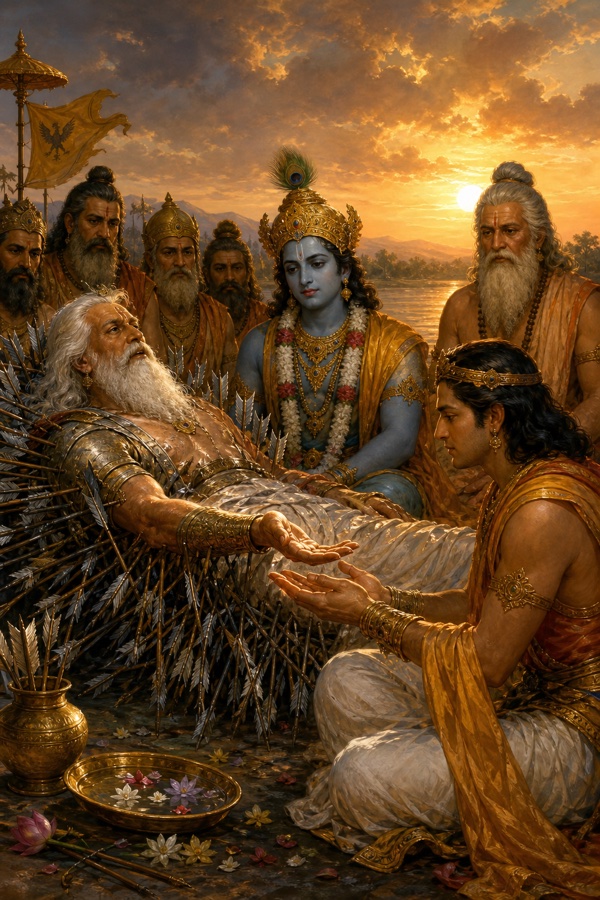
Bhishma gave one answer to all five. “A man should always, with eagerness and with every trace of sloth thrown off, sing the praise of the lord of the universe, the god of gods, the infinite one, the highest of beings, by uttering his thousand names. By worshiping that changeless being always with reverence and devotion, by meditating on him, by singing his praise and bowing the head to him, by sacrificing to him, by praising Vishnu always, who has no beginning and no end, who is the supreme lord of all the worlds and the master and controller of the universe, a man passes beyond all sorrow. He is devoted to the Brahmins. He knows every duty and every practice. He increases the fame and achievement of all, he is master of all the worlds, he is wonderful beyond measure, and he is the first cause from which all creatures arise. This, in my judgment, is the religion that stands above all religions: that a man should always worship the lotus-eyed Vasudeva with devotion and sing his praise. He is the highest energy. He is the highest austerity. He is the highest Brahman. He is the highest refuge. He is the holiest of all holy things and the most auspicious of all auspicious things. He is the god of all the gods, and he is the changeless father of all creatures. When the first age comes on, all creatures spring from him, and when an age runs out, all things disappear into him again.”
“Hear the thousand names of Vishnu, master of the universe,” Bhishma said, “names of great power to destroy sin. They are drawn from his attributes, some of them secret and some well known, and the rishis have sung them. I will recite them to you for the good of all.” He began with the sacred syllable. Om. He who enters all things; he who covers all things; he to whom the libations of sacrifice are poured; the lord of the past, the present, and the future; the maker of all existing things and their upholder; the Existent; the soul of all; the originator of all things.
The names came on in an unbroken stream. He is of cleansed soul. He is the Supreme Soul, the highest refuge of all the liberated, the changeless one, the one who lies enclosed in a case, the witness, the knower of the body in which he lives, the indestructible. He is the one on whom the mind rests in the stillness of yoga, the guide of all who know yoga, and the lord of both Prakriti and Purusha. He took the form of Narasimha, a man’s body with the head of a lion. He is handsome in feature and beautiful of hair, and he is the highest of Purushas. He is the embodiment of all things and the destroyer of all things. He is beyond the three attributes of sattva, rajas, and tamas. He is the motionless one, the beginning of all things, and the receptacle into which all things sink at the universal dissolution. He takes birth by his own will. He makes the acts of all living creatures bear their fruit, in good fortune or in grief. He is the upholder of all things, the source from which the primal elements came, and the one in whom lies unbounded lordship over everything.
The hymn calls him the self-born, the one who gives happiness to his worshipers, the golden presence in the middle of the sun’s disc, the lotus-eyed, the loud-voiced, the one without beginning and without end. He upholds the universe in the form of Ananta and in other forms. He ordains all acts and their fruits, and he is higher than the Grandsire Brahma. He is the immeasurable, the lord of the senses, the one from whose navel sprang the primeval lotus in which the Grandsire Brahma was born, the lord of all the gods, the artificer of the universe, the ancient one, the enduring. He cannot be seized by the senses or by the mind. He is Krishna. He is the red-eyed one, and he kills all creatures when the universal dissolution comes. He is the lord of Shri and the slayer of Madhu. He is armed with the bow, and he ranges through the universe riding on Garuda. He is the day; he is the year; and he is the snake, because no one can lay hold of him.
Many of the names hold a descent into the world. He is the younger brother of Indra. He is the one who took birth as a dwarf, born of Aditi by her husband Kashyapa, to trick the Asura king Bali out of the sovereignty of the three worlds and hand it back to Indra, who had lost it. He is the tall one, for the vast form he took at Bali’s sacrifice, when he covered heaven, earth, and the lower regions in three steps. As the mighty boar he raised the earth when she had sunk beneath the waters. He took the form of Rama, the son of Dasharatha, went into exile at his father’s command, and made a treaty with Sugriva, chief of the apes: he would help Sugriva win back his kingdom from his elder brother Vali, and Sugriva would help him recover his wife Sita from Ravana, the Rakshasa who had carried her off to his island home in Lanka. He killed Ravana and rescued Sita. He shows compassion even to Chandalas when they come to him with devotion, as he showed it in his friendship with Guhaka, chief of the Chandalas of the country called Shringaverapura. And he takes the form of a mighty fish when the waters of the dissolution cover the earth, and speeding through that vast expanse with the boat tied to his horns, he draws Manu and the others to safety.
A sub-tale (some names and their tales): The hymn often opens a name into the story behind it. One name is the mark of a cord around his waist, and the reason is given at once: Yashoda tied him with a rope while he was Krishna. Another is read as the one who held up the mountains of Govardhana in the woods of Vrinda, to shelter the people of that place, who were especially dear to him, when Indra in his anger poured rain for days on end and meant to drown everything. Another recalls that he took the form of a swan to deliver the Vedas to the Grandsire Brahma. Another recalls that, as the vast tortoise, he held on his back the great mountain Mandara, which the gods and the Asuras used as their churning staff when they churned the ocean for the treasures hidden in it.
The hymn reaches for his whole extent. He is of universal form and of vast form; he has a hundred forms and a hundred faces. He is one, and through illusion he is many. He is full of happiness. He is the one called That, and he is the highest refuge. He is of golden complexion; his limbs are like gold and beautiful, and he wears armlets made of sandal paste. He has four arms, to hold the conch, the discus, the mace, and the lotus. He is four-souled, because of his four forms, Aniruddha, Pradyumna, Sankarshana, and Vasudeva. He is the refuge of the four modes of life and the four orders of men. From him spring the four objects of life, righteousness, wealth, pleasure, and liberation, and he knows the four Vedas. And what he has shown, the hymn says, is only a fraction of his power.
The last names look to his origin and to his arms. He is the cause of his own existence. He is self-born. He passed through the solid earth, went down to the lower regions, and killed Hiranyaksha. He sings the Saman hymns. He is the delight of Devaki, the creator of all, and the destroyer of his worshipers’ sins. He bears the conch Panchajanya in his hands. He bears the sword of knowledge and illusion. He sets the cycle of the yugas turning without rest. He clothes himself in consciousness and the senses. He carries the mace of the most solid understanding. He is armed with a chariot wheel, he cannot be shaken, and he is armed with weapons of every kind. That is the thousandth name, and the recital closes on the syllable with which it opened: Om, salutations to him.
“So I have recited to you, leaving none out, the thousand excellent names of Keshava, whose glory should always be sung,” Bhishma said. “The man who hears these names every day, or recites them every day, never meets with any evil, here or hereafter. A Brahmin who does it masters the Vedanta. A Kshatriya is always victorious in battle. A Vaishya comes into wealth, and a Shudra earns great happiness. One who wants the merit of righteousness earns it; one who wants wealth gains wealth; the man who wants the pleasures of the senses has them, and the man who wants children gets children. The man who purifies himself and recites these thousand names of Vasudeva every day, with devotion and perseverance and his whole heart turned toward him, wins great fame, a leading place among his kinsmen, lasting prosperity, and at the end the highest good, which is liberation. He never knows fear, and he gains great prowess and energy. Disease does not touch him; a fine complexion, strength, and beauty become his. The sick grow well, the suffering are freed from their suffering, the frightened are freed from fear, and the man sunk in calamity is lifted out of it. Those devoted to Vasudeva are freed from the fear of birth, death, old age, and disease, and neither anger nor jealousy nor greed nor an evil mind ever shows itself in them. The sky with the sun, moon, and stars, the quarters, the earth, and the ocean are all held up by the might of Vasudeva. The whole universe that moves and stands still, with its gods, Asuras, and Gandharvas, its Yakshas, serpents, and Rakshasas, is under the rule of Krishna. The senses, mind, understanding, life, energy, strength, and memory have Vasudeva for their soul, and so do this body, which is called the field, and the knower of the field within it. Yoga, the Sankhya philosophy, knowledge, every craft, the Vedas, and all learning have come from Janardana. Vishnu is the one great substance that has spread itself out into many forms; covering the three worlds, the soul of all things, he enjoys them all. This hymn in praise of Vishnu was composed by Vyasa, and whoever wants happiness and the highest good should recite it.”
A key to reading this (the frame of the sahasranama): “Sahasranama” means the thousand names. Bhishma describes them as drawn from Vishnu’s attributes, some secret and some well known, and as sung by the rishis. The recital opens with Om and closes with “Om, salutations to him,” and the names are counted in their order up to the thousandth. Many are given with the reason for them, and some with two readings side by side, so that one name is read both as the lord of the senses and as the one with curled locks. Bhishma calls the hymn a composition of Vyasa and promises its rewards to anyone who hears or recites it every day.
The gist: Yudhishthira asks who the one god is, who the one refuge is, whom to praise, which religion is highest, and which mantras free a creature from birth. Bhishma answers all five with Vasudeva: the highest religion is to worship him with devotion and to sing his praise in his thousand names. The names run from the one who enters all things to the one armed with every weapon, and they hold the dwarf, the boar, the tortoise, the fish, Rama, and Krishna within them. The promised rewards rise from wealth and victory to freedom from the fear of birth and death.
The Savitri-mantra and the muttering of the names of gods and sages
Yudhishthira had a smaller and more daily question. What should a man recite silently, day after day, to earn a large measure of merit? What is the mantra that brings success when it is said on setting out on a journey, on entering a new building, at the start of any undertaking, or at the rites for the gods and the ancestors? He wanted the one that quiets every hostile influence, that brings prosperity and growth, protection from evil, the destruction of enemies, and freedom from fear, and that agrees with the Vedas besides.
“Listen closely,” Bhishma said. “That mantra was declared by Vyasa. It was ordained by Savitri and is of great excellence, and it can cleanse a man of all his sins at once. A man who recites it day and night is never stained by sin. The man who hears it lives long, gains all his wishes, and is happy here and hereafter. The great royal sages recited it daily, men devoted to the duties of the Kshatriya and steady in the vow of truth, and kings who recite it every day with their senses restrained and their souls at peace win prosperity without rival.” Then he spoke it. “Salutations to Vasishtha of the high vows, after bowing with reverence to Parashara, that ocean of the Vedas. Salutations to the great snake Ananta, and to all those who are crowned with success and whose glory does not fade. Salutations to the rishis, and to him who is the highest of the high, the god of gods, who gives boons to the greatest. Salutations to him of the thousand heads, the most auspicious one, him of the thousand names, Janardana. Aja, Ekapada, Ahirbudhnya, the unconquered Pinakin, Rita, Pitrirupa, the three-eyed Maheshvara, Vrishakapi, Shambhu, Havana, and Ishvara: these are the celebrated Rudras, eleven in number, lords of all the worlds. These same eleven are spoken of as a hundred in the Shatarudra.”
“Amsha, Bhaga, Mitra, Varuna the lord of waters, Dhatri, Aryaman, Jayanta, Bhaskara, Tvashtri, Pushan, Indra, and Vishnu make a count of twelve. These twelve are called the Adityas, and they are the sons of Kashyapa, as the sacred texts declare. Dhara, Dhruva, Soma, Savitra, Anila, Anala, Pratyusha, and Prabhava are the eight Vasus named in the scriptures. Nasatya and Dasra are the two Ashvins, the sons Martanda had by his wife Samjna; they came forth from her nostrils. After these come the witnesses of every act done in the worlds. They take note of all sacrifices, all gifts, and all good deeds, and, unseen themselves, they see everything that every being does, good and bad. They are Mrityu, Kala, the Vishvedevas, the ancestors in their bodily forms, the great rishis rich in austerity, and the munis who have won success and are given to austerity and liberation. Smiling gently, they grant many benefits to the men who recite their names, and worlds of happiness that the Grandsire created. These thirty-three gods, lords of all beings; Nandishvara of the huge body; the great one who has the bull on his banner; the followers of the one called Ganeshvara; those called the Saumyas, the Rudras, the Yogas, and the Bhutas; the lights in the sky, the rivers, the heavens, and Garuda, king of birds; all those on earth whom austerity has crowned with success; Himavat and all the mountains, and the four oceans; the companions of Bhava, who equal Bhava in prowess; the ever-victorious Vishnu, and Skanda, and Ambika: these are the great souls by reciting whose names, with the senses restrained, a man is cleansed of all his sins.”
“Next come the great rishis known as the Manavas: Yavakrita, Raibhya, Arvavasu, Paravasu, Aushija, Kakshivat, and Bala the son of Angiras, and then Kanva the son of the rishi Medhatithi, and Varishada. They carry the energy of Brahma and are spoken of as creators of the universe; they sprang from Rudra, from Anala, and from the Vasus. They are the priests of Indra, and they live in the east. The man who recites their names with rapt attention rises to the worlds of Indra and is honored there. Unmuchu, Pramuchu, Svastyatreya, Dridhavya, Urdhvabahu, Trinasoma, Angiras, and Agastya, the son of Mitravaruna, are the officiating priests of Yama, king of the dead, and they live in the south. Dridheyu and Riteyu, the famous Pariyadha, Ekata, Dvita, and Trita, those three bright as the sun, and Atri’s righteous son, the rishi Sarasvata: these seven served as priests at the great sacrifice of Varuna, and they have made their homes in the west. Atri, Vasishtha, the great rishi Kashyapa, Gautama, Bharadvaja, Vishvamitra the son of Kushika, and Jamadagni, the fierce son of Richika: these seven are the priests of Kubera, lord of treasures, and they live in the north. Seven more live in every direction and are bound to none. They bring men fame and everything that is good for them, and they are sung of as creators of the worlds: Dharma, Kama, Kala, Vasu, Vasuki, Ananta, and Kapila, the seven upholders of the world. Rama, Vyasa, and Ashvatthama the son of Drona are named with them. These are the great rishis in their seven groups of seven. They make the peace and the good that men enjoy, and they are called the guardians of the quarters.”
A key to reading this (the seven sages of the directions): Bhishma assigns each group of rishis a quarter of the sky and a divine patron: the east with Indra, the south with Yama, the west with Varuna, the north with Kubera, lord of treasures, and one group that belongs to every direction. The rule that follows is simple. A man who wishes to worship one of these rishis should turn his face to the quarter in which that rishi lives. Bhishma calls them the creators of all creatures and the cleansers of all.
“Samvarta, Merusavarna, the righteous Markandeya, Sankhya and Yoga, Narada, and the great rishi Durvasa are men of hard austerity and great self-control, famous through the three worlds. There are others, equal to Rudra himself, who live in the world of Brahma. By naming them with reverence a man without a son gets a son, and a poor man gets wealth. The kings must be named too. Name Prithu, the son of Vena, emperor of the whole earth and the equal of a Prajapati, whose daughter the earth became. Name Pururavas, the son of Ila and the dear son of Budha, famous through the three worlds and equal to great Indra in prowess. Name Bharata, a hero known in all three worlds. Name Rantideva, who in the Krita age worshiped the gods in a grand Gomedha sacrifice, a man of austerity who bore every auspicious mark and was a blessing to the world. Name the royal sage Shveta, who pleased the great Mahadeva; it was for his sake that Andhaka was killed. Name the royal sage Bhagiratha, who by the grace of Mahadeva brought the sacred river down from heaven and had the waters of Ganga flow over the ashes of the sixty thousand sons of Sagara, and so rescued them from their sin. Take the names of all these gods and rishis and kings, morning and evening, with your senses restrained. It is they who protect. They send the rain. They shine and give light and heat, they blow as wind, and they create all things. They are the witnesses of every deed, good and bad.”
“The man who rises in the morning and takes their names is certain to gain everything good. He is freed from the fear of fire and of thieves. His road is never blocked. Bad dreams of every kind leave him, and, cleared of every sin, he is born into an auspicious family. A twice-born man who recites these names, with his senses restrained, at the opening rites of a sacrifice or of any religious observance becomes righteous, devoted to the study of the soul, forgiving, self-controlled, and free of malice. A sick man who recites them is freed from the sin that has taken the form of his sickness. Recited inside a house, they drive every evil from those who live in it. Recited in a field, they help every kind of crop to grow. Recited at the moment of setting out, or while a man is far from home, they bring him good fortune. These names protect a man’s own self, his children and wives, his wealth, his seed and his plants. The Kshatriya who recites them as he goes into battle sees destruction overtake his enemies and good fortune crown his own side. The man who recites them at the rites for the gods or the ancestors helps the gods and ancestors to eat what is offered. Recited on board a boat, or in a vehicle, or in the courts of kings, these Savitri mantras bring high success. Where they are recited, fire does not burn the wood; children do not die there, and snakes do not live there; no one in that place need fear the king, or Pishachas, or Rakshasas. Recited among cattle, they make the cows fruitful. They bring peace and well-being to all four orders.”
Bhishma gave the mantra’s history and its worth. “What I have told you is the excellent teaching of Parashara, and it was recited long ago to Shakra himself. It stands for truth, for the eternal Brahman, and I have given it to you in full. All the princes of the lines of Soma and Surya, the Raghavas and the Kauravas, recite these mantras every day after purifying themselves. The sages of old adored them: Kashyapa, Gautama, Bhrigu, Angiras, Atri, Shukra, Agastya, Brihaspati, and others. Approved by the son of Bharadvaja, they came to the sons of Richika, and when Shakra and the Vasus had received them again from Vasishtha, they went out to battle and overcame the Danavas. The man who gives a learned Brahmin, one who knows the Vedas well, a hundred cows with their horns sheathed in gold, and the man who has the excellent story of the Bharata recited in his house every day, are said to earn equal merit. By reciting the name of Bhrigu a man increases his righteousness. By bowing to Vasishtha he increases his energy. By bowing to Raghu he becomes victorious in battle. By reciting the praises of the Ashvins he is freed from disease. If you wish to question me on any other matter, do so, and I will answer you.”
The gist: Asked for a mantra to recite daily and at every beginning, Bhishma gives the one he calls the Savitri mantras, declared by Vyasa and held as the teaching of Parashara. It is a roll of names: salutations to Vasishtha, Parashara, Ananta, and Janardana, then the eleven Rudras, twelve Adityas, eight Vasus, and two Ashvins, the rishis of the four quarters, and kings from Prithu to Bhagiratha. Recited in house, field, court, or battle line, the names protect. Bhishma sets the daily recital of the Bharata story equal to a gift of a hundred gold-horned cows.
The greatness of the Brahmin: the dialogue of the wind and Arjuna (Kartavirya)
Yudhishthira’s next question was the plainest he had put from that bedside. Who deserves to be worshiped? To whom should a man bow, and how should he carry himself toward each kind of person so that no blame attaches to him? Bhishma did not hesitate. “To humiliate the Brahmins is to humiliate the gods themselves. No fault comes to a man who bows to them. Honor them, salute them, and treat them as you would your own sons, for it is these men of great wisdom who hold up all the worlds.” Then he said what kind of men he meant. Their happiness lies in giving up every kind of wealth. They keep the vow of restraining speech. Austerity is their treasure, speech is their strength, and the duties they keep are the source of their power. They are the causeways of dharma across all the worlds, the road every creature must travel and the guides upon it, the island where the four kinds of living beings find refuge, the eyes of all who have sight. Like strong cattle on a hard road, they carry the heavy loads of fathers and grandfathers and never droop under them, and they attend to the ancestors, the gods, and the guest. The first portion of every offering made to gods and to ancestors is theirs to eat, and by the very food they eat they deliver the three worlds from fear. Their wealth is the branches of learning and all the revealed texts. They know the beginning, the middle, and the end of things, and doubt has left them. Sandal paste and filth are the same in their eyes, and so are coarse brown cloth, silk, and animal skin. They go without food for many days until their limbs dry out, and they study the Vedas with their senses held in. “They can make gods of those who are no gods, and unmake those who are,” Bhishma said. “In their anger they could create other worlds, and other guardians to rule them. It was their curse that turned the ocean too salt to drink. The fire of their wrath still burns in the forest of Dandaka, and time has not put it out.” Young and old among them deserve honor alike, and among themselves they honor one another for austerity and knowledge, whatever their years. A Brahmin without learning is still a god and a means of cleansing others, and one with learning is a greater god, like the ocean when it is full to the brim. Fire is a great deity whether or not mantras have consecrated it, and a fire burning on a cremation ground takes no taint from the ground it burns on. Clarified butter is beautiful on the altar and beautiful in a storeroom. So a Brahmin, even one given to evil acts, is to be honored still. Yudhishthira pressed him. Bhishma had worshiped these men all his life; what reward had he seen in it, what success, that he went on doing it? For answer the old man reached for an old story, a quarrel between a king and the wind. The king was Arjuna, the son of Kritavirya, called Kartavirya after his father, a ruler of long ago who bears the same name as the Pandava archer sitting by the bed. He was chief of the Haihaya Kshatriyas. His capital was Mahishmati, and he ruled the whole sea-belted earth with her islands and her mines of gold and gems. He kept the duties of his order, he had humility and Vedic learning, and he gave great wealth to the sage Dattatreya, who was pleased with him and told him to ask three boons. The king asked for a thousand arms whenever he stood among his troops, and his ordinary two at home. He asked to conquer the whole earth by his own prowess, and to rule with vigilance what he had won righteously. Then he asked for a fourth. “I depend on you. Whenever I happen to go wrong, let the righteous come forward to instruct me and set me right.” The Brahmin said, “So be it.”
The boons made him, and they blinded him. Riding one day in a chariot as bright as fire or the sun, Kartavirya asked aloud who could be counted his equal in patience and energy, in fame and heroism, in prowess and strength. A voice with no body behind it answered from the sky: “Ignorant wretch, do you not know that the Brahmin is above the Kshatriya? The Kshatriya rules all creatures with the Brahmin’s help.” The king argued back. Pleased, he could create many creatures; angry, he could destroy them all; in thought, word, and deed he was first, and no Brahmin stood above him. The unseen speaker had said that the two orders work together, and the king pointed to the difference between them. Brahmins take shelter with Kshatriyas and draw their living from them under the pretext of teaching the Vedas, and no Kshatriya ever goes to a Brahmin for shelter. The protection of all creatures is the Kshatriya’s charge. From that day, he declared, he would bring these beggars in animal skins, so proud of their independence, under his rule, and a world that now held Brahmins first would soon hold Kshatriyas first. What the maiden Gayatri had said from the sky was untrue. No god or man in the three worlds could throw him down from his sovereignty, and no one could bear his might in battle. The goddess in the air was shaken by his words. Then a second voice spoke, and it was the wind. “Put away this sinful mood and bow to the Brahmins. Harm them and you bring trouble on your kingdom. They will kill you, king though you are, or strip you of your power and drive you out of your realm.” “Who are you?” the king demanded. “I am the god of wind, the messenger of the gods, and I am telling you what is good for you.” Kartavirya’s reply had an edge to it. So the wind was devoted to Brahmins; then let the wind say what kind of earthly creature a Brahmin is. Is he like wind? Like water, or fire, or the sun, or the sky? “Listen, deluded man,” said the wind. “The Brahmin is greater than everything you have named.” And he began to count. Earth herself once fell into rivalry with the king of the Angas and gave up her nature as earth, and the Brahmin Kashyapa brought ruin on her by striking her motionless. The great sage Angiras drank up all the waters as if they were milk, found his thirst unquenched, and then filled the earth again by raising one vast wave. “When Angiras was angry with me,” the wind admitted, “I left the world and hid for a long time in the fire offering of the Brahmins, for fear of him.” Gautama cursed Indra for coveting the body of Ahalya, and it was only for the sake of dharma and wealth that the sage stopped short of destroying the king of the gods outright. The ocean, once full of clear water, turned salt when Brahmins cursed it. Agni, golden, blazing without smoke, his flames joining and climbing upward, lost every one of those marks when the angry Angiras cursed him. The sixty thousand sons of Sagara came to worship the ocean and were ground to dust by one Brahmin, the golden-skinned Kapila. The wide kingdom of the Dandakas was destroyed by a Brahmin, and the mighty Kshatriya Talajangha by a single Brahmin, Aurva. “A Kshatriya, however strong he is, bows to Brahmin children still in their mothers’ wombs. You are no equal of the Brahmins. Look to your own good.”
Then the wind turned the king’s own life against him. The broad kingdom, the strength, the merit, and the learning Kartavirya enjoyed, every one of them hard to win, had come to him through the grace of one Brahmin, Dattatreya. He worshiped Agni every day, and Agni is a Brahmin, the carrier of offerings from every part of the universe. He knew very well that a great Brahmin protects all creatures and is the maker of the living world, so why let folly cloud what he knew? The wind spoke then of the maker himself, Brahma, the Lord of creatures, unmanifest, of glory that does not fade, who made this boundless universe of moving and unmoving things. Some who lack wisdom say that Brahma was born from an egg, that when the first egg burst open the mountains, the quarters of the sky, the waters, the earth, and the heavens sprang out of it. No one saw that birth, the wind said, and how can one who is declared unborn have been born of an egg? The egg men speak of is uncreated space, and from it the Grandsire came. If the king asked what the Grandsire could have rested on when nothing else existed, the answer was a being called Consciousness, mighty and full of power. “There is no egg. Brahma is. He is the creator of the universe and its king.” Kartavirya said nothing. So the wind went on to tales. There was once a ruler named Anga who wished to give away the whole earth to the Brahmins as a sacrificial gift, and the Earth was filled with anxiety. “I am Brahma’s daughter,” she said. “I hold all creatures. Why does this king, having won me, wish to hand me to the Brahmins? I will put off my nature as soil and go to my father. Let this king and his whole kingdom meet destruction.” She set out for Brahma’s realm. The sage Kashyapa saw the goddess on the point of leaving, and by the power of yoga he cast off his own body and entered the visible form she was abandoning. Filled with the spirit of Kashyapa, the earth prospered and bore every kind of plant. Dharma stood first everywhere and all fear ceased. For thirty thousand celestial years the earth lived on in that way, carrying out every one of her offices exactly as she had when Brahma’s daughter was within her. When that time was over the goddess came back from her father’s realm, bowed to Kashyapa, and from then on was his daughter. “Kashyapa is a Brahmin, and this is what a Brahmin did,” said the wind. “Tell me the name of the Kshatriya who can be held above Kashyapa.” The king kept silent.
A sub-tale (Utathya and Varuna): The wind’s next tale was of Utathya, born in the line of Angiras. Soma had a daughter named Bhadra, whose beauty was held to have no rival, and Soma judged Utathya the fittest husband for her. The girl herself kept vows and went through the hardest austerities in the hope of winning him. In time Atri, the father of Soma, invited Utathya to his house and gave her to him, and Utathya, a giver of lavish sacrificial gifts, took her as his wife with due rite. But the handsome Varuna, lord of the waters, had wanted the girl for a long time. He came to the woods where Utathya lived, and when Bhadra went down into the Yamuna to bathe he seized her and carried her to his own house. It was a marvel of a place, set with six hundred thousand lakes, full of palaces and Apsaras and every delight, and there he took his pleasure with her. Narada brought Utathya the news. “Go to Varuna,” Utathya told him, “and speak to him sternly. Ask him why he has taken my wife, and tell him in my name to give her up. Say to him: you are a guardian of the worlds, Varuna. What guardian steals the wife Soma gave to Utathya?” Narada carried the message, and Varuna answered, “This timid girl is very dear to me. I cannot bring myself to let her go.” Narada came back downcast. “Varuna took me by the throat and threw me out of his house. He will not return your wife. Do as you please.” Utathya burned with anger. By the wealth of his austerities he made the waters solid and drank them off, and the lord of that element grieved with all his friends and kin, and still he kept the woman. Then Utathya commanded the Earth: “Show me dry land where the six hundred thousand lakes now lie.” The ocean drew back from the place and barren ground appeared. To the river that ran through that country he said, “Sarasvati, become invisible here. Leave this region and go to the desert, and let this land, without you, be holy no longer.” When his own country had gone dry, Varuna came to the sage with Bhadra and handed her over. Utathya was glad to have her, and he released the world and the lord of waters from the distress he had laid on them. “I have recovered my wife by my austerities, Varuna,” he said, “after making you cry aloud in pain.” Then he took her home. “Such was Utathya,” said the wind. “Shall I go on, or do you hold to your opinion still? Is there a Kshatriya above Utathya?”
The gist: Bhishma tells Yudhishthira that to humiliate a Brahmin is to humiliate the gods, and that a Brahmin, learned or unlearned, is a deity as fire is a deity wherever it burns. Asked what such worship earns, he tells of Kartavirya of the thousand arms, who owed his boons to Dattatreya and still boasted that no Brahmin stood above him. The wind answers the king with one feat after another, Kashyapa sustaining the earth for thirty thousand celestial years, Utathya drinking the waters dry to win back his wife, and after each feat asks him to name a Kshatriya who is greater.
The wind’s tales: Agastya, Vasishtha, Atri, and Chyavana
Kartavirya gave no answer, and the wind took up Agastya. The Asuras had once beaten the gods, and the gods lost heart. Their sacrifices were seized, the offering that belongs to the ancestors was carried off, and the Danavas put a stop to the rites and observances of human beings as well. Stripped of their prosperity, the gods wandered over the earth, and in their wandering they came upon Agastya, a Brahmin of high vows whose splendor blazed like the sun. They saluted him, asked after his welfare as courtesy required, and then said it plainly: “The Danavas have beaten us in battle, and we have fallen from all we had. Deliver us from this great fear.” Agastya heard what they had been brought to, and his anger rose against the Danavas. He blazed up like the fire that consumes everything at the dissolution of the world, and in the rays that streamed from him the Danavas began to burn. They dropped out of the sky by thousands. Those still alive abandoned heaven and earth and fled toward the south. The Danava king Bali was performing a horse sacrifice in the nether regions at that time, and the Asuras who were with him there, or who lived in the bowels of the earth, escaped the burning. The gods had their own realms again and their fear was gone. Heartened by what he had done for them, they asked the sage to finish the work and destroy the Asuras under the earth as well. “I am fully able to burn them,” Agastya said. “But if I do, my austerities will be the poorer for it. I will not use my power.” So the Danavas were consumed by one sage’s austerity, and the wind put his question again. Should he continue, or would the king reply? Was there a Kshatriya greater than Agastya?
The king was silent, and the wind told a feat of Vasishtha’s. The gods were holding a sacrifice on the shore of the lake Vaikhanasa, and, knowing his power, they thought of Vasishtha and made him their priest in their minds. The consecration they had undertaken for the rite had left them thin and weak, and a race of Danavas called the Khalins, each as huge as a mountain, saw their condition and resolved to kill them. These Khalins held a boon from the Grandsire. Any of them disabled or killed in the fight was plunged into the waters of the Manasa lake and came out at once alive and strong. They took up mountain peaks, maces, and whole trees, and churned the lake until its waters stood a hundred yojanas high, and then they ran at the gods, who numbered ten thousand. The gods fled to their chief for protection, and Indra was soon as hard pressed as they were. In his distress he turned to Vasishtha. The sage saw how low the gods had sunk and, out of compassion, told them to put away their fear. He put forth his power and burned the Khalins without effort. Then, by the wealth of his austerities, he brought to that place the river Ganga, who had gone to Kailasa. She came piercing through the waters of the lake, and as she flowed on beyond it she took the name Sarayu. The ground where those Danavas fell came to be called after them. So Indra and the dwellers in heaven were pulled out of great danger, and Danavas who carried Brahma’s own boon were killed by a single sage. “Shall I go on? Was there a Kshatriya who could surpass the Brahmin Vasishtha?”
Again the king had nothing to say, and the wind went on to Atri. Gods and Danavas were once fighting each other in the dark when Rahu pierced both Surya and Soma with his arrows. With the sun and the moon wounded and darkness over everything, the gods began to fall before the Danavas, struck again and again, their strength draining away. Then they saw the learned Brahmin Atri at his austerities, a man who had mastered his senses and in whom anger had been put out, and they called to him: “Look at these two, Soma and Surya, pierced by the arrows of the Asuras. Darkness has overtaken us and the enemy is striking us down. We see no end to our troubles. Save us from this great fear.” “How am I to protect you?” the sage asked. “Become the moon yourself,” they said. “Become the sun as well, and kill these robbers.” Atri took the form of Soma, the destroyer of darkness, and so gentle was his nature that he looked as lovely as the moon itself. Seeing the true Soma and the true Surya dimmed by the enemy’s shafts, he took the forms of both lights and shone over the battlefield by the power of his austerities. He made the universe blaze and drove out all its darkness, and with the same power he overcame the vast host of the gods’ enemies. The gods saw the great Asuras burning and, sheltered by Atri’s energy, fell on them and finished them quickly. A silent reciter of mantras, dressed in deerskin, living on fruit alone and aided only by his sacred fire, had lit the god of day, rescued the gods, and destroyed the Asuras. “Shall I go on? Is there a Kshatriya above this sage?”
Arjuna of the thousand arms kept silent, and the wind came to Chyavana. The sage had given his word to the twin Ashvins, and to keep it he went to Indra and said, “Make the Ashvins drinkers of soma with all the other gods.” Indra refused. “We have cast the Ashvins out. How can they be admitted to the circle of the sacrifice to drink soma with the rest? They are not numbered among the gods. Do not ask this of us. Name any other command and we are ready to carry it out.” “The twin Ashvins shall drink soma with all of you,” Chyavana said. “They are gods, both of them, for they are sons of Surya. Do what I have said and the gods will gain greatly by it. Do otherwise and evil will overtake you.” “I will not drink soma with the Ashvins,” Indra said. “Let others drink with them if they like. I will not.” “Then this very day,” said Chyavana, “you will drink with them in a sacrifice, and I will compel you.” He took the Ashvins with him and began a great rite for their benefit, and with his mantras he struck all the gods motionless. Indra saw what the sage had begun and was seized with rage. He took up a huge mountain and ran at Chyavana, armed with the thunderbolt as well. The sage cast one angry glance at him as he came, threw a little water at him, and the king of the gods stood paralyzed, mountain and thunderbolt and all. Out of the libations he had poured on the sacred fire Chyavana then made a terrible Asura, an enemy for Indra, named Mada, whose mouth gaped wide. There were a thousand teeth in that mouth, reaching a hundred yojanas, and the fangs were two hundred yojanas long. One of his cheeks rested on the earth and the other touched the heavens. All the gods with Indra seemed to stand at the root of that tongue like fish that have swum into the open mouth of a sea monster.
Standing inside the mouth of Mada, the gods held a hurried council and then spoke to Indra. “Bow your head to this Brahmin, and quickly. We put away every scruple. We will drink soma with the Ashvins beside us.” Indra bowed his head to Chyavana and did as he was told, and so the Ashvins became drinkers of soma with the other gods. Then the sage called Mada back and gave him his work. Mada was to make his home in four places: in dice, in hunting, in drinking, and in women. “That is why men who give themselves to these meet destruction, without doubt,” the wind said, “and why a man should put these faults a long way from him. Shall I go on, or will you answer? Is there a Kshatriya higher than the Brahmin Chyavana?”
The gist: The wind sets a Brahmin’s austerity against a king’s arms four more times. Agastya burns the Danavas out of heaven and earth and refuses to spend more of his austerity on those under the ground. Vasishtha burns the Khalins and brings the Ganga through the lake, where she flows on as the Sarayu. Atri shines as moon and sun when Rahu has darkened both. Chyavana paralyzes Indra, makes the Asura Mada, and wins soma for the Ashvins. After each feat the wind asks whether any Kshatriya is greater, and each time Kartavirya has no answer. Mada is sent to live in dice, hunting, drink, and women, and the wind warns that men who take to these four are destroyed.
The slaying of the Kapas, and the homage of Arjuna
The king kept his silence, and the wind told one more tale. It began inside the mouth of Mada. While Indra and the gods stood trapped there, Chyavana took the earth away from them. They had already lost heaven, and now the earth was gone too. Sick with grief, they threw themselves on the protection of the Grandsire. “Chyavana has taken the earth from us,” they said, “and the Kapas have taken heaven.” Brahma sent them elsewhere. “Go quickly, all of you, with Indra at your head, and seek the protection of the Brahmins. Please them, and you will have both worlds back as before.” The gods went to the Brahmins as suppliants. “Whom are we to subdue?” the Brahmins asked. “Subdue the Kapas,” said the gods. “We will bring them down to the earth first,” the Brahmins answered, “and then we will make short work of them.”
So the Brahmins began a rite whose aim was the destruction of the Kapas. The Kapas heard of it at once and sent a messenger named Dhanin, who came to the Brahmins where they sat on the ground and gave them the message. The Kapas, he said, were men like themselves. What would these rites accomplish? Every one of the Kapas knew the Vedas well and had wisdom. Every one was mindful of sacrifice and held truth as his vow, and for that they were counted the equals of great sages. The goddess of prosperity sported among them, and they kept her with reverence. They never lay with their wives where no child could come of it, and never during a wife’s monthly period. They ate no flesh of animals that had not been killed in sacrifice. They poured their libations on the blazing fire each day and obeyed their teachers and elders. Their souls were under control. They took no food without first dividing it among their children, and while a woman heavy with child or an old man had still to eat, none of them ate. They traveled together in their chariots and other conveyances, so that no one rode while another went on foot. They did not play or amuse themselves in the forenoon, they did not sleep by day, and in everything they acted so as to win the blessed worlds after death. “When the Kapas have these virtues and many more,” Dhanin said, “why would you seek to subdue them? Leave this undertaking. It is in leaving it that your own good lies.”
The Brahmins were not moved. “We will subdue the Kapas. In this we are one with the gods, and so the Kapas deserve to die at our hands. As for Dhanin, let him go back where he came from.” Dhanin returned and told his people, “The Brahmins are not disposed to do you any good.” At that every one of the Kapas took up his weapons, and they marched on the Brahmins with the standards of their chariots raised. The Brahmins watched them come and made fires, blazing ones, called up with Vedic mantras for the destruction of the Kapas. Those eternal fires did what they were made for, and afterward they shone in the sky like clouds of gold. The gods, meanwhile, had gathered for battle and killed many of the Danavas, and they did not yet know whose work the victory was. Narada came and told them: their enemies the Kapas had been destroyed by the Brahmins. The gods were delighted, and they praised those allies of great fame. From then on the energy and prowess of the gods grew, they were worshiped in all the worlds, and they won the boon of immortality.
When the wind had finished, King Arjuna worshiped him with due rite, and this time he had an answer. “Always and in every way I live for the Brahmins. I am devoted to them, and I worship them always. It was through the grace of Dattatreya that I came by this might of mine, and through his grace that I have done great deeds in the world and won high merit. I have listened with attention to the feats of the Brahmins as you have truly told them, with all their details.” The wind gave him a charge and a warning. “Protect and cherish the Brahmins in the exercise of the Kshatriya duties that are yours by birth. Protect them as you protect your own senses. There is danger to you from the line of Bhrigu. All of that, though, lies on a distant day.”
The gist: On their own messenger’s account the Kapas know the Vedas, keep truth as their vow, feed their children, their old men, and their pregnant women before themselves, and are counted the equals of great sages. The Brahmins dispute none of it. They answer that they stand with the gods, and they burn the Kapas with fires made of mantra. Kartavirya ends by declaring that he lives for the Brahmins and owes his strength to Dattatreya, and the wind’s last word to him is a warning: danger will come to him from the line of Bhrigu, on a day still far off.
Krishna is all: Bhishma hands Keshava to Yudhishthira
Yudhishthira came back to the question the story had been told to settle. Bhishma had worshiped Brahmins of praiseworthy vows all his life; what fruit had he seen in it, what prosperity, that he did so? This time the old man did not answer it himself. “Keshava is here,” he said, “and his understanding is great. He will tell you everything about the prosperity that comes of honoring Brahmins.” Then, lying on the arrows, he spoke of himself. “My strength, my hearing, my speech, my mind, my eyes, and the clear understanding I had are all clouded today. I think the time is close when I must put off this body. The sun seems to me to move very slowly.” He had recited, he said, all the high duties the Puranas lay down for Brahmins, Kshatriyas, Vaishyas, and Shudras. What little remained to be learned on that head, Yudhishthira should learn from Krishna. “I know Krishna truly. I know who he is and what his ancient might is. His soul is beyond measuring, and whenever dharma is in danger it is he who holds it up.”
“It was Krishna who made the earth, the sky, and the heavens,” Bhishma said, “and the earth came from his body. Existing from the beginning of time, terrible in his strength, he became the great Boar and raised the earth when she had sunk. He made the quarters of the sky and all the mountains. Sky, heaven, the four cardinal points and the four between them all lie below him, and the whole creation has flowed from him. A lotus appeared in his navel, and within that lotus Brahma was born, and it was Brahma who tore apart the darkness that lay deeper and wider than the ocean.” He told how Krishna had lived on the earth through the ages. In the Treta age he was there as dharma and as knowledge. In the Dvapara age he was there as might. In the Kali age he comes to the earth as unrighteousness. He killed the Daityas long ago. He is the Ancient God. He ruled the Asuras in the form of their emperor. He is the creator of all beings and their future, and the protector of a universe that carries the seed of its own destruction. “When the cause of dharma weakens, this Krishna takes birth among the gods or among men. Standing on dharma, he protects the higher worlds and the lower. He spares those who should be spared and sets himself to the killing of the Asuras. He is every act, the fitting and the unfitting, and he is their cause. He is the act done, the act to be done, and the act now being done.”
“Know that he is Rahu and Soma and Indra. He is Vishvakarma. He is of universal form, the destroyer of the universe and its creator. He carries the lance; he has a human form and a terrible one. All creatures sing of him, for he is known by what he does. Gandharvas, Apsaras, and gods go with him in hundreds, and the very Rakshasas hymn him. At sacrifices the eloquent praise him, the singers of samans praise him with the Rathantaras, the Brahmins praise him with Vedic mantras, and it is to him that the priests pour their libations. The gods with Indra at their head sang his praise when he lifted Mount Govardhana to shelter the cowherds of Vrindavana from the endless rain that Indra sent down in his rage.” Bhishma’s voice went on through the roll of what Krishna is. He entered the old cave of Brahma and saw from there the first covering of the world at the beginning of time. He shook the Danavas and the Asuras and rescued the earth. Men offer him their food, and warriors dedicate their chariots and mounts to him when war comes. He made the seed of the gods Mitra and Varuna fall into a jar, and from that jar the sage Vasishtha was born. He is the wind, he is the twin Ashvins, he is the sun of a thousand rays. He covered the three worlds in three steps. He is the soul of gods, of men, and of the ancestors, and he is the sacrifice that those who know the ritual perform. He rises each day and divides time into day and night, traveling north for half the year and south for half, and the sun shines with a portion of his rays. He is the wheel of the year with its three naves and the seven horses that draw it. In the form of Agni he once lived among the dry grass of the Khandava forest and was soon satisfied; he overcame the Rakshasas and the serpents and poured them as libations on the fire. He gave Arjuna his white horses, and he is the maker of all horses. The world is his chariot, three-wheeled, moving in three ways, drawn by four horses, turning on three naves, and it is he who yokes it and sets it rolling. He once crossed the rivers to chastise Indra, who was about to hurl the thunderbolt at him, and left him paralyzed. “And it was this Krishna alone,” Bhishma said, “who was able to keep the sage Durvasa as a guest in his house.” He is the three worlds, the three guardians of the worlds, the three sacrificial fires, the three sacred utterances. He is the year, the seasons, the fortnights, the day and the night, and the measures of time called kalas, kashthas, matras, muhurtas, lavas, and kshanas. The moon and the sun, the planets, constellations, and stars, the days of the full moon and the junctures of the seasons have flowed from him. The Rudras, the Adityas, the Vasus, the Ashvins, the Sadhyas, the Vishvedevas, the Maruts, Prajapati himself, Aditi the mother of the gods, and the seven sages all sprang from Krishna.
“Becoming wind, he scatters the universe. Becoming fire, he burns it. Becoming water, he drenches and drowns it, and in the form of Brahma he creates every tribe of living and unliving thing. He is himself the Veda and yet he studies all the Vedas. He is himself every ordinance and yet he keeps them all. Know, Yudhishthira, that this Keshava is everything that moves and everything that stands still. He made the waters first and this universe after them. Know that this Krishna is Vishnu, the soul of the universe. He is the seasons and the wonders of growing things, the clouds that pour rain and the lightning that flashes in the sky. He is the elephant Airavata.” Then Bhishma gave the names by which the one Krishna unfolds himself. As the abode of the universe, beyond all attributes, he is Vasudeva. When he becomes the living soul he is called Sankarshana. Next he changes himself into Pradyumna, and then into Aniruddha. In this way Krishna, whose only origin is himself, displays himself in a fourfold form. Wishing to create a universe made of the five primal elements, he sets to work and keeps it going in five forms of life: gods, Asuras, human beings, beasts, and birds. He made earth and wind, sky, light, and water. He made the moving and unmoving world in its four orders of being, then the earth with her fivefold seed, then the sky to pour rain upon her. “Whatever exists and whatever will come to exist, all of it is Keshava. He is the death that overtakes every creature when its end arrives, and he is eternal, and he upholds the cause of dharma. Whatever was in the past, and whatever we do not know, that too is Vishvaksena. Whatever is noble in the universe, whatever of good and of evil exists, all of it is Keshava, who cannot be conceived. It is absurd to think of anything higher than Keshava. He is Narayana, the highest of the high, unchanging and unfading, the eternal cause of all that moves and all that stands, with its beginning, its middle, and its end. Go to that Krishna.”
A key to reading this (the four vyuhas): The four vyuhas are the four forms Bhishma names here, in this order. As Vasudeva, Krishna is the abode of the universe, beyond every attribute. As the living soul he is called Sankarshana. Next he becomes Pradyumna, and then Aniruddha. By listing them Bhishma shows that the root of creation and its unfolding are one being, whose only origin is himself.
The gist: Bhishma tells Yudhishthira that his strength, hearing, speech, mind, sight, and understanding are clouded and that the time to leave his body is near. He has finished reciting the duties of the four orders, and he hands the king’s remaining question to Krishna. First he says who Krishna is: the maker of earth and sky, the Boar who raised the earth, the one who is born among gods or men whenever dharma weakens, Vasudeva unfolding as Sankarshana, Pradyumna, and Aniruddha, and the death that takes every creature at its end.
The tale of Vasudeva and Durvasa; the Shata-rudriya and the names of Rudra
So Yudhishthira turned to the man beside the bed. “Tell us, Krishna, what prosperity comes of honoring the Brahmins. You know this matter well, and our grandsire knows you.” Krishna answered with something that had happened under his own roof. He had been sitting at Dwarka one day when his son Pradyumna came to him in a rage at certain Brahmins and asked the same question. What merit is there in worshiping Brahmins? Where does their lordship come from, in this world and the next? His mind was troubled with doubt, the young man said, and he wanted it explained clearly. Krishna told Yudhishthira what he had told the boy. “Son of Rukmini, whoever sets out to win dharma, wealth, and pleasure, or liberation, or fame and prosperity, or the cure of a disease, or to worship the gods and the ancestors, should take care to please the Brahmins. Each of them is a King Soma. They give out happiness and misery. In this world and the next, my son, everything pleasant has its source in the Brahmins; I have no doubt of it. Great deeds, fame, and strength flow from honoring them. The dwellers in all the worlds and the guardians of the universe worship Brahmins. How, then, can we slight them because we think ourselves masters of the earth? Do not let your anger fasten on them. They see everything in the universe directly. Angry, they can reduce everything to ashes, and they can make other worlds with other guardians. Why should men of energy and right knowledge refuse them obedience and respect?”
“There was a time, my son, when the Brahmin Durvasa lived in my house.” Krishna described the guest. He was green and tawny in complexion and dressed in rags. He carried a staff of bilva wood. His beard was long, his body was wasted, and he stood taller than the tallest man on earth. He wandered through every world, the human one and those of the gods and higher beings, and wherever people gathered, in assemblies and in public squares, he sang one verse: “Who will keep the Brahmin Durvasa in his house and do a host’s duty by him? He is enraged with everyone at the smallest slip. Hearing this of my temper, who will give me refuge? And whoever shelters me as a guest must do nothing to anger me.” No one dared. “When I saw that no one would take him in,” Krishna said, “I invited him and had him live in my own house.”
A sub-tale (the test of Durvasa): Krishna went on with what the guest did there. Some days Durvasa ate the food of thousands of people, and some days he ate very little. Some days he left the house and did not come back. He laughed with no cause anyone could see and wept the same way, and no one on earth at that time was his equal in years. One day he went into the quarters assigned to him and burned all the beds and coverlets and all the finely dressed young women who were there to serve him, and walked out. A little later he met Krishna and said, “Krishna, I want to eat rice pudding, and at once.” Krishna had read his guest’s mind beforehand and had set his servants to prepare every kind of food and drink, so the pudding was brought hot the moment it was asked for. Durvasa ate a little and said quickly, “Take some of this, Krishna, and smear all your limbs with it.” Krishna did it without a scruple, covering his body and his head with what was left. Rukmini was standing near, and the ascetic, laughing, smeared her body too. Then he had her yoked, smeared as she was, to a chariot, climbed up, and drove out of the house. “That Brahmin, blazing like fire, struck my Rukmini, in the bloom of her youth, in front of me,” Krishna said, “as if she were an animal born to pull the chariots of men.”
“I saw it, and I felt no grief born of malice and no wish to injure the sage.” Durvasa drove on with Rukmini in the traces, meaning to go by the high road of the city. Some of the Dasharhas who saw that sight were filled with anger and said to one another, “Who else on earth would still be breathing after yoking Rukmini to a chariot? Let the world be filled with Brahmins only, and let no other order be born in it! A snake’s poison is keen, and a Brahmin is keener than poison. For the man bitten or burned by that snake there is no physician.” Rukmini staggered along the road and fell again and again, and each time the sage grew angry and drove her on with the whip. At last, in a towering rage, he leaped down from the chariot and ran off toward the south, on foot, over ground where there was no path. “We ran after him over that pathless ground, smeared with rice pudding as we were,” Krishna said, “calling out behind him to be pleased with us.”
Durvasa stopped and looked at him. “Krishna, you have subdued anger by the strength of your own nature. I have found no fault in you, none at all, and I am greatly pleased with you, Govinda. Ask for what you wish. See what I can do when I am pleased with a man. As long as gods and men go on liking their food, every one of them will like you as they like their food. As long as dharma lasts in the worlds, the fame of your deeds will last, and your distinction with it, through all three worlds. You will be dear to everyone. Whatever of yours I have broken or burned or destroyed you will see restored as it was, or better. And for as long as you wish to live, you need have no fear of death through any part of your body that was smeared with the rice pudding I gave you. But why, my son, did you not smear it on the soles of your feet as well? In leaving them bare you did a thing I do not approve.” Krishna told his son that when the sage had finished speaking he saw his own body shining with beauty and splendor. Then Durvasa, well pleased with Rukmini too, turned to her. “You will be the first of your sex in fame, and great glory will be yours. Age, disease, and loss of color will never touch you. Everyone will see you waiting upon Krishna, with the fragrance that is always about you. Among his sixteen thousand wives you will stand first, and when your time comes to leave the world you will have Krishna’s company and never be parted from it.” To Krishna he said one thing more, blazing like a fire: “Keshava, let your mind be disposed toward the Brahmins always as it was today.” And he vanished where he stood. “From that day I resolved to do whatever the Brahmins might ask of me,” Krishna said, “and I took up the vow of repeating certain mantras silently, unheard by anyone. Your mother and I went back into our palace with joy in our hearts, and I saw that everything the sage had broken or burned was there again, new, and more lasting than before. I was filled with wonder. From that day, son of Rukmini, I have worshiped the Brahmins in my mind.” Then he spoke to Yudhishthira directly. “That is what I told him. Worship the Brahmins every day, son of Kunti, with gifts of wealth and cattle. This is how I came by the prosperity I have; it was born of their grace. And everything Bhishma has said of me is true.”
Yudhishthira wanted the rest. “Tell me the knowledge you gained through the grace of Durvasa,” he said. “I want to know all of it truly and in detail, the blessedness of that great being and all his names.” It was a question about Durvasa, and Krishna answered it with Shiva, whom he called by one name after another. “I will tell you the good I have gained and the fame I have won through his grace, and I bow first to Kapardin. Listen to the Shata-rudriya, which I recite with my senses restrained every morning when I rise from bed. The Grandsire Brahma himself, lord of all creatures, composed those mantras after a season of special austerity.” Shankara, he said, made all the creatures of the universe, moving and unmoving. No being is higher than Mahadeva, and in the three worlds none can stand before him or be counted his equal. When he stands enraged on a battlefield the very smell of his body robs his enemies of their senses, and those he has not killed tremble and fall. His roar is like the clouds, and the hearts of the gods break in two when they hear it in battle. When the wielder of the bow Pinaka grows angry, takes a terrible form, and merely casts his eye on a god, an Asura, a Gandharva, or a serpent, that creature finds no peace of mind even in the depths of a mountain cave.
Krishna told what that anger had once done. When Daksha, a lord of creatures, spread out his sacrifice and slighted Bhava, the god gave way to wrath, shot from his terrible bow, pierced the embodied Sacrifice with the shaft, and roared. The gods lost all happiness and calm. At the twang of his bowstring the whole universe shook. Gods and Asuras alike were stunned. The ocean heaved, the earth trembled to her center, the hills and mountains came loose from their bases and ran in every direction, and the vault of the sky cracked. Gloom covered all the worlds. Nothing could be seen, and the light of every luminary went dark, the sun’s with them. The great sages, in fear for themselves and the universe, performed the rites of propitiation and peace. Rudra rushed at the gods. He tore out the eyes of Bhaga. He struck Pushan with his foot and tore out his teeth as he sat eating the large sacrificial cake. Trembling, the gods bent their heads to Shankara, and still he was not appeased; he set another sharp, blazing arrow to his string. Then gods and sages together, in alarm, joined their hands and began to recite the Shata-rudriya. Praised in those mantras, Maheshvara was pleased at last. The gods assigned him a large share of the offerings and sought his protection, and when Rudra was pleased the embodied Sacrifice, which had been pierced in two, was joined again, and every limb the shafts had destroyed was whole.
He told of the three cities. The Asuras once had three cities in the sky, one of iron, one of silver, and the third of gold, and Indra with all his weapons could not pierce them. The gods, hard pressed, went to Rudra together. “The Asuras threaten ruin to every rite. Kill the Daityas and destroy their city, and protect the three worlds.” “So be it,” he said. He made Vishnu the head of his arrow, Agni its reed, and Yama, the son of Surya, its feathers. He made the Vedas his bow and the goddess Savitri his bowstring, and he made the Grandsire Brahma his charioteer. With that one shaft of three knots and three sections, bright as the sun and fierce as the fire that appears at the end of an age to consume all things, he pierced the triple city and burned the Asuras and their cities together. And Krishna told a smaller scene. Mahadeva once became a child with five locks of hair and lay in the lap of Parvati, and she asked the gods who he was. Indra saw the child, was filled with sudden jealousy and anger, and made up his mind to kill him with the thunderbolt. The child paralyzed the arm that held it, an arm like a mace of iron. The gods stood stupefied. None of them, the guardians of the world included, could understand that the child was the Lord of the universe. Then the Grandsire, reflecting by the power of his austerities, found out that this was the first of all beings, the lord of Uma, Mahadeva. He praised him, the gods hymned Uma and Rudra together, and Indra’s arm was restored.
“That Mahadeva took birth as the Brahmin Durvasa,” Krishna said, “and lived a long time in my house at Dwarka. He did all manner of mischief there. It was hard to bear, and I bore it out of largeness of heart.” He is Rudra, he is Shiva, he is Agni, he is Sharva, the vanquisher of all. He is Indra and Vayu, the Ashvins and the god of lightning. He is the moon, he is Ishana, he is Surya and Varuna. He is Time, the Destroyer, and Death. He is the day and the night, the fortnight, the seasons, the two twilights, and the year. He is Dhatri and Vidhatri and Vishvakarma, and he knows all things. He is the cardinal points and the points between them. The holy Durvasa has the complexion of the gods. He shows himself as one, or divides himself in two, or appears in many forms, a hundred thousand of them. Such is Mahadeva, the god who is unborn. “In a hundred years no one could come to the end of his merits by reciting them.”
“Listen, Yudhishthira, to the many names of Rudra and to his greatness.” The sages, Krishna said, call Mahadeva Agni, and Sthanu, and Maheshvara; they call him one-eyed, three-eyed, of universal form, and Shiva, the auspicious. Brahmins who know the Vedas say the god has two forms, one terrible and one mild, and that each divides again into many. The terrible form is one with fire, lightning, and the sun. The mild form is one with dharma, water, and the moon. Half his body is fire, it is said, and half is Soma. The mild form keeps the vow of chastity, and the terrible one carries on all the destruction in the universe. Because he is great and the supreme lord of all, he is called Maheshvara. Because he burns and oppresses, is keen and fierce, and eats flesh, blood, and marrow, he is Rudra. Because he is first among the gods, because his dominion is wide and he protects the wide universe, he is Mahadeva. Because he is the color of smoke he is Dhurjati. Because in all his acts he sacrifices for all and seeks the good of every creature, he is Shiva. Standing above, he burns the lives of all creatures, he keeps to a fixed course from which he never strays, and his emblem stands fixed and unmoving for all time; for these reasons he is Sthanu. He is past, present, and future, moving and unmoving, and so he is Bahurupa, the many-formed. The Vishvedevas live in his body, and so he is Vishvarupa. He has a thousand eyes, or ten thousand, or eyes on every side, and his energy goes out through them without end. Because he nourishes all creatures, plays among them, and is their master, he is Pashupati. His emblem keeps the vow of chastity and all the worlds worship it. Of two worshipers, one who makes his image and one who honors his emblem, it is the second who wins lasting prosperity. Sages, gods, Gandharvas, and Apsaras worship that upraised emblem, and Maheshvara, who loves his devotees, gives them happiness with a glad heart. He likes to live on cremation grounds, where he burns every corpse, and those who sacrifice on such ground reach the worlds set apart for heroes. He is the death that lives in the bodies of all creatures, and he is the breaths called prana and apana in everything that has a body. “The Brahmins recite the Shata-rudriya in his honor, the one that stands in the Vedas and the one composed by Vyasa. They call him the eldest of all beings and the first of the gods, and from his mouth he created Agni. He never abandons one who comes to him for protection; he would sooner give up his own life breaths and take every affliction on himself. Long life, health, wealth, and every pleasure are his to give, and his to take away. The lordship men see in Indra and the other gods is his. Because he is master of every object of enjoyment he is Ishvara, and because he is master of the vast universe he is Maheshvara. It is this god whose mouth, in the form of the huge mare’s head, roars and burns the waters of the sea.”
A key to reading this (the Shata-rudriya): Krishna says three things about the Shata-rudriya in this tale. Brahma composed its mantras after a season of austerity. The gods recited it with joined hands to calm Rudra at Daksha’s sacrifice, when bowing their heads had failed to appease him. And Krishna himself recites it every morning on rising, with his senses restrained. He adds that Brahmins recite it in two forms, the one found in the Vedas and the one composed by Vyasa. The guest who tested him at Dwarka, he tells Yudhishthira, was Mahadeva born as the Brahmin Durvasa.
The gist: Krishna answers Yudhishthira with the question his own son Pradyumna once asked in anger, and with the story of the guest no one else would house. Durvasa burns his quarters, has Krishna smear himself with rice pudding, yokes Rukmini to a chariot and whips her through the city, and finds no anger in his host. His boons follow: Krishna will be dear to all as food is dear, and safe from death wherever the pudding touched him. The soles of his feet are left bare, and the sage says he does not approve. Then Krishna names the guest as Mahadeva, tells of Daksha’s sacrifice, the three cities, and the child in Parvati’s lap, and explains the names of Rudra.
Direct sight or scripture, which is the proof
When Krishna, the son of Devaki, had finished, Yudhishthira turned again to Bhishma, the son of Shantanu, and the question he brought this time was about knowing itself. “You have great understanding, and you know the duties as few men do. Of the two, direct perception and the scriptures, which is to be taken as the authority for reaching a conclusion?”
“I think there is no doubt in this,” Bhishma said. “Listen, and I will answer; you have great wisdom, and the question is a proper one. To harbor a doubt is easy. To resolve it is hard. The cases are beyond counting, with what is seen and with what is heard from scripture, in which doubt can arise. There are men who delight in the name of logician and fancy themselves wiser than others, and they declare that direct perception is the only authority. They say that nothing exists, however true it may be, unless it can be perceived directly, or at the least they doubt that such things exist. That is an absurd position, and the men who hold it are foolish in understanding, whatever pride they take in their learning.
“Suppose your doubt is a different one: how the One, the indivisible Brahman, could by itself be the cause. I answer that a man comes to understand that only after a long course of years, with the help of yoga practiced without idleness. One who lives by whatever means present themselves, tied to no settled way of life, and who gives himself to that question, is able to understand it. No one else is fit for it. When a man reaches the very end of reasons, he attains that excellent, all-comprehending knowledge, the vast mass of light that illumines the whole universe, which is called Brahman. The knowledge that is drawn from reason and inference, Yudhishthira, can scarcely be called knowledge. Reject it. Mark that it is nowhere defined or contained in the word of the scriptures, and for that reason reject it.”
A key to reading this (the four proofs): Yudhishthira’s next question names four things a conclusion can rest on: direct perception, inference drawn from what is observed, the scriptures, and the practices that set the good apart. In this first answer Bhishma has dealt with the man who accepts the first alone, and has called that position absurd. Brahman, he says, is understood after long years of yoga practiced without idleness, by one who has given himself to the question, and knowledge drawn from inference alone hardly deserves the name.
Yudhishthira set the whole field before him. “Then tell me, grandsire, which of these four carries the most authority: direct perception, inference from what is observed, the science of the scriptures, or the many practices that mark out the good.”
“When wicked men of great power set about destroying dharma,” Bhishma said, “the good can protect it for a time, if they exert themselves with care and earnestness. That protection does not hold in the long run, and destruction overtakes dharma in the end. Then again, dharma often serves as a mask for its opposite, the way grass and straw cover the mouth of a deep pit and hide it from view. Hear me further, Yudhishthira. Because of this, the practices of the good are interfered with and destroyed by the wicked. Men of evil conduct who throw away the revealed texts, haters of dharma, destroy the very course of conduct that might have been set up as a standard. So doubt clings to all three: to direct perception, to inference, and to good conduct.
“Among the good, therefore, those whose understanding is born of the scriptures and who are always content are to be held first. Let the anxious, who have lost their peace of soul, go to them. Attend on such men, Yudhishthira, and ask them to resolve your doubt. Pleasure and wealth always follow greed; set both aside, wake to the belief that dharma alone is to be sought, and then wait on those men and question them. Their conduct never goes wrong and never perishes, and neither do their sacrifices, their study of the Vedas, and their rites. Conduct as it shows in outward acts, conduct in the matter of inner purity, and the Vedas: these three together make up dharma.”
“Grandsire, doubt has stupefied my understanding once more,” Yudhishthira said. “I stand on this side of the ocean looking for a way across, and I cannot see the other shore. If these three, the Vedas, what is directly seen in acts, and purity of conduct, together make the authority, then it can be said that they differ from one another. Dharma is one and indivisible, and yet it turns out to be of three kinds.”
“Dharma is sometimes seen to be destroyed by wicked men of great power,” Bhishma said. “If you think it must really be of three kinds, I grant that reason supports your conclusion. The truth is that dharma is one and indivisible, and it can be viewed from three different points. The path of each of the three that make its foundation has been laid down. Act as you have been instructed. Never wrangle about dharma and then go looking for someone to resolve the doubts you have argued yourself into. Let no doubts of this kind take hold of your mind. Do what I tell you without scruple of any kind. Follow me as a blind man follows, or as one who has no judgment of his own and must lean on another’s.
“Harmlessness, truth, freedom from anger, and generosity in giving: practice these four, you who have no enemy, for these four are the eternal dharma. Keep toward the Brahmins the conduct your fathers and grandfathers kept toward them. These are the chief signs of dharma. The man of small intelligence who would pull down the weight of authority, denying a standard that has always been accepted as one, will never become an authority among men himself. He becomes the cause of much grief in the world. Revere the Brahmins and treat them with hospitality. Serve them always in this way. The universe rests on them. Understand them to be so.”
The gist: Asked whether what is seen or what scripture says is the authority, Bhishma dismisses the logicians who accept perception alone and says that Brahman is understood only after long years of yoga. Asked to rank four authorities, he answers that perception, inference, and the conduct of the good are all open to doubt, because the wicked corrupt conduct and dharma itself can mask its opposite. The safe guide is the good man whose understanding is born of scripture. Dharma is one, seen from three points, and its eternal form is four things: harmlessness, truth, freedom from anger, and giving.
The fate of the dharma-hater and the dharma-lover, and the marks of the good
Yudhishthira left the question of proof where Bhishma had set it down and asked about ends. “Tell me, grandsire,” he said, “what end awaits those who hate dharma, and what end awaits those who revere and keep it.” “Men who hate dharma,” Bhishma said, “are said to have hearts overwhelmed by passion and darkness, and they must always go to hell. Those who revere and keep it, who are devoted to truth and sincerity, are called the good, and they enjoy the happiness of heaven. Because they wait on their teachers with reverence, their hearts turn always toward dharma, and those who revere dharma reach the worlds of the gods. Men or gods, whoever strips himself of greed and malice and wears down his body in austerity gains great happiness through the dharma that then becomes his. The wise have said that the Brahmins, the eldest sons of Brahma, stand for dharma. The righteous worship them always, and their hearts go out to them with the love a hungry man’s stomach has for ripe, delicious fruit.”
“What do the wicked look like,” Yudhishthira asked, “and what are the acts that those called good should do? Explain it to me. Tell me the marks of the good and of the wicked.” “The wicked are evil in their practices,” Bhishma said. “No rule can hold them in, and their mouths are foul. The good are always good in what they do, and the acts they do are taken as the marks of the conduct that is called good. Hear what those acts are.
“The good never relieve themselves on a public road, or in the middle of a cow pen, or on a field of rice. They take their own food only after feeding the five: the gods, the ancestors, guests, the creatures at large, and their own relatives. They do not talk while eating, and they do not go to sleep with wet hands. When they see a blazing fire, a bull, the image of a god, a cow pen, a place where four roads meet, or an old and virtuous Brahmin, they walk around it in reverence. They stand aside and give the road to the old, to those bent under loads, to women, to those who hold high office in the government of a village or a town, to Brahmins, to cattle, and to kings.
“A good man protects his guests, his servants and other dependents, his own relatives, and everyone who seeks his protection, and he greets them with the usual courteous questions about their welfare. The gods have appointed two times for human beings to eat, morning and evening. Nothing should be eaten in between, and a man who keeps this rule is said to be keeping a fast. As the sacred fire waits for the libation when the hour of the offering comes, a woman whose monthly period has ended waits for her husband. One who approaches his wife at that time and at no other is said to keep the vow of chastity.
“Nectar, Brahmins, and cattle are held to be equal, these three, and so Brahmins and cattle should always be worshiped with due rites. No fault and no stain comes of eating the meat of animals killed in sacrifice with the formulas of the Yajur Veda. The flesh of the backbone, and the flesh of any animal not killed in sacrifice, should be avoided as one would avoid the flesh of one’s own son. A guest must never be allowed to go without food, whether one is living in one’s own country or in a foreign land.
A key to reading this (the dharma of repetition and its moral complexity): Bhishma’s rule on meat has two halves. The flesh of an animal killed in sacrifice, with the formulas of the Yajur Veda said over it, carries no fault for the one who eats it. The flesh of the backbone, and all flesh from an animal killed outside a sacrifice, is to be shunned like the flesh of one’s own son. He gives both halves together, among rules about guests and cattle, and offers no reason for either.
“When his studies are complete a man should give his teacher the fee that is due. When he sees his teacher he should greet him with reverence, worship him, and offer him a seat. By honoring his teacher a man lengthens his life and increases his fame and prosperity. He should never speak ill of the old or send them on errands, and he should never sit while an old person stands. By this he protects the length of his own life. He should never look at a naked woman or a naked man. He should lie with his wife only in privacy, and he should eat unseen by others as well.
“Among sacred fords the teacher comes first. Among sacred things, the heart. Among things worth seeking, knowledge, and among all kinds of happiness, contentment. Morning and evening a man should listen to the grave counsel of the aged, for wisdom comes of waiting constantly on those made venerable by years. In reading the Vedas and in eating he should use his right hand. He should keep his speech, his mind, and his senses under thorough control. At the shraddha called Ashtaka he should worship the ancestors and the gods with well-cooked rice pudding, with yavaka, with krisara, and with clarified butter, and the same should be used in worshiping the planets. He should not be shaved without first calling down a blessing on himself. When someone sneezes, those present should bless him. The sick and the ailing should be blessed too, and long life prayed for them.
“Never address an eminent person with the familiar tvam. Even in great difficulty a man should not do it. To call such a person tvam and to kill him are the same thing, and men of learning are degraded by that form of address. To those below oneself, to equals, and to one’s own pupils the word may be used.
A key to reading this (the grammar of respect): Tvam is the familiar word of address. Bhishma allows it toward those below oneself, toward equals, and toward pupils, and forbids it toward an eminent person even under great hardship. He sets the offense beside killing, and says that the learned are degraded by being addressed so.
“The heart of a sinful man is always proclaiming the sins he has done. Those who have sinned deliberately destroy themselves by trying to hide it from the good. The hardened sinner conceals his acts from others and thinks that neither men nor gods are witnesses to them. Overwhelmed by his sins, he is born in a miserable order of being, and his sins keep growing, as the interest a moneylender charges grows from day to day. But if a man who has sinned seeks to cover the sin with dharma, that sin is destroyed and leads on to dharma, where it would have led to other sins. Pour water on salt and it dissolves at once; so sin dissolves when expiation is performed. For these reasons a sin should never be hidden. Hidden, it is certain to grow. Having committed one, a man should confess it before the good, and they will destroy it at once.
“If a man does not enjoy in good time what he has stored up in hope, the store finds another owner after his death. The wise have said that the mind of every creature is the true test of dharma, and so every creature in the world has an inborn leaning toward it. A man should achieve dharma alone and single-handed. He should not proclaim himself righteous and walk about with the banner of dharma held high for show. Those who practice it to enjoy the fruits it brings are called traders in dharma. The gods should be adored without pride, and the teacher served without deceit. And a man should lay up for himself, in the world to come, the priceless wealth that consists of gifts made here to those who deserve them.”
The gist: The wicked are known by evil practice, lawlessness, and a foul mouth; the good by what they do each day. Bhishma lists it: feeding gods, ancestors, guests, creatures, and kin before oneself, giving way on the road, eating twice a day, honoring teachers and the old, eating meat only from a sacrifice, never calling an eminent person tvam. A hidden sin grows like a moneylender’s interest, and a confessed one dissolves like salt in water. Dharma carried as a banner is trade, and gifts to the deserving are the wealth a man lays up for the next world.
The question of wealth, fortune, and effort
“It is seen,” Yudhishthira said, “that an unlucky man fails to gain wealth however great his strength, and that a lucky one comes into wealth though he is a weakling or a fool. When the time for gain has not come, a man’s best exertion gains him nothing. When the time comes, he wins great wealth without any exertion at all. Hundreds of men can be seen who achieve no result though they strain to the utmost, and many who prosper without any effort.
“If wealth were the result of exertion, a man could have it at once by exerting himself, and no man of learning would ever be seen seeking the protection of an unlearned man for his livelihood. What is not destined to be had, among men, is never had. One man seeks wealth by a hundred means and fails, while another is happy in its possession without having sought it at all. Men are seen doing evil continually for the sake of wealth and still missing it. Others enjoy wealth and do no evil whatever. And others, who keep the duties the scriptures assign them, have none.
“One man studies every treatise on morals and policy and comes away knowing nothing of the science. Another has never studied it and is appointed prime minister to a king. A learned man may be seen with wealth, and so may an unlearned one, and both kinds may be seen with nothing at all. If learning brought the happiness of wealth, no learned man would be found living under an unlearned man’s protection for his very subsistence. If learning brought every desirable thing the way water brings relief to a thirsty man, no one in this world would be idle about acquiring it. A man whose time has not come does not die though hundreds of arrows pierce him. A man whose hour has come gives up his life when he is struck with a blade of grass.”
“If a man sets himself to an undertaking, even one of great exertion, and fails to earn wealth by it,” Bhishma said, “he should then practice severe austerities. No crop appears unless seed has been sown. It is by making gifts in this life that a man comes into many objects of enjoyment in the next, as it is by waiting on those made venerable by years that he comes into intelligence and wisdom. The wise have said that a man gains long life by keeping from cruelty to all creatures. So he should give, and he should neither ask nor accept what others offer. He should worship the righteous. He should speak sweetly to everyone and do what is agreeable to others. He should seek purity, within and without, and keep from injuring any creature. When even for insects and ants their own acts, of this life and of lives before it, and Nature are the cause of their happiness and their pain, it is fitting, Yudhishthira, that you be tranquil.”
The gist: Yudhishthira lays out what he has seen of wealth: the strong man who stays poor, the fool who grows rich, the scholar living under an unlearned man’s protection, the man who survives a hundred arrows and the man killed by a blade of grass. Bhishma answers with what a man can do. If effort fails, practice austerity. Give in this life, since gifts are the seed of what is enjoyed in the next. Ask for nothing, be gentle in speech, and harm no creature. Acts of this life and earlier ones, and Nature, decide the happiness even of ants, and knowing that, the king should be tranquil.
Dharma is eternal, Time is its lord, and the truth of the four orders
“A man who does good acts himself, or causes others to do them, may expect to win the merit of dharma,” Bhishma went on, unasked. “A man who does evil acts himself and causes others to do them should never expect it. At all times it is Time that enters the understanding of all creatures, sets them to acts of dharma or of its opposite, and then confers happiness or misery on them. When a person sees the fruits of dharma and understands it to be the higher thing, he inclines toward it and puts faith in it. One whose understanding is not firm fails to put faith in it. Faith in dharma comes to this and to nothing else, and to have that faith is the mark of wisdom in anyone.
“One who knows both what should be done and what should not, and has an eye for the right moment, should carry out what is right with care and devotion. Righteous men who have been blessed with affluence in this life take particular care of their souls, acting of their own accord, so that in their next lives they need not be born as people in whom passion rules. Time, the supreme disposer of all things, can never make dharma a cause of misery. Know, then, that the soul that is righteous is certainly pure. As for the opposite of dharma, however large it grows, it cannot so much as touch dharma, which Time always protects and which shines like a blazing fire. Dharma accomplishes these two things: the stainlessness of the soul, and its being beyond the touch of what is unrighteous. Dharma carries victory with it. Its radiance is so great that it lights the three worlds.
“A wise man cannot seize a sinner and make him righteous by force. Pressed hard to act rightly, the sinful only put on a show of it, driven by fear. The righteous among the Shudras never take to that kind of hypocrisy on the plea that men of the Shudra order are not allowed to live by any of the four prescribed modes of life. I will tell you exactly what the duties of the four orders are. As far as their bodies go, people of all four orders have the five primal elements for their ingredients, and in this respect they are all of one substance. Even so, there are distinctions among them, in the practices of worldly life and in the duties of dharma. And with all these distinctions, enough freedom of action is left to them that every person may reach an equal condition.
“The happy worlds that are the reward of dharma are not eternal, for they are destined to come to an end. Dharma itself is eternal. When the cause is eternal, why is the effect not eternal too? The answer is this. Only that dharma is eternal which is not prompted by the desire for fruit or reward. The reward that attaches to it, unsought, is oneness with Brahman, and that is eternal. Where dharma is prompted by desire, both it and the heaven it earns come to an end.
“All men are equal in their physical frame, and all have souls that are equal in their nature. When dissolution comes, everything else dissolves away. What remains is the first will to achieve dharma, and that reappears of itself in the next life. Since this is so, and the enjoyments and endurances of this life come from the acts of a past one, the inequality of lot that is seen among human beings cannot be called anomalous in any way. It is seen too that the creatures of the intermediate orders of existence are equally subject, in what they do, to the influence of example.”
A key to reading this (dharma with and without desire): Bhishma raises the objection himself: if dharma is eternal, why do the happy worlds it earns come to an end? His answer separates two kinds. Dharma done from desire for reward earns heaven, and heaven ends. Dharma done without that desire brings oneness with Brahman, which does not end. On the four orders he says that their bodies are made of the same five elements and their souls are equal in nature, that they differ in their practices and duties, and that enough freedom of action is left to all of them to reach an equal condition.
The gist: Time enters the minds of creatures, sets them to right or wrong acts, and deals out happiness and misery, and Time never lets dharma become a cause of misery. Unrighteousness, however large, cannot touch dharma, which burns like a fire under Time’s protection. No one can be forced into righteousness; fear produces only a show of it. The four orders share one bodily substance and one nature of soul. When all else dissolves, the first will toward dharma survives and returns in the next life, and so the unequal lots of men follow from their own earlier acts.
The grandsire’s silence, and Yudhishthira’s leave to return to the city
Yudhishthira had one thing more to ask: what is good for a man in this world, what brings him happiness, and what cleanses him of all his sins? Bhishma answered by reciting names to be said at morning, noon, and evening. He began with the Grandsire Brahma and his consort Savitri, Vishnu who is called Narayana, and the three-eyed lord of Uma, and went on through gods, rivers, mountains, and holy places, with the prayer that all of them, named and unnamed, might rescue and cleanse the one who recites. He named the sages of the east, the south, the west, and the north, and then the kings, Nriga and Yayati and Nahusha among them, and his own father Shantanu. Janamejaya, hearing all this from Vaishampayana generations afterward, wanted to know what followed. “Bhishma lay on his bed of arrows, the bed that heroes covet, and the Pandavas sat around him. My great-grandfather Yudhishthira, a man of much wisdom, heard these mysteries of duty expounded and had all his doubts resolved. He heard the ordinances of giving, and his doubts on dharma and on wealth were removed. Tell me now what the great Pandava king did next.”
Vaishampayana told him. When Bhishma fell silent, the whole circle of kings seated around him fell silent too. They sat without moving, like figures painted on canvas. Vyasa, the son of Satyavati, reflected for a moment and then spoke to the son of Ganga. “Yudhishthira, chief of the Kurus, has been restored to his own nature, and all his brothers and followers with him. With Krishna at his side he bows his head to you. Give him leave now to return to the city.”
Bhishma, the son of Shantanu and Ganga, did as the sage asked and released Yudhishthira and his counselors. He spoke to his grandson in a gentle voice. “Go back to the city. Let the fever of your heart be gone. Worship the gods in many sacrifices, with great gifts of food and wealth, as Yayati did, with devotion and self-restraint. Keep to the practice of the Kshatriya order and satisfy the ancestors and the gods, and great good will come to you. I say it again: put away the fever of your heart. Gladden your subjects. Reassure them and establish peace among them all, and honor your well-wishers with the rewards they deserve. Let your friends and those who wish you well live by you as birds live by a full-grown tree, heavy with fruit, that stands on holy ground. And when the hour comes for me to leave this world, come back here. The time when I shall put off my body is the time when the sun stops in his southward course and begins to return to the north.”
“So be it,” said the son of Kunti. He saluted his grandsire with reverence and set out with all his relatives and followers for Hastinapura, the city named for the elephant. He put Dhritarashtra at the head of the procession, and with him Gandhari, whose whole devotion was to her husband, and so, with the sages and Keshava, with the citizens and the people of the countryside and his counselors, the Kuru king entered his capital.
There he honored the citizens and the people of the province as was due and sent them to their homes. To the women who had lost their warrior husbands and sons in the battle he gave abundant wealth, the consolation that was in his power. He had recovered his kingdom, and now he had himself duly installed on its throne. He reassured his subjects with many acts of goodwill, and he set himself to earn the solid blessing of the Brahmins, of the chief officers of the army, and of the leading citizens. The sun, all this while, was still traveling south.
The gist: When the teaching ends the kings sit as still as painted figures. Vyasa tells Bhishma that Yudhishthira is himself again and asks leave for him to go. Bhishma sends his grandson back to rule, to sacrifice as Yayati did, and to be a fruiting tree to those who depend on him, and tells him to return when the sun stops in its southward course and turns north, the time when he will put off his body. Yudhishthira enters Hastinapura behind Dhritarashtra and Gandhari, consoles the widows of the war, and is installed on the throne.
The uttarayana has come: Yudhishthira’s last arrival
Fifty nights the king passed in the capital. Then he remembered the hour his grandsire had named for leaving the world, and he saw that the sun had ceased to go south and had begun its northward course. He set out from Hastinapura with a company of priests.
He took with him what is needed to burn a body: a large quantity of clarified butter, garlands of flowers, perfumes, silken cloths, fine sandalwood, aloe wood, and dark sloe wood. There were costly garlands of many kinds among the stores, and gems. Dhritarashtra went at the head, with Queen Gandhari, known for her virtues, and Yudhishthira’s own mother Kunti, and all his brothers. Krishna went with him, and the wise Vidura, and Yuyutsu and Yuyudhana, and the rest of his relatives and followers in a long train, while eulogists and bards sang his praises along the road. Bhishma’s own sacrificial fires were carried in the procession. So accompanied, the king went out of his city like a second Indra.
He came soon to the place where the son of Shantanu still lay on his bed of arrows. Vyasa, the son of Parashara, was in attendance on him, and Narada, and Devala and Asita, and the kings who had survived the war and gathered there from many parts of the country. Warriors appointed to the duty guarded the bed on every side. Yudhishthira got down from his chariot and, with his brothers, saluted his grandsire. They saluted the sages too, the island-born Vyasa first among them, and were saluted in return. Then, with his priests, each of them like the Grandsire Brahma himself, and with his brothers behind him, he went up to the place where Bhishma lay among those reverend sages.
Standing at the head of his brothers, Yudhishthira the just spoke to the son of the river Ganga as he lay there. “I am Yudhishthira. I salute you, son of the river Jahnavi. If you can hear me still, tell me what I am to do for you. I have come at the hour you named, and I have brought your sacrificial fires with me. Teachers of every branch of learning are here, and Brahmins, and the priests of the sacrifice, and all my brothers, and your son King Dhritarashtra with my counselors, and Vasudeva. The warriors who were left alive are here, and all the people of Kurujangala. Open your eyes and look at them. Everything that should be done at this hour I have arranged and provided. All is ready, at the time you set.”
The son of Ganga opened his eyes. He saw all the Bharatas gathered there, standing around him. Then he took Yudhishthira’s strong hand in his own and spoke, and his voice was deep as the clouds.
A key to reading this, the cremation-materials: Everything named in Yudhishthira’s baggage is for the pyre: clarified butter, garlands, perfumes, silk, sandalwood, aloe, and dark sloe wood, with Bhishma’s own sacrificial fires carried in the procession. The king says as much when he reaches the bed. He has brought the fires, and everything the hour requires has been arranged and is ready.
The gist: After fifty nights in Hastinapura, Yudhishthira sees the sun turn north and sets out with priests, with Dhritarashtra, Gandhari, Kunti, his brothers, Krishna, Vidura, Yuyutsu, and Yuyudhana, carrying Bhishma’s fires and all that a cremation needs. He finds his grandsire still on the arrows, attended by Vyasa, Narada, Devala, and Asita and guarded by warriors. He gives his name and asks whether the old man can still hear him. Bhishma opens his eyes and takes his hand.
The grandsire’s last words: to Dhritarashtra, Krishna, and all
“It is good fortune that you have come, son of Kunti, with all your counselors,” Bhishma said. “The maker of day, the holy sun of a thousand rays, has begun his northward course. I have lain on this bed for fifty-eight nights. Stretched on these sharp-pointed arrows, I have felt the time as long as a century. The lunar month of Magha has come, Yudhishthira. This is the bright fortnight, and by my reckoning a fourth part of it should be over by now.”
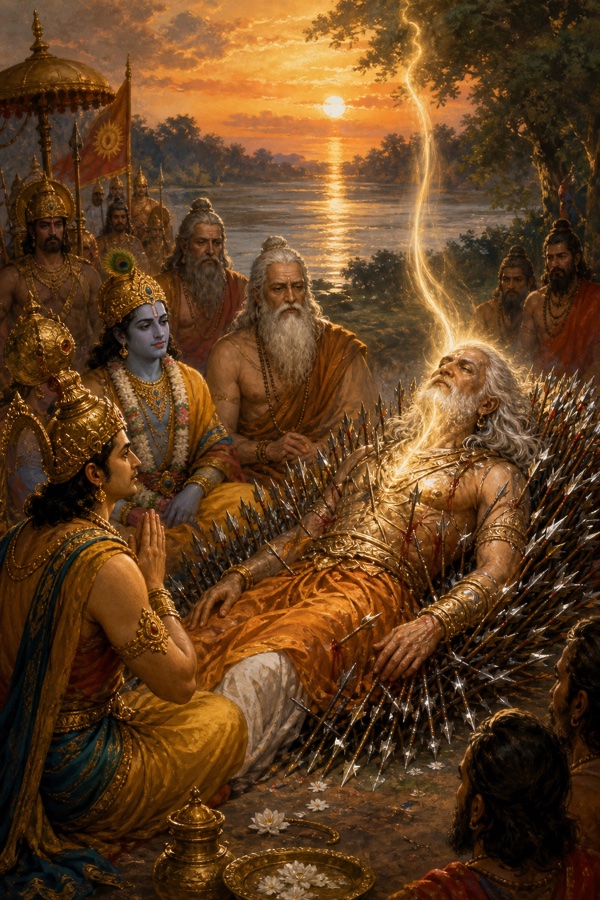
Having said this to Yudhishthira, the son of Ganga saluted Dhritarashtra and spoke to him. “You know the duties well. Your doubts about the science of wealth have all been resolved. You have waited on many Brahmins of great learning, and the subtle sciences connected with the Vedas, all the duties of religion, and the whole of the four Vedas are known to you. You should not grieve, then. What was ordained beforehand has happened. It could not have been otherwise. You have heard the mysteries of the gods from the lips of the island-born sage himself. In the eye of dharma Yudhishthira and his brothers are as much your sons as they are Pandu’s. Keep to the duties of religion and cherish and protect them. They, for their part, are always devoted to the service of their elders. King Yudhishthira is pure in soul, and he will always be obedient to you. I know that he is devoted to compassion and to harmlessness, and devoted to his elders and teachers. Your own sons were all wicked in soul. They were wedded to wrath and greed, overcome by envy, and evil in their behavior. You must not grieve for them.”
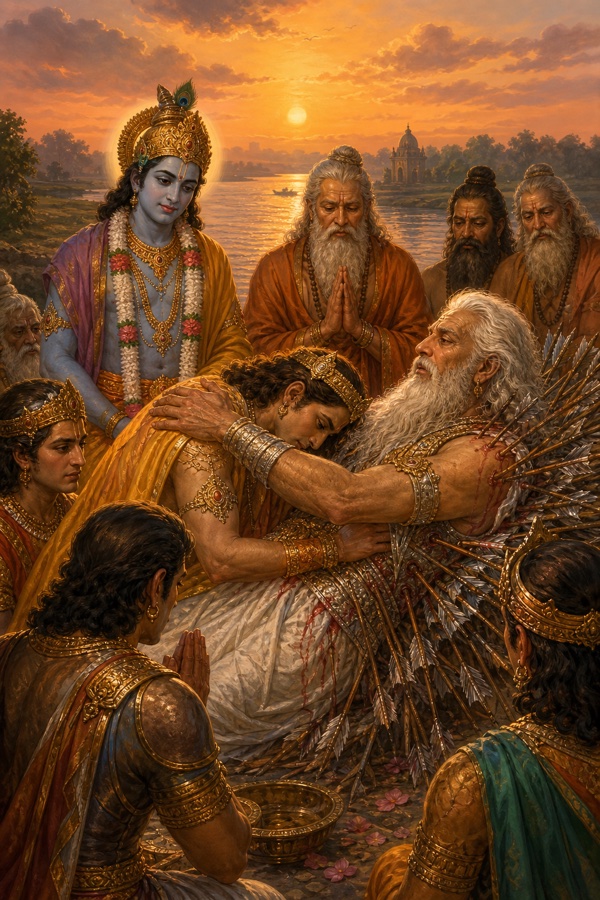
Then the Kuru hero turned to Krishna. “Holy one, god of all gods, worshiped by all the gods and Asuras, you who covered the three worlds with three steps, I bow to you, bearer of the conch, the discus, and the mace. You are Vasudeva. You are golden-bodied. You are the one Purusha, the creator, vast in your proportions. You are the living soul. You are the subtle. You are the supreme and eternal Soul. Rescue me, lotus-eyed one, first of all beings. Give me leave, Krishna, to depart from this world, you who are supreme happiness. The sons of Pandu should always be protected by you. You are already their only refuge.
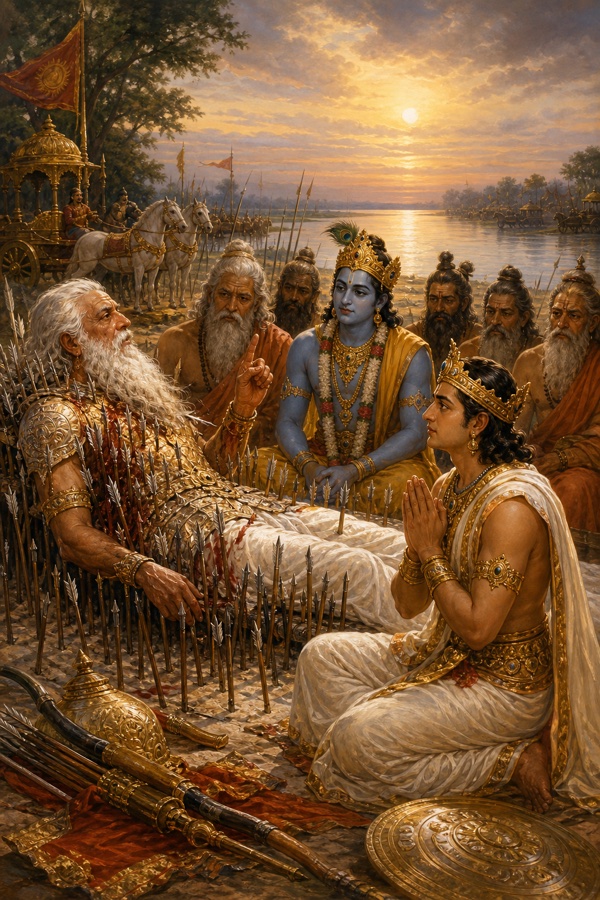
“Long ago I told Duryodhana, foolish and wicked in understanding as he was, that where Krishna is, there is dharma, and where dharma is, there is victory. I counseled him to take Vasudeva as his refuge and make peace with the Pandavas. I told him over and over, ‘This is the best time for you to make peace.’ He did not do as I bade him. He brought great havoc on the earth, and at the end he laid down his own life. I know you, Krishna, to be that ancient sage, the greatest of them, who lived for many years with Nara in the hermitage of Badari. The divine sage Narada told me this, and Vyasa of the stern austerities told me too. They said that you and Arjuna are the old sages Narayana and Nara, born among men. Give me leave, Krishna. I shall cast off my body. With your permission I shall reach the highest end.”
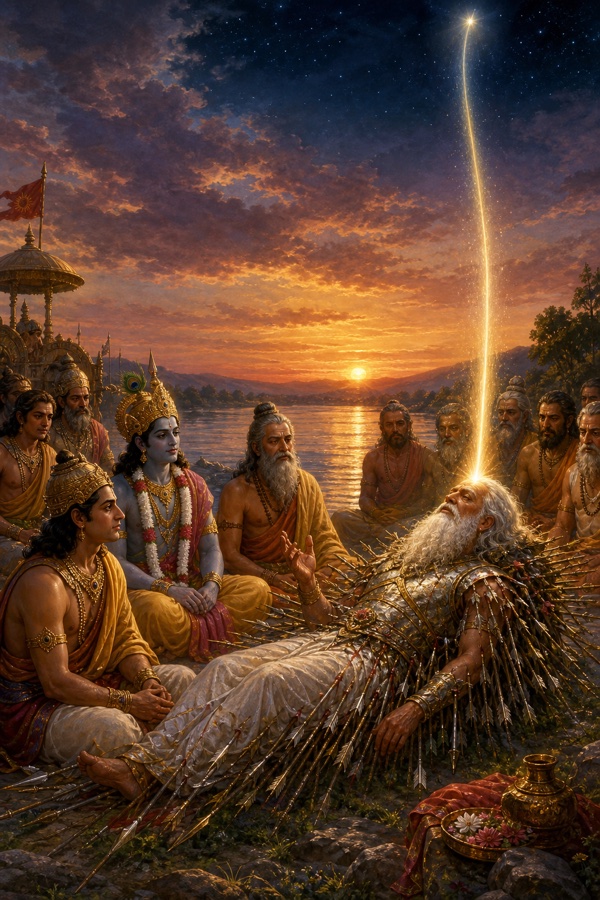
“I give you leave, Bhishma,” Krishna said. “Go to the state of the Vasus. You have not been guilty of a single transgression in this world. You were devoted to your father, and for that you are like a second Markandeya. That is why death waits on your pleasure like a servant watching to learn your wish.”
The son of Ganga spoke once more, to the Pandavas with Dhritarashtra at their head and to the other friends and well-wishers around him. “I wish to cast off my life breaths. Give me your leave. Strive to reach truth; truth is the highest power. Live always with Brahmins of righteous conduct, devoted to austerity, who keep from all cruelty and have their souls under control.” He embraced them all. Then he spoke once more to Yudhishthira. “Let all Brahmins, and above all those who have wisdom, and those who are teachers, and those who are priests able to assist at sacrifices, be worthy of worship in your eyes.”
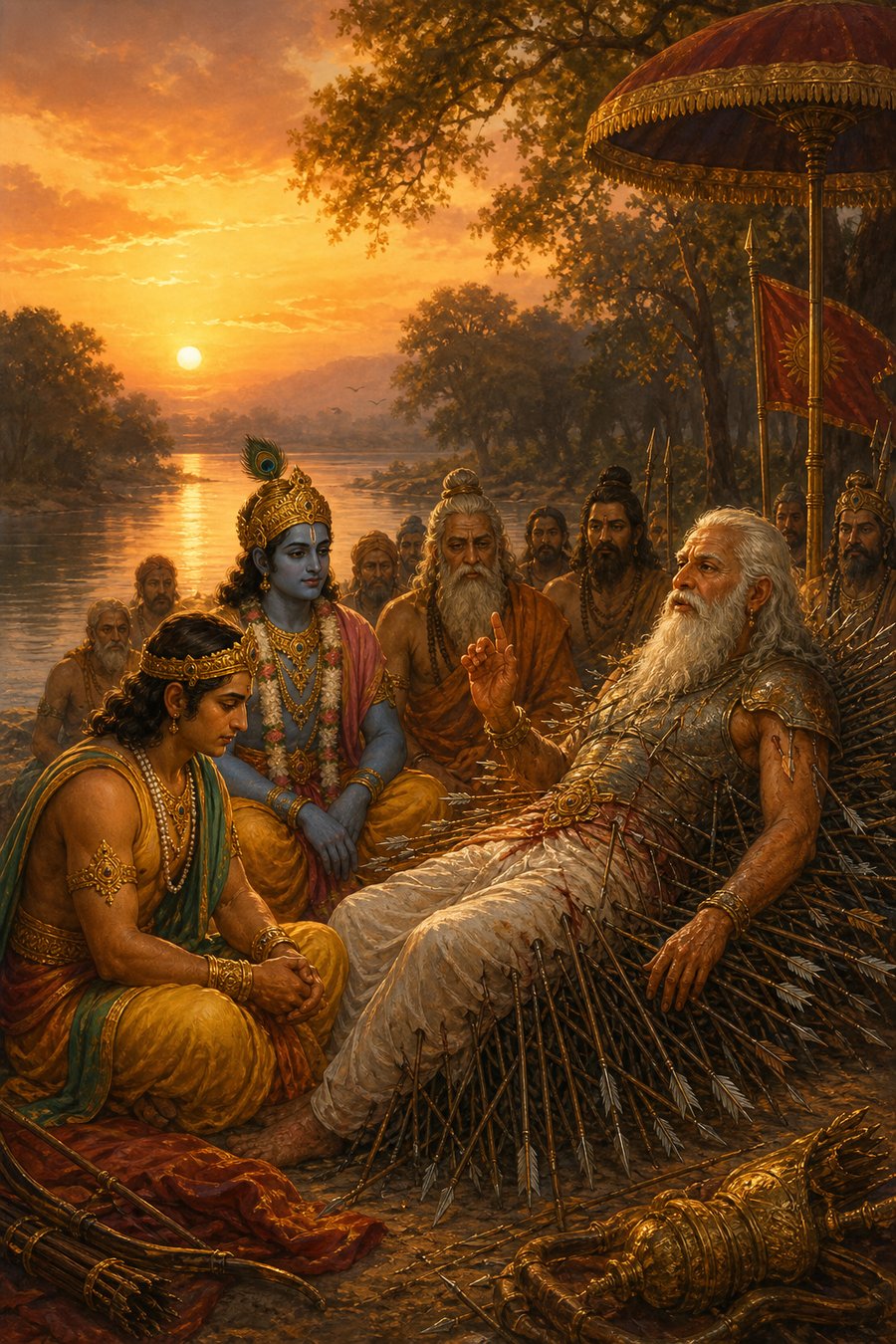
A key to reading this, Magha and the bright fortnight: Bhishma dates his own death. The sun has begun its northward course, the lunar month is Magha, the fortnight is the bright one, and by his reckoning a quarter of it has passed. He has counted fifty-eight nights on the arrows, and this turning of the sun is the hour he named to Yudhishthira when he sent him back to the city.
A sub-tale: Krishna gives the reason for Bhishma’s power over his own death in a single line. Bhishma was devoted to his father, and for that he is like a second Markandeya, and death waits on his pleasure like a servant watching for his wish. With the same words Krishna tells him that he has not committed one transgression in this world, and sends him to the state of the Vasus.
The gist: Bhishma tells Yudhishthira that the sun has turned north after his fifty-eight nights on the arrows, in the bright fortnight of Magha. He tells Dhritarashtra to stop grieving, to cherish the Pandavas as his own sons, and to spend no sorrow on the sons he lost. He praises Krishna as the eternal Soul and as the ancient sage Narayana, entrusts the Pandavas to him, and asks leave to die. Krishna grants it and sends him to the state of the Vasus. Bhishma asks leave of all the rest, bids them strive for truth, embraces them, and gives Yudhishthira a last instruction to honor the Brahmins.
The grandsire lays down his body: the upward departure of the breaths
Vaishampayana told what came next. Having spoken so to all the Kurus, Bhishma, the son of Shantanu, was silent for some time. Then he held his life breaths, one stage after another, in those parts of the body that yoga indicates. Held in this way, the breaths began to rise. And as they rose, each part of his body that the breaths left behind was freed of its wounds, one part after another.
Among the men gathered there, with the great sages and Vyasa at their head, it was a strange thing to see. In a short time the whole body of Bhishma was without an arrow and without a wound. Krishna and all the eminent men with him, and Vyasa and all the ascetics, were filled with wonder. The life breaths, restrained and unable to escape by any of the body’s outlets, at last pierced through the crown of the head and went upward to heaven.
The kettledrums of the gods began to sound, and flowers rained down. The Siddhas and the Brahmin sages, filled with delight, cried, “Excellent! Excellent!” The life breaths of Bhishma, having pierced the crown of his head, shot up through the sky like a great meteor and soon could no longer be seen. So, after fifty-eight nights on the arrows, the son of Shantanu, the pillar of the Bharata line, united himself with eternity.
A key to reading this, yogic death: Bhishma dies by yoga, step by step. He falls silent. He holds the life breaths in the parts of the body that yoga indicates, one after another, and they rise. Each part they leave is healed, until no arrow and no wound remains on him. The breaths, unable to leave by any outlet of the body, break through the crown of the head and go up through the sky like a meteor.
The gist: Bhishma falls silent, holds his breaths in the places yoga indicates, and they rise. Part by part his body is freed of its wounds, until it lies without an arrow, to the wonder of Krishna, Vyasa, and all who stand there. The breaths pierce the crown of his head and shoot up the sky like a great meteor while the drums of the gods sound and flowers fall, and the pillar of the Bharata line is united with eternity.
The funeral, the grief of Ganga, and the consolation of Krishna
Then the Pandavas and Vidura gathered a great quantity of wood and fragrant things of many kinds and built a funeral pyre, while Yuyutsu and others stood and watched the preparations. Yudhishthira and Vidura wrapped Bhishma’s body in silken cloth and garlands of flowers. Yuyutsu held a fine umbrella over it. Bhima and Arjuna held a pair of pure white yak tails. The two sons of Madri held two headdresses in their hands. Yudhishthira and Dhritarashtra stood at Bhishma’s feet, and fans of palmyra leaf were taken up around the body and moved softly over it.
The rite for the departed was performed for Bhishma as it is laid down. Many libations were poured on the sacred fire, and the singers of samans sang many samans. Then they covered the body of Ganga’s son with sandalwood, black aloe, bark wood, and other fragrant fuel and set it alight, and the Kurus, with Dhritarashtra and the rest, stood on the right side of the pyre. When the body of the son of Ganga had been burned, they went with the sages to the sacred Bhagirathi, the river who was his mother.
Vyasa followed them, and Narada, and Asita, and Krishna, and the women of the Bharata house, and those citizens of Hastinapura who had come out to the place. At the river all of them offered the oblation of water to the son of Ganga, as the rite requires. And when the water had been offered to her son, the goddess Bhagirathi rose out of her own stream, weeping, beside herself with sorrow.
In the midst of her weeping she spoke to the Kurus. “Listen while I tell you how it was with my son. He had the conduct and the temper of a king. He had wisdom and high birth. He was the benefactor of all the elders of his line. He was devoted to his father, and his vows were high. Rama of Jamadagni’s line, with all his divine weapons, could not defeat him. And that hero has been killed by Shikhandi. Truly my heart is made of adamant, for it does not break even now, when that son is gone from my sight. At the svayamvara at Kashi he defeated the assembled Kshatriyas on a single chariot and carried off the three princesses. There was no one on earth who equaled him in might. And my heart does not break when I hear that this son of mine was killed by Shikhandi.”
Krishna heard the goddess of the great river lamenting and comforted her with many gentle words. “Be comforted. Do not give way to grief. Your son has gone to the highest region of happiness; there is no doubt of it. He was one of the Vasus. A curse brought him to birth among men, and you should not grieve for him. He was killed on the field of battle by Dhananjaya, while he fought, as the duty of a Kshatriya has it. He was not killed by Shikhandi, goddess. When Bhishma stood with his bow drawn in his hand, the king of the gods himself could not have killed him in battle. Your son has gone to heaven in happiness. All the gods assembled together could not have killed him in battle. So do not grieve, goddess Ganga, for that son of the Kuru line. He was one of the Vasus. Your son has gone to heaven. Let the fever of your heart be gone.”
So Krishna spoke to her, and Vyasa, and the river goddess put away her grief and was calm again. All the kings who were present, with Krishna at their head, paid the goddess the honor due to her and received her leave to depart from her banks. Here the Anushasana Parva ends.
A sub-tale: Ganga’s lament and Krishna’s answer turn on one name. Twice she says that her son, whom Rama of Jamadagni’s line could not defeat, was killed by Shikhandi, and twice she says that her heart does not break. Krishna answers that Bhishma was killed by Dhananjaya on the field, fighting, as the duty of a Kshatriya has it, and that Shikhandi did not kill him. He adds that neither Indra nor all the gods together could have killed Bhishma in battle while he stood with his bow drawn.
A key to reading this, one of the Vasus: Twice in his answer Krishna tells Ganga that her son was one of the Vasus, born among men because of a curse. It is the same word he gave Bhishma on the bed of arrows, when he granted him leave to die and told him to go to the state of the Vasus. On that ground he tells the goddess that her son has gone to heaven and that she should not grieve.
The gist: The Pandavas and Vidura build the pyre and wrap the body in silk and garlands. Umbrella, yak tails, headdresses, and palm fans attend it, samans are sung, and the Kurus burn it with sandalwood and aloe and stand to its right. At the Bhagirathi, when the water has been offered, Ganga rises from her stream and weeps for a son whom Rama, of the line of Jamadagni, could not defeat and who, she says, was killed by Shikhandi. Krishna tells her that Arjuna killed him in battle, as a Kshatriya’s duty has it, that he was a Vasu born under a curse, and that he has gone to heaven. She grows calm, the kings take their leave of her, and the Anushasana Parva ends.
Source: the Mahabharata of Krishna-Dwaipayana Vyasa, Anushasana Parva, Danadharma sub-parva, Sections 1 to 168; this part draws on Sections 120 to 168. The Gita Press Hindi edition is the controlling witness. The Sanskrit e-text and an independent complete translation were used to verify names, sequence, and principal events. Where recensions differ, this retelling follows Gita Press.
Source: the Mahabharata of Vyasa (Gita Press, Gorakhpur)
The same story elsewhere
- Chapter 34 · Bhishma on the Bed of Arrows: the Law of Kings
The Mahabharata (Shanti Parva): Bhishma’s law of kings from the bed of arrows - Chapter 35 · Bhishma: the Law of Release and the Law of Distress
The Mahabharata (Shanti Parva): Bhishma’s moksha-dharma and apad-dharma - Bhishma’s Last Teaching
The Bhagavatam (Canto 1): Bhishma’s praise of Krishna on his deathbed - Bhishma
Character profile: the whole life of Bhishma