On this page
The greatness of the holy fords, the teaching of Angira
Yudhishthira had heard it said since he was a boy, and now he wanted it from the one man he trusted to know. “They say that a journey to the sacred waters earns merit,” he said, “that a bath in them earns merit, and that even listening to their praise earns merit. Tell me which waters on this earth are sacred. I want to hear it from you, and in full.” Bhishma answered from the bed of arrows. The roll of the earth’s holy waters, he said, had first been counted out by the sage Angira, and whoever listened to it with attention earned something for the listening. Long ago Gautama, a man of hard vows, had gone looking for Angira where the great rishi lived in the forest, settled and at peace with himself, and had laid the same doubt before him. “I am not sure what merit belongs to the sacred waters and the shrines,” Gautama told him. “Tell me what a man earns toward the next world by bathing in the holy waters of this one. Tell it to me exactly, and by the rule.” Angira began at the rivers of the north.
“Bathe for seven days running in the Chandrabhaga or the Vitasta,” Angira said, “whose waters are never still, and fast while you do it, and you come out cleansed of every sin, with the merit of an ascetic on you. The many rivers that run down through Kashmir and empty into the Sindhu give good character to whoever bathes in them, and heaven after this life. Bathe at Pushkara, at Prabhasa, at Naimisha, in the ocean, in the Devika, at Indramarga and at Svarnavindu, and you go up to heaven seated in a celestial chariot, filled with joy while the apsaras pay you honor. Plunge into the Hiranyavindu with a gathered mind, revere that stream, and then bathe at Kushesaya and at Devendra, and every sin is washed from you. Go to Indratoya below the Gandhamadana mountains, and then to the Karatoya in the country called Kuranga, and fast for three days before you bathe there with a clean body and a settled heart; that bath carries the merit of a horse sacrifice. Bathe at Gangadvara, at Kushavarta, at the Bilvaka in the Nita mountains, and at Kanakhala, and you are cleansed of every sin and rise to heaven.” Angira went on.
“A man who keeps the vow of a student, who has mastered his anger, who holds to truth and feels for every living creature, and who then bathes at Jalaprada, the Lake of Waters, gains what the horse sacrifice gives. Where the Bhagirathi Ganga turns and flows northward, that stretch is called the meeting place of heaven, earth, and the world below; fast there for a month and bathe in the tirtha that Maheshvara loves, and you become fit to look upon the gods. Offer water to your ancestors at Saptaganga, at Triganga, and at Indramarga, and if you must be born again you will have ambrosia for food. Keep your daily fire offering with a pure body and mind, fast for a month, and bathe at Mahashrama, and in that one month you reach perfection. Fast three days, empty your mind of every evil passion, and bathe in the great lake of Bhrigukunda, and even the killing of a Brahmin is washed from you. Bathe at Kanyakupa and rinse at Valaka, and you win fame among the very gods and shine with it. Bathe in the Devika, in the lake called Sundarika, and in the tirtha called Ashvini, and in your next life you will be beautiful. Fast a fortnight and bathe at Mahaganga and at Krittikangaraka, and you are cleansed and go to heaven. Bathe at Vaimanika and at Kinkinika, and you gain the power to go anywhere at will, and the apsaras in their own heaven hold you in high regard.” Then Angira turned to the Vipasha.
“Master your anger, keep the student’s vow for three days, and bathe in the Vipasha at the retreat called Kalika, and you pass beyond the debt of rebirth. Bathe at the hermitage sacred to the Krittikas, offer water to the ancestors, and please Mahadeva, and with body and mind made pure you rise to heaven. Fast three days with a clean body and mind and bathe at Mahapura, and you are freed from fear of every creature that moves or stands still, and of every creature that walks on two feet. Bathe in the Devadaru forest, offer water to the ancestors, and stay there seven nights in purity, and when you leave this world you go to the world of the gods. Bathe in the waterfalls at Sarastamba, at Kushastambha, and at Dronasharmapada, and you are sure of the apsaras’ heaven, where those beings wait on you themselves. Fast and bathe at Chitrakuta, at Janasthana, and in the waters of the Mandakini, and the fortune of kings comes to you. Go to the retreat called Shamya, live there a fortnight, and bathe in its sacred water, and you gain the power to vanish at will and the happiness that was made for the gandharvas. Go to the tirtha called Kaushiki, live there with a pure heart and take neither food nor drink for three days, and in your next life you dwell in the happy country of the gandharvas. Bathe in the lovely tirtha called Gandhataraka, stay a month without food or drink, and you gain the power to vanish at will, and after twenty-one days more, the ascent to heaven. Bathe in the lake called Matanga and you reach perfection in a single night.” And now he came to the great confluence.
“Bathe at Analamba, or in the undying Andhaka, or at Naimisha, or at the tirtha called Svarga, and offer water to the ancestors with your senses held in, and the merit of a human sacrifice is yours. Bathe in the Gangahrada and in the tirtha called Utpalavana and offer water to the ancestors there every day for a full month, and you have the merit of a horse sacrifice. Bathe where the Ganga and the Yamuna meet, and at the tirtha in the Kalanjara mountains, and offer water to the ancestors every day for a full month, and the merit of ten horse sacrifices is yours. Bathe in the Shashthi lake and you earn far more than the gift of food can earn. In the month of Magha ten thousand tirthas, and thirty million more, gather at Prayaga, where the Ganga and the Yamuna meet. Whoever bathes at Prayaga in Magha with a restrained soul and hard vows is cleansed of every sin and goes to heaven. Bathe in the tirtha sacred to the Maruts, in the one that lies in the retreat of the ancestors, and in the one called Vaivasvata, and you are cleansed and become as pure and holy as a tirtha yourself. Go to Brahmasaras and to the Bhagirathi, bathe, offer water to the ancestors every day for a month, and eat nothing the while, and you are sure of the world of Soma. Bathe at Utpataka and then at Ashtavakra, offer water to the ancestors for twelve days running and fast through them, and you have the merit of a horse sacrifice. At Gaya there are three: Asmaprishtha, the Niravinda mountain, and Kraunchapadi. A bath in the first washes away one killing of a Brahmin, a bath in the second washes away two, and a bath in the third washes away three. Bathe at Kalavinga and a great store of water is laid up for you in the world to come. Bathe in the city of Agni and you earn a next life in the city of Agni’s daughter. Bathe at Vishala in Karavirapura, offer water to your ancestors, and bathe again in Devahrada, and you become one with Brahma and shine as he shines. Bathe at Punaravartananda and at Mahananda with your senses held and your heart open to every creature, and you go to Nandana, Indra’s garden, where apsaras of every tribe attend you.” He was still not done.
“Bathe with a gathered soul in the tirtha named for Urvashi, which lies in the river Lohitya, on the full moon of Kartika, and the merit of the Pundarika sacrifice is yours. Bathe in Ramahrada, offer water to the ancestors in the Vipasha, and fast twelve days, and you are cleansed of every sin. Bathe in the tirtha called Mahahrada with a pure heart after a month’s fast, and you reach the end that the sage Jamadagni reached. At the tirtha called Vindhya let the heat work on you, and then, truthful and feeling for every creature, take up hard austerity in humility; in one month you have the ascetic’s success. Bathe in the Narmada and in the tirtha called Shurparaka, fasting a full fortnight, and in your next birth you are a prince of a royal house. Go with your senses held and your soul gathered to the tirtha called Jambumarga, and success comes in a single day and night. Go to the Chandalika hermitage and bathe in the tirtha called Kokamukha, having lived a while on wild greens and worn rags, and ten maidens of great beauty will be your wives. Whoever lives beside the tirtha called Kanyahrada never has to go down to Yama’s country; he rises to the worlds of the gods. Whoever bathes with his senses held in the tirtha called Prabhasa on the day of the new moon has success and immortality at once. Bathe in the tirtha called Ujjanaka, in the retreat of Arshtishena’s son, and then in the one that lies in the retreat of Pinga, and you are cleansed of every sin. Fast three days, bathe in the tirtha called Kulya, and recite the mantras called Aghamarshana, and you have the merit of a horse sacrifice. Fast one night and bathe at Pindaraka, and at dawn you are pure, with the merit of an Agnishtoma. Go to the Brahmasara that the woods called Dharmaranya surround, and you are cleansed of every sin, with the merit of the Pundarika. Bathe in the waters of the Mainaka mountain, say your morning and evening prayers there, and live on that spot a month with desire held down, and the merit of every sacrifice is yours. Set out for Kalolaka, for Nandikunda, and for Uttaramanasa, and reach a spot a hundred yojanas from any of them, and the killing of an unborn child is washed from you. Whoever manages a sight of the image of Nandishvara is cleansed of every sin. Bathe in the tirtha called Svargamarga and you are sure of the worlds of Brahman. And Himavat is holy. That king of mountains is the father-in-law of Shankara, a mine of every gem and jewel, the resort of the siddhas and the charanas. A twice-born man who knows the Vedas, who sees how unsteady this life is, and who lays his body down on those mountains, giving up food and drink by the rite the scriptures lay down, after he has worshiped the gods and bowed his head to the ascetics, reaches success and goes to the eternal worlds of Brahman. Nothing is beyond the reach of a man who lives at a tirtha with his lust held down and his anger mastered. And to visit every tirtha in the world, a man should hold in his mind the ones that can hardly be reached at all, the ones that lie past hardships no traveler can cross. A journey to the tirthas bears the fruit of sacrifices. They can wash anyone clean of sin. They lead to heaven. This is a deep mystery. The very gods should bathe in the tirthas; for them too they wash away sin. Teach this to Brahmins, to honest people who are working for their own good, to well-wishers and friends, to obedient and devoted pupils.” So Angira, a sage of great austerity, taught it to Gautama, and Angira himself had received it from Kashyapa, whose understanding was vast. The great rishis hold this discourse worth repeating every day; of all things that cleanse, it stands first. Whoever recites it daily is washed of every sin and goes to heaven when this life ends, and whoever hears it recited, this hidden teaching of Angira, is born in his next life into a good family, and carries with him the memory of the life before. Bhishma let the roll end there, and Yudhishthira had his next question ready.
A key to reading this (the places): Chandrabhaga, Vitasta, Vipasha are today’s Chenab, Jhelum, and Beas, the rivers of the Punjab, and the Sindhu is the Indus. Prayaga is the meeting of Ganga and Yamuna, today Prayagraj, and Angira gives it the month of Magha, deep winter, when the tirthas of the whole world are said to gather there. Gaya is the tirtha in Bihar where the ancestors are fed; its three baths are the ones Angira sets against the killing of a Brahmin, the heaviest sin the roll names. Bhagirathi is the Ganga under the name of Bhagiratha, who brought her down. Himavat is the Himalaya, father of Parvati and so father-in-law of Shankara, and the roll ends on him because the mountain is where a Vedic scholar may choose to lay his body down. Horse sacrifice, human sacrifice, Pundarika, Agnishtoma are the great Vedic rites of kings and the wealthy; a bath that carries their merit puts a king’s reward within reach of a man who owns nothing.
The gist: Angira’s roll strings the sacred rivers, lakes, and mountains of the whole land on a single thread, from the Chandrabhaga in the north down to the Narmada and the Vindhya, and attaches to each bath its own exact fruit: a sin washed off, a rebirth bettered, a sacrifice’s merit earned by water and fasting alone. At the summit stand Prayaga in Magha and the slopes of Himavat, and the roll closes with a quiet grant to anyone who cannot travel, since even to hold the unreachable tirthas in the mind counts as a visit.
The coming of the sages, and the greatness of the Bhagirathi Ganga
Vaishampayana paused over the man on the arrows before he went on. Bhishma, the son of Ganga, was the equal of Brihaspati in intelligence, of Brahma himself in forgiveness, of Shakra in prowess, and of the sun in fire, and Arjuna had brought him down in battle. Now he lay on the bed that heroes long for, waiting for the hour that would be right for leaving the body, and King Yudhishthira, with his brothers and a crowd of others around him, kept putting his questions. Word of the dying man had gone out, and the great rishis came to see him. Atri came, and Vasishtha, Bhrigu, Pulastya, Pulaha, and Kratu. Angira came, and Gautama, Agastya, Sumati of the well-ruled soul, Vishvamitra, Sthulashira, Samvarta, Pramati, and Dama. Brihaspati and Ushana came, Vyasa and Chyavana, Kashyapa and Dhruva, Durvasa and Jamadagni, Markandeya and Galava, Bharadvaja and Raibhya, Yavakrita and Trita. There were Sthulaksha and Savalaksha, Kanva and Medhatithi, Krisha and Narada, Parvata and Sudhanva, Ekata and Dvita. There were Nitambhu and Bhuvana, Dhaumya and Satananda, Akritavrana and Rama the son of Jamadagni, and Kacha. Every one of these great rishis had come for the same thing, to look once more on Bhishma lying on his arrows.
Yudhishthira and his brothers worshiped each of them as he arrived, one after another, in the proper order, and when the rishis had accepted that worship they sat down together and began to talk among themselves. Their talk was of Bhishma, and it was sweet to every sense that heard it. Bhishma, listening to such men speak of him, was filled with delight and felt that he was already in heaven. Then the rishis took leave of him and of the Pandava princes and made themselves invisible, vanishing while every eye was on them, and the Pandavas went on bowing and offering their homage to the empty air where the rishis had been. After that they turned back to the son of Ganga and waited on him with glad hearts, the way Brahmins who know the mantras wait on the rising sun. They saw the quarters of the sky blazing with the light the rishis’ austerities had left behind, and the wonder of it stayed with them, so that for a while the brothers and their grandfather talked of nothing except the holiness and power of those men. When that talk was done, Yudhishthira, the son of Pandu, touched Bhishma’s feet with his head and took up his questions on righteousness again.
“Which countries,” he asked, “which provinces, which hermitages, which mountains, and which rivers stand first in holiness?” Bhishma reached for an old story, a conversation between a Brahmin who lived by the vows of shila and unchha, gleaning his grain from what the harvest left behind, and a rishi who had reached ascetic perfection. That rishi, after wandering the whole mountain-studded earth, arrived one evening at the house of the gleaner, who kept a householder’s life in strict obedience to his vow, and the host received him with the proper rites. The guest, well looked after, passed a happy night under his roof. In the morning the gleaner finished his daily acts and rites, purified himself, and went gladly to sit with his visitor, and the two of them, at their ease, fell to talking about the Vedas and the Upanishads. Toward the end of that talk the Brahmin, who had a good mind, put to the perfected sage, with every respect, the very question that Yudhishthira had just put to Bhishma. “Which countries, which provinces, which hermitages, which mountains, and which rivers should be held the holiest? Teach me this.”
“Those countries, those provinces, those hermitages, and those mountains are the holiest,” the perfected sage answered, “through which, or beside which, the Bhagirathi flows, the first of all rivers. The end a creature can reach by austerity, by the student’s vow, by sacrifice, or by renunciation, it reaches simply by living beside the Bhagirathi and bathing in her holy water. Those whose bodies have been sprinkled with her water, or whose bones have been laid in her bed, never fall from heaven once they are there. Those who use the water of the Bhagirathi in everything they do go to heaven when they leave this world. Even those who did every kind of wrong in the first part of their lives and then, in their later years, went to live beside the Ganga, come to a very high end. Hundreds of sacrifices cannot earn what a man of restrained soul earns by bathing in her. For as long as his bones lie in the channel of the Ganga, a man is honored and worshiped in heaven. As the sun at dawn blazes up after scattering the dark of night, so a man who has bathed in the Ganga is seen to shine, every sin gone from him. Countries and quarters that have no Ganga water are like nights without the moon, like trees without flowers. A world without the Ganga is like the orders and stages of life without righteousness, like a sacrifice without Soma. Countries and quarters without the Ganga are the sky without the sun, the earth without mountains, the air with no wind in it.”
The sage went on, and the praise grew. “Every creature in the three worlds, if it is served with the Ganga’s water, takes a pleasure from it that nothing else can give. A man who drinks Ganga water that the sun has warmed earns more than the man who keeps the vow of living on grains picked out of cow dung. Whether these two are equal no one can say: the man who performs a thousand Chandrayana fasts to purify his body, and the man who drinks the water of the Ganga. Whether these two are equal no one can say: the man who stands a thousand years on one foot, and the man who lives one month beside the Ganga. The man who lives beside her for good outranks the man who hangs ten thousand yugas head downward. As cotton touched by fire burns away and leaves nothing, so the sins of a man who has bathed in the Ganga are consumed and leave nothing. For creatures whose hearts are heavy with sorrow and who are looking for an end that will lift it, there is no end above the Ganga. As snakes lose their poison at the mere sight of Garuda, so a man loses every sin at the mere sight of her. Those who have no good name and are given to sinful deeds have the Ganga for their fame, their protection, their rescue, their refuge, and their cover. Many wretches stained with the worst of sins, about to sink into hell, are pulled back by the Ganga in the next world if they turn to her in their later years. Those who plunge into her every day become the equals of the great munis and of the gods with Vasava at their head. Wretches with no humility and no modesty, deeply sinful, become righteous and good by going to live beside her. As amrita is to the gods, as svadha is to the ancestors, as sudha is to the nagas, so is the water of the Ganga to human beings. As hungry children beg their mothers for food, so people who want their highest good pay court to the Ganga. As the world of the self-born Brahma is called the first of all places, so the Ganga is called the first of all rivers for anyone who wants to bathe. As the earth and the cow are called the chief support of the gods and the other celestials, so the Ganga is the chief support of every living creature. As the gods live on the amrita that lies in the sun and the moon and is offered in the sacrifices, so human beings live on Ganga water. A man smeared with sand from her shore feels himself a citizen of heaven, anointed with celestial unguents. A man who carries on his head the mud of her banks gives off a light like the sun’s when it sets about scattering the dark. When a wind that has picked up drops of her water touches a man, it cleanses him of every sin at once. A man crushed under calamities, about to go down under their weight, finds them all scattered by the joy that springs up in his heart at the sight of her. With the music of the swans and the koka birds and all the water fowl that play on her breast she challenges the gandharvas themselves, and with her high banks she challenges the mountains of the earth. Heaven herself, looking at that surface alive with swans and water birds, at those banks edged with pasture where cattle graze, loses her pride. The happiness a man has from living on the bank of the Ganga is a happiness that someone living in heaven itself never has. I have no doubt that a man stained with sins of speech, of thought, and of open deed is cleansed at the sight of the Ganga. By holding that sacred stream, by touching it, by bathing in it, a man rescues his ancestors to the seventh generation and his descendants to the seventh generation, and his other kin before and after. By hearing of the Ganga, by wanting to go to her, by drinking her water, by touching it, and by bathing in it, a man saves both his father’s line and his mother’s.”
“By seeing the Ganga, by touching her, by drinking her water, even by praising her, hundreds and thousands of sinful men have been cleansed of all their sins. Those who want their birth, their life, and their learning to bear fruit should go to the Ganga and satisfy the ancestors and the gods there with offerings of water. The merit of one bath in her is a merit that cannot be had through sons, or wealth, or good works. Those who have the strength of body to go and still do not wish to see the holy Ganga and her sacred current are, past any doubt, to be counted with the blind from birth, with the dead, and with those who cannot move for palsy or lameness. What man would withhold reverence from a river that the great rishis who know the present, the past, and the future revere, and the gods with Indra at their head? What man would refuse the protection of a river whose protection forest hermits and householders, yatis and students alike all seek? The righteous man who thinks of the Ganga with his whole soul at the moment his breath is leaving him reaches the highest end. The man who lives beside her to the day of his death, honoring her with reverence, is freed from the fear of every calamity, of sin, and of kings. When that holiest of streams fell from the sky, Maheshvara held her on his head, and it is that same stream the gods worship in heaven. The three regions, earth, heaven, and Patala below, are adorned by her three courses. The man who uses her water is sure of success. As the sun’s ray is to the gods in heaven, as the moon is to the ancestors, as the king is to men, so is the Ganga to all rivers. A man bereaved of mother, or father, or sons, or wives, or wealth does not know the grief of a man bereaved of the Ganga. The joy that comes from a sight of her does not come from acts that lead to Brahma’s world, or from the sacrifices and rites that lead to heaven, or from children, or from wealth. The pleasure men take from a sight of the Ganga equals the pleasure they take from a sight of the full moon. A man becomes dear to the Ganga when he adores her with deep devotion, with a mind that rests wholly on her, with a reverence that admits no other object, with the feeling that nothing else in the universe deserves to be adored like this, and with a steadiness that does not fail. Creatures who live on the earth, in the air, or in heaven, even beings far above these, should always bathe in the Ganga. For the righteous this is the first of all duties.”
“Her fame for holiness has spread through the whole universe since the day she carried the sons of Sagara, burned to ash, from this earth up to heaven. Men washed by her bright, high, fast-running waves, raised by the wind, are cleansed of every sin and shine like the sun with his thousand rays. Men of quiet soul who have let their bodies go in her waters, which are as holy as the butter and the other liquids poured into the sacrifice and carry the merit of the greatest sacrifices, have reached a station equal to the gods. The Ganga, famous and vast, one with the whole universe, revered by the gods with Indra at their head, by the munis and by men, can fulfill every wish of the blind, of the simple, and of those who have nothing at all. Those who have sought refuge in her, the protector of the whole universe who flows in three streams, whose water is holy and sweet as honey and the source of every good, have reached the bliss of heaven. The mortal who lives beside her and sees her every day is cleansed by her sight and touch, and the gods give him every happiness here and a high end afterward. She is held able to rescue every creature from sin and carry it to the joy of heaven. She is held to be one with Prishni, the mother of Vishnu. She is one with speech. She is far off, hard to reach. She is the body of good fortune and prosperity, the giver of the six attributes that begin with lordship, always inclined to grace, the one who shows all things in the universe, the high refuge of every creature. Those who sought her protection in this life have reached heaven. Her fame fills the sky and heaven and earth and every quarter of the compass. Mortals who use the water of this first of streams are always crowned with success. The man who, having seen the Ganga himself, points her out to others, finds that she rescues him from rebirth and gives him release. She carried Guha in her womb, the general of the armies of the gods, and she carries gold in that womb too. Those who bathe in her every morning win the three aims together, righteousness, wealth, and pleasure. Her waters are as holy as the butter poured with mantras onto the sacrificial fire. She came down from heaven to cleanse every sin, and her current is held in honor by everyone. She is the daughter of Himavat, the wife of Hara, the ornament of heaven and of earth. She gives everything auspicious and the six attributes that begin with lordship. She is the one holy thing in the three worlds, and she confers merit on all. She is righteousness in liquid form, and energy running in liquid form over the earth, with the fire of the mantra-blessed butter in her. She is always adorned with great waves, and with Brahmins who can be seen at any hour performing their ablutions in her water. Falling from heaven she was held by Shiva on his head. Mother of the heavens, she sprang from the highest mountain to run over the plains and carry the most precious gifts to every creature of the earth. She is the highest cause of all things, perfectly stainless, subtle as Brahma. She is the best bed for the dying. She carries creatures to heaven quickly. She bears a great body of water. She gives great fame to all. She is the protector of the universe. She is one with every form. Those who have reached perfection long for her. For those who have bathed in her current, the Ganga is the road to heaven. The Brahmins hold her equal to the earth in forgiveness and in sheltering and supporting those who live by her, equal to fire and to the sun in energy and brightness, and equal to Guha himself in the favors she shows the twice-born. Those who in this life seek with their whole souls, even in thought only, this sacred stream that the rishis praise, which came out of the feet of Vishnu, which is ancient beyond measure and holy beyond measure, go to the worlds of Brahman. Men of subdued soul, who have seen clearly that children and possessions and even the worlds of every happiness pass away or can be destroyed, and who want the everlasting station that is one with Brahma, pay their adoration to the Ganga with the reverence and love a son owes his mother. The man of cleansed soul who wants success should seek the protection of the Ganga, who is like a cow that gives amrita for milk, who is prosperity itself, who knows everything, who exists for the whole universe of creatures, who is the source of every kind of food, who is the mother of all mountains, who is the refuge of all the righteous, whose power and energy cannot be measured, and who charms the heart of Brahma himself. It was Bhagiratha who, having pleased all the gods and the supreme lord Vishnu with his hard austerities, brought the Ganga down onto the earth. Men who go to her are freed from every kind of fear, here and in the world to come.”
The sage let the praise rest and came back to his own voice. “What I have told you, as far as my understanding reaches, is only a small part of the merits of the Ganga. I do not have the power to speak them all, or to measure her holiness and strength. A man might, with all his effort, count the stones in the mountains of Meru, or measure the water in the ocean, but he could never count all the merits that belong to the water of the Ganga. So, having listened to these few of her merits, which I have spoken with deep devotion, revere them in thought, word, and deed, with faith and with love. Because you have listened to them, you will fill the three worlds with your fame and reach a success that is very great and that hardly anyone else can reach. And soon after that you will take your joy in the many worlds of happiness that the Ganga herself has made for those who revere her. She always extends her grace to those who are devoted to her with humble hearts, and she joins them to every kind of happiness. I pray that the blessed Ganga may always fill your heart and mine with the qualities that belong to righteousness.” The gleaner sat silent with that, and the sage rose.
“That was how the learned ascetic,” Bhishma said, “a man of high intelligence and great light, perfected in austerity, spoke to the poor Brahmin of the shila vow about the endless merits of the Ganga, and when he had finished he went up into the sky. The Brahmin, woken by those words, worshiped the Ganga by the rule and reached a high perfection. You too, son of Kunti, seek the Ganga with great devotion, and the reward of that seeking will be a high and excellent success.” Vaishampayana said that when Yudhishthira and his brothers had heard this discourse of Bhishma’s, full of the praise of the Ganga, they were filled with delight; and whoever recites this sacred discourse, or hears it recited, is cleansed of every sin.
A sub-tale: The sons of Sagara whom the sage names are the root of the Ganga’s descent, which Bhishma touches here only in passing. The sons of King Sagara had been reduced to ash, and it was the Ganga who carried them up to heaven; Bhagiratha pleased the gods and Vishnu with hard austerities and brought her down from the sky, and Shiva took the falling torrent on his head. From Bhagiratha she carries the name Bhagirathi, and from that descent the sage draws his claim that her fame has filled the whole universe. The full tale is told in the Vana Parva of this epic.
The gist: Bhishma answers a question about the holiest places with a single river. He puts the whole praise of the Ganga into the mouth of a perfected sage speaking to a poor Brahmin who gleans for his food: to live on her bank gives what austerity, sacrifice, and renunciation give; a man whose bones lie in her bed is honored in heaven for as long as they lie there; one touch rescues seven generations each way. The sage ends by admitting he has told only a fragment, since the stones of Meru could be counted before her merits, and Bhishma turns the whole of it into one instruction for Yudhishthira: go to her.
The dialogue of Matanga and the she-donkey, the rarity of Brahmin-hood
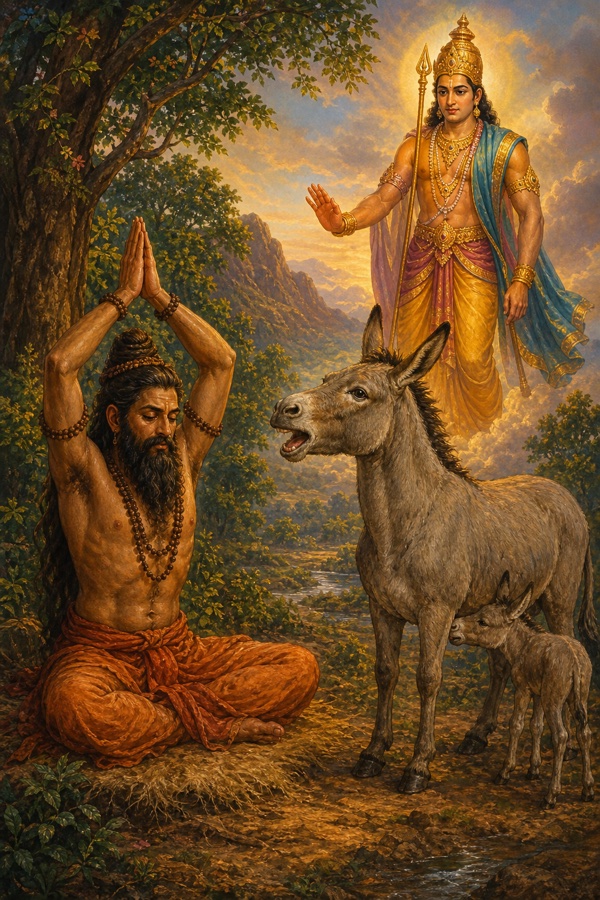
Yudhishthira’s next question was a king’s question, about the four orders he ruled. “You have wisdom and the knowledge of the scriptures,” he said, “conduct, every excellent quality, and years. There is no one in all the worlds worthier of being asked about righteousness. So tell me this. If a man is a Kshatriya, or a Vaishya, or a Shudra, how can he win the standing of a Brahmin? By the hardest austerity, by religious acts, or by knowledge of the scriptures? Which of these lifts a man of the three lower orders into the first?” Bhishma did not soften it. The standing of a Brahmin, he said, cannot be acquired by anyone born into the other three orders. It is the highest standing among all creatures. A soul travels through orders of existence past counting, birth after birth, and at last, in some one birth, comes to be born a Brahmin. On this there was an old story, a conversation between a man named Matanga and a she-donkey.
Once a Brahmin obtained a son, Bhishma said, a boy fathered by a man of another order, though the rites of infancy and youth were performed for him exactly as the ordinances lay them down for Brahmins. The child was named Matanga, and he grew up accomplished in everything. His father, wanting to perform a sacrifice, sent him out to gather what the rite required, and Matanga, obedient, set off in a fast chariot drawn by a donkey. The donkey yoked to that chariot was very young. It ignored the reins and carried the chariot straight toward the place where its mother stood, the she-donkey that had borne it, and Matanga, angry at the detour, began to beat it again and again on the nose with his goad. The mother saw the marks of the goad on her foal’s nose, and love for her child put words in her mouth.
“Do not grieve over this treatment, child,” she said to the foal. “It is a chandala who is driving you. There is no cruelty like this in a Brahmin. A Brahmin is called the friend of every creature, their teacher and their ruler. Could he punish any creature so savagely? This fellow’s deeds are sinful. He has no pity to spare even for a creature as young as you. He is only proving the order of his birth by behaving like this. The nature he took from his father will not let the pity and kindness that come naturally to a Brahmin rise in him.” The words were meant for the foal, and the man in the chariot heard every one of them.
Matanga climbed down from the chariot at once. “Tell me, blessed mother,” he said to the she-donkey, “what fault stains my mother? How do you know I am a chandala? Answer me without delay. How do you know I am a chandala? How was my standing as a Brahmin lost? You have great wisdom; tell me all of it, from the beginning to the end.” The she-donkey answered him. “You were fathered on a Brahmin woman, in the heat of her desire, by a Shudra who worked as a barber. So you are a chandala by birth, and the standing of a Brahmin you do not have at all.” Matanga turned the chariot around.
He went home. His father saw him come back and asked the obvious question. “I sent you on the hard errand of gathering what my sacrifice needs. Why have you come back with the errand undone? Is something wrong with you?” “How can a man be well and happy,” Matanga said, “who belongs to no settled order of birth, or to a very low one? Father, how can a man be happy whose mother is stained? This she-donkey, who seems to be something more than a beast, tells me I was fathered on a Brahmin woman by a Shudra. For this reason I am going to undertake the hardest austerities.” He said it to his father, and he meant it, and he went out to the great forest and began the harshest penances a man can undertake.
He meant to win the standing of a Brahmin by austerity, and the austerity he set himself was so severe that it began to scorch the very gods. Indra, chief of the celestials, came down to him where he stood. “Why do you spend your time in grief like this, Matanga,” he said, “cut off from every human pleasure? I will give you boons. Name the boons you want. Do not delay; tell me what is in your heart. Even if the thing cannot be had, I will still give it to you.” “I began these penances because I want the standing of a Brahmin,” Matanga said. “When I have it, I will go home. That is the only boon I ask.” And Purandara, who had just promised him anything, told him what he could not have. “The standing of a Brahmin that you want, Matanga, is beyond your reach. You want it, true, but it cannot be won by those begotten on unclean souls. You are a fool, and you will destroy yourself if you keep at this. Give up this useless effort now. The thing you want, the standing of a Brahmin, is the first of everything, and penances cannot win it. By coveting that first of standings you will only bring on your own destruction. A man born a chandala can never reach the standing that gods and asuras and men hold the most sacred of all.” Matanga stood where he was.
A key to reading this (the idea): This tale ties a man’s order to his birth, and it speaks for the scriptural view of its age. The Mahabharata carries the other view too, that the order is shown by conduct, as in the dialogue of Yudhishthira and Nahusha, and Yudhishthira himself will press the point in the very next tale with the names of Vishvamitra and Vitahavya; so this is one voice of the tradition in a conversation that stays open. A chandala is a person of the lowest standing, held to be born of a mixed union. A goad is the pointed stick a driver uses on a draft animal.
The gist: A she-donkey, watching her foal beaten, tells it that the man with the goad is a chandala, and Matanga, who had every rite of a Brahmin’s childhood performed for him, learns from her that he is the son of a Brahmin woman and a Shudra barber. He goes to the forest to burn the stain off with austerity, and Indra, forced down by the heat of it, offers him anything in the world except the one thing he asks for.
Matanga’s unshaken austerity, and Indra’s teaching on the order of births
Indra had counseled him, Bhishma said, and Matanga had not listened. Keeping his vows, his soul in order, he stood on one foot for a hundred years. Shakra came down to him a second time. “The standing of a Brahmin cannot be reached, child. You covet it, and it is impossible for you to have it. By coveting that very high standing, Matanga, you are sure to be destroyed. Do not be so rash, my son. This is not a righteous path for you. You are a fool; you cannot have it in this world, and by coveting what cannot be had you will meet destruction in no time. I am forbidding you again and again. If you go on striving for it with your penances in spite of my warnings, you are sure to be destroyed.” And then Indra laid out for him the whole ladder of births. From the life of a brute, he said, a creature rises to the standing of a human being, and when it is born human it is born as a pukkasa or a chandala. In that sinful order of existence it has to wander a very long time. After a thousand years in that order it reaches the standing of a Shudra. In the Shudra order, again, it wanders a long time. After thirty thousand years it reaches the standing of a Vaishya, and there it passes a very long period. After a time sixty times as long as the Shudra period it becomes a man of the fighting order.
“In the Kshatriya order it has to pass a very long time. After a time measured by multiplying that last period by sixty, it is born as a fallen Brahmin, and in that order it wanders a long period. After a time measured by multiplying the last by two hundred, it is born into the family of a Brahmin who lives by arms, and there it wanders a long period. After a time measured by multiplying the last by three hundred, it is born into the family of a Brahmin given to reciting the Gayatri and the other sacred mantras, and there it wanders a long period. After a time measured by multiplying the last by four hundred, it is born into the family of a Brahmin who knows the whole of the Vedas and the scriptures, and there it wanders a very long period. And even while it wanders in that standing, joy and grief, desire and aversion, vanity and evil speech try to get into it and make a wretch of it. If it conquers those enemies it reaches a high end. If those enemies conquer it, it falls from that high standing the way a man falls to the ground from the top of a palmyra tree. Knowing this for certain, Matanga, I tell you: name some other boon. The standing of a Brahmin cannot be reached by you, who were born a chandala.” Matanga heard the whole ladder out, and gave no sign of coming down off his one foot.
A key to reading this (the number): Indra’s ladder is built by multiplication, and the multiplications are not meant to be worked out. A thousand years as a pukkasa or chandala; thirty thousand as a Shudra; sixty times that as a Vaishya; sixty times that again as a Kshatriya; then two hundred, three hundred, and four hundred times the last span through the grades of Brahmin, from the fallen to the one who holds the whole Veda. What the numbers carry is the feel of a kalpa’s worth of ages, and the point that a soul climbs this ladder one slow birth at a time, with a fall waiting at the top for anyone who lets pride or spite back in.
The gist: Matanga stands a hundred years on one foot, and Indra comes down a second time to show him the ladder of births, from brute to pukkasa to Shudra to Vaishya to Kshatriya and up through the grades of Brahmin, with ages beyond counting on every rung and a fall possible even from the top. The offer is the same as before: anything else.
Matanga’s last plea and boon
Matanga did not accept a word of it, Bhishma said. With his vows kept and his soul cleansed he stood on one foot for a thousand years, sunk in the meditation of yoga, and when the thousand years had passed Shakra came again, the slayer of Vala and Vritra, and said the same things he had said before. This time Matanga had a question of his own. “I have passed these thousand years standing on one foot, in deep meditation, keeping the student’s vow. Why have I still not won the standing of a Brahmin?” “A man born a chandala cannot, by any means, win the standing of a Brahmin,” Shakra said. “So name some other boon, so that all this labor of yours is not wasted.”
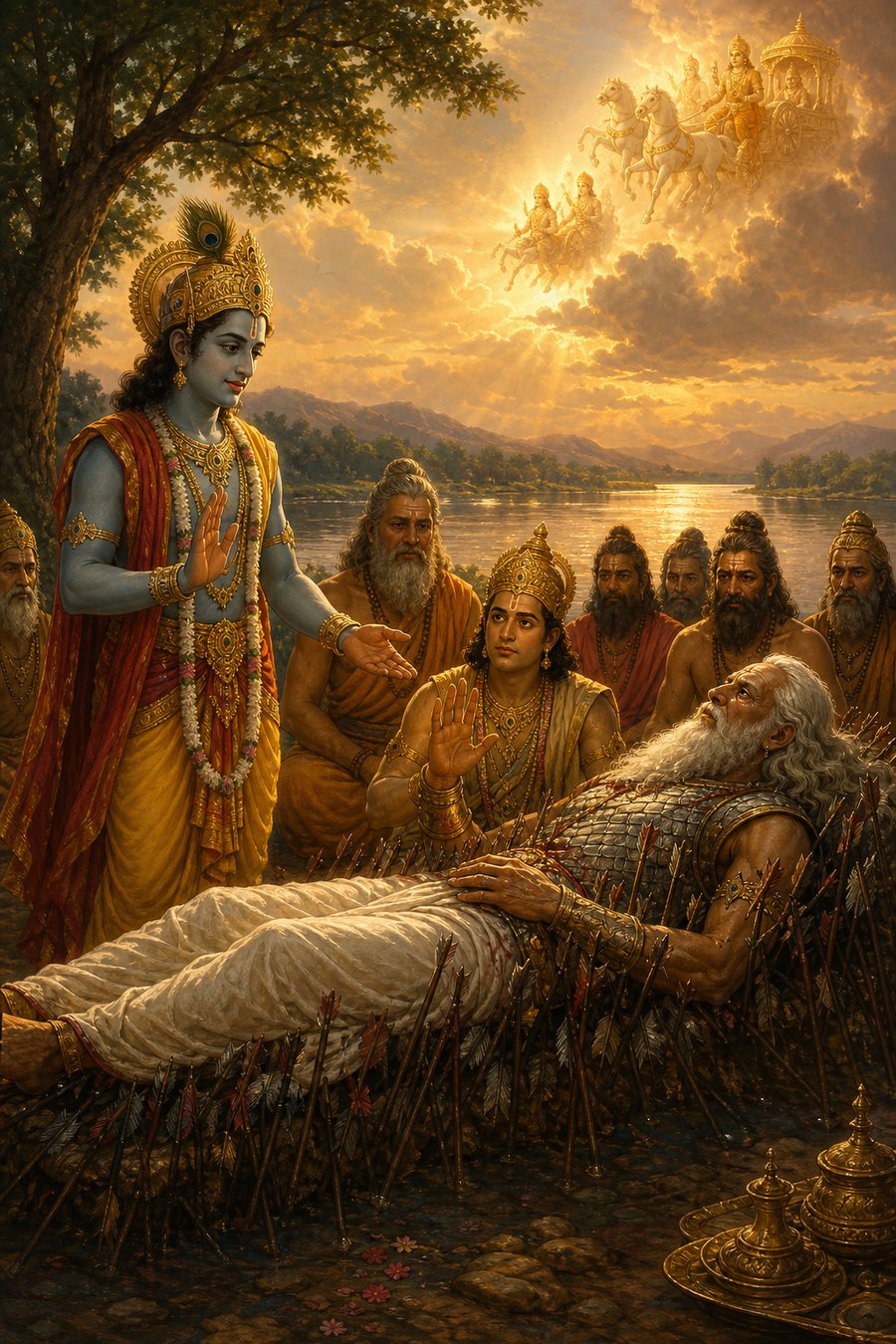
Grief took hold of Matanga at that. He went to Prayaga and spent a hundred years there standing on his toes. The yoga he kept was almost past bearing; he wasted away, the veins and arteries stood out swollen on him, and he was reduced to skin over bone. And it has been heard, Bhishma said, that the righteous Matanga, keeping those austerities at Gaya, dropped to the ground from sheer exhaustion. Vasava, the lord and giver of boons, who works for the good of all creatures, saw him fall, came quickly to the spot, and caught him and held him up.
“It seems, Matanga, that the standing of a Brahmin you are seeking is ill suited to you,” Shakra said, with the ascetic still in his arms. “You cannot reach it. For you it is hedged about with dangers. By worshiping a Brahmin a man wins happiness; by withholding that worship he wins grief and misery. For every creature the Brahmin is the giver of what it prizes and the protector of what it already has. It is through the Brahmins that the ancestors and the gods are satisfied. The Brahmin, Matanga, is called the first of all created beings; he grants everything that is desired, in the way that it is desired. A soul wanders through orders of being past counting, birth after birth, and in some later birth it wins the standing of a Brahmin. That standing cannot be won by the unclean of soul. So give up the idea. Name some other boon. The one you are asking for cannot be granted to you.”
Matanga answered from the ground. “I am already stricken with grief, Shakra. Why do you strike me again with speeches like these? You are beating a man who is already dead. I do not pity you for having won the standing of a Brahmin and then failing to keep it, for you have no compassion to show a man like me. You of a hundred sacrifices, you say the standing of a Brahmin cannot be won by any of the other three orders; and yet the men who have it by birth do not hold to it. What sins do even Brahmins not commit? Those who have won the standing of a Brahmin, which is as hard to come by as wealth, and do not keep it up by the duties that belong to it, must be counted the lowest wretches in the world. They are the most sinful of all creatures. There is no doubt that the standing of a Brahmin is very hard to reach, and once reached, hard to keep. It can scatter every kind of grief. And still men who have it do not always try to keep it. When even such men are counted Brahmins, why am I not held fit for that standing, I who am content in myself, who have risen above the pairs of opposites, who am cut loose from every worldly thing, who keep the duty of compassion toward all creatures and the restraint of my own conduct? How unlucky I am, Purandara, to have been brought to this through my mother’s fault, when there is nothing unrighteous in the way I live. There is no doubt that destiny cannot be turned aside or beaten by a man’s own effort, since for all this striving I cannot win the thing I set my heart on. Since that is how it stands, lord, it is right that you grant me some other boon, if I have earned your grace, or if there is a little merit in me.”
“Name the boon,” said the slayer of Vala and Vritra. Pressed by the great Indra, Matanga named it. “Let me have the power to take any form I choose and to travel through the skies, and let me enjoy whatever pleasure I set my heart on. And let me have the willing worship of both Brahmins and Kshatriyas. I bow my head to you, god. Do this also, Purandara: let my fame live forever in the world.” “You will be celebrated as the deity of a particular measure of verse,” Shakra said, “and you will have the worship of all women. Your fame, my son, will be unrivaled in the three worlds.” Having granted those boons, Vasava vanished on the spot. Matanga too let go of his life breaths and reached a high place. “So you may see,” Bhishma said, “how very high the standing of a Brahmin is. It cannot be won here, except in the natural way of birth; the great Indra himself said so.” Yudhishthira had another name ready.
The gist: A thousand years on one foot, a hundred on his toes at Prayaga, a body worn to bone and a collapse at Gaya, and Indra catches him only to say the same thing a fourth time. Matanga’s answer is the sharpest thing in the tale: the men who have Brahmin standing by birth do not keep its duties, so why is a man who does keep them turned away? He gets no reply to that, only a boon, and he asks for shape at will, the freedom of the sky, the worship of Brahmins and Kshatriyas, and a name that will not die; Indra makes him the deity of a meter, worshiped by all women, and Matanga leaves his body.
The Brahmin-hood of the royal sage Vitahavya
“I have heard this great story,” Yudhishthira said, “and you have told me that the standing of a Brahmin is very hard to win. Yet it is heard that in former times Vishvamitra won it. You say it cannot be won; and I have also heard that King Vitahavya, long ago, came to the standing of a Brahmin. I want to hear how Vitahavya rose. By what acts did that king win the standing of a Brahmin? Was it through a boon from someone of great power, or through the strength of his austerities? Tell me the whole of it.” Bhishma told him how the royal sage Vitahavya, famous in his time, had won the standing that is so hard to reach and that the whole world holds in such reverence. Long ago, when Manu was ruling his subjects by righteousness, a righteous son was born to him who became famous under the name of Sharyati. In Sharyati’s line two kings were born, Haihaya and Talajangha, both of them sons of Vatsa. Haihaya had ten wives, and on them he fathered a hundred sons, every one of them bred for fighting. They were alike in features and in prowess, all of them strong, all of them skilled in battle, and all of them had studied the Vedas and the science of weapons to the end.
In Kashi, meanwhile, there reigned a king named Haryashva, the grandfather of Divodasa and a winner of many battles. The sons of King Haihaya, the king who was also called Vitahavya, invaded the kingdom of Kashi, pushed into the country that lies between the Ganga and the Yamuna, met Haryashva in battle there, and killed him. Then those great chariot warriors went home without fear to their own pleasant city in the country of the Vatsas. Haryashva’s son Sudeva, who looked like a god and was a second lord of righteousness, was installed on the throne of Kashi. That righteous prince, the delight of Kashi, had ruled for some time when the hundred sons of Vitahavya came back, invaded his dominions, and beat him in battle too; and having beaten Sudeva they went home again. After him Sudeva’s son Divodasa was installed on the throne of Kashi. Divodasa had the measure of the sons of Vitahavya by then, and at Indra’s command he rebuilt and fortified the city of Varanasi. His territories were full of Brahmins and Kshatriyas, thick with Vaishyas and Shudras, stocked with goods and provisions of every kind, lined with shops and markets swollen with prosperity. They ran northward from the banks of the Ganga to the southern banks of the Gomati, and they looked like a second Amaravati, the city of Indra. The Haihayas came for them anyway.
They attacked Divodasa while he ruled, Bhishma said, and the king came out of his capital and gave them battle. The fight that followed was as fierce as the old war between the gods and the asuras. Divodasa fought the enemy for a thousand days, and at the end of them, with his followers and his animals dead in great numbers, he was worn down to nothing. His army was gone and his treasury was empty. He left his capital and fled, and he made for the pleasant retreat of Bharadvaja, the sage of great wisdom, where he joined his hands and asked for the rishi’s protection. Bharadvaja, the eldest son of Brihaspati, a man of excellent conduct, was the king’s own priest, and seeing Divodasa standing before him he asked what had brought him. “Tell me everything, king. I will do whatever is agreeable to you, without a second thought.” “Holy one,” the king said, “the sons of Vitahavya have killed every child and every man of my house. I alone have escaped with my life, beaten to the ground by the enemy. I come to you for protection. Protect me with the affection you would show a disciple. Those princes of sinful deeds have slaughtered my whole race and left only me alive.”
“Do not fear. Do not fear,” Bharadvaja told the man who had pleaded so piteously. “Son of Sudeva, let your fears go. I will perform a sacrifice so that you may have a son, and through him you will strike down the followers of Vitahavya by the thousand upon thousand.” The rishi performed the sacrifice with that single aim, a son for Divodasa, and as its fruit a son was born to Divodasa, and he was named Pratardana. The moment he was born he grew to the size of a boy of thirteen, and in no time he had mastered the whole of the Vedas and the whole of arms. Bharadvaja, by the power of his yoga, had entered into the prince; he had gathered up all the energy that lies in the things of the universe and put it together inside Pratardana’s body. With shining armor on him and the bow in his hand, Pratardana, with bards and the celestial rishis singing his praises, shone like the risen sun. He mounted his chariot with the scimitar tied at his belt, and with scimitar and shield, whirling the shield as he went, he rode into his father’s presence like a blazing fire. Divodasa, the son of Sudeva, looked at him and was filled with joy; the old king counted the sons of his enemy Vitahavya as already dead. He installed Pratardana as heir apparent, held himself crowned with success, and was very happy. Then he gave the order.
Divodasa commanded his son to march against the sons of Vitahavya and kill them in battle, and Pratardana, with all that power in him, crossed the Ganga on his chariot at speed and drove on the city of the Vitahavyas. The sons of Vitahavya heard the clatter of his wheels and came out of their city on chariots of their own, chariots built like fortified citadels, made to destroy whatever vehicles came against them. Out through the gates of their capital they rushed at Pratardana, all of them skilled fighters cased in mail, weapons raised, and covered him in showers of arrows. They surrounded him with chariots past counting and poured weapons of every kind down on him, the way clouds pour rain on the breast of Himavat. Pratardana turned their weapons aside with his own and killed them all with arrows that struck like the lightning fire of Indra. Their heads were taken off by broad-headed arrows in hundreds and thousands, and the warriors of Vitahavya went down with blood-dyed bodies on every side, like kimshuka trees that woodmen have felled with axes.
When every one of his warriors and his sons had fallen, King Vitahavya fled his capital for the retreat of Bhrigu, and once he was there he begged the rishi for protection, and Bhrigu assured the beaten king that he had it. Pratardana followed in Vitahavya’s footsteps. He reached the retreat and called out in a loud voice, “Listen, you disciples of Bhrigu, whoever is present. I wish to see the sage. Go and tell him I am here.” Bhrigu understood who had come. He came out of his retreat himself, honored the king with the rites a king is owed, and asked him his business. “King Vitahavya has come here, Brahmin,” Pratardana said. “Give him up to me. His sons destroyed my race. They laid waste the territories and the wealth of the kingdom of Kashi. This king was proud of his strength, and his hundred sons have all been killed by me. By killing the king himself I will pay off, today, the debt I owe my father.”
Bhrigu, who was full of compassion and the first of righteous men, gave him an answer. “There is no Kshatriya in this retreat. Everyone here is a Brahmin.” Pratardana heard those words, which he knew must be true in Bhrigu’s mouth, and he bent and touched the rishi’s feet, slowly, and said with delight, “By this, holy one, I am without doubt crowned with success, since my prowess has cost this king the very order of his birth. Give me your leave to go, Brahmin, and I ask you to pray for my welfare. This king, founder of the line that bears your name, has been forced out of the community he was born into because of my strength.” Bhrigu dismissed him, and Pratardana left the retreat and went back the way he had come, like a snake that has spat out its whole store of poison.
And King Vitahavya, meanwhile, by the words of Bhrigu alone, had reached the standing of a Brahmin sage, and through the same cause he gained a complete mastery of all the Vedas. Vitahavya had a son named Gritsamada, who in beauty of person was a second Indra; once the daityas tormented him badly, taking him for Indra himself. Of that sage one of the first of the shrutis, among the hymns of the Rich, says this: the man with whom Gritsamada stays is held in high respect by all Brahmins. Gritsamada, with his great intelligence, became a twice-born rishi who kept the student’s vow. And from him the line ran on.
Gritsamada had a twice-born son named Sutejas. Sutejas had a son named Varchas, and the son of Varchas was Vihavya. Vihavya’s son was Vitatya, Vitatya’s son was Satya, Satya’s son was Shanta, and Shanta had a son who was the rishi Shravas. Shravas fathered Tama, and Tama fathered Prakasha, a Brahmin of the highest kind. Prakasha had a son named Vagindra, the first of all those who recite the sacred mantras in silence, and Vagindra fathered Pramati, a complete master of the Vedas and all their branches. Pramati, on the apsara Ghritachi, fathered a son named Ruru. Ruru, on his wife Pramadvara, fathered a son who was the twice-born rishi Shunaka, and Shunaka fathered a son named Shaunaka. “That is how King Vitahavya,” Bhishma said, “a Kshatriya by the order of his birth, won the standing of a Brahmin through the grace of Bhrigu, and I have told you the genealogy of the line that sprang from Gritsamada as well. What else would you ask?”
A key to reading this (the lineage and places): Haihaya is the Kshatriya house descended from Sharyati; its king Haihaya is the one the tale also calls Vitahavya, and his hundred sons fight three generations of Kashi. Kashi is Varanasi, the capital of Haryashva, Sudeva, and Divodasa, which Divodasa rebuilds and walls at Indra’s command. Bharadvaja is the eldest son of Brihaspati and the family priest of Divodasa, and his sacrifice produces Pratardana. Bhrigu is the sage whose single sentence turns the Kshatriya Vitahavya into a Brahmin sage, and the line that descends from him runs down to Shaunaka, the sage to whom the whole Mahabharata is recited. Kimshuka is the palasha, the tree with blood-red flowers, which is why the poet reaches for it when heads fall.
A sub-tale: Read the Vitahavya tale against the Matanga tale that came just before it. In one, Indra tells a man who has stood a thousand years on one foot that Brahmin standing is beyond reach except by birth. In the other, a Kshatriya king who has just lost a hundred sons becomes a Brahmin sage because a rishi, to shelter him, says the single sentence “There is no Kshatriya in this retreat.” Yudhishthira set the two side by side himself when he asked his question, and Bhishma answers by telling both stories and leaving the gap between them standing.
The gist: The hundred sons of the Haihaya king Vitahavya lay waste the royal line of Kashi for three generations, killing Haryashva, beating Sudeva, and driving Divodasa from his rebuilt Varanasi after a thousand days of fighting. Bharadvaja’s sacrifice gives Divodasa a son, Pratardana, who kills all hundred. Vitahavya flees to Bhrigu, and when Pratardana comes for him Bhrigu says only that there is no Kshatriya in his hermitage; the sentence makes Vitahavya a Brahmin sage, ends the feud, and begins the line that runs to Shaunaka.
The dialogue of Narada and Vasudeva, who is to be worshiped
“Which men in the three worlds deserve reverent homage?” Yudhishthira asked. “Tell me this in full. I never tire of hearing you on these things.” Bhishma gave him an old conversation between Narada and Vasudeva. Keshava had once come upon Narada with his hands joined, worshiping one Brahmin after another, a great many of them, and he wanted to know why. “Whom are you worshiping?” he asked. “Which of these Brahmins, holy one, do you worship with such reverence? If this is something I may hear, I would like to hear it. Tell me.”
“Hear, Govinda, who it is that I worship,” Narada said. “Who else in this world deserves to hear it as much as you? I worship the Brahmins who constantly worship Varuna and Vayu, Aditya and Parjanya, the god of fire, Sthanu and Skanda, Lakshmi and Vishnu, the Brahmins, the lord of speech, Chandramas, the waters, the earth, and the goddess Sarasvati. I always worship, you tiger of the Vrishnis, the Brahmins who are rich in austerity, who know the Vedas and never leave off studying them, and who are of high worth. I bow my head to those who have put boasting away, who perform the rites of the gods on an empty stomach, who are always content with what they have, and who are full of forgiveness. I worship those, Yadava, who perform sacrifices, who are forgiving and self-restrained, who are masters of their own senses, who worship truth and righteousness, and who give away land and cattle to good Brahmins.”
“I bow, Yadava, to those who are given to austerity, who live in the forests on fruit and roots, who never store anything for tomorrow, and who keep every act and rite the scriptures lay down. I bow to those who feed and cherish their servants, who are always hospitable to guests, and who eat only what is left after the gods have been offered their share. I worship those whom the study of the Vedas has made irresistible, who speak well on the scriptures, who keep the vow of the student, and who give their lives to officiating at the sacrifices of others and to teaching disciples. I worship those who hold compassion for every creature and who study the Vedas until noon, until the sun is hot on their backs. I bow, Yadava, to those who work to win the grace of their teachers, who labor to gain their Vedas, who are firm in their vows, who wait on their teachers and seniors with dutiful obedience, and who are free of malice and envy.”
“I bow, Yadava, to those of excellent vows who keep silence, who hold the knowledge of Brahman, who are firm in truth, who pour out libations of clarified butter and offerings of meat. I bow to those who live on alms, thin for want of food and drink, who have lived in the houses of their teachers, who have turned their backs on every pleasure and have none, and who are poor in the goods of this earth. I bow, Yadava, to those who have no love for the things of this earth, who have no quarrels to wage with anyone, who do not clothe themselves, who want nothing, whom the Vedas have made irresistible, who speak well on righteousness, and who utter Brahma. I bow to those who practice the duty of compassion toward every creature, who are firm in truth, self-restrained, and peaceful in their conduct. I bow, Yadava, to those who worship the gods and their guests, who keep the householder’s life, and who feed themselves the way pigeons do, on what lies scattered on the ground.”
“I always bow to those in whom the three aims together, righteousness, wealth, and pleasure, stay unweakened in everything they do, and who keep truth and righteous conduct. I bow, Keshava, to those who know Brahma, who hold the knowledge of the Vedas, who attend to the three aims, who are free of greed, and who are righteous in their conduct. I bow, Madhava, to those who live on water alone, or on air alone, or on what is left after the gods and the guests have eaten, and who keep excellent vows of every kind. I always worship those who have no wives, because of the celibacy they keep, and those who have wives and the household fire, because of the domestic life they lead, who are the refuge of the Vedas, and who, out of the compassion they feel, are the refuge of every creature in the universe. I always bow, Krishna, to those rishis who are the makers of the universe and the elders of the universe, the eldest of the race and the family, the scatterers of the dark of ignorance, the best of all beings in the universe for righteous conduct and knowledge of the scriptures. For these reasons, you too, born of the Vrishnis, should worship every day the twice-born men I am speaking of. They deserve reverent worship, and when they are worshiped they give you happiness.”
“The men I am speaking of are always givers of happiness, in this world and in the next. They move about in this world revered by everyone, and if you worship them they are sure to give you happiness. Those who are hospitable to everyone who comes to them as a guest, and who are always devoted to Brahmins and cattle and to truth in speech and conduct, cross every calamity and obstacle. Those who are always devoted to peaceful conduct, who are free of malice and envy, and who are always attentive to the study of the Vedas cross every calamity and obstacle. Those who bow to all the gods without preferring one over another, who take one Veda as their refuge, who have faith and are self-restrained, cross every calamity and obstacle. Those who worship the first of the Brahmins with reverence, who are firm in excellent vows, and who practice charity, cross every calamity and obstacle. Those given to austerity, those who always keep the vow of celibacy, and those whose souls austerity has cleansed cross every calamity and obstacle. Those devoted to the worship of the gods and of guests and dependents and of the ancestors, who eat what is left after gods, ancestors, guests, and dependents have been fed, cross every calamity and obstacle. Those who have kindled the household fire and keep it burning and worship it with reverence, and those who have poured the proper libations to the gods in the Soma sacrifices, cross every calamity and obstacle. Those who behave as they should toward their mothers and fathers, their teachers and their other seniors, as you do, tiger of the Vrishnis, cross every calamity and obstacle.” With that the celestial rishi fell silent. “For these reasons,” Bhishma said, “you too, son of Kunti, should always worship with reverence the gods, the ancestors, the Brahmins, and the guests who arrive at your house. Live like that and you are sure of a desirable end.”
A key to reading this (the idea): The three aims are righteousness, wealth, and pleasure, the three ends of a human life, and Narada honors the men in whom none of the three starves the others. The pigeon’s livelihood is to live on what has fallen to the ground, a life without storing or grasping. Sthanu is Shiva, Skanda is Kartikeya. Keshava, Govinda, Madhava, Yadava, tiger of the Vrishnis are all ways of addressing Krishna, who is Vasudeva, and Narada turns the names over one after another as he speaks to him.
The gist: Krishna finds Narada with folded hands before a crowd of Brahmins and asks which of them he is worshiping, and Narada answers with a long garland of bows: to the Brahmins who worship the gods, to the forest dwellers who store nothing, to the silent, the thin, the unclothed, the householders who feed their guests first and eat like pigeons, the ones who live on water or on air. Then he turns the garland into a rule of life, ending with the men who treat their parents and teachers as Krishna does, and Bhishma hands the rule on to Yudhishthira.
The pigeon and the hawk, King Vrishadarbha’s protection of a suppliant
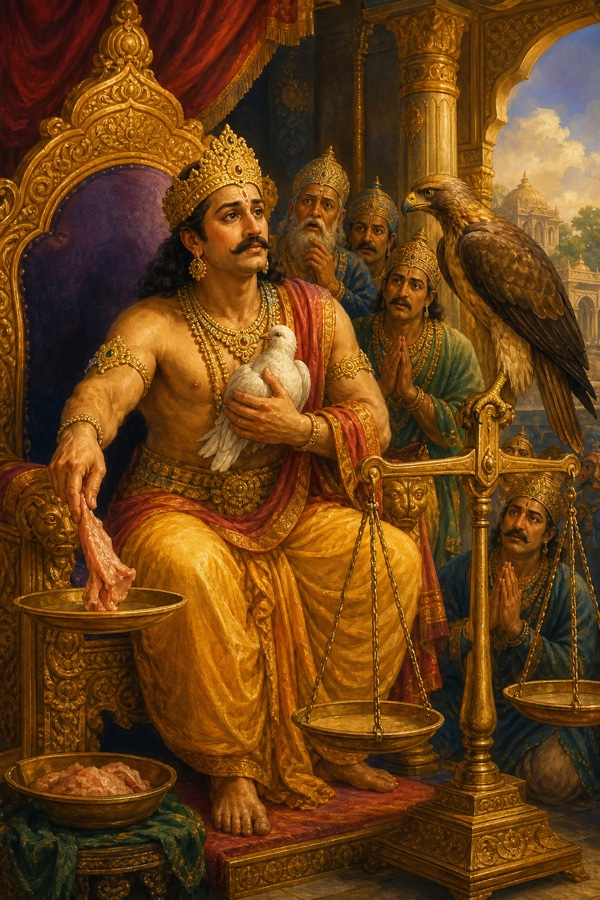
Yudhishthira wanted the rest of what Bhishma knew. “You have great wisdom and you know every branch of learning. I want to hear you on duty and righteousness. Tell me truly: what is the merit of those who give protection to living creatures of the four orders, when those creatures come begging for it?” Bhishma answered with the old history of a king and a bird. Once a lovely pigeon, with a hawk after it, dropped out of the sky and asked the protection of King Vrishadarbha. The king, who had a pure soul, saw the pigeon take refuge in his lap out of terror and comforted it. “Take heart, bird. Do not be afraid. Where did you catch such a fright? What have you done, and where, that you have lost your wits and seem more dead than alive? Your color, beautiful bird, is the color of a freshly opened blue lotus. Your eyes are the color of the pomegranate, or the ashoka flower. Do not be afraid; I tell you to take heart. Now that you have come to me for refuge, know that no one will have the courage even to think of seizing you, with such a protector looking after you. For your sake I would give up today the kingdom of Kashi itself, and my life too if it came to that. Take heart, pigeon, and let no fear be yours.”
The hawk had landed, and it spoke for itself. “This bird has been ordained to be my food, king. You have no business protecting him from me. I outflew him and I caught him; I got him at last with great effort. His flesh and blood and marrow and fat will do me a great deal of good; this bird is going to give me real satisfaction. Do not put yourself between him and me like this. A fierce thirst is on me and hunger is gnawing at my bowels. Release the bird and throw him off. I cannot bear the pain of hunger any longer. I hunted him down as my prey. Look at him: his body is bruised and torn by my wings and my talons. Look, his breath has grown very faint. You have no business protecting him from me. In the exercise of the power that properly belongs to you, you are competent to step in and protect human beings when other human beings are trying to destroy them. You cannot claim any power over a bird that ranges the sky and is tormented by thirst. Your power may extend over your enemies, your servants, your relatives, and the disputes among your subjects; it may extend over every part of your dominions and over your own senses too. It does not extend over the sky. Show your prowess against foes who act against your wishes, and you may establish your rule over them. Your rule does not run over the birds of the air. And if what you want is merit, by protecting this pigeon, then it is your duty to look at me as well, and do what is proper to let me quiet my hunger and save my life.”
The royal sage, Bhishma said, listened to the hawk and was astonished. He did not brush the bird’s words aside; he wanted its comfort too, and he answered it. “Let a bull, or a boar, or a deer, or a buffalo be dressed for you today. Satisfy your hunger on that. Never to desert anyone who has sought my protection is a vow I hold to. Look, bird, this pigeon will not leave my lap.” “I do not eat the flesh of boar or ox, king,” the hawk said, “or of any of the different kinds of fowl. What do I want with food of this kind or that? My concern is with the food that has been ordained for creatures of my order from eternity. Hawks eat pigeons; that is the eternal rule. Sinless Ushinara, if you feel such affection for this pigeon, then give me flesh from your own body, of a weight equal to the pigeon’s.”
“That is a great favor you do me, speaking to me like this,” the king said. “Yes. I will do as you say.” And that first of kings began to cut the flesh from his own body and weigh it in a balance against the pigeon. Inside the palace the king’s wives, decked in jewels and gems, heard what was happening and cried out in anguish and came running out, stricken with grief. From those cries of the women, and of the ministers and the servants, a noise rose in the palace as deep as the roar of thunderclouds. The sky, which had been perfectly clear, was swallowed in thick cloud on every side. The earth began to shake under the act of truth the king was performing. The king cut the flesh from his flanks, from his arms, from his thighs, and piled it fast into one pan of the scale against the pigeon, and for all of it the pigeon went on weighing more.
When at last the king was a skeleton of bones with no flesh left on him and blood all over him, he resolved to give his whole body, and he climbed onto the pan where he had laid the flesh he had already cut away. At that moment the three worlds, with Indra at their head, came to that spot to look at him. Celestial kettledrums and drums of every kind were beaten by unseen beings in the sky. King Vrishadarbha was bathed in a shower of nectar poured down on him. Garlands of heavenly flowers, delicious to smell and to touch, were showered on him again and again, in heaps. The gods, the gandharvas, and the apsaras in great companies began to sing and dance around him, as they sing and dance around the grandfather Brahma. Then the king mounted a celestial chariot that surpassed, in grandeur and beauty, a mansion built entirely of gold, with arches of gold and gems and columns of lapis lazuli, and through the merit of his act the royal sage Shibi went to the eternal heaven.
“Do the same, Yudhishthira, with those who come to you for protection,” Bhishma said. “The man who protects those devoted to him, those bound to him by love and affection, those who depend on him, and who has compassion for every creature, reaches great happiness in the world to come. The king who is righteous in his conduct, honest and upright, wins every valuable reward by the sincerity of his acts. The royal sage Shibi, pure of soul, wise, his prowess never once baffled, ruler of the kingdom of Kashi, became celebrated over the three worlds for his deeds of righteousness. Anyone who protects a suppliant in the same way comes to the same happy end that Shibi came to. Whoever recites this history of the royal sage Vrishadarbha is cleansed of every sin, and whoever hears it recited by another reaches the same result.”
A key to reading this (the idea): In this telling one king carries three names. He is Vrishadarbha when the pigeon lands in his lap, the hawk addresses him as Ushinara, and when he goes to heaven he is the royal sage Shibi, ruler of Kashi. An act of truth is a vow kept at any cost, and its power is physical in the telling: the sky clouds over and the earth shakes while the king is still at the scale. Lapis lazuli is the deep blue stone of the chariot’s columns.
The gist: A pigeon falls into King Vrishadarbha’s lap and a hawk lands to claim it, arguing that a king’s writ stops at the sky. The king offers a bull or a boar; the hawk wants pigeon, or the king’s own flesh at the pigeon’s weight. Vrishadarbha cuts himself down to bone while the scale refuses to balance, climbs onto the pan whole, and the three worlds arrive to carry him to heaven as the royal sage Shibi, with Bhishma’s instruction to Yudhishthira attached: do the same.
The best deed for a king, the worship of Brahmins
“Of all the acts laid down for a king,” Yudhishthira asked, “which is the first? What is the act by which a king comes to enjoy both this world and the next?” Bhishma had the answer ready. “The worship of the Brahmins. Of all the acts laid down for a king duly installed on his throne, that is the first, if he wants great happiness. That is what the first of kings should do. Know it well. The king should always worship with reverence every righteous Brahmin who holds Vedic learning. With bows, with comforting words, with gifts of everything that gives enjoyment, he should worship every Brahmin of great learning who lives in his city or his provinces. This is the first of the acts laid down for a king, and he should keep his eyes fixed on it always. He should protect and cherish such men as he protects himself, or his own children. Those among the Brahmins who deserve it most, for their holiness and their learning, he should worship with the greater reverence. When such men are free of every anxiety, the whole kingdom blazes with beauty.”
“Such men are worthy of adoration. To such men the king should bow his head. They should be honored as a man honors his fathers and grandfathers. The course of conduct that men follow depends on them, as the existence of every creature depends on Vasava. Their prowess cannot be baffled and their energy is great; when they are enraged they can burn the whole kingdom to ash by a single act of will, or by incantation, or by other means drawn from their austerities. I see nothing that can destroy them. Their power seems to have no check on it; it reaches to the farthest end of the universe. When they are angry their glances fall on men and things like a blazing flame on a forest. The bravest men are struck with fear by them. Their virtues and their powers are extraordinary and beyond measure. Some of them are like wells and pits with mouths hidden under grass and creepers, and others are like the sky when the clouds and the dark have cleared. Some have fierce dispositions, like Durvasa and those of his stamp. Some are as mild and soft as cotton, like Gautama. Some are very cunning, like Agastya, who ate the asura Vatapi. Some give themselves to austerity. Some work the land, like the teacher of Uddalaka. Some keep cattle, as Upamanyu did while he served his teacher. Some live on alms. Some are even thieves, as Valmiki was in his early years and Vishvamitra during a famine. Some are fond of stirring up quarrels, like Narada. Some are actors and dancers, like Bharata. And some can accomplish any feat, ordinary or extraordinary, like Agastya drinking up the whole ocean as if it were a palmful of water.”
“The Brahmins are of many aspects and many kinds of conduct. One should always speak the praises of those among them who know every duty, whose conduct is righteous, who give themselves to acts of many kinds, and who are seen to live by many kinds of work. In their origin the Brahmins are older than the ancestors, the gods, the men of the three other orders, the snakes, and the rakshasas. They cannot be defeated by the gods or the ancestors, by the gandharvas or the rakshasas, by the asuras or the pishachas. They can make a god of one who is no god, and strip a god of his godhood. The man they wish to make a king becomes a king; the man they neither love nor like goes to the wall. I tell you truly: the fools who speak against the Brahmins and run them down are destroyed, without any doubt. Skilled in praise and in blame, themselves the source of other people’s fame and disgrace, the Brahmins are always angry with those who try to injure others. The man the Brahmins praise grows in prosperity, and the man they censure and cast off soon meets with ruin. It was through the absence of Brahmins among them that the Shakas, the Yavanas, the Kambojas, and other Kshatriya peoples fell and were degraded to the standing of Shudras. The Dravidas, the Kalingas, the Pulindas, the Ushinaras, the Kolisarpas, the Mahishakas, and other Kshatriyas were degraded to Shudras because there were no Brahmins among them. Defeat at their hands is better than victory over them. A man who kills every other living creature in the world does not commit a sin as heavy as the killing of a single Brahmin. The great rishis have called that killing a heinous sin. One should never speak against the Brahmins or slander them; where such slander is spoken, one should sit with the face turned down, or leave the place. The man has not yet been born in this world, and never will be, who could quarrel with the Brahmins and then pass his life in happiness. One cannot seize the wind in the hands. One cannot touch the moon with the hand. One cannot hold up the earth on the arms. In the same way, no one in this world can defeat the Brahmins.”
Bhishma had more. “One should always offer the Brahmins the most reverent worship. Soma is their king, and it is they who hand out happiness and misery to others. They should be cherished and protected as a man cherishes and protects his fathers and grandfathers, and adored with bows, with gifts of food and ornaments and everything that gives enjoyment, and with whatever else they may desire. The peace and happiness of a kingdom flow from the respect shown its Brahmins, as the peace and happiness of every living creature flow from Vasava, chief of the celestials. Let Brahmins of pure conduct and the light of Brahma be born in a kingdom, and let Kshatriyas be wished for too, splendid chariot warriors who can scorch every enemy. Narada said this to me. There is nothing higher than this: to cause a Brahmin of good birth, who knows morality and righteousness and is steadfast in excellent vows, to take up his residence in one’s own house. That act brings every kind of blessing. The offerings given to the Brahmins reach the very gods, who accept them. The Brahmins are the fathers of all creatures. There is nothing higher than a Brahmin. Aditya, Chandramas, the wind, the waters, the earth, the sky, and the quarters of the compass all enter the body of a Brahmin and share what he eats. In the house where Brahmins do not eat, the ancestors refuse to eat. The gods never eat in the house of the wretch who hates the Brahmins. When the Brahmins are pleased, the ancestors are pleased; there is no doubt of it. Those who give the sacrificial butter to the Brahmins are themselves made content, in this world and the other; such men never meet destruction, and they reach high ends. The offerings in a sacrifice with which a man pleases the Brahmins go on to please the ancestors and the gods. The Brahmin is the cause of the sacrifice from which every created thing has sprung. He knows that from which this universe came and into which, when it seems to be destroyed, it returns. He knows the path that leads to heaven and the other path that leads the opposite way. He knows what has happened and what will happen. He is the first of all two-legged beings, and he knows every duty laid down for his order. Those who follow the Brahmins are never defeated; they are never destroyed when they leave this world; victory is always theirs. The men of subdued soul who accept the words that fall from the lips of the Brahmins are never defeated, and victory is always theirs. The energy and might of Kshatriyas who scorch everything they touch are neutralized when they meet the Brahmins. The Bhrigus conquered the Talajanghas. The son of Angira conquered the Nipas. Bharadvaja conquered the Vitahavyas, and the Ailas too. All those Kshatriyas could use weapons of every kind, and the Brahmins I have named, with nothing for their emblem except black deerskins, conquered them outright. A man should bestow the earth on the Brahmins, lighting both worlds with the splendor of such a deed, and do the acts by which he may reach the end of all things. Like fire hidden in wood, everything that is said or heard or read in this world lies hidden in the Brahmin.”
On this there was an old conversation, Bhishma said, between Vasudeva and the Earth. “Mother of all creatures, auspicious goddess,” Vasudeva asked her, “I want you to clear a doubt for me. By what act does a man leading the householder’s life cleanse himself of all his sins?” “He should serve the Brahmins,” the Earth said. “That conduct is cleansing and excellent. Every impurity in the man who serves the Brahmins with reverence is destroyed. From that conduct rise prosperity and fame; from it springs the knowledge of the soul. By that conduct a Kshatriya becomes a great chariot warrior, a scorcher of his foes, and wins great fame. This is what Narada told me: that a man who wants prosperity of every kind should always revere a Brahmin of good birth, hard vows, and knowledge of the scriptures. The man the Brahmins applaud truly grows in prosperity, and the Brahmins stand higher than those who are counted higher than all other men. The man who speaks ill of the Brahmins soon meets ruin, like a clod of unbaked earth thrown into the sea; and in the same way every act that hurts the Brahmins brings ruin and defeat. Look at the dark marks on the moon, and at the salt in the sea. The great Indra was once marked all over with a thousand marks of his shame, and it was by the power of the Brahmins that those marks were turned into as many eyes. Look how all those things came about. A man of pure conduct and soul who wants fame and prosperity and the many happy regions of the next world should live, slayer of Madhu, in obedience to what the Brahmins direct.” Hearing the goddess, the slayer of Madhu said, “Excellent, excellent,” and honored her with the proper rites. “Having heard this conversation between the goddess Earth and Madhava,” Bhishma said, “you too, son of Pritha, should always worship the first of the Brahmins with a rapt soul. Do it and you will gain what is of the highest benefit to you.”
A key to reading this (the lineage and the idea): The sages Bhishma lists are famous for the traits he gives them: Agastya ate the asura Vatapi and drank the ocean, Valmiki was a thief before he was a poet, Vishvamitra stole in a famine, Narada stirs quarrels, Bharata is the master of dance and drama. The point of the list is that the Brahmins come in every disposition and the king must honor all of it. Soma, their king is the moon, named here as the presiding lord of the Brahmins. Indra’s thousand marks are the marks of Gautama’s curse on him, which the Anusasana Parva recounts later, in the tale of Vipula, where they become his thousand eyes.
The gist: Asked for a king’s single best act, Bhishma names the worship of the Brahmins and then spends the whole answer on what they are: older than the gods, unbeatable by anyone, able to make or unmake a king, as varied as Durvasa and Gautama and the thief Valmiki, the reason whole Kshatriya nations fell to Shudra standing when they had none. The Earth tells Vasudeva the same from the other side: a householder cleans away his sins by serving them, and even Indra’s thousand marks of shame were turned into eyes by their power.
Brahma’s ordinance for the Brahmins
“By birth alone,” Bhishma said, “a Brahmin is an object of adoration for every creature, and as a guest he is entitled to the first portion of all cooked food. From the Brahmins flow all the great aims of life, righteousness, wealth, pleasure, and release. They are the friends of every creature in the universe. They are the mouths of the gods, for the food put into their mouths is eaten by the gods. Worshiped with reverence, they wish us prosperity in words of good omen. Slighted by our enemies, let them be enraged with those enemies and wish them evil in words of heavy curse. On this, those who know the old histories repeat the verses sung long ago about how the Creator, having made the Brahmins at the beginning, laid down their duties.”
“A Brahmin should never do anything except what has been ordained for him. Protected, let the Brahmins protect others. Conducting themselves that way, they reach what is mightily to their advantage. Doing the acts ordained for them, they obtain the prosperity of Brahma. You shall be the exemplars of all creatures, and the reins that hold them in. A Brahmin of learning should never do what is laid down for Shudras; by such acts a Brahmin loses merit. By Vedic study he is sure of prosperity, intelligence, energy, a power that can scorch everything, and glory of the most exalted kind. By offering clarified butter to the gods, the Brahmins reach high blessedness and become entitled to be served before even the children with every kind of cooked food, and endowed with the prosperity of Brahma. Endowed with a faith that is full of compassion for every creature, devoted to self-restraint and to the study of the Vedas, you shall have every wish fulfilled. Whatever exists in the world of men, whatever is found in the region of the gods, can all be won by austerity, by knowledge, and by keeping vows and restraints.” Those, Bhishma said, were the verses Brahma himself sang; with his supreme intelligence and wisdom the Creator ordained it so, out of compassion for the Brahmins.
“Among the Brahmins, those given to austerity have a power equal to the might of kings. They are irresistible, fierce, as fast as lightning, and very quick in what they do. There are some among them with the might of lions and some with the might of tigers. Some have the might of boars, some of deer, some of crocodiles. There are some whose touch is like the touch of a snake full of poison, and some whose bite is like a shark’s. Some can bring about the destruction of those who stand against them by speech alone, and some by a single look. Some, as I said, are like poisonous snakes, and some have very mild dispositions. The dispositions of the Brahmins, Yudhishthira, are of many kinds. The Mekalas, the Dravidas, the Latas, the Paundras, the Konvashiras, the Saundikas, the Daradas, the Darvas, the Chauras, the Shavaras, the Barbaras, the Kiratas, the Yavanas, and many other Kshatriya peoples have been degraded to the standing of Shudras by the anger of the Brahmins. Because they slighted the Brahmins, the asuras have been forced to take refuge in the depths of the ocean. By the grace of the Brahmins, the gods have become the dwellers of the happy regions of heaven. The element of space cannot be touched. The mountains of Himavat cannot be moved from where they stand. The current of the Ganga cannot be held back by a dam. The Brahmins cannot be subdued. Kshatriyas cannot rule the earth without cultivating the goodwill of the Brahmins. The Brahmins are great of soul; they are the gods of the very gods. Always worship them with gifts and obedient service, if you wish to enjoy the sovereignty of the whole earth with her belt of seas. And mark this: the energy and might of a Brahmin are abated by the acceptance of a gift. Guard your race, king, from the Brahmins who do not want to accept gifts.”
The gist: Bhishma recites the root ordinance Brahma sang for the Brahmins at the beginning: keep to the acts ordained for you, protect others as you are protected, never do a Shudra’s work, draw your power from the Veda and the fire offering. Then he lists their kinds, lion and tiger and crocodile, the ones who kill with a word and the ones who kill with a look, and ends on a warning aimed at a king: a Brahmin who accepts a gift has spent some of his power, so the ones to be most careful of are the ones who refuse to take anything.
The dialogue of Shakra and Shambara
On this, Bhishma said, there was an old conversation between Shakra and Shambara. Once Shakra took the guise of an ascetic, matted locks on his head and his whole body smeared with ash, mounted an ugly chariot, and drove to the asura Shambara. “By what conduct, Shambara, have you come to stand at the head of all the beings of your race?” he asked. “For what reason does everyone hold you superior? Tell me this truly, and in detail.”
“I never nurse any ill feeling toward the Brahmins,” Shambara said. “Whatever instruction they give, I accept with unquestioning reverence. When the Brahmins are interpreting the scriptures I listen to them with great happiness, and having heard their interpretations I never disregard them. I never offend against the Brahmins in any way. I always worship the Brahmins who have intelligence. I always go to them for information. I always worship their feet. They approach me with confidence, and they always speak to me with affection and ask after my welfare. If they ever happen to be careless, I am careful. If they happen to sleep, I stay awake. As bees drench the cells of the comb with honey, so the Brahmins, who are my instructors and my rulers, drench me with the nectar of knowledge, me who keep always to the path the scriptures point out, who am devoted to the Brahmins, and who am wholly free of malice and evil passion. Whatever they say to me with a cheerful heart, I accept, with memory and understanding to help me. I am always careful of my own faith in them, and I always keep my own inferiority to them in mind. I always lick the nectar that lives at the tip of their tongues, and that is why I stand as far above all the others of my race as the moon stands above the stars. The interpretations of scripture that fall from the lips of the Brahmins, which every wise man in the world acts on when he has heard them, are nectar on earth, and they are like eyes of remarkable excellence.”
“My father watched the battle between the gods and the asuras in the old days, and he understood the power of the instructions that came from the Brahmins, and he was filled with delight and wonder. Seeing the power of the great Brahmins, my father put a question to Chandramas: how do the Brahmins come to success? And Soma answered him. The Brahmins, he said, are crowned with success through their austerities. Their strength lies in speech. The prowess of the kingly order lives in the arms; the Brahmins have speech for their weapon. Enduring the discomforts of a long residence in his teacher’s house, a Brahmin should study the Vedas, or at the least the Pranava. He should put away anger, give up earthly attachments, and become a yati, looking on all things and all creatures with an equal eye. If he stays in his father’s house and masters all the Vedas there, and gains great knowledge and a position that should command respect, people still run him down as untraveled, a stay-at-home.”
“Like a snake swallowing mice, said Soma, the earth swallows these two: a king who is unwilling to fight, and a Brahmin who is unwilling to leave home to acquire knowledge. Pride destroys the prosperity of men of little intelligence. A maiden who conceives is stained. A Brahmin who keeps to his house earns reproach. That is what my father heard from Soma of the wonderful aspect, and because of it my father began to worship and reverence the Brahmins. Like him, I too worship and adore every Brahmin of high vows.” Shakra heard those words from the mouth of that prince of the danavas, Bhishma said, and he began to worship the Brahmins, and the result of it was that he won the chieftainship of the gods.
A key to reading this (the idea): Shambara is a famous asura, and the shape of the tale is its point: the king of the gods disguises himself as a matted-haired ascetic on a shabby chariot and goes to an enemy of the gods to learn what makes him great. Pranava is the syllable Om, the least a Brahmin must learn. A yati is a restrained renunciate. Shambara had the rule from his father, and the father had it from Soma, so the honor of Brahmins passes down three generations before Indra borrows it.
The gist: Indra, in ascetic disguise, asks the asura Shambara the secret of his standing among his people, and Shambara answers that he has never once slighted a Brahmin: he listens, he watches over them while they sleep, he licks the nectar from the tip of their tongues. He had the rule from his father, who had it from Soma, along with Soma’s saying that the earth swallows a king who will not fight and a Brahmin who will not leave home to learn. Indra takes the rule home and wins the chieftainship of the gods by it.
The worthy receiver of a gift, and the qualities that make one fit for honor
Yudhishthira turned to the practical question of a giver. “Of these three, which should be held the best to give to: a complete stranger; a man who lives with the giver and has been known to him a long time; or a man who presents himself before the giver after coming a long way?” “They are all equal,” Bhishma said. “Some are fit to receive because they ask alms to perform a sacrifice, or to pay a teacher’s fee, or to support their wives and children. Some are fit because they keep the vow of wandering the earth, never asking for anything and accepting whatever is given. One should also give a man what he asks for, so we have heard. And one should give without hurting those who depend on oneself, for by hurting one’s dependents one hurts oneself. The stranger, the man who has come for the first time, is a fit object of gifts. The man who is familiar and well known and lives with the giver is to be seen in the same light. And the learned know that the man who has come from a far place is to be seen in an equal light too.”
“It is true that we should give to others without hurting anyone and without doing violence to the ordinances of the scriptures,” Yudhishthira said. “But one should also know for certain who it is that should be counted a fit object for a gift. He should be a man who will not make the gift itself grieve at being given to him.” “If the ritvik, the purohita, the preceptor, the acharya, the disciple, the relative by marriage, and the kinsmen have learning and are free of malice,” Bhishma said, “then they should be held worthy of respect and worship. Those who lack those qualifications cannot be counted worthy of gifts or hospitality. So one should examine with deliberation the people one comes into contact with. Freedom from anger, truthfulness of speech, abstention from injury, sincerity, peacefulness of conduct, the absence of pride, modesty, renunciation, self-restraint, and a tranquil and contented soul: the man in whom these are present by nature, and in whom there are no wicked acts, should be counted a fit object. Such a man deserves honors. Whether he is well known and familiar, or newly arrived, or never seen before, if he has these qualifications he should be held worthy of honors and hospitality.”
“The man who denies the authority of the Vedas, or works to show that the scriptures should be disregarded, or approves of every breach of restraint in society, simply brings about his own ruin, and he is not a fit object for gifts. The Brahmin who is vain of his learning, who speaks ill of the Vedas, who gives himself to the science of useless disputation, who wants to win in the assemblies of good men by knocking down the reasons that exist for morality and religion and putting everything down to chance, who indulges in censuring and reproaching others, who scolds Brahmins, who suspects everyone, who is foolish and stripped of judgment, or who is bitter in his speech, should be known for what he is, as hateful as a dog. As a dog goes at others, barking and looking to bite, so such a man spends his breath in vain and works to destroy the authority of all the scriptures. The practices that hold society up, the duties of righteousness, and every act that benefits one’s own self: these should be attended to. The man who lives attending to these grows in prosperity for all time. He pays the debt he owes the gods by performing sacrifices, the debt to the rishis by studying the Vedas, the debt to the ancestors by begetting children, the debt to the Brahmins by making gifts to them, and the debt to guests by feeding them; paying them in due order, with purity of intention, and attending properly to the ordinances of the scriptures, a householder does not fall away from righteousness.” Yudhishthira let that settle, and then asked about women.
A key to reading this (the idea): The five debts are what Bhishma says a householder is born owing: to the gods, paid by sacrifice; to the rishis, paid by studying the Veda; to the ancestors, paid by begetting children; to Brahmins, paid by gifts; and to guests, paid by feeding them. Paid in that order, with a clean intention and by the rule of scripture, they keep a householder from falling out of dharma. Ritvik, priest, preceptor are Brahmins in their working roles, the ritvik and the purohita conducting the rites and the acharya and the preceptor teaching, and Bhishma names them beside pupils, relatives by marriage, and kinsmen as the people worth honoring when they carry learning and no malice.
The gist: Bhishma tells Yudhishthira that the stranger at the door, the man who has lived under your roof for years, and the one who has walked a long road to reach you are equal claims on a gift, and that the thing to look at is the receiver’s nature: no anger, true speech, no injury, sincerity, a calm way of living, no pride, modesty, renunciation, restraint, contentment. A gift must never be squeezed out of the people who depend on you. The Brahmin who sneers at the Veda and lives for argument is as unwelcome as a barking dog, and the householder who pays his five debts in order stays inside dharma.
Narada and Panchachuda, a discourse on the nature of women
Yudhishthira’s next question came with its own verdict already attached. He wished to hear Bhishma speak on the disposition of women, he said, because women were called the root of all evil and were held to be exceedingly frail, and he wanted the grandsire’s own word on it. Bhishma answered as he answered most things from that bed of arrows, with an old story. Long ago the celestial rishi Narada, who had roamed over the whole world, came upon the apsara Panchachuda in the region of Brahma, where she had her home. Her beauty was faultless, every limb of it, and the ascetic looked at her and said that a doubt sat in his mind and he wanted her to resolve it.
She was careful before she agreed. If the subject was one she knew, she told him, and if he judged her competent to speak on it, she would certainly say what was in her mind. Narada promised he would set her no task beyond her competence; what he wished to hear from her was the disposition of women. At that she drew back. She was a woman herself, she said, and could not speak ill of women; he already knew what women were and what nature they carried, and it was beneath him to put her to such work. Narada pressed her with the one argument an apsara in Brahma’s own region could not refuse. A person incurs fault by saying what is untrue, he said; in saying what is true there can be no fault at all. Panchachuda smiled and consented then, and she began to tell what the true and eternal faults of women were.
Even when they are born into high families, she said, even when they are beautiful and have protectors around them, women wish to cross the lines drawn for them, and that wish is the stain on them; nothing is more sinful than women, and Narada knew it already. A husband might have fame and wealth, a handsome face, and complete obedience to her every wish, and still, given the opportunity, she stood ready to slight him. “This is the sinful disposition in us women,” Panchachuda said, “that we throw off modesty and seek the company of men of sinful habits and intentions.” Women warm to any man who courts them, who comes into their presence and serves them with even a little respect. What keeps them beside their husbands is want of solicitation from the other sex, or fear of relatives; they are by nature impatient of every restraint. There is no one they would refuse their favor, and they never weigh the age of the man they are ready to favor; ugly or handsome, it is enough that he is a man. Their faithfulness, when it holds, is owed to no fear of sin, no compassion, no wealth, and no affection for kinsmen and children. Women raised in the bosom of respectable families envy the young women who go about adorned with jewels and gems and live free lives. Wives loved and honored by their husbands are seen to give their favor to men who are hunchbacked, blind, idiots, or dwarfs, to men who cannot walk and to men of great ugliness. “There is no man in this world,” she told the great rishi, “whom women would hold unfit for companionship.” Only the inability to find a man, or fear of relatives, or fear of death and prison, keeps them inside the restraints prescribed for them. They are restless beyond measure and always hungry for a new companion, and because their nature cannot be understood, affection does not keep them obedient; once bent on transgression they cannot be held. In this, she said, women are like the words of the wise, which no one can seize or fathom.
Fire is never sated with fuel. The ocean is never filled by the rivers that pour into it. The Destroyer is never sated with killing, though he kill every living creature. And women, Panchachuda said, are never sated with men. That was one mystery; she gave Narada another. The moment a woman sees a man of handsome and charming features, the unmistakable signs of desire show on her body. She never gives enough regard to a husband who fulfills all her wishes, who always does what pleases her, who guards her from want and danger; no abundance of enjoyments, no ornaments, no agreeable possessions weigh with her as the company of the other sex does. The Destroyer, the god of wind, death, the nether regions, the mare’s mouth that roams the ocean vomiting unending flame, the edge of the razor, virulent poison, the snake, and fire: all of these, she said, live together inside women. Then she went back to the beginning of things. From the eternal Brahman the five great elements had sprung, and from it the creator Brahma had ordained the universe, and from it men had come; from that same eternal source women had sprung too, and at that moment, when women were created, these faults she had counted were planted in them.
A key to reading this (the idea): Panchachuda’s catalogue is one voice, and the text keeps it beside others. A few sections on, this same Bhishma calls faithful women the mothers of the world who hold up the earth with its waters and its forests, quotes Daksha on the honor owed to a bride, and quotes a princess of Videha who says that to cherish a woman is to cherish the goddess of prosperity herself. Even here, the speaker is an apsara who twice refused to say a word against her own kind until Narada argued her into it on the ground that truth carries no fault. The submarine fire in her list is the mare’s mouth that roams the ocean vomiting flame, a fire that burns even in water.
The gist: Asked for the disposition of women, Bhishma lets Narada ask it of an apsara, and Panchachuda, having first refused to speak against her own sex, lists the faults she calls true and eternal: the wish to cross every boundary, a hunger that fuel, rivers, and the Destroyer’s killing cannot match, the readiness to slight a devoted husband for any man who serves her a little, and a nature that affection cannot govern. She closes by saying the faults were planted at creation, in the same act that made the elements, Brahma’s universe, and men.
Vipula’s last truth, and how what he hid became his sin
Yudhishthira had listened, and the story had sharpened his question. Everywhere in the world, he said, men were seen to attach themselves to women, overcome by the illusion the divine Being had made, and women to attach themselves to men. If women carried so many faults, why did men still cling to them? Which men pleased women and which displeased them, and how were men ever to protect women at all? Men took their pleasure with women, and women, it seemed, spent that time deceiving men, and a man who once fell into their hands found it hard to climb out; like cows forever seeking new pasture, women sought new men one after another. The illusion the Asura Shambara had possessed, and Namuchi, and Bali, and Kumbhinasi, the whole sum of it, women possessed. If a man laughed, they laughed; if he wept, they wept; if the moment required it, they received a man they disliked with agreeable words. The science of policy that the preceptor of the Asuras knew, the science that Brihaspati, preceptor of the gods, knew, was no deeper or subtler than what a woman’s intelligence brought forth by nature, and it seemed to Yudhishthira that Brihaspati and the other great thinkers had built that science by watching the understandings of women. They made a lie look like truth and truth look like a lie; treated with respect or with contempt, they turned men’s heads and shook their hearts. All living creatures were said to be virtuous, and yet women, treated with affection or without it, were seen to deserve censure in their conduct toward men. So the doubt that filled him was this: had anyone, ever, succeeded in keeping women within the bounds the scriptures set? Bhishma said that every word of it was true, and that he would tell him how, in the old days, Vipula had done exactly that; he would also tell how women came to be created by the Grandsire, and for what purpose. There was no creature more sinful than woman, he said. Woman was a blazing fire; she was the illusion that the Daitya Maya had made; she was the razor’s edge, poison, a snake, fire, all of them joined in one. It had been heard that all human beings were marked by righteousness and that in the natural course of their improvement they rose to the status of gods, and this alarmed the gods. They gathered and went to the Grandsire, told him what was in their minds, and stood before him silent with lowered eyes. Brahma read their hearts and created women with the help of an Atharvan rite. In an earlier creation women had all been virtuous; the women who came from this creation, made with the aid of illusion, became sinful. The Grandsire gave them the desire for enjoyment and every carnal pleasure, and tempted by that desire they went after men. The lord of the gods made Wrath the companion of Lust, and men, yielding to both, sought the company of women. No special acts were prescribed for women; that was the ordinance laid down. The Shruti declared that women had the most powerful senses of all, that they had no scriptures to follow, and that they were living lies. Beds and seats and ornaments, food and drink, the absence of everything respectable and righteous, a taste for disagreeable words, and love of sexual company: these were what Brahma gave them. Men were quite unable to keep them within bounds; the Creator himself could not keep them within proper limits, so what could men do? And yet Vipula had protected his preceptor’s wife. Bhishma had heard it in former days, and he told it now. There was once a celebrated rishi named Devasharma, and he had a wife called Ruchi whose beauty had no equal on earth. Gods, Gandharvas, and Danavas lost their heads at the sight of her, and Indra most of all, the chastiser of Paka and slayer of Vritra, who coveted her and wanted her body. Devasharma, a great ascetic, understood the disposition of women, and he knew that Indra had no scruples at all about other men’s wives, so he guarded Ruchi with everything he had. Then the day came when the rishi wished to perform a sacrifice away from home, and he had to think how his wife could be protected while he was gone. He found his answer in his favorite disciple, Vipula of Bhrigu’s race. “I am leaving home for a while to perform a sacrifice,” Devasharma told him. “The chief of the gods always covets this Ruchi of mine. Protect her while I am away with all your strength, and keep Purandara always in view, for Indra puts on many disguises.” Vipula, whose senses were under control, who lived in severe penance, who shone like fire or the sun, who knew every duty of righteousness and always spoke the truth, answered that it would be so. Then, as his teacher was about to set out, he asked him one more thing: what forms did Shakra take when he came, what kind of body, what kind of energy?
Devasharma told him all of Shakra’s illusions, truthfully. Indra was full of illusion and took whatever form he chose from moment to moment. Sometimes he wore a diadem and held the thunderbolt; sometimes, thunderbolt in hand and crowned, he put on earrings and in a moment turned himself into a Chandala. Sometimes his hair was dressed in a crown of locks, and soon afterward it was matted and his body was in rags. Sometimes he took a goodly, gigantic frame; the next moment he was emaciated and ragged. Fair, darkish, dark; ugly, then very handsome; young, then old; Brahmin, Kshatriya, Vaishya, Shudra; the son of a superior father by an inferior mother or of an inferior father by a superior mother; parrot, crow, swan, cuckoo; lion, tiger, elephant; god, Daitya, king; fat and plump, or a man whose limbs had been broken by disordered wind in the body; a bird, a creature of exceeding ugliness, a four-footed animal; an idiot with no intelligence in him; a fly, a gnat. No one could make him out through so many disguises, Devasharma said, and the Creator of the universe could not match the feat; Indra made himself invisible when he chose and could be seen only with the eye of knowledge; sometimes he turned himself into the wind. “So protect this wife of mine with great care,” he said, “and see to it that the chief of the gods does not defile her the way a wretched dog licks the offering set out for a sacrifice.” And with that the rishi set out from his hermitage, intent on his sacrifice. Vipula was left to think. He would certainly protect the lady in every respect from the chief of the gods; the question was how. Indra had great powers of illusion and was hard to resist. He could not be kept out by walling the retreat or fencing the yard, since he could take innumerable forms; he could come as the wind and assault his teacher’s wife. The best course, then, was to enter the lady’s body by the power of yoga and stay there. Bodily strength would never protect her, since the chastiser of Paka could take any form he liked; yoga would. If his preceptor came back and found his wife defiled, he would surely curse Vipula in his anger, for the man had great ascetic merit and spiritual sight. This lady could not be guarded the way other women were guarded by men. The behest of his teacher had to be obeyed, and if he protected her by yoga the feat would be reckoned a wonderful one. He would stay within her and never touch her body, the way a drop of water lies on a lotus leaf without wetting it; free of the taint of passion, he could incur no fault; as a traveler on his road takes up lodging for a while in an empty house he finds, so he would lodge that day in the body of his preceptor’s wife, his mind rapt in yoga. He weighed all of this against righteousness, against the whole of the Vedas and their branches, against the measure of penance his teacher possessed and he himself possessed, and settled it: for the lady’s protection alone, he would enter her by yoga. He sat down beside her as she sat in her cottage and began to speak to her of righteousness and truth, turning her mind toward them. Then he directed his eyes into hers, joined the rays of light that came from her eyes to the rays that came from his, and entered her body in his subtle form, the way wind enters space. Eye into eye, face into face, he stayed inside her without moving, invisible, like her shadow, restraining every part of her body and intent on keeping Indra out. She knew nothing of it. In this way he kept guard until his teacher should come back from the sacrifice.
One day the chief of the gods, judging that the opportunity he had waited for had come, took on a form of celestial beauty, a body without rival for comeliness, made to tempt women and pleasant to look upon, and walked into the rishi’s hermitage. He saw Vipula’s body seated there, motionless as a post, the eyes empty of sight, like a figure painted on canvas. And he saw Ruchi seated too, her eyes long at the corners, her hips full and round, her breasts deep, her eyes wide as lotus petals, her face as sweet as the moon at the full. At the sight of him she wished to rise and welcome him, and the beauty of the stranger stirred her so that she longed to ask who he was; her limbs were held by Vipula living inside her, and she could not move from where she sat. Indra spoke to her in a sweet voice with agreeable words. “Know that I am Indra, come here for your sake,” he said. “Know, sweet lady, that the god of desire torments me with thoughts of you. I have come into your presence. Time is passing.” Vipula, inside his preceptor’s wife, heard every word and saw everything. Ruchi heard Indra too, and could not rise to welcome or honor him, could not speak a word in answer, because her senses were held. Vipula, reading in the lady’s body that she was willing enough to receive Indra kindly, tightened his hold on her limbs and senses with yoga and bound them all with the bonds of yoga. Indra, a little abashed to see her sit without a flicker of agitation, tried again: “Come, come, sweet lady.” She tried to answer him; Vipula held back the words she meant to say, and what actually came out of her moon-like mouth, grammatically perfect, was, “What is the reason of your coming here?” She was mortified at her own words, spoken under another’s control. Indra’s face fell, and the thousand-eyed god, looking at that awkward result with his spiritual eye, saw the ascetic inside the lady’s body like an image in a mirror, and at the sight of the terrible power of penance he trembled, afraid of the rishi’s curse. Vipula left the body of his teacher’s wife, returned to his own body lying nearby, and spoke to the frightened god. “Wicked-souled Purandara,” he said, “you of sinful mind, you wretch with no control over your senses, neither gods nor men will worship you for long. Have you forgotten, Shakra, does it no longer live in your memory, that Gautama cursed you and your body broke out in a thousand marks of your sex, which the rishi in his compassion later turned into eyes? I know that your understanding is exceedingly foolish, your soul uncleansed, your mind unsteady. Know, fool, that this lady is under my protection. Go back where you came from, sinful wretch. I do not burn you to ashes today with my energy; I am full of compassion for you, and that is why I do not wish to burn you, Vasava. My preceptor has great intelligence and terrible power, and if he had seen you his eyes would have blazed and he would have burned your sinful self today. Never do this again, Shakra. Regard the Brahmins, and see that you and your sons and counselors do not meet destruction under their might. You think that because you are immortal you are free to go on like this. Do not slight the Brahmins. Know that there is nothing penance cannot reach.” Indra said nothing. Overwhelmed with shame, he made himself invisible. A moment after he was gone Devasharma came home, his sacrifice accomplished, and Vipula gave back to him the wife of faultless beauty whom he had kept safe from Indra’s machinations, then saluted him with a tranquil soul and stood before him with a fearless heart. When the preceptor had rested a while and sat down with his wife on one seat, Vipula told him everything Shakra had done. Devasharma was greatly pleased with his conduct and disposition, his penances and his observances; seeing his devotion to his teacher and his steadiness in virtue, he cried out, “Excellent, excellent!” and welcomed his virtuous disciple with a boon: Vipula would never swerve or fall away from righteousness. Dismissed by his teacher, Vipula left the hermitage and practiced the severest austerities, and Devasharma and his wife lived on in those solitary woods from that day, perfectly fearless of the slayer of Bala and Vritra.
Having carried out his teacher’s command, Vipula went on with the most severe penances until at last he judged his ascetic merit sufficient. He took pride in the feat he had achieved; he wandered the earth fearless and content, regarded everywhere as a man of great fame for what he had done, and the Bhargava held that by that feat and by his penances he had conquered both worlds. Some time later the occasion came for a ceremony of gifts for Ruchi’s sister, at which abundant wealth and grain were to be given away. About then a celestial girl of great beauty was traveling through the sky, and as she passed, some flowers dropped from her body and fell to earth, flowers with a celestial fragrance, on a spot not far from the hermitage of Ruchi’s husband. Ruchi of the beautiful eyes found them lying scattered on the ground and picked them up. Soon afterward an invitation came to her from the country of the Angas, for her sister Prabhavati was the wife of Chitraratha, ruler of the Angas. Ruchi fastened the flowers in her hair and went to the palace of the king of the Angas, and the queen, seeing them in her sister’s hair, urged her to get some for her too. Ruchi carried the request to her husband, and the rishi granted his sister-in-law’s prayer. He summoned Vipula and commanded him to bring flowers of the same kind. “Go, go!” he said, and the great ascetic accepted the order without hesitation, answered “So be it,” and went to the spot where Ruchi had gathered the flowers her sister coveted. There he found others still lying scattered where they had fallen from the sky, every one of them as fresh as if newly plucked from the plant that bore it, none drooping in the least. He gathered those celestial flowers of great beauty; their fragrance was of heaven, and it was by his severe penances that he found them there at all. Delighted at having done what his teacher asked, he set out quickly for the city of Champa, which was hung with festoons of champaka blossom.
On the road he saw a human couple moving in a circle hand in hand. One of them made a quick step and broke the cadence of the movement, and a dispute flared between them at once. “You made a quicker step!” one charged. “No, never,” the other answered, and each held to his own opinion stubbornly, asserting what the other denied and denying what the other asserted. And then, in the heat of their quarrel, an oath came out, and the oath had Vipula’s name in it. “Whichever of us two speaks falsely,” each of them swore, “shall meet in the next world the end that waits for the Brahmin Vipula!” Vipula’s face darkened. He had undergone severe penances; the quarrel between these two was hot, and painful to him besides. What sin had he committed, that these two people should name his end in the next world as the most painful of all the ends reserved for creatures? He walked on with his head hung down, searching his memory for what he had done.
A little farther on he saw six men playing at dice made of gold and silver, so excited by the game that the hair on their bodies stood on end. A dispute rose among them too, and he heard them take the same oath he had heard from the couple, with the same reference to himself: “Whichever of us, led by greed, acts improperly, shall meet the end reserved for Vipula in the next world!” He strained to remember, and could not find a single transgression in himself from his earliest years. He began to burn like a fire set inside another fire. The curse ate at his mind, and a long time passed in that anxiety before the memory came up at last: the way he had protected his preceptor’s wife from Indra. He had entered the body of that lady, limb within limb, face within face, and when he told his teacher what Shakra had done he had never told him that. That was the transgression, and there was no doubt it was a real one. He came into Champa, gave the flowers to his preceptor, and, devoted to his elders, worshiped him in due form.
A key to reading this (Vipula’s “sin”): Vipula committed no fault of desire in guarding Ruchi, and Devasharma says so outright: had the entry been made with a wicked mind, the curse would have come without hesitation. The fault lay in what Vipula left out when he reported Indra’s visit, the one material detail he chose to hide, trusting that no one would ever know. Day and Night and the six Seasons had watched it, and that is the point the story drives at: a deed done in secret has witnesses the doer never counted.
Devasharma looked at the disciple who had come back from his errand and spoke to him in words Bhishma now repeated for Yudhishthira. “What did you see, Vipula, on your way through the great forest?” he asked. “Those you saw knew you. I know, and so does my wife Ruchi, how you acted when you protected her.” Vipula asked who the two were whom he had seen first, and who the six he had seen afterward. All of them knew him; who were these people his teacher was speaking of?
“The first couple you saw,” Devasharma said, “are Day and Night. They move without ceasing, like a circle, and both of them know the transgression you are guilty of. The six men you saw playing so cheerfully at dice are the six Seasons, and they know it too. A man who has sinned in secret should never cherish the comforting thought that his transgression is known to himself alone. When a man does a sinful deed in secret, the Seasons and Day and Night see it, always. The regions reserved for the sinful will be yours for this. What you did, you did not tell me; you believed no one knew, and that belief filled you with joy. You did not tell your preceptor the whole truth; you hid a material part of it. Day and Night and the Seasons, whom you heard speak as they did, thought it right to remind you. They know every good and bad deed in a man, and they spoke to you because they knew what you had done and what you had lacked the courage to tell me, fearing you had done wrong. You were fully able to protect my wife, whose disposition is by nature sinful, and in doing what you did you committed no sin; for that I was pleased with you. Had I known you to have acted wickedly I would have cursed you without hesitation. Women unite with men, and such union is very desirable to men; you protected my wife in a different spirit, and had it been otherwise, a curse would have fallen on you. You protected my wife, my son, and the way you did it is as plain to me now as if you had told me yourself. I am pleased with you. Go to heaven, relieved of all anxiety.”
With those words the great rishi Devasharma rose to heaven with his wife and his disciple and passed his time there in great happiness. Bhishma said that the great ascetic Markandeya had told him this history on the banks of the Ganga, once, in the course of conversation, and so he repeated it. Women, he told Yudhishthira, should always be protected by him from temptation and from opportunity of every kind. Both kinds were to be seen among them, the virtuous and the other. The virtuous were highly blessed; they were the mothers of the universe, who cherished every creature on every side, and it was they who held up the earth with all her waters and forests. The sinful ones, of wicked behavior, destroyers of their families, wedded to sinful resolves, could be known by the signs of the evil in them that showed on their bodies. That was how men of great soul were able to protect women; there was no other way. Women were fierce, Bhishma said, and had fierce prowess; they loved no one so much as the men who lay with them; they were like the Atharvan incantations that destroy life; having agreed to live with one man they stood ready to leave him for another, and were never satisfied with one. Men should feel no affection for them and no jealousy on their account; with regard only for virtue, they should enjoy their company without enthusiasm and without attachment, since any other course ended in destruction. Reason was respected at all times and in all circumstances. Only one man, Vipula, had ever succeeded in protecting a woman, and there was no one else in the three worlds who could.
The gist: Vipula guarded Ruchi by entering her body with yoga and never touching her, drove Indra off with a rebuke, and reported the god’s visit to his teacher while hiding the manner of his guard. Years later a dancing couple and six dice players swore oaths on the fate awaiting him, and he burned until he remembered the one thing he had concealed. Devasharma named the witnesses, Day and Night and the six Seasons, judged the deed itself blameless, and took him to heaven with Ruchi; Bhishma, who had the story from Markandeya on the Ganga, adds that in three worlds Vipula alone ever managed to guard a woman.
The eight forms of marriage, and whose wife a maiden becomes
Yudhishthira moved to the duty he held highest of all. He asked the grandsire to tell him about the root of all duties, the root of kinsmen, of the home, of the ancestors, and of guests, and said what he meant by it: the giving of a daughter in marriage. On what sort of man, he asked, should a daughter be bestowed?
Good people, Bhishma said, look into a man’s conduct and disposition, his learning and accomplishments, his birth, and his acts, and then give their daughter to an accomplished bridegroom. All righteous Brahmins did this, and it was called the Brahma marriage. When the girl’s father chose an eligible bridegroom and brought him to the marriage with presents of many kinds, that form was the eternal practice of all good Kshatriyas. When the father set aside his own wishes and gave his daughter to a man she liked and who returned her feeling, the knowers of the Veda called the form Gandharva. The wise called it the practice of the Asuras to wed a girl after buying her at a high price and sating the greed of her kinsmen. And sometimes a bridegroom killed and beheaded weeping kinsmen and carried the girl off by force; that wedding was called Rakshasa. Of these five, the Brahma, the Kshatra, the Gandharva, the Asura, and the Rakshasa, three were righteous and two were unrighteous. The Paishacha and the Asura forms were never to be resorted to; the Brahma, Kshatra, and Gandharva were righteous, and whether pure or mixed, those were the forms to use without any doubt.
A sub-tale: Bhishma names one more form later, when he comes to the sold daughter: the Arsha marriage, in which the man who weds gives a bull and a cow and the girl’s father accepts them. Some call that gift a price and some say it should never be regarded so; Bhishma’s own verdict is that a gift made for such a purpose, small or large, is a price, that the giving of a daughter on those terms is a sale, and that a few people practicing it does not make it eternal usage.
Bhishma gave the family rule next. A Brahmin could take three wives, a Kshatriya two, and a Vaishya only a wife from his own order, and the children born of all these wives were to be regarded as equal. Of a Brahmin’s three wives, the one taken from his own order was the first in rank, and so with the two a Kshatriya was permitted. Some said that men of the three higher orders could take a wife from the Shudra order for enjoyment only and never for virtue; others forbade the practice altogether. The righteous condemned the begetting of children on Shudra women, and a Brahmin who did so incurred an expiation. A man of thirty should wed a girl of ten, a nagnika, one so young she wears a single cloth; or a man of twenty-one should wed a girl of seven. A girl who had neither brother nor father should not be wed, since her father might have meant her for his putrika, the daughter who stands in a son’s place. After puberty an unmarried girl should wait three years, and in the fourth year look for a husband herself; her children lost no respectability for it, and union with her was no disgrace, while if she did otherwise she incurred the reproach of Prajapati. And a man should wed a girl who was no sapinda of his mother and of a different gotra from his father; that was the usage Manu had declared.
A key to reading this (the appointed daughter): A putrika is a daughter a sonless father reserves to stand in a son’s place: the son she bears gives the funeral offering to his maternal grandfather and inherits from him, which is why Bhishma warns against wedding a girl who has neither brother nor father, since her children may already be promised to her father’s line. Sapinda names kin who share the same ancestral offering of pindas, and the gotra is the father’s line of descent; Manu’s bound forbids a wife from the mother’s sapindas or the father’s gotra.
Yudhishthira set out a knot. One man, wanting to marry a girl, actually paid a price to her kinsmen; another, with the kinsmen’s consent, promised to pay; a third announced that he would carry her off by force; a fourth simply displayed his wealth to the kinsmen; and a fifth took the girl’s hand with the rites of wedding. Whose wife did the girl actually become? For people who wished to know the truth, he said, the grandsire was the eye to see it with.
Whatever acts of men had been approved and settled by the wise in consultation turned out well, Bhishma said; false speech was always sinful. If a girl gave her hand to a man other than the one she had promised to wed, then she herself, the sons born of her, and the ritviks, preceptors, disciples, and upadhyayas present at the marriage all became liable to expiation; some held that no expiation was needed. Manu did not applaud a girl’s living with a man she disliked, since life as the wife of a man one dislikes led to disgrace and sin. There was no great sin in forcibly carrying off for marriage a girl whom her kinsmen had bestowed with due rites, or a girl for whom a price had been paid and accepted. Once the kinsmen had given their consent, the mantras and the homa fire did their work and truly accomplished their purpose; recited for a girl her kinsmen had never bestowed, they accomplished nothing. The engagement the kinsmen made was binding and sacred, and the engagement the wedded pair entered into with mantras was very much more so, since that was what created husband and wife. By the scriptures a husband should regard his wife as won by his own acts in a former life or as ordained by God, and so no one incurred reproach by taking as wife a girl her kinsmen had promised to another, or for whom another man’s price had been accepted.
Yudhishthira pressed on. When a father had already received a price for his daughter and then a more eligible man presented himself, one with virtue, profit, and pleasure in judicious proportion, did the father incur reproach by rejecting the first man in favor of the better one? Either course looked faulty to him: to discard the man the girl was promised to could never be honorable, and to reject the more eligible man could never be good, given the obligation to bestow a daughter on the most eligible person there was. How should the father act so as to do what was beneficial? Of all duties this one seemed to him to need the most deliberation, and he was never sated with listening to the grandsire. Bhishma answered that the gift of a price did not attach the status of wife to the girl, and the man who paid it knew that; he paid it simply as the girl’s price. Good people never bestowed their daughters for the prices others offered. It was when the suitor’s qualities did not please the kinsmen that they demanded a price from him; when a man, won over by another’s accomplishments, said, “Wed my girl, and adorn her with proper ornaments of gold and gems,” and the other man complied, neither could be said to demand a price or give one, for that was no sale. To bestow a daughter on acceptance of what were strictly gifts of affection was the eternal practice. Fathers said all sorts of things in these matters: I will never give my daughter to that man; I will give her to this one; I must give her to such a one. None of those declarations amounted to marriage. People solicited one another for the hands of maidens, promised, and drew back; until the hand was actually taken with due rites, no marriage could be said to have taken place. That, Bhishma said, was the boon the Maruts had granted to men in the old days with respect to maidens. The rishis had laid the command on all men that a maiden should never be bestowed on anyone unless he was most fit, because the daughter was the root of desire and of the collateral line of descendants. The sale and purchase of daughters had been known among human beings for a long time, and anyone who examined the practice with care could find innumerable faults in it; the mere gift and acceptance of a price could never create husband and wife. And he gave Yudhishthira a case from his own life. In the old days, having defeated all the Magadhas, the Kashis, and the Kosalas, he had brought away two maidens by force for Vichitravirya. One of them was wedded with due rites. The other was not formally wedded, on the ground that a price had already been paid for her in the form of valor, and his uncle of the Kuru line, King Bahlika, ruled that a maiden brought away like that and not wedded with due rites should be set free; so she was recommended to Vichitravirya to be married by him with due rites. Bhishma had doubted the ruling, and he went to others for their opinion, thinking the old king exceedingly punctilious in matters of morality; then he went back to Bahlika himself and asked him again and again, so great was his eagerness, what the practices of righteous people really were in marriage. Bahlika answered that if the status of husband and wife were held to arise from the gift and acceptance of a price, with no actual taking of the maiden’s hand with due rites, then a father who let his daughter go with the giver of the price would be following a creed other than the one the ordinary scriptures taught, and that was what the accepted scriptures declared. People who understood morality gave no authority at all to those who said that husband and wife were made by the price in place of the hand taken with rites. The well-known saying was that husband and wife were created by the father’s actual bestowal of the daughter and her acceptance with due rites. The status of wife could never attach to a maiden through sale and purchase; those who thought it could were ignorant of the scriptures, and no one should give a daughter to such men, who were no fit husbands at all. A wife should never be bought, and a father should never sell his daughter. Only men of sinful soul, possessed by greed, the kind who bought and sold female slaves to make serving women of them, held that a wife could be made by the gift and acceptance of a price.
On this same question some people had once asked Prince Satyavat whether, if the giver of a price to a maiden’s kinsmen died before the marriage, another man might take her hand; they had doubts, they said, and he was wise and honored by the wise, and they asked him to be their eye. The kinsmen should bestow the maiden on whomever they considered eligible, Satyavat answered, and have no scruples about it. The righteous did so without taking any note of the giver of the price even while he lived; as for a giver who had died, there was not the slightest doubt. Some said that a virgin wife or widow, one whose marriage had never been consummated because of her husband’s absence or death, might be allowed to unite herself with his younger brother or some such relation, and that a virgin widow might either give herself to the younger brother or take up penances; others maintained that this practice, however common, sprang from desire and had no scripture behind it. Those who said so clearly held that a maiden’s father had the right to bestow her on any eligible man, setting aside a price another had given and he had accepted. Even if all the initial rites before marriage had been performed after her hand was promised, the maiden could still be given to another; only the giver incurred the sin of falsehood, and the status of wife took no injury. The marriage mantras accomplished the indissoluble union at the seventh step, and the maiden became the wife of the man to whom the gift was actually made with water. The wise knew for certain how the gift of a maiden should be made: a superior Brahmin should wed a girl who was not unwilling, who came from a family equal to his own in purity and standing, and who was given away by her brother, in the presence of fire, with due rites, led around it the usual number of times.
The gist: Bhishma names the forms of marriage, Brahma, Kshatra, Gandharva, Asura, Rakshasa, and a Paishacha never to be used, counts three of the five righteous and two unrighteous, and then settles Yudhishthira’s knot: a price paid, promised, or displayed makes no one a wife, and neither does a threat of force. Only the hand taken with due rites does, the mantras binding at the seventh step and the gift made with water, which is why his uncle Bahlika ruled that a girl Bhishma carried off for Vichitravirya by valor alone had to be freed or properly wed, and why Satyavat let a promised girl be given elsewhere, the sin of the broken word falling on the giver alone.
If the price-giver goes away, and the right of the daughter’s son
Yudhishthira asked what a maiden’s father, or the kinsmen entitled to bestow her, should do when a man paid a price for her and then went away. If the girl was the daughter of a rich and sonless father, Bhishma said, the father should maintain her against the return of the man who had paid. If the father did not return the price to the giver’s kinsmen, the maiden was to be regarded as the giver’s; she might even raise offspring for him in his absence by any of the means the scriptures laid down, and no one else could wed her with due rites.
Bhishma touched an old dispute here. In days gone by the princess Savitri, at her father’s command, had chosen a husband and united herself with him. Some applauded the act; others, learned in the scriptures, condemned it; other righteous people had never acted so; and others held that the conduct of the righteous was always the first evidence of what duty was. Sukratu, grandson of Janaka, ruler of the Videhas, had declared his opinion on the point. The scriptures said plainly that women were unfit to enjoy freedom at any period of their lives, he argued, and if that were not the path the righteous trod, how could such a declaration exist? Where the righteous were concerned there could be no question about it, and no one could condemn the declaration by choosing to behave otherwise; the unrighteous abandonment of eternal usage was the practice of the Asuras, and nothing of the kind was heard of among the ancients. The relationship of husband and wife was very subtle, Sukratu said, having to do with destiny and knowable only through the inspired declarations of scripture, and it was a different thing from the natural relation of male and female, which consisted only in the desire for pleasure.
Yudhishthira asked on what authority the wealth of a man who had daughters passed to others, when to her father a daughter was the same as a son. The son was one’s own self, Bhishma agreed, and the daughter was like the son; how could another take the wealth when the man lived on in his own self in the form of his daughter? Whatever wealth was called the mother’s yautuka formed the portion of the unmarried daughter. If a maternal grandfather died without sons, his daughter’s son inherited, because the daughter’s son offered pindas both to his own father and to his mother’s father, and in justice there was no difference between a son and a daughter’s son. When a man had only a daughter and had invested her with the status of a son, and then a son was born to him, that son shared the inheritance with the daughter in place of taking it all. When such a man took a son by adoption or purchase, the daughter ranked above that son: she took three shares of her father’s wealth, and the son the remaining two.
There was one case, Bhishma said, in which he saw no reason for the sons of a daughter to count as daughter’s sons at all: the daughter her father had sold. The sons born of a daughter sold by her father for an actual price belonged exclusively to their own father, even when he had not begotten them himself and had obtained them by the scriptural rules for raising issue through another; they could never belong, even as daughter’s sons, to a maternal grandfather who had sold their mother and lost every right to her by the sale. Such sons, sprung from the sinful form of marriage called Asura, grew up full of malice, unrighteous in conduct, takers of other people’s wealth, deceitful and cunning. People who knew the histories of old, who knew their duties, who kept the scriptures and the restraints they laid down, recited on this point some verses Yama had sung in ancient days. A man who acquired wealth by selling his own son, Yama sang, or who gave his daughter away after accepting a price for his own livelihood, sank in turn through seven terrible hells named Kalasutra, and there the wretch fed on sweat and urine and excrement the whole time.
A key to reading this (daughter’s son and appointed daughter): The whole passage turns on one equation: a daughter is as a son, so her son stands to her father as a son’s son would, giving him the pinda offering and taking his inheritance when he dies without sons. The equation holds only while the daughter has been given, never sold. The father who takes a price forfeits every right in her and in her children, and Yama’s verses send him to the seven Kalasutra hells; Bhishma adds that the children of such a marriage grow up malicious and deceitful, and that no one, kin or stranger, should ever be an object of sale.
Other forms of marriage were seen among men too, Bhishma said, such as wedding a girl after carrying her off by force from among her kinsmen, and the men who lay with a maiden after subduing her by force were perpetrators of sin who sank into the darkest hell. Then he closed the matter with two sentences. Even a human being with whom one had no tie of blood should never be made an object of sale, so what need was there to speak of one’s own children? And with wealth got by sinful deeds, no act that led to merit could be performed at all.
The gist: If the man who paid a price goes away, a rich sonless father keeps his daughter for him, and unless he returns the price she remains the giver’s, free to raise children for him by the scriptural means and closed to any other husband. A daughter is as a son: her mother’s yautuka is hers, her son inherits from a sonless grandfather, and beside an adopted or bought son she takes three shares to his two. The father who sells her forfeits all of it, and Yama’s verses sink him through the seven Kalasutra hells; wealth earned by sin buys no merit.
The word of Daksha, and the greatness of women
Those who knew the old histories, Bhishma said, recited a verse of Daksha, the son of Prachetas: the maiden for whom her kinsmen take nothing in the way of a price cannot be said to be sold. The girl whose hand was taken in marriage should be given respect, kind treatment, and everything else that was agreeable. Her father and brothers, her father-in-law, and her husband’s brothers should all show her respect and adorn her with ornaments if they wished to reap any benefit, since that conduct always led to considerable happiness and advantage. And if a wife did not like her husband or failed to gladden him, then out of that dislike and that absence of joy the husband could never have children to increase his line.
Women should always be worshiped and treated with affection, Bhishma told the king. Where women were respected, the very gods were said to rejoice; where they were not worshiped, every act became fruitless. If the women of a family grieved at their treatment and shed tears, that family soon died out, and the houses women cursed met destruction and ruin as though scorched by an Atharvan rite; they lost their splendor and their growth and prosperity ceased. Manu, on the eve of his departure for heaven, had made women over to the care and protection of men, saying that they were weak, that they fell easy prey to the seductive wiles of men, that they were disposed to accept the love offered them, and that they were devoted to truth; there were others among them full of malice, greedy for honors, fierce in disposition, unlovable, and deaf to reason. Women deserved honor all the same. Men should honor them, Bhishma said; the righteousness of men depended on women, and so did every pleasure and enjoyment. Serve them, worship them, bend your wills before them: the begetting of offspring, the nursing of children already born, and every act that society needs done, all of these had women for their cause, and by honoring women a man was sure to attain the fruition of every object.
On this point a princess of the house of Janaka, ruler of the Videhas, had sung a verse, and Bhishma gave it. No sacrifices were ordained for women, no shraddhas they were called on to perform, no fasts they were required to keep; to serve their husbands with reverence and willing obedience was their one duty, and through it they conquered heaven. In childhood the father protected her, in youth the husband, and in old age her sons; at no period of her life did a woman deserve to be free. Women were the goddesses of prosperity, and whoever desired affluence and prosperity should honor them. By cherishing a woman one cherished the goddess of prosperity herself, and by tormenting her one tormented that goddess.
A key to reading this (the tension of two voices): Bhishma says both things within a few lines. Women are the mothers of the world, the goddesses of prosperity to be cherished, and the houses they curse burn as if under an Atharvan rite; and women are weak, easy prey, handed by Manu into the keeping of men, protected by father, husband, and son in turn, and never fit to be free. The honor and the dependence sit side by side in the source, said by the same Bhishma in the same breath, and the verse of Janaka’s princess carries both within four lines.
The gist: Daksha’s verse rules that a girl for whom nothing is taken is no sold girl, and that her father, brothers, father-in-law, and brothers-in-law owe her honor and ornaments for their own good. Bhishma says that where women are honored the gods rejoice, that a family whose women weep dies out, and that women are the goddesses of prosperity; he also carries Manu’s word that they are weak and were handed to men to protect, and the Videha princess’s verse that a woman is never to be free.
The division of paternal wealth by order
Yudhishthira had a doubt about inheritance. The grandsire knew the ordinances of every scripture and stood first among those who knew the duties of kings, famous through the world as a dispeller of doubts, and Yudhishthira would ask no one else. It had been laid down, he said, that a Brahmin could take four wives: one of his own order, a Kshatriya, a Vaishya, and a Shudra if he wished to indulge in sexual desire. Which of their sons inherited the father’s wealth, in what order, and what share did each take? How had the distribution of paternal property been ordained among them?
Brahmin, Kshatriya, and Vaishya were the three twice-born orders, Bhishma said, and to wed within those three was the Brahmin’s duty. Through wrong judgment, greed, or lust a Brahmin took a Shudra wife, and he was not competent to take her by the scriptures; by taking a Shudra woman to his bed he came to a low end in the next world, and he should undergo the expiation the scriptures laid down, twice as heavy if the union gave him children. Then he laid out the division. The son of the Brahmin wife took from his father’s wealth, first of all, a bull of good marks and the best chariot or vehicle. What remained was divided into ten equal portions. The son of the Brahmin wife took four of them. The son of the Kshatriya wife had the status of a Brahmin without any doubt, and because of the distinction attaching to his mother he took three of the ten. The son of the Vaishya wife took two of the remaining three. The son begotten on the Shudra wife was no heir and should take nothing; a little should be given to him nonetheless, and so the one remaining share went to him out of compassion. That was the order of the ten shares. Sons born of the same mother, or of mothers of the same order, shared their portion equally. The son of the Shudra wife was never to be regarded as holding the status of a Brahmin, being unskilled in the scriptures and the Brahmin’s duties; only children born of wives of the three higher orders held it, for there were four orders and no fifth had ever been counted. The Shudra wife’s son took his tenth only when his father gave it and never when the father withheld it, yet some portion should without doubt be given, because compassion was among the highest virtues and it was compassion that gave the Shudra’s son anything, and compassion, whatever its object, was always productive of merit; whether the father had children by his other wives or none, the son of the Shudra wife should be given no more than a tenth. A Brahmin with more wealth than his family needed for three years should perform sacrifices with the surplus; a Brahmin should never acquire wealth merely to store it. The most a husband should give a wife was three thousand coins, and what he gave her she might spend or dispose of as she liked. On the death of a childless husband the wife enjoyed all his wealth, without selling or disposing of any part of it, and a wife should never take any of her husband’s wealth without his knowledge. Whatever a Brahmin wife acquired by gift from her father went after her death to her daughter, since the daughter was like the son; the scriptures had ordained the daughter the equal of the son. Such was the law of inheritance, and remembering these ordinances about the distribution and disposal of wealth, a man should never acquire wealth uselessly.
A key to reading this (the arithmetic of ten shares): Among the sons of a Brahmin’s four wives the paternal wealth goes in this order: the son of the Brahmin wife first takes a bull of good marks and the best chariot as his special portion, then the rest is cut into ten equal shares, four to the son of the Brahmin wife, three to the son of the Kshatriya wife, two to the son of the Vaishya wife, and the last one to the son of the Shudra wife, who is no heir and receives it only out of compassion and only if his father chooses to give it. Sons of one mother, or of mothers of the same order, split their portion equally among themselves.
Yudhishthira reasoned against the arithmetic. If the son of a Shudra woman by a Brahmin had been declared disentitled to any wealth, by what exceptional rule did a tenth of the property go to him? And the son of a Brahmin wife by a Brahmin was unquestionably a Brahmin; so was the son of a Kshatriya wife, or of a Vaishya wife, by a Brahmin husband. Why then did those sons share the paternal wealth unequally, when Bhishma himself had said they were all Brahmins, born of mothers of the three higher orders and equally entitled to the name of twice-born? Every spouse in the world, Bhishma answered, went by the name of dara, and yet with the name common to all there was a great distinction to observe. If a Brahmin married three wives of the three other orders and took a Brahmin wife last of all, she was still to be regarded as first in rank among all of them and deserving of the greatest respect, the first among the co-wives in every consideration. In her apartments were kept the things the husband needed for his bath, his adornment, the cleaning of his teeth, and the collyrium for his eyes; in her apartments were kept the havya and the kavya and everything else he needed for his religious acts. While the Brahmin wife was in the house, no other wife was entitled to attend to those needs of his; only she should assist him in those acts, and his food and drink, garlands and robes and ornaments should all come to him from her hand, since she was first in rank among all his wives. Those were the ordinances Manu had laid down and the course of eternal usage, and a Brahmin who, led by lust, acted otherwise, came to be regarded as a Chandala among Brahmins.
As for the sons, Bhishma said, the son of the Kshatriya wife had been declared equal in status to the son of the Brahmin wife, and even so a distinction attached to the Brahmin wife’s son because the Brahmin stood above the Kshatriya in the order of birth. A Kshatriya woman could not be held the equal of a Brahmin woman in point of birth, and so the Brahmin wife’s son ranked first and above the Kshatriya wife’s son, and for the same reason took, one after another, all the best things among his father’s possessions. In the same way the Vaishya could not be held the equal of the Kshatriya in birth. Prosperity, kingdom, and treasury belonged to the Kshatriya; all of these had been ordained for him, and the whole earth with her belt of seas was seen to be his. By following the duties of his order a Kshatriya acquired extensive affluence and held the scepter of royalty, and without the Kshatriya there could be no protection. The Brahmins were highly blessed, being the gods of the very gods, and the Kshatriyas, following the ordinances the rishis laid down, should worship them with due rites; that was eternal usage. The possessions of all men, coveted by thieves and others, were protected by Kshatriyas doing the duties of their order; without that protection wealth and wives and every other possession people owned would be carried off by force, and the Kshatriya as king was the protector and rescuer of all the rest. Hence the son of the Kshatriya wife was without doubt superior to the son of the Vaishya wife, and took the larger share of the paternal property.
Yudhishthira said the grandsire had given the rules for Brahmins and asked for the rules of the other orders. For the Kshatriya two wives had been ordained, Bhishma said; he might take a third from the Shudra order, a practice that prevailed without the sanction of scripture. A Kshatriya’s property was divided into eight shares: four to the son of the Kshatriya wife, three to the son of the Vaishya wife, and the remaining eighth to the son of the Shudra wife, who took it only when the father gave it. For the Vaishya one wife had been ordained, and a second from the Shudra order was taken in practice without scriptural sanction; where a Vaishya had a Vaishya wife and a Shudra wife there was a difference of status between them. A Vaishya’s wealth was divided into five portions: four to the son of the Vaishya wife, and the fifth to the son of the Shudra wife, again only when the father gave it and never otherwise. A son begotten on a Shudra wife by a man of any of the three higher orders was always to be regarded as disentitled to a share of his father’s wealth. The Shudra had only one wife, from his own order, and could take no other under any circumstances; even if he had a hundred sons by her, all of them shared his wealth equally. In every order the children born of a wife from the husband’s own order shared the father’s wealth equally, with this distinction: the eldest son’s share was greater than every other son’s by one share, made up of his father’s best things. That was the law of inheritance as the Self-born himself had declared it. And among children all born of wives from the husband’s own order there was a further distinction, since the elder wives were married before the younger: the spouses being equal in order and the children equal in their mothers’ status, the first-born son took one share more than each of his brothers, the next in age took a share next in value, and the youngest took the share that belonged to the youngest. Among wives of every order, those belonging to the husband’s own order were regarded as first. That, Bhishma said, was what the great rishi Kashyapa, son of Marichi, had declared.
The gist: A Brahmin’s estate is cut ten ways after the eldest Brahmin-born son’s bull and chariot, four, three, two, and a compassionate one; a Kshatriya’s eight ways, four, three, one; a Vaishya’s five ways, four and one; a Shudra’s hundred sons share alike, and in every order the son of the Shudra wife takes only what his father chooses to give. The Brahmin wife, even if married last, keeps the first rank, the husband’s bath things and sacrificial articles in her rooms, and a Brahmin who serves another wife before her out of lust becomes a Chandala among Brahmins. Kashyapa, son of Marichi, declared the rule, and the eldest son of the first wife takes one share more than his brothers.
Mixture of order, and how the mark of birth cannot be hidden
Yudhishthira asked about the mixture of orders. Through the lure of wealth, through mere lust, through ignorance of the true order of birth, or through folly, the orders got mixed; what were the duties of people born in the mixed classes, and what acts were laid down for them? In the beginning, Bhishma said, the Lord of all creatures created the four orders and laid down their acts for the sake of sacrifice. A Brahmin could take four wives, one from each order. In two of them, the wife from his own order and the one from the order next below, he took birth himself, and the children begotten on them held his own status; the sons begotten on the wives of the next two orders, the Vaishya and the Shudra, were inferior, their status fixed by their mothers and never by their father. The son a Brahmin begot on a Shudra wife was called a Parashara, a name that meant one born of a corpse, since the Shudra woman’s body was held as inauspicious as a corpse. He should serve the people of his father’s race and never give up the duty of service laid down for him; by every means in his power he should uphold the burden of his family, and even if he was the eldest in years he should dutifully serve his father’s younger children and hand over to them whatever he earned.
A Kshatriya could take three wives, Bhishma said. In two of them, the one from his own order and the one from the order immediately below, he took birth himself, and those children held the status of his order; his third wife, of the Shudra order, was very inferior, and the son he begot on her was called an Ugra. A Vaishya could take two wives, from his own order and from the lowest of the four pure orders, and in both he took birth himself. A Shudra could take only one wife, from his own order, and the son he begot on her was a Shudra. A son born in any circumstances other than these was looked on as very inferior, and if a man of a lower order begot a son on a woman of a higher one, that son stood outside the pale of the four pure orders and was an object of censure to all four. The son of a Kshatriya by a Brahmin woman, outside all four orders, was a Suta, whose duties were the reciting of eulogies and encomiums of kings and great men. The son of a Vaishya by a Brahmin woman was a Vaidehaka, charged with the bars and bolts that guarded the privacy of women in respectable households, and such sons had no cleansing rites laid down for them. The son of a Shudra by a woman of the first order was a Chandala: fierce in disposition, made to live on the outskirts of cities and towns, assigned the duty of public executioner, and always counted a wretch of his race. The son of a Vaishya by a Kshatriya woman became a Vandin or a Magadha, whose duty was eloquent recitation of praise; the son a Shudra begot in transgression on a Kshatriya woman was a Nishada, whose duties had to do with catching fish; the son of a Shudra by a Vaishya woman was an Ayogava, with a carpenter’s work to do, and Brahmins should never accept gifts from such a man, who was entitled to own no wealth of any kind. Men of the mixed castes begot children of their own status on wives of their own castes, and children inferior to themselves, holding their mothers’ status, on women of castes below theirs; so with the four pure orders, whose men begot children of their own status on wives of their own order or of the one immediately below, and children of a status principally outside the four orders on any other wife. When those children in turn begot sons on women of their own classes, the sons took their fathers’ status; it was only when they took wives from castes other than their own that the children they begot sank lower. A Shudra, for instance, begot on a woman of the highest order a son outside the four orders, the Chandala, who was much inferior, and the man outside the four orders, uniting with women of the four principal orders, begot offspring still further degraded.
From those outside the pale, and from those further outside it, Bhishma said, children multiplied through the union of men with women of classes above their own, and in this way fifteen classes sprang up from people of inferior status, equally low or lower still, every one of them born of a woman uniting with a man who should never have had her. Among the classes outside the four pure orders, the Magadhas begot children on women of the class called Sairindhri whose occupation was adorning the bodies of kings and others; they knew the preparation of unguents, the making of wreaths, and the manufacture of articles for decorating the person, and though free by the status of their birth, they lived a life of service. From Magadhas of a certain class with Sairindhri women came the Ayogava, whose occupation was making nets for fish and fowl and animals of the chase. Vaidehas with Sairindhri women begot the Maireyakas, who made wines and spirits. From the Nishadas sprang the Madgura and the Dasas, who plied boats. From the Chandala came the Shvapaka, who kept guard over the dead. The women of the Magadhi caste, by union with those four castes of wicked disposition, produced four more who lived by deceit: the Mansa, the Swadukara, the Kshaudra, and the Saugandha. From the Vaideha sprang a cruel and sinful caste that lived by deception; from the Nishadas, the Madranabha, who were seen riding in carts drawn by asses; from the Chandalas, the Pukkasa, who ate the flesh of asses, horses, and elephants, dressed in garments stripped from corpses, and ate from broken earthenware. Those three castes of very low status were born of Ayogava women by fathers of different castes. From the Vaidehaka sprang the Kshudra, and the Andhra, who lived on the outskirts of towns. The Charmakara, with a woman of the Nishada caste, begot the Karavara; from the Chandala came the Pandusaupaka, who made baskets and other things from split bamboo; from a Nishada with a Vaidehi woman came the Ahindaka; a Chandala on a Saupaka woman begot a son no different from the Chandala in status or work; and a Nishada woman by a Chandala bore a son who lived on the outskirts of villages and towns, in the crematoria, whom the very lowest orders refused to number among themselves. So the mixed castes sprang up from the improper and sinful union of fathers and mothers of different castes, and whether they lived in concealment or openly, they were to be known by their occupations. The scriptures laid down duties for the four principal orders only and were entirely silent about the rest, and the members of those castes to whom the scriptures assigned no duties need have no fear about what they did to earn their living. People for whom no sacrifices were laid down, deprived of the company and the instruction of the righteous, inside the four orders or outside them, uniting with women of other castes out of uncontrolled lust, brought numberless mixed castes into existence, whose occupations and dwellings depended on the irregular unions they came from. They built their homes where four roads met, or in crematoria, on hills and mountains, among forests and trees; the ornaments they wore were made of iron; living there openly, they followed their own occupations, adorned their persons, and manufactured domestic and other utensils of many kinds.
A sub-tale: Bhishma keeps the door open even for these classes. By helping cows and Brahmins, by practicing abstention from cruelty, compassion, truthfulness of speech, and forgiveness, and, if need be, by laying down their very lives to preserve others, people of the mixed castes can achieve success, and he has no doubt that those virtues become the cause of it. In the same breath he warns the intelligent man to beget children only on the women the scriptures declare fit for him, since a son begotten on a woman of a degraded caste drags his father down the way a heavy weight drags down a swimmer trying to cross water; lust and wrath, he says, belong to human nature with or without learning, women are seen forever dragging men onto the wrong path, and the wise keep their attachment to women within bounds.
Yudhishthira asked about men of the mixed castes whose birth was very impure, who presented the features of respectability and were in reality disrespectable; those outward aspects hid the truth about their birth, and he wanted to know whether there were signs by which it could be told. A person born of an irregular union, Bhishma said, showed many features of disposition. Purity of birth was to be judged from acts that resembled the acts of people everyone knew to be good and righteous; disrespectable behavior, acts opposed to the scriptures, crookedness and cruelty, and abstention from sacrifices and the other spiritual acts that led to merit all proclaimed an impure origin. A son received the disposition of his father or his mother, and sometimes of both, and a person of impure birth could never succeed in hiding his true disposition. As the cub of a tiger or a leopard resembled its sire and dam in form and in the pattern of its stripes or spots, so a man could not help betraying the circumstances of his origin; however covered the course of his descent, if that descent was impure its character was sure to show itself a little or a great deal. A man might choose, for his own purposes, to walk an insincere path and display conduct that looked righteous, and still his disposition, in the acts he actually did, proclaimed whether he belonged to a good order or a different one.
Creatures in the world had many kinds of disposition, Bhishma said, and were seen employed in many kinds of acts, and among all of them there was nothing so good or so precious as pure birth and righteous conduct. If a man was born in a low order, the good understanding that came from studying the scriptures failed to rescue his body from low acts. Goodness of understanding came in degrees, high, middling, and low, and even when it appeared in a man of low extraction it vanished like the clouds of autumn without producing any consequence, while the other goodness of understanding, the one that had ordained the status a man was born into, showed itself in his acts. A man of a superior order who lacked good behavior deserved no respect and no worship; a Shudra who knew his duties and was of good conduct might be worshiped. A man proclaimed himself by his good and bad acts, by his disposition, and by his birth, and if his race had become degraded for any reason, he soon raised it and made it resplendent and famous by what he did. For all these reasons, Bhishma said, men of wisdom should avoid, among the castes mixed and pure, the women on whom they should not beget offspring.
The gist: Bhishma traces the mixed castes from the first crossings, Parashara, Ugra, Suta, Vaidehaka, Chandala, Vandin, Nishada, Ayogava, down through fifteen further classes with their trades, from net-makers and distillers to the corpse-watchers of the crematoria, and says the scriptures give these classes no duties and so no cause for fear in earning a living. Then he puts the weight on conduct: a virtuous Shudra may be worshiped, a badly behaved man of high order deserves no respect, a degraded line is raised by its deeds, and an impure birth shows itself in a man’s acts as surely as a cub’s stripes show its parents.
The twelve kinds of sons, and the question of seed and field
Yudhishthira asked the grandsire to speak of the orders and classes one by one: the kinds of sons begotten on the different kinds of women, who was entitled to have them as sons, and what their standing was in life, since disputes about sons arose constantly and the brothers were stupefied on the subject. The son of one’s own loins, Bhishma said, was regarded as one’s own self. The son begotten on one’s wife by a man invited for the purpose was called a Niruktaja. The son begotten on one’s wife by someone without one’s permission was a Prasritaja. The son begotten on his own wife by a man who had fallen from his status was a Patitaja. There were two more, the son given and the son made, and another called an Adhyudha, the son begotten on a maiden by a man who never became her husband and born after her marriage. The son born of a maiden in her father’s house was a Kanina. Beyond these there were six kinds of sons called Apadhvamsaja and six others called Apasada, and those were the kinds of sons the scriptures named.
Yudhishthira asked who the six Apadhvamsajas were, and who the Apasadas. The sons a Brahmin begot on wives from the three inferior orders, Bhishma said, the sons a Kshatriya begot on wives from the two orders below his, and the sons a Vaishya begot on a wife from the one order below his were all Apadhvamsajas, and so explained they were of six kinds. As for the Apasadas: the son a Shudra begot on a Brahmin woman was a Chandala, the son of a Shudra by a Kshatriya woman was a Vratya, and the son of a Shudra father by a Vaishya woman was a Vaidya; those three were Apasadas. A Vaishya begot on a Brahmin woman a son called a Magadha, and on a Kshatriya woman a son called a Vamaka; a Kshatriya could beget only one kind of son on a woman of a superior order, and that son, by a Brahmin woman, was a Suta; those three too were Apasadas, and no one could say of any of the six that he was no son. Yudhishthira then raised the question of seed and soil.
Some said a man’s son was the son born in his soil, and some said the son begotten from his seed; were the two equal, and whose was the son? The son belonged to the man from whose seed he sprang, Bhishma said; if the owner of the seed abandoned the son born of it, the son then became his on whose wife he had been begotten. The same rule applied to the Adhyudha: he belonged to the man from whose seed he was born, and if that man abandoned him he became the son of his mother’s husband, and that was what the law declared. Yudhishthira pressed him. They knew the son was his from whose seed he had come; from where, then, did the husband of the woman who bore him derive any right to him, and how could the Adhyudha, who should by the same rule be the son of the man whose seed he was, become another man’s son merely because the engagement to own and rear him had been broken? A man who begot a son of his own loins and then abandoned him for some reason, Bhishma answered, could not be regarded as that son’s father, because vital seed alone could not create sonship, and such a son must be held to belong to the owner of the soil. When a man who wanted a son wed a girl already quick with child, the son born of her belonged to him, as the fruit of his own soil, and the man whose seed had made him had no right to him. The son born in a man’s soil and begotten by another, though, bore every mark of the man who had actually begotten him and none of the husband’s; he could not conceal the evidence of his face and body, and was known at a glance to belong to another. The son made was a different case: he was sometimes regarded as the child of the man who made him his son and brought him up, and in his case neither the seed he was born of nor the soil he was born in was the cause of sonship.
Yudhishthira asked what sort of son that was, whose sonship arose from being taken and brought up, with neither seed nor soil as its cause. When a man took up and reared a child its father and mother had cast off on the road, Bhishma said, and after searching failed to find the parents, he became the child’s father and the child became his made son; having no one to own him, the child was owned by the man who raised him, and took the order of the man who raised him. Yudhishthira asked how the purificatory rites of such a son should be performed, and what girl he should be wed to. The rites were to be performed by the usage of the man who raised him, Bhishma said, since the child cast off by his parents took the rearer’s order; the rearer should perform every purificatory rite for him according to the practices of his own race and kinsmen, and the girl given to him in marriage should belong to the rearer’s order, all of this only when the order of the boy’s true mother could not be ascertained. Among sons, the one born of a maiden and the one conceived before his mother’s marriage and born after it were regarded as very disgraceful and degraded, and even those two should receive the same rites of purification laid down for the sons a father begot in lawful wedlock. For the son who became his father’s by birth in the father’s soil, for the Apasadas, and for the sons conceived in maidenhood and born after marriage, Brahmins and the rest should apply the rites of purification that held for their own orders. Those were the conclusions the scriptures held about the different orders, Bhishma said; he had told Yudhishthira everything his questions asked for, and he wanted to know what else he wished to hear.
A key to reading this (seed versus field): “Seed” is the father’s vital seed and “soil” or “field” is the wife in whom a son is born. Bhishma’s rule runs in two steps: the son belongs to the owner of the seed, and if that man abandons him, or if the girl was already carrying him when her husband wed her, the son belongs to the owner of the soil, the husband. The body keeps its own record either way, since a son born in one man’s soil of another man’s seed carries the begetter’s features for anyone to read. The made son stands apart from both: a foundling raised by a man who searched for the parents and failed, taking the rearer’s order, rites, and bride.
The gist: Bhishma names the kinds of sons: the son of one’s own loins, the Niruktaja and Prasritaja and Patitaja, the given, the made, the Adhyudha, the Kanina, the six Apadhvamsajas a twice-born man begets on wives of lower orders, and the six Apasadas, Chandala, Vratya, Vaidya, Magadha, Vamaka, and Suta, whom no one may call no sons. On seed against soil he rules for the seed, then for the soil when the begetter abandons the boy or the bride was already with child, and gives the foundling to the man who raised him, with that man’s order and rites.
Chyavana and the fish, and the peerless greatness of the cow
Yudhishthira asked three things at once: what was the nature of the compassion felt at the sight of another’s suffering, what was the nature of the fellow-feeling that grew between people from living in each other’s company, and how great was the blessedness that attached to cows? Bhishma said he would answer all three with an old story, a conversation between Nahusha and the rishi Chyavana.
Long ago the great rishi Chyavana of Bhrigu’s race, who kept the highest vows, wished to live for a time by the mode called Udavasa, and he set about it. Casting off pride and wrath, joy and grief, he pledged himself to live for twelve years by the rules of that vow. He inspired a happy trust in every creature, and the same confidence in every creature that lived in water; in his bearing toward all of them he was like the moon. He bowed to all the gods, cleansed himself of every sin, and entered the water at the confluence of the Ganga and the Yamuna, and stood there like a post of dead wood. He set his head against the fierce and roaring current of the two rivers joined, a current as fast as the wind, and the Ganga and the Yamuna and the other streams and lakes whose waters met at Prayaga went past him without troubling him, as if to show him respect. In the posture of a wooden post he sometimes lay down in the water and slept at ease; sometimes he stood erect. He became agreeable to every creature of the water, and without the least fear they came and smelled his lips. In this way he passed a long time at that great meeting of waters.
One day fishermen came there with nets in their hands, many of them, all bent on catching fish: well-made, broad-chested men of great strength and courage who never turned back from water in fear and lived on what their nets earned. They came to that stretch of water, which held many fish, and tied all their nets together. The Kaivartas, many of them acting as one, surrounded a portion of the waters of the Ganga and the Yamuna with their nets and cast in a net made of new cords, able to cover a great space, long and broad enough for the work. Then all of them went into the water and began to drag that huge, well-spread net with great force, fearless and cheerful and ready to do one another’s bidding. They had netted a great number of fish and other creatures of the water, and as they hauled, they hauled up Chyavana, the son of Bhrigu, along with the fish, with no trouble at all. His body was overgrown with river moss. His beard and his matted locks had turned green. Conches and other shellfish clung all over him by their heads. At the sight of that rishi, a master of the Vedas, dragged out of the water by their own hands, the fishermen stood with joined palms, prostrated themselves on the ground, and bent their heads again and again. The fish in the net, in the fear and pain of the hauling, and because they had been brought onto land, were giving up their lives, and the ascetic, seeing that great slaughter of fish, was filled with compassion and sighed again and again.
“We did this sin in ignorance,” the fishermen said. “Be pleased with us. What wish of yours shall we fulfill? Command us.” From the heap of fish around him Chyavana answered. “Listen with concentrated attention to what my most cherished wish is,” he said. “I shall either die with these fish, or you shall sell me together with them. I have lived with them a long time in the water, and I do not wish to abandon them at such a time as this.” The fishermen were terrified. With pale faces they went to King Nahusha and told him everything that had happened.
Nahusha, hearing the pass Chyavana had come to, hurried to the spot with his ministers and his priest. He cleansed himself duly and, with joined palms and his whole attention gathered, presented himself to the rishi, and the king’s priest worshiped with due ceremony that keeper of the vow of truth, who looked like a god standing there. “Tell me what act we can do that will please you,” Nahusha said. “However hard it is, there is nothing I cannot accomplish at your bidding.” Chyavana said that these men who lived by catching fish had all been tried with labor, and the king should pay them the price that was set on him, together with the value of the fish.
Then began a strange bargaining. “Let my priest give these Nishadas a thousand coins,” Nahusha said, “as the price for purchasing this holy man, as he himself has commanded.” A thousand coins could not represent his price, Chyavana said; the matter rested on the king’s discretion, and he should settle a fair value with his own intelligence. “Then let a hundred thousand coins be given to these Nishadas,” Nahusha said. “Is that your price, or do you think otherwise?” Chyavana would not be bought for a hundred thousand; let a proper price be given, and let the king consult his ministers. Nahusha offered a crore, and more if a crore did not represent the rishi’s price, and Chyavana said he deserved no such purchase for a crore or for more; let a fair and proper price be given, and let the king consult the Brahmins. Half the kingdom, then, Nahusha said, or the whole of it; he thought that would represent the rishi’s price, and what did the rishi think? Chyavana did not deserve to be bought with half the kingdom or the whole of it. Let the proper price be given to these men, he said; let the king consult the rishis. Nahusha sank into grief and began to deliberate with his ministers and his priest.
As they deliberated there came to the king an ascetic who lived in the woods on fruit and roots, a rishi born of a cow. “I shall soon satisfy you,” he told Nahusha, “and the rishi will be satisfied too. I never speak an untruth, not even in jest, let alone on other occasions; do what I tell you without any scruple.” Nahusha begged him to name the price of the great rishi of Bhrigu’s race. “Save me from this terrible pass,” he said. “Save my kingdom and save my race. If the holy Chyavana grows angry he can destroy the three worlds, and what am I beside that, a man with no penances, who depends on nothing beyond the strength of his arm? Be the raft to us who have fallen into a fathomless ocean, counselors and priest and all. Settle what the rishi’s price should be.”
The cow-born ascetic answered in words that gladdened the king and all his counselors. Brahmins belonged to the first of the four orders, he said, and no value, however great, could be set on them; cows too were beyond price. Let the king, therefore, regard a cow as the value of the rishi. Nahusha and his counselors and priest were filled with joy. He went into Chyavana’s presence and spoke to please him with everything he had. “Rise, rise, son of Bhrigu,” he said. “You have been purchased, with a cow as your price. That, I think, is your price.”
“Yes, king of kings, I rise,” Chyavana said. “You have purchased me properly. I see no wealth that is equal to cows. To speak of cows, to hear others speak of them, to give cows, and to see them are all applauded acts, highly auspicious and sin-cleansing. Cows are always the root of prosperity. There is no fault in cows. They give the gods their best food, in the form of havi; the sacred mantras svaha and vashat are established on them for ever. Cows are the chief conductresses of sacrifice; they are its mouth. They bear and yield an excellent, strength-giving nectar, and all the worlds worship them and hold them to be the source of nectar. On earth cows resemble fire in energy and in form; they are high energy itself, and they bestow great happiness on every creature. The country where cows, settled by their owners, breathe without fear, shines in beauty, and the sins of that country are washed away. Cows are the stairs that lead to heaven, and in heaven itself they are adorned. Cows are goddesses who can give everything and grant every wish. There is nothing else in the world so high or so superior.”
A key to reading this (udavasa and the price of a cow): Udavasa is the vow Chyavana set himself, twelve years lived in the water at the meeting of the Ganga and the Yamuna, cast off from pride, anger, joy, and grief. The bargaining fails at every figure, a thousand, a hundred thousand, a crore, half the kingdom, the whole kingdom, because a Brahmin has no price that can be set, and the cow-born sage breaks the deadlock with the one other thing the text calls beyond price: a single cow stands for the rishi because only a priceless thing can be weighed against a priceless thing, and Chyavana rises at once and spends his first words out of the net on the greatness of cows.
That, Bhishma told Yudhishthira, was what he had to say on the glory and superiority of cows; he was competent to proclaim only a part of their merits and had no power to exhaust the subject. Then the Nishadas spoke to the rishi. “Ascetic, you have seen us and spoken with us,” they said. “It has been said that friendship with the good rests on seven words alone. Show us your grace. The blazing sacrificial fire eats every oblation of clarified butter poured into it, and you, righteous of soul and great in energy, are a blazing fire among men. We propitiate you; we surrender ourselves to you. In your kindness, take this cow back from us.” Chyavana told them that the eye of a poor man, or of one fallen into distress, or the eye of an ascetic, or the eye of a snake of virulent poison, consumed a man roots and all, the way a fire fed by the wind consumed a stack of dry grass. “I shall accept the cow you wish to give me,” he said. “Fishermen, freed from every sin, go to heaven without delay, and take with you these fish you caught in your nets.”
And by the energy of that rishi of cleansed soul, by virtue of the words he had spoken, the fishermen went to heaven, and all those fish went with them. King Nahusha watched the fishermen rise to heaven with the fish in their company and was filled with wonder. Then the two rishis, the one born of a cow and Chyavana of Bhrigu’s race, gladdened the king with many boons, and Nahusha said at last, “Enough!” Like a second Indra he accepted the boon of his own steadiness in virtue, and having received it, worshiped them both with great reverence. Chyavana, his vow completed, went back to his hermitage, and the rishi born of a cow went to his own retreat; the Nishadas had gone up to heaven with the fish they caught, and Nahusha, with his boons, went back into his city. Bhishma said he had now answered what Yudhishthira asked: the affection that is born of the mere sight of others and of living with them, the high blessedness of cows, and the ascertainment of true righteousness. What else, he asked, was in Yudhishthira’s heart?
The gist: Twelve years into a vow lived underwater at Prayaga, Chyavana is hauled out in a fishermen’s net among dying fish, and he refuses to be parted from the creatures he has lived with: let him die with them or be sold with them. King Nahusha bids a thousand coins, a hundred thousand, a crore, half his kingdom, all of it, and the rishi refuses each sum as no measure of a Brahmin, until a cow-born sage names a single cow as the only fit price. Chyavana rises, praises the cow as the mouth of sacrifice and the stairway to heaven, accepts the cow back from the Nishadas as a gift, and sends them to heaven with their fish, which is Bhishma’s answer on compassion, on the love that grows from living together, and on the greatness of cows.
Chyavana and Kushika, and the binding of the Bhargava and Kaushika lines
Yudhishthira had a doubt he called as vast as the ocean, and it concerned Rama, the son of Jamadagni, the first of all righteous men. How was Rama born, with a prowess nothing could baffle? He belonged by birth to a race of Brahmin rishis; how did he come to follow Kshatriya practices? And how did a son of the race of Kushika, a Kshatriya, become a Brahmin? The power of Rama had been great, and so had Vishvamitra’s. Why was it the grandson of Richika, and never his son, who became a Kshatriya in conduct, and the grandson of Kushika, and never his son, who became a Brahmin? Why did those strange turns overtake the grandsons of both men and pass their sons by?
Bhishma answered with the old history of Chyavana and Kushika. Chyavana of Bhrigu’s race, a man of great intelligence, saw with his spiritual eye the stain that would one day touch his own race through a descendant wedded to Kshatriya practice. He weighed the merits and faults of that event, its strength and its weakness, and the ascetic resolved on the consumption of the race of the Kushikas, because it was from that race that the stain would pass into his own. He went to King Kushika and said that the desire had risen in his heart to live with him for a while.
Kushika was careful and courteous at once. Living together, he said, was something the learned ordained for girls when they were given away in marriage; that was the only connection in which the wise spoke of the practice, and the residence the rishi sought with him had no sanction in the ordinance. Still, however much it ran against the dictates of duty, he would do whatever the rishi was pleased to command. He had a seat set for the great ascetic and stood before him with his wife; he brought a small jar of water and washed the guest’s feet himself, had his servants perform every rite due to such a guest, and cheerfully presented, with due form, the honey and the other ingredients of the welcome offering, and prevailed on the rishi to accept them. Then he asked for orders. “We two await your commands,” he said. “Tell us what we are to do for you. If it is our kingdom you want, or wealth, or cows, or all the articles that are given away at sacrifices, say the word and we shall bestow it all on you. This palace, the kingdom, this seat of justice await your pleasure. You are the lord of all of it. Rule the earth. As for myself, I am completely dependent on you.”
Chyavana was delighted. He did not covet the king’s kingdom, he said, nor his wealth, nor the girls he had, nor his cows, nor his provinces, nor the articles needed for sacrifice. If it pleased the king and his wife, he would begin a certain vow, and he wished the two of them to serve him during it without any scruples. The king and queen, full of joy, answered that it would be so. Kushika led him into an apartment of the palace, an excellent one, agreeable to see, and showed him everything in it. “This is your bed,” he said. “Live here as you please. My queen and I will do our utmost to give you every comfort and every pleasure.” While they talked the sun passed the meridian, and the rishi commanded the king to bring him food and drink. Kushika bowed and asked what food was agreeable to him and what should be brought, and the rishi, pleased, told him to bring food that was proper. The king said it would be so and offered him food of the proper kind. When he had finished his meal Chyavana said that he wished to sleep, for sleep hindered him now, and went to the chamber prepared for him and lay down on the bed, and the king and queen sat down beside him. “Do not wake me while I sleep,” he told them. “Keep yourselves awake, and press my feet continually as long as I sleep.” Kushika, who knew every duty, said without the least scruple that it would be so, and the king and queen kept themselves awake the whole night, tending the rishi exactly as he had directed.
Having laid his commands on the king, the Brahmin slept soundly, without changing his posture or turning even once, for twenty-one days. The king and his wife gave up all food and sat the whole time joyfully tending and serving him. At the end of the twenty-one days the son of Bhrigu rose of his own accord and walked out of the room without a word to either of them. Famished and worn out, the king and queen followed, and the rishi did not deign to cast a single glance at them; a little way on he vanished before their eyes, made invisible by the power of his yoga. The king, struck with grief, fell to the ground. He gathered himself and rose, and with his queen beside him began to search everywhere for the rishi.
Yudhishthira wanted to know what the king and his queen did after the rishi vanished, and Bhishma went on. Having lost sight of the rishi, overwhelmed with shame, worn out, barely in command of his senses, the king went back to his palace with his queen. He entered his house heavy with gloom and spoke to no one; he thought only of Chyavana’s conduct, and with a despairing heart went on to his own chamber. There lay the son of Bhrigu stretched on the bed as before. They wondered at it, and turned the strange thing over in their minds, and the sight of him dispelled their fatigue; they took their seats beside him once more and began gently pressing his feet as before. The great ascetic went on sleeping as soundly as before, except that he now lay on his other side, and so he passed another twenty-one days. Shaken by their fears, the royal couple showed no change at all in their attitude or feeling toward him. When he woke he told them to rub his body with oil, since he wished to bathe. Famished and worn as they were, they readily agreed and came to him with a costly oil that had been prepared by boiling it a hundred times, and while the rishi sat at his ease the king and queen, holding their speech, rubbed him with it. The son of Bhrigu never once said “Enough.” He saw that the royal couple were wholly unmoved. Rising suddenly, he went into the bathing chamber, where every article needed for a bath, and such as a king might use, stood ready; without honoring a single one of them by putting it to use, he disappeared again, there and then, by the power of his yoga, in full sight of Kushika and his wife. Even that did not disturb the couple’s equanimity.
The next time the rishi was seen he was seated on the throne, bathed, and it was from there that he showed himself to the king and queen. With a cheerful face Kushika, with his wife, offered him cooked food with great reverence; he made the offer with wisdom and a heart wholly unmoved, and the ascetic said, “Let the food be brought.” With his wife’s help the king soon brought it: meats of many kinds and many preparations of them, a great variety of vegetables and pot-herbs, juicy cakes, agreeable confectionery of several kinds, solid preparations of milk, dishes of every taste, and among them food of the wilderness, the kind ascetics liked and ate, and many agreeable fruits fit for a king’s table, vadaras and ingudas and kasmaryas and bhallatakas, food for householders and food for forest-dwellers both, because for fear of the rishi’s curse the king had every kind of food collected and dressed for his guest. All of it was brought from the kitchen and set before Chyavana, with a seat placed and a bed spread, and the dishes covered with white cloths. Then Chyavana of Bhrigu’s race set fire to all of it and reduced it to ashes. The royal couple, in their great intelligence, showed no anger at that, and the rishi, once more, made himself invisible before their eyes. The royal sage Kushika stood there in the same posture the whole night, his wife at his side, without speaking a word, and did not give way to wrath. Every day, good and pure food of many kinds, excellent beds, abundant articles for the bath, and cloths of various kinds were collected and kept ready in the palace for the rishi, and Chyavana could find no fault in the king’s conduct.
Then the Brahmin rishi spoke to King Kushika again. “Yoke yourself to a chariot, you and your wife,” he said, “and carry me on it wherever I direct.” Without the least scruple the king answered that it would be so, and asked which chariot he should bring, the pleasure-chariot he used for progresses of pleasure, or his battle-chariot. The ascetic told the delighted and contented king to make ready, promptly, the chariot with which he penetrated hostile cities: the battle-chariot with every weapon on it, with its standard and flags, its darts and javelins, its golden columns and poles, the one whose rattle was like the tinkling of bells, adorned with many arches of pure gold and furnished always with high and excellent weapons by the hundred. The king said it would be so, and soon had his great battle-chariot equipped. He yoked his wife to it on the left and himself on the right. Among its other equipment he placed on the chariot the goad with three handles, whose point was at once as hard as the thunderbolt and as sharp as a needle. When everything was in place he asked the rishi where the chariot should go; let the son of Bhrigu give his command, and the chariot would proceed wherever he was pleased to indicate.
“Let the chariot go from here dragged slowly, step by step,” the holy man said. “Obey my will, and go in such a way that I feel no fatigue; I should be borne along pleasantly, and let all your people see this progress of mine through their midst. Let no one who comes to me as I pass along the road be driven off. I shall make gifts of wealth to everyone. To the Brahmins who approach me on the way I shall grant their wishes and bestow gems and wealth on all of them without stint. See that all this is done, and have no scruples.” Kushika summoned his servants and told them to give away, without any fear, whatever the ascetic ordered. Then jewels and gems in abundance, beautiful women, pairs of sheep, gold coined and uncoined, huge elephants like hills and mountain peaks, and all the king’s ministers followed the rishi as he was borne along on the chariot, and cries of “Oh!” and “Alas!” rose from every quarter of the city, plunged in grief at that extraordinary sight.
And then the rishi struck. Without warning he brought the sharp-pointed goad down on the king and the queen, on the back and on the cheeks, and struck like that, the royal couple showed no sign of agitation and went on bearing him forward as before. No food had passed their lips for fifty nights. They trembled from head to foot, and in their great weakness the heroic pair still somehow managed to drag that excellent chariot along. Cut deep by the goad again and again, they were covered in blood, and they looked like a pair of kimshuka trees in the season of their flowering. The citizens, seeing the plight their king and queen had been brought to, grieved for them, and the fear of the rishi’s curse kept them silent in their misery. They gathered in knots and said to one another, “See the power of penance. We are all angry, and we still cannot look at the rishi. Great is the energy of the holy rishi of cleansed soul. And see the endurance of the king and his queen, worn out with toil and hunger, and still pulling the chariot!” And the son of Bhrigu, for all the misery he had put Kushika and his queen through, could not find in them a single sign of dissatisfaction or agitation.
Seeing the king and queen wholly unmoved, the son of Bhrigu began to give away wealth from the king’s treasury on an enormous scale, as if he were a second lord of treasures, and at that too Kushika showed no mark of displeasure and did as the rishi commanded. Then the ascetic was delighted. He came down from that excellent chariot, unharnessed the royal couple, freed them, and addressed them as they deserved. “I am ready to give an excellent boon to you both,” the son of Bhrigu said, in a soft, deep, delighted voice. Their bodies were delicate, and the goad had pierced them; moved by affection, he touched them softly with hands whose healing power was like nectar itself. “My wife and I have felt no toil,” the king answered, and he could say it because the rishi’s power had taken all their fatigue away.
Delighted with their conduct, Chyavana told them that he had never spoken an untruth before, and so it must be as he had said. This spot on the banks of the Ganga was very delightful and auspicious, he said; he would stay there a little while in observance of a vow. The king should go back to his city, since he was tired, and come again; tomorrow, returning with his wife, he would find the rishi there. He should give way to neither wrath nor grief, for the time had come for him to reap a great reward, and the thing he coveted in his heart would surely be accomplished. Kushika answered with a glad heart and in words of weight. He had cherished no wrath and no grief, he said; the rishi had cleansed and sanctified them, and they had become young again. Their bodies had grown exceedingly beautiful and strong; he no longer saw the wounds and scars the goad had made on them; he and his wife were in perfect health, and his queen stood before him as lovely as an apsara, with all the comeliness and splendor she had ever had. All of it was the rishi’s grace, and there was nothing astonishing in it from a holy rishi whose power was never baffled. Chyavana told him to return the next day with his wife, and dismissed him. The royal sage saluted the rishi and went back to his capital in his handsome new body like a second chief of the gods. His counselors came out to receive him with the priest, and his troops and the dancing women and all his subjects came too, and surrounded by them, blazing with beauty and splendor, with bards and encomiasts singing his praises, Kushika entered his city with a delighted heart. He performed his morning rites, ate with his wife, and passed the night happily. Each of them saw the other newly young; with every affliction and pain gone, each saw in the other a being of heaven, and in the splendor the first of Brahmins had given them as a boon, with bodies exceedingly comely and beautiful, the two passed a happy night in their bed. And while they slept, the rishi, rich in penance, turned that lovely wood on the bank of the Ganga, by the power of his yoga, into a retreat full of every kind of wealth and adorned with every variety of jewel and gem, so that it surpassed in beauty and splendor the very abode of the chief of the gods.
A key to reading this (twenty-one days, the goad, and the yoke): Chyavana later calls the whole stay a fiery ordeal, and every act in it was a test with a curse waiting behind it: the twenty-one days of sleep that no one was to interrupt, the silent walk out and the vanishing, a second twenty-one days, the bath that was never taken, the feast burned to ash, the king and queen yoked to the war-chariot, the goad on their backs and cheeks, the treasury scattered through the streets. Fifty nights pass without food. The couple never gave him the opening he came for, and that is what turned the sage who had come to burn the line of Kushika into the sage who healed them with a touch and promised a boon.
The gist: Chyavana, intending to destroy the line of Kushika, comes to the king’s palace on the pretext of a vow and makes the king and queen his servants: two spells of twenty-one days’ sleep with their hands on his feet and no food, a vanishing, an oil-rubbing with no word of “enough,” a feast of meats and sweets and forest fruits burned to ash, and at last the yoke of the battle-chariot, with the three-handled goad cutting them until they bleed like flowering kimshuka trees while he throws the treasury to the crowd. They show neither anger nor regret. He unharnesses them, heals the wounds with his hand, sends them home young and beautiful, and that night builds a jeweled hermitage on the bank of the Ganga for them to find in the morning.
The dream of the golden hermitage, and the rarity of Brahmin-hood
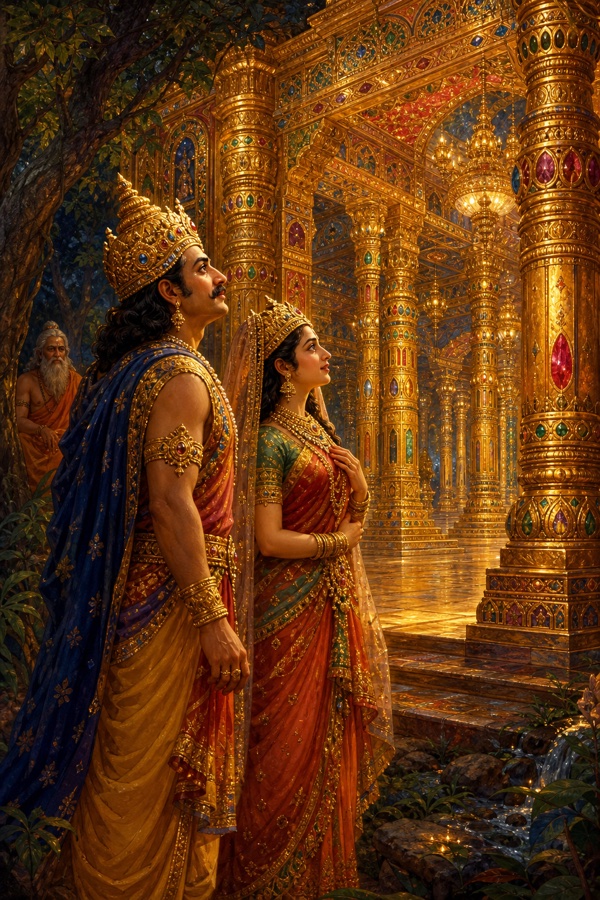
When the night had passed, King Kushika rose, performed his morning rites, and went with his wife toward the wood the rishi had chosen for his residence. There stood a palace made entirely of gold, with a thousand columns each made of gems and precious stones, like a building that belonged to the Gandharvas, and in every part of it the king saw the marks of celestial design. He saw hills with delightful valleys and lakes with lotuses on their breasts, mansions full of costly and curious things, gateways and arches, open glades and lawns carpeted with grass that lay as level as fields of gold. He saw mango trees in blossom, ketakas and uddalakas, dhavas and ashokas, kundas in flower and atimuktas; champakas and tilakas, bhavyas and jackfruit, vanjulas and karnikaras hung with flowers, varanapushpas and the creepers called ashtapadika, all clipped properly and beautifully; trees on which lotuses of every variety bloomed, and some that bore the flowers of every season at once. He saw mansions like celestial chariots or like beautiful mountains, tanks and lakes of cool water here and of warm water there, excellent seats and costly beds, bedsteads of gold and gems spread with cloths and carpets of great beauty and value, and food in enormous quantities, well dressed and ready. There were talking parrots and she-parrots, bhringarajas and cuckoos, chatapatras and koyashtikas and kukkubhas, peacocks and cocks, datyuhas and jivajivakas, chakoras and monkeys, swans and sarasas and chakravakas. Here and there were companies of rejoicing apsaras and gatherings of happy Gandharvas, and other Gandharvas elsewhere taking their pleasure with the wives they loved. Sometimes the king saw these sights and sometimes he could not see them, for they seemed to vanish before his eyes. He heard melodious singing, and the agreeable voices of preceptors lecturing their disciples on the Vedas and the scriptures, and the cackle of geese at play on the lakes.
Looking at those wonders the king began to question himself. Was this a dream? Was it an aberration of his own mind? Or was it real? Without casting off his earthly body, had he reached the beatitude of heaven? This land was either the sacred country of the Uttara-Kurus or Amaravati, the abode of the chief of the gods; what were these wonderful sights he saw? Turning it over, the king at last caught sight of the rishi. In the palace of gold with its columns of jewels and gems, the son of Bhrigu lay stretched on a costly and excellent bed. With his wife beside him the king went toward him with a delighted heart, and Chyavana vanished at once, bed and all. The king next saw him in another part of the woods, seated on a mat of kusha grass, silently reciting high mantras; by the power of his yoga the Brahmin had stupefied the king. In a moment the delightful wood, the companies of apsaras, the bands of Gandharvas, the beautiful trees, all of it was gone, and the bank of the Ganga lay as silent as it always had, covered with kusha grass and anthills.
King Kushika and his wife had seen a sight of the highest wonder and had seen it vanish, and amazement filled them. With a delighted heart the king turned to his wife. “Look at the agreeable scenes and sights we two have just witnessed,” he said, “things that occur nowhere else. All of it is the grace of Bhrigu’s son and the power of his penances. By penance one obtains everything one can imagine. Penance is higher than sovereignty over the three worlds. By penance well performed, emancipation itself can be won. Look at the power of the great and celestial rishi Chyavana, drawn from his penances; at his pleasure he can create other worlds than the ones that exist. Only Brahmins are born in this world to attain to speech and understanding and sacred acts; who else than Chyavana could do all this? A kingdom can be won with ease, and the standing of a Brahmin comes hard. It was by the power of a Brahmin that we were harnessed to a chariot like well-broken animals.”
The thoughts that passed through the king’s mind became known to Chyavana, and knowing them, the rishi called out, “Come here quickly!” The king and the queen came to the great ascetic, bent their heads, and worshiped him who deserved worship. He blessed the king, comforted him, and told him to sit on a seat. Then the son of Bhrigu, with no guile or insincerity in him of any kind, soothed the king with many soft words and said, “You have completely subdued the five organs of action and the five organs of knowledge, with the mind as their sixth, and so you have come out unscathed from the fiery ordeal I prepared for you. I have been properly honored and adored by you, my son. There is no sin in you, not even a minute one. Give me leave, for I shall now go back to the place I came from. I have been exceedingly pleased with you. Accept the boon I am ready to give.” “In your presence,” Kushika said, “I have stayed like a man standing in the middle of a fire. That I have not been consumed is enough; that alone is the highest boon I have obtained. That you are pleased with me, and that I have succeeded in rescuing my race from destruction, those are the best boons in my case, and I regard them as plain evidence of your grace. The end of my life has been accomplished; this is the whole end of my sovereignty, and the highest fruit of my penances. If you are pleased with me, then clear up some doubts that are in my mind.”
The gist: In the morning Kushika and his queen find a golden palace of a thousand jeweled columns in the wood, with lakes, flowering trees, birds, apsaras and Gandharvas, and the sound of the Veda being taught; the king asks himself whether he is dreaming or has reached heaven in his own body, and the moment he approaches the rishi on his bed the whole vision vanishes and the Ganga bank is kusha grass and anthills again. Kushika tells his wife that a kingdom is easily won and a Brahmin’s standing comes hard, and Chyavana, reading the thought, tells him he has mastered the ten organs and the mind, passed the ordeal unscathed, saved his race, and may ask a boon; Kushika asks first for his doubts to be cleared.
Chyavana’s revelation, and from Urva to Parashurama and Vishvamitra
Chyavana told him to accept a boon and to say what the doubt was; he would accomplish all his purposes. Kushika put his questions one after another. If the rishi was pleased with him, let him tell what his object had been in living in the palace for a while; the king wished to hear it. Why had he slept twenty-one days together on the bed assigned to him, without turning on his side? Why had he walked out of the room without a word? Why had he made himself invisible for no visible reason and then visible again? Why had he lain down and slept twenty-one days more? Why had he walked out after they rubbed him with oil for his bath? Why, after having every kind of food in the palace collected, had he burned it with fire? What was the reason for the sudden journey through the city on the chariot, and what object had he had in giving away so much wealth? What was his motive in showing them the wonders of the forest his yoga had created, the golden mansions, the bedsteads on posts of jewels and gems, and why had all those wonders vanished from their sight? Thinking of all those acts, the king said, he had been stunned again and again, and he could not find the sure motive behind them; he wished to hear the truth of all of it in detail.
Chyavana told him he would give the reasons for all his acts in detail, since a king who asked could not be refused. Once, in days past, when the gods were assembled, the Grandsire Brahma had said something that Chyavana heard, and he repeated it now: from a contention between Brahmin and Kshatriya energy an intermixture would occur in Chyavana’s own race, and the king’s grandson would be endowed with great energy and power. “Hearing that,” Chyavana said, “I came here resolved to exterminate your race. I came, Kushika, seeking its utter extermination, to consume all your descendants to ash. With that in mind I came to your palace and told you I would observe a vow and asked you to attend on me and serve me. And while I lived in your house I could find no fault in you. That is why you are still alive; otherwise you would by now have been numbered with the dead.”
“It was with that resolve that I slept twenty-one days,” he went on, “hoping that someone would wake me before I rose of my own accord. You and your wife did not wake me, and even then I was pleased with you. I rose from my bed and walked out of the chamber without addressing either of you, hoping that you would question me and give me the chance to curse you. I made myself invisible, showed myself again in the room of your palace, and, taking to yoga once more, slept for twenty-one days; my motive was that the two of you, worn out with toil and hunger, would grow angry with me and do something to displease me, and it was with that intention that I let hunger torment you and your wife. The slightest wrath or vexation never rose in your heart, and for that I was highly delighted with you. When I had every kind of food brought and then set fire to it, I hoped the two of you would give way to anger at the sight, and you tolerated even that. I mounted the chariot and told you to bear me with your wife, and you did as I said without the least scruple, and I was filled with delight. The gifts of wealth I made could not provoke your anger. Pleased with you, I created with the power of my yoga the forest that you and your wife saw here, and listen to what I meant by it: to gratify you and your queen I gave you a glimpse of heaven. Everything you saw in these woods was a foretaste of heaven. For a little while I let you and your wife, in your earthly bodies, look on some sights of heaven, so that you would see the power of penance and the reward that waits for righteousness.”
“The desire that rose in your heart at the sight of those delightful things is known to me,” Chyavana said. “You came to desire the status of a Brahmin and the merit of penance, setting aside the sovereignty of the earth, and the sovereignty of heaven itself. What you thought was this. The status of a Brahmin is exceedingly hard to win; having become a Brahmin, it is exceedingly hard to become a rishi; and for a rishi it is hard to become an ascetic. I tell you that your desire will be fulfilled. From you, Kushika, will spring a Brahmin who shall be called after your name. The third in descent from you will attain the status of a Brahmin. Through the energy of the Bhrigus your grandson will be an ascetic with the splendor of fire, and he will strike all men, all the inhabitants of the three worlds, with fear. I tell you the truth. Accept the boon that is now in your mind, for I shall soon set out on a tour of all the sacred waters, and time is running out.” That was a high boon in itself, Kushika said, since the rishi was pleased with him; let it happen as the rishi had said; let his grandson become a Brahmin, and let the status of Brahmin-hood attach to his race. That was the boon he asked. And he wished to ask once more, in detail: in what way would Brahmin-hood attach to his race, who would be his friend, and who would have his affection and respect?
Chyavana told him the whole circumstance for which he had come to exterminate his race. It was well known, he said, that the Kshatriyas should always have the help of the sons of Bhrigu in their sacrifices. By an irresistible decree of destiny the Kshatriyas and the Bhargavas would fall out; the Kshatriyas would slay the descendants of Bhrigu and, driven by fate, exterminate the race of Bhrigu, sparing not even the infants in their mothers’ wombs. Then in Bhrigu’s race would be born a rishi named Urva, whose splendor would equal the fire or the sun. On hearing of the extermination of his race he would cherish a wrath sufficient to consume the three worlds, able to reduce the whole earth with her mountains and forests to ash, and for a little while he would quell that fiery rage by throwing it into the mare’s mouth that wanders through the ocean. Urva would have a son named Richika, and to Richika the whole science of arms would come in embodied form, by the decree of destiny, for the extermination of the entire Kshatriya race. Receiving that science by inward light, Richika would pass it by the power of yoga to his son Jamadagni, a man of cleansed soul, who would carry that science in his mind.
“Jamadagni will wed a girl from your race,” Chyavana said, “to spread its glory. He will take for his wife the daughter of Gadhi, your granddaughter, and on her that great ascetic will beget a Brahmin son endowed with the accomplishments of a Kshatriya. And in your race will be born a son who is a Kshatriya endowed with the virtues of a Brahmin, a man of great righteousness, the son of Gadhi, known by the name of Vishvamitra, who in energy will come to be held the equal of Brihaspati himself, the preceptor of the gods. It is Richika who will grant that son to your race, a Kshatriya endowed with high penances. In this exchange of sons, a Kshatriya son in the race of Bhrigu and a Brahmin son in your race, the cause will be two women. All of it will happen at the command of the Grandsire, and it will never be otherwise. To the third in descent from you the status of a Brahmin will attach, and you shall become a relative of the Bhargavas by marriage.”
A key to reading this (the exchange of two lines): The hidden center of the tale is this exchange: in the Bhargava line, Brahmins, a son of Kshatriya nature, Rama; in the Kushika line, Kshatriyas, a son of Brahmin nature, Vishvamitra. As Chyavana lays the descent out, it runs on the Kushika side from Kushika to Gadhi to Vishvamitra, and on the Bhrigu side from Urva to Richika to Jamadagni to Rama, with Jamadagni’s marriage to Gadhi’s daughter, Kushika’s granddaughter, tying the two lines together, so that Brahmin-hood reaches Kushika’s house in the third generation and Kushika becomes kin to the Bhargavas by marriage. The cause of the exchange, Chyavana says, will be two women, and he says nothing more about them; the rest, he insists, happens at Brahma’s command.
Hearing the words of the great ascetic Chyavana, King Kushika was filled with joy and answered, “So be it!” Chyavana pressed him once more to accept a boon from him, and the king said, “Very well. From you I shall obtain the fruition of my wish: let my race be invested with the status of Brahmin-hood, and let it always set its heart on righteousness.” The ascetic granted the prayer, took leave of the king, and set out on the tour of the sacred waters he had intended. Bhishma told Yudhishthira that he had now answered his questions about how the Bhrigus and the Kushikas became connected by marriage, and that everything fell out as the rishi Chyavana had said: the birth of Rama of Bhrigu’s race, and of Vishvamitra of Kushika’s, happened in the way Chyavana had foretold.
The gist: Chyavana confesses that he came to burn the line of Kushika to its root, infants in the womb included, after hearing Brahma foretell that a clash of Brahmin and Kshatriya energy would mix his own Bhargava blood and make Kushika’s grandson a man of great power; every test was bait for a curse the king never earned. He foretells the feud in which Kshatriyas will slaughter the Bhrigus, the birth of Urva and the wrath he will sink in the ocean’s mare’s mouth, Richika and the embodied science of arms, Jamadagni’s marriage to Gadhi’s daughter and the Brahmin son of Kshatriya nature born of it, and Vishvamitra, Gadhi’s son, a Kshatriya of Brahmin nature, with two women as the cause of the exchange. Kushika asks only that his race win Brahmin-hood and hold to righteousness, and Chyavana grants it and leaves for the sacred waters.
Source: the Mahabharata of Krishna-Dwaipayana Vyasa, Anushasana Parva, Danadharma sub-parva, Sections 1 to 168; this part draws on Sections 25 to 56. The Gita Press Hindi edition is the controlling witness. The Sanskrit e-text and an independent complete translation were used to verify names, sequence, and principal events. Where recensions differ, this retelling follows Gita Press.
Source: the Mahabharata of Vyasa (Gita Press, Gorakhpur)