On this page
The fruits of austerity, of giving, and the greatness of the hero’s bed
The teaching had run for days, and the man receiving it was still not at peace. Yudhishthira sat close to the bed of arrows and told his grandfather what all the instruction so far had failed to quiet. “Hearing you, I go numb,” he said. “I think of the earth stripped of its kings, men who had everything, and my heart fills with grief. I conquered the earth. I took kingdoms by the hundred. And when I count the millions of men I have had killed, I can find no comfort anywhere. What will become of the women we widowed, the wives and mothers whose husbands and sons and maternal uncles and brothers we took from them? We killed Kurus, our own kin, our friends and well-wishers. For that we will sink into hell head downward; I have no doubt of it. I want to give my body to hard penance. Teach me how to do it.” Bhishma did not answer at once. He turned the words over with the whole of his understanding, and only then began.
“Listen to me,” he said. “What I am going to tell you is a wonder, and it is a great secret: what a creature obtains after death as the reward of each particular act or way of life. By penance a man reaches heaven. By penance he wins fame. By penance he gains length of life and every article of enjoyment. By penance he gains knowledge, learning, health and freedom from disease, beauty of body, prosperity, and blessedness, and by penance he gains wealth. By keeping the vow of silence a man brings the whole world under his sway. By giving he obtains everything that can be enjoyed. By taking the consecration of Diksha he earns birth in a good and high family. Those who live on fruits and roots alone, refusing cooked food, obtain kingdoms and sovereignty. Those who live on the leaves of plants and trees reach heaven, and so does the man who lives on water alone. Giving increases a man’s wealth. Serving his teacher with reverence earns him learning. Performing the shraddha for his ancestors every day gives him many children. Keeping Diksha on nothing but potherbs and vegetables brings him many cows. Those who live on grass and straw reach heaven. Bathing three times a day with the proper rites brings a man many wives, and drinking nothing but water wins him a home in the world of Prajapati. A Brahmin who bathes every day and recites the sacred mantras at the two twilights rises to the standing of Daksha himself. Worshiping the gods in a wilderness or a desert wins a kingdom. Casting off the body by a long fast lifts a man to heaven. One rich in penance who passes his days in yoga obtains fine beds and seats and vehicles. One who ends his body by walking into a blazing fire is honored in the world of Brahma. Those who sleep on the hard bare ground obtain houses and beds. Those who dress in rags and bark obtain fine robes and ornaments. A man who denies himself the pleasant tastes gains great prosperity, and a man who gives up meat and fish gets long-lived children. The one who lives for a time in the way called Udavasa becomes the very lord of heaven.”
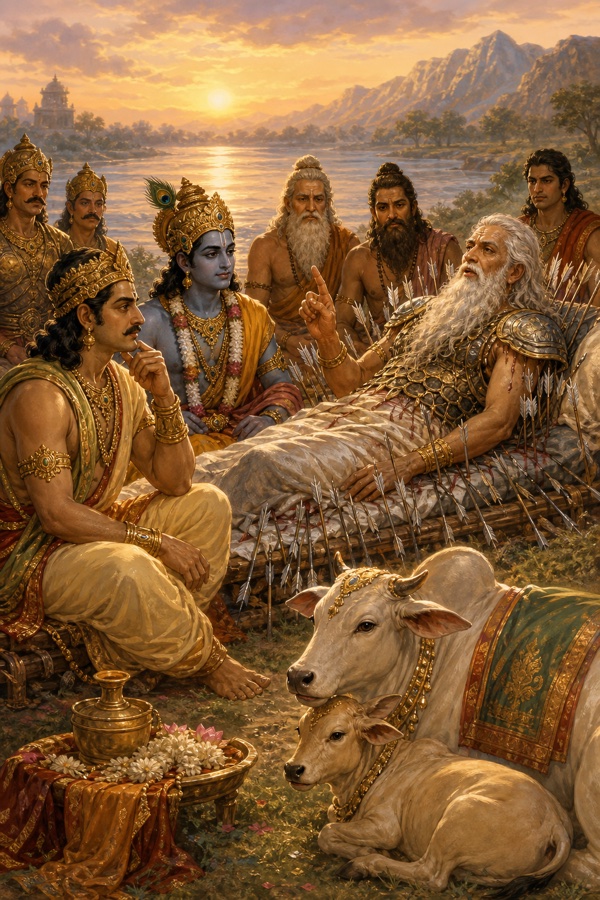
He went on, and the list turned from penance to giving. “The man who speaks the truth sports happily with the gods themselves. By giving, a man wins great fame for his high deeds. By never being cruel he wins health and freedom from disease. By serving Brahmins with reverence he wins a kingdom, sovereignty, and the high standing of a Brahmin. By giving water and other drink he wins fame that lasts. By giving food he wins every kind of enjoyable thing. The man who gives peace to every creature, who refuses to injure anything alive, goes free of every world. By serving the gods he wins a kingdom and a celestial beauty. By setting lamps in dark places where men pass, he wins good eyesight. By giving away good and beautiful things he wins a fine memory and understanding. By giving scents and garlands he wins a fame that spreads over a wide country. Those who never shave their hair and beards obtain excellent children. By keeping fasts and Diksha and baths for twelve years, as the ordinance lays it down, a man wins a world higher than the one reserved for heroes who never turn back. By giving his daughter in the Brahma form of marriage to a worthy bridegroom he obtains male and female servants, ornaments, fields, and houses. By performing sacrifices and keeping fasts he climbs to heaven. The man who gives fruits and flowers obtains auspicious knowledge. The man who gives a thousand cows with their horns sheathed in gold reaches heaven; the gods themselves said so in their assembly. The one who gives a Kapila cow with her calf, with a brass pail for her milking and her horns cased in gold and every other mark of a good cow, obtains from that cow the fulfillment of all his wishes. He lives in heaven for as many years as there are hairs on her body, and in the next world he pulls his sons and grandsons and his whole line to the seventh generation out of the misery of hell. The worlds of the Vasus open to the man who gives a cow with gold-worked horns, a brass milking jar, a cloth embroidered with gold, a measure of sesame, and a sum of money as her dakshina. When a man finds himself falling into the deep darkness of hell, held down by his own acts in this world, the gift of cows carries him out of it the way a boat with its sails full of wind carries a drowning man out of the sea. The one who gives his daughter in the Brahma form to a fit husband, or gives land to a Brahmin, or gives food to a Brahmin with the proper rites, reaches the world of Indra. The one who gives a Brahmin devoted to the Veda a house fitted with every kind of furniture lives afterward in the country of the Uttara-Kurus. Draft bullocks given away win the world of the Vasus. Gold leads to heaven, and pure gold leads higher still. An umbrella given away becomes a mansion. A pair of sandals becomes fine vehicles. Cloth becomes personal beauty, and scents make the giver a fragrant man in his next life. The one who gives a Brahmin flowers and fruits and plants and trees obtains, without effort, a mansion filled with beautiful women and wealth. The giver of food and drink of many tastes and of other enjoyable things obtains such things in plenty, and the giver of houses and cloths obtains houses and cloths; there is no doubt about it. The one who gives Brahmins garlands and incense and scents and unguents and the things a man needs after his bath is freed of every disease, made beautiful, and sports in the world reserved for great kings. The one who gives a Brahmin a house stored with grain and furnished with beds and wealth, auspicious and pleasant, obtains a palace. And the one who gives a Brahmin a good bed perfumed with fragrant scents, spread with an excellent sheet, and fitted with pillows wins, without any effort of his own, a beautiful wife of high family and agreeable ways.”
Then he came to the end of the list, and the end of it was addressed to the man in front of him. “The man who takes to a hero’s bed on the field of battle becomes the equal of the Grandsire Brahma himself. There is no end higher than this. So the great rishis have declared.” Yudhishthira, who had come to the bed asking for penances, listened to that last sentence and wanted the end reserved for heroes, and from that moment he stopped speaking of the householder’s life with disgust. He turned to his brothers, all of them near the bed, and said, “Let what our grandfather has said command your faith.” The Pandavas and Draupadi with them praised the words and answered him with one word: yes.
A key to reading this (the tawny cow and the count of hairs): The tawny cow is the Kapila, the cow the whole of the teaching holds above every other cow when it comes to a gift; where she came from, and why she outranks the rest, Bhishma tells later. The count of hairs is the measure the teaching returns to again and again: a year in heaven for every hair on the cow’s body, a span no one is asked to count, only to feel. The hero’s bed is death in battle with your face toward the enemy, and the man naming it as the highest end is lying on one. Bhishma has been on the arrows since he fell on the tenth day of the war, and he is waiting for the sun to turn north before he lets his life go.
The gist: Yudhishthira, sick with the memory of the millions he had killed and the women he had widowed, asks to be taught hard penance. Bhishma answers with the whole ledger of acts and their fruits after death: what penance earns, what silence earns, what each kind of gift earns, from a lamp in a dark place to a Kapila cow with gilded horns. The ledger ends with the hero’s bed, death in battle, which makes a man the equal of Brahma, and hearing it Yudhishthira lets go of his disgust for the householder’s life and makes his brothers and Draupadi promise to believe it.
Trees and tanks, and the supreme gift
Yudhishthira wanted to know what reward attaches to the planting of trees and the digging of tanks. Bhishma began with the ground itself. “A stretch of land that pleases the eye, fertile, set among lovely scenes, veined with metals of many kinds and alive with every sort of creature, is the best of places, and a part of such land should be chosen for the digging of a tank. I will tell you in order the kinds of tanks, and the merit that comes of digging them so that all creatures may draw water there. The man who has a tank dug earns the respect and worship of the three worlds. A tank full of water is as pleasant and as useful as the house of a friend. It gladdens the sun himself. It helps the gods to grow. Of all the things that bring a man fame it stands first, and the wise say that a tank serves all three of the great aims at once, dharma, wealth, and pleasure. A tank is well dug when it is dug on land where respectable people live; it serves all four needs of living creatures, and tanks are the beauty of a country. Gods and men, gandharvas and ancestors, serpents and rakshasas, and even the creatures that cannot move all take a tank full of water as their refuge. So hear what the great rishis have said its merits are, and what the man who has it dug obtains. If water stands in his tank through the season of rains, he reaps the merit of the daily fire offering. If it stands there in autumn, he wins the high reward of the man who gives away a thousand cows. If it stands there in the cold season, his is the merit of a sacrifice with plentiful gifts of gold, and in the season of dew, the wise say, the merit of the Agnishtoma. If water stands in a well-made tank in spring, the digger has the merit of the Atiratra sacrifice, and if it stands there through the summer, the rishis say he has the merit of a horse sacrifice. The man from whose tank cows quench their thirst and righteous men draw their water rescues his whole race. The man from whose tank cows and other animals and birds and human beings all drink has the merit of a horse sacrifice. Every measure of water drunk from his tank, and every measure taken from it for bathing, is stored up for the man who dug it, and he enjoys it in the next world for days without end. Water is hard to come by in that other world. A gift of drink produces happiness that does not end. Give sesame here. Give water. Give lamps for the lighting of dark places. And while you are alive and awake, take your pleasure with your kinsmen, because these are things you will not be able to do on the other side. The gift of drink stands above every other gift; in point of merit it is distinguished above them all. So give water. That is what the rishis have declared about the digging of tanks.”
“Now the planting of trees,” he went on. “Of things that do not move there are six classes: trees, shrubs, creepers, climbing vines, the hard-rinded plants such as bamboo, and grasses of many kinds. Hear the merit of planting them. By planting trees a man wins fame in the world of men and auspicious rewards in the world to come. He is praised and honored in the world of the ancestors, and his name does not perish even when he has become a citizen of the world of the gods. The man who plants trees rescues the ancestors and the descendants of both his lines, his father’s and his mother’s. So plant trees, Yudhishthira. The trees a man plants become his children; there is no doubt of it. Leaving this world, such a man rises to heaven, and many eternal worlds of happiness become his. Trees gladden the gods with their flowers, the ancestors with their fruit, and every guest and stranger with the shade they throw. Kinnaras and serpents and rakshasas, gods and gandharvas and human beings, and the rishis too, all take trees for their refuge. Trees that bear flowers and fruit gladden all men, and in the next world the planter is rescued by the trees he planted the way a father is rescued by his own sons. So the man who wants his own good should plant trees beside his tanks and rear them like children, because by reason and by scripture alike the trees a man plants are his children. The Brahmin who digs a tank, the man who plants trees, and the man who performs sacrifices are all honored in heaven just as men devoted to truthful speech are honored. Have tanks dug, then, and trees planted; worship the gods in many sacrifices; and speak the truth.”
Yudhishthira moved to a harder question. Of all the gifts the treatises outside the Veda name, which did his grandfather hold the most distinguished, and which gift was the one that followed a giver into the next world? Bhishma answered without hesitating. “An assurance of love and affection to every creature, and abstention from injury of every kind; kindness and favor done to a person in distress; a thing given to one who asks for it with real thirst, and given in the form he wishes; and whatever a man gives without ever afterward thinking of it as a gift he made: these are the highest and best of gifts. The gift of gold, the gift of cows, and the gift of earth are the ones called sin-cleansing; they pull the giver out of his own evil acts. Make such gifts always, and make them to the righteous, because gifts do rescue a giver from all his sins. A man who wants his gifts to be eternal should give to persons of real qualification the things everyone desires and the best things in his house. The man who gives what is agreeable and does for others what is agreeable to them always obtains what is agreeable to himself, and he becomes agreeable to everyone, here and hereafter. The man who, out of vanity, will not attend as far as his means allow to the wish of someone poor and helpless who asks him for help is a cruel wretch. The man who shows favor to even a helpless enemy who has fallen into distress and comes to him asking for help is the highest kind of man. No one equals in merit the man who satisfies the hunger of a person wasted by want, learned, without any means of support, and weakened by misery. And you should use every means in your power, Yudhishthira, to dispel the distress of righteous men faithful to their vows who, though they have neither sons nor wives and are sunk in misery, still ask no one for anything.”
That last kind of man led Bhishma to the center of the whole teaching. “Those who never pronounce blessings on gods or men in the hope of a gift, who deserve reverence, who are always content, and who live on whatever alms come to them without their asking, are snakes of deadly venom. Protect yourself from them by giving to them. They are fit to be the first of your sacrificing priests. Find them out by your spies and agents. Honor them with good houses furnished with every necessary thing, with servants and attendants, with fine robes, and with everything that contributes to ease and happiness. Righteous men of righteous deeds make such gifts because it is their duty to make them, with no wish for any reward, and they make them so that men like these will feel no reluctance to accept gifts hallowed by devotion and faith. There are men bathed in learning and bathed in vows who get their living without depending on anyone, Brahmins of rigid vows who study the Veda and practice penance without proclaiming it to a soul. Whatever you give to such men, pure in conduct, masters of their senses, content in desire with their own wedded wives, wins you a merit that will go with you into every world you enter. Gifts to such self-restrained men earn the same merit as libations properly poured on the sacred fire morning and evening. This is the sacrifice spread out for you, a sacrifice hallowed by devotion and faith and rich in dakshina, distinguished above all other sacrifices; let it flow from you without ceasing as you give. Men who do not yield to anger, who never want so much as a blade of grass that belongs to another, and whose speech is kind deserve our most reverent worship. Such men never flatter a giver and never strive for gifts, and a giver should cherish them as he cherishes his own sons. I bow my head to them. From them a man may get heaven, and from them he may get hell. Sacrificing priests and household priests and teachers become such men when they know the Vedas and deal gently with their pupils. The energy of a Kshatriya loses its force when it meets a Brahmin. Do not tell yourself that you are a king, that you have great power, that you are rich, and then enjoy your riches without giving the Brahmins anything. Keep the duties of your own order and worship the Brahmins with whatever wealth you have. Let them live as they please. Always bow your head to them. Let them rejoice in you as your children rejoice, living happily and as they wish. Who else has the means to support Brahmins whose contentment is unending, who wish you well, and who are satisfied with very little? Women have one eternal duty in this world, to depend on their husbands and serve them, and that duty is their whole end; in the same way the service of the Brahmins is our eternal duty and our end. If the Brahmins see cruelty and sin among the Kshatriyas and, unhonored by us, forsake us all, what use would life be to us, cut off from them, unable to study the Vedas, to perform sacrifices, to hope for worlds of happiness hereafter, or to do anything great at all? Hear what the ancient usage was. In the old days the Kshatriyas served the Brahmins, the Vaishyas worshiped the royal order, and the Shudras worshiped the Vaishyas. So we have heard. The Brahmin was like a blazing fire; the Shudra served him from a distance, unable to touch him or come near him, and only the Kshatriya and the Vaishya could serve him by touching his person and approaching his presence. Brahmins are mild by nature, truthful in their conduct, and followers of the true religion, and when they are angry they are snakes of deadly venom. Knowing that, serve them and wait on them with obedience and reverence. They stand above even those who stand above the high and the low, and the energy and penance of Kshatriyas who blaze with strength and might go powerless and dead when they come up against a Brahmin.” Then he swore. “My father is not dearer to me than the Brahmins. My mother is not dearer. My grandfather is not dearer, my own self is not dearer, my life itself is not dearer to me than the Brahmins are. On this earth there is nothing dearer to me than you, Yudhishthira. And the Brahmins are dearer to me than even you. I tell you the truth, and I swear by this truth, by which I hope to win every world of happiness that was Shantanu’s. I can see those holy worlds now, with Brahma shining before them. I will go there and live there for days without end, and looking at them I am filled with joy at everything I have done in the service and honor of the Brahmins.”
A sub-tale: Bhishma sets the service of Brahmins beside the one duty the old law gives a wife, faithful service of her husband, as her whole end, and says that the service of Brahmins is the Kshatriya’s duty and end in exactly that way. He then reaches back to the usage of the earliest days, when each order served the one above it: the Kshatriya served the Brahmin, the Vaishya worshiped the king, and the Shudra worshiped the Vaishya. The Brahmin of that age was held to burn like a fire on the hearth, so that the Shudra served him from a distance without touching him or coming near, and only the Kshatriya and the Vaishya could serve him with their hands and stand in his presence. Bhishma tells this as what was heard from of old, and he tells it to a king who has just won the earth and is being asked what the earth is for.
The gist: A tank that holds water through each season earns the merit of a named sacrifice, up to the horse sacrifice for summer water, and the gift of drink stands above every other gift because water is the one thing hard to find on the far side of death. Trees are the planter’s children and rescue him as sons rescue a father, so they belong beside every tank. Asked for the supreme gift, Bhishma names safety for every creature, help to the distressed, and the gift the giver forgets he made. From there he moves to the men who never ask, the venomous snakes a king must seek out with spies and feed, and he closes with an oath by the worlds of Shantanu that he loves the Brahmins more than his parents, his life, and Yudhishthira himself.
The gift to one who does not ask, the king’s dharma, and the supreme greatness of the gift of land
Yudhishthira put a case to him. Two Brahmins, equal in purity of conduct, equal in learning, equal in birth and blood, differing in one thing only: one of them asks, and the other does not. To which of the two is a gift the greater merit? “It has been said,” Bhishma answered, “that a gift to the man who does not ask brings more merit than a gift to the man who asks. A man who has contentment deserves more than a man who lacks it and is therefore helpless in the storms and blows of the world. The firmness of a Kshatriya lies in the protection he gives to others. The firmness of a Brahmin lies in his refusal to ask. A Brahmin who has steadiness and learning and contentment gladdens the gods. The wise say that for a poor man to ask is a great reproach, and that those who go about asking trouble the world the way thieves and robbers do. The one who asks is said to meet with death; the giver is said to escape it, and to give life to the one who asks, and by the act of giving to rescue his own self as well. Compassion is a very high virtue. Let people give from compassion to those who ask. Those who do not beg, and are yet sunk in poverty and distress, should be respectfully invited to accept help. If Brahmins of that kind, the first of their order, live in your kingdom, regard them as fire covered with ashes; blazing with penance, they could burn the whole earth. Men like that are not generally worshiped, and they deserve worship in every way, for their knowledge and their inner sight and their penance and their yoga. Go to them yourself, uninvited, these Brahmins who ask nothing of anyone, and give them wealth of every kind in abundance. The merit of libations properly poured on the fire morning and evening is won by the man who gives to a Brahmin of learning, of the Vedas, and of high vows. Invite those Brahmins who are cleansed by learning and Vedic study and vows, who live in independence, whose study and penance are hidden and never proclaimed from the housetop, and honor them with well-built and pleasant houses fitted with servants and robes and furniture and every article of comfort. Men of that kind, who know every duty and see finely, may accept what is offered them with devotion and respect, thinking that they should not refuse and disappoint the giver. Invite the Brahmins whose wives wait for their return the way farmers wait for rain, and when you have fed them well, give them more food to carry home, so that their wives can share it out among children who cried for food and were quieted with promises.”
Then he laid down the shape of the household day. “Students of restrained senses who eat at your house in the forenoon gladden the three sacred fires along with the householder who feeds them. Let the sacrifice of giving go forward in your house at midday, and after you have fed your guests give them cows and gold and robes. Live that way and you are certain to gladden the chief of the gods himself. That would be your third sacrifice, Yudhishthira, the one in which offerings go to the gods, the ancestors, and the Brahmins, and by it you will gladden the Vishvedevas. Let compassion for every creature, the giving to every creature of what is its due, restraint of the senses, renunciation, steadiness, and truth be the closing bath of that sacrifice made of gifts. This is the sacrifice spread out for you, hallowed by devotion and faith and carrying a great dakshina. A sacrifice made of gifts is distinguished above all other sacrifices. Perform it always.”
Yudhishthira wanted the whole ground surveyed. Where are the high rewards of gifts and sacrifices met with, here or hereafter? Which of the two is the greater? To whom should gifts go, how, and when? And what leads to the highest reward, gifts made from the sacrificial platform or gifts made away from it? Bhishma turned to the dharma of a king. “A Kshatriya is a man employed for the most part in fierce deeds, and for him sacrifices and gifts are what cleanse and sanctify. Good and righteous men do not accept the gifts of kings given to sinful acts, and that is why a king should perform sacrifices with abundant dakshina. If good and righteous men will accept what he offers, the Kshatriya should give to them without pause, with devotion and faith. Gifts bring great merit and are deeply cleansing. Keeping your vows, perform sacrifices and gladden with wealth those Brahmins who are friends to every creature, righteous, versed in the Vedas, and eminent in act, conduct, and penance. If such Brahmins refuse your gifts, no merit is yours. Perform sacrifices with generous dakshina; give good and pleasant food to the righteous; treat every act of giving as a sacrifice performed. Honor with gifts the Brahmins who perform sacrifices, and you will share in the merit of their sacrifices. Support the Brahmins who have children and who are able to send people to heaven, and you will have as large a progeny as Prajapati himself. The righteous uphold and advance every righteous act; support such men even at the cost of everything you own, and support those who do good to all creatures. You have wealth in plenty; give Brahmins cows and bullocks and food and umbrellas and robes and sandals. Give the Brahmins who sacrifice clarified butter, food, chariots and vehicles with horses harnessed to them, houses and mansions and beds. Such gifts bring the giver prosperity and are held to be pure. Search out the Brahmins who are blameless in all they do and have no means of support assigned to them, and cherish them, openly or in secret, by assigning them a livelihood. That does a Kshatriya more good than the Rajasuya and the horse sacrifice. Cleansed of sin, you are sure of heaven. Fill your treasury and do good to your kingdom, and you will win much wealth and be born a Brahmin in your next life. Protect your own means of support and of righteous action, and the means by which other people live. Support your servants as your own children. Protect the Brahmins in what they have and give them what they lack. Let your life be devoted to the Brahmins, and let it never be said that you fail to protect them. Great wealth in a Brahmin’s hands becomes a source of evil to him: constant company with riches fills him with pride and stupefies him about his real duties, and if the Brahmins are stupefied and sunk in folly, righteousness and duty perish, and when those two end, every creature is destroyed. The king who piles up wealth, hands it to his treasury officers and guards, and then begins plundering his kingdom again, telling his officers to bring him whatever they can wring from it, and who spends what he has collected in fear and cruelty on sacrifices, should know that the righteous never applaud those sacrifices. A king should sacrifice with the wealth his subjects pay willingly into his treasury out of their prosperity and their peace. Sacrifice should never be made with wealth got by harshness and extortion. When a king has given himself to the good of his people and they bathe him in showers of wealth brought gladly for the purpose, then let him perform the great sacrifices with great dakshina. A king should protect the wealth of the old, of children, of the blind, and of everyone else unable to protect his own. In a season of drought he should take nothing from people who have managed to grow grain with water drawn from wells. Nor should he take wealth from weeping women. Wealth taken from the poor and the helpless destroys a kingdom and the prosperity of its king. A king should always give the righteous all enjoyable things in plenty, and he should take away from such men every fear of going hungry.”
Bhishma said something harder then, and he said it plainly. “There are no men more sinful than those on whose food children look with longing without being able to eat it. If in your kingdom any learned Brahmin wastes with hunger like one of those children, you have incurred the sin of killing a child in the womb by allowing it. King Shibi himself said this: shame on the king in whose kingdom a Brahmin, or any man at all, goes hungry. A kingdom in which a Brahmin who has finished his studies goes hungry is overwhelmed with adversity, and the kingdom and its king are both disgraced. A king in whose kingdom women are carried off from among their husbands and sons, crying out in grief and outrage, is a dead man who still breathes. The subjects should arm themselves to kill the king who does not protect them, who only plunders their wealth, who confounds every distinction, who is never able to lead them, who has no compassion, and who is counted the most sinful of kings. The king who tells his people that he is their protector and then fails or refuses to protect them should be killed by his subjects acting together, like a dog gone mad with rabies. A fourth part of every sin his subjects commit clings to the king who does not protect them. Some authorities say the whole of it passes to him, and others say half, but bearing in mind what Manu declared, our view is that a fourth part of such sins becomes the unprotecting king’s. And the king who protects his subjects receives a fourth part of every merit they earn living under his protection. Act so, Yudhishthira, that all your subjects seek you as their refuge as long as you live, the way every creature seeks the god of rain and the way the birds of the air seek a great tree, and let your kinsmen and your friends and well-wishers seek you as their refuge the way the rakshasas seek Kubera and the gods seek Indra.”
Yudhishthira came at last to the question under all the others. People accept with affection what the Vedas declare, this is to be given and this other thing is to be given, and kings give many things to many men; what, of all gifts, is the best? “Of every kind of gift,” Bhishma said, “the gift of earth has been called the first. Earth is immovable and indestructible. To the man who owns it, it yields whatever his heart is set on: robes and vestments, jewels and gems, animals, paddy and barley. Of all creatures the giver of earth grows in prosperity forever, and for as long as the earth lasts, so long does its giver go on prospering. There is no gift higher than this one. We have heard that all men have given a little earth, and that is why all men enjoy a little of it, because in this world and the next every creature lives under the conditions its own acts have made. Earth is Prosperity herself. She is a mighty goddess, and the man who gives her away to others in this life she makes her lord in the next. The one who gives away the indestructible earth as a dakshina is born again as a man and as a lord of the earth. What a man enjoys in this life is the measure of what he gave in the last; that is the conclusion the scriptures point to. A Kshatriya should either give away the earth or throw his life away in battle; that is the highest source of a Kshatriya’s prosperity. We have heard that earth given away cleanses and hallows the giver. A man of sinful conduct, guilty even of killing a Brahmin and of falsehood, is cleansed by the gift of earth; such a gift rescues even a sinner like that from all his sins, and the righteous will take earth, and nothing else, from a king who is sinful. Like a mother, earth given away cleanses both the one who gives and the one who takes. She has an eternal and secret name, Priyadatta, and whether she is given or received, the name she loves is that one, the dear gift.”
A sub-tale: Bhishma quotes a verse that those who know the old histories sing about the gift of earth, and he says that it was on hearing this verse that Rama, the son of Jamadagni, gave away the whole earth to Kashyapa. The verse is the earth speaking: “Receive me as a gift. Give me away. By giving me away you will obtain me again.” What is given away in this life is got back in the next. The ancients, Bhishma adds, saw very little difference between the man who performs a horse sacrifice and the man who gives earth to a righteous person, and the Brahmin who recites this high declaration of the Vedas at a shraddha reaches the highest reward.
He closed the question with the earth’s own tenderness and with the powers that cannot reach her giver. “As a mother nourishes her child with the milk of her breast, so the earth feeds with every taste the man who gives her away. Death, Vaikinkara, the Rod, Yama, the fire that burns most fiercely, and every heinous and terrible sin are unable to touch the giver of earth. Whatever sins a man has committed for want of a livelihood are all washed away by the gift of only so much earth as a cowhide would cover, and by giving earth a man rescues ten generations of his father’s line and his mother’s. All the wealth a king owns belongs, in truth, to the Brahmins. A king who knows the science of duty is the first requisite of a kingdom’s prosperity, and the people whose king is unrighteous and godless can never be happy; they can neither sleep in peace nor wake in peace.”
The gist: A gift to the Brahmin who does not ask outweighs a gift to the one who does, and the king should seek out the unasking poor like fire under ash and set the sacrifice of giving running in his house at midday. Turning to the king’s own dharma, Bhishma says that sacrifice bought with extorted wealth earns nothing, that taxing drought-stricken farmers and weeping women destroys a realm, that a king who fails to protect shares a fourth of his subjects’ sins and deserves to be killed like a rabid dog, and that no sin is worse than letting a child or a learned Brahmin go hungry. The best of all gifts is earth, Priyadatta, who cleanses giver and taker like a mother, rescues ten generations, and moved Parashurama to give the whole world to Kashyapa.
The gift of land, which is first among all gifts
From the bed of arrows the grandfather was giving Yudhishthira the law of giving, and he had arrived at the gift he set above every other. “Of every kind of gift, Yudhishthira, the gift of earth is called the first. Earth does not move and cannot be destroyed. To the man who owns her she yields every excellent thing his mind desires: robes and vestments, jewels and gems, cattle, paddy, and barley. Among all creatures the giver of earth grows in prosperity forever and ever, and for as long as this earth endures, her giver goes on prospering.”
“There is no gift higher than the gift of earth. We have heard that all men have given a little earth, and because all men have given a little of her, all men enjoy a little of her, since in this world and in the next every creature lives under the conditions its own acts have made. Earth is Prosperity herself, the goddess Shri. She is a great goddess, and the man who gives her away to others in this life she makes her lord in the next birth. The man who gives away this imperishable earth as a dakshina, as the fee that closes a sacrifice or a rite of dharma, is born in his next life a man and a lord of the earth. What a man enjoys in this life is measured by what he gave in a life before it; that is where the scriptures come to rest.”
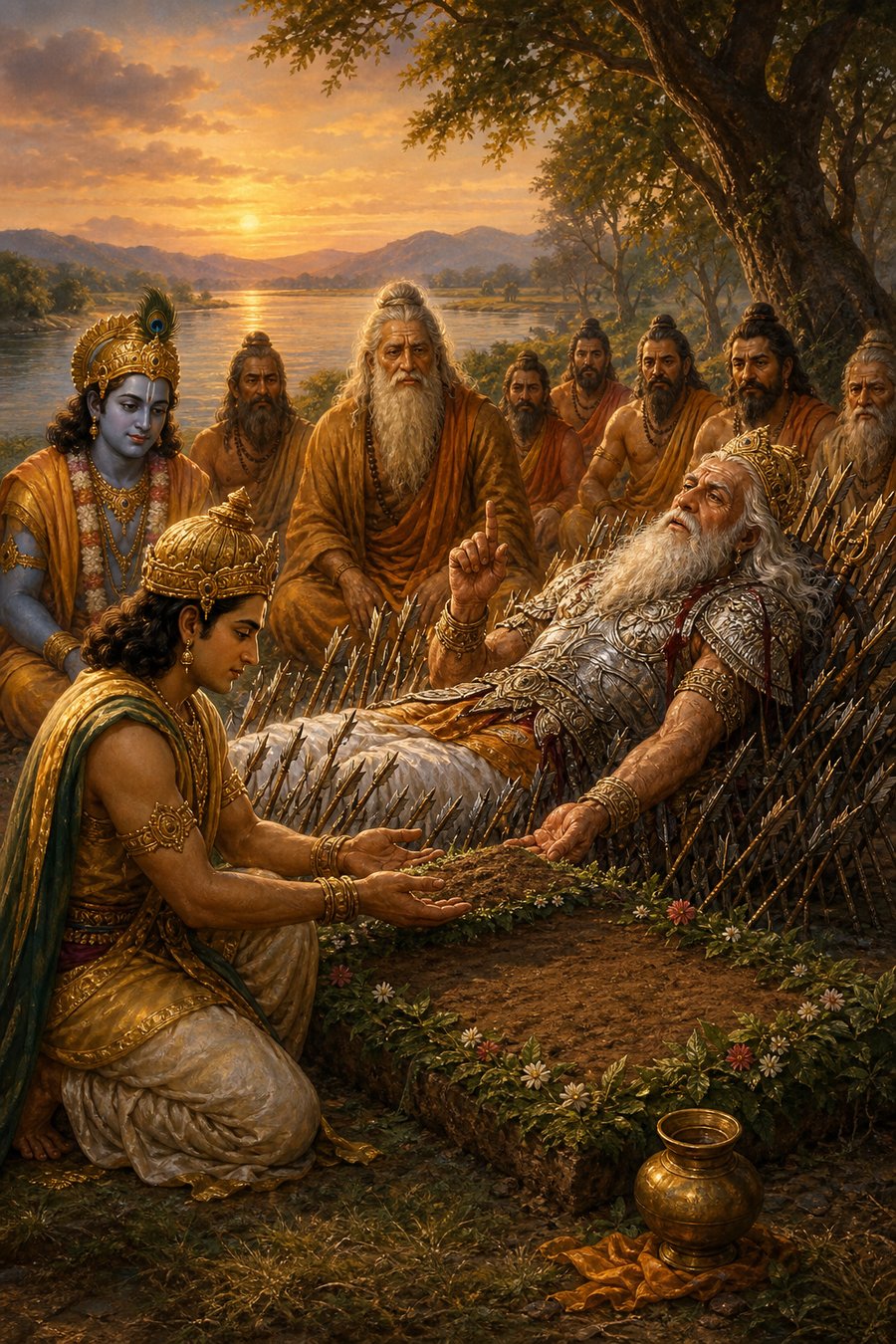
“A Kshatriya should either give away the earth or throw his life away in battle. That is the highest source of prosperity there is for a Kshatriya. We have heard that earth given away cleanses and hallows the giver. The man of sinful conduct, guilty even of killing a Brahmin and of lying, is cleansed by the gift of earth; the gift rescues even a sinner like that from all his sins. From kings who are sinful the righteous accept gifts of earth and nothing else. Like a mother, earth given away cleanses the giver and the taker both. She has an eternal and secret name, Priyadatta, given as a dear thing, and whether she is given away or accepted, the name that is dear to her is that one.”
“The king who gives earth to a learned Brahmin obtains a kingdom from that gift; born again into this world, he rises without question to a standing equal to a king’s. So a king should give earth to the Brahmins as soon as he gets it. No one who is not a lord of the earth is able to give earth, and no one who is not a worthy person should accept it; those who want earth should give it. The man who takes away earth belonging to a righteous person never gets any earth at all. By giving earth to the righteous a man gets good earth, and being of virtuous soul he wins great fame here and hereafter. When the Brahmins say of a righteous king, we live on earth he gave us, his enemies cannot utter the smallest reproach against his kingdom. Whatever sins a man commits for want of a livelihood are all washed away by the gift of only so much earth as a cowhide would cover, and kings who are mean in their acts or fierce in their deeds should be taught that the gift of earth cleanses beyond anything and is at the same time the highest gift in merit.”
“The ancients held that there was always very little difference between the man who performs the horse sacrifice and the man who gives earth to a righteous person. The learned doubt the merit of every other act of righteousness; the one act about which they hold no doubt is the gift of earth, the first of all gifts. The wise man who gives earth gives with her gold and silver and cloth and gems and pearls and precious stones. Penance, sacrifice, knowledge of the Veda, good conduct, freedom from greed, firmness in truth, and the worship of elders and teachers and gods all live in the man who gives earth. Even those who rise to the world of Brahma by giving up their lives in battle, fighting for their masters with no thought for themselves, cannot pass beyond the merit of the men who give earth.”
“As a mother always nourishes her own child with the milk of her breast, so the earth feeds with every taste the man who gives her away. Death, Vaikinkara, the Rod, Yama, the fire that burns most fiercely, and every heinous and terrible sin are unable to touch the giver of earth. The man of tranquil soul who gives earth gladdens by that act the ancestors who live in their own world and the gods who come from theirs. The man who gives earth to someone wasted and sick at heart, without any means of life and worn down by weakness, and so supplies him with a livelihood, earns the honor and the merit of performing a sacrifice. As a loving cow runs to her calf with her udder full and dripping, so the earth runs to the man who gives her away.”
“The man who gives a Brahmin earth that has been tilled, or sown, or that carries a standing crop, or a house fitted with everything needed, becomes in his next life the fulfiller of everyone’s wishes. The man who gets a Brahmin who has a livelihood, a domestic fire, and pure vows and practices to accept a gift of earth never falls into any danger or distress. As the moon waxes day by day, the merit of a gift of earth grows every time that earth brings forth a crop.”
“Those who know the old histories sing a verse about the gift of earth. When he heard that verse, Rama, the son of Jamadagni, gave away the whole earth to Kashyapa. This is the verse: receive me as a gift; give me away; by giving me away you will obtain me again. What is given away in this life is got back in the next. The Brahmin who recites this high declaration of the Vedas at a shraddha reaches the highest reward. For powerful men who have turned to the rites of the Atharvan to injure others, a gift of earth is the great expiation.”
A key to reading this: The dakshina Bhishma keeps naming is the fee that closes a sacrifice or a rite of dharma, handed at its end to the priest or to the worthy man who has been chosen to receive it; a rite without its dakshina is not finished. When he calls the earth Prosperity herself he is calling her Shri, the goddess of fortune whom the household knows better as Lakshmi. The ancestors who are gladdened by the gift are the pitris, the dead of one’s own line, who live in a world of their own and are fed with water and rice at the shraddha, and who, in this teaching, are always watching what the living do with what they own.
“By giving earth a man rescues ten generations of his father’s line and his mother’s, and the man who merely knows this Vedic declaration about the merit of the gift of earth rescues ten generations of both his lines as well. The earth is the first source of every creature, since it is from her that they all draw their sustenance, and the god of fire has been named the presiding genius of the earth. When a king has been crowned, this Vedic declaration should be recited to him, so that he will give earth and never take earth away from a righteous man. Without doubt, all the wealth a king owns belongs to the Brahmins.” And with that the grandfather brought in an old story, the conversation between Brihaspati, the teacher of the gods, and Indra, their king, whom the old tellers call by his other names too, Maghavat and Shakra and Purandara.
Having worshiped Vishnu in a hundred sacrifices, each of them famous for the plenty of its dakshina, Maghavat put a question to Brihaspati. “By what gift does a man come to heaven and reach beatitude? Tell me of the gift that bears high and inexhaustible merit.” And the teacher of the gods answered the king of a hundred sacrifices. The worlds of happiness set aside for the man who gives earth that is auspicious and rich in every taste never run out, he said; such is the merit of the gift of earth. The king who wants prosperity and wishes to win happiness for himself, should always give earth with the due rites to deserving persons. If a man who has committed sin upon sin gives earth to men of the twice-born order, he casts off all those sins the way a snake casts its slough. The man who gives earth is said to give everything: seas and rivers and mountains and forests. By giving earth he gives away lakes and tanks and wells and streams. Because of the moisture in earth, he is said to give away things of every taste. He is counted as giving herbs and plants of high and healing virtue, trees adorned with flowers and fruit, pleasant woods, and hills. The merit he wins cannot be won by even the great sacrifices, the Agnishtoma and the rest, with all their dakshina.
Brihaspati went on to the other side of the ledger. The giver of earth, he said, rescues ten generations of both his lines; the man who takes back earth that was given hurls himself into hell and throws ten generations of both his lines in after him. The man who has promised a gift of earth and does not make it, or who makes it and takes it back, passes a long time in great misery, tied in the noose of Varuna at the command of Death. Those who honor and worship the Brahmins who pour libations on their domestic fire every day, who are always engaged in sacrifice, who have scanty means of livelihood, and who receive every guest who comes to their door with hospitality, never have to go to Yama at all. A king should free himself from the debt he owes the Brahmins and protect the helpless and the weak of the other orders. He should never take back earth that another man gave to a Brahmin who has no means of life, because the tears that fall from the eyes of destitute Brahmins whose lands have been taken from them destroy the ancestors and the descendants of the man who took them, to the third generation. The man whose effort restores a king driven from his kingdom earns a home in heaven and is greatly honored there. The king who gives earth with crops standing on it, sugarcane or barley or wheat, with cows and horses and other draft cattle, earth won with the strength of his own arms, with mineral wealth in its depths and every kind of wealth on its surface, wins inexhaustible worlds of happiness in the next life; he is the king who is said to perform the earth sacrifice. A king who gives earth is washed of every sin; he is pure and approved by the righteous, and in this world he is honored and praised by all righteous men. And the merit of a gift of earth grows every time the earth given away bears a crop for its owner, the way a drop of oil that falls on water spreads out on every side until it covers the whole surface.
He described what waits for the giver. Heroic kings, the ornaments of assemblies, who throw their lives away in battle with their faces to the enemy reach the world of Brahma, and beautiful girls skilled in music and dance, wearing garlands of celestial flowers, come to meet the giver of earth as he leaves the earth and arrives in heaven. The king who gives earth with the due rites to the twice-born sports in happiness in the celestial worlds, honored the whole time by gods and gandharvas, and a hundred apsaras wearing celestial garlands come to meet him as he rises to the world of Brahma. Flowers of exquisite perfume, a fine conch and a fine seat, an umbrella, excellent horses and excellent vehicles are always ready for the man who gives earth. By giving earth a king can always command fragrant flowers and heaps of gold; possessing every kind of wealth, his orders are never disobeyed anywhere, and cries of victory hail him wherever he goes. The rewards of the gift of earth are a home in heaven, and gold and flowers and healing plants and herbs, and kusha grass and mineral wealth and green pasture, and in his next life the giver of earth receives an earth that yields nectar. There is no gift equal to the gift of earth. There is no elder worthier of respect than a mother. There is no duty higher than truth. There is no wealth more precious than wealth that has been given away. When he had heard this from the son of Angiras, Vasava gave him the whole earth, with all her jewels and gems and all her wealth of every kind. And if these verses on the merit of the gift of earth are recited at a shraddha, Bhishma said, neither rakshasas nor asuras can seize any share of the offerings, and the offerings made to the ancestors at that shraddha become inexhaustible; so at a shraddha a learned man should recite these verses in the presence and hearing of the invited Brahmins while they eat. “I have now told you of the gift that is the first of all gifts,” he said. “What else do you wish to hear?”
The gist: Earth is the first of gifts because she cannot be destroyed and yields everything, because she cleanses giver and taker like a mother, because she lifts even a Brahmin-killer out of his sins, and because a strip the size of a cowhide rescues ten generations of both a man’s lines. Brihaspati tells Indra the same truth with its dark side: to take back given earth throws ten generations into hell, a broken promise of earth ends in Varuna’s noose, and the tears of a dispossessed Brahmin destroy the taker’s line to the third generation. Indra gives Brihaspati the whole earth, and the verses are to be read aloud at every shraddha so that no rakshasa can steal the offering.
The gift of food, and the word of Narada
Yudhishthira asked what a king who wants to give in this world should give to Brahmins of real accomplishment: which gift satisfies them at once, what they give back for it, and which gifts bear fruit both here and hereafter. He wanted all of it in detail. Bhishma said that these very questions had once been his own, put long ago to Narada, the sage of celestial form who walks between the worlds, and that he would repeat what Narada had answered.
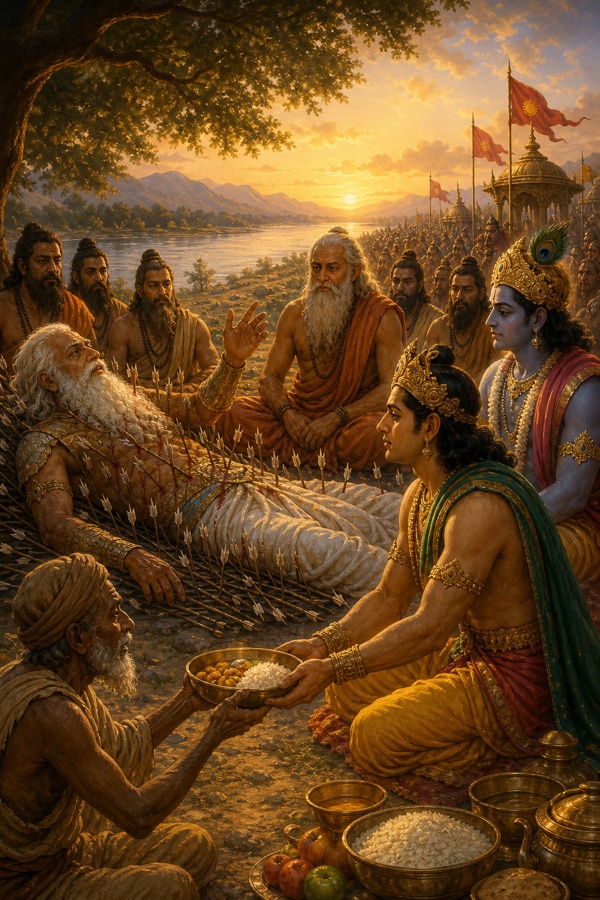
Narada had begun with food. The gods and all the rishis praise food, he said. The course of the world and the powers of the mind are all founded on it. There has never been a gift, and there never will be, equal to the gift of food, and that is why men are always so eager to give it. In this world food is the cause of energy and strength; the breath of life rests on it; it is food that holds up the wide universe. Householders, mendicants, and ascetics, every class of man, live by depending on food. So a man who wants his own prosperity should give food to a Brahmin of high character or to a man of the mendicant order, even if he has to press his own relatives to do it. The man who gives food to an accomplished Brahmin who asks for it secures for himself wealth of great value in the world to come. A householder who wants to prosper should receive with reverence the deserving old man who arrives spent with travel, far from home, and honors the house with his presence. And the man who gives food after casting off the anger that leaps every bound, righteous in disposition and free of malice, is sure of happiness here and hereafter.
The rule of the door came next. A householder should never slight the man who comes to his house, and never insult him by sending him away. Food given even to a chandala or to a dog is never lost. The man who gives clean food to a traveler on the road, worn out and unknown to him, wins great merit, and the man who satisfies with food the ancestors, the gods, the rishis, the Brahmins, and the guests who arrive at his door earns merit beyond measuring. Even a man who has committed a heinous sin, if he gives food to one who asks or to a Brahmin, is never stupefied by that sin. Food given to a Brahmin becomes inexhaustible; food given to a Shudra bears great merit; that is the whole difference between the two. When a Brahmin asks for food, no one should inquire into his family or his conduct or his learning; asked for food, a man gives food to the one who asks. The giver of food obtains here and hereafter many trees that yield food and every other thing he wants. The ancestors wait for their sons and grandsons to feed them at the shraddha the way farmers wait for a good rain. The Brahmin is a great being, and when he comes into a man’s house and says, give me, the owner of that house, whether he cares about merit or does not, wins great merit simply by hearing the words. The Brahmin is the guest of every creature in the universe and is entitled to the first portion of all food. The house to which Brahmins come hoping for alms and from which they go away honored, their wish fulfilled, grows in prosperity, and its owner is born next into a family that commands every comfort of life.
Narada went on, and the argument widened until it held the whole world. By giving food in this world a man reaches an excellent place hereafter, and the man who gives sweetmeats and every food that is sweet lives in heaven honored by all the gods. Food is the life-breath of men; everything stands on it; the giver of food obtains cattle and children and wealth and every comfort in plenty. The giver of food is called the giver of life, and indeed the giver of everything, and so he wins strength and beauty of body in this world. If food is given with the proper care to a Brahmin who arrives at the house as a guest, the giver comes to great happiness and is honored by the gods themselves, because the Brahmin is a fertile field, and whatever seed is sown in that field returns a heavy crop of merit. The gift of food is the one gift whose fruit is visible at once, in the happiness of the giver and the receiver both; every other gift bears fruit unseen. Food is the origin of all creatures. From food come happiness and delight. Dharma and wealth both flow from food, and so does the cure of disease. In a former kalpa the Lord of all creatures said that food is amrita, the source of deathlessness. Food is earth, food is heaven, food is the space between them; everything is founded on food. Without food the five elements that make up the body cannot stay joined together; without food the strength of the strongest man is seen to fail; invitations and marriages and sacrifices all stop for want of it, and when there is no food the very Vedas disappear. Every creature in the universe, moving or unmoving, depends on food, and dharma and wealth in all three worlds depend on it. So the wise give food, and the strength and energy and fame and achievements of the man who gives it grow without pause in all three worlds.
Then Narada explained where food comes from, and it was a circle. The lord of the life-breaths, the god of wind, lifts above the clouds the water that the sun has drawn up. Shakra causes that water, carried to the clouds, to be poured back on the earth. The sun with his rays sucks the moisture out of the earth, and the wind makes that moisture fall from the sun. When the water falls from the clouds, the goddess Earth grows moist, and then people sow crops of many kinds, and on what those crops yield the whole universe of creatures depends. In the food so grown is the origin of the flesh and fat and bone and the vital seed of every being, and from the vital seed spring all the many kinds of living creatures. Agni and Soma, the two agents that live inside the body, make the vital seed and keep it. Food, the sun, the wind, and the seed rise together and act together, and they are said to make up a single element, and from them every creature springs. So the man who gives food to the one who comes to his house and asks for it gives life and energy to living creatures.
A key to reading this: The twice-born are the men who have been born a second time by the rite of initiation, the thread ceremony that opens the Veda to them; Narada’s fertile field is that Brahmin. The kalpa in which Prajapati called food amrita is one of the vast cycles by which the world is made and unmade. The five elements that food holds together in the body are earth, water, fire, wind, and space, the same five that Narada’s circle of sun, wind, cloud, and soil is made of.
Bhishma took the thread back. “After Narada told me this, I have always given food. You too, free of malice and with a glad heart, give food, and by giving it with the proper rites to deserving Brahmins you may be sure of heaven. Now hear what worlds are set aside for the givers of food. The mansions of those high-minded men shine in the regions of heaven. Bright as the stars of the sky and held up on many pillars, white as the disk of the moon, hung with many tinkling bells, and rosy as the newly risen sun, those palaces stand fixed or move about, and they are filled with hundreds upon hundreds of creatures that live on land and as many that live in water. Some of them have the glow of lapis lazuli and some the blaze of the sun; some are made of silver and some of gold. Inside them are trees that grant every wish of the people who live there, and tanks and roads and halls and wells and lakes all around them, and thousands of conveyances with horses and other animals harnessed to them, their wheels always loud. There are mountains of food and of every enjoyable thing, heaps of cloth and ornaments, rivers running with milk, and hills of rice and other things to eat, and palaces like white clouds with beds of golden splendor. All of this is won by the men who give food in this world. So be a giver of food; these are the worlds reserved for the high-minded and righteous men who give food here, and for their sake men should always give it.”
The gist: Bhishma answers with Narada’s teaching on food: nothing equals its gift, because life itself and the powers of the mind rest on food, the Vedas vanish where there is none, and its fruit shows at once in the faces of giver and eater. No one at the door may be turned away, food given even to a chandala or a dog is never wasted, and the Brahmin who says give me earns the householder merit by the asking alone. Narada traces the circle of sun, wind, and rain that makes food and the seed of every creature, and Bhishma, who has given food ever since, tells Yudhishthira what the palaces of the givers of food look like in heaven.
Gifts according to the constellations, the dialogue of Devaki and Narada
Yudhishthira had heard the ordinance of food, and now he asked about the conjunction of the planets and the stars with the act of giving. Bhishma reached for another old conversation, this one between Narada and Devaki, the mother of Krishna. Once, when Narada, who knows every duty, arrived at Dwarka, Devaki asked him this very question, and the celestial rishi answered her in order, constellation by constellation.
Under Krittika, Narada told her, a man who satisfies deserving Brahmins with rice pudding cooked with ghee wins worlds of great happiness. Under Rohini, to free himself from the debt he owes the Brahmins, he should give them handfuls of venison with rice and ghee and milk and other kinds of food and drink. The man who gives a cow with her calf under the constellation whose god is Soma, Mrigashira, goes from this world of men to a world in heaven of great joy. The man who keeps a fast and gives away krisara, rice cooked with pulse and mixed with sesame, crosses every difficulty in the next world, including the mountains whose rocks are sharp as razors. Cakes and other food given under Punarvasu bring personal beauty and great fame and a next birth in a family where food is never short. Gold, wrought or unwrought, given under Pushya makes the giver shine like the moon in a world of surrounding darkness. A gift of silver or of a bull under Ashlesha frees him from every fear and brings him great wealth and prosperity.
Under Magha, earthen dishes filled with sesame bring children and cattle in this world and happiness in the next. Under Purva-Phalguni, food mixed with jaggery syrup given to Brahmins while the giver fasts is rewarded with great prosperity here and hereafter. Under Uttara-Phalguni, ghee and milk with the rice called shashtika bring great honor in heaven, and whatever gifts men make under that constellation bear a merit that becomes inexhaustible; of that there is no doubt. A chariot with four elephants, given under Hasta while the giver fasts, wins worlds of great happiness that grant every wish. A bull and good perfumes given under Chitra let the giver sport in the worlds of the apsaras the way the gods sport in the groves of Nandana. Wealth given under Svati wins whatever worlds the giver desires, and great fame besides. Under Vishakha, a bull, a cow that gives milk in plenty, a cart full of paddy with a cover over it, and cloth to wear gladden the ancestors and the gods; the giver never meets with calamity and certainly reaches heaven. And to give Brahmins whatever they ask for wins a man the livelihood he wants and rescues him from hell and from every calamity that visits a sinner after death.
Under Anuradha, embroidered cloth and other garments and food, given while fasting, bring honor in heaven for a hundred yugas. Under Jyeshtha, the potherb called kalashaka given with its roots brings great prosperity and a good end. Fruits and roots given under Mula to Brahmins, with a restrained mind, gladden the ancestors and lead to a good end. Under Purvashadha, cups filled with curds, given while fasting to a Brahmin of good family and conduct who knows the Vedas, bring a next birth in a family rich in cows. Jugs full of barley water with ghee and thickened sugarcane juice in plenty, given under Uttarashadha, grant every wish. Milk with honey and ghee, given to men of wisdom under the conjunction called Abhijit, brings a righteous man to heaven and makes him an object of honor there. Blankets or other cloth of thick weave given under Shravana let a man travel freely through every world of happiness on a white chariot of pure radiance. Under Dhanishtha, a vehicle with bulls yoked to it, or heaps of cloth and wealth, given with a restrained mind, brings heaven at once in the next life.
Under Shatabhisha, perfumes of aloe wood and sandalwood win the company of apsaras in the next world and eternal perfumes of many kinds. Rajamasha, the large bean, given under Purva-Bhadrapada brings great happiness in the next life and an abundant store of every kind of food and fruit. Mutton given under Uttara Bhadrapada gladdens the ancestors and earns inexhaustible merit. A cow given under Revati with a vessel of white copper for her milking comes to the giver in the next world ready to grant every wish. A chariot with horses yoked to it, given under Ashvini, brings a next birth in a family rich in elephants and horses and chariots, and great energy with it. And cows and sesame given to Brahmins under Bharani bring great fame and an abundance of cows in the life to come. That, Bhishma said, was what Narada told Devaki about which gifts belong to which constellations, and Devaki, having listened, taught it in her turn to her daughters-in-law, the wives of Krishna.
A key to reading this: The gifts follow the stars the moon passes through on its way around the sky, a calendar the household of Dwarka would have known the way a farmer knows the seasons; Narada runs the list from Krittika all the way around to Bharani, and every giver is expected to know under which star the day stands. One entry, Abhijit, Narada names as a conjunction, and it carries a gift of its own. Devaki hears it as the mother of a household, and she hands it on to the wives of Krishna, who will keep it.
The gist: Narada gives Devaki the whole calendar of giving, star by star, from Krittika to Bharani: rice pudding under one, venison under another, gold under Pushya, a four-elephant chariot under Hasta, mutton under Uttara Bhadrapada, a cow with a milking vessel under Revati, and with each gift the world or the birth it buys. Devaki hands the teaching on to Krishna’s wives.
The gift of gold, water, ghee, parasol, and shoes
Bhishma called the authorities one after another. Atri, the son of Brahma himself, said that those who give gold give everything in the world. King Harishchandra said that the gift of gold cleanses sin, lengthens life, and yields inexhaustible merit to the ancestors. Manu said that the gift of drink is the best of all gifts, and that a man should therefore have wells and tanks and lakes dug. A well full of water from which many creatures drink is said to take away half the sins of the man who dug it. The whole race of a man is rescued from hell and from sin if cows and Brahmins and righteous people constantly quench their thirst at his well or his tank or his lake, and the man from whose well or tank everyone draws water freely through the summer passes beyond every kind of calamity.
Ghee, he said, gladdens Brihaspati, Pushan, Bhaga, the twin Ashvins, and the god of fire. It has high medicinal virtue, it is a first requisite of sacrifice, and it is the best of all liquids, so the merit of a gift of ghee is very high. The man who wants happiness in the next world and fame and prosperity in this one should purify himself in body and mind and give ghee to the Brahmins. On the man who gives ghee to Brahmins in the month of Ashvina the twin Ashvins, pleased, confer beauty of person. Rakshasas never enter the house of the man who gives Brahmins rice pudding cooked with ghee. The man who gives Brahmins jars filled with water never dies of thirst; he has every necessity of life in plenty and never falls into distress. The man who gives to the first of Brahmins with real devotion and his senses in check is said to take a sixth part of the merit the Brahmins have won by their penances.
The man who gives Brahmins who have a livelihood firewood, for cooking and for driving off the cold, finds every purpose and every act of his crowned with success; he shines over all his enemies, the god of fire is pleased with him, he is never left without cattle, and he wins in battle. The man who gives an umbrella obtains children and great prosperity, never suffers any disease of the eyes, and gains the merits of a sacrifice besides; if he gives it in summer or in the rains he never knows heartburning on any account and is quickly freed of every difficulty. And the rishi Shandilya, Bhishma said, held that of all gifts the gift of a chariot is the best.
Yudhishthira asked about a smaller mercy: what merit is there in giving a pair of sandals to a Brahmin whose feet are burning on hot sand as he walks? “The man who gives Brahmins sandals to protect their feet,” Bhishma said, “crushes every thorn under his own feet and gets past every kind of difficulty. He stands over the heads of all his enemies. Vehicles of pure splendor, made of gold and silver and drawn by mules, come to him, and the man who gives sandals is said to earn the merit of giving a vehicle with well-broken horses yoked to it.”
The gist: Atri, Harishchandra, Manu, and Shandilya are called as witnesses: gold gives everything, water is the best of gifts and a well takes away half its digger’s sins, ghee gladdens five gods and buys beauty when given in Ashvina, and a chariot outranks all gifts. Firewood, an umbrella, and a pair of sandals for a Brahmin walking on hot sand each carry their own exact reward.
The gift of sesame, land, house, cowpen, and cow
Yudhishthira asked to hear once more, in detail, the merits of giving sesame, land, cows, and food. Bhishma began with sesame. Sesame seeds were made by the self-born Brahma as the best food for the ancestors, and so a gift of sesame gladdens the ancestors above all. The man who gives sesame to Brahmins in the month of Magha never has to visit the hell that swarms with frightful creatures. The man who worships the ancestors with offerings of sesame is counted as worshiping the gods at every sacrifice, and no one should perform a shraddha with sesame without holding some purpose in mind. Sesame sprang from the limbs of the great rishi Kashyapa, and for that reason it is held to have high power in a gift; it confers prosperity and beauty and cleanses the giver of all his sins, which is why its gift stands above the gift of every other article and is counted inexhaustible in merit. Apastamba, Shankha, Likhita, and the great rishi Gautama all rose to heaven by giving sesame. Brahmins who make offerings of sesame into the fire, who abstain from intercourse, and who follow the path of works are held equal in purity to the ghee of the cow itself. And once, in ancient times, when ghee for the oblation could not be had, the rishi Kushika offered sesame into his three sacred fires and reached an excellent end.
Then Bhishma told a short story about land. Once the gods wished to perform a sacrifice on earth and went to the self-born Brahma to beg a piece of auspicious ground, because the man who has not lawfully obtained the earth on which he builds his altar earns none of the merit of his sacrifice. “You are the lord of the whole earth and of all the gods,” they said. “With your permission we wish to sacrifice, and it is for you to grant us a piece of earth to do it on.” Brahma told the sons of Kashyapa that he would give them ground for their sacrifice, and the gods, their wish granted, undertook to perform it there with great dakshina and asked that the sages always honor the spot. Agastya and Kanva and Bhrigu and Atri came to that place, and Vrishakapi, Asita, and Devala, and the gods performed their sacrifice and completed it in due time on the breast of Himavat, the first of mountains, and attached a sixth part of its merit to the gift of the earth on which it stood.
From that story came the rules. The man who gives even a span of earth to a Brahmin with reverence and faith never languishes under difficulty and never meets calamity. The man who gives a house that keeps out cold and wind and sun, standing on clean land, reaches the world of the gods and does not fall from it even when his merit is spent; the wise man who gives a dwelling house lives in happiness in the company of Shakra and is greatly honored in heaven, and the man in whose house a Brahmin of restrained senses, learned in the Vedas and born of a family of teachers, lives in contentment wins a world of high happiness. In the same way the man who gives a shed for cows, solid in structure and proof against cold and rain, rescues seven generations of his race. Giving arable land brings excellent prosperity, and giving land with mineral wealth in it makes a family and race great. No one should ever give away earth that is barren or burnt dry, or earth close to a cremation ground, or earth that a sinful man owned and enjoyed before the gift. When a man performs a shraddha for his ancestors on earth that belongs to someone else, the ancestors make both the gift of that earth and the shraddha itself come to nothing; so a wise man should buy even a small piece of earth and give that, since the pinda offered to the ancestors on earth that was duly purchased becomes inexhaustible. Forests and mountains and rivers and holy fords are held to have no owner, and there no earth need be bought for a shraddha.
A sub-tale: Bhishma turns from land to cows by way of a river. In the old days King Rantideva performed a great sacrifice in which an immense number of cows were offered up and killed, and from the juice that ran from the hides of the slaughtered animals a river formed, and it came to be called the Charmanvati, the river of hides. Then Bhishma says the sentence that closes that age: cows are no longer animals fit for sacrifice. They are now animals fit for a gift.
Cows, he told Yudhishthira, are held above all ascetics, and that is why the divine Mahadeva performed his penance in their company. Cows live in the world of Brahma in the company of Soma, and the twice-born rishis who have won success strive for that very world as the highest end. Cows benefit men with milk and ghee and curds, with dung and hide and bone and horn and hair. They feel neither cold nor heat; they are always at work; the season of rains cannot trouble them. Because cows reach the highest end in the company of Brahmins, the wise say that cows and Brahmins are equal. The king who gives cows to the first of Brahmins gets over every calamity he falls into. The man who gives a thousand cows does not go to hell, and he wins victory wherever he goes. The chief of the gods himself said that the milk of cows is nectar, so the man who gives a cow gives nectar; those who know the Vedas have declared that ghee made from cows’ milk is the best of all libations poured on the fire, so the man who gives a cow gives a libation for sacrifice. A bull is heaven embodied, and the man who gives a bull to an accomplished Brahmin is greatly honored in heaven. Cows are called the life-breath of living creatures, so the giver of a cow gives life-breath, and those who know the Vedas call cows the great refuge of living creatures, so the giver of a cow gives the high refuge of all.
Then he set the limits. A cow must never be given for slaughter, to a man who will kill her; never to a tiller of the soil; never to an atheist; and never to a man whose occupation is the keeping of cows. The wise have said that the man who gives a cow to any such sinner sinks into everlasting hell. And a cow that is lean, or whose calves do not live, or barren, or diseased, or missing a limb, or worn out with labor should never be given to a Brahmin. The man who gives ten thousand cows reaches heaven and sports in happiness in the company of Indra, and the man who gives cows by the hundred thousand wins many worlds of happiness that never run out. Bhishma ended where Yudhishthira had asked him to, on food: Rantideva, the same king of the sacrifice, rose to heaven by gifts of food; the king who feeds a man worn out and hungry reaches the world that is the self-born’s own; gold and robes cannot buy what a giver of food reaches; food is the first of things, and from it come life and energy and strength; the man who feeds the righteous with care never falls into distress, as Parashara said; food should be offered to the gods before it is eaten, since the gods eat what their worshipers eat; a gift of food in the bright half of the month of Kartika carries a man over every difficulty here and into inexhaustible happiness hereafter; and the man who feeds a hungry guest at his door reaches the worlds reserved for the knowers of Brahman.
A key to reading this: The ghee that Kushika could not get is the havi, the offering poured on the fire, and the teaching keeps two words for what the fire carries: havya for what goes to the gods and kavya for what goes to the ancestors. The pinda that becomes inexhaustible on purchased ground is the ball of rice or barley set down for the dead at a shraddha, the food by which the living feed their line. The self-born who made sesame is Brahma, who was born of no one.
The gist: Sesame is the food Brahma made for the ancestors and the seed that sprang from Kashyapa’s limbs, and four named sages reached heaven by giving it. Land for a rite must be lawfully owned, never barren, burnt, near a burning ground, or a sinner’s, and a shraddha on another man’s earth feeds no one. The Charmanvati, a river of cowhide juice from Rantideva’s sacrifice, marks the moment cows stop being victims and become gifts, and Bhishma names exactly who may never receive a cow and which cows may never be given.
The gift of water, and the dialogue of the Brahmin and Yama
Yudhishthira had understood that the gift of food stands highest, and he asked what the great merits of giving drink were. Bhishma said the merit a man wins by giving food and drink cannot, he thought, be won by any other gift, and that there is therefore no gift higher than either. All living creatures exist by food; from food their strength and energy grow without pause; that is why the lord of all creatures himself called the gift of food a very high gift, and why Yudhishthira had already heard the blessed words of Savitri on the subject and knew the reason they were spoken and the mantras they were spoken in. A man who gives food gives life itself, and there is no gift in this world higher than the gift of life. Then Bhishma turned to water. Food may or may not stand above drink, he said, since nothing can exist without what springs from water. Soma himself, lord of all the planets, sprang from water. Amrita and sudha and svadha and milk, every kind of food, the herbs that die back each year, and the creepers, medicinal and otherwise, all spring from water, and from these flows the life-breath of every creature. The gods have nectar for their food, the nagas have sudha, the ancestors have svadha, the animals have herbs and grass, and men, the wise say, have rice and grain; and all of these spring from water. So there is nothing higher than the gift of water. The man who wants prosperity should always give drink. The gift of water wins great fame and a long life; the giver of water stands over the heads of his enemies, obtains everything he wishes, earns fame that lasts, is cleansed of every sin, and goes to heaven to an unending happiness, and Manu himself has said that such a man wins worlds of inexhaustible bliss.
Bhishma reminded him of the end that King Shibi reached in the old days by giving his own life to save a pigeon. That end, he said, is reached by the man who gives food to a Brahmin, because those who give life rise to worlds of very high happiness in the life after this; and the giver of food, in giving food, gives life.
Yudhishthira asked once more about sesame, lamps for dark places, food, and robes, and Bhishma answered with a story about a mistake made by the messenger of Death. In the country between the Ganga and the Yamuna, at the foot of the hills called Yamuna, there was a large and beautiful town of Brahmins named Parnashala, and many learned men lived there. One day Yama, the ruler of the dead, called one of his messengers, a creature dressed in black, with blood-red eyes and hair standing on end, whose feet and eyes and nose were those of a crow, and gave him an errand. “Go to the town of the Brahmins,” he said, “and bring me the man called Sharmin, of the line of Agastya. He is set on peace of mind and he is learned; he is a teacher of the Vedas and his practices are well known. Do not bring me the other man of the same line who lives in the same neighborhood. That other man is Sharmin’s equal in virtue and study and birth, and in his children and his conduct he resembles the intelligent Sharmin exactly. Bring me the one I mean. And bring him with honor, with respect shown to him, not dragged here.”
The messenger reached the town and did the exact reverse of what he had been told. He fell on the man Yama had forbidden him to touch and brought that one back. The moment Yama saw the Brahmin he stood up and worshiped him with all the proper forms, and then he told his messenger, “Take this one back, and bring me the other.” The Brahmin, hearing the great judge of the dead say so, spoke up. “I have finished my study of the Vedas and I have no attachment left to the world. Whatever remains of my mortal life I would like to pass here, in your dwelling.” Yama answered him carefully. “I cannot know the exact span that Time has fixed for any man’s life, and unless Time urges me I cannot let anyone take up residence here. My work is to take note of the righteous acts, and the other kind, that men do in the world. Go back to your house at once. And tell me what is in your mind, and what I can do for you.”
The Brahmin asked him to name the acts by which a man earns great merit, since in that matter Yama was the first authority in the three worlds. “Hear the excellent ordinances about gifts,” Yama said. “The gift of sesame is a very high one, and it produces merit that never ends. Give as much sesame as you can. A man who gives sesame every day is sure of every wish he has. The gift of sesame at a shraddha is praised. Give sesame to the Brahmins according to the rites in the scriptures. On the day of the full moon in the month of Vaishakha a man should give sesame to the Brahmins, and he should have them eat sesame and touch sesame on every occasion he can afford. Those who want what is good for them should do this in their houses with their whole hearts. Men should likewise give water, and set up resting places along the roads where drinking water is handed out. They should have tanks and lakes and wells dug; such acts are rare in the world. Always give water; it carries great merit. Build the resting places by the roads. And when a man has eaten, give him above all things water to drink.” When Yama had said this, the messenger who had carried the Brahmin from his home carried him back to it, and the Brahmin, on his return, did what he had been told. Then the messenger fetched the Sharmin whom Yama had really wanted and brought him before his master. Yama worshiped that righteous Brahmin too, talked with him a while, gave him the same instruction, and sent him home, and Sharmin, back in the world of men, did everything Yama had said.
Bhishma added what Yama praises beside water. Out of his wish to do good to the ancestors, Yama praises the gift of lamps to light dark places, so the man who gives a lamp for a dark place is counted a benefactor of the ancestors, and men should always give lamps for dark spots; the giving of lamps sharpens the sight of the gods, of the ancestors, and of the giver himself. The gift of gems is called a very high gift. A Brahmin who accepts gems and sells them to perform a sacrifice incurs no fault, and a Brahmin who accepts gems and gives them on to other Brahmins wins inexhaustible merit himself and confers inexhaustible merit on the man who first gave them; Manu, who knew every duty, said that a man of proper restraints who earns and gives gems to a Brahmin of proper restraints wins that double merit. The man content with his own wedded wife who gives robes earns a fine complexion and fine garments for himself. Bhishma said he had now told the merits of giving cows and gold and sesame as the Vedas and the scriptures teach them, and he closed with a different injunction: a man should marry and raise children on his wedded wives, since of all acquisitions the birth of a son is held the first.
A key to reading this: Sudha is the drink of the nagas, the serpent people under the earth, as amrita is the drink of the gods. Svadha is the offering the ancestors live on, and it is also the word spoken as it is poured, the way svaha is spoken when an offering goes into the fire for the gods. The resting places Yama tells the Brahmin to build are the sheds on the roads where a traveler is handed water without being asked for anything, which is why the teaching sets them beside wells and tanks.
The gist: Water outranks every gift because Soma, nectar, milk, and all food spring from it, and Shibi, who gave his life for a pigeon, shows what the giver of life earns. Yama sends for a Brahmin named Sharmin and his crow-faced messenger brings the wrong man; Yama honors him anyway, refuses him a home among the dead because Time has not sent for him, and sends him back with the ordinance of sesame on the full moon of Vaishakha, water on the roads, and lamps in dark places, then gives the true Sharmin the same teaching.
Cow, land, and knowledge, three equal gifts; the tale of King Nriga
Yudhishthira asked once more for the ordinance of gifts, and in particular for the gift of earth: a Kshatriya gives earth to a Brahmin of righteous deeds, who accepts it with the proper rites, and no one except a Kshatriya can give it; what, then, could persons of every order give if they wanted merit, and what did the Vedas say about it? Bhishma answered that there are three gifts that go by one name and bear equal merit, and all three grant every wish: cows, earth, and knowledge. The man who tells his pupil words of righteous meaning drawn from the Vedas wins the same merit as the giver of earth and cows. Cows are praised in the same breath; there is no higher object of gift, and their merit comes at once. Cows are the mothers of all creatures and bestow every kind of happiness; the man who wants prosperity should give them always. No one should kick a cow or walk through the middle of a herd. Cows are goddesses and the homes of good fortune, and they deserve worship at all times. In the old days the gods, tilling the earth on which they meant to sacrifice, used the goad on the bullocks yoked to the plow, so in tilling for that purpose a man may use the goad without sin, and in every other act bullocks should never be struck with goad or whip. When cows are grazing or lying down no one should trouble them in any way. When cows are thirsty and someone keeps them from water, they can destroy that man with all his relatives and friends by merely looking at him. What creature is more sacred than the cow, when the altars on which the ancestors are fed and the gods worshiped are cleansed with her dung? The man who, before he eats, gives every day for a year a single handful of grass to a cow that belongs to someone else is counted as keeping a vow that grants every wish; he gains children and fame and wealth and prosperity, and every evil and every bad dream is driven off.
Yudhishthira wanted the signs of a cow fit for giving and the signs of one to pass over, and the character of the man who should receive one and the man who should not. A cow must never be given, Bhishma said, to a man of unrighteous conduct, or a sinner, or a covetous man, or a liar, or a man who makes no offerings to the ancestors and the gods. The man who gives ten cows to a Brahmin learned in the Vedas, poor in worldly wealth, burdened with many children, and keeping his domestic fire reaches many worlds of great happiness. When a man performs a meritorious act with what another gave him, a share of the merit always goes to the man whose wealth made the act possible. The one who begets a person, the one who rescues him, and the one who assigns him his livelihood are counted as three fathers. Service to a teacher destroys sin; pride destroys even great fame; three children wipe out the reproach of childlessness, and ten cows wipe out the reproach of poverty. To a Brahmin devoted to the Vedanta, learned, full of wisdom, master of his senses, keeping the restraints of scripture, withdrawn from every worldly attachment, kind in speech to all creatures, who would never do an evil act even under the goad of hunger, mild, at peace, and hospitable to every guest, a man of similar conduct who has children and wives should assign a livelihood. The measure of merit in giving cows to a deserving man is exactly the measure of sin in robbing a Brahmin of what is his. Under every circumstance, the seizing of a Brahmin’s property must be shunned, and his wives kept at a distance.
A sub-tale: To show what that sin does, Bhishma tells the story the righteous tell of King Nriga. Some time before, certain young men of the Yadu race, out searching for water, came upon a large well whose mouth was covered with grass and creepers. They wanted to draw from it and worked hard to clear the growth away, and when the mouth was clean they saw, down inside, an enormous lizard, big as a hill, living in the well. They tried over and over to get it out with cords and leather tongs, and when they could not, they went to Janardana.
They told Krishna that a lizard filling the whole well could be seen down there and that all their efforts had failed to free it. Vasudeva went to the spot himself, lifted the lizard out, and asked it who it was. The lizard said that it was the soul of King Nriga, who had flourished in the old days and performed many sacrifices. Madhava said to it, “You did many righteous acts. You committed no sin. Why, then, have you come to so wretched an end? Explain what this is and how it came about. We have heard that you gave the Brahmins cows by the hundred thousand, again and again, and eight times as many after that. Why has this overtaken you?” Nriga answered, “Once a cow belonging to a Brahmin who worshiped his domestic fire every day wandered off from his house while he was away and got into my herd. My cowherds counted her into the tale of a thousand cows, and in time I gave that cow away to a Brahmin, wanting happiness in heaven. The true owner came home, searched for his lost cow, and found her at last in the house of another man.
“He said, ‘This cow is mine.’ The other man contested it, and the two of them, arguing and hot with anger, came to me. One said, ‘You gave me this cow.’ The other said, ‘You robbed me of this cow; she is mine.’ I begged the Brahmin to whom I had given her to return the gift in exchange for hundreds upon hundreds of other cows. He refused. ‘The cow I have,’ he said, ‘suits my time and my place. She gives a great deal of milk, she is very quiet, and she is fond of us. Her milk is very sweet. She is praised in my house by everyone, and she is nursing a weak child of mine who has just been weaned. I cannot give her up.’ And he went away. Then I begged the other Brahmin to take an exchange, a hundred thousand cows for this one cow. He said, ‘I do not accept gifts from men of the kingly order. I can get on without help. Give me, and waste no time about it, the very cow that was mine.’ I offered him gold and silver and horses and chariots. He would take none of it, and he went away.
“Meanwhile, under Time’s irresistible pull, I had to leave this world. I went to the world of the ancestors and was brought before the king of the dead. Yama worshiped me as I deserved and said, ‘There is no end to the merit of your deeds. But there is one small sin you committed without knowing it. Suffer its punishment now or later, as you please. When you took the throne you swore that you would protect all men in the enjoyment of what was theirs, and you did not keep that oath rigidly, and you took what belonged to a Brahmin. That is the twofold sin.’ I answered, ‘Let me undergo the misery of punishment first, and when it is over let me enjoy the happiness that is waiting for me.’ The moment I had said it, I fell to the earth. Falling, I could still hear Yama’s voice, loud, saying: Janardana, the son of Vasudeva, will rescue you, and when a full thousand years have passed and the demerit of your sin is spent, you will reach the many worlds of inexhaustible happiness that your own righteous acts have earned. I landed head downward inside this well, changed into a creature of the middle order, and my memory did not leave me. Today you have rescued me, and what does that show except the power of your penances? Give me your leave, Krishna. I want to rise to heaven.” With Krishna’s permission King Nriga bowed his head to him, mounted a celestial chariot, and went up to heaven.
When Nriga had gone, Vasudeva said a verse over the empty well. “No one should knowingly take anything that belongs to a Brahmin. A Brahmin’s property, once taken, destroys the taker the way the Brahmin’s cow destroyed King Nriga. And I tell you this too: a meeting with the good never goes for nothing. See how King Nriga was rescued from hell by meeting one who is good.” As a gift produces merit, Bhishma said, so an act of seizure produces demerit, and for that reason a man should also avoid doing any injury to cows.
A key to reading this: Nriga never intended to steal; his cowherds counted a stray into a herd of a thousand, and he gave her away hoping for heaven. Yama, weighing him, calls the fault small and unconscious and names it as two faults in one: an oath of protection sworn at his coronation and kept loosely, and a Brahmin’s property taken. Nriga chooses to pay first and enjoy later, and the price of the two small faults is a thousand years head-down in a well in the body of a lizard, with his memory left intact so that he knows the whole time who he was.
The gist: Cows, earth, and knowledge are the three gifts of equal merit that grant every wish, and Bhishma lays down who may receive a cow and who may never, closing with the rule that a Brahmin’s property must never be seized. The tale of King Nriga shows why: one stray cow given away in good faith, one loosely kept oath, and a king of countless sacrifices spends a thousand years as a lizard in a well until Krishna lifts him out and sends him to heaven.
The tale of Nachiketa, the journey to Yama’s world, and the ordinance of cow-giving
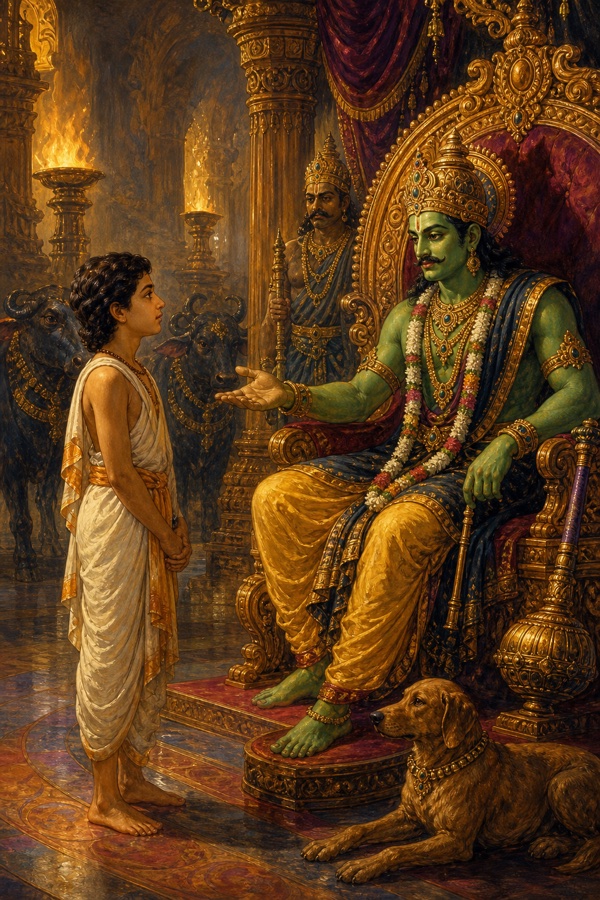
Yudhishthira said he was never sated with his grandfather’s words and asked for more on the merits of giving cows, so Bhishma told the old history of the rishi Uddalaka and his son Nachiketa. Once Uddalaka told the boy to wait on him and serve him, and when the vow he had been keeping was complete, the great rishi said to his son, “While I was bathing, and with my mind deep in my Vedic study, I forgot to bring back with me the firewood, the kusha grass, the flowers, the water jar, and the potherbs I had gathered. Go and bring them from the riverside.” Nachiketa went to the place and saw that everything had been carried off by the current. He came back and said, “I do not see the things.” Uddalaka was hungry and thirsty and tired, and in a sudden fury he cursed his son: “Meet with Yama today.”
The boy, struck by the thunderbolt of his father’s speech, joined his palms and said, “Be at peace with me.” Then he fell to the ground, and the life went out of him. When Uddalaka saw Nachiketa lying dead on the earth, grief took his senses from him; he cried out, “What have I done?” and fell down beside his son, and lamenting, he let the rest of the day pass and night come on. Then Nachiketa, drenched in his father’s tears where he lay on a mat of kusha grass, began to show signs of life, the way seeds sprout when a good rain has soaked them. Restored to consciousness, he was still weak. His body was smeared with fragrant unguents and he looked like a boy just waking from deep sleep. The rishi asked him, “Have you won auspicious worlds by your own acts? By good luck you have been given back to me. Your body does not seem to be human.”
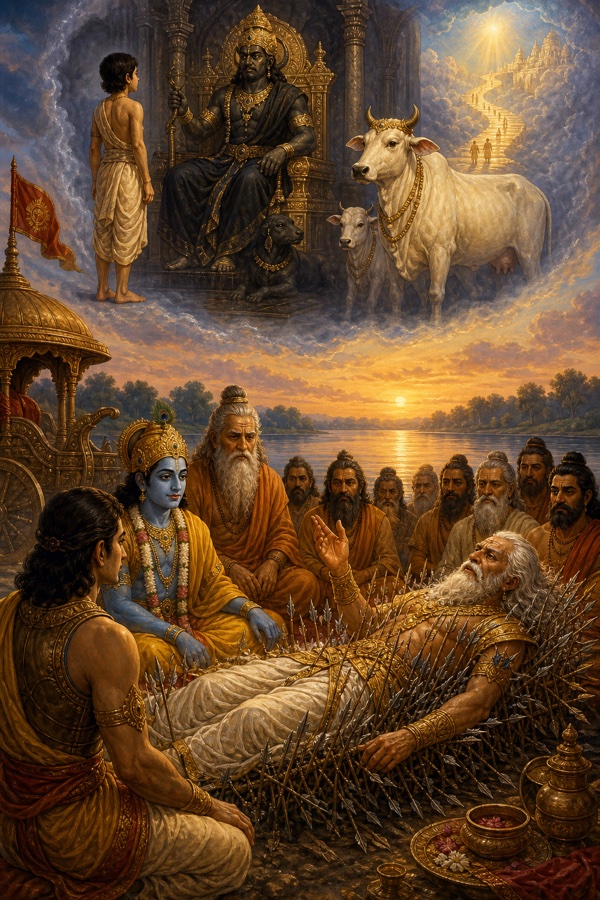
Nachiketa, who had seen everything with his own eyes, answered his father in the midst of the rishis. “Obeying your command, I went to the wide realm of Yama, which shines with a lovely radiance. There I saw a palace that stretched for thousands of yojanas and gave off a golden splendor from every part of it. As soon as Yama saw me coming toward him, he ordered his attendants to give me a good seat, and the king of the dead worshiped me himself, for your sake, with the arghya and the other offerings. Seated in the midst of his counselors, I said mildly, ‘I have come to your dwelling. Assign me the worlds I have earned by my acts.’ Yama answered me, ‘You are not dead. Your father, who is rich in penance, said to you, meet with Yama, and the energy of your father is like a blazing fire; I could not make his word false. You have seen me. Now go back. The author of your body is lamenting for you. You are my dear guest. What wish that you hold in your heart shall I grant you? Ask for whatever you desire.’
“I said, ‘I have come into your dominions, from which no traveler ever returns. If I really deserve your attention, let me see the worlds of high prosperity and happiness that are set aside for the doers of righteous deeds.’ Then Yama had me mounted on a vehicle as bright as the sun, with many excellent horses harnessed to it, and carrying me on it he showed me all the delightful worlds reserved for the righteous. I saw mansions of great radiance meant for the high-minded, of many shapes, adorned with every kind of gem, bright as the disk of the moon and hung with rows of tinkling bells, hundreds of them of many stories, with pleasant groves and woods and clear water inside them. They shone like lapis lazuli and the sun, made of silver and of gold, and their color was the color of the morning sun; some were fixed and some moved. Inside them were hills of food and enjoyable things, robes and beds in plenty, trees that grant every wish, rivers and roads and wide halls and lakes and great tanks, thousands of chariots with rattling wheels and excellent horses, rivers running with milk, hills of ghee, and great sheets of clear water. I saw many worlds I had never seen before, worlds of happiness and joy approved by the king of the dead.
“I asked the ancient and powerful judge of the dead for whose use and enjoyment these rivers with their unending currents of milk and ghee had been made. He answered me, ‘Know that these streams of milk and ghee are for the enjoyment of the righteous who make gifts in the world of men. And there are other eternal worlds, filled with mansions free of sorrow of every kind, that are reserved for those who give cows. The mere gift of a cow is not worthy of praise. There is the question of whether the man to receive her is fit, of the right time, of the kind of cow, and of the rites to be observed. Cows should be given only after the qualifications of both the Brahmin who receives and the cow that is given have been examined. Cows should not be given to a man in whose house they are likely to suffer from fire or from the sun. A Brahmin who knows the Vedas, whose penance is austere, and who performs sacrifices is fit to receive them. Cows rescued from a distressed situation, or given by poor householders who could not feed and keep them, are for those reasons counted of high value. Living on water alone for three nights, sleeping the while on the bare ground, and having properly fed the cows he means to give, a man should give them to Brahmins after satisfying the Brahmins with other gifts as well. The cows should be given with their calves, they should be cows that bring forth good calves in season, and other articles should go with them; and when the gift is made, the giver should live for three days on milk alone. The man who gives a cow that is not vicious, that calves well and at proper intervals, and that does not run away from her owner’s house, and gives with her a vessel of white brass for her milking, enjoys the happiness of heaven for as many years as there are hairs on her body. The man who gives a Brahmin a bull that is well broken, able to bear burdens, strong and young, disinclined to mischief, large, and full of energy, enjoys the worlds reserved for the givers of cows. The fit receiver of a cow is the man known to be mild toward cows, who takes cows for his refuge, who is grateful, and who has no livelihood assigned to him. When an old man falls ill, when a Brahmin means to perform a sacrifice, when a man needs to till his fields, when a son is born to him by the power of a homa performed for the purpose, for the use of one’s teacher, or for the feeding of a child born in the usual way, a man should give away a cow he loves; these are the occasions of place and time the ordinance praises. The cows fit to be given are those that yield milk in plenty, those known for their docility and other virtues, those bought for a price, those received as a fee for teaching, those got in exchange for other living creatures such as sheep and goats, those won by strength of arms, and those received as a dowry from the wife’s father and kin.’
“When I had heard this from Vaivasvata, I asked him one more thing: what can a man give, when cows cannot be had, and still go to the worlds reserved for the givers of cows? And the wise Yama explained. In the absence of cows, a man who gives what has been declared the substitute of a cow wins the merit of giving one. If a man gives a cow made of ghee, keeping a vow the while, these rivers of ghee become his to use, and they come to him the way a loving mother comes to her child. If even a cow of ghee cannot be had and he gives a cow made of sesame seeds, keeping a vow the while, that cow helps him over every calamity in this world and gives him great happiness hereafter from these rivers of milk. And if there is no cow of sesame and he gives a cow made of water, he comes to these happy worlds and enjoys this river of cool clear water that grants every wish. The king of the dead explained all this to me while I was his guest, and I felt great joy at the wonders he showed me. Now I will tell you what will please you. I have found a great sacrifice that needs no great wealth to perform, the sacrifice made of the gift of cows; it will flow from me, and others will obtain it too, and it is in no way against the ordinances of the Vedas. The curse you spoke over me has turned into a blessing, since it let me see the great king of the dead and learn what rewards attach to gifts. From this day I will practice the duty of giving without one doubt in my mind about its fruit. And Yama, full of joy, told me again and again: the man who has won purity of mind by frequent giving should then give cows above all; this whole matter of gifts is holy; never disregard it; give to deserving persons when time and place are right; give cows always and hold no doubt about it. Many high-minded men in the old days, afraid of severe penance, gave cows according to their means, cast off pride and vanity in time, purified their souls, performed the shraddhas for their ancestors and every righteous act, and reached heaven, where they shine. On the eighth day of the moon called Kamyashtami a man should give cows lawfully won to Brahmins whose fitness he has examined, and afterward live for ten days on the milk of cows and their dung and their urine, taking nothing else. The gift of a bull equals the divine vow; the gift of a pair of cows brings mastery of the Vedas; the gift of chariots and vehicles with cows yoked to them equals bathing in the sacred waters; the gift of one Kapila cow lawfully won cleanses every sin a man has committed. Nothing tastes higher than the milk of cows; by their milk cows rescue all the worlds, and it is cows that produce the food creatures live on, and the man who knows the extent of their service and holds no affection for them in his heart is a sinner certain to sink in hell. Whether a man gives a thousand cows or a hundred or ten or five, if he gives a righteous Brahmin even one cow that calves well and in season, he will see her come to him in heaven as a river of sacred water granting every wish. In the growth and prosperity they confer and the protection they give to every creature on earth, cows are equal to the rays of the sun; the word for the cow is also the word for those rays, and the giver of a cow becomes the father of a race that spreads over the earth and shines like a second sun. In the giving of cows a pupil should choose his teacher, since choosing a teacher is the first ordinance on which all the others rest, and after examining the Brahmins he should choose a fit one, give him a cow lawfully won, and see that he accepts it; and the gods and men and we ourselves, wishing others well, say: let the merit of gifts be yours in return for your righteousness. So the judge of the dead spoke to me. I bowed my head to the righteous Yama, took his leave, and came from his dominions to the soles of your feet.”
A key to reading this: Nachiketa is the boy of the Katha Upanishad, sent to Death by his father’s angry word and received there as a guest; that text has Yama teach him the knowledge of the self, and this one has Yama teach him the ordinance of the cow, with the same courtesy and the same offer of a boon. The tawny cow whose single gift cleanses every sin is the Kapila. A yojana is the old measure of a long journey, and a palace of thousands of them is the size the boy is trying to convey to a father who has just watched him die.
The gist: Cursed to Yama by a father exhausted from his bath and his study, Nachiketa dies, revives under his father’s tears, and reports what he saw: Yama’s golden palace, the mansions and rivers of milk and ghee reserved for givers of cows, and the whole ordinance of giving them, from the three nights on water and the milking vessel to the cow of ghee, sesame, or water that stands in for a real one. He comes home calling the curse a blessing and takes up the gift of cows as his sacrifice.
The nature of the world of cows, and the fruit of cow-giving by order
Yudhishthira said that he had now heard the gift of cows praised through Nachiketa and had heard how a single fault kept Nriga a lizard at Dvaravati for so long until Krishna rescued him, and that one doubt remained: he wanted to hear in detail about the worlds set aside for those who give cows. Bhishma reached for the old conversation between the one born from the first lotus and the one who performed a hundred sacrifices. Shakra had said, “I see that those who live in the worlds of cows surpass in radiance the prosperity of the dwellers of heaven and pass them by as beings of a lower station. That has raised a doubt in me. What are the worlds of cows like? What do they yield? What is the highest thing their people win there? How do men, freed from every anxiety, reach them? For how long does a giver of cows enjoy the fruit of his gift? How does a man who gives many cows become the equal of one who gave few, and the giver of few the equal of the giver of many? How does a man become a giver of cows without giving any cow at all? And what dakshina stands first in the giving of cows? Tell me all of it truly.”
Brahma answered that no one else in the three worlds could have put those questions. There are many kinds of worlds, he said, invisible even to Indra; Brahma himself sees them, and so do women who are chaste and have kept to one husband, and rishis of excellent vows and Brahmins of righteous soul reach them in their bodies of flesh, and men of excellent vows see them, bright as the creations of dreams, with cleansed minds in the release that follows the loss of bodily consciousness. In those worlds the course of Time itself is suspended. There is no old age there, and no fire, which is present everywhere else in the universe; there the smallest evil does not occur, nor disease, nor weakness of any kind. The cows that live there obtain every wish their hearts hold; able to go anywhere at will, they enjoy wish after wish as it rises in them. Lakes and tanks and rivers and forests of many kinds, mansions and hills, and every delightful thing that any creature could find delightful are there, and there is no world of happiness higher than these. The men who reach them are those who forgive every creature, who endure everything, who are full of affection for all things, who obey their teachers, and who are free of pride and vanity; the man who abstains from every kind of flesh, whose heart is cleansed, who worships his parents, whose speech and conduct are true, who waits on the Brahmins with obedience, who is never angry at cows or at Brahmins, who serves his teachers, who is devoted his whole life to truth and to gifts, who forgives every wrong done him, mild and self-restrained, reverent to the gods, hospitable to every guest, and full of compassion, reaches the eternal and unchanging world of cows.
And the man stained with adultery never sees it; nor the slayer of his teacher, nor the liar and idle boaster, nor the man always quarreling, nor the man hostile to Brahmins, nor the one who injures his friends, nor the man of guile, the ingrate, the cheat, the crooked, the despiser of religion, or the killer of a Brahmin. Men like these cannot see the world of cows even in imagination.
Then Brahma set out the merit of giving. The man who gives cows he has bought with inherited wealth or wealth lawfully earned wins many worlds of inexhaustible happiness. The man who gives a cow bought with money won at dice enjoys happiness for ten thousand years by the measure of the gods. A cow that comes as a man’s share of the family wealth is lawfully his and may be given, and those who give cows so acquired win many eternal worlds. The man who receives a cow as a gift and gives her on again with a pure heart wins eternal worlds too. If a man devoted to truth gives a single cow, that one cow becomes equal to a thousand. If a Kshatriya of such virtue gives a single cow, his merit equals a Brahmin’s, since the one cow such a Kshatriya gives bears as much merit as the one cow a Brahmin gives in the same circumstances; that is the settled conclusion of the scriptures. A Vaishya of the same virtue who gives one cow earns the merit of five hundred, and a Shudra endowed with humility who gives one cow earns the merit of a hundred and twenty-five. The man devoted to penance and truth, made proficient by serving his teacher, forgiving, at peace, pure in body and mind, enlightened, free of every egotism, who gives a Brahmin a cow rich in milk with the proper rites, wins great merit by the act. The man who studies the Vedas, reveres cows, is glad whenever he sees them, and has bowed his head to them since birth wins the merit of a Rajasuya and of heaps of gold given away. The man who for a whole year presents food to cows before he eats wins the merit of a thousand cows given; the man who takes one meal a day and gives the other whole to cows enjoys ten years of unbroken happiness; and the man who saves the second meal, buys a cow with what he saved, and gives her to a Brahmin earns the eternal merit of as many cows as she has hairs. A Kshatriya who buys a cow in that way and gives her wins great happiness for five years; a Vaishya wins half a Kshatriya’s merit, and a Shudra half a Vaishya’s. The man who sells himself and buys cows with the price and gives them to Brahmins enjoys heaven for as long as cows are seen on the earth, since in every hair of a cow bought with the price of oneself there is a world of inexhaustible happiness, and the man who wins cows in battle and gives them earns the same. The man who, having no cow, gives a cow made of sesame seeds with his senses restrained is rescued by that cow from every calamity and sports in great happiness. Brahma repeated what Yama had told Nachiketa: the bare gift is no merit; the fit receiver, the time, the kind of cow, and the rite must all be weighed; cows are not to go where fire or sun will hurt them; the receiver should be rich in Vedic lore, of pure lineage, tranquil, given to sacrifice, afraid of sin, learned, compassionate toward cows, mild, a protector of those who seek him, and without an assigned livelihood; the occasions are a Brahmin without means or starving in famine, tillage, a son born by a homa, the teacher’s use, and a child’s feeding; the cows are those of known disposition, received as a fee for knowledge, bought in exchange for goats and sheep, won by arms, got as dowry, rescued from danger, or handed over for keeping by a poor owner; and the cows praised are those strong of body, good of disposition, and sweet in their smell. As the Ganga is the first of rivers, he said, so a Kapila cow is the first of all cows. After three nights on water and three nights on the bare ground the giver should give cows free of every vice, with healthy unweaned calves, after gladdening the Brahmins with other presents, and then live three days on the products of the cow alone. The gift of a good cow, one that lets herself be milked quietly, calves living and healthy calves, and does not run off, earns happiness in the next world for as many years as she has hairs, and the gift of a strong young docile bull that bears heavy burdens and takes the yoke of the plow quietly earns the worlds of the man who gives ten cows. The man who rescues cows and Brahmins from danger in the wilderness is rescued from every calamity; his merit equals the eternal merit of a horse sacrifice; he reaches whatever end he desires at the hour of death, and, permitted by the cows, lives honored in every world of happiness.
Brahma ended with the herdsman. The man who follows cows through the woods every day, living himself on grass and cow dung and the leaves of trees, his heart free of any wish for reward, his senses held back from every improper thing, and his mind cleansed of dross, lives in joy, freed from the rule of desire, in my world or in any other world of happiness he chooses, in the company of the gods.
A key to reading this: The world of cows Brahma describes stands above the heaven of the gods, and Indra’s question is the envy of a king who has seen his own subjects outshone; Time does not run there, and neither fire nor age nor sickness has entry. Brahma’s scale of merit, in which one cow from a truthful man counts as a thousand and the same cow from a Vaishya or a Shudra as five hundred or a hundred and twenty-five, measures the gift by the giver’s order and by the virtue the ordinance asks of him, and it sits beside a second scale in which the poorest giver of all, the man who sells himself to buy a cow, outranks everyone.
The gist: Indra, envious of the radiance of those who live in the worlds of cows, asks Brahma what those worlds are, and Brahma describes a place beyond Time, fire, and age that only the forgiving, the truthful, and the obedient reach and that the adulterer, the teacher-killer, and the ingrate cannot see even in imagination. He then grades the gift: one cow from a truthful man equals a thousand, a Kshatriya’s cow equals a Brahmin’s, a Vaishya’s five hundred, a Shudra’s a hundred and twenty-five, and the cow bought with the price of one’s own self holds a world of happiness in every hair.
The fruit of cow-theft, gold as the dakshina, and the mantra-ordinance of cow-giving
Indra had one more question for Brahma: what end waits for the man who knowingly steals a cow, or sells one out of greed? Brahma told him what overtakes those who steal a cow to kill her for food, or to sell her for money, or even to give her to a Brahmin. The man who, unchecked by scripture, sells a cow or kills one or eats her flesh, and those who for money let someone kill cows, all of them, the one who kills, the one who eats, and the one who permits the killing, rot in hell for as many years as there are hairs on the body of the cow that was killed. The faults that attach to obstructing a Brahmin’s sacrifice attach to the sale and the theft of cows. And the man who steals a cow and gives her to a Brahmin enjoys happiness in heaven as the reward of the gift and suffers misery in hell for the theft for exactly as long.
Gold, Brahma said, is the dakshina in the gift of cows, and gold is the best dakshina in every sacrifice. By giving cows a man rescues his ancestors to the seventh generation and his descendants to the seventh; by giving cows with a dakshina of gold he rescues twice that number on either side. The gift of gold is the best of gifts and gold is the best dakshina; gold is a great cleanser, the best of all cleansing things, and it has been said to sanctify the entire race of the man who gives it away. That, in brief, was Brahma’s word on dakshina.
Bhishma traced the road the teaching had traveled to reach the bed of arrows. Brahma said it to Indra. Indra gave it to Dasharatha, and Dasharatha to his son Rama, and Rama of Raghu’s line to his dear brother Lakshmana, and Lakshmana, while they lived in the forest, gave it to the rishis. From there it came down from generation to generation, held among the rishis of rigid vows and the righteous kings of the earth, until Bhishma’s own teacher gave it to him. The Brahmin who recites it every day, in assemblies of Brahmins, at sacrifices, at gifts of cows, or when two men meet together, wins many worlds of inexhaustible happiness hereafter and lives there with the gods for his companions.
Yudhishthira asked to hear in detail the high ordinance that governs the gift of cows, since it is by giving according to the ordinance that a man wins the countless worlds of eternal happiness. There is no gift higher in merit than the gift of cows, Bhishma said; a cow lawfully acquired and given away rescues the giver’s whole race at once, and the rite that sprang up for the good of the righteous and was afterward declared for the sake of all creatures has come down from the first age and existed before it was ever declared. Long ago, when a number of cows meant for giving were brought before him, King Mandhata was unsure of the rite he should observe in giving them, and he put his doubt properly to Brihaspati, the teacher of the gods. Brihaspati told him that the giver, keeping the restraints, should on the day before honor the Brahmins and fix the time of the gift. The cows should be of the class called Rohini, and they should be addressed by the words Samange and Vahule. Entering the fold where they are kept, the giver should say the words of the Shruti: the cow is my mother, the bull is my father, give me heaven and prosperity on earth, the cow is my refuge. He should pass the night in the fold, and say the words again at the moment of giving. Living there with the cows without doing anything to restrain their freedom, lying on the bare earth and leaving alone the gnats and insects that trouble him as they trouble the cows, he is cleansed at once of all his sins by making himself exactly like them.
When the sun rises, Brihaspati said, give the cow, with her calf and a bull, and heaven will be yours, and with it the blessings the mantras name. The mantras say this of cows: they hold the elements of strength and vigorous effort; they hold the elements of wisdom; they are the source of the immortality that sacrifice wins; they are the refuge of all energy, the steps by which prosperity on earth is climbed, the eternal course of the universe, the extenders of a man’s race. Let the cows I give destroy my sins; they have in them the nature of both Surya and Soma; let them help me to heaven; let them come to me as a mother comes to her child; and let every other blessing the mantras do not name be mine as well. Then the giver says: you cows are always the carriers of every kind of merit; be pleased with me and appoint me a good end; today I have become what you are; by giving you away I truly give myself away. And the receiver, who knows the rite, answers: you are no longer owned by the man who gives you; you have become mine; having the nature of both Surya and Soma, make the giver and the receiver both blaze with prosperity of every kind. In the curing of wasting diseases and in the freeing of the soul from the body, if a man takes the help of the five products of the cow, the cows incline to bless him the way the river Sarasvati blesses.
Bhishma gave the ordinance of the substitute too. The man who gives the usual value of a cow, or cloth, or gold in her place is counted a giver of cows. Giving her value he says, this cow with her face turned up is given, accept her; giving cloth he says the one word Bhavitavya, meaning that the gift is to be taken as the cow; giving gold he says Vaishnavi, meaning that the gold has the form and nature of the cow. The reward of these vicarious gifts is a home in heaven for thirty-six thousand years, eight thousand years, and twenty thousand years respectively. The man who gives an actual cow has all the merit of the vicarious gifts before the receiver has taken his eighth step homeward. The giver of a real cow becomes righteous in his conduct in this world; the giver of her value is freed of every fear; the giver of a substitute for her never meets with sorrow; and all three of them, along with those who perform their ablutions and other rites at early dawn and the man who knows the Mahabharata well, reach the worlds of Vishnu and Soma. Having given a cow, the giver keeps the vow of the cow for three nights and passes one night among cows, and from the eighth day of the moon called Kamya he spends three nights living wholly on the milk and urine and dung of the cow. The gift of a bull earns the merit of the divine vow of chastity, and the gift of a pair of cows brings mastery of the Vedas. The man who sacrifices and gives cows by the rite reaches many high worlds that the man who gives without knowing the rite cannot reach; the man who gives even one cow rich in milk earns the merit of giving every desirable thing on earth gathered together, and what, then, of many cows whose full udders yield the havya and the kavya; and the gift of superior oxen carries more merit than the gift of cows.
Then came a warning about the ordinance itself. It should never be taught to anyone who is not one’s pupil, who keeps no vows, who has no faith, or whose understanding is crooked, because this religion is a mystery unknown to most people and the man who knows it should not speak of it everywhere; there are many men without faith in the world, and many who are mean and resemble rakshasas, and taught to them, or to the sinful who have taken shelter in atheism, it would lead to evil. Bhishma named the righteous kings who reached worlds of great happiness by giving cows as Brihaspati had instructed: Ushinara, Vishvagashva, Nriga, Bhagiratha, the famous Mandhata son of Yuvanashva, King Muchukunda, Bhagiratha again, Naishadha, Somaka, Pururavas, Bharata of imperial sway to whose race all the Bharatas belong, the heroic Rama son of Dasharatha, many other famous kings of great deeds, and King Dilipa of widely known works. Mandhata kept sacrifices, gifts, penance, the duties of a king, and the gift of cows all his life, and Bhishma told Yudhishthira to hold Brihaspati’s instruction in mind and, now that the Kuru kingdom was his, to give good cows to the first of Brahmins with a glad heart. Yudhishthira did all that Bhishma wished. He kept in mind the whole religion that the teacher of the gods had given to Mandhata, began from that day to give cows always and to live on grains of barley and on cow dung as his food and drink, slept from that day on the bare ground, and, restrained in soul and like a bull in his bearing, became the first of kings. He grew attentive to cows, worshiped them, and sang their praises; and from that day he gave up yoking cows to his vehicles and went wherever he had to go in chariots drawn by spirited horses.
A key to reading this: The chain Bhishma recites runs from Brahma to Indra and then through Dasharatha, Rama, and Lakshmana in the forest before it reaches the rishis and, through his own teacher, the bed of arrows; the ordinance of the cow arrives at Kurukshetra by way of Ayodhya. The cows the rite asks for are of the class the ordinance calls Rohini, addressed by two names of their own, Samange and Vahule, and the substitutes are ranked so that a real cow outstrips the whole of their merit before the receiver has walked eight steps home, while the price, the cloth, or the gold remain open roads for a man who has no cow to give.
The gist: Brahma tells Indra that killer, eater, and permitter of a cow’s slaughter rot in hell for as many years as she had hairs, that a stolen cow given away earns heaven and hell in equal measure, and that gold is the dakshina of the cow-gift and the best dakshina of all. Bhishma traces the teaching from Brahma through Rama and Lakshmana to his own teacher, then gives Brihaspati’s rite to Mandhata: the night in the fold among the insects, the mantras of giver and receiver at sunrise, the substitutes of price, cloth, and gold, and the kings who kept it. Yudhishthira takes it up at once, down to barley and cow dung and a bed on the ground.
Which cow to give and which not; the origin of the Kapila cow and the glance of Mahadeva
Yudhishthira, who said he could not be sated with his grandfather’s words on the gift of cows, asked to hear its merits once more, and Bhishma began with the cow herself. By giving a Brahmin a cow with her calf, docile and full of good qualities, young, and wrapped in a piece of cloth, a man is cleansed of all his sins, and there are many sunless regions in hell that the giver of a cow never has to enter. The man who gives a Brahmin a cow that can no longer drink or eat, whose milk has dried up, whose senses have all weakened, diseased and overcome with age, a cow like a tank whose water has dried away, gives that Brahmin nothing except pain and disappointment, and he goes into the dark hell for certain. A cow that is angry and vicious, or diseased, or weak, or bought without the agreed price being paid, or that would only bring the Brahmin who received her distress, should never be given; the worlds such a giver may have earned by his other acts will give him no happiness and no energy. Only cows that are strong, well-behaved, young, and sweet-smelling are praised in the matter of gifts. And as the Ganga is the first of rivers, the Kapila cow is the first of cows.
That last sentence stopped Yudhishthira. Why, he asked, do the righteous praise the gift of a Kapila cow above the rest, when every good cow given away ought to count the same? He wanted to know what set her apart. Bhishma said he had heard old men tell the story of how the Kapila cow was made, and he told it.
A sub-tale: In the beginning the self-born Brahma commanded the rishi Daksha to create living creatures. Out of care for the creatures he was about to make, Daksha created food first, since as the gods live by depending on nectar, all living things would live on the sustenance Daksha assigned them; of everything that moves and does not move, the moving are higher, and among moving creatures the Brahmins are highest, and on them the sacrifices rest, and by sacrifice the nectar Soma is won, and sacrifice itself is founded on cows. So the means of support came first and the creatures came after. As soon as they were born they cried aloud for food and ran to their maker the way children run to a father or a mother. Daksha knew what moved them, and for the sake of the beings he had made he himself drank a quantity of nectar. It satisfied him, and he belched, and the belch spread an excellent fragrance on every side, and Daksha saw that it had given birth to a cow. He named her Surabhi. She was his daughter, sprung from his mouth.
Surabhi brought forth many daughters, and they came to be called the mothers of the world. Their color was the color of gold, and they were all Kapilas, and they were the means by which every creature was fed. When those cows, whose color was the color of nectar, began to give milk, the froth of it rose and spread on every side the way froth spreads when the waves of a running stream break against one another. Some of that froth fell from the mouths of the sucking calves onto the head of Mahadeva, who was sitting on the earth. Mahadeva filled with anger and turned his eyes on the cows, and with the third eye that adorns his forehead he seemed to burn them as he looked. As the sun tints masses of cloud with many colors, the energy that came from that eye produced many colors in those cows. The ones that escaped his glance by entering the world of Soma kept the color they were born with; in them no change was made.
Seeing how angry Mahadeva had become, Daksha, the lord of creatures, spoke to him. “You have been drenched with nectar. The milk or the froth that escapes from the mouths of calves sucking their mothers is never counted an impure leaving. The moon drinks nectar and pours it out again, and no one calls it impure for that. In the same way the milk these cows give, being born of nectar, should not be thought impure because a calf has touched the udder with its mouth. Wind can never become impure. Fire can never become impure. Gold, the ocean, and the nectar the gods themselves drink can never become impure, and the milk of a cow cannot become impure because her calf has sucked her. These cows will support all the worlds with the milk they give and the ghee that is made from it, and every creature wants the auspicious wealth, one with nectar, that these cows possess.” With that, Daksha gave Mahadeva a bull with some cows. The present gladdened Rudra’s heart. He made the bull his mount, and it was after the form of that bull that he adopted the device on the standard of his war chariot, which is why Rudra is called the bull-bannered god. On that same occasion the gods, joining together, made Mahadeva the lord of animals: the great Rudra became the master of cows and is named the god whose sign is the bull.
“That is why, in giving cows, the gift of Kapila cows comes first,” Bhishma said. “They have great energy and their color was never changed. Cows are the first of all creatures in the world; from them flow the means by which all the worlds are fed; Rudra is their master; they yield Soma, the nectar, in the form of milk; they are auspicious and sacred, granters of every wish and givers of life. The man who gives a cow gives every article men desire to enjoy. The man who reads with a pure heart and body these verses on the origin of cows, wanting prosperity, is cleansed of all his sins and gains prosperity and children and wealth and animals. And the man who gives a cow wins the merits of the havya and the kavya, of the water offered to the ancestors, of every other religious act that brings peace and happiness, of the gift of vehicles and cloth, and of the cherishing of children and the old.” When he had heard this, Yudhishthira, joining with his brothers, began to give the first of Brahmins bulls and cows of many colors, and to win worlds of happiness hereafter and great fame here he performed many sacrifices and gave away hundreds of thousands of cows as their dakshina.
A key to reading this: Surabhi, born of Daksha’s belch of nectar, is the mother of all cows and herself a giver of boons; the Kapila is her daughter of the unchanged golden color. Two of Shiva’s names are born in the same story: the bull-bannered, because Daksha’s bull became his mount and the device on his chariot’s standard, and the lord of animals, because the gods gave him that lordship on the spot. The story does not soften his anger. The fire of the third eye leaves the herds of the world in many colors for good, and only the cows that reached the world of Soma before his glance fell keep the gold they were born with.
The gist: A worn-out, dry, sick, or unpaid-for cow given to a Brahmin sends the giver to hell, and among sound cows the Kapila stands first as the Ganga stands first among rivers. Daksha, told by Brahma to create, made food first, drank nectar to feed the crying newborn creatures, and belched out Surabhi, whose golden daughters fed the world; froth from their calves’ mouths fell on Mahadeva’s head, his third eye scorched the herd into many colors, and Daksha’s gift of a bull made Shiva the bull-bannered lord of animals.
Vasishtha’s greatness of the cow, and King Saudasa
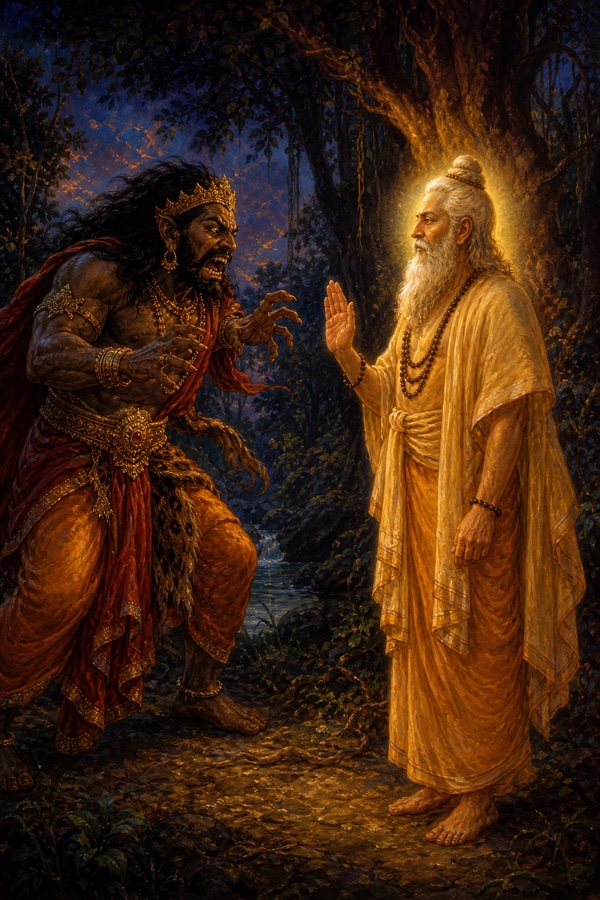
Bhishma told another story from the old days. King Saudasa, of the line of Ikshvaku and the most eloquent of men, once went to his family priest, Vasishtha, the rishi crowned with ascetic success who can travel through every world, the vessel of Brahma, endowed with life without end, and asked him a question: “What is that thing in the three worlds which is holy, and by reciting which at all times a man wins high merit?” Saudasa stood before him with his head bowed, and Vasishtha, before he answered, bowed to the cows and purified himself in body and mind, and then he opened the mystery of cows, a matter whose fruit is high for everyone.
“Cows are always fragrant,” Vasishtha said. “The scent of aloe wood comes from their bodies. Cows are the great refuge of all creatures and the great source of blessing to all. Cows are the past and the future; they are the source of eternal growth and the root of prosperity, and anything given to a cow is never lost. Cows are the highest food and the best offering for the gods. The mantras svaha and vashat live forever in cows; cows are the fruit of sacrifice, and sacrifice is founded on cows; morning and evening they yield the rishis the ghee for the homa. Those who give cows pass beyond every sin they have committed and every calamity they fall into. The man who owns ten cows and gives one, the man who owns a hundred and gives ten, and the man who owns a thousand and gives a hundred all earn the same measure of merit. The man with a hundred cows who lights no domestic fire, the man with a thousand who performs no sacrifice, and the rich man who lives as a miser, giving nothing and keeping no guest, are three men not worthy of any respect. Those who give Kapila cows with their calves and a vessel of white brass for milking, cows that are not vicious and are wrapped in cloth as they are given, conquer this world and the next; and the man who gives a Brahmin learned in the Vedas a bull in the prime of youth, all his senses strong, the first of hundreds of herds, his great horns adorned with ornaments, reaches great prosperity in every birth he takes.”
Then came the daily rules. “Never go to bed without reciting the names of cows, and never rise in the morning without doing the same. Morning and evening, bow your head to the cows, and great prosperity will be yours. Never feel any disgust at the urine and the dung of the cow, and never eat the flesh of cows. Always take the names of cows; never slight them in any way; if you see evil dreams, take the names of cows. Bathe using cow dung, sit on dried cow dung, never let your urine and excreta and other secretions fall on cow dung, and never obstruct cows in any way. Eat sitting on a cowhide purified by dipping it in water, with your eyes turned to the west; eat ghee in silence, with the bare earth for your dish, and the prosperity that cows are the source of will be yours. Pour libations on the fire with ghee, have Brahmins pronounce blessings on you by giving them ghee, give ghee, and eat ghee, and the prosperity that cows confer will be yours. The man who makes a cow of sesame seeds, quickens it with the mantras called Gomati, adorns it with gems of every kind, and gives it away never has to grieve over anything he has done or left undone.” And Vasishtha taught the king the words to say: “Let cows that yield milk in plenty, with horns adorned with gold, Surabhis and the daughters of Surabhi, come to me as rivers come to the sea. I always look at cows; let the cows always look at me. The cows are ours, and we are theirs. We are wherever the cows are.” By night or by day, in happiness or in sorrow, even at a time of great fear, a man should say those words, and by saying them he is freed from every fear.
Vasishtha went on to what the cows had earned. In a former age the cows that had been created practiced the hardest penance for a hundred thousand years, wanting a place of high pre-eminence. They said to themselves: in this world we will become the best of every kind of dakshina in sacrifices, and we will not be liable to stain by any fault; by bathing in water mixed with our dung people will be made holy; gods and men will use our dung to purify every creature that moves and does not move; and those who give us away will reach the worlds of happiness that will be ours. At the end of their austerities Brahma appeared to them and gave them the boons they had sought. “It shall be as you wish,” he said. “Now rescue all the worlds.” Their wishes granted, they rose, those mothers of the past and the future, and from the end of their penance cows became the refuge of the world, which is why they are called blessed and holy and the first of all things and are said to stand at the very head of all creatures. Every morning, Vasishtha said, people should bow to them with reverence, and prosperity will follow.
Then he matched each cow to the world her gift opens. The gift of a Kapila cow with a calf like herself, giving milk in plenty, free of every vice, and covered with a piece of cloth wins great honor in the world of Brahma. A red cow, given the same way, wins the world of Surya; a cow of variegated color the world of Soma; a white cow the world of Indra; a dark cow the world of Agni; a smoke-colored cow the world of Yama. A cow the color of the foam of water, with her calf and a vessel of white brass for milking and a covering of cloth, wins the world of Varuna; a cow the color of dust blown on the wind the world of the wind god; a cow of golden color with tawny eyes the world of Kubera; a cow the color of the smoke of burning straw the world of the ancestors. A fat cow with the flesh of her throat hanging down, given with her calf, wins with ease the high world of the Vishvedevas; a Gauri cow the world of the Vasus; a cow the color of a white blanket the world of the Sadhyas. A bull with a high hump, adorned with every jewel, wins the world of the Maruts, and a blue bull full-grown in years and adorned with every ornament the worlds of the gandharvas and the apsaras; a cow with her dewlap hanging down and every ornament on her wins, for a giver freed of every grief, the worlds that belong to Prajapati himself. The man who habitually gives cows goes up to heaven through the clouds on a chariot as bright as the sun and shines there; he is counted the first of his kind; a thousand celestial girls with beautiful hips, in fine robes and ornaments, receive him when he arrives and wait on him and minister to his delight, and he sleeps in peace and is woken by the laughter of those gazelle-eyed girls, the notes of their vinas, the soft strains of their vallakis, and the tinkling of their anklets. He lives in heaven, honored there, for as many years as there are hairs on the cows he gave, and when his merit is spent and he falls from heaven he is born again among men, in a high family.
A key to reading this: Svaha is the word spoken as an offering goes into the fire for the gods, and vashat is the call the priest gives at the moment of offering; Vasishtha says both live forever in the cow, which makes the animal itself the place where the sacrifice happens. Saudasa is a king of Ikshvaku’s line, the same house Rama was born into. The colors Vasishtha lists are keyed to the worlds of named gods, so that a giver chooses his heaven by choosing the color of the cow he leads out, and the milking vessel of white brass and the covering cloth are part of the gift each time.
The gist: Asked by King Saudasa what is holiest in the three worlds, Vasishtha bows to the cows before answering and gives him the whole discipline: the cows’ fragrance and their place at the root of sacrifice, the equal merit of the man who gives one cow of ten and the man who gives a hundred of a thousand, the daily rules of naming and bowing and dung and ghee, and the prayer that ends with the cows are ours and we are theirs. The cows earned their standing by a hundred thousand years of penance and Brahma’s boon, and each color of cow, from Kapila to straw-smoke, opens the world of a different god.
The chant of ghee, the dialogue of Vyasa and Shuka, and the making of the world of cows
Vasishtha gave Saudasa a chant of ghee as well. “Cows are the givers of ghee and milk. They are the sources of ghee and they have sprung from ghee; they are rivers of ghee and eddies of ghee. Let cows be in my house forever. Ghee is always my heart. Ghee is set in my navel. Ghee is in every limb of mine. Ghee lives in my mind. Cows are always in front of me, cows are always behind me, cows are on every side of me, and I live in the midst of cows.” A man who purifies himself by touching water and recites this morning and evening every day is cleansed of every sin he commits in the course of the day. Those who give a thousand cows go, when they leave this world, to the worlds of the gandharvas and the apsaras, where the palaces are of gold and the celestial Ganga called the current of Vasu runs, and where rivers flow with milk for their water, cheese for their mud, and curds for their floating moss. The man who gives cows by the hundred thousand according to the rite wins high prosperity here and great honor in heaven, carries his ancestors of both lines to the tenth generation into worlds of great happiness, and sanctifies his whole race. Cows are holy, the first of all things in the world, the refuge of the universe, the mothers of the very gods, beyond compare; they are to be dedicated in sacrifices, and on a journey a man should pass them keeping them on his right. The man who gives a Kapila cow with large horns, her calf, a vessel of white brass, and a covering of cloth enters without fear the palace of Yama that is so hard to enter. “Cows are of beautiful form. Cows are of many forms. They are of universal form. They are the mothers of the universe. Let cows come to me.” That mantra, Vasishtha said, should always be recited, because there is no gift holier than the gift of cows and none that yields more blessed merit; nothing has ever equaled the cow and nothing ever will; with her skin and hair and horns, the hair of her tail, her milk, and her fat, all together, she holds up sacrifice, and what is more useful than she is? “I bow my head to her,” he said, “the mother of the past and the future, by whom the whole universe of moving and unmoving creatures is covered. I have told you only a portion of the high merits of cows. There is no gift in the world above the gift of cows, and no refuge higher.” Saudasa, who was already a giver of land, took the rishi’s words as the most important he had heard, restrained his senses, and gave a very large number of cows to the Brahmins, and by those gifts he reached many worlds of happiness in the next life.
Yudhishthira asked what was holiest of all holy things beyond what had already been named, and Bhishma answered that cows are the first of all objects: holy themselves and able to make others holy, upholding every creature with their milk and the offerings made from it, living in a world higher than the world of the gods, rescuing those who give them. Mandhata the son of Yuvanashva, Yayati, and his father Nahusha gave cows by the thousand and reached worlds the gods themselves cannot reach. Then he told of a morning when Shuka, having finished his morning rites, came with a restrained mind to his father, Krishna-Dvaipayana, the island-born Vyasa, who knows the difference between what is higher and what is lower, saluted him, and asked, “Which sacrifice seems to you the first of all sacrifices? By what act do the wise reach the highest world? By what holy act do the gods enjoy the happiness of heaven? What gives a sacrifice its character as sacrifice, and on what does sacrifice rest? What do the gods hold best, and which sacrifice passes beyond the sacrifices of this world? And tell me what is the holiest of all things.” Vyasa answered that cows are the stay and the refuge of all creatures, merit embodied, holy, and sanctifiers of all. In the beginning, he said, cows had no horns. Wanting horns, they worshiped the eternal Brahma and sat in the fast called praya, and Brahma, seeing them at their worship, granted each of them what she desired, and their horns grew, and they shone in beauty in many colors.
Vyasa described where the givers of cows go. The trees of that world bear sweet fruit and are always dressed in flowers of celestial fragrance; its whole soil is made of gems and its sands are gold; the excellence of every season is felt at once, and there is no mud and no dust. Its streams shine with red lotuses on their breasts and with the jewels and gems and gold along their banks, bright as the morning sun; its lakes carry lotuses and lilies with petals of costly gems and filaments the color of gold, and around them stand flowering forests of oleander with thousands of creepers wound through them, and forests of santanaka heavy with bloom. Rivers run there between banks bright with pearls and gems and gold; trees hung with jewels of every kind cover parts of it, some of them golden and some blazing like fire; mountains of gold stand there, and hills of jewels whose summits are made of every kind of gem. Those of righteous deeds sport there in joy, freed from grief and anger, every wish fulfilled, moving from place to place on lovely vehicles while bands of apsaras amuse them with music and dance, and a man goes there as the reward of giving cows; the worlds whose lords are Pushan and the Maruts are reached by the givers of cows, and the giver of cows comes to a wealth like Varuna’s, who is pre-eminent in wealth. A man should recite every day, with the steadiness of a vow, the mantras Prajapati himself declared about cows, whose words are Vishvarupa, Yugandhara, Surupa, Bahurupa, and Matara. The one who serves cows with reverence and follows them in humility obtains priceless boons from cows made glad by him; no one should injure a cow even in his heart; a man should give cows happiness, revere them, and bow his head to them, and doing so with his senses restrained and a glad heart he reaches the happiness that cows enjoy and that only cows can give. Vyasa laid out a hard vow too: for three days drink the hot urine of the cow, for three days her hot milk, for three days hot ghee, and for the next three days live on air alone; then ghee, the holiest of holy things, by whose aid the gods enjoy their worlds, should be carried on the head; pour libations with ghee, have Brahmins bless you by giving them ghee, eat ghee and give ghee, and the prosperity that belongs to cows becomes yours. A man who lives for a month on gruel of barley picked out of cow dung every day is cleansed of sins as grave as killing a Brahmin; the gods performed that expiation after their defeat by the Daityas, and by it they regained their standing and their strength. Living pure among cows, having touched water, a man should silently recite the mantras called Gomati; righteous Brahmins cleansed by knowledge and the Vedas and vows should teach those mantras to their pupils only among sacred fires or cows or assemblies of Brahmins, and a man fasts three nights to receive them, and by adoring them the man who wants a son gets a son, the one who wants wealth gets wealth, the girl who wants a good husband gets him, and every wish is fulfilled, because cows made glad by service grant every wish. When Shuka had heard all this from his father, he began from that day to worship cows every day, and Bhishma told Yudhishthira to do the same.
Yudhishthira had heard that the dung of the cow is endowed with Shri, prosperity herself, and he wanted to know how that came about. Bhishma answered with the old story of the conversation between the cows and Shri.
A sub-tale: Once the goddess Shri took on a form of great beauty and walked into a herd of cows, and the cows, seeing the wealth of her beauty, filled with wonder and asked who she was, where she had won a beauty unequaled on earth, and where she was going. “I am dear to every creature,” Shri said. “I am known by the name of Shri. The Daityas I forsook have been lost forever. The gods, Indra and Vivasvat and Soma and Vishnu and Varuna and Agni, having obtained me, sport in joy and will forever; the rishis and the gods succeed only when they have me, and the beings I do not enter meet with destruction. Dharma and wealth and pleasure become sources of happiness only when I am in them. Such is my power. I wish to live in every one of you. I have come to you to ask it. Be all of you endowed with Shri.”
The cows refused her. “You are fickle and restless,” they said. “You let yourself be enjoyed by many. We have no wish for you. Blessed be you; go wherever you please. All of us have good forms already. What need have we of you?” Shri protested that it was a strange thing for cows to turn her away when she was so hard to attain, and that the popular saying must be true, that whoever comes to another unsought is met with disregard; gods and Danavas, gandharvas, pishachas, serpents, rakshasas, and men obtain her only after the hardest austerities, and no one in the three worlds had ever disregarded her. The cows answered that they meant her no slight and were only taking their leave of her because of her restless heart, and told her again to go where she chose. Then Shri begged. Cast off by them, she said, she would be an object of contempt to the whole world; they were ever ready to protect those who sought their protection, and she had come seeking it; she was without fault; she would be devoted to them always; she wished to live in any part of their bodies however repulsive, even in their rectum, though she could see no part of them that was repulsive, since they were holy and sanctifying and blessed; let them only tell her where in their bodies she might live. The cows, always kind to those devoted to them, took counsel together and said, “It is right that we should honor you. Live in our urine and our dung. Both of them are holy.” Shri said that by good luck they had shown her grace, that it would be as they said, and that she had truly been honored by them, and having made that compact she made herself invisible there, in the very sight of the cows. That, Bhishma said, is the glory of the dung of cows.
He turned then to one more conversation, between Brahma and Indra. Those who give cows and live on the leavings of what has been offered on the fire are counted as always performing every kind of sacrifice, he said, since no sacrifice can be performed without curds and ghee, and ghee, or the cow it comes from, is the very root of sacrifice; the milk and curds and ghee of cows cleanse a man of every kind of sin, and nothing is holier than they are. After the Daityas had been defeated and Shakra had become lord of the three worlds, when every creature was prospering and devoted to the true religion, the rishis and gandharvas and kinnaras and serpents and rakshasas, the gods and the asuras, the winged creatures and the Prajapatis all assembled to worship Brahma. Narada and Parvata and Vishvavasu and Haha and Huhu sang in celestial strains; the wind carried the fragrance of celestial flowers; the seasons in their bodily forms brought the perfumes of the flowers of each; and celestial girls danced and sang to celestial music. In the middle of that assembly Indra bowed his head to the lord of all the gods and asked why the world of cows stands higher than the world of the gods, who are lords of all the worlds, and what austerities, what chastity, the cows had performed to live happily in a place above the gods. Brahma told the slayer of Vala that he had always slighted cows and so did not know their greatness. Cows are the limbs of sacrifice, he said, and sacrifice itself; without them there can be none; with their milk and the offerings made from it they uphold every creature; their male calves work at the plow and produce paddy and every other grain; from them flow sacrifices and the havya and the kavya, milk and curds and ghee; hungry and thirsty, they bear burdens of every kind; they support the sages; they are guileless in all they do, and by that and by their many good acts they live in a world above Brahma’s own. They took many excellent forms, and they are themselves givers of boons; they are called Surabhis. Then Brahma told him why the offspring of Surabhi came down to the earth. In the age of the gods, when the high-minded Danavas had become lords of the three worlds, Aditi, wanting a son, stood on one leg for long years in the hardest austerity, and got Vishnu into her womb as its reward. Watching the great goddess Aditi at her penance, Surabhi, the daughter of Daksha, devoted to righteousness, undertook the same severity on the breast of the lovely mountain Kailasa, where gods and gandharvas go; fixed in the highest yoga, she stood on one leg for eleven thousand years, until the gods and the rishis and the great nagas were all scorched by the heat of her penance.
Brahma had gone to her with all of them and worshiped her. “For what purpose,” he asked her, “do you undergo such severe austerity? I am pleased with your penance. Ask what boon you desire and I will grant it.” Surabhi answered, “I have no need of boons. It is a great boon to me that you are pleased with me.” Her freedom from greed and desire pleased him more than the penance. “I grant you the boon of immortality,” he told her. “You will live, through my grace, in a world higher than the three worlds, and it will be known to all as Goloka. Your offspring, always engaged in good deeds, will live in the world of men; your daughters will live there. Every enjoyment, celestial or human, that you can think of will be yours the moment you think of it, and whatever happiness exists in heaven will be yours as well.” Brahma described Surabhi’s worlds to Indra: every means of fulfilling every wish is there; neither death nor old age nor fire can overcome its people; there is no ill luck; there are lovely woods and lovely ornaments and objects of beauty, and beautiful chariots, fully equipped, that move at the will of the rider. And it is only by chastity, by penance, by truth, by self-restraint, by gifts, by righteous deeds of many kinds, by journeys to sacred waters, in short by hard austerity and righteous acts well performed, that anyone reaches Goloka. “You asked me, and I have answered you in full,” Brahma said. “Never disregard cows.” When Shakra of the thousand eyes had heard the self-born Brahma say this, he began from that day to worship cows every day and to show them the greatest respect.
Bhishma closed the greatness of cows. “I have now told you everything about the sanctifying nature of cows and their holy pre-eminence, which cleanses a man of every sin. The man who, with his senses withdrawn from everything else, recites this account to Brahmins when the havya and the kavya are offered, or at sacrifices, or at the worship of the ancestors, gives his ancestors an inexhaustible happiness that grants every wish. The man devoted to cows obtains every wish he has, and so does the woman devoted to them. The one who wants sons gets sons; the one who wants daughters gets daughters; the one who wants wealth wins it, and the one who wants merit wins that; the one who wants knowledge gains it, and the one who wants happiness gains it. For the person devoted to cows there is nothing that cannot be reached.”
A key to reading this: Shuka, who asks his father the question that opens the world of cows, is the son of Vyasa, and the father he questions is the island-born Krishna-Dvaipayana who arranged the Vedas; the two of them, teacher and pupil in one house, are the frame inside which cows are called holier than every sacrifice. The praya in which the cows sat to win their horns is the fast in which one sits without food until the aim is granted or life gives out. Goloka, the world of cows above the three worlds, is the fruit of Surabhi’s eleven thousand years on one leg and of her refusing the boon she had earned, and it is Brahma’s own answer to a king of the gods who had always looked down on cows.
The gist: Vasishtha’s chant of ghee and his last words to Saudasa; Vyasa telling Shuka how the hornless cows won horns by fasting before Brahma and what the gem-floored, gold-sanded world of the givers of cows looks like, with a vow of hot urine, hot milk, hot ghee, and air; Shri turned away by the cows as fickle until they let her live in their urine and dung; and Brahma telling Indra, in the great assembly, that cows live above the gods because they are sacrifice itself, and that Goloka was his gift to Surabhi for eleven thousand years of penance and a refused boon, after which even Indra began to worship cows.
The question of the origin of gold, and Bhishma’s memory of his father’s shraddha
Yudhishthira had heard the gift of cows praised to its end, and he brought the conversation to the last of the three great gifts. For kings who keep their duties, he said, that gift is the most meritorious of all, because sovereignty is always painful, men of uncleansed soul cannot bear it, and in most cases kings fail to reach an auspicious end; it is by giving earth that they cleanse themselves. His grandfather had taught him many duties, had told him of the cows King Nriga gave, and had told him what the rishi Nachiketa learned. The Vedas and the Upanishads lay down that in every sacrifice and every religious act the dakshina should be earth or cows or gold, and the Shruti declares that among all dakshinas gold is the highest and best. “I want to hear the truth of this,” he said. “What is gold? How did it spring up, and when did it come into existence? What is its essence? Who is its presiding deity? What are its fruits? Why is it counted the first of all things, and why do the wise praise the gift of it? Why is it the best dakshina a sacrifice can close with, and why is it held a greater cleanser than earth itself and than cows?”
“Listen with your whole attention,” Bhishma said, “and I will tell you in detail what I know of the origin of gold. First the event that this matter is joined to. When my father Shantanu left this world, I went to Gangadvara, where the river comes out of the mountains, to perform his shraddha. Arriving there, I began it. My mother Jahnavi, the Ganga herself, came to that place and gave me great help. I invited many ascetics crowned with success, seated them before me, and began the preliminary rites, the gifts of water and the rest.”
“With a concentrated mind I performed every preliminary rite as the scriptures lay them down, and then I set myself to offer the pinda, the ball of food for the dead. And then I saw a handsome arm, adorned with armlets and other ornaments, rise up through the ground and through the blades of kusha grass I had spread. I was filled with wonder at the sight of it. I thought my father had come himself to accept the pinda I was about to offer. Then I reflected by the light of the scriptures, and the conviction came to me that the ordinance in the Vedas is that the pinda is never to be placed in the hand of the man whose shraddha is being performed. That was the conviction that took hold of me: that no man in this world should ever put the pinda into the visible hand of the one whose funeral rites he is performing. The ancestors do not come in visible form to take it. The ordinance provides that it be laid on blades of kusha grass spread on the earth for the purpose.”
“So I set aside that hand, which was the sign of my father’s presence, remembered the true ordinance that rests on the authority of the scriptures, and offered the whole pinda on the blades of kusha grass spread before me. Know that what I did was entirely in keeping with the scriptural rule. After that, my father’s arm vanished before our eyes. That night, as I slept, the ancestors appeared to me in a dream. They were pleased with me, and they said: we are pleased with you for the sign you gave today of your adherence to the ordinance; it has pleased us to see that you did not swerve from the injunctions of the scriptures; by your following it, the scriptural ordinance has become more authoritative, and you have honored and upheld the authority of yourself, of the scriptures, of the Vedas heard from of old, of the ancestors and the rishis, of the Grandsire Brahma himself, and of those seniors, the Prajapatis. You have acted very properly today. You have given earth and cows. Now give gold. The gift of gold is very cleansing, and by such acts of yours we and our own forefathers will all be cleansed of every sin, since such gifts rescue both the ancestors and the descendants of the giver to the tenth generation.”
A key to reading this: The pinda is the ball of rice or barley set down for the dead at a shraddha, and the kusha is the holy grass on which it is laid; Gangadvara, where Bhishma performs his father’s rite, is the ford at which the Ganga leaves the mountains for the plain. His mother is the river, which is why Jahnavi can come to the riverbank to help her son bury his father. What the ancestors praise in their dream is that even his father’s own hand, risen through the grass, could not move Bhishma off the ordinance, and it is that steadiness they reward with the next instruction, the gift of gold.
The gist: Yudhishthira asks what gold is, where it came from, who presides over it, and why the Shruti sets it above earth and cows as a dakshina. Bhishma answers by first telling what happened at his father Shantanu’s shraddha at Gangadvara, with Ganga herself helping: an ornamented arm rose through the kusha grass to take the pinda, he remembered that the ancestors never come in visible form and that the offering belongs on the grass, and he laid it there. The arm vanished, and that night the ancestors, pleased, told him in a dream to give gold.
The close of the greatness of cows, and Indra’s devotion to cows
On the bed of arrows the grandfather was still telling Yudhishthira the greatness of giving cows when the thread of the story reached Goloka, the world of cows. Brahma, answering Indra, had told him what he himself had promised Surabhi on Kailasa when she refused every boon: that her offspring, always engaged in good deeds, would live in the world of men, that her daughters would live there, that every enjoyment she could think of, divine or human, would be hers the moment she thought of it, and that whatever happiness exists in heaven would be hers too. In Surabhi’s world, Brahma told the thousand-eyed god, every means of fulfilling every wish is at hand; neither death nor old age nor fire can overcome its people, and no ill luck exists there; it holds lovely woods and lovely ornaments and every object of beauty, and beautiful chariots, fully equipped, that move wherever their riders wish. And it is only by chastity, by penance, by truth, by self-restraint, by gifts, by righteous deeds of many kinds, and by journeys to the sacred waters, by hard austerity and good acts well done, that anyone reaches Goloka. That was Brahma’s answer, and he ended it with a command: never disregard cows.
“When Shakra of the thousand eyes had heard the self-born Brahma say this,” Bhishma went on, “he began from that day to worship cows every day and to show them the greatest respect. I have told you everything about the sanctifying nature of cows. Their holy pre-eminence and glory, which cleanse a man of every sin, have now been laid open to you. The man who, with his senses withdrawn from every other object, recites this account to Brahmins when the havya and the kavya are offered, or at sacrifices, or at the worship of the ancestors, gives his ancestors an inexhaustible happiness that grants every wish. The man devoted to cows obtains every wish he has, and so does the woman devoted to them. The one who wants sons gets sons. The one who wants daughters gets daughters. The one who wants wealth wins it, and the one who wants merit wins that; the one who wants knowledge gains it, and the one who wants happiness gains it. For the one devoted to cows, Yudhishthira, there is nothing that cannot be reached.”
A key to reading this: The war is over and the man teaching lies on the arrows that ended his part in it, holding his life until the sun turns north; the king he is teaching has already been given the law of kings and is now being given the law of giving, gift by gift. Goloka, the world Brahma made for Surabhi above the three worlds, closes the long praise of cows, and Bhishma’s promise that the devotee of cows lacks nothing is the last word on that gift before Yudhishthira asks about gold.
The gist: Brahma’s description of Goloka, the deathless world he gave Surabhi, and his command to Indra never to slight cows end the greatness of cows; Indra becomes their worshiper, and Bhishma promises that whoever recites this account at the offerings or the shraddha feeds his ancestors forever and that the devotee of cows, man or woman, obtains every wish.
The question of gold and the tale of the grandsire’s father from the bed of arrows
Yudhishthira folded his hands. “You have told me the great merit of the gift of cows,” he said, “and for kings who keep their duties that gift is the most meritorious of all. Sovereignty is always painful. Men of uncleansed soul cannot bear it, and for the most part kings fail to reach a good end; it is by giving earth again and again that they cleanse themselves of their sins. You have taught me many duties. You have told me of the cows King Nriga gave in the old days, and of what the rishi Nachiketa learned about that act long ago. The Vedas and the Upanishads lay down that in every sacrifice, in every kind of religious act, the dakshina, the fee that closes the rite, should be earth or cows or gold. And the Shruti declares that of all dakshinas gold is the highest and the best. I want to hear you speak the truth of this. What is gold? How did it spring up? When did it come into existence? What is its essence, and who is its presiding deity? What are its fruits? Why is it counted the first of all things, why do the wise praise the gift of it, why is it the best dakshina in every sacrifice, and why is it held a greater cleanser than earth itself and than cows? Tell me all of it.”
“Listen with a concentrated mind,” Bhishma said, “and I will tell you in detail the circumstances of the origin of gold as I understand them. When my father Shantanu left this world, I went to Gangadvara to perform his shraddha. There I began my father’s rite, and my mother Jahnavi, the Ganga, came to the place and gave me great help. I invited many ascetics crowned with success, seated them before me, and performed the preliminary rites, the gifts of water and the rest. Then, with my mind fixed, having done every preliminary rite as the scriptures lay them down, I set myself to offer the pinda, the ball of food for the dead, and I saw a handsome arm, adorned with armlets and other ornaments, rise up piercing the ground through the blades of kusha grass that I had spread.”
A sub-tale: Wonder took Bhishma at the sight of the arm, and with it the thought that his father Shantanu had come in person to accept the pinda his son was about to offer. Then he reasoned by the light of the scriptures and remembered that the Vedas ordain that the pinda is never to be placed in the hand of the man whose shraddha is being performed, that no man should ever put it into the visible hand of the one whose funeral rites he is doing, that the ancestors do not come in their visible forms to take it, and that the ordinance provides for it to be laid on the kusha grass spread on the earth. So, disregarding the hand that was the sign of his father’s presence and holding to the true ordinance, he offered the whole pinda on the blades of kusha grass spread before him, and that, he told Yudhishthira, was entirely in keeping with the scriptural rule. After it was done, his father’s arm vanished before the eyes of everyone there.
That night, as Bhishma slept, the ancestors appeared to him in a dream, pleased with him. “We are pleased with you,” they said, “for the sign you gave today of your adherence to the ordinance. It has pleased us to see that you did not swerve from the injunctions of the scriptures. By your following it, the scriptural ordinance has become more authoritative, and by your conduct you have honored and upheld the authority of yourself, of the scriptures, of the Vedas heard from of old, of the ancestors and the rishis, of the Grandsire Brahma himself, and of those seniors, the Prajapatis. Adherence to the scriptures has been maintained. You have acted very properly today. You have given earth and you have given cows. Now give gold. The gift of gold is very cleansing. You know your duties well, and by such acts of yours we and our own forefathers will all be cleansed of every sin, because such gifts rescue both the ancestors and the descendants of the giver to the tenth generation.” When they had said this, Bhishma woke, full of wonder, and set his heart on giving gold. And he told Yudhishthira that the old history he was about to relate, the one that came to him with that resolve, is highly praiseworthy and lengthens the life of anyone who listens to it.
The gist: Asked what gold is and why the Shruti sets it above earth and cows, Bhishma begins with his own life: at his father Shantanu’s shraddha at Gangadvara an ornamented arm rose through the kusha grass to take the pinda, and he laid the offering on the grass as the ordinance requires, because the ancestors never come in visible form. The arm vanished, the ancestors praised him in a dream for holding to the rule against the pull of his own father’s hand, and they told him to give gold. That resolve is the door to the old history of gold’s origin.
Parashurama and the origin of gold, the teaching of the sages
The history, Bhishma said, was first told to Rama, the son of Jamadagni. In the old days that Rama, in a great rage, had swept the Kshatriyas off the face of the earth twenty-one times over, and when he had brought the whole earth under his hand he began to prepare a horse sacrifice, the rite that Brahmins and Kshatriyas alike praise, that grants every wish, that cleanses all creatures and adds to the energy and splendor of those who complete it. By performing it Rama was purified. And yet, when the first of sacrifices was over, he still had not reached perfect lightness of heart. Full of remorse and of compassion, he went to the rishis who knew every branch of learning and to the gods and asked them what was more cleansing still for men who had been engaged in fierce deeds.
Those great rishis, masters of the Vedas and the scriptures, told him to honor all learned Brahmins as the Vedas direct, to follow that course for a time, and then to ask the twice-born rishis again what he should do to cleanse himself and to follow the advice of those men of great wisdom. So Rama went to Vasishtha and Agastya and Kashyapa and put his question to them. “This is the wish that has risen in my heart. How can I cleanse myself? By what acts and rites can it be done? Or if by gifts, what is the thing whose giving will bring my wish about? If your minds incline to do me a favor, tell me, you who are rich in asceticism, what it is by which I can be made clean.”
“The mortal who has sinned is cleansed by gifts of cows, of earth, and of wealth,” the rishis said. “That is what we have heard. There is another gift, counted a great cleanser; listen to us on it. The article is excellent and wonderful to look at, and it is the offspring of fire. In the old days the god Agni burned all the world, and we have heard that from his seed sprang gold of bright color, which came to be called the well-colored. By giving gold your wish will surely be fulfilled.” Then Vasishtha in particular, the rishi of rigid vows, addressed him and undertook to tell him how gold, which has the splendor of fire, came into being, what gold is, where it came from, and how it came to hold its high attributes.
A key to reading this: Rama the son of Jamadagni is Parashurama, the Brahmin of the Bhrigu line, and the twenty-one clearings of the earth are the burden he brings to the sages; the epic sets the slaughter down plainly and makes that weight the reason for the whole history of gold. The horse sacrifice, the highest rite a conqueror can perform, purifies him and still leaves him without lightness of heart, and it is that residue the rishis and then Vasishtha answer.
Vasishtha’s teaching, the essence of fire and soma, and the supremacy of gold
“Hear how gold, which has the splendor of fire, came into being,” Vasishtha said. “That gold will confer merit on you; in the matter of gifts it is highly praised. Know for certain that gold is of the essence of fire and of Soma. The Smritis declare that the goat is Agni, and its gift leads to the world of the god of fire; the sheep is Varuna, and leads to the world of the lord of waters; the horse is Surya and leads to the sun’s world; elephants are the nagas and lead to the world of the nagas; buffaloes are the asuras and lead to theirs; cocks and boars are the rakshasas and lead to the world of the rakshasas; and the earth is sacrifice, cows, water, and Soma, and leads to the merit of sacrifice and to the worlds of cows and of the lord of waters and of Soma. When the whole universe was churned, a mass of energy was found, and that energy is gold. Compared with every one of the things I have named, then, gold is certainly the higher. It is precious, high, and excellent. That is why gods and gandharvas, serpents and rakshasas, human beings and pishachas all keep it with care, and why all of them shine, by the help of gold, when they have made it into crowns and armlets and ornaments of every kind.”
“For the same reason gold is counted the most cleansing of all cleansing things, above earth and cows and every other kind of wealth. The gift of gold is the highest gift; it stands above the gifts of earth and cows and of everything else, and gold is an eternal cleanser. Give it to the first of Brahmins, since it is the first of cleansing things, and of every kind of dakshina gold is the best. Those who give gold are said to give everything, and indeed they are said to give the gods themselves. Agni is all the gods in one, and gold has Agni for its essence, so the man who gives gold gives all the gods, and there is no gift higher than that.” Then Vasishtha said he would tell more of the pre-eminence of gold, as he had heard it long ago in the Purana, and that he would be repeating the speech of Prajapati himself.
When the wedding of Rudra, the great god who carries the trident, to the goddess who became his wife was over, on the breast of Himavat, the first of mountains, the god wished to unite himself with her. Anxiety went through all the gods, and they came to Rudra. Bowing their heads and pleasing Mahadeva and his boon-giving wife Uma, who were seated together, they spoke. “This union of yours with the goddess is a union of one whose penance is severe with another whose penance is as severe. It is the union of one whose energy is very great with another whose energy is scarcely less. Your energy cannot be resisted, and the goddess Uma’s energy cannot be resisted either. The offspring of a union like this will without doubt be endowed with very great might, and it will consume everything in the three worlds and leave nothing. Grant these gods prostrated before you a boon for the good of the three worlds. Restrain this high energy of yours, which could become the seed of offspring; it is the essence of every force in the three worlds. By an act of union you two will scorch the universe, and the child born of you will be able to afflict the gods. Neither the goddess Earth, nor the firmament, nor heaven, nor all of them together, we firmly believe, could bear your energy, and the whole universe is certain to be burned by its force. Show us favor. The favor is that you beget no son on the goddess Uma. Hold back, with patience, this fiery and irresistible energy of yours.”
The holy Mahadeva, whose sign is the bull, said to the gods, “So be it,” and drew up his vital seed, and from that time he has been called Urdhvaretas, the one who drew his seed upward. His wife was greatly angered by this attempt of the gods to stop procreation, and she spoke harsh words: “Since you have opposed my lord in the begetting of a child when he wished to beget one on me, you gods shall all be sonless. Since you have opposed the birth of issue from me, you shall have no offspring of your own.” The god of fire was not there when that curse was pronounced. It is because of the goddess’s curse that the gods have been childless. Rudra, at their asking, held his energy of incomparable power inside himself, but a small quantity that came out of his body fell on the earth, leaped into a blazing fire, and there began to grow most wonderfully in size and power, and the energy of Rudra, meeting that other energy of great power, became one with it in essence.
A key to reading this: Vasishtha’s table of animals and gods comes from the Smritis, the remembered law: each creature given away opens the world of the deity it stands for, and gold, churned out of the whole universe as a mass of energy, outranks every item on the table. The essence of fire and Soma that he assigns to gold is the pairing the rest of the history will act out, Agni’s heat and the cool of Soma joined in one seed; the same drop of Rudra’s energy that falls into the fire here is the seed from which both Kartikeya and gold will be born.
The terror of Taraka and the gods’ prayer to Brahma
Meanwhile all the gods, with Shakra at their head, were being badly scorched by an asura named Taraka. The Adityas, the Vasus, the Rudras, the Maruts, the Ashvins, and the Sadhyas were all in great distress from the prowess of that son of Diti. All the worlds of the gods, their beautiful chariots and their palaces, and the retreats of the rishis had been seized by the asuras. So the gods and the rishis, sick at heart, went for protection to Brahma, whose glory does not fade.
“The asura Taraka, who received boons from you, is tormenting the gods and the rishis,” they said. “Ordain his death. Our fear of him has been great. Rescue us; we have no refuge except you.” Brahma answered them, “I behave equally toward all creatures. And I cannot approve of unrighteousness. Let Taraka, that enemy of the gods and rishis, be quickly destroyed. The Vedas and the eternal duties shall not be exterminated. I have ordained what is proper in this matter. Let the fever of your hearts be gone.”
The gods pressed him. “Because of the boons you granted him, that son of Diti is proud of his strength. He cannot be killed by the gods, so how will his death come about? The boon he had from you is that he cannot be killed by gods or asuras or rakshasas. And we ourselves have been cursed by the wife of Rudra, because we tried in the old days to stop procreation; her curse is that we are to have no offspring.” Brahma said, “Agni was not there when the goddess pronounced her curse. He will beget a son for the destruction of the enemies of the gods. Passing beyond all the gods and Danavas and rakshasas and human beings and gandharvas and nagas and winged creatures, the child of Agni, with a dart in his hands that nothing can turn aside once it is thrown, will destroy Taraka, the source of your fear, and every other enemy of yours as well.”
Brahma explained how it would be done. “Will is eternal. That will is known by the name of Kama, and it is one with the seed of Rudra, a part of which fell into the blazing form of Agni. That energy, a mighty substance like a second Agni, will be cast by Agni into the Ganga to beget a child on her for the destruction of the enemies of the gods. Agni did not come within the range of Uma’s curse; the eater of offerings was not present when it was pronounced. So let the god of fire be searched out, and let him be set to this task. I have told you the means of Taraka’s destruction. The curses of those endowed with energy have no effect on those endowed with energy; a force, meeting a stronger force, is weakened; and those endowed with penance can destroy even the boon-giving gods, who cannot be destroyed. Will, or liking, or desire, which is one with Agni, sprang up in the earliest times and is the most eternal of all creatures. Agni is the lord of the universe. He cannot be grasped or described. Able to go everywhere and present in everything, he is the creator of all beings and lives in every creature’s heart, and he is older than Rudra himself. Seek out that eater of offerings, who is a mass of energy. He will accomplish the desire of your hearts.”
The gist: Taraka, made unkillable by gods, asuras, or rakshasas through Brahma’s own boon, has seized the worlds of the gods and the hermitages of the rishis, and the gods, childless under Uma’s curse, come to Brahma. He tells them that Agni was absent when the curse was spoken, that a part of Rudra’s seed already burns in Agni’s flame, and that Agni will cast it into the Ganga to beget the son who will kill Taraka with an unfailing dart; the gods must now find Agni.
The search for Agni, and the curses of the frog, the elephant, and the parrot
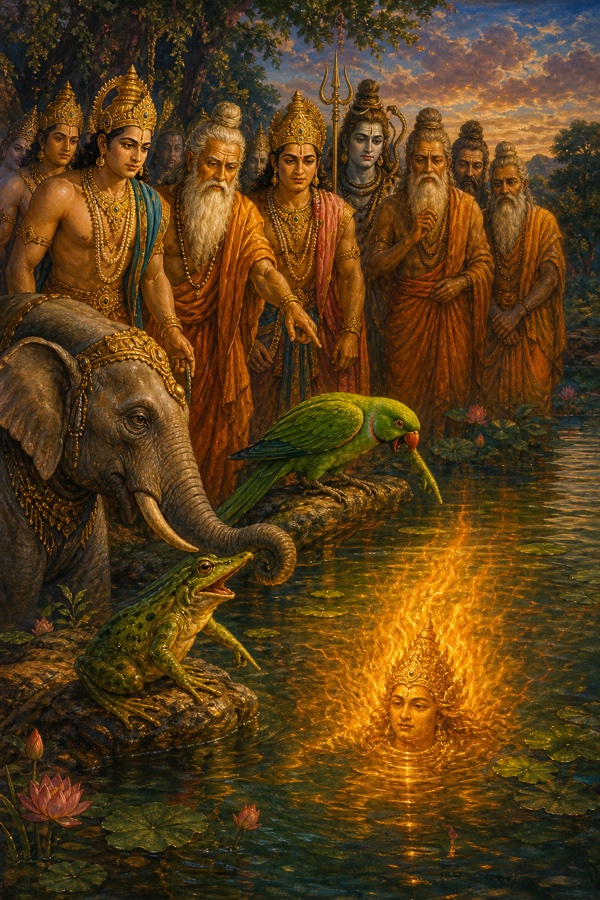
The gods set out to find the god of fire with glad hearts, sure that their purpose was as good as achieved. They and the rishis searched every part of the three worlds, their minds full of Agni, eager to catch sight of him; rich in penance and prosperity, famous through all the worlds, those crowned with ascetic success went over every corner of the universe. They failed. The eater of offerings had hidden himself by merging his self into his self. About that time a frog that lived in water came up to the surface from the lowest regions, wretched from being scorched by Agni’s energy, and the little creature spoke to the frightened gods who wanted so badly to see the god of fire. “Agni is living in the lowest regions now. Scorched by his energy and unable to bear it any longer, I have come up here. The bearer of offerings is under the waters; he has made a mass of water and is staying inside it, and all of us have been scorched by him. If you want to see him, if you have any business with him, go down there. Go there. As for us, we are fleeing this place for fear of Agni.” Having said that much, the frog dived back into the water.
The eater of offerings learned of the frog’s treachery. He came to the animal and cursed the whole race of frogs: “From this day you shall be deprived of the organ of taste.” Then he left the spot quickly to take up his dwelling somewhere else, and he did not show himself. Seeing the state to which the frogs had been reduced for doing them a service, the gods showed the creatures favor. “Deprived of your tongues by Agni’s curse and robbed of the sense of taste, you shall still be able to utter many kinds of speech,” they said. “Living in holes, without food, without consciousness, wasted and dried up, barely alive, you will nevertheless be held by the Earth, and you will be able to wander about at night when everything is wrapped in thick darkness.”
The gods went over every part of the earth again to find the god of blazing flames, and for all their effort they could not reach him. Then an elephant, as large and mighty as the elephant of Shakra, told them, “Agni is living inside this ashvattha tree.” Furious, Agni cursed all elephants: “Your tongues will be bent back.” Having been pointed out by the elephant, and having cursed all elephants so, he went away and entered the core of a shami tree, meaning to stay inside it for a time. And the gods, of unfailing prowess, pleased with the service one of their kind had done them, showed the elephants favor in their turn: “Even with your tongues bent inward you shall be able to eat everything, and even with those tongues you shall be able to utter cries, though the cries will be indistinct.”
With the elephants blessed, the dwellers of heaven took up their search once more. Agni had come out of the ashvattha and gone into the core of the shami, and this new dwelling of his was given away by a parrot. The gods went to the place. Enraged at the parrot, the god of blazing flames cursed the whole race of parrots: “From this day you shall be deprived of the power of speech,” and he turned up the tongues of every parrot. But the gods, seeing Agni where the parrot had pointed and having watched the curse fall on the bird, felt pity for the poor creature and blessed it: “Because you are a parrot you shall not be wholly deprived of speech. Though your tongue has been turned back, speech you shall have, confined to the letter K. Like the speech of a child or an old man, yours shall be sweet and indistinct and wonderful.”
A sub-tale: When the gods had spoken to the parrot and seen the god of fire inside the shami, they made shami wood the holy fuel for kindling fire in every religious rite. From that time fire has been seen to live inside the shami, and men came to regard the shami as the proper means of producing fire for a sacrifice. The waters of the lowest regions had been in contact with the god of blazing flames while he hid in them, and those heated waters are what the mountain springs pour out; because Agni lived in them for a time, they were made hot by his energy, and they run hot still.
Agni, seeing the gods before him, was grieved, and he asked them the reason for their coming. The gods and the great rishis said, “We wish to set you to a particular task. It is for you to accomplish it, and when it is accomplished it will add greatly to your fame.” Agni said, “Tell me what your business is. I will accomplish it. I am always willing to be set by you to any task you wish; do not hesitate to command me.”
The gist: Agni, hidden by merging himself into himself, is betrayed three times, by a frog scorched under the waters, by an elephant who names the ashvattha tree, and by a parrot who names the shami, and each time he curses the whole race of the betrayer, taking the frogs’ taste, bending the elephants’ tongues, and turning up the parrots’; each time the gods soften the curse with a gift of their own. Found at last in the shami, which becomes the sacred kindling wood, Agni asks the gods what they want of him and promises to do it.
Agni’s seed in the Ganga and the birth of Kartikeya
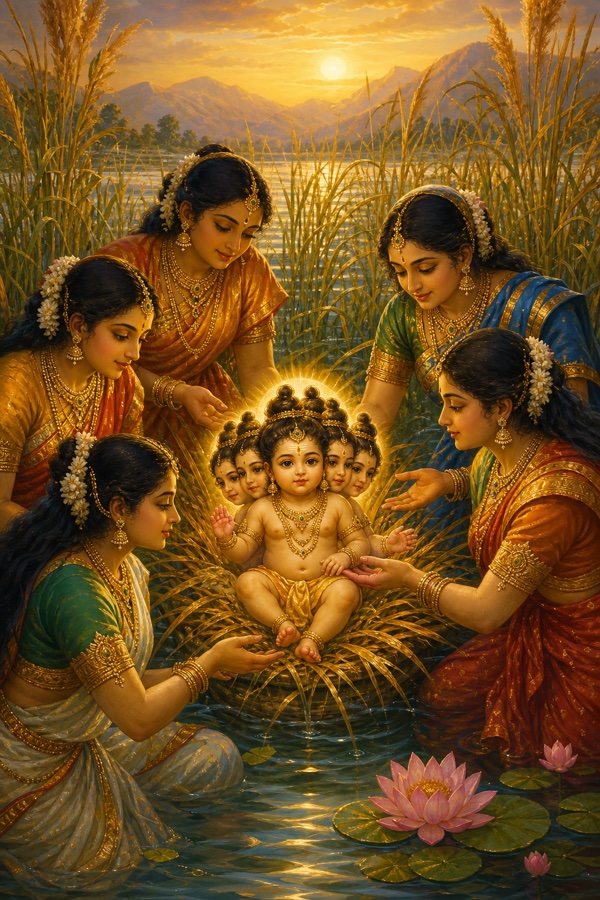
The gods told him. “There is an asura named Taraka who has been filled with pride by the boon he obtained from Brahma. By his energy he is able to oppose us and to beat us. Ordain his destruction. Rescue these gods, these Prajapatis, and these rishis, Pavaka. Beget a heroic son endowed with your energy, a son who will take from us our fear of that asura. We have been cursed by the great goddess Uma, and there is nothing now except your energy that can be our refuge. Rescue us all.” The bearer of offerings, whom nothing can resist, answered, “Be it so,” and went to the Ganga, the river that is also called Bhagirathi. He united himself with her in a union of the spirit, and she conceived. In the womb of the Ganga the seed of Agni began to grow the way Agni himself grows when he is fed with fuel and the wind gets under him.
The energy of that god went through the Ganga and left her shaken to the heart. She suffered, and she could not bear what she carried. At the moment the god of blazing flames cast his seed into her womb, an asura, bent on some purpose of his own and with no thought of her, let out a frightful roar, and the roar terrified her. Her eyes rolled in fear and gave her agitation away. Consciousness left her. She could no longer hold her own body, let alone the seed inside it. Jahnu’s daughter, filled with the energy of that god, began to tremble, and under the weight of what she held in her womb she spoke to the deity of blazing fire. “I am no longer able to bear your seed in my womb. This seed of yours has overcome me with weakness. The health I had before is gone from me. I have been shaken beyond anything, and my heart is dead inside me. I cannot carry your seed any longer. I am going to cast it off, and it is the distress that has come over me that compels me, and no caprice of mine. My body has had no actual contact with your seed. Our union, which had the distress of the gods for its cause, was a fitting one, a union of the spirit and never of the flesh. Whatever merit there is in what I am about to do, or whatever fault, belongs to you. The righteousness of this deed, I believe, or its unrighteousness, must be yours.”
“Bear the seed,” the god of fire told her. “Bear the child that carries my energy. It will lead to great things. You are able to bear the whole earth, and you will gain nothing by refusing to hold this energy.” Agni urged her, and all the other gods urged her too, and still the first of rivers cast the seed off on the breast of Meru, the first of mountains. She had been able, somehow, to bear it; it was the energy of Rudra in it, since Agni and Rudra are one, that oppressed her, and its burning was more than she could hold any longer. So, out of sheer distress, she let that blazing seed with the splendor of fire fall. Agni saw her then and asked the first of rivers, “Is it well with the child you have cast off? What complexion does it have? What form does it look to have, and what energy does it seem to carry? Tell me all of it.” The Ganga answered him. “The child has the complexion of gold, and in energy it is like you. Of an excellent complexion, perfectly stainless, blazing with splendor, it has lit up the whole mountain. The fragrance that comes from it is like the cool perfume that drifts off lakes covered in lotuses and water lilies, mixed with the scent of the kadamba. In its splendor everything around it seems to have turned to gold, the way everything on the heights and in the low country seems to turn to gold under the rays of the sun. Its splendor spreads far and falls on mountains and rivers and springs. It seems to me that the three worlds, with every moving and unmoving creature in them, are lit by it. That is the kind of child you have, bearer of offerings. Like Surya, or like your own blazing self, it is in beauty a second Soma.” Having said that, the goddess vanished where she stood, and Pavaka, the business of the gods accomplished, went off to the place he liked.
A sub-tale: For what came of that act the rishis and the gods gave the god of fire the name Hiranyaretas, he whose seed is gold, and because the Earth held the seed after the Ganga had cast it on her, she came to be called Vasumati, the bearer of treasure. The child that had sprung from Pavaka and been carried for a time by the Ganga fell on a forest of reeds, and there it began to grow, and in time it took on a wonderful form. The goddess who presides over the constellation Krittika saw that form, which looked like the rising sun, and from then on she reared the child as her own son with the milk of her breast; that is why a child of such splendor came to be called Kartikeya, after her. Because he grew from seed that had fallen out of Rudra’s body he was called Skanda, and because his birth took place in the solitude of a forest of reeds, hidden from everyone’s sight, he was called Guha.
That is how gold came into existence as the offspring of the god of blazing flames. Because of it gold came to be looked on as the first of all things and the ornament of the very gods, and from that birth it took the name Jatarupa, the form it was born with. It is the first of all costly things, and among ornaments it is the first; among cleansing things it is the cleanser, and among auspicious things it is the most auspicious. Gold is truly Agni, the lord of all things and the first of the Prajapatis. The most sacred of all sacred things is gold, and it is said to have Agni and Soma for its essence.
The gist: The gods ask Agni, who alone escaped Uma’s curse, for a son who will end Taraka, and Agni unites with the Ganga in a union of the spirit. The seed burns her beyond bearing, an asura’s roar robs her of her senses, and she sets it down on Meru, where it lights the whole mountain gold and scents the air like lotus lakes and kadamba. Agni becomes Hiranyaretas, the Earth becomes Vasumati, the child in the reeds becomes Kartikeya, Skanda, and Guha, and gold itself is born from the same seed and takes the name Jatarupa.
The tale of Brahmadarshana, Rudra’s sacrifice, and the birth of Bhrigu, Angiras, and Kavi
Vasishtha had more to tell him. “There is another history, Rama, that I heard long ago,” he said. “It is called Brahmadarshana, the vision of Brahma, and it concerns an achievement of the Grandsire, who is one with the Supreme Soul.” In the old days Lord Rudra, the first of the gods, performed a sacrifice, and for that occasion he had taken on the form of Varuna, the lord of the waters. To his sacrifice came the munis and all the gods, with Agni at their head. The limbs of the sacrifice came too, each of them in a body of its own, and the mantra Vashat, the cry that sends an offering into the fire, came in a body of its own. All the Samans and all the Yajushes, the chants and the sacrificial formulas, came by the thousand, each one embodied, and the Rig Veda came adorned with the rules that govern how its sounds are to be spoken. The marks and the accents, the etymologies, the notes set out in their rows, the syllable Om, and the rules called Nigraha and Pragraha all came there and took up their residence in the eye of Mahadeva. The Vedas with the Upanishads, learning itself, the Savitri, and the past, the present, and the future all came, and Shiva held them.
Then the lord of all poured the libations into his own self, and the wielder of the Pinaka made that sacrifice of many forms a thing of extraordinary beauty. He is heaven, he is the firmament, he is the earth and the sky between them. He is called the lord of the earth, and he is the lord whose rule every obstacle owns. He is endowed with Shri, and he is one with the god of blazing flames. That god is called by many names: he is Brahma, and Shiva, and Rudra, and Varuna, and Agni, and Prajapati, the auspicious lord of all creatures. Sacrifice itself in its embodied form, and Penance, and all the rites of union, and the goddess Diksha, the consecration that opens a rite, blazing with her strict observances, the several points of the compass with the gods who preside over each, the wives of all the gods and their daughters, and the celestial mothers, all came together in one body to Pashupati, and when they saw the sacrifice of the great Mahadeva in Varuna’s form, every one of them was glad.
The celestial women were there in their beauty, and at the sight of them the seed of Brahma came out and fell on the earth. Since it had fallen into the dust, Pushan, the sun, took up that dust mixed with the particles of seed in his hands and threw it into the sacrificial fire. The sacrifice went on around the blazing fire, and Brahma, acting as the hotri, the priest who pours, was offering the libations. While he was so engaged desire rose in the Grandsire, and his seed came out again. The moment it did he took it up in the sacrificial ladle and poured it as a libation of ghee, with the proper mantras, onto the blazing fire. From that seed Brahma, in his great energy, caused the four orders of creatures to come into being.
The seed of the Grandsire carried the three attributes, sattva, rajas, and tamas, the strands of light, of motion, and of darkness that run through everything made. From the element of rajas in it sprang every creature that moves, each endowed with the principle of action. From the element of tamas sprang every creature that stays in place. The sattva that dwelt in that seed entered both kinds of being. That sattva has the nature of tejas, of light, and it is one with the understanding; it is eternal, and of it the unending space is made. In every creature the attribute of sattva is present, and it is the same thing as the light by which what is right and what is wrong can be seen.
When the seed of Brahma had been poured on that sacrificial fire as a libation, three beings sprang from it. They were three male persons, and each had a body that took its character from the circumstance it came out of. The first rose out of the flames of the fire, which are called bhrig, and so he was named Bhrigu. The second came out of the burning charcoal, which is called angara, and so he was named Angiras. The third rose from a heap of charcoal that had gone out, and he was named Kavi. From the rays of the sacrificial fire another arose, Marichi, and from Marichi, afterward, came Kashyapa. From the blades of kusha grass spread out at that sacrifice came the tiny rishis called the Valakhilyas, and from those same blades came Atri. From the ashes of the fire came all those who are counted among the twice-born rishis as the Vaikhanasas, rich in penance, devoted to the lore of the Vedas and to every excellent accomplishment. From the eyes of Agni came the twin Ashvins, beautiful in person. At the last, from his ears, came all the Prajapatis. The rishis sprang from the pores of Agni’s body; from his sweat came the Chhandas, the meters, and from his strength came Mind. For this reason the rishis learned in the Vedas, following the Vedas’ own authority, have said that Agni is all the gods in his single self.
A sub-tale: In the same vision the body of Agni is laid out as time itself. The pieces of wood that keep his flames alive are the months, and the juices the fuel gives up are the fortnights; his liver is called day and night, and his fierce light is the muhurtas, the hours of the day. His blood is the source of the Rudras, and from that blood came also the gold-complexioned gods called the Maitradevatas. From his smoke came the Vasus, and from his flames the Rudras and the twelve Adityas of great radiance. The planets, the constellations, and the other stars set in their orbits across the firmament are his burning coals. The first creator of the universe declared Agni to be the supreme Brahman, eternal, the giver of every wish, and that, Vasishtha said, is a mystery.
The gist: At a sacrifice Rudra performs in the form of Varuna, with the Vedas, the mantras, the quarters, and the celestial mothers present in their own bodies, Brahma’s seed falls twice, once into the dust that Pushan throws into the fire and once into the ladle Brahma himself pours. From it come the four orders of creatures and three persons named for where they rose: Bhrigu from the flame, Angiras from the live coal, Kavi from the dead coal, with Marichi, Atri, the Valakhilyas, the Vaikhanasas, the Ashvins, and the Prajapatis after them, so that Agni is called all the gods in one.
The claim over the three sons and the spread of the Prajapati lines
When all these births had taken place, Mahadeva, who had taken Varuna’s form for his sacrifice and who had the wind for his soul, spoke first. “This excellent sacrifice is mine. I am the master of the house in it. The three beings who sprang first from the sacrificial fire are mine. Without doubt they are to be regarded as my offspring. Know this, you gods who range the skies: they are the fruits of this sacrifice.” Agni answered him. “These offspring have sprung from my limbs. For their coming into life they all depended on me as the cause. They are to be regarded as my children. Mahadeva in Varuna’s form is in error in this matter.” Then Brahma, the master of all the worlds and the Grandsire of all creatures, spoke. “These children are mine. The seed was mine, and it was I who poured it on the sacrificial fire. I am the one who brings this sacrifice to completion. It was I who poured on the fire the seed that came out of my own self. The fruit belongs always to the one who planted the seed, and the principal cause of these births is the seed, which is mine.”
The gods went before the Grandsire, bowed their heads, joined their hands in reverence, and said, “All of us, and the entire universe of moving and unmoving creatures, are your offspring. Let Agni of the blazing flames, and the great Mahadeva who has taken Varuna’s form for this sacrifice, have what they wish in the matter of these children.” At those words Mahadeva in Varuna’s form, the ruler of every creature of the waters, received the firstborn, Bhrigu, who had the radiance of the sun, as his own child, though Bhrigu was born of Brahma. The Grandsire then intended that Angiras should become the son of Agni, and he, who knows the truth of all things, took Kavi as his own son. Bhrigu, counted a Prajapati and set to peopling the earth with creatures, came in that way to be called Varuna’s offspring; Angiras, endowed with every prosperity, came to be called the offspring of Agni; and the celebrated Kavi came to be known as the child of Brahma himself. Bhrigu and Angiras, who had sprung from the flame and the charcoal of Agni, became the fathers of wide races and tribes in the world, and these three, Bhrigu, Angiras, and Kavi, each counted a Prajapati, are the progenitors of many peoples. All are the children of these three.
Bhrigu begot seven sons, every one of them his equal in merit and accomplishment: Chyavana, Vajrashirsha, Shuchi, Urva, Shukra the giver of boons, Vibhu, and Savana. Those seven are the children of Bhrigu, and so they are Bhargavas, and because their ancestor Bhrigu was adopted by Mahadeva in Varuna’s form they are called Varunas too. “You belong to the race of Bhrigu,” Vasishtha told Rama. Angiras begot eight sons, and they also are known as Varunas: Brihaspati, Utathya, Payasya, Shanti, Dhira, Virupa, Samvarta, and Sudhanva the eighth. Those eight are counted as Agni’s offspring too; freed from every evil, they are devoted to knowledge alone. The sons of Kavi, whom Brahma himself had taken, are likewise known as Varunas. They number eight, every one of them the progenitor of races and tribes, auspicious by nature and learned in Brahman: Kavi, Kavya, Dhrishnu, Ushanas of great intelligence, Bhrigu, Viraja, Kashi, and Ugra, who knew every duty. By them the whole world has been peopled; all are Prajapatis, and many are the offspring they have begotten. So the whole world came to be filled with the progeny of Angiras and of Kavi and of Bhrigu. Mahadeva in the Varuna form he took for his sacrifice had first adopted both Kavi and Angiras, which is why those two lines are counted as Varuna’s, and afterward the eater of offerings, the god of blazing flames, adopted Angiras, which is why all the progeny of Angiras are known as belonging to the race of Agni.
In those old days the gods, all together, pleased the Grandsire Brahma with a prayer. “Let these lords of the universe rescue us all,” they said of Bhrigu and Angiras and Kavi and their descendants. “Let all of them become progenitors of offspring. Let all of them be endowed with penance. Through your grace let them rescue the world. Let them become procreators, and extenders of races and tribes, and let them increase your energy. Let all of them become complete masters of the Vedas, and achievers of great deeds. Let all of them be friends to the cause of the gods, and let all of them be auspicious. Let them become founders of wide races and tribes and let them be great rishis. Let all of them be rich in penance, and let all of them be devoted to the highest brahmacharya. All of us, and all of these, are your progeny. You are the creator of both the gods and the Brahmins. Marichi is your first son, and all these who are called Bhargavas are your progeny, as we are. Seeing this, we shall all aid and support one another. In this way all of these will multiply their progeny, and at the beginning of each creation, after the universal destruction, they will establish you anew.” Brahma, the Grandsire of all the worlds, answered them, “So be it. I am pleased with you all,” and went back to the place he had come from. That, Vasishtha said, is what happened in the old days at the sacrifice of the great Mahadeva, the first of all the gods, at the beginning of creation, when for the purposes of his sacrifice he had taken on the form of Varuna.
A key to reading this: The one line in all this that Vasishtha speaks straight to his listener is “You belong to the race of Bhrigu.” Rama, the son of Jamadagni, is a Bhargava, which means that the man who has just cleared the earth of Kshatriyas twenty-one times and is asking how to be cleansed is hearing the story of his own first ancestor rising out of the flame of Rudra’s sacrifice, claimed by three gods at once and given to Varuna. The history of gold, told to purify him, has turned out to be the history of his own house.
The identity of fire and gold, and the fruit of the gift of gold
“Agni is Brahma,” Vasishtha went on. “He is Pashupati. He is Sarva. He is Rudra. He is Prajapati. It is well known that gold is the offspring of Agni, and so, when fire cannot be had for a sacrifice, gold is used in its place. Guided by what the Vedas declare, a man who knows the authorities and knows that gold and fire are one acts in this way: he lays a piece of gold on blades of kusha grass spread on the ground and pours his libations onto it. And if the libations are poured on the openings of an anthill, or on the right ear of a goat, or on a piece of level earth, or on the waters of a tirtha, or on the hand of a Brahmin, the god of fire is pleased, and he regards the offering as the increase of himself, and of the gods through him. That is why we have heard that all the gods look on Agni as their refuge and are devoted to him. Agni sprang from Brahma, and from Agni sprang gold, and that is why we have heard that the righteous who give gold are counted as giving away all the gods.”
“The man who gives gold reaches a very high end. Regions of blazing radiance are his, and in heaven he is installed as a king of kings. The man who gives gold at sunrise, according to the ordinance and with the proper mantras, wards off the evil that his ominous dreams foretold, and the man who gives it the moment the sun has risen is cleansed of all his sins. The man who gives gold at midday destroys the sins he has yet to commit. The man who gives gold at the second twilight, the evening one, with his soul restrained, wins a residence with Brahma and with the god of wind and with Agni and Soma, each in his own region, and auspicious fame in the regions of great happiness that belong to Indra himself. He wins great fame in this world too, and, cleansed of all his sins, he sports in joy and happiness. Many other regions of happiness are his, and he becomes unequaled in glory and fame; his course is wholly unobstructed, he goes wherever he wishes, he never falls from the regions he has reached, and the glory he acquires is great. By giving gold a man reaches regions of happiness beyond counting, and he enjoys them for eternity. The man who kindles a fire at sunrise and gives gold in observance of a particular vow sees every wish of his fulfilled.”
“It has been said that gold is one with Agni. The gift of gold, for that reason, is productive of great happiness. It leads to the merits and accomplishments a man desires, and it cleanses the heart. So I have told you the origin of gold. Hear now how Kartikeya grew up. After a long time Kartikeya grew, and all the gods with Indra at their head chose him as the general of the armies of heaven. At the command of the chief of the gods, and moved too by the desire to do good to all the worlds, he killed the Daitya Taraka, and many other asuras as well. I have told you the merits of giving gold, Rama. Give gold.”
Vasishtha had finished, Bhishma said, and the son of Jamadagni did as he had been told: he gave gold to the Brahmins, and he was cleansed of his sins. “So I have told you everything about the merits of giving gold, Yudhishthira, and about its origin. Give gold to the Brahmins, and give it in abundance. By giving gold you will surely be cleansed of all your sins.”
The gist: Because Agni is Brahma, Pashupati, Sarva, Rudra, and Prajapati, and gold is Agni’s child, gold stands in for fire at a sacrifice and the giver of gold is counted as giving away all the gods. Vasishtha sets out the fruits by the hour, sunrise, midday, and the evening twilight, tells Rama in a few lines how Kartikeya grew up to command the gods and kill Taraka, and sends him to give gold; Rama gives it and is cleansed, and Bhishma tells Yudhishthira to do the same.
Kartikeya’s growth and the full account of the slaying of Taraka
Yudhishthira was not ready to let the story go. “You have told me in detail the merits of giving gold according to the ordinances of the scriptures and what the Vedas declare,” he said, “and you have told me how gold came to be. Now tell me how Taraka met his destruction. You said that asura could not be killed by the gods. Tell me in detail how his death was brought about. I want to hear it from you, the whole account of the killing of Taraka. My curiosity to hear it is very great.” Bhishma took it up from the moment the Ganga let the seed fall. The gods and the rishis, in great distress from Taraka’s prowess and from what the Ganga had done, urged the six Krittikas to rear that child, because among the women of heaven there were none except these six whose energy could hold the seed of Agni in their wombs. The god of fire was deeply pleased with those goddesses for their readiness to sustain the conception his cast-off seed had caused, charged as it was with his own high energy. His energy was divided into six portions and placed within the channels that lead to the womb, and each of the six Krittikas began to nourish the portion she held.
As Kumara grew inside them, his energy tormented their bodies, and they could find no peace anywhere, in heaven or on earth. Their bodies were full of that energy when the time for delivery came at last, and it happened that all six of them delivered at the same time. Though he had been held in six separate wombs, all the portions, as they came out, joined into one. The goddess Earth lifted the child up from a heap of gold. He blazed with splendor like the god of fire himself, and, beautiful in every feature, he began to grow in a delightful forest of reeds. The six Krittikas looked at the child who was theirs and saw the morning sun in his splendor, and, full of affection for him, loving him very much, they reared him with the milk of their breasts. Because he was born of the Krittikas and reared by them he came to be known through the three worlds as Kartikeya; because he had sprung from the seed that fell from Rudra he was named Skanda; and because he was born in the solitude of a forest of reeds he was called Guha, the secret-born.
The thirty-three gods came to see him, and the points of the compass in their embodied forms with the gods who preside over them, and Rudra and Dhatri and Vishnu and Yama and Pushan and Aryaman and Bhaga, and Amsha and Mitra and the Sadhyas and Vasava and the Vasus and the Ashvins, and the Waters and the Wind and the Firmament, and Chandramas and all the constellations and the planets and Surya, and all the Riks and Samans and Yajushes in their embodied forms: all of them came to look at that wonderful child, the son of the god of blazing flames. The rishis uttered hymns of praise and the gandharvas sang in honor of the child called Kumara, who had six heads and twice six eyes and was devoted beyond measure to the Brahmins. His shoulders were broad, he had twelve arms, and the splendor of his person was like fire and like the sun. He lay stretched out on a clump of reeds, and the gods and the rishis who looked at him were filled with delight and counted the great asura as already dead.
The gods began bringing him toys and things to amuse him, and as he played like any child, toys and birds of every kind were put into his hands. Garuda of the splendid feathers gave him one of his own children, a peacock with plumes of many colors. The rakshasas gave him a boar and a buffalo. Aruna himself gave him a cock of fiery splendor. Chandramas gave him a sheep, and Aditya gave him some dazzling rays of his own. Surabhi, the mother of all cows, gave him cows by the hundreds and thousands. Agni gave him a goat of many good qualities. Ila gave him flowers and fruit in abundance. Sudhanvan gave him a riding chariot and a chariot of the kind called Kuvara. Varuna gave him many fine and auspicious products of the ocean, and some elephants. The chief of the gods gave him lions and tigers and leopards and winged creatures of every kind, many terrible beasts of prey, and many umbrellas of many kinds. Rakshasas and asuras in large bands began to walk in that child’s train.
Taraka watched the son of Agni grow and tried by every means to destroy him, and he could do nothing to that god. In time the gods invested Agni’s son, born in the solitude of the reeds, with the command of their forces, and they told him of the oppressions the asura Taraka had committed against them. The general of the armies of heaven grew up and came into his full energy and power, and in time Guha killed Taraka with his dart that nothing can resist; Kumara killed the asura as easily as if he were at play. With Taraka destroyed he set the chief of the gods back on his sovereignty over the three worlds. The general of heaven blazed in beauty and splendor; Skanda became the protector of the gods and did what pleased Shankara, and the son of Pavaka had a form of gold. Kumara is the leader of the armies of heaven always. Gold is the energy of the god of fire, and it was born with Kartikeya, from the same seed; that is why gold is so highly auspicious, and why, as a thing of value, it is excellent and holds inexhaustible merit. “So, in the old days, did Vasishtha recite this history to Rama of Bhrigu’s race,” Bhishma said. “Try, then, to give gold. By giving gold Rama was cleansed of all his sins, and in the end he reached a high place in heaven that other men cannot attain.”
The gist: The six Krittikas, the only women in heaven who can hold Agni’s seed, carry it in six portions and deliver at the same hour; the portions join, the Earth lifts the child from a heap of gold, and the six mothers nurse him in the reeds. Every god comes to look at the six-headed, twelve-armed boy, each brings him a creature or a gift, and when he is made general of the armies of heaven he kills Taraka with one throw of his dart and gives Indra back the three worlds. Gold was born with him from the same seed, which is why its merit does not run out.
Source: the Mahabharata of Krishna-Dwaipayana Vyasa, Anushasana Parva, Danadharma sub-parva, Sections 1 to 168. The Gita Press Hindi edition is the controlling witness. The Sanskrit e-text and an independent complete translation were used to verify names, sequence, and principal events. Where recensions differ, this retelling follows Gita Press.
Source: the Mahabharata of Vyasa (Gita Press, Gorakhpur)