On this page
The ordinance of the shraddha and the fruit of the lunar days
Yudhishthira had listened to the duties of the four orders, and he wanted the next thing set out with the same care. “Tell me now,” he asked his grandfather, “every ordinance of the shraddha, the rite a family performs for its dead.” Bhishma, from his bed of arrows, told him to listen closely. “The rite is auspicious and praiseworthy,” he said; “it brings a man fame and children, and it is counted as a sacrifice offered to the Pitris, the ancestors who have gone ahead. No class of being is excused from it. Gods and Asuras, human beings, Gandharvas, the serpent race, Rakshasas, Pishachas and Kinnaras all owe the ancestors worship, always. Look at what people do: they honor the Pitris first and turn to the gods afterward, and so a man should give the ancestors every care he has.” There is a saying that the offering to the ancestors is a thing done afterward, once the gods have had theirs. A special rule overrides that general one and fixes the shraddha on the afternoon of the new-moon day, so that the dead are served first and the gods on the day that follows.
“The grandfathers of a house are content with a shraddha on any day at all,” Bhishma went on, “yet the days of the moon are unequal, and each carries its own return.” He went through the lighted fortnight in order. A man who worships the ancestors on the first day finds beautiful wives in his house, able to bear him many children with every quality he could wish for. The second day brings many daughters, the third many horses, the fourth a large herd of the smaller animals, goats and sheep. The fifth day gives many sons. The sixth gives great splendor, the seventh great fame, the eighth large profits in trade. The ninth brings animals of the uncloven hoof, and the tenth brings wealth in cattle. On the eleventh a man gains clothes and vessels of brass and other metals, and sons who carry the radiance of Brahman. On the twelfth he has before his eyes, whenever he wants them, beautiful things made of silver and gold, and on the thirteenth he rises above his own kinsmen.
Then came the day to fear. “In the house of a man who performs the shraddha on the fourteenth,” Bhishma said, “every young man dies, and the performer himself is drawn into war.” The new-moon day that comes next is another matter: a shraddha on that day brings every wish to fruit. As for the dark fortnight, its good days run from the tenth to the new moon, always leaving the fourteenth out, and the earlier days of that fortnight do not serve. One more rule closed the list. The dark half of the month is better for this rite than the lighted half, and in the same way the afternoon is better than the forenoon.
A key to reading this: The Pitris are a family’s dead forefathers, and the shraddha is the rite in which they are fed. The month the teaching counts by has two halves, a lighted fortnight and a dark one, and the dark one ends on the day of the new moon. The general rule placed the ancestors’ rite after the worship of the gods. The special rule Bhishma cites sets it on the afternoon of the new moon and leaves the gods to be worshiped on the first day of the lighted fortnight, so the ancestors are served before the gods.
The gist: The shraddha is a sacrifice in honor of the ancestors, owed by every class of being, and its proper time is the afternoon of the new-moon day. Each day of the lighted fortnight returns a different reward, from wives and daughters to cattle, gold and standing among kinsmen. The fourteenth brings death to the young men of the house, and in the dark fortnight only the days from the tenth onward, the fourteenth excepted, are fit.
The inexhaustible offering and the shraddha by the constellations
Yudhishthira’s next question was a practical one. Food is eaten and gone. “What is there,” he asked, “that a man can dedicate to the Pitris and have it never run out? Which offering lasts for all time, and which becomes eternal?” Bhishma answered with the reckoning kept by those who know the rite, offering by offering, each with the length of time it holds the ancestors content. Sesame seeds, rice, barley, masha beans, water, roots and fruits keep them satisfied for one month. Manu has said that a shraddha performed with sesame in generous measure becomes inexhaustible, and of every kind of food sesame is counted the best. Then the scale climbs by the month. Fish satisfies the ancestors for two months, the flesh of the sheep for three, the hare for four, the goat for five, the boar for six, and the flesh of birds for seven.
Venison from the deer called Prishata holds them for eight months, that of the Ruru deer for nine, and the meat of the Gavaya for ten. Buffalo meat lasts eleven months, and beef offered at the shraddha is said to satisfy them for a full year. Payasa, rice boiled in milk and mixed with ghee, is as welcome to the Pitris as beef. The meat of the creature called Vadhrinasa contents them for twelve years. And some offerings pass beyond counting altogether. The flesh of the rhinoceros, offered on the anniversary of the lunar day on which an ancestor died, becomes inexhaustible, and so do the potherb called Kalashaka, the petals of the Kanchana flower and the meat of the goat when they are offered on that same day.
A sub-tale: On this subject, Bhishma said, there are verses the Pitris themselves first sang, still sung in the world, and Sanatkumara taught them to him long ago. “Whoever is born in our line,” the ancestors say, “should give us payasa mixed with ghee on the thirteenth day of the dark fortnight, under the constellation Magha, while the sun travels its southward course. Under Magha, as a man keeps a vow, he should offer us the meat of the goat or the petals of the Kanchana flower. He should offer us payasa with ghee, with the proper rites, on ground covered by the shadow of an elephant. And a man should wish for many sons, so that at least one of them may go to Gaya, where the banyan famous through all the worlds stands and makes every offering laid under its branches inexhaustible. Even a little water, a few roots and fruits, some meat, some rice mixed with honey, offered on the anniversary of the day of death, never runs out.”
Bhishma did not wait to be asked for the rest. “There are shraddhas a man is free to perform or to leave alone,” he said, “each belonging to one of the constellations, and it was Yama, king of the dead, who first described them, to a king named Shashabindu.” A man who always performs the rite under Krittika is counted as one who has set up the sacred fire and sacrificed, and he goes up to heaven with his children, free of fear. Whoever wants children should choose Rohini, and whoever wants energy, Mrigashiras. A shraddha under Ardra makes a man a doer of fierce deeds. Under Punarvasu he gains by tilling the soil; under Pushya he wins growth and advancement; under Ashlesha he fathers heroic children. The Maghas give him the first place among his kinsmen. The earlier Phalgunis bring good fortune and the later Phalgunis many children. Hasta grants what he wishes for, Chitra gives children of great beauty, Svati large profit in trade. A man who longs for children has his wish under Vishakha, and under Anuradha he becomes a king over kings.
Offerings made to the Pitris under Jyeshtha, with devotion and humility, bring sovereignty. Mula brings health, and the earlier Ashadha an excellent name. Under the later Ashadha a man comes to travel the whole world with no sorrow on him. Abhijit gives high knowledge. Under Shravana he reaches, when he leaves this world, a very high end, and under Dhanishtha he becomes the ruler of a kingdom. The constellation Varuna presides over, Shatabhisha, makes him a successful physician. The earlier Bhadrapada brings great property in goats and sheep and the later Bhadrapada cattle by the thousand. Revati brings wealth in vessels of white brass and copper, Ashvini many horses, and Bharani a long life. “King Shashabindu heard these ordinances and acted on them,” Bhishma said, “and he subdued the entire earth and ruled it with ease.”
The gist: Grain, roots and fruit satisfy the ancestors for a month, and each kind of flesh for a month longer than the one before, up to beef for a year and the Vadhrinasa for twelve years. Sesame in plenty becomes inexhaustible, and so does even a small offering made on the anniversary of a death, and every offering made under the banyan at Gaya. Yama’s list for King Shashabindu then assigns a separate reward to the shraddha under each constellation, from Krittika to Bharani.
The Brahmin who defiles the row and the Brahmin who hallows it
Then Yudhishthira asked what any man laying out such a meal must ask. “To what kind of Brahmins, grandfather, should the food offered at a shraddha be given?” Bhishma began with the rule and then marked off the exception. A Kshatriya who understands the ordinances of giving never examines the Brahmins he gives to. The devotion with which men on earth worship the gods comes from the gods themselves, and so a man approaches every Brahmin and gives, counting the gift as made to the gods. In the rites of the gods and the ancestors, though, examination has been declared proper, and at a shraddha above all an intelligent man looks hard at the Brahmins who will receive what is offered to the Pitris. He weighs their birth, their conduct, their age, their appearance, their learning and the standing of their parents. The guests at such a meal are seated in a row, and among Brahmins there are some who pollute that row and some who sanctify it. “Listen,” Bhishma said, “while I tell you first who must be kept out.”
The list was long, and Bhishma gave it without softening. Kept out of the line are the man full of guile, the man guilty of killing a child in the womb, the consumptive, the keeper of animals, the Brahmin who has not studied the Veda, the common servant of a village, the lender who lives on interest, the singer, the seller of goods of every kind, the man guilty of arson, the poisoner, the pimp by trade, the seller of Soma, the reader of palms, the man in the king’s employ, the seller of oil, the cheat and false swearer, the man at quarrel with his father, the man who tolerates his wife’s lover under his roof, the man under a curse, the thief, the man who lives by some mechanical craft, the wearer of disguises, the man deceitful in his dealings, the man hostile to those he calls friends, the adulterer, the teacher of Shudras, the Brahmin who has taken up the profession of arms, the man who roams with hunting dogs, the man a dog has bitten, the younger brother who married before his elders, the man who looks circumcised, the violator of his teacher’s bed, the actor or mime, the man who earns his living by setting up an image of a god, and the man who lives by reckoning the conjunctions of stars and planets. The knowers of the Veda say that when Brahmins of this kind eat what is offered at a shraddha, the food goes to fill the bellies of Rakshasas and the Pitris get none of it.
What the guest does after the meal matters as much. If a man who has eaten at a shraddha goes on studying the Veda that same day, or lies that day with a Shudra woman, his own ancestors must lie for a month in his dung. Bhishma then said what the offering itself becomes in the wrong hands. Given to a Brahmin who sells Soma, it turns to human excrement. Given to one who practices medicine, it turns to pus and blood. Given to one who lives by setting up an image, it bears no fruit; to one who lives on interest, it brings infamy; to one engaged in trade, it yields nothing in this world or the next. Given to a Brahmin born of a widow by her second husband, it is as wasted as a libation poured on ashes. People who hand the offerings meant for gods and ancestors to Brahmins who have dropped the duties and the conduct of their order earn nothing by it hereafter, and the dull man who does so knowing what they are forces his own Pitris to eat excrement in the next world. Such men, and with them the Brahmins of little energy who teach Shudras, are to be shut out of the line. A blind Brahmin stains sixty of those seated in it. One without virile power stains a hundred. One with white leprosy stains as many as his eyes fall on.
The manner of eating counts too. Whatever is eaten at a shraddha by a man with a cloth wrapped around his head, or with his face to the south, or with shoes or sandals on his feet, all goes to please the Asuras. Whatever is given with malice, and whatever is given without reverence, Brahma himself has assigned to Bali, the prince of the Asuras, as his portion. Dogs must be kept from looking at the offerings, and so must the Brahmins who pollute a line. For that reason the rite is performed in a place properly fenced around or hidden from view, and the ground is strewn with sesame seeds. A shraddha performed without sesame, or by a man in anger, has its offering carried off by Rakshasas and Pishachas. And the foolish host who invites an unfit guest loses merit in proportion to the number of Brahmins that guest sets eyes on.
“Now,” Bhishma said, “hear who sanctifies the line, and find them by examination.” Every Brahmin cleansed by knowledge, by study of the Veda, by vows and observances, and every Brahmin of good and upright conduct, sanctifies whatever he comes near. The ones fit to sit in the line are these. He knows the three Nachiketas. He has set up the five sacrificial fires. He knows the five Suparnas, and the six Angas, the limbs of the Veda. He descends from fathers who taught the Veda and teaches it himself. He is at home in the Chhandas and knows the Jyeshtha Saman. He is obedient to his parents. He knows the Vedas and his forefathers have known them for ten generations. He goes only to his wedded wives, and only in their season. Knowledge, the Veda, vows and observances have made him clean. There is also the Brahmin who recites the Atharvashiras, who keeps the discipline of brahmacharya and holds steadily to his vows, who is truthful and upright and faithful to the duties of his order; and there are those who have worn themselves out traveling to bathe at the tirthas, who have taken the final bath that closes a sacrifice performed with the proper mantras, who are free of anger, steady, forgiving, masters of their senses and devoted to the good of every creature. These are the men to invite to a shraddha, and whatever is given to them becomes inexhaustible.
Others, highly blessed, sanctify the line as well. There are the Yatis, and those who know the religion of moksha, and those devoted to yoga, and those who keep excellent vows and recite the sacred histories, with a collected mind, to eminent Brahmins. There are those who know the Bhashyas, the commentaries, and those given to the study of grammar; those who study the Puranas and the Dharmashastras and then live up to the standard those books lay down; the man who has lived out his full term in his teacher’s house; the man truthful in speech; the giver of thousands; and those who stand first in knowledge of all the Vedas and of the aphorisms of scripture and philosophy. Men like these sanctify a line as far along it as they can see, and because they cleanse everyone seated in it they are called sanctifiers of lines. Those who speak of Brahman say that a single man descended from teachers of the Veda, and himself a teacher of it, sanctifies the ground for a full seven miles around him. The seat a man takes matters as well. If someone who is neither a Ritvik nor a teacher of the Veda takes the first seat at a shraddha, even with the leave of the Ritviks present, he takes on himself the sins of everyone sitting in the line. If the man in that seat knows the Vedas and is free of every fault that pollutes a line, he is not counted as fallen and is a true sanctifier. “For all these reasons,” Bhishma told the king, “examine the Brahmins before you invite them, and invite only those devoted to the duties of their order, born in good families and deeply learned.”
A sub-tale: Bhishma added a warning about the host. A man who performs the shraddha only to feed his friends, and whose offering pleases neither gods nor Pitris, does not go up to heaven. He misses the lighted road of the gods after death and is cut loose from heaven the way a bird is cut loose from its perch when the chain that tied it snaps. So the performer does not honor his friends at the rite; he may gather them and give them wealth on other days. What is offered at a shraddha goes to people who are neither friends nor enemies and stand neutral. Seed sown in sterile soil does not sprout, and the man who has sown nothing gets no share of the harvest; in the same way a shraddha whose offerings are eaten by an unworthy man yields nothing here or hereafter. A Brahmin without Vedic study is a fire of grass or straw, quickly out, and the offerings are no more to be given to him than libations are to be poured on the ashes of the sacrificial fire. When performers trade their shraddha offerings with one another, those are called Pishacha gifts: they please neither gods nor ancestors and wander about in this world like a cow that has lost her calf and circles inside the fold. A gift to a dancer or a singer earns nothing, and a sacrificial fee given to a liar or a cheat destroys giver and receiver together and makes the giver’s Pitris fall from the road of the gods. The offerings belong to Brahmins devoted to knowledge, the kind who never speak ill of other Brahmins. Anyone who runs Brahmins down in the talk of assemblies should never be fed at a shraddha, for the Vaikhanasa Rishis declare that slandered Brahmins destroy three generations of the slanderer. “Examine learned Brahmins from a distance,” Bhishma said, “and whether you like them or dislike them, give to them.” The man who feeds thousands upon thousands of false Brahmins earns only what he would have earned by feeding one who knows the Veda.
The gist: Ordinary giving asks no questions of a Brahmin, yet at a shraddha the guests are examined for birth, conduct, age, appearance, learning and family. Bhishma names those who pollute the row of diners, from the usurer and the seller of Soma to the reckoner of stars, and says the food they eat feeds Rakshasas. He names those who sanctify it, the men cleansed by Veda, vows and conduct, to whom a gift becomes inexhaustible. The rite is held in an enclosed place strewn with sesame, it is never made a feast for friends, and feeding one knower of the Veda is worth as much as feeding thousands of false Brahmins.
The beginning of the shraddha, the tale of the sage Nimi, and the forbidden things
Yudhishthira wanted the beginning of the thing. “Who first conceived the shraddha,” he asked, “and when? What is its essence? In the age when the world held only the descendants of Bhrigu and Angiras, which sage established it? What must never be done at a shraddha, in which shraddhas are fruits and roots the offering, and which kinds of grain are to be kept away from it? Tell me all of this, grandfather.” Bhishma said he would give him the origin, the time, the essence and the name of the sage together, and he began with a line of descent. From Brahma the Self-born came Atri. In Atri’s line was born the sage Dattatreya. Dattatreya had a son, Nimi, rich in austerity, and Nimi had a son named Shrimat, who was very beautiful. Shrimat practiced the hardest austerities for a full thousand years, and at the end of them Time took him, and he left this world.
Nimi performed the rites of purification as the ordinance lays them down, and they did nothing for his grief. He could think of nothing except the son he had lost. On the fourteenth day of the moon, still turning that sorrow over, he gathered together things good to eat and drink. The next morning he rose from his bed with his heart aching, and as he rose he managed to draw his mind off the one thing it had been fixed on and set it to work on something else. With his attention gathered, he conceived the idea of a shraddha. He thought carefully over everything he himself lived on, the fruits and the roots, and the staple grains he liked. It was the day of the new moon. He invited Brahmins worthy of worship to his hermitage, seated them on kusha grass and honored them by walking around them. To seven of these Brahmins, brought together under his roof, he served a meal of shyamaka rice with no salt in it. While they ate, he spread blades of kusha on their seats, toward their feet, with the tips pointing south. Then, clean in body and mind and wholly attentive, with the sacred grass laid as he wanted it, Nimi offered cakes of rice to his dead son, speaking his son’s name and the name of his family.
The moment it was done, regret took hold of him. He had performed an act that, so far as he knew, no scripture laid down: a father doing for his son what sons do for their fathers. “No sage has ever done this,” he thought. “What have I done? How shall I escape the curse of the Brahmins for bringing in a strange rite?” In that fear he turned his thoughts to the first ancestor of his line, and Atri, rich in austerity, was there as soon as he was thought of. The undying sage saw how grief for the dead son had worn Nimi down and comforted him with gentle counsel. “Nimi,” he said, “this rite you have conceived is a sacrifice in honor of the Pitris. Put away your fear. The Grandsire Brahma himself laid it down in the old days; who except the Self-born could have ordained such a ritual? I will tell you now, my son, the excellent ordinance he made for the shraddha. Hear it first, and then follow it.”
“First,” Atri said, “the rite called Karana is performed on the sacred fire with mantras, and libations are poured to the god of fire, to Soma and to Varuna.” The Vishvedevas are always in the company of the Pitris, and the Self-born assigned them a portion of the offerings as well. Then the Earth is praised, the goddess who bears up everything offered at a shraddha, under her names Vaishnavi, Kashyapi and Akshaya, the inexhaustible. When the water for the rite is being fetched, Varuna is praised, and after that Agni and Soma are invoked with reverence and given their libations. The gods who are called Pitris were created by the Self-born, and so were those others, highly blessed, called the Ushnapas; shares of the offering are fixed for all of them, and when all are worshiped at a shraddha the ancestors of the man performing it are freed from every sin. The Pitris the Self-born created are seven in number. As for the Vishvedevas, who have Agni for their mouth, Atri gave the names of those who deserve a share: Vala, Dhriti, Vipapa, Punyakrit, Pavana, Parshni, Kshemak, Divyasanu, Vivasvat, Viryavat, Hrimat, Kirtimat, Krita, Jitatman, Munivirya, Diptaroman, Bhayankara, Anukarman, Pratia, Pradatri, Anshumat, Shailabha, Paramakrodhi, Dhiroshni, Bhupati, Sraja, Vajrin and Vari. Others are named Vidyutvarchas, Somavarchas and Suryashri. Still others are counted with them: Somapa, Suryasavitra, Dattatman, Pundariyaka, Ushninabha, Nabhoda, Vishvayu, Dipti, Chamuhara, Suresha, Vyomari, Shankara, Bhava, Isha, Kartri, Kriti, Daksha, Bhuvana, Divya, Karmakrit, Ganita, Panchavirya, Aditya, Rashmimat, Saptakrit, Somavachas, Vishvakrit, Kavi, Anugoptri, Sugoptri, Naptri and Ishvara. These are the eternal Vishvedevas, and they know everything that happens in Time.
Then Atri named what must stay out of the rite. Two kinds of grain are never offered, the ones called Kodrava and Pulka. Among things used in cooking, asafoetida is barred, and onions and garlic with it, and the pods of the drumstick tree, and the kachnar, and the meat of animals killed with poisoned arrows, and every variety of pumpkin and bottle gourd, and black salt. Barred too are the flesh of the domestic pig, the meat of any animal not slaughtered at a sacrifice, black cumin, the salt called Vid, the potherb called Sitapaki, sprouts of every kind such as those of the bamboo, and the water chestnut. All kinds of salt are kept from the offerings, and so are the fruits of the jambu. Nothing that anyone has spat on, and nothing on which tears have fallen, may be offered. The potherb called Sudarshana must never be among the things offered to the Pitris or among the offerings made to the gods; food mixed with it the Pitris will not accept. And certain people are kept away from the ground where a shraddha is performed: the Chandala and the Shvapacha, anyone wearing cloth dyed yellow, the leper, the man cast out for his transgressions, the killer of a Brahmin, the Brahmin of mixed descent, and the kinsman of an outcast. When he had said all this to Nimi, the sage of his own line, Atri went back to the assembly of the Grandsire in heaven.
The gist: The sage Nimi, of Atri’s line, lost his son Shrimat, and on a new-moon day he fed seven Brahmins and offered rice cakes to the dead man by name. That was the first shraddha men performed. Atri came to tell him he had done nothing strange, for Brahma himself had ordained the rite, and then gave its order: libations to Agni, Soma and Varuna, praise of the Earth, shares for the seven Pitris and the Vishvedevas, and the list of foods and persons a shraddha excludes.
The indigestion of the ancestors and the shared meal of Agni
“What Nimi began,” Bhishma said, “the great Rishis took up.” All of them now performed the sacrifice to the Pitris by the rites the ordinance laid down, and, firm in their duties, they added careful offerings of sacred water. Then people of every class began making offerings to the ancestors, and the ancestors set about digesting what they were sent. It was more than they could manage. Before long the Pitris were suffering from indigestion, and the gods along with them. Weighed down by the heaps of food that everyone had started to give, they went to Soma and laid the matter before him. “We are in great distress,” they said, “from the food offered to us at shraddhas. Arrange something for our ease.” Soma told them that if ease was what they wanted they should go to the house of the Self-born, who would do what was good for them.
So the gods and the Pitris went to the Grandsire where he sat on the summit of Mount Meru. “We are sorely troubled,” the gods said to him, “by the food that is offered to us in sacrifices and shraddhas. Show us your grace and do what will help us.” The Self-born heard them and pointed to the help that was sitting next to him. “Here is the god of fire, at my side. He will do what is for your benefit.” Agni spoke to the ancestors directly. “Fathers,” he said, “when a shraddha comes, we will eat the offerings together. Eat them with me and you will digest them easily; there is no doubt of it.” At that the Pitris were easy in their hearts. “This is the reason,” Bhishma told the king, “that at a shraddha a share is offered to the fire before anything else.” It serves a second purpose too. When a portion has first been given to Agni, the Rakshasas of twice-born descent can do the rite no harm, for Rakshasas run from a shraddha the moment they see the god of fire in it.
Bhishma then gave the order of the rite itself. The first cake of rice is offered to the dead father, the next to the grandfather, the next to the great-grandfather. Over each cake the man offering it speaks the Savitri mantras with his whole attention, and one mantra more, addressed to Soma who is fond of the Pitris. A woman who is impure because her season has come, or a woman whose ears have been cut off, is not allowed to stay where a shraddha is being performed, and no woman is brought in from a gotra other than the performer’s to cook the rice for it. Water has its own duties. A man crossing a river offers water to his ancestors, naming them all; whenever he comes to a river he satisfies them with it, first the ancestors of his own line and then his dead friends and relations. When a man fords a stream in a chariot drawn by a pair of dappled oxen, or goes over in a boat, the Pitris are waiting for their water, and those who know this offer it attentively. On the day of every new moon a man should make his offerings to the dead of his house. Growth, long life, energy and prosperity all come within reach through devotion to the Pitris. And the Pitris are no small company: the Grandsire Brahma, Pulastya, Vasishtha, Pulaha, Angiras, Kratu and the great Rishi Kashyapa, all great masters of yoga, are numbered among them. “Through shraddhas performed on earth,” Bhishma said, “the dead of a family are set free from a state of misery. That is the ordinance of the shraddha as the scriptures give it. Now I will speak to you again of gifts.”
The gist: Once every class of people was making offerings, the Pitris and the gods fell ill with indigestion. Soma sent them to Brahma on Meru, and Brahma handed the problem to Agni, who offered to eat with them. So the first share at a shraddha goes to the fire, whose presence also drives off Rakshasas. The cakes go to father, grandfather and great-grandfather in that order, water is offered to the ancestors at every river crossing, and the offering is renewed at each new moon.
The true meaning of vow, fasting, and austerity
With the ordinances of the shraddha complete, Yudhishthira found a difficulty in them. “Suppose,” he said, “that Brahmins who are keeping a vow of fasting are invited by another Brahmin and eat what is offered at a shraddha. Can they be charged with breaking their vow? Or should they refuse the invitation?” Bhishma drew the line by the kind of vow. Brahmins keeping vows that the Vedas do not prescribe may eat as their desire prompts them. Brahmins keeping vows the Vedas do prescribe are held guilty of a breach if they eat the shraddha food at the request of the man performing it.
That answer opened a larger question, and Yudhishthira asked it. “Some people say that fasting is tapas, penance. Is penance really the same thing as going without food, or is it something else?” “People do count a regular fast of a month or half a month as penance,” Bhishma said. “The truth is that a man who only punishes his own body is no ascetic, and he does not know what duty is. Renunciation is the highest penance.” He then described the life he meant. A Brahmin is always an abstainer from food and always keeps the vow of brahmacharya. He practices self-denial, holds even his speech in check, and recites the Vedas. He marries, and surrounds himself with children and kin, because he wants to do what is right. He never sleeps by day. He keeps from meat. He reads the Vedas and the scriptures constantly, speaks the truth always, and denies himself. He eats vighasa, what is left when the gods and the guests have been served, and he is hospitable to everyone who comes to his door. He eats amrita, the food remaining in the house after the whole family has eaten, guests and servants included. He performs every rite and sacrifice as it is due.
Yudhishthira wanted each of those terms pinned down, and he put four questions. “How does a man come to be counted as always fasting? How as always keeping his vow? How does he come to eat vighasa, and what must he do to be called fond of guests?” Bhishma answered item by item. The man who eats only in the morning and the evening, at the prescribed hours, and takes nothing in between, is the abstainer from food. The man who goes only to his wedded wife, and only in her season, is keeping brahmacharya. By always giving, a man comes to be regarded as truthful in speech. By refusing all meat from animals slaughtered for no purpose, he becomes an abstainer from meat. By giving he is cleansed of all his sins, and by not sleeping during the day he is counted as always awake. He who always eats what remains after the guests and the servants have been fed eats amrita. He who will not eat until Brahmins have eaten wins heaven by that restraint. He who eats what remains after the gods, the Pitris, his relations and his dependents have been served eats vighasa. Such men win many worlds in the abode of Brahma himself. They live there among Apsaras and Gandharvas, taking their pleasure with gods, guests and Pitris for company, their own children and grandchildren around them. That is the high end they come to.
A key to reading this: Bhishma defines vighasa and amrita twice. In his first answer vighasa is what remains after the gods and the guests have been served, and amrita is what remains after the whole household, guests and servants included, has eaten. In his second, amrita is what remains after guests and servants, and vighasa what remains after gods, Pitris, relations and dependents. The fasting he praises is the abstention from food between the two prescribed meals of morning and evening.
The gist: A Brahmin under a vow the Vedas prescribe breaks it by eating shraddha food at the performer’s request; one under any other vow may eat. Punishing the body is no penance, and renunciation is the best penance. The man who always fasts is the one who eats only at the two prescribed hours, the celibate is the one faithful to his wife in her season, and the householder who eats only after gods, ancestors, guests and dependents have been served reaches the world of Brahma.
The tale of Vrishadarbhi and the seven sages, the test of renouncing greed
Yudhishthira turned next to the two ends of a gift. “People are seen giving every kind of present to Brahmins,” he said. “What is the difference, grandfather, between the one who gives and the one who receives?” Bhishma answered that a Brahmin takes gifts from the righteous man and from the unrighteous man alike. If the giver is righteous, the receiver incurs a little fault. If the giver is unrighteous, the receiver sinks into hell. “There is an old history told on this point,” he said, “of what passed between Vrishadarbhi and the seven Rishis.” Kashyapa, Atri, Vasishtha, Bharadvaja, Gautama, Vishvamitra and Jamadagni, together with the chaste Arundhati, Vasishtha’s wife, shared one maidservant, whose name was Ganda, and a Shudra named Pashusakha had married Ganda and become her husband. In those days Kashyapa and the others practiced the hardest penances and wandered the world, hoping to reach the eternal world of Brahma through the meditation of yoga.
Then a severe drought came. Hunger wore down the whole living world until every creature was weak with it. Some time before, a son of Shibi had performed a sacrifice at which these Rishis officiated, and as the sacrificial gift he had given one of his own sons to the priests. Now that prince, who was not fated to live long, died of starvation. The Rishis, tormented by hunger, came to the dead prince and sat down around him. There was no food left anywhere in the world of men. Looking at the son of the man whose sacrifice they had served, dead of want in front of them, those ascetics did the wretched thing that would keep them alive: they set the body in a pot and began to cook it. While they were at it King Shaivya, the son of Vrishadarbha, came wandering along the road and met them at their cooking.
The king, whom the story calls Vrishadarbhi after his father, spoke at once. “Accept a gift from me and you are saved this minute,” he said. “Take something to keep your bodies alive. Listen to what I have. The Brahmin who asks of me is always dear to me. I will give you a thousand mules. To each of you I will give a thousand cows, white-haired and swift, each with her bull and her well-bred calf and so each in milk. I will give you a thousand white bulls of the best breed, strong enough for heavy loads. I will give you a great many cows besides, sweet-tempered, the pick of their kind, all of them fat, each of them past her first calf and carrying her second. Tell me what else you want: the best villages, grain, barley, even the rare and costly jewels. Only do not eat this food that should not be eaten. Tell me what I should give you to keep you alive.”
The Rishis answered him together. “Taking a gift from a king,” they said, “is very sweet at first, and it is poison in the end. You know this well. Why do you tempt us with these offers? The body of a Brahmin is the field of the gods. Penance makes it pure, and whoever pleases a Brahmin pleases the gods. A Brahmin who takes what a king gives him loses the merit his penance would have earned him that day; the taking burns it up the way a blazing fire burns up a forest. May happiness be yours as the fruit of what you give to those who ask you.” With that they left the place and went off by another road. The flesh they had meant to cook stayed uncooked. They abandoned it and went into the woods to look for food.
Vrishadarbhi did not give up. At his urging his ministers went into those woods, picked figs, and tried to give them to the Rishis. The king’s officers had filled some of the figs with gold and mixed them in with the rest, to draw the ascetics into accepting. Atri picked up a few, felt their weight, and put them down again. “We are not without knowledge,” he said. “We are not fools. We know there is gold inside these figs. We have our wits about us, and we are wide awake. Taken in this world, these will bear bitter fruit in the next. Whoever wants happiness here and hereafter should never accept them.”
Each of the others then gave a reason of his own. Vasishtha said, “If we accept even one gold coin, it will be counted against us as a hundred, or even a thousand. If we accept many, we shall certainly come to an unhappy end hereafter.” Kashyapa said, “All the rice and barley on earth, all the gold and the animals and the women the world holds, cannot satisfy the desire of a single person. A wise man therefore drives out greed and takes up tranquility.” Bharadvaja said, “The horns of a Ruru deer, once they have appeared, keep growing as the animal grows. The greed of man is like that. It has no measure.” Gautama said, “Everything that exists in the world is too little to satisfy even one person. Man is like the ocean, which all the rivers pour into and never fill.”
Vishvamitra said, “When one desire a man has cherished is satisfied, another springs up at once and demands its turn, and it pierces him like an arrow.” Jamadagni said, “Refusing gifts is the ground penance stands on. Accepting them destroys that wealth.” Then Arundhati spoke: “Some people hold that worldly goods may be stored up so as to spend them on acquiring righteousness. I think that acquiring righteousness is better than acquiring worldly wealth.” Ganda the maidservant said, “When these lords of mine, with all their power, are so afraid of this thing, which looks like a great terror, how much more should a weak creature like me fear it.” And her husband Pashusakha said, “The wealth there is in righteousness is very high. Nothing is higher. The Brahmins know that wealth, and I wait on them as their servant only to learn how to value it.”
Then all of them spoke together, and what they spoke was a blessing on the man who had tried to trap them. “May happiness be his,” they said, “as the fruit of what he gives, whoever is king over the people of this land. May the gift bear fruit for the one who sent us these figs with gold shut inside them.” Having said it, those Rishis, steady in their vows, left the gold-filled figs where they lay and went wherever they chose. The ministers returned to their master. “The Rishis found out that there was gold inside the figs,” they reported, “and they have gone away. We thought you should know.”
A key to reading this: Bhishma tells this history in answer to the question about giver and receiver: a gift from a righteous giver leaves a little fault on the Brahmin who takes it, and a gift from an unrighteous giver sinks him. The party of ten is the seven Rishis, Arundhati, the maidservant Ganda and her husband Pashusakha. The king is called both Shaivya, the son of Vrishadarbha, and Vrishadarbhi. The prince whose body the Rishis began to cook is the son of a son of Shibi, given to them long before as a sacrificial gift.
Yatudhani, Shunahsakha, and the protection of Indra
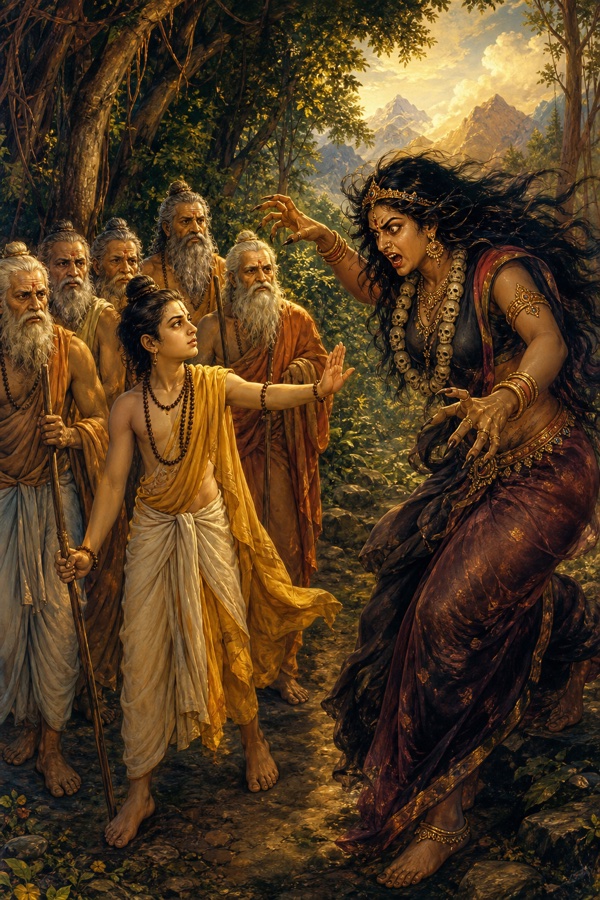
When the ministers had told him, King Vrishadarbhi was filled with rage against all those Rishis, and he went into his own chamber to take his revenge. There he undertook the hardest austerities and poured libation after libation of ghee onto his sacred fire, speaking a mantra over each. Out of that fire, born of the incantation, rose a shape that would have struck fear into anyone. Vrishadarbhi named her Yatudhani. Terrible as the Last Night, she stood before the king with her palms joined and asked: “What shall I do?” “Go after the seven Rishis,” he told her, “and Arundhati, and the husband of their maidservant, and the maidservant herself, and understand what their names mean. When you have made sure of their names, kill them all. After that you may go wherever you like.”
“So be it,” the Rakshasi said, and in her own form she went to the forest where the great Rishis were wandering in search of food. They were living on fruits and roots, Atri among them, and as they roamed they came on a wandering mendicant who looked nothing like themselves: broad in the shoulder, plump in the arms and legs, full in the face and the belly, every limb of him fat, and walking with a dog at his side. Arundhati looked at that handsome, well-fed figure and said to the Rishis: “Not one of you will ever show a body like that.” Each of them had an explanation. Vasishtha said that the man’s sacred fire was unlike theirs: he could pour his libations on it morning and evening, which none of them could do, and that was why he and his dog looked so well. Atri said the man did not feel hunger as they did; his energy had suffered no loss like theirs, and his Vedas, won with the greatest difficulty, had not slipped away from him as theirs had. Vishvamitra said the man was still able to keep the eternal duties the scriptures teach. “I have grown idle,” he said. “I feel the pangs of hunger. I have lost the knowledge I had gained, and he has not.” Jamadagni said the man had no need to think about laying in a year’s grain and fuel, as they were forced to. Kashyapa said he did not have four full brothers begging from house to house crying “Give, give.” Bharadvaja said he carried no regret like theirs for having condemned and cursed his wife, and had never acted so wickedly and senselessly. Gautama said the man did not have, as they had, only three coverings of kusha grass and a single skin of the Ranku deer, each of them three years old. And each one ended the same way: “That is why I see him and his dog so sleek.”
The mendicant, seeing the great Rishis, came up and greeted every one of them by touching the hand, as custom required. They talked together of how hard it was to find anything to live on in that forest and how hunger simply had to be borne, and then they all moved on in one company, with one purpose, picking fruit and digging roots. One day in their wandering they came on a beautiful lake overgrown with lotuses. Trees stood thick along its banks. The water was pure and clear, the lotuses that covered it were the color of the morning sun, and the leaves floating on the surface were the color of lapis lazuli. Water birds of many kinds were playing on it. A single path led down to it, the banks were firm underfoot, and the water was easy to reach. And at Vrishadarbhi’s bidding the Rakshasi born of his incantations, Yatudhani of the frightful face, stood guard over it. The Rishis, with Pashusakha among them, went toward the lake to gather lotus stalks, and saw her standing on the bank. “Who are you,” they asked, “standing alone in this empty forest? Whom are you waiting for? What is your purpose, and what are you doing here beside this lake of lotuses?”
“It does not matter who I am,” Yatudhani said. “I am not to be questioned. Know that I am the guard set to watch this lake.” The Rishis said, “We are all hungry, and we have nothing else to eat. With your leave we would gather some lotus stalks.” “Take the stalks as you please,” she said, “on one condition. One by one you must give me your names. Then you may take them without delay.” Atri understood who she was. He knew her name was Yatudhani, and he knew she stood there to kill them once the meanings of their names had told her how far their power reached. Famished as he was, he answered her first. “I am called Atri,” he said, “because I cleanse the world of sin. I study the Vedas three times every day, and so I have made days of my nights; the night in which I have not studied the Vedas is no night. For these reasons too I am called Atri, lovely lady.” Yatudhani said, “The explanation you have given me of your name is beyond my understanding. Go, then, and plunge into this lake full of lotuses.”
One after another they stepped up and did the same. Vasishtha said, “I possess the wealth of yoga and its powers. I live the life of a householder, and I am held the first of all who live it. Because of that wealth, because I dwell in a house, and because I am counted first among householders, I am called Vasishtha.” She told him the derivation was entirely beyond her, the roots having been bent out of recognition, and sent him into the lake. Kashyapa said, “I always protect my body, and my penances have given me radiance. For guarding the body, and for that radiance, I have come to be called Kashyapa.” Bharadvaja said, “I always support my sons, my disciples, the gods, the Brahmins and my wife, and because I bear them all with ease I am called Bharadvaja.” Gautama said, “I have conquered heaven and earth by self-restraint. I look on all creatures and all things with an equal eye, and so I am like a smokeless fire, and you cannot subdue me. When I was born, the light of my body drove off the darkness around it. For these reasons I am called Gautama.” Vishvamitra said, “The gods of the universe are my friends, and I am the friend of the universe. Know, Yatudhani, that this is why I am called Vishvamitra.” Jamadagni said, “I sprang from the sacrificial fire of the gods, and so I am Jamadagni.” Arundhati said, “I always stay at my husband’s side and hold the earth together with him, and I always turn my husband’s heart toward me. For these reasons I am called Arundhati.” Ganda said, “Ganda means a part of the cheek. Mine stands a little higher than the rest, and so, creature of Shaivya’s sacrificial fire, I am called Ganda.” Pashusakha said, “I protect and tend every animal I see, and I am a friend to all animals always. Hence I am Pashusakha.” To each of them Yatudhani gave the same reply: the explanation was beyond her because of the changes the roots had undergone, and the speaker should go and plunge into the lake of lotuses.
Last came the mendicant with the dog. “I cannot explain the derivation of my name the way these ascetics have done,” he said. “Know, Yatudhani, that I am called Shunahsakha.” She said, “You have spoken your name only once, and I could not catch the explanation you offered. Say it again.” “Since you could not catch my name at one telling,” Shunahsakha answered, “I will strike you with my triple staff. Be struck, and burn to ashes on the spot.”
The sannyasin brought the triple staff down on her head, and it fell with the force of a Brahmin’s own rod of chastisement. The Rakshasi who had sprung from King Vrishadarbhi’s incantations dropped to the earth and was reduced to ashes. Having destroyed her, Shunahsakha drove his staff into the ground and sat down on a patch of grass. The Rishis went into the water and pulled as many lotuses and lotus stalks as they liked, and came up out of the lake full of joy. They threw down on the bank the heap they had gathered with so much labor and went back in once more, to offer water to the Pitris. When they came out again they walked to the place on the bank where they had left the stalks. The stalks were nowhere to be seen.
The gist: Furious that the Rishis had seen through him, King Vrishadarbhi raised a Rakshasi named Yatudhani from his sacred fire and sent her to learn the meanings of their names and kill them. She waited at a lotus lake and demanded each name in turn, and could make nothing of the derivations they gave her. The well-fed mendicant who had joined the party with his dog, Shunahsakha, whose name means friend of dogs, struck her to ashes with his triple staff. The Rishis gathered their lotus stalks, bathed, and came back to find the stalks gone.
The oaths over the lotus-stalks and the revelation of Indra
Hunger made the loss unbearable. “What sinful, hard-hearted man,” the Rishis cried, “has stolen the lotus stalks that we gathered in our hunger and meant to eat?” They looked at one another with suspicion, and it was said among them that each would have to swear to his innocence. Starved and worn out as they were, they agreed, and one by one they called down on the thief the worst things they could think of. Atri said, “Let him who stole the lotus stalks touch cows with his foot, make water facing the sun, and study the Vedas on the days when study is forbidden.” Vasishtha said, “Let him give up studying the Vedas, or keep hounds on the leash, or be a wandering mendicant who ignores the rules laid down for that life, or kill those who come to him for protection, or live on what he gets by selling his daughter, or beg wealth from the low and the vile.”
Kashyapa said, “Let him say every kind of thing in every kind of place, give false evidence in a court of law, eat the flesh of animals not killed in sacrifice, give to the undeserving, or to the deserving at the wrong time, and lie with women in the daytime.” Bharadvaja said, “Let him be cruel and unrighteous in his conduct toward women, toward kinsmen and toward cows. Let him humiliate Brahmins in debate by showing off his greater knowledge and skill. Let him study the Riks and the Yajuses in disregard of his teacher. Let him pour his libations on fires made of dry grass or straw.” Jamadagni said, “Let him be guilty of throwing filth and dirt into water. Let him bear ill will toward cows. Let him lie with women outside their season. Let everyone turn from him in aversion. Let him live on his wife’s earnings. Let him have no friends and many enemies. Let him be another man’s guest in order to collect a return on the hospitality he once showed that man.”
Gautama said, “Let him be guilty of throwing the Vedas away after studying them. Let him abandon the three sacred fires. Let him be a seller of Soma. Let him live with the kind of Brahmin who stays in a village with a single well, from which every class draws its water, and who has married a Shudra woman.” Vishvamitra said, “Let him be fated to see his teachers, his elders and his servants supported by others while he is still alive. Let him come to no good end. Let him be the father of many children. Let him be always impure, a wretch among Brahmins, proud of what he owns. Let him be a tiller of the soil and full of malice. Let him wander in the season of the rains. Let him be a paid servant. Let him be the priest of a king, and let him officiate at the sacrifices of impure people who deserve no priest.” Then the women swore. Arundhati said, “Let her who stole the lotus stalks always humiliate her mother-in-law. Let her be always vexed with her husband. Let her eat whatever good things come into her house without sharing them. Let her live in her husband’s house with no regard for his kinsmen and eat, at the close of day, the flour of fried barley. Let her be a woman no one cares to enjoy, and let her be the mother of a hero.” Ganda said, “Let her always speak falsehoods. Let her always quarrel with her kinsmen. Let her give her daughter in marriage for a price. Let her eat the food she has cooked alone, sharing it with nobody. Let her pass her whole life in slavery, and let her be found with child from a guilty union.” Pashusakha said, “Let him who stole the stalks be born of a slave mother. Let him have many children, every one of them worthless. And let him never bow to the gods.”
Then Shunahsakha took his oath. “Let him who removed the lotus stalks,” he said, “have the merit of giving his daughter in marriage to a Brahmin who has studied all the Samans and the Yajuses and kept the vow of brahmacharya with care. Let him take the final bath of one who has studied all the Atharvans.” The Rishis turned on him together. “That oath is no oath at all,” they said. “Everything you have named is exactly what a Brahmin most desires. It is plain, Shunahsakha, that you are the one who took our lotus stalks.” He did not deny it. “The stalks you set down are not to be seen,” he said, “and what you say is perfectly true: I stole them. I made them vanish before your very eyes. I did it because I wished to test you, and I came here in the first place to protect you. The woman lying dead over there was called Yatudhani. She was fierce by nature, risen from the incantations of King Vrishadarbhi, and she came here at his urging to kill every one of you. That wicked creature of the sacrificial fire would have had your lives, and I came to kill her and to save you. Know that I am Vasava. You have freed yourselves completely from the grip of greed, and by doing so you have won many eternal worlds, where every wish is fulfilled the moment it rises in the heart. Get up from this place without delay and go to those blessed worlds that are kept for you.”
The great Rishis were glad to hear it. “So be it,” they said to Indra, and they went up to heaven in his own company. “Consider what they had refused,” Bhishma said. “They were starving, and in that very hour they were tempted with every kind of good thing, and they would not yield. Heaven was the fruit of that self-denial. So it appears that a man should cast off greed whatever his circumstances; that is the highest duty there is.” He added what the telling itself is worth. A man who recites this account of the Rishis in gatherings of men gains wealth and never comes to a wretched end. The Pitris, the Rishis and the gods are all pleased with him, and in the life after this one he has fame, merit and wealth.
The gist: Suspecting one another of the theft, the seven Rishis, Arundhati, Ganda and Pashusakha each call down a curse on whoever took the stalks, and the curses add up to a list of what a Brahmin must never be. Shunahsakha alone wishes the thief the merit of a good marriage gift and a completed course of study, and so gives himself away. He is Indra, who killed Yatudhani to protect them and hid the stalks to test them, and he takes them all to heaven as the reward of their freedom from greed.
Agastya’s lotus-stalks and Indra’s second test
“There is another old history on this same matter,” Bhishma said: “the oaths that were sworn, one after another, on a journey to the sacred waters. That time the theft was committed by Indra himself, and the oaths were taken by a great many Rishis, royal and Brahmin together.” The Rishis had once assembled and gone to Prabhasa in the west, and there they took counsel and resolved to visit every sacred water on the earth. In the company were Indra, whom they also call Shakra, with Angiras, Agastya, Narada, Parvata and the deeply learned Kavi; Bhrigu, Vasishtha, Kashyapa, Gautama, Vishvamitra and Jamadagni; the Rishi Galava, Ashtaka, Bharadvaja, Arundhati and the Valakhilyas; and the kings Shibi, Dilipa, Nahusha, Ambarisha, Yayati, Dhundhumara and Puru. They put Indra of the hundred sacrifices, the killer of Vritra, at their head, and went from one sacred water to the next, and on the day of the full moon in the month of Magha they reached the holy river Kaushiki. Having washed away every sin by bathing at all those places, they came at last to the very sacred lake called Brahmasara.
They bathed in the lake, those Rishis bright as fire, and then began to pull up the stalks of the water plants and eat them. Some drew out the stalks of the lotus and some the stalks of the water lily. It was soon discovered that the stalks Agastya had pulled and laid on the bank had been taken by somebody. Agastya addressed the whole company. “Who has taken the good stalks I drew out and put down here?” he asked. “I suspect it must be one of you. Let whoever took them give them back to me. It is wrong of you to make off with my stalks.” Then his anger widened into something larger than the theft. “We have heard,” he said, “that Time attacks the strength of Righteousness. That Time has come upon us, and Righteousness is under assault. It is fitting that I should go to heaven for good, before unrighteousness attacks the world and makes itself at home here.”
He named what he did not intend to stay and see. “Before the time comes when Brahmins recite the Vedas at the top of their voices inside villages and settled places, so that Shudras hear them; before the time comes when kings offend against the rules of Righteousness for reasons of policy, I shall go to heaven for good. Before men stop observing the distinctions among the lower, the middle and the higher classes, I shall go to heaven for good. Before Ignorance attacks the world and wraps everything in darkness, I shall go to heaven for good. Before the time comes when the strong lord it over the weak and treat them as slaves, I shall go to heaven for good. I do not dare remain on earth to witness these things.” The Rishis were shaken by what he said. “We have not stolen your stalks,” they told the great ascetic. “You should not hold these suspicions against us. We will swear the most frightful oaths.” And so, knowing themselves innocent and wishing to uphold the cause of righteousness, the Rishis and the royal sages began to swear, one after another.
Bhrigu said, “Let him who stole your stalks return abuse when he is abused and blows when he is struck, and let him eat the flesh that clings to the backbone of animals.” Vasishtha said, “Let him neglect his Vedic studies, keep hounds on the leash, and, having entered the order of mendicants, live in a city or a town.” Kashyapa said, “Let him sell every kind of thing in every kind of place, make off with what has been deposited in his keeping, and give false evidence.” Gautama said, “Let him live displaying pride in everything, with a mind that does not look on all creatures with an equal eye, always giving in to desire and anger. Let him be a tiller of the soil, and let malice drive him.” Angiras said, “Let him be always impure. Let him be a Brahmin men rightly blame. Let him keep hounds. Let him be guilty of killing a Brahmin. Let him be unwilling to perform the expiation after he has transgressed.”
The kings swore in the same spirit. Dhundhumara said, “Let him be ungrateful to his friends. Let him be born of a Shudra woman. Let him eat alone whatever good food comes to the house, sharing it with no one.” Dilipa said, “Let him go down to those regions of misery and infamy that are kept for the Brahmin who lives in a village with a single well and lies with a Shudra woman.” Puru said, “Let him take up the trade of a physician. Let him be supported by what his wife earns. Let him draw his living from his father-in-law.” Shukra said, “Let him eat the flesh of animals not killed in sacrifice. Let him lie with a woman in the daytime. Let him be a servant of the king.” Jamadagni said, “Let him study the Vedas on forbidden days and occasions. Let him feed his friends at the shraddhas he performs. Let him eat at the shraddha of a Shudra.”
Shibi said, “Let him die without ever having established a fire for daily worship. Let him be guilty of obstructing other men’s sacrifices. Let him quarrel with those who practice penance.” Yayati said, “Let him lie with his wife when she is not in her season, while he himself is under a vow and wears matted locks on his head, and let him disregard the Vedas.” Nahusha said, “Let him live as a householder after taking the vow of mendicancy. Let him behave exactly as he pleases after undergoing the rites of initiation for a sacrifice or a solemn observance. Let him take payment for the lessons he gives his disciples.” Ambarisha said, “Let him be cruel and unrighteous in his conduct toward women, kinsmen and cows, and let him be guilty of killing a Brahmin as well.” Narada said, “Let him be one who takes the body for the soul. Let him study the scriptures under a teacher who deserves censure. Let him chant the Vedas with a fault of pronunciation at every step. Let him disregard all his elders.”
Nabhaga said, “Let him always speak falsehoods and quarrel with the righteous. Let him give his daughter in marriage after taking a payment offered by his son-in-law.” Kavi said, “Let him be guilty of striking a cow with his foot. Let him make water facing the sun. Let him cast off the person who seeks shelter at his hands.” Vishvamitra said, “Let him become a servant who deals deceitfully with his master. Let him be the priest of a king. Let him be the Ritvik of a man whose sacrifice no one ought to assist.” Parvata said, “Let him be the headman of a village. Let him make his journeys on asses. Let him keep hounds for a living.” Bharadvaja said, “Let him bear every fault that belongs to the man who is cruel in his conduct and untruthful in his speech.” Ashtaka said, “Let him be a king without wisdom, capricious and sinful in his conduct, and inclined to rule the earth unrighteously.” Galava said, “Let him be more infamous than a sinful man. Let him be sinful in what he does to his kinsmen and relations. Let him proclaim the gifts he makes to others.”
Arundhati said, “Let her who stole your stalks speak ill of her mother-in-law. Let her feel disgust for her husband. Let her eat alone any good food that comes to her house.” The Valakhilyas said, “Let him stand on one foot at the entrance of a village to earn his keep, and let him, knowing every duty, be guilty of breaking every one.” Shunahsakha said, “Let him be a Brahmin who sleeps happily after neglecting his daily homa. Let him become a religious mendicant and then behave in whatever way he likes, under no restraint.” Last of all Surabhi, the cow, swore: “Let her who stole your stalks be milked with her hind legs tied by a rope of human hair, and with the help of a calf that is not her own, and let her milk be caught in a vessel of white brass.”
When the Rishis and the royal sages had sworn all these oaths, the thousand-eyed chief of the gods was filled with joy. He looked at Agastya, who was still furious over his vanished stalks, and there in the midst of that company of Brahmin Rishis, celestial Rishis and royal sages he said what was in his mind. “Let him who stole your stalks,” said Shakra, “have the merit of the man who gives his daughter in marriage to a Brahmin who has duly kept the vow of brahmacharya, or has duly studied the Samans and the Yajuses. Let him have the merit of one who takes the final bath on completing his study of the Atharva Veda. Let him who stole your stalks have the merit of having studied all the Vedas. Let him keep every duty and be righteous in his conduct. Let him go to the world of Brahma.” Agastya heard the difference at once. “Killer of Vala,” he said, “you have spoken a blessing where a curse was called for. You took my stalks. Give them back to me, for that is the eternal duty.”
Indra answered, “Greed had nothing to do with it. I took your stalks because I wanted to hear this assembly recite the duties we ought to keep. Do not give way to anger. Duties are the first of the Shrutis; duties are the eternal road. I have now heard the Rishis discourse on them, a discourse that is eternal and unchanging and beyond all alteration. So take back these stalks of yours, most learned of Brahmins. Forgive my transgression.” At these words from the chief of the gods the ascetic Agastya, who had been so angry, took back his stalks, and the wise Rishi’s good humor returned. After that those dwellers in the forest went on to many other sacred waters and bathed at every one of them.
A sub-tale: Bhishma closes with the fruit of the telling. The man who reads this narrative with close attention on every parva day will never be the father of an ignorant and wicked son. He will never lack learning. No calamity will touch him, and he will be free of every kind of sorrow. Decrepitude and decay will not be his. Free of every stain and rich in merit, he is sure to reach heaven; and whoever studies this shastra, which the Rishis themselves observed, is sure to reach the eternal and blissful world of Brahma.
The gist: On a pilgrimage led by Indra, the stalks Agastya has gathered at the lake Brahmasara disappear, and Agastya threatens to leave for heaven before unrighteousness takes over the world. To clear themselves the Rishis and kings each swear an oath, and each oath names a way of life they hold in contempt. Indra alone wishes the thief merit, is found out, and explains that he took the stalks so as to hear the assembly speak on duty. He returns them and asks pardon, and Agastya is appeased.
The gifts of parasol and shoes, the dialogue of Jamadagni and the sun
Yudhishthira had noticed a custom at these rites that nobody had accounted for. “Who first began the giving of umbrellas and sandals at ceremonies for the dead,” he asked, “and why, and to what end? They are given at other religious rites too, on many occasions, for the sake of merit. I want to know the true meaning of the custom in detail.” Bhishma promised him the whole of it: who introduced the practice, how it gained the force of a permanent observance, and how it came to be thought meritorious. “It goes back,” he said, “to what passed between Jamadagni and Surya, the Sun.” Long ago Jamadagni of Bhrigu’s line was practicing with his bow. He would take aim and loose arrow after arrow, and his wife Renuka would pick up the shafts and carry them back to him, again and again. He liked the hiss of the arrows and the twang of the string, and he amused himself in this way, shooting what Renuka returned to him. Then came a day in the month when the sun stands in Jyeshthamula. It was noon. The Brahmin had shot away all his arrows, and he said to his wife: “Go and bring me the shafts I have loosed, large-eyed Renuka. I will shoot them again.”
She set off on the errand, and the heat stopped her. The sun had scorched her head and her feet, and she had to sit down in the shade of a tree. Dark-eyed, graceful Renuka rested there only a moment. She was afraid of her husband’s curse, and so she got up and went back to collecting the arrows. With all of them in her hands she returned, sick at heart, her feet smarting, and came up to her husband trembling. The Rishi was full of anger, and he put the same question to his fair-faced wife over and over: “Renuka, why have you been so long in coming back?” She told him the truth. “My head and my feet were scorched by the rays of the sun. The heat overcame me, and I went into the shade of a tree. That alone is the cause of the delay. Now that you know it, do not be angry with me.”
Jamadagni’s anger found a new target at once. “Renuka,” he said, “this very day I will destroy that blazing star of the day that has hurt you so, with the fiery power of my weapons.” He drew his celestial bow, took up a great many arrows, and stood with his face turned to the sun, watching it move across the sky. Surya saw a man making ready for battle with him, and he came to Jamadagni in the form of a Brahmin and spoke. “What has Surya done to displease you? He travels the sky and draws the moisture up out of the earth, and he pours it back on her as rain. That is how the food of human beings springs up, the food they find so pleasant. The Vedas say that food is the breath of life itself. Hidden in the clouds and wrapped in his own rays, the sun drenches the seven islands with showers, and that moisture spreads into the leaves and fruits of plants and herbs and is turned into food.”
The Brahmin who was the Sun pressed the point. “Consider,” he said: “the rites of birth, religious observances of every kind, the investiture with the sacred thread, gifts of cows, weddings, everything gathered for a sacrifice, the rules by which men are governed, gifts, every kind of union between people, and the gaining of wealth all have their origin in food. You know this well. Every good and pleasant thing in the universe, and every effort living creatures make, flows from food. I am only reciting what you already know. So calm your anger. What will you gain by annihilating the sun?” Yudhishthira broke in to ask what Jamadagni did when the maker of day pleaded with him like that. “He kept his anger,” Bhishma said; “for all Surya’s entreaties the sage went on burning like a fire.” So Surya, still in his Brahmin’s form, bowed his head, joined his hands, and tried a gentler argument. “The sun is always moving,” he said. “How will you pierce the lord of day, who never stops going forward?”
Jamadagni was not deceived for a moment. “With the eye of knowledge,” he said, “I know you to be both moving and motionless, and I will certainly teach you a lesson today. At midday you seem to stand still in the heavens for an instant. That is when I will pierce you with my arrows, Surya. I will not turn from this resolve.” Then the Sun gave up argument. “Without doubt you know me,” he said, “great archer that you are. I have offended; even so, see, I come to you as a suppliant asking your protection.” At that Jamadagni smiled. “Surya,” he said, “since you have sought my protection you have nothing to fear. The man who would kill a suppliant would have to overstep the simplicity that is in Brahmins, the steadiness that is in the Earth, the mildness in the Moon, the gravity in Varuna, the radiance in Agni, the brightness of Meru and the heat of the sun. A man who can kill one who has come to him for protection is capable of violating his teacher’s bed, of killing a Brahmin, of drinking liquor. So find some remedy for this evil, some way for people to be relieved when your rays have heated them.”
Having said so much, the descendant of Bhrigu fell silent for a while, and Surya handed him at once an umbrella and a pair of sandals. “Take this umbrella,” he said. “With it the head can be protected and my rays kept off. This pair of sandals is made of leather, to protect the feet. From this day on the gift of these two things shall be a fixed usage in all religious rites.”
“So it was Surya who began the custom of giving umbrellas and shoes,” Bhishma said, “and through the three worlds these gifts are counted meritorious. Give umbrellas and shoes to Brahmins yourself; I have no doubt you will earn great merit by it.” The man who gives a Brahmin a white umbrella with a hundred ribs comes after death to lasting happiness and lives in the world of Indra, respected by Brahmins, Apsaras and gods. The man who gives shoes to snataka Brahmins, and to Brahmins busy with the rites of religion whose feet are sore from the heat of the sun, reaches worlds the gods themselves desire, and after his death he lives in happiness in the highest heaven.
A key to reading this: Jamadagni belongs to the line of Bhrigu, and Renuka is his wife. The quarrel happens at noon, in the month when the sun is in Jyeshthamula. Jamadagni knows from the first that the Brahmin pleading with him is Surya. What disarms him is the claim of a suppliant: a man able to kill one who has asked his protection is ranked with the violator of a teacher’s bed, the killer of a Brahmin and the drinker of liquor.
The gist: Renuka, fetching her husband’s arrows at noon, is scorched on the head and feet, and Jamadagni takes up his bow to shoot down the sun. Surya comes as a Brahmin and argues that rain, food and every rite of life flow from him, and the sage is unmoved. When Surya asks for protection as a suppliant, Jamadagni spares him and demands a remedy for the heat. Surya gives the first umbrella and the first pair of leather sandals, and decrees that both be given at every religious rite.
The dialogue of Vasudeva and the goddess Earth, the householder’s dharma
From gifts Yudhishthira came back to the house itself. “Tell me all the duties of the householder’s life,” he asked, “and everything a man must do to prosper in this world.” Bhishma answered with an old story of Vasudeva and the goddess Earth. The mighty Vasudeva had once sung the praises of the Earth and then put this very question to her. “Having taken up the state of a householder,” he asked, “what acts should I perform, or anyone like me, and how do such acts come to bear good fruit?”
“Madhava,” the goddess said, “a householder worships the Rishis, the gods, the Pitris and men, and he performs sacrifices. Learn this from me too: the gods are always pleased by sacrifices, and men are pleased by hospitality. The householder should therefore satisfy them with the things they want, and by doing so he pleases the Rishis as well. Each day, before he has eaten, he attends to his sacred fire and to his sacrificial offerings, and with that the gods are content. Each day he makes offerings of food and water for the Pitris, or of fruits, roots and water. He performs the Vaishvadeva offering with boiled rice and pours oblations of clarified butter to Agni, to Soma and to Dhanvantari, and he makes a separate and distinct oblation to Prajapati.”
“Then the offerings go out in their order,” the Earth said, “each to its quarter: to Yama in the south, to Varuna in the west, to Soma in the north, to Prajapati within the homestead, to Dhanvantari in the northeast, and to Indra in the east. At the entrance of his house he offers food to men. These, Madhava, are what are called the bali offerings. The bali for the Maruts and the gods is set out inside the house. For the Vishvedevas it is set out under the open sky, and for the Rakshasas and the spirits the offerings are made at night. When these are done he makes offerings to Brahmins, and if no Brahmin is at hand the first portion of the food is put into the fire. When a man means to offer a shraddha to his ancestors, he completes the shraddha and satisfies them first, then makes the bali offerings in their order, then the offerings to the Vishvedevas. After that he invites Brahmins, and then he feeds the guests who have arrived at his house, and feeds them properly. That is how guests are pleased.”
The Earth defined the word. “A guest is one who does not stay in the house long, or who comes and goes away again after a short time. To his teacher, to his father, to his friend and to a guest the householder says: ‘This is what I have in my house to offer you today.’ And he offers it accordingly, every day, and does whatever they ask of him. Such is the established usage. The householder himself, Krishna, eats last of all, after he has offered food to every one of them. With the offering of madhuparka he honors his king, his priest, his teacher and his father-in-law, and snataka Brahmins too, even if they should stay in his house for a whole year. In the morning and again in the evening food is put out on the ground for dogs, for Shvapachas and for birds; this is called the Vaishvadeva offering. The householder who performs these rites with a mind unclouded by passion has the blessings of the Rishis in this world, and after death he reaches the heavenly worlds.” “Vasudeva listened to all of this from the goddess Earth,” Bhishma said, “and he acted on it. Do the same yourself. By keeping these duties of a householder you will win fame here and heaven afterward.”
The gist: Asked by Vasudeva what a householder must do, the goddess Earth lists his daily debts: sacrifice for the gods, food and water for the Pitris, hospitality for men, the Vaishvadeva oblations to Agni, Soma, Dhanvantari and Prajapati, and bali offerings set out quarter by quarter, at the door, under the open sky and at night. Brahmins and guests are fed next, food goes on the ground for dogs, Shvapachas and birds, and the householder himself eats last.
How the offering of flowers and lamps began: Suvarna, Manu, and Shukra with Bali
Yudhishthira’s next question was about a flame. “Of what kind is the gift of light?” he asked. “How did this gift begin, and what merits attach to it? Tell me all of it.” Bhishma said that an old account is recited on the subject, a conversation between Manu, lord of creatures, and a man called Suvarna. In the old days there was an ascetic whose skin was the color of gold, and for that he was named Suvarna, the gold-complexioned. He came of a pure lineage, his conduct was good and his accomplishments excellent, and he had mastered all the Vedas. By those accomplishments he had come to surpass many men of high birth.
One day this learned Brahmin caught sight of Manu, the lord of all creatures, and went up to him. They met and exchanged the usual courteous inquiries. Both were men firm in the keeping of truth. They sat down together on the delightful breast of Meru, the mountain of gold, and there they talked of many things, of the gods and the Brahmin Rishis and the Daityas of ancient times.
Then Suvarna put a question to Manu, the Self-born. “Answer me one thing,” he said, “for the benefit of all creatures. The gods are seen to be worshiped with gifts of flowers and other sweet scents. What is this? How did the practice begin? What merits attach to it? Speak to me on this subject.”
Manu answered with a history older still, the conversation of Shukra and Bali. “Once,” he said, “Shukra of Bhrigu’s line came to visit Bali, the son of Virochana, in the days when Bali ruled the three worlds.” The chief of the Asuras, a giver of sacrificial gifts in abundance, honored the descendant of Bhrigu with the arghya and offered him a seat, and sat down himself only when his guest was seated. The very subject Suvarna had raised came up between them. “You know Brahman better than any ascetic,” Bali said. “What is the merit of giving flowers and incense and lamps? Tell me this.”
Shukra went back to the beginning of things. “Penance came into being first,” he said, “and Dharma, compassion and the other virtues, came after it.” In the interval between the two a multitude of creepers and herbs sprang to life, in species beyond counting, and every one of them has the god Soma for its lord. Some of these plants came to be regarded as amrita, some as poison, and a third class was neither one nor the other.
He told the Asura how to know the two apart. Amrita is whatever gives the mind immediate satisfaction and joy. Poison is whatever tortures the mind by its very smell. Amrita is highly auspicious and poison highly inauspicious. All the herbs are amrita, while poison was born of the energy of fire. Flowers gladden the mind and confer prosperity, and for that reason men of righteous deeds gave them the name sumanas.
“A man who is in a state of purity and offers flowers to the gods finds the gods pleased with him,” Shukra said, “and in their pleasure they give him prosperity.” The gods to whom worshipers offer flowers, speaking their names as they offer, are pleased with the gift because of the devotion in it. The herbs are of many kinds and of many kinds of power, and they are to be classed as fierce, mild and strong. “Listen, Bali, while I tell you which trees are useful for sacrifice and which are useless, which garlands the Asuras accept and which do good when offered to the gods. I will set out in due order the garlands that please the Rakshasas, the serpents, the Yakshas, human beings and the Pitris.”
A sub-tale: Three conversations sit one inside another. Yudhishthira asks Bhishma about lamps. Bhishma tells of Suvarna asking Manu about flowers and scents, and Manu tells of Bali asking Shukra about flowers, incense and lamps. The whole teaching on flowers, incense, lamps and the bali offering is Shukra’s, spoken to the Asura king in the days when Bali ruled the three worlds.
The gist: Yudhishthira asks how the gift of light began. Bhishma goes back to the gold-complexioned ascetic Suvarna, who asked Manu on Mount Meru why the gods are worshiped with flowers and scents, and Manu goes back to what Shukra told Bali. Shukra starts from the creation of the plants, which have Soma for their lord. He divides them into amrita, poison and a class that is neither, and says why flowers are called sumanas.
The gift of flower, incense, and lamp, and to whom each is dear
“Flowers are of many kinds,” Shukra told Bali. Some grow wild. Some come from trees that stand among the houses of men, some from trees that never grow unless they are planted in well-tilled soil, some from trees on the mountains; some come from trees without thorns and some from trees that have them. They can be sorted as well by fragrance, by beauty of form and by taste. The scent flowers give is of two kinds, pleasant and unpleasant, and the flowers of pleasant scent are the ones to offer to the gods. The flowers of thornless trees are for the most part white, and such flowers the gods always accept. A wise man offers garlands of water flowers, the lotus and its like, to the Gandharvas, the Nagas and the Yakshas. Plants and herbs that bear red flowers, sharp in scent and prickly, are laid down in the Atharvan for every act of incantation meant to injure an enemy. And flowers of fierce energy, painful to the touch, growing on thorny trees and plants, blood-red or black, are offered to evil spirits and unearthly beings.
For human beings there is another kind. Flowers that gladden the mind and the heart, that are very pleasant when they are pressed and beautiful in form, are the ones declared worthy of being offered to men. Flowers that grow in cemeteries and cremation grounds, or in places dedicated to the gods, must never be brought and used at a marriage or at any other rite whose object is growth and prosperity, and they must never be used in the private pleasures of love. Flowers born on the mountains and in the valleys, pleasing in scent and appearance, are to be offered to the gods. They are sprinkled with sandal paste and offered duly, as the ordinances of the scriptures direct.
Each kind of being takes its pleasure from a flower in its own way. The gods are pleased by the scent of flowers, the Yakshas and Rakshasas by the sight of them, the Nagas by their touch, and human beings by all three, scent and sight and touch together. Flowers offered to the gods please them at once. And the gods can accomplish any object by wishing it accomplished, so that when they are pleased with a devotee who brings them flowers they see to it that everything he cherishes is accomplished without delay. Pleased, they please their worshipers. Honored, they cause their worshipers to enjoy every honor. Disregarded and insulted, they bring those vilest of men to ruin and burn them up.
“After flowers,” Shukra said, “I will speak of the merits that belong to the gift of incense. Know that incense is of many kinds, some auspicious and some inauspicious.” Some incenses are the gums that trees exude. Some are fragrant woods set on fire. Some are made by hand, from many things mixed together. Their scent too is of two kinds, pleasant and unpleasant. Of the gums, all are pleasing to the gods except the gum of the frankincense tree, and the finest gum of all is certainly guggul. Of the incenses of the class called sari, aloe-wood is the best, and it is very pleasing to the Yakshas, the Rakshasas and the Nagas. The gum of the frankincense tree, with others of its class, is much desired by the Daityas. Incense made from the gum of the sal tree and the deodar, mixed with various strong-scented spirits, is ordained for human beings, and such incense is said to please gods, Danavas and spirits at once. Besides these there are many other kinds that men use for their own pleasure and enjoyment. All the merits that have been declared for the offering of flowers belong equally to the gift of incense that gives satisfaction.
“Now,” Shukra said, “I will speak of the merits of the gift of light, and of who may give lights, at what time, in what manner, and of what kind.” Light is said to be energy and fame, and its motion is upward. So the gift of light, which is energy, increases the energy of men. There is a hell named Andhatamas, and the season of the sun’s southward course is likewise held to be dark. To escape that hell and the darkness of that season, a man should give lights while the sun is on his northward course; the good applaud such an act. Because light rises, and because it is counted the remedy for darkness, a man should be a giver of light. That is the conclusion of the scriptures. It is through the lights offered to them that the gods came to have beauty, energy and radiance, and by holding back from such offerings that the Rakshasas came to have the opposite. So lights should always be given. The giver of lights gains keen sight and radiance. No one should look on such a giver with jealousy. Lights are never to be stolen, and never put out when others have given them. The man who steals a light goes blind; he gropes through darkness in the next world with no radiance left to him. The man who gives lights shines in beauty in the celestial worlds like a row of lamps.
A key to reading this (the idea): Shukra reckons the year in two halves by the sun’s course, northward and southward, and counts the southward half dark, as the hell called Andhatamas is dark. A man who dies while the sun is on its southward course is dragged through a thick darkness, and the lamp given in the northward half is the remedy for it. The reasoning rests on what light is said to be: energy and fame, with a motion that goes upward.
Among lights the best are those in which ghee is burned. Next come those that burn the juice pressed from herbs, the oil of mustard seed and castor seed and the like. A man who wants advancement and growth should never burn fat for light, or marrow, or the juice that runs from the bones of creatures. He should give lights where the mountain paths come down, on roads through forests and country hard to cross, under the sacred trees that stand among the houses of men, and at the crossings of streets. The man who gives lights always illumines his family; he gains purity of soul and radiance of body, and after death he reaches the company of the shining bodies in the sky.
“Last,” Shukra said, “I will tell you the merits and the fruits of the bali offerings made to the gods, the Yakshas, the serpents, human beings, spirits and Rakshasas.” Those unscrupulous and wicked men who eat without first serving Brahmins, gods, guests and children should be known for Rakshasas. A man should therefore first offer the food he has made ready to the gods, after worshiping them duly with his senses restrained and his attention gathered, and he should offer the bali to them with his head bent in reverence. The gods are always sustained by the food that householders offer, and they bless the houses in which offerings are made to them. The Yakshas, the Rakshasas and the serpents, and guests and all homeless people too, are sustained by the food that those who live the household life put out; the gods and the Pitris draw their sustenance from such offerings, and being satisfied they repay the offerer with long life, fame and wealth. To the gods a man offers clean food, pleasant in scent and appearance, mixed with milk and curds, and flowers with it. The bali for Yakshas and Rakshasas should be rich with blood and meat, with wines and spirits beside it, and dressed with a coating of parched rice. Bali mixed with lotuses and utpalas is very pleasing to the Nagas. Sesame seeds boiled in raw sugar are offered to the spirits and other unearthly beings.
The man who never takes any food without first serving Brahmins, gods and guests from it becomes entitled to the first portions of food himself, and he grows in strength and energy. So no one should ever eat without first offering a portion to the gods, after worshiping them with reverence. A man’s house shines with beauty because of the household gods who live in it, and whoever desires his own advancement and prosperity should worship those gods by giving them the first portion of everything he eats. “So spoke the learned Kavi of Bhrigu’s line to Bali, chief of the Asuras,” Bhishma said. “Manu afterward recited that discourse to the Rishi Suvarna, Suvarna recited it to Narada, and the celestial Rishi Narada recited to me the merits of each of these acts. Now you know them, my son. Perform them.”
A key to reading this (the idea): Kavi of Bhrigu’s line is Shukra himself. The bali is the portion of prepared food a householder sets out for gods and other beings before he eats, and the word is the same as the name of the Asura king Bali, son of Virochana, to whom Shukra is speaking. The parched rice on the offering for Yakshas and Rakshasas is rice well fried and ground to powder, used as a coating for dishes of meat.
The gist: Shukra assigns each offering to those who want it: fragrant flowers, white flowers and mountain flowers with sandal paste to the gods, water flowers to Gandharvas, Nagas and Yakshas, red and thorny flowers to hostile rites and to spirits, pleasant flowers to men. Incense follows the same division, with guggul the finest gum and aloe-wood first in its class. Lamps are given in the sun’s northward course against the hell Andhatamas, burning ghee or plant oils and never fat. And no one eats before the gods, Brahmins, guests and children have had their share.
The fall of King Nahusha: Bhrigu, Agastya, and the throne of Indra
Yudhishthira was not finished with the subject. “I have heard,” he said, “the merits won by those who give flowers and incense and lights, and the merits of keeping the ordinance of the bali. Speak to me of it once more, grandfather. Tell me again what comes of offering incense and lights. And why is it on the ground that householders set out the bali?” Bhishma answered with an old narrative that concerns three people: Nahusha, Agastya and Bhrigu.
Nahusha was a royal sage, rich in austerity, and by his own good deeds he won the sovereignty of heaven. He lived there with his senses under control, and from him flowed acts of every kind, those that belong to men and those that belong to the gods. The rites of the sacrificial fire, the gathering of sacred fuel and kusha grass and flowers, the bali of food dressed with powdered parched rice, the offering of incense and of light: all of it went on every day in the house of that king while he lived in heaven. He performed the sacrifice of japa, the silent recitation, and the sacrifice of meditation. He had become the chief of the gods, and he went on worshiping all the gods with the proper rites exactly as he had before. He knew why it mattered. Such acts bring a householder prosperity and advancement. When food is cooked, the first portion goes to a Brahmin and the bali goes to the gods of the house, and the pleasure the gods take in such offerings is a hundred times what the householder himself feels in making them. The wise offer incense and lights with bows and prostrations; the rites the learned perform with water at their bathing, bowing to the gods, add to the gods’ content; and the Pitris, the Rishis rich in austerity and the household gods are all satisfied when they are worshiped as they should be. With all this in his mind the great king kept every one of these observances after he had gained the lordship of the gods.
Then, some time later, Nahusha took in what he had become. He was chief of all the gods, and the knowledge filled him with pride. From that day every one of those observances stopped. Puffed up by the boon he had received from all the gods, he made the Rishis themselves carry him on their shoulders. His fortune was already waning. Because he had given up the offerings of incense and light his energy began to fail, and Rakshasas obstructed his sacrifices and his gifts. For a very long time Nahusha, in his pride, kept the greatest of the ascetics as the bearers of his vehicles, making them take the humiliating work by turns. And the day came when it was Agastya’s turn.
On that day Bhrigu, who knew Brahman, came to Agastya where he sat in his hermitage. “Why,” he said, “should we go on patiently bearing the indignity this wicked Nahusha puts on us, now that he has become chief of the gods?” Agastya answered with a question of his own. “How am I to curse Nahusha? You know that the boon-giver himself has given him the highest of boons. When Nahusha came to heaven he asked that anyone who came within range of his sight should be stripped of all energy and fall under his sway. The Self-born granted it, and that is why neither you nor I have been able to burn him, and why no other Rishi has been able to burn him or throw him down from his high place. Brahma also once gave Nahusha nectar to drink, and for that reason too we are powerless against him. It seems the supreme god gave him that boon to plunge all creatures into grief. The wretch behaves most unrighteously toward Brahmins. You speak better than any of us; tell us what should be done, and I will do whatever you advise.”
“I have come to you at the command of the Grandsire,” Bhrigu said, “to break the power of Nahusha, who is strong and whom fate has made a fool. Today that wicked chief of the gods will yoke you to his chariot. Today, with my own energy, I will throw him down from the place of Indra, because he has overstepped every restraint. Before your eyes I will put the true Indra back in his seat, him who has performed a hundred horse sacrifices, and cast the sinful Nahusha out of it. Today that unrighteous king, his understanding ruined by fate, will insult you with a kick and so bring about his own fall. In my anger at that insult I will curse the sinner, that enemy of Brahmins: ‘Become a snake!’ And cries of ‘Shame’ will go up on every side, and he will be drained of all his energy, and before your eyes I will hurl him down to the earth, this doer of unrighteous deeds whom lordship and power have stupefied. I will do it if you consent.” When Bhrigu had said this, Agastya, the son of Mitravaruna, was greatly pleased, and every anxiety left him.
Yudhishthira wanted to see it happen. “How was Nahusha brought to grief?” he asked. “How was he thrown down to the earth, and how was he stripped of the lordship of the gods? Tell me everything.” “That was how the two Rishis spoke together,” Bhishma said, “and this is what followed.” The time had come for Nahusha to put Agastya in harness. Smiling, sure of his strength, he set the great Rishi quickly to the task and commanded him to draw the vehicle from the banks of the Sarasvati. At that moment Bhrigu said to the son of Mitravaruna: “Close your eyes until I have entered the matted locks on your head.” Agastya stood as still as a wooden post, and Bhrigu went into his matted hair, to throw King Nahusha from the throne of heaven. Soon Nahusha saw Agastya coming toward him to pull the vehicle. “Yoke me without delay,” Agastya said to the lord of the gods. “To what place shall I take you? I will draw you wherever you are pleased to direct.” And Nahusha had the ascetic harnessed. Bhrigu, hidden in the matted locks, was well pleased to see it, and he took care never once to let his eyes rest on Nahusha. He knew exactly what power Brahma’s boon had given the king.
Agastya, harnessed like an animal, did not give way to anger. King Nahusha drove him on with his goad, and still the Rishi kept his temper. The lord of the gods lost his, and in his rage he struck Agastya on the head with his left foot. The moment that foot touched the Rishi’s head, Bhrigu, inside the matted locks, blazed up and cursed the sinner. “Since you have struck this great Rishi on the head with your foot,” he said, “fall down to the earth and be a snake, you wretch of wicked mind!” Nahusha had never seen the one who cursed him. He turned into a snake on the spot and fell to the earth. “Had he once set eyes on Bhrigu,” Bhishma said, “Bhrigu’s energy could never have thrown him down.”
Nahusha had given many gifts in his time, and he had his penances and his observances behind him, and because of them he kept his memory even as he fell. He began to beg Bhrigu to set a limit to the curse. Agastya was moved to pity and joined him in soothing Bhrigu, so that the curse might have an end. At last Bhrigu felt compassion for Nahusha and provided for his release. “A king will appear on earth,” he said, “by the name of Yudhishthira, the first of his line. He will rescue you from this curse.” With those words the Rishi vanished from Nahusha’s sight. Agastya, having done the work of the true Indra, the performer of a hundred sacrifices, went back to his own hermitage, honored by all the twice-born. “And it was you,” Bhishma told Yudhishthira, “who rescued Nahusha from Bhrigu’s curse. Freed by you, he went up to the world of Brahma while you looked on.”
As for Bhrigu, once he had thrown Nahusha down he went to the world of Brahma and told the Grandsire what had been done. The Grandsire called Indra back and spoke to the gods. “Through the boon I gave him,” he said, “Nahusha gained the sovereignty of heaven. Agastya in his wrath has taken it from him, and he has been hurled down to the earth. You gods cannot live without a chief. Install Indra once more as lord of heaven.” “So be it,” the gods answered him joyfully, and the divine Brahma set Indra on the throne of heaven again, and Vasava, chief of the gods once more, shone in beauty and splendor. That is what came, long ago, of Nahusha’s transgression, and it was the merit of the observances he had once kept that brought him back in the end to a high place. “Therefore,” Bhishma said, “when evening comes, those who live the household life should give lights.” The giver of lights is sure to gain celestial sight after death, and he becomes as radiant as the full moon. He has beauty of form and strength for as many years as there are instants in the burning of the lamps he gave.
A key to reading this (the lineage and place): Nahusha is a royal sage, a king who won the throne of heaven by his own good deeds; the true Indra, the performer of a hundred horse sacrifices, is called back to it when he falls. Agastya is the son of Mitravaruna, and Bhrigu comes to him on Brahma’s order. The yoking takes place on the banks of the Sarasvati. The king named in Bhrigu’s promise is the Yudhishthira who is listening: Bhishma tells him that he freed Nahusha from the curse and saw him go up to the world of Brahma.
The gist: Nahusha won Indra’s throne by his good deeds and kept every observance there, the lamp and the incense and the bali, until pride made him drop them and harness the Rishis to his vehicle. Brahma’s boon put anyone he looked at in his power, so Bhrigu hid in Agastya’s matted hair, and when Nahusha kicked Agastya on the head Bhrigu cursed him unseen and he fell to earth a snake. Indra was restored. Bhishma draws the rule from it: give a lamp when evening comes.
The tale of the Chandala: never seize a Brahmin’s property
Yudhishthira asked next about a particular kind of thief. “Where do they go,” he said, “those foolish, wretched, sinful men who steal what belongs to Brahmins or turn it to their own use?” Bhishma said he would tell him the old account of a conversation between a Chandala and a Kshatriya of low standing.
The man of the royal order spoke first. “Chandala,” he said, “you look old in years, and you are behaving like a boy. Your body is smeared with the dust that dogs and donkeys kick up, and you pay no attention to it. What troubles you is a few small drops of cow’s milk that have fallen on you. Everyone knows that the acts the pious condemn are the acts ordained for a Chandala. Why, then, are you so anxious to wash those spots of milk off your body?”
The Chandala told him. “Once,” he said, “some cows belonging to a Brahmin were stolen. As they were being driven off, milk from their udders dripped onto a stand of Soma plants growing beside the road. The Brahmins who drank the juice of those plants, wetted as they were with that milk, sank into hell, and so did the king who performed the sacrifice at which that Soma was drunk. He had taken something that belonged to a Brahmin, and for it he went to hell with all the Brahmins who had assisted him. Every man, Brahmin or Kshatriya, who drank milk or ghee or curds in the palace of the king who had stolen the Brahmin’s cows fell into hell as well. And the stolen cows themselves, shaking their bodies, killed with their milk the sons and grandsons of the men who had taken them, and killed the king and the queen too, though the queen treated the animals with great care and attention.”
“As for me,” he went on, “I was living under the vow of brahmacharya in the place where those cows were kept after they had been stolen. The food I got by begging was sprinkled with their milk. I ate that food, and in this life I am a Chandala. The king who stole a Brahmin’s cows came to an infamous end. So no one should ever steal or take for himself anything that belongs to a Brahmin. Look at the state I am brought to for eating food on which a Brahmin’s milk had fallen. This is why a wise man will not sell the Soma plant. Those who sell it are condemned by the wise; the buyer of Soma and the seller both sink into the hell called Raurava when they leave this world and come to the country of Yama. A man who knows the Vedas and sells Soma as a regular thing becomes a usurer in his next life and is quickly destroyed. Three hundred times he sinks into hell, and he is turned into an animal that lives on human dung. Set these three in a balance, service to a vile and low man, pride, and the violation of a friend’s wife, and pride, which oversteps every restraint, will prove the heaviest. Look at this dog here, a man in his former life, so sinful, so sickly pale and lean. It is through pride that living creatures come to an end as miserable as his. In a former birth I was born in a great family, and I was a complete master of every branch of knowledge and every science. I knew how grave all these faults are. Pride blinded me all the same, and I ate the meat that clings to the backbones of animals. That conduct and that food brought me to what I am. See what reverses Time brings about! Like a man whose cloth has caught fire at one end, like a man with bees after him, I am running, look at me, shot through with fear and covered in dust.”
Then he asked for what he had come to ask. “Those who live the household life are rescued from all their sins by study of the Vedas, the wise declare, and by gifts of other kinds. A Brahmin of sinful conduct is rescued from all his sins by study of the Vedas if he takes to the life of the forest and gives up every attachment. I have been born in this life in a sinful order, and I cannot see clearly how I am to cleanse myself. Some meritorious act of a former life has let me keep the memory of the lives I have lived. I throw myself on your mercy and I ask you: resolve my doubt. By what good course of conduct should I seek my release? By what means shall I be rid of my condition as a Chandala?”
The man of the royal order gave him one way and no other. “Know the means, Chandala, by which you may win release,” he said. “Give up your life-breath for the sake of a Brahmin and you may reach a desirable end. Throw your body on the fire of battle, as an offering to the beasts and the birds of prey, for a Brahmin’s sake; by giving up your life in that way you may achieve it. By no other means will you succeed.” “The Chandala heard him,” Bhishma said, “and he poured out his life as a libation on the fire of battle, defending a Brahmin’s wealth, and by that act he came to a very desirable end. Therefore, my son, always protect the property of Brahmins, if the end you want for yourself is everlasting happiness.”
A key to reading this (the idea): Soma is the plant whose juice is drunk at the sacrifice, and in this account selling it and buying it both lead to the hell called Raurava. The Chandala names two causes for his fall. One is begged food on which the milk of a Brahmin’s stolen cows had been sprinkled, eaten while he lived under the vow of brahmacharya. The other is the pride that led him to eat the meat of the backbone, although he had been born in a great family and had mastered every science. Bhishma calls the man he speaks with a low Kshatriya.
The gist: The property of a Brahmin ruins whoever takes it and whoever shares in it, down to a mendicant who ate food splashed with the milk of stolen cows. That man, reborn a Chandala, cares more about a few drops of milk on his skin than about the dust of dogs and donkeys, and he is told there is one release: to die in battle protecting what belongs to a Brahmin. He does so, and reaches a good end.
Gautama and Indra: the dispute over the elephant, and the many worlds of heaven
Yudhishthira had heard so much about the rewards of the righteous that he wanted them compared. “It has been said, grandfather, that all pious men reach the same world after death. Is it true, or is there a difference of place and standing among them?” Bhishma told him that men reach different worlds by different deeds. Those whose conduct is righteous come to worlds of happiness, and the sinful come to worlds full of misery. “On this,” he said, “they tell the old story of what was said between the ascetic Gautama and Vasava.”
A Brahmin named Gautama, mild and self-restrained, with every sense under control, once came on an infant elephant that had lost its mother and was wretched for the loss. Gautama was a man full of compassion and steady in his vows, and he nursed the little animal. After a long time it grew into a large and powerful elephant. One day Indra took the form of King Dhritarashtra and seized that elephant, huge as a hill by then, with the juice of rut trickling down from its split temples. Gautama saw it being dragged away and called out to the king. “Ungrateful Dhritarashtra, do not rob me of this elephant. I look on him as a son, and I reared him with great trouble. They say that between the righteous a friendship springs up if they exchange only seven words. See to it that the sin of injuring a friend does not touch you. You must not take by force this elephant who brings me my fuel and water, who guards my hermitage when I am away, who is docile and obedient to his teacher and careful to do everything his teacher commands, who is gentle and well broken, grateful, and very dear to me. You must not carry him off over my protests and my cries.”
The king who was Indra offered a price. “I will give you a thousand cows,” he said, “a hundred maidservants and five hundred pieces of gold, and other wealth of many kinds besides. What use can a Brahmin have for an elephant?” “Keep your cows,” Gautama said, “and your maidservants and your gold coins and your gems and all your other wealth. What have Brahmins to do with wealth?” Dhritarashtra tried the argument from rank. “Brahmins have no use for elephants. Elephants are meant for men of the royal order. If I take this splendid animal to ride on, no one can say I have done wrong. Stop standing in my way, Gautama.” Then Gautama made a different kind of threat. “Go where you like,” he said. “Even if you go to that country of Yama where the righteous live in joy and the sinful in grief, I will come there and take my elephant back from you.”
That began a strange contest. Gautama would name a world, and Dhritarashtra would say who goes there and announce that he was bound for a higher one. “Only those without good works,” he answered now, “those without faith, the atheists, the men of sinful soul forever busy pleasing their senses, have to go to Yama’s country and bear the misery he deals out. Dhritarashtra will go to a higher world and will never go there.” Gautama said, “Yama’s country is a place where men are kept under control. No untruth can be told there; only truth prevails. There the weak persecute the strong. I will go there and force you to give this elephant up to me.” Dhritarashtra said, “Only those who are drunk with pride and treat their eldest sister, their father and their mother as enemies have to go to such a place. I shall go to a higher world.” Gautama named the next. “There is the world called Mandakini, that belongs to King Vaishravana, reached by the highly blessed for whom every joy and comfort is prepared, where Gandharvas, Yakshas and Apsaras live. Even there I will come and make you give up this elephant.” Dhritarashtra said, “Those who keep hospitality to guests as a vow, who hold to their good vows, who give shelter to Brahmins and who eat what is left after they have shared with all who depend on them, adorn Kubera’s Mandakini.” Gautama said, “Go, then, to the delightful woods on the summit of Meru, decked with flowers, echoing with the sweet voices of the Kinnaris, graced with jambu trees whose branches spread wide. I will follow you even there.” Dhritarashtra said, “Brahmins of mild disposition, devoted to truth, deeply learned in the scriptures, compassionate to all creatures, who study the Puranas together with all the histories, who pour libations on the sacred fire and give gifts of honey to Brahmins, go to those places. I shall go higher. If you know any other famous world of happiness, name it, for I shall go even there.” Gautama said, “Go to the woods that belong to Narada and are dear to him, bright with flowers, ringing with the songs of the prince of the Kinnaras, the eternal home of Gandharvas and Apsaras, and I will follow you there.” Dhritarashtra said, “Those who never ask for alms, who cultivate music and dancing and always go about in joy, proceed to such places. I shall go higher.” Gautama said, “Go to the land where the Uttara-Kurus shine in beauty and pass their days in gladness in the company of the gods themselves; where the beings born of fire, the beings born of water and the beings born of the mountains live in happiness; where Shakra rains down the fulfillment of every wish; where women live in perfect freedom, held by no rule over their conduct or their movements, and there is no jealousy between men and women. Even there I will come for my elephant.” Dhritarashtra said, “Men who are free of desire for every object of enjoyment, who keep from meat, who never take up the rod of punishment and never do the least harm to any creature that moves or stands still, who have made themselves the soul of all creatures, who are wholly free of the idea of mine, who have cast off every attachment, who hold gain and loss, praise and blame, as equal: only such men go there. I shall go to a higher world.” Gautama kept climbing. “Next to these,” he said, “shine those eternal worlds, fragrant with excellent perfumes, free of every passion and empty of sorrow, that are the home of King Soma. Go there and I will come and make you give this elephant up.” Dhritarashtra said, “Men who always give and never take a gift, who accept no service from others, who own nothing they would not give to a deserving person, who are hospitable to all creatures and inclined to be gracious to everyone, who forgive, who never speak ill of others, who protect all creatures under the cover of their compassion and are always righteous in their conduct: only they go to such worlds. I shall go higher.” Gautama said, “Next to those shine other worlds, eternal, free of passion and darkness and sorrow, that lie at the foot of the god of the Sun.” Dhritarashtra said, “Men attentive to the study of the Vedas, devoted to the service of their teachers, keeping penances and excellent vows, firm in truth, never saying a word that smacks of disobedience or enmity to their teachers, always alert and ready in the service of their elders, pure, restrained in speech, well versed in the Vedas: they go to such worlds. Dhritarashtra shall never go there.”
Gautama said, “Next come the eternal worlds, shining, sweet with perfumes, free of passion and of every sorrow, that are the home of King Varuna.” Dhritarashtra said, “Those who worship the gods by keeping the vow called Chaturmasya, who perform a hundred and ten sacrifices, who for three years pour libations every day on their sacred fire with devotion and faith as the Vedas direct, who bear the load of every duty without flinching and walk steadily on the road the righteous have walked: only they go there. I shall go higher.” Gautama said, “Above them are the worlds of Indra, free of passion and sorrow, hard to reach and desired by all men. I will go even to the house of Indra himself and make you give this elephant up.” Dhritarashtra said, “The man who lives a hundred years, who is a hero, who studies the Vedas and performs sacrifices with devotion goes to the world of Shakra. I shall go higher.” Gautama said, “Above the heavens are the worlds of the Prajapatis, rich in every happiness and stripped of sorrow, belonging to those powerful ones from whom creation sprang and desired by everyone.” Dhritarashtra said, “Kings who have bathed at the completion of the Rajasuya sacrifice, who are righteous, who have protected their subjects properly and washed their limbs in consecrated water at the completion of the horse sacrifice go to such worlds. Dhritarashtra shall not go there.” Gautama said, “Next to those shine the eternal worlds of the cows, sweet with perfumes, free of passion, beyond all sorrow, hard to win, where oppression can never be.” Dhritarashtra said, “The man who owns a thousand cows and gives away a hundred every year, or owns a hundred and gives ten as far as his means allow, or owns only ten, or even five, and gives one of them; those who reach a ripe old age keeping the vow of brahmacharya all their days, who obey the declarations of the Vedas, and who set out with spirit on pilgrimages to the sacred waters and shrines, live in happiness in the world of the cows. Those who go to Prabhasa and Manasa, to the lakes of Pushkara, to the great lake called Mahatsara, to the sacred woods of Naimisha, to Bahuda, Karatoya, Ganga, Gayashiras, Vipasha, Sthulavaluka, Krishna, the five rivers, the wide lake called Mahahrada, Gomati, Kaushiki, Champa, Sarasvati, Drishadvati and Yamuna, those Brahmins steady in their vows, go there, wearing celestial bodies and celestial garlands and always giving off the sweetest perfumes. Dhritarashtra shall not go there.” Then Gautama named a world beyond all of these. “There are worlds,” he said, “where there is no fear of the least cold or heat, no hunger, no thirst, no pain, no sorrow, no joy, no one pleasant or unpleasant, no friend and no enemy; where old age and death are absent, and where there is neither righteousness nor sin. Even to that place, free of passion, full of even happiness, where wisdom and the quality of sattva dwell, even to the sacred house of the Self-born Brahma, I will go and make you give up this elephant.” Dhritarashtra said, “Those who are free of all attachments, whose souls are cleansed, who are steady in the highest vows, who are devoted to the yoga that rests on stilling the mind, and who have reached the happiness of heaven in this life, people wedded to sattva, come to the sacred world of Brahma. You will not find Dhritarashtra there.” Gautama said, “Where the first of the Rathantaras is sung, where altars are strewn with blades of sacred kusha for the Pundarika sacrifices, where Soma-drinking Brahmins travel in vehicles drawn by excellent horses, even there I will go and make you give up this elephant. And now I think I know you. You are the slayer of Vritra, the god of a hundred sacrifices, wandering through all the worlds of the universe. I hope that in my weakness of mind, failing to know you sooner, I have done no wrong by the words I have spoken to you.”
“Yes,” said the god of a hundred sacrifices, “I am Maghavat. I came to the world of men to seize this elephant. I bow to you. Command me, and I will gladly do whatever you are pleased to say.” Gautama asked for one thing. “Give me this elephant,” he said. “He is white, and so young, only ten years old. I have brought him up as a child of my own. Living in these woods he has grown up under my eyes and been a dear companion to me. Set free this child of mine that you have seized and mean to drag away.” Indra answered, “This elephant that has been a son to you is coming to you now, looking at you with longing. See, he is snuffing at your feet. I salute you. Pray for my welfare.” Gautama said, “I always think of your good, and I always offer you worship. Give me your blessing too, Shakra. I accept this elephant as your gift.”
The god of a hundred sacrifices said, “Among all the great Rishis who hold fast to truth and carry the Vedas planted in their hearts, you alone were able to recognize me, and for that I am very greatly pleased with you. Come with me quickly, and bring this son of yours. You deserve to reach many worlds of great happiness without the delay of a single day.” With those words the wielder of the thunderbolt placed Gautama and his son the elephant before him and went up to heaven, which even the righteous find hard to reach. Whoever listens to this history every day, or recites it with his senses restrained, goes after death to the world of Brahma, as Gautama himself did.
A key to reading this (let there be no confusion of names): The Dhritarashtra of this story is a form taken by Indra, and is a different figure from the Kuru king Dhritarashtra who is present at Bhishma’s bedside. Vasava, Shakra, Maghavat, the slayer of Vritra and the god of a hundred sacrifices are all Indra. Vaishravana and Kubera are one king, the lord of the world called Mandakini. The Rathantara is a Saman, sung where the Pundarika sacrifice is performed.
The gist: Different deeds lead to different worlds. Indra, disguised as King Dhritarashtra, seizes the elephant the Brahmin Gautama raised from a calf, refuses to return it, and is pursued in words through one world after another: Yama’s, Kubera’s, Meru, Narada’s woods, the Uttara-Kurus, Soma, the Sun, Varuna, Indra, the Prajapatis, the cows and Brahma. For each he says what conduct earns it. Gautama recognizes him at last, gets his elephant back, and is taken to heaven with it.
Bhagiratha and Brahma: no austerity above fasting
Yudhishthira gathered up what he had been taught and asked for the summit of it. “You have spoken to us,” he said, “of the many kinds of gift, of peace of soul, of truth, of compassion, of contentment with one’s own wedded wife, and of the merit of giving. You know, grandfather, that nothing has a power greater than penance. Tell us what the highest penance is.” Bhishma answered that a man reaches a world matching the kind of penance he practices. “And this is what I hold,” he said: “there is no penance higher than abstaining from food. They recite on this the old conversation between Bhagiratha and Brahma, the Grandsire of creation.”
“We have heard,” Bhishma said, “that Bhagiratha reached the world that lies beyond the world of the gods, beyond the world of the cows, beyond the world of the Rishis.” Brahma saw him there and spoke to him. “How have you come to this place, Bhagiratha, which is so hard to reach? Neither gods nor Gandharvas nor human beings come here without the hardest austerities. How did you do it?”
Bhagiratha answered with an account of his whole life, and after every entry he struck it out. “I used to give gold coins to the Brahmins by the hundred thousand,” he said, “keeping the vow of brahmacharya all the while. It is not through the merit of those gifts that I have reached this world. I performed the Ekaratra sacrifice ten times and the Pancharatra as many, the Ekadasharatra eleven times, and the great Jyotishtoma a hundred times. It is not through the merit of those sacrifices that I am here. For a hundred years I lived without a break beside the holy Jahnavi, practicing the hardest austerities, and there I gave the Brahmins male and female slaves by the thousand. Beside the lakes of Pushkara I gave the Brahmins, a hundred thousand times over, a hundred thousand horses and two hundred thousand cows. I gave away a thousand girls of great beauty, each adorned with golden moons, and sixty thousand more decked with ornaments of pure gold. It is not through the merit of those acts that I have come to this place.”
He went on, and the gifts grew. “In the sacrifices called Gosava I gave away ten arbudas of cows, ten to each Brahmin, every cow with her calf and in milk, and with each a vessel of gold and a vessel of white brass for milking her. In many Soma sacrifices I gave each Brahmin ten cows in milk, each with her first calf, and hundreds of cows of the kind called Rohini besides; and I gave the Brahmins twice ten prayutas of other cows, all in milk. I gave a hundred thousand horses of the Bahlika breed, all white, wearing garlands of gold. I gave eight crores of gold coins to the Brahmins, and then another ten crores, in every sacrifice I performed. I gave ten and then seven crores of horses, each of them green in color with dark ears and a garland of gold. I gave seventeen thousand elephants of huge size, with teeth as large as plowshares, each bearing on its body the whorls called padmas and each garlanded with gold. I gave ten thousand chariots whose limbs were made of gold, and seven thousand more with horses in gold ornaments yoked to each, the sacrificial gifts exactly as the Vedas describe them. In the ten great Vajapeya sacrifices I performed I gave a thousand horses, each with the power of Indra himself. Spending a vast treasure, I performed eight Rajasuya sacrifices and gave the officiating Brahmins a thousand kings, their necks hung with garlands of gold, whom I had beaten in battle. In those sacrifices my gifts flowed as full as the stream of Ganga herself: to each Brahmin two thousand elephants decked with gold, as many horses in gold ornaments, and a hundred of the best villages, and all this three times in succession. Keeping penance, eating by rule, calm of soul and restrained in speech, I lived a long time on the breast of Himavat, beside that Ganga whose irresistible current Mahadeva bore on his head. Throwing the shami stick to set the place of each new altar, I worshiped the gods in countless sacrifices of a single day, and in others of twelve days and of thirteen, and in many Pundarikas. I gave the Brahmins eight thousand white bulls, each with a fine hump and one horn sheathed in gold, and beautiful wives with chains of gold at their necks, and heaps of gold, and hills of gems, and villages by the thousand, full of wealth and grain, and a hundred thousand cows with their first calves. I worshiped the gods in a sacrifice of eleven days, twice in sacrifices of twelve days, many times in horse sacrifices, and sixteen times in the Arkayana. To each Brahmin I gave a forest of Kanchana trees a yojana across on every side, each tree hung with jewels. For thirty years, my heart wholly free of anger, I kept the Turayana vow and gave the Brahmins nine hundred Rohini cows in milk every day. I worshiped thirty fires daily. I worshiped the gods in eight sacrifices in which the fat of every animal was poured on the fire, in seven in which the fat of human beings was poured, and in a thousand and twenty-eight Vishvajit sacrifices. On the banks of the Sarayu, the Bahuda and the Ganga and in the woods of Naimisha I gave the Brahmins cows by the million. And it is not through the merit of any of these acts that I have reached this world.”
Then he named the one thing that had done it. “The vow of fasting was known to Indra, and Indra kept it a secret. Shukra of Bhrigu’s line came to know it by the spiritual sight his penances had given him, and it was Ushanas, blazing with energy, who first made it known to the universe. I kept that vow. When I had completed it the Brahmins were all well pleased with me. A thousand Rishis came to that place, and all of them, Brahmins and Rishis together, said to me in their pleasure: ‘Go to the world of Brahma.’ It is by the merit of that vow that I have reached this world of the highest happiness. There is no doubt of it. The Ordainer of all things has asked me, and I have set out the merit of the vow of fasting as it is. In my judgment there is no penance higher than the fast. I bow to you. Be gracious to me.”
“When King Bhagiratha had finished,” Bhishma said, “Brahma honored him with the rites proper to such an occasion, for he deserved every honor. So keep the vow of fasting yourself, Yudhishthira, and worship the Brahmins every day. The words of Brahmins can accomplish anything, in this world and the next. Brahmins should always be pleased with gifts of clothing, food, white cows and good houses to live in; the gods themselves should please them. Put greed away from you and practice this vow, whose merit is very high and which is not known to everyone.”
A key to reading this (the modern equivalent of the numbers): A crore is ten million, so the gold Bhagiratha gave in each sacrifice comes to eighty million coins and then a hundred million more, and the dark-eared horses to a hundred and seventy million. Arbuda and prayuta are the names of very large numbers, which the account uses for herds of cows. The padmas on the elephants are whorls on the animal’s body; the same word names a very large number where Bhishma counts the years of heaven that fasts earn. The world that all these gifts failed to win was won by the vow of fasting alone.
The gist: Bhagiratha reaches a world above those of the gods, the cows and the Rishis, and Brahma asks how. He lists gifts and sacrifices on an immense scale and says of each that it did not bring him there. What brought him was the vow of fasting, a secret Indra kept until Shukra learned it by his penances and made it known. Bhishma tells Yudhishthira to keep that vow and to honor Brahmins daily.
Conduct that lengthens life: the rules of a long life
Yudhishthira’s next question was about the length of life itself. “A man, it is said, is given a hundred years of life and no small share of energy and strength. Why, then, grandfather, do people die while they are still very young? What makes a life long and what cuts it short? How does a man win the fame that rests on great deeds, and how does he come to wealth and prosperity? Is it by penance, by brahmacharya, by the silent recitation of mantras, by drugs? Is it by his acts, or by his speech?” Bhishma gave one answer to all of it. It is conduct that brings long life, conduct that brings wealth and prosperity, conduct that brings fame here and hereafter. The man of wicked conduct never lives long; every creature fears him and suffers at his hands. Good conduct drives off the ill fortune even of a sinner, and a man who acts rightly is esteemed by people who have only heard of him. Atheists, men who perform no rites, men who disobey their teachers and overstep the scriptures, men ignorant of their duties and men of wicked conduct are short-lived. Those who break every restraint and are unscrupulous with women are short-lived here and go to hell afterward. A man without a single accomplishment still lives a hundred years if his conduct is right and he has faith and no malice, and so does the man free of anger, truthful, harmless to every creature, without crookedness. The one who is forever crumbling little clods of earth, or tearing up the grass under his feet, or biting his nails, the one always unclean or always restless, never gains a long life. Then Bhishma went through a man’s day. He wakes at the hour called Brahma Muhurta and thinks on duty and on profit; he rises, washes his face and mouth, joins his hands and says the morning prayers, and at evening, in silence, he says the evening prayers. The Rishis won their long lives by worshiping the two twilights without fail, and a righteous king should set Brahmins who neglect them to the work of Shudras. He never looks at the sun rising or setting, or in eclipse, or reflected in water, or at noon. No man of any order goes to another man’s wife. Nothing shortens life so surely, and the adulterer lives in hell for as many thousand years as there are pores on the bodies of the women he sinned with. In the forenoon he dresses his hair, puts collyrium on his eyes, cleans his teeth and worships the gods. He does not start a journey at early dawn, at midday or at dusk, or with a stranger, or with a Shudra, or alone. On the road he steps aside for a Brahmin, for cows, for kings, for an old man, for anyone carrying a load, for a woman with child, for the weak. He keeps away from crossroads at midday, at midnight and at the two twilights. He keeps brahmacharya on the days of the new moon and the full moon and on the eighth day of both fortnights. He never eats the flesh of animals not killed in sacrifice, or the flesh of the back. He takes no gift from a low and vulgar man. And he guards his tongue: no slander, no deceit, no cruel word. Arrows of speech fly from the mouth, and the one they strike grieves day and night. A forest shot through with arrows or cut down with the axe grows again, while the man wounded by words foolishly spoken carries wounds that fester and kill. Barbed arrows, nalikas and broad-headed shafts can be drawn out of the body. The arrows of speech cannot be drawn out, for they lie buried in the heart. So he never taunts a person who lacks a limb or has one too many, or the unlearned, the wretched, the ugly, the poor or the weak. He avoids atheism, abuse of the Vedas, censure of the gods, malice, pride, arrogance and harshness, and he never lifts the rod in anger; a son or a pupil may be mildly chastised, for instruction, and no one else. He does not speak ill of Brahmins, or point at the stars with his finger, or say what the lunar day is when he is asked, for telling it shortens his life. He washes his feet after relieving himself, after walking a road, before reciting the Vedas and before eating, and the man who sits down to his meal with washed feet lives a hundred years. Three things the gods hold pure and fit for a Brahmin’s use: what is not known to be impure, what has been washed in water, and what has been well spoken of. Samyava, krisara, meat, shashkuli and payasa are never cooked for oneself alone and are offered to the gods whenever they are made. He tends his fire every day and gives alms every day. He cleans his teeth in silence with a tooth-stick, a new one each day. He is never in bed when the sun is up, and performs an expiation on the day he fails. On rising he first salutes his parents, his teachers and his elders, and by that he gains long life.
The rules went on into every corner of the house. He eats nothing the scriptures forbid and fasts on the days of the new moon and the full moon. By day he relieves himself facing north and by night facing south, far from his dwelling, never facing the sun, a fire, a cow or a twice-born person, and never on a road, in a field or in water. He does not sleep with his head to the north or the west, or on a broken bed, or naked. He never bathes naked, has his limbs rubbed after bathing, or puts on an unguent before he has bathed. He eats seated and silent, wearing an upper garment, without finding fault with the food, and leaves a little of it; he does not eat walking, or from the bare ground, or off one plate with another, or food in which a hair is found, or at the shraddha of an enemy, or without some sesame, or without giving a share to those who look on wanting it. A man who sits in a row with friends and eats without sharing eats virulent poison. Facing east as he eats he gains long life, facing south great fame, facing west great wealth, facing north truthfulness. A guest is given water first and then food, and only then does the host sit down to eat. The fruits of the pipal, the banyan and the cluster fig are forbidden, and so are the flesh of goats, cows and peacocks, dried or stale meat, salt taken up in the hand, and curds or barley flour at night. While he is impure he does not touch fire, a cow or a Brahmin, or look at the sun, the moon and the stars, or touch another person’s head, for the life-breaths are gathered in the head; and he never strikes a head or seizes anyone by the hair. When an old and venerable man comes into his house the breath of a young man rises upward, and he gets it back by standing and saluting his guest. He gives the old a seat with his own hand, sits after them with joined palms, and walks behind them on the road. He neither studies nor teaches while impure, or when a storm is rising, or when a foul smell is in the air. Those who know the old histories recite a verse sung by Yama: the Brahmin who studies the Vedas at forbidden times loses his Vedas and shortens his life. Three, however weak and thin they look, are never slighted by one who wants a long life, the Brahmin, the Kshatriya and the snake, for all three carry a virulent poison. The snake burns its victim with a glance. The Kshatriya burns him with his energy as soon as he sees him. The Brahmin, stronger than both, destroys the offender and his whole family, and does it by thought as well as by sight. A man never disputes with his teacher; he soothes him when he is angry and follows him even when he is wholly wrong, for slander of the teacher eats up the slanderer’s life. He marries a girl of good family, of full age and auspicious marks, from a house higher than his own or at least its equal, never of his own pravaras or of his mother’s line. He gives his sons to a good teacher and settles a share of the inheritance on them, and gives his daughters to intelligent young men of respectable families. He never injures women, and wives are to be protected. He keeps an old kinsman or a poor friend in his own house as one of the family, and provides for friends, Brahmins and those who seek his protection. He does not sleep, study, eat or bathe at dusk, when the mind should be gathered for meditation. He performs no rite for the Pitris at night. He does not travel alone to foreign parts or go out alone at night, and is home before evening. He obeys his mother, his father and his teacher without weighing whether the command is good for him. Malice shortens life; so does sleep in the daytime, or after sunrise, or at the twilights, and so does adultery. “A king,” Bhishma told him, “should attend carefully to the Vedas and the science of arms and practice riding the elephant, the horse and the war-chariot. He should learn the science of reasoning, the science of words, the science of the Gandharvas and the sixty-four arts called kala, and hear the Puranas, the histories and the lives of great men every day. When the years set for the household life are over he should enter the life of the forest. All this is in brief, and what I have left out you should hear from those who know the three Vedas. Conduct is the root of prosperity. Conduct increases fame, lengthens life and destroys every calamity. It is declared higher than all the branches of knowledge, for conduct gives birth to righteousness and righteousness lengthens life. And the Self-born Brahma himself has said that a man should show compassion to every order of men.”
A key to reading this (the idea): The word translated as conduct is achara, and it covers the whole body of what a person does in this life, toward himself and toward those below him, equal to him and above him, down to the sentiments he harbors. The Brahma Muhurta is the hour when the sun is just below the horizon, and the prayers of morning and evening are what is meant by worshiping the two twilights. Brahmacharya in these rules means going to no one except one’s wedded wife in her season. Bhishma also names the sacred places of the hand: the Brahma tirtha between the tip and the root of the thumb, from which water is sipped in purification; the Deva tirtha on the back of the little finger; and the space between thumb and forefinger, used in the rites of the Pitris.
The gist: Long life, wealth and fame all come from conduct, and conduct is the mark of righteousness. The godless, the disobedient and the dissolute die young; the truthful, the harmless and the unmalicious live a hundred years. Bhishma’s rules run from the prayers of the two twilights through eating, bathing, sleeping, speech, marriage and the honor owed to elders and teachers, and Brahma’s own word closes them: show compassion to every order of men.
The dharma of elder and younger brothers, and the fruits of fasting
Yudhishthira was himself an eldest brother, and his next question touched his own house. “Tell me,” he said, “how the eldest brother should behave toward his younger brothers, and how the younger should behave toward the eldest.” “Behave toward your younger brothers, my son, as their eldest brother should,” Bhishma said; “you are and always will be the eldest of them. Take toward them the high conduct a teacher takes toward his disciples.” If the teacher has no wisdom the disciple cannot treat him with proper respect, and if the teacher is pure and high in his conduct the disciple grows to be the same. The eldest brother should at times be blind to what his younger brothers do; wise as he is, he should at times act as if he had not understood. If they transgress, he should correct them by indirect ways and means. When brothers are on good terms and the eldest corrects the younger openly, enemies, who are pained by the sight of that harmony and are always looking for a way to break it, set to work to divide them. It is the eldest brother who raises the fortune of the family or destroys it entirely. If he is senseless and wicked he brings the whole family down. An eldest brother who injures his younger brothers ceases to be regarded as the eldest; he forfeits his share in the family property and deserves to be checked by the king. A man who deals deceitfully goes, without doubt, to worlds of grief, and his birth has been as useless as the flower of the cane. The family in which a sinful man is born becomes subject to every evil; he brings it infamy, and its good deeds vanish. Brothers wedded to evil acts forfeit their shares, and in that case the eldest may take the whole of the yautuka property and give them none of it. Whatever the eldest gains by going to a distant place, without using what his father left, he may keep for his own use with no share to the others. If brothers still living together wish to divide the family property in their father’s lifetime, the father should give equal shares to all his sons. An eldest brother of sinful acts and no distinction may be disregarded by the younger. If a wife or a younger brother is sinful, her good or his must still be looked after. Those who know what righteousness can do say that righteousness is the highest good.
Then Bhishma gave the order of reverence. The Upadhyaya is above even ten Acharyas. The father is equal to ten Upadhyayas. The mother is equal to ten fathers, or even to the whole earth. There is no elder equal to the mother; in the reverence due to her she passes them all, and that is why people hold her so high. When the father has stopped breathing, the eldest brother is to be regarded as the father. He is the one who assigns the younger their means of support and protects and cherishes them, and all of them should bow to him and obey him and live in dependence on him as they did on their father while he was alive. The father and the mother create the body. The birth the Acharya gives is counted the true birth, and that one does not fade or die. The eldest sister is like a mother. And the wife of the eldest brother is like a mother too, for in infancy the younger brother is nursed at her breast.
Yudhishthira then raised something he had seen and could not account for. “In every order of men, grandfather, even among the Mlechchhas, one sees the inclination to keep fasts, and we do not know the reason for it. We have heard that only Brahmins and Kshatriyas should keep the vow of fasting. How, then, do the other orders earn merit by it? How did vows and fasts come to be kept by people of all orders? What end does a man devoted to fasting reach? What fruit does he earn in this world, by what means is he cleansed of his sins, and what should he give away when the fast is done?” Bhishma said that he had once put these same questions to the Rishi Angiras, who sprang from the sacrificial fire, and that he would repeat what Angiras told him. For Brahmins and Kshatriyas, fasts of three nights together are ordained; they may fast one night, two or three, and never more. For Vaishyas and Shudras the fast prescribed is a single night. If out of folly they fast for two or three nights it does not advance them, though a fast of two nights has been ordained for them on certain occasions; a fast of three nights has never been laid down for them by those who know duty. A wise man who, with soul and senses in check, gives up one of his two meals on the fifth and sixth days of the moon and on the day of the full moon becomes forgiving, handsome and learned in the scriptures, and is never childless or poor. He who sacrifices to the gods on the fifth and sixth days rises above all the members of his family and feeds a great many Brahmins. He who fasts on the eighth and the fourteenth of the dark fortnight is freed from disease of every kind and gains great energy. Then Angiras went through the year, month by month, for the man who gives up one meal a day. In Margashirsha, if he also feeds Brahmins with reverence and devotion, he is freed from all his sins and gains prosperity, energy and rich harvests from his fields. In Pausha he gains good fortune, pleasant looks and great fame. In Magha he is born in a high family and reaches eminence among his kinsmen. In the month of Bhagadaivata he becomes a favorite with women, who readily accept his sway. In Chaitra he is born in a high family and becomes rich in gold, gems and pearls. In Vaishakha a man or a woman who keeps the senses under control gains eminence among kinsmen. In Jyaishtha a man gains eminence and great wealth, and a woman reaps the same. In Ashadha come grain, great wealth and many children. In Shravana he receives the honors of abhisheka wherever he lives and stands first among the kinsmen he supports. In Proshthapada he gains great wealth and an affluence that swells and lasts. In Ashvin he becomes pure in soul and body and rich in animals, vehicles and children. In Kartika he gains heroism, many wives and great fame.
After the months, Angiras gave the longer disciplines and what each one earns. A man who takes rice only at the end of every fortnight gains many cows, many children and a long life. A man who fasts three nights in every month, and keeps it up for twelve years, reaches a supremacy among his kinsmen and companions that no rival contests. The one who eats once in the forenoon and once after evening, takes nothing between, is compassionate to all creatures and pours clarified butter on his sacred fire every day reaches success in six years. He earns the merit of the Agnishtoma sacrifice, goes to the world of the Apsaras that rings with song and dance, lives in the company of a thousand beautiful women, rides a chariot the color of molten gold and is honored in the world of Brahma; when that merit is spent he returns to earth and to a high position. A whole year on one meal a day earns the merit of the Atiratra. A year of fasting three days and eating on the fourth, harmless, truthful and self-controlled, earns the merit of the Vajapeya. A year of fasting five days and eating on the sixth earns the merit of the horse sacrifice; his chariot is drawn by chakravaka birds, and he enjoys heaven for forty thousand years. Fasting seven days and eating on the eighth earns the merit of the Gavamaya, a chariot drawn by swans and cranes, and fifty thousand years. A year of eating once a fortnight earns the merit of a continuous fast of six months, Angiras himself has said, and sixty thousand years in heaven, where the man is roused each morning by vinas, vallakis and flutes. A year of drinking only a little water at the end of each month earns the merit of the Vishvajit, a chariot drawn by lions and tigers, and seventy thousand years. No fast longer than a month has been ordained. The man who fasts while free of disease gains at every step the merits of sacrifices, and he goes up to heaven on a chariot drawn by swans, where a hundred Apsaras wait on him and the sound of their girdles and anklets wakes him. He who wants heaven does not ask for strength when he is weak, for healing when he is wounded, for medicine when he is ill, or for wealth to ease his poverty. He leaves a world of privation and rides in heaven on a golden chariot, bright as the morning sun, set with pearls and lapis lazuli, loud with vinas and drums and celestial bells, hung with banners and lamps, for as many years as there are pores in his body. “There is no shastra above the Veda,” Angiras said, “and no one more worthy of reverence than the mother. There is no gain above righteousness and no penance above the fast.” By fasts the gods became dwellers in heaven, and by fasts the Rishis reached success. Vishvamitra lived a thousand celestial years on one meal a day and so became a Brahmin. Chyavana, Jamadagni, Vasishtha, Gautama and Bhrigu, great and forgiving Rishis, all reached heaven by fasting. Whoever reads these ordinances daily, or hears them read, is freed from every sin and every calamity, comes to understand the sounds of all creatures other than man, and wins lasting fame.
Yudhishthira had one objection left, and it was a poor man’s objection. “You have told us, grandfather, about sacrifices and their rewards here and hereafter. Sacrifices need a great store of things, and only kings and princes can perform them. The merit of them is out of reach for people who have no wealth and no ability, who live alone and helpless. Tell us what acts carry a merit equal to sacrifice and can be done by those without means.” “Listen,” Bhishma said. “The ordinances of fasting that Angiras first declared are equal to sacrifices in their fruits.” A man who eats once in the forenoon and once at night, with nothing between, for six years together, harming no creature and tending his fire daily, wins a chariot the color of heated gold and lives for millions of years in the world of Prajapati. Three years on one meal a day, faithful to his wedded wife, earns the merit of the Agnishtoma. Fasting a whole day and eating on the second, for a year, earns the Agnishtoma too, with a chariot drawn by swans and cranes and a home in the world of Indra. A meal every third day earns the Atiratra and the world of the seven Rishis for three padmas of years. A meal every fourth day earns the Vajapeya and the world of Indra; a meal every fifth, kept without greed, in truth and harmlessness, earns the Vajapeya again, a chariot of gold bright as many suns and a white palace for fifty-one padmas of years. A meal every sixth day, with three baths daily and a life of brahmacharya, earns the Gomedha, and after it the world of Brahma for as many years as there are hairs on the bodies of hundreds of bears. A meal every seventh day, kept in silence and without flowers, unguents, honey or meat, brings a man to the world of the Maruts and of Indra. A meal every eighth day earns the Paundarika and a chariot the color of the lotus. A meal every ninth day earns a thousand horse sacrifices and the world of Rudra; a meal every tenth earns the same merit and a chariot that turns in beautiful circles, loud with conchs and pillared with crystal and diamond. The man who takes only ghee every eleventh day, who never covets another man’s wife and never speaks an untruth even for his mother’s or his father’s sake, sees Mahadeva seated on his chariot and finds the chariot of the Self-born Brahma coming to carry him. Ghee on the twelfth day earns the merits of all the sacrifices and a chariot bright as a dozen suns; ghee on the thirteenth earns the divine sacrifice and the world of the Maruts; ghee on the fourteenth earns the Mahamedha, and years as countless as the sands on the banks of Ganga. A meal on the sixteenth day, after a fortnight’s fast, earns a thousand Rajasuyas and heaven for a thousand yugas; the fast of fifteen days earns as well the merit of the Soma sacrifice and the company of Soma’s daughters. From there the ladder climbs a day at a time. Ghee on the seventeenth day brings the worlds of Varuna, Indra, Rudra, the Maruts, Ushanas and Brahma, for as long as the sun and the moon move in the sky. A meal on the eighteenth, and then on the nineteenth, puts the seven worlds of the universe within a man’s sight. A meal on the twentieth brings the wide worlds of the Adityas; on the twenty-first, the worlds of Ushanas and Shakra, the Ashvins and the Maruts; on the twenty-second, the worlds of the Vasus; on the twenty-third, the worlds of the Wind, Ushanas and Rudra; ghee on the twenty-fourth, the worlds of the Adityas for years beyond counting. A meal on the twenty-fifth earns a thousand kalpas of happiness; on the twenty-sixth, the worlds of the seven Maruts and the Vasus for two thousand yugas; on the twenty-seventh, three thousand yugas and kalpas in heaven; on the twenty-eighth, a merit equal to that of the celestial Rishis; on the twenty-ninth, the worlds of the Vasus and the Maruts, the Sadhyas and the Ashvins, the Rudras and Brahma himself. And the man who fasts a full month and eats on the first day of the next, and does this for a year, looking on all things with an equal eye, reaches the world of Brahma and lives there for as many years as there are drops in the rain that falls on Jambudvipa in a thousand years. If he keeps it for ten years he gains the rank of a great Rishi and goes to heaven in his own body. “So a poor man,” Bhishma said, “may win the fruits of sacrifice by fasting, if he keeps up the worship of the gods and the Brahmins. Do not doubt it of those who hold to such vows with a steady and humble mind.”
The gist: The eldest brother stands to the younger as a teacher to his pupils and, after the father’s death, as a father; the mother outranks every other elder. Fasting belongs to all four orders, three nights at most for Brahmins and Kshatriyas and one for Vaishyas and Shudras. Angiras gives the reward of one meal a day in each of the twelve months, then a rising scale of fasts kept for a year, each equal to a named sacrifice, up to the fast of a whole month and the world of Brahma. Through them a poor man earns what a king earns by sacrifice.
The ford of the mind, and the monthly worship of Keshava
Yudhishthira had heard many sacred waters named, and he asked now for the first among them. “Tell me, grandfather, which tirtha is counted the first of all, the one that leads to the greatest purity.” “Without doubt every tirtha has merit,” Bhishma said. “Listen closely, though, while I tell you of the tirtha that cleanses men of wisdom.” A man who holds to eternal truth should bathe in the tirtha called Manasa, which is unfathomable, stainless and pure, which has truth for its waters and the understanding for its lake. The cleansing a man gets by bathing there shows as freedom from greed, sincerity, truthfulness, mildness, compassion, harmlessness to every creature, self-restraint and tranquility. Men who are free of attachments and stripped of pride, who have passed beyond every pair of opposites, who have no wives and children, no houses and gardens, who are pure and live on the alms others give them, are themselves regarded as tirthas. The man who knows the truth of all things and is free of the idea of mine is called the highest tirtha. When you look for the marks of purity, look for these qualities. Those from whose souls sattva, rajas and tamas have been washed away, who go after the ends they have set themselves without regard for outward purity and impurity, who have renounced everything, who have knowledge and sight of all things, and whose conduct is pure, are tirthas with the power to cleanse.
“A man whose limbs alone are wet with water is not counted as washed,” Bhishma said. “The one who has washed himself by self-denial is washed, and he is pure within and without.” Those who never trouble themselves over what is past, who feel no attachment to what they have gained in the present, who are free of desire, have the highest purity. Knowledge is said to be the special purity of the body, and so are freedom from desire and cheerfulness of mind. Purity of conduct is the purity of the mind. The purity a man gains by bathing in sacred waters is counted the lesser kind; the purity that comes of knowledge is counted the best. The baths a man takes with a blazing mind in the waters of the knowledge of Brahman, in the tirtha called Manasa, are the true baths of those who know the truth. “These,” Bhishma said, “are the tirthas that belong to the body. Now hear of the sacred tirthas that lie on the earth.” As certain qualities of the body are called sacred, so there are particular places on the earth, and particular waters, that are held sacred. By reciting the names of the tirthas, by bathing in them and by offering water to the Pitris there, a man’s sins are washed away, and those whose sins are washed away reach heaven when they leave this world. Certain parts of the earth have come to be held sacred through their association with righteous people, and through the special power of the earth and the water in those places. The tirthas of the mind are separate and distinct from the tirthas of the earth, and the one who bathes in both succeeds without delay. Strength without effort accomplishes nothing, and effort without strength accomplishes nothing, and the two together accomplish everything. In the same way the man who has the purity of the tirthas in the body and the purity of the tirthas on the earth is truly pure, and the purity drawn from both sources is the best.
Yudhishthira asked which fast, of all the kinds there are, bears the highest, the most beneficial and the most certain fruit. “Listen,” Bhishma said, “to what the Self-born himself has sung; the man who carries it out reaches the highest happiness without any doubt.” A man who fasts on the twelfth day of the moon in the month of Margashirsha and worships Krishna as Keshava through the whole day and night earns the merit of the horse sacrifice and is cleansed of all his sins. In the same way, on the twelfth of Pausha he worships Krishna as Narayana and earns the merit of the Vajapeya and the highest success. On the twelfth of Magha he worships him as Madhava, earns the merit of the Rajasuya and rescues his own family. On the twelfth of Phalguna he worships him as Govinda, earns the merit of the Atiratra and goes to the world of Soma. On the twelfth of Chaitra he worships him as Vishnu, earns the merit of the Pundarika and goes to the world of the gods. On the twelfth of Vaishakha he worships him as the slayer of Madhu, earns the merit of the Agnishtoma and goes to the world of Soma. On the twelfth of Jyaishtha he worships Krishna as the one who covered the universe in three strides at Bali’s sacrifice, earns the merit of the Gomedha and takes his pleasure with the Apsaras. On the twelfth of Ashadha he worships him as the Dwarf who outwitted the Asura king Bali, earns the merit of the Naramedha and lives in happiness with the Apsaras. On the twelfth of Shravana he worships him as Shridhara, earns the merit of the sacrifice called Panchayajna and gains a beautiful chariot in heaven. On the twelfth of Bhadrapada he worships him as Hrishikesha, earns the merit of the Sautramani and is cleansed of every sin. On the twelfth of Ashvin he worships him as Padmanabha and earns the merit of the sacrifice in which a thousand cows are given away. On the twelfth of Kartika he worships him as Damodara and earns the merits of all the sacrifices together. The man who worships Krishna in this way for a whole year as Pundarikaksha gains the power to remember his past births and wins great wealth in gold, and the man who worships him every day as Upendra becomes one with him. When the vow is completed he should feed a number of Brahmins or give them gifts of ghee. Vishnu, that ancient Being, has said himself that no fast has a merit higher than this one. Yudhishthira then asked how a man gains beauty of form, prosperity and a pleasing disposition, and how he comes to merit, wealth, pleasure and happiness. Bhishma gave him the vow of the moon, the Chandravrata. It is begun in the month of Margashirsha, when the moon is in conjunction with the asterism Mula, and the asterisms are counted over as the parts of the moon’s own body: his feet in Mula, his calves in Rohini, his knees in Ashvini, his shins in the two Ashadhas, his waist in Krittika, his navel in Bhadrapada, his back in the Dhanishthas, his belly in Anuradha, his arms reaching to the Vishakhas, his hands in Hasta, his fingers in Punarvasu and his nails in Ashlesha, his neck in Jyeshtha, his ears in Shravana, his mouth in Pushya, his teeth and lips in Svati, his smile in Shatabhisha, his nose in Magha, his eyes in Mrigashiras and Revati, his forehead in Chitra, his head in Bharani and his hair in Ardra. When the vow is complete, ghee is given to Brahmins who know the Vedas, and its fruit is knowledge and a fullness of every good quality like the fullness of the moon itself.
A key to reading this (the idea): The Manasa tirtha Bhishma means is a different thing from the lake of that name beyond the Himalaya. The word signifies the soul, called fathomless because no one can find its origin, with truth for its water and the understanding for its lake. A tirtha is ordinarily a sacred water, a river, a lake or a well; Bhishma extends the word to a quality of mind and to the men who have it. In the vow of the twelfth day Krishna is worshiped under a different name or form in each of the twelve months, beginning with Keshava in Margashirsha and ending with Damodara in Kartika.
The gist: The first of the tirthas is the Manasa, the mind itself, where a man bathes in truth and comes out free of greed and of the will to harm; men who have that purity are tirthas in their own persons. The sacred places of the earth cleanse too, and the one who bathes in both kinds is fully pure. The fast of surest fruit is kept on the twelfth day of each month with a day and a night of worship of Krishna, under twelve names through the year, each month earning the merit of a great sacrifice.
The teaching of Brihaspati: who goes with you after death
Then Yudhishthira asked about the journey itself. “Grandfather, you are wise and you know all the scriptures. I want to know the ordinances under which mortal creatures travel their rounds of rebirth. By what conduct do men reach high heaven, and by what conduct do they sink into hell? And when people leave the dead body behind, inert as a piece of wood or a clod of earth, and go on to the other world, what goes there with them?” Bhishma did not answer the question himself. “Here comes Brihaspati,” he said, “great in intelligence. Ask him. This subject is an eternal mystery, and no one else is able to explain it; there is no speaker like Brihaspati.” While the two of them were still talking, Brihaspati, the teacher of the gods, came down to that place out of the sky. King Yudhishthira and all the others, with Dhritarashtra at their head, rose and received him with the honors that were due, and the worship they offered him was excellent. Then Yudhishthira went up to him and put the question in proper form, wanting the truth. “You know all duties and all the scriptures,” he said. “Tell me what is truly the friend of mortal creatures. Is it the father, or the mother, or the son, or the teacher, or kinsmen, or relations, or those who are called friends? A man goes to the next world and leaves his dead body lying like a piece of wood or a clod of earth. Who follows him there?”
“A man is born alone,” Brihaspati said, “and he dies alone. Alone he gets across the difficulties he meets, and alone he faces whatever misery falls to him. In these things he really has no companion. Father, mother, brother, son, teacher, kinsmen, relations and friends leave the dead body as if it were a piece of wood or a clod of earth. They mourn for a moment, and then they all turn away from it and go about their own concerns. Righteousness alone follows the body they have all abandoned. So it is plain that righteousness is the only friend, and that righteousness is the one thing everyone should seek. A man who has it reaches that high end which is heaven. A man burdened with its opposite goes to hell. So a man of intelligence should always try to earn merit with wealth he has won by lawful means, for in the world hereafter righteousness is the one friend creatures have. Out of greed, or confusion, or compassion, or fear, a man of little knowledge is seen doing wrong even for the sake of another, his judgment clouded. Righteousness, wealth and pleasure are the three fruits of life, and all three should be gained without impropriety and without sin.”
Yudhishthira had listened carefully, and the answer raised a difficulty. “I have heard your words,” he said, “and they are full of righteousness and of great benefit. Now I wish to know how the body stands after death. A dead man’s body becomes subtle and unmanifest. It cannot be seen. How is it possible for righteousness to follow it?” Brihaspati said, “Earth, Wind, Ether, Water, Light, Mind, Yama, the Understanding, the Soul, and Day and Night as well, all together watch as witnesses the merits and the faults of every living creature. With these, righteousness follows the creature. When the body is emptied of life, skin, bones, flesh, the vital seed and blood all leave it together. The jiva, carrying its merit and its fault, comes to another body, and when it has that body the gods who preside over the five elements once more look on as witnesses at everything it does, good and bad. What else do you wish to hear?” Yudhishthira asked how the vital seed comes to be. “The gods who live in the body,” Brihaspati said, “Earth, Wind, Ether, Water, Light and Mind, are satisfied by the food they eat, and when those five elements are satisfied, with Mind for the sixth, the seed is produced; when a man and a woman come together it flows out and causes conception.” Yudhishthira asked how the jiva that is born then grows. “As soon as the jiva enters the seed,” Brihaspati said, “it is overwhelmed by those elements. Joined to them it has a body, and parted from them it is said to have reached the other end, which is death; and the gods of the elements watch all its acts as witnesses.” Then Yudhishthira asked the last of these questions. “When it has left skin and bone and flesh behind, and is stripped of all those elements, where does the jiva live, that it can feel happiness and misery?”
“Carrying all its acts with it,” Brihaspati said, “the jiva quickly enters the vital seed and in time is born of a woman.” After its birth it receives woe and death from the messengers of Yama; misery and a painful round of rebirths are its inheritance. From the moment of birth a creature enjoys and endures its own earlier acts. If it follows righteousness from the day it is born, as far as its power allows, it enjoys unbroken happiness when it is reborn. If it mixes righteousness with sin, it has happiness first, as the reward of the one, and misery afterward. If it is given to unrighteousness it must go to the dominions of Yama, suffer greatly there, and be born among the animals. That country of Yama has places full of every merit, fit to be the homes of the gods and equal to the world of Brahma, and places worse than those where beasts and birds live. “Listen,” he said, “while I tell you what acts lead a deluded creature into what births, as the Vedas, the scriptures and the histories declare.” A Brahmin who has studied the four Vedas and accepts a gift from a fallen man lives fifteen years as an ass, seven as an ox and three months as a Brahma-Rakshasa before he is a Brahmin again. One who officiates at the sacrifice of a fallen man is a worm for fifteen years, then an ass, a hog, a cock and a jackal for five years each, then a dog for one. The disciple who injures his teacher becomes a dog, a beast of prey and an ass, and wanders for a time as a spirit. A son who disregards his father and mother is an ass for ten years and a crocodile for one; one who strikes them is a tortoise for ten years, then a porcupine, then a snake for six months. A man who eats his king’s food and works against his king is an ape for ten years, a mouse for five and a dog for six months. The man who makes off with what was entrusted to him passes through a hundred births and ends as a worm for fifteen years. The thief of grain becomes a mouse, a hog that dies of disease at birth, and a dog for five years. The adulterer becomes a wolf, a dog, a jackal, a vulture, a snake, a kanka and a crane, and the one who goes to the wife of a friend, a teacher or a king lives through the bodies of hog, wolf, cat, cock, ant and worm. He who obstructs a wedding, a sacrifice or a gift is a worm for fifteen years. He who eats without first honoring the gods and the Pitris is a crow for a hundred years, then a cock, then a snake for a month. He who slights his eldest brother, who is like a father to him, is a crane for two years. The ungrateful man is tortured in Yama’s country with clubs and hammers, heated jars, forests of sword-blades, burning sand and thorny shalmali trees. Then he is born among vermin, dies in the womb before birth, passes through a hundred more wombs, and at last becomes a hairless tortoise. Thieves are born according to what they stole: a crane for curds, a monkey for raw fish, a gadfly for honey, an ant for fruits and roots, a pigeon for a vessel of silver, a parrot for muslin, a hare for linen, a peacock for dyes, a mole for perfumes, a bee for food, a crow for fish. The armed man who kills an unarmed one for his wealth becomes an ass and dies by a weapon, becomes a deer and dies by a weapon, becomes a fish and dies in the net, and lives as a beast of prey before he is a man again. The man who kills a woman passes through twenty-one births and lives twenty years as a worm. Each of these, when the sin is used up, comes back to human birth. Those who avoid sin all their lives are free of disease, handsome and wealthy, and women who act in these ways come to births of the same kind, as the mates of the animals named. “All this,” Brihaspati said, “I heard long ago from Brahma himself, when he spoke of it among the celestial Rishis. Set your heart always on righteousness.”
Yudhishthira said, “You have told me where unrighteousness ends. Now I want to hear where righteousness ends. When people have committed many kinds of sin, by what acts do they still come to a good end in this world, and by what acts to a good end in heaven?” Brihaspati said that a man who sins with a perverted mind falls under the power of unrighteousness and goes to hell. A man who has sinned out of confusion, who then feels the pain of repentance and sets his heart on contemplation, does not have to bear the consequences. He is freed from his sins in the measure that he repents of them. If he declares his sin before Brahmins who know their duties, he is quickly cleansed of the disgrace of it, like a snake freed from its diseased skin. And by giving gifts of many kinds to a Brahmin, with a gathered mind, he comes to a good end. “Of all gifts,” Brihaspati said, “the gift of food is counted the best.” Food is the life-breath of men. All creatures are born from it, and all the worlds of the living are founded on it; gods, Rishis, Pitris and men all praise it. King Rantideva went to heaven long ago by his gifts of food. Good food, lawfully earned, should be given with a cheerful heart to Brahmins learned in the Veda. The man whose food, given gladly, is eaten by a thousand Brahmins is never born among the animals. A Brahmin who knows the Vedas and gives the food he has received as alms to another Brahmin devoted to Vedic study is happy in this world. A Kshatriya who takes nothing that belongs to a Brahmin, protects his subjects lawfully and gives food won by his own strength to Brahmins of the highest Vedic learning is cleansed of all his sinful acts. A Vaishya who divides the produce of his fields into six equal shares and gives one share to Brahmins is cleansed of every sin. A Shudra who earns his food by hard labor, at the risk of his life, and gives of it to Brahmins is cleansed of every sin. Those who give food are called givers of life, and the merit of the gift is eternal. Food is the great refuge of the living world, and the giver of it never has to go to hell. A householder should always try to eat only after he has given food to a Brahmin, and every man should make his day fruitful with such a gift. “This,” Brihaspati said, “is the root of all righteousness and of all giving.”
Yudhishthira had one more question for the teacher of the gods. “Harmlessness, the keeping of the Vedic ritual, meditation, the mastery of the senses, penance, and obedient service to one’s teachers: which of these carries the greatest merit for a man?” “All six carry merit,” Brihaspati said. “They are six different doors of righteousness. I will tell you now what the highest good of a human being is.” The man who practices the religion of universal compassion reaches his highest good. The man who holds down the three faults, lust and anger and greed, casting them off from himself, comes to success. He who, for the sake of his own happiness, strikes down harmless creatures with the rod never comes to happiness in the next world. He who looks on all creatures as his own self and treats them as he treats himself, who lays the rod aside and has wholly mastered his anger, comes to happiness. The gods themselves, who long for a settled home, are bewildered when they try to trace the path of such a man, who has made himself the soul of all creatures; he leaves no track behind him. One should never do to another what one would count as an injury to oneself. That, in brief, is the rule of righteousness. The man who acts otherwise, giving way to desire, is guilty of unrighteousness. In refusing and in giving, in happiness and in misery, in what is pleasant and what is unpleasant, a man should judge the effect by looking to his own self. When one man injures another, the injured one turns and injures him; when one man cherishes another, the other cherishes him. Let a man frame his rule of conduct by this. Having said this to King Yudhishthira, the teacher of the gods rose upward and went to heaven while they all watched.
A key to reading this (the idea): Brihaspati is the teacher of the gods, and Bhishma hands the question to him because the matter is an eternal mystery. The jiva is what leaves the dead body and takes another, carrying its merit and its fault with it. The witnesses Brihaspati names are Earth, Wind, Ether, Water, Light, Mind, Yama, the Understanding, the Soul, and Day and Night; when the elements leave the body, righteousness goes with them. The births between gods and men, which the account calls the intermediate order, are those of animals and birds.
The gist: A man is born alone and dies alone. His kin turn back from the corpse after a moment of mourning, and righteousness alone goes on with him, attested by the elements, the mind and Yama, who witness every act. The jiva takes body after body according to what it has done, and Brihaspati lists the animal births that follow particular sins. Repentance, confession before Brahmins and above all the gift of food cleanse a sinner. The highest good is universal compassion: never do to another what you would count an injury to yourself.
Non-harming the supreme dharma: the matter of the renunciation of meat
When Brihaspati had gone, Yudhishthira turned back to his grandfather on the bed of arrows. “The Rishis, the Brahmins and the gods,” he said, “guided by the authority of the Vedas, all praise the religion whose mark is compassion. What I ask is this: how does a man who has injured others in word, thought and deed cleanse himself of misery?” “Those who speak of Brahman,” Bhishma said, “have declared four kinds of harmlessness, and if even one of the four is not kept the religion of compassion is not kept.” No four-footed animal can stand on three legs, and compassion cannot stand if one of its four parts is missing. As the footprints of every other animal are swallowed up in the footprint of the elephant, so every other religion is contained in that of compassion. A man becomes guilty of injury by acts, by words and by thoughts, and he should cast it off first in the mind, then in word and in deed; the one who abstains from meat by that rule is cleansed in three ways. “The meat of other animals is like the flesh of one’s own son,” he said. Cooked with salt or without it, in whatever form a man takes it, it gradually draws the mind and enslaves it, and those who eat it praise its taste as something beyond conceiving, beyond describing, beyond imagining, and even that praise carries fault. Many righteous men in former days protected the flesh of other creatures by giving the flesh of their own bodies, and went to heaven for it. Then Yudhishthira put the contradiction that had been troubling him. “You have said many times that harmlessness is the highest religion. Yet in the shraddhas performed for the Pitris, you told us, a man should for his own good offer meat of many kinds. How can meat be had without killing a living creature? Your statements seem to me to contradict each other, and a doubt has risen in our minds about the duty of abstaining from meat. What faults does a man incur by eating it, and what merits does he win by refusing it? What is the fault of the man who kills a creature himself and eats it, of the man who eats what others have killed, of the man who kills for another, of the man who buys meat and eats it? I want to be certain about this eternal religion. And how does a man come to long life, to strength, to faultless limbs and the marks of good fortune?”
“Listen,” Bhishma said, “and I will tell you the merit that belongs to abstaining from meat, and the ordinances on it as they truly are. Those who want beauty, faultless limbs, long life, understanding, strength of mind and body, and memory should keep from every act of injury. The Rishis held countless discussions on this subject, Yudhishthira, and this was their judgment.” The man who gives up honey and meat earns a merit equal to that of the man who, with the steadiness of a vow, worships the gods in a horse sacrifice every month. The seven celestial Rishis, the Valakhilyas and those Rishis who drink the rays of the sun all praise abstention from meat. Manu, the Self-born, has said that the man who does not eat meat, does not kill living creatures and does not cause them to be killed is the friend of all creatures. No creature can oppress him. Every living being trusts him, and the righteous approve and commend him. Narada has said that the man who wants to increase his own flesh by eating the flesh of other creatures meets with calamity. Brihaspati has said that the man who abstains from honey and meat gains the merit of gifts, of sacrifices and of penances. “In my own judgment,” Bhishma said, “these two are equal: the man who worships the gods in a horse sacrifice every month for a hundred years, and the man who abstains from honey and meat.” And a man who has eaten meat and afterward gives it up earns a merit so great that the study of all the Vedas, or the performance of all the sacrifices, cannot give its like. It is exceedingly hard to give up meat once its taste is known. It is exceedingly hard for such a man to keep this high vow, which reassures every creature by driving out its fear. The learned man who gives all living creatures the sacrificial gift of complete safety is counted, without doubt, the giver of life in this world.
“The lives of other creatures are as dear to them as a man’s own life is to him,” Bhishma went on, “and a man of intelligence and a clean soul should treat other creatures as he would have others treat him.” Even learned men who are seeking the highest good, which is emancipation, are seen to be afraid of death. What, then, of innocent and healthy creatures who love their lives, when sinful men who live by slaughter come to kill them? Know for this reason that giving up meat is the highest refuge of religion, of heaven and of happiness. Harmlessness is the highest religion. It is the highest penance. It is the highest truth, from which all duty comes. Flesh cannot be had from grass, or wood, or stone. It cannot be had unless a living creature is killed, and that is the fault in eating it. The gods, who live on Svaha, Svadha and nectar, are devoted to truth and sincerity; those who live to please the tongue should be known as Rakshasas, given over to the quality of passion. The man who abstains from meat is never put in fear by any creature, wherever he may be: in terrible wildernesses or in places hard to reach, by day, by night or at the two twilights, in the open squares of towns or in assemblies of men, before raised weapons or where wild animals and snakes are a terror. All creatures seek his protection and all trust him. He makes no one anxious and is never anxious himself. If no one ate flesh there would be no one to kill living creatures. The man who kills them kills for the sake of the man who eats; it is for the eater that the slaughter in the world goes on. The lives of those who slaughter, or cause slaughter, are shortened, so the man who wishes his own good should give up meat entirely. Those fierce men who are busy with slaughter find no protector when they are in need, and are to be hunted and persecuted like beasts of prey. “This I heard long ago from Markandeya,” Bhishma said, “when that Rishi spoke on the faults of eating flesh.” He who eats the flesh of animals that wanted to live, whether he killed them or others did, takes on the sin of the slaughter. He who buys flesh kills by his wealth. He who eats it kills by his eating. He who binds or seizes and kills is the slaughterer. Those are the three kinds of killing, and the one who eats no flesh himself and approves an act of slaughter is stained with it too.
Then Bhishma marked the boundary. “By abstaining from meat and showing compassion to all creatures,” he said, “a man becomes safe from every creature and gains long life, perfect health and happiness, and we have heard that the merit of it is higher than that of the man who gives gold, cows and land.” One should never eat the meat of animals that were not dedicated in sacrifice, that were killed for nothing and never offered to the gods and the Pitris by the ordinances; there is not the least doubt that the man who eats such meat goes to hell. If a man eats meat made holy because it came from animals dedicated in sacrifice and killed to feed Brahmins, he incurs a little fault. The wretch who kills living creatures for those who would eat them incurs great fault, and the eater’s fault is smaller. He who kills a living creature out of a wish to eat its flesh, while claiming to follow the path of the Vedic rites, will certainly live in hell. He who arranges for flesh to be obtained, he who approves the arrangement, he who kills, he who buys or sells, he who cooks and he who eats are all counted eaters of flesh. “I will cite another authority,” Bhishma said, “one declared by the Ordainer himself and established in the Vedas.” The religion whose mark is action has been ordained for householders, and it is another matter for those who seek emancipation. Manu himself has said that meat sanctified with mantras and properly dedicated, by the ordinances of the Vedas, in rites performed for the Pitris, is pure. All other meat comes of useless slaughter; it may not be eaten, and it leads to hell and infamy. No one should ever eat, like a Rakshasa, meat got by means the ordinance does not allow. It is heard that in the ancient kalpa men who wanted the worlds of merit performed their sacrifices with seeds, regarding those as the animals they dedicated. And Agastya, wishing to benefit all men, once dedicated all wild animals of the deer kind to the gods by the power of his penances, so that those animals no longer need to be sanctified before they are offered to the gods and the Pitris. Served with flesh according to the ordinance, the Pitris are satisfied. “Even so,” Bhishma said, “there is complete happiness in abstaining from meat. The man who practices hard austerities for a hundred years and the man who abstains from meat are equal in merit; that is my judgment.” In the lighted fortnight of the month of Kartika above all a man should give up honey and meat. He who abstains through the four months of the rains gains the four valued blessings of achievement, long life, fame and strength. He who abstains for the whole of Kartika passes beyond every sorrow and lives in complete happiness, and those who abstain a month or a fortnight at a time have the world of Brahma appointed for them.
“Many kings in ancient days,” Bhishma said, “kings who had made themselves the souls of all creatures and knew the truth of soul and not-soul, abstained from flesh for the whole month of Kartika or for the whole of its lighted fortnight.” They were Nabhaga and Ambarisha, Gaya and Ayu and Anaranya, Dilipa and Raghu and Puru, Kartavirya and Aniruddha, Nahusha and Yayati, Nriga and Vishvaksena, Shashabindu and Yuvanashva, Shibi the son of Ushinara, Muchukunda and Mandhatri, and Harishchandra. “Always speak the truth,” he told Yudhishthira; “never speak an untruth; truth is an eternal duty, and it is by truth that Harishchandra moves through heaven like a second moon.” These other kings as well, Shyenachitra, Somaka, Vrika, Raivata, Rantideva, Vasu, Srinjaya, Dushmanta, Karushma, Rama, Alarka, Nala, Virupashva, Nimi, the wise Janaka, Aila, Prithu, Virasena, Ikshvaku, Shambhu, Shveta, Sagara, Aja, Dhundhu, Subahu, Haryashva, Kshupa and Bharata, ate no flesh in the month of Kartika, and they reached heaven for it and shone in the world of Brahma, worshiped by Gandharvas and surrounded by a thousand beautiful women. Yudhishthira could not hide what he felt. “Those cruel men who put every other food aside and want only flesh are like great Rakshasas,” he said. “Cakes of many kinds, potherbs, sweet khanda with all its juice please them far less. My understanding is confounded by it. I can only think that nothing compares with flesh for taste. Tell me, then, what flesh is and of what substance, the merit of refusing it and the fault of eating it.” “It is as you say,” Bhishma answered. “Nothing on earth is better than flesh in point of taste. Nothing does more good to the lean, the weak, the sick, the man worn out by women or by travel; flesh quickly builds strength. And still the merit of those who abstain from it is great.” No one is meaner or more cruel than the man who would increase his own flesh by the flesh of another living creature. Nothing in this world is dearer to a creature than its life. Flesh has its origin in the vital seed, and there is great fault in eating it, though none is incurred by eating flesh sanctified by the ordinances of the Vedas, for it is heard that animals were created for sacrifice. For Kshatriyas there is a further rule. They incur no fault by eating flesh won by their own prowess. All the deer of the wilderness were dedicated to the gods and the Pitris by Agastya long ago, and so the hunting of deer is not censured. There is no hunting without risk to the hunter’s own life; the danger is equal between the killer and the killed, and either the animal dies or it kills the hunter. So even royal sages take to the hunt, and it is not held a sin in them. Yet nothing, here or hereafter, equals compassion to all living creatures. The compassionate man has nothing to fear. Wounded, fallen, weakened or bruised, on even ground or uneven, all creatures protect him; snakes, wild animals, Pishachas and Rakshasas do not kill him. No gift has ever been or ever will be higher than the gift of life. Death is a calamity to every creature, and when its hour comes the whole body is seen to tremble. Those who covet meat are cooked again and again in the womb, helpless, in fluids sour and bitter, and cooked in the hell called Kumbhipaka. The eater is eaten in his turn. “Since he has eaten me, I will eat him in return”: that, Bhishma said, is what makes mamsa mamsa. The killer is always killed, and after him the eater meets the same fate. Harmlessness is the highest religion. Harmlessness is the highest self-control, the highest gift, the highest penance, the highest sacrifice, the highest power, the highest friend, the highest happiness, the highest truth and the highest Shruti. The gifts made in all sacrifices, the baths taken in all sacred waters and the merit of every gift the scriptures name do not come up to it. The man who harms nothing is the father and mother of all creatures, and the merits of harmlessness could not be told through if one spoke for a hundred years.
A sub-tale: The doubt Yudhishthira raised is an old one. The Rishis themselves, uncertain whether it was proper to eat flesh, once took the question to Vasu, the ruler of the Chedis, and asked him to settle it. King Vasu knew that flesh is not to be eaten, and he answered that it was. From that moment he fell from the sky down to the earth. He then gave the same opinion a second time, and for that he sank below the earth.
A key to reading this (the idea): Bhishma counts three ways of killing: with the hand, with money and by eating. He allows two kinds of flesh, the kind dedicated in sacrifice by the Vedic ordinance and the game a Kshatriya takes at the risk of his own life, deer having been dedicated once for all by Agastya. The word for flesh, mamsa, is read as two words, mam and sa, me and he: the one whose flesh I eat will eat me.
The gist: Harmlessness is the highest religion, and giving up meat outweighs gifts, sacrifices and penances, because flesh cannot be had without a killing and the killing is done for the eater. Bhishma admits to Yudhishthira that nothing tastes better or strengthens faster than flesh. He leaves standing the meat consecrated in sacrifice and the Kshatriya’s hunt, and he names the kings who gave up flesh in the month of Kartika and reached heaven.
The tale of the worm: life is dear to all
Yudhishthira’s next question came out of the war behind him. “Many men,” he said, “wishing to die or wishing to live, give up their lives in the great sacrifice of battle. Tell me, grandfather, what end they come to. Throwing life away in battle is a sorrowful thing for men, and you know that life is hard to give up whether a man is prosperous or ruined, happy or wretched. You know everything. Tell me the reason for this.” “In prosperity or adversity, in happiness or misery,” Bhishma said, “living creatures who have come into this world live by one settled bent, and I will explain it with an old account, the conversation between the island-born Rishi and a crawling worm.” Long ago that learned Brahmin, Krishna the island-born, who had made himself one with Brahman, was wandering the world when he saw a worm moving fast along a road where chariots used to pass. He knew the course of every creature and understood the speech of every animal, and he spoke to it.
“Worm,” said Vyasa, “you look terribly alarmed, and you are in a great hurry. Tell me where you are running, and what has frightened you.” The worm said, “I hear the rattle of that great chariot over there, and I am full of fear. Its roar is fierce, and it is almost on me. Will it not kill me? That is why I am running. I can hear the bulls. They are breathing hard under the driver’s whip as they drag their heavy load, and I can hear the different cries of the men who drive them. A creature born a worm, as I am, cannot bear such sounds, and so I am fleeing from this place of terror. Death is felt as pain by every creature. Life is a thing hard to win. So I run in fear; I do not wish to pass from happiness into misery.”
Vyasa answered with a hard question. “Worm, where is your happiness? You belong to the order of animals. I think death would be a happiness to you. Sound, touch, taste, scent and all the finer enjoyments are unknown to you. I think death will prove a gain.” The worm answered him, “A living creature grows attached to whatever condition it is placed in. Even in this order of being I am happy, I think, and that is why I wish to live. Even here every object of enjoyment exists for me, as my body needs it. In my former life I was a human being, a Shudra of great wealth. I had no devotion to Brahmins. I was cruel, vile in my conduct, a usurer, harsh in speech. I took cunning for wisdom and hated all creatures. I used the terms of the compacts I made with others as a pretext to take what was theirs. When I was hungry I filled my own belly, out of pride and greed for good food, without feeding the servants and the guests who had come to my house. Greedy for wealth, I never dedicated food with faith and reverence to the gods and the Pitris, as duty required. People who came to me in fear, asking for protection, I sent away unprotected. I envied other men their wealth, their grain, the wives they loved, their drink and their fine houses; the sight of another’s happiness filled me with envy, and I always wished them poor. Remembering those acts now, I am filled with repentance and grief, as a man grieves who has lost a dear son. Yet I honored my old mother, and once I honored a Brahmin, a man of good birth and accomplishments who came to my house as a guest in the course of his wandering, and I received him with reverent hospitality. Because of the merit of that act my memory has not left me, and I think that by it I shall come to happiness again. You know everything; tell me in kindness what is for my good.” Vyasa told him that it was by a meritorious act that he, born a worm, was not stupefied, and that the act was the sight of Vyasa himself, for the power of his penances could rescue a creature by letting it see him. He promised the worm the birth of a Brahmin and offered, if he preferred, to place him in any other condition. The worm agreed, and stayed where he was on the road. The great vehicle arrived. The wheels tore him to pieces and he gave up his life. He passed through birth after birth, as hedgehog and iguana, boar and deer and bird, Chandala and Shudra and Vaishya, and was born at last a Kshatriya, by the grace of Vyasa, and came to the Rishi as a prince and touched his feet with his head. “Elephants in golden chains carry me now,” he said, “and Kamboja horses draw my chariots; bards praise me in the last hours of every night; I who was a worm am a king’s son, and I bow to you.” Vyasa told him that the sin of the cruel Shudra was not yet used up, and that he would rise from Kshatriya to Brahmin if he gave up his life on the field of battle for the sake of cows or Brahmins. The prince took to hard austerities in the forest, and Vyasa came to him again and said that the penance of a Kshatriya is the protection of all creatures. So he protected his subjects righteously, and when he put off that body he became a Brahmin, set up a thousand sacrificial stakes on the earth, and reached the world of Brahma. “That was the end of the worm,” Bhishma said. “And those Kshatriyas who gave up their lives at Kurukshetra, putting forth all their strength, have all come to a meritorious end. Do not mourn for them.”
A key to reading this (the idea): The island-born Krishna is Vyasa. Bhishma tells the story in answer to the question about men who die in battle: every creature clings to the condition it is born into, the worm included, and the Kshatriyas who died at Kurukshetra, he concludes, have come to a good end. The worm’s memory of his former life is the fruit of merit, first of the honor he once showed his mother and a Brahmin guest, and then of the sight of the sage.
The gist: Life is dear to every creature, and each clings to the state it is in: a worm on a chariot road runs from the wheels. He remembers that he was once a rich and cruel Shudra who honored his mother and, one time, a Brahmin guest. Vyasa’s favor carries him through many births to that of a Kshatriya prince and then, by the just protection of his subjects, to that of a Brahmin and to the world of Brahma. Bhishma’s answer to Yudhishthira is that the warriors who died at Kurukshetra have reached a good end and are not to be mourned.
Source: the Mahabharata of Krishna-Dwaipayana Vyasa, Anushasana Parva, Danadharma sub-parva, Sections 1 to 168; this part draws on Sections 87 to 119. The Gita Press Hindi edition is the controlling witness. The Sanskrit e-text and an independent complete translation were used to verify names, sequence, and principal events. Where recensions differ, this retelling follows Gita Press.
Source: the Mahabharata of Vyasa (Gita Press, Gorakhpur)