On this page
The conduct of a king without means: the question of subtle dharma
The question Yudhishthira put next was about a king who has nothing left. “Grandfather,” he said, “what is a king to do when he has lost his friends and gained many enemies, when his treasury is spent and he has no troops? What is he to do when the ministers around him are wicked men, when every plan he makes is carried out of the council chamber, when he cannot see his way in front of him? What when he has marched on another kingdom and is grinding it down, or when he is weak and finds himself at war with a ruler stronger than he is? Think of a king whose affairs are badly ordered, who pays no heed to what the place and the hour demand, who has pressed his own people so hard that he can neither make peace with his enemies nor set them against one another. Should such a man get wealth by evil means? Or should he lay down his life and leave the wealth unsought?”
Bhishma took his time with it. “You know the duties, Yudhishthira, and you have asked me about a part of them that is kept hidden,” he said. “Had you not asked, I would not have ventured to speak of it. Dharma is very subtle. A man comes to understand it through the words of the scriptures, and by remembering what he has heard and doing good acts someone, somewhere, becomes a righteous man. A king who uses his wits may succeed in getting wealth, or he may fail. Bring your own understanding to the question and consider what answer it ought to have. I will tell you the means by which kings have carried themselves through bad seasons, and those means bear great merit; for the sake of true dharma, though, I will not call them righteous. A treasury filled by oppression brings a king to the edge of ruin, and every thoughtful man who has gone into the matter has come to that conclusion. Whatever science a man studies all his life gives him the knowledge it has to give, and he grows fond of that knowledge. Ignorance leaves a man barren of means, and the means that knowledge contrives become a source of great happiness. So listen to this with no scruple and no malice in you. When the treasury shrinks, the king’s forces shrink with it. The king has to fill it, then, the way a man makes water in a wilderness that has none, and by this half-dharma the ancients practiced he must show his people compassion again once the season for it returns. That is the eternal duty. For men who are able the duties are of one kind, and in a season of distress they are of another. A king with no wealth may still earn merit; life, though, counts for much more than merit. A weak king who gathers merit and nothing else never finds a just and proper living, and since his best efforts cannot win him power through merit alone, the practices of a hard season are sometimes held to agree with dharma. The learned hold all the same that those practices lead to sin. And when the hard season is over, what should the Kshatriya do? He should carry himself so that his merit is kept whole and so that he never has to go under to his enemies. These too are named among his duties. He must never sink into despair. In such a season he should leave merit, his own and other men’s, to look after itself; the thing he has to rescue is himself. That is the settled conclusion. The shruti says that Brahmins, who know the duties, should be skilled in the duties. The Kshatriya’s skill is exertion, because the strength of his arms is his great possession. When his means of support are gone, what may a Kshatriya leave untaken, apart from what belongs to ascetics and what Brahmins own? A Brahmin in distress may officiate at the sacrifice of a man he would never serve in ordinary times, and may eat forbidden food; in the same way a Kshatriya in distress may take wealth from anyone except ascetics and Brahmins. For a man hard pressed, what way out is the wrong way out? For a man shut in a dungeon, what path is the wrong path? A man in that state escapes by whatever opening he finds. For a Kshatriya brought low by a weak treasury and a weak army, the scriptures have laid down neither a beggar’s life nor the trade of a Vaishya nor the work of a Shudra. The living ordained for him is wealth won by battle and victory, and he must never beg from a man of his own order. A man who lives in ordinary times by the practices laid down first for him may live in distress by the practices laid down as their alternative, and when the ordinary ones cannot be followed a Kshatriya may live even by unjust and improper means. Brahmins themselves are seen to do so when their living is destroyed, and if Brahmins do it, what doubt can there be about Kshatriyas? Without sinking into despair and yielding to destruction, a Kshatriya may take by force what he can from those who are rich. Know that the Kshatriya is both the protector of the people and their destroyer; when he takes by force in distress, he takes so that he can protect them in the end. No one in this world keeps himself alive without injuring other creatures. The ascetic living alone in the depths of the forest is no exception. And a Kshatriya, above all one who wants to rule, should never live trusting to what the Ordainer has written on his forehead.”
A key to reading this (the law of distress): Under the hard rule Bhishma laid its reasoning, and he gave that to Yudhishthira in full. The king and the kingdom, he said, must always protect each other, and this is an eternal duty: as the king spends everything he has to protect the kingdom when it sinks into distress, so the kingdom should protect the king when he sinks. Even at the last extremity a king must never let go of his treasury, his means of punishing the wicked, his army, his friends and allies, the other institutions he needs, and the chiefs in his kingdom. Men who know duty say that a man must hold back his seed-grain even out of his own food, a truth quoted from the treatise of Shambara, who was famous for his powers of illusion. Shame on the life of a king whose kingdom wastes away, and on the life of a man who goes to a foreign country for a living because he has no means. A king’s roots are his treasury and his army; the army has its root in the treasury, the army is the root of all his merit, and his merit is the root of his subjects. No treasury is ever filled without pressing on others, and no army is kept without one, so a king in a season of distress commits no fault by pressing his subjects to fill it. Many improper acts are done for the sake of sacrifices, and by the same reasoning the improper acts a king does for his treasury in such a season carry no fault; if they were left undone, evil would be certain to follow. The army and the courts that punish, institutions kept up to work destruction and misery, exist for the sake of collecting wealth. Animals and other things are needed for sacrifices, sacrifices are for purifying the heart, and all of them are for final liberation; in the same way policy and punishment exist for the treasury, the treasury exists for the army, and all three exist for defeating enemies and for protecting or enlarging the kingdom. Then he gave an example. A large tree is cut down to make a sacrificial stake. To cut it, the trees standing in its way have to be cut as well, and those, as they fall, kill others standing on the spot. In the same way the men who stand in the way of a full treasury have to be struck down, and Bhishma said he saw no other way to succeed. By wealth both worlds can be had, and truth and merit with them. A man without wealth hardly counts among the living. Wealth for sacrifices should be got by every means, and the fault that clings to an act done in distress is smaller than the fault of the same act done at any other time. Getting wealth and giving it up are never seen in the same man; he had never seen a rich man in the forest. Over every piece of wealth in this world each man contends with every other, saying, this shall be mine. Nothing carries so much merit for a king as the possession of a kingdom. To load his subjects with heavy taxes in ordinary times is a sin in a king; in a season of distress it is quite different. Some get wealth by gifts and sacrifices, some who love penance get it by penance, some by intelligence and cleverness. A man without wealth is called weak and a man who has it becomes powerful, and a king with a full treasury can accomplish everything: by it he earns merit, satisfies his desire for pleasure, and gains the next world and this one. Bhishma closed where he had opened. The treasury is to be filled by righteous means and never by unrighteous ones, the kind, that is, that pass for righteous in times of distress.
The gist: A king with no friends, no money, and no army asks whether to get wealth by evil means or die. Bhishma answers that this is hidden teaching he would never have offered unasked. Duties are of one kind for the able and of another in distress; a Kshatriya whose living is gone may take from anyone except ascetics and Brahmins, because the treasury feeds the army and the army protects the people. He refuses, all the same, to call those means righteous.
The tale of the cat and the mouse, and Bhishma’s maxim
Bhishma had already praised the mind that provides against the future and the mind that meets the emergency in front of it, and had said that delay destroys a man. Yudhishthira now asked for that mind itself. “I want to hear of the understanding by which a king who knows the scriptures, and knows dharma and profit, keeps his head when enemies stand all around him,” he said. “When a king falls into distress, the many enemies his past acts have made range themselves against him and try to bring him down. How does a king who is weak and alone hold up his head when powerful kings in league challenge him from every side? How does he make friends and enemies in such an hour, and how should he behave toward both? When men who carry every mark of a friend turn out to be his enemies, what must he do if he is to be happy? With whom should he make war, and with whom peace? And if he is strong, how should he carry himself among enemies? I hold this the highest of all questions about the duties of a king. Few men will sit to hear its answer, and no one can give that answer except Shantanu’s son, Bhishma, who is wedded to truth and has every sense under control.” The old man lying on the arrows told him the question was worthy of him and that its answer held great happiness. An enemy becomes a friend, he said, and a friend becomes an enemy. As circumstances combine, the course of human affairs grows very uncertain, so a man has to look to the time and the place and then either trust his enemies or make war on them. He should work as hard as he can to make friends of intelligent, knowing men who wish him well, and he should make peace even with enemies when his life cannot be saved any other way. The fool who never makes peace with an enemy never wins any of the gains other men strive for, while the man who weighs the circumstances and then makes peace with enemies, or quarrels even with friends, wins great rewards. On this, Bhishma said, they tell the old story of what passed between a cat and a mouse at the foot of a banyan. The banyan stood in the middle of a wide forest. Creepers of many kinds covered it, birds of every sort roosted in it, and from its great trunk the branches ran out in all directions and laid a cool shade on the ground. A mouse of great wisdom named Palita lived at the foot of that tree, in a hole he had dug with a hundred outlets. In the branches lived a cat named Lomasha, very content, eating a great many birds every day. After some time a chandala came into the forest and built himself a hut. Every evening after sunset he spread his snares, nets made of leather cords, and went back to the hut and slept soundly, and at daybreak he came again, and every night animals of one kind or another fell into his nets. One day the cat, in a careless moment, was caught. With the old enemy of all mice tangled in the cords, Palita came out of his hole and wandered about without fear, looking for food, and soon he saw the meat the chandala had set out as bait. He climbed onto the trap and began to eat. Laughing to himself, he even climbed onto his enemy, who lay helpless in the net. He was so intent on the meat that he never marked his own danger, and when at last he looked up, a terrible enemy had arrived: a restless mongoose named Harita, copper-eyed, his body the color of a reed flower, a creature of holes in the ground who had caught the scent of the mouse and come fast. He stood on his haunches with his head raised, licking the corners of his mouth. And on a branch of the banyan above sat another enemy, a night-prowling owl with a sharp beak, whose name was Chandraka. Both of them had seen him. The mouse was badly frightened, and he thought it through all the same. Death was staring at him and there was fear on every side; what does a creature do then, if it wishes itself well? A life has to be saved, he told himself, through a hundred dangers and by a hundred means. If he climbed down from the trap without care, the mongoose would seize him. If he stayed where he was, the owl would take him. And if the cat worked himself loose from the net, the cat would eat him. A creature of his intelligence had no business losing its wits; one who knows the science of policy never goes under, however great the danger. He could see only one refuge, and it was the cat. The cat was an enemy, and the cat was in distress, and the service a mouse could do him was very great. Hunted by three enemies, he would seek the protection of one of them.
A creature pressed by a stronger one, he reasoned, should make peace even with an enemy; the teachers of policy say so, and they say too that a learned enemy is better than a fool for a friend. Perhaps this once the cat could be taken for an intelligent and learned enemy. So Palita, who knew when war should be declared and when peace should be made, spoke gently. “I speak to you in friendship, cat. Are you alive? I want you to live. I want the good of us both. You have nothing to fear; you will live happily. I will rescue you, if you do not kill me. I have thought hard and found a way by which you may escape and I may gain a great deal. The mongoose and the owl are waiting there, and they mean me harm. My life is safe only as long as they hold off. That wretched owl with its restless eyes and its horrid cries is watching me from the branch, and I am terribly afraid of it. Among the good, friendship takes seven steps to make. You are wise, and you are my friend, and I will act toward you as a friend. Without my help you will never tear this net. I will cut it for you if you keep from killing me. You have lived in this tree and I at its foot for many long years, and you know it. The wise praise neither the one whom nobody trusts nor the one who trusts nobody; both are unhappy. So let our affection grow, and let there be a union between us two. Wise men never praise an effort made after its hour has gone, and this is the hour for our understanding. I want you to live, and you want me to live. A man crosses a deep, wide river on a piece of wood: he carries the wood to the other side, and the wood carries him. Our compact will be like that. I will rescue you, and you will rescue me.” Then he waited for his answer. Lomasha, with his sharp front teeth and his eyes like lapis lazuli, looked at the mouse mildly, considered his own position, and praised the speaker. “I am delighted with you. Bless you for wishing me to live. Do without hesitating whatever you think will turn out well. I am in great distress, and you, if that is possible, are in greater. Let us make our compact without delay. I put myself in your hands. I am devoted to you; I will wait on you and serve you like a disciple, and do whatever you command.” Palita, who now had the cat entirely in his power, laid out his plan. “I will crouch under your body. I am terribly afraid of the mongoose; save me from him, and do not kill me. Protect me from the owl too, for he also wants me for his prey. I will cut the noose that holds you. I swear it by Truth, my friend.” Lomasha welcomed him with glad cries. “Come quickly! You are a friend as dear to me as life. Through your kindness I have almost got my life back. Let there be peace between us. Once I am out of this, I and all my friends and relatives will do whatever pleases and serves you, and honor you on every occasion. Whoever repays a kindness, however richly, never draws level with the one who was kind first. The first acted for no return at all, and the second is only answering him.” So the mouse, having made the cat see where his own interest lay, crept in and lay down under the breast of his enemy as trustingly as if it were the lap of his father or his mother. Harita and Chandraka, strong and clever hunters both, saw him settled there and were astonished at this sudden closeness between a mouse and a cat. They gave up hope of their prey, could find no way to pry the two apart, and went off each to his own home. Lying under the cat’s body, Palita began to cut the cords of the noose, and he cut them slowly, waiting for the right moment to finish. The cords hurt, and the cat grew impatient watching him. “Why do you not hurry, my friend? Now that you have what you wanted, do you care nothing for me? Cut these strings quickly. The hunter will soon be here.” The mouse answered a cat who did not seem to him to have much wisdom. “Wait quietly. There is no need for haste; put away your fears. I know what the hour requires, and I am wasting no time. An act begun at the wrong moment never pays when it is finished, and an act begun at the right moment always bears splendid fruit. If you are freed at the wrong moment, I will have to stand in great fear of you. So wait for the right one, friend, and be patient. When I see the hunter coming toward this place with his weapons, in that moment of fear for both of us, I will cut the strings. Freed then, you will think of nothing except saving your life, and while you, Lomasha, run up your tree in terror, I will go into my hole.”
The cat, who had done his share of the bargain quickly and properly, reproached the mouse for his slowness. “I saved you from a great danger, and I did it promptly. Honest people never do a friend’s business in this fashion; they do it gladly and they do it fast. Work a little harder, so that good comes to us both. If you are remembering our old hostility and only letting the time slip by, know that your own life will be the shorter for it. And if I ever did you some wrong without knowing it, do not hold it against me. I ask your forgiveness. Be pleased with me.” Palita, who knew the scriptures, gave him this reply. “I have heard what you say for your own ends, cat. Now hear what suits mine. A friendship that has fear in it, that cannot be kept up without fear, has to be handled the way a snake charmer keeps his hand from the fangs. The one who makes a compact with someone stronger and then fails to guard himself finds the compact brings him injury where he looked for benefit. Nobody is anybody’s friend, and nobody is anybody’s well-wisher. Interest alone makes friends and enemies. Interest enlists interest, the way tame elephants are used to catch wild ones of their kind. And once a thing is done, the doer is hardly thought of again, which is why every act should be done so that something is still left to do. When I set you free, the hunter will be upon you and you will run for your life with no thought of catching me. Look: I have cut every string of this net except one, and I will cut that one quickly. Be comforted, Lomasha.” While the two of them talked, both in serious danger, the night slowly wore away, and a great fear worked its way into the cat’s heart. At last morning came, and with it the chandala, whose name was Parigha. His face was frightful. His hair was black and tawny, his hips were huge, his look was fierce; his mouth ran from ear to ear, his ears were very long, and he was filthy. He came armed, with a pack of dogs around him, and to the cat he looked like a messenger of Yama. Sick with fright, Lomasha said to Palita, “What will you do now?” The mouse cut the last string at once. The cat sprang free and raced up the banyan, and Palita, delivered in the same instant from the trap and from a terrible enemy, ran into his hole. The hunter, who had seen all of it, picked up his net. His hopes had come to nothing, and he went back to his hut. From high in the branches, his life his own again, the cat called down to the mouse in his hole. “You ran off without a word to me. I hope you do not suspect me of anything. I am grateful, and you did me a great service. You gave me trust and you gave me my life; why do you stay away now, at the very hour when friends should taste the sweetness of friendship? Whoever makes friends and then forgets them is counted a wicked creature and finds no friends in his hour of danger. You honored me and served me as well as you could; now enjoy the company of a poor friend. My friends and my kinsmen will honor you the way disciples honor a teacher, and so will I. Who would refuse to worship the giver of his life? Be master of my body and my home. Dispose of everything I own. Be my honored counselor and rule me as a father would. I swear by my life that you have nothing to fear from us. In intelligence you are Ushanas himself. You conquered us by your understanding, and by the strength of your policy you gave us our lives.” Palita answered him sweetly, and every word served his own safety. “I have heard you, Lomasha. Now hear how it looks to me. Friends must be examined well and enemies studied well, and even the learned call that a hard task that wants a sharp mind. Friends put on the look of enemies, and enemies the look of friends. There is no such thing as an enemy, and no such thing as a friend; circumstances make both. A creature whose interests are safe while another lives, and in danger once that other dies, calls him a friend for exactly as long as those interests hold. No state of things deserves the name of friendship or of enmity forever. In time friendship turns into enmity and an enemy turns into a friend, for self-interest is very powerful. The one who trusts friends blindly, or mistrusts enemies always, with no regard for policy, finds his life unsafe, and so does the one who sets his heart on a loving union with either. Never trust the one who deserves no trust, and never trust too far the one who does. The danger that grows from blind trust cuts a creature off at the roots. Father, mother, son, the mother’s brother, the sister’s son, every relative and kinsman is guided by interest and profit; a father and a mother can be seen casting off a dear son who has fallen.
“Everyone looks after himself. See how strong self-interest is. And the creature who, the moment he is free of danger, looks for ways to make his enemy happy will find his own escape very hard. You came down from the top of the tree to this very spot and, light of mind, never saw that a net was spread here. One who cannot protect himself protects no one else and ruins everything he does. You tell me in sweet words that I am dear to you. Hear my reasons. One becomes dear for a cause, and one becomes an enemy for a cause. This whole world of creatures moves from desire for gain. The friendship of two brothers born of one mother and the love of husband and wife both rest on interest; I know of no affection anywhere that rests on anything else. Brothers, or a husband and wife, who have quarreled are sometimes seen to come together again from natural affection. Nothing of the kind is seen between those who have no tie. One is loved for his generosity, another for his sweet words, a third for his religious acts; a creature is loved for the purpose he serves. The affection between us had a cause, and the cause is gone. What reason is left for me to be so dear to you, besides your wish to make me your prey? Time spoils reasons. You are powerful, and this fondness of yours is badly timed. Peace and war are unstable things, and the circumstances that call for one or the other change as fast as clouds change their shapes. This very day you were my enemy. This very day you were my friend. This very day you have become my enemy again. You are my enemy by nature; circumstances made you my friend; that state of things has passed, and the old natural enmity has come back. Knowing policy as I do, why should I walk today, for your sake, into the net that is spread for me? Your power freed me from a great danger, and my power freed you from one like it. Each of us has served the other, and there is no need for us to meet again. You have no use for me now except as a meal. I am the food and you are the eater; I am weak and you are strong, and there can be no friendly union between two placed so unequally. You were caught in that net for the sake of food. You are out of it, and you are hungry, and I know this is your hour for eating. You are looking for prey with your eyes on me. You have sons and wives. If they saw me beside you, why would your dear wife and your loving children not eat me up cheerfully? Who with any sense puts himself in the power of an enemy who is no pattern of righteousness, who is hungry, and who is hunting? Be happy, then; I am leaving you. I am filled with alarm when I see you even from a distance. If you believe I did you a service, keep the rules of friendship on the day you find me wandering careless and off my guard. That will be gratitude enough. To live near the strong is never praised, even after the danger seems past. Ask of me anything else and I will give it, everything except my life. To protect himself a creature should give up his children, his kingdom, his jewels, and his wealth; if he lives, he can win back all he gave.” The cat flushed with shame. “I swear to you, I hold it a great wrong to injure a friend,” he said. “I know your wisdom, and I know you wish me well. Do not take me for what I am not. You gave me my life and I bear you great friendship for it. I know my duties, I value merit in others, I am grateful, I am devoted to my friends and to you above all. At your command I and all my kinsmen would lay down our lives. You have no cause to suspect me.” Palita thought for a moment. “You are very good, and I am glad to have heard you. For all that, I cannot trust you. No praise and no gift of wealth will bring me to you again. A weak creature who makes a compact with a stronger one while enemies threaten them both must walk carefully once the danger is over, and having gained his end he must never trust the stronger again. He should always try to make others trust him, and he should place no trust in enemies himself. Possessions and children and everything else have value only while one is alive. In brief, the highest truth in all the treatises on policy is mistrust. However weak a creature is, if he mistrusts his enemies they never get him in their power, strong as they are. One like me, cat, must always guard his life from one like you. And you, guard yours from the chandala, whose anger has been roused.” At the mention of the hunter the cat left his branch in terror and fled at great speed, and Palita, having shown what understanding can do, went into another hole.
A key to reading this (the law of kings): Bhishma drew the counsel out for the king beside him. Palita was weak and alone and he baffled many powerful enemies, and a man of intelligence and learning should likewise make peace with a powerful enemy; the mouse and the cat both owed their escape to their reliance on each other’s service. When two who were at war make peace, each of them has it in his heart to get the better of the other. The wise one succeeds by the power of his understanding, and the one without wisdom, through his carelessness, lets himself be overreached. So a man in fear should seem fearless, and a man who mistrusts should seem to trust, and one who walks this heedfully never trips, or tripping, is never ruined. When the time comes he makes peace with an enemy, and when the time comes he makes war even on a friend. Before the cause of fear arrives he should act like a man afraid and make his peace with enemies, for that fear and that care sharpen the understanding, and one who has acted so is never overcome with fear when the cause stands in front of him; out of the man who is always fearless, very great fear is seen to arise. Never tell anyone to have no fear. The man who fears, knowing his weakness, goes looking for the counsel of the wise and the experienced. And even with the gravest matters in view, Bhishma added, a man should never deal falsely with others. He told Yudhishthira to take from the old story the difference between friend and enemy and the right hours for war and for peace, and to find by it a way out when danger closed over him: to make peace with a powerful man in a time of common danger, to weigh carefully any union with him once that danger was past, and, his object gained, never to trust that enemy again. Such policy, he said, agrees with dharma, profit, and pleasure together. He told the king to win prosperity by protecting his subjects once more and to keep the company of Brahmins in everything he did. They are the great source of benefit in this world and the next, they teach duty, they are grateful, and when they are honored they do good; by honoring them a king comes in due order to kingdom, great good, fame, achievement, and children.
The gist: A mouse caught between a mongoose, an owl, and a trapped cat makes peace with the cat, lies under his breast until the other two give up, and cuts the last cord only when the hunter is in sight, so that the cat has no leisure to eat him. Afterward he refuses every offer of friendship. Interest makes friends and enemies, he says, and the highest truth in the books of policy is mistrust. Bhishma’s rule for a king follows from it: afraid within and fearless to the eye, at peace with an enemy when the hour demands it and never trusting him afterward.
Yudhishthira’s doubt, and the beginning of the tale of Pujani
Yudhishthira had followed the story to its end, and the end troubled him. “You have laid it down that no trust is to be placed in enemies,” he said. “How is a king to keep himself standing if he trusts no one at all? You have said that out of trust great danger comes to kings. How, then, is a king to conquer his enemies without trusting others? Take this doubt from me, grandfather. What I have heard you say about mistrust has left my mind confused.”
Bhishma answered with another story. “Listen, then, to what happened in the house of Brahmadatta, and to what was said there between the king and Pujani. Pujani was a bird, and she had lived a long time with King Brahmadatta in the inner apartments of his palace at Kampilya, among the women of the household. She could mimic the cry of every animal, as the bird called the jivajivaka does. She was a bird by birth and nothing more, and yet she had great knowledge, and there was no truth she did not understand.”
“While she lived there she hatched a chick, a splendid little creature, and at that very same time the queen bore the king a son. Pujani was grateful for the shelter of the king’s roof, and she showed it. Every day she flew to the shore of the ocean and came back with two fruits, one for her own young one and one for the infant prince, and she gave the first to her chick and the second to the king’s child. The fruits were as sweet as nectar, and they built strength and energy in whoever ate them. Day after day she brought them, and day after day she divided them in the same way, and the little prince grew very strong on the fruit that came to him from Pujani.”
One day the prince, carried in his nurse’s arms, caught sight of Pujani’s chick. He got down from the nurse and ran to it, and with a small child’s eagerness he began to play with the bird and was delighted with the game. The two were of an age, born on the same day under the same roof. At last he lifted the chick in his hands and squeezed, and pressed the young life out of it, and then he went back to his nurse.
The mother was away, out after the fruit she fetched every day. She came back to the palace and saw her young one lying on the ground, killed by the prince. She looked at her son, who had no life left in him, and the tears poured down her cheeks, and her heart burned, and she wept bitterly. “No one should live with a Kshatriya,” she said, “or make a friend of one, or take pleasure in any dealings with him. While they have some purpose to serve they are all courtesy. Once the purpose is served they throw the instrument away. Kshatriyas do harm to everyone, and they are never to be trusted. Even after they have done an injury they come to the injured with soothing words and assurances that are worth nothing.”
Then she spoke to herself. She would take a full revenge for this act of enmity on the cruel and ungrateful child who had betrayed her confidence. “He is guilty three times over,” she said. “He has taken the life of one who was born on the same day as himself and was being reared in the same place with him, of one who ate with him, and of one who depended on him for protection.” With that Pujani flew at the prince and drove her talons into his eyes. The act gave her some comfort, and she spoke again. “A sin done deliberately falls on the doer without any loss of time. Those who avenge an injury lose none of their merit by it. And if the fruit of a sinful act does not show in the one who did it, it will surely show in his sons, or in his sons’ sons, or in his daughters’ sons.”
Brahmadatta saw his son blinded by the bird. He judged what she had done a fitting return for what the boy had done, and he turned to Pujani and spoke to her.
A key to reading this (the characters and the place): Pujani is a bird who has lived for years in the inner apartments of Brahmadatta, whose palace stands at Kampilya. She knows every truth, and like the jivajivaka she can give back the cry of any animal. Her gratitude for the king’s roof is what sends her to the seashore each day for two fruits. The first wrong in the story is the prince’s, and she counts it as three sins in one because the chick was his birth-mate, his companion at meals, and his dependent. Her answer is to put out his eyes, and the king himself judges it a proper vengeance. Everything the two of them go on to say starts from that pair of injuries.
The gist: Yudhishthira cannot see how a king who trusts nobody can stand or conquer. Bhishma answers with the bird Pujani and King Brahmadatta of Kampilya: she feeds the king’s son with fruit from the seashore, the child crushes her chick in play, and she tears out his eyes with her talons. The king accepts the blinding as a fair return, and what he says to her next opens the real argument.
The talk of Pujani and Brahmadatta: why there is no trust after injury
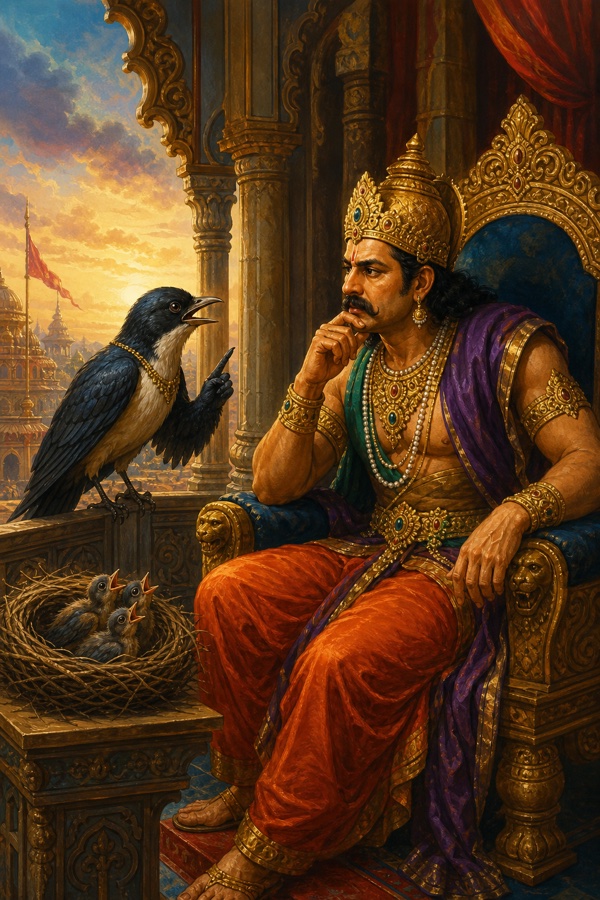
Brahmadatta said, “We did you an injury, and you have avenged it by doing one in return. The account is squared. Do not leave the home you have here, Pujani. Stay on with us.”
Pujani answered, “When someone has injured another and still goes on living beside him, the learned never praise it. In such a case it is always better for the one who did the injury to leave the old place. Nobody should put faith in the soothing assurances of a party he has injured; the fool who trusts them soon meets his destruction. Enmity does not cool quickly. The very sons and grandsons of those who have injured one another are destroyed by it, because the quarrel comes down to them like an inheritance, and with their offspring destroyed the first parties lose the next world as well. Between those who have injured each other, mistrust is what brings happiness. One who has betrayed a confidence should never be trusted again, even a little.”
She went on. “The one who deserves no trust should have none, and the one who deserves it should never have too much. The danger that comes of blind confidence brings a destruction that is complete. Try to make others trust you, and place no confidence in others yourself. A father and a mother are the first of friends, and the only ones. A wife is a vessel that receives the seed. A son is one’s own seed and nothing more. A brother is an enemy. A friend or a companion stays one only while his palm is oiled. It is one’s own self that tastes one’s happiness and one’s misery. Between those who have injured each other there can be no real peace, and the reason I had for living here no longer exists. When someone who has done an injury sees the injured party honoring him with gifts and attentions, his mind naturally fills with mistrust, and when the one paying those honors is the stronger of the two, the weak grow afraid. An intelligent creature leaves the place where honor came first and dishonor and injury came after it, and leaves whatever honor the enemy may offer from then on. I have lived in your house a long time, and you have honored me through all of it. A cause of enmity has arisen at last. I ought to leave this place without hesitation.”
Brahmadatta would not let it go. “Whoever returns an injury for an injury received is never held to have offended,” he said. “The avenger squares his account by it. So stay here, Pujani, and do not leave this place.”
Pujani said, “No friendship can be cemented a second time between the one who gave an injury and the one who gave an injury back. Neither heart can forget what has happened.”
Brahmadatta said, “The one who injured and the one who avenged the injury must come together again. Where they have done so, their enmity has been seen to cool, and no fresh injury has followed.”
Pujani answered, “Enmity that springs from injuries given and returned can never die. The injured one should never trust his enemy, telling himself that he has been soothed with assurances of goodwill. In this world men meet their destruction again and again through misplaced confidence, and for that reason you and I should meet no more. Those whom force and sharp weapons cannot subdue are conquered by an insincere gentleness, the way wild elephants are taken by means of a tame she-elephant.”
Brahmadatta tried the argument from daily life. “When two live together,” he said, “even if one has done the other a deadly injury, affection grows up between them naturally, and trust with it, as it does between the chandala and the dog. Between those who have injured each other, living side by side blunts the edge of enmity. It never lasts long. It runs off quickly, like water poured on a lotus leaf.”
Pujani gave him the whole of her reasoning. “Enmity springs from five causes, and the learned know them: woman, land, harsh words, natural incompatibility, and injury. When the enemy is a generous man he should never be killed, least of all by a Kshatriya, either openly or by hidden means; in such a case his fault ought to be weighed with care. And once enmity has arisen, even with a friend, no further confidence should be placed in him. The feeling lies hidden, like fire in wood. Like the Aurva fire inside the waters of the ocean, the fire of enmity can never be put out by gifts of wealth, by a show of valor, by conciliation, or by learning in the scriptures. Once it has been lit by an injury, it never goes out until it has burned up one of the two parties. One who has injured another should never trust him again as a friend, however much wealth and honor he may have paid him since, for the fact of the injury fills the one who did it with fear. I never injured you, and you never injured me, and that is why I lived in your house. All of that is changed, and now I cannot trust you.”
A key to reading this (the five roots of enmity): Pujani names the five causes of enmity as woman, land, harsh words, natural incompatibility, and injury, and her own quarrel with the king belongs to the fifth, as the enmity of a cat and a mouse belongs to the fourth. The Aurva fire she speaks of burns inside the waters of the ocean, and she takes it as the image of a hatred that neither wealth nor valor nor soft words nor learning can quench. The king and the bird are arguing a single question: can trust come back after an injury given and an injury returned? Brahmadatta keeps saying that it can, and Pujani answers each time that neither heart can forget.
The argument from Time, and Pujani’s refutation
Brahmadatta reached then for the largest argument he had. “It is Time that does every act,” he said. “Acts are of many kinds, and all of them proceed from Time. Who, then, injures whom? Birth and death come about in the same way. Creatures are born and live because of Time, and because of Time they cease to live. Some are seen to die all at once. Some die one by one. Some are seen to live for long ages. As fire consumes its fuel, Time consumes all creatures. So I am no cause of your sorrow, and you are no cause of mine. It is Time that always ordains the happiness and the misery of everything that has a body. Stay here, then, as long as you please, with affection for me and with no fear of any harm from me. What you did, I have forgiven. Forgive me too, Pujani.”
Pujani took his doctrine and turned it over in front of him. “If Time, as you say, is the cause of all acts, then of course nobody on earth can bear enmity toward anybody. I ask you, though, why friends and kinsmen seek to avenge their dead. Why did the gods and the Asuras strike at each other in battle in the old days? If it is Time that causes happiness and misery and birth and death, why do physicians try to give medicine to the sick? If Time is shaping everything, what need is there of medicine? Why do people who have lost their senses to grief pour themselves out in such wild laments? And if Time, as you say, is the cause of acts, how can anyone gain merit by doing the acts religion asks of him?”
Then she put her own case, and she did not spare herself. “Your son killed my child, and I injured him for it. By that act I have made myself liable to be killed by you. Grief for my son drove me to it. Hear now why I am liable. Men want birds for one of two things, to kill them for food or to keep them in cages for sport. There is no third reason for which men seek out my kind. And birds, for fear of being killed or caged, look for their safety in flight. Those who know the Vedas have said that death and the cage are both painful. Life is dear to all. All creatures are made miserable by grief and pain, and all creatures wish for happiness. Misery has many sources. Old age is misery, Brahmadatta. The loss of wealth is misery. To have near you anything disagreeable or evil is misery, and so is separation from friends and from the things you love. Misery comes from death and from the cage. It comes from causes that have to do with women, and from other causes that lie in nature. And the misery that comes from the death of a child changes every creature and wounds it terribly. Some foolish people say that there is no misery in another’s misery. Only one who has never felt any himself can say that among men; one who has felt sorrow would never dare. Whoever has known the pain of every kind of misery feels the misery of others as his own. What I have done to you, and what you have done to me, a hundred years will never wash away. After what has passed between us there can be no reconciliation. As often as you happen to think of your son, your enmity toward me will be fresh again. When one who has taken revenge for an injury wants peace afterward with the one he injured, the two can no more be joined than the pieces of a broken clay pot.”
She had authority to bring, and she brought it. “Men who know the scriptures have laid it down that trust never produces happiness. Ushanas himself sang two verses to Prahlada in the old days. Whoever trusts the words of an enemy, be they true or false, comes to destruction like a seeker of honey in a pit covered over with dry grass. And enmities are seen to outlive the very death of the enemies, for people go on telling the surviving children about the old quarrels of their dead fathers. Kings put out enmities by conciliation, and then, when the opportunity comes, they break their enemies to pieces like clay jars full of water dashed on a stone. If a king has injured anyone, he should never trust that one again. Great misery comes of trusting those one has wronged.”
A key to reading this (the doctrine of Time against human effort): Brahmadatta’s largest defense is Time: if Time does every act, nobody injures anybody, and guilt and enmity dissolve together. Pujani answers from the way creatures actually behave. Kinsmen avenge their dead, the gods and the Asuras went to war, physicians give medicine, the bereaved cry out, and men expect merit from their religious acts; none of it would happen if Time alone were the doer. She adds that her own kind have two things to expect from men, to be killed for food or kept in a cage, and that the death of a child is the misery that changes a creature most. Her proof text is a pair of verses Ushanas sang to Prahlada, on the honey-seeker who walks into a pit covered with dry grass.
The gist: The king tries to wash the quarrel away by saying that Time does everything and nobody is to blame. The bird asks why, in that case, anyone takes revenge, gives medicine, or hopes for merit, and she tells him that what the two of them have done a hundred years will not wash out. A friendship mended after injury and revenge holds no better than the pieces of a broken clay pot, and Ushanas taught Prahlada that whoever trusts an enemy’s words falls like a honey-seeker into a hidden pit.
Pujani’s parting words: the dharma of country, king, and the care of the people
Brahmadatta had one argument left. “No man gets the fruit of anything he wants by withholding his trust,” he said. “And one who lives always in fear is obliged to live like a man already dead.”
Pujani answered him out of plain experience. “One whose feet are sore will fall if he tries to walk, however carefully he goes. One whose eyes are sore, if he opens them against the wind, finds the wind hurts them cruelly. One who sets foot on an evil road without knowing his own strength, and keeps walking, soon loses his life for it. The man who puts no effort into his land and pays no heed to the season of the rains never brings in a harvest. The one who eats nourishing food every day, be it bitter or sharp or savory or sweet, enjoys a long life, and the one who neglects what is wholesome and eats what harms him, with no eye to what follows, soon meets his death. Destiny and exertion depend on each other. Great souls achieve good and great things, and only the unmanly pay court to destiny. An act that does a man good should be done, be it harsh or mild; the unlucky man of no action is always overwhelmed by calamity of every kind. So one should leave everything else aside and put out his energy, and do what brings good to himself. Knowledge, courage, cleverness, strength, and patience are called a man’s natural friends, and the wise pass their lives in this world with the help of those five. Houses, precious metals, land, a wife, and friends are called by the learned his secondary sources of good, and those a man may come by anywhere. The wise are content anywhere, and anywhere they shine. Such a man frightens no one, and when others try to frighten him he does not give way to fear. Whatever wealth he has, however small, is sure to grow, for he does every act with skill, and through his self-restraint he wins great fame.”
She turned to her own leaving. “Men of small understanding who cling to home put up with shrewish wives who eat away their flesh the way the young of a crab eat their mother. Some lose all heart at the very thought of leaving. ‘These are our friends,’ they say to themselves, ‘this is our country. How can we leave them?’ A man should certainly leave the country of his birth when plague or famine has fallen on it. He should live in his own country respected by all, or else go and live in another. So I will go to some other region. I dare not live in this place any longer, for I have done your child a great wrong. From a distance one should abandon a bad wife, a bad son, a bad king, a bad friend, a bad alliance, and a bad country. No trust can be put in a bad son. What joy is there in a bad wife? There is no happiness in a bad kingdom, and in a bad country no hope of a living. With a bad friend, whose attachment is never certain, there is no lasting companionship, and in a bad alliance made without need there is disgrace. She is a wife who speaks only what is pleasant. He is a son who makes his father happy. He is a friend in whom one can trust. That is one’s country where one earns one’s living. And he is a king of firm rule who does not oppress, who cherishes the poor, and in whose lands there is no fear.”
From her own case Pujani had come to his, and she spoke now of what a king is. “Wife, country, friends, sons, kinsmen, and relatives: a man can have all of these when the king is accomplished and looks on his people with a righteous eye. When the king is sinful, his subjects are destroyed by his oppressions. The king is the root of the three things a man lives for, dharma, wealth, and pleasure. He should protect his subjects with care. Taking from them a sixth share of their wealth, he should protect them all. A king who does not protect his subjects is truly a thief. And the king who gives his assurance of protection and then, out of greed, fails to make it good, that ruler of sinful soul takes on himself the sins of all his subjects and sinks at last into hell. The king who gives the assurance and keeps it, protecting every one of his subjects, comes to be looked on as the benefactor of all.”
“Manu, the lord of all creatures, has said that a king has seven attributes. He is mother, father, teacher, protector, fire, Vaishravana, and Yama. By behaving with compassion toward his people he is called their father, and the subject who deals falsely with him is born in his next life as an animal or a bird. By doing them good and cherishing the poor he becomes a mother to them. By scorching the wicked he comes to be regarded as fire, and by restraining the sinful he is called Yama. By giving wealth to those who are dear to him he is regarded as Kubera, the granter of wishes. By giving instruction in dharma and virtue he becomes a teacher, and by carrying out the duty of protection he becomes the protector.”
“The king who delights the people of his cities and his provinces by his merits is never stripped of his kingdom, since he has kept his duty. The king who knows how to honor his subjects never suffers misery here or hereafter. The king whose subjects are always full of anxiety, or loaded with taxes, or overwhelmed by evils of every kind, meets defeat at the hands of his enemies. And the king whose subjects grow like a great lotus in a lake wins every reward in this world and at last is honored in heaven. Enmity with one who is powerful is never praised. The ruler who has drawn on himself the enmity of one stronger than he is loses his kingdom and his happiness both.” Having said this to King Brahmadatta, Bhishma told Yudhishthira, the bird took her leave of him and flew away to the region she had chosen. “That is the conversation between Brahmadatta and Pujani,” the grandsire said. “What else do you want to hear?”
A key to reading this (the sixth part, and the king’s seven forms): Two measures stand at the center of Pujani’s parting speech. The first is the sixth share: the king takes a sixth of his subjects’ wealth and owes them protection for it, and the king who takes and does not protect is, in her word, a thief, while the one who promises protection and withholds it out of greed carries the sins of all his people into hell. The second is Manu’s list of the king’s seven attributes: mother, father, teacher, protector, fire, Vaishravana, who is Kubera the giver of wealth, and Yama. Each is tied to something the king does, compassion for the father, care of the poor for the mother, the scorching of the wicked for fire, the restraint of sinners for Yama. A speech that began in the hardest mistrust ends on the protection a ruler owes the people he taxes.
The gist: Before she flies off, the bird answers the king’s charge that fear is a living death: effort and destiny lean on each other, and knowledge, courage, cleverness, strength, and patience are the five friends a creature carries anywhere. She names six things to leave from a distance, a bad wife, son, king, friend, alliance, and country. Then she tells Brahmadatta what a good king is: the root of dharma, wealth, and pleasure, who takes a sixth and protects everyone, who is mother, father, teacher, protector, fire, Kubera, and Yama to his people, and who never picks a quarrel with someone stronger.
The king’s dharma in the decline of the age and the time of robbers: Bharadvaja and Shatrunjaya
Yudhishthira asked about the age itself. “When dharma and men both decay as the yuga slowly runs down, grandfather, and when the world is harried by robbers, how should a king carry himself then?”
“I will tell you the policy a king should follow in such miserable times,” Bhishma said, “and how he should bear himself when he has put compassion aside. On this they tell the old story of what passed between Bharadvaja and King Shatrunjaya. There was a king among the Sauviras named Shatrunjaya, a great chariot warrior. He went to the rishi Bharadvaja and asked him for the truths of the science of profit. How is a thing not yet gained to be gained? Once gained, how is it to be increased? Once increased, how is it to be protected? And once protected, how is it to be used? Those were his four questions, and the Brahmin rishi answered them with reasons, to make those truths plain to the ruler.”
“A king should always stand with the rod of punishment lifted in his hand,” the rishi said. “He should always show his strength. He should leave no weak place in himself and should mark every weak place in his enemies, and he should keep his eyes at that work always. At the sight of a king whose rod is always lifted, everyone is struck with fear, and so the king should rule all creatures with the rod. Men of learning who know the truth praise punishment. Of the four requisites of rule, conciliation, gift, disunion, and punishment, punishment is said to stand first. When the foundation of a refuge is cut away, all who sheltered in it perish. When the roots of a tree are cut, how will the branches live? A wise king cuts away the very roots of his enemy, and then he wins over the allies and partisans of that enemy and brings them under his own sway. When calamity overtakes him he should lose no time: he should take wise counsel, show his strength properly, fight with skill, and even retreat with wisdom.”
“Let his humility be in his speech alone, and at heart let him be as sharp as a razor. He should put away lust and anger and speak sweetly and mildly. When the occasion comes for dealings with an enemy, a king with foresight makes peace and keeps his trust to himself, and when the business is finished he turns quickly away from the new ally. He should soothe an enemy with sweet assurances as though the man were a friend, and he should fear that enemy always, as one fears to live in a room that has a snake in it. The man whose mind you mean to master is comforted with assurances drawn from the past. The man of wicked understanding is assured with promises of good to come. The wise man is assured with services done now. One who wants prosperity should join his hands, swear oaths, use sweet words, bow his head in worship, and shed tears. He should carry his enemy on his shoulders as long as the time is against him, and when the opportunity comes he should break him to pieces like a clay jar on a stone. It is better for a king to blaze up for a moment like charcoal of ebony wood than to smolder and smoke like chaff for many years. A man with many purposes to serve should not shrink from dealing even with an ungrateful person. If he succeeds he has his happiness, and if he fails he loses esteem; so in doing the business of such people he should never finish it, and should always leave something undone. And a king should do what is for his own good by imitating a cuckoo, a boar, Mount Meru, an empty chamber, an actor, and a devoted friend.”
A sub-tale: Each of the six that Bharadvaja tells the king to imitate stands for a practice. Like the cuckoo, he has his own friends and subjects maintained by others. Like the boar, he tears up his enemies by their very roots. Like Mount Meru, he shows a front that nobody can cross. Like an empty chamber, he keeps room enough to store whatever he acquires. Like the actor, he takes on different guises. And like a devoted friend, he attends to the interests of the subjects who love him.
“He should go often and attentively to the houses of his enemies, and even when calamities fall on them he should ask after their welfare. Prosperity is never won by the idle, or by those with no manliness and no exertion in them, or by those stained with vanity, or by those who fear to be unpopular, or by those who are always putting things off. A king should act so that his enemy never finds his weak places, and he should mark the enemy’s. He should imitate the tortoise, which hides its limbs, and keep his own openings always concealed. He should think over every matter of wealth as the crane does, waiting patiently for hours at the water’s edge for its fish. He should show his valor like a lion. He should lie in wait like a wolf, and fall on his enemies and pierce them like an arrow. Drink, dice, women, hunting, and music he should enjoy with judgment, for addiction to them brings evil. He should make his bows of bamboo and of other things; he should sleep as lightly as the deer; he should be blind when it is necessary to be blind, and even deaf when it is necessary to be deaf. A wise king uses his strength with regard to time and place, since where those are against him strength is wasted. He should mark what is timely and untimely, reflect on his own strength and weakness, build his strength by measuring it against the enemy’s, and then address himself to action. The king who fails to crush an enemy his army has already brought to submission provides for his own death, like the crab when she conceives. A tree with beautiful blossoms may have no strength in it. A tree heavy with fruit may be hard to climb. And sometimes trees with unripe fruit look like trees whose fruit is ripe. A king who sees all this should never let himself be cast down, and if he conducts himself so he will hold his own against every enemy. With those who come to him asking, he should first strengthen their hopes. Then he should put obstacles in the way of those hopes. He should say the obstacles are only a matter of the occasion, and afterward he should explain that the occasion itself has grave causes behind it.”
“As long as the cause of fear has not actually come, a king should make all his arrangements like a man who is afraid. When it does come upon him, he should strike without fear. No man reaps any good without running into danger, and if he comes through the danger with his life he is sure to earn great benefits. A king should find out every danger that lies ahead; when dangers are present he should conquer them; and for fear they grow again, even after he has conquered them, he should think of them as unconquered. To give up the happiness in hand and chase the happiness that is to come is never the policy of an intelligent man. The king who makes peace with an enemy and then sleeps happily in his trust is like a man asleep at the top of a tree, who wakes after he has fallen. When a man falls into distress he should raise himself by every means in his power, mild or stern, and after he has risen, when he is able, he should practice righteousness.”
A key to reading this (the science of the rod and the four measures): Shatrunjaya asks the four questions of the science of profit: how to gain, how to increase, how to protect, and how to use. Bharadvaja answers first with the four requisites of rule, which are conciliation, gift, disunion, and punishment, and he sets punishment, the lifted rod, at their head. The rod, in his teaching, waits on time and place: strength shown at the wrong hour or on the wrong ground is wasted, and the same teacher who orders the enemy broken like a clay jar orders the king to carry that enemy on his shoulders until the hour turns.
The guarding of counsel, spies, and the hard policy of destroying enemies
The rishi came next to the hidden side of rule. “A king should always honor the enemies of his enemies. He should look on his own spies as though they were agents in his enemy’s pay, and he should see to it that the enemy never recognizes them. He should make spies of atheists and of ascetics and send them into the territories of his enemies.”
“Sinful thieves, who offend against the laws of righteousness and are thorns in everyone’s side, find their way into gardens and places of amusement, into the sheds set up to give drinking water to thirsty travelers, into public inns and drinking places, into houses of ill fame, and into holy places and public assemblies. They should be recognized, arrested, and put down. A king should give no trust to the man who deserves none, and he should never trust too far the man who does deserve it. Danger springs from trust, and trust should never be given before the man has been examined. Having won the enemy’s confidence with plausible reasons, the king should strike him when he makes a false step.”
“He should fear the one from whom there seems nothing to fear, and he should always fear those who ought to be feared. The danger that rises from a quarter nobody feared can end in total destruction. By attention to pious works, by silence, by the reddish cloth of ascetics, by matted locks and skins, one should win the confidence of an enemy, and then, when the chance comes, spring on him like a wolf. A king who wants prosperity should not shrink from killing a son or a brother or a father or a friend, if any of them tries to thwart his aims. The teacher himself, if he is arrogant, if he cannot tell what should be done from what should never be done, and if he walks unrighteous paths, deserves to be restrained by punishment. As certain insects with sharp stings cut off every flower and fruit of the tree they settle on, the king, after winning his enemy’s confidence with honors and salutations and gifts, should turn on him and shear him of everything. Without piercing the vitals of others, without doing many stern deeds, without killing living creatures as the fisherman kills, no one comes to great prosperity.”
“There is no separate species of creature called enemy or friend. Men become friends or enemies according to the force of circumstances. A king should never let his enemy escape, even if the enemy breaks into piteous lamentation; he should stay unmoved by it, for it is his duty to destroy the man who has done him an injury. A king who wants prosperity should take care to attach to himself as many men as he can, and to do them good. In his dealings with his subjects he should always be free of malice, and with great care he should punish and check the wicked and the disaffected. When he means to take wealth he should say what is pleasant, and when he has taken it he should say the same. Having struck off a man’s head with his sword, he should grieve and shed tears. He should draw others to himself with sweet words and honors and gifts, and so bind men to his service. He should never enter into fruitless disputes, and he should never cross a river with nothing to help him except his two arms. To chew on the horns of a cow is fruitless and gives no strength: the teeth are broken and the taste goes unsatisfied. Dharma, wealth, and pleasure carry three disadvantages, each of them bound up with something that cannot be parted from it, and a king should study those attachments carefully and so avoid the disadvantages.”
“The unpaid balance of a debt, the unquenched remnant of a fire, and the unkilled remnant of one’s enemies grow and increase again and again. So all three should be completely extinguished and rooted out. A debt, which always grows, is sure to remain unless it is wiped out whole, and the same is true of defeated enemies and of neglected diseases; these always breed great fear. Every act should be done thoroughly, and one should be heedful always. So small a thing as a thorn, if it is badly drawn, leads to a stubborn gangrene. By killing its people, by tearing up its roads and damaging them in other ways, and by burning and pulling down its houses, a king should destroy a hostile kingdom.”
A sub-tale: Bharadvaja follows the six models with a second set of six, all of them creatures. A king, he says, should be far-sighted like the vulture, motionless like the crane, vigilant like the dog, valiant like the lion, and fearful like the crow, and he should make his way into the territories of his enemies like the snake, with ease and without anxiety.
“A king should win over a hero by joining his palms to him, a coward by putting him in fear, and a greedy man by gifts of wealth, while with an equal he should make war. He should be mindful to sow disunion among the leaders of sects and to conciliate those who are dear to him, and he should protect his ministers from disunion and from destruction. If a king becomes mild, the people disregard him. If he becomes stern, the people feel it as an affliction. The rule is that he should be stern when the occasion requires sternness and mild when it requires mildness. By mildness the mild are cut down, and by mildness one may destroy what is fierce. There is nothing mildness cannot bring about, and for that reason mildness is said to be sharper than fierceness. The king who turns mild when mildness is called for and stern when sternness is called for accomplishes all his aims and puts his enemies down.”
“Having drawn on yourself the enmity of a man of knowledge and wisdom, take no comfort from the thought that you are far away from him. The arms of an intelligent man reach far, and with them he injures those who have injured him. Never try to cross what truly cannot be crossed. Never snatch from an enemy what the enemy will be able to take back. Never start to dig if digging will not bring you to the root of the thing you dig for. Never strike a man whose head you will not cut off.” There the rishi stopped, and before he let the king go he set a boundary around everything he had said. “A king should not always act in this way. The course of conduct I have laid down is to be followed in seasons of distress alone. I have said all this out of a wish to do you good, to teach you how to bear yourself when enemies assail you.”
“The ruler of the Sauviras heard those words from a Brahmin who wished him well,” Bhishma said. “He obeyed the instructions cheerfully, and with his kinsmen and his friends he came to a blazing prosperity.”
A key to reading this (the bound of the law of distress): Everything hard in Bharadvaja’s teaching, the killing of a son or a father who stands in the way, punishment even for a teacher, tears shed over the man one has just beheaded, the hostile kingdom destroyed with its roads and houses, belongs to apad-dharma, the conduct allowed in a season of distress. The rishi says so himself in his last words to Shatrunjaya: a king should not always act in this way, and this course is for seasons of distress alone. Bhishma opens the story on the same note, promising to tell how a king bears himself when he has put compassion aside in a time when dharma and men are both in decay and robbers harry the world. The rule about remnants comes out of that same logic: a debt, a fire, and an enemy left half finished all grow back.
The gist: In an age of decay and robbers, Bharadvaja teaches Shatrunjaya of the Sauviras the whole policy of the lifted rod: punishment first among the four requisites, humility in speech and a razor at heart, the enemy carried on the shoulder until he can be broken like a clay jar, spies dressed as atheists and ascetics, no trust without examination, and no debt, fire, or enemy left half finished. Mildness, used at the right hour, cuts deeper than fierceness. Then the rishi fences it in: this conduct is for seasons of distress alone. Shatrunjaya followed it and prospered.
Vishvamitra and the chandala: the dharma of saving life in a terrible famine
Yudhishthira’s next question was the darkest he had asked. “Think of a time,” he said, “when the high dharma decays and everyone oversteps it, when unrighteousness passes for righteousness and righteousness takes the shape of its opposite. Every wholesome restraint is gone, and every truth about dharma is shaken and confused. The people are ground down by kings and by robbers. Men of all four stages of life have lost their bearings in their duties, and acts have lost their merit. Out of lust and greed and folly men see cause for fear in every direction. No creature trusts another; they kill each other by deceit and cheat each other in their dealings. Houses are burned down across the whole country. The Brahmins are in great suffering. The clouds do not pour a single drop. Every man’s hand is turned against his neighbor, and everything needed for life has fallen into the hands of robbers. When such a season of terrible distress sets in, grandfather, how is a Brahmin to live, a man unwilling to cast off compassion or his children? How does he keep himself alive? And how should the king live in such a time, when sin has overtaken the world, so that he falls away neither from dharma nor from profit?”
Bhishma said, “The peace and prosperity of the subjects, rain enough and rain in season, disease, death, and every other fear, all depend on the king. I have no doubt of this either, that the setting in of Krita, Treta, Dvapara, and Kali depends on the king’s conduct. When a season of misery such as you describe does set in, the righteous should keep themselves alive by the help of judgment. On this they tell the old story of what passed between Vishvamitra and a chandala, in a hamlet where chandalas lived.”
“Toward the end of Treta and the beginning of Dvapara, by what the gods had ordained, a frightful drought came and lasted twelve years. It was the time for many creatures worn out with age to lay down their lives, and the thousand-eyed god of heaven poured no rain. The planet Brihaspati began to move backward in its course, and Soma left his own orbit and drew away to the south. No dewdrop could be seen anywhere, much less a gathering of clouds. The rivers all shrank to narrow streams. Lakes and wells and springs dried up everywhere and lost their beauty. With water grown scarce, the sheds that charity had set up to give it out stood deserted. The Brahmins left off their sacrifices and their recitation of the Vedas; they no longer uttered the vashat or performed their rites of propitiation. Farming and the keeping of cattle were given up. Markets and shops were abandoned. The stakes for tethering sacrificial animals disappeared, and people gathered nothing for sacrifices any longer. Every festival and amusement died out. Heaps of bones lay everywhere, and every place rang with the shrill cries of fierce creatures. The cities and towns of the earth emptied of people, and villages and hamlets were burned down. Men fled, some harried by robbers, some by weapons, some by bad kings, all in fear of one another. Temples and places of worship stood desolate. The old were turned out of their houses by force. Cattle and goats and sheep and buffaloes fought over food and died in great numbers. Brahmins began to die on every side, and protection was at an end. Herbs and plants dried up, and the earth lost all her beauty and grew as dreadful as the trees of a cremation ground. In that time of terror, Yudhishthira, when righteousness was nowhere, men lost their senses from hunger and began to eat one another. The rishis themselves gave up their vows, abandoned their fires and their gods, left their retreats in the woods, and wandered here and there.”
“Among them wandered the great rishi Vishvamitra, a holy man of great intelligence, homeless and wasted with hunger. He had left his wife and his son in some place of shelter. He had given up his sacred fire, he had no roof, and he no longer cared whether food was clean or unclean. One day, deep in a forest, he came on a hamlet of cruel hunters who lived by killing. Broken jars and clay pots lay all over the little place. Dog skins were spread here and there. Bones and skulls of boars and asses were heaped in several spots. Cloths stripped from the dead lay about, and the huts were decorated with garlands of flowers already used in worship. Many of the dwellings were full of the cast skins of snakes. The place rang with the crowing of cocks and hens and the harsh braying of asses, and here and there the people quarreled with each other in shrill voices. There were temples of gods that bore the emblems of owls and other birds. Iron bells tinkled, and packs of dogs stood or lay on every side.”
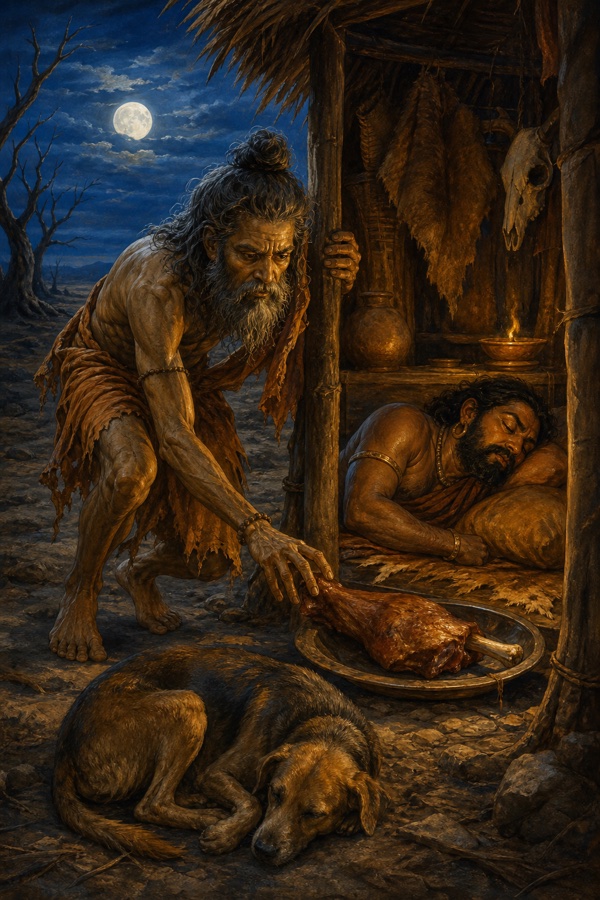
“Driven by the pain of his hunger, Vishvamitra went into that hamlet and did his best to find something to eat. The son of Kushika begged again and again, and he got no meat, no rice, no fruit, no root, no food of any kind. ‘Alas, great is the distress that has overtaken me!’ he cried, and he fell down from weakness there in the hamlet of the chandalas. Lying there the sage asked himself what was best for him to do, and his one thought was of how to keep off immediate death. Then he saw it. On the floor of a chandala’s hut a large piece of flesh was spread out, the haunch of a dog that had lately been killed with a weapon. He considered it, and he came to the conclusion that he would steal that meat.”
“He argued it out with himself. ‘I have no means of keeping alive now. In a season of distress theft is allowed even to an eminent man, and it takes nothing from his glory. Even a Brahmin may do it to save his life; that is certain. One should steal first from a low person. Failing that, one may steal from an equal, and failing an equal, even from an eminent and righteous man. My life itself is ebbing away, and I will steal this meat. I see no fault in such a theft. I will take this haunch of dog’s meat.’ With that resolved, the great sage lay down to sleep in the place where the chandala was. After a while, when the night was far gone and the whole hamlet had fallen asleep, he got up quietly and went into the hut. The chandala who owned it lay like one asleep, his eyes crusted with phlegm. He was an ugly man, and he spoke in a harsh, cracked voice. ‘Who is there, undoing the latch? The whole chandala hamlet is asleep. I am awake, though. I am not asleep. Whoever you are, you are about to be killed.’”
“Those were the words that met the sage. Fear went through him; his face burned with shame and his heart shook at the theft he had attempted. ‘Long life to you,’ he said. ‘I am Vishvamitra. I have come here crushed by hunger. If your sight is clear and your mind is righteous, do not kill me.’ The chandala rose from his bed in terror and came to him. He joined his palms in reverence, and with his eyes full of tears he asked, ‘What are you looking for here in the night, Brahmin?’ Vishvamitra spoke to him gently. ‘I am very hungry and about to die of starvation. I want to take away that haunch of dog’s meat. Hunger has made a sinner of me; a man desperate for food has no shame. My breath is failing. Hunger has destroyed my Vedic learning. I am weak, I have lost my senses, and I have no scruple left about clean food and unclean. I know it is a sin, and still I wish to take that haunch away. I went from house to house in this hamlet of yours and got no alms, and only then did I set my heart on this sinful act. Fire is the mouth of the gods, and he is their priest as well, so he ought to take nothing except what is pure and clean. And yet there are times when that great god becomes a devourer of everything. Know that I have become like him.’”
“The chandala answered him. ‘Listen to me. Hear the truth I tell you, and then act so that your merit does not perish. Hear what I have to say about your duty. The wise say a dog is more unclean than a jackal, and the haunch of a dog is a far worse part than the other parts of its body. This was not wisely resolved by you. It goes against righteousness, it is the theft of what belongs to a chandala, and it is the theft of unclean food besides. Bless you, look for some other way of keeping yourself alive. Do not let your penances be destroyed by this strong desire for dog’s meat. You know the duties laid down in the scriptures, and you should not do a thing that ends in a confusion of duties. Do not cast righteousness away, you who stand first among all who keep it.’”
“Vishvamitra, with hunger tearing at him, spoke again. ‘A long time has gone by and I have eaten nothing, and I see no other means of keeping alive. A dying man should save his life by whatever means he has, without judging the means. Afterward, when he is able, he should seek merit. Kshatriyas should follow the way of Indra, and it is the duty of Brahmins to behave like Agni. The Vedas are fire, and they are my strength. So I will eat even this unclean food to quiet my hunger. Whatever preserves life should be done without scruple. Life is better than death; a living man can gain virtue. I want to save my life, and with my understanding fully awake I mean to eat this unclean food. Give me your permission. If I go on living I will seek virtue, and by penance and by knowledge I will destroy the evils that follow from what I do now, as the lights of the sky destroy even the thickest darkness.’”
“So the two of them argued it in the night, the starving sage and the man whose meat it was. ‘One such as you cannot get long life from eating this food,’ the chandala said, ‘or strength, or the satisfaction that nectar gives. Look for some other alms. Do not let your heart lean toward dog’s meat. To the twice-born orders the dog is certainly unclean food.’ Vishvamitra said, ‘No other meat is easily had in a famine like this. I have no wealth, chandala. I am starving and I cannot move any farther. I am past hope. I think all six kinds of taste are in that piece of dog’s meat.’ The chandala said, ‘The scriptures lay it down that only the five kinds of five-clawed animals are clean food for Brahmins and Kshatriyas and Vaishyas. Do not set your heart on what is unclean.’ Vishvamitra said, ‘The great rishi Agastya, when he was hungry, ate up the Asura named Vatapi. I have fallen into distress and I am hungry, and I will eat that haunch.’ The chandala said, ‘Seek some other alms. You should not do such a thing; truly it should never be done by you. All the same, if it pleases you, you may take this piece of dog’s meat.’ Vishvamitra said, ‘Those who are called good are the authorities in matters of duty, and I am following their example. I now hold this dog’s haunch to be better food than anything that is highly pure.’ The chandala said, ‘What an unrighteous person does can never be counted an eternal practice, and an improper act can never be a proper one. Do not commit a sin through deception.’ Vishvamitra said, ‘A man who is a rishi cannot do what is sinful. A deer and a dog, as I see it here, are the same. So I will eat this haunch.’ The chandala said, ‘The Brahmins asked that rishi to do what he did. In those circumstances it could not be a sin. That is righteousness in which there is no sin. And Brahmins, who are the teachers of the three other orders, are to be protected and preserved by every means.’”
“Vishvamitra said, ‘I am a Brahmin. This body of mine is my friend. It is very dear to me and deserves my highest reverence, and it is from the wish to sustain it that I want to carry off that haunch. I am so eager for it that I no longer have any fear of you and your fierce brothers.’ The chandala said, ‘Men lay down their lives and still do not set their hearts on unclean food. By conquering hunger they win the fruit of all their wishes even in this world. Conquer your hunger and win those rewards.’ Vishvamitra said, ‘I keep hard vows and my heart is set on peace. To preserve the root of all merit I will eat food that is unclean. In a man of cleansed soul such an act is plainly righteous, though to one whose soul is uncleansed the eating of dog’s flesh would look like sin. And if my conclusion is wrong, I still will not become one like you for having eaten it.’ The chandala said, ‘It is my settled conclusion that I must try my hardest to hold you back from this sin. A Brahmin who does a wicked act falls from his high state. That is why I am reproving you.’ Vishvamitra said, ‘Cattle go on drinking and take no notice of the croaking of the frogs. You have no claim to say what righteousness is. Do not praise yourself.’ The chandala said, ‘I have become your friend, and it is for that reason alone that I preach to you. Do what is good for you. Do not do a sinful thing out of temptation.’ Vishvamitra said, ‘If you are a friend who wants my happiness, then raise me out of this distress. Then I could give up the dog’s haunch and count myself saved by righteousness.’ The chandala said, ‘I dare not make you a present of this meat, and I cannot quietly let you rob me of my own food. If I give it and you, a Brahmin, take it, both of us will sink into places of misery in the next world.’ Vishvamitra said, ‘By this sinful act today I will certainly save my life, which is very sacred. Having saved it, I will practice virtue afterward and cleanse my soul. Tell me which of the two is to be preferred.’ The chandala said, ‘In carrying out the duties of his own order and race, a man’s own self is the best judge. You know yourself which of those two acts is sinful. Whoever would count dog’s meat clean food, I think, would hold back from nothing in the matter of food.’ Vishvamitra said, ‘There is sin in accepting an unclean gift and in eating unclean food. When a man’s life is in danger, there is none. And the eating of unclean food, where no killing and no deception go with it and where the act will draw only a mild rebuke, is a matter of small consequence.’ The chandala said, ‘If that is your reason for eating unclean food, it is clear that you have no regard for the Veda and for Arya morality. Taught by what you are about to do, I see that there is no sin in ignoring the difference between clean food and unclean.’ Vishvamitra said, ‘Nobody is seen to incur a grave sin by eating. That a man falls by drinking wine is only a precept of words. The other forbidden acts of that kind, whatever they are, indeed every sin, cannot destroy a man’s merit.’ The chandala said, ‘The learned man who carries dog’s meat away from an unworthy place, from an unclean man like me, from one who leads so wicked a life, does a thing opposed to the conduct of those who are called good. And for his part in such a deed he is certain to suffer the pangs of repentance.’ Having said that to the son of Kushika, the chandala fell silent.”
“Then Vishvamitra took the haunch of dog’s meat,” Bhishma went on. “Having got possession of it to save his life, the great ascetic carried it off into the woods, meaning to eat it with his wife. He resolved that he would first satisfy the gods with the proper rites and only then eat the haunch at his ease. He lit a fire by the Brahma rites, and following the rites that go by the name Aindragneya he began to cook the meat himself into the sacrificial charu. Then he began the ceremonies in honor of the gods and the ancestors, dividing the charu into as many portions as were needed, as the scriptures enjoin, and calling on the gods, with Indra at their head, to come and take their shares.”
“And while he did so the chief of the gods began to pour down rain. Reviving all creatures with those showers, he made the plants and herbs grow once more. Vishvamitra finished the rites to the gods and the ancestors, satisfied them duly, and then ate the meat himself. Afterward he burned away all his sins by his penances, and after a long time the sage came to a most wonderful ascetic success. In this way, when the end in view is the saving of life itself, a learned man who knows the means should pull his sinking self out of distress by everything in his power. Relying on such understanding he should always keep himself alive, for a man who lives can win merit and enjoy happiness and prosperity. So, Yudhishthira, a learned man of cleansed soul should live and act in this world trusting to his own intelligence to tell righteousness from its opposite.”
A key to reading this (the law of distress, and the edible and inedible): The story is Bhishma’s furthest case of apad-dharma. In ordinary times theft is a sin, and dog’s meat is unclean food for every twice-born order; in a drought twelve years long, with men eating one another, a great rishi does both to stay alive. The argument turns on a reversal the tale leaves standing: the chandala, whose meat it is, pleads the cause of the scriptures and of the rishi’s own penances, and the Brahmin pleads necessity. The rule of the five five-clawed animals and the question of what a starving man may eat run through the whole exchange. What Bhishma takes from it is a rule of judgment: a man who lives can win merit, so in such a season he keeps himself alive and relies on his own intelligence to tell righteousness from its opposite.
A sub-tale: Twice in the debate the name of Agastya comes up. Vishvamitra brings it first: the great rishi Agastya, when he was hungry, ate the Asura named Vatapi, so a hungry rishi may eat a dog’s haunch. When the chandala replies that an unrighteous act can never become a lasting practice, Vishvamitra presses the point: a man who is a rishi cannot do what is sinful, and Agastya was a rishi. The chandala’s answer is that Agastya acted because the Brahmins asked him to, and that an act done on those terms had no sin in it, since Brahmins, the teachers of the other three orders, are to be protected by every means.
The gist: In a twelve-year drought at the meeting of the Treta and Dvapara ages, the starving Vishvamitra creeps into a chandala’s hut at night to steal the haunch of a dog. The owner is awake, and the two argue until the chandala has no more to say: he urges the scriptures and the sage’s own merit, and Vishvamitra answers that a dying man saves his life first and seeks virtue afterward. The sage takes the meat, cooks it as a sacrificial offering, and calls the gods and ancestors to their shares; Indra sends rain, and only then does he eat. Bhishma’s conclusion is that life comes first in such a season, because a living man can still win merit.
The thirteen forms of truth: Yudhishthira’s question and Bhishma’s answer
Bhishma had been speaking of penance: that everything has it for a root, that the Creator made this universe by it, that the rishis won the Vedas by it and the gods their high place. Yudhishthira let that teaching rest and turned to something else that is praised wherever the wise gather. “Brahmins and rishis, the ancestors and the gods all applaud the duty of truth,” he said. “I want to hear about truth, grandfather. Speak to me of it. What are the marks of truth? How is it to be acquired? What is gained by practicing it, and how? Tell me all of this.”
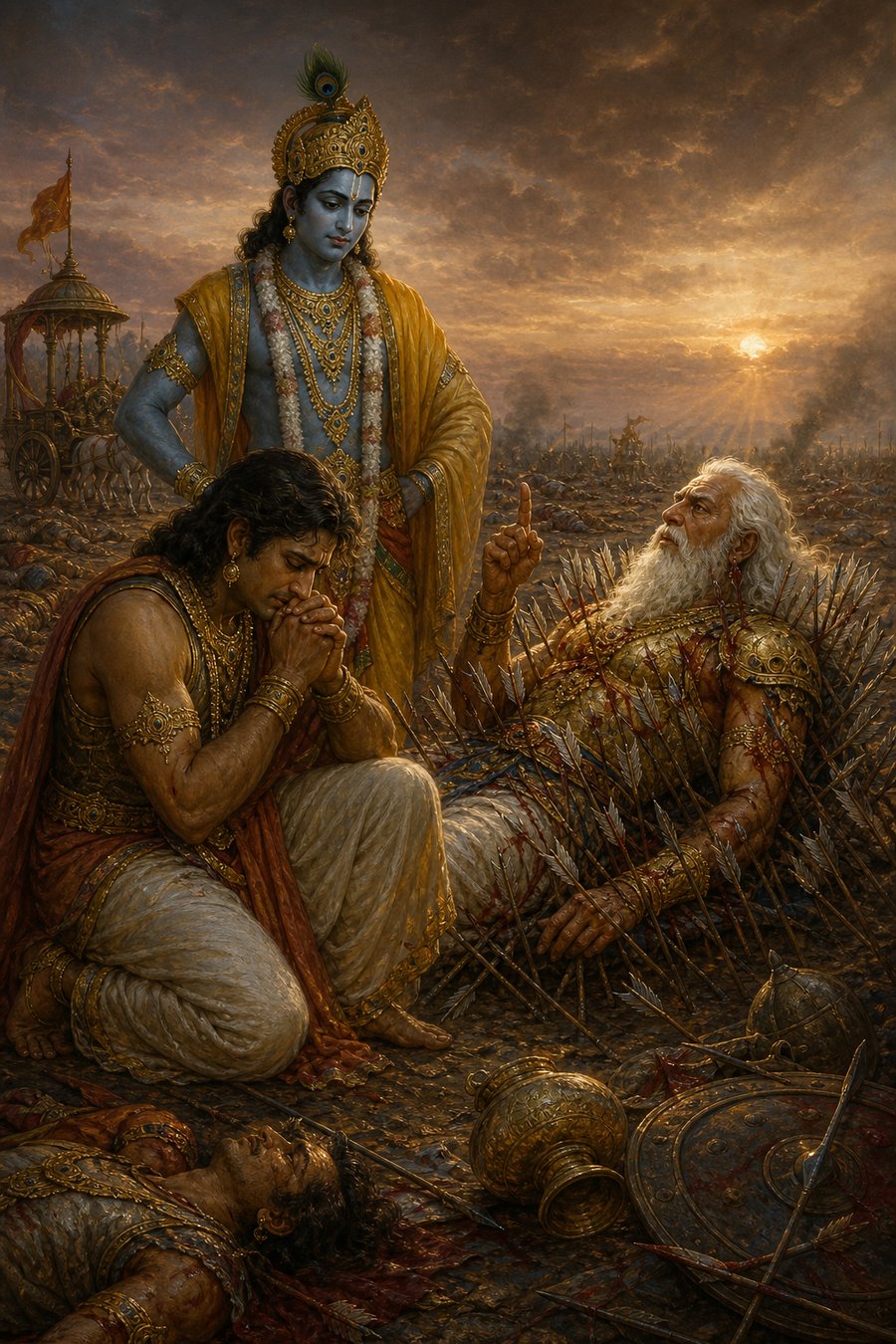
Bhishma said, “A confusion of the duties of the four orders is never praised. What is called truth lives pure and unmixed in every one of those four orders. For the good, truth is always a duty; it is an eternal duty. One should bow to truth with reverence. Truth is the highest refuge of all. Truth is duty, truth is penance, truth is yoga, and truth is the eternal Brahman. Truth has been called a sacrifice of a high order, and everything rests on truth. I will tell you now the forms of truth one after another, and its marks in their order, and you should hear as well how truth may be acquired.”
“Truth as it exists through all the world is of thirteen kinds. The forms it takes are impartiality, self-control, forgiveness, modesty, endurance, goodness, renunciation, contemplation, dignity, fortitude, compassion, and abstention from injury. These are the thirteen forms of truth. Truth is immutable, eternal, and unchangeable. It may be acquired through practices that are at war with none of the other virtues, and it may be acquired through yoga.”
“When desire and aversion, and lust and anger, have been destroyed, the quality by which a man can look with an unchanging eye on himself and on his enemy, on his own good and on his own harm, is called impartiality. Self-control lies in never wishing for what belongs to another man, in gravity and patience, in being able to quiet the fears that others have of oneself, and in freedom from disease; it may be acquired through knowledge. Devotion to the practice of generosity, together with the keeping of every duty, is what the wise call goodwill, and a man comes to have goodwill toward all through constant devotion to truth.”
“The quality by which a good and esteemed man bears what is agreeable and what is disagreeable alike is called forgiveness, and it is well acquired through the practice of truthfulness. The virtue by which an intelligent man, contented in mind and speech, does many good deeds and never draws the censure of others is called modesty; it is acquired with the help of righteousness. The virtue that forgives for the sake of dharma and profit is called endurance. It is a form of forgiveness, it is acquired through patience, and its purpose is to attach people to oneself. The casting off of affection, and of all earthly possessions with it, is called renunciation, and renunciation can never be acquired by anyone who has anger and malice still in him.”
“The virtue by which a man does good to all creatures, with watchfulness and care, is called goodness. It has no particular shape, and it consists in putting off all selfish attachments. The virtue by which a man stays unchanged in happiness and in misery is called fortitude; the wise man who wants his own good always practices it. One should always practice forgiveness and devotion to truth, and the wise man who succeeds in casting off joy and fear and anger succeeds in acquiring fortitude. Abstention from injury toward all creatures in thought, word, and deed, and kindness, and gift, are the eternal duties of the good. These thirteen attributes look distinct from one another, and they have one and the same form, which is truth. All of them support truth and strengthen it.”
“It is impossible to exhaust the merits of truth, and it is for these reasons that the Brahmins, the ancestors, and the gods applaud it. There is no duty higher than truth, and no sin more heinous than untruth. Truth is the very foundation of righteousness, and for that reason one should never destroy it. From truth come gifts, and sacrifice with its presents, and the threefold agnihotra, and the Vedas, and everything else that leads to righteousness. Once a thousand horse sacrifices and truth were weighed against each other in the balance, and truth proved the heavier.”
A key to reading this (the thirteen forms of truth): Truth, in Bhishma’s answer, takes in a whole way of living. He calls it duty, penance, yoga, and the eternal Brahman, says it lives unmixed in each of the four orders, and then spreads it into the virtues a person practices: the level eye of impartiality, the self-control that covets nothing, forgiveness, modesty, endurance, renunciation, goodness, fortitude, harmlessness in thought, word, and deed. Each of these has its own source, knowledge for self-control, truthfulness for forgiveness, patience for endurance, and all of them, he says, have one form and hold truth up. The closing image sets a thousand horse sacrifices in one pan of a balance and truth in the other, and truth is the heavier.
The gist: Asked for the marks of truth, Bhishma answers that truth is duty, penance, yoga, and Brahman, the refuge on which everything rests. It takes thirteen forms, among them impartiality, self-control, forgiveness, modesty, endurance, renunciation, goodness, fortitude, and abstention from injury, and it is acquired by practices that clash with no other virtue and by yoga. Gifts, sacrifice, and the Vedas all proceed from it. Weighed in the balance, it is heavier than a thousand horse sacrifices.
The thirteen faults: anger, desire, and their kin
From the virtues Yudhishthira went to their enemies. “Tell me, grandfather, in your great wisdom, everything about the source of anger and of lust, of sorrow and loss of judgment, of the inclination to do harm, of jealousy and malice and pride, of envy, of slander, of the inability to bear another’s good, of unkindness, and of fear. Tell me about all of these, truly and in detail.”
Bhishma said, “These thirteen vices are held to be very powerful enemies of all creatures. They come at men and tempt them from every side. They goad and torment the man who is heedless or dull. The moment they see a person they fall on him with force, like wolves leaping on their prey. From them comes every kind of grief, and from them comes every kind of sin, and every mortal should know it always. I will tell you where they begin, what they rest on, and how they are destroyed. Listen first, with your whole attention, to the origin of anger.”
“Anger springs from covetousness. It is fed by the faults of others. Through forgiveness it lies dormant, and through forgiveness it disappears. Lust springs from resolve. Indulgence strengthens it, and when a wise man turns resolutely away from it, it disappears and dies. Envy of others comes from between anger and covetousness. It disappears through compassion and knowledge of the self, through compassion for all creatures and the disregard for worldly things that knowledge brings with it. It rises too from seeing the faults of other people, and in the intelligent it quickly disappears before true knowledge. Loss of judgment has its origin in ignorance and comes from sinful habit. When the man it has seized begins to take delight in the company of the wise, that vice hides its head at once.”
“Men see scriptures that conflict with one another, and from that springs the desire for many kinds of action. When true knowledge has been gained, that desire is quieted. The grief of an embodied creature comes from affection awakened by separation, and it subsides when a man learns that the dead do not return. The inability to bear another’s good comes from anger and covetousness, and it is extinguished through compassion for every creature and a disregard for all earthly things. Malice comes from the abandonment of truth and from indulgence in wickedness. That vice disappears when a man waits on the wise and the good.”
“Pride in men springs from birth, from learning, and from prosperity. When those three are truly understood, the vice disappears instantly. Jealousy springs from lust and from delight in low and vulgar people, and wisdom destroys it. Slander takes its rise from errors of conduct that go against the ordinary course of men, and from disagreeable speeches that express aversion; it disappears on a survey of the whole world. When the one who injures is powerful and the injured one is unable to avenge the injury, hate shows itself, and kindliness makes it subside. Compassion comes from the sight of the helpless and miserable people of whom the world is full, and that feeling too disappears when a man understands the strength of virtue. Covetousness in all creatures springs from ignorance, and it is destroyed by the sight of how unstable every object of enjoyment is. It has been said that tranquility of soul, and that alone, can subdue all thirteen of these faults. All thirteen stained the sons of Dhritarashtra. You have always desired truth, and through your regard for your elders you have conquered every one of them.”
A key to reading this (the family tree of the faults): Bhishma gives each fault a parent and a cure. Anger comes of covetousness and yields to forgiveness. Lust comes of resolve, grows on indulgence, and dies when a wise man turns away. Envy is born between anger and covetousness; pride comes of birth, learning, and prosperity; hate appears where the injured cannot strike back. The cures repeat: forgiveness, knowledge, compassion for every creature, the company of the wise and good. Compassion itself appears in his list, as a feeling that rises at the sight of misery and settles once the strength of virtue is understood. Over all thirteen he sets one remedy, tranquility of soul.
The gist: Anger, lust, and the eleven that go with them are the powerful enemies of every creature, and they spring on the heedless like wolves on their prey. Each has a source and each has a cure, and tranquility of soul subdues them all. Bhishma ends with a judgment on two houses: these thirteen stained the sons of Dhritarashtra, and Yudhishthira, by his regard for his elders, has conquered them.
The marks of the malevolent man
Yudhishthira said, “I know what benevolence is, because I have watched those who are good. The malevolent I do not know, grandfather, or the nature of what they do. People keep away from malevolent men of cruel deeds as they keep away from thorns and pitfalls and fire. And it is plain that the malevolent man is sure to burn with misery, here and hereafter. So tell me what, in truth, the acts of such a man are.”
Bhishma said, “Malevolent men always do wicked acts and feel an inclination to do them that they cannot resist. They slander others and bring disgrace on themselves. They always think they have been cheated of what is due to them. A malevolent man brags of his own acts of charity. He looks at others with malicious eyes. He is very mean. He is deceitful and full of cunning, and he never gives others what is theirs. He is arrogant. He keeps evil company and is always boasting. He fears and suspects everyone he comes into contact with. His understanding is foolish. He practices miserliness, and he praises his own associates. He cherishes a hatred beyond all measure for every recluse who has retired into the woods.”
“He takes delight in injuring others. He cares nothing for telling the merits of others from their faults. He is full of lies, he is discontented, he is greedy beyond measure, and he always acts cruelly. Such a man looks on a virtuous and accomplished person as a pest, and thinking everybody else is like himself he never trusts anyone. He proclaims the faults of other people, however little anyone had suspected them; of faults like those that stain himself he says nothing, even from afar, for the sake of the advantage he gets from them. He takes the man who does him good for a simpleton he has cleverly deceived. And he is filled with regret that he ever made any gift of wealth, even to one who had helped him.”
“Know for a malevolent and wicked man the one who quietly and alone takes food and drink and other things that are counted choice while people are standing by with longing eyes. The man who gives the first portion to Brahmins, and takes what remains, and divides that with his friends and kinsmen, comes to great happiness in the next world and to endless happiness here. I have told you now what the marks of the wicked and malevolent man are. A wise man should always keep away from him.”
The gist: Yudhishthira knows the good from having watched them and asks for the marks of the malevolent. Bhishma lists them: slander, boasting of his own charity, deceit, suspicion of everyone, lies, cruelty, hatred of the recluses in the woods, contempt for the man who does him good, regret for every gift, and choice food eaten alone under hungry eyes. The contrast is the man who gives the first portion to Brahmins and shares the rest with friends and kin. The wise keep away from the first.
The dharma of gift, of officiating, and of atonement
Bhishma went on without waiting for a question. “There are Brahmins who are pious and poor, who have been robbed of what they had, who are engaged in sacrifices, who know all the Vedas well, and who want the merit of righteousness. So that such men can discharge what they owe to their teachers and to the ancestors, and pass their days in reciting and studying the scriptures, wealth and knowledge should be given to them. To Brahmins who are not poor, the dakshina alone should be given. To those who have fallen from the status of a Brahmin through their sinful deeds, uncooked food should be given outside the limits of the sacrificial altar. The Brahmins are the Vedas themselves, and they are all the sacrifices with their large presents. Wishing to excel one another, and moved by their virtuous inclinations, they are always performing sacrifices, and so the king should make them presents of valuable wealth of many kinds.”
“The Brahmin who has stores enough to feed his family for three years or more deserves to drink the soma. Now suppose a virtuous king is on the throne, and a sacrifice someone has begun, a Brahmin above all, cannot be completed for want of a mere fourth part of its estimated cost. To complete that sacrifice the king should take the wealth of a Vaishya who owns a large herd of cattle and who is averse to sacrifices and never drinks the soma, and he should take it from the man’s kinsmen. The Shudra has no competence to perform a sacrifice, so for such a purpose the king should take wealth from a Shudra’s house. Without any scruple he should also take, from the kinsmen, the wealth of the man who owns a hundred cattle and performs no sacrifices, and of the man who owns a thousand and abstains from them. The king should always take away, and take publicly, the wealth of a man who practices no charity, and by acting so he earns great merit.”
“Listen to me again. A Brahmin whom want has forced to go without six meals may take without permission, by the rule of one who cares for today and gives no thought to tomorrow, exactly what he needs for a single meal. He may take it from the husking tub, from the field, from the garden, or from any other place, even from a man of low pursuits. He should, though, asked or unasked, tell the king what he has done. A king who knows his duty should inflict no punishment on such a Brahmin. He should remember that a Brahmin comes to hunger only through the fault of the Kshatriya. Once he has learned the Brahmin’s learning and conduct, the king should make provision for him and protect him as a father protects the son of his own body. At the end of every year one should perform the Vaishvanara sacrifice. Those who know religion say that to follow an act laid down as the alternative does not destroy virtue. The Vishvedevas, the Sadhyas, the Brahmins, and the great rishis, fearing death in seasons of distress, do not hesitate to fall back on the provisions the scriptures lay down as alternatives. The man who is able to live by the primary provision and takes to the alternative anyway comes to be counted a wicked man and never wins any happiness in heaven.”
“A Brahmin who knows the Vedas should never speak to the king of his own energy and knowledge. Set the energy of a Brahmin beside that of a king, and the Brahmin’s will always be found the greater; for that reason a king can hardly bear it or resist it. The Brahmin is said to be creator, ruler, ordainer, and god. No word of abuse and no dry speech should ever be addressed to him. The Kshatriya should cross all his difficulties by the might of his arms. The Vaishya and the Shudra should overcome theirs by wealth, and the Brahmin by mantras and by homa. A maiden, a young woman, a person who does not know the mantras, an ignorant person, or one who is impure: none of these is competent to pour libations on the sacrificial fire, and if any of them does so, he or she is sure to fall into hell together with the one for whom the rite was done. So no one except a Brahmin who knows the Vedas and is skilled in all sacrifices should pour the sacrificial libations. Those who know the scriptures say that the man who kindles the sacrificial fire and does not give away the dedicated food as dakshina has not kindled a sacrificial fire at all. A man should do every act of merit with his senses under control and with proper devotion. He should never worship the gods in sacrifices in which no dakshina is given. A sacrifice left incomplete for want of dakshina destroys a man’s children, his animals, and his heaven, and it destroys his senses, his fame, his achievements, and the very span of his life.”
“Brahmins who lie with women in their season, or who never perform sacrifices, or whose families have no member who knows the Vedas, are counted Shudras in act. The Brahmin who marries a Shudra girl and lives for twelve unbroken years in a village that has a well alone for its water becomes a Shudra in act. The Brahmin who calls an unmarried maiden to his bed, or who lets a Shudra sit on the same carpet with him, thinking the man worthy of respect, should sit on a bed of dry grass behind some Kshatriya or Vaishya and pay him respect in that fashion; so he is cleansed. The sin a Brahmin commits in a single night by respectfully serving a member of a lower order, or by sporting with him in the same spot or on the same bed, is cleansed by three unbroken years of sitting so, on dry grass, behind a Kshatriya or a Vaishya. A falsehood spoken in jest is no sin, and no more is one spoken to a woman, or at a marriage, or for the benefit of one’s teacher, or to save one’s own life. These five kinds of falsehood, it is said, are sinless. Useful knowledge may be learned, with devotion and reverence, even from a person of low pursuits. Gold may be picked up without scruple even from an unclean place. A woman who is the ornament of her sex may be taken as a wife even from a base family. Nectar, if it can be drawn from poison, may be drunk. Women, jewels and other valuables, and water can never, by the scriptures, be impure or unclean. And for the benefit of Brahmins and of cattle, and when the castes are being confounded, even a Vaishya may take up weapons for his own safety.”
“Drinking liquor, killing a Brahmin, and the violation of a teacher’s bed are sins that, when committed knowingly, have no expiation; the one expiation laid down for them is death. The same may be said of stealing gold and of the theft of a Brahmin’s property. By drinking liquor, by union with one with whom union is forbidden, by mingling with a fallen person, and, for a man of the other three orders, by union with a Brahmin woman, a man inevitably becomes fallen. He becomes fallen by keeping company with a fallen person for one whole year in such matters as officiating at sacrifices, teaching, and sexual union. He does not become so by riding in the same vehicle, sitting on the same seat, or eating in the same line. Setting aside the five grave sins I have named, every other sin has an expiation provided for it, and a man who has expiated his sins by the proper ordinance should never fall into them again. When men guilty of the first three of those five die, their surviving kinsmen are under no restriction about taking food and wearing ornaments, even if the funeral rites remain unperformed, and they need have no scruple about it. In keeping his own duties a virtuous man should cast off even his friends and his revered elders; until such sinners perform their expiation, the virtuous should not so much as talk with them. A man who has acted sinfully destroys his sin by acting virtuously afterward and by penance. By calling a thief a thief, one incurs the sin of theft, and by calling a thief one who is no thief, one incurs a sin just double that. A maiden who lets her virginity be taken incurs three-fourths of the sin of killing a Brahmin, and the man who takes it incurs a sin equal to a fourth part of that. By slandering Brahmins or striking them a man sinks in infamy for a hundred years. By killing a Brahmin he sinks into hell for a thousand. So no one should speak ill of a Brahmin or kill one. And whoever strikes a Brahmin with a weapon will have to live in hell for as many years as there are grains of dust soaked by the blood that flows from the wound.”
“One guilty of the killing of an unborn child is cleansed if he dies of wounds received in a battle fought for the sake of cattle and Brahmins, or he may be cleansed by casting himself on a blazing fire. A drinker of liquor is cleansed by drinking liquor boiling hot; his body is burned by that drink, and through his death he is cleansed in the other world. For the violation of a teacher’s bed the sinner is cleansed by the death that comes of embracing a heated female figure of iron; or, having mutilated himself, he should walk in a straight line toward the southwest until he casts off his life; or he may wash off his sin by meeting death for the benefit of a Brahmin; or, after performing a horse sacrifice, or a cow sacrifice, or an agnishtoma, he may regain esteem here and hereafter. The killer of a Brahmin should keep the vow of brahmacharya for twelve years and wander as an ascetic, devoted to penance, holding the skull of the slain in his hands all that time and proclaiming his sin to everyone. The same is laid down for the man who kills a woman with child, knowing her condition, and such a man incurs double the sin of killing a Brahmin. A drinker of liquor should live on frugal fare, keep the vows of brahmacharya, sleep on the bare ground, and perform for more than three years the sacrifice next to the agnishtoma, and then give away a thousand cattle with one bull. One who has killed a Vaishya should perform such a sacrifice for two years and give a hundred cattle with one bull; one who has killed a Shudra, for one year, with the same gift; and the killing of a dog, a bear, or a camel carries the Shudra’s penance. For killing a cat, a chasa, a frog, a crow, a reptile, or a rat, it is said, one incurs the sin of animal slaughter. For every minor sin a man should repent, or keep some vow for one year. For union with the wife of a Brahmin who knows the Vedas, three years of brahmacharya, eating a little at the fourth part of the day; for union with any other woman who is not his wife, two years; for taking pleasure in a woman’s company on the same spot or the same seat, three days on water alone, and the same for one who fouls a blazing fire. Whoever casts off his father or mother or teacher without good cause surely becomes fallen. To a wife guilty of adultery, or to one confined in prison, food and clothes alone should be given, and the vows laid down for a man guilty of adultery should be laid on a woman guilty of the same. The woman who abandons a husband of higher caste for a man of a lower order, the king should have devoured by dogs in a public place before a great crowd, and a wise king should have the man burned on a heated bed of iron. The sinner who performs no expiation within a year of his sin incurs double its demerit. One who keeps company with such a person for two years must wander the earth in penance, living on alms, and one who does so for four years must live that way for five. If a younger brother weds before his elder, the younger brother, the elder, and the woman all become fallen. All three should keep the vows prescribed for one who has neglected his sacrificial fire, or the chandrayana vow for a month, or some other painful vow; the younger should give his wife to the unmarried elder, and afterward, with the elder’s permission, take her back, and so all three are cleansed. The slayer of animals, the cow excepted, is not stained, for the learned know that man has dominion over the lower animals. A sinner should go about holding a yak tail and a clay pot, proclaiming his sin, and beg each day of seven families alone and live on what they give; in twelve days he is cleansed, and one unable to carry the yak tail should keep that vow of begging for a whole year. Among men this is the best expiation. For those who are able, charity is laid down in all such cases, and those who have faith and virtue may cleanse themselves by giving away a single cow. One who eats or drinks the flesh, ordure, or urine of a dog, a boar, a man, a cock, or a camel must have his investiture with the sacred thread performed again. If a soma-drinking Brahmin breathes the smell of liquor from the mouth of one who has drunk it, he should drink warm water for three days, or warm milk for the same time, or drink warm water for three days and then live for as long on air alone. These are the eternal injunctions for the expiation of sin, and they are meant above all for a Brahmin who has committed these sins through ignorance and want of judgment.”
A key to reading this (the law of distress and the policy of the treasury): Several terms carry this teaching. Dakshina is the present made in a sacrifice, and Bhishma holds a sacrifice without it to be no sacrifice. To drink the soma is to perform the great sacrifice in which soma is offered to the gods and drunk by the sacrificer and his priests, and a Brahmin is fit for it once his stores will feed his family for three years. A man who has gone six meals without food has fasted three whole days; the rule that lets him take a single meal’s worth unasked is the rule of one who provides for today alone, and the king is told to hold himself at fault, since a Brahmin starves only where a Kshatriya has failed to provide. The thread tying this to the law of distress is the alternative provision: the scriptures lay down a second way to live when the first is closed, gods and rishis have used it in fear of death, and the man who takes it while the first way is still open to him is counted wicked.
The gist: A king gives wealth and learning to poor and learned Brahmins and sees that no sacrifice fails for want of a fourth of its cost, taking what is needed from rich men who never sacrifice. A Brahmin three days without food may take one meal’s worth and must tell the king, who is to feed him like a son. Bhishma then lists the five falsehoods that are no sin, the five grave sins that death alone expiates, and the long table of penances for everything else, with double the guilt for whoever lets a year pass without atoning.
Nakula’s question: the origin of the sword and the tale of the Asi
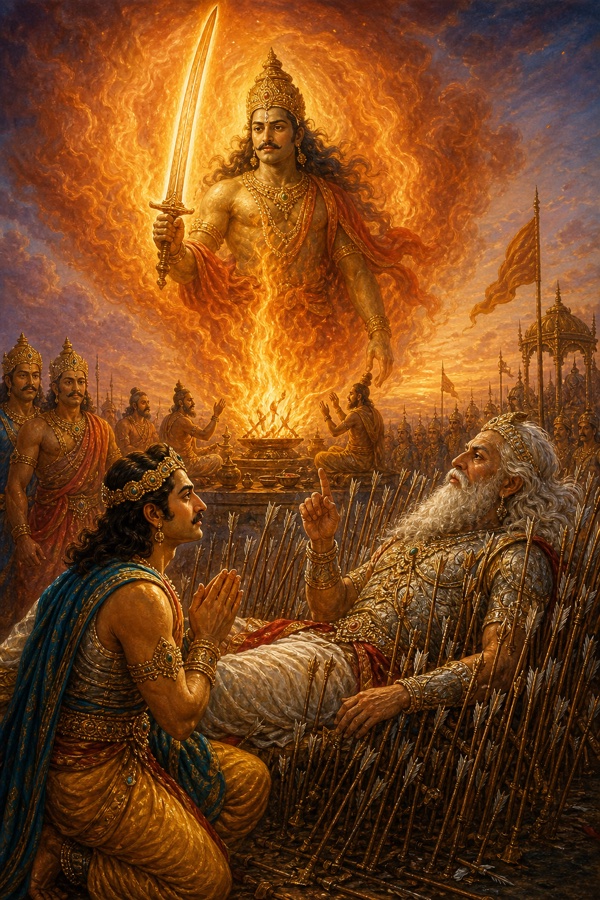
When that discourse was finished it was Nakula who spoke, and Nakula was an accomplished swordsman. He put his question to the Kuru grandsire where he lay on his bed of arrows. “The bow, grandfather, is held to be the first of weapons in this world. My own mind leans toward the sword. When the bow is cut or broken, when the horses are dead or spent, a good warrior who has been well trained in the sword can still protect himself with it. A hero with a sword in his hand can stand alone against many bowmen, and against many who come at him with maces and darts. I have this doubt, and I am curious to know the truth. Which is really the first of weapons in all battles? How was the sword first created, and for what purpose? And who was the first teacher of the weapon? Tell me all of this.”
Bhishma was a complete master of the science of the bow, and it was a pupil of Drona, a skillfully trained fighter, who had asked him. He answered Madri’s clever son from the arrows in graceful and well-chosen words, every vowel in its place. “Hear the truth of what you have asked me, Nakula. Your question has stirred me, and I am like a hill of red chalk. In ancient times the universe was one vast expanse of water, motionless and skyless, with no earth holding any place in it. It was wrapped in darkness, it could not be touched, and its look was dreadful. Utter silence lay over all of it, and it stretched beyond measure. In his own proper time the Grandsire of the universe took birth. He created the wind and fire, and the blazing sun. He created the sky, the heavens, the nether regions, the earth, the directions, the firmament with its moon and stars, the constellations, the planets, the year, the seasons, the months, the two fortnights, bright and dark, and the smaller divisions of time.”
“Then the divine Grandsire took a visible form and by the power of his will begot powerful sons: the sages Marichi, Atri, Pulastya, Pulaha, Kratu, Vasishtha, and Angiras, and the mighty lord Rudra, and Prachetas. Prachetas begot Daksha, and Daksha in his turn begot sixty daughters, and the Brahmin sages took all those daughters to raise children by them. From them sprang all the creatures of the universe: the gods, the ancestors, Gandharvas, Apsaras, Rakshasas of many kinds, birds and beasts and fishes, monkeys, great snakes, the many sorts of fowl that range the air or sport on the water, the plants, and every being born from an egg, from a womb, or from filth. So the whole universe of moving and unmoving creatures came into existence. When he had called them all into being, the universal Grandsire proclaimed the eternal religion laid down in the Vedas. It was accepted by the gods with their teachers and priests, by the Adityas, the Vasus, the Rudras, the Sadhyas, the Maruts, and the Ashvins, by Bhrigu, Atri, and Angiras, by the Siddhas, by Kashyapa rich in penances, by Vasishtha, Gautama, Agastya, Narada, and Parvata, by the Valikhilya rishis, and by those other rishis known as the Prabhasas, the Sikatas, the Ghritapas, the Somavayavyas, the Vaishvanaras, the Marichipas, the Akrishtas, the Hamsas, those born of fire, the Vanaprasthas, and the Prashnis. All of them lived in obedience to Brahma.”
“The chiefs of the Danavas, though, set the Grandsire’s commands at naught. Giving way to anger and covetousness, they began to bring about the destruction of righteousness. They were Hiranyakashipu and Hiranyaksha, Virochana and Shambara, Viprachitti, Prahlada, Namuchi, and Bali. These and many other Daityas and Danavas overstepped every restraint of duty and religion and amused themselves with wicked acts of all kinds. Holding themselves equal to the gods in birth, they began to challenge the gods and the sages of pure conduct. They never did any good to the other creatures of the universe and never showed compassion for any of them. Passing over the three well-known means, they set about persecuting and afflicting all creatures with the rod of punishment alone. Swollen with pride, those Asuras gave up every friendly dealing with other beings.”
“Then the divine Brahma, with the Brahmin sages around him, went to a delightful summit of Himavat. It stretched a hundred yojanas, it was adorned with jewels and gems of many kinds, and the stars seemed to rest on its surface like lotuses on a lake. On that prince of mountains, covered with forests of flowering trees, he stayed for a time to attend to the business of the world. When a thousand years had passed, the lord made ready a grand sacrifice by the ordinances of the scriptures. The altar was crowded with rishis skilled in sacrifice and able to perform every part of it, with bundles of sacrificial fuel, and with blazing fires, and it shone with plates and vessels that were all of gold. The first among the gods took their seats on it, and the members of the assembly who sat about the platform were all high rishis. I have heard from the rishis that something very dreadful soon happened in that sacrifice. A creature sprang up out of the sacrificial fire, they say, scattering the flames around him, and his splendor was that of the moon when it rises in a sky strewn with stars. His color was dark, like the petals of the blue lotus. His teeth were sharp, his belly was lean, his stature was tall, and he seemed irresistible and full of exceeding energy. When that being appeared, the earth trembled. The ocean was stirred into high waves and dreadful whirlpools. Meteors that foretold great disasters shot through the sky, and the branches of trees began to fall. Every quarter of the compass grew unquiet, ill-omened winds began to blow, and all creatures quaked with fear from moment to moment. Seeing that dreadful agitation of the universe, and the being who had sprung from the fire, the Grandsire spoke to the great rishis, the gods, and the Gandharvas. ‘I thought of this being. He has great energy, and his name is Asi. I have created him for the protection of the world and the destruction of the enemies of the gods.’”
“Then that being put off the form he had first taken and became a sword, splendid, highly polished, sharp-edged, risen like the all-destroying one at the end of the yuga. Brahma made that sharp weapon over to Rudra of the blue throat, who carries the bull on his banner, so that he could put down irreligion and sin. The divine Rudra, while the great rishis praised him, took up the sword and assumed a different shape. He put out four arms. He grew so tall that, standing on the earth, he touched the very sun with his head. With his eyes turned upward and every limb stretched wide he began to pour flames of fire from his mouth. He took on many colors, blue and white and red. He wore a black deerskin studded with stars of gold, and on his forehead he bore a third eye that shone like the sun, while his two other eyes, one black and one tawny, blazed very brightly. So Mahadeva, bearer of the trident, who tore out the eyes of Bhaga, lifted the sword whose splendor was that of the fire at the end of the yuga, and with it a great shield with three high bosses, like a mass of dark cloud lit by flashes of lightning, and he began to go through the figures of the swordsman. He whirled the blade in the sky, wanting an encounter. His roars were loud and the sound of his laughter was dreadful. The Danavas heard that Rudra had taken that form to do fierce deeds, and they were filled with joy. They came at him at great speed, showering huge rocks on him as they came, and blazing brands of wood, and terrible weapons of iron, each with the sharpness of a razor. And then the Danava host saw him, the indestructible Rudra swelling with might, and it was stupefied and began to tremble.”
“Rudra was alone, and he moved over the field so quickly, sword in hand, that the Asuras believed a thousand Rudras were fighting them. Tearing, piercing, cutting, lopping, and grinding down, the great god went through the thick masses of his enemies like a forest fire through heaps of dry grass. The mighty Asuras, broken by the whirling of his sword, fell to the earth with arms and thighs and chests cut through and heads struck from their trunks. Others broke under the strokes and fled in every direction, calling out to hearten one another as they ran. Some went down into the bowels of the earth. Some got under the cover of mountains. Some went upward, and some entered the depths of the sea. As that fierce battle went on, the earth turned to a mire of flesh and blood, and horrible sights lay on every side. Strewn with the fallen bodies of Danavas covered in blood, the ground looked as though mountain peaks overgrown with kinshuka trees had been scattered across it. Drenched with gore, the earth looked like a fair woman, flushed with wine, dressed in crimson robes. When he had killed the Danavas and set righteousness up again on earth, Rudra put off his dreadful form and took his own kindly shape, and all the rishis and all the gods adored that god of gods with loud shouts wishing him victory.”
“After this the divine Rudra gave the sword, that protector of religion, still dyed with the blood of the Danavas, to Vishnu, with due reverence. Vishnu gave it to Marichi. The divine Marichi gave it to all the great rishis. They gave it to Vasava, and Vasava gave it to the Regents of the world. The Regents gave that great sword to Manu, the son of Surya, and when they gave it they said to him, ‘You are the lord of all men. Protect all creatures with this sword, which holds religion in its womb. Those who break through the barriers of virtue, for the sake of the body or of the mind, are to be duly punished, and protection is to be given by the ordinances and never by caprice. Some should be punished with rebukes in words, and with fines and forfeitures. Loss of limb or death should never be inflicted for slight reasons. These punishments, with the rebuke in words as their first, are counted so many forms of the sword. They are the shapes the sword takes in answer to the transgressions of those under the king’s protection.’”
“In time Manu installed his own son Kshupa in the sovereignty of all creatures and gave him the sword for their protection. From Kshupa it was taken by Ikshvaku, and from Ikshvaku by Pururavas. From Pururavas it was taken by Ayus, and from Ayus by Nahusha. From Nahusha it was taken by Yayati, and from Yayati by Puru. From Puru it was taken by Amurtaraya, and from Amurtaraya it came down to the royal Bhumishaya. From Bhumishaya it was taken by Bharata, the son of Dushyanta, and from Bharata by the righteous Ailavila. From Ailavila it was taken by King Dhundhumara, from Dhundhumara by Kamboja, and from Kamboja by Muchukunda. From Muchukunda it was taken by Marutta, and from Marutta by Raivata. From Raivata it was taken by Yuvanashva, and from Yuvanashva by Raghu. From Raghu it was taken by the valiant Harinashva, from Harinashva by Shunaka, and from Shunaka by the righteous Ushinara. From Ushinara it was taken by the Bhojas and the Yadavas. From the Yadus it was taken by Shibi, and from Shibi it came down to Pratardana. From Pratardana it was received by Ashtaka, and from Ashtaka by Prishadashva. From Prishadashva it was received by Bharadvaja, and from Bharadvaja by Drona. After Drona it was taken by Kripa. And from Kripa that sword, the finest there is, has come to you and to your brothers.”
“The constellation under which the sword was born is Krittika. Agni is its deity, Rohini is its family, and Rudra is its high teacher. The sword has eight names that are not generally known, and I will tell them to you, for the man who speaks them may always win victory. They are Asi, Vaishasana, Khadga, the sharp-edged, the hard to win, Shrigarbha, victory, and protector of righteousness. Of all weapons, Nakula, the sword stands first, and the Puranas truly declare that Mahadeva was the first to wield it. As for the bow, it was Prithu who first made it; with that weapon the son of Vena, who governed the earth virtuously for many years, milked her of crops and grain in abundance. You should take what the rishis have said as conclusive proof. Everyone skilled in battle should worship the sword. I have told you truly and in detail the first part of what you asked, the origin and creation of the sword. Whoever listens to this story of how the sword came to be wins fame in this world and unending happiness in the next.”
A sub-tale: The sword reaches Manu with instructions attached, and they are the heart of the story. The Regents of the world tell him that the weapon holds religion in its womb and that he is to protect creatures by the ordinances and never by caprice. They tell him that some offenders are to be corrected with a rebuke in words and others with fines and forfeitures, and that loss of limb or death is never to be inflicted for slight reasons. All of these, beginning with the spoken rebuke, they call forms of the sword. So the blade Rudra used alone against the Danavas, who had ruled by the rod and nothing else, passes into human hands as a graded scale of punishment.
The gist: Nakula, the swordsman among the brothers, asks which weapon is first and where the sword came from. Bhishma goes back to the waters before creation: Brahma makes the world and proclaims the religion of the Vedas, the Danavas overturn it, and after a thousand years on Himavat a being named Asi rises from Brahma’s sacrificial fire and becomes a sword. Rudra, grown tall enough to touch the sun, destroys the Danavas with it. The sword then passes from Rudra to Vishnu, to Marichi, the rishis, Indra, the Regents of the world, and Manu, and down a long line of kings to Drona, Kripa, and the Pandavas.
Dharma, wealth, and pleasure: the brothers’ debate
Bhishma fell silent after that, and Yudhishthira and the others went home. There the king turned to his four brothers, and to Vidura, who made a fifth among them, and gave them a question of his own. “The course of the world rests on dharma, wealth, and pleasure. Of these three, which stands first in importance, which second, and which last? And to master the other three, lust, anger, and covetousness, on which of the first three should the mind be fixed? I want each of you to answer gladly, and in words that are true.”
Vidura spoke first. He knew the science of profit and the way the world goes, he knew the truth of things, and his mind was brilliant, and he answered out of his memory of the scriptures. “Study of the various scriptures, austerity, gift, faith, the performance of sacrifices, forgiveness, sincerity, compassion, truth, and self-restraint: these are the possessions of dharma. Take dharma for your own, and never let your heart turn away from it. Dharma and profit both have their roots in these, and I think all of them can be gathered under the one word. It is by dharma that the rishis crossed the world and its difficulties. It is on dharma that all the worlds depend. It is by dharma that the gods came to their high position, and it is on dharma that profit rests. Dharma stands first in merit. Profit is said to be the middle one. Pleasure, the wise say, is the lowest of the three. So a man should live with his soul restrained and give his attention to dharma most, and he should behave toward all creatures as he would toward himself.”
When Vidura had finished, Arjuna took it up. Pritha’s son was well versed in the science of profit and knew the truths of dharma as well, and the drift of the king’s question carried him. “This world is the field of action, and so action is what is praised here. Farming, trade, the keeping of cattle, and the many arts make up what is called profit, and profit is the end of all such acts. Without profit neither dharma nor the objects of desire can be won; this is the declaration of the shruti. Even men of uncleansed soul, once they have wealth of many kinds, can perform the highest acts of dharma and satisfy desires that look impossible to satisfy. Dharma and pleasure are the limbs of wealth, as the shruti declares, and when wealth is won, both can be won. As all creatures worship Brahma, men of high birth themselves wait on a man who has wealth. Those who dress in deerskins and wear matted locks, who are self-restrained, who smear their bodies with mud and keep their senses under complete control, those with shaven heads who are devoted celibates and live apart from one another, all of them cherish a desire for wealth. Others in yellow robes, with long beards, graced with modesty, learned, contented, and freed from all attachments, come to desire wealth. Others who follow the practices of their ancestors and keep their own duties, and others who want heaven, do the same. Believers and unbelievers, and those who are strict practitioners of the highest yoga, all testify to the excellence of wealth. That man is said to be truly wealthy who cherishes his dependents with things to enjoy and afflicts his enemies with punishments. This is truly my opinion. Listen now to these two, who are about to speak.”
The two were Madri’s sons, Nakula and Sahadeva, and they spoke together. “Sitting or lying, walking or standing, a man should strive for wealth, even by the most vigorous means. Wealth is hard to get and very pleasant to have, and once it is earned the one who earned it is seen, without doubt, to obtain everything he desires. Wealth that is joined to dharma, and dharma that is joined to wealth, are certainly like nectar. So our opinion is this. A man with no wealth cannot satisfy any desire, and in the same way no wealth comes to one who has no dharma. The man who stands outside both dharma and wealth is therefore an object of fear to the world. A man should seek wealth with a devoted mind, then, and never disregard what dharma requires. Those who believe this saying get whatever they desire. One should first practice dharma. Next one should acquire wealth without sacrificing dharma. Then one should seek the satisfaction of desire, for that is the last act of a man who has succeeded in getting wealth.”
The twin sons of the Ashvins fell silent, and Bhimasena began. “A man without desire never wishes for wealth. A man without desire never wishes for dharma. One who has no desire in him cannot feel any wish at all, and for that reason desire is the first of the three. It is under the sway of desire that the rishis themselves give their lives to penance, living on fruits, or on roots, or on air alone. Others who have Vedic learning are busy with the Vedas and their branches, or with rites of faith and acts of sacrifice, or with making gifts and accepting them. Traders, farmers, keepers of cattle, artists and artisans, and those who are employed in rites of propitiation all act from desire. There are some who dive to the depths of the ocean, and desire sends them. Desire takes many forms, and everything is pervaded by it. A man outside the reach of desire is not seen in this world, never was, and never will be. This is the truth. Dharma and wealth are both founded on desire. As butter is the essence of curds, desire is the essence of profit and dharma. Oil is better than oil seeds. Ghee is better than sour milk. Flowers and fruits are better than wood. In the same way desire is better than dharma and profit. As honey is drawn out of flowers, desire is said to be drawn out of those two. Desire is the parent of dharma and profit, and desire is their soul. Without desire the Brahmins would never give sweets or wealth to Brahmins. Without desire the many kinds of action seen in the world would never have been seen.”
“For these reasons desire is seen to be the first of the three,” he said, and he went further. “Go to beautiful women dressed in fine robes, wearing every ornament, and merry with sweet wines, and take your pleasure with them. Desire should be the first of the three with us. I have thought the question through to its roots and this is where I have come out, so do not hesitate to accept it, Yudhishthira. These words of mine are no hollow thing; there is righteousness in them, and all good men will accept them. Dharma, profit, and desire should all be attended to equally. The man who gives himself to one of them alone is certainly no superior person. The one who gives himself to two is called middling. And the one who attends to all three stands highest of his kind.” Having said this to those heroes in brief and at length, Bhima, wise, with his friends around him, his body smeared with sandal paste, garlands and ornaments on him, fell silent.
King Yudhishthira the just, a man of great learning, thought for a while about what each of them had said, and he judged all of it false philosophy. Then he spoke. “There is no doubt that all of you have settled conclusions about the scriptures, and all of you know the authorities. I have heard what you said, and you said it with certainty. Now listen to me with your whole attention. The man who is engaged neither in merit nor in sin, who attends to neither profit nor dharma nor desire, who is above all faults, who looks on gold and on a lump of brick with the same eye, is freed from pleasure and pain and from the need to accomplish his purposes. All creatures are subject to birth and death. All of them are liable to waste and change. Awakened again and again by the benefits and the evils of life, every one of them praises liberation. We do not know, though, what liberation is.”
“The self-born and divine Brahma has said that there is no liberation for the one who is bound by ties of attachment and affection. Those who have learning seek nirvana. For that reason one should never look on anything as agreeable or as disagreeable, and this view seems the best. No one in this world can act as he pleases. I act exactly as I am made to act. The great Ordainer makes all creatures go as he wills. The Ordainer is supreme; know this, all of you. No one can obtain by his acts what is not to be obtained, and what is to be, comes to pass. Know this too. And since the one who has withdrawn himself from the three aims may succeed in winning liberation, it seems that liberation produces the highest good.” Bhima and the others heard these words, full of reason and welcome to the heart, and they were delighted; they joined their hands and bowed to that prince of the Kurus, and they praised a speech so well made, sweet in its letters and syllables and free of any harsh sound. Yudhishthira, the son of Dharma, praised his listeners, now convinced, in return. And then once more the king went to the son of Ganga, to ask about duties.
A key to reading this (the group of three and the fourth goal): Dharma, wealth, and pleasure are the three aims on which, Yudhishthira says, the course of the world rests; he pairs them with a second three that have to be mastered, lust, anger, and covetousness. Vidura ranks dharma first, profit in the middle, and pleasure last. Arjuna puts wealth first and calls the other two its limbs. The twins give an order of practice: dharma first, then wealth earned without sacrificing dharma, then desire. Bhima makes desire the root of both the others and then says all three should be attended to equally. Yudhishthira judges every one of these answers false philosophy and names something outside the three, liberation, which he says belongs to the one who has withdrawn from them all and looks on gold and a lump of brick with the same eye.
The gist: At home after Bhishma falls silent, Yudhishthira asks his brothers and Vidura which of dharma, wealth, and pleasure comes first. Vidura answers dharma, Arjuna wealth, the twins wealth joined to dharma, and Bhima desire, with the rider that the highest man serves all three. Yudhishthira sets every answer aside. The one who is bound to none of the three is free of pleasure and pain, he says; no one acts as he pleases, the Ordainer is supreme, and liberation is the highest good.
The dharma of friendship: with whom to be friends, with whom not
Back beside the grandsire, Yudhishthira asked about friends. “Grandfather, you who have such wisdom, I have a question, and I ask you to speak on it fully. What kind of men are said to be of gentle disposition? With whom may the most delightful friendship exist? Tell us too who are able to do us good now and in the end. It is my opinion that swelling wealth, relatives, and kinsmen do not hold the place that well-wishing friends hold. A friend who can listen to good counsel, and who can also do good, is exceedingly rare. Speak to me fully on all of this.”
Bhishma said, “Listen, Yudhishthira, and I will tell you in detail of the men with whom friendships may be formed and those with whom they may never be. One who is covetous, one who is pitiless, one who has given up the duties of his order, one who is dishonest, a knave, a mean man, a man of sinful practices, one who suspects everybody, one who is idle, one who puts things off, one of crooked disposition, one whom everybody reviles, one who dishonors his teacher, one given to the seven well-known vices, one who casts off friends in their distress, one with a wicked soul, one who is shameless, one whose eyes are always on sin, an atheist, a slanderer of the Vedas, one whose senses are unrestrained, one who gives free rein to lust, one who is untruthful, one whom all have deserted, one who breaks through every restraint, one who is deceitful, one who has no wisdom, one who is envious, one who is wedded to sin, one whose conduct is bad, one whose soul is uncleansed, one who is cruel, a gambler, one who is always trying to injure his friends, one who covets wealth that belongs to others: all these should be avoided. So should the wicked man who is never satisfied with what another gives him to the limit of his means, the man who is never pleased with his friends, the man who grows angry when nothing justifies anger, the man of restless mind, the man who quarrels without cause, and the sinner who feels no scruple about deserting friends who mean him well. So should the man who thinks always of his own interest and who quarrels with his friends when they do him some very slight injury or wrong him without knowing it, the man who acts like an enemy and speaks like a friend, the man whose perceptions are perverse, the man who is blind to his own good, and the man who never takes delight in what is good for himself or for others. One who drinks liquor, one who hates others, one who is wrathful, one who has no compassion, one who is pained by the sight of another’s happiness, one who injures friends, one who is always taking the lives of living creatures, one who is ungrateful, and one who is base should be avoided, and no alliance of friendship should ever be formed with any of them. And none should be formed with the man who is forever intent on marking the faults of others.”
“Hear now of those with whom friendship may be formed. Men who are well born, who have eloquence and courtesy of speech, who are gifted with knowledge and science, who have merit and other accomplishments, who are free from covetousness, who are never worn out by labor, who are good to their friends, who are grateful, who have wide information and knowledge, who have no avarice in them, who have agreeable qualities, who are firm in truth, who have subdued their senses, who are devoted to athletic and other exercises, who come of good families, who carry their families on with wives and children, who are free of faults, and who have fame: kings should accept such men for alliances of friendship. So too with those who are pleased and contented when one does for them the best that is in one’s power, who never grow angry when nothing justifies anger, who are never displeased without sufficient cause, who know the science of profit well and keep their minds calm even when they are annoyed, who give themselves to the service of their friends at a cost to themselves, and who are never estranged from a friend and stay as they were, like a red woolen blanket that holds its color. So too with those who never slight the poor out of anger, who never dishonor young women by giving way to lust and loss of judgment, who never point out wrong paths to their friends, who can be trusted, who are devoted to the practice of righteousness, who look on gold and a lump of brick with the same eye, who hold fast to friends and well-wishers, and who gather their own people and work at a friend’s business with no thought for their own dignity, putting off every mark of their own rank. Such are the men with whom alliances of friendship should be made. The dominions of a king who makes his friends among men of that stamp spread in every direction, like the light of the lord of the stars.”
“Alliances should be formed with men who are well practiced in weapons, who have completely subdued their anger, who are always strong in battle, and who have high birth, good conduct, and varied accomplishments. And among all the vicious men I named, the lowest are those who are ungrateful and those who injure friends. Men who behave so should be avoided by everyone. This is a settled conclusion.”
Yudhishthira said, “I want to hear this described in full. Tell me who they are that are called injurers of friends and ungrateful men.”
The gist: Yudhishthira holds that a well-wishing friend is worth more than wealth or kin, and asks whom to choose. Bhishma gives two long lists: the covetous, the idle, the suspicious, the gambler, the drinker, the man who speaks like a friend and acts like an enemy are to be avoided, and the well born, the grateful, the truthful, the self-controlled, the man who stays the same like a red blanket that keeps its color are to be sought. Lowest of all he places the ungrateful and those who injure friends. The king asks to hear more of those two, and the answer is a story.
The tale of Gautama and Rajadharma: the example of ingratitude (beginning)
Bhishma said, “I will tell you an old story, and the things in it happened in the country of the Mlechchhas that lies to the north. There was a certain Brahmin who belonged to the Middle Country, a man with no Vedic learning at all. One day he saw a prosperous village and went into it, hoping for charity. A robber lived in that village, a man of great wealth, who knew the marks that distinguish all the orders of men, who was devoted to Brahmins, firm in truth, and always busy making gifts. The Brahmin went to that robber’s house and begged. He asked for a house to live in, and for the necessaries of life for one year.”
“The robber gave him what he asked, and a piece of new cloth with both its ends whole, and a widowed woman who was still young. The Brahmin, whose name was Gautama, was filled with delight at getting all this, and he settled happily into the roomy house the robber assigned him. He took up the support of the relatives and kinsmen of the slave woman the robber chief had given him, and he lived on in that prosperous village of hunters. He began to practice archery with great devotion. Every day, like the other robbers who lived there, Gautama went into the woods and killed wild cranes in great numbers. Always at the work of killing living creatures, he grew skilled in it, and soon he said farewell to compassion. From keeping close company with robbers he became like one of them.”
“He lived happily in that robber village for many months, and the number of wild cranes he killed was large. Then one day another Brahmin came to the village. He was dressed in rags and deerskins and wore his hair in matted locks. His conduct was very pure, and he was devoted to the study of the Vedas; he was humble, frugal in what he ate, devoted to Brahmins, deeply versed in the Vedas, and a keeper of the vows of brahmacharya. That Brahmin had been a dear friend of Gautama’s, and he came from the same part of the country Gautama had left. He never accepted food from the hand of a Shudra, and so, arriving in the course of his wanderings at that village crowded with robber families, he began to look for the house of a Brahmin where he might be a guest. He searched it in every direction. At last he came to the house that belonged to Gautama.”
“It happened that Gautama was coming back from the woods at that very moment and was just entering his door. The two friends met. Gautama was armed with a bow and a sword. He carried a load of slaughtered cranes on his shoulders, and his body was smeared with the blood that trickled down from the bag. The new arrival looked at this man who had the appearance of a cannibal, who had fallen away from the pure practices of the order he was born in, and he knew him. ‘What is this you are doing here in your folly?’ he said. ‘You are a Brahmin, and you carry a Brahmin family forward. You were born in a respectable family of the Middle Country. How have you come to live like a robber? Remember your famous kinsmen of earlier days, every one of them well versed in the Vedas. You were born in their line, and you have become a stain on it. Wake yourself by your own effort. Remember the energy, the conduct, the learning, the self-restraint, and the compassion that are yours by birth, and leave this place where you are living.’”
“Gautama answered that well-meaning friend with real pain in his heart. ‘I am poor,’ he said. ‘I have no knowledge of the Vedas. I took up my home here for the sake of wealth alone; know that. Seeing you today, though, I am blessed. We will set out from this place together tomorrow. Spend the night here with me.’ The newcomer was a compassionate man and he stayed the night. He touched nothing in that house. He was hungry, and Gautama pressed him again and again, and still the guest refused to touch any food there.”
A key to reading this (Mlechchha, the Middle Country): Bhishma places the story in the country of the Mlechchhas that lies to the north, and its people in a village of robbers and hunters. Gautama comes from the Middle Country, from a respectable family whose earlier members were all versed in the Vedas, though he has no Vedic learning himself. His old friend from the same region measures the fall by what a Brahmin has by birth, energy, conduct, learning, self-restraint, and compassion, and by what Gautama now carries: a bow, a sword, and a bag of dead cranes dripping blood. The friend’s own rule is strict. He takes no food from a Shudra, and he goes hungry through the night under Gautama’s roof.
The gist: A Brahmin of the Middle Country with no Vedic learning begs a house and a year’s living from a rich robber in the northern country of the Mlechchhas, receives a young widow with them, and stays. He learns the bow, kills cranes every day, and loses his compassion. A friend from home, an ascetic student of the Vedas, finds him at his own door with blood on him and tells him to leave. Gautama promises to go in the morning, and the friend spends the night there without eating.
The meeting with the crane Rajadharma, and the wealth from Virupaksha
Bhishma said, “When that night had passed and the good Brahmin had left the house, Gautama came out too and set off toward the sea. On the way he saw some merchants who made voyages by sea, and he joined their caravan and went on with it toward the ocean. But as that large caravan was passing through a valley, a maddened elephant attacked it, and almost every person in it was killed. The Brahmin escaped somehow from that great danger and ran for his life toward the north, with no idea where he was going. Cut off from the caravan and carried far from that place, he wandered alone in a forest like a kimpurusha.”
“At last he came on a road that led toward the ocean, and he followed it until he reached a delightful, heavenly forest full of flowering trees. Mango trees stood in it that put out flowers and fruit the whole year round. It was like the very woods of Nandana, and Yakshas and Kinnaras lived there. There were shala trees and palmyras and tamalas, clusters of black aloe, and many great sandal trees. On the pleasant tablelands, fragrant with scents of many kinds, the finest birds could always be heard pouring out their songs. The birds called bharundas, whose faces are like the faces of human beings, sang there, and those called bhulingas, and others that belong to the mountains and to the sea. Gautama walked through that forest listening to them. On his way he saw a level piece of ground, very lovely, covered with golden sand and as beautiful as heaven. On it stood a large and handsome banyan with a rounded top. Its many branches matched the parent trunk in beauty and size, and the tree looked like an umbrella set over the plain. The ground under it had been sprinkled with water scented with the most fragrant sandal. Flowers lay all around, and the place looked like the court of the Grandsire himself.”
“Gautama was delighted with that charming and sacred spot, which looked like the home of a god, and he sat down there with a contented heart. As he sat, a soft and pleasant breeze began to blow, carrying the perfume of many kinds of flowers. It cooled his limbs and filled him with a heavenly ease, and refreshed by it he soon fell asleep. The sun went down behind the Asta hills. When that shining body had entered his chambers in the west and the evening twilight had come, a bird who stood first among his kind came back to that spot, which was his home, from the regions of Brahma. His name was Nadijangha, and he was a dear friend of the creator. He was a prince of cranes, a bird of great wisdom, and a son of the sage Kashyapa. He was widely known on earth by another name too, Rajadharma. Indeed he surpassed everyone on earth in fame and in wisdom. He was the child of a celestial maiden, beautiful and learned, and he shone like a god. The many ornaments he wore were as bright as the sun, and that child of a celestial girl seemed to blaze with beauty.”
“Gautama saw that bird arrive and was filled with wonder. He was also worn out with hunger and thirst, and he began to look the bird over with the wish to kill him. Rajadharma spoke first. ‘Welcome, Brahmin. It is my good luck that I find you in my home today. The sun has set and the evening twilight is here. Having come to my home, you are my dear and honored guest for today. Receive my worship by the rites laid down in the scriptures, and tomorrow morning go wherever you wish.’”
“Those sweet words astonished Gautama, and a great curiosity came over him. He stared at Rajadharma and could not take his eyes away. ‘Brahmin,’ the bird said, ‘I am the son of Kashyapa by one of the daughters of the sage Daksha. You are a man of great merit and you are my guest today. You are welcome.’ He offered him hospitality by the rites the scriptures lay down. He made him an excellent bed of the shala flowers that lay all around. He brought him several large fish caught in the deep waters of the Bhagirathi, and with the fish the son of Kashyapa set a blazing fire before his guest. When the Brahmin had eaten and was content, the bird, who was rich in penance, began to fan him with his wings to drive off his weariness.”
“Seeing his guest seated at his ease, he asked him about his lineage. ‘I am a Brahmin, and I am known by the name Gautama,’ the man said, and he said nothing more. The bird gave him a soft bed made of leaves and scented with many fragrant flowers, and Gautama lay down on it and felt great happiness. When he had lain down, the eloquent son of Kashyapa, who was like Yama himself in his knowledge of duties, asked him what had brought him there. ‘I am very poor,’ Gautama answered. ‘I want to go to the sea to earn wealth.’ The son of Kashyapa answered him cheerfully. ‘You need feel no anxiety. You will succeed, and you will go home with property. The sage Brihaspati has spoken of four ways of acquiring wealth: by inheritance, by a sudden accession that comes of luck or the favor of the gods, by labor, and through the aid and kindness of friends. I have become your friend. I have good feelings toward you. So I will exert myself in such a way that you succeed in acquiring wealth.’”
“The night passed and morning came. Seeing his guest rise cheerfully from his bed, the bird said, ‘Go along this very road, my friend, and you are sure to succeed. About three yojanas from this place there is a mighty king of the rakshasas. He has great strength, his name is Virupaksha, and he is a friend of mine. Go to him. At my request that chief will without doubt give you as much wealth as you desire.’ Gautama set out gladly, eating his fill on the way of fruits as sweet as nectar. He looked at the sandal and aloe and birch trees that stood along the road, enjoyed their cool shade, and went quickly. So he reached the city known by the name Meruvraja. It had great gateways made of stone and high walls of stone, a trench ran around it on every side, and large pieces of rock and engines of many kinds were kept ready on the ramparts. The rakshasa chief, a being of great intelligence, soon learned of him as a dear guest sent by his friend. He received the news gladly and commanded his attendants, ‘Let Gautama be brought here from the gate at once.’ At the king’s command certain men, as quick as hawks, came out of their ruler’s splendid palace, went to the gate, and addressed Gautama. ‘Come quickly. The king desires to see you. You may have heard of the king of the rakshasas, Virupaksha by name, a king of great courage. He himself is impatient to see you. Come quickly, and do not linger.’ The Brahmin forgot his tiredness in his surprise and ran along with the messengers. He saw the great wealth of the city and was filled with wonder, and soon, eager for a sight of the rakshasa king, he entered the palace in their company.”
“He was led into a spacious room and presented to the king of the rakshasas, who honored him with the usual offerings, and he took his place on an excellent seat. The king asked him about the family of his birth and his practices, about his study of the Vedas and his keeping of the vow of brahmacharya. The Brahmin left the other questions unanswered and stated his name and his family, nothing more. The king, having learned so much and no more, and seeing that his guest had neither the splendor of a Brahmin nor Vedic study, asked next about the country he lived in. ‘Where is your home, and to what family does your wife belong? Tell us truly, and do not be afraid. Trust us, and have no anxiety.’ Gautama said, ‘I belong by birth to the Middle Country. I live in a village of hunters. I have married a Shudra wife who had been a widow. All this that I tell you is the truth.’”
“The king began to consider what he should do, and how he might win merit in the matter. He said to himself, ‘This man is a Brahmin by birth. He is also a friend of Rajadharma, and that son of Kashyapa has sent him to me. I must do what is pleasing to my friend. Rajadharma is very close to me; he is my brother and my dear kinsman, truly a friend of my heart. On this day of the month of Kartika a thousand Brahmins of the first rank are to be entertained in my house. This Gautama shall be entertained with them, and I will give wealth to him as well. This is a sacred day. Gautama has come here as a guest. The wealth that is to be given away is ready. What is there left to think about?’”
“Just about then a thousand Brahmins of great learning came to the palace, bathed and purified, adorned with sandal paste and flowers, and dressed in long robes of linen. The rakshasa king Virupaksha received his guests as they came, duly and by the rites of the scriptures. At his command skins were spread out for them, and the royal servants laid mats of kusha grass on the ground. When the king had honored them, those Brahmins sat down on the seats, and the rakshasa chief worshiped his guests once more, as the ordinance provides, with sesame seeds, green blades of grass, and water. Some among them were chosen to represent the Vishvedevas, the ancestors, and the deities of fire. These were smeared with sandal paste, flowers were offered to them, and they were adored with other costly offerings, and after that worship every one of them looked as radiant as the moon in the sky. Then bright, polished plates of gold, adorned with engravings and filled with excellent food prepared with ghee and honey, were set before the Brahmins. Every year, on the days of the full moon in the months of Ashadha and Magha, a great number of Brahmins used to receive from the rakshasa chief, after proper honors, the best kinds of food they could desire. And on the day of the full moon in the month of Kartika above all, when autumn had gone, the king used to give the Brahmins much wealth of many kinds: gold, silver, jewels, gems, pearls, diamonds of great value, stones of lapis lazuli, deerskins, and skins of the ranku deer.”
“Throwing down a heap of wealth of many kinds to be given away as dakshina, the mighty Virupaksha said to those Brahmins, ‘Take from these jewels and gems as much as you wish and can hope to carry away.’ And he used to tell them, ‘Take the plates of gold and the vessels you have used for your dinner, and go.’ When the rakshasa king spoke those words at that feast, the Brahmins took as much wealth as each of them desired. Honored with costly jewels and gems, and dressed in excellent robes, they were filled with delight. Then the king held back the rakshasas who had come to his palace from many lands, and he spoke to the Brahmins once more. ‘For this one day, Brahmins, you need have no fear of the rakshasas here. Enjoy yourselves as you wish, and then go away with speed.’ The Brahmins left that place and went off in all directions as fast as they could. Gautama too lost no time. He took up a heavy quantity of gold and went away.”
A key to reading this (the name Rajadharma, and the yojana): The crane has two names in the story, Nadijangha and, on earth, Rajadharma, and under that second name he does for a stranger everything a host owes a guest: a welcome at nightfall, a bed of flowers, fish and a fire, his own wings for a fan, and a plan to make the man rich. He sends Gautama about three yojanas down the road to Meruvraja, the walled city of his friend Virupaksha. The rakshasa king is the second generous host. He sees that this Brahmin has neither the splendor of his order nor any Vedic study, hears that he lives among hunters with a Shudra wife, and seats him among a thousand learned Brahmins all the same, because a friend sent him. The one who behaves badly in these scenes is the Brahmin, who looked at the bird, on first seeing him, with the wish to kill him.
The gist: Fleeing north from a caravan wrecked by an elephant, Gautama falls asleep under a great banyan and is found there at nightfall by the crane whose home it is, Rajadharma, son of Kashyapa and friend of Brahma. The bird feeds and beds him as a guest and in the morning sends him three yojanas on to the rakshasa king Virupaksha. For his friend’s sake the king seats Gautama among the thousand Brahmins he feasts on that day in Kartika, and Gautama leaves Meruvraja carrying as much gold as he can lift.
The dire sin of ingratitude: Gautama kills Rajadharma
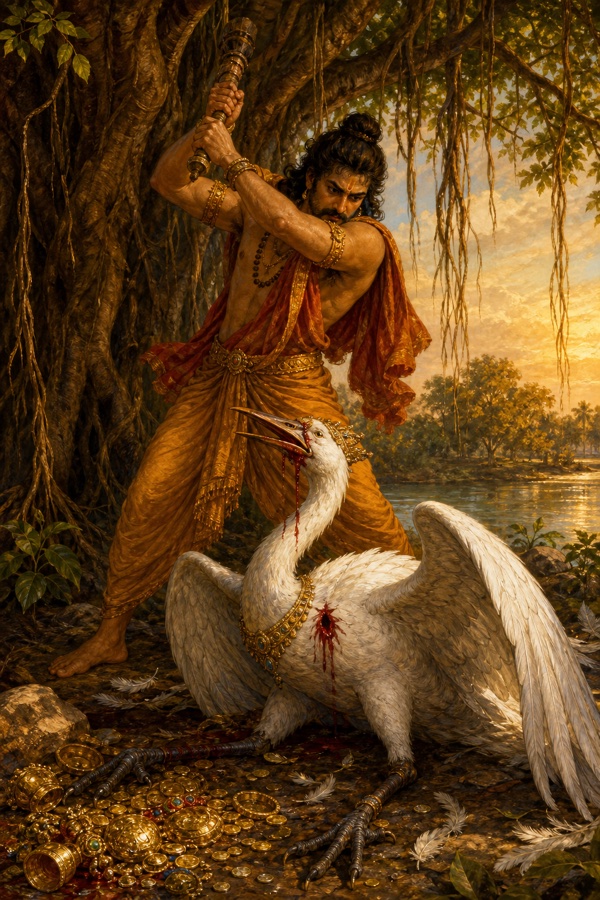
Bhishma said, “He could hardly carry the load. He got as far as the same banyan under which he had met the crane, and there he sat down, tired, worn with the road, and hungry. While he rested, Rajadharma came. The bird was devoted to his friends, and he gladdened Gautama by bidding him welcome. He beat his wings to fan his guest and drive away his weariness, he did him honor, and he saw to his food. When Gautama had eaten and was refreshed he began to think. ‘This load of bright gold I have taken up is heavy; greed and folly made me take so much. I have a long way to travel. I have no food to keep me alive on the way. What am I to do to stay alive?’”
“Those were his thoughts, and think as he might, he could see no food he might eat on the road. Then this ungrateful man conceived a thought. ‘This prince of cranes is so large, and there is a heap of flesh on him, and he stays right beside me. I will kill him and put him in my bag, and leave this spot, and travel fast.’”
“There under the banyan the prince of birds had lit a fire for the protection of his guest and kept it burning with high, blazing flames. On one side of that fire the bird slept, in complete trust. The ungrateful man made ready to kill his sleeping host. With the help of that blazing fire he killed the trusting bird, and when he had finished him he was filled with delight, and it never came to him that there was sin in what he had done. He stripped off the feathers and the down and roasted the flesh on the fire. Then he took it up, together with the gold he had brought, and fled quickly from that spot.”
“The next day the rakshasa king Virupaksha said to his son, ‘Alas, my son, I do not see Rajadharma today. Every morning he goes to the regions of Brahma to adore the Grandsire, and on his way back he never goes home without paying me a visit. Two mornings and two nights have now passed without his coming to my house, and my mind is uneasy. Let inquiry be made after my friend. That Gautama who came here has no Vedic study and none of a Brahmin’s splendor, and he has found his way to my friend’s home. I greatly fear that this worst of Brahmins has killed Rajadharma. I read him through by the signs he showed: evil in his practices, wicked in his understanding, without compassion, cruel and grim of face, the lowest of men, and like a robber. That Gautama has gone to the home of my friend, and my heart is very anxious. Go from here at full speed, my son, to the home of Rajadharma, and find out if that pure-souled bird is still alive. Do not delay.’”
“The prince set out at once with other rakshasas, traveling fast. At the foot of the banyan he saw what was left of Rajadharma. The son of the rakshasa king wept with grief, and then he ran, as fast and as hard as he could, to seize Gautama. The rakshasas had not far to go before they caught the Brahmin, and with him they found the body of Rajadharma, stripped of its wings, its bones, and its feet. Taking their captive with them, they went back at great speed to Meruvraja and showed the king the mangled body of Rajadharma and that ungrateful, sinning wretch, Gautama.”
“When the king saw the remains of his friend, he and his counselors and his priest began to weep aloud. The sound of lamentation in his house was loud, and the whole city of the rakshasa king, men, women, and children, was plunged in grief. Then the king said to his son, ‘Let this sinner be killed. Let these rakshasas here feast merrily on his flesh. Sinful in his deeds, sinful in his habits, sinful in his soul, and hardened in sin, this man, I think, should die at your hands.’ But the rakshasas, fierce and strong as they were, said they were unwilling to eat the flesh of that sinner. Those wanderers of the night bent their heads to their king. ‘Let this lowest of men be given away to the robbers,’ they said. ‘You should not give us such a sinner for our food.’ The king said, ‘Let it be so. Let this ungrateful creature be given to the robbers, then, without delay.’”
“So the rakshasas, armed with lances and battle-axes, hacked the man into pieces and gave the pieces to the robbers. And it turned out that the robbers themselves refused to eat his flesh. They were eaters of men, and still they would not eat an ungrateful person. For one who kills a Brahmin, for one who drinks liquor, for one who steals, for one who has fallen away from a vow, there is expiation. For an ungrateful person there is none. The cruel man who injures a friend and turns ungrateful is left uneaten by the very cannibals, and by the worms that feed on carrion.”
The gist: Gautama comes back to the banyan bent under his gold, and the crane welcomes him a second time, fans him, and feeds him. With no food for the long road, the Brahmin decides that his host is food. He kills the sleeping bird with the fire the bird had lit to protect him, roasts the flesh, and runs. Virupaksha, missing his friend’s daily visit for two days, sends his son, who finds the remains and brings Gautama back. The rakshasas will not eat such a man, and the robbers, eaters of men themselves, refuse him too. There is expiation for the killer of a Brahmin, the drinker, the thief, and the breaker of a vow, and none for the ungrateful.
Surabhi’s nectar, Rajadharma’s revival, and the heart of the tale
Bhishma said, “Then the rakshasa king had a funeral pyre built for that prince of cranes, and he adorned it with jewels and gems and perfumes and costly robes. He set fire to it with the body of the prince of birds on it and had the last rites of his friend performed by the ordinance. At that moment the auspicious goddess Surabhi, the daughter of Daksha, appeared in the sky above the place where the pyre had been raised. Her udder was full of milk. From her mouth froth mixed with milk fell on the funeral pyre of Rajadharma, and at its touch the prince of cranes came back to life. He rose up and went to his friend Virupaksha, the king of the rakshasas.”
“At that very time the chief of the gods himself came to the city of Virupaksha. ‘By good luck you have revived the prince of cranes,’ Indra said to the rakshasa king, and he went on to tell him the old story of a curse that the Grandsire had once pronounced on Rajadharma. ‘Once this prince of cranes stayed away from the region of Brahma when his presence was expected. In his anger the Grandsire said of him, “Since this worthless crane has failed to present himself in my assembly today, that wicked-souled one shall not soon die and leave the earth.” Because of those words of the Grandsire, the prince of cranes, though Gautama killed him, has come back to life, through the power of the nectar with which his body was drenched.’”
“When Indra had finished, Rajadharma bowed to the chief of the gods and said, ‘If your heart is inclined to show me grace, then let my dear friend Gautama be restored to life.’ Vasava heard him, sprinkled nectar over the Brahmin Gautama, and restored him to life. The prince of cranes went up to his friend Gautama, who still had the load of gold on his shoulders, and embraced him, and felt great joy. Then Rajadharma sent Gautama of the sinful deeds on his way, together with his wealth, and went back to his own home. At the proper hour the next day he went to the Grandsire’s region, and the Grandsire honored that great-hearted bird with the attentions that are shown to a guest.”
“Gautama went back to his home in the village of the hunters and begot many sinful children on his Shudra wife. The gods pronounced a heavy curse on him: having begotten many children within a few years on the body of his remarried wife, that ungrateful sinner was to sink into a terrible hell for many years. All of this, Yudhishthira, Narada recited to me in former days. I have called this grave story back to mind and told you every part of it in order.”
“Where can an ungrateful person find fame? Where is his place? Where can he find happiness? An ungrateful person does not deserve to be trusted, and one who is ungrateful can never escape. No one should injure a friend. He who injures a friend sinks into a terrible and everlasting hell. Everyone should be grateful, and everyone should try to benefit his friends. Everything may be had from a friend. Honors may be had from friends. Through friends a man may enjoy the many things there are to enjoy, and through the exertions of friends he may escape from danger and distress of many kinds. A wise man honors his friend with his best attentions. The wise should shun an ungrateful, shameless, and sinful creature. One who injures his friends is the disgrace of his family, and such a sinner is the lowest of men. So I have told you the marks of the sinner who is stained by ingratitude and who injures his friend. What else do you wish to hear?” Yudhishthira had heard the grandsire through to the end, and he was well pleased.
A sub-tale: The crane’s first act on coming back to life is to ask a favor for the man who killed him. Indra has just explained that Rajadharma lives because of an old sentence from Brahma, and the bird uses the moment to say that if the chief of the gods means to show him grace, his dear friend Gautama should live again. Indra sprinkles the nectar. Rajadharma embraces the revived Brahmin, who still has the gold on his shoulders, feels great joy, and sends him away with his wealth. The story then follows each of them home, the crane to Brahma’s region, where he is received as a guest, and Gautama to the hunters’ village, his Shudra wife, many sinful children, and the curse of the gods that sends him to a terrible hell.
A key to reading this (Surabhi, gratitude): Surabhi, the daughter of Daksha, is the celestial cow, and the froth mixed with milk that falls from her mouth onto the pyre is what Indra calls nectar. Brahma’s old sentence on the crane, spoken in anger when the bird missed an assembly, was that he should not soon die and leave the earth, and so, though Gautama killed him, he came back to life when the nectar drenched his body. Bhishma, who had the story from Narada, draws from it his teaching on gratitude: the killer of a Brahmin, the drinker, the thief, and the breaker of vows all have their expiation, the ungrateful man has none, and whoever injures a friend sinks into an everlasting hell.
The gist: The froth of Surabhi’s milk falls on the pyre and Rajadharma rises alive; Indra explains the old sentence of Brahma that kept him from dying, and at the crane’s own request he revives Gautama as well. The bird embraces his killer and lets him go with the gold. Gautama returns to the hunters’ village and to the hell the gods have cursed him with. Bhishma’s last word is that the ungrateful man has no fame, no place, and no happiness, and that everything good, honor and enjoyment and rescue from danger, comes to a man through his friends.
Source: the Mahabharata of Krishna-Dwaipayana Vyasa, Shanti Parva, Rajadharmanushasana sub-parva, Sections 1 to 128; this part draws on Section 130 of that sub-parva and on Sections 138 to 141 and 162 to 173, in the Apaddharma sub-parva that follows it. The Gita Press Hindi edition is the controlling witness. The Sanskrit e-text and an independent complete translation were used to verify names, sequence, and principal events. Where recensions differ, this retelling follows Gita Press.
Source: the Mahabharata of Vyasa (Gita Press, Gorakhpur)
The same story, elsewhere
- Chapter 35 · Bhishma: the Law of Liberation and the Law of Distress
The Mahabharata (Shanti Parva): Bhishma’s law of liberation and law of distress - Chapter 36 · Bhishma: the Law of Gifts and the Last Teaching, Bhishma’s Ascent to Heaven
The Mahabharata (Anushasana Parva): Bhishma’s law of gifts and ascent to heaven - Bhishma’s Last Teaching
The Shrimad Bhagavatam (Canto 1): Bhishma’s praise of Krishna on his deathbed - Bhishma
Character profile: the whole life of Bhishma