On this page
Utathya’s teaching to Mandhata: the king is dharma, the king is the age
Bhishma turned next to a teaching he had carried a long time. Utathya, he said, of the line of Angiras, a man who knew the Vedas as well as anyone alive, once spoke cheerfully and at length to Mandhata, the son of Yuvanashva, and he would now repeat for Yudhishthira everything that sage had said to that king. Utathya had begun with the plainest thing. A man becomes king in order to act for dharma, he said, and never so that he may act on his own whims. Know this, Mandhata: the king is the protector of the world. If he acts in dharma he rises to the standing of a god, and if he acts against it he sinks into hell. Every creature rests on dharma, and dharma rests on the king, so the king who upholds it is the one who truly deserves the name. A king with a righteous soul and every grace about him is called dharma in a body. And if a king fails to punish unrighteousness, the gods leave his house and men speak of him with contempt. The efforts of those who keep to their own duties come to fruit; that is why all men try to follow the path of dharma, since it is the path along which prosperity travels.
When sin goes unchecked, Utathya said, the practice of dharma stops and unrighteousness spreads through everything. Then no one can stand on the scriptures and say, this is mine and this is not. Men can no longer keep their own wives, their cattle, their fields, or their houses. The gods receive no worship, the ancestors no offerings at the shraddha, guests no welcome at the door. The twice-born stop studying the Veda, stop keeping their vows, stop spreading the sacrifices. The minds of men grow weak and confused, like the minds of people wounded by weapons. It was with both worlds in view, this one and the next, that the rishis made the king, a being set above the rest, meaning him to be dharma walking on the earth. He is called Rajan in whom dharma shines. The king in whom there is no dharma is called Vrishala, because dharma has another name, Vrisha, and the one who weakens Vrisha earns that name. So a king should advance the cause of dharma. All creatures grow when dharma grows and decay when it decays, and it must never be allowed to decay. It is called dharma because it helps in the winning and keeping of wealth, dhana; the sages have said that dharma restrains and sets bounds to every evil act of men, and the Self-born created it for the advancement and growth of creatures. For that reason the king should act by its dictates for the good of his people, and for that reason dharma has been called the foremost of all things. The man who rules his subjects by it is the one called a king. Put lust and anger aside, Utathya told him, and keep to what dharma dictates, because among everything that brings a king prosperity, dharma stands first.
A sub-tale: Utathya wanted Mandhata to see what pride costs, so he gave him Bali. Dharma is born of the Brahmin, he said, and so the Brahmin must always be honored; a king who neglects to satisfy the Brahmins’ wishes brings danger on himself, gains no new friends, and watches his enemies multiply. The Asura Bali, son of Virochana, let a malice toward the Brahmins grow out of his own folly, and the goddess of prosperity, who had lived with him until then, grew angry and left him. She went to Indra. Bali watched her living beside Purandara and gave himself over to regrets that changed nothing. That, Utathya said, is what malice and pride come to. Wake up, Mandhata, so that the goddess does not leave you in the same anger. The shruti says that Unrighteousness fathered a son on the goddess of prosperity, and the son’s name is Pride; this Pride has led many gods and Asuras to ruin, and many royal sages have been destroyed on his account. Whoever conquers him becomes a king. Whoever lets Pride conquer him becomes a slave.
If you want a life of lasting happiness, Utathya said, live as a king should who gives no room to those two, Pride and Unrighteousness. Keep away from the man drunk on pride, from the man careless of honesty, from the scoffer at religion, from the fool, and when they gather together, do not pay court to any of them. Keep your distance from ministers you have once punished, and above all from women; from mountains and uneven ground and fastnesses no road reaches; from elephants, from horses, from reptiles with venom in them. Give up wandering about at night. Put away stinginess, vanity, boasting, and anger. Never go to women you do not know, or to those of doubtful sex, or the lewd, or other men’s wives, or virgins. When a king fails to restrain vice, the orders begin to mix, and sinful Rakshasas, people of neither sex, children born without limbs or with thick tongues, and idiots begin to appear even in respectable families. So a king must take particular care to act in dharma for his people’s sake, because carelessness in him breeds a great evil. Unrighteousness grows and the orders run together. Cold arrives in the summer months and is gone when its own season comes. Drought, flood, and pestilence go through the people. Evil stars rise and terrible comets appear, and portent after portent announces the ruin of the kingdom. If a king takes no measures for his own safety and does not protect his people, the people are destroyed first and then destruction reaches the king himself. Two men join to seize the wealth of one, and many join to rob the two. Maidens are violated. All of it is said to come from the king’s faults, and when a king abandons dharma and grows careless, every right of property among men comes to an end.
A key to reading this (Rajan and Vrishala): Utathya’s teaching turns on a play of words that the names themselves carry. A Rajan is the one in whom dharma shines, and the title is heard as coming from that shining. Dharma has a second name, Vrisha, and the one who weakens Vrisha is a Vrishala, a fallen king, a man with no dharma left in him. Dharma in its turn is tied to dhana, wealth, because it helps a people win wealth and keep it. Each of these derivations points the same way: a king’s right to rule comes from the dharma in him, and when that goes, the title goes with it.
Utathya went on. If the god of the clouds rains in season and the king acts in dharma, the prosperity that follows keeps the people in ease. Think of a washerman, he said, who cannot get the dirt out of a cloth without taking the dye out with it; he is a poor hand at his own trade. A Brahmin, a Kshatriya, or a Vaishya who has fallen away from the duties of his order and sunk to a Shudra’s life is exactly that washerman. Service belongs to the Shudra, farming to the Vaishya, the science of the rod to the Kshatriya, and to the Brahmin belong celibacy, austerity, mantra, and truth. The Kshatriya who knows how to correct the faults of conduct in the other orders, and to wash them clean the way a good washerman would, is truly their father and deserves to be their king. The ages called Krita, Treta, Dvapara, and Kali all hang on the conduct of the king. It is the king who makes the age. When the king grows careless, the four orders, the Vedas, and the duties of the four stages of life fall into confusion and weaken; the three fires, the three Vedas, and the sacrifices with their gifts are lost. The king is the creator of all creatures and the king is their destroyer: righteous, he creates; sinful, he destroys. His wives, his sons, his kinsmen, and his friends all suffer and grieve when he is careless, and the elephants, horses, cattle, camels, mules, asses, and every other animal lose their strength when he turns unrighteous.
A sub-tale: Utathya then set before the king the strangest and hardest of his figures, the power of the weak. The Creator, he said, made Power, which is the king, for one purpose only, the protection of Weakness, and Weakness is a great being, for everything depends on it. All creatures worship the king and all creatures are his children, so when the king turns unrighteous, every creature comes to grief. Count three things unbearable, the eyes of the weak, the eyes of a sage, and the eyes of a snake with poison in its fangs, and never come against the weak in hostility. Do not mistake them for people who can always be humiliated. Take care that their eyes do not burn you together with your kinsmen: in a house scorched by the eyes of the weak no children are born, and those eyes burn a line down to its roots. Weakness is more powerful than the greatest Power, because a Power once scorched by Weakness is wiped out altogether. If a man who has been humiliated or beaten cries for help and finds no protector, the rod of divine punishment falls on the king and destroys him. So while you enjoy Power, take nothing from the Weak, and take care that their eyes do not burn you like a blazing fire. The tears of men who weep because they were lied to kill the children and the animals of the liars. Like a cow, a sin does not give its fruit at once; if the fruit is not seen in the man himself it is seen in his son, or his son’s son, or his daughter’s son.
Utathya laid out what the king’s duty is made of. When all the people of a realm are driven by distress to live like mendicant Brahmins, that begging destroys the king. When the officers posted in the provinces join together to act unjustly, the king is said to bring an unmixed evil on his realm, and when they extort wealth, from lust or greed, from people begging for mercy, a great destruction waits for him. A great tree grows tall and many creatures come to shelter under it; cut it down or let a fire take it, and all of them are homeless. When the people of a realm do righteous acts and praise the good in their king, the king grows in wealth; when they abandon dharma in ignorance, misery overtakes him. When known sinners move freely among the righteous without punishment, Kali comes to the rulers of that land, and when the king’s punishment reaches all the wicked, the realm thrives. To share good things, to honor the ministers and use them in policy and in war, to break the men drunk on their own strength, to protect everyone by word, body, and deed, to forgive no offender, even his own son: these make up the king’s great duty. So does feeding the weak from his own store until they grow strong, guarding the realm, rooting out robbers, winning in battle, sheltering those who ask shelter as he would his children, never stripping a man of an honor he has earned, adoring the gods with a devoted heart in sacrifices completed by gifts, subduing his own lust and envy, wiping the tears of the distressed, the helpless, and the old, raising his friends, weakening his enemies, honoring the good, keeping his word, giving land, receiving guests, supporting those who depend on him. The king is Yama himself, Utathya said, and to the righteous he is the god in person. By mastering his senses he wins great wealth; by failing to master them he earns sin. Yama governs all creatures without distinction, and the king should govern his people in the same way. He is said to be the equal of thousand-eyed Indra in every respect, and what he holds to be dharma is to be held as dharma. Cultivate forgiveness, intelligence, patience, and love for all creatures, and never grow careless. Learn the strength and weakness of every man and learn to tell right from wrong. Keep the people of your city and your provinces happy. A king without skill cannot protect his subjects. Kingship is a happy burden, Utathya told him, and only a man of wisdom and courage who knows the science of the rod can carry it; the man without energy or intelligence, untrained in the great science, is unequal to it. With ministers of good birth and good looks, clever in business, devoted to their master, and deeply learned, the king should examine the hearts and acts of all men, down to the ascetics in the forests, and that is how he learns the duties of every order and holds to his own, at home or in another realm. Among dharma, wealth, and pleasure, dharma comes first, and the man of righteous soul wins great happiness here and hereafter. Men who are honored will give up their very wives and sons for the sake of that honor, so bind good men to you with kindness, gifts, sweet words, attentiveness, and purity of conduct, and watch your own faults as closely as you watch your enemies’, so that they never see your weaknesses while you strike at theirs. This is how Vasava, Yama, Varuna, and all the great royal sages acted, and the gods, the rishis, the ancestors, and the Gandharvas sing, here and hereafter, of the king whose conduct is righteous. Bhishma finished the story as Utathya’s hearer had finished it: Mandhata did as he was directed, without hesitating, and became the sole lord of the wide earth. Act in dharma as Mandhata did, Bhishma said, and after ruling the earth you will find a place in heaven.
The gist: Utathya tells Mandhata that the king is dharma given a body, and that the age itself, Krita or Kali, takes its character from him. He is to keep clear of Pride and Unrighteousness, the two that undid Bali, and above all he is never to oppress the weak, whose eyes can burn a royal line to its roots. Power was created to protect Weakness and for nothing else, and Mandhata, who took the lesson whole, ended as sole lord of the earth.
Vamadeva’s teaching to Vasumanas: nothing is higher than dharma
Yudhishthira had a further question. How should a righteous king who wants to stay righteous conduct himself? Bhishma answered with an old story: the song that Vamadeva, a sage of great intelligence who knew the true bearing of everything, had sung long ago. There was once a king named Vasumanas, a man of knowledge, fortitude, and clean conduct, and he went to the great rishi Vamadeva, whose austerities were famous, and asked to be taught. Give me words of dharma and of weight, he said, on the conduct I should keep so that I never fall from the duties laid down for me. Vasumanas was golden-skinned and sat at his ease the way Yayati, son of Nahusha, used to sit, and the sage looked at him and began. Act in dharma, Vamadeva said, for there is nothing higher. The kings devoted to dharma conquer the whole earth. The king who treats dharma as the surest means to his ends and acts on the counsel of righteous men shines with it. The one who sets dharma aside and reaches for brute force falls from dharma at once and loses wealth along with it.
A king who acts on the counsel of a vicious and sinful minister, Vamadeva went on, becomes a destroyer of dharma and deserves to be killed by his own people together with his whole family; ruin reaches him soon. A king who cannot manage the business of the state, who does everything on caprice and boasts of it, perishes quickly even if he rules the whole earth. The king who wants prosperity, who is free of malice, who has his senses in hand and intelligence behind them, swells in wealth the way the ocean swells with the waters a hundred rivers pour into it. Let him never think he has enough dharma, enough enjoyment, enough wealth, enough intelligence, or enough friends, because the conduct of the world rests on these; a king who listens to such counsel wins fame, achievement, prosperity, and the loyalty of his people. Devoted to dharma, seeking dharma and wealth by fitting means, beginning each measure only after weighing its object, he comes to great prosperity. The king who is mean and without affection, who torments his people with punishments they have not earned, and who is rash in what he does, is destroyed soon. And the king who has no intelligence cannot see his own faults; he is covered with infamy here and sinks into hell afterward.
If the king gives proper honor to those who deserve it, makes gifts, and knows the worth of a sweet word well enough to speak one himself on every occasion, then when calamity falls on him his people drive it off as if it had fallen on themselves. The king who has no teacher in the ways of dharma, who never asks anyone for counsel, and who goes after wealth by whatever means his whim suggests never enjoys happiness for long. The king who listens to his teachers on matters of dharma, who watches over the affairs of the realm with his own eyes, and who lets dharma guide every acquisition, enjoys it for a long time.
The gist: Vamadeva’s teaching stands on the supremacy of dharma. A kingdom taken by force and held by whim does not last, and the king who cannot see his own faults ends in infamy and then in hell. Let the king never say to himself, enough, of dharma, of intelligence, or of friends. The counsel of the righteous, honor to the worthy, and a sweet word spoken in his own voice are what turn a people into a shield.
Vamadeva speaks further: the evil fruit of injustice to the weak
Vamadeva turned to the weak. When a powerful king acts unjustly toward the weak, he said, the people born in his own line take up the same conduct, and others imitate the wretch who set the sin going. That imitation, ungoverned by any restraint, soon brings the kingdom down. The conduct of a king who keeps to his proper duties is taken by people in general as a model for their own. The conduct of a king who falls from those duties cannot be tolerated even by his own kinsmen. The rash king who disregards the injunctions of the scriptures and rules with a high hand meets destruction soon. A Kshatriya who does not follow the conduct kept from old days by other Kshatriyas, conquered or unconquered, is said to have fallen from the Kshatriya’s dharma. And the king who has seized in battle a royal enemy who once did him a kindness, and out of malice pays him no honor, has fallen from that dharma too.
A king should display his power, live cheerfully, and do what is needed when danger comes, Vamadeva said. Such a ruler becomes dear to every creature and never loses his prosperity. If you have done someone a disservice, do him a service when your turn comes. A man who is unloved becomes loved when he does what pleases. Avoid untruthful speech. Do good to others without being asked. Never abandon dharma out of lust, anger, or malice. Do not give harsh answers when anyone questions you, do not speak undignified words, never be in a hurry to do anything, never indulge in malice. By these means an enemy is won over. When something agreeable happens, do not give yourself up to joy, and when something disagreeable happens, do not let sorrow overwhelm you. Do not grieve when your money runs out, and always remember the duty of doing good to your people. The king who by his own nature always does what is agreeable succeeds in all his measures, and prosperity never leaves him.
The king should always, with care, cherish the devoted servant who does his master no harm and always does him good. To the great affairs of the realm he should appoint men who have subdued their senses, who are loyal and clean in their conduct and able; the man whose qualities please the king and who never grows careless of his master’s interests is the man to be set over the kingdom’s business. The king loses his prosperity when he gives important offices to fools and slaves of their senses, to the covetous and the disreputable, to the deceitful and the hypocrites, to the malicious, the wicked-souled, and the ignorant, to the low-minded and to men given to drink, gambling, women, and hunting. The king who first protects himself and then protects those who deserve protection feels the satisfaction of watching his people grow in prosperity, and greatness comes to him too. Through secret agents devoted to him he should watch the conduct and acts of other kings; that is how superiority is gained.
A key to reading this (the five pillars of the realm): Vamadeva names five works that enlarge a king’s dominions: the defense of forts, war, the administration of justice, deliberation on questions of policy, and keeping the people happy. The king who attends to these five is counted the best of kings, and by attending to them always he keeps his kingdom. Vamadeva adds the practical truth beneath the list. No one man can supervise all five at all times, so the king hands the supervision to his ministers, and a king who does that may govern the earth forever.
The people make a man their king, Vamadeva said, when he is liberal, when he shares what he enjoys, when he is mild and clean in his conduct and never abandons his subjects. He is obeyed in the world who listens to wise counsel and accepts it, giving up his own opinion. The king who cannot bear a well-wisher’s counsel because it crosses his own view, who listens with half an ear to whatever contradicts him, and who does not keep to the conduct of high and noble men, conquered or unconquered, has fallen from a Kshatriya’s duties. Having injured a powerful king, do not comfort yourself with the distance between you. Such a king, once injured, falls on the injurer in a moment of carelessness the way a hawk drops on its prey. A king whose power is consolidated and who is sure of his own strength should attack a neighbor weaker than himself, never one who is stronger. The king devoted to dharma, having won the earth by prowess, protects his subjects in dharma and slaughters his enemies in battle; everything in this world is bound for destruction and nothing here lasts, so a righteous king protects his people while he can. Let the king, always with care, guard himself from ministers he has once punished, from women above all, from mountains and inaccessible places, from elephants, horses, and reptiles. A king who sets aside his chief ministers and makes favorites of low men soon falls into distress and never achieves what his measures were meant to achieve. A king of infirm soul who, out of anger or malice, does not love and honor the kinsmen of good qualities lives on the very edge of ruin, while the king who binds accomplished men to himself by doing them good, even when at heart he does not like them, enjoys fame forever. Never lay taxes out of season. Do not grieve at what is disagreeable or rejoice too much at what is agreeable; set yourself always to good acts. Find out which of your dependent kings is truly devoted to you, which is loyal from fear, and which of them has faults. Even a powerful king should keep watch on the weak, because in a careless moment the weak fall on the powerful like a flock of vultures on their prey; a man of sinful soul tries to injure his master however sweet-spoken and accomplished that master is, and such men are never to be trusted. Yayati, son of Nahusha, declaring the secrets of kingcraft, said that a man engaged in ruling other men should destroy even enemies who seem beneath notice.
The gist: Injustice to the weak and the guiltless teaches the king’s own line to sin and sends the kingdom after it. A powerful king once injured does not forget the injury, and distance is no protection from him. The five pillars, forts, war, justice, counsel, and a contented people, stand only when the king hands their keeping to ministers he has chosen well, and low men in high office are the shortest road to distress.
Victory without war, and the rules of righteous war
Let the king win his victories without battles, Vamadeva said; the wise do not speak highly of a victory that had to be fought for. While his own power is still unconfirmed a king should not reach for new acquisitions, because it is wrong for a king whose strength is unconsolidated to go looking for more. The power of a king is called confirmed when his dominions are wide and full of wealth, when his subjects are loyal and contented, and when he has officers in plenty; it is called confirmed too when the people of his cities and provinces have compassion for all creatures and are rich in wealth and grain. A king whose soldiers are contented, satisfied with their pay and their share of the prizes, and clever enough to outwit an enemy can bring the whole earth under him with even a small force. When he judges his own power greater than an enemy’s, then, with intelligence to guide him, he may go after that enemy’s lands and wealth. The king whose resources keep growing, who is compassionate to all creatures, who never loses time by putting things off, and who is careful of his own safety, advances. The king who deals falsely with his own people when they have done no wrong cuts himself down the way a man with an axe cuts down a forest. If a king fails to keep at the work of destroying his enemies they never grow fewer, and the king who knows how to kill his own temper finds he has no enemies at all. A wise king never does what good men disapprove; he keeps to the acts that benefit himself and others, and having done all his duties he rests content in his own conscience, with no reproach to answer and nothing to regret. A king who lives this way toward men wins both worlds and enjoys the fruits of victory. Bhishma closed the story where it closed: Vasumanas did as Vamadeva directed, and Yudhishthira, following the same counsel, would without doubt conquer both worlds himself.
Yudhishthira asked what a Kshatriya should do who wants to conquer another Kshatriya in battle; how should he go about that victory? Bhishma said that the king, with an army behind him or without one, should enter the dominions of the king he means to subdue and say to all the people there: I am your king. I will always protect you. Give me the tribute that is just, or meet me in battle. If the people accept him as their king, there is no need for fighting at all. If men who are Kshatriyas by no birth of theirs show signs of resistance, they are doing what was never laid down for them, and they should be restrained by every means; people of the other orders do take up arms against an invader when they see their own Kshatriya unarmed for the fight, unable to protect himself, and making too much of the enemy. Yudhishthira wanted the next thing too: how should the Kshatriya king conduct himself in the fight itself, when he advances against another king of his order?
Bhishma opened the rules of righteous war. A Kshatriya must not put on armor to fight a Kshatriya who wears none. One should fight one, and leave the opponent alone once he is disabled. If the enemy comes in armor, his opponent puts on armor too; if he comes with an army at his back, he is challenged with an army. If he fights by deceit he is met with deceit, and if he fights fairly he is met with fair means. A man on horseback does not go against a chariot-warrior; chariot goes against chariot. An enemy who has fallen into distress is never to be struck, nor one who is frightened, nor one who is already beaten. Poisoned arrows and barbed arrows are never to be used; those are the weapons of the wicked. One fights in dharma, without giving way to anger and without wanting to kill. A weak man or a wounded one is never to be killed, nor a man without sons, nor one whose weapon has broken, nor one who has fallen into distress, nor one whose bowstring has been cut, nor one who has lost his chariot.
A wounded opponent, Bhishma said, is either sent home or, if he is brought to the victor’s quarters, has his wounds treated by skilled surgeons. When a righteous warrior falls into distress in a quarrel between righteous kings, his wounds are tended and, once he is cured, he is set free. This is the eternal dharma. Manu himself, the son of the Self-born, said that battles are to be fought fairly. The righteous act in dharma toward the righteous and keep to it without destroying it. If a Kshatriya whose duty is to fight fairly wins by unrighteous means, he becomes a sinner; a man of deceitful conduct is said to kill his own self, and such is the practice of the wicked. Even a wicked enemy is to be subdued by fair means. It is better to lay down life itself in keeping with dharma than to win a victory by sin.
A sub-tale: Bhishma gave the figure of a sin’s slow fruit. Like a cow, he said, a sin that has been committed does not bear its fruit at once. It overwhelms the man who did it after it has eaten through his roots and his branches. A sinful man who gets rich by sinful means is delighted, and as he rises by those means he grows wedded to sin. He decides that dharma has no power, and he laughs at people who behave righteously. Believing in no dharma, he comes at last to destruction. Caught already in the noose of Varuna, he still thinks himself immortal. Like a great leather bag puffed up with wind, he has cut himself off from dharma altogether, and soon he vanishes, the way a tree on a riverbank is washed away with its roots. Then people look at him, an earthen pot broken on a stone, and say of him what he deserves. So a king should seek victory, and the growth of his resources, by righteous means only.
The gist: The best victory is the one won without a battle, and the king whose power is still unconfirmed should not go looking for one. When war does come it has its own dharma: equal against equal, armor for armor, an army for an army, no poisoned or barbed arrows, no stroke against a man in distress, frightened, beaten, unhorsed, or disarmed, and care for the wounded enemy afterward. A victory won by sin is the leather bag full of wind.
The dharma after victory, and the examples of ancient kings
A king should never want to subdue the earth by unrighteous means, Bhishma said, even if that would make him sovereign of the whole of it. What king would rejoice in a victory won unfairly? A victory stained with unrighteousness is uncertain and never leads to heaven. Such a victory weakens both the king and the earth. A warrior whose armor has fallen off, or who begs for quarter, saying I am yours, or who joins his hands, or who has laid his weapon down, may be seized and never killed. If a hostile king is beaten by the invader’s troops, the invader does not fight his beaten enemy himself. He brings him to his palace and, for a whole year, persuades him to say, I am your slave. Whether he says it or never says it, the beaten enemy who has lived a year in his conqueror’s house has been given a new lease of life.
If a king has carried off a maiden by force from the house of an enemy he has beaten, he keeps her for a year and asks her whether she will marry him or someone else. If she does not agree, she is sent back. He does the same with every other kind of wealth taken by force, slaves among the rest. A king never keeps for himself the wealth confiscated from thieves and others awaiting execution. The cattle taken from the enemy by force are given to the Brahmins so that the Brahmins may drink their milk, and the bulls are set to farm work or returned to the enemy. It is laid down that a king fights a king; one who is no king never strikes a king. If a Brahmin who wants peace walks fearlessly between two contending armies, both stop fighting at once, because whoever killed or wounded a Brahmin would be breaking an eternal rule, and a Kshatriya who broke it would be a wretch of his order. A Kshatriya who destroys dharma and tramples every wholesome barrier no longer deserves to be counted a Kshatriya, and should be driven from society. A king who wants victory never follows that road, for what gain is greater than a victory won in dharma?
A sub-tale: Bhishma gave the examples of ancient kings. King Pratardana beat his enemies in a great battle and took all their wealth, down to their grain and their medicinal herbs, and left their land untouched. King Divodasa beat his enemies and carried off even the remnants of their sacrificial fires, the clarified butter meant for their libations, and their food, and for that he was stripped of the merit of his conquests. King Nabhaga, after his conquests, gave away whole kingdoms with their rulers as sacrificial presents to the Brahmins, and excepted only the wealth of learned Brahmins and ascetics. The conduct of all the righteous kings of old was excellent, Bhishma said, and he approved of it entirely; a king who wants his own prosperity seeks conquest by every kind of excellence and never by deceit or by pride.
The excitable classes of a newly conquered kingdom, Bhishma said, should be won over without delay with soothing words and gifts. That is good policy for a king. If he tries to govern them by bad policy in place of that, they leave the kingdom, go over to the victor’s enemies, and wait for his calamities so that they can rise against him; discontented men watch for the king’s misfortunes and side with his enemies as soon as danger comes. An enemy is never to be tricked by unfair means, nor wounded to the death, because a mortal wound may take his life; and a king of small resources, if he is treated kindly, will count his life alone a great deal. The king whose dominions are wide and full of wealth, whose subjects are loyal, and whose servants and officers are all contented, is said to have his roots firm. The king who gives due respect to his officiating priests, his family priests, his teachers, and the others around him who are learned in all the scriptures and deserve honor, is said to know the ways of the world. It was by such conduct that Indra won the sovereignty of the world, and it is by the same conduct that kings on earth win the standing of Indra.
The gist: The dharma after victory is finer still than the dharma of the fight. The beaten king lives a year in his conqueror’s house, the maiden carried off is asked and, if she refuses, sent home, the cattle go to the Brahmins and the bulls to the plow, and a Brahmin walking between the armies stops the war. Pratardana left the land, Divodasa took even the fire and lost his merit, Nabhaga gave the kingdoms away. Soothing words and gifts to the restless classes of a new realm keep them from joining the enemy in the next calamity.
How the king wins merit amid the violence of war: the figure of the field-guard
Yudhishthira asked the next question with something troubling him. There are no practices more sinful than a Kshatriya’s, he said. On the march or in battle, the king kills great multitudes of beings. By what acts, then, does a king win the regions of joy? Bhishma said that by punishing the wicked, by drawing the good to themselves and cherishing them, by sacrifices and by gifts, kings are made pure and clean. It is true that kings who want victory afflict many creatures, and after victory they raise up and advance them all. By the power of gifts, sacrifices, and austerities they destroy their sins, and their merit grows so that they can do good to every creature.
A sub-tale: Bhishma gave the figure of the man who reclaims a field. To bring a field back into cultivation, he said, the farmer pulls up both the young rice and the weeds together, and the rice, left standing, grows the more vigorously for it. In the same way, men who take up weapons destroy many who deserve to be destroyed, and that wide slaughter becomes the cause of the growth and advancement of those who remain. The man who protects people from plunder, slaughter, and affliction, and so keeps their lives safe from robbers, comes to be looked on as the giver of wealth, of life, and of food. A king who honors the gods this way, through what amounts to every sacrifice at once, with the dispelling of everyone’s fear for the priests’ fee, enjoys every kind of happiness here and a home in Indra’s heaven afterward.
The king who goes out to fight in battles that arise for the sake of Brahmins and lays down his life there, Bhishma said, is looked on as the embodiment of a sacrifice with gifts beyond measure. If a king with his quivers full shoots fearlessly at his enemies, the gods themselves see no one on earth above him. However many arrows he drives into the bodies of his enemies, that many regions he wins, eternal and able to grant every wish. The blood that flows from his own body washes away all his sins together with the pain he feels as it flows; those who know the scriptures say that the pains a Kshatriya suffers in battle work on him as austerities do, increasing his merit. Righteous men, when fear takes them, stay in the rear and beg for their lives from the heroes who have rushed forward, the way men beg the clouds for rain. If those heroes keep the beggars out of the danger, take the danger on themselves, and defend them in that hour of fear, their merit is great; and if the timid, afterward, value that deed and always respect the men who did it, they do what is proper and just, and by any other conduct they never free themselves from their fear.
There is a great difference among men who look equal, Bhishma said. Some rush into the terrible din of battle against armed ranks of enemies, and the hero who does that, plunging into crowds of them, has taken the road to heaven. The man filled with a coward’s fear looks for safety in flight and deserts his comrades in their danger. Let no such wretch ever be born in your line. The gods with Indra at their head send calamities on the men who desert their comrades in battle and come home unwounded. A man who wants to save his own breath by abandoning his comrades should be killed with sticks or stones, or rolled in a mat of dry grass and burned to death; Kshatriyas guilty of that conduct are to be killed as animals are killed. Death on a comfortable bed, spitting up phlegm and passing urine and crying out piteously, is a sin for a Kshatriya, and those who know the scriptures never praise the death a Kshatriya meets with an unwounded body. To die at home is nothing to praise in a Kshatriya. They are heroes, and any unheroic act of theirs is sin and disgrace. A man in his sickness may be heard crying, what sorrow, how it hurts, I must have been a great sinner; his face wasted, a stench rising from his body and his clothes, he plunges his kinsmen into grief, and envying the healthy, in the middle of his torments, he keeps wishing for death. A hero with dignity and pride in him does not deserve a death like that. Surrounded by his kinsmen and cutting down his enemies, a Kshatriya should die at the edge of sharp weapons. Moved by the wish for enjoyment and full of rage, a hero fights furiously and does not feel the wounds the enemy puts in his limbs; meeting death in battle he earns the high merit, full of fame and the world’s respect, that belongs to his kind, and in the end a home in Indra’s heaven. The hero who never shows his back, who fights by every means in his power at the front of the battle with no thought for his life, wins the companionship of Indra, and wherever he meets death among his enemies without ignoble fear or gloom, he has won regions of everlasting bliss.
The gist: Amid the violence of war the king still wins merit, because by destroying the wicked he makes room for the rest to grow, as the man clearing a field pulls the weeds and the rice comes up stronger. His own blood in battle washes his sins away and his wounds count as austerities. The man who abandons his comrades and comes home whole earns the punishment of an animal, and the death that disgraces a Kshatriya is the one he meets in bed.
Ambarisha and Indra: the figure of war as sacrifice
Yudhishthira asked what regions are won by heroes who never turn back and meet their death in battle. Bhishma answered with the old story of a talk between Ambarisha and Indra. Ambarisha, the son of Nabhaga, had reached the heaven that is so hard to reach, and there he saw his own commander-in-chief in Indra’s company. The king watched his general blazing with every kind of energy, in a celestial body, seated on a chariot of great beauty, traveling up and up toward regions higher still. It was the sight of Sudeva’s prosperity, and of Sudeva crossing regions that lay above his own, that filled the great-souled Ambarisha with astonishment, and he turned to Vasava and spoke. I governed the whole earth to the edge of its seas, he said. Wanting merit, I kept all the duties the scriptures lay on the four orders together. I kept the duties of the student’s stage with rigid austerity. I waited on my teachers and my elders as a son should. I studied the Vedas and the science of kings with every observance. I satisfied guests with food and drink, the ancestors with offerings at the shraddha, the rishis with attentive study and with initiation into the mysteries, and the gods with many great and excellent sacrifices. I kept the Kshatriya’s duties as the scriptures direct, and I looked on hostile armies without fear and won many victories in battle. This Sudeva was once the commander of my forces. That is true. He was a warrior of tranquil soul. He never worshiped the gods in high and great sacrifices, and he never satisfied the Brahmins with frequent and costly gifts as the rule requires. Then for what reason has he passed beyond me?
Indra answered him. This Sudeva, he said, had spread out the great sacrifice of battle many times. The same happens with every other man who goes into a fight. Every warrior who buckles on his armor and advances against the enemy in battle array is installed in that sacrifice, and it is a settled conclusion that a man who acts this way comes to be counted the performer of the sacrifice of battle.
A sub-tale: Ambarisha asked what the libations are in that sacrifice, and what its liquid offerings, and what its fee, and who its priests, and Indra opened the figure for him. The elephants are the priests of that sacrifice and the horses are its adhvaryus. The flesh of enemies is its libation and their blood the liquid poured. Jackals and vultures and ravens, and winged arrows with them, are its sadasyas, seated through the rite; they drink what is left of the liquid offering and eat what is left of the libations. Heaps of lances and spears, of swords and darts and axes, blazing, sharp, and well tempered, are the sacrificer’s ladles, and straight, sharp, well-tempered arrows with keen points, driven from well-stretched bows to pierce the bodies of enemies, are its great double-mouthed ladles. Swords sheathed in tiger-skin, with ivory handles, able to take off an elephant’s trunk, stand in for the wooden blade of the rite. The strokes struck with blazing lances and darts and swords and axes of hard iron are its wealth, gathered from respectable people by agreement as to amount and term. The blood that runs across the field in the fury of the attack is the final libation in the homa of this sacrifice, and it carries great merit and grants every wish. The cries of cut and pierce heard in the front ranks are the Samans its chanters sing in the abode of Yama. The front ranks of the enemy’s array are the vessel that holds its libations. The crowd of elephants and horses and men with shields is its fire piled in the shape of a hawk. The headless trunks that rise up after thousands have been slaughtered are its eight-sided stake of khadira wood. The shrieks of elephants urged on with hooks are its ida-mantras, and the kettle-drums, with the slap of palms for the vashat-calls, are the udgatri singing its three Samans.
When a Brahmin’s property is being carried off, Indra went on, the man who gives up his own dear body to protect it wins by that devotion the merit of a sacrifice with infinite gifts. The hero who shows his prowess at the front of the array for his master’s sake and never turns his back in fear wins the regions of happiness that are mine. So does the man who strews the altar of battle with swords in blue scabbards and severed arms like heavy clubs, and the warrior who, set on victory, drives into the middle of the enemy’s ranks without waiting for anyone’s help. And so does the warrior who sets flowing a river of blood, terrible and hard to cross, with kettle-drums for its frogs and turtles, the bones of heroes for its sand, blood and flesh for its mud, swords and shields for its rafts, the hair of the slain for its weeds and moss, crowds of horses and elephants and chariots for its bridges, standards and banners for its clumps of cane, the bodies of dead elephants for its boats and its great crocodiles, swords and scimitars for its larger vessels, and vultures and kankas and ravens for the rafts that float on it; the man who makes a river like that, which even the brave and the strong find hard to cross and which fills every timid heart with dread, has completed the sacrifice with its final bath. The hero whose altar is strewn with the severed heads of enemies, of horses, and of elephants wins regions like mine.
The sages have said, Indra went on, that the warrior who looks on the front of the hostile army as the chambers of his wives, on the front of his own army as the vessel that holds the offering, on the fighters to his south as his sadasyas and those to his north as his agnidhras, and on the enemy’s forces as his wedded wife, wins every region of happiness. The open ground between two armies drawn up for battle is his altar, the three Vedas are his three fires, and on that altar, with the Vedas in his memory, he performs his sacrifice. The disgraced warrior who turns from the fight in fear and is killed by his enemies sinks into hell; there is no doubt of it. The warrior whose blood drenches an altar already strewn with hair and flesh and bone reaches a high end. The powerful warrior who kills the enemy’s commander and mounts his fallen antagonist’s chariot is held to have the prowess of Vishnu himself and the intelligence of Brihaspati, the teacher of the gods, and the one who can take the enemy’s commander alive, or his son, or some other honored leader, wins regions like mine. No one should grieve for a hero killed in battle. If nobody grieves for him, the slain hero goes to heaven and earns the respect of those who live there. Men do not want to offer food and drink for his salvation; they do not bathe when the news comes, and they do not go into mourning. Hear what happiness waits for such a man: the foremost of the apsaras, thousands of them, go out to him at great speed, each wanting him for her lord. The Kshatriya who keeps his duty in battle acquires by that act the merit of austerities and of dharma, his conduct follows the eternal path of duty, and he obtains the merit of all four stages of life.
The aged and children are never to be killed, Indra said, nor a woman, nor a man running away, nor one who holds a straw between his lips, nor one who says, I am yours. I killed in battle Jambha, Vritra, Bala, Paka, Shatamaya, Virochana, the irresistible Namuchi, Shambara of his countless illusions, and Viprachitti, all of them sons of Diti and of Danu, and Prahlada as well, and by that I myself became the chief of the gods. Bhishma added that Ambarisha heard these words of Shakra and approved them, and understood how warriors, with battle for their means, win the regions of bliss in heaven.
A key to reading this (the figure of war as sacrifice): Indra takes the horror of a battlefield and describes it in the vocabulary of the Vedic sacrifice, item by item. A sacrifice has its priests, the ritvijs, and among them the adhvaryu who performs the physical work of the rite; it has the libation offered into the fire, the dakshina paid to the priests, the sadasyas who sit as members, and the calls of ida and vashat by which the offering is made. Indra ties each of these to something on the field, elephants and horses, flesh and blood, jackals and arrows, the strokes of weapons, the shrieks of elephants and the slap of palms on drums, so that the hero’s war stands revealed as a sacrifice in its own right, with his blood as the last offering poured.
The gist: War itself is a great sacrifice, Indra tells Ambarisha, in which the hero is the sacrificer, the field between the armies his altar, the three Vedas his fires, and his own blood the final libation; death in that rite is the highest merit, and thousands of apsaras compete for the man who dies in it. Inside the same figure Indra keeps the bounds of war intact: no child, no old man, no woman, no fugitive, no man with a straw in his mouth, no man who has said, I am yours.
King Janaka of Mithila rousing his warriors, and the array of the army
On this, Bhishma said, there is the old story of the battle between Pratardana and the ruler of Mithila. Janaka, king of Mithila, a man who knew the truth of everything, had been installed in the sacrifice of battle, and on the eve of the fight he gladdened all his troops by showing them both heaven and hell. Look, he told his warriors. These are the regions of great splendor for the men who fight without fear. Full of Gandharva girls, they are eternal and grant every wish. And there, on the other side, are the regions of hell for the men who run from battle. They would have to rot there for eternity in everlasting disgrace. Make up your minds to throw away your very lives, and conquer your enemies. Do not fall into that disgraceful hell. For a hero, to lay down his life in battle is the happy door of heaven. The warriors of Mithila heard their king, and gladdening their rulers, they beat their enemies in the battle.
Then Bhishma set out how an army is arranged. Men of firm soul take their stand at the front. The chariot-warriors are placed among the elephants, behind the chariots stand the horsemen, and behind the horsemen the foot-soldiers, all of them in armor. The king who forms his array this way always beats his enemies, so this, Bhishma said, is the array Yudhishthira should always form. Heroes filled with rage want to win blessedness in heaven by fighting fairly; like makaras churning the ocean, they churn the ranks of the enemy. Reassuring one another, they should put heart into the ones among them who have lost it. The victor must protect the land he has newly conquered from any fresh attack, and he must never let his troops pursue a routed enemy too far. Men who rally after a rout and, despairing of their lives, turn on their pursuers come on with a charge nothing can stop. That is one reason, Bhishma said, never to press a beaten enemy too hard; another is that brave warriors do not care to strike men who are running away at speed. What cannot move is eaten by what can; the toothless are eaten by those with teeth; water is drunk by the thirsty; cowards are eaten by heroes. The coward has the same back and belly and arms and legs as the victor and is beaten anyway. Men in fear bow their heads and stand with their hands joined before men of courage. This world rests on the arms of heroes the way a son rests on his father’s, so a hero deserves respect in every circumstance, and there is nothing higher in the three worlds than heroism. The hero protects and cherishes everyone, and everything depends on him.
The gist: Janaka made his warriors fearless by showing them the two destinations, the splendid regions full of Gandharva girls for those who stand and the eternal disgrace of hell for those who run. The array he teaches puts firm men in front, chariots among the elephants, horse behind them and armored foot at the rear. A routed enemy is never chased too far, because men who have given up hope of living turn with a charge nothing stops.
The moving of the army, the season, the road, and the gentle and the dark means
Yudhishthira wanted the practical part. How should a king who wants victory lead his troops into battle, he asked, even bending a little from the rules of dharma? Bhishma said that some hold dharma to be made stable by truth, some by reasoning, some by good conduct, and some by the use of means and contrivances, and that he would now describe the means and contrivances that bear fruit at once. Robbers, breaking every wholesome bound, become again and again the destroyers of property and of merit, and the scriptures name the contrivances for resisting and restraining them; these are the means by which acts succeed. The king should have both kinds of wisdom within call, the straight and the crooked. Though he knows the crooked kind he does not use it to injure others; he may use it to resist a danger that has fallen on him. Enemies injure a king again and again by producing disunion among his ministers, his troops, his allies, or his subjects, and a king who understands deceit may counter such enemies with deceit of his own.
Bhishma set out what has to be gathered. Leather armor for the bodies of elephants and leather armor for the bulls; bones and thorns and sharp-pointed weapons of iron; coats of mail; yak-tails; sharp, well-tempered weapons; armor of every kind, yellow and red; banners and standards in many colors; swords, lances, scimitars of great sharpness, battle-axes, spears, and shields, all of these are to be made and stored in abundance. Every weapon is to be properly whetted, and the soldiers filled with courage and resolution. The right time to set the troops moving is the month of Chaitra or the month of Agrahayana, when the crops ripen and water is nowhere scarce, and the year is neither very cold nor very hot. If the enemy has been overtaken by distress, though, the troops move at once without waiting for that favorable season. These are the two best occasions for moving an army against an enemy.
The road to take, Bhishma said, is the one with water and grass in abundance along it, level and easy to march. The country on both sides of the road is to be learned beforehand from skilled spies who know the woods intimately, and the troops are never to be marched through forest like a herd of animals; kings who want victory choose good roads. At the front goes a division of brave men of strength and high birth. Among forts, the one to praise has walls and a water-filled trench on every side and a single entrance, and resistance to an invader can be offered from inside it. Men who understand war hold that a camp pitched near woods is much better than one under the open sky, so the camp goes not far from such a wood; pitching it there, placing the foot-soldiers where they are safe, and closing with the enemy the moment he arrives are the means of warding off danger and distress. Keeping the Great Bear behind them, the troops should take their stand like hills, and by that means even irresistible enemies can be beaten. They are placed so that the wind, the sun, and the planet Shukra blow and shine from behind them, and among these helps to victory the wind is better than the sun, and the sun better than Shukra. Ground that is neither miry nor watery nor uneven, and free of bricks and stone, suits cavalry. A field free of mud and holes suits chariots. Country grown over with bushes and large trees, and standing under water, suits the fighters on elephants, and country with many inaccessible spots, large trees and clumps of cane, or mountains and woods, suits infantry. An army with a large infantry is counted very strong. An army in which chariots and horsemen predominate is most effective on a clear day, and one in which foot-soldiers and elephants predominate is most effective in the rains. When he has attended to all this, the king turns to the character of the place and the time, and the king who sets out under a proper constellation and on an auspicious day of the moon, leading his troops as they should be led, always wins. No one is to kill a man who is asleep, or thirsty, or exhausted, or whose armor has fallen off, or who has set his heart on final release, or who is running away, or walking unprepared along a road, or eating or drinking, or mad, or insane, or mortally wounded, or badly weakened by his wounds, or resting in trust, or who has begun a task he has not been able to finish, or who is skilled in some special art, or who is in grief, or who has gone out of the camp for forage or fodder, or the men who set up the camps and follow the army, or those who wait at the gates of the king or of his ministers, or those who do menial service for the chiefs, or the chiefs of those servants.
Those among your warriors who break the enemy’s ranks or rally your retreating troops, Bhishma said, should have their pay doubled and be honored by you with food, drink, and seats equal to your own. The chiefs of ten among them are made chiefs of a hundred, and the attentive hero who commands a hundred is made chief of a thousand. The principal warriors are gathered together and addressed: let us swear to conquer and never to desert one another. Let those who are afraid stay here. Let those stay here too who would get their chiefs killed by failing to act like heroes in the press of battle. Let the men come who will never break away from the fight or get their own comrades killed; guarding themselves and their comrades, they are sure to kill the enemy. The fruits of running from battle are loss of wealth, death, infamy, and reproach; the man who runs, who loses his lips and his teeth, who throws his weapons away, or who lets himself be taken captive, has to listen to cutting speeches, and may all those consequences fall on the warriors of our enemies. Men who run from battle are wretches among men; they only add to the count of human beings on the earth, and for true manhood they are nothing here or hereafter. The victorious enemy goes forward cheerfully, his praises recited by bards, in pursuit of the men who ran, and when enemies who have come to battle blacken a man’s name, the misery he feels is sharper, Bhishma thought, than death itself. Know that victory is the root of merit and of every kind of happiness. What cowards count the worst of miseries, heroes bear cheerfully. Resolved on heaven, they say, we will fight without regard for life, determined to conquer or to die, and reach a blessed end in heaven. With that oath taken and life thrown away in advance, the heroes rush at the enemy’s ranks. At the front goes a division of men with swords and shields. At the rear goes the chariot division. In the space between go the other classes of fighters. This is the arrangement for an attack. The veterans fight at the front, protecting the comrades behind them, and the men counted foremost for strength and courage stand there with them, the rest behind. Those who are afraid are comforted and encouraged with care, and these weaker fighters are kept on the field, if only to show the enemy the size of the army. If the troops are few they are drawn close together for the fight, and if the leader wishes, the close array can be spread wide again. When a small number has to fight a great army, the array called Suchimukha, the needle-mouthed array, is formed. When a small force is engaged with a large one, its leader may grip his men by the hand and shout, the enemy has broken, the enemy has broken; the strong among them hold the enemy and call to their comrades, fresh friends have arrived, strike at your enemies without fear; and the men in front raise loud shouts and every kind of noise, blowing and beating krakachas, cow-horns, drums, cymbals, and kettle-drums.
A key to reading this (a modern parallel): The needle-mouthed array Bhishma names is a thin, piercing formation, shaped like the point of a needle, by which a few soldiers can break into a great army. A modern staff officer would call it a concentrated penetration, a small force gathered at a single point to break the enemy’s line. His reckoning of the seasons, Chaitra and Agrahayana, works the way a modern campaign calendar works, fixing the time of a march by supply and weather.
The gist: The dharma of moving an army is practical from end to end: the stores of leather armor and whetted weapons, the season when the crops are ripe and the water has not failed, a level road scouted by spies, a camp near woods with the wind and the sun at the army’s back, each arm on the ground that suits it, doubled pay and a chief’s rank for the men who break a line or rally a rout, the oath sworn before the fight, and the needle-mouthed array for the few against the many. A distressed enemy is struck at once, in any season.
The marks of warriors, and the omens of victory
Yudhishthira asked what disposition warriors should have to be fit for battle, and what conduct, what build, what equipment, and what weapons. Bhishma said that each body of fighters should take the weapons and vehicles they have grown familiar with by use, because brave soldiers fight best with what they know. The Gandharas, the Sindhus, and the Sauviras fight best with their nails and with lances; they are brave and very strong, and their armies can beat any force. The Ushinaras are very strong and skilled in every kind of weapon. The men of the east are skilled at fighting from the backs of elephants and know every trick of unfair fighting. The Yavanas, the Kambojas, and the people who live around Mathura are well skilled at fighting with bare arms. The southerners fight sword in hand. And it is well known, Bhishma said, that men of great strength and great courage are born in almost every country.
Then he gave the marks by which such men are known. Those with the voices and eyes of a lion or a tiger, and the gait of a lion or a tiger, and those with the eyes of a pigeon or a snake, are all heroes who can grind hostile ranks. Those with a deer’s voice and the eyes of a leopard or a bull are very quick. Those whose voice is like a bell are excitable, wicked, and wrathful. Those whose voice is deep as the clouds, with an angry face or a face like a camel’s, with hooked noses and tongues, have great speed and can shoot or throw their weapons a long way. Those whose bodies curve like a cat’s, with thin hair and thin skin, are swift and restless and almost unbeatable in battle. Some with eyes narrowed like an iguana’s, mild in disposition, with the speed and voice of horses, can fight any enemy. Those with well-knit, handsome, even frames and broad chests, who grow angry the moment they hear the enemy’s drum or trumpet, who delight in every kind of fight, whose eyes are grave or seem to start from their heads or are green, whose faces are dark with frowns or whose eyes are like a mongoose’s, are all brave and able to throw their lives away in battle. Those with crooked eyes and broad foreheads, cheekbones bare of flesh, arms strong as thunderbolts and fingers marked with circles, lean, with the veins and sinews showing, rush forward at great speed when the armies collide, and like elephants in rut they cannot be stopped. And those with greenish hair curling at the ends, with fat flanks and cheeks and faces full of flesh, raised shoulders and broad necks, fearful faces and fat calves, fiery as Vasudeva’s horse Sugriva or as the children of Garuda, son of Vinata, with round heads, large mouths, cat-like faces, shrill voices and quick tempers, who rush to a battle guided by its noise, wicked in conduct and full of insolence, terrible to look at, who live in the outlying districts, are all careless of their lives and never run. Such troops are always placed at the front. They kill their enemies in the fight and let themselves be killed without retreating. Wicked in their ways and outlandish in their manners, they take soft words for a sign of defeat, and if they are treated gently they turn their anger on their own king.
Yudhishthira asked for the well-known signs of an army’s coming success, and Bhishma told him all of them. When the gods are angry and men are pushed by fate, he said, learned men who see everything with the eye of heavenly knowledge perform auspicious acts and rites of expiation, the homa and the silent recitation of mantras, and so put all the evils to rest. The army whose troops and animals are all cheerful and undepressed is sure of a decided victory. The wind blows favorably from behind such troops. Rainbows appear in the sky. The clouds throw their shadows on them and at times the sun shines on them. The jackals become auspicious to them, and the ravens and the vultures too, and when these show such regard to an army, high success is certain. Its sacrificial fires blaze up with a pure splendor, the light going upward and the smokeless flames bending a little to the south, and the libations poured on them give off a pleasant fragrance. The conches and drums, blown and beaten, send out loud, deep peals, and the fighters fill with eagerness. All of these have been named as the signs of success to come.
If deer and other four-footed animals are seen behind the troops or to their left, whether the troops have already set out or are about to, that is auspicious, Bhishma said, and if they appear on the right of warriors about to begin the slaughter, that too is a sign of success; if they show themselves in front, they mean disaster and defeat. When swans and cranes and shatapatras and chashas cry with auspicious voices, and all the able-bodied fighters are cheerful, success is coming. The army whose array blazes with splendor and is terrible to look at, from the sheen of its weapons, machines, armor, and standards and from the radiant faces of the vigorous men standing inside it, always beats its enemies. If the fighters of a host are pure in conduct and modest in bearing and attend to one another with loving kindness, that is a sign of success, and if agreeable sounds and orders and sensations of touch prevail, and the fighters are inspired with gratitude and patience, that is the root of success. A crow on the left of a man already fighting, and on the right of a man about to fight, is auspicious. At his back it means that his object will not be gained, and in front it warns of danger.
Then Bhishma gave what he called the last word on all of it. Even after enlisting a large army of all four kinds of forces, Yudhishthira, first behave peacefully. If your efforts toward peace fail, then you may go to war. A victory acquired by battle is very inferior; victory in battle, it seems, hangs on caprice or on destiny. When a large army breaks and the troops begin to run, it is extremely hard to check their flight, which comes on like a great current of water or a frightened herd of deer. Some have broken, and for no adequate cause others break too, brave men and skilled fighters among them; a large army, even of brave soldiers, is like a large herd of ruru deer. And sometimes it is seen that fifty men, resolute and relying on one another, cheerful and ready to lay down their lives, grind down enemies far greater in number. Sometimes five, or six, or seven men, resolute and standing close together, of high descent and esteemed by those who know them, beat enemies far greater in number than themselves.
The gist: Warriors are known by their country and by their bodies, the lion’s gait, the deer’s voice, the cat’s curve, the fiery outlanders who take a soft word for defeat and must be put in front. The signs of success are read from the mood of the men and the animals, the wind at their backs, the fire’s upward flame, the birds and the beasts and where they show themselves. Above all of it Bhishma sets one rule: try peace first, because a victory in battle hangs on caprice and destiny and is the lowest kind there is.
Conciliation, gift, discord, and the rod, and compassion after victory
As long as a battle can be avoided, Bhishma said, it is never to be wished for. The policy of conciliation, of producing disunion, and of making gifts is tried first; battle, it is said, comes after these. At the mere sight of a hostile force fear paralyzes the timid, the way men who see the blazing bolt of heaven ask, on whom is it going to fall? Once a battle is known to be raging, the limbs of the men who go to join it sweat profusely, the conqueror’s along with the rest. The whole country that is the seat of war is shaken and afflicted, everything in it that moves and everything that stands still, and the very marrow of embodied creatures, scorched by the heat of weapons, languishes in pain. So a king should on every occasion apply the arts of conciliation, mixing them with measures of severity; people afflicted by enemies are always inclined to come to terms. Secret agents are sent to produce disunion among the enemy’s allies, and once that disunion is produced, it is very desirable to make peace with whichever king is more powerful than the enemy you mean to crush. An invader who does not proceed this way never succeeds in crushing his enemy completely. In dealing with an enemy, care is taken to hem him in from every side. Forgiveness comes always to the good and never to the bad.
Now hear the uses of forgiveness and of severity, Bhishma said. The fame of a king who shows forgiveness after a conquest spreads more widely, and the very enemies of a forgiving man trust him even when he is guilty of a grave transgression. Shambara said that an enemy should first be afflicted and forgiven afterward, because a wooden pole straightened without heat soon goes back to its old shape. Those who know the scriptures do not applaud this, and they do not count it a mark of a good king. They say an enemy should be subdued and checked the way a father subdues and checks a son, without anger and without destroying him. If a king turns severe, Yudhishthira, every creature hates him, and if he turns mild, everyone disregards him. So practice both, severity and mildness.
Then Bhishma gave a rule of compassion that has no match. Before you strike, he said, and while you are striking, speak sweet words, and once you have struck, show the beaten men compassion and let them understand that you are grieving and weeping for them. When he has beaten an army, the king should say to the survivors: I take no gladness at all in the killing of so many by my troops. They were dissuaded by me again and again and they did not obey me. I wish that all the dead were alive. They did not deserve such a death. They were all good men and true, men who never retreated from battle, and such men are rare. Whoever killed such a hero in battle has done a thing that does not please me. Having said this before the survivors of the beaten enemy, the king in private honors those among his own troops who bravely killed the enemy. To soothe his wounded men for what they suffered at the enemy’s hands, and to bind them to himself, the king should even weep, taking their hands with affection. In every circumstance, Bhishma said, the king behaves with conciliation. A king who is fearless and righteous becomes dear to every creature, and every creature trusts him, and having won that trust he enjoys the earth as he pleases. So the king puts deceit aside and seeks the trust of all creatures, and if he wants to enjoy the earth he protects his people from every fear.
A key to reading this (conciliation, gift, discord, the rod): These are the four measures of statecraft, and Bhishma uses them in a fixed order. Sama is conciliation, the sweet word and the reasonable term. Dana is winning a man over with a gift, or with a bribe. Bheda is sowing discord on the enemy’s side until his allies fall away from him. Danda is the rod, force, and in the end war. Bhishma’s root ordinance is that the rod comes last, after the other three have been tried to the full.
The gist: The order of statecraft is conciliation, gift, discord, and only then the rod, and even then the enemy is hemmed in from every side before the blow falls. A king who is only severe is hated and a king who is only mild is despised, so he must be both. After the victory he weeps for the dead of the other side in public, honors his own killers in private, and takes his wounded by the hand; that is what makes a king dear to every creature.
Brihaspati and Indra: how to deal with an enemy, and how to know the wicked
Yudhishthira asked how a king should behave toward an enemy who is mild, toward one who is fierce, and toward one who has many allies and a large force. On this, Bhishma said, there is the old story of a talk between Brihaspati and Indra. Once, Vasava, chief of the gods and killer of hostile heroes, joined his palms, went to Brihaspati, saluted him, and asked: how should I behave toward my enemies? How may I subdue them by contrivance, without wiping them out? When two armies collide, either side may win. How should I act so that this blazing prosperity I have won, which scorches all my enemies, never deserts me? Brihaspati, who was skilled in dharma, in wealth, and in pleasure, who knew the duties of kings and had a great intelligence, answered him. One should never wish to subdue an enemy by a quarrel, he said. Boys seek quarrels, worked up with anger and stripped of forgiveness.
The man who wants an enemy destroyed does not put that enemy on his guard, Brihaspati said. He never shows his anger, his fear, or his joy; he keeps them shut inside his own breast. Trusting his enemy not at all, he behaves toward him as if he trusted him completely. He always speaks sweetly to his enemies and never does anything they would dislike. He keeps away from fruitless acts of hostility and from insolent speech. As a fowler, carefully uttering cries like those of the birds he wants to catch or kill, brings them under his power, so a king brings his enemies under him and then, if he likes, kills them. Having overcome his enemies, he does not sleep at ease, because a wicked enemy raises his head again like a fire carelessly put out. When victory could go to either side, a clash of arms is avoided altogether.
Having lulled an enemy into security, Brihaspati went on, a king reduces him to subjection and gains his object. An enemy who has been disregarded and neglected, and has stayed unsubdued at heart all the while, consults his ministers and men skilled in policy and strikes at the proper season, above all when his opponent takes a false step, and through trusted agents he makes the other’s forces useless by producing disunion among them; so a king learns the beginning, the middle, and the end of his enemies, cherishes his hostility in secret, corrupts their forces after he has proved everything by positive evidence, and uses disunion, gifts, and poison. A king never lives in company with his enemies. He waits a long time and then kills them, watching for the opportunity, so that he comes down on his enemy at the moment when the enemy least expects him. He never kills a large number of the enemy’s troops, though he certainly does whatever makes the victory decisive. He never does his enemy an injury that will rankle in the enemy’s heart, and he never wounds him with the darts and arrows of words. If the opportunity comes he strikes without letting it slip, because an opportunity that passes the man who waited for it never comes back. Acting on the opinions of the wise, a king only breaks the strength of his enemy; he does not try for his objects when the opportunity is unfavorable, and he does not persecute his enemy when it is at hand. Giving up lust and anger and pride, acting with care, he watches continually for his enemies’ lapses. His own mildness, the severity of his punishments, his inactivity and carelessness, and the deceitful contrivances his enemies apply well, these four ruin a foolish ruler, and the king who conquers these four faults and counters his enemies’ contrivances beats them all, without doubt.
When a single minister can accomplish a secret object of the king’s without help, Brihaspati said, the king consults that one minister only. Many ministers consulted together try to shift the burden onto one another’s shoulders, and they give publicity to what should stay secret; only when consulting one is improper should the king consult many. When enemies are unseen, divine punishment is invoked on them; when they are seen, the army of four kinds of forces is moved. The king uses the arts of disunion first, and the arts of conciliation, and each particular means when its time comes. At times the king even prostrates himself before a powerful enemy, and then, acting carefully, seeks the victor’s destruction when the victor grows careless; by prostration, by paying tribute, by sweet words, the weaker king humbles himself before the stronger, and takes care to do nothing that might rouse the stronger king’s suspicion. A victorious king, in turn, does not trust the enemies he has beaten, because the beaten are always awake. Nothing, Brihaspati told the ruler of the immortals, is harder to achieve than prosperity for people of a restless disposition, whose very existence is full of danger, so kings must attend closely to who their friends and their enemies are. A mild king is disregarded; a fierce one fills people with dread. So be neither fierce nor mild, and be both fierce and mild. As a rapid current forever eats away the high bank and brings down great landslips, so carelessness and error bring down a kingdom. Never attack many enemies at once. By conciliation, or gift, or the production of disunion, they are ground down one by one, and toward the few that remain the victor may behave peaceably; an intelligent king, even when he could, does not set out to crush all his enemies at one time. When a king has a large army of the six kinds of forces, full of horse, elephants, chariots, foot, and engines, all devoted to him, and on a fair comparison judges himself superior to his enemy in many respects, then he strikes openly and without hesitation. If the enemy is strong, the policy to approve is punishment by secret means, since conciliation toward such an enemy earns no praise, and neither does mildness or a string of expeditions, because the loss of crops, the poisoning of wells and tanks, and suspicion in the seven branches of administration are all to be avoided. On such occasions the king applies deceptions of many kinds, contrivances for setting his enemies against one another, and different kinds of hypocritical behavior, and through trusted agents learns what his enemies are doing in their cities and provinces. Kings pursuing their enemies enter their towers, seize the best of what is there, and devise proper measures of policy in their own cities and dominions; giving wealth to the enemy’s men in private while confiscating their possessions in public, without doing them any real harm, and proclaiming them all wicked men who have suffered for their own misdeeds, kings send their agents into the cities and provinces of their enemies, and at home, through learned men of every accomplishment who know the ordinances of the sacred books, they have incantations and enemy-killing rites performed.
A sub-tale: Indra asked what the marks of a wicked man are, and how he was to know who was wicked. Brihaspati told him. A wicked man proclaims the faults of others behind their backs, envies other men’s accomplishments, and stays silent when other people’s merits are praised in his presence, reluctant to join the chorus. Silence alone on such occasions is no sign of wickedness; at such moments, though, the wicked man breathes heavily, bites his lips, and shakes his head. He mixes in company and speaks beside the point. He never does what he promised when the eye of the man he promised is off him, and when that eye is on him he does not so much as allude to the matter. He eats by himself, and he finds fault with the food set before him, saying that everything is wrong today, unlike other days. His disposition shows in how he sits, how he lies down, and how he rides. Sorrow in another’s sorrow and joy in another’s joy are the marks of a friend, and the opposite conduct marks an enemy. Keep these sayings in your heart, Brihaspati told the ruler of the gods, for the disposition of wicked men can never be hidden; hear the truths the scriptures lay down, and follow them.
Bhishma added that Purandara heard these words of Brihaspati and acted strictly by them in the subduing of his enemies. Bent on victory, that killer of enemies obeyed the instructions when his opportunity came and brought all his enemies under him.
The gist: Policy toward an enemy is patience and secrecy: hide your anger, your fear, and your joy, speak sweetly, trust him not at all while seeming to trust him wholly, lull him and wait for his false step, never rankle him with a wound or with words, and never take on many enemies at once. Consult one minister when one will do. Be neither fierce nor mild and both at once. And know friend from enemy by the small signs, the held breath at another’s praise, the bitten lip, the meal eaten alone.
Bhishma paused there, and the pause had weight. Lying on his bed of arrows, he had opened for Yudhishthira the whole road of a king’s duty, from the choosing of ministers to forts and treasury, the policy of taxes, the protection of the Brahmins, righteous war, the bounds set on victory, and the handling of enemies, and he had lit the road as he went with the tales of Kalakavrikshiya, of Brihaspati and Indra, of Utathya and Mandhata, of Vamadeva and Vasumanas, of Ambarisha and Indra, and of Janaka. The king of dharma’s questions had not run out. He asked next about a king stripped of his kingdom and opposed by his own officers, and Bhishma answered with the story of Kshemadarshin of Kosala and the sage Kalakavrikshiya, who sent that broken prince to serve Janaka of Mithila and in the end made the two kings friends; he asked how the nobles gathered around a king are kept from falling out with him, and about the debt owed to mother, father, and teacher. And then Yudhishthira asked the question that lay under all the others.
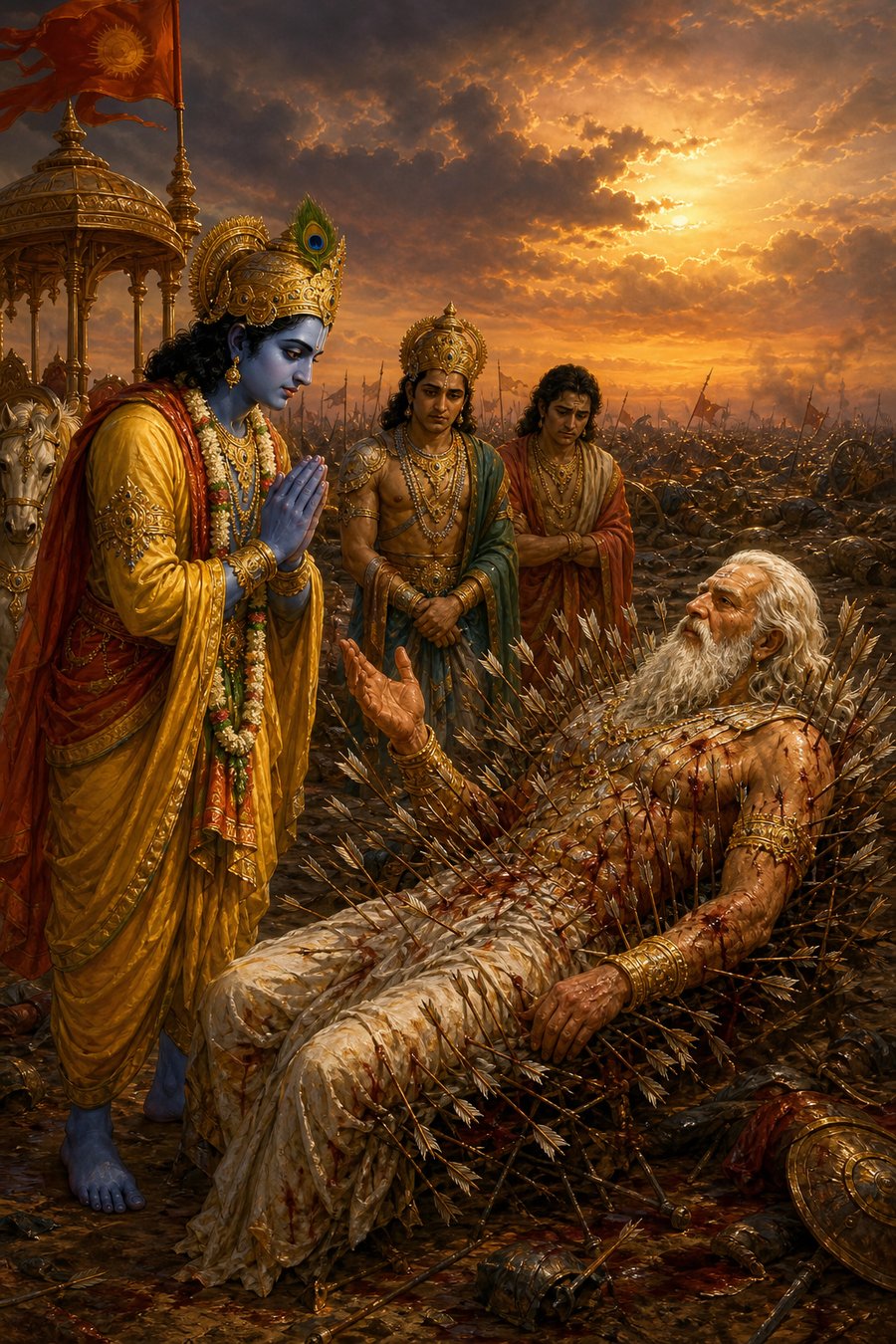
What is dharma, and when even untruth is no sin
How should a man act, he asked, who wants to hold to dharma? Truth and falsehood both exist, and between the two of them they cover every world there is. Which of the two should a man take up who means to stand firm in dharma? What is truth, and what is falsehood, and what is the eternal dharma? On what occasions should a man speak the truth, and on what occasions should he speak an untruth? Bhishma took the question the way he had taken the hardest of the others, slowly. To speak the truth, he said, is in keeping with dharma, and there is nothing higher than truth; and now he would tell Yudhishthira a thing that most men are never told. Where a falsehood would wear the face of truth, the truth should not be spoken. Where the truth would wear the face of falsehood, even a falsehood should be spoken. The man who speaks a truth that has come loose from dharma is an ignorant man, and he earns sin by it; the man who knows his duties is the one who can tell truth from falsehood. Bhishma gave him three cases out of the old stories, each stranger than the last. A man of no standing, unclean in soul and very cruel, can still earn great merit, as the hunter Valaka did when he killed the blind beast that threatened to destroy every creature alive. A man of foolish understanding, wanting merit by his hard austerities, still committed a sin, and what a strange thing that was. And an owl on the banks of the Ganga, by a deed that went against dharma, won great merit. Then he came back to the question itself. It was a hard one, he told Yudhishthira, because it is hard to say what dharma is, and no one who talks about dharma can mark its edges exactly. Brahma declared it for the advancement and the growth of every creature, so whatever leads to advancement and growth is dharma. Brahma declared it to hold creatures back from injuring one another, so whatever keeps injury away from creatures is dharma. And it carries the name dharma because it holds up all creatures; every creature that lives is held up by it, and so whatever can hold up all creatures is dharma.
Some say, Bhishma went on, that dharma is what the shruti lays down, the Veda that the rishis heard and handed on. Others do not agree, and he would not blame either side. Still, not everything has been set down in the shruti, and he showed Yudhishthira what he meant with a case from the road. Sometimes men who want another man’s wealth come to him asking questions, the kind of questions that make the plunder easier once they have been answered. Such questions are never to be answered; that is a settled duty. If a man can get clear by keeping silent, let him keep silent. If his silence, at a moment when speech is expected of him, would itself rouse their suspicion, then on that occasion it is better to say what is untrue than what is true; this too is settled. And if a false oath is all that stands between a man and the sinful men who have hold of him, he may swear it, and no sin attaches to him for it.
A man should never give his wealth to the sinful, even when he can well afford to, because wealth that goes to sinful men comes back as affliction on the one who gave it. Bhishma turned next to a debt. If a creditor wants his debtor to work off the loan with his own body, and summons the witnesses to establish what the contract was, then every one of those witnesses is a liar if he fails to say what ought to be said. When life is at risk, or on the occasion of a marriage, a man may speak an untruth. A man who seeks dharma commits no sin by an untruth spoken to save the wealth and prosperity of others, or for a religious purpose. A promise to pay binds the man who made it, and if he fails to pay, that thief of his own word is to be seized and made a slave by force; and the man who breaks a righteous engagement and then behaves improperly has certainly earned the rod for the road he has chosen.
Then Bhishma spoke of the deceitful man, and the teaching turned hard. Such a man falls away from every duty, abandons the duties of his own order, and sets himself to live by the practices of the Asuras. A sinful wretch who lives by deceit should be killed by every means. Men of that kind hold that nothing in this world stands higher than wealth, and they are never to be tolerated. No one should eat with them. They are to be counted as fallen because of their sins, fallen out of the condition of humanity and shut out from the grace of the gods, so that they are like evil spirits walking about among men. They keep no sacrifices and no austerities, and a man should keep away from their company. If their wealth is lost they even kill themselves, and there is nothing more pitiable. Among such men there is no one to whom you can say, this is your duty, turn your heart to it, because their settled conviction is that nothing in the world equals wealth. The man who kills such a creature incurs no sin. He kills one who has already been killed by his own acts, and when such a man is killed, it is the dead who is killed. Whoever has vowed to destroy men who have lost their senses in this way should keep his vow. Sinners of this kind depend on deceit for their living, the way the crow and the vulture do, and when their human bodies dissolve they are born again as crows and vultures. In any matter, Bhishma said, a man should deal with another the way that other deals with him in it: the one who practices deceit is met with deceit, and the one who is honest is treated with honesty.
A key to reading this (shruti): Shruti is what was heard, the Veda itself, the revelation the rishis received and passed down. Bhishma opens by setting truth above everything, and then shows how much moral weight the Mahabharata is willing to carry: a truth cut loose from dharma is a sin, and an untruth spoken to save a life, to keep a marriage, to protect another’s wealth, or to escape robbers and sinful men, carries no sin at all. He grants that the shruti does not contain everything, and he leaves the judgment, in the end, with the man who can tell truth from falsehood.
The gist: Dharma is what holds up creatures, keeps them from injuring one another, and advances them. Truth stands highest, and the shruti does not hold everything: where life, marriage, another’s wealth, or escape from robbers is at stake, an untruth carries no sin, and a truth spoken against dharma does. The deceitful are met with deceit, the honest with honesty, and the man who lives by fraud is already dead by his own acts.
The means of crossing all difficulties
Yudhishthira said, “Grandfather, creatures are seen afflicted in many ways and almost without pause. Tell me by what means a man can cross over all those difficulties.”
Bhishma answered with a long roll of the men who cross over, and he began with the twice-born, the men of the three orders who take the sacred thread. Those among them who keep, with restrained souls, the duties the scriptures lay down for each stage of life cross over all these difficulties. Those who never practice deceit, whose conduct is held within wholesome bounds, and who keep every worldly desire in check cross over. Those who do not answer when they are spoken to in evil language, who do not injure others when they are injured themselves, who give and never take, cross over. Those who always give a guest shelter, who do not indulge in malice, and who are constantly engaged in the study of the Veda cross over. Those who know their duties and behave toward their parents as they should, and who do not sleep during the day, cross over. And those who commit no sin of any kind in thought, word, or deed, and never injure any creature, have already crossed.
The kings who do not lay oppressive taxes under the sway of passion and greed, and who protect their own dominions, cross over. Those who go to their own wedded wives in season and never seek the company of other women, who are honest and attentive to the agnihotra, the fire kept burning at home, cross over. Those who have courage and, casting away all fear of death, go into battle wanting victory by fair means, cross over. Those who speak the truth in this world even when life is at stake, and who are examples for every creature to follow, cross over. Those whose acts never deceive, whose words are always agreeable, and whose wealth is always well spent, cross over. The Brahmins who never study the Veda at the hours forbidden to study and who practice austerities with devotion cross over, and so do the Brahmins who take up a life of celibacy, perform austerities, and are cleansed by learning, by knowledge of the Veda, and by proper vows.
Those who have checked every quality that belongs to passion and to darkness, who are high in soul and practice the qualities that are called good, cross over. Those of whom no creature is afraid, and who fear no creature themselves, and who look on all creatures as their own selves, cross over. The good men who never grieve at the sight of another’s prosperity and keep away from every kind of ignoble conduct cross over. Those who bow to all the gods, listen to the doctrines of every creed, have faith, and are tranquil in soul, cross over. Those who want no honor for themselves, give honor to others, and bow to those who deserve worship, cross over. Those who perform the shraddha, the offering to the ancestors, on the proper days of the moon, with pure minds and the wish for offspring, cross over. Those who restrain their own anger and calm the anger of others, and never grow angry with any creature, cross over. Those who from their birth have kept away from honey, meat, and intoxicating drink cross over. And those who eat only to keep life in the body, who go to a woman only for offspring, and who open their lips only to speak the truth, cross over everything.
Those who worship with devotion the god Narayana, the supreme lord of all creatures, the origin and the dissolution of the universe, cross over all difficulties. And here Bhishma did a thing the list had not prepared anyone for. Krishna was there among them, and the old man spoke of him as a man speaks of someone in the room. This Krishna here, he said, with eyes red as the lotus, dressed in yellow, with those mighty arms, this Krishna who is our well-wisher, our brother, our friend, and our kinsman, is Narayana of the unfading glory. He covers all the worlds like a leather case, at his own pleasure. He is the mighty lord whose soul cannot be conceived. He is Govinda, the first of all beings. This Krishna, who is always at work for the good and the pleasure of Arjuna, and for yours as well, is that first of all beings, the irresistible one, the abode of eternal happiness. Those who with devotion take refuge in this Narayana, who is also called Hari, cross over all difficulties. Those who read these verses on the crossing of difficulties, who recite them to others, and who speak of them to Brahmins, cross over too. I have now told you, he said, every act by which men cross over every difficulty, here and hereafter.
A key to reading this (the three qualities): Goodness, passion, and darkness, sattva, rajas, and tamas, are the three strands of which nature is woven: light and purity, restlessness and desire, dullness and inertia. Bhishma says the man who has checked every mark of passion and darkness in himself and practices goodness crosses over difficulty. His long list closes on devotion to Narayana, and then he points to the one who is sitting there with them. The Krishna beside them, he says, is that Narayana, the one who works without pause for Arjuna’s good and for Yudhishthira’s.
The gist: The road across every difficulty is made of restraint, harmlessness, truth kept even at the cost of life, hospitality, service to parents, fair taxes and fair war, moderation in food and in bed, anger held and anger calmed, and at the end refuge in Narayana. Bhishma names that Narayana: the Krishna who is present as he speaks.
The tale of the tiger and the jackal: knowing the calm soul
Yudhishthira said, “There are many men in this world who are far from tranquil in soul and who look, from the outside, like men of tranquil soul. And there are others whose souls are truly tranquil and who look like anything else. How are we to know these people?”
Bhishma answered him with an animal story, the old account of a talk between a tiger and a jackal, and he told Yudhishthira to listen to it closely. In ancient times, he said, in a city called Purika that was full of wealth, there was a king named Paurika. He was the worst of beings. He was cruel past measure, and he took his pleasure in injuring others, and when the span of his life ran out he came to the end such a life earns: stained by the evil acts of his years as a man, he was born again as a jackal. He remembered. He remembered the prosperity that had been his, and the memory filled him with grief, and he would not touch meat even when other jackals brought it and set it down in front of him. He became compassionate toward every creature, truthful in speech, and firm in austere vows. At the appointed hour he ate, and what he ate was fruit that had dropped from the trees. And he lived in a vast cremation ground, the burning place outside the city where the dead are carried and where a jackal ordinarily eats well, and he liked living there. It was the place of his birth, and he never wished to trade it for a finer one.
The other jackals of his kind could not bear the purity of his conduct, and they came to him to change his mind, choosing their words humbly. “You live in this terrible cremation ground,” they said, “and still you want to live in such purity. You are by nature an eater of carrion. Is this not a perversion of your judgment? Be like us. All of us will give you food. Give up this purity of conduct and eat what ought always to be your food.” The jackal heard them out with his whole attention and answered them in sweet words, full of reason, that taught harmlessness to everything that lives. “My birth has been low,” he said. “It is conduct, though, that decides what a creature is. I want to live in such a way that my fame spreads. My home is this cremation ground, and still, hear my vows about conduct. A creature’s own self is the cause of its acts; the way of life it has taken up is no cause of its acts of dharma. If a man kills a Brahmin while living in some particular way of life, will the sin of killing a Brahmin fail to attach to him? And if a man gives away a cow while living in no particular way of life at all, will that pious gift produce no merit? You are moved by the wish for what pleases you, and you are busy with nothing except filling your stomachs. Stupefied by folly, you do not see the three faults that wait at the end. I do not want the life you lead. It is full of evil both here and hereafter, and it is marked by a shameful loss of dharma that comes of discontent and temptation.”
A tiger famous for his prowess happened to overhear all of this. He took the jackal for a learned creature of pure conduct, paid him the respect that was due to his own rank, and told him that he wished to make him his minister.
“I know what you are,” the tiger said. “Attend to the duties of government along with me. Enjoy whatever you desire and leave aside whatever does not suit your taste. As for us, we are known to be of a fierce disposition; we tell you this beforehand. If you behave with mildness you will gain by it and reap the advantage yourself.” The jackal honored these words of the great lord of all the animals, let his head hang a little, and answered him with humility.
“These words of yours about me are worthy of you,” the jackal said. “It is worthy of you, too, to look for ministers of pure conduct who know their duties and the affairs of the world. You cannot keep your greatness without a righteous minister, and you cannot keep it with a wicked one who is watching for his chance to end your very life. Those among your ministers who are devoted to you, who know policy, who do not lean on one another, who want to crown you with victory, who are unstained by greed and free of deceit, who are wise, always intent on your good, and endowed with great strength of mind: regard them as you regard your teachers or your parents. As for me, I am perfectly content with my present position and have no wish to exchange it for anything else. I do not covet luxurious enjoyments or the happiness they bring. My conduct may not agree with that of your old servants, and if they happen to be of wicked conduct, they will set you and me at odds. Dependence on another, even on one endowed with splendor, is neither desirable nor praiseworthy.
“I am of cleansed soul, and I am highly blessed. I am incapable of showing severity even to sinners. I have great foresight and a great capacity for exertion. I do not look at small things. I have great strength, I succeed in what I do, and I never act to no purpose. I have every object of enjoyment about me, and I am never satisfied with a little. I have never served another, and I am unskilled in serving. I live in the woods as I please. Everyone who lives beside a king has to bear great pain from the evil things said against him, and those who live in the woods pass their days without fear or anxiety, keeping their vows. The fear that rises in a man when a king summons him is unknown to those who pass their days content in the woods, keeping themselves alive on fruit and roots. Simple food and drink got without effort and rich food procured in fear are very different things, and weighing the two, my opinion is that happiness is where there is no anxiety. Few of those who serve kings are justly punished for their offenses; a great many of them suffer death under false accusations.
“If in spite of all this you appoint me your minister, I want to make a compact with you about the conduct you will always keep toward me. The words I speak for your good are to be listened to and heeded. The provision you make for me is never to be interfered with. I will never consult with your other ministers, because if I do, wanting superiority as they do, they will lay all kinds of faults on me. Meeting you alone and in secret, I will say what is for your good. In matters that touch your kinsmen, you will not ask me what is good and what is otherwise. Having consulted me, you will not afterward punish your other ministers, and you will not, giving way to rage, punish my followers and dependents.” Addressed this way, the lord of beasts answered, “Let it be so,” and showed him every honor. Then the jackal accepted the ministership of the tiger.
A key to reading this (the minister’s compact): The terms the jackal sets are the dharma of a minister as the old science of policy understood it: counsel given alone and in private, no dealings with the other ministers, no questions on the king’s own kin, no punishments handed down on the strength of his advice, and above all the king’s promise never to distrust him without cause. Every turn of the story that follows hangs on that last promise.
When the old servants of the king saw the jackal treated with respect and honored in everything he did, they conspired together, and from then on their hatred of him never rested. Those wicked creatures first tried to win him over with a show of friendship and to make him tolerate the many abuses that existed in the state. They had long lived by plundering other people’s property and enjoying their perquisites, and now, with the jackal set over them, they could take nothing that belonged to anyone else. Wanting advancement and prosperity, they tempted him with sweet speeches, and large bribes were offered to win his heart. The jackal, in his great wisdom, showed no sign of yielding. So some of them made a compact among themselves to destroy him. They took the well-dressed meat that was meant for the lord of beasts, the dish he most desired, and they hid it in the jackal’s house. The jackal knew who had stolen the meat and who had conspired in it. He knew everything, and for a purpose of his own he let it pass, because of the compact he had made with the king on the day he accepted the ministership: you want my friendship, he had said, and you will never mistrust me without cause.
Bhishma went on. When the lord of beasts came in hungry to eat, the meat that should have been kept ready for his dinner was gone. He ordered the thief found. His deceitful ministers told him that the meat kept for him had been stolen by his learned minister the jackal, the one so proud of his own wisdom, and at the news of this reckless act of the jackal’s the tiger filled with rage, and giving way to it, the king ordered his minister killed. The old ministers saw their opportunity. “The jackal is always ready to take the means of living away from all of us,” they said, and having said that, they spoke again of the jackal’s robbing the king of his food. “That is what he does. What would he not venture? He is not as you had heard. He is righteous in speech, and his real disposition is sinful. A wretch in truth, he has disguised himself in a garb of virtue. His conduct is truly sinful. It was to serve his own ends that he practiced his austerities of diet and vows. If you do not believe this, we will give you proof for your own eyes.” With that they went at once into the jackal’s dwelling and had the meat discovered there. When the king learned that the meat had been carried back from the jackal’s house, and had heard everything his old servants said, he gave the order again: let the jackal be killed.
The tiger’s mother heard those words, and she came to the place herself, to wake her son’s good sense with counsel he needed. “Son,” the old lady said, “you should not accept this accusation; it is full of deceit. Wicked people lay faults even on an honest man, moved by envy and rivalry. Enemies who want a quarrel cannot bear the rise of a rival that his own high deeds have brought about. Faults are laid even on a man of pure soul who has given himself to austerities. Around an ascetic living in the woods and busy with his own harmless acts, three parties still gather: friends, neutrals, and enemies. The grasping hate the pure. The idle hate the active. The unlearned hate the learned. The poor hate the rich. The unrighteous hate the righteous. The ugly hate the beautiful. Many among the learned, the unlearned, the grasping, and the deceitful will falsely accuse an innocent man even if he has the virtues and the intelligence of Brihaspati himself, the teacher of the gods.
“If meat was really stolen from your house in your absence, remember that the jackal refuses meat even when it is set in front of him. Let that fact be weighed well in finding the thief. Wicked creatures sometimes put on the look of the good, and good ones sometimes wear the look of the wicked. Many kinds of appearance are to be seen among creatures, so it is necessary to examine which is which. The sky looks like the solid base of a vessel, and the firefly looks like a real spark of fire; in truth the sky has no base and there is no fire in the firefly. You see, then, how much scrutiny is needed even for things that come straight to the eye. The one who settles every matter after scrutiny is never called on to regret it afterward. It is no great feat, son, for a master to put his servant to death. Forgiveness in the powerful is always praiseworthy, and it brings renown. You made the jackal your first minister, and by that one act you earned great fame among all the neighboring chiefs. A good minister is hard to come by. The jackal is your well-wisher; keep him. The king who takes a truly innocent man, falsely accused by his enemies, for a guilty one, soon meets destruction through the very ministers who led him to that conviction.”
When the tiger’s mother had finished, a righteous agent of the jackal’s stepped out of the ranks of the jackal’s enemies and laid open the whole way in which the false accusation had been made. With his innocence made plain, the jackal was acquitted and honored by his master, and the lord of beasts embraced him with affection again and again. And the jackal, who knew the science of policy through and through, was burning with grief. He saluted the lord of beasts and asked his leave to throw away his life by sitting in the praya, the fast that ends in death. The tiger, his eyes wide with affection, showered the virtuous jackal with honor and tried to turn him from his resolve. The jackal saw his master shaken by feeling. He bowed to him, and he spoke in a voice choked with tears. “You honored me first,” he said, “and afterward you insulted me. Your conduct toward me is the kind that makes an enemy of me. So it is no longer proper for me to live with you.
“Think of the servants who are discontented, who have been driven from their offices or degraded from the honors that were theirs, who have brought destitution on themselves or been ruined by their enemies through their master’s anger, who have been weakened, who are grasping, or enraged, or alarmed, or deceived in their employers, who have suffered confiscation, who are proud and want to achieve great things and have been denied the means of earning wealth, and who burn with grief or rage over some injury done to them. Servants like these always wait for calamities to overtake their masters, and once deceived, they leave their masters and become effective instruments in the hands of enemies. I have been insulted by you and pulled down from my place. How will you trust me again? And how, for my part, am I to go on living with you? Thinking me competent you took me, and having examined me you placed me in office, and then, violating the compact made between us, you insulted me. If a man speaks of someone before others as a person of righteous conduct, and wants to keep his own consistency, he should never afterward describe that same person as wicked.
“Disregarded by you like this, I can no longer enjoy your confidence. And on my side, when I see you withdraw your confidence from me, I will be filled with alarm and anxiety. You suspicious and I alarmed, our enemies will be watching for chances to injure us, and your subjects, as a consequence, will grow anxious and discontented. A state of things like that has many faults. The wise do not count that situation happy in which there is honor first and dishonor afterward. It is hard to reunite two who have been separated, just as it is hard to separate two who are united, and if people who have parted come together again, there is no affection left in how they treat each other. No servant is to be seen who is moved in what he does by the wish to benefit his master alone; service proceeds from the motive of doing good to the master and to oneself as well. All acts are undertaken from selfish motives, and unselfish acts or motives are very rare. Kings whose hearts are restless and unquiet cannot come to a true knowledge of men. Only one in a hundred can be found who is either able or fearless. The prosperity of men comes of itself, and so does their fall; prosperity and adversity, and greatness too, all proceed from weakness of understanding.”
Bhishma went on. Having said these conciliatory words, full of dharma, wealth, and pleasure, and having gratified the king, the jackal withdrew to the forest. The lord of beasts pleaded with him, and the wise jackal did not listen. He sat down in the praya, cast off his body, and went to heaven, which his good deeds on earth had earned him.
A sub-tale: The tale rests on the rebirth of King Paurika, the cruel king of Purika who came back as a jackal, and on what he did with his memory. He remembered the prosperity he had lost, and the memory turned him toward compassion, truth, and hard vows, in a cremation ground he would not leave because it was where he was born. When his own kind mocked him for it, he gave the answer the Mahabharata returns to again and again: his birth was low, and it is conduct that decides what a creature is.
The gist: Trust once broken is never made whole again. The tiger lays a fault on his minister without inquiry, learns from his mother that even the sky and the firefly need testing before they are believed, and is proved wrong; the jackal, cleared and embraced, still finds it unfitting to stay, because honor followed by dishonor is a state the wise do not call happy. Forgiveness in the powerful wins renown, and a promise the powerful have broken stays broken.
The tale of the camel: the ruin of sloth, and victory through intelligence
Yudhishthira said, “What acts should a king do, and by what acts does a king become happy? Tell me this in detail.”
Bhishma said he would tell him what he wanted to know, and that Yudhishthira should hear the settled truth about what a king should do in this world and which acts make a king happy. A king, he said, should not behave the way a certain camel behaved, in a high history of which they had all heard, and he told it. In the Krita age, the first of the ages, there was a huge camel who remembered all the acts of his former life. Keeping the most rigid vows, that camel practiced very severe austerities in the forest, and toward the end of them the mighty Brahma was gratified with him. So the Grandsire wished to grant him boons.
The camel knew what he wanted. “Holy one,” he said, “let my neck grow long by your grace, so that I can seize any food lying even at the end of a hundred yojanas.” The great giver of boons said, “Let it be so.” Having won the boon, the camel returned to his own forest, and from the day he got it the foolish animal turned idle; stupefied by what fate had handed him, he did not go out to graze from that day on. One day, while he was stretching out his neck of a hundred yojanas and picking up his food without any labor, a great storm arose. The camel put his head and part of his neck inside the cave of a mountain and settled down to wait until the storm was over, and meanwhile the rain came down in torrents and flooded the whole earth. A jackal with his wife, drenched by the rain and shivering with cold, dragged himself with difficulty toward that same cave and slipped inside it quickly for shelter. He lived on meat, and he was extremely hungry and tired, and when he saw the camel’s neck lying there he began to eat as much of it as he could. When the camel felt his neck being eaten he tried, in his pain, to draw it in, and as he moved it up and down the jackal and his wife kept their hold on it and went on eating. In a short time the camel was dead. When the storm and the rain had stopped, the jackal came out of the cave, having killed the camel and eaten him. That is how the foolish camel met his death, Bhishma said, and see what a great evil came of idleness.
As for you, he told Yudhishthira, avoid idleness and restrain your senses, and do everything in the world by proper means. Manu himself has said that victory depends on intelligence. Of all acts, those accomplished with the aid of intelligence are counted the foremost; those achieved by the strength of arms are middling; those achieved with the feet are inferior; and those done by carrying loads are the lowest. If a king is clever in the conduct of affairs and keeps his senses in check, his kingdom endures. Manu himself has said that it is with the aid of intelligence that an ambitious man wins his victories. In this world, those who listen to wise counsels that the crowd does not know, who have allies, and who act after proper scrutiny accomplish all their objects, and a man with such aids can rule the whole earth. Bhishma looked at the man in front of him, whose prowess matched Indra’s own, and told him that this had been said by the wise men of ancient times who knew the ordinances of the scriptures, and that he too, with his sight fixed on the scriptures, had now said the same. Use your intelligence, he said, and act in this world.
A key to reading this (yojana and the Krita age): A yojana is the epic’s long measure of road, the kind of distance a traveler counts in days, so a neck that reaches food a hundred yojanas away is a neck that never again needs to carry its owner anywhere. The Krita age is the first of the four ages, the one in which dharma stood whole, which is why a camel could do penance there and be heard. The tale turns on what the camel did with the gift: a boon of ease became, joined with sloth, the shape of his death.
The gist: Even a boon of ease brings ruin when it is joined with sloth. Manu’s word, which Bhishma repeats as settled, is that victory rests on intelligence: work done by intelligence stands first, work done by strength of arm is middling, work done on foot ranks below it, and the carrying of loads stands lowest. The king who is clever in his business and holds his senses in check keeps his realm, and the one who listens to counsel that is not common property, keeps allies, and acts only after looking hard at a thing can rule the whole earth.
The talk of the sea and the rivers: bending like a reed
Yudhishthira said, “Tell me this too. A king may come into a realm, the most precious thing a man can hold, and have none of the usual supports with which a realm is held. If such a king finds a stronger enemy standing over him, how should he conduct himself?”
Bhishma said, “On this the old talk between the sea and the rivers is told. In ancient days the eternal sea, lord of all rivers and the refuge into which the enemies of the gods once fled, had a doubt rise in his mind, and he put it to every river that came down to him.
“The sea said, ‘Rivers, I watch what each of you carries to me when you run full. You bring great trees with thick trunks, torn out of the bank root and branch, and roll them down to me whole. What you never bring is a reed. Not one. The reeds that grow along your banks are thin in the stem and have no strength in them at all. Do you leave them standing out of contempt, because they are too small to bother with? Or are they of some use to you? I want to know what moves all of you alike, and why a reed is never uprooted by any of you.’ It was the Ganga who answered him, and she answered in words that were grave and reasoned, the kind of words that everyone present could accept.
“The Ganga said, ‘A tree stands in one place and is stubborn about the place where it stands. It sets itself against our current out of that nature, and because it resists, it has to leave the ground it grew in. The reed behaves in another way altogether. When the reed sees the current rising toward it, it bends. The others do not bend. When the flood has gone past, the reed straightens and takes up its old posture as if nothing had happened. The reed understands the qualities of time and occasion. It is humble and obedient, it yields, and there is no stiffness in it. For these reasons it stays where it grows and never has to travel down with us. Every plant and tree and creeper that bends before the force of wind and water and then rises again is spared the one defeat that matters to a growing thing, which is to be taken up by the roots.’
“Bhishma said, the man who will not bend before the strength of an enemy who has grown mightier than he is, an enemy able to bind him or kill him, soon meets his ruin. The wise man is the one who acts after weighing fully his own strength and weakness, his own might and fire, and the same four things in his enemy; such a man never suffers the defeat of being uprooted. So when a man of sense sees that his enemy is stronger than himself, let him take up the conduct of the reed. That bending is the sign of wisdom, and a king without supports who has just come into a realm should read it as his own case.”
The gist: The tree that stands firm against the flood is torn out by the roots, and the reed that yields is still standing on the bank when the water goes down. A king without supports who faces a stronger enemy should weigh his own strength against the other’s and bend like the reed; Bhishma calls that bending the mark of wisdom.
Bearing harsh words in an assembly
Yudhishthira said, “Here is another thing I need to know. A learned man, one who has taken humility as an ornament, sits in an assembly, and some ignorant man swollen with conceit turns on him there with harsh words, in front of everyone. How should he conduct himself?”
Bhishma said, “Hear how the scriptures treat this, and how a man of good soul is to bear the abuse of people of little intelligence. When a man is abused by another and does not give way to anger, he takes for himself the merit of every good deed the abuser has ever done. The one who bears it goes further: he hands over to that man, who is shouting at him under the sway of wrath, the demerit of all his own bad acts. Let the man of sense treat such abuse as the harsh cry of the tittibha bird, which shrieks and means nothing by it. Whoever gives in to hatred is said to live in vain. You will hear the fool boasting of it afterward: ‘I spoke such words to such a respected man in front of such an assembly,’ he says, and he takes pride in the wicked act. He adds, ‘Abused by me, the man stayed silent, as if he had died of shame.’ In this way the shameless man exults in a thing that no one should exult in. Such a wretch among men should be carefully passed over. The wise man endures everything a person of small mind may say, because there is nothing behind it. What can a vulgar fellow accomplish with either his praise or his blame? He is a crow cawing uselessly in the woods.
“If the men who accuse others with nothing besides words could prove their accusations by those words, then perhaps the words would be worth something. As it is, they are exactly as effective as the curses fools shout at the men they quarrel with, calling death down on them. A man who behaves and speaks like this proclaims his own bastardy by it. He is like the peacock that dances and, in dancing, shows the part of its body that should always stay hidden. A man of pure conduct should never so much as speak with a sinner who hesitates at nothing, in word or in deed. The man who praises your merits while your eye is on him and speaks ill of you the moment your eye is turned away is a dog in his nature; he loses all his worlds in heaven and every fruit of whatever knowledge and virtue he had. The one who slanders you behind your back loses, without delay, the fruit of all his libations on the fire and of every gift he ever made, even to a hundred men. So the wise man should avoid a person of such sinful heart without hesitating, in the way an honest man avoids the flesh of a dog.
“The wicked man who broadcasts the faults of a high-souled person publishes his own evil nature by that very act, as a snake shows its hood when someone interferes with it. The man of sense who sets out to counter such a backbiter, a man forever busy at the one trade that suits him, ends in the painful state of a stupid ass sunk in a heap of ashes. From a man who is always speaking ill of others, keep away as you would from a furious wolf, or an elephant in rut trumpeting in its madness, or a fierce dog. Shame on the sinful wretch who has taken the road of fools, who has fallen from every wholesome restraint and from modesty itself, who is always busy doing harm to others and has no regard even for his own prosperity. If an honest man is tempted to trade words with such people when they set out to humiliate him, he should be counseled in these words: do not let yourself be pained. A war of words between a high man and a low one is always disapproved by people of tranquil intelligence. A slanderer, once enraged, may strike with his palms, or throw dust or chaff, or grind and bare his teeth to frighten you; all of this is well known, and none of it is new. The man who endures the reproaches and slanders that wicked-souled people utter in assemblies, or who reads these instructions often, is never afterward hurt by anything said to him.”
A key to reading this (the transfer of merit and sin): Bhishma states a subtle moral rule. The one who bears an insult without anger takes for himself the merit of the man who insults him, and hands that man his own sin in exchange. This is the ground under the advice to treat abuse as the tittibha’s cry: the silence of the man who is being shouted at is an active gain of the subtle dharma, a piece of work done without moving.
The gist: The man who hears harsh words and does not grow angry takes away the slanderer’s merit and passes him his own sin. A boor’s praise or blame is as empty as a crow’s cawing in the woods, and the man who answers a slanderer ends like an ass sunk in ashes. Bhishma’s counsel is to pass such a man over, to refuse the quarrel of high with low, and to remember that the one who bears it takes no wound from speech.
How to keep the realm happy: servants, treasury, and justice
Yudhishthira said, “Grandfather, one great doubt still troubles me, and you are the one man who can settle it, because you have been the strength of this family for longer than any of us has been alive. You have spoken of the slanders that wicked men utter. I want to ask past that now, about the things that do a kingdom good: what brings happiness to a royal line, what gives well-being and advancement both now and in the years to come, what is good even in the matter of food and drink and the body itself. A king has been set on the throne and holds it, with friends and ministers and servants around him. How does that king keep his people content? Think of the king who lets his likings lead him, who falls in with evil companions and, because his senses have him in their grip, pays court to wicked men. Every servant of good birth and blood turns away from such a king, and nothing that needs many good servants ever gets done for him. Your intelligence is equal to Brihaspati’s; explain to me these duties of kings, which are so hard to make out, and take my doubts away. You have always worked for the good of our house, and that is why you keep teaching us the craft of kings, and Vidura, who is wise in the same way, keeps instructing us too. Hearing from you what will do our line and our kingdom good, I can pass my days as content as a man who has drunk the amrita that keeps death away. Which classes of servants are to be counted inferior, and which are complete in every accomplishment? With servants of what kind, of what birth, should a king carry out the work of ruling? If a king chooses to act alone, without servants, he can never protect his people. And yet every man of high birth wants the crown.”
Bhishma said, “A king cannot rule his kingdom alone. Without servants to help him he can accomplish nothing, and if he does accomplish something by himself, he cannot hold it by himself. The happiness that comes with sovereignty belongs to the king whose servants have knowledge and wisdom, who are devoted to their master’s good, who come of high birth and have a tranquil disposition. It belongs to the king whose ministers are well born and cannot be pulled away from him by bribes or any other lure, who live with him and are always giving him counsel, who have wisdom and goodness in them, who understand how one thing bears on another, who can provide for what is coming and for what may go wrong, who know the qualities of time, and who never grieve over what is already past. It belongs to the king whose servants share his griefs and his joys, who do what pleases him, who keep their attention on his ends, and who are faithful, every one of them. And it belongs to the king whose subjects are cheerful and high-minded and walk the road of righteousness.
“The best of kings is the one whose sources of income are all managed and watched over by contented and trustworthy men who understand how revenue is increased. Affluence and great merit come to the king whose storehouses and granaries are supervised by servants who cannot be bribed, who are trustworthy and devoted and free of greed, and who are always bent on gathering more in. The merit of sovereignty is earned by the king in whose city justice is done properly, so that a plaintiff or a defendant whose case is false is fined for it, and where the criminal law is administered in the manner of Shankha and Likhita, the two brothers whose code the old kings followed. And it is earned by the king who binds his subjects to him with kindness, who knows the duties of kings, and who attends to the six measures of policy that every ruler must weigh in his dealings with other kings.”
A key to reading this (the six qualities and Shankha and Likhita): The six measures that Bhishma tells the king to attend to are the six moves a ruler has toward other kings: making peace, making war, marching, staying put, playing a double game, and taking shelter with a stronger power. Shankha and Likhita were two brother-sages, and their code of law was the standard against which the ancient science of the rod measured itself.
The gist: The king cannot rule alone. His happiness rests on ministers who are well born, faithful, and free of greed, on a treasury and granaries kept by honest hands, on justice in the city as even-handed as the law of Shankha and Likhita, and on binding the people to himself by kindness. Yudhishthira had asked which servants to keep; Bhishma’s answer begins with the men around the throne, because nothing the king wants done gets done without them.
The tale of the dog: the ruin of a post beyond one’s worth
Bhishma said, “On this subject an old story is told, one that good and wise men hold up as a high precedent, and it bears on exactly what you have asked. I heard it in the hermitage of Rama, the son of Jamadagni, recited by many of the foremost rishis. In a great forest where no human being lived, there was an ascetic who ate only fruit and roots, kept the strictest vows, and held his senses under control. He observed every hard regulation, he was tranquil and pure in soul, he was always at his Vedic recitations, and his fasts had cleansed his heart, so that he lived in goodwill toward every creature. He had great intelligence, and as he sat in his place the goodness of his conduct became known to every animal in that forest, and they began to come to him out of affection. Fierce lions and tigers, huge elephants in rut, leopards, rhinoceroses, bears, and the other terrible beasts that live on blood would come to the rishi and put to him the usual polite questions about his health. They behaved toward him like disciples and like slaves, always doing what pleased him, and having made their inquiries they went off again to their own quarters.
“One animal, though, was a domestic one, and it lived there always and never left the sage at any hour. It was a dog. Weak and emaciated with fasting, it lived on fruit and roots and water, tranquil and harmless in its aspect, devoted to the sage and deeply attached to him. Lying at the feet of that high-souled rishi while he sat, the dog, whose heart was like a human being’s, grew more attached still because of the affection with which it was treated. Then one day a leopard of great strength came into the forest, a beast that lived on blood, cruel by disposition and always delighted at the prospect of prey, so that it looked like a second Yama. It came licking the corners of its mouth with its tongue and lashing its tail furiously, hungry and thirsty, its jaws wide open, wanting the dog for its meal. The dog saw the terrible thing coming and, in fear for its life, spoke to the sage. ‘This leopard is the enemy of dogs, and it means to kill me. Great sage, act so that through your grace all my fear of this animal is taken away. You have mighty arms, and beyond any doubt you know everything.’ The sage knew the thoughts of every creature and could read in the voices of animals what they meant, and he felt that the dog had ample cause for its fear.
“The sage said, ‘You need have no more fear of death from leopards. Let your natural form disappear, and be a leopard yourself, my son.’ At those words the dog was transformed into a leopard with a skin as bright as gold, striped along the body, with large teeth, and from then on it went about that forest without fear. The leopard, seeing before it a creature of its own kind, at once let go of all its hostility. Some time afterward a fierce and hungry tiger came into the hermitage with its mouth open, licking the corners of its mouth, eager to drink blood, and it began to move toward the animal that had been made a leopard. Seeing the hungry tiger with its terrible teeth approaching through the forest, the transformed leopard ran to the rishi for the protection of its life, and the sage, who felt great affection for the creature because it lived in the same place as he did, at once made his leopard into a tiger, powerful against every enemy. The tiger, seeing a beast of its own species, did it no harm. So the dog, in the course of time made into a powerful tiger that lived on flesh and blood, gave up the fruit and roots it had eaten before, and from that day it lived on the other animals of the forest, the way a true king of beasts does.
“The dog that had become a tiger ate its fill of the flesh of the beasts it killed and slept at its ease. One day, as it lay in the yard of the hermitage, an elephant in rut came there, looking like a cloud that has just risen. It was of huge stature, with split cheeks running with the juice of its season, the marks of the lotus on its body, broad frontal globes, long tusks, and a voice as deep as the clouds. Seeing that maddened elephant, proud of its strength, coming toward it, the tiger shook with fear and sought the rishi’s protection, and that best of sages made the tiger into an elephant. The real elephant, seeing a creature of its own kind as huge as a mass of cloud, was terrified. The rishi’s elephant, freckled with the pollen of lotus filaments, dived with delight into lakes overgrown with lotuses and wandered along their banks, where the ground was pitted with the burrows of hares. A long time passed that way. Then one day, as the elephant strode cheerfully near the hermitage, a maned lion came to that spot, born in a mountain cave and accustomed to killing elephants. Seeing the lion come, the rishi’s elephant trembled for its life and sought the protection of the sage, and the sage made that prince of elephants into a lion. Since the wild lion was of the same species as itself, the rishi’s lion had nothing to fear from it; it was the wild lion that saw a stronger beast of its own kind in front of it and was terrified. The rishi’s lion took up its dwelling in the hermitage in the forest, and for fear of it the other animals no longer dared to come near the place. Every one of them, it seemed, had begun to worry about the safety of its own life.
“Some time after that, a sharabha came to the spot: a killer of every animal, of enormous strength, a creature that fills every living thing with fright, with eight legs and its eyes set in its forehead. It came to that very hermitage for the purpose of killing the rishi’s lion. Seeing this, the sage made his lion into a sharabha of great strength, and the wild sharabha, finding the rishi’s sharabha in front of it fiercer and more powerful than itself, fled from that forest at once. Made a sharabha by the sage, the animal lived happily at the side of the one who had transformed it. Every creature in the neighborhood became afraid of that sharabha, and fear and the wish to save their lives drove them all out of the forest. Filled with delight, the sharabha went on killing animals every day for its food. It had become a carnivore, and it no longer cared for the fruit and roots on which it had once lived. And one day that ungrateful beast, which had begun as a dog and was now a sharabha, in its thirst for blood, wished to kill the sage himself. The sage saw it all by the power of his austerities, through his spiritual knowledge, and having made out what the beast intended, that man of great wisdom spoke to it.
“The sage said, ‘Dog, you were first made a leopard. From a leopard you were made a tiger. From a tiger you were changed into an elephant with the juice of its season running down its cheeks. Your next transformation was into a lion, and from a mighty lion you were made a sharabha. It was I who changed you into all these shapes, because I was filled with affection for you. You did not belong by birth to any of those species, and you do not now. But since, sinful wretch, you want to kill me, who have done you no injury, you shall go back to your own species and be a dog again.’ At that, the mean and foolish animal of wicked soul that had been made a sharabha took on once more, by the rishi’s curse, its own proper form of a dog.”
A key to reading this (the sharabha): The sharabha is the beast at the top of the forest’s ladder: a killer of every other animal, stronger than the lion that kills elephants, with eight legs and its eyes set in its forehead, and so frightening that the sight of it empties a forest. The ladder in the tale runs dog to leopard to tiger to elephant to lion to sharabha, and Bhishma tells it for a reason of statecraft: raise a base creature above the place it was born for, and in the end it turns on the one who raised it.
“Bhishma said, having taken its proper form again, the dog became very cheerless, and the rishi, rebuking it, drove the sinful creature out of his hermitage. An intelligent king, guided by this precedent, appoints servants each to the office he is fit for, keeps a proper watch over them, and does so only after first finding out their qualifications: their truthfulness and purity, their sincerity, their general disposition, their knowledge of the scriptures, their conduct, their birth, their self-restraint, their compassion, their strength, their energy, their dignity, and their forgiveness. A king should never take a minister without examining him first. If a king gathers men of low birth around him, he can never be happy. A man of high birth, even if his royal master persecutes him though he has done no wrong, never sets his heart on injuring that master; the respectability of his blood will not let him. A man who is mean and of low birth, on the other hand, may have gained great affluence from his connection with some honest man, and he will become that man’s enemy if he is so much as reproached in words.
“A minister should be of high birth and strong. He should be forgiving and self-restrained, with all his senses under control, free of the vice of rapacity, content with what he has justly earned, glad at the prosperity of his master and his friends, aware of what place and time require, always occupied in attaching men to himself or to his master by doing them good offices, attentive to his duties, wishing his master well, always heedful and faithful in the discharge of his own work. He should be a thorough master of the art of war and peace, familiar with what the king needs in the matter of dharma, wealth, and pleasure, loved by the citizens and by the people of the provinces alike, versed in every kind of battle array for piercing and breaking the enemy’s ranks, able to fill his master’s forces with cheerfulness and joy, a reader of signs and gestures, familiar with everything a march requires, skilled in the training of elephants, free of pride, confident of his own powers, clever in the transaction of business, always doing what is right and of righteous conduct, surrounded by righteous friends, sweet of speech, agreeable in his features, able to lead men, well versed in policy, accomplished, energetic in action, active, ingenious, sweet-tempered, modest in his address, patient, brave, rich, and able to adapt his measures to the requirements of place and time. The king who finds such a minister can never be humiliated or overpowered by anyone, and his kingdom spreads over the earth by degrees, like the light of the moon.
“A king who knows the scriptures, who holds righteousness above everything, who is always at the work of protecting his subjects, and who has the virtues that follow, wins the love of all. He is patient and forgiving, pure in his conduct, severe when the occasion demands it, aware of what exertion can do, respectful in his behavior toward all his seniors, learned in the scriptures, ready to listen to the instruction and counsel of those competent to give it, able to judge correctly among different or opposite courses of action put before him, intelligent, of retentive memory, ready to do what is just, self-restrained, always sweet in his speech, forgiving even toward enemies, giving charity with his own hands, full of faith, agreeable in his features, ready to hold out a hand to people plunged in distress, served by ministers who seek his good, free of the fault of egoism, never without a wife, and disinclined to do anything in haste. He rewards his ministers whenever they achieve something signal. He loves those who are devoted to him. Avoiding idleness, he keeps drawing men to himself by doing them good. His face is always cheerful. He attends to the wants of his servants and never gives way to wrath, and he is magnanimous besides. Without ever laying aside the rod of chastisement, he wields it with propriety. He makes all the men about him act righteously. With spies for his eyes he supervises the concerns of his subjects, and he is conversant with every matter that touches dharma and wealth. A king with these hundred qualifications earns the love of all, and every ruler should strive to be such a king.
“The king should also look for good warriors to enlist in his army, all of them with the necessary qualifications, to help him protect his kingdom. A king who wants his own advancement never neglects his army. The king whose soldiers are brave in battle, grateful, and versed in the scriptures, whose foot soldiers know the treatises on religion and duty, whose elephant warriors are fearless, and whose chariot warriors are skilled in their own way of fighting and expert in shooting arrows and handling other weapons, brings the whole earth under him. The king who is always at work attaching all men to himself, who is ready for exertion, and who is rich in friends and allies becomes the foremost of rulers. And a king who has succeeded in attaching all men to himself can conquer the whole earth with the help of no more than a thousand horsemen of courage.”
The gist: The lesson of the dog is that a king appoints each servant only after testing him and only to the office he is fit for, because a base creature raised above its place ends by turning on the one who raised it. Bhishma then counts out the qualities of the minister and the hundred qualities of the king, and closes on the army: the king who has bound all men to himself can take the whole earth with a thousand brave horsemen.
A post to match one’s worth, and the company of the lion
Bhishma said, “The king who takes the lesson of the dog’s story and appoints each of his servants to the office he is fit for enjoys the happiness that goes with sovereignty. A dog should never be honored with a position above the one it is fit for. Put a dog above its station and it grows drunk with pride. Ministers should be appointed to the offices they are fit for, and they should have the qualifications their particular occupations need; appointments of unfit persons are never approved. The king who gives each servant the office he is fit for enjoys, through that merit, the happiness of sovereignty. A sharabha should hold the position of a sharabha, a lion should swell with the might of a lion, a tiger should be placed as a tiger, and a leopard as a leopard. Servants are to be appointed, according to the ordinance, to the offices each is fit for. If you want success, never appoint servants to positions higher than they deserve. The foolish king who breaks precedent and gives offices to men unfit for them fails to satisfy his people.
“A king who wants accomplished servants never appoints men who lack intelligence, who are low-minded, who have no wisdom, who are not masters of their senses, or who are not of high birth. Men who are honest, of high birth, brave, learned, free of malice and envy, high-minded, pure in their behavior, and clever in the transaction of business deserve to be made ministers. Men who have humility, who are prompt in performing their duties, tranquil in disposition, pure in mind, adorned with the other gifts of nature, and never the objects of slander in the offices they hold should be the king’s intimate companions. A lion should always make a companion of a lion. If one who is no lion becomes the companion of a lion, he gains every advantage that belongs to a lion. But the lion who, while doing a lion’s duties, keeps only a pack of dogs for company never succeeds, with such companions, in doing those duties. In the same way a king can bring the whole earth under him if his ministers are men of courage, wisdom, great learning, and high birth. Kings should never keep a servant who lacks learning, sincerity, wisdom, and great wealth. Men devoted to their master’s service are never stopped by any obstacle, and to the servants who are always doing him good a king should always speak in soothing terms.
“Kings should look after their treasuries with great care. A king has his roots in his treasury, and he should always be seeking to swell it. Let your granaries be filled with grain, and let their keeping be entrusted to honest servants. Work to increase your wealth and your grain. Let your servants who are skilled in battle be always attentive to their duties, and it is well if they are skilled in the management of horses. Attend to the wants of your kinsmen and friends. Keep friends and relatives around you, and seek the good of your city. By citing the precedent of the dog I have instructed you in the duties you should take up toward your subjects. What more do you wish to hear?”
The gist: Every office goes to the one fit for it, and a servant set above his worth grows drunk with the height. The lion keeps the company of lions; a lion that runs with dogs cannot do a lion’s work. The treasury is the root of the king, so its keeping, and the keeping of the granaries, belongs in honest hands.
The king like a peacock: the law of kings worth remembering
Yudhishthira said, “You have gone through the many duties of kingcraft that the men of ancient times, who knew the work of kings, observed and laid down, and you have spoken of them in detail, as the wise approve. Now say them in such a way that a man can hold them in his memory.”
Bhishma said, “The protection of all creatures is the highest duty of the Kshatriya. Hear now how that duty of protection is to be carried out. A king who knows his duties takes on many forms, the way a peacock puts out plumes of different colors. Keenness, crookedness, truth, and sincerity are the qualities that should all be present in him. With complete impartiality he should practice the qualities of goodness if he means to earn happiness, and he should put on whichever color or form serves the particular end he is trying to reach, because a king who can take many forms succeeds even in the subtlest objects. Silent as the peacock in autumn, he should keep his counsel hidden. He should speak little, and the little he speaks should be sweet. He should be of good features and well versed in the scriptures. He should always be watchful over the gates through which dangers can come and overtake him, the way men keep watch on the weak places in an embankment where the waters of a great tank could break through and flood their fields and houses. He should take refuge with Brahmins who have won success in their austerities, the way men take refuge with the loud rivers that the rains gather in mountain lakes and send down.
“The rod of chastisement should always be raised in his hand. He should act with care in levying his taxes, examining the incomes and the expenses of his subjects first, the way men go to a full-grown palm to draw its juice. He should deal fairly with his own subjects. He should have the crops of his enemies crushed under the tread of his cavalry, march against his foes when his own wings have grown strong, and keep watch on every source of his own weakness. He should proclaim the faults of his enemies, crush the men who take their part, and collect wealth from outside as a person plucks flowers in the woods. The proudest of monarchs, the ones swollen with might who stand with their heads raised like mountains, he should bring down by taking cover where no one expects him, by ambush and sudden attack. Like the peacock in the season of the rains, he should go to his night quarters alone and unseen, and like the peacock he should enjoy the company of his wives within his inner apartments. He should never take off his mail. He should guard his own person himself and keep clear of the nets that the spies and secret agents of his enemies spread for him. He should win over the spies of his enemies too, and root them out when the chance comes. Like the peacock, the king should kill his powerful and angry enemies of crooked policy, destroy their force, and drive them from their homes. And like the peacock he should do what is good for himself and pick up wisdom from every side, as peacocks pick up insects even in the forest.
“A wise and peacock-like king rules his kingdom this way and follows the policy that does him good. By his own intelligence he settles what he is going to do, and by consulting with others he either drops that resolution or confirms it. Aided by an intelligence that the scriptures have sharpened, a man can settle his courses of action, and that is the whole usefulness of the scriptures. By the arts of conciliation he should breed confidence in the hearts of his enemies. He should display his own strength. By judging different courses of action in his own mind he should arrive, by his own intelligence, at conclusions. The king should be well versed in conciliation and possessed of wisdom, able to do what should be done and to avoid what should not. A person of wisdom and deep intelligence does not need counsel or instruction at all. And a wise man with an intelligence like Brihaspati’s, if he falls into disgrace, soon recovers his disposition, the way heated iron cools when it is dipped in water.
“A king should accomplish every object, his own or another’s, by the means the scriptures lay down. A king who knows the ways of acquiring wealth should always employ in his acts men who are mild in disposition and possessed of wisdom and courage and great strength. Seeing his servants employed in the acts for which each is fit, he should move in accord with all of them, the way the strings of a musical instrument, stretched to their proper tension, sound together in their intended notes. He should do good to everyone without breaking the rules of righteousness. The king whom every man regards with the words ‘He is mine’ stands immovable as a hill. When he has set himself to judging between litigants, he should uphold justice without making any distinction between the people he likes and the people he dislikes. In every office he should appoint men who know the characteristics of particular families, of the mass of the people, and of the different countries, men mild in speech, of middle age, without faults, devoted to good acts, never careless, free of rapacity, possessed of learning and self-restraint, firm in virtue, and always ready to uphold the interests of virtue and profit both. Having learned in this way what is to be done and what its final objects are, the king should carry it out with care, and informed of everything by his spies, he may live in cheerfulness.
“The king who never gives way to anger or joy without sufficient cause, who oversees all his acts himself, and who looks at his income and his expenditure with his own eyes wins great wealth from the earth. The king who is said to understand the duties of kingcraft is the one who rewards his officers and his subjects in public for whatever good they do, who punishes those who deserve punishment, who protects his own person, and who protects his kingdom from every evil. Like the sun pouring its rays on everything below it, the king should look after his kingdom himself, and with his own intelligence he should supervise all his spies and officers. He should take wealth from his subjects at the proper time, and he should never proclaim what he does. As an intelligent man milks his cow every day, the king should milk his kingdom every day. As the bee gathers honey from flowers a little at a time, the king should draw wealth from his kingdom a little at a time and store it. Having set apart a sufficient portion, he should spend what remains on the acquisition of religious merit and on the satisfaction of his desire for pleasure. A king who knows his duties and has intelligence never wastes what has been stored.
“The king should never disregard any wealth because it is small, and he should never disregard an enemy because he is weak. He should examine his own self by his own intelligence, and he should never put his confidence in men who have no intelligence. Steadiness, cleverness, self-restraint, intelligence, health, patience, bravery, and attention to what time and place require: these eight qualities increase wealth, whether the wealth is small or great. A little fire fed with clarified butter can blaze up into a conflagration, and a single seed can produce a thousand trees, so even a king who hears that his income and his expenditure are both great should never disregard the smaller items. An enemy, whether he is a child or a young man or an old one, succeeds in killing a person who is careless. An insignificant enemy, once he has become powerful, can wipe a king out, which is why the king who understands the requirements of time is the foremost of rulers. An enemy, strong or weak, moved by malice, can very soon destroy a king’s fame, block his acquisition of religious merit, and strip him even of his energy. A king of regulated mind, therefore, is never careless while he has an enemy.
“If a king of intelligence wants affluence and victory, he should survey his expenditure, his income, his savings, and his administration, and only then make peace or war; and for this a king should have the help of an intelligent minister. Blazing intelligence weakens even a mighty man. By intelligence, power that is growing is protected; by intelligence, an enemy who is growing is weakened; so every act undertaken according to the dictates of intelligence deserves praise. A king who has patience and no fault can, if he likes, win everything he wishes with the help of even a small force. But the king who wants a train of self-seeking flatterers around him never wins the smallest benefit. For these reasons the king should be gentle in taking wealth from his subjects. A king who keeps oppressing his people meets his end like a flash of lightning that blazes for a single second and is gone.
“Learning, penances, vast wealth, everything, can be earned by exertion. Exertion, as it occurs in embodied creatures, is governed by intelligence, and so exertion should be regarded as the foremost of all things. The human body is the dwelling of many intelligent beings of great energy: of Indra, of Vishnu, of Sarasvati, and of others. A man of knowledge, therefore, never neglects the body. A covetous man is to be brought under by constant gifts, because a covetous man is never satisfied with taking other people’s wealth, and everyone becomes covetous where his own enjoyment is concerned. A person who becomes destitute of wealth becomes destitute of virtue and of pleasure as well, since both are won by wealth. The covetous man wants the wealth, the enjoyments, the sons and daughters, and the affluence of others, and in covetous men every kind of fault can be seen. The king, therefore, should never take a covetous man for a minister or an officer. When he has no proper agent, a king may send even a low person to find out the disposition and the acts of his enemies. A ruler of wisdom frustrates all the efforts and objects of his enemies. The trusting and high-born king who takes instruction from learned and virtuous Brahmins and is protected by his ministers keeps all his tributary chiefs under proper control. I have told you in brief all the duties the scriptures lay down; attend to them, with your intelligence to help you. A king who follows them in obedience to his preceptor rules the whole earth. A king who disregards the happiness that comes of policy and looks instead for what chance may bring never enjoys the happiness that belongs to sovereignty, and he wins no regions of bliss hereafter.
“A king who is watchful, and who attends properly to the requirements of war and peace, succeeds in killing even enemies who are eminent for wealth, honored for intelligence and good conduct, accomplished, brave in battle, and ready for exertion. The king should find out the means that different kinds of acts and measures furnish, and he should never depend on destiny. The man who sees faults in faultless persons never wins prosperity or fame. When two friends set themselves to accomplishing one and the same act, a wise man always applauds the one of the two who takes the heavier share of the work upon himself. Practice these duties of kings that I have told you, and set your heart on the duty of protecting men. Then you will easily obtain the reward of virtue, and every region of felicity hereafter depends on merit.”
A key to reading this (the figure of the peacock): Bhishma binds the whole law of kings into the image of a single bird. The peacock’s many colors are the many forms a king takes as the occasion needs; its silence in autumn is the king keeping his counsel; its solitude in the rains is the king going unseen to his night quarters and to the company of his wives; and its picking of insects from the forest floor is the king gathering knowledge from every side. Beside the bird he sets two rules for taking wealth: milk the kingdom as a cowherd milks his cow, every day and never dry, and gather as the bee gathers, a little at a time, so that the people are never wrung.
The gist: The king should be like a peacock: many forms, hidden counsel, few words and those sweet, and a constant watch on the gates where danger enters. He should take wealth as a cowherd milks and as a bee gathers, by degrees, and never by wringing the people. He should neglect no small item, no small enemy, and no small sum, because a little fire fed with butter becomes a forest fire; and above everything he should trust exertion governed by intelligence, never chance.
Who is the Rod: its form and its many names
Yudhishthira said, “Grandfather, you have finished your teaching on the duties of kings, and from what you have said it seems to me that the Rod, the power that punishes, holds the high place and is lord of everything, because everything depends on it. The Rod, with its great energy, present everywhere, seems to stand foremost among all beings: among the gods and the rishis and the high-souled ancestors, among the yakshas and rakshasas and pishachas and sadhyas, and among the living creatures of this world, beasts and birds included. You have said that the whole universe, what moves and what does not, with the gods and the Asuras and men, can be seen to rest on the Rod. Now I want to know truly who the Rod is. Of what kind is he? What is his form, what is his disposition, of what is he made? Where does he come from? What are his features, what is his splendor? How does he stay so watchfully awake among living creatures? Who is it that stays eternally awake, protecting this universe? Who is that high personage called the Rod, on what does he depend, and what is his course?”
Bhishma said, “Hear who the Rod is and why he is also called Vyavahara. That on which all things depend is the Rod. The Rod is what keeps righteousness standing, and he is sometimes called Vyavahara for this reason: so that the righteousness of a king who stays watchfully awake may never be destroyed. In the old days Manu was the first to declare the truth of it: ‘He who protects all creatures, the loved and the hated equally, by wielding the lord of chastisement without partiality, is said to be the embodiment of righteousness.’ These words I have quoted were first uttered by Manu in days of old. They are the high words of Brahma, and because they were spoken first, they are known as the first words. And since it is by the Rod that the misappropriation of other people’s possessions is stopped, the Rod has come to bear the name of Vyavahara.
“Dharma, wealth, and pleasure, the three together, always rest on a Rod that is well applied. The Rod is a great god. In form he looks like a blazing fire, and his complexion is dark as the petals of the blue lotus. He has four teeth, four arms, eight legs, and many eyes; his ears are pointed like arrows and his hair stands on end; he wears matted locks and has two tongues; his face is the color of copper, and he is clad in a lion’s skin. That is the fierce shape the irresistible god takes on. He takes on other shapes too: the sword, the bow, the mace, the dart, the trident, the mallet, the arrow, the thick short club, the battle-axe, the discus, the noose, the heavy bludgeon, the rapier, the lance, and every kind of weapon that exists on earth. In all of those the Rod moves through the world, piercing and cutting and afflicting, lopping off and dividing, striking and killing and rushing at his victims.
“Here, Yudhishthira, are some of the names the Rod bears: Sword, Sabre, Righteousness, Fury, the Irresistible, the Parent of Prosperity, Victory, the Punisher, the Checker, the Eternal, the Scriptures, the Brahmin, the Mantra, the Avenger, the Foremost of the First Lawgivers, the Judge, the Undecaying, God, He Whose Course Cannot Be Resisted, the Ever-Moving, the First-Born, He Who Has No Attachments, the Soul of Rudra, the Eldest Manu, and the Great Benefactor. The Rod is the holy Vishnu; he is the mighty Narayana. And because he always takes a terrible form, he is called Mahapurusha, the great person. His wife is Maryada, morality itself, and she is known too by the names of the Brahmin’s Daughter, Lakshmi, Vriti, Sarasvati, and Mother of the Universe. The Rod, then, has many forms. Blessing and curse, pleasure and pain, righteousness and unrighteousness, strength and weakness, fortune and misfortune, merit and demerit, virtue and vice, desire and aversion, season and month, night and day and the hour, heedfulness and heedlessness, joy and anger, peace and self-restraint, destiny and exertion, salvation and condemnation, fear and fearlessness, injury and abstention from injury, penances and sacrifice and rigid abstinence, poison and wholesome food, the beginning and the middle and the end, the result of every murderous act, insolence, insanity, arrogance, pride, patience, policy and impolicy, powerlessness and power, respect and disrespect, decay and stability, humility, charity, the fit time and the unfit time, falsehood, wisdom, truth, belief and disbelief, impotence, trade, profit and loss, success and defeat, fierceness and mildness, death, acquisition and its absence, agreement and disagreement, what should be done and what should not be done, strength and weakness, malice and goodwill, righteousness and unrighteousness, shame and shamelessness, modesty, prosperity and adversity, energy, acts, learning, eloquence, and keenness of understanding: all of these are forms of the Rod in this world. So the Rod is exceedingly multiform.
“If the Rod did not exist, all creatures would have ground one another to nothing. It is from fear of the Rod that living creatures do not kill one another. Subjects who are always protected by the Rod increase the might of their ruler, and that is why the Rod is regarded as the foremost refuge of all. The Rod quickly sets the world on the road of righteousness. Righteousness, which rests on truth, lives in the Brahmins; the foremost of the Brahmins, endowed with righteousness, are devoted to the Vedas; from the Vedas the sacrifices flow; the sacrifices gratify the gods; the gratified gods commend the people of the earth to Indra; and Indra, to benefit the people of the earth, gives them food in the form of the rain without which crops and vegetation would fail. The life of every creature depends on food, and from food every creature draws its support and its growth. Among all of them the Rod stays awake, in the form of the Kshatriya ruler. It is for this that the Rod takes the form of a Kshatriya among men, and protecting men he stays awake, always watchful and never decaying.”
A key to reading this (the Rod and Vyavahara): The Rod is danda, the royal power to punish, and Bhishma gives it a body: a fire-colored god with four arms and eight legs, dark as a blue lotus, dressed in a lion’s skin, who walks the earth as every weapon there is. Vyavahara, the Rod’s other name, covers both the lawsuit that comes before a king, the dispute of a plaintiff and a defendant, and the whole ordered dealing of the world that keeps to the bounds of dharma. Bhishma sets the Rod equal to righteousness, to the scriptures and the mantra, and at the last to Vishnu and Narayana, and he gives the Rod a wife, Maryada, who is one with Lakshmi and Sarasvati.
The gist: The Rod is the power on which dharma, wealth, and pleasure all rest. He is a god of many forms; every pair of opposites, from the sword to shame, is one of his shapes. It is from fear of the Rod that creatures do not kill one another, and a chain runs from him through the Brahmins, the Vedas, the sacrifices, the gods, and Indra’s rain to the food that keeps every creature alive. Among men he takes the form of the Kshatriya, and stays awake so that the rest can live.
Vasuhoma and Mandhata: the origin of the Rod and its handed-down tradition
Bhishma went on, “The Rod has eight further names: God, Man, Life, Power, Heart, the Lord of All Creatures, the Soul of All Things, and the Living Creature. God gave both affluence and the rod of chastisement to the king who has strength in the form of an army and who is himself a combination of five ingredients. For a king these should be sought: nobility of blood, ministers of great wealth, knowledge, the different kinds of force, such as strength of body and energy of mind, together with the eight objects that follow, and the other force, the one that depends on a well-filled treasury. The eight objects are elephants, horses, chariots, foot soldiers, boats, the impressed laborers who follow the camp and do its work, an increase of population, and cattle such as sheep. Of an army equipped in mail and every other accoutrement, the chariot warriors, the elephant warriors, the cavalry, the infantry, the officers, and the surgeons are the limbs. Beggars, the principal judges, the astrologers, the performers of the rites of propitiation and of the Atharvan rites, the treasury, the allies, grain, and every other requisite make up the body of a kingdom, which is composed of seven attributes and eight limbs. The Rod is another powerful limb of a kingdom, and in the form of an army the Rod is the author of a kingdom. God himself, with great care, sent the Rod down for the use of the Kshatriya. This eternal universe is the very self of the impartial Rod, and there is nothing kings should respect more than the Rod, by which the ways of righteousness are pointed out. Brahma himself, for the protection of the world and for settling the duties of different men, sent it down. There is another kind of Vyavahara too, which arises out of the disputes of litigants, and it also sprang from Brahma; it turns on belief in one of the two parties, and it is seen to do good. There is another kind that has the Veda for its soul and the Veda for its cause, and a third kind, connected with the customs of families, which is consistent with the scriptures. The Vyavahara that turns on belief in one of two litigants is to be understood as inhering in the king, and it is known by the name of the Rod and by the name of Evidence as well; though the Rod is seen to be regulated by evidence, its soul is said to be Vyavahara, and Vyavahara is founded on the precepts of the Veda. The Vyavahara whose soul is the Veda is morality and duty, and it does good to men who believe in duty and morality, so that men of cleansed souls have spoken of it as they speak of ordinary law. The third kind, the one that rests on the customs of families, is a preceptor of men too, rooted in the Veda; it upholds the three worlds, it has truth for its soul, and it brings prosperity. What is the Rod we have seen to be eternal Vyavahara; what is Vyavahara is the Veda; what is the Veda is morality and duty; and what is morality and duty is the path of righteousness, which in the beginning was Brahma himself, the grandsire, the lord of all creatures, who made the whole universe with its gods and Asuras and rakshasas and human beings and snakes and everything else. From him, then, flowed the Vyavahara that turns on belief in one of two litigants, and for that reason he laid down this rule about it: neither mother nor father nor brother nor wife nor priest is beyond punishment by a king who rules as his duty requires.
“On this an old story is told. Among the Angas there was a king of great splendor named Vasuhoma. He was always at works of piety, and with his wife beside him he practiced the most rigid penances. He went to the place called Munjaprishtha, which the ancestors and the celestial rishis hold in high esteem. There, on that peak of the Himalaya, near the golden mountains of Meru, Rama, the great Brahmin of that name, had once sat in the shade of a famous banyan and tied his matted locks together, and from that day the spot, a favorite haunt of Rudra, has been called Munjaprishtha by rishis of rigid vows. Living there, King Vasuhoma acquired many pious attributes, and having won the esteem of the Brahmins he came to be regarded as a celestial rishi in holiness.
“One day that crusher of enemies and friend of Indra, the high-souled King Mandhata, came to Vasuhoma in his mountain retreat. When he arrived and saw Vasuhoma of the austere penances, he stood before him in an attitude of humility. Vasuhoma gave his guest water to wash his feet and the customary offering of welcome, and he asked after the well-being of his kingdom with its seven limbs. Then Vasuhoma said to his royal guest, who faithfully followed the practices of the righteous men of old, ‘What shall I do for you?’ And Mandhata, best of kings, highly gratified, answered the wise Vasuhoma, who sat at his ease, in these words.
“Mandhata said, ‘You have studied all the doctrines of Brihaspati, and the doctrines that Ushanas laid down are known to you as well. I want to know the origin of the Rod. What was awake before the Rod was? What is said to be his end? How did the Rod come to depend on the Kshatriya? Tell me all this. I have come to you as a disciple, ready to give you the teacher’s fee.’
“Vasuhoma said, ‘Hear how the Rod, the upholder of the world, arose. He is the soul of righteousness, he is eternal, and he was created to maintain the due government of all creatures. We have heard that once, long ago, the divine Brahma, grandsire of all the worlds, wished to perform a sacrifice and could not find a priest with qualifications like his own. So he conceived in his brain, and he held the fetus there for many long years. When a thousand years had gone by, the great god sneezed, and in that act the fetus fell from his head. The divine being who was born from Brahma in that way was called Kshupa. Possessed of great powers, he became a lord of creatures, and it was Kshupa who served as the priest in the sacrifice of the high-souled grandsire. And at the beginning of that sacrifice of Brahma’s, the Rod disappeared, because of the visible form the grandsire was then obliged to take on.
“‘With the Rod gone, a great confusion set in among all creatures. There was no longer any distinction between what should be done and what should not. All distinction between clean and unclean food ceased. Men stopped telling the drink that was allowable from the drink that was forbidden. Every creature began to injure every other. There were no restraints in the union of the sexes. All idea of property ceased. Creatures took to robbing, and to snatching meat out of one another’s mouths. The strong began to kill the weak, and nobody had the slightest consideration for his neighbor. Then the grandsire worshiped the divine and eternal Vishnu and said to that great boon-giving god, “Keshava, show mercy now. Ordain it so that this confusion disappears.” So addressed, that foremost of gods, armed with an enormous trident, reflected for a long while and then created his own self into the form of the Rod. From that form, which had righteousness for its legs, the goddess Sarasvati created the science of the Rod, dandaniti, and it very soon became celebrated throughout the world.
“‘After this the great trident-bearing god reflected again for a time and appointed certain of the gods as the lords and rulers of their respective classes. It was then that he made the divine Indra of the thousand eyes ruler of the gods. Yama, the son of Vivasvat, was made lord of the ancestors. Kubera was made lord of treasures and of all the rakshasas. Meru was made king of the mountains, and the Ocean lord of the rivers. The mighty Varuna was installed in the sovereignty of the waters and of the Asuras. Death was made lord of life and of all living things, and Fire was appointed lord of everything possessed of energy. The mighty Ishana, the high-souled and eternal Mahadeva of the three eyes, was made lord of the Rudras. Vasishtha was made lord of the Brahmins, and Jatavedas chief of the Vasus. Surya was made lord of all luminous bodies, and Chandramas king of the stars and constellations. Anshumat was made lord of all herbs, and the mighty Skanda, the twelve-armed Kumara, foremost of gods, was made chief of all the spirits and ghostly beings who wait on Mahadeva. Time, which carries the seeds of both destruction and growth, was made sovereign of all creatures, and of the four portions of Death as well, which are weapons, diseases, Yama, and acts, and lastly of grief and joy. The shrutis declare that the supreme god Mahadeva, that lord of lords who bears the trident, is chief of the Rudras. The rod of chastisement was given to Kshupa, Brahma’s later-born son, lord of all creatures and the foremost of all virtuous persons.
“‘When that sacrifice was completed with the due rites, Mahadeva, with proper reverence, made over the Rod, the protector of righteousness, to Vishnu. Vishnu gave it to Angiras, and Angiras, that foremost of ascetics, made it over to Indra and Marichi. Marichi gave it to Bhrigu. Bhrigu gave the rod meant for the protection of righteousness to all the rishis. The rishis gave it to the regents of the world, and the regents made it over again to Kshupa. Kshupa made it over to Manu, the son of Surya, and Manu, the god of the shraddha offerings, gave it to his sons for the sake of true righteousness and wealth. Chastisement should be inflicted with discrimination, guided by righteousness and never by caprice. It is meant for restraining the wicked. Fines and forfeitures are meant to strike alarm, and never to fill the king’s treasury. The maiming of a man’s body, or his death, should never follow from trivial causes, and neither should the infliction of physical pain by various means, hurling from the tops of mountains, or banishment.
“‘Manu, the son of Surya, gave the rod of chastisement to his sons for the protection of the world. In the hands of one holder after another the Rod stays awake, protecting all creatures. At the top of the scale the divine Indra is awake with it; after him, Agni of the blazing flames; after him, Varuna; after Varuna, Prajapati; after Prajapati, Righteousness, whose essence is restraint; after Righteousness, the son of Brahma, the eternal Law; after Law, Energy is awake, employed in the act of protection; after Energy, the herbs that are offered in sacrifice to support the gods and are used as food and medicine; after the herbs, the mountains; after the mountains, every kind of juice and its attributes; after these, the goddess Nirriti; after Nirriti, the planets and the luminous bodies in heaven; after these, the Vedas; after the Vedas, the mighty form of Vishnu with the horse’s head; after him, the almighty and eternal grandsire, Brahma; after the grandsire, the divine and blessed Mahadeva; after Mahadeva, the Vishvedevas; after them, the great rishis; after the rishis, the divine Soma; after Soma, the gods, who are all eternal; and after the gods, know that the Brahmins are awake. After the Brahmins, the Kshatriyas righteously protect all creatures. The eternal universe of moving and unmoving things is kept awake by the Kshatriyas. Creatures are kept awake in this world, and among them the Rod is awake, and with a splendor like the grandsire’s own the Rod keeps everything together and upholds it all. Time is always awake, in the beginning, the middle, and the end. The master of all the worlds, the lord of all creatures, the mighty and blessed Mahadeva, god of gods, is always awake, and he is called by these names too: Kapardin, Shankara, Rudra, Bhava, Sthanu, and the lord of Uma. So the Rod also keeps awake in the beginning, the middle, and the end, and a virtuous king rules properly with the Rod to guide him.’
“Bhishma said, the person who listens to this teaching of Vasuhoma and, having listened, conducts himself according to its tenor is sure to win everything he wishes. I have now told you all of it: who the Rod is, the restrainer of a universe that righteousness governs.”
A sub-tale: The episode of Brahma’s sacrifice is the key to where the Rod came from. When Brahma had to take a visible form for his rite, the Rod vanished, and the world lost every distinction at once: between what should be done and what should not, between clean food and unclean, between one man’s property and another’s, so that the strong began to kill the weak and no one cared for his neighbor. Then the trident-bearing god whom Brahma addressed as Keshava made of his own self the form of the Rod, Sarasvati drew the science of the Rod out of it, and the Rod passed down a line of hands, Vishnu to Angiras to Marichi to Bhrigu to the rishis to the guardians of the worlds to Kshupa to Manu, until it reached the Kshatriya.
The gist: The Rod arose from the very self of the god whom Brahma called on as Keshava, and the moment it vanished the world sank into anarchy. It came down through a line of gods and rishis to Manu and his sons, and so to the Kshatriya. It is to be used with judgment and under dharma, never by whim or for the sake of the treasury; its purpose is to strike fear into the wicked, and maiming, death, and banishment are never to follow from trivial causes.
Dharma, wealth, and pleasure: Kamandaka and Angarishtha
Yudhishthira said, “I want to hear the settled conclusions about dharma, wealth, and pleasure. On which of the three does the course of a life depend? What are their roots, each of them, and what are their fruits? Sometimes they seem to run together, and sometimes each seems to stand on its own.”
Bhishma said, “When men in this world set out with good hearts to win wealth by the help of dharma, then the three of them, dharma, wealth, and pleasure, can be seen together, in one union, as to time, cause, and act. Wealth has its root in dharma, and pleasure is said to be the fruit of wealth. All three, again, have their root in the will. The will is concerned with objects, and every object, without exception, exists to satisfy the desire for enjoyment; on these, then, the three depend. Complete withdrawal from all objects is liberation. It is said that dharma is sought for the protection of the body, and wealth for the acquisition of dharma, and pleasure is only the gratification of the senses, so all three carry the quality of passion in them. When dharma, wealth, and pleasure are sought for the sake of heaven or some other reward, they are called remote, because the rewards themselves are remote; when they are sought for the sake of the knowledge of the self, they are called near, and in that character a man should seek them, and he should not cast them off even in his mind. If they are ever to be abandoned, let him abandon them when he has freed himself by austerities. The aim of the three together is toward liberation, and would that a man could reach it. Acts that a man undertakes and completes, even with intelligence to help him, may or may not lead to the results he expected. Dharma is not always the root of wealth, because other things besides dharma lead to wealth, such as service and agriculture; and there is a contrary opinion too, held by those who say that wealth comes through chance or birth or causes of that kind. In some cases the wealth a man acquired has done him evil, and in others things that are no wealth at all, fasts and vows, have led to the acquisition of dharma. On this subject, therefore, a dullard whose understanding ignorance has debased never reaches the highest aim of dharma and wealth, which is liberation. The dross of dharma is the desire for reward, and the dross of wealth is hoarding it; when they are purged of these impurities they yield great results.
“On this the old talk between Kamandaka and Angarishtha is told. One day King Angarishtha, having waited for his opportunity, saluted the rishi Kamandaka as he sat at his ease and put these questions to him. ‘If a king, driven by lust and folly, commits a sin that he afterward repents of, by what acts, rishi, can those sins be destroyed? And if a man, driven by ignorance, does what is sinful in the belief that he is acting righteously, how is the king to put a stop to that sin once it has come into fashion among men?’
“Kamandaka said, ‘The man who abandons dharma and wealth and pursues pleasure alone reaps, as the consequence of that conduct, the destruction of his intelligence. The destruction of intelligence is followed by heedlessness, and heedlessness destroys both dharma and wealth at once. From that heedlessness come dire atheism and a settled wickedness of conduct. If the king does not restrain such wicked men of sinful conduct, all his good subjects live in fear of him, the way a man lives in a room in which a snake has hidden itself. The subjects do not follow such a king, and the Brahmins and all pious men do the same. As a consequence the king comes into great danger, and in the end into the risk of destruction itself. Overtaken by infamy and insult, he drags out a miserable existence, and a life of infamy is equal to death.
“‘Men learned in the scriptures have set out these means for checking sin. The king should always devote himself to the study of the three Vedas. He should respect the Brahmins and do them good offices. He should be devoted to righteousness. He should make his marriage alliances with high families. He should wait on high-minded Brahmins adorned with the virtue of forgiveness. He should perform his ablutions and recite the sacred mantras, and so pass his time in happiness. Banishing every wicked subject from his own person and from his kingdom, he should seek the companionship of virtuous men. He should gratify everyone by his speech or by his good acts. He should say to all, “I am yours,” and he should proclaim the virtues even of his enemies. By conduct like this he soon cleanses himself of his sins and wins the high regard of all; there is no doubt that by such conduct all his sins are destroyed. Carry out all the high duties that your seniors and preceptors point out to you, and you are sure of great blessing through their grace.’”
A key to reading this (the group of three and the fourth goal): Dharma, wealth, and pleasure are the three aims that Bhishma calls the group of three, the trivarga, and liberation stands beyond them as the fourth and highest. His subtle point is that the three are remote when a man seeks them for heaven and its rewards, because those rewards are remote, and near when he seeks them for the knowledge of the self; and even then their aim runs toward liberation. Kamandaka is the rishi to whom King Angarishtha brings the question of how a king’s sins are undone.
The gist: Wealth has its root in dharma, and pleasure is the fruit of wealth, but the aim of all three together is liberation. The dross of dharma is the desire for reward, and the dross of wealth is hoarding it. Kamandaka tells Angarishtha that a man who chases pleasure alone loses his intelligence, then his heedfulness, and then his faith, and that a king washes his sins away by the study of the Veda, the service of Brahmins, marriage into high families, and the casting out of the wicked.
The glory of conduct: how Prahlada lost his conduct
Yudhishthira said, “Everyone on earth praises good conduct, and I have great doubts about the thing they praise. If it is something we are able to understand, I want to hear everything about how good conduct is acquired. How is it acquired? And what are said to be its marks?”
Bhishma said, “Long ago Duryodhana asked his father Dhritarashtra this same question. He was burning with grief at the sight of the famous prosperity that you and your brothers enjoyed at Indraprastha, and at the jeers he had received for the mistakes he made in that grand hall of yours. Hear what passed on that occasion. Having seen your grand hall and the high prosperity you were master of, Duryodhana sat before his father and described what he had seen, and when he had heard his son out, Dhritarashtra, addressing his son and Karna together, answered him this way.
“Dhritarashtra said, ‘Why do you grieve, my son? I want to hear the cause in detail. If, once I have found out the reason, it seems adequate, I will try to instruct you. You too have won great affluence. All your brothers obey you, and so do all your friends and relatives. You cover your limbs in the best robes, you eat the richest food, and the best of horses carry you. Why, then, have you become pale and thin?’
“Duryodhana said, ‘Ten thousand high-souled Snataka Brahmins, men who have completed their years of Vedic study, eat every day at Yudhishthira’s palace off plates of gold. I have seen his excellent mansion adorned with excellent flowers and fruit, his horses of the Tittiri and Kalmasha breeds, his robes of every kind, the whole high prosperity of my enemies, the sons of Pandu, a prosperity like the affluence of Vaishravana himself, and I am burning with grief.’
“Dhritarashtra said, ‘If you want to win prosperity like Yudhishthira’s, my son, or a prosperity greater still, then strive to be of good conduct. There is no doubt that by conduct alone a man can conquer the three worlds; nothing is impossible for men of virtuous conduct. Mandhata conquered the whole world in the course of a single night, Janamejaya in the course of three, and Nabhaga in the course of seven. All those kings had compassion and good conduct, and for that reason the earth came to them of her own accord, won over by their virtue.’
“Duryodhana said, ‘I want to hear how that conduct is acquired, the conduct by which those kings won the earth so quickly.’
“Dhritarashtra said, ‘On this there is an old story, which Narada once told on the subject of good conduct. In days of old the Daitya Prahlada, by the merit of his conduct, took his sovereignty from the high-souled Indra and brought the three worlds under his sway. Then Indra, the chief of the gods, went with joined hands to Brihaspati and said to the great preceptor, “I want you to tell me what the source of happiness is.” Brihaspati told him that knowledge, the knowledge that leads to liberation, is the source of the highest happiness. But Indra asked him once more whether there was anything higher than that.
“‘Brihaspati said, “There is something higher still, my son. The high-souled Bhargava will instruct you better; go to him, and ask him.” So the chief of the gods went to Bhargava and learned from him, with a contented heart, what was for his great good. Then, with the high-souled Bhargava’s permission, Indra of the hundred sacrifices asked the sage once more whether there was anything higher than what he had already been told. The omniscient Bhargava said, “The high-souled Prahlada has better knowledge of this.” When he heard that, Indra was highly delighted. The chastiser of Paka, with his great intelligence, took the form of a Brahmin, went to Prahlada, and said, “I want to hear what leads to happiness.” Prahlada answered the Brahmin, “I have no time. I am wholly taken up with ruling the three worlds, so I cannot instruct you.” The Brahmin said, “When you have leisure, I want to listen to your instruction about what course of conduct brings good.” At that answer Prahlada was pleased with that speaker of Brahma. He said, “So be it,” and when a favorable moment came he began to give the Brahmin the truths of knowledge.
“‘The Brahmin behaved toward Prahlada exactly as a disciple behaves toward his preceptor, and he set himself with his whole heart to doing whatever Prahlada wanted. Many a time he asked, “By what means have you been able to win the sovereignty of the three worlds? Tell me what those means are.” And Prahlada answered the Brahmin’s question. “I feel no pride in being king,” he said, “and I have no hostile feelings toward the Brahmins. I accept and follow the counsels of policy that they declare to me, based on the teachings of Shukra. In complete trust they tell me what they want to tell me, and they hold me back from courses that are unrighteous or improper. I am always obedient to the teachings of Shukra. I wait on the Brahmins and my seniors and serve them. I bear no malice. I am of righteous soul. I have conquered anger. I am self-restrained, and all my senses are under my control. Those Brahmins who are my instructors pour their beneficial teaching over me the way bees drop honey into the cells of their comb, and I taste the nectar those learned men let fall, and I live among the members of my race like the moon among the constellations. This is the nectar on earth, this is the clearest eye a man can have: to hear the teaching of Shukra from the lips of Brahmins and to act by it. In that lies a man’s good.” So Prahlada spoke to that speaker of Brahma.
“‘Served dutifully by him, the chief of the Daityas said again, “I am exceedingly pleased with you because of your dutiful behavior toward me. Ask me for the boon you want, and I will surely grant it.” The Brahmin answered the chief of the Daityas, “Very well. I will obey you.” And Prahlada, pleased with him, said, “Take what you wish.” The Brahmin said, “If you have been pleased with me and want to do what is agreeable to me, then I want to acquire your conduct. That is the boon I ask.” At this Prahlada was delighted, and a great fear came over him at the same time. When the Brahmin named that boon, the chief of the Daityas thought that the one asking it could be no person of ordinary energy. He wondered at it a long moment, and then he said, “Let it be so.” But having granted the boon, the chief of the Daityas was filled with grief. The Brahmin took the boon and went away, and Prahlada, pierced by a deep anxiety, did not know what to do.
“‘While the chief of the Daityas sat brooding over it, a flame of light came out of his body. It had a shadowy form, of great splendor and huge proportions. Prahlada asked the form, “Who are you?” The form answered, “I am the embodiment of your Conduct. You have cast me off, and I am going. From now on I will live in that faultless and foremost of Brahmins who became your devoted disciple.” With those words the form disappeared, and soon afterward it entered the body of Indra. After it had gone, another of the same shape came out of Prahlada’s body. The chief of the Daityas asked it, “Who are you?” The form answered, “Know me, Prahlada, for the embodiment of Righteousness. I am going where that foremost of Brahmins is, because I live wherever Conduct lives.” When Righteousness had gone, a third form, blazing with splendor, came out of the body of the high-souled Prahlada. Asked who he was, that form of great effulgence answered, “Know that I am Truth. I am leaving you, and I am following the way of Righteousness.” After Truth had left Prahlada, following in the wake of Righteousness, another great person came out of his body, and when the Daitya king questioned him the mighty being answered, “I am the embodiment of Good Deeds. Know, Prahlada, that I live where Truth lives.” After that one had left him, another being came out, uttering loud and deep cries, and when Prahlada addressed him he answered, “Know that I am Might. I live where Good Deeds are.” And with those words Might went away to the place where Good Deeds had gone.
“‘After this a goddess of great effulgence came out of Prahlada’s body. The chief of the Daityas asked her, and she answered him that she was the embodiment of Prosperity, and she added, “I lived in you, hero of prowess that cannot be baffled. Cast off by you, I will follow in the wake of Might.” Pierced with great fear, the high-souled Prahlada asked the goddess one thing more. “Where are you going, goddess who dwells among lotuses? You are always devoted to truth, and you are the first of deities. Who is that foremost of Brahmins who was my disciple? I want to know the truth.” The goddess of Prosperity said, “That Brahmin whom you instructed, devoted to the vow of brahmacharya, was Indra himself. He has robbed you of the sovereignty you held over the three worlds. It was by your conduct, righteous one, that you brought the three worlds under you, and knowing this, the chief of the gods has robbed you of your conduct. Righteousness and Truth and Good Deeds and Might and I myself, all of us have our root in Conduct.”
“Bhishma said, having said this, the goddess of Prosperity went away, Yudhishthira, and all the rest went with her. Then Duryodhana spoke to his father once more. ‘I want to know the truth about conduct,’ he said. ‘Tell me the means by which it is acquired.’
“Dhritarashtra said, ‘Those means were set out by the high-souled Prahlada when he was instructing Indra. But hear, in brief, how conduct is acquired. Abstaining from injury to all creatures in act, in thought, and in word, together with compassion and gift, is the conduct that deserves praise. The act or exertion by which others are not benefited, or the act that leaves a man ashamed afterward, should never be done; the act to do is the one that wins praise in society. I have now told you in brief what conduct is. If men of wicked conduct ever do win prosperity, my son, they do not enjoy it long, and they are seen to be rooted out entirely. Knowing all this truly, be of good conduct, if you want a prosperity greater than Yudhishthira’s.’
“Bhishma said, that is what King Dhritarashtra said to his son. Act by these instructions yourself, and you will surely obtain their fruit.”
A sub-tale: The story sits inside a double frame. Bhishma tells Yudhishthira the talk that Dhritarashtra once had with a jealous Duryodhana, and inside that talk lies Narada’s old story of Prahlada. Its heart is that Indra, disguised as a Brahmin, asked Prahlada for his conduct as a boon, and that once conduct had gone out of the Daitya king, righteousness, truth, good deeds, might, and Lakshmi herself walked out after it one by one, because the root of every one of them is conduct.
The gist: Conduct is the root of everything: righteousness, truth, good deeds, might, and prosperity all stay bound to it and leave with it. By conduct alone the three worlds can be won, as Mandhata won the earth in a night. Harmlessness in thought, word, and act, compassion, and gift are its marks, and the prosperity of the wicked, when they win any, is torn out by the root.
What is vaster than hope: Sumitra and Rishabha
Yudhishthira said, “Grandfather, you have said that conduct comes first. But where does hope come from? Tell me what it is. This great doubt has taken hold of my mind, and there is no one besides you who can remove it. I had great hope of Suyodhana. I hoped that when a battle was about to come, and his own obstinacy was bringing it, he would do what was proper. In every man hope is great, and when that hope is destroyed the grief that follows is great too, and there is no doubt that it comes close to death itself. Fool that I am, I let Dhritarashtra’s wicked-souled son Duryodhana destroy the hope I had nursed. See how foolish my mind is. I think hope is vaster than a mountain with all its trees on it. Or perhaps it is vaster than the sky. Or perhaps it truly has no measure at all. Hope is exceedingly hard to understand, and just as hard to subdue. Seeing that last quality in it, I ask you: what else is as unconquerable as this?”
Bhishma said, “I will tell you, on this subject, the talk that once passed between Sumitra and Rishabha. Listen. A royal sage of the Haihaya race, Sumitra by name, went out hunting. He pierced a deer with a straight arrow, and the deer, which had great strength, ran on ahead with the arrow still in it. The king had great strength of his own, and he went after his prey at speed. The deer, which was very fleet, cleared a stretch of low ground and then a level plain, and the king, young and active and strong, armed with bow and sword and cased in mail, kept after it. He was alone. In chasing the animal through the forest he crossed rivers and streams, lakes and thickets. The deer, at its own will, kept showing itself to him now and then and running on again at full speed. Pierced by many of the king’s arrows, that creature of the wilderness, as if it were playing, kept closing the distance between itself and its pursuer; again and again it put on speed, passed from one forest into another, and then let itself be seen at a near point. At last the king took a very superior arrow, sharp and terrible and made to go through the vitals, and set it on his bowstring. And the deer, huge as it was, as if laughing at his efforts, suddenly bounded ahead to a point a full four miles beyond the range of the arrow. That arrow of blazing splendor fell to the ground. The deer went into a great forest, and still the king did not give up the chase.
“The king went into that great forest and came on a hermitage of ascetics. Worn out by the toil he had gone through, he sat down to rest. Seeing him armed with a bow, exhausted, and hungry, the ascetics came to him and honored him in due form. The king accepted the honors the rishis offered and asked them about the progress and the advancement of their penances, and the rishis, rich in asceticism, having answered him properly, asked that tiger among rulers what had brought his steps to their retreat. ‘Blessed be you,’ they said. ‘In pursuit of what delightful object have you come to this hermitage on foot, armed with sword and bow and arrows? We want to hear where you have come from, and in what race you were born, and what your name is.’ So the king gave all those Brahmins an account of himself. ‘I was born in the race of the Haihayas,’ he said. ‘My name is Sumitra, and I am the son of Mitra. I chase herds of deer and kill them by the thousand with my arrows. I came out on a hunting expedition with a large force, my ministers, and the ladies of my household. I pierced a deer with an arrow, and the animal ran off at great speed with the shaft still in its body, and chasing it, without any set purpose, I have come to this forest and find myself standing before you, stripped of my splendor, worn out, my hope disappointed. What could be more pitiable than this, that I have arrived at this hermitage spent with fatigue, without the signs of royalty about me, with my hope come to nothing? I am not sorry at all, ascetics, to be without the signs of royalty now, or to be so far from my capital. The grief that pierces me is the grief of a hope disappointed. The prince of mountains, Himavat, and that vast receptacle of waters, the ocean, for all their vastness cannot measure the extent of the sky, and in the same way I cannot make out the limit of hope. You who are rich in penances are omniscient; there is nothing unknown to you, and you are highly blessed. So I ask you to resolve my doubt. Hope as a man nurses it, and the wide sky: which of the two seems vaster to you? I want to hear in detail what is so unconquerable as hope. If this is a topic that it is not improper for you to discourse on, tell me all about it without delay. I do not want to hear anything from you that is a mystery improper to speak of, and if speaking of it would injure your penances, I would not want you to speak. But if the question I have asked is a worthy topic, then I want to hear the whole matter in detail. You are devoted to penances; instruct me, all of you, on this subject.’
“Bhishma said, then that best of rishis, Rishabha, sitting in the midst of all those rishis, smiled a little and said these words. ‘Once, tiger among kings, while I was traveling among the sacred places, I arrived at the beautiful hermitage of Nara and Narayana, where the delightful spot called Badari lies, and where that lake stands in the sky from which the sacred Ganga takes her rise. There the sage Ashvashiras reads the eternal Vedas without pause. Having bathed in that lake and offered water with the due rites to the ancestors and the gods, I went into the hermitage, where the rishis Nara and Narayana always pass their time in true pleasure. Not far from that spot I went on to another retreat to take up my abode. While I was seated there I saw a very tall and emaciated rishi coming toward me, clad in rags and skins. He was rich in the wealth of penances, and his name was Tanu. Compared with other men his height seemed to be eight times greater, and as for his leanness, I can tell you that I have never seen its like. His body was as thin as a man’s little finger. His neck and arms and legs and hair were all of an extraordinary aspect. His head was in proportion to his body, and so were his ears and his eyes. His speech and his movements were exceedingly feeble. Seeing that emaciated Brahmin, I became very cheerless and frightened. I saluted his feet and stood before him with my hands joined, and having told him my name and my family and the name of my father, I sat down slowly on the seat he pointed out to me.
“‘Then Tanu, that foremost of virtuous men, began to discourse in the midst of the rishis who lived in that hermitage on matters of righteousness and profit. While he was speaking, a king with eyes like lotus petals came to that spot on a chariot drawn by fleet horses, with his forces and the ladies of his household around him. His name was Viradyumna. He was handsome, and his fame was great. His son’s name was Bhuridyumna, and the child had gone missing, and the father, exceedingly cheerless, had come there in the course of his wanderings through the forest in search of him. “I shall find my son here!” “I shall find my son here!” Dragged on by hope in that way, the king had been wandering through the forest in those days. He spoke to the emaciated rishi. “There is no doubt that this highly virtuous son of mine is very hard for me to trace. He was my only child. He is lost, and he can be found nowhere. Though he cannot be found, my hope of finding him is very great, and filled with that hope, which is disappointed over and over, I am truly at the point of death.” When the king had said this, the holy Tanu, foremost of munis, stayed a short while with his head hanging down, buried in contemplation. Seeing him so, the king became exceedingly cheerless, and in great grief he began to say, slowly and softly, “Celestial rishi, what is unconquerable, and what is greater than hope? Tell me this, if I may hear it without impropriety.”
“‘The muni said, “A holy and great rishi was once insulted by your son. He did it through ill luck, moved by his foolish understanding. The rishi had asked your son for a golden jar and for the barks of plants, and your son contemptuously refused to satisfy him. Treated like that by your son, the great sage was disappointed.” When he had said this, the king worshiped that ascetic whom all the world worships. Viradyumna, virtuous in soul, sat down there spent with fatigue, just as you, best of men, sit now. The great rishi, in return, offered the king water to wash his feet and the usual ingredients of the offering of welcome, according to the rites the forest dwellers observe. Then all the rishis sat around that bull among men, the way the seven stars of the Great Bear sit around the pole star, and they asked the unvanquished king what had brought him to that hermitage.’
“‘The king said, “I am a king called by the name of Viradyumna, and my fame has spread in all directions. My son Bhuridyumna has been lost, and it is in search of him that I have come to this forest. Foremost of Brahmins, that child was my only son, and he is of very tender years, and he is nowhere to be found here. I am wandering everywhere to find him.”
“‘Rishabha went on, when the king had said these words, the ascetic Tanu hung his head. He stayed perfectly silent, without a single word in answer. In former days that Brahmin had not been much honored by the king. In his disappointment he had practiced austere penances for a long time on that account, resolving in his mind that he would never accept anything in gift from a king or from a member of any other order. And he had said to himself, “Hope agitates every man of foolish understanding. I will drive hope out of my mind.” Such had been his determination. Viradyumna questioned that foremost of ascetics once more. “What is the measure of the thinness of hope?” he asked. “What on earth is exceedingly hard to get? Tell me this, for you understand morality and profit.”
“‘Rishabha went on, remembering all the past incidents of his own disregard at the king’s hands, and calling them back to the king’s memory as well, that holy Brahmin of the emaciated body addressed him. “There is nothing,” he said, “that equals hope in slenderness. I have solicited many kings, and I have found that nothing is so hard to get as the image that hope sets before the mind.” The king said, “From your words, Brahmin, I understand what is slender and what is not, and I understand how hard to get the images are that hope sets before the mind. I take these words of yours as utterances of the shruti. But one doubt has arisen in my mind, and I ask you, sage of great wisdom, to explain it to me in detail. What is more slender than your body? Tell me this, best of sages, if of course it is a topic that can be spoken of without impropriety.”
“‘The emaciated sage said, “A contented applicant is exceedingly hard to meet with. Perhaps there is no such person in the world. Rarer still is the man who never disregards an applicant. The hope that rests on people who give their promises and then do not do good to others according to the best of their powers and according to what the applicants deserve is slenderer than even my body. The hope that rests on an ungrateful man, or on a cruel one, or on an idle one, or on a man who injures others, is slenderer than even my body. The hope a father with a single son cherishes, of seeing that son again once he is lost or missing, is slenderer than even my body. The hope that old women entertain of bearing sons, and the hope that rich men cherish, are slenderer than even my body. The hope that springs up in the hearts of grown maidens when they so much as hear anyone speak of marriage in their presence is slenderer than even my body.” When they heard these words, King Viradyumna and the ladies of his household prostrated themselves before that bull among Brahmins and touched his feet with their bent heads.
“‘The king said, “I beg your grace. I want to meet my child. What you have said, best of Brahmins, is very true. There is no doubting the truth of your words.” Rishabha went on, the holy Tanu, that foremost of virtuous persons, smiled, and by means of his learning and his penances he caused the king’s son to be brought to that spot. Having had the prince brought there, the sage rebuked the king, the boy’s father. Then that foremost of virtuous persons showed himself to be the god of righteousness, and having displayed his own wonderful and celestial form, he went off into the forest nearby, his heart freed of wrath and of the desire for revenge. I saw all of this myself, and the words I have repeated I heard. So drive off your own hope, which is slenderer still than any of the hopes the sage named.’
“Bhishma said, addressed in this way by the high-souled Rishabha, King Sumitra quickly cast off the hope that was in his heart, which was slenderer than any of the kinds of hope the emaciated rishi had named. You have heard these words of mine now; be calm and collected like the Himalaya. Overcome with distress, you questioned me, and you have heard my answer. Having heard it, it is right that you let these regrets of yours go.”
A sub-tale: The leanness of the ascetic Tanu is the figure the whole tale turns on: his body is as thin as hope, and then hope proves thinner still. Long before, King Viradyumna had slighted him, and out of that disappointment Tanu had vowed never to accept a gift from a king again and to drive hope out of his own mind, so when the same king arrives dragged along by hope of a lost son, the lesson is already waiting. At the end Tanu brings the boy, rebukes the father, and shows himself to be the god of dharma. It is by this tale that Rishabha frees Sumitra of the hope he set on a deer, and by Sumitra’s tale that Bhishma frees Yudhishthira of the hope he set on Duryodhana.
The gist: Hope seems vaster than the sky, and yet the hope set on the ungrateful, the cruel, the idle, and the man who breaks his promise is thinner than the ascetic’s wasted body. A father’s hope for a lost only son is thinner still, and so is the hope Yudhishthira set on Duryodhana. Bhishma tells him to let it go and be steady as the Himalaya.
Gautama and Yama: freedom from the debt to parents
Yudhishthira said, “Like a man drinking nectar, I am never satisfied with listening to you. As a man who knows the self is never satisfied with meditation, I am never satisfied with hearing you. Grandfather, teach me once more about dharma. I never tire of drinking the nectar of your teaching on it.”
Bhishma said, “On this the old story of the talk between Gautama and the illustrious Yama is told. Gautama owned a wide retreat on the Paripatra hills, and hear how many years he lived in that abode: for sixty thousand years that sage practiced austerities there. One day Yama, the regent of the world, came to that great sage of cleansed soul while he was engaged in the severest austerities, and Yama looked on the great ascetic Gautama of the rigid penances. The Brahmin sage understood that it was Yama who had come. He saluted him quickly and sat with his hands joined in an attentive attitude, waiting for his commands, and the royal Dharma, seeing that bull among Brahmins, saluted him in return and asked what he could do for him.
“Gautama said, ‘By doing what acts does a man free himself of the debt he owes to his mother and his father? And how does he win the regions of pure bliss that are so hard to attain?’
“Yama said, ‘Devoting himself to the duty of truth, and practicing purity and penances, a man should worship his mother and his father without cease. He should also perform horse sacrifices with gifts in profusion to the Brahmins. By such acts a man wins many regions of felicity, and they are of wonderful aspect.’”
The gist: Truth, purity, penance, and the unceasing service of one’s mother and father, together with the horse sacrifice rich in gifts to Brahmins, free a man of the debt to his parents and win him regions of felicity that are wonderful in their aspect.
Source: the Mahabharata of Krishna-Dwaipayana Vyasa, Shanti Parva, Rajadharmanushasana sub-parva, Sections 1 to 129. The Gita Press Hindi edition is the controlling witness. The Sanskrit e-text and an independent complete translation were used to verify names, sequence, and principal events. Where recensions differ, this retelling follows Gita Press.
Source: the Mahabharata of Vyasa (Gita Press, Gorakhpur)