On this page
Bhishma begins the law of kings: protection of the people, truth, and the balance of the rod
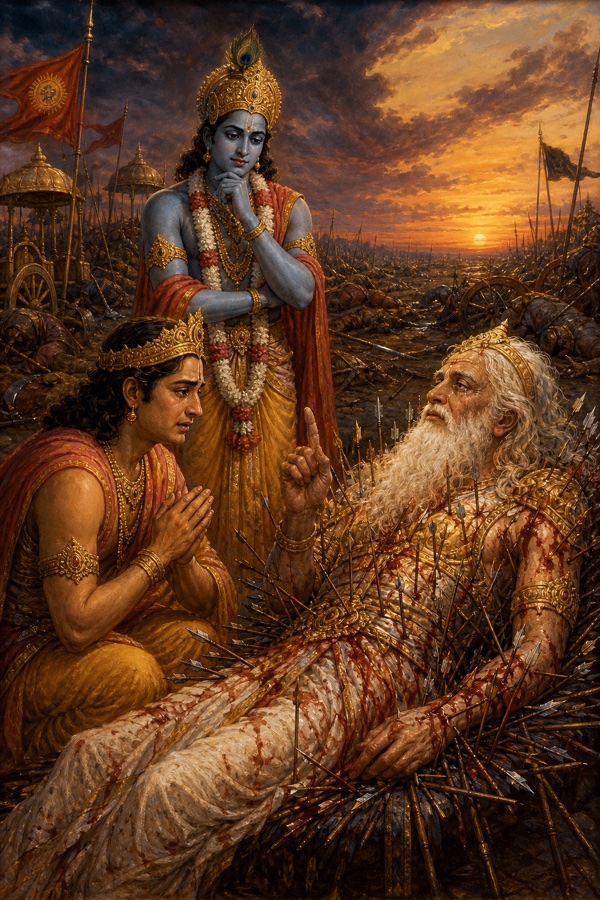
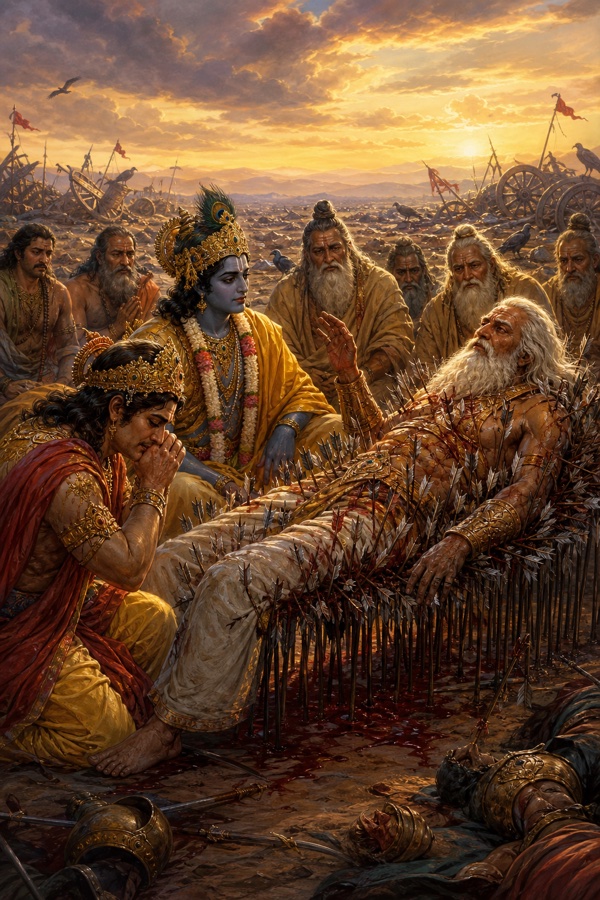
The next day they came back to the field, the Pandavas with Dhritarashtra among them, and Krishna and Bhima and Arjuna and the twins, and gathered around the old man on the arrows, grieving for him aloud. Rishis and siddhas had gathered there too, with Narada at their head, and it was Narada who looked at the grandsire, lying like the sun fallen out of the sky, and then at the princes, and said what none of them had dared to say. The time had come to question Bhishma about dharma. The son of Ganga was about to give up his breath, the way the sun gives up the day, and he knew the duties of all four orders; whatever doubts they carried, they should lay them before him now, without delay. The princes heard him, moved toward the bed, and stopped. They could ask nothing. They looked at one another. It was Yudhishthira who broke it, and he turned to Krishna. “No one but the son of Devaki can put a question to the grandsire,” he said. “You are the first among us all, and you know every duty and practice. You speak first.” So Krishna went to the unconquerable Bhishma and asked, plainly, whether the night had been easy, whether his understanding was clear, whether his knowledge shone in him by its own inward light, whether his heart still felt pain. Bhishma’s answer was almost joyful. “Burning, faintness, weariness, sickness, and pain, all of it has left me in a single day, by your grace. Past, future, and present I see as plainly as a fruit set in my hand. Every duty the Vedas declare, every duty of the Vedanta, the customs of countries and tribes and families, the four stages of life, the whole craft of kings, it all stands before me. Strengthened by meditating on you, I feel like a young man again. But Janardana, why do you not teach the son of Pandu yourself? What answer do you have to that? Tell me quickly.”
Krishna said, “Know that I am the root of fame and of everything that leads to good. Whatever is good and whatever is bad, both come from me. Who on earth would wonder to hear that the moon has cool rays? Who would wonder to hear that the full measure of fame is mine? And yet I have resolved to make your fame greater, Bhishma, and that is why I have filled you with this understanding. As long as the earth lasts, your name will travel through all the worlds with its light undimmed. Whatever you say to the son of Pandu when he asks will be held on earth to carry the authority of the Veda itself, and whoever lives by your word will win hereafter the reward of every good deed. A man’s achievements are said to live as long as his fame lives; I have given you this divine understanding so that yours will. The kings who survived the war are sitting around you, and they want to hear you on dharma and duty. You are old in years, your conduct has always followed the ordinance of the shruti, you know the duties of kings and every other science of duty, and from your very birth no one has found the smallest fault in you. So speak to them the way a father speaks to his sons. You have always worshiped the rishis and the gods; a learned man asked by the righteous is bound to teach, the sages have called it a duty, and if you keep silent now, when your sons and grandsons are asking you about the eternal duties of men, you will earn a share of sin.”
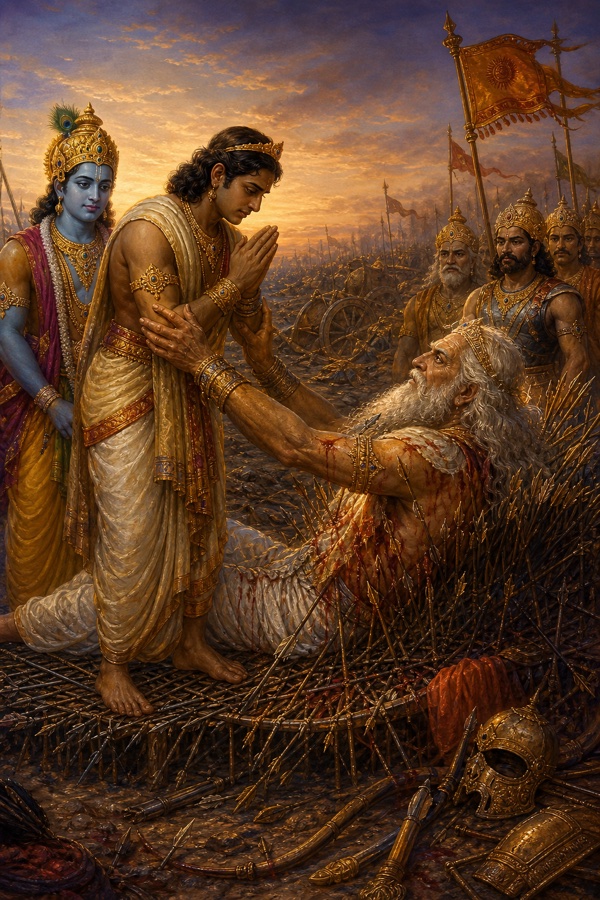
Bhishma said, “I will teach dharma. My speech and my mind have grown steady through your grace, Govinda, for you are the eternal soul of every being. Let the righteous Yudhishthira question me, and I will gladly speak of every duty.” Then he said it again, and again, each time naming what he loved in the man he was inviting: let the son of Pandu question me, at whose birth all the Vrishnis rejoiced; who has no equal among the Kurus or among men of good conduct; in whom are intelligence, restraint, celibacy, forgiveness, righteousness, and strength of mind; who honors his kin and his guests and his dependents; who is truthful and generous and fearless and would never sin from desire or profit or fear. Still Yudhishthira held back, and Krishna explained why. “The king is overcome with shame, and he is afraid of your curse. He caused a great slaughter. He pierced with arrows the men he should have worshiped, men devoted to him, his teachers, his kinsmen, the ones he held in highest regard, and so he does not dare come near you.” Bhishma answered him, and the answer was the first lesson of the day. “As the duty of a Brahmin is charity, study, and penance, so the duty of a Kshatriya is to throw away his body in battle. A Kshatriya must strike down fathers and grandfathers and brothers and teachers and kinsmen if they meet him in an unjust battle. That is the duty declared for him. The Kshatriya who kills even his own teacher in battle, if that teacher is sinful and greedy and has thrown off restraint and vow, is called a knower of his duty; so is the one who kills the man who, out of greed, tramples the eternal barriers of virtue; so is the one who in battle makes the earth a lake of blood, with the hair of the slain for its floating grass, elephants for its rocks, and standards for the trees on its banks. When he is challenged, a Kshatriya must always fight, for Manu has said that a righteous battle brings the Kshatriya both heaven and fame on earth.” When he had said this, Yudhishthira came forward at last, in great humility, and stood where the old man could see him, and took hold of his feet. Bhishma gladdened him with affectionate words, smelled his head the way an elder does, and told him to sit. Then the son of Ganga, the greatest bowman of them all, said, “Do not fear, child. Ask me anything, without anxiety.”
Yudhishthira bowed to Hrishikesha, saluted Bhishma, took the leave of all the elders sitting there, and began. “Those who know dharma say that the duties of kings are the highest science of duty, and I believe them, and the burden of those duties seems to me very heavy. The science of the law of kings is the refuge of the whole living world. Dharma, wealth, and pleasure hang on it, and so does the path that leads to liberation. As the reins are to a horse and the iron hook to an elephant, so this science is the rein that checks the world. If a man grows confused about the duties royal sages have kept, disorder sets in on the earth and everything is thrown together. As the rising sun drives off the darkness, this science drives off every kind of evil consequence for the world. So teach me the duties of kings first, grandfather, for you are the first of all who know duty, and Vasudeva holds you the first of all intelligent men, and all of us expect the highest knowledge from you.”
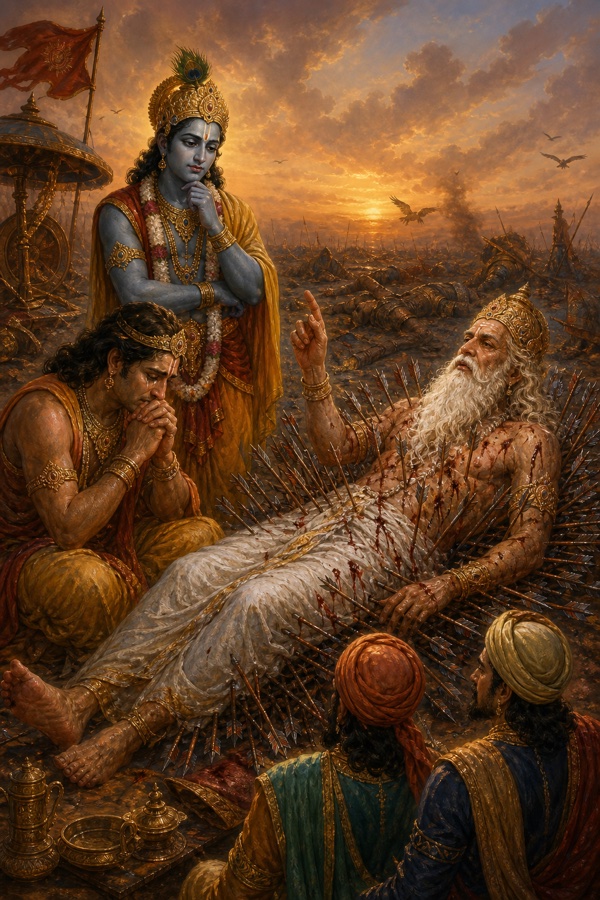
Bhishma said, “I bow to dharma, which is supreme, to Krishna, who is Brahman in full, and to the Brahmins, and I will speak the eternal duties. Yudhishthira, hear the whole range of a king’s duties with your mind gathered on it, and whatever else you want to know. First: a king who wants to please his people should wait on the gods and the Brahmins with humility, and always in the manner the ordinance lays down. By worshiping the gods and the Brahmins the king pays his debt to dharma, and his people come to respect him. Next, exert yourself, and exert yourself promptly, for without prompt effort mere destiny never brings a king what he wants. Effort and destiny work as equals, and of the two I hold effort the higher, because destiny can only be read from the result of something begun with effort. If a thing you begin ends in disaster, do not grieve over it; go back to the same work with twice the attention. That is the high duty of kings.
“Nothing serves a king’s success like truth. The king devoted to truth is happy here and hereafter. Truth is the great wealth of the rishis, and for kings there is nothing that inspires confidence in them like truth. The king who has every accomplishment and good conduct, who is self-restrained, humble, and righteous, who has his passions in hand, who is handsome to look at and does not pry into everything, never loses his prosperity. He wins prosperity by administering justice and by attending to three things, hiding his own weaknesses, learning the weaknesses of his enemies, and keeping his own counsel, and by conduct that is straightforward.
“If the king turns mild, everyone disregards him. If he turns fierce, his people are troubled. So keep both kinds of behavior. Never punish a Brahmin, for the Brahmin is the first of beings on the earth. Manu sang two verses about this, and you should always keep them in mind. Fire was born from water, the Kshatriya from the Brahmin, and iron from stone. These three can exert their force on everything else, and when they meet their own source, their force is stilled. When iron strikes stone, when fire fights water, when the Kshatriya turns his enmity on the Brahmin, all three soon grow weak. So the Brahmins are to be worshiped, and the greatest among them are gods on earth; honored as they should be, they hold up the Vedas and the sacrifices. Those who want that honor while they stand as obstacles in the way of the three worlds, you must hold down with the strength of your arms.
“The great rishi Ushanas sang two verses in the old days; listen to them with attention. A righteous Kshatriya, mindful of his duties, should chastise even a Brahmin who is a master of the Vedas if that Brahmin rushes into battle with a weapon raised. The Kshatriya who upholds righteousness when it is trampled does not become a sinner by that act, for the anger of the attacker justifies the anger of the one who punishes him. Within those limits, the Brahmins are to be protected. If they offend, exile them beyond your borders, and even when they deserve punishment, show them compassion. If a Brahmin is guilty of killing a Brahmin, of violating the bed of his teacher or another revered elder, of causing a miscarriage, or of treason against the king, his punishment is banishment from your dominions; no bodily punishment has been laid down for him. Those who show respect to the Brahmins should be favored by you with offices. There is no treasure a king holds that is worth more than a well-chosen body of servants. Among the six kinds of fortress the scriptures name, among every kind of fortress there is, the one built of the ready service and love of the people is the hardest to breach. So a wise king always shows compassion to the four orders of his subjects, and the king of righteous soul and truthful speech wins them.
“Do not, though, forgive everyone always, for the king who is mild is counted the worst of his kind, like an elephant that has lost its fierceness. In the scriptures composed by Brihaspati there is an old verse that fits here, and I will recite it: if the king is always forgiving, the lowest of men gets the better of him, the way the driver who sits on an elephant’s head masters the animal he guides. So the king should be neither always mild nor always fierce. He should be like the sun of spring, neither cold nor so hot that it draws sweat. He should study friends and enemies by what his senses tell him, by inference, by comparison, and by the canons of the scriptures. Keep clear of the evil practices called vyasanas. You may touch them; what you must never do is grow attached to them, because the man who is attached to them is mastered by everyone. The king who has no love for his people fills them with anxiety. He should bear himself toward them as a mother toward the child of her womb, and here is why that is right: as a mother sets aside the things she loves most to seek the good of her child alone, so should a king set aside what is dear to him to do what will benefit his people. Never let go of fortitude. The king who has fortitude and is known to punish wrongdoers has nothing to fear.
“Do not fall into jesting with your servants. Hear what comes of it. When the master mixes too freely with them, his dependents begin to disregard him; they forget their own place and climb past his. Ordered to do a thing, they hesitate, and they let out the master’s secrets. They ask for things that should never be asked for, and they eat the food meant for the master. They show their temper openly and try to outshine him. They set themselves above the king, take bribes, practice deceit, and choke the business of the state; they rot the state with false accounts and forgeries. They make love to the women who guard the palace and dress in the same style as their master. They grow shameless enough to belch and spit in his very presence, and they are not afraid to speak of him lightly before others. If the king is mild and given to joking, they ride horses and elephants and chariots as fine as his; his counselors, sitting in open court, say things like ‘This is beyond your power’ and ‘This is a wicked attempt.’ If the king grows angry, they laugh. If he gives them favors, they are not gladdened, though they may show joy for other reasons. They give away his secret counsel and spread word of his evil acts, and they set his orders at naught without a flicker of worry. If his jewels or his food or the things for his bath and his unguents are missing, they show no concern, standing right in front of him. They leave their own rightful share untouched and help themselves to what belongs to the king, never content with what was assigned to them. They want to play with the king the way a boy plays with a bird on a string, and they let the people understand that the king is close to them and loves them dearly. These evils, Yudhishthira, and many more spring from a king who is mild and disposed to jest.
“A king should always be ready for action. The king who sits without effort, like a woman, is not worth praise. The holy Ushanas sang a verse on this, and I will recite it: as a snake swallows mice, so the earth swallows two men, the king who shrinks from battle and the Brahmin who is too attached to wife and children. Keep that always in your heart. Make peace with those enemies with whom the ordinance says peace should be made, and wage war on those with whom war should be waged. Whether he is your teacher or your friend, whoever acts against your kingdom of seven limbs is to be killed. There is an old verse of King Marutta on the duty of kings that agrees with Brihaspati: by the eternal rule there is punishment even for a teacher, if he grows arrogant, forgets what should and should not be done, and breaks every restraint. King Sagara, of great intelligence, exiled his own eldest son Asamanjas for the good of the citizens, because Asamanjas used to drown their children in the Sarayu; his father rebuked him and sent him away. The rishi Uddalaka cast off his favorite son Shvetaketu, who afterward grew great in penance, because the boy used to invite Brahmins with promises of a feast and cheat them. The happiness of the people, truth, and sincerity of conduct are the eternal duty of kings.
“Never covet the wealth of others. Give what should be given, in its time. If the king has prowess, truthful speech, and a forgiving temper, he never falls from prosperity. With his soul cleansed of vices he should govern his anger, and every conclusion he reaches should conform to the scriptures. He should pursue dharma, wealth, pleasure, and liberation, with judgment. His counsels concerning the first three he should always keep hidden, for no greater evil can befall a king than the disclosure of his counsels. Kings should protect the four orders in the discharge of their duties, and to keep the orders from confusing their duties is the eternal duty of kings. The king should not trust others beyond his own servants, and even in his own servants he should never place his full trust. With his own intelligence he should weigh the merits and defects of the six requisites of sovereignty. The king who watches for the slips of his enemies, pursues dharma, wealth, and pleasure with judgment, sets clever spies to learn secrets, and draws away the officers of his enemies with gifts of wealth, deserves applause. Let him give justice like Yama and gather wealth like Kubera. Let him watch the merits and defects of his own gains and losses and his own dominions. Let him feed those who have not been fed and ask after those who have. Sweet of speech, he should speak with a smiling face and never a sour one. He should wait on the aged and drive out delay. He should hold to the conduct of the righteous and watch it carefully, never take wealth from the righteous, and take the wealth of the unrighteous and give it to the righteous. He should be skilled in striking, generous, master of himself, splendid in dress, regular in his meals, giving in season, and good in his behavior.
“A king who wants prosperity should bind to his service men who are brave, devoted, proof against the enemy’s deceptions, well-born, healthy, well-behaved, and connected with respectable families of good conduct; men never inclined to insult others, learned in every science, knowing the world and its affairs, careless of their own future state, always at their duties, honest, and steady as mountains. Between him and them there should be no difference in the objects of enjoyment. The only distinction should be his umbrella and his power to give orders, and his conduct toward them, to their faces and behind their backs, should be the same. The king who lives like this never comes to grief. The crooked, greedy king who suspects everyone and taxes his people heavily is soon killed by his own servants and relatives. The king of righteous conduct who is always drawing the hearts of his people to him never sinks when enemies attack him, and if he is overcome, he soon regains his place. If he is free of anger, free of evil practices, never savage in his punishments, and able to keep his passions in hand, he becomes a thing all creatures can rely on, like the Himalaya. The best of kings is the one who has wisdom and generosity, who is quick to use an enemy’s slip, whose face is pleasant, who knows what is bad for each of the four orders, who acts promptly, who governs his anger, who is neither vindictive nor irascible, who is high-minded, steady in sacrifice and religious acts, never boastful, and who drives every work he begins through to its end. He is the best of kings in whose dominions men live without fear, like sons in their father’s house; whose subjects need not hide their wealth; whose people keep to their duties and do not fear to throw away their bodies when duty calls, and are peaceful, obedient, willing, unquarrelsome, and generous. That king earns eternal merit in whose dominions there is no wickedness, no dissimulation, no deceit, and no envy. He deserves to rule who honors knowledge, holds to the scriptures and the good of his people, walks the path of the righteous, and gives; he deserves to rule whose spies and counsels and acts, done and undone, remain unknown to his enemies. Ushanas of Bhrigu’s line sang a verse on this in the story called the Ramacharita: a man should first choose a king to live under, then a wife, then earn his wealth, for without a king what would become of his wife and his earnings? For those who want a kingdom there is no eternal duty more binding than protection; the protection a king gives his subjects holds up the world. And Manu, the son of Prachetas, sang two verses on the duties of kings, and here they are: six persons are to be avoided like a leaky boat at sea, a teacher who does not speak, a priest who has not studied the scriptures, a king who does not protect, a wife who says what is disagreeable, a cowherd who likes to roam inside the village, and a barber who wants to go off to the woods.”
Bhishma held up the protection of the people as the very essence of the law of kings. “The divine Brihaspati praises no other duty so much. The divine Kavi, Ushanas of the large eyes and the austere penances, the thousand-eyed Indra, Manu the son of Prachetas, the divine Bharadvaja, and the sage Gaurashiras, all devoted to Brahman and all speakers of Brahman, composed treatises on the duties of kings, and every one of them praises protection above the rest. Listen to the means by which it is secured: the employment of spies and servants, and giving them their due without arrogance; collecting taxes with consideration, and never taking anything from a subject on a whim and without cause; choosing honest men for the work of the state; heroism, skill, and cleverness in business; truth; seeking the good of the people; sowing discord and disunion in the enemy by fair means or foul; repairing buildings that are old or about to fall; punishing in body and in purse as the occasion allows; never abandoning the honest; giving employment and shelter to men of respectable birth; storing what should be stored; keeping company with men of intelligence; always keeping the soldiers content; watching over the subjects; steadiness in the transaction of business; filling the treasury; never trusting the guards of the city blindly; producing disloyalty in a hostile town; looking carefully after friends and allies who live in the enemy’s country; strictly watching the servants and officers of the state; inspecting the city in person; distrust of servants; soothing the enemy with assurances; steadily observing the dictates of policy; readiness for action; never disregarding an enemy; and casting off the wicked.
“Readiness for exertion is the root of the law of kings; Brihaspati said so, and these are his verses: by exertion the amrita was won; by exertion the Asuras were killed; by exertion Indra himself won sovereignty in heaven and on earth. The hero of exertion stands above the heroes of speech, and the heroes of speech honor and worship the hero of exertion. The king without exertion, even if he is intelligent, is always overcome by his enemies, like a snake that has lost its venom. And however strong he is, a king should never disregard an enemy, however weak, for a spark of fire can raise a conflagration and a grain of poison can kill. With one kind of force alone, an enemy inside a fort can torment the whole country of a powerful and prosperous king.
“A king’s secret speeches, the troops he gathers for a victory, the crooked purposes in his heart, the similar intents he holds for particular ends, and the wrong acts he does or means to do, all of it he should hide under a look of candor. He should act righteously to keep his people in hand. Men of crooked mind cannot bear the burden of a great empire, and a mild king cannot reach the higher rank, whose winning depends on toil. A kingdom is coveted by everyone, like meat, and candor and simplicity alone can never guard it; so a king should always carry himself with both candor and crookedness. If in protecting his subjects a king falls into danger, he earns great merit. Such should be the conduct of kings. I have told you a portion only of their duties. Tell me what more you want to know.”
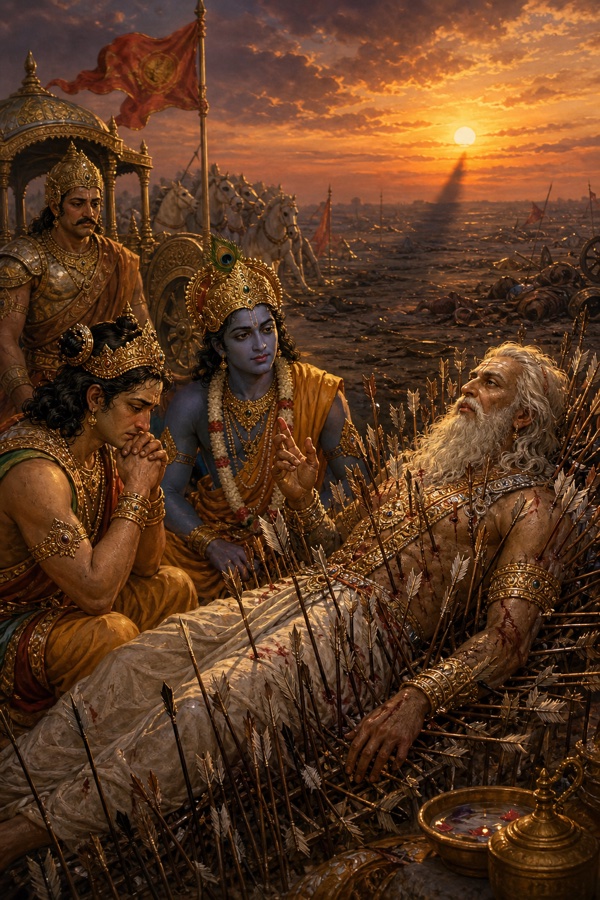
Vyasa and Devasthana and Ashva, Vasudeva and Kripa, Satyaki and Sanjaya, their faces opening like flowers in full bloom, cried “Excellent! Excellent!” and sang the praises of Bhishma, the first of virtuous men. Then Yudhishthira, with a heavy heart and his eyes swimming, gently touched the grandsire’s feet. “The points I am still in doubt about I will ask tomorrow,” he said, “for today the sun, having drunk up the moisture of everything on earth, is about to set.” Keshava and Kripa and Yudhishthira and the others saluted the assembled Brahmins, walked around the son of the great river, and climbed cheerfully onto their chariots. All of them, keepers of excellent vows, bathed in the current of the Drishadvati, offered water to their ancestors, silently recited the sacred mantras and did the other auspicious acts, performed the evening prayer with its due rites, and entered Hastinapura, the city named for the elephant.
A key to reading this (the seven-limbed realm): When Bhishma says that whoever acts against “your kingdom of seven limbs” is to be killed, teacher or friend, he is naming the realm the way the science of the rod counts it, as seven parts that live or die together. Later in this same teaching he lists the seven things a king must take care of: himself, his counselors, his treasury, his machinery for punishment, his friends, his provinces, and his capital. A blow at any one of the seven is a blow at the whole, which is why the law of kings here sets itself above the ties of blood and gratitude.
A key to reading this (the guarding of counsel): The word “counsel” in Bhishma’s mouth means the king’s secret deliberation, the plans he makes with his ministers about war and peace and wealth. He returns to it again and again: no greater evil can befall a king than the disclosure of his counsels, so the king should look candid and keep his purposes hidden, and his ministers should draw their counsel inside themselves the way a tortoise draws in its limbs. The spies, the assurances offered to an enemy, and the distrust of even loyal servants all serve the same end.
The gist: Narada tells the princes to ask, none of them can, and Krishna, at Yudhishthira’s plea, asks first; Bhishma names the Kshatriya’s duty to strike even his elders in an unjust war, and Yudhishthira takes hold of his feet. The law of kings begins: worship of gods and Brahmins, effort held above destiny, truth, secrecy of counsel, a temper like the spring sun, Manu’s verse on fire and water and the Kshatriya and the Brahmin, Ushanas on when a Brahmin may be chastised, the long account of what a joking king’s servants become, the duties of protection with their roll of authorities, and the counsel to carry both candor and craft. The sun goes down over Kurukshetra and they ride back to Hastinapura; tomorrow Yudhishthira will ask where the word “king” came from.
Lying on the arrows with his life held back by his own will, the son of Ganga went on with the law of kings, and what he laid before Yudhishthira now was the working part of it, the duties by which the protection of the people is actually done. He leaned on Brihaspati and on the others who had written on kingship before him, and he strung the duties out one after another: give the offices of the state to honest men; be brave, skilled, and clever in business; be truthful; seek the good of the people; lay fines and bodily punishments at the moment that fits them; never abandon the honest; give livelihood and shelter to men of good birth; store what is worth storing; keep company with the wise; keep the soldiers always content; fill the treasury; never trust the guards of your own city blindly; sow disloyalty in the enemy’s town and look after the friends who live in the enemy’s country; watch the servants and officers of the state closely and inspect the city yourself; soothe an enemy with assurances; hold steadily to policy; stay ready for action; never disregard an enemy; and push the wicked away. Effort, he said, is the root of the law of kings, and he gave the reason in Brihaspati’s words: by effort the amrita was won, by effort the Asuras were killed, by effort Indra won the kingdom of heaven and earth. The hero of effort stands above the hero of speech, and the heroes of speech end by worshiping him. A king who is wise and without effort is beaten by his enemies all the same, like a snake that has lost its venom.
Even a strong king, Bhishma went on, should never despise a weak enemy, because a single spark can become a forest fire and a single grain of poison can take a life, and one enemy sitting inside a fort, with a single kind of force at his command, can torment the whole country of a prosperous and mighty king. Let the king keep his secret counsel, his gathering of troops, the crooked purposes of his heart, and the wrong acts he does or means to do under a cloak of candor. Let him act by dharma to keep the people in hand, and let him understand two things about the height he is reaching for: crooked-minded men cannot bear the burden of a great empire, and a king who is only mild never reaches the high place whose winning rests on toil. This earth is coveted by all like meat, and candor and simplicity cannot guard it; so the king must take refuge in both candor and craft. And if in protecting the people he falls into danger, even then he earns great merit. That, Bhishma said, was a portion of the duties of kings, and he asked Yudhishthira what more he wanted to know.
Vyasa, Devasthana, Ashva, Vasudeva, Kripa, Satyaki, and Sanjaya, their faces like flowers in full bloom, cried “Excellent, excellent,” and praised him. Yudhishthira’s face was another matter. With a sad heart and his eyes wet, he touched the grandsire’s feet and told him that the doubts still in him would keep until tomorrow, because the sun, having drunk up the sap of the whole earth, was about to set. Then Keshava, Kripa, Yudhishthira, and the rest bowed to the Brahmins, walked around the son of the great river, and mounted their chariots. They bathed in the water of the Drishadvati, offered water to their ancestors, recited the mantras in silence, said the evening worship with its rites, and entered Hastinapura.
A key to reading this (the whole passage): Everything from here to the end of the chapter is the Shanti Parva’s instruction in the duties of kings, spoken by a man who has chosen the hour of his own death and is waiting on the bed of arrows for the sun to turn north. The teaching keeps two things in one hand: dharma and statecraft. Bhishma asks the king for truth and for compassion toward every creature, and in the same breath for spies, for hidden purposes, and for a cloak of candor over craft, because the protection of the people, in his telling, requires both.
The gist: Bhishma gives the long list of the king’s working duties, names effort the root of the law of kings with Brihaspati’s verses on the amrita and the Asuras, warns against despising a weak enemy, and tells the king to carry both candor and craft. The day ends at the Drishadvati and the company rides back into Hastinapura.
Where the word “King” came from: the birth of rule at the beginning of creation
They rose the next day, performed the morning rites the scriptures lay down, and set out again, Pandavas and Yadavas together, on chariots that looked like fortified towns rolling across the plain. On the field of Kuru they came to the sinless Bhishma and asked whether he had passed the night well. They saluted all the rishis, were blessed by them in turn, and took their seats around the bed. Then Yudhishthira worshiped his grandfather in the proper way and put his question with his hands joined, and it was the question of a man who had just been made a king and did not understand why anyone obeyed him. Where did the word “king” come from, the word that is used on earth? A king has hands and arms and a neck like other men. He has understanding and senses like theirs, the same joys and griefs, a back and a mouth and a stomach like everyone else’s, the same vital fluids and bones and marrow and flesh and blood. He breathes in and out like others; he has a life and a body like other men; he is born and dies like them. In every attribute of humanity he is the same as the rest. Then for what reason does this one man govern the rest of the world, a world full of men of great intelligence and courage? How does one man rule a wide earth teeming with brave, energetic, high-born men of good conduct? Why do all men seek his favor? Why, when this one man is pleased, is the whole world pleased, and when he is troubled, is the whole world troubled? There had to be some grave reason for it, Yudhishthira said, because he had seen the whole world bow to one man as to a god, and he wanted to hear it in full.
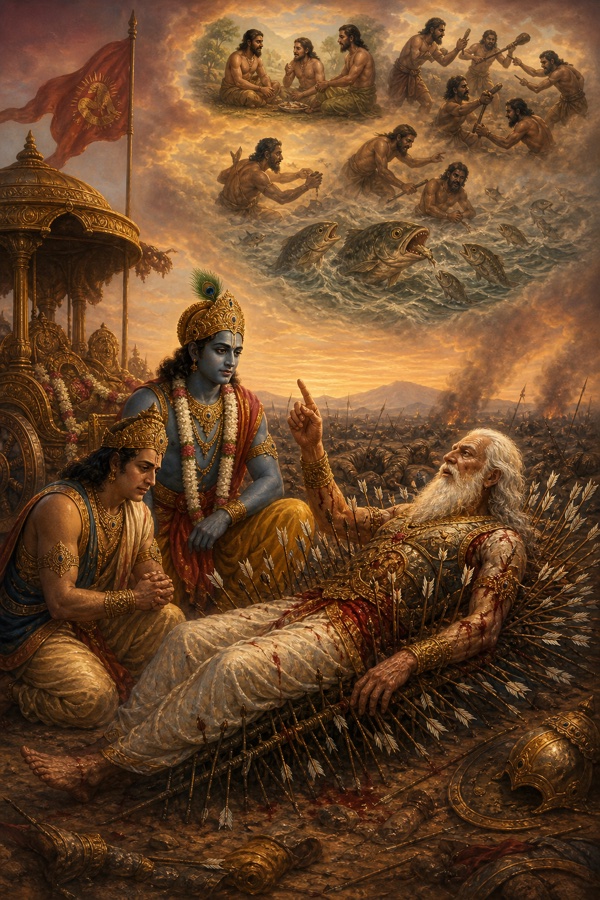
Bhishma told him to listen closely, because the story went back to how sovereignty first began in the Krita age, the first and best of the ages. In the beginning there was no sovereignty and no king, no rod of punishment and no one to wield it. All men protected one another righteously, on their own. They lived that way for a while, and then the task began to feel painful to them. Error crept into their hearts. Once error had them, their perceptions clouded over, and their virtue began to decline. With their perceptions dimmed, every one of them became covetous. Because men now wanted objects they did not possess, a new passion took hold of them, the lust of acquisition; and once they were subject to that, another passion, anger, soon soiled them. Under anger they lost all sense of what should be done and what should not. Sexual indulgence ran without restraint. Men said whatever they pleased. Every distinction between clean food and unclean, between virtue and vice, disappeared. When that confusion had spread among men, the Vedas vanished, and when the Vedas vanished, righteousness was lost with them.
With both the Vedas and righteousness gone, the gods themselves were afraid, and in their fear they went to Brahma, the grandsire of the universe, and stood before him with their hands joined. The eternal Vedas, they said, had been struck down in the world of men by greed and error, and that was why they were afraid: with the Vedas lost, righteousness was lost, and the gods were about to sink to the level of human beings. Men had poured their offerings upward and the gods had poured rain downward; now, with the pious rites stopped among men, great distress lay ahead for the gods. They asked him to think of something that would help them, so that the universe he had made by his power would not be destroyed. The self-born Lord answered that he would think of what would do good to all, and told the gods to let their fears go.
Then the grandsire, by his own intelligence, composed a treatise of a hundred thousand chapters. Virtue, profit, and pleasure were treated in it, the three he named the triple aggregate, and a fourth subject, liberation, with its opposite meaning and attributes. It treated the three qualities of goodness, passion, and darkness, and the practice of duty without hope of reward in this world or the next. It treated a second set of three connected with the rod, conversation, growth, and destruction, and a set of six, the hearts of men, place, time, means, overt acts, and alliances. It laid down the rites of the three Vedas, knowledge, the acts by which life is supported, farming and trade among them, and the vast branch of learning called the science of punishment. It treated the conduct of counselors, of spies, the marks of princes, secret agents with their various means, envoys and agents of other kinds; conciliation, sowing discord, gifts, and chastisement, with toleration as the fifth; deliberation of every kind, counsels for producing disunion, the errors of deliberation and the results when counsels succeed or fail; treaties of three kinds, bad, middling, and good, made through fear, through good offices, and through gifts of wealth; the four times for making journeys; the three kinds of victory, the one won righteously, the one won by wealth, and the one won by deceit; the attributes, bad, middling, and good, of the aggregate of five, which is counselors, kingdom, fort, army, and treasury; chastisement of two kinds, open and secret, with eight kinds of each. Chariots, elephants, horses, foot soldiers, impressed laborers, crews, paid attendants, and guides taken from the country where the war is fought are the eight instruments of open force. The use of poison, movable and immovable, in clothing, in food, and in incantations; enemies, allies, and neutrals; the roads to take as the stars and planets direct and the soil to camp on; the protection of the king’s own person; the building of chariots and the other gear of war; the care of men and elephants and chariots and horses; the arrays and strategies and maneuvers of battle; the planetary conjunctions that bode evil and the calamities like earthquakes; the methods of fighting and of retreat; the keeping of weapons; the disorders of troops and their cure; the ways of putting joy and confidence into an army; the guiding of foot soldiers, the sounding of alarms and orders, and the frightening of an enemy by a display of standards; and the harrying of an enemy’s kingdom by robbers and wild tribes, fire-raisers, poisoners, and forgers, by disunion among his chief officers, by cutting down his crops, by ruining his elephants, by producing alarms, by honoring those among his subjects who lean toward the invader, and by lulling him into confidence: all of this was in it. So were the waste, growth, and harmony of the seven requisites of sovereignty, the ways of extending a kingdom and winning over the people of an enemy’s territory, the punishment of the strong, the exact administration of justice, the extermination of the wicked, wrestling and the throwing and hurling of weapons, the making of presents and the storing of what is needed, the feeding of the unfed and the watching of the fed, freedom from the vices called vyasanas, the attributes of kings and the qualifications of military officers, the behavior of dependents, suspicion against everyone, the avoidance of heedlessness, the winning of what has not been won and the improving of what has, and the spending of wealth for piety, for desire, and for dispelling danger and distress.
It went further still. The fierce vices born of temper and of lust, ten in all, were set down: the four the learned trace to lust, hunting, gambling, drinking, and women, and the six born of anger, rude speech, fierceness, savage punishment, the infliction of bodily pain, suicide, and the ruin of one’s own ends. Machines of every kind and their workings were described; the devastation of an enemy’s territory, the removal of his landmarks, the cutting of his great trees for their shade, the siege of forts, the supervision of farming, the storage of necessaries, the robes of troops and the best way to make them; the uses of drums and conches; the six kinds of articles, gems, animals, land, robes, female slaves, and gold, and the means of gaining them and of destroying them in an enemy’s hands; the pacification of new territory, the honoring of the good, friendship with the learned, the rules of gifts and of rites like the homa; the adornment of the body and the preparing of food; piety, truthfulness, sweetness of speech, and the acts of festivals and households; the immunity of Brahmins from punishment; the honoring of dependents for kinship and merit; the counsel a king should follow when he lives in the middle of a dozen kings, toward four kinds of enemy, four kinds of ally, and four kinds of neutral; the seventy-two acts the medical works lay down for the care of the body; and the practices of countries, tribes, and families. Every means by which men might be kept from straying off the road of righteousness and honesty was in it. When it was finished, the divine Lord spoke cheerfully to the gods with Indra at their head. “For the good of the world and for the establishing of virtue, profit, and pleasure, I have composed this science; it is the very cream of speech. Assisted by chastisement it will protect the world. It will deal out reward and punishment among men. And because men are led by chastisement, because chastisement governs everything, this science will be known in the three worlds as dandaniti, the science of the rod.” Then the lord of Uma, the divine and many-formed Shiva of the large eyes, source of all blessings, was the first to study and master it. Seeing how the lives of men were shortening, he abridged the grave work Brahma had compiled. Shiva’s abridgment, ten thousand lessons long, was called Vaishalaksha, and it passed to Indra, devoted to Brahman and rich in ascetic merit, who cut it to five thousand lessons and called it Bahudantaka. Brihaspati, by his intelligence, brought it down to three thousand and called it Barhaspatya, and Kavi, the celebrated teacher of yoga, Shukra of immeasurable wisdom, reduced it to a thousand. So, watching the span of men’s lives and the general decline of everything, the great rishis abridged that science for the good of the world.
A key to reading this (concept, numbers): The shrinking of the science of the rod is a genealogy of knowledge: Brahma’s original of a hundred thousand chapters, Shiva’s Vaishalaksha of ten thousand, Indra’s Bahudantaka of five thousand, Brihaspati’s Barhaspatya of three thousand, and Shukra’s thousand. Each abridgment is made for the same stated reason, that the lives of men were growing shorter and their capacity smaller, so a code the size of a world contracts, hand to hand, into something a mortal king could learn.
Then the gods went to Vishnu, the lord of creatures, and asked him to point out the one among mortals who deserved superiority over the rest. The divine Narayana reflected a little, and by an act of will created a son from his own energy, and named him Virajas. But the blessed Virajas had no wish for sovereignty on earth; his mind leaned toward renunciation. His son was Kirtimat, and he too renounced pleasure and enjoyment. Kirtimat’s son was Kardama, and Kardama practiced severe austerities. Kardama, a lord of creatures, begot Ananga, and Ananga became a protector of creatures, pious in his conduct and fully versed in the science of the rod. Ananga begot Atibala, well versed in policy, who came into a great empire on his father’s death and became the slave of his passions. Mrityu, Death, had a daughter born of his mind, Sunitha, famous through the three worlds. She was married to Atibala, and she gave birth to a son named Vena.
The unrighteousness of Vena and the rise of Prithu: the origin of the names “King” and “Earth”
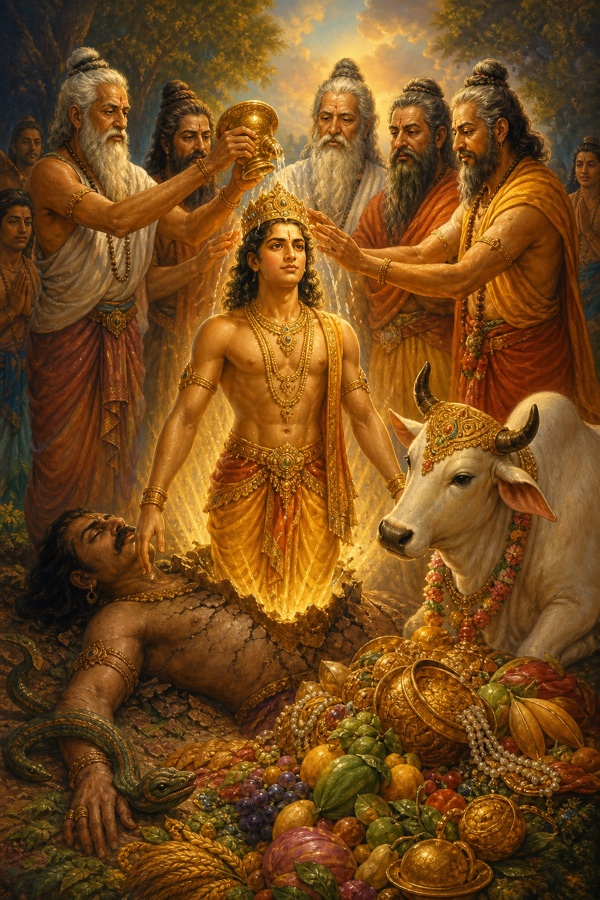
Vena, Bhishma said, was a slave of anger and malice, and he turned unrighteous toward every creature. So the rishis, those speakers of Brahman, killed him. Their weapons were blades of kusha grass charged with mantras. Then, still reciting, they pierced the dead king’s right thigh, and out of the thigh came a short-limbed man, dark as a charred brand, with blood-red eyes and black hair. “Nishida,” they told him: sit here. From him came the Nishadas, the wicked tribes who make their home in the hills and the forests, and the hundreds of thousands of others called Mlechchhas who live on the Vindhya mountains. Then the great rishis pierced Vena’s right arm, and from the arm came a man who was a second Indra in form, clad in mail, armed with swords and bow and arrows, versed in the science of weapons and fully acquainted with the Vedas and their branches. Every ordinance of the science of the rod came to him in bodily form.
The son of Vena joined his hands and asked the great rishis what he should do with what he had been given. He had, he said, an understanding that was very keen and watchful of righteousness; whatever useful task they named, he would do it without hesitation. The gods who were present and the rishis answered him together. Do fearlessly every task in which righteousness lives. Set aside what is dear to you and what is not, and look on all creatures with an equal eye. Throw lust and anger and greed and pride far from you, and always keeping to the dictates of righteousness, punish with your own hands any man, whoever he is, who leaves the path of duty. Swear that in thought, word, and deed you will always uphold the religion the Vedas teach on earth. Swear that you will fearlessly maintain the duties the Vedas lay down with the help of the science of the rod, and that you will never act on a whim. Know that Brahmins are exempt from chastisement, and pledge that you will protect the world from a confusion of castes. Vena’s son answered the gods and the rishis with one promise: the highly blessed Brahmins, the first among men, would always be worshiped by him. And the speakers of Brahman said, “Let it be so.”
Then Shukra, that vast vessel of Brahman, became his priest; the Valakhilyas became his counselors and the Sarasvatas his companions; the great rishi Garga became his astrologer. There is a high declaration of the shruti current among men, that Prithu is the eighth from Vishnu. A little before this, two persons named Suta and Magadha had come into being, and they became his bards and panegyrists; Prithu, the royal son of Vena, pleased with them, gave Suta the land along the seacoast and Magadha the country that has been called Magadha since.
It has been heard, Bhishma said, that the surface of the earth had been very uneven before then, and that it was Prithu who made it level; in every manvantara the earth grows uneven again. Vena’s son shoved aside the rocks and rocky masses that lay everywhere with the horn of his bow, and by that the hills and mountains grew larger. Then Vishnu, the gods with Indra, the rishis, the regents of the world, and the Brahmins gathered to crown Prithu king of the world. The earth herself, in bodily form, came to him with a tribute of gems and jewels. Ocean, the lord of rivers, and Himavat, the king of mountains, and Shakra gave him wealth that could not be exhausted. Great Meru, the mountain of gold, gave him heaps of gold. The divine Kubera, borne on the shoulders of men, lord of yakshas and rakshasas, gave him wealth enough for every need of religion, profit, and pleasure. Horses, chariots, elephants, and men sprang into life by the millions the moment Vena’s son thought of them. In that time there was no decrepitude, no famine, no calamity, and no disease on earth. Under his protection nobody feared reptiles or thieves or anything else. When he went toward the sea, the waters turned solid; the mountains gave him a way through, and his standard was never obstructed anywhere. He drew from the earth, as a milker draws from a cow, seventeen kinds of crops, food for yakshas and rakshasas and nagas and all other creatures.
Then Bhishma opened the secret of the names, and every one of them was a description of what this king did. That great king made all creatures regard righteousness as the first of things, and because he pleased all the people, he was called Rajan, king. Because he healed the wounds of the Brahmins, he earned the name Kshatriya. And because the earth in his time became famous for the practice of virtue, she came to be called by many Prithvi, after Prithu. The eternal Vishnu himself confirmed his power and told him that no one would ever surpass him, and by the strength of Prithu’s penances Vishnu entered the king’s body; and for that reason the whole universe offered divine worship to Prithu, who was numbered among the gods in human form. So a kingdom is to be protected by the science of the rod and by watching, through the movements of spies, that no one can injure it; all good acts lead to the good of the king, and his conduct should be governed by his own intelligence and by the openings and means that offer themselves. What other cause is there, Bhishma asked, for a multitude living in obedience to one man, if it is not the divinity of the king? At that time a golden lotus was born from Vishnu’s brow, and from the lotus the goddess Shri was born, and she became the wife of Dharma, and on Shri, Dharma begot Artha, wealth, and all three, Dharma, Artha, and Shri, were established in sovereignty. A man whose merit is exhausted comes down from heaven and is born on earth as a king versed in the science of the rod; he is endowed with greatness and is a portion of Vishnu, and being established by the gods, no one surpasses him. That is why everyone obeys one man though he belongs to the same world and has the same limbs; that is why the world cannot command him. Whoever once saw Prithu’s pleasant face became obedient to him, and from then on thought him handsome, wealthy, and blessed. Through the might of his scepter the practice of virtue and just conduct became visible on the earth, and so the earth was overspread with virtue.
A key to reading this (lineage, concept): The line runs Vishnu, Virajas, Kirtimat, Kardama, Ananga, Atibala, Vena, Prithu, which is why the shruti calls Prithu the eighth from Vishnu. Vena, the wicked king, is killed by the rishis, and from the churning of his body come two things: from the thigh the Nishadas, the residue of his unrighteousness, and from the arm Prithu, the ideal king. The names are then read as deeds: Rajan from pleasing the people, Kshatriya from healing the wounds of the Brahmins, Prithvi from Prithu. The claim underneath the etymologies is that kingship is justified by protection and by the welfare of the people, and by nothing else.
The gist: In the Krita age men protected one another until error, greed, lust, and anger erased the Vedas and dharma, so Brahma wrote the science of the rod in a hundred thousand chapters and Shiva, Indra, Brihaspati, and Shukra abridged it step by step. Vishnu’s line came down through renouncers and ascetics to Vena, whose body the rishis churned: a Nishada from the thigh, Prithu from the arm. Prithu leveled the earth, milked seventeen crops from her, and gave the names Rajan, Kshatriya, and Prithvi; Vishnu entered him, and a king ever since is a portion of Vishnu, which is why one man is obeyed by many.
Bhishma on the dharma of the four orders and the Shudra’s right to sacrifice
Yudhishthira saluted his grandfather again and asked the next thing, with his hands joined and his attention gathered. What are the duties common to the four orders of men, and what the special duties of each? What way of life should each order take up? Which duties are the king’s in particular? By what means does a kingdom grow, and by what means the king himself, and how do the citizens and the king’s servants grow with him? What kinds of treasury, punishment, fort, ally, counselor, priest, and teacher should a king keep away from? Whom should he trust, and in what kinds of danger? From what evils should he guard himself most firmly? Bhishma bowed to dharma, which is great, and to Krishna, who is Brahman, and to the Brahmins gathered there, and began with the ground that all four orders stand on. The suppression of anger, truthfulness of speech, justice, forgiveness, begetting children on one’s own wedded wife, purity of conduct, the avoidance of quarrels, simplicity, and the support of dependents: these nine duties belong equally to all four orders. Then he told the duties that belong to the Brahmin alone. Self-restraint, he said, is declared the first duty of the Brahmin; the study of the Veda and patience in austerity are the others, and by those two everything he does is accomplished. If wealth comes to a peaceful, learned Brahmin while he keeps to his own duties and does nothing improper, he should marry, seek children, give in charity, and perform sacrifices, and the wise have said that such wealth should be enjoyed by sharing it among deserving people and relatives. His study of the Veda accomplishes every pious act laid down for him. Whether he achieves anything else or not, if he gives himself to the study of the Veda he is known as a Brahmin, the friend of all creatures.
Then the Kshatriya. Bhishma said he should give and never beg; perform sacrifices himself and never officiate as a priest at another man’s; study the Vedas with a Brahmin teacher and never teach them. He should protect the people. Always exerting himself to destroy robbers and the wicked, he should put out his prowess in battle. Kshatriya rulers who perform great sacrifices, know the Vedas, and win victories in battle are first among those who earn many blessed regions hereafter by their merit. The people who know the old scriptures do not applaud the Kshatriya who comes home from battle unwounded; they call that the conduct of a wretched Kshatriya. There is no higher duty for him than the suppression of robbers. Gifts, study, and sacrifice bring prosperity to kings, and so a king who wants religious merit should fight. Setting all his subjects in their respective duties, he should make every one of them act by the dictates of righteousness. Whether he does anything else or not, if he protects his subjects he is held to have accomplished every religious act, and is called a Kshatriya and the first of men. The Vaishya’s eternal duties came next. A Vaishya should give, study the Vedas, perform sacrifices, and earn wealth by fair means, and with proper care he should protect and rear all the domestic animals as a father protects his sons; anything else he does is improper for him, and by protecting the animals he wins great happiness. The Creator, having made the domestic animals, put their care on the Vaishya, as he put the care of all creatures on the Brahmin and the Kshatriya. Bhishma even gave the arithmetic of his living. If he keeps six cows for another man, he may take the milk of one cow as his wage; if he keeps a hundred, he may take a single pair. If he trades with another man’s wealth, a seventh of the profit is his; a seventh also in the trade in horns, and a sixteenth if the trade is in hoofs. If he farms with seed another man supplies, a seventh of the yield is his for the year. A Vaishya should never wish to be free of tending cattle, and if a Vaishya wants to tend cattle, no one else should be set to that task.
Of the Shudra Bhishma said that the Creator intended him to be the servant of the other three orders, and so the service of the three is the Shudra’s duty, and by it he may win great happiness; he should wait on the three in their order of seniority. A Shudra should never amass wealth, lest by his wealth he make the members of the three higher orders obedient to him, which would be a sin in him; with the king’s permission, though, a Shudra may earn wealth for the performance of religious acts. It is said that the Shudras should certainly be maintained by the other three orders. Worn-out umbrellas, turbans, beds and seats, shoes, and fans should be given to the Shudra servants, and torn clothes no longer fit to wear should be given by the twice-born to the Shudra; these are his lawful acquisitions. If a Shudra comes to a man of the three orders wanting to do menial service, the man should assign him proper work. To the sonless Shudra his master should offer the funeral cake, and the weak and the old among them should be maintained. The Shudra should never abandon his master, whatever the distress the master falls into, and if the master loses his wealth, the Shudra servant should support him with all the more zeal. A Shudra cannot have wealth of his own; whatever he possesses belongs lawfully to his master.
Then Bhishma gave the teaching a turn that opened a door. Sacrifice is laid down as a duty of the three other orders, and it has been ordained for the Shudra also. A Shudra cannot utter svaha or svadha or any other Vedic mantra, so, without the vows the Vedas lay down, he should worship the gods in the minor sacrifices called paka-yajnas, the cooking sacrifices, whose dakshina, the fee, is the gift called purnapatra, the full vessel. It has been heard, Bhishma said, that in the old days a Shudra named Paijavana gave, in one of his sacrifices, a dakshina of a hundred thousand full vessels, by the ordinance called Aindragni. So sacrifice is laid down for the Shudra as much as for the other three. Of all sacrifices, devotion has been declared the first; devotion is a high deity, and it cleanses everyone who sacrifices. The Brahmins are the first of gods to their Shudra attendants, and they worship the gods in sacrifices for the fulfillment of various wishes; the members of the three other orders have all sprung from the Brahmins, and the Brahmins are the gods of the very gods, so every kind of sacrifice belongs by nature to all four orders, and the obligation is one whose discharge is never optional. The Brahmin who knows the Rig, Yajus, and Sama verses should always be worshiped as a god; the Shudra, who is without them, has Prajapati for his god. The mental sacrifice is laid down for all the orders. It is not true that the gods and the other superior beings have no wish to share in even a Shudra’s offerings in such a sacrifice, and that is why the sacrifice that consists in devotion is laid down for all the classes. All the orders are bound to one another by kinship through the classes between them, and all have sprung from the Brahmins; in the order of creation the Brahmin was made first, and in the beginning the Saman was one, the Yajus was one, and the Rig was one. Those who know the old histories cite a verse the Vaikhanasa munis sang in praise of sacrifice at one of their own: before sunrise or after, a man of subdued senses, his heart full of devotion, pours his offerings on the fire according to the ordinance, and devotion is a mighty agent. Sacrifices are many, and their rites and their fruits are many, and the devout Brahmin who is learned in the scriptures and knows them all is competent to perform them. The man who wants to perform a sacrifice is counted righteous even if he is a thief, a sinner, or the worst of sinners; the rishis applaud such a man, and without doubt they are right. So this is the conclusion: all the orders should always, by every means in their power, perform sacrifices, for there is nothing in the three worlds equal to sacrifice, and everyone whose heart is free of malice should sacrifice, aided by sacred devotion, to the best of his power and as he pleases.
A key to reading this (concept): This passage on the duties of the orders carries the Mahabharata’s moral complexity intact. On one side it sets hard limits on the Shudra: he may hold no wealth of his own, and the Vedic mantras are closed to him. On the other it opens to him the door of sacrifice and devotion, insists that the gods do wish to share in his offerings, and calls devotion the first of all sacrifices. Paijavana, a Shudra who gave a hundred thousand full vessels in fee, stands inside the text as the proof. The text records the social structure of its age and does nothing to soften it.
The gist: Nine duties belong to all four orders alike, and then each order has its own: restraint, study, and austerity for the Brahmin; giving, sacrificing, protecting, and fighting for the Kshatriya; gifts, study, sacrifice, fair trade, and cattle for the Vaishya, with his wages fixed in cows and sevenths; service for the Shudra. Sacrifice is laid down for all four, for the Shudra in the form of the cooking sacrifice and the full vessel, and devotion is the highest sacrifice of all.
The four stages of life, and the supremacy of the Kshatriya dharma
Bhishma named the four modes of life next and the duties of each: Vanaprastha, the life in the forest; Bhaikshya, the life of the mendicant; Garhasthya, the householder’s life, which is of great merit; and Brahmacharya, the student’s life, which the Brahmins take up. A man who has gone through the rite of regeneration, kept the sacred fire for a time, and studied the Vedas, and who has first carefully performed all the duties of the householder, should undergo the purificatory rite of the matted locks and go, with his wife or without her, to the woods, to adopt the life of the forest. Having studied the scriptures called Aranyakas, having drawn up his vital fluid and withdrawn from every worldly affair, the virtuous recluse may then attain absorption in the eternal Soul that knows no decay. A learned Brahmin should practice these things first. The Brahmin who wants liberation is competent, as everyone knows, to take up the mendicant’s mode after passing through the student’s; sleeping wherever evening overtakes him, without any wish to better his situation, without a home, living on whatever food comes to him, given to contemplation, restrained, his senses under control, without desire, regarding all creatures equally, without enjoyments and without dislike for anything, the learned Brahmin who lives so attains absorption in the eternal Soul. The householder, after studying the Vedas, should accomplish all the religious acts laid down for him; he should beget children and enjoy pleasures and comforts, and with careful attention discharge all the duties of a mode of life that ascetics praise and that is extremely hard to pass through without a fault. He should be satisfied with his own wedded wife and never approach her except in her season. He should observe the ordinances of the scriptures and never be cunning or deceitful. He should eat sparingly, be devoted to the gods, grateful, mild, without cruelty, forgiving; tranquil of heart, tractable, attentive in his offerings to the gods and the ancestors; always hospitable to the Brahmins; free of pride; his charity given to no single sect alone; and always devoted to the Vedic rites. The great rishis cite here a verse of grave import that Narayana himself sang: by truth, simplicity, the worship of guests, the winning of dharma and wealth, and the enjoyment of one’s own wedded wives, a man enjoys many kinds of happiness here and hereafter. The support of sons and wives and the study of the Vedas are the duties of this high mode of life, the rishis have said, and the Brahmin who goes through it properly, always engaged in sacrifice, wins blessed rewards in heaven; at his death the rewards he desired become deathless and wait on him for eternity like servants alert for a master’s command. The student, always attending to the Vedas, silently reciting the mantras his teacher gave him, worshiping all the gods, serving and waiting on his teacher with his own body smeared with clay and dirt, should keep rigid vows, hold his senses in check, and attend always to the instruction he has received. Reflecting on the Vedas and discharging all his duties of contemplation and of act, he should live in dutiful attendance on his teacher and always bow to him. Unengaged in the six kinds of work, such as officiating at the sacrifices of others, never attached to any act, showing favor and disfavor to no one, doing good even to his enemies: these are the duties of a student.
Yudhishthira asked for the duties fit for men like themselves, the ones that are auspicious, that yield happiness later, that are benevolent, approved by all, pleasant, and agreeable. Bhishma said the four modes of life had been laid down for the Brahmin, and the other three orders did not take them up. Many acts that lead to heaven and are fit above all for the kingly order had already been declared, and they could not be brought in to answer this question, because all of them were laid down for Kshatriyas who are not disinclined to pitilessness. The Brahmin who gives himself to the practices of Kshatriyas, Vaishyas, or Shudras is censured in this world as a man of wicked soul and goes to hell in the next; the names men give to slaves and dogs and wolves and beasts are given to the Brahmin who is busy with pursuits improper for him. Drawing the bowstring, the destruction of enemies, farming, trade, tending cattle, and serving others for wealth are improper for a Brahmin. He should avoid the service of a king, wealth won by farming, a living from trade, every kind of crooked conduct, companionship with any woman except his wedded wife, and usury. The wretched Brahmin who falls away from his duties and turns wicked becomes a Shudra; whether he recites the Vedas or not, if he does such things he is the equal of a Shudra, is seated among Shudras at a feeding, and is set aside when the gods are worshiped, and gifts of food made to such Brahmins bring no merit to the giver. That is why self-restraint, purity, and simplicity were laid down as the Brahmin’s duties, and the four modes of life laid down by Brahman for him. He is the true Brahmin who is self-restrained, has drunk the soma in sacrifice, is of good conduct, has compassion for all creatures and patience to bear everything, has no wish to better his position by gaining wealth, and is frank, simple, mild, without cruelty, and forgiving; the one who is sinful in his acts is no Brahmin. Then Bhishma widened it. For a Shudra who wants to hear what is not forbidden him, who has done his duties, begotten a son, and whose conduct is so pure that little separates him from the higher orders, all the modes of life have been laid down except the vows of universal peacefulness and self-restraint; for such a Shudra, and for a Vaishya, and for a Kshatriya, the mendicant’s mode has been laid down. A Vaishya of venerable years who has discharged the duties of his order and served the king may, with the king’s permission, take up another mode of life. A Kshatriya who has studied the Vedas and the treatises on the duties of kings, begotten children, drunk the soma, ruled and protected his subjects righteously, performed the Rajasuya, the horse sacrifice, and the other great rites, invited learned Brahmins to recite the scriptures and given them what they wished, won victories small or great in battle, set on his throne the son of his loins or some well-born Kshatriya for the protection of the people, and worshiped the ancestors with the rites laid down for them and the gods with sacrifices and the rishis with study, may in old age leave the mode of life he is in and adopt the next, and by that he is sure of ascetic success. A Kshatriya may take up the mendicant’s life to live as a rishi, never to enjoy the pleasures of the world; leaving the householder’s life, he may live by begging just what will keep him alive. A life of mendicancy is not obligatory on the Kshatriya, the Vaishya, and the Shudra, and yet since they may adopt it if they choose, that mode of life is open to all four orders. And then Bhishma set the Kshatriya’s duties above everything. Among men, the highest duties are those the Kshatriyas practice. The whole world is subject to the might of their arms, and all the duties, principal and subordinate, of the three other orders depend on the Kshatriya’s duties for their observance; the Vedas have declared it. As the footprints of every other animal are swallowed in the footprint of the elephant, so all the duties of the other orders, in every circumstance, are swallowed in those of the Kshatriya. The duties of the other three orders give small relief and small protection and produce small rewards, the learned say; the Kshatriya’s give great relief and produce great rewards. All duties have kingly duties for their head, and every order is protected by them. Every kind of renunciation is found in kingly duties, and renunciation has been called the eternal virtue and the first of all. If the science of the rod disappears, the Vedas disappear, and every scripture that teaches men their duties is lost; if the ancient duties of the Kshatriyas are abandoned, the duties of every mode of life are lost with them. As animals slaughtered by the vulgar become the means of destroying the slaughterers’ virtue and religious acts, so all the other duties, stripped of the protection kingly duties give them, lie open to attack and destruction, and men, full of anxiety, let go of the practices laid down for them.
Then Bhishma told an old history, and set it up first. The duties of all four modes of life, the duties of yatis, and the customs of men in general are all included in kingly duties; all those acts occur within the Kshatriya’s duties, and if the functions of royalty are disturbed, evil overtakes every creature. The duties of men are not obvious; they have many outlets, and led by many false systems men sometimes offend against their eternal nature, and those who pin their faith on conclusions other men have reached, without knowing the truth of duty as the scriptures declare it, end confounded, stranded on faiths whose ends are unknown. The duties laid on Kshatriyas are plain, productive of great happiness, evident in their results, free of deceit, and beneficial to the whole world. Many brave kings in the old days, Bhishma said, had gone to Vishnu, the divine lord of all creatures, to resolve their doubts about the science of the rod, weighing each of their acts against the duties of each mode of life; and the Sadhyas, the Vasus, the Ashvins, the Rudras, the Vishvas, the Maruts, and the Siddhas, created by the first of gods, all keep the Kshatriya’s duties. In those days, when the Danavas had multiplied and swept away every barrier and distinction, the powerful Mandhata became king of the earth. Wanting to see Narayana, the god of gods, who is without beginning, middle, or end, he performed a great sacrifice and worshiped the great Vishnu in it with humility, and the Supreme Lord showed himself to him in the form of Indra. With many good kings around him Mandhata offered his adorations, and between that king and the god in Indra’s form a high discourse took place, and its subject was Vishnu of the great effulgence. What was his object, the god asked, in seeking to see that ancient and first of gods, Narayana of inconceivable energy and infinite illusions? Neither Indra himself nor Brahma could obtain a sight of that god of universal form. Mandhata was the first of mortals, his soul at peace, devoted to righteousness, his senses under control, heroic, and unflinching in doing what pleased the gods; for his intelligence and devotion and faith, the god would grant him whatever other boon his heart held. Mandhata bent his head. He wished, without doubt, to see the first of gods. Casting off every earthly desire, he wanted to earn religious merit and to walk the highest mode of life, the path of the good, which all men honor. By exercising the high duties of a Kshatriya he had earned many regions of inexhaustible merit in the other world and spread his fame through those same duties; what he did not know was how to discharge the first duties in the world, the ones that had flowed from the first of gods.
The Vishnu in Indra’s form answered that those who are not kings, however faithfully they keep their duties, cannot easily win the highest rewards of duty. Kingly duties flowed first from the original god; the other duties flowed afterward from his body, and they were infinite, the duties of the forest life among them, and all of them were created later. The fruits of all those are exhaustible. Kingly duties are distinguished above them, and all the other duties are included in them, and that is why the Kshatriya’s duties are called the first of all. In the old days Vishnu, acting by the Kshatriya’s duties, forcibly put down and destroyed his enemies and gave relief to the gods and the rishis. If the divine Vishnu of inconceivable energy had not killed all his enemies among the Asuras, then the Brahmins, and Brahma the creator of the worlds, and the Kshatriya’s duties, and the duties that first flowed from the Supreme, would all have been destroyed; if that first of gods had not subdued the earth with all her Asuras by his prowess, the duties of the four orders and the four modes of life would have perished with the Brahmins. The eternal duties of men had all suffered destruction, and it was by the exercise of the Kshatriya’s duties that they were revived. In every yuga the duties of the Brahmins for reaching Brahman come first, and all of them are protected by kingly duties, which on that account are held the first. Throwing away life in battle, compassion for all creatures, knowledge of the affairs of the world, the protection of men, rescuing them from danger, relieving the distressed and the oppressed: all of that lies in the Kshatriya’s duties as kings practice them. Men who disregard wholesome restraints and are governed by lust and anger commit no open sin, out of fear of kings; other men, docile and righteous, succeed by the same influence in performing all their duties. That is why the Kshatriya’s duties are counted righteous, and why all creatures, protected by kings who exercise them, live happily in the world like children protected by their parents. The god went on. Kshatriya duties, which hold such energy, which include every other duty in their exercise, and which stand first of all, should be kept by great-hearted men like Mandhata who seek the good of the world, for if they are not properly discharged, ruin overtakes every creature. A king with compassion for all creatures should hold these to be his first duties: reclaiming land for cultivation and making it fertile, performing great sacrifices for his own cleansing, contempt for begging, and the protection of his subjects. The sages call giving up the first of virtues, and of every kind of giving up, that of the body in battle stands first. Mandhata had seen with his own eyes how the rulers of the earth, keeping the Kshatriya’s duties, having waited on their teachers and acquired great learning, at last cast off their bodies in battle against one another. A Kshatriya who wants religious merit should, after the student’s life, lead the householder’s, which is always meritorious, and in judging ordinary questions of right between his subjects he should be wholly impartial. For making all the orders keep their duties, for the protection they give to all, for the many means and the prowess and exertion with which they pursue their ends, the Kshatriya’s duties, which include every other duty in their scope, are called the first; the other orders can keep their own duties because of kingly duties, and so they are said to depend on them for the merit they produce. Men who disregard all wholesome restraints and are too attached to worldly objects are said to have the nature of brutes, and they are compelled to justice by the exercise of kingly duties. The conduct prescribed for Brahmins who follow the three Vedas and the modes of life laid down for them should be observed by every Brahmin before everything else, and a Brahmin who acts otherwise should be punished like a Shudra; a Kshatriya should make no provision for the support of such a man, for a Brahmin busy with acts not laid down for him deserves no respect and should not be trusted. These, the god said, are the duties of the several orders, and the Kshatriyas should take care of them so that their observance improves; that too is a duty of Kshatriyas, and for these reasons also kingly duties, and no other, stand first of all. They are the duties of heroes, and heroes lead in practicing them.
Mandhata asked about the peoples who lived inside the dominions of Arya kings: the Yavanas, the Kiratas, the Gandharas, the Chinas, the Shabaras, the Barbaras, the Shakas, the Tusharas, the Kankas, the Andhras, the Madrakas, the Paundras, the Pulindas, the Ramathas, the Kambojas, the castes that have sprung from Brahmins and Kshatriyas, the Vaishyas and the Shudras. What duties should they perform, and to what duties should kings like himself force the tribes that live by robbery? The god was the friend of the Kshatriyas, he said, and he wanted to be taught. The Vishnu in Indra’s form answered that all the robber tribes should serve their mothers and fathers, their teachers and other elders, and the recluses who live in the woods, and they should serve their kings. The duties and rites the Vedas teach should be followed by them. They should perform sacrifices for the ancestors, dig wells and give them to the use of all, give water to thirsty travelers, and give beds and other seasonable presents to Brahmins. Harmlessness, truth, the suppression of anger, the support of Brahmins and kinsmen by giving them their due, the maintenance of wives and children, purity, peacefulness, and gifts to Brahmins at sacrifices of every kind are the duties that everyone of this class who wants his own prosperity should practice; such a man should also perform all kinds of paka-yajnas with costly presents of food and wealth. These and duties like them were laid down in the old days for men of this class, and every act laid down for all other men should be done by men of the robber class too. Mandhata observed that in the world of men such wicked men could be seen living in disguise in all four orders and all four modes of life. And the god told him what happens when kingly duties and the science of the rod disappear: all creatures suffer beyond bearing under the tyranny of kings. After this Krita age ends, confusion will set in about the modes of life, and countless mendicants will appear wearing sectarian marks of every kind; disregarding the Puranas and the high truths of religion, men driven by lust and anger will wander into wrong paths. When sinful men are restrained by great-hearted men with the help of the science of the rod, then religion, which is above everything and eternal and the source of every good, stands firmly established. The gifts, libations, and offerings to the ancestors of a man who disregards the king, who is above everyone, bear no fruit; the very gods do not disregard a virtuous king, for he is truly an eternal god. The divine Lord of all creatures, having created the universe, intended the Kshatriya to rule men in the light of their inclinations and disinclinations toward duty, and the god said he honored and worshiped the man who, aided by his understanding, watches over the course of the duties men perform, because it is on such supervision that the Kshatriya’s duties rest.
A key to reading this (concept): “The Kshatriya’s dharma is the foremost” is the spine of Bhishma’s politics, and the figure he gives it is the elephant’s footprint, inside which every smaller footprint disappears. The logic runs one way: sacrifice, study, and penance all need the protection of the rod to exist at all, so the duty that protects them stands above the duties it protects. The Mandhata story puts that claim in Narayana’s own mouth, in the form of Indra, and grounds it in Vishnu’s own past, when he killed the Asuras by the Kshatriya’s duties and so saved the Brahmins, the Vedas, and every other duty from destruction.
The gist: The four modes of life belong first to the Brahmin, though the mendicant’s way is open to the other orders under conditions, and the Kshatriya’s dharma stands above every dharma because the others live under its protection. Mandhata, wanting to see Narayana, meets him in Indra’s form and is told that kingly duties flowed first from the first god, that Vishnu himself once saved the world by them, and what duties the Yavanas, Kiratas, Shakas, Kambojas, and the robber tribes should keep.
The fruits of the other stages that come to a king, and the realm’s first list of duties
Having said this, Bhishma told him, the divine Narayana in Indra’s form went back with the Maruts to his eternal abode of inexhaustible felicity. When the duties the good practiced had such a course in the old days, what man of cleansed soul and learning would disregard the Kshatriya? Creatures that act and abstain unrighteously meet destruction like blind men lost on a road; Yudhishthira should hold to the circle of duties that was first set going and that the ancients had recourse to, and Bhishma knew he was competent to do it. Yudhishthira wanted more on the four modes of life, and Bhishma gave him something he had not asked for: the merit a king wins from the duties other men practice in modes of life that are not his. All the merits that belong to men practicing the duties of the four modes, he said, attach to righteous kings. A king who is not governed by lust and hate, who rules with the science of the rod, and who looks equally on all creatures, attains the object of the mendicant’s life. The king who has knowledge, gives to deserving people on proper occasions, knows how to favor and how to punish, conducts himself in everything by the injunctions of the scriptures, and has tranquility of soul, attains the object of the householder’s life. The king who always worships those who deserve worship by giving them their due attains the mendicant’s object in full. The king who rescues his kinsmen and relatives and friends from distress to the best of his power attains the object of the forest life, and so does the king who honors the first among men and the first among yatis on every occasion, and the king who makes offerings every day to the ancestors and large offerings to all living creatures, and the king who grinds the kingdoms of others to protect the righteous. By protecting all creatures and his own kingdom properly, a king earns the merit of as many sacrifices as there are creatures protected, and so attains the object of the life of renunciation. Daily study of the Vedas, forgiveness, the worship of teachers, and service to one’s own teacher lead to the object of the student’s life. The king who silently recites his mantras every day and worships the gods by the ordinance attains the householder’s object; the king who goes into battle resolved to protect his kingdom or die attains the forest-dweller’s; the king who gives to those living the forest life and to Brahmins versed in the three Vedas attains the same; and the king who shows compassion to all creatures and abstains wholly from cruelty attains the objects of every mode of life at once, as does the king who shows compassion to the young and the old in every circumstance. Relief to the oppressed who seek his protection, the protection of all creatures moving and unmoving and the honor due to each of them, favor and punishment dealt out to wives and brothers, elder and younger, and to their sons and grandsons, these are the domestic duties of a king and his best penances. Honoring the righteous and protecting those who have won knowledge of the self by their penances, inviting to his home those who have taken up the forest life and the other modes and feeding them: these too belong to the householder’s duties of a king. The king who keeps the duties the Creator laid down wins the blessed merits of every mode of life. The king in whom no virtue is wanting is said by the learned to live in the forest life and all the others at once; the king who honors the office that deserves honor, the family that deserves honor, and the old men who deserve it lives in all the modes of life; by keeping the duties of his country and his family, by giving affluence and gifts of value to the righteous in season, by keeping his eye on the duties of all men even when danger and fear have overcome him, a king earns the merits of all the modes of life.
Bhishma added the accounting that goes with it. The king obtains a share of the merits earned under his protection by the righteous people in his dominions, and if kings do not protect the righteous people in their dominions, they take on their sins, of omission and of commission; the men who help kings protect their subjects become entitled to a share of the merits earned by others in the same way. The learned say the householder’s life, which they had all adopted, is superior to the other modes, and its conclusions are very clear; it is sacred. The man who regards all creatures as his own self, never does harm, and has his anger under control wins great happiness here and hereafter. A king crosses the ocean of the world easily with kingly duties for his boat, a swift one, urged by the breeze of gifts, rigged with the scriptures for its tackle, with intelligence for the strength of its helmsman, and kept afloat by the power of righteousness. When the desire in his heart has been withdrawn from every earthly object he is said to rest on his understanding alone, and in that state he soon attains Brahman; cheerful through meditation and through the restraint of desire and the other passions of the heart, a king engaged in the duty of protection wins great merit. So Yudhishthira should exert himself with care to protect Brahmins of pious deeds who are devoted to the study of the Vedas, and all other men with them, for by the duty of protection alone a king earns merit a hundred times greater than what recluses earn in their retreats in the woods. Those were the various duties of men, Bhishma said, and the eldest son of Pandu should hold to the eternal kingly duties that great men have practiced since the old days; if he gave his whole attention to the duty of protecting his subjects, he would obtain the merits of all four modes of life and all four orders of men.
Then Yudhishthira asked what the principal duties of a kingdom are, and Bhishma answered that the election and coronation of a king is the first of them. A kingdom in which anarchy prevails grows weak and is soon overrun by robbers. Righteousness cannot live in a kingdom torn by anarchy; the inhabitants devour one another; anarchy is the worst state there is. The shruti declares that in crowning a king it is Indra who is crowned, in the person of the king, and a man who wants prosperity should worship the king as he would worship Indra himself. No one should live in a kingdom torn by anarchy, for Agni does not carry to the gods the libations poured on him where anarchy prevails. If a powerful king approaches a kingdom weakened by anarchy, meaning to annex it, the people should go out and receive the invader with respect; that is the wise course, because there is no evil greater than anarchy. If the invader inclines to equity, everything will be well, and if he is enraged, he may exterminate them all. The cow that cannot be milked easily suffers much torment, and the cow that is milked easily suffers none; the wood that bends easily does not have to be heated, and the tree that bends easily is spared the gardener’s torture. By those examples men should bend before the powerful, for the man who bows his head to a powerful person is really bowing to Indra. So men who want prosperity should elect and crown a king. Those who live in countries where anarchy prevails cannot enjoy their wealth or their wives. In anarchy the sinful man takes great pleasure in robbing other people, and when his stolen wealth is snatched away by others in turn, he wishes for a king; so even the wicked cannot be happy under anarchy. The wealth of one is snatched by two, and the wealth of the two by many acting together; the free man is made a slave; women are carried off by force. For these reasons the gods created kings to protect the people.
If there were no king on earth to wield the rod, the strong would prey on the weak the way fish do in water. It has been heard, Bhishma said, that men in the old days, under anarchy, met destruction that way, devouring one another like the bigger fish devouring the smaller. And it has been heard that a few of them gathered and made a compact: whoever became harsh in speech or violent in temper, whoever seduced or carried off another man’s wife or robbed another man’s wealth, would be cast out by them. They made that compact to give confidence to every class of people, and they lived under it for a time. Then they gathered again and went in their distress to the grandsire. Without a king, they told him, they were going to destruction; let him appoint someone as their king, and all of them would worship him and he would protect them. Brahma asked Manu, and Manu refused. “I fear every sinful act,” he said. “To govern a kingdom is exceedingly hard, above all among men who are always false and deceitful in their conduct.”
The inhabitants of the earth answered him, and what they offered was a bargain. Do not fear. The sins men commit will touch only those who commit them, and will not stain you at all. For the increase of your treasury we will give you a fiftieth part of our animals and our precious metals and a tenth part of our grain. When our maidens are ready to marry, we will give you, when the question arises, the most beautiful among them. The men who become the best of all in the use of weapons and in riding animals and driving vehicles will march behind you the way the gods march behind Indra. With your strength built up like this, invincible and full of prowess, you will be our king and protect us happily, as Kubera protects the yakshas and the rakshasas. A fourth part of the merit men earn under your protection will be yours, and strengthened by merit won so easily, protect us the way the god of a hundred sacrifices protects the gods. Go out for victory like the sun scorching everything with his rays; crush the pride of enemies, and let righteousness always triumph. So addressed, Manu, full of energy and of high descent, set out at the head of a large force, and he seemed to blaze with prowess. When the inhabitants of the earth saw his might, as the gods had seen the might of Indra, fear came over them and they set their hearts on their own duties. Manu made his round through the world, checking every act of wickedness wherever he found it and setting all men to their duties, like a rain-charged cloud on its errand of good. So, Bhishma said, men on earth who want prosperity should first elect and crown a king for the protection of all, and humble themselves before him as disciples do before their teachers and the gods before Indra. A king honored by his own people is regarded by his enemies too; one disregarded by his own is overridden by his enemies, and when the king is overridden, all his subjects are unhappy. That is why umbrellas and vehicles and ornaments, food and drink, mansions, seats, beds, and every article of use and of show should be assigned to the king, for by such means he discharges the duty of protection the better and becomes irresistible. He should speak with a smile; addressed sweetly, he should answer sweetly; grateful to those who serve him, firmly devoted to those who deserve his respect, with his passions under control, he should give everyone his due; and when others look at him, he should look back at them mildly, sweetly, and handsomely.
A sub-tale: The story of Manu’s refusal and acceptance sets out a bargain, and its terms are written out. Manu will not rule, because ruling among false and deceitful men is hard and he fears the sin of it. The people answer with a price: a fiftieth of their animals and precious metals, a tenth of their grain, their most beautiful daughters, their best fighters marching behind him, and a fourth part of every merit they earn under his protection, with their sins left to stain only themselves. Tax and honor in exchange for protection is the foundation the whole law of kings stands on, and the law of the fishes, the big swallowing the small, is the reason the people are willing to pay it.
The gist: A king who protects earns the fruit of every mode of life that other men practice, and a boat of kingly duty, rigged with the scriptures and driven by gifts, carries him over the ocean of the world. The first duty of a kingdom is to crown a king, because under anarchy the strong eat the weak like fish; men once tried a compact among themselves, failed, and begged Brahma for a king, and Manu agreed only after the people priced out his tax, his honor, and his share of their merit.
Why the king is a god: the talk of Brihaspati and Vasumanas
Yudhishthira asked why the Brahmins say that the king, a ruler of men, is a god, and Bhishma answered with an old story, the discourse Brihaspati gave to Vasumanas. There was a king of Kosala of great intelligence named Vasumanas, and on one occasion he questioned the great sage Brihaspati, who was rich in wisdom. Vasumanas knew what humility requires: devoted to the welfare of all, he observed the proper courtesies, walked around the great sage, bowed to him duly, and then asked him about the ordinances of a kingdom, moved by the wish to secure the happiness of men. By what means, he asked, do creatures grow, and by what are they destroyed? By adoring whom do they win eternal happiness? Brihaspati answered him coolly, and his subject was the respect that is owed to kings. The duties of all men, he said, may be seen to have their root in the king. It is only from fear of the king that men do not devour one another. It is the king who brings peace to the earth, by the due observance of duty, by checking every disregard for wholesome restraints and every kind of lust; achieving that, he shines in glory. If the sun and the moon did not rise, no creature could see another, and all would sink in utter darkness. Fish in shallow water and birds in a spot safe from danger dart and rove as they please for a time, and then attack and grind one another repeatedly by force and meet certain destruction. So men sink into utter darkness and are destroyed if they have no king to protect them, like a herd of cattle with no herdsman to watch it.
Then Brihaspati counted out what would happen without him. If the king did not protect, the strong would seize the possessions of the weak by force, and if the weak did not give them up easily, their lives would be taken. Nobody could say of anything in his possession, “This is mine.” Wives, sons, food, and every kind of property would cease to exist. Wicked men would carry off other people’s vehicles and robes and ornaments and precious stones. Weapons of every kind would fall on the righteous, and unrighteousness would be adopted by all. Men would disregard or even injure their own mothers and fathers when they grew old, their teachers, their guests, their elders. Everyone who had wealth would meet death, confinement, and persecution, and the very idea of property would disappear; everything would be exterminated before its time, every part of the country would be overrun by robbers, and everybody would fall into a terrible hell. The restrictions on marriage and on intercourse between kin would cease; farming and trade would fall into confusion; morality would sink and be lost; the three Vedas would disappear. Sacrifices completed with presents by the ordinance would no longer be performed, and no sacrifice lasting a year would ever occur; no marriage would take place; society itself would cease to exist. The bulls would not cover the cows, the milk jars would not be churned, and men who live by rearing cattle would be destroyed. Everything, seized with fear and anxiety, would lose its senses and cry out in woe and be destroyed in no time. Brahmins would never study the four Vedas or undergo austerities or be cleansed by knowledge and rigid vows. The man who killed the killer of a Brahmin would earn no reward, and the one guilty of killing a Brahmin would enjoy perfect immunity. Men would snatch wealth from other people’s very hands, every wholesome barrier would be swept away, and everybody, in fear, would look for safety in flight. Every kind of injustice would set in, the castes would mix, and famine would ravage the kingdom. It is because of the king’s protection that men can sleep fearlessly and at ease everywhere without bolting their doors, that nobody has to hear the evil speech of others, still less suffer assault, that women decked in ornaments can wander wherever they please with no male relative to attend them, that men are righteous and serve one another without injury, and that the members of the three orders can perform high sacrifices and give themselves to learning. The world depends on farming and trade and is protected by the Vedas, and all of that is protected by the king doing his principal duty. Because the king takes a heavy load on himself and protects his subjects with a mighty force, the people are able to live in happiness.
Who, Brihaspati asked, would not worship the man in whose existence the people exist and in whose destruction they are destroyed? The man who does what is agreeable and beneficial to the king, and bears a share of the burden of kingly duties, which strike every caste with fear, conquers both this world and the next. The man who even thinks of injuring the king meets grief here, without doubt, and goes to hell hereafter. No one should disregard the king by taking him for a man, for he is really a high divinity in human form. He takes five different forms on five different occasions: Agni, Aditya, Mrityu, Vaishravana, and Yama. When he is deceived by falsehood and burns the sinful offenders before him with his fierce energy, he is in the form of Agni, fire. When he watches the acts of everyone through his spies and does what serves the general good, he is in the form of Aditya, the sun. When in anger he destroys hundreds of wicked men with their sons and grandsons and relatives, he is in the form of the Destroyer. When he restrains the wicked with severe punishments and favors the righteous with rewards, he is in the form of Yama. When he rewards with gifts of wealth those who have done him valuable service and snatches away the wealth and precious stones of those who have offended him, giving prosperity to some and taking it from others, he is in the form of Kubera on earth. No man who is clever, capable, eager for virtue, and free of malice should ever spread evil reports about the king. No man can make himself happy by acting against the king, even if he is the king’s son or brother or companion or one the king regards as his second self. Fire driven by the wind, blazing among things that burn, may leave a remnant; the king’s anger leaves nothing to the man who incurs it. Whatever belongs to the king should be avoided from a distance, and a man should turn from it as he would turn from death. Whoever appropriates what belongs to the king is speedily destroyed, like a deer that has touched poison, and those who take the king’s wealth sink senseless into a deep hell of eternal gloom and infamy; the man of intelligence guards what belongs to the king as his own. Who would not worship the king who is adored by such names as delighter of the people, giver of happiness, possessor of prosperity, the first of all, healer of injuries, lord of earth, and protector of men? So the man who wants his own prosperity, who keeps every wholesome restraint, whose soul is under control, who is master of his passions and has intelligence and memory and is clever in business, should always be attached to the king. The king in turn should honor the minister who is grateful, wise, large-hearted, loyal, master of his senses, virtuous, and observant of policy, and should entertain the man who is loyal, grateful, virtuous, self-controlled, brave, magnanimous in his acts, and able to accomplish tasks without the help of others. Knowledge makes men proud; the king makes them humble. The man the king oppresses can never be happy, and the man the king favors becomes happy. The king is the heart of his people, their great refuge, their glory, and their highest happiness, and those attached to him conquer both this world and the next. Having governed the earth with the qualities of self-restraint, truth, and friendship, and adored the gods with great sacrifices, the king wins great glory and an eternal abode in heaven. So instructed by Brihaspati, the son of Angiras, the heroic Vasumanas, ruler of Kosala, began from that time to protect his subjects.
A key to reading this (concept): “The king is a god” is spoken here as a description of an office, and the five forms make it precise: he is fire when he burns an offender, the sun when his spies let him see everything, the Destroyer when he wipes out the wicked with their families, Yama when he punishes and rewards, and Kubera when he gives wealth and takes it away. It is the roles that are divine, and the same speech binds them to danger: royal wealth is to be shunned like poison, and the king’s anger, which fire itself cannot match, leaves no remnant.
The gist: Brihaspati tells Vasumanas of Kosala that every duty has its root in the king, that only fear of him keeps men from devouring one another, and that without his protection property, marriage, sacrifice, the Vedas, and society itself would end. The king is a high divinity in human form, taking the five forms of Agni, Aditya, the Destroyer, Yama, and Kubera; his wealth is poison to whoever touches it, and Vasumanas goes home to protect his people.
Self-conquest, spies, treasury, and the seven limbs: the full policy of guarding the realm
Yudhishthira asked what special duties were left for the king: how he should protect his kingdom and subdue his enemies, how he should employ his spies, how he should inspire confidence in the four orders of his subjects and in his own servants, wives, and sons. Bhishma began with the thing a king must do first. The king should first subdue himself, and then seek to subdue his enemies; how could a king who had not conquered his own self conquer anyone else? The conquest of the five senses is the conquest of self, and the king who has subdued his senses is competent to resist his enemies. He should station bodies of foot soldiers in his forts, on his frontiers, in his towns, in his parks and pleasure gardens, in every place he himself goes, and inside his own palace. As spies he should employ men who look like idiots or like the blind and the deaf, men thoroughly examined for their ability, wise, and able to bear hunger and thirst. With proper attention he should set his spies on all his counselors and friends and sons, in his city and his provinces and in the dominions of the chiefs under him, and he should employ them so that they do not know one another. He should also learn the spies of his enemies by setting his own in shops and places of amusement and gatherings of people, among beggars, in his pleasure gardens and parks, in the meetings of the learned, in the country and in public places, in the places where he holds his own court, and in the houses of the citizens; if the enemy’s spies are known, the king can gain much from it.
Then the practical rules. When the king, on surveying himself, finds himself weak, he should consult his counselors and make peace with a stronger enemy; and a wise king should make peace quickly with an enemy even when he knows he is not weak, if there is an advantage in it. Engaged in protecting his kingdom righteously, he should make peace with those who have every accomplishment, who are capable of great exertion, virtuous, and honest. When he finds himself threatened with danger and about to be overtaken by ruin, he should kill all the offenders he had overlooked before and everyone the people point at. With a man who can neither benefit nor injure him, or who cannot rescue himself from distress, a king should have nothing to do. As for marching, a king confident of his strength should first arrange the protection of his own capital, and then, at the head of a large force, cheerfully and with courage, and without proclaiming his destination, order the march against an enemy who has no allies or friends, or who is already at war with someone else and so heedless of danger from other quarters, or who is weaker than himself. A king should never live forever in subjection to a stronger power; though weak, he should seek to harass the stronger and go on ruling his own with that resolve, harrying the stronger kingdom with weapons, with fire, with poison, and by sowing dissension among the enemy’s counselors and servants. Brihaspati has said that an intelligent king should always avoid war for the winning of territory; dominion should be won by the three well-known means, conciliation, gift, and disunion, and a wise king is content with what those three bring him.
On taxes, the king should take a sixth of his subjects’ incomes as tribute to meet the cost of protecting them, and from the ten kinds of offenders the scriptures name he should take wealth by force, much or little as the case requires, for the protection of the people. A king should look on his subjects as his own children, without doubt; in deciding their disputes, though, he should show no compassion. For hearing the complaints and the answers of parties in a suit he should always appoint men of wisdom who know the affairs of the world, because the state truly rests on the proper administration of justice. Over his mines, his salt, his grain, his ferries, and his elephant corps he should set honest and trustworthy men. The king who always wields the rod of chastisement with propriety earns great merit; the proper regulation of chastisement is the high duty of kings and deserves great applause. The king should know the Vedas and their branches, be wise, engaged in penances, charitable, and devoted to the performance of sacrifices, and all these qualities should live in him permanently. If he fails to administer justice, he can have neither heaven nor fame.
Bhishma’s directions for a king under attack were exact. If a stronger king presses him hard, the intelligent king should take refuge in a fort. He should call his friends together for consultation and devise means, using conciliation and dissension to prepare a war against the assailant. He should set the people of the woods on the high roads and, if necessary, remove whole villages, transplanting their inhabitants to smaller towns or the outskirts of great cities. Reassuring his wealthy subjects and the chief officers of the army again and again, he should bring the people of the open country into forts that are well protected. He should withdraw every store of grain from the open country into his forts, and where that is impossible, burn it completely. He should set men to destroy the crops in the enemy’s fields by producing disunion among the enemy’s subjects, and failing that, destroy them with his own troops. He should break every bridge over the rivers in his kingdom, and bale out the water of every tank in his dominions, or poison it if it cannot be baled. Setting aside for the time the duty of protecting his friends, and with an eye to both present and future, he should seek the protection of some other ruler who is the enemy of his enemy and able to meet that enemy on the field of battle. He should destroy all the smaller forts in his kingdom, cut down all the smaller trees except those called chaitya, lop the branches of the larger trees, and leave the very leaves of the chaityas untouched. He should raise outer ramparts around his forts with enclosures inside them, fill his trenches with water, drive pointed stakes into their beds, and stock them with crocodiles and sharks. He should keep small openings in his walls for sallies and defend them as carefully as the great gates, plant destructive engines in every gate, set shataghnis and other weapons on the ramparts, store wood for fuel, and dig and repair wells for the garrison. Every house of grass and straw should be plastered over with mud, and in the summer months every store of grass and straw withdrawn to a safe place for fear of fire. All food should be cooked at night. No fire should be lit by day except for the daily homa, special care should be taken with the fires of smithies and lying-in rooms, the fires in the houses of the inhabitants should be well covered, and it should be proclaimed that severe punishment will fall on anyone who lights a fire in the daytime. In such times all beggars, eunuchs, lunatics, and mimes should be driven out of the town, for evil follows if they are allowed to stay. Competent spies should be set in places of public resort, in tirthas, in assemblies, and in the houses of the citizens. The king should build wide roads and open shops and water stations at proper places, and lay out depots, arsenals, camps and quarters for soldiers, stables for horses and elephants, encampments, trenches, streets and byways, and houses and gardens for retirement and pleasure, so that outsiders cannot learn where they are. A king pressed by a hostile army should gather wealth and store oil and fat and honey and ghee, medicines of every kind, charcoal and munja grass, leaves, arrows, scribes and draftsmen, grass, fuel, poisoned arrows, and weapons of every sort, darts, swords, lances, and the rest; he should keep ready drugs of every kind, roots and fruits, the four kinds of physicians, actors and dancers, athletes, and men able to take on any disguise. He should decorate his capital and gladden all his subjects. He should lose no time in bringing under control anyone who makes him afraid, whether servant, counselor, citizen, or neighboring king. When a task of his has been accomplished, he should reward those who helped with wealth and other proportionate gifts and thankful speech. The scriptures lay it down that a king pays off his debt when he routs his enemy or kills him outright.
A king, Bhishma said, should take care of seven things, and he named them: his own self, his counselors, his treasury, his machinery for awarding punishments, his friends, his provinces, and his capital. His kingdom consists of those seven limbs, and he should protect it with care. The king who knows the aggregate of six, the triple aggregate, and the high aggregate of three wins sovereignty over the whole earth. The aggregate of six is this: ruling in peace after concluding a treaty with an enemy; marching to battle; producing disunion in the enemy; concentrating forces to put fear into him; preparedness for war joined with readiness for peace; and alliance with others. The triple aggregate is decrease, the maintenance of what is, and growth. The high aggregate of three is virtue, profit, and pleasure, and these are to be pursued with judgment, for by virtue a king succeeds in ruling the earth forever. Brihaspati, the son of Angiras, sang two verses on this, and Bhishma turned to Krishna, the son of Devaki, and told him it was fitting that he hear them too. Having discharged all his duties and protected the earth and protected his cities, a king attains great happiness in heaven. What are penances to that king, and what need has he of sacrifices, who protects his people properly? Such a king is to be regarded as one who knows every virtue.
A key to reading this (concept): Two lists in this section are the frame the rest of the teaching hangs on. The seven limbs are the seven things a king must take care of, in Bhishma’s own order: himself, his counselors, his treasury, his machinery of punishment, his friends, his provinces, and his capital. The aggregate of six is the whole range of choices a king has toward an enemy: peace under a treaty, war, sowing disunion, massing forces to frighten, readiness for war held together with readiness for peace, and alliance. Beneath them sit the triple aggregate of decrease, holding, and growth, which is the arithmetic of a kingdom’s condition, and the high three of virtue, profit, and pleasure, which is what the arithmetic is for.
The gist: Conquer the five senses before any enemy; post soldiers everywhere and spies who look like idiots and do not know one another; make peace when weak or when peace pays, march without announcing the destination against a friendless or distracted or weaker enemy, and win territory by conciliation, gift, and disunion before war. Take a sixth in tax, judge without compassion, guard the mines and ferries with honest men. Under siege: burn the grain you cannot carry, break the bridges, poison the tanks, spare the chaitya trees, cook only at night, drive out the mimes and lunatics, and store everything from ghee to scribes. Guard the seven limbs and know the aggregate of six.
The science of the rod and the four ages: the thirty-six virtues
Yudhishthira asked what advantage the science of the rod, the king, and the subjects each derive from the others. Bhishma answered in what he called sacred words of grave import, on the great blessedness of the science of the rod. That science forces all men to keep the duties of their orders, and properly administered it forces them to virtuous acts. When the four orders attend to their duties, when every wholesome barrier is kept, when peace and happiness flow from the science of the rod, when the people are freed of fear and the three higher orders strive by their duties to keep harmony, then men are truly happy. Then he set a question and answered it himself. Whether the king makes the age or the age makes the king is a thing about which there should be no doubt at all: the king makes the age. When a king rules with complete and strict reliance on the science of the rod, the first of ages, called Krita, sets in. Righteousness rules the Krita age, and nothing of unrighteousness exists; the hearts of men of all four orders take no pleasure in it. All men win what they desire and keep what they have won. Every Vedic rite bears its fruit. The seasons are delightful and free of evil. The voices, the pronunciation, and the minds of all men are clear and cheerful. Diseases disappear and men live long. Wives are not widowed and no one is a miser. The earth yields crops without being tilled; herbs and plants grow in luxuriance, and barks, leaves, fruits, and roots are vigorous and abundant. No unrighteousness is seen anywhere. Those are the marks of the Krita age.
When the king relies on only three of the four parts of the science of the rod and leaves out the fourth, the age called Treta sets in. A fourth part of unrighteousness follows on the observance of three fourths of the great science; the earth yields crops, and waits for tillage, and the herbs and plants depend on tillage to grow. When the king observes the great science by only a half, the age that sets in is Dvapara: a half of unrighteousness follows, and the earth needs tillage and yields her crops by half. When the king abandons the great science altogether and oppresses his subjects by evil means of every kind, the age that sets in is Kali. In Kali unrighteousness is full and nothing of righteousness is seen. The hearts of men of every order fall away from their duties; Shudras live by begging and Brahmins live by serving others. Men fail to win what they desire and fail to keep what they have won. The four orders mix. Vedic rites bear no fruit. The seasons cease to be delightful and fill with evil. The voices and pronunciation and minds of men lose their vigor. Diseases appear and men die before their time. Wives are widowed and cruel men are seen everywhere. The clouds do not rain in season and the crops fail; every kind of moisture fails when the king does not protect his subjects with proper attention to the great science. The king is the creator of the Krita age, of the Treta, and of the Dvapara, and the king is the cause of the fourth age, Kali. If he causes the Krita age, he attains everlasting heaven; if the Treta, heaven for a limited time; if the Dvapara, blessedness in heaven by the measure of his merits. By causing the Kali age the king takes on a heavy load of sin; stained by wickedness, he rots in hell for innumerable years, for by sinking in the sins of his subjects he earns great sin and infamy of his own. Keeping the great science in view, a learned Kshatriya should strive to win what he desires and protect what he has won. The science of the rod, which establishes all men in their duties, which is the groundwork of every wholesome distinction, and which holds up the world and sets it going, protects all men when it is properly administered, the way a mother and a father protect their children; the very lives of creatures depend on it. The highest merit a king can win is to know the science of the rod and administer it properly. So Yudhishthira should protect his subjects righteously with the help of that great science, and by such protection and such conduct he would surely reach a blessedness in heaven that is hard to win.
Yudhishthira asked what conduct would let a king easily win, here and hereafter, the objects that end in happiness. Bhishma answered with thirty-six virtues a king should observe, connected with thirty-six others, by attending to which a virtuous man surely earns great merit. The king should observe his duties without anger and without malice. He should never abandon kindness. He should have faith. He should acquire wealth without persecution and cruelty, and pursue pleasure without attachment. He should say what is agreeable, and say it cheerfully, and be brave without bragging. He should be liberal, and never give to those who do not keep the observances. He should have prowess without cruelty. He should make alliances, and avoid the wicked in making them. He should never act with hostility toward friends. He should never employ as spies and secret agents men who are not devoted to him. He should never gain his ends by persecution. He should never disclose his purposes before the wicked. He should speak of the merits of others and never of his own. He should take wealth from his subjects, and never from the good. He should never employ or take the help of the wicked. He should never punish without careful inquiry. He should never disclose his counsels. He should give, and never to the covetous. He should trust others, and never those who have injured him. He should hold no malice. He should protect his wedded wives. He should be pure, and never always melted by compassion. He should not indulge much in the company of women. He should eat wholesome food and never the other kind. He should pay regard to those who deserve it without pride, and serve his teachers and elders with sincerity. He should worship the gods without pride. He should seek prosperity, and never do anything that brings infamy. He should wait on his elders with humility. He should be clever in business, and always wait for the proper time. He should comfort men and never send them away with empty speeches. Having favored a man, he should not abandon him. He should never strike in ignorance. Having killed his enemy, he should never grieve. He should show temper, and never when there is no occasion. He should be mild, and never to those who have offended. A king who conducts himself so while ruling his kingdom will have prosperity, and the king who behaves otherwise runs into great danger; the one who keeps all these virtues reaps many blessings on earth and great rewards in heaven. Yudhishthira heard the son of Shantanu out, docile in receiving instruction and great in intelligence, and with Bhima and the others guarding him he worshiped his grandfather and from that time began to rule by that teaching.
A key to reading this (concept): “The king makes the age” is the sentence this whole section turns on. It makes the four ages, Krita, Treta, Dvapara, and Kali, the measured result of how much of the science of the rod a king keeps, four quarters, three, two, or none, with the harvest, the seasons, the widows, and the life spans of men following the fraction. The whole responsibility is laid on the king, and so are the reward and the hell, and there is no fate left over to blame.
The gist: The science of the rod binds every order to its duty and is the source of peace; the king makes the age, the full rod bringing Krita with untilled harvests and long lives, three quarters Treta, half Dvapara, and its abandonment Kali with its widows and failed rains. Thirty-six virtues, each paired with its limit, give the king blessings on earth and rewards in heaven, and Yudhishthira begins to rule by them.
The dharma of the treasury: take as the flower-picker takes
Yudhishthira asked how a king should protect his subjects so as to escape grief and never offend against righteousness. Bhishma said he would give the eternal duties in brief, because if he told them in detail he would never reach their end. Worship the Brahmins who are devoted to their duties, learned, regular in worshiping the gods, keepers of high vows, and endowed with other accomplishments, when they come to your house, and employ them to officiate at your sacrifices. With your priest beside you, rise when they approach, touch and worship their feet, and do everything else that is needed; doing these pious acts and the other acts that serve your good, move them by presents to pronounce blessings on the success of your purposes. With sincerity and wisdom and intelligence, adopt truth and avoid lust and anger. The foolish king who pursues profit without driving out lust and anger fails to win virtue, and in the end he sacrifices profit as well. Never employ the covetous and the foolish in matters of pleasure and profit; employ in all your acts men who are free of covetousness and possessed of intelligence, because foolish men stained with lust and anger and unskilled in business, if they are given authority in matters of profit, always oppress the people with mischievous contrivances of every kind.
On the treasury Bhishma’s word was exact. With a sixth part of the yield of the soil, fairly calculated, as his tribute; with the fines and forfeitures levied on offenders; and with the imposts the scriptures allow on merchants and traders in return for the protection given them, a king should fill his treasury. Collecting that just tribute and governing the kingdom properly, he should act with such care that his subjects never feel the pressure of want. Men grow deeply devoted to the king who discharges the duty of protection properly, who is liberal, steady in righteousness, vigilant, and free of lust and hate. Never wish to fill the treasury by unrighteousness or greed. The king who does not act by the scriptures fails to earn wealth and religious merit; the king who thinks only of the means of getting wealth never wins both, and the wealth he does get is seen squandered on unworthy objects. The greedy king who through folly oppresses his subjects with taxes the scriptures do not sanction is said to wrong his own self. As a man who wants milk gets none by cutting off the cow’s udders, so a kingdom squeezed by improper means yields the king no profit; the man who treats a milch cow tenderly always gets milk from her, and the king who rules his kingdom by proper means reaps much fruit from it. By protecting a kingdom properly and ruling it by judicious means a king may always obtain great wealth; the earth, well protected by the king, yields crops and gold to ruler and ruled alike, like a contented mother giving milk to her child. Follow the example of the flower-seller, Bhishma told him, and keep away from the charcoal-maker’s way. The one who gathers flowers spares the plant and comes back for more; the one who makes charcoal burns the whole tree at once, and there is nothing to come back to. Become like the first, discharge the duty of protection, and you may enjoy the earth forever.
If in attacking an enemy’s kingdom the treasury runs dry, Bhishma went on, refill it by taking wealth from everyone except the Brahmins. Even in great distress, seeing Brahmins who possess wealth, do not let your heart be moved, and there is no need to say what you should do when you are in affluence: give them wealth to the best of your power and as they deserve, protect them, and comfort them on every occasion, and by that conduct you may win regions hereafter that are most difficult to reach. Protect your subjects righteously and no regret or pain will be yours. Protection of the subjects is the highest duty of the king, since compassion for all creatures and protecting them from injury has been called the highest merit, and those who know duty count it the king’s highest merit when, engaged in protecting all creatures, he shows compassion to them. The sin a king incurs by neglecting for a single day to protect his subjects from fear is such that he does not reach the end of his sufferings for it in hell until a thousand years have passed. The merit a king earns by protecting his subjects righteously for a single day is such that he enjoys its reward in heaven for ten thousand years. All the regions that are won by men who duly lead the householder’s, the student’s, and the forest life are soon won by a king who does nothing more than protect his subjects righteously; merit like that cannot be won by men who are not kings, and so it is a king, and no one else, who can earn such a reward of virtue. You have obtained a kingdom, Bhishma said; protect your subjects righteously, please Indra with offerings of soma, and give your friends and well-wishers the objects of their wishes.
Yudhishthira asked for the conduct by which a king enlarges his subjects and earns blessed regions in the other world, and Bhishma answered that the king should be liberal and perform sacrifices, keep vows and penances, and give himself to the duty of protecting his subjects; protecting them righteously, he should honor all righteous men by standing up when they come and by making gifts to them. If the king regards righteousness, it is regarded everywhere; whatever the king likes, his subjects like. Toward his enemies he should always be like Death with the rod raised in his hands, exterminate robbers everywhere in his kingdom, and never pardon anyone on a whim. The king earns a fourth part of the merit his subjects earn under his protection, a fourth of what they win by study, by gifts, by libations, and by worshiping the gods; and he earns a fourth part of the sin his subjects commit in any distress that arises from his neglect of the duty of protection. Some say he earns a half, and some the full measure, of whatever sin is caused by his growing cruel and untruthful in speech, and there is a means by which he may be cleansed of it: if he fails to restore to a subject the wealth thieves have stolen from him, he should compensate the injured man from his own treasury, or, if he cannot, with wealth got from his dependents. All the orders should protect a Brahmin’s wealth as they would protect his body and his life, and whoever offends against Brahmins should be exiled from the kingdom; everything is protected by protecting the Brahmin’s wealth, and through the Brahmin’s grace, secured that way, the king is crowned with success. Men seek the protection of a competent king as creatures seek relief from the clouds and birds take refuge in a large tree. A cruel and covetous king, lustful of soul and forever chasing the gratification of his desire, never succeeds in protecting his subjects. It was here that Yudhishthira told his grandfather what was in him. He did not for a moment want the happiness sovereignty gives, he said, or sovereignty itself for its own sake; he wanted it only for the merit a man might win from it, and it seemed to him now that no merit was attached to it, and if no merit could be won by it, there was no need of it. He would go to the woods to earn merit. Laying aside the rod and subduing his senses, he would go to the sacred forests and win the merit of righteousness as an ascetic living on fruit and roots. Bhishma knew the nature of his heart, he said, and how inoffensive his disposition was, and inoffensiveness alone would never let him rule a kingdom. His heart leaned to mildness; he was compassionate and exceedingly righteous; he was without energy, virtuous, and full of mercy, and for that reason people did not regard him much. He should follow the conduct of his father and his grandfather. Kings should never adopt the conduct he wished to adopt; he should never be touched by such anxiety after doing his duty, and never take up such inoffensiveness, because by it he would fail to earn the merit of righteousness that comes from protecting subjects. The conduct he wanted, urged by his own intelligence and wisdom, did not agree with the blessings his father Pandu and his mother Kunti used to ask for him: Pandu always asked for him courage, might, and truth, and Kunti asked high-mindedness and liberality. The offerings with svaha and svadha in shraddhas and sacrifices are always asked of children by the ancestors and the gods. Whether gifts and study and sacrifices and the protection of subjects are meritorious or sinful, Yudhishthira had been born to practice and perform them. The fame of men who even fail while bearing the burdens laid on them, the burdens they were yoked to in life, is never tarnished; a horse properly trained bears its burden without falling, and what need was there to say it of a human being? A man incurs no censure if his acts and words are proper, for success depends on acts. No one, householder or king or student, has ever conducted himself without a stumble. It is better to do a good act of small merit than to abstain from all acts, for total abstention from acts is very sinful. When a high-born and righteous man succeeds in winning affluence, the king succeeds in prosperity in all his affairs. A virtuous king who has obtained a kingdom should seek to subdue some by gifts, some by force, and some by sweet words. And there is no one more virtuous than the man on whom high-born and learned people rely, out of fear of losing their livelihood, and depending on whom they live in contentment.
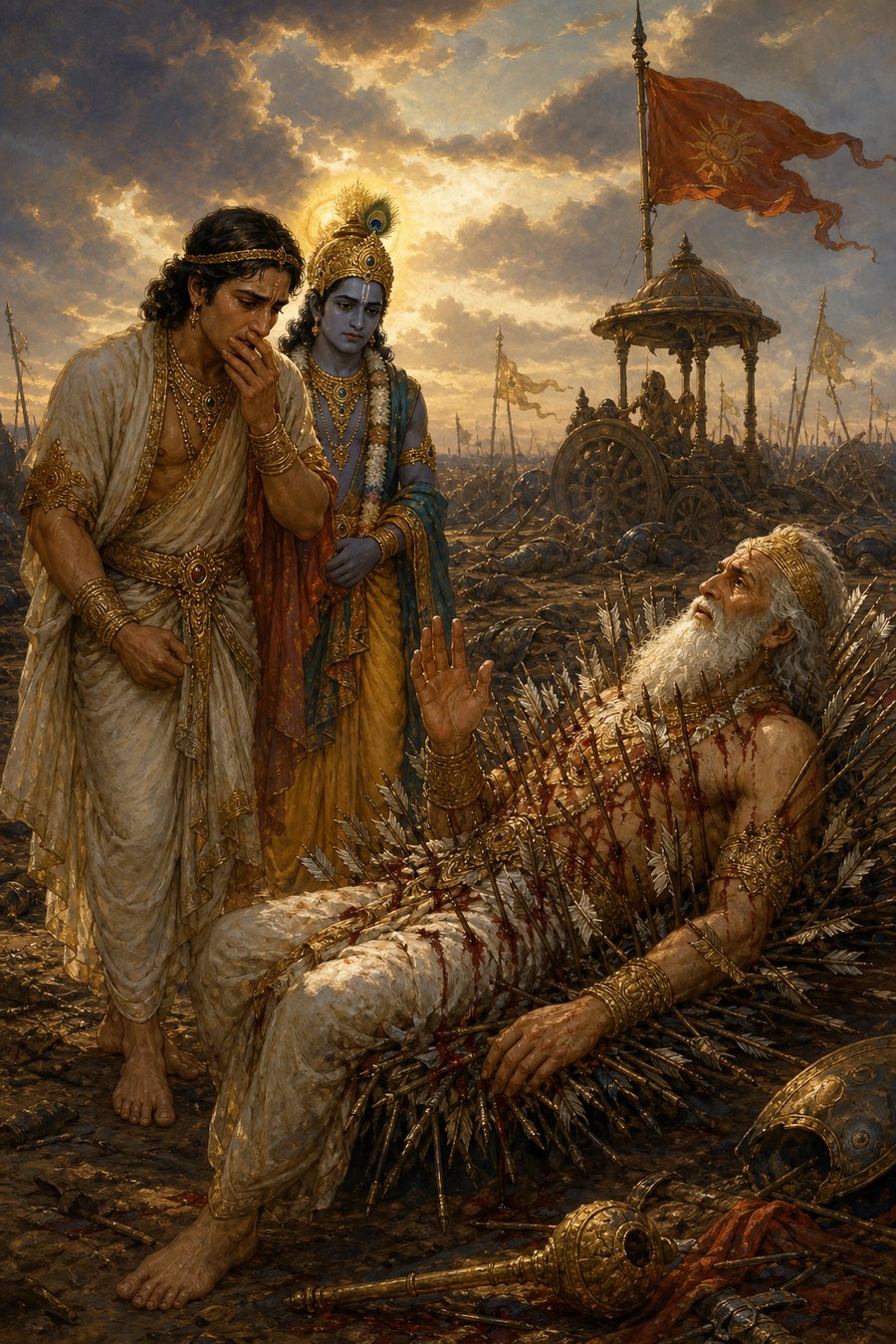
Yudhishthira asked what acts lead to heaven, what the great felicity is that comes from them, and what high prosperity may be won by them. Bhishma’s answer was short. The man from whom a person gripped by fear obtains relief, even for a moment, is the most worthy of heaven among us all; that is the plain truth. Be the king of the Kurus cheerfully, he said, win heaven, protect the good, and kill the wicked. Let your friends and all honest men draw their support from you as every creature draws it from the god of the clouds and as birds draw it from a great tree heavy with delicious fruit. Men seek the protection of the man who is dignified, courageous, able to strike, compassionate, master of his senses, affectionate toward all, equitable, and just.
A sub-tale: The flower-seller and the charcoal-maker are the whole of Bhishma’s treasury policy in one pair of figures. The gardener picks his flowers and leaves the plant alive, and so has flowers again next season; the charcoal-maker takes his one gain by burning the tree, and afterward there is nothing. The king who taxes by measure milks prosperity for a lifetime; the king who wrings his people out of greed dries up the spring he drinks from. The cut udder says the same thing: a man who cuts the cow open for milk gets no milk, and the one who handles her gently is never without it.
The gist: Fill the treasury with the sixth part, the fines of offenders, and the lawful imposts on merchants, and never by greed; be the flower-seller and never the charcoal-maker, and take from everyone except the Brahmins when war empties the coffers. A day’s neglect of protection costs a thousand years in hell and a day’s protection earns ten thousand in heaven. Yudhishthira offers to leave for the forest, and Bhishma turns him back with the blessings Pandu and Kunti asked for him and the rule that relieving a frightened man for one moment is the surest road to heaven.
Brahmin and Kshatriya: the choosing of a priest and their mutual dependence
Bhishma said the king should appoint as his priest the man who would protect the good and punish the wicked, and on that he cited the old story of Pururavas, the son of Ila, and Matarishvan, the Wind. Pururavas asked from where the Brahmin had sprung and from where the three other orders, and for what reason the Brahmin had become the first. Matarishvan answered that the Brahmin sprang from the mouth of Brahman, the Kshatriya from his two arms, the Vaishya from his two thighs, and, to wait on those three orders, a fourth, the Shudra, from his feet. Created so, the Brahmin takes birth on earth as the lord of all creatures, and his duty is the keeping of the Vedas and the other scriptures. Then, for ruling the earth, wielding the rod, and protecting all creatures, the second order, the Kshatriya, was created; the Vaishya was created to support the two other orders and himself by cultivation and trade; and Brahman ordained that the Shudra should serve the three orders as a menial. Pururavas asked the god of winds to tell him truly to whom the earth rightly belonged, the Brahmin or the Kshatriya. Everything in the universe, the Wind said, belongs to the Brahmin by his birth and his precedence; those who know morality say so. What the Brahmin eats is his own, the place he lives in is his own, what he gives away is his own; he deserves the veneration of all the other orders, being the first-born and the first in rank. As a woman, in the absence of her husband, accepts his younger brother in his place, so the earth, when the Brahmin refused her, accepted his next-born, the Kshatriya, as her lord. That is the first rule; in times of distress there is an exception to it. If Pururavas wanted to discharge the duties of his order and win the highest place in heaven, he should give all the land he conquered to a Brahmin who was learned and of virtuous conduct, who knew his duties and kept his penances, who was content with the duties of his order and free of any greed for wealth.
The Wind went on. A well-born Brahmin, wise and humble, guides the king in every matter by his own great intelligence; by sound counsel he makes the king prosper, and he points out to the king the duties the king must keep. As long as a wise king who keeps the duties of his order and is free of pride wants to hear the Brahmin’s instruction, so long is he honored and so long does he enjoy fame. The king’s priest therefore has a share in the merit the king acquires. When the king behaves so, all his subjects rely on him and become virtuous in their conduct, attentive to their duties, and free of every fear, and the king obtains a fourth part of the righteous acts his subjects perform in his kingdom under his protection. The gods, men, the ancestors, gandharvas, uragas, and rakshasas all depend on sacrifices for their support, and in a country without a king there can be no sacrifice; the gods and the ancestors live on the offerings made in sacrifice, and sacrifice depends on the king. In summer men want the shade of trees, cool water, and cool breezes; in winter they take comfort from fire, warm clothes, and the sun; the heart of a man may find pleasure in sound, touch, taste, sight, and scent. The man who is afraid finds no pleasure in any of it. So the man who dispels the fears of men earns great merit, and there is no gift in the three worlds as valuable as the gift of life. The king is Indra. The king is Yama. The king is Dharma. The king takes different forms, and the king sustains and supports everything.
Bhishma took the same thread a third time. A king who keeps both religious merit and profit in view, and their considerations are often intricate, should appoint without delay a priest who is learned and intimate with the Vedas and the other scriptures. Kings whose priests are virtuous of soul and skilled in policy, and who have those qualities themselves, prosper in every direction. Both the priest and the king should have qualities worthy of regard and should keep vows and penances; they will then succeed in supporting and enlarging the subjects and the gods, the ancestors and the children. It is laid down that the two should have like hearts and be each other’s friends, because the subjects are happy through that friendship between Brahmin and Kshatriya, and if the two do not regard each other, destruction overtakes the people. The Brahmin and the Kshatriya are said to be the progenitors of all men. On this there is the old story of the discourse between Ila’s son and Kashyapa. Aila asked: when the Brahmin forsakes the Kshatriya, or the Kshatriya forsakes the Brahmin, which of them should be held the superior, and on whom do the other orders then rely to maintain themselves? Kashyapa said that ruin overtakes the Kshatriya’s kingdom when Brahmin and Kshatriya contend with each other. Robbers infest a kingdom where that confusion prevails, and all good men regard its ruler as a mlechchha. The oxen there do not thrive, and neither do the children; the milk pots are not churned, and no sacrifices are performed. The children do not study the Vedas in kingdoms where the Brahmins abandon the Kshatriyas; wealth does not increase in their houses; their children do not turn out good or study the scriptures or sacrifice; and Kshatriyas who abandon Brahmins become impure in blood and take on the nature of robbers. The Brahmin and the Kshatriya are joined to each other by nature, and each protects the other. The Kshatriya is the cause of the Brahmin’s growth and the Brahmin the cause of the Kshatriya’s; when each helps the other, both come to great prosperity, and if their friendship, which has existed from the old days, breaks, confusion settles over everything, and no one wanting to cross the ocean of life succeeds, any more than a small boat on the bosom of the sea. The four orders are confounded and destruction overtakes all. If the Brahmin, who is like a tree, is protected, gold and honey are showered down; if he is left unprotected, tears and sins are showered. When Brahmins fall away from the Vedas and, with no Kshatriya ruler, seek protection from the scriptures, Indra does not rain in season and calamities of every kind fall on the kingdom without cease. When a sinful wretch who has killed a woman or a Brahmin incurs no reproach in the assemblies of men and has no fear of the king, then danger threatens the Kshatriya ruler. Through the sins of sinful men the god Rudra appears in the kingdom; the sinful by their sins bring that god of vengeance down on them, and he destroys all, the honest and the wicked alike.
Aila asked where Rudra springs from and what his form is, since creatures are seen destroyed by creatures. Kashyapa said that Rudra lives in the hearts of men; he destroys the very bodies he lives in and the bodies of others too, and he is like the visitations of the atmosphere, his form like that of the wind gods. Aila objected that the wind does not visibly destroy men every time it blows, nor the god of the clouds every time he rains, while among men it is seen that they lose their senses and are killed through lust and malice. Kashyapa said that a fire blazing up in one house burns a whole quarter or an entire village, and in the same way this god stupefies the senses of one man, and that stupefaction touches all, the honest and the wicked alike, without distinction. Then Aila put the hard question. If chastisement touches everyone alike, the honest and the wicked, on account of the sins the sinful commit, why should men do good acts at all, and why should they not do wicked ones? Kashyapa answered that a man becomes pure and stainless by avoiding all connection with the sinful; it is because they are mixed with the sinful that the sinless are overtaken by chastisement. Wet wood mixed with dry wood is consumed by the fire because of that coexistence, and so the sinless should never mingle with the sinful. Aila pressed him: the earth holds the honest and the wicked; the sun warms both; the wind blows for both equally; water cleanses both alike. That, Kashyapa said, is the course of this world, and it is not so hereafter. In the other world there is a great difference of condition between the man who acts righteously and the man who acts sinfully. The regions the meritorious win are full of honey and have the splendor of gold, or of a fire on which ghee has been poured; they are likened to the navel of ambrosia, and the meritorious man enjoys great felicity there, and death, decrepitude, and sorrow are not there. The region of the sinful is hell, with darkness and ceaseless pain, full of sorrow, where the man of sinful deeds, sinking in infamy, is wrung with remorse for many years. Because disunion between Brahmins and Kshatriyas brings unbearable grief on the people, a king should appoint a Brahmin priest of experience and wide knowledge, and he should first install the priest in his office and only then cause his own coronation; that is the ordinance. The ordinances declare the Brahmin the first of all creatures, and those who know the Vedas say the Brahmin was created first; by the precedence of his birth everything good in this world is vested in him, and being the rightful owner of all the best things that have flowed from the Creator, he is worthy of the respect and worship of all creatures. A king, however powerful, should bestow on the Brahmin, by the dictates of the scriptures, whatever is best and distinguished above the rest. The Brahmin contributes to the greatness of the Kshatriya and the Kshatriya to the greatness of the Brahmin, and so Brahmins should be worshiped by kings, especially and always.
A key to reading this (concept): The mutual dependence of Brahmin and Kshatriya is one of the longest threads in the law of kings: the power of penance and mantra lives in the Brahmin, the power of arms in the Kshatriya, and used apart neither can hold the world up. The text has already given the images for it, in Manu’s verse on fire and water, the Kshatriya and the Brahmin, iron and stone: each of the three is irresistible until it strikes its own source, and then its force is stilled. The Rudra exchange adds the darker corollary, that when the two orders fall out, the punishment that follows makes no distinction between the guilty and the innocent.
The gist: The king appoints his priest first and is crowned after. Matarishvan tells Pururavas that the earth belongs to the Brahmin by birth and passed to the Kshatriya as a widow passes to her husband’s younger brother, and that the king is Indra, Yama, and Dharma because he takes away fear. Kashyapa tells Aila that when Brahmin and Kshatriya quarrel the kingdom rots, that Rudra lives in men’s hearts and burns the innocent with the guilty like wet wood with dry, and that the difference between the good and the wicked is settled hereafter, in regions of honey and gold or in hell.
Muchukunda and Kubera: a kingdom of one’s own arm against one given by a boon
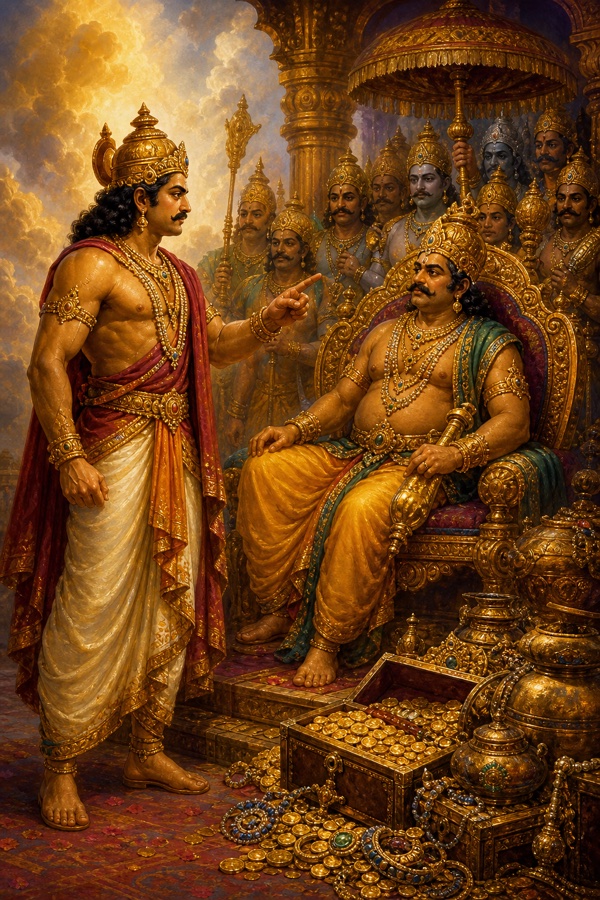
Bhishma said that the preservation and growth of a kingdom rest on the king, and the preservation and growth of the king rest on the king’s priest. That kingdom enjoys true felicity where the unseen fears of the subjects are dispelled by the Brahmin and all their visible fears by the king with the might of his arms. On this there is the old story of the discourse between King Muchukunda and Vaishravana, who is Kubera. Muchukunda had subjugated the whole earth, and he went up to the lord of Alaka to test his strength. King Vaishravana created by ascetic power a large force of rakshasas, and they ground down the forces Muchukunda led. Seeing the slaughter of his army, Muchukunda turned on his own learned priest, Vasishtha, and rebuked him. Then Vasishtha, the first of righteous men, underwent very severe penances, had those rakshasas killed, and made certain of the course Muchukunda was bent on. While his troops were being slaughtered, Vaishravana showed himself to Muchukunda.
Many kings of old, the lord of treasures said, more powerful than Muchukunda, with their priests to aid them, had never approached him like this. All of them were skilled in weapons and all of them were mighty, and they came to him to offer worship, regarding him as the one who grants weal and woe. “If you have might of arms, then show it. Why do you act so proudly, leaning on the might of Brahmins?” Muchukunda was angered, and he answered without pride and without fear, and what he said was reasoned and just. The self-born Brahman created the Brahmin and the Kshatriya; they have one origin. If they applied their forces separately they could never hold up the world. The power of penance and mantra was given to the Brahmins, and the might of arms and weapons to the Kshatriyas; made great by both kinds of might, kings should protect their subjects. “I am acting that way. Why then, lord of Alaka, do you rebuke me?”
Vaishravana then said to Muchukunda and his priest that he never, without the order of the self-created, bestowed sovereignty on anyone, and never, without being ordered, took it away from anyone; the king should know that, and rule the whole earth without bounds. And Muchukunda answered that he did not want to enjoy a sovereignty received as a gift from Kubera; he wanted to enjoy the sovereignty won by the might of his own arms. At those words Vaishravana, seeing the king fearless in keeping the Kshatriya’s duties, was filled with surprise, and Muchukunda, devoted to those duties, went on ruling the whole earth he had won by the might of his own arms. The virtuous king who rules his kingdom aided by the Brahmin and yielding him precedence, Bhishma said, succeeds in subjugating the whole earth and winning great fame. The Brahmin should perform his religious rites every day and the Kshatriya should always be armed, and between them the two are the rightful owners of everything in the universe.
The gist: Kubera grinds Muchukunda’s army with rakshasas, Vasishtha’s penance destroys them, and when Kubera mocks the king for leaning on Brahmin power, Muchukunda answers that Brahman made the two orders from one source and that a king protects with both kinds of might. Offered the earth as a gift, he refuses it and keeps only what his own arm won. Self-reliant valor and precedence for the Brahmin, the two together, are the lesson.
The king of Kekaya and the rakshasa: the armor of a righteous realm
Yudhishthira asked whose wealth the king is held to be lord of, and what conduct he should adopt. The Vedas declare, Bhishma said, that the king is lord of the wealth of everyone except the Brahmins, and of the wealth of those Brahmins too who do not keep their proper duties. Brahmins who are learned and beneficent and look on all creatures with an equal eye are held equal to Brahma; those who know the Rig, the Yajus, and the Sama verses and keep the practices of their order are equal to the gods; those who are not well born, who neglect the duties of their order, and are given to evil practices are like Shudras. A virtuous king should take tribute from Brahmins who have no Vedic learning and no fires of their own, and impress them without pay into the public service. Those who summon people in courts of justice, those who worship for others for a fee, those who perform the sacrifices of Vaishyas and Shudras, those who officiate for a whole village, and those who make voyages on the ocean, these five are counted the chandalas among Brahmins. Those among them who become ritviks, priests, counselors, envoys, and messengers are equal to Kshatriyas; those who ride horses or elephants or chariots or serve as foot soldiers are equal to Vaishyas; and if the treasury is not full, the king may take tribute from these, excluding always the Brahmins whose conduct makes them equal to the gods or to Brahma. The king should never be indifferent to Brahmins who do not keep their duties; for the sake of making his people virtuous he should punish them and separate them from their betters. The king in whose territory a Brahmin becomes a thief is held by the learned to be the author of that misdeed; the king becomes sinful on that account, and kings in that case count themselves worthy of reproach. If a Brahmin learned in the Vedas and keeping his vows turns thief for want of a living, it is the king’s duty to provide for his support, and if after that provision he does not stop stealing, he should be banished from the kingdom with all his kinsmen. That is why all righteous kings provide the Brahmins with the means of support, and on this Bhishma told the old story of what the king of the Kekayas said to a rakshasa who was carrying him off. The king of the Kekayas kept rigid vows and knew the Vedas, and while he was living in the woods a rakshasa seized him by force.
The king spoke to the thing that held him, and every sentence ended in the same question. There is no thief in my territories, he said, no man of wicked conduct, no one who drinks alcohol. There is no one in my dominions who does not keep his sacred fire and perform sacrifices. How then have you been able to possess my heart? There is no Brahmin in my dominions without learning, or without vows, or who has not drunk the soma. No sacrifice in my dominions has been left without its dakshina. No one studies the Vedas who does not keep vows. How then have you been able to possess my soul? The Brahmins in my kingdom teach and study, sacrifice and officiate, give and receive; they keep all six of those acts; they are devoted to the duties of their order, worshiped and provided for, mild and truthful in speech. The Kshatriyas in my kingdom are all devoted to the duties of their order: they give and never beg; they know truth and virtue; they study and never teach; they perform sacrifices and never officiate at another man’s; they protect the Brahmins and never run from battle. The Vaishyas keep the duties of their order; with simplicity and without deceit they live by farming, cattle-keeping, and trade, heedful, keeping the rites and excellent vows, truthful in speech, giving guests their due, self-restrained, pure, and attached to their relatives and kinsmen. The Shudras humbly and duly serve the other three orders without malice toward them. I support the helpless and the old, the weak, the ill, and women without guardians, with everything they need. I never destroy the special customs of families and countries that have come down from the old days. The ascetics in my kingdom are protected and worshiped, always honored and fed. I never eat without feeding others from my dishes. I never go to other men’s wives. I never amuse myself alone. No one who is not a brahmacharin begs his food, no mendicant wants to become a student, and no one who is not a ritvik pours ghee on the sacrificial fire. I never disregard the learned or the old or those engaged in penances. When the whole population sleeps, I stay awake to watch and protect. My priest knows the self; he is given to penances and versed in every duty, a man of great intelligence who has the fullest power over my kingdom. By gifts I seek knowledge, by truth and the protection of Brahmins I seek the regions of the blessed, by service I bind myself to my teachers, and I have no fear of rakshasas. In my kingdom there are no widows, no wicked Brahmins, no Brahmin fallen from his duties, no deceiver, no thief, no Brahmin officiating for people he should never officiate for, and no doer of sinful deeds. There is no space on my body, not two fingers’ breadth, that does not carry the scar of a weapon, and I always fight for the sake of righteousness. The people of my kingdom always call down blessings on me, that I may always be able to protect cows and Brahmins and perform sacrifices. How then have you been able to possess me?
The rakshasa answered that since the king kept his duties in every circumstance, he should go back to his own house; the rakshasa blessed him and let him go. Those who protect cows and Brahmins and all their subjects have nothing to fear from rakshasas, and much less from sinful men; those kings who give the lead to Brahmins, whose might depends on the might of the Brahmins, and whose subjects keep the duties of hospitality, always win heaven. So protect the Brahmins, Bhishma told Yudhishthira; protected by you, they will protect you in return, and their blessings will surely descend on a king of righteous conduct. For the sake of righteousness, the Brahmins who do not keep the duties of their order should be chastised and set apart from their betters. A king who conducts himself so toward the people of his city and his provinces wins prosperity here and a home in heaven with Indra.
A sub-tale: The king of the Kekayas’ speech to the rakshasa is the armor of a righteous realm recited aloud. His whole defense is an inventory: every class firm in its duty, no sacrifice left without its fee, the helpless fed, the old customs unbroken, a priest with full power, and his own body without two fingers of unscarred skin. The rakshasa, finding nothing to hold, lets him go. What guards a king, the tale says, is a realm ruled well enough that there is no purchase on it.
The gist: The king is lord of all wealth except the Brahmins’, and of the wealth of Brahmins fallen from their duties; five kinds of Brahmin are chandalas among their own, and a Brahmin driven to theft by want is the king’s failure to feed him. The king of the Kekayas, seized by a rakshasa, recites the order of his realm and his own wounds, and the rakshasa releases him; good rule and the protection of Brahmins are the armor no rakshasa can pierce.
The law of distress: the Brahmin’s livelihood, and when the Kshatriya is unable
Yudhishthira asked whether a Brahmin, who in a time of distress may support himself by the practices of a Kshatriya, may ever support himself by the duties laid down for Vaishyas. Bhishma said that when a Brahmin loses his means of support and falls into distress, he may certainly take up the practices of a Vaishya and live by farming and keeping cattle, if he is not competent for the Kshatriya’s duties. Then what, Yudhishthira asked, may he sell without losing his prospect of heaven? Wine, salt, sesame seeds, animals with manes, bulls, honey, meat, and cooked food, Bhishma said, a Brahmin should avoid in every circumstance; by selling them he would sink into hell. By selling a goat he incurs the sin of selling the god of fire; by selling a sheep, the sin of selling the god of water; by selling a horse, the sin of selling the god of the sun; by selling cooked food, the sin of selling land; and by selling a cow, the sin of selling sacrifice and the soma. The good do not applaud buying uncooked food with cooked food, though uncooked food may be given to procure cooked; in a compact that says, “We will eat this cooked food of yours, and you may cook these raw things we give in exchange,” there is no sin. And there is an eternal practice, from the old days, of men who follow approved usage: “I give you this; give me this other thing in return.” Exchange by that agreement is righteous. To take things by force is sinful. That is the usage the rishis and others have followed, and there is no doubt it is righteous.
Then Yudhishthira put a harder case. When all the orders give up their own duties and take up arms against the king, and the king’s power falls off, by what means does the king become the protector and refuge of the people? Bhishma said that on such occasions all the orders, led by the Brahmins, should seek their own good by gifts, penances, sacrifices, peacefulness, and self-restraint. Those among them who have Vedic strength should rise on every side and, like the gods strengthening Indra, add to the king’s strength by the Vedic rites. The Brahmins are said to be the king’s refuge while his power decays, and a wise king seeks to build his power up again by the power of the Brahmins. When the king, crowned with victory, seeks to establish peace again, all the orders go back to their own duties. And when robbers break through every restraint and spread devastation, all the orders may take up arms, and in doing so they incur no sin.
Yudhishthira asked what would happen if all the Kshatriyas turned hostile to the Brahmins: who would protect the Brahmins and their Vedas then, what would the Brahmins’ duty be, and who would be their refuge? By penances, Bhishma said, by celibacy, by weapons, and by physical might, applied with deceit or without it, the Kshatriyas should be subjugated. If the Kshatriya misconducts himself, above all toward Brahmins, the Vedas themselves will subjugate him. The Kshatriyas sprang from the Brahmins. Fire sprang from water, the Kshatriya from the Brahmin, and iron from stone; the energy of fire, of the Kshatriya, and of iron is irresistible, and when each meets the source it came from, its force is stilled. When iron strikes stone, when fire fights water, when the Kshatriya turns hostile to the Brahmin, the strength of each of the three is destroyed; so the energy and might of Kshatriyas, however great, is quelled the moment it is turned against Brahmins. When the energy of the Brahmins grows mild and the Kshatriya’s grows weak, and all men misbehave toward the Brahmins, then those who go into battle casting off all fear of death, for the protection of the Brahmins, of morality, and of themselves, moved by righteous indignation and strong in mind, win high regions of bliss hereafter. All men should take up arms for the sake of the Brahmins; the brave who fight for them reach the blessed regions reserved for those who have studied the Vedas with attention, done the severest penances, and cast their bodies into blazing fires after fasting. The Brahmin who takes up arms for the three orders incurs no sin. People say there is no higher duty than laying down life in such a case; Bhishma bowed to those who lay down their lives to chastise the enemies of Brahmins, and wished to reach the region meant for them, which Manu has said is the region of Brahman. As men are cleansed of every sin by the final bath of a horse sacrifice, so those who die at the edge of weapons fighting wicked men are cleansed of theirs. Righteousness becomes unrighteousness, and unrighteousness righteousness, according to place and time; such is the power of place and time in fixing the character of what men do. The friends of humanity have reached high heaven by doing even acts of cruelty, and righteous Kshatriyas have come to blessed ends by doing even sinful acts. And on three occasions a Brahmin incurs no sin by taking up arms: to protect himself, to compel the other orders back to their duties, and to chastise robbers.
Yudhishthira’s last question in this line was the sharpest. When robbers raise their heads and the orders begin to mix in the confusion, and the Kshatriyas prove incompetent, if some powerful man who is no Kshatriya, a Brahmin or a Vaishya or a Shudra, sets out to subdue the robbers for the people’s sake, and succeeds in protecting the people by wielding the rod righteously, is he justified, or do the ordinances forbid him? When the Kshatriyas fall so low, it seemed to Yudhishthira that others should take up weapons. Bhishma answered without hedging. Whether he is a Shudra or a member of any other order, the man who becomes a raft on a raftless current, or a means of crossing where there is none, deserves respect in every way. The man on whom the helpless rely, oppressed and made miserable by robbers, so that they live happily, deserves to be lovingly worshiped by all as if he were a near kinsman. The man who dispels the fears of others always deserves respect. What use is there in bulls that will not bear burdens, or cows that will not give milk, or a barren wife? And what need is there of a king who cannot grant protection? Like an elephant made of wood, or a deer made of leather, like a man without wealth, or a eunuch, or a sterile field, so is a Brahmin without Vedic learning and a king unable to protect; both are like a cloud that does not rain. The man who always protects the good and restrains the wicked deserves to become a king and to govern the world.
A key to reading this (the law of distress): Apad-dharma is the loosening of the ordinary rules in a time of crisis, and here the Mahabharata’s realism is at full stretch. In ordinary times the text binds each order to its livelihood; in distress it lets the Brahmin farm and trade, with a short list of things he may never sell, lets every order take up arms when robbers break loose, and lets a Shudra who protects the people be honored as a king. The sentence that licenses all of it is Bhishma’s own: righteousness becomes unrighteousness, and unrighteousness righteousness, according to place and time.
The gist: In distress a Brahmin may live as a Vaishya, though never by selling wine, salt, sesame, maned animals, bulls, honey, meat, or cooked food. When the orders rise against a failing king, the Brahmins rebuild his strength by Vedic rites; when robbers break every bound, all the orders may take up arms; when Kshatriyas turn on Brahmins, the Vedas themselves bring them down; and when the Kshatriyas fail, whoever becomes a raft on a raftless current is fit to rule.
The qualities of a priest, the truth of the sacrificial fee, and penance above sacrifice
Yudhishthira asked what the acts and conduct of the men employed as priests in their sacrifices should be, and what sort of men they should be. Bhishma said it is laid down that the Brahmins eligible as priests should know the chhandas, the Samans included, and all the rites the shrutis teach, and should be able to perform every religious act that leads to the king’s prosperity. They should be devotedly loyal and speak agreeably when they address kings. They should be friendly toward one another and cast an equal eye on all. They should be free of cruelty and truthful in speech, never usurers, and always simple and sincere. The man who is peaceful in temper, free of vanity, modest, charitable, self-restrained, and contented, intelligent, truthful, keeping his vows, harmless to every creature, without lust and malice, endowed with the three excellent qualities, free of envy, and possessed of knowledge, deserves the seat of Brahma himself; men with such qualities are the best of priests and deserve every respect.
Then Yudhishthira raised a subtle doubt. There are Vedic texts about the gift of the dakshina, the fee, in sacrifices, and no ordinance that says how much should be given; the ordinance about the fee did not come from any motive connected with the distribution of wealth. Its command, because of the provision it makes for cases of incapacity, is terrible; it is blind to the competence of the sacrificer. The Veda says a man should sacrifice with devotion, and what can devotion do when the sacrificer is stained by falsehood? No man, Bhishma answered, wins blessedness or merit by disregarding the Vedas or by deceit or falsehood; Yudhishthira should never think otherwise. The dakshina is one of the limbs of the sacrifice and feeds the Vedas, and a sacrifice without a dakshina can never lead to salvation. The efficacy of a single purnapatra, though, is equal to that of any dakshina however rich, and so everyone of the three orders should perform sacrifices. The Vedas have settled that soma is as the king himself to the Brahmins; yet they are willing to sell it for the sake of performing sacrifices, though never to sell it for a living, and rishis of righteous conduct have declared, in keeping with morality, that a sacrifice performed with the proceeds of selling soma serves to extend sacrifices. These three, the sacrificer, the sacrifice, and the soma, must all be of good character; a man of bad character belongs neither to this world nor to the other. And it has been heard that the sacrifice that great Brahmins perform with wealth earned by excessive physical labor produces no great merit.
At the last Bhishma gave a high word. There is a declaration in the Vedas that penances are higher than sacrifices, and he told Yudhishthira what penance is. Abstention from injury, truthfulness of speech, benevolence, and compassion: these are what the wise regard as penances, and never the emaciation of the body. Disregard of the Vedas, disobedience to the dictates of the scriptures, and the violation of every wholesome restraint lead to self-destruction. Then he gave what has been laid down by those who pour ten libations on the fire at ten times of the day. For those who perform the sacrifice of penance, the yoga they strive to effect with Brahman is their ladle, the heart is their ghee, and high knowledge is their pavitra, the strainer. Every kind of crookedness means death, and every kind of sincerity is called Brahman. That is the subject of knowledge, and the rhapsodies of system-builders cannot touch it.
A key to reading this (philosophical): “Penances are higher than sacrifices,” and then the definition, “abstention from injury, truthfulness, benevolence, compassion, and never the emaciation of the body,” lifts Bhishma’s law of kings off the altar and sets it on moral ground. The outer rite and its fee keep their value, and a single full vessel is declared equal to any fee; the inner sacrifice has the yoga with Brahman for its ladle and the heart for its ghee. “Every kind of crookedness means death, and every kind of sincerity is called Brahman” is the line the whole section comes to rest on.
The gist: A priest should know the chhandas and the rites, love his king, speak agreeably, and be truthful, simple, and free of usury; the best of them deserve the seat of Brahma. The fee is a limb of the sacrifice, and a single full vessel counts for any fee. Above sacrifice stands penance, which is harmlessness, truth, benevolence, and compassion, and never the wasting of the body.
Ministers, trust, and the dharma of one’s own kin: the talk of Vasudeva and Narada
Yudhishthira observed that the most trifling act cannot be done by any man unaided, let alone the governing of a kingdom, and he asked what the conduct and acts of the king’s minister should be, and whom the king should trust and whom he should not. Kings, Bhishma said, have four kinds of friends: the one who has the same object, the one who is devoted, the one related by birth, and the one won over by gifts and kindness. A fifth is the man of righteous soul who serves one side only, and never both; he takes the side where righteousness is, and acts accordingly, and to such a man the king should never disclose purposes that would not win his sympathy, since kings who want success are obliged to walk both paths, the righteous and the unrighteous. Of the four kinds of friends, the second and the third are the better, and the first and the fourth should always be regarded with suspicion; and in view of the acts a king must do in person, he should regard all four with suspicion. A king should never be careless in watching his friends, for a careless king is always overpowered. A wicked man puts on the garb of honesty, and an honest man becomes otherwise; an enemy may become a friend and a friend an enemy; a man cannot always be of the same mind, so who would trust him completely? All the chief acts of a king he should accomplish in his own presence. Complete reliance on his ministers destroys both morality and profit; a want of trust in everyone is worse than death; trustfulness is premature death, and a man incurs danger by truthfulness. If a man trusts another completely, he is said to live at the mercy of the man he trusts. So everyone should be trusted and also mistrusted; that is the eternal rule of policy. One should always mistrust the man who would gain one’s wealth by one’s wishing it, whom the wise call an enemy. The man whose joy knows no bounds at the king’s rise and who feels miserable at the king’s decay shows the marks of one of the king’s best friends. The one whose fall would be brought about by the king’s own fall should be trusted completely, as a man trusts his father, and enlarged to the best of the king’s power as the king enlarges himself; the one who seeks to rescue the king from harm even in his religious rites will seek to rescue him in every other business, and is his best friend. Those who wish him harm are his enemies. That friend is like the king’s own self who feels fear when calamity comes to him and joy when prosperity shines on him. Beauty, fair complexion, an excellent voice, liberality, benevolence, and good birth cannot make such a friend. The man who has intelligence and memory, who is clever in business, naturally averse to cruelty, never given to anger, and never dissatisfied whether he is regarded or disregarded, whether he is the king’s priest or teacher or honored friend, should always receive the king’s worship if he accepts the office of counselor and lives in the king’s house; such a man may be told the king’s most secret counsels and the true state of all his affairs, religious or profitable, and the king may confide in him as in his own father. One man should be set to one task, and never two or three, for they may not tolerate each other; it is always seen that several men set to one task disagree. The man who has won fame, who keeps every restraint, who never envies the able and competent, who never does an evil act, who never abandons righteousness from lust or fear or greed or anger, who is clever in business and wise and weighty in speech, should be the king’s chief minister; men of good birth and good conduct, liberal, never given to bragging, brave and respectable, learned and full of resources, should be appointed to supervise all the king’s affairs, and honored and rewarded with wealth they will act for his good and be of great help, bringing prosperity in offices connected with profit, and discharging their duties in healthy rivalry, consulting one another when they need to.
Bhishma warned that a king should fear his kinsmen as he fears death. A kinsman can never bear a kinsman’s prosperity, just as a feudatory chief cannot bear to see the prosperity of his overlord; no one but a kinsman can feel joy at the destruction of a kinsman adorned with sincerity, mildness, liberality, modesty, and truthfulness. Yet those who have no kinsmen cannot be happy either; no men are more contemptible than the kinless, and a man without kinsmen is easily overridden by his enemies. Kinsmen are the refuge of a man harried by others, for kinsmen can never bear to see a kinsman harried, and when a kinsman is persecuted even by his friends, every kinsman feels the injury as done to himself. So there are both merits and faults in kinsmen; the man without them shows favor to no one and humbles himself to no one. For that reason a man should always honor and worship his kinsmen in words and acts and do them agreeable offices without ever injuring them, and, mistrusting them in his heart, behave toward them as if he trusted them completely; reflecting on their nature, they seem to have neither faults nor merits. The man who conducts himself carefully in this way finds his very enemies disarmed of hostility and turned into friends, and the man who bears himself so among kinsmen and relatives, friends and enemies, wins everlasting fame.
Yudhishthira asked what a man should do when this course fails to win over his kinsmen and relatives, and those who were meant to be friends become enemies; how should he conduct himself so that the hearts of both friends and enemies are won? Bhishma answered with the old story of a discourse between Vasudeva and the celestial sage Narada. On a certain occasion Krishna said to him that neither an illiterate and foolish friend nor a learned friend of fickle soul deserved to know a man’s secret counsels, and that, relying on Narada’s friendship, he would say something to him, because a man should speak to another only when he is convinced of the other’s intelligence. “I never behave with slavish obsequiousness toward my kinsmen, flattering them about their prosperity. I give them half of what I have, and I forgive their evil speeches. As a fire-stick is ground by a man who wants fire, so my heart is ground by my kinsmen with their cruel speeches; those speeches burn my heart every day. Might lives in Sankarshana, mildness in Gada, and in beauty of person Pradyumna surpasses even me, and with all of that on my side I am helpless, Narada. Many others among the Andhakas and the Vrishnis have great prosperity and might, courage and constant perseverance; the man they do not side with meets destruction, and the man they side with achieves everything. Dissuaded in turn by both Ahuka and Akrura, I side with neither. What is more painful for a man than to have both Ahuka and Akrura on his side, and what is more painful than to have neither? I am like the mother of two brothers gambling against each other, praying for the victory of both. Tell me what is for the good of me and of my kinsmen alike.”
Narada said that calamities are of two kinds, external and internal, and they arise from one’s own acts or from the acts of others; the calamity that had overtaken Krishna was an internal one, born of his own acts. Baladeva and others of the Bhoja race were partisans of Akrura, and had taken his side for the sake of wealth, or out of caprice, or moved by words or by hate. As for Krishna himself, he had given away the wealth he had won to another; possessed of men who should have been his friends, he had brought the calamity on his own head by his own act. He could not take that wealth back, any more than a man can swallow again the food he has vomited; the kingdom could not be taken back from Babhru and Ugrasena, to whom it had been given, and Krishna in particular could not take it back, for fear of producing civil strife. Even if the attempt succeeded, it would succeed only after much trouble and the most difficult feats, with a great slaughter and a great loss of wealth, perhaps total destruction. So he should use a weapon that is not made of steel, very mild and still able to pierce every heart, and sharpening and resharpening it, correct the tongues of his kinsmen. Krishna asked what that weapon was, mild, made of no steel, piercing all hearts, that he must use to correct his kinsmen’s tongues. The giving of food to the best of one’s power, Narada said, forgiveness, sincerity, mildness, and honor to whom honor is due: these are the weapon that is not made of steel. With soft words alone he should turn away the anger of the kinsmen who uttered cruel speeches, and soften their hearts and minds and slanderous tongues. No one who is not a great man with a cleansed soul and accomplishments and friends can bear a heavy burden; Krishna should take up the great weight of governing the Vrishnis and carry it on his shoulders. All oxen can bear heavy burdens on a level road, and only the stronger among them on a difficult road. From disunion destruction would spring and overtake all the Bhojas and the Vrishnis; Krishna was the first among them, and he should act so that the Bhojas and the Vrishnis did not meet destruction. Intelligence and forgiveness, restraint of the senses, and liberality are what a man of wisdom has; advancing one’s own race is always praiseworthy and glorious and leads to long life. There was nothing unknown to Krishna in policy or in the art of war. The Yadavas, the Kukuras, the Bhojas, the Andhakas, and the Vrishnis all depended on him, as all the worlds and their regents did; the rishis always prayed for his advancement; he was the lord of all creatures, knew past, present, and future, and was the first of all the Yadavas, and relying on him they expected to live in happiness.
That, Bhishma said, was the first means, and he gave Yudhishthira the second. The man who seeks to advance the interests of the king should always be protected by the king. If any man, paid or unpaid, comes to tell the king that his treasury is being damaged and its resources embezzled by a minister, the king should give him a hearing in private and protect him from the minister he has accused, because ministers who have robbed the treasury seek to kill such informers; those who plunder the royal treasury combine against the man who tries to protect it, and if he is left unprotected, he is sure to be ruined.
A sub-tale: The weapon that is not made of steel is Narada’s figure, and it is an unusual one. Krishna, tormented by the cruel tongues of his own Vrishni kin and pulled between the factions of Ahuka and Akrura, is told that the wound was made by his own act, the giving away of the kingdom to Babhru and Ugrasena, and that the only weapon left to him is a soft one: food given to the best of his power, forgiveness, sincerity, mildness, and honor where honor is due, which pierces every heart and draws no blood. It is one of the rare places in the law of kings where forbearance and generosity stand in the place of force, and where Krishna himself openly admits to being helpless.
The gist: The king has four kinds of friends and a righteous fifth; the devoted and the kin are the better two, and even they are suspect in the acts he must do himself, because full trust is early death and full distrust is worse than death. Kin cannot bear one another’s prosperity, and a man without kin is trampled, so honor them outwardly and mistrust them within. Narada gives Krishna the weapon made of no steel, and Bhishma adds the rule that the man who exposes an embezzling minister must be heard in private and guarded.
Kalakavrikshiya and Kshemadarshin: the caged crow and the corrupt officials
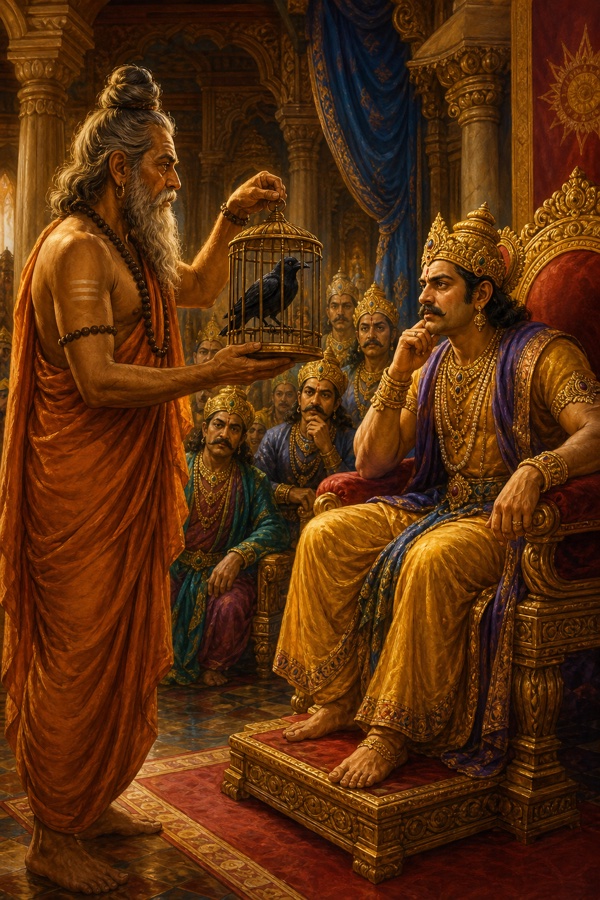
On this Bhishma told the old story of what the sage Kalakavrikshiya said to the king of Kosala. It has been heard, he said, that the sage once came to Kshemadarshin, who had ascended the throne of the kingdom of Kosala. Wanting to examine the conduct of all of Kshemadarshin’s officers, the sage traveled again and again through every part of the king’s dominions with a crow in a cage in his hand, and to everyone he met he said, “Study the science of crows. The crows tell me the present, the past, and the future.” Proclaiming this through the kingdom, and with a large number of people following him, he began to observe the misdeeds of all the king’s officers, and when he had learned the affairs of the whole kingdom and found that every officer the king had appointed was guilty of corrupt dealing, he came with his crow to see the king. Strict in his vows, he told the king that he knew everything. Then, in the king’s presence, he addressed the minister who wore the insignia of his office and said that his crow had informed him that the minister had done such a misdeed in such a place, and that such and such persons knew he had plundered the royal treasury. “My crow tells me this. Admit it, or prove the accusation false, quickly.” Then he proclaimed the names of other officers who had been guilty of embezzlement in the same way, adding, “My crow never says anything that is false.”
Accused and shamed in open court, the king’s officers joined together, and while the sage slept that night they pierced his crow with an arrow. In the morning he found the bird lying dead in its cage with the shaft through it. He did not run. He went to Kshemadarshin, asked for the king’s protection, said that he had come as a friend to wake him the way a driver urges on a good horse, and asked leave to say what was for the king’s good. The king gave it. He was not blind to his own good, he said, and whatever the sage told him, he would hear and obey.
Then the sage spoke, and he began with the words of Yama. The lot of those who serve a king is very painful and wretched; whoever has any connection with kings has a connection with snakes of virulent poison. Kings have many friends and many enemies, and those who serve them have to fear all of them, and every moment they have to fear the king himself. A man should sit in the presence of the king as he would sit before a blazing fire, ready to lay down his life at every moment, because the king is master of the lives and wealth of all; pleased, he can shower prosperity like a god, and enraged, he can burn a man to the roots. That was said by Yama, the sage told the king, and its truth is seen in the affairs of the world. From there he turned to the kingdom itself, and to the ministers the king had reared.
A sub-tale: The caged crow is a device for exposing corruption without exposing the informer. Kalakavrikshiya keeps his own name out of the accusations and lets a fortune-telling bird name the embezzlers one by one, in open court, so that the blame lands on the crow and the sage stays clear. The officers kill the crow in the night anyway, which is the tale’s second lesson: an informer’s life is always in danger. It is the story-form of the rule Bhishma has just given, that the man who reports an embezzling minister must be heard in private and protected.
The gist: The sage Kalakavrikshiya walks Kosala with a crow that “knows past, present, and future,” learns every official’s theft, and names the thieves to their faces in King Kshemadarshin’s court; the officials shoot the crow while he sleeps. In the morning he tells the king Yama’s word on the service of kings, that to be near one is to be near a venomous snake, calls the ministers parasite grass on a great tree, and the king takes him into his palace.
Lying on his bed of arrows, resting on the points of the shafts, Bhishma held his life back, and Yudhishthira went on setting question after question. The grandsire’s speech did not stop, as if he meant to pour the whole law of kings, gathered over a lifetime, into Yudhishthira’s heart in these last days. The story running was that of the king of Kosala and the sage Kalakavrikshiya, whose crow had been shot in the night and who had come to the king in the morning to warn him against the deceit of his own servants. Bhishma finished that story first, and then opened out the whole range of ministers, forts, treasury, the protection of the people, righteous war, and policy toward enemies.
The rest of the sage Kalakavrikshiya’s teaching: to serve near a king is to live near a venomous snake
In the morning the sage came to King Kshemadarshin and said, “I seek your protection. You are all-powerful, master of every man’s life and wealth. If you permit it, I will say what is for your good. I count you a friend, and grieving for you, moved by devotion, I have come to serve you with my whole heart. Your wealth is being plundered, and with no regard for the plunderers I have come to tell you so. As a driver urges on a good horse, I have come to rouse you, whom I hold a friend, and a friend who is alive to his own interests and wants his own prosperity should forgive a friend who forces himself on him, moved by devotion and anger, to do him good.” The king answered, “Why should I not bear anything you say, since I am not blind to my own good? You have my permission. Say what you please, and I will surely keep your instructions.”
The sage said, “Having learned the merits and faults of your servants, and the dangers you run at their hands, I have come, moved by devotion, to lay everything before you. The teachers of mankind declared long ago what curses fall on those who serve others. The lot of those who serve a king is most painful and wretched. Whoever has any connection with kings has a connection with snakes of virulent poison. Kings have many friends and many enemies as well, and the servants of a king have to fear them all, and at every moment they have to fear the king himself. A man serving a king cannot be careless in the king’s work with impunity; a servant who wants prosperity should never show heedlessness in his duties, for his heedlessness may move the king to anger, and that anger may bring destruction down on him. Having carefully learned how to behave, a man should sit in the presence of the king as he would sit before a blazing fire. Ready to lay down his life at every moment, he should serve the king attentively, for the king is all-powerful and master of the lives and wealth of all, and so he is like a snake of virulent poison. A man should always fear to speak evil before the king, to sit with a sullen face or in an irreverent posture, to wait disrespectfully, to walk disdainfully, or to make insolent gestures and disrespectful movements of the limbs. If the king is pleased, he can shower prosperity like a god. If he is enraged, he can burn a man to the very roots like a blazing fire. This was said by Yama, and its truth is seen in the affairs of the world. Acting by these precepts, I will now do what will enhance your prosperity; friends like me can give friends like you the aid of their intelligence in a season of peril.”
A key to reading this (the law of kings): The law of kings is the king’s own dharma, the body of duties bound up with statecraft, justice, the rod, the treasury, and the protection of the people, and it differs from the householder’s dharma because thousands of lives rest on the king’s decisions. The Kalakavrikshiya story turns that weight around and shows it from the servant’s side: to stand near the man who holds every life and every fortune is to stand near a fire, and the ministers who feed on him will burn with him when the forest catches.
“This crow of mine was killed doing your business,” the sage went on, “and I cannot blame you for it; you are not loved by the men who killed it. Find out who your friends are and who your enemies. Do everything yourself, without surrendering your judgment to others. Every man on your establishment is robbing you. They do not want the good of your subjects. I have earned their hostility. Conspiring with the servants who have constant access to you, they covet the kingdom after you, by compassing your destruction, and their plans have failed so far only through unforeseen circumstances. Out of fear of those men I will leave this kingdom for some other refuge. I have no worldly desire, and still those men of deceitful intent shot this shaft at my crow and sent the bird to Yama’s house. I have seen it with eyes whose sight penance has sharpened. With the help of this single crow I crossed this kingdom of yours, which is like a river full of alligators and sharks and crocodiles and whales. With the help of that bird I passed through your dominions, which are like a Himalayan valley, impenetrable and inaccessible, choked with the trunks of fallen trees and scattered rocks and thorny shrubs, and with lions and tigers and other beasts of prey.”
“The learned say that a region made inaccessible by darkness can be crossed with a light, and a river that cannot be forded can be crossed by a boat. There is no means, though, for penetrating or passing through the labyrinth of a king’s affairs. Your kingdom is like an inaccessible forest wrapped in gloom. You, who are its master, cannot trust it; how then can I? Good and evil are regarded here in the same light, so residence here cannot be safe. Here a man of righteous deeds meets death, and a man of unrighteous deeds is in no danger. By the requirements of justice a man of unrighteous deeds should be killed, and never one who is righteous in his acts. It is not proper, then, to stay long in this kingdom; a man of sense should leave this country soon. There is a river called Sita, in which boats sink; this kingdom of yours is like that river. An all-destroying net seems to have been cast around it. You are like the fall that waits for gatherers of honey, or like attractive food with poison in it. Your nature now resembles that of dishonest men; you are like a pit full of snakes of virulent poison, like a river of sweet water that is very hard to reach, with steep banks overgrown with karira and thorny canes, like a swan among dogs and vultures and jackals. Grassy parasites, drawing their sustenance from a mighty tree, swell into luxuriant growth, and at last cover the tree itself and overshadow it completely; a forest fire sets in, catches those grassy plants first, and consumes the lordly tree along with them. Your ministers are like those parasites. Check them and correct them. They have been nourished by you, and conspiring against you they are destroying your prosperity.”
“Hiding the faults of your servants from you, I have been living in your house in constant dread of danger, like a man living in a room with a snake in it, or like the lover of a hero’s wife. My object was to learn the behavior of the king I lodged with: whether he has his passions under control, whether his servants obey him and love him, and whether he loves his subjects. For that I came to you. Like food to a hungry man you have become dear to me; your ministers I dislike as a man whose thirst is slaked dislikes drink. They have found fault with me because I seek your good, and there is no other cause for their hostility. I hold no hostile intent toward them; I am busy only with marking their faults. As a man fears a wounded snake, everyone should fear an enemy of wicked heart.” The king said, “Live in my palace. I will always treat you with respect and honor, and always worship you. Those who dislike you will not live with me. Do what should be done next about those men yourself. See that the rod is wielded properly and that everything is done well in my kingdom, and reflecting on everything, guide me so that I may win prosperity.” The sage told him how. Shut your eyes for now to this offense of theirs, the killing of the crow, and weaken them one by one; prove their faults, then strike them one after another, because when many men are guilty of the same offense they can, by acting together, blunt the very points of thorns; proceed with that caution, so that your ministers, suspecting you, do not act against you and disclose your counsels. “As for us, we are Brahmins, compassionate by nature and unwilling to give pain to anyone. We wish your good and the good of others as we wish our own. I speak of myself: I am your friend. I am known as the sage Kalakavrikshiya, and I always keep to truth. Your father regarded me lovingly as his friend. When distress overtook this kingdom in your father’s reign, I abandoned every other business and performed many penances to drive it off. Out of my affection for you I say this, so that you may not again commit the fault of trusting undeserving men. You have obtained a kingdom without trouble; reflect on everything that touches its weal and woe. You have ministers in your kingdom. Why then should you be guilty of heedlessness?” After this the king of Kosala took a minister from the Kshatriya order and appointed the sage Kalakavrikshiya as his priest. With those changes made, the king of Kosala subjugated the whole earth and won great fame. The sage worshiped the gods in many grand sacrifices performed for the king, and the king, having listened to his beneficial counsel, conquered the whole earth and conducted himself in every respect as the sage directed.
The gist: The heart of the Kalakavrikshiya story is that a king should test the honesty of his own courtiers and officers, surrender his judgment to no one, and deal with guilty servants one at a time, weakening each before striking, so that they cannot band together and turn on him. Kshemadarshin takes a Kshatriya minister, makes the sage his priest, and conquers the earth.
What ministers, generals, envoys, and councillors should be
Yudhishthira asked what the marks should be of a king’s legislators, his ministers of war, his courtiers, his generals, and his counselors. Men with modesty, self-restraint, truth, sincerity, and the courage to say what is proper, Bhishma said, should be your legislators. Those who are always at your side, of great courage, of the twice-born order, very learned, pleased with you, and persevering in every act, you should want as your ministers of war in every season of distress. The man of high descent who, treated with honor by you, always exerts his powers to the utmost on your behalf, and who will never abandon you in weal or woe, in illness or in death, you should keep as a courtier. Men of high birth, born in your own kingdom, with wisdom, beauty of form and feature, great learning, and dignity of conduct, and devoted to you besides, should be employed as officers of your army.
Men of low descent and covetous disposition, cruel and shameless, will court you only as long as their hands stay wet, only as long as something keeps coming to them. Men of good birth and good conduct, who can read every sign and gesture, who are free of cruelty, who know what place and time require, and who seek their master’s good in every act, should be appointed by the king as ministers in all his affairs. Those who have been won over with gifts of wealth, honors, respectful receptions, and the means of happiness, and who for that reason may be regarded as inclined to benefit you in all your affairs, should always be made sharers of your happiness. Those who are unchanging in conduct, learned and well behaved, keepers of excellent vows, large-hearted, and truthful in speech will always attend to your affairs and never abandon you; those who are disreputable, who keep no restraints, who are of wicked soul and have fallen from good practices, should always be compelled by you to observe every wholesome restraint. When the question is which of two sides to take, do not abandon the many to take the side of one; when that one man surpasses the many by his many accomplishments, then for that one abandon the many. The marks of superiority are these: prowess, devotion to pursuits that bring fame, and the keeping of wholesome restraints. The man who honors everyone who has ability, who never indulges in rivalry with men of no merit, who never abandons righteousness from lust or fear or anger or greed, who is adorned with humility, truthful in speech and forgiving in temper, master of himself, with a sense of dignity, and who has been tried in every situation, should be employed as your counselor. High descent, purity of blood, forgiveness, cleverness, purity of soul, bravery, gratitude, and truth are the marks of superiority and goodness, and a wise man who conducts himself so disarms his very enemies of their hostility and turns them into friends.
A key to reading this (the guarding of counsel): “Counsel” here means the king’s secret deliberation, his political plans and the talks in which they are made, and the guarding of counsel means keeping those deliberations hidden from the enemy. Bhishma gives it the figure of the tortoise: as the tortoise draws its limbs into its shell, so the ministers should draw their counsels in and hide even their own slips, for counsels are the king’s armor and the limbs of his subjects and officers.
A king who is master of himself, wise, and eager for prosperity should examine the merits and faults of his ministers with care. A king who wants prosperity and wants to shine among his contemporaries should have for ministers men connected with his trusted friends, of high birth and born in his own kingdom, incapable of being corrupted, unstained by adultery and vices like it, well tested, of good families, learned, sprung from fathers and grandfathers who held the same offices, and adorned with humility. The king should employ five such men to look after his affairs, men whose intelligence is unstained by pride, of good disposition, with energy, patience, forgiveness, purity, loyalty, firmness, and courage, whose merits and faults have been well tested, of mature years, able to bear burdens, and free of deceit. Men wise in speech, heroic, full of resources under difficulties, of high birth, truthful, able to read signs, free of cruelty, knowing the requirements of place and time, and desiring their master’s good should be employed as his ministers in all the affairs of the kingdom. A man without energy whom his friends have abandoned can never work with perseverance, and if he is employed he fails in almost every business. A minister of little learning, even with high birth and attention to virtue, profit, and pleasure, is incompetent to choose a course of action; a man of low descent, even with great learning, always errs in acts that need dexterity and foresight, like a blind man without a guide; a man of infirm purpose, with intelligence and learning and knowledge of means, cannot act long with success; and a man of wicked heart and no learning may set his hand to work and never know what its results will be. The number of ministers should be no fewer than three.
A king should never trust a minister who is not devoted to him, and so he should never disclose his counsels to such a man; a wicked minister, combining with the king’s other ministers, may ruin his master the way a fire, with the wind to help it, enters a tree through the holes in its trunk and consumes it from within. Giving way to anger, a master may one day pull a servant down from his office or reprove him harshly in his rage, and restore him to power again; only a servant devoted to his master can bear and forgive that treatment. Ministers too are sometimes deeply offended with their royal masters, and the one among them who subdues his anger out of a wish to do his master good, the one who shares the king’s weal and woe, should be consulted by the king in all his affairs. A man of crooked heart, even if he is devoted to his master, wise, and adorned with many virtues, should never be consulted. One who is allied with enemies and does not regard the interests of the king’s subjects should be known as an enemy, and the king should never consult him. A man of no learning who is impure, stained with pride, who courts the king’s enemies, brags, and is unfriendly, angry, and covetous, should not be consulted. A stranger, even if devoted and very learned, may be honored by the king and given the means of living, and the king should never consult him in his affairs. A man whose father was unjustly banished by royal edict should not be consulted, even if the king has since honored him and given him a livelihood, and neither should a well-wisher whose property was once confiscated for a slight offense, however accomplished he is.
The man who has wisdom, intelligence, and learning, who was born in the kingdom, who is pure and righteous in all his acts, deserves to be consulted by the king. So does the one who has knowledge and wisdom, who knows the dispositions of his friends and his enemies, and who is such a friend to the king as to be his second self. So does the one who is truthful in speech, modest, mild, and a hereditary servant of the king; and the one who is contented and honored, truthful and dignified, who hates wickedness and wicked men, knows policy and the requirements of the moment, and is courageous; and the one who can win over all men by conciliation, if the king wants to rule by the science of the rod; and the one on whom the people of both the capital and the provinces rely for his righteous conduct, who is able to fight and knows the rules of policy. Men with such qualities, who know everyone’s disposition and want to achieve high acts, should be honored by the king and made his ministers. Ministers should be employed in observing the slips of their masters, of themselves, of the subjects, and of their master’s enemies. The kingdom has its root in the counsels of policy that flow from ministers, and its growth comes from the same source. Ministers should act so that the enemies of their master cannot detect his slips, and when the enemy’s slips become visible, they should attack. As the tortoise protects its limbs by drawing them into its shell, ministers should protect their own counsels and hide their own slips the same way; the ministers who succeed in hiding their counsels are the ones called wise. Counsels are the armor of a king and the limbs of his subjects and officers; a kingdom is said to have its roots in spies and secret agents and its strength in counsels of policy. If master and ministers follow each other for mutual support, subduing pride and anger, vanity and envy, both may be happy. A king should also consult with ministers who are free of the five kinds of deceit. Having first learned the separate opinions of the three among them whom he has consulted, the king should go to his preceptor, a Brahmin well versed in every matter of virtue, profit, and pleasure, to lay those opinions and his own before him, and with a collected mind ask his opinion; when a decision has been reached after deliberation with him, the king should carry it out without attachment. Those who know the conclusions of the science of consultation say that kings should always take counsel this way, and that counsels settled this way should then be put into practice, for then the king can win over all his subjects. There should be no dwarfs, no hunchbacks, no one of emaciated constitution, no one lame or blind, no idiot, no woman, and no eunuch at the spot where the king holds his consultations. Nothing should move there, before or behind, above or below, or to the sides. Getting up on a boat, or going to an open space free of grass and grassy bushes from which the surrounding land can be clearly seen, the king should hold his consultations at the proper time, avoiding faults of speech and gesture.
A key to reading this (the seven marks of an envoy): The envoy is the royal representative who carries one king’s message to another, and Bhishma says the king should never kill an envoy in any circumstance; the king who does so sinks into hell with all his ministers, and if the envoy he kills has faithfully delivered the message he was charged with, the sin stains the king’s dead ancestors as the killing of an unborn child would. The envoy should have seven marks: high birth, a good family, eloquence, cleverness, sweet speech, faithfulness in delivering the message exactly as it was given, and a good memory.
The gist: The king’s machinery is only as strong as his ministers, and the tests are high birth, birth within the realm, tested loyalty, learning, humility, and the power to keep counsel like a tortoise in its shell; no fewer than three, and five to look after affairs, with the preceptor consulted last. Then the thread Bhishma ends on: the king should lull his enemies and trust no one himself, his own son included. Refusal to trust anyone is one of the highest mysteries of kingcraft.
Brihaspati and Indra: the one virtue of sweet speech
On this, Bhishma told Yudhishthira, the old account of a conversation between Brihaspati and Shakra is cited. Indra asked his priest what that one act is by which, if he does it with care, a man comes to be held in regard by all creatures and wins great fame. Agreeableness of speech, Brihaspati answered, is the one thing by whose practice a man comes to be held in regard by all creatures and wins great fame; it is the one thing that gives happiness to all, and by practicing it a man may always have the love of every creature. The man who does not speak a word and whose face is always furrowed with frowns becomes an object of hatred to all creatures, and it is his abstention from agreeable speech that makes him so. The man who, on seeing others, addresses them first and does it with a smile succeeds in pleasing everyone.
Even gifts, Brihaspati said, if they are not made with agreeable speeches, do not delight the people who receive them, like rice without curry. And if even the possessions of men are taken away with sweet speeches, that sweetness of behavior succeeds in reconciling the men who were robbed. So a king who means even to inflict punishment should speak sweet words. Sweetness of speech never fails of its purpose, and it never pains any heart. A man of good acts and good, agreeable, and sweet speech has no equal. So addressed by his priest, Shakra began to act by those instructions, Bhishma said, and Yudhishthira too should practice that virtue.
The gist: Brihaspati gives Indra one virtue that wins every creature: agreeable speech. It seasons a gift as curry seasons rice, it reconciles even a man whose goods are taken from him, and it costs nothing; a king who must punish should still speak sweetly.
The forming of the council of ministers, and the dharma of justice and the rod
Yudhishthira asked by what method a king ruling his subjects wins great blessedness and eternal fame, and Bhishma said that a king of cleansed soul who attends to the duty of protecting his subjects earns merit and fame here and hereafter by conducting himself righteously. Then Yudhishthira asked how the king should behave toward whom, and confessed a doubt: the virtues Bhishma had already asked of a single man could not, he believed, be found together in any one person. Bhishma praised him for it. He was right, and the man who had all those good qualities was very rare; conduct like that was hard to meet with even on a careful search. Even so, Bhishma would tell him what kinds of ministers he should appoint.
Four Brahmins learned in the Vedas, with a sense of dignity, of the snataka order and of pure conduct; eight Kshatriyas, all of them physically strong and able to wield weapons; twenty-one Vaishyas, all of them wealthy; three Shudras, each of them humble, of pure conduct, and devoted to his daily duties; and one man of the suta caste who knows the Puranas and the eight cardinal virtues: these should be your ministers. Every one of them should be fifty years of age, with a sense of dignity, free of envy, versed in the shrutis and the smritis, humble, impartial, able to decide readily among disputants urging different courses of action, free of covetousness, and free of the seven dreadful vices called vyasanas. The king should consult with those eight ministers and hold the lead among them, and then publish in his kingdom, for the information of his subjects, the results of their deliberation. Adopting such conduct, you should always watch over your people.
A key to reading this (the science of the rod): The science of the rod is the science that fixes the relation between an offense and its punishment, which is to say the whole system of justice and rule. Bhishma’s root rule here is that punishment should match the measure of the offense and rest on evidence, never on caprice: the wealthy pay in fines and confiscation, the poor in loss of liberty, the utterly depraved in their bodies. The king who punishes on a whim earns infamy in this world and sinks into hell in the next.
Never confiscate what is deposited with you, Bhishma went on, and never make your own a thing whose ownership two men dispute. Conduct like that spoils the administration of justice, and if justice is injured, sin will fall on you and on your kingdom too, and put your people in fear, like small birds at the sight of a hawk; your kingdom will then melt away like a boat wrecked at sea. If a king governs his subjects with unrighteousness, fear takes hold of his heart and the door of heaven is shut against him. A kingdom has its root in righteousness. The minister or king’s son who acts unrighteously while he sits in the seat of justice, and the officers who, having accepted the charge of affairs, act unjustly out of self-interest, all sink into hell along with the king himself. The helpless men who are oppressed by the powerful and pour out piteous lamentations over it have their protector in the king. In a dispute between two parties the decision should rest on the evidence of witnesses, and if one of the parties has no witnesses and is helpless, the king should give his case his best consideration.
The king should have chastisement meted out to offenders by the measure of their offenses. The wealthy should be punished with fines and confiscation; the poor with loss of liberty; those of very wicked conduct even in their bodies. The king should cherish all good men with agreeable speeches and gifts of wealth. The man who plots the king’s death should be punished with death by various means, and the same is the punishment for arson, for theft, and for such cohabitation with women as leads to a confusion of castes. A king who inflicts punishments duly, by the dictates of the science of the rod, incurs no sin by it, and earns merit that is eternal; the foolish king who punishes capriciously earns infamy here and sinks into hell hereafter. One man should never be punished for the fault of another, and a man should be convicted or acquitted only after careful reflection on the code of offenses. A king should never kill an envoy in any circumstance. The king’s aide, who protects his person, and the officer who guards his capital or citadel should have the same accomplishments as an envoy. The king’s minister should know the conclusions of the scriptures and be competent to direct wars and make treaties, intelligent, courageous, modest, able to keep secrets, of high birth, strong in mind, and pure in conduct, and only then is he worthy. The commander of the king’s forces should have the same accomplishments, and should know the kinds of battle array and the use of engines and weapons, be able to bear rain, cold, heat, and wind, and watch for the slips of the enemy. The king should be able to lull his enemies into a sense of security, and he should trust no one himself; trusting even his own son is not approved. Those, Bhishma said, were the conclusions of the scriptures, and refusal to trust anyone has been called one of the highest mysteries of kingcraft.
The gist: A council drawn from all four orders and a suta, four, eight, twenty-one, three, and one, every man fifty years old and free of the seven vices, with the king holding the lead among the eight he consults and publishing their decisions. Justice rests on witnesses and on the measure of the offense; a deposit is never seized, an envoy is never killed, and no man pays for another’s fault. The king lulls his enemies and trusts no one, his own son included.
The king’s capital and the building of forts
Yudhishthira asked in what kind of city a king should live: should he choose one already built, or have one built to his own plan? It was proper, Bhishma said, to ask about the conduct to be followed and the defenses to be adopted for the city a king lives in, and he would speak of it with the defenses of forts in mind; Yudhishthira should listen, make the arrangements required, and conduct himself attentively as directed. Keeping his eye on the six kinds of fort, the king should build his cities so that they hold every kind of affluence and every other article of use in abundance. The six kinds are water forts, earth forts, hill forts, human forts, mud forts, and forest forts. The king, with his ministers and an army thoroughly loyal to him, should live in a city defended by a fort that holds an abundant stock of rice and weapons; that is protected by impenetrable walls and a trench; that teems with elephants and horses and chariots; that is inhabited by learned men and men versed in the mechanical arts; where provisions of every kind are well stored; whose population is virtuous in conduct and clever in business and made up of strong and energetic men and animals; that is adorned with many open squares and rows of shops; where the conduct of all is righteous, where peace prevails and no danger exists; that blazes with beauty and resounds with music and song; where the houses are all spacious and many of the residents are brave and wealthy; that echoes with the chanting of Vedic hymns; where festivities and rejoicings are frequent, and where the gods are always worshiped.
Living there, the king should busy himself with filling his treasury, increasing his forces, adding to the number of his friends, and establishing courts of justice. He should check every abuse and evil in his cities and his provinces. He should collect provisions of every kind and fill his arsenals with care, increase his stores of rice and other grain, and strengthen his counsels with wisdom. He should build up his stores of fuel, iron, chaff, charcoal, timber, horns, bones, bamboo, marrow, oils and ghee, fat, honey, medicines, flax, resins, rice, weapons, arrows, leather, catgut for bowstrings, canes, and the strings and cords made of munja grass and other plants and creepers. He should increase the number of tanks and wells holding large quantities of water and protect all the trees that give sap. He should entertain with honor and attention the teachers of the different sciences, the ritviks and priests, mighty bowmen, men skilled in architecture, astronomers and astrologers, and physicians, and every man of wisdom and intelligence, self-restraint and cleverness, courage and learning, high birth and energy of mind, who is capable of close application to every kind of work.
The king should honor the righteous and chastise the unrighteous. Acting with resolution, he should set the several orders to their duties. Learning properly through his spies the outward conduct and the state of mind of the people of his city and provinces, he should adopt the measures required. He should himself supervise his spies and his counsels, his treasury, and the agencies that inflict punishment, for everything may be said to depend on those. With spies for his eyes, he should learn all the acts and intentions of his enemies, friends, and neutrals, and then, with heedfulness, devise his own measures, honoring those who are loyal and punishing those who are hostile. He should always adore the gods in sacrifices and make gifts without giving pain to anyone, and protect his subjects without ever doing anything that obstructs righteousness. He should always maintain and protect the helpless, the masterless, the old, and women who are widows. He should always honor the ascetics and give them, in the proper seasons, cloths and vessels and food; he should inform the ascetics in his dominions, with attentive care, of the state of himself, of all his measures, and of the kingdom, and always behave with humility in their presence; when he sees ascetics of high birth and great learning who have abandoned every earthly object, he should honor them with gifts of beds and seats and food. Whatever the distress he falls into, he should confide in an ascetic, for the very robbers trust men of that character; he should place his wealth in an ascetic’s charge and take wisdom from him, though he should not always wait on ascetics or worship them on every occasion. From those living in his own kingdom he should choose one for his friendship, another from those in the kingdom of his enemy, a third from those in the forests, and a fourth from those in the kingdoms that pay him tribute, and show them hospitality, honor them, and assign them the means of living, behaving toward the ascetics in enemy kingdoms and in the forests as he does toward those in his own. Engaged in penances and rigid in their vows, they will, if calamity overtakes the king and he asks their protection, grant him what he wants. That, Bhishma said, was a brief account of the city a king should live in.
A key to reading this (the six forts): Bhishma names six kinds of fort a king may build his city around, the water fort, the earth fort, the hill fort, the human fort, the mud fort, and the forest fort, and earlier in the same teaching he has already ranked them: among the six kinds the scriptures name, and among every kind of fort there is, the one made of the ready service and the love of the subjects is the hardest to breach. The list of stores and the four ascetic friends, one from home, one from the enemy’s land, one from the forest, and one from the tributary kingdoms, are the rest of that defense.
The gist: The capital should sit inside one of six kinds of fort, stocked with rice and weapons, elephants and chariots, learned men, shops, music, and daily worship. The king’s work there is heavy: filling the treasury and arsenals, guarding the tanks and the sap trees, keeping teachers and physicians and archers, running spies, and holding four ascetics, from home, from the enemy, from the forest, and from the tributaries, as friends against the day of calamity.
The strengthening of the realm and the policy of taxes: the figure of the cow and the calf
Yudhishthira asked how a kingdom is consolidated and how it is protected, and Bhishma told him to listen with concentrated attention. A headman should be chosen for every village. Over ten villages there should be one superintendent; over two such superintendents an officer, with twenty villages under him; above him, officers with a hundred villages each; and above those, men with a thousand villages each under their control. The headman should learn the character of every person in his village and every fault that needs correcting, and report it all to the officer over ten villages; that officer should report to the officer over twenty, and he in his turn should report the conduct of everyone in his charge to the officer over a hundred villages.
The village headman should have control over all the produce and possessions of the village. Every headman should contribute his share for the support of the lord of ten villages, and the lord of ten should do the same for the lord of twenty. The lord of a hundred villages should receive every honor from the king and have for his support a large village, populous and rich in wealth, which should nonetheless lie within the control of the lord of a thousand villages. That high officer, the lord of a thousand, should have a minor town for his support, and enjoy the grain and gold and other possessions drawn from it, and perform all the duties of its wars and other internal affairs. Some virtuous minister, stern in temper, should supervise the administration and the mutual relations of all those officers, and in every town there should be an officer to attend to every matter in his jurisdiction. Like some planet of dreadful form moving above all the stars below it, the officer with full powers should move and act above every officer subordinate to him, and learn the conduct of those under him through his spies. Such high officers should protect the people from every man of murderous disposition, every man of wicked deeds, everyone who robs others of their wealth, everyone full of deceit, and everyone held to be possessed by the devil.
Taking note of sales and purchases, the state of the roads, food and dress, and the stocks and profits of those engaged in trade, the king should levy taxes on them. Learning on every occasion the extent of the manufactures, the receipts and expenses of the men engaged in them, and the state of the arts, he should tax the artisans by the arts they follow. The king may take high taxes, Bhishma said, and he should never levy taxes that would drain the strength of his people. No tax should be levied without learning the yield and the amount of labor needed to produce it, since nobody would work or seek a yield without sufficient cause. The king should levy taxes, after reflection, so that he and the man who labors to produce the thing taxed both share its value. He should never, by his thirst, destroy his own foundations or those of others, and he should always avoid the acts that would make him an object of hatred to his people, for by that he wins popularity. The subjects hate a king who becomes notorious for voraciousness in taxes and imposts, and from where can a king who is hated get prosperity? Such a king never obtains what is for his good.
A sub-tale: Bhishma’s figure for the policy of taxes is the cow and the calf. A king of sound intelligence milks his kingdom the way men handle calves. If the calf is allowed to suck, it grows strong and bears heavy burdens; if the cow is milked too much, the calf grows lean and is of little use to its owner. Drain the kingdom too far and the subjects can accomplish nothing great. The king who protects his kingdom himself, shows favor to his subjects in the matter of taxes, and lives on what comes easily earns many grand results and never lacks the wealth he needs; then the whole kingdom becomes his treasury, and what was his treasury becomes his bedchamber.
If the people of the cities and the provinces are poor, the king should show them compassion to the best of his power, whether they depend on him directly or through others. Chastising every robber on the outskirts, he should protect the people of his villages and make them happy, and the subjects, sharing the king’s weal and woe, are deeply pleased with him. When he first thinks of collecting wealth, the king should go to the chief centers of his kingdom one after another and try to inspire his people with fright. He should tell them: a calamity threatens us here; a great danger has arisen from the acts of the enemy; there is every reason, though, to hope the danger will pass, for the enemy, like a bamboo that has flowered, will very soon meet destruction; many enemies of mine have risen up and joined with a large number of robbers, wanting to put our kingdom in difficulty, and they will meet destruction themselves; in view of this great and dreadful calamity I ask your wealth for devising the means of your protection, and when the danger passes I will give back what I now take; our enemies, if they are not opposed, will never give back what they take from you by force, and they will kill all your relatives beginning with your very wives; you want wealth, surely, for the sake of your children and your wives; I am glad of your prosperity and I beg you as I would beg my own children; I will take from you what it lies within your power to give, for I wish to give pain to no one; in a season of calamity you should bear such burdens like strong bulls, and in a season of distress wealth should not be so dear to you.
With such agreeable, sweet, and complimentary words, Bhishma said, a king who understands the considerations of time should send his agents and collect the imposts from his people. Pointing out to them the need to repair his fortifications and to meet the expenses of his establishment and other heads, inspiring them with the fear of foreign invasion, and impressing on them the need to protect them and let them live in peace, the king should levy imposts on the Vaishyas of his realm. If he disregards the Vaishyas, they are lost to him; they abandon his dominions and go to the woods. So the king should behave leniently toward them, always conciliate and protect them, take measures to give them a sense of security and secure them in the enjoyment of what they have, and always do what pleases them. He should act so that their productive powers grow, for the Vaishyas increase the strength of a kingdom, improve its farming, and build up its trade; a wise king always keeps them content, and acting with heedfulness and leniency he levies mild imposts on them. It is always easy to behave with goodness toward the Vaishyas, and nothing does a kingdom greater good than such conduct toward the Vaishyas of the realm.
The gist: The kingdom is consolidated by a graded chain from village headman through the lords of ten, twenty, a hundred, and a thousand villages, each reporting upward and each supported by the one below, with a stern minister moving above them all like a planet over the stars. Taxes are set by the yield and the labor and shared between king and producer; the calf must be left its milk. In a crisis the king asks wealth with sweet words and a promise to return it, and the Vaishyas, who make a kingdom strong, are taxed lightly so they do not leave for the woods.
When there is craving for still more wealth: the figure of the bee, the leech, and the mouse
Yudhishthira asked how a king should behave if, in spite of great wealth, he wants more. A king who wants religious merit, Bhishma said, should give himself to the good of his subjects and protect them according to place and time and to the best of his intelligence and power, adopting in his dominions every measure that in his judgment secures their good and his own. He should milk his kingdom like a bee gathering honey from plants. He should act like the keeper of a cow who draws her milk without boring her udders and without starving the calf. In the matter of taxes he should act like the leech, which draws blood mildly. Toward his subjects he should behave like a tigress carrying her cubs, touching them with her teeth and never piercing them. He should behave like the mouse, which has sharp and pointed teeth and still cuts the feet of sleeping animals so that they never become aware of it.
A little at a time should be taken from a growing subject, and by that means he should be shorn; the demand should then be increased by degrees until what is taken reaches a fair proportion. The king should increase the burdens of his subjects gradually, as a man gradually increases the burdens of a young bullock; acting with care and mildness, he should at last put the reins on them, and if the reins are put on that way they will not turn intractable. Adequate measures must be used to make them obedient; mere entreaties will not reduce them to subjection, and it is impossible to behave equally toward all men. Conciliating those who lead, the common people should be reduced to obedience; producing disunion, through their leaders, among the common people who are to bear the burdens, the king should himself come forward to conciliate them, and then enjoy in happiness what he draws from them. He should never impose taxes out of season or on people unable to bear them; he should impose them gradually and with conciliation, in the proper season and by due forms. These contrivances, Bhishma said, are legitimate means of kingcraft, and are not counted as methods of deceit; a man who tries to govern horses by improper methods only makes them furious. Drinking shops, public women, pimps, actors, gamblers and the keepers of gaming houses, and other people of that kind, who are sources of disorder in the state, should all be checked, for living in the realm they harass and injure the better classes of the subjects.
A sub-tale: Bhishma recalls that Manu himself, in the old days, laid down the rule for all men that nobody should ask anything of anyone when there is no distress. If all men lived by asking or begging and gave up work, the world would surely come to an end, and the king alone is competent to restrain and check it. The king who does not restrain his subjects from sin earns a fourth part of the sins his people commit, the shrutis declare, just as he earns a fourth part of their merits, and the king who neglects to restrain them becomes sinful himself. So he must keep the sinful in check.
Those who do not live on alms, Bhishma said, may beg in a season of distress, and the king, keeping righteousness, should make gifts to them out of compassion and never out of fear. Let there be no beggars in your kingdom, and no robbers; it is robbers who give to beggars, and such givers are no real benefactors of men. Let those men live in your dominions who advance the interests of others and do them good, and never those who exterminate others. The officers who take more from the subjects than is due should be punished, and others appointed who will take only what is due. Farming, the rearing of cattle, trade, and works like them should be carried on by many men on the principle of the division of labor. If a man engaged in farming, cattle rearing, or trade comes to feel unsafe because of thieves and tyrannical officers, the king earns infamy by it. The king should always honor the rich among his subjects and say to them, “Work with me to advance the interests of the people.” In every kingdom the wealthy are an estate of the realm, and without doubt a wealthy man stands first among men. The man who is wise, or courageous, or wealthy, or influential, or righteous, or engaged in penances, or truthful in speech, or gifted with intelligence, helps in protecting his fellow subjects. For all these reasons, Bhishma told him, love all creatures, and show the qualities of truth, sincerity, freedom from anger, and abstention from injury; wield the rod, enlarge your treasury, support your friends, and consolidate your kingdom, practicing truthfulness and sincerity and upheld by your friends, your treasury, and your forces.
The gist: Even a king who wants more should take like the bee, the cowherd, the leech, the tigress, and the mouse, so gently the subject never feels it, raising the load by degrees as one loads a young bullock; Bhishma calls these legitimate kingcraft and never deceit. The disorderly trades are checked, beggars and robbers kept out of the realm, overcharging officers punished, and the wealthy enlisted as partners, because a king who does not keep his people from sin carries a fourth of that sin himself.
The dharma of protecting Brahmins, of spies, and of self-protection
Let no tree that yields edible fruit be cut down in your dominions, Bhishma said. Fruits and roots are the property of the Brahmins; the sages have declared it an ordinance of religion. The surplus, after the Brahmins are supported, should go to the support of the other people, and nobody should take anything by doing an injury to a Brahmin. If a Brahmin, hard pressed for want of support, wishes to leave the kingdom to find a livelihood elsewhere, the king should assign him the means of living with affection and respect. If he still will not stay, the king should go to an assembly of Brahmins and say, “Such a Brahmin is leaving the kingdom. In whom will my people then find an authority to guide them?” If after that he still does not give up his intention of leaving, and says anything, the king should say to him, “Forget the past.” That, Bhishma said, is the eternal way of the duty of kings.
The king should say to him further: “People say that a Brahmin should be assigned only what is just enough to maintain him. I do not accept that opinion. I hold that if a Brahmin seeks to leave a kingdom because the king has neglected to provide him with the means of support, those means should be assigned to him, and that if he means to leave to procure the means of luxury, he should still be asked to stay and supplied with those very means.” Farming, cattle rearing, and trade provide all men with the means of living, and it is the knowledge of the Vedas that provides them with the means of reaching heaven. Those who obstruct the study of the Vedas and the cause of Vedic practice are therefore to be counted the enemies of society, and it was for their extermination that Brahman created the Kshatriyas. Subdue your enemies, protect your subjects, worship the gods in sacrifices, and fight your battles with courage.
A king should protect those who deserve protection, and the king who does so is the best of rulers; the kings who do not exercise the duty of protection live a vain life. For the benefit of all his subjects the king should always seek to learn the acts and thoughts of everyone, and for that reason he should set spies and secret agents. Protecting others from his own people, and his own from others, others from others, and his own from his own, the king should always cherish his people. Protecting himself first from everyone, he should protect the earth, for men of knowledge have said that everything has its root in the self. The king should always reflect on these things: what his slips are, what evil habits he is addicted to, what the sources of his weakness are, and what the sources of his faults. He should send secret and trusted agents through the kingdom to learn whether his conduct on the previous day met with the approval of the people, whether it is generally praised, whether it is acceptable to the people of the provinces, and whether he has succeeded in earning a good name in his kingdom. Among the virtuous and the wise, those who never retreat from battle, those who do not live in his kingdom, those who depend on him, his ministers, and those who belong to no party, the ones who praise him and the ones who blame him should never be objects of his disregard. No man can win the good opinion of everyone in the world; every man has friends, enemies, and neutrals.
The gist: The protection of Brahmins is an eternal limb of the law of kings; the fruit tree and the Brahmin’s livelihood are both in the king’s keeping, and a Brahmin who would leave is to be kept even at the price of his comforts. Spies are the king’s eyes, and the first man he must guard against is himself, because every fault has its root within; agents go out each night to learn whether the day’s conduct pleased the people, since no man is praised by everyone.
Source: the Mahabharata of Krishna-Dwaipayana Vyasa, Shanti Parva, Rajadharmanushasana sub-parva, Sections 1 to 128. The Gita Press Hindi edition is the controlling witness. The Sanskrit e-text and an independent complete translation were used to verify names, sequence, and principal events. Where recensions differ, this retelling follows Gita Press.
Source: the Mahabharata of Vyasa (Gita Press, Gorakhpur)