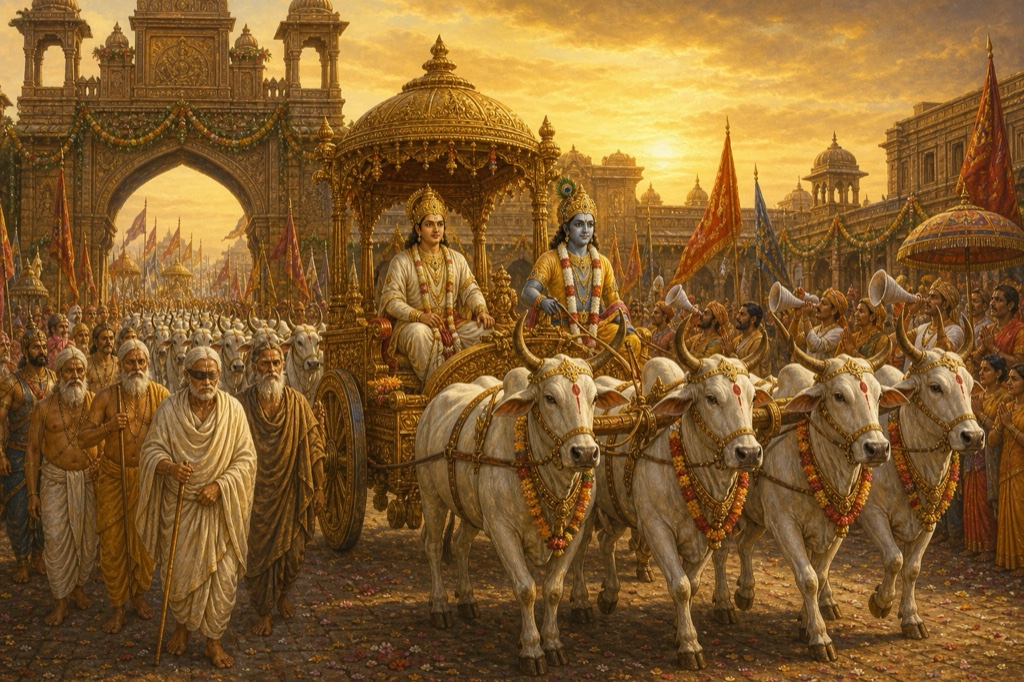
Krishna’s consolation, and the story of Srinjaya
Yudhishthira still said nothing, and Arjuna turned to Krishna. “Dharma’s son is burning with grief for his dead kinsmen. Comfort him, Krishna. We have all fallen into danger again. Drive this grief out of him.” Krishna turned his face to the king. Yudhishthira could never set Krishna aside. From their earliest years Krishna had been dearer to him than Arjuna himself.
Krishna took up the king’s hand, a hand marked with sandal paste and like a column of marble, and began to speak. Those who listened were glad as he spoke. His face, with its fine teeth and eyes, was bright as a lotus fully opened at sunrise. “Do not give way to a grief that wastes your body. Those who were killed in this battle will not be got back by any means. The Kshatriyas who fell in that great fight are like the things a man gains in a dream, which vanish when he wakes.
“They were heroes, every one, and ornaments of battle. They went down rushing with their faces to the enemy. None of them was killed with a wound in the back, and none while running. They fought with heroes, gave up their lives, and went to heaven made pure by weapons. They kept the Kshatriya’s duty, they had courage, they knew the Vedas and their branches, and they have reached the end that heroes reach. You should not grieve for them, least of all when you have heard how the great rulers of old left this world.
“There is an old discourse told here, the one Narada gave Srinjaya when that king was sunk in grief for the death of his son. Narada said to him: ‘I, you, and all creatures, Srinjaya, are subject to happiness and misery, and all of us must die. What cause is there for sorrow? Listen while I tell you of the great good fortune of kings of old, and listen closely, for you will put your grief down as you hear it.’ Then Narada named sixteen kings, one after another. And after each he said the same thing to the grieving father. This king, he said, had surpassed Srinjaya in the four things that count, religious merit, knowledge, renunciation and wealth. The king was purer than Srinjaya’s son, and death took him too. ‘Your son never performed a sacrifice and never made a gift,’ Narada told him. ‘Knowing this, quiet your mind.’”
- Marutta, the son of Avikshit. The gods came to his sacrifice, the one called Vishvasrij, with Indra, Varuna and Brihaspati at their head. He challenged Indra and defeated him in battle. Brihaspati, wishing Indra well, had refused to officiate for him, and Samvarta, Brihaspati’s younger brother, performed the rite. In his reign the earth gave crops without being tilled. At that sacrifice the Vishvedevas sat as courtiers, the Maruts served out the food and drank the Soma, and the Sadhyas were present. The gifts he made surpassed any ever made by gods, Gandharvas or men.
- Suhotra, the son of Atithi. For one whole year Indra rained gold on his kingdom, and the earth, with him for her lord, became Vasumati in fact as well as in name. The rivers of his realm carried golden tortoises, crabs, alligators, sharks and porpoises, which Indra had showered into them. Suhotra, seeing them in hundreds and thousands, was filled with wonder. He gathered up the gold that covered the land, performed a sacrifice at Kurujangala, and gave all of it to the Brahmins.
- Brihadratha, king of the Angas. He gave away a hundred thousand horses. In one sacrifice he gave a hundred thousand maidens adorned with gold, in another a hundred thousand elephants of the best breed. As sacrificial gifts he gave a hundred million bulls in golden chains, with thousands of cows beside them. When he sacrificed by the hill called Vishnupada, Indra grew drunk on the Soma and the Brahmins on the gifts. No man has been born, or will be, who gave what the king of the Angas gave in his seven Soma sacrifices.
- Shibi, the son of Ushinara. He held the whole earth as a man holds the leather shield in his hand. Riding a single chariot that won every battle, he made the earth ring with the rattle of his wheels and subdued every monarch. In one sacrifice he gave away all the cattle and horses he had, the tame and the wild. The Creator himself judged that no king before or after could carry the burden Shibi carried, a hero with the prowess of Indra.
- Bharata, the son of Dushyanta and Shakuntala, a king with a vast and well-filled treasury. He offered three hundred horses to the gods on the banks of the Yamuna, twenty on the Sarasvati and fourteen on the Ganga. And so he performed, in that order, a thousand horse sacrifices and a hundred Rajasuyas. No king can match his deeds, as no man can rise into the sky by the strength of his arms. He raised altars without number and gave the sage Kanva countless horses and untold wealth.
- Rama, the son of Dasharatha. He cherished his subjects as his own children. In his realm there were no widows and no one helpless. The clouds rained in season, the crops were abundant, no one died by water or by fire, and no one feared disease. Every man lived a thousand years and had a thousand children. Even the women did not quarrel. The trees bore flowers and fruit without fail, and every cow filled a drona measure to the brim. After fourteen years of hard penance in the forest he performed ten horse sacrifices of great splendor, open to all. Young, dark, red-eyed, with arms that reached his knees and a lion’s shoulders, he sat on the throne of Ayodhya for ten thousand years and ten hundred more.
- Bhagiratha, of the race of Ikshvaku. At one of his sacrifices Indra, drunk on the Soma, overcame many thousands of Asuras by the strength of his arms. At another the king gave away a million maidens adorned with gold, each seated on a chariot drawn by four horses. With each chariot went a hundred elephants in golden chains, behind each elephant a thousand horses. Behind each horse went a thousand cows, and behind each cow a thousand goats and sheep. The river goddess Ganga, already named Bhagirathi, sat on the lap of this king who lived beside her stream, and from that she came to be called Urvashi. She of the three courses had agreed to be his daughter.
- Dilipa, whose deeds the Brahmins love to recite. At one great sacrifice he gave the whole earth, with all her wealth, to the Brahmins, and gave it gladly. At every sacrifice of his the chief priest received a thousand elephants made of gold. His sacrificial stake was of gold, ringed and shining. Six thousand gods and Gandharvas danced on it for joy while Vishvavasu played the seven notes on his vina in their midst. So every creature thought the great Gandharva was playing for him alone. His elephants, in housings of gold, lay down in the roads. Three sounds never ceased in his house: the chanting of the Vedas, the twang of bows, and the cry of “Let it be given.”
- Mandhata, the son of Yuvanashva, who conquered the three worlds. His father drank, by mistake, the mantra-hallowed butter meant for his queen, and the child was born in the king’s own belly. The Maruts drew him out through his father’s side. The gods saw the beautiful infant lying on his father’s lap and asked one another who would nurse him. Indra said, “He shall be nursed by me,” and from those words came the name Mandhata. Indra put a finger in the child’s mouth and it gave milk. In twelve days the boy looked twelve years old, and in a hundred he was a grown youth. The whole earth came under his rule in a single day. He defeated King Angada, Marutta, Asita, Gaya and Brihadratha of the Angas, and when he fought Angada the gods thought the sky was splitting at the twang of his bow. All the earth from where the sun rises to where it sets is called the field of Mandhata. He performed horse sacrifices and a hundred Rajasuyas, and gave the Brahmins rohita fish ten yojanas long and one broad.
- Yayati, the son of Nahusha. Having subdued the whole world with its seas, he traveled across it and marked it with sacrificial altars, one after another, until he came to the shore of the sea. The distance between the altars was measured by the throw of a heavy piece of wood. He performed a thousand sacrifices and a hundred Vajapeyas and gave the Brahmins three mountains of gold. He killed many Daityas and Danavas in battle and divided the earth among his children. At the last he set aside his other sons, Yadu and Druhyu at their head, placed Puru on the throne, and went into the forest with his wife.
- Ambarisha, the son of Nabhaga, whom his subjects looked on as virtue in a body. At one of his sacrifices he assigned a million kings, each of whom had himself performed thousands of sacrifices, to wait on the Brahmins. The pious said that such a thing had never been done before and never would be again. Those kings, by Ambarisha’s merit, gained the fruit of the horse sacrifice and followed their lord by the southern path.
- Shashabindu, the son of Chitrasena. He had a hundred thousand wives and a million sons, all of them in golden armor and all fine bowmen. Each prince married a hundred princesses. Each princess brought a hundred elephants. With each elephant came a hundred chariots, with each chariot a hundred horses in trappings of gold. With each horse came a hundred cows, and with each cow a hundred sheep and goats. All of that wealth beyond counting Shashabindu gave to the Brahmins at a horse sacrifice.
- Gaya, the son of Amurtarayas. For a hundred years he lived on what was left of the sacrificial food. Agni, pleased, offered him boons. He asked that his wealth be inexhaustible however much he gave, that his regard for virtue last forever, and that his heart always delight in truth. And he received them. For a thousand years he performed the horse sacrifice at every new moon, every full moon and every fourth month. Rising from each he gave a hundred thousand cows and hundreds of mules. At his great horse sacrifice he had a ground of gold made, a hundred cubits long and fifty wide, and gave it as the fee. He gave away as many cows as there are grains of sand in the Ganga.
- Rantideva, the son of Sankriti. By the hardest penance he won from Indra the boons he asked. They were abundant food, many guests, a faith that would never lessen, and never to have to ask anything of anyone. The animals of field and forest came to his sacrifices of their own accord, and from the fluid that ran off their hides rose the great river still called Charmanvati. When he offered a Brahmin a hundred nishkas the gift was refused with a murmur, and when he said a thousand it was taken. Every vessel in his palace was of gold. On the nights when guests stayed with him, twenty thousand one hundred cows were slaughtered. Even so the cooks, with rings in their ears, would call out, “There is plenty of soup, take as much as you like. Of meat we have not as much today as on other days.”
- Sagara, of the race of Ikshvaku, whose rule covered the whole earth. Sixty thousand sons walked behind him like the stars that attend the moon in a cloudless autumn sky. He satisfied the gods with a thousand horse sacrifices and gave deserving Brahmins palaces with golden columns, furnished with rich beds and lotus-eyed women. The Brahmins divided them among themselves at his command. In his anger he had the earth dug up, and the ocean came to lie on her breast. And so the ocean is called Sagara, after him.
- Prithu, the son of Vena. The great rishis gathered in the great forest and installed him as sovereign of the earth. He was called Prithu because it was thought he would advance all mankind, a Kshatriya because he protected people from injury. He was called a Raja because every creature, on seeing him, said it had become attached to him. In his reign the earth gave crops untilled, every leaf held honey, and every cow gave a jugful of milk. Men were healthy and afraid of nothing, and lived in the fields or in houses as they chose. When he wished to cross the sea the waters grew solid, and the rivers lay calm for him. At one great horse sacrifice he gave the Brahmins twenty-one mountains of gold, each three nalwas in measure.
“‘What are you thinking of, Srinjaya, sitting silent?’ Narada said at the end. ‘It seems you do not hear me. If you have not heard, then all this talk of mine has been wasted, like medicine or food given to a man on the point of death.’ Srinjaya answered, ‘I am listening, Narada. Your discourse on the royal sages of great deeds and great fame is fragrant as a garland of flowers, and it has the power to drive grief away. It was not wasted. The very sight of you freed me from grief. As a man is never sated with drinking nectar, I am not sated with your words. And suppose you, who see truly, are inclined to show grace to a man burning for the death of his son. Then by that grace my son will surely live again and be with me once more.’ Narada said, ‘I will give you back your son, Suvarnashthivin, the child Parvata gave you, whose life is gone. He shall be bright as gold, and he shall have a thousand years.’”
The secret of Suvarnashthivin: the tale of Narada and Parvata
Yudhishthira had a question before he would let the story go. “How did Srinjaya’s son come to be Suvarnashthivin? Why did Parvata give him that child, and why did the child die? In those days every man lived a thousand years. Why did Srinjaya’s son die in infancy? Was he Suvarnashthivin in name only, or in fact, and how did it come about? I want to know all of it.”
Krishna said, “I will tell you the facts as they happened. There are two rishis, first among the seers of the world, Narada and Parvata. Narada is the mother’s brother, and Parvata is his sister’s son. Once, long ago, the uncle and the nephew left heaven together in high spirits for a pleasant ramble on earth, wanting the taste of clarified butter and rice. They wandered the world living on the food men eat. They were fond of each other, and in their gladness they made a compact. Whatever wish either of them might conceive, good or bad, he would tell the other. And whichever of them kept a wish back would lie under the other’s curse. With that agreed between them, those two great rishis came to King Srinjaya, the son of Sitya, and said, ‘For your good we will stay with you a few days. See to all our wants.’
“The king said, ‘So be it,’ and made them his guests. After a time, in his gladness, he brought his daughter before them, a girl of the fairest complexion. ‘This daughter of mine will wait on you both,’ he said. ‘She is bright as the filaments of the lotus, lovely, faultless of limb, accomplished and sweet in her ways. Her name is Sukumari.’ The rishis said, ‘Very well.’ And the king told her, ‘Child, serve these two Brahmins as you would the gods or your own father.’ She said, ‘So be it,’ and did as she was told.
“Her dutiful service and her beauty, which had no equal, soon woke a tender flame in Narada. It grew in the saint’s heart as the moon grows, night by night, in the bright fortnight. He was overcome with shame, and he could not bring himself to tell his sister’s son of that burning attachment. Parvata understood everything, by his ascetic power and by the signs. He was inflamed with rage, and he resolved to curse the lovesick Narada. ‘Of your own accord you made a compact with me,’ he said, ‘that whatever wish either of us cherished, good or bad, would be told to the other. Those were your own words, and you have broken them. You did not tell me that the maiden Sukumari’s charms had pierced your heart. For that I will curse you.
“‘You are a man vowed to continence. You are my teacher, an ascetic and a Brahmin, and still you broke the compact you made with me. Listen. This Sukumari shall be your wife, there is no doubt of it. And from the hour of your marriage she and all men shall see you as an ape. Your true features will be gone, and an ape is what you will appear to everyone.’ Narada heard him, and the uncle’s wrath rose to meet the nephew’s. ‘You have ascetic merit and continence and truth and self-restraint,’ he said. ‘You are devoted to virtue always, and for all that you shall not succeed in going to heaven.’ So they cursed each other, full of rage and the wish for vengeance, and blazed at each other like a pair of maddened elephants.
“From that day Parvata wandered the earth, honored everywhere, as his power deserved. And Narada received the hand of Srinjaya’s daughter, the faultless Sukumari, with every due rite. The princess saw him exactly as the curse had said. The last of the wedding mantras had only just been spoken when she looked at the celestial rishi and saw the face of an ape. She did not slight her lord for it. She gave him her love. She was chaste, and she devoted herself to him wholly, and never in her heart wished for any other husband among gods, sages or Yakshas. Then one day Parvata, in the course of his wandering, entered a lonely forest and found Narada there. He bowed to him and said, ‘Show me your grace. Give me leave to go to heaven.’ Narada saw him kneeling there with his hands joined, a man with no joy left in him, and Narada had even less.
“‘You cursed me first,’ he said. ‘You said, be an ape. After that I cursed you, in anger, and said that from that day you should not live in heaven. It was not well done of you, for you are like a son to me.’ And the two saints freed each other from their curses. Sukumari saw her husband in his celestial form, blazing with beauty, and ran from him, taking him for some other man. Parvata called after her, ‘This is your own husband. Have no scruple. This is the rishi Narada, your lord, of one soul with you. Do not doubt it.’ He reassured her in many ways and told her of the curse that had lain on her husband, and the princess grew calm again. Then Parvata went to heaven, and Narada went home.” Krishna looked across the gathering. “The rishi Narada, who was himself a part of all this, is sitting here. Ask him, and he will tell you everything that happened.”
The end of Suvarnashthivin’s tale, and Narada’s own account
Yudhishthira turned to Narada. “Holy one, I want to hear of the birth of the child whose excreta were gold.” And Narada, sitting among the sages on the bank of the Ganga, took up the tale himself. “It is as Krishna has told you. You have asked, and I will tell the part that remains.
“My sister’s son, the great ascetic Parvata, and I came to Srinjaya, that conqueror among kings, to live with him for a while. He honored us with every rite and gave us whatever we wished for, and we made his house our home. The season of rains went by. The time came for us to leave, and Parvata spoke to me, and what he said was weighty and suited the hour. ‘We have lived in this king’s house for some time, Brahmin, and he has honored us highly. Think what return we should make him.’
“I looked at Parvata, whose face is a blessing to see, and said, ‘Nephew, this is for you to do. You have great power, and all of it rests with you. Let the king be made happy by your boons, and let him have his wishes. Or, if you prefer, let him gain his end through the ascetic merit of us both.’
“So Parvata sent for King Srinjaya and said to him, ‘We are very well pleased, king, with the care you have shown us, which came from a sincere heart. You have our leave: think what boon you would ask. Only let it be a boon that carries no enmity to the gods and no destruction to men. Take a boon, then, for we think you deserve one.’ Srinjaya answered, ‘If you are pleased with me, my object is gained already. That is itself my greatest gain, and I count it the fulfillment of everything I desire.’
“Parvata would not leave it there. ‘Ask, king, for the wish you have been carrying in your heart this long time.’ And Srinjaya said, ‘I want a son. Let him be a hero, with great fire in him, firm in his vows and long-lived, highly blessed, and equal in splendor to the chief of the gods himself.’
“Parvata said, ‘Your desire shall be fulfilled. Your child, however, will not live long, for the wish behind such a son is a wish to prevail over the chief of the gods. He will be known by the name Suvarnashthivin. He will have a splendor like Indra’s. Take care to protect him, always, from that god.’ Srinjaya began to plead with him to ordain it otherwise. ‘Let my son be long-lived, sage, through your ascetic merit.’ Parvata said nothing. He was partial to Indra.
“I saw how the king’s heart had sunk, and I spoke to him. ‘Think of me, king, when trouble comes, and I promise I will come when you think of me. Do not grieve. I will give your beloved child back to you, even if he is dead, in his living form.’ Having said that, the two of us left him and went where we wished, and Srinjaya went back to his palace.
“Some time passed, and a son was born to the royal sage Srinjaya, a boy of great prowess who blazed with energy. He grew like a great lotus in a lake, and he was Suvarnashthivin in fact as well as in name. So strange a thing was soon known all over the world. The chief of the gods came to know of it too, and knew it for the fruit of Parvata’s boon.
“Indra, the slayer of Vala and Vritra, feared the humiliation the child might bring him when he was grown, and he began to watch for the prince’s unguarded moments. He summoned his celestial weapon, Thunder, which stood before him in a bodily shape, and gave it a command. ‘Go, take the form of a tiger, and kill this prince. When he is grown, this son of Srinjaya may humble me by his achievements, as Parvata said.’ From that day Thunder, the breaker of enemy cities, kept a constant watch for the boy’s lapses.
“Srinjaya, meanwhile, was full of joy in a child whose splendor was like Indra’s own. He went with his wives and the other women of his household to live for a time in the middle of a forest. One day, on the shore of the Bhagirathi, the boy was running here and there at play with his nurse beside him. He was only five years old, and already he had the strength of a great elephant. A powerful tiger came on him suddenly. The little prince shook violently as the tiger crushed him, and soon he fell lifeless on the ground. The nurse screamed. And the tiger, having killed the prince, vanished on the spot through Indra’s power of illusion.
“The king heard the nurse crying and ran to the place in great alarm. He saw his son there, drained of blood, lying lifeless on the ground like the moon dropped out of the sky. He took the boy up on his lap, covered in blood as he was, and with his heart struck through he began to lament. The royal women came running to where the king was, weeping and wild with grief.
“In that state the king thought of me, and fixed his whole mind on it. I knew he was thinking of me, and I appeared before him. He was stricken, and I recited to him all those stories which the hero of Yadu’s race has just recited to you. Then, with Indra’s permission, I brought Srinjaya’s child back to life. What is ordained must happen. It cannot be otherwise.
“After that Prince Suvarnashthivin was the delight of his mother and father. When his father had gone to heaven he took the throne, and he ruled for one thousand and one hundred years. He worshiped the gods in many great sacrifices rich in gifts and satisfied the gods and the ancestors. He fathered many sons, whose children multiplied the race, and after many years he went the way of all nature. Put away the grief that has risen in your heart, as Krishna has counseled you, and Vyasa of the hard penances. Rise, king. Carry the burden of your ancestral kingdom, and perform great sacrifices, so that the worlds you desire may be yours.”
Vyasa’s question: who is the doer, God, man, or chance?
Yudhishthira sat on, silent and sunk in grief, and Vyasa spoke to him again. “The protection of subjects is the duty of kings. Men who keep to duty hold duty to be all-powerful. Walk, then, in the steps of your ancestors. For Brahmins penance is the duty. That is the eternal ordinance of the Vedas. The Kshatriya is the protector of every person in respect of his duties.
“The man who, greedy for earthly things, breaks through wholesome restraints, that offender against the peace of society, should be put down with a strong hand. The senseless man who tries to overstep authority, be he an attendant, a son, or even a saint, must be punished by every means, or even killed. The king who acts otherwise sins. He who does not protect the moral law when it is being trampled is himself a trespasser against it. The Kauravas were trespassers against it, and you have killed them with their followers. You have kept the duties of your own order. Why, then, do you give way to this grief? The king should kill those who deserve death, give to those who deserve gifts, and protect his subjects as the ordinance directs.”
“I do not doubt the words that fall from your lips,” Yudhishthira said. “Everything that belongs to morality and duty is known to you. And still, for the sake of a kingdom, I have caused many men to be killed. Those deeds are burning me, Brahmin. They are eating me away.”
Vyasa put the question to him plainly. “Is the Supreme Being the doer, or is man the doer? Is everything in the world the result of chance, or are the fruits we enjoy and suffer the results of earlier acts? Take them one at a time. Suppose that man does everything he does, good or bad, because the Supreme Being drives him to it. Then the fruits of those acts should fasten on the Supreme Being. When a man cuts down a tree in the forest with an axe, the sin is the man’s, and by no means the axe’s. Or someone may say that the axe is only the tool and the consequence belongs to the living agent. Very well. Then the sin might as easily be laid on the man who made the axe, and that can hardly be true. And suppose it is unreasonable that one man should bear the consequence of an act done by another. Then, following the same rule, you should lay the whole responsibility on the Supreme Being.
“Suppose instead that man himself is the agent of all his acts, the virtuous and the sinful. Then there is no Supreme Director at all, and whatever you have done can bring no evil consequence on you. No one, king, can turn aside from what is destined. Suppose destiny is the result of the acts of former lives. Then no sin can fasten on a man in this life, just as the sin of felling the tree cannot touch the maker of the axe. And if you think it is chance alone that acts in the world, then such an act of destruction could never have happened and never will.
“If a man needs to settle what is good and what is evil in the world, let him go to the scriptures. In them it is laid down that kings should stand with the rod of punishment raised in their hands. I think that acts, good and bad, turn here continually like a wheel, and that men receive the fruits of the acts they do. One sinful act gives rise to another. So avoid all evil acts, and do not set your heart on grief like this. Hold to the duties of your own order, even where they are open to reproach. This destroying of yourself does not look well in you. Expiations have been ordained for evil acts. A man who is alive can perform them, and a man who dies cannot. So keep your life, king, and perform those acts of expiation. If you leave them undone, you may have cause to repent in the next world.”
Time alone is the destroyer, and the example of the war of gods and demons
“Sons and grandsons, brothers and fathers, fathers-in-law and teachers, mothers’ brothers and grandfathers have fallen, grandfather,” Yudhishthira said. “Many great Kshatriyas, kinsmen by marriage, friends, companions, sisters’ sons, and leading men from many countries have fallen. I alone caused them to be killed, out of desire for a kingdom. They were heroic kings, devoted to righteousness. Every one of them had drunk the Soma in sacrifice. What end will I come to, having caused their deaths? I burn day after day to think that the earth has lost so many kings who were lions, all of them in the fullness of their fortune. I saw this slaughter of kinsmen and of millions of other men, and I burn. And what will become of the women who have lost sons, husbands and brothers? They will call the Pandavas and the Vrishnis cruel murderers. Thin with grief, they will throw themselves on the ground.
“Seeing no father, no brother, no husband, no son, they will give up their lives and go to the house of Yama. I have no doubt of it. The course of morality is very subtle, and it is plain that we will be stained with the guilt of killing women. We have killed kinsmen and friends, a sin past expiation, and we must fall into hell head downward. So we will waste our limbs with the hardest penance. Tell me, grandfather, what way of life I should take up.”
Vyasa thought hard for a time and then answered. “Remember the duties of a Kshatriya and do not give way to grief. All those Kshatriyas fell in the keeping of their own duties. They were after great prosperity and great fame on earth, they were all subject to death, and they have perished through the working of Time. You were not their slayer. Bhima was not, nor Arjuna, nor the twins. Time took their life-breaths, by the great law of change. Time has no mother and no father and no one he is inclined to favor. He is the witness of the acts of all creatures, and by him they were taken. This battle was only an occasion he appointed.
“He causes creatures to be killed through creatures. That is how his power, which nothing resists, shows itself. Know that Time, in his dealings with creatures, is tied to the bond of action and is the witness of every act, good and bad. Know that it is Time who brings round the fruits of our acts, full of bliss or of woe. Think of the acts of the Kshatriyas who have fallen. Those acts were the causes of their destruction. Think of your own acts, your vows kept with a restrained soul. And think how you were forced by the Supreme Ordainer to do such a deed as this.
“A weapon made by a smith or a carpenter is under the control of the man who handles it and moves as he moves it. In the same way this universe, controlled by actions done in Time, moves as those actions move it. The births and deaths of creatures take place without any cause that can be assigned, at perfect random, and so grief and joy are needless. This entanglement of your heart is a delusion. And yet, if it would please you, perform the rites of expiation, and wash yourself clean of what you call your sin.
“It is heard that the gods and the Asuras fought each other. The Asuras were the elder brothers and the gods the younger. Both coveted prosperity, and the battle between them was fierce. It lasted thirty-two thousand years. The gods made the earth one wide sheet of blood, killed the Daityas, and took possession of heaven. Then a number of Brahmins who had got possession of the earth, men who knew the Vedas, lost their heads to pride. They took up arms with the Danavas to help them in the fight. They were known by the name of Shalavrika, and they numbered eighty-eight thousand. The gods killed all of them.
“Those wicked men who wish virtue extinguished and set sin moving deserve to be killed, as the furious Daityas were killed by the gods. If by killing one man a family may be saved, or by killing one family a whole kingdom, that killing is no transgression. Sin sometimes takes the form of virtue, king, and virtue sometimes takes the form of sin. Those who are learned know which is which. So take comfort. You know the scriptures well.
“You have only followed the road the gods themselves walked before you. Men like you never go to hell. Comfort your brothers and all your friends. Someone goes into sinful acts with his eyes open. He commits them and feels no shame and continues exactly as he was. That man is the one the scripture calls a great sinner. For him there is no expiation, and his sins never grow less.
“You were born in a noble line. You were forced into this by the faults of others. You did it most unwillingly. And having done it, you repent. The horse sacrifice, that grand rite, has been named as an expiation for you. Make ready for it, and you will be freed of your sins. Indra, with the Maruts to help him, defeated his enemies and performed a hundred sacrifices one by one, and so came to be called Shatakratu. He is freed of sin, in possession of heaven, with many worlds of bliss and great happiness and prosperity for his own. He shines among the Maruts and lights every quarter of the sky. The Apsaras honor Shachi’s lord in the heavens, and the rishis and the other gods worship him.
“You won the earth by your prowess, and by your prowess every king was beaten. Go now with your friends to the kingdoms of those kings, and set their brothers, their sons or their grandsons on their thrones. Be kind even to the children still in the womb. Make your subjects glad and happy, and rule the earth. Where a king has left no son, set his daughter on the throne. Women are fond of pleasure and power, and by this they will put off their sorrow and be happy. When you have comforted the whole empire in this way, worship the gods in a horse sacrifice as Indra did in the old days. It is not right for us to grieve for those Kshatriyas. The Destroyer’s power took their senses from them, and they died in the keeping of the duties of their order. You have done a Kshatriya’s duty and you hold the earth without a thorn in it. Keep your own duties, son of Kunti, and happiness in the other world will be yours.”
Which acts call for atonement, and when those same acts are no sin
“After doing what acts does a man become liable to expiation?” Yudhishthira asked. “And what must he do to be freed of sin? Tell me, grandfather.” Vyasa said, “A man becomes liable to expiation by leaving undone the acts that are ordained, by doing those that are forbidden, and by behaving deceitfully. There is the student under the vow of continence who rises after the sun has risen or lies down while it is setting. Then come the man with a rotten nail or black teeth, the man whose younger brother marries before him, and the man who marries before his elder brother. Next are the killer of a Brahmin and the man who speaks ill of others. There is the man who marries a younger sister before the elder is married, and the man who marries the elder after the younger.
“After them come one who falls from a vow and one who kills any member of the twice-born orders. Then there is one who teaches the Vedas to a person unworthy of them, and one who will not teach them to a person who is worthy. There is one who takes many lives, one who sells flesh, one who has abandoned his sacred fire, one who sells knowledge of the Vedas. After that come one who kills his teacher, or a woman, one born in a sinful family, one who kills an animal wilfully, one who sets fire to a dwelling. Last are one who lives by deceit, one who acts against his teacher, and one who has broken a compact. All these are guilty of sins that call for expiation.
“There are other acts that no one should do, acts forbidden by the world and by the Vedas alike. To reject one’s own creed and practice another’s. To assist at the sacrifice or the rites of one who is not worthy of that help. To eat forbidden food. To desert one who begs for protection. To neglect the keep of servants and dependents. To sell salt and treacle and things of that kind. To kill birds and animals. To refuse, though able, to give a child to a woman who asks it. To omit the daily gifts, the handfuls of grass for the cattle and the rest. To withhold the dakshina. To humiliate a Brahmin. Those who know duty have declared that no one should do these things. The son who quarrels with his father, the man who violates his teacher’s bed, and the man who neglects to father children on his wedded wife are all sinful. These, in brief and at length, are the acts and omissions by which a man becomes liable to expiation.
“Now hear the circumstances in which men commit these very acts and are not stained. If a Brahmin who knows the Vedas well takes up arms and rushes at you in battle to kill you, you may go against him and take his life. Then you will not be guilty of killing a Brahmin. There is a mantra in the Vedas that lays this down, and I tell you only what the Vedas sanction. He who kills a Brahmin fallen from his own duties and advancing weapon in hand to slaughter is no true Brahmin-killer. In such a case it is the wrath of the one that goes against the wrath of the other.
“Suppose a man drinks strong liquor in ignorance, or on the advice of a virtuous physician when his life is in danger. Then he should have the rites of his initiation performed over again. Everything I told you about the eating of forbidden food may be cleansed by such rites. Union with the teacher’s wife at the teacher’s own command does not stain the pupil. The sage Uddalaka had his son Shvetaketu fathered by a disciple. A man who steals for his teacher in a season of distress is not stained. He must take from someone other than a Brahmin and keep no part of it for himself. The man who steals to buy his own pleasures is stained. A falsehood may be spoken to save one’s own life or another’s, for the sake of one’s teacher, to please a woman, or to bring about a marriage. A vow of continence is not broken by a dream. The expiation laid down in that case is to pour clarified butter on the blazing fire.
“If the elder brother has fallen from his order or renounced the world, the younger takes on no sin by marrying. Union with a woman at her own asking does not destroy virtue. No one should kill an animal, or have one killed, except in a sacrifice. Animals were made sacred, and fit for that use, by the kindness the Creator himself showed them in his ordinance. A gift made in ignorance to an undeserving Brahmin brings no sin, and neither does a failure, through ignorance, to give to one who deserves it. A man takes on no sin by casting off an adulterous wife. By such treatment the woman herself may be made clean, and the husband keeps clear of fault. One who knows the true use of the Soma takes on no sin by selling it. One who dismisses a servant unable to do his work is untouched. I have now told you the acts a man may do without sin. I will speak next of expiation, in detail.”
The full range of atonements, and Manu’s teaching on pure and impure food
“By penance, by religious rites and by gifts a man may wash off his sins, provided he does not commit them again,” Vyasa said. “The man who has killed a Brahmin is cleansed if for a full twelve years he lives on one meal a day, and that begged. He must do everything for himself, and go his begging round with a human skull in one hand and a khatvanga staff in the other. He must live in continence and be always ready for exertion, cast off all malice, sleep on the bare ground, and proclaim his offense to the world.
“He may be cleansed by dying of his own will, on the advice of men learned in the scriptures, on the weapon of one who lives by arms. Or he may be cleansed by throwing himself head down three times into a blazing fire, or by walking a hundred yojanas reciting the Vedas all the way. Or he may be cleansed by giving his whole property to a Brahmin who knows the Vedas, or enough to keep that Brahmin for life, or a furnished house. And he may be cleansed by protecting cows and Brahmins.
“By living for six years on the scantiest of meals he may be cleansed. By a harder vow about food he may be cleansed in three years, by one meal a month in a single year. By an absolute fast he may be cleansed in a very short time. There is no doubt, too, that a man is cleansed by the horse sacrifice. Those guilty of killing a Brahmin who have taken the final bath at the close of that rite are cleansed of all their sins. This is an injunction of great authority in the Vedas. He who lays down his life in a battle fought for a Brahmin’s sake is cleansed of the killing of a Brahmin.
“He who gives a hundred thousand cows to those who deserve gifts is cleansed of the killing of a Brahmin, and of all his sins. He who gives twenty-five thousand cows of the Kapila kind, every one with a calf, is cleansed of all his sins. He who, at the point of death, gives a thousand cows with their calves to the poor and deserving is freed from sin. So is he who gives a hundred horses of the Kamboja breed to Brahmins of regulated conduct. And so is he who gives even one person everything that person asks and afterward speaks of it to no one.
“A man who has once taken liquor is made pure, here and hereafter, by drinking liquor scalding hot. A man may fall from the top of a mountain, enter a blazing fire, or renounce the world and set out on the journey that has no end. That man is freed of all his sins. A Brahmin who drinks liquor may reach the world of Brahma by performing the sacrifice Brihaspati laid down. Brahma himself has said so. If, having drunk, he is humbled, makes a gift of land, and never touches it again, he is cleansed.
“The man who has violated his teacher’s bed should lie down on a sheet of heated iron. Having cut off the mark of his sex he should leave the world for the woods with his eyes turned always upward. Women are cleansed of all their sins by living a regulated life for one year. One who lies to his teacher or acts against him is cleansed by doing something that pleases the teacher.
“One fallen from the vow of continence is cleansed by wearing a cow’s hide for six months and keeping the penances laid down for the killing of a Brahmin. The adulterer and the thief are cleansed by a year of strict vows, and the thief must return, by every means he has, goods of the value he stole. The brother who married before his elder, and the elder who was passed over, are cleansed by a strict vow kept for twelve nights. Those who know the scriptures take no account of the sins women commit in their hearts. Whatever those sins are, their monthly course scours them as ash scours a metal plate.
“It is laid down that a Brahmin should acquire and practice the full measure of virtue. A man of the royal order should acquire and practice a measure less by a fourth, a Vaishya a fourth less than the Kshatriya. And a Shudra should acquire and practice a fourth less than the Vaishya. The weight or lightness of a sin, for each of the four orders, is to be fixed on that principle. One who has killed a bird or an animal, or cut down living trees, should proclaim his sin and fast for three nights. A Brahmin may be cleansed of all the sins he has committed unknowingly by reciting the Gayatri in a sacred place. He must live on frugal fare, cast off malice, anger and hate, and be unmoved by praise and blame. He must keep silence, under the open sky by day and by night. And he must plunge into a stream or lake in his clothes three times in the day and three in the night.
“There is expiation for every sin except those called Mahapatakas, the great sins. Sins are of two classes, those committed knowingly and those committed unknowingly. The first are grave and the second light, and there is expiation for both. These ordinances are laid down for those who believe and have faith. They are of no use to atheists, or to men in whom pride and malice rule. For the reasons I have given, king, you will be cleansed of all your sins. For you killed your enemies in the discharge of a king’s duties, and to protect your life and your inheritance. Or if, after all this, you still hold yourself sinful, perform expiation. Do not throw your life away in a grief that does not become a wise man.” The king thought for a short while, and then he spoke again.
“Tell me, grandfather, what food is clean and what unclean, what gift is praiseworthy, and who should be counted deserving of gifts and who undeserving.” Vyasa said, “There is an old account told here, of a discourse between the ascetics and Manu, the lord of creation. In the Krita age an assembly of rishis strict in their vows came to the great Manu as he sat at his ease and asked him to speak on duties. ‘What food should be taken? Who is a deserving person? What gifts should be made? How should a man study, what penances should he perform and how, and what acts should be done and what left undone? Tell us everything, lord of creation.’
“The divine, self-born Manu answered them. ‘Listen while I set out the duties in brief and at length. These are the acts and the objects that cleanse, in regions that have not been forbidden. They are the silent recitation of sacred mantras, the fire offering, fasts, knowledge of the self, sacred rivers, and places where pious men live. Certain mountains cleanse as well, and the eating of gold, and bathing in water into which gems and precious stones have been dipped. A journey to the holy places and the eating of sanctified butter cleanse a man quickly. No man is called wise who indulges in pride, and if he wishes to live long he should drink hot water for three nights. To refuse what has not been given, to give, to study, to do penance: these are marks of virtue. To harm no one, to speak truth, to be free of anger, and to worship the gods in sacrifice: these are the marks of virtue.
“‘And what is virtue may, according to time and place, be sin. Taking what belongs to another, untruth, injury and killing may, under special circumstances, become virtue. For those able to judge, acts are of two kinds, virtuous and sinful. From the worldly and the Vedic points of view they are good or bad according to their consequences. From the Vedic point of view, virtue and sin fall under action and inaction. Inaction, by which is meant abstention from the Vedic rites and a life of contemplation, leads to release from rebirth. The consequences of action, the practice of the rites, are repeated death and rebirth. From the worldly point of view, evil acts lead to evil and good acts to good. Virtue and sin are told apart by the character of what follows from them. Acts that look evil, when they are undertaken for reasons connected with the gods, the scriptures, life itself, and the means by which life is kept up, bear good consequences.
“‘When an act is undertaken in the expectation, however doubtful, that it will do mischief to someone later, or when its consequence is plainly mischievous, expiation has been laid down. When an act is done in anger or with a clouded judgment, the expiation is pain given to the body, as precedent, scripture and reason direct. When something is done to please or displease the mind, the sin of it may be cleansed by sanctified food and the recitation of mantras.
“‘The king who in a particular case lays the rod of punishment aside should fast for one night. The priest who in a particular case does not advise the king to punish should fast for three nights. The man who, out of grief, tries to kill himself with a weapon should fast for three nights. There is no expiation for those who cast off the duties and practices of their order and class, their country and their family, and abandon their very creed. Suppose a doubt arises about what should be done. Then the injunction of the scriptures is whatever ten persons versed in the Vedic scriptures declare, or three of those who recite them constantly.
“‘The bull, earth, small ants, worms bred in dirt, and poison should not be eaten by Brahmins. They should not eat fish that have no scales, or four-footed creatures of the water such as frogs, the tortoise alone excepted. First are the water-birds called bhasas, ducks, suparnas, chakravakas, diving ducks, cranes, crows, shags, vultures, hawks and owls. Then come all four-footed animals that eat flesh and have long sharp teeth, birds, animals with two teeth and animals with four. Last is the milk of the sheep, the she-ass, the she-camel, the cow that has just calved, of woman and of the deer. None of these should be taken by a Brahmin. Food cooked by a woman who has lately given birth, and food cooked by a person unknown, should not be eaten. If a Brahmin eats food cooked by a Kshatriya, it lessens his energy. Food provided by a Shudra dims his Brahmin’s luster.
“‘Food provided by a goldsmith, or by a woman who has neither husband nor children, shortens his life. The food of a usurer is the same as dirt, and the food of a woman who lives by prostitution is the same as semen. The food of men who tolerate the unchastity of their wives, and of men ruled by their wives, is forbidden. So is the food of the miser who neither enjoys his wealth nor gives. So is the food of the seller of Soma, the shoemaker, the unchaste woman, the washerman, the physician and the watchman. So is food given by a crowd, or by a man at whom the whole village points. So is the food of one who lives off dancing girls, of one who married before his elder brother, of professional bards and panegyrists, and of gamblers. So are food brought with the left hand, stale food, food mixed with liquor, food already tasted, and the leavings of a feast.
“‘Cakes, sugarcane, potherbs and rice boiled in sweetened milk are not to be taken once they have lost their relish. Nor is the flour of fried barley and other fried grain, mixed with curds, to be taken once it has grown stale. Rice boiled in sweetened milk, food mixed with sesame, meat and cakes that have not been dedicated to the gods should not be taken by Brahmins who live as householders. Such a Brahmin should first satisfy the gods, the rishis, guests, the ancestors and the household deities, and then take his own food. A householder who lives so in his own house becomes like a mendicant who has renounced the world, and living with his wives he earns great religious merit.
“‘No one should make a gift for the sake of fame, or from fear, or to a man who has done him a service. A virtuous man does not give to those who live by singing and dancing, or to professional jesters. The virtuous man does not give to one who is drunk, or insane, or a thief, or a slanderer, or an idiot. He does not give to one pale of hue, or lacking a limb, or a dwarf. Nor does he give to a wicked person, or one born in a low and wicked family, or one who has not been sanctified by the keeping of vows. No gift should be made to a Brahmin who has no knowledge of the Vedas. Gifts should be made only to a Shrotriya, one who has that learning. An improper gift and an improper acceptance bring evil on the giver and on the taker both.
“‘A man who tries to cross the ocean on a rock, or on a mass of catechu, sinks along with his support. In the same way giver and taker go down together. A fire covered with wet fuel does not blaze, and a taker of gifts who is without penance, study and piety can do the giver no good. Water held in a human skull and milk held in a bag of dogskin are fouled by the vessel, and so the Vedas bear no fruit in a man who is not of good conduct. One may give, out of compassion, to a low Brahmin who has neither mantras nor vows, who is ignorant of the scriptures and full of envy. One may give, out of compassion, to a person who is poor or suffering or ill. He should not give in the belief that any benefit or religious merit will come to him from it.
“‘A gift to a Brahmin without the Vedas is made fruitless by the fault of the one who receives it. An elephant made of wood, an antelope made of leather, and a Brahmin who has not studied the Vedas: all three have nothing of the thing except the name. A eunuch with women, a cow with a cow, a bird without feathers: such is a Brahmin without mantras. Grain with no kernel, a well with no water, butter poured on ashes: such is a gift to a Brahmin without learning. He is an enemy to all, the destroyer of the food offered to gods and ancestors, and no better than a robber of other men’s wealth.’ I have told you in brief everything Manu said on that occasion.”
Vyasa’s instruction: ask Bhishma himself, and the entry into Hastinapura
“Holy one,” Yudhishthira said, “I want to hear in detail what the duties of kings are, and the duties, in full, of all four orders. I want to hear what conduct a man should adopt in seasons of distress, and how I may bring the world under me while keeping to the road of morality. This discourse on expiation and on fasts has filled me with curiosity and with joy. And yet the practice of virtue and the work of a king are always at odds. My mind is worn dull with turning over how the two can be reconciled.”
Vyasa, who knew the Vedas better than any man living, turned his eyes on Narada, that ancient who knows everything. Then he said to the king, “If you wish to hear of duty and morality in full, ask Bhishma, the old grandfather of the Kurus. He knows every duty and his knowledge is whole, and he will clear your heart of every doubt on this hard subject. The goddess of the heavenly river of three courses gave him birth. He has seen with his own eyes all the gods with Indra at their head. By his dutiful service he pleased the celestial rishis, Brihaspati first among them, and learned from them the duties of kings. He mastered, with its interpretations, the science that Ushanas knows and that the teacher of the gods knows. Under hard vows he learned all the Vedas and their branches from Vasishtha and from Chyavana of Bhrigu’s line.
“Long ago he studied under Sanatkumara, the eldest son of the Grandsire himself, who knows the truths of mind and spirit. He learned the whole duty of ascetics from the lips of Markandeya, and he had all his weapons from Parashurama and from Indra. He was born among men, and yet his death is in his own keeping. He is childless, and yet, as we have heard, many worlds of bliss await him. Rishis of great merit were always the companions of his court. Nothing that can be known is unknown to him. Go to him before he gives up his breath.”
Yudhishthira answered Satyavati’s son. “I have brought about a great and hideous slaughter of kinsmen. I have offended against everyone, and I am a destroyer of the earth. And Bhishma himself, who always fought fairly, I caused to be killed by deceit. How can I go to him and ask about duty and morality?”
It was Krishna, the chief of Yadu’s race, who spoke then, wishing well to all four orders. “This stubbornness in grief does not become you. Do what the holy Vyasa has said. The Brahmins and these brothers of yours stand before you like men pleading with the god of the clouds at the end of summer. What is left alive of the assembled kings is here, and the people of all four orders of your kingdom of Kurujangala. Do it to please these Brahmins. Do it in obedience to your elder, Vyasa. Do it at the request of those of us who wish you well, and of Draupadi. Do what we ask of you, and what is good for the world.”
Then the king rose from his seat, for the good of the whole world. Krishna had asked him, and the island-born Vyasa, and Devasthana, and Arjuna, and many others, and he put his grief and his anxiety down. He knew the Vedas and the science that interprets them, and everything men hear and ought to hear. His mind grew quiet, and he settled what he should do next. Ringed by all of them like the moon by the stars, and setting Dhritarashtra at the head of the train, he made ready to enter the city. He worshiped the gods and thousands of Brahmins.
Then he mounted a new white chariot, spread with blankets and deerskins, hallowed with Vedic mantras, and yoked to sixteen white bullocks with auspicious marks. With bards and singers praising him he rode like Soma, the moon, on his chariot of nectar. Bhima took the reins. Arjuna held over his head a white umbrella that shone like a white cloud set with stars. The twins, Nakula and Sahadeva, took up two yak-tail fans, white as moonlight and set with gems, to fan the king. The five brothers in their ornaments, on one chariot, looked like the five elements. Behind them on another white chariot, drawn by horses quick as thought, came Yuyutsu, the one son of Dhritarashtra who had sided with the Pandavas. Krishna followed with Satyaki on his own bright chariot of gold, with Shaibya and Sugriva in the traces.
The eldest uncle of Pritha’s son went at the head of the train with Gandhari, in a litter carried on men’s shoulders. The other women of the Kuru house, and Kunti and Draupadi, rode in fine carriages with Vidura leading them, and behind came chariots and ornamented elephants, foot soldiers and horse. The city and its streets were dressed for him: garlands of flowers and banners without number along the way he would pass, incense in the streets. There were powdered scents and blossoms and fragrant plants underfoot, wreaths overhead, new metal jars filled to the brim with water at the door of every house. Groups of fair young girls stood at their appointed places. So, with his friends around him and sweet words in his ears, the son of Pandu passed in through the well-adorned gate.
Thousands upon thousands of citizens had come out to see the sons of Pritha enter. The squares and streets, with the crowd growing every moment, swelled like the sea at moonrise. The great houses along the way, hung with every ornament and full of women, seemed to shake under the weight of them. In soft and modest voices the women praised Yudhishthira, and Bhima and Arjuna, and the two sons of Madri. They called to Draupadi, “You deserve all praise, blessed princess of Panchala, who wait beside these men as Gautami waits beside the seven rishis. Your acts and your vows have borne their fruit.” With their praises and their talk and the shouting of the men, the city filled with noise. Yudhishthira went through the streets as became him and came to the palace of the Kurus.
The people of the city and the provinces crowded up with words that pleased him. “By good fortune, king, you have beaten your enemies. By good fortune you have your kingdom back through virtue and prowess. Be our king for a hundred years, and guard your subjects in dharma as Indra guards those who live in heaven.” Blessed so at the gate, and taking the benedictions the Brahmins spoke from every side, he entered the palace. It was like the house of Indra. Yudhishthira stepped down from the chariot. He went in to the household gods and worshiped them with gems and scents and garlands.
When he came out again, Brahmins were waiting with auspicious things in their hands to bless him, and he stood among them like the clear moon among stars. With his priest Dhaumya and his eldest uncle beside him he honored them, with due rites, with sweets and gems and gold in plenty. The king honored them with cows and robes and whatever else each one wanted. A shout went up, “This is a blessed day,” and filled the whole sky, loud and clear as the calling of a flock of swans. Then drums rolled and conches sounded for the victory.
The deceit of the rakshasa Charvaka, and the coronation
A little while later, when the Brahmins had fallen silent, a Rakshasa named Charvaka spoke up. He was a friend of Duryodhana’s, and he had disguised himself as a Brahmin. He stood there in the dress of a religious mendicant, with a rosary, a tuft of hair on his head and the triple staff in his hand. Charvaka was proud and unafraid among the thousands of Brahmins, men of penance and vows, who had come to bless the king. He wished the Pandavas evil, and he had consulted none of them. “All these Brahmins have made me their spokesman,” he said to the king, “and this is what they say. ‘Shame on you. You are a wicked king, a killer of kinsmen. What have you gained by destroying your own race? You have killed your elders and your teacher, and the proper thing for you now is to throw your life away.’”
The Brahmins were shaken. Stung by the speech, they raised an uproar, and then all of them, and the king with them, were struck dumb with anxiety and shame. Yudhishthira spoke first. “I bow to you, and I beg you humbly, be kind to me. Do not cry shame on me. I will lay down my life soon.” Then the Brahmins cried out together, “Those are not our words. May you prosper, king.”
They knew the Vedas, and penance had made their understanding clear, and with the eye of the spirit they saw through the speaker’s disguise. “This is the Rakshasa Charvaka, the friend of Duryodhana. He has put on a mendicant’s dress to serve his friend. We said nothing of the kind. Let this fear leave you, and may good fortune stay with you and your brothers.” Then, beside themselves with rage, those Brahmins uttered the sound Hun. Clean of every sin themselves, they cursed the sinful Rakshasa and killed him where he stood. Burned up by the power of those knowers of the Veda, Charvaka fell dead, like a tree with all its shoots blasted by Indra’s thunder. The Brahmins, duly honored, blessed the king and went away, and the son of Pandu and all his friends were glad.
Then Krishna, who knows all things, spoke to the king as he stood there with his brothers. “In this world Brahmins are always the objects of my worship. They are gods on earth, with poison in their speech, and they are very easy to please. Long ago, in the Krita age, a Rakshasa named Charvaka performed hard penance for many years at Badari. Brahma urged him again and again to ask for boons, and at last he asked to be free of fear from every being in the universe. The Lord of the universe gave him that high boon, immunity from fear at the hands of all creatures, with a single limit. The Rakshasa was to be careful how he offended the Brahmins. With the boon in hand, that sinful Rakshasa, mighty and fierce in his deeds, began to torment the gods. They gathered and went to Brahma to ask for their enemy’s destruction.
“The eternal god told them, ‘I have already arranged the means by which this Rakshasa will soon die. There will be a king named Duryodhana. Among men he will be this creature’s friend, and out of affection for him the Rakshasa will insult the Brahmins. Stung by the wrong he does them, the Brahmins, whose strength is in their speech, will curse him in their wrath, and he will be destroyed.’ That same Charvaka lies there dead, killed by the curse of the Brahmins. Do not grieve. Your kinsmen all died in the keeping of the Kshatriya’s duty, and those heroes have gone to heaven. Attend to your own duties now. Put down your enemies, protect your subjects, and honor the Brahmins.”
Freed of his grief and the fever of his heart, the son of Kunti took his seat, facing east, on a fine seat of gold. On another golden seat, bright and beautiful, sat Satyaki and Krishna, facing him. Bhima and Arjuna sat on either side of the king on two seats set with gems. On a white throne of ivory decked with gold sat Kunti with Sahadeva and Nakula. Sudharman, Vidura, Dhaumya and the Kuru king Dhritarashtra each had a seat that blazed like fire, and Yuyutsu, Sanjaya and Gandhari sat where Dhritarashtra sat. The king touched the white flowers set before him, the swastikas, the vessels filled with many things, the earth, the gold, the silver and the gems.
Then all his subjects came to see him with the priest at their head, bringing auspicious things. Everything the rite of coronation requires was brought in plenty: golden jars filled to the brim, and jars of copper, of silver and of earth. There were flowers and fried paddy and kusha grass, cow’s milk, fuel of shami, pippala and palasha wood. Honey and clarified butter were brought, ladles of udumbara wood, and conches adorned with gold. At Krishna’s request the priest Dhaumya built, by the rule, an altar sloping gently toward the east and the north. He seated Yudhishthira, with Draupadi the daughter of Drupada beside him, on a handsome seat called Sarvatobhadra, firm-footed, covered with a tiger skin and bright as flame. Dhaumya began to pour the offerings of butter on the fire with the proper mantras.
Then Krishna, prince of the Dasharha line, rose from his seat, took up the consecrated conch, and poured its water on the head of Kunti’s son. At his request the royal sage Dhritarashtra and all the subjects did the same. Bathed in that water with his brothers, the son of Pandu was beautiful to see. Panavas and anakas and drums were struck. The king accepted the gifts his subjects brought and honored them with gifts in return. To the Brahmins who spoke blessings over him, men of learning and good conduct, he gave a thousand nishkas.
In voices sweet as the calling of swans they wished him prosperity and victory. “By good fortune, Yudhishthira, the victory is yours. By good fortune you have won back your place by prowess. By good fortune Arjuna and Bhima and you and the two sons of Madri are well, with your enemies dead. You are yourselves alive out of a battle that destroyed so many heroes. Attend now, without delay, to what should be done next.” So Yudhishthira the just, with his friends about him, was installed on the throne of a great kingdom.
Yudhishthira’s first ordering of the realm, the funeral rites, and the praise of Krishna
When his subjects had spoken, Yudhishthira answered them. “The sons of Pandu must be great men, since their merits, true or false, are recited by such an assembly of Brahmins. You plainly look on us with favor, to describe us so freely. King Dhritarashtra, though, is our father and our god. If you wish to please me, give him your obedience always and do what pleases him. I have slaughtered all my kinsmen, and I live for him alone. My great duty is to serve him watchfully in everything. If you and my friends hold me worth your favor, behave toward Dhritarashtra as you did before. He is the lord of the world, and of you, and of me. The whole earth, with the Pandavas, belongs to him. Keep these words of mine in your minds.”
Then he told them they might go where they pleased. When the citizens and the people of the provinces had been dismissed, he appointed his brother Bhima as Yuvaraja, the heir to the throne. He gladly appointed Vidura, a man of great intelligence, to assist him with his counsel and to oversee the sixfold requirements of the state. Sanjaya, old in years and accomplished in everything, he made general director and supervisor of the finances. Nakula was to keep the register of the forces, give them their food and their pay, and see to the other business of the army.
Arjuna was to resist hostile forces and punish the wicked. The priest Dhaumya was to attend daily to the Brahmins and to every rite in honor of the gods. Sahadeva was to stay always at his side, for the king thought that this brother should guard him in all circumstances. And he set others to other tasks as he judged each one fit. To Vidura and to Yuyutsu he gave a command: “Do everything my royal father Dhritarashtra wishes, promptly and with care. Whatever is to be done for the citizens and the people of the provinces, do it in your own departments, after taking the king’s permission.”
After this Yudhishthira had the Shraddha, the rite for the dead, performed for every one of his kinsmen killed in the battle. King Dhritarashtra too, for the good of his sons in the other world, gave excellent food, cows, great wealth and many beautiful and costly gems to the Brahmins. Yudhishthira, with Draupadi beside him, gave much wealth for the sake of Drona and of Karna, of Dhrishtadyumna and Abhimanyu, of the Rakshasa Ghatotkacha, Hidimba’s son. He gave it for the sake of Virata and his other well-wishers who had served him loyally, of Drupada and of the five sons of Draupadi. For each of them he satisfied thousands of Brahmins with wealth and gems, cows and clothes.
He performed the Shraddha as well for every king who had fallen in that battle and left no kinsman or friend behind. And for the souls of all his friends he had houses founded where food was given out, and places where water was given, and tanks dug in their names. So he paid the debt he owed them and gave the world no cause to blame him, and he went on protecting his subjects in dharma. He showed Dhritarashtra, Gandhari, Vidura, all the elder Kauravas and all the officers the honor he had always shown them. He honored and protected the women whom the battle had left without husbands and sons. And to the destitute, the blind and the helpless he gave food, clothing and shelter, out of a great compassion.
With the kingdom his again and the ceremony of installation over, Yudhishthira joined his hands and spoke to lotus-eyed Krishna of the Dasharha race. “By your grace, Krishna, by your policy and might, your intelligence and prowess, I have my ancestral kingdom back. I bow to you again and again. You have been called the One only Being, and the refuge of all who worship, and the twice-born adore you under names without number. Salutations to you, Creator of the universe. You are its soul, and it has sprung from you. You are Vishnu, you are Jishnu, you are Hari, you are Krishna, you are Vaikuntha, and the first of all beings. The Puranas say you took birth seven times in the womb of Aditi, and it was you who were born of Prishni. The learned say you are the three ages. You are the lord of our senses, the great Lord worshiped in sacrifices, the great swan. You are three-eyed Shambhu. You are one, though known as Vibhu and Damodara.
“You are the great Boar, you are Fire, you are the Sun. The bull is on your banner, and Garuda also. You are Truth, the giver of food, and Guha, the general of the gods. You are the Ocean. You are without attributes. You are Emperor, Virat and Svarat, the chief of the gods and the cause from which the universe came. You are the sage Kapila, and you are the Dwarf. You are Sacrifice embodied, and Dhruva, and Garuda. You are the one the Vedas describe, the great holder of the waters, Brahman, the sacred refuge. You are Hiranyagarbha, the mantras svadha and svaha, and Keshava. You are the cause from which all this has sprung, and you are its dissolution. In the beginning it is you who create the universe, and it is under your control. Salutations to you, bearer of the bow Sharnga, the discus and the sword.” So he praised him in the middle of the court, and Krishna was pleased, and gladdened Pandu’s eldest son with many kind words in return.
The king dismissed his subjects, and they went to their homes. Then he comforted his brothers. “Your bodies were torn in the great battle by weapons of every kind,” he said to Bhima and Arjuna and the twins. “You are worn out. Grief and anger have scorched your hearts. Through my fault you suffered the miseries of exile in the forest like common men. Enjoy this victory now in gladness and at your ease. Rest, recover the full use of your faculties, and come to me again in the morning.”
With Dhritarashtra’s approval he gave Bhima the palace of Duryodhana, with its many fine buildings and rooms, its gems of every kind and its servants, men and women. Bhima entered it as Indra enters his own house. Arjuna, at the king’s command, received the palace of Duhshasana, which was in no way inferior, with its gateway of gold, its wealth and its attendants. The palace of Durmarshana was finer still, like the mansion of Kubera, bright with gold and every gem. The king gave it gladly to Nakula, who deserved it and who had grown thin in the great forest.
The palace of Durmukha, lovely and adorned with gold, full of beds and of lotus-eyed women, he gave to Sahadeva, who was always busy with what would please him. Sahadeva was as glad as the Lord of treasures when he was given Kailasa. Yuyutsu, Vidura and Sanjaya, Sudharman and Dhaumya went to the houses they had owned before. Krishna, with Satyaki, entered the palace of Arjuna like a tiger entering its cave in the hills. Food and drink had been made ready for them all. The princes passed the night happily, woke glad, and presented themselves before King Yudhishthira.
The secret of Krishna’s trance: Bhishma remembering him
With the kingdom in his hands, Yudhishthira set each of the four orders to its duties. He gave a thousand Brahmins of the Snataka order a thousand nishkas each. He satisfied the wishes of his servants and dependents and of the guests who came to him, the undeserving and the unorthodox among them. To his priest Dhaumya he gave cows in thousands, wealth, gold, silver and robes. He behaved toward Kripa as a man should toward his teacher, went on honoring Vidura greatly, and placed his kingdom at the disposal of Dhritarashtra, Gandhari and Vidura. With everyone content, the citizens included, he went with joined hands to Krishna.
He found him seated on a large couch adorned with gold and gems. Krishna was the color of a dark cloud, in robes of yellow silk and celestial ornaments, blazing like a jewel set in gold. The Kaustubha gem on his chest was like the rising sun on the eastern mountain. Yudhishthira came up smiling. “Did you pass the night happily? Are all your faculties in their full strength? Through your grace we have the kingdom back and the whole earth under us. Through your grace we have won victory and great fame and have not fallen from the duties of our order.”
Krishna said not a word. He was deep in meditation. “How wonderful this is,” Yudhishthira said, “that you, whose prowess has no measure, are sunk in meditation! Is all well with the three worlds? You have withdrawn into the fourth state, and my mind is full of wonder. The five life-breaths that move in the body you have brought to stillness. Your senses you have gathered into your mind, and speech and mind into your understanding, and all of them into your soul. The hair on your body stands up. You are as motionless as a wooden post or a stone, as still as a lamp flame burning where there is no wind. If I am fit to hear the cause, if it is no secret of yours, drive away my doubt. I ask it as a favor, I am your worshiper, and I bow my head to you.”
Krishna brought his mind, his understanding and his senses back to their usual sphere. He said with a soft smile, “Bhishma, lying now on a bed of arrows, like a fire that is about to go out, is thinking of me. So my mind was fixed on him. My mind was fixed on the man the twang of whose bowstring and the clap of whose palms Indra himself could not bear. I was thinking of him who, at the self-choice of the daughters of the king of Kashi, defeated all the assembled kings in a moment. He carried off three princesses for the marriage of his brother Vichitravirya.
“I was thinking of him who fought Rama of Bhrigu’s race for twenty-three days without a pause, and whom Rama could not overcome. He gathered in all his senses, fixed his mind by the help of his understanding, and sought refuge in me. That is why my mind was centered on him. I was thinking of him whom Ganga conceived and bore as human mothers bear, and whom Vasishtha took as a pupil. He is that hero who knows all the celestial weapons and the four Vedas with their branches. He is the favorite disciple of Rama, Jamadagni’s son, a vessel of the sciences. He knows the past, the future and the present.
“When he has gone up to heaven by his own achievements, the earth will look like a moonless night. So go to Ganga’s son, Yudhishthira, humbly, and ask him what you wish to learn. Ask him about the four branches of knowledge, which concern morality, profit, pleasure and release. Ask him about the sacrifices and the rites laid down for the four orders, about the four ways of life, and about the duties of kings in full. When Bhishma disappears from the world, every kind of knowledge will disappear with him. That is why I urge you to go now.”
Yudhishthira’s voice was choked with tears. “What you have said of Bhishma’s greatness is true, and I do not doubt a word of it. I have heard Brahmins speak of his high blessedness. If your heart is inclined to grace, Krishna, then let us go to him with you at our head. When the sun turns to the north, Bhishma will leave this world for the regions he has won. He deserves to see you.”
Krishna turned to Satyaki, who was sitting beside him. “Let my chariot be yoked.” Satyaki went out at once and gave the order to Daruka, and Daruka made it ready. It was a chariot adorned with gold, set with emeralds and moon-gems and sun-gems, its wheels cased in gold. It was quick as the wind, bright as the morning sun, with Garuda on its standard and many banners flying. Yoked to it, in trappings of gold, were Sugriva and Shaibya and the other two, horses swift as thought. He came back with joined hands and said that it was ready.
Out on the field, Bhishma lay on his bed of arrows among the greatest of the Brahmins. His body was pierced with arrows beyond counting and shining like the sun among its rays. Vyasa was there, and Narada, Devasthana, Jaimini, Paila, Shandilya, Devarata, Maitreya, Asita, Vasishtha, Kaushika, Harita, Lomasha, Brihaspati and Shukra. There were Chyavana, Sanatkumara, Kapila, Valmiki, Tumburu, Maudgalya, Rama of Bhrigu’s line, Trinabindu, Pippalada, Samvarta, Pulaha, Kashyapa, Pulastya. Kratu, Daksha, Parashara, Marichi, Angiras, Gautama, Galava, Dhaumya, Mandavya, Markandeya and many more were there. So he lay among them like the moon among the planets and stars. With a pure heart and joined palms he thought of Krishna in mind, word and act, and in a strong, glad voice he sang his praise.
“You are without beginning and without end. Neither the gods nor the rishis know you. All the worlds and all created things live in you and enter you again, strung on you like gems on a thread. You are called Hari of the thousand heads, the thousand feet, the thousand eyes. You are called Narayana, the refuge of the universe. You are the subtlest of the subtle and the highest of the high. You were born of Devaki and Vasudeva as fire is born of two sticks. You have filled heaven with your head and the earth with your feet. The directions are your arms and the sun is your eye.
“A single bow of the head to Krishna is equal to ten horse sacrifices. And the man of ten horse sacrifices is born again, while the man who bows to Krishna is freed from birth. I seek your protection. Think what will be for my good.” He said, “Salutations to Krishna,” and bowed. And Krishna, knowing by his yoga of the old man’s devotion, gave him heavenly knowledge reaching over the past, the present and the future.
The journey to Kurukshetra, and Parashurama’s twenty-one clearings of the Kshatriyas
Krishna rose from his seat and mounted his chariot, and Satyaki rode with him. Yudhishthira and Arjuna went on a second chariot, Bhima and the twins on a third, and Kripa, Yuyutsu and Sanjaya of the Suta caste each on his own. The chariots looked like moving towns and shook the earth with the rattle of their wheels. As he went Krishna listened gladly to the Brahmins who spoke his praise, and greeted the people who stood along the streets with joined hands and bowed heads.
With standards and banners flying and quick horses under the yoke they came soon to Kurukshetra and drove down onto the field. It was covered with hair and marrow and bones, the place where millions of Kshatriyas had cast off their bodies. There were hills on it made of the carcasses and bones of elephants and horses, and human heads and skulls lay scattered across it like conch shells. Thousands of funeral pyres had marked it. Heaps of armor and weapons lay everywhere, and the wide plain looked like the drinking ground of the Destroyer himself, used and lately abandoned. The great chariot-fighters drove on quickly, looking at a battlefield haunted by crowds of spirits and thronged with Rakshasas.
And as they went Krishna spoke to Yudhishthira of the prowess of Jamadagni’s son, Rama of the axe, the Parashurama who had taught Karna. “There, far off, you can see the five lakes of Rama. There Rama offered the blood of Kshatriyas to the spirits of his ancestors. It was here that he gave up his task, having cleared the earth of Kshatriyas three times seven times.”
“I have great doubts about what you say,” Yudhishthira answered, “that Rama emptied the earth of Kshatriyas three times seven times. If the very seed of the Kshatriyas was burned up, how was the order revived? How was it destroyed, and how did it grow again? Millions of Kshatriyas died in terrible chariot battles, and the earth was strewn with their bodies. For what reason did Rama of Bhrigu’s line do this? Clear away my doubt, Krishna. The highest knowledge comes from you.”
And Krishna, as the chariot ran, told him all of it. “Hear the story of Rama’s power and his birth as I heard it from great rishis. Jahnu had a son named Rajas. Rajas had a son named Balakashva, and King Balakashva had a son named Kushika, a man of righteous conduct, who was like Indra on earth. Kushika did the hardest penance, wishing to have the lord of the three worlds for his son. Indra, seeing him so engaged and fit to father a son, entered into the king with his own force and was born as Kushika’s son, known as Gadhi. Gadhi had a daughter named Satyavati, and he gave her as wife to Richika, a descendant of Bhrigu. Her husband was greatly pleased with the purity of her conduct, and he cooked the sacrificial food of milk and rice in order to give her father Gadhi a son.
“He called his wife and said, ‘This portion of the hallowed food is for you, and this other portion is for your mother. A son will be born of her who will blaze with energy, a champion among Kshatriyas, unconquerable by Kshatriyas, and the killer of the greatest of them. And for you, blessed lady, this portion will bring a son of great wisdom, the image of calm, rich in penance, a Brahmin above all others.’ Having said this, Richika set his heart on penance and went to the woods.
“About that time King Gadhi, who had resolved on a pilgrimage to the holy waters, arrived with his queen at Richika’s hermitage. Satyavati took the two portions and, glad and in great haste, told her mother what her husband had said. And the queen mother gave her daughter the portion meant for herself, and in her ignorance took the portion meant for her daughter. So Satyavati, her body shining, conceived a child of terrible form, destined to be the destroyer of the Kshatriyas. Richika looked and saw what kind of child lay in her womb. He said to his wife, ‘You have been deceived by your mother, blessed lady, through the exchange of the hallowed portions. Your son will be a man of cruel deeds and a vengeful heart.
“‘Your brother, born of your mother, will be a Brahmin given to penance. Into the food meant for you I had placed the seed of the supreme and universal Brahman. Into the food meant for your mother I had placed the whole sum of Kshatriya energy. Because the portions were exchanged, what was intended will not happen. Your mother will have a Brahmin child, and you will have a son who becomes a Kshatriya.’ Satyavati threw herself down, laid her head at his feet, and spoke, trembling. ‘Holy one, do not say such a thing to me, that I will have a wretch among Brahmins for my son.’ Richika said, ‘I did not intend this for you. A son of fierce deeds has been conceived in you only because the portions were exchanged.’
“She said, ‘If you wished, sage, you could create other worlds. What is a child to that? Give me a son who is righteous and devoted to peace.’ Richika said, ‘I have never spoken a falsehood, lady, even in jest, and certainly I spoke none over food prepared with Vedic formulas at a kindled fire. Destiny ordained this long ago. I have seen all of it by my penances. All the descendants of your father will have the virtues of Brahmins.’ Satyavati said, ‘Then let it be our grandson who is such, and let me have a son of peaceful ways.’ And Richika answered, ‘I see no difference between a son and a grandson, fair one. It will be as you say.’
“So Satyavati bore, in Bhrigu’s line, a son given to penance and to peaceful ways: Jamadagni, a man of ordered vows. And Kushika’s son Gadhi fathered a son named Vishvamitra, who had every quality of a Brahmin and, though born in the Kshatriya order, was a Brahmin’s equal. Jamadagni, that ocean of penance, fathered a son of fierce deeds, who mastered the sciences and the science of arms among them, and who was like a blazing fire. That son was Rama, the destroyer of the Kshatriyas. He pleased Mahadeva on the mountains of Gandhamadana and begged weapons of the great god, above all the axe of fierce energy the god carried in his hands. With that axe, which had no equal for fiery splendor and sharpness, he had no equal on earth. Meanwhile there was Arjuna, the mighty son of Kritavirya, a Kshatriya and the ruler of the Haihayas. He had great energy and was highly virtuous in his conduct, and through the grace of the rishi Dattatreya he had a thousand arms.
“With the strength of those arms he subdued in battle the whole earth, with her mountains and her seven islands. He became a very powerful emperor, and at last gave the earth away to the Brahmins in a horse sacrifice. Once the god of fire came to him thirsty and begging, and the thousand-armed king gave him alms. The fire sprang from the points of his arrows, hungry to consume, and burned villages and towns, kingdoms and the hamlets of cowherds. It burned mountains and great forests. And with the king of the Haihayas to help it and the wind to fan it, it burned the hermitage of Apava. It was a delightful place where at that time no one was living. Apava saw his retreat burned by that powerful Kshatriya and cursed him in his wrath. ‘You did not spare even these woods of mine, Arjuna. For that, Rama of Bhrigu’s line will cut off your arms.’
“Arjuna was mighty and brave, a lover of peace, respectful to Brahmins, a protector and a giver, and he gave no thought to the curse. It was his sons, powerful, always haughty and cruel, who became the cause of his death. Without the knowledge of the king of the Haihayas the princes seized the calf of Jamadagni’s homa cow and carried it off. For that a quarrel arose between Jamadagni and the Haihayas. Rama, Jamadagni’s son, in his wrath cut off the arms of Arjuna and brought back his father’s calf, which was wandering in the inner enclosures of the king’s palace.
“Then Arjuna’s foolish sons went together to the hermitage of Jamadagni while Rama was out gathering sacred fuel and grass. With the points of their lances they struck the rishi’s head from his body. Rama burned with rage at his father’s death, and he swore to rid the earth of Kshatriyas and took up arms. He put out his strength and quickly killed every son and grandson of Kritavirya. Killing Haihayas by the thousand in his fury, he turned the earth to a mire of blood, and soon he had stripped her of all her Kshatriyas. Then he was filled with compassion, and he withdrew into the woods.
“Some thousands of years went by. Rama was wrathful by nature, and now he was accused of cowardice. Paravasu, the grandson of Vishvamitra and the son of Raibhya, a man of great ascetic merit, began to taunt him in public. ‘Rama, those righteous men who gathered at the sacrifice when Yayati fell, Pratardana and the rest, were they not Kshatriyas by birth? Your vow is false. Your boast among men is empty. You ran to the mountains for fear of Kshatriya heroes.’
“Rama heard him and took up his weapons again, and again he strewed the earth with Kshatriya bodies by the hundred. Those Kshatriyas he spared, and there were hundreds, multiplied in time and became mighty kings, and Rama slaughtered them in their turn and did not spare the children. The earth was strewn again, with the bodies of children born before their time. As soon as Kshatriya children were born, Rama killed them. Some Kshatriya women, all the same, managed to protect their children from his wrath. Rama had emptied the earth of Kshatriyas three times seven times. Then the descendant of Bhrigu completed a horse sacrifice and gave the earth away as the sacrificial gift to Kashyapa.
“Kashyapa wished to save what was left of the Kshatriyas. Pointing with the hand that still held the sacrificial ladle, he said, ‘Great sage, go to the shores of the southern ocean. You must not live, Rama, within what is now my dominion.’ At those words Ocean at once made a region for Jamadagni’s son on his farther shore, a land called Shurparaka. Kashyapa, having accepted the earth as a gift, made a present of it to the Brahmins and entered the great forest.
“Then Shudras and Vaishyas, acting as they pleased, began to take the wives of Brahmins. When anarchy sets in on earth, the weak are oppressed by the strong, and no man is master of his own property. With no Kshatriyas of virtue to protect her, and oppressed by the wicked in that disorder, the earth sank quickly toward the lowest depths. Kashyapa saw her sinking in her fear and held her on his lap. And because the great rishi held her on his lap, his uru, the earth is known by the name Urvi. Then the goddess Earth, for her own protection, pleased Kashyapa and begged a king of him.
“The Earth said, ‘There are some great Kshatriyas, Brahmin, whom I have hidden among women. They were born in the race of the Haihayas. Let them protect me. There is another, of Puru’s race, the son of Viduratha, who has been brought up among bears in the Rikshavat mountains. Another, the son of Saudasa, has been protected out of compassion by Parashara, that tireless sacrificer. Though he was born in a twice-born order he does every kind of work for the rishi like a Shudra, and so he is named Sarvakarman. Shibi’s son Gopati has been brought up in the forest among cattle. Let him protect me. Pratardana’s son Vatsa has been brought up among calves in a cowpen. Let that prince protect me. The grandson of Dadhivahana and son of Diviratha was hidden and guarded on the banks of the Ganga by the sage Gautama.
“‘His name is Brihadratha, and he has been protected by wolves and by the mountains of Gridhrakuta. Many Kshatriyas of the race of Marutta have been saved as well, brought up by Ocean, and equal in energy to the lord of the Maruts. These children of the Kshatriya order are heard of in different places, living among artisans and goldsmiths. If they protect me, I will stay unmoved. Their fathers and grandfathers were killed for my sake by Rama, and it is my duty to see their funeral rites performed. I do not wish to be protected by my present rulers. Arrange it quickly, sage, that I may stand as I stood before.’ So Kashyapa sought out the Kshatriyas the goddess had named and installed them as kings in due form. The Kshatriya lines that exist today are the offspring of those princes. That is how it happened, son of Pandu, in the old days.”
At the bed of arrows: the talk of Krishna and Bhishma, and the boon of divine sight
Yudhishthira was filled with wonder. “The prowess of Rama, who in his wrath emptied the earth of Kshatriyas, was like Indra’s own,” he said to Krishna. “And the children of the Kshatriyas, in their fear of him, were hidden and reared by cattle, by Ocean, by leopards, bears and apes. This world of men deserves all praise, and those who live in it are fortunate, since such a feat was done in it by a Brahmin.”
With that their talk ended, and the two of them came to where Ganga’s son lay on his bed of arrows. They saw Bhishma stretched there, bright as the evening sun wrapped in its own rays. Ascetics were around him as the gods surround Indra, on a most sacred spot on the bank of the river Oghavati. Seeing him from a distance, Krishna and the king, the four Pandavas, Kripa and the rest got down from their chariots. They gathered in their restless minds, stilled their senses, and went up to the great rishis. Krishna, Satyaki and the others bowed to the seers, with Vyasa at their head, and then approached the son of Ganga and sat down around him.
Krishna looked at Bhishma, who was like a fire dying down, and his heart was heavy as he spoke. “Are your perceptions as clear as they were? I hope your understanding is unclouded. I hope your limbs are not tortured by the pain of these arrow wounds. Grief of mind weakens the body too. By the boon your father Shantanu gave you, your death depends on your own will. I myself do not have the merit that won you that. The smallest pin lodged in the body gives pain. What is there to say of hundreds of arrows? And surely pain cannot be said to afflict you. You are able to teach the gods themselves about the origin and the dissolution of living creatures. Everything of the past, the future and the present is known to you. I saw you, in the enjoyment of a swelling kingdom, sound of limb and in perfect health, with women all around you, give up the company of women.
“Shantanu’s son Bhishma lies on a bed of arrows at the point of death. Apart from him we have never heard of anyone in the three worlds who could hold death itself off by the power of his penance. We have never heard of anyone so devoted to truth, to penance, to giving, to sacrifice, to the science of arms. We have never heard of anyone so devoted to the Vedas and to the protection of those who ask for protection. We have never heard of anyone so harmless to all creatures, so pure in conduct and so self-restrained, who was also so great a chariot-fighter. On a single chariot you could subdue the gods, the Gandharvas, the Asuras, the Yakshas and the Rakshasas. The Brahmins always speak of you as the ninth of the Vasus, and by your virtues you have gone beyond them all and are the equal of Indra.
“Now drive out the grief of Pandu’s eldest son, who is burning for the slaughter of his kinsmen. The duties of the four orders and the four ways of life are known to you, and all that is taught in the four branches of knowledge. You know the eternal duties laid down in Yoga and Sankhya, the duties of those born of mixed orders. The customs of particular countries, tribes and families, the histories and the Puranas are known to you. There is no one else who can settle the doubts that rise in these matters. Men of such knowledge live only to comfort those whose minds have gone dark.”
Bhishma raised his head a little and joined his hands. “Salutations to you, divine Krishna. You are the origin of all the worlds and their dissolution. You are the Creator and the Destroyer, and no one can overcome you. The universe is your handiwork. You are its soul, and it has sprung from you. You are beyond the five elements. Salutations to you who are the three worlds and are above the three worlds. What you have said of me has let me see your divine attributes as they are shown in the three worlds, and I see your eternal form. You stand closing the seven paths of the Wind. Your head fills the sky and your feet the earth. The directions are your two arms, the sun is your eye, and Indra is your strength. In your robes of yellow, the color of the atasi flower, you look to us like a cloud shot with lightning. I am devoted to you, I seek your protection, and I wish for a blessed end. Think, lotus-eyed one, what would be good for me.”
Krishna said, “Because your devotion to me is very great, I have shown you my celestial form. I do not show myself to one who is not devoted to me, or to a devotee who is not sincere, or to one whose soul is unrestrained. You are devoted to me and you have always kept to righteousness. Your heart is pure. You are self-restrained, given to penance and to gifts. Through your own penances, Bhishma, you are fit to see me. Those regions from which there is no return are ready for you. Fifty-six days still remain for you to live. Then, casting off your body, you will have the blessed reward of your acts. Look: the gods and the Vasus, in forms of fiery splendor, are waiting for you unseen on their chariots until the moment the sun enters on its northern course.
“When the sun turns north, you will go to the regions from which no man of knowledge ever comes back to this earth. And when you leave this world for that one, all knowledge will die with you. That is why all these people have gathered and come to you, to hear you speak on duty and morality. Yudhishthira is firm in truth, and grief for his slaughtered kinsmen has clouded his learning. Speak to him words of truth, full of morality and of yoga, and quickly drive that grief away.”
Bhishma answered him. “Master of all the worlds, Shiva, Narayana, I have heard your words and I am filled with joy. And what words of instruction can I speak in your presence, when everything that speech can treat is already contained in your speech? Whatever is done or ought to be done in either world comes from your intelligent self. A man who could lecture on heaven before the king of the gods could lecture on morality, pleasure, profit and release before you. My mind is shaken by the pain of these arrow wounds. My limbs are weak, and my understanding is not clear. These shafts are like poison or fire, and I have no strength to say anything. My strength is leaving me.
“My life-breaths are hurrying to go. The vital parts of my body are burning. My words come out slurred. How can I venture to speak? Be kind to me. I will say nothing. Forgive me. Brihaspati himself, the master of speech, would falter if he had to speak before you. I can no longer tell the quarters of the sky apart, or the sky from the earth. It is only by your power that I am still alive. Speak yourself, for the good of King Yudhishthira the just, for you are the ordainer of every ordinance. How can a man like me speak while you are here, the eternal creator of the universe? It would be a pupil lecturing in front of his teacher.”
Krishna said, “Those words are worthy of you, the first man of Kuru’s race, great in soul, great in patience, and master of every subject. As for what you say of the pain of your arrow wounds, receive this boon from me, Bhishma, by my grace. Discomfort, stupor, burning, pain, hunger and thirst shall not overcome you. Your perceptions and your memory shall be unclouded. Your understanding shall not fail you. Your mind, freed from the qualities of passion and darkness, shall rest always in the quality of goodness, like the moon come out from the clouds. Whatever subject touching duty, morality or profit you think on, your understanding will enter it. You will have celestial sight and see the four orders of created things. With the eye of knowledge you will see every created thing you try to recall, as a man sees fish in a clear stream.”
Then the great rishis, Vyasa among them, praised Krishna with hymns from the Rig, the Yajur and the Sama Vedas. A shower of flowers of every season fell from the sky on the place where Krishna, Ganga’s son and the son of Pandu were. Celestial instruments of every kind sounded in the air, and the companies of Apsaras began to sing. No sign of evil was seen anywhere. A pure and pleasant breeze began to blow, carrying every fragrance. The quarters of the sky grew clear and quiet, and the animals and birds moved about in peace. Soon afterward the thousand-rayed sun was seen going down in the west, like a fire at the far edge of a great forest. The rishis rose and saluted Krishna, Bhishma and King Yudhishthira, and Krishna and the sons of Pandu, Satyaki, Sanjaya and Kripa bowed to them in return.
“We will come back tomorrow,” the sages said, and went quickly to their own places. Krishna and the Pandavas saluted Bhishma, walked around him in reverence, and climbed onto their chariots. Many other chariots went with them, with golden poles, and elephants in rut like moving hills, horses swift as Garuda, and foot soldiers with bows. That host, moving at speed, went in two divisions, one before the princes and one behind. They were like the two currents of the great river Narmada where the Rikshavat mountains stand across her and part her. The moon rose before them and gladdened the army, putting back into the herbs and plants of the earth the sap the sun had drawn out of them. So Krishna and the sons of Pandu came into the Kuru city, which was as splendid as the city of Indra. They went to their houses like tired lions going to their caves.