On this page
Three chariots were all that remained. They drew away from the ground where Duryodhana lay with his thighs broken and drove south together, and the men in them were the whole of what had been the Kaurava host: Ashvatthama, son of Drona, the teacher of the Bharata princes, who had been killed in this war; Kripa, his mother’s brother; and Kritavarma, chief of the Bhojas, a Satvata by race. Eleven akshauhinis had marched under the Kuru king, eleven whole armies, and these three were what was left alive of them. Ashvatthama had sworn in the king’s presence to kill the Pandavas, and the oath rode with him. Sanjaya told the blind king Dhritarashtra what the three of them did that night, and he told it in order, as it happened.
At sunset they came to a place near the Kuru encampment and turned their horses loose, and there fear came over them. They found a forest and went into it in secret and made their halt at no great distance from the camp. All three had been cut and torn by many sharp weapons. They drew long, hot breaths, and their thoughts were on the sons of Pandu. Then the noise reached them, the Pandavas shouting over their victory, and they were sure a pursuit was coming and fled toward the east. They drove on for some time, until the horses were spent and the men themselves were parched. Rage and the wish for revenge had hold of all three of them. They were great bowmen, the king they served had been cut down, and they could not bear what had been done. For a short while, all the same, they rested.
Dhritarashtra’s Outcry and the Three Under the Banyan
Here the blind king stopped him.
“What Bhima did is hard to believe, Sanjaya,” Dhritarashtra said. “The son of mine he struck down had the strength of ten thousand elephants. He was in the prime of his manhood, with a body like adamant, and no creature alive should have been able to kill him. And the Pandavas have struck that son down in battle. My own heart must be made of adamant, since it does not break into a thousand pieces when I am told that my hundred sons are dead. What is to become of me and of my wife, two old people with no child left to them? I dare not live in the country that Pandu’s son now rules. I was the father of a king and a king myself. How am I to pass my days as a slave who does whatever Pandu’s son commands? I laid my orders on the whole earth and stood over every head in it, and now I am to live in wretchedness as a servant. How will I endure the words of Bhima, who with his own hands has killed a full hundred of my sons? Vidura told us it would come to this, and my son would not listen to him. Now tell me. After my son Duryodhana had been struck down unfairly, what did Kritavarma and Kripa and the son of Drona do?”
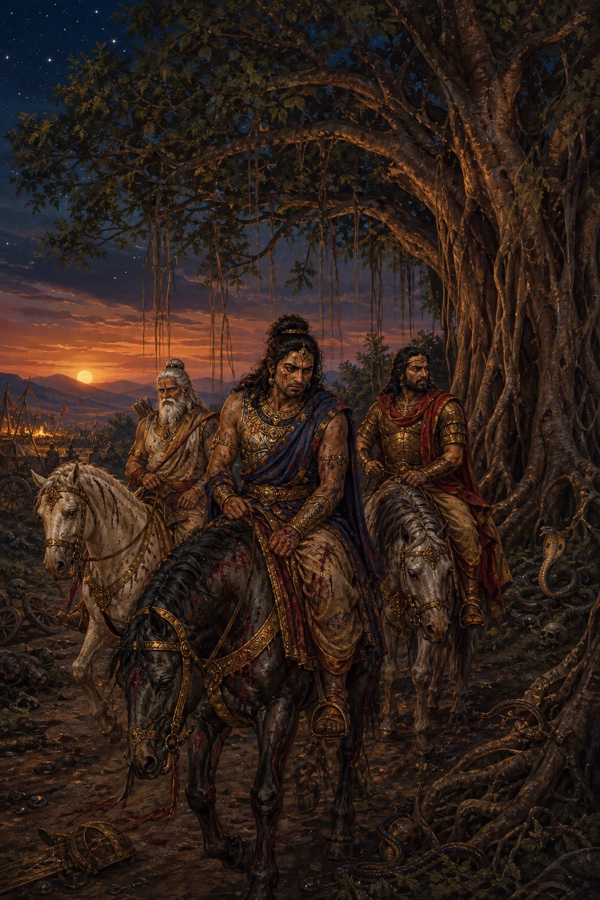
They had not gone far, Sanjaya told him, before they stopped again, because a forest stood in front of them, dense with trees and creepers. They rested a little, let the horses drink their fill, and drove in on their chariots. It was a great forest, full of animals of many kinds and loud with birds of many kinds, and beasts that eat flesh hunted through it. There was water everywhere in it, and flowers of every sort, and lakes grown over with blue lotuses. Once inside, they looked around them and saw a banyan of enormous size, a tree with thousands of branches, and when they had come into its shade they saw that it was the biggest tree in that forest. There they got down from their chariots and unyoked their horses. They washed as the rule requires and said their evening prayers.
The sun went down behind the Asta mountains, and Night, the mother of the universe, came on. The sky filled with planets and stars and shone like a length of brocade worked with ornaments, and it was beautiful to look at. The creatures that walk at night began to howl and call as they liked, and the creatures of the day gave themselves up to sleep. The noise of the night wanderers was terrible to hear. The eaters of flesh were glad, and as the dark deepened the night grew dreadful.
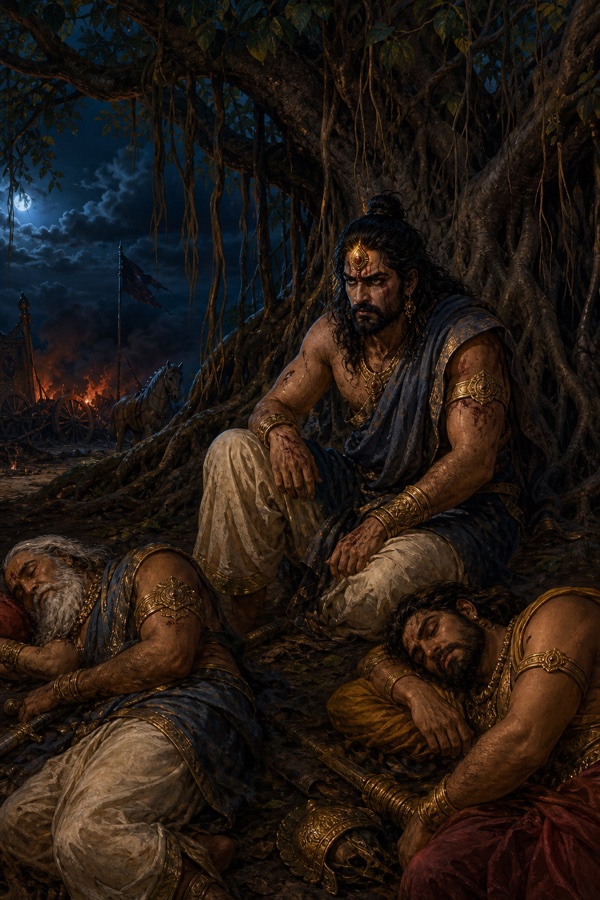
In that hour Kritavarma, Kripa, and Drona’s son sat down together under the banyan, full of grief, and they spoke of one thing only, the destruction that had come on the Kurus and the Pandavas alike. They were worn out, and the arrows had torn them badly. Sleep weighed on them and they lay down on the bare earth. Kripa and Kritavarma gave way to it. These were two great chariot fighters who had earned comfort and had never earned this, men who had slept all their lives on costly beds, and they lay stretched on the ground like men with no one in the world to help them, beaten down by toil and by sorrow.
The gist: Of the eleven akshauhinis that fought for Duryodhana, three men are alive: Ashvatthama, Kripa, and Kritavarma. Wounded, thirsty, and afraid of pursuit, they flee the sound of the Pandava victory and stop for the night under a great banyan in a forest. Dhritarashtra, hearing it from Sanjaya, mourns his hundred sons and asks what the three did next.
The Owl’s Sign and Ashvatthama’s Resolve
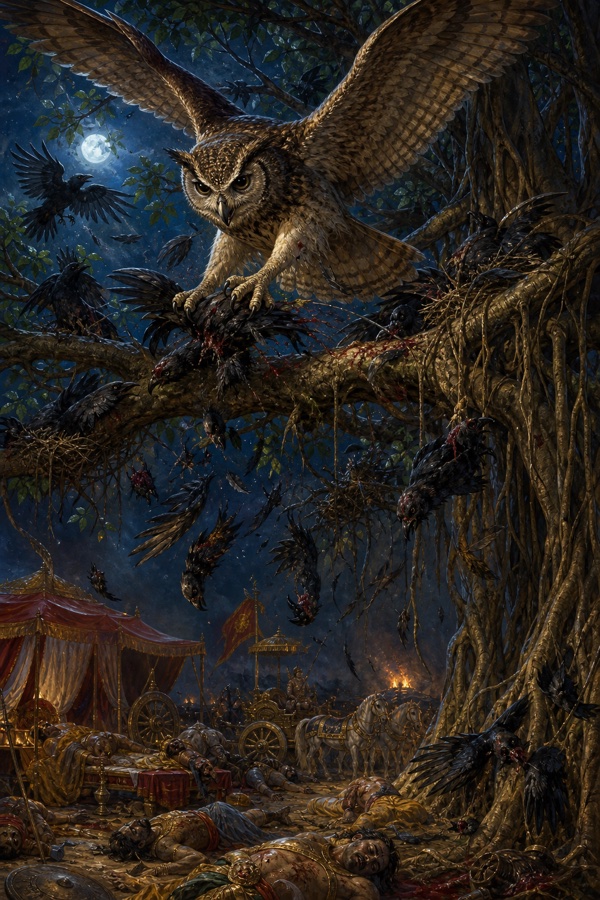
Drona’s son did not sleep. Wrath had hold of him, and reverence with it, and he lay breathing like a snake. He burned, and no sleep came near him at all. He let his eyes go over that terrible forest on every side, with all the creatures that lived in it, and they stopped on another large banyan, one that was covered with crows. Thousands of crows were roosting in it for the night. Each bird perched a little apart from its neighbor, and all of them slept at their ease.
While the birds slept there in safety on every side, Ashvatthama saw an owl come suddenly out of the dark. It was terrible to look at, huge in body, with a frightful cry, green eyes, tawny feathers, a very large beak, and long talons, and it came with the speed of Garuda, the bird who is the enemy of all snakes. Now it made only soft sounds. It came in among the branches of the banyan in secret, that ranger of the sky, that killer of crows, settled on a branch, and began to kill its sleeping enemies in great numbers. It tore the wings off some. It took the heads off others with its sharp talons. It broke the legs of many. It was very strong, and many that dropped before its eyes it killed as well. The ground under the spread of the banyan was soon covered thick on every side with the limbs and the bodies of crows. When the killing was done the owl was full of delight, like a man who has dealt with his enemies exactly as he pleased.
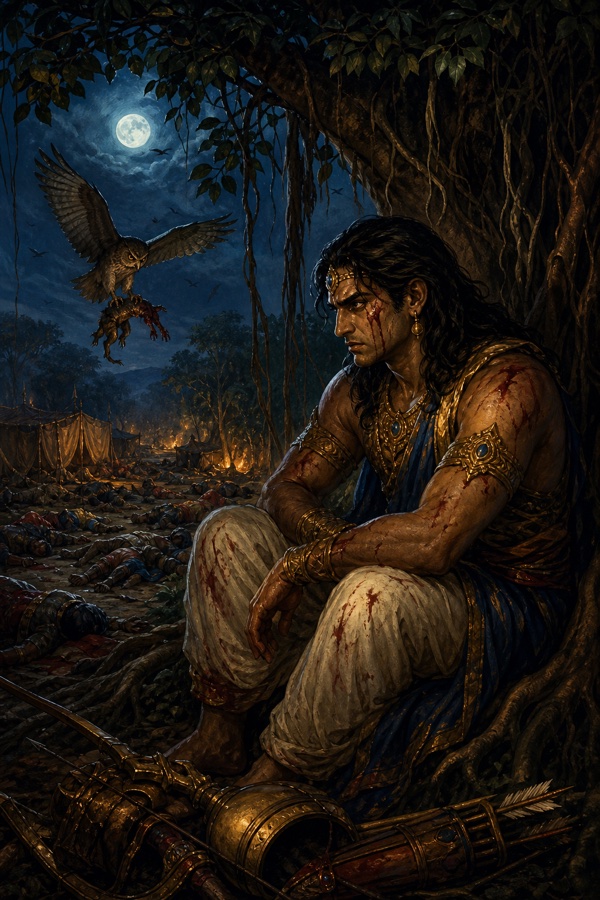
Drona’s son watched the whole of it, an act done in the night that seemed to speak straight to him, and he began to turn it over, wanting to shape his own conduct by the example.
“This owl has given me a lesson in war,” he said to himself. “I am bent on destroying the enemy, and the hour for it has come. The Pandavas have won, and I cannot kill them as they are. They are strong, they do not tire, they hit what they aim at, and they know how to strike. Yet in the king’s presence I swore that I would kill them. I have bound myself to a thing that will destroy me, like an insect that means to fly into a blazing fire. If I fight them fairly I will lose my life, there is no doubt of it. By guile I may still succeed, and a great destruction may still come upon my enemies. People in general, and the men who know the scriptures as well, always praise the means that are certain above the means that are uncertain. Whatever blame and ill repute this act brings, a man who lives by the Kshatriya’s practice ought to accept them. The Pandavas, with their unclean souls, have done ugly and blameworthy things at every step, things full of guile.”
He had verses to lean on as well. They were old ones, he told himself, full of truth, sung by men who saw what is true and kept to what is right, and who sang them only after weighing with care what justice demands. An enemy’s force should be struck, the verses ran, even when it is worn out, or wounded with weapons, or busy eating, or withdrawing, or resting inside its own camp. It should be dealt with in the same way when sleep has overcome it in the dead of night, or when it has lost its commanders, or when it is broken, or when it is laboring under some mistake.
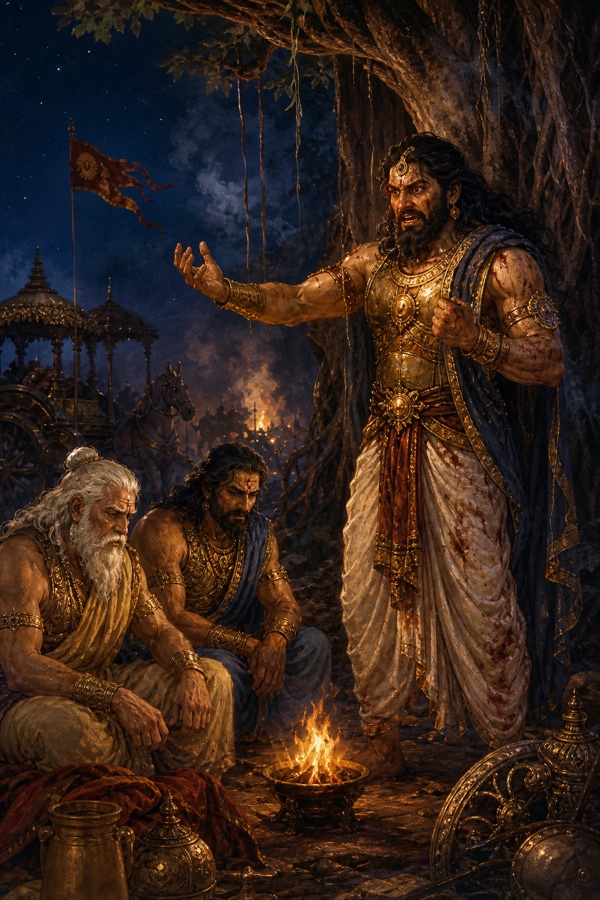
So he reasoned, and so the son of Drona came to his decision: he would kill the Pandavas and the Panchalas in the night, while they slept. The Panchalas were the people of King Drupada, whose daughter Draupadi was the Pandavas’ queen and whose son Dhrishtadyumna commanded the Pandava army. The resolve was a wicked one, and he pledged himself to it over and over. Then he woke his mother’s brother and the chief of the Bhojas. Kripa and Kritavarma came up out of sleep and heard what Ashvatthama meant to do, and shame filled them both, and neither could find an answer fit to give him.
A key to reading this (the owl’s sign): The parva takes its name, Sauptika, from the deed this owl sets in motion, a slaughter done in the hour of sleep. Ashvatthama takes the bird for a teacher. He has sworn before his king to kill men he cannot kill in open battle, and the owl among the sleeping crows shows him a way to keep the oath. He then looks for verses that will permit it, and he finds them.
Ashvatthama’s Lament and Kripa’s Counsel on Dharma
Ashvatthama thought for a little while, and when he spoke his eyes were full of tears. “King Duryodhana has been cut down,” he said, “the one hero of great strength for whose sake we made war on the Pandavas. He was lord of eleven akshauhinis, and he was struck down deserted and alone, by Bhimasena and a crowd of low men banded together. And Bhima has done a further wickedness. He has put his foot on the head of a man whose hair was bathed in the sacred water of a king’s anointing. Listen to the Panchalas. They are roaring and shouting and bursting into laughter, and in their joy they blow their conches and beat their drums. That noise of instruments, with the blare of the conches in it, is dreadful to hear, and the wind is carrying it into every quarter of the sky. Their horses are neighing, their elephants are grunting, their warriors are roaring. The din of men rejoicing as they march to their quarters, and the fearful clatter of their chariot wheels, comes to us out of the east. The Pandavas have made such havoc of the sons of Dhritarashtra that the three of us are the only men left from that great slaughter. Some of those who fell had the strength of a hundred elephants. Some were masters of every weapon. The sons of Pandu have killed them all the same, and I take it for one of the reversals that Time brings about. This is the end to which such a deed leads. The Pandavas have done things that were hard to do, and still this ought to be the result of what they did. If bewilderment has left you your wisdom, tell me what is right for us to do, with so heavy a ruin on us.”
“We have heard everything you said,” Kripa answered. “Now listen to a few words of mine. All men are subject to two forces and governed by them, destiny and effort. There is nothing higher than those two. What we do does not succeed through destiny alone, and it does not succeed through effort alone. Success comes when the two are joined, and every purpose, high or low, depends on their joining. Throughout the world it is through these two that men are seen to act and to hold back. What comes of the clouds pouring on a mountain? And what does not come of them when they pour on a plowed field? Effort where destiny is unfavorable, and idleness where destiny is favorable, are both without fruit. When the rains soak a well-tilled soil as they should, the seed gives a great yield, and a man’s success is of that kind. Sometimes destiny settles a course of events and then works by itself, waiting for nobody. Even so, the wise use their skill and take to effort. A man may take to effort, and the effort succeeds through destiny; it is through destiny as well that the man who sets to work, trusting his own exertion, arrives at success. And the effort of a capable man, well directed, is seen in this world to bear nothing when destiny does not go with it. That is why the idle and the dull among men speak against effort. The wise do not think as they do. An act once done is seldom seen to go without its fruit, and the failure to act is seen to bring heavy misery. You will find no man who gained something of itself with no effort made, and none who gained nothing whatever after effort. The man who keeps busy is able to support his life, and the idle man never comes to happiness. Those who are given to action are generally moved by the wish to earn some good, and whether such a man gains his object or misses it, no blame attaches to him. A man seen enjoying the fruits of action in luxury, having done nothing, earns ridicule and is hated. Whoever ignores this rule and lives otherwise does himself an injury. So the intelligent hold. Efforts fail for two reasons, destiny without exertion and exertion without destiny, and without exertion nothing in this world succeeds. The man who is devoted to action and has skill, and who bows to the gods before he seeks his object, is never lost. Neither is the man who, wishing for success, waits properly on the aged, asks them what is good for him, and follows the counsel they give. A man who exerts himself should always go for counsel to those whom the old approve. They are the unfailing root of means, and success depends on means. He who listens to the old first and applies his effort afterward soon reaps a great deal from it. He who goes after his purposes with no respect for those able to advise him, driven by passion, anger, fear, and greed, soon loses his prosperity.
“This Duryodhana was stained with greed and had no foresight. He took counsel with no one and set out, like a fool, after a purpose he had never thought through. He brushed aside everyone who wished him well and consulted only the wicked, and though he was told to stop, he went to war with the Pandavas, who are better than he is in every good quality. He was very wicked from the beginning. He could not hold himself in. He did not do what his friends asked of him. For all of that he is burning now in grief, with calamity all around him. And we followed that sinful man, and so this great calamity has come on us as well. It has scorched my understanding. I sink into thought and I cannot see what is good for us.
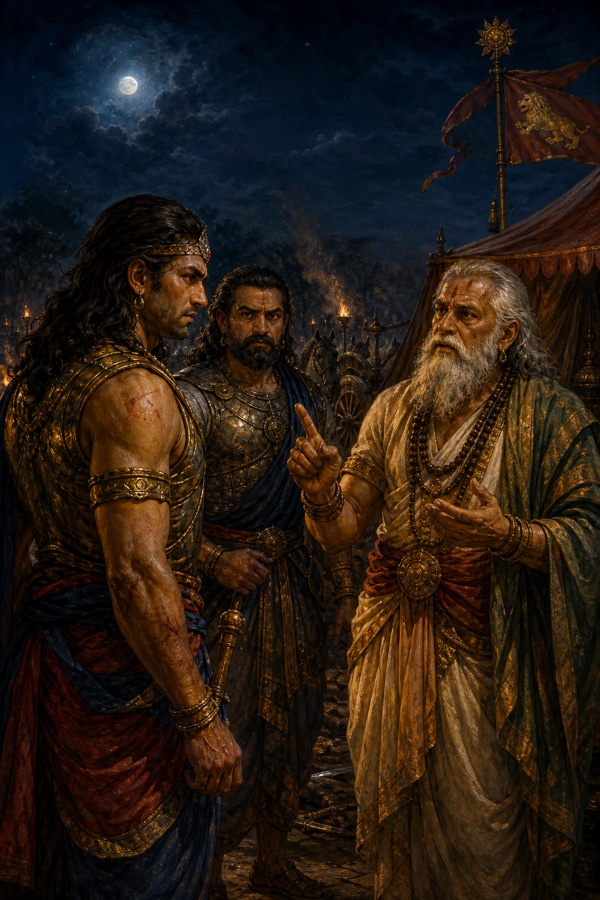
“A man whose own mind is clouded should ask his friends. In such friends he has his understanding, his humility, and his prosperity, and what he does should have its root in them. Whatever intelligent friends settle on by their own understanding and advise, that is the thing to do. So let us go to Dhritarashtra and to Gandhari and to Vidura, and ask them what we ought to do. They will tell us what is good for us after all that has happened, and we should do as they say. That is my settled resolve. Men whose acts do not succeed even after they have put in the effort should be counted, without any doubt, as struck down by destiny.”
Kripa’s words were sound, and there was right in them and advantage as well. Ashvatthama heard them and was overwhelmed with sorrow. Grief burned in him like a fire that has caught, and he fixed on a wicked resolve and spoke to the two of them. “The faculty of understanding is different in different men,” he said, “and each man is pleased with his own. Every man thinks himself more intelligent than the rest. Each respects his own understanding and gives it great praise, and each speaks ill of other men’s wisdom and well of his own, every time. Men whose judgments agree about some object they have not yet gained, though there are many things to weigh, are pleased with one another and applaud one another. Let Time bring reverses on those same men and their judgments turn against each other. And because human intellects differ, judgments are bound to differ most of all when the intellects are clouded. A skilled physician diagnoses a disease properly and then, applying his intelligence, prescribes a medicine to bring about a cure. In the same way men use their intelligence, helped by their own wisdom, to accomplish what they undertake, and other men disapprove of what they do. A man in his youth is under one kind of understanding. In middle age that understanding no longer holds with him, and in the time of his decay a different kind again becomes agreeable to him. Under terrible distress, or under great prosperity, a man’s understanding is seen to be badly shaken. In one and the same person, for want of wisdom, the understanding is one thing at one time and another at another, and what seemed acceptable once seems the reverse later. Still, when a man has resolved according to his wisdom, and the resolution is a good one, he should try to carry it out. Such a resolution ought to drive him to effort. All men begin gladly, Kritavarma, even on enterprises that lead to death, believing they can carry them through. All men rely on their own judgment and wisdom and try to accomplish their different purposes, knowing them to be for their good. A resolve has taken hold of my mind today, born of this great calamity of ours, and it is one that can drive out my grief. I will tell it to you both.”
A sub-tale: Ashvatthama argues his way to the deed from his own birth. The Creator, he says, made his creatures and gave each its work, and to each order a share of excellence: to the Brahmin the Veda, which stands first among all things; to the Kshatriya superior energy; to the Vaishya skill; to the Shudra the duty of serving the other three. So a Brahmin without self-restraint deserves blame, a Kshatriya without energy is base, a Vaishya without skill is to be faulted, and so is a Shudra who lacks humility. He himself was born in a high and honored family of Brahmins and by ill luck is wedded to the Kshatriya’s practice. To take up a Brahmin’s duties now, knowing a Kshatriya’s as he does, and to win some high end that way would have no nobility in it. He holds an excellent bow and excellent weapons. If he leaves his father’s killing unavenged, how will he open his mouth among men? So he will honor the Kshatriya’s duty without hesitation and walk tonight in the steps of his father and of the king.
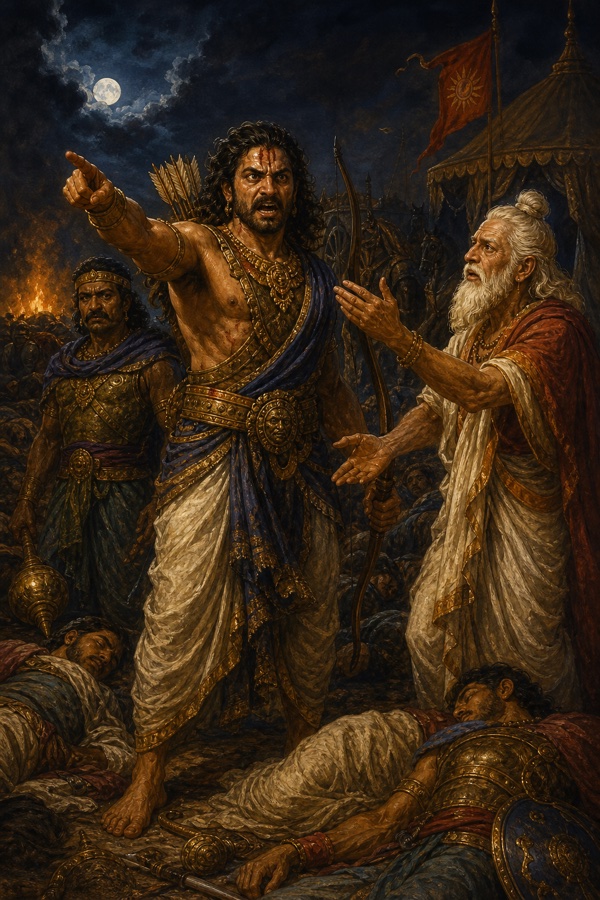
Then he told them. “The Panchalas are flushed with their victory. They will sleep tonight in trust, with their armor off, in high spirits, happy at the thought of what they have won and spent with toil and effort. While they sleep at their ease in their own camp I will make a great and terrible assault on it. I will fall on them as they lie senseless, dead in sleep, and kill them all, as Indra killed the Danavas, and I will show what I can do. I will kill them gathered in one place with their leader Dhrishtadyumna, as a blazing fire eats a heap of dry grass. When the Panchalas are dead I will have peace of mind. I will move among them in that killing like Rudra himself, the wielder of the bow Pinaka, in his rage among living creatures. When I have cut down every Panchala tonight I will turn, glad, on the sons of Pandu in battle. I will take their lives one after another and strew the earth with the bodies of all the Panchalas, and so pay what I owe my father. Tonight I will send the Panchalas down the hard road that Duryodhana and Karna and Bhishma and the ruler of the Sindhus have gone. Tonight I will put out my strength and grind the head of Dhrishtadyumna, king of the Panchalas, as the head of an animal is ground. Tonight, uncle, I will cut down with my sharp sword the sleeping sons of the Panchalas and of the Pandavas. And when I have wiped out the Panchala army in its sleep I will be happy, and I will hold that I have done my duty.”
The gist: Ashvatthama grieves aloud that Duryodhana was struck down by many and that Bhima set a foot on an anointed head, and he asks what is right to do. Kripa answers that success needs destiny and effort joined, that Duryodhana took no counsel and ruined them all, and that they should go and ask Dhritarashtra, Gandhari, and Vidura. Ashvatthama replies that every man trusts his own understanding, argues from his birth as a Brahmin living a Kshatriya’s life, and declares that he will kill the Panchalas tonight in their sleep, Dhrishtadyumna with them.
Kripa’s Last Restraint and Ashvatthama’s Unbending Will
“It is good fortune that your heart is set on vengeance today,” Kripa said. “The wielder of the thunderbolt himself could not turn you from it now. Both of us will go with you, though, in the morning. Take off your armor tonight, take down your standard, and rest. When you ride out against the enemy I will be with you, and Kritavarma of the Satvatas, both of us in mail and on our chariots. With us beside you, you will kill the Panchalas and all who follow them tomorrow, in the press of battle. You are able to do it if you put out your strength. So rest for this one night. You have kept awake for many nights. Sleep, come to the field fresh, and meet the enemy then, and you will kill him, there is no doubt of it. Indra himself among the gods would not venture to defeat you when you carry the finest weapons. And who is there, even the chief of the gods, who would fight Drona’s son when he comes with Kripa beside him and Kritavarma guarding him? Let us rest this night, then, and sleep, and shake off our weariness, and kill the enemy tomorrow morning. You are a master of the celestial weapons, and so am I. This Satvata is a great bowman and always skilled in a fight. Together, my son, we will put out our strength and kill our enemies gathered in battle, and great will be our happiness then. Put your cares away. Rest tonight and sleep well. Kritavarma and I will follow you in our armor, bows in hand, while you drive against them on your chariot. You will go to their camp and call out your name in battle and make a great slaughter of them. Tomorrow morning, in broad daylight, when you have made that slaughter, you will take your pleasure like Indra after he has killed the great Asuras. You are able to beat the army of the Panchalas as the slayer of the Danavas beat the Danava host in his rage. With me at your side and Kritavarma guarding you, the wielder of the thunderbolt himself could not stand against you. Neither I nor Kritavarma will ever leave a battle, my son, until the Pandavas are beaten. We will kill the angry Panchalas and the Pandavas with them and come away, or they will kill us and we will go to heaven. By every means we have, the two of us will help you in battle tomorrow morning. I am telling you the truth.”
His uncle’s words were meant for his good. Drona’s son heard them with his eyes red with rage. “Where is sleep to come from,” he answered, “for a man who is in pain, or a man in the grip of rage, or a man whose heart is forever turning over schemes for getting wealth, or a man under the power of lust? Look at me. All four of those causes are present in my case, and any one of them alone would destroy sleep. How great is the grief of a man whose heart never stops thinking of his father’s slaughter! My heart burns day and night and I find no peace. All of you saw how those sinful men killed my father, and the thought of it cuts through everything vital in me. How could a man like me live even a moment after hearing the Panchalas say that they have killed my father? I cannot bear the thought of going on living without having killed Dhrishtadyumna in battle. By killing my father he has made himself a man I may kill, and so have all who are joined with him. And who is so hard of heart that he would not burn after hearing what I have heard, the lament of the king as he lay with his thighs broken? Who is so empty of compassion that his eyes would not fill at such words from the king? The side I took has been defeated. That thought swells my sorrow as a rush of waters swells the sea. Guarded as they are by Krishna and Arjuna, I hold my enemies to be beyond the power of great Indra himself. I cannot hold down this wrath that is rising in my heart, and I see no man in this world who can quiet it. The messengers told me that my friends were defeated and that the Pandavas had won, and that burns in my heart. When I have made a slaughter of my enemies in their sleep, then I will rest, and then I will sleep with nothing weighing on me.”
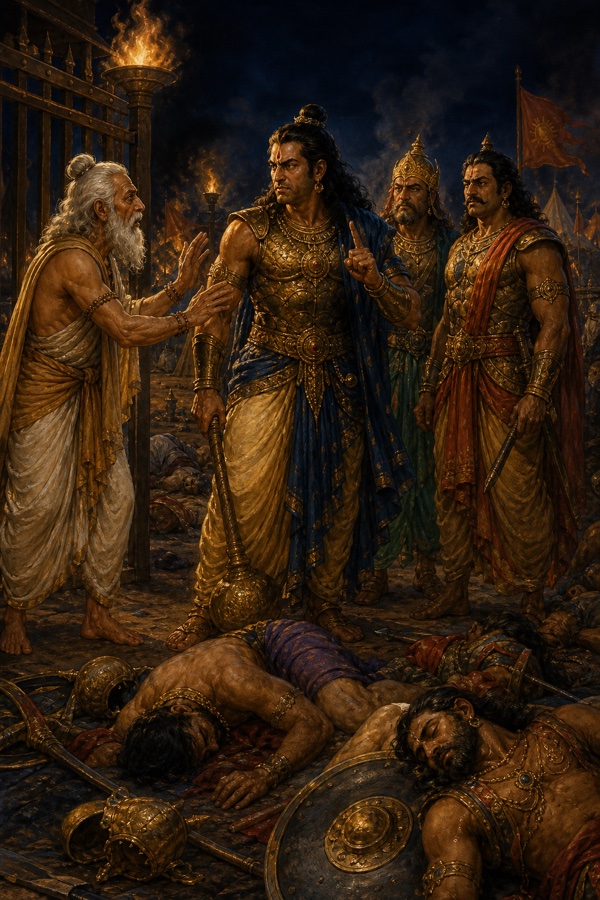
“A man without intelligence, who has not mastered his passions, cannot understand all that right conduct involves, even if he waits dutifully on his elders. That is my opinion,” Kripa said. “An intelligent man who does not practice humility fails in the same way to grasp what is settled about right and wrong. A brave man with no understanding may wait on a learned man all his life and never come to know his duties, as a wooden ladle never tastes the soup it lies in. A wise man waits on a learned man for a moment and knows his duties, as the tongue tastes the soup the instant it touches it. The man who has intelligence, who waits on his elders, and who keeps his passions in check comes to know every rule of right conduct, and he never disputes what all men accept. An ungovernable, irreverent, sinful man of wicked soul commits sin when he seeks his own good in defiance of destiny. Those who wish a friend well try to hold him back from sin. He who lets himself be turned wins prosperity, and he who does otherwise reaps misery. As a man whose mind is disordered is restrained with soothing words, so a friend should be restrained by those who wish him well, and the man who allows it never becomes the prey of misery. When a wise friend is about to do a wicked thing, well-wishers who have wisdom try again and again, as far as their power goes, to hold him back. Set your heart on what is truly good for you, my son. Restrain yourself by your own self and do as I ask, so that you will have nothing to repent of afterward. In this world the killing of sleeping men is not approved by the teaching of religion. It is the same with men who have laid down their arms and come down from chariot or horse. Those who say ‘We are yours’ are not to be killed, nor those who surrender, nor those whose hair is loose, nor those whose animals have been killed under them or whose chariots are broken. All the Panchalas will sleep tonight with their armor off. Sunk trustfully in sleep, they will be like dead men. The crooked-minded man who makes war on them then will sink, that much is plain, into a deep and shoreless hell with no raft except himself. You are known in this world as the first of all who understand weapons. Up to now you have committed no trespass, even the smallest. When the sun rises tomorrow and light shows everything as it is, you will conquer the enemy in battle, shining like a second sun. This blameworthy deed, so impossible in a man like you, will look like a red spot on a white sheet. That is what I think.”
“It is as you say, uncle. There is no doubt of it,” Ashvatthama said. “The Pandavas, though, broke the bridge of right conduct into a hundred pieces long before tonight. With every king looking on, and before your own eyes, my father laid down his weapons and Dhrishtadyumna killed him. Karna, a chariot fighter with few equals, was killed by the wielder of the bow Gandiva after his wheel had sunk and he stood in great distress. Bhishma, the son of Shantanu, had put his weapons aside and was unarmed when Arjuna killed him, with Shikhandi set in front. The great bowman Bhurishravas had sat down on the field in praya, the vow of a man who sits to die, when Satyaki killed him, and all the kings were crying out against it. And Duryodhana met Bhima with the mace and was struck down unrighteously with all the kings of the earth watching. The king stood alone, with a great number of chariot fighters standing around him, and in that condition Bhimasena brought him down. The messengers carried the news about, and from them I heard how the king lamented, lying on the ground with his thighs broken, and it cuts me to the core of the heart. Such are the Panchalas, unrighteous and sinful, who have thrown down the barrier of virtue. Why do you not blame them, who have crossed every limit? They killed my father. When I have killed them in the night, buried in their sleep, I do not care if I am born a worm or a winged insect in my next life. What I have resolved is hurrying me toward its doing. Hurried like this, how am I to have sleep or happiness? The man has not been born in this world, and will not be born, who can turn aside the resolve I have formed for their destruction.”
A key to reading this (a moral knot): Kripa names the men a warrior may not kill: the sleeping, those who have laid down their arms or come down from chariot or horse, those who say “We are yours,” those who surrender, those whose hair is loose, those whose animals are dead or whose chariots are broken. Ashvatthama grants every word of it. His answer is a list of his own: Drona killed after he laid down his weapons, Karna with his wheel sunk, Bhishma disarmed with Shikhandi set in front of Arjuna, Bhurishravas in the vow of praya, Duryodhana brought down unfairly with the mace. He lays that list beside Kripa’s rule and counts the broken rules of the Pandava side as his license.
The Fearsome Form at the Gate and the Praise of Shiva
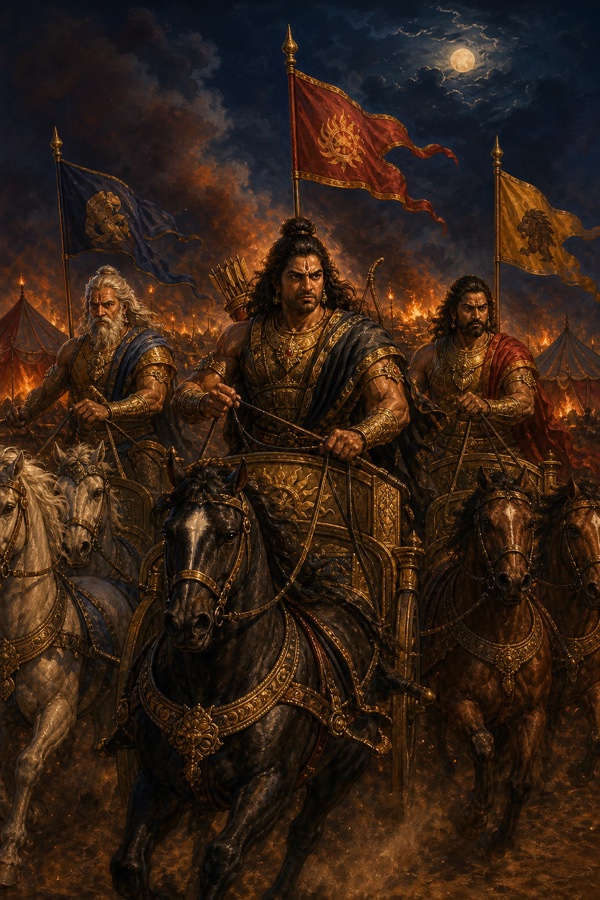
With those words the son of Drona yoked his horses to his chariot, off at one side, and set out in the direction of his enemies.
“Why are you yoking your horses? What are you going to do?” the Bhoja chief and Kripa, the son of Sharadvat, called to him. “We have made up our minds to go with you tomorrow. We share your good and your ill. You have no cause to mistrust us.”
Ashvatthama was full of rage, with his father’s killing in his mind, and he told them truly what he had resolved to do. “My father had killed warriors in their hundreds and thousands with his sharp arrows, and he had laid his weapons aside when Dhrishtadyumna killed him. I will kill that killer tonight in the same condition, when he has laid aside his armor. The sinful son of the Panchala king I will kill by a sinful act. I mean to kill that prince like an animal, so that he does not reach the worlds that are won by men who die under weapons. Put on your coats of mail at once, take your bows and your swords, and wait for me here.”
He climbed onto his chariot and drove off toward the enemy, and Kripa and Kritavarma of the Satvatas both followed him. The three of them, going against the enemy, shone like three fires blazing at a sacrifice when the clarified butter has been poured on them. They went toward the camp of the Panchalas, where every man was asleep. At the gate Drona’s son, a great chariot fighter, stopped.
“When Drona’s son stopped at the gate of the camp, Sanjaya, what did those two great chariot fighters do, Kripa and Kritavarma?” Dhritarashtra asked. “Tell me that.”
Drona’s son called Kritavarma and Kripa to him, Sanjaya said, and went up to the gate full of rage. A being stood there guarding the way in. His body was enormous, the sight of him made the hair rise, and he shone with the light of the sun or the moon. A tiger skin dripping blood was wrapped around his loins, and he wore a black deerskin for his upper garment. A great snake served him as the sacred thread. His arms were long and massive and held many kinds of weapons raised, and around his upper arm, where an armlet would sit, another large snake was wound. His mouth seemed to blaze with fire. It stood open and dreadful, and his teeth made his face terrible to see. Thousands of beautiful eyes covered that face. There were no words for his body or for what he wore. The mountains themselves, at the sight of him, would have split into a thousand pieces. Flames seemed to pour from his mouth and his nose and his ears and from all those thousands of eyes, and out of the flames came figures of Hrishikesha, which is a name of Krishna, in their hundreds and thousands, armed with conches and discuses and maces.
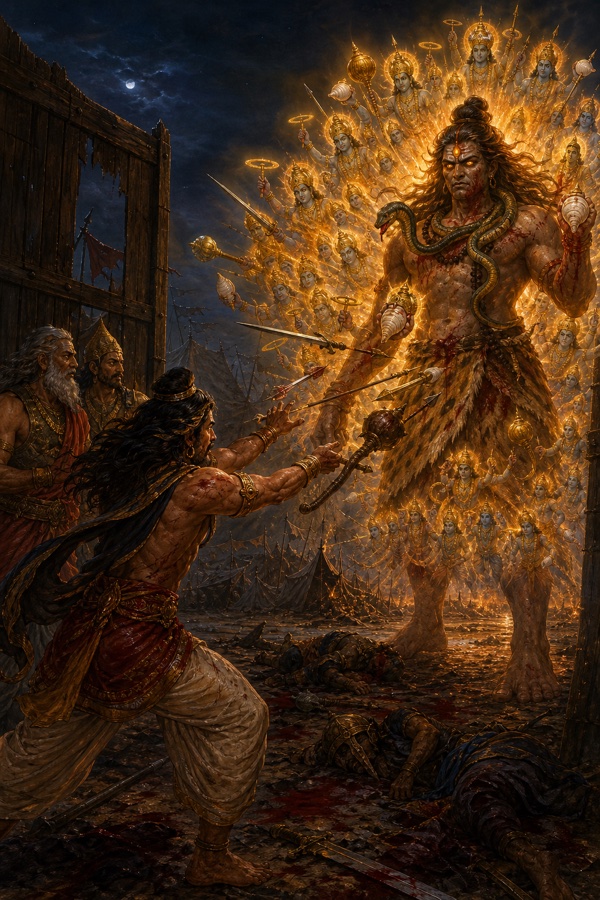
The sight of that being could have filled the whole world with terror. Drona’s son felt nothing stir in him, and he covered the being with showers of celestial weapons. The being ate them. Every arrow Ashvatthama shot he swallowed, as the vadava fire swallows the waters of the ocean. Ashvatthama saw his arrows come to nothing and hurled a long dart at him that blazed like a flame. Its burning point struck the being and the dart broke in pieces, like a huge meteor at the end of the yuga that strikes the sun and breaks and drops out of the sky. Without losing a moment he pulled from its sheath an excellent scimitar the color of the sky, with a hilt of gold. It came out like a blazing snake from its hole. He threw it, and the blade reached the being, went into his body, and was gone, like a mongoose going into its burrow. In a rage now, the son of Drona hurled a blazing mace the size of a pole set up in Indra’s honor. The being swallowed that as well.
At last every weapon he had was spent. Ashvatthama looked around him and saw the whole sky packed thick with images of Krishna. He stood without a weapon, looking at that wonder, and Kripa’s words came back to him. He went pale with grief. “The man who will not listen to the good advice of friends has to repent when calamity overwhelms him,” he said, “as I, fool that I am, repent of brushing aside the two who wished me well. The fool who ignores the way the scriptures point out and goes to kill his enemies falls off the path of right and is lost in a trackless wilderness of sin.
“No weapon is to be cast at cattle, at Brahmins, at kings, at women, at friends, at one’s own mother, at one’s own teacher, at a weak man, an idiot, a blind man, a sleeping man, a terrified man, a man just risen from sleep, a drunken man, a madman, or a man who is off his guard. The teachers of old always pressed this truth on men. I set aside the eternal way the scriptures point out and tried to walk a wrong road, and I have fallen into terrible distress. The wise call it a terrible calamity when a man starts on a great deed and then falls back from it in fear. And I cannot do what I have sworn to do by my own skill and strength alone. Human effort is never held to count for more than destiny. When a thing a man has begun does not succeed, and destiny is the cause, he becomes like one who has left the path of right and is lost in the wilderness of sin. The sages call it folly and defeat when a man begins an act and swerves from it out of fear. This calamity has come on me because what I attempted was wicked. Otherwise Drona’s son would never have been forced to hold back from a fight.
“And this being I see in front of me is the greatest wonder of all. He stands there like the rod of divine punishment lifted up. I think hard and still I cannot tell who he is. He must be the terrible fruit of my own sinful purpose, which I tried to carry out by unrighteous means, and he stands there to defeat it. So this falling back from the fight was ordained for me by destiny, and it is useless for me to strive for my purpose unless destiny turns my way. In this hour, then, I will seek the protection of Mahadeva. He will take away this dreadful rod of punishment that is raised before me. I will take shelter with that god, the source of every good, the lord of Uma, who is called Kapardin, who wears a garland of human skulls, who tore out the eyes of Bhaga, and who is called Rudra and Hara. In austerities and in power he far surpasses all the gods. I will seek the protection of Girisha, who carries the trident.”
So he reasoned. Then the son of Drona got down from the floor of his chariot and stood with his head bent to that supreme god. “I seek the protection of him who is called Ugra, Sthanu, Shiva, Rudra, Sharva, Ishana, Ishvara, Girisha,” he said, “the boon-giving god who is the creator and lord of the universe; whose throat is blue, who was never born, who is called Shakra, who destroyed the sacrifice of Daksha, and who is called Hara; whose form is the universe, who has three eyes and many forms, and who is the lord of Uma; who lives in the burning grounds, who swells with energy, who is lord of the tribes of ghostly beings and holds prosperity and power that never decay; who carries the skull-topped club, who is called Rudra, who wears matted hair on his head, and who is a brahmachari. I purify this soul of mine, which is so hard to purify, and small as my strength is, I adore the destroyer of the triple city and offer myself as the victim. You have been hymned, you deserve hymns, and I hymn your glory. Your purposes are never turned aside. You are robed in skins. Your hair is red, your throat is blue, and no one can bear you or resist you. You are pure. You are the creator of Brahma, and you are Brahman. You are a brahmachari, a keeper of vows, given to austerities. You are infinite, and you are the refuge of all ascetics. You have many forms, and you lead the many tribes of ghostly beings. You have three eyes. You are fond of those who are called your companions. The lord of treasures always sees you. You are dear to Gauri’s heart, and you are the father of Kumara. You are tawny, and a bull carries you. Your dress is fine, you are most fierce, and you are eager to adorn Uma. You are higher than all that is high, higher than everything, and nothing is higher than you. You bear weapons. You are beyond measure, and you protect every quarter. You wear golden armor, you are divine, and the moon is an ornament on your brow. With my whole mind gathered, I seek your protection, god. To come through this dreadful distress, which is so hard to come through, I sacrifice to you, the purest of the pure, and I offer for your acceptance the five elements of which my body is made.”
A key to reading this (the gate-guardian’s secret): Ashvatthama cannot tell who the being is, and he takes it for the fruit of his own sinful purpose. The explanation comes from Mahadeva when he appears: Krishna had worshiped him, and for Krishna’s sake and at his word he had been protecting the Panchalas and showing many kinds of illusion. The guardian who swallows every weapon, with figures of Krishna streaming from his flames and filling the sky, belongs to that protection.
The Golden Altar, the Ghostly Hosts, and Mahadeva Entering Ashvatthama
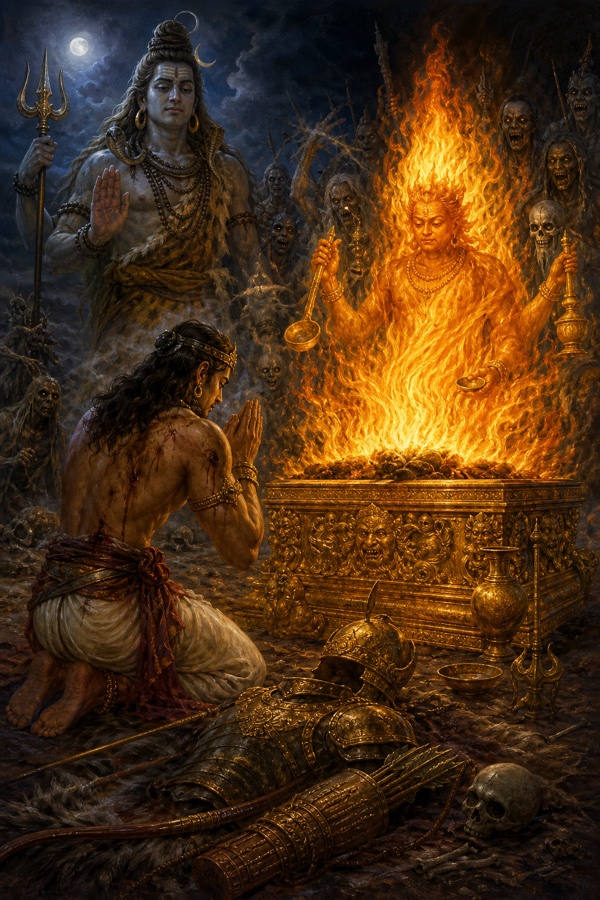
As soon as that resolve of his was known, and what he wanted by it, a golden altar appeared before the son of Drona. On the altar a fire blazed up and filled every quarter of the sky, the four directions and the points between, with its light. Great beings appeared there too, with blazing mouths and eyes, with many feet and heads and arms, wearing armlets set with gems, their arms raised, and they looked like elephants and like mountains. Their faces were the faces of hares and boars and camels, of horses and jackals and cows, of bears and cats and tigers and leopards, of crows and apes and parrots. Some had the faces of great snakes and some the faces of ducks, and all of them shone. Some had the faces of woodpeckers and jays, of tortoises and alligators and porpoises, of huge sharks and whales, of lions and cranes and pigeons and elephants and stags. Some had faces like ravens and hawks. Some had ears on their hands. Some had a thousand eyes, some had very large stomachs, and some had no flesh on them. Some had no heads, and some had the faces of bears. The eyes of some were like fire, and some were the color of fire. The hair on the heads and bodies of some was burning. Some had four arms, and some had the faces of sheep and goats. Some were the color of conch shells, some had faces like conches, some had ears like conches, some wore garlands of conches, and the voices of some were like a conch being blown. Some wore matted locks, some had five tufts of hair, and some were bald. Some had lean bellies. Some had four teeth, some had four tongues, some had ears straight as arrows, and some wore diadems on their brows. Some had strings of grass around their bodies, and some had curling hair. Some wore head-dresses of cloth and some wore coronets; some had beautiful faces, and some were covered with ornaments, ornaments of lotuses or of other flowers. There were hundreds of them, and thousands.
They were armed. Some carried shataghnis, some thunderbolts, some pestles; some had bhushundis, some nooses, some maces. Some had quivers of good arrows slung on their backs, and all of them were fierce in a fight. Some carried standards with banners and bells, and some carried battle-axes. Some held great nooses in their raised arms, some clubs and bludgeons, some stout posts, some scimitars. Some wore snakes with lifted heads for diadems, some had large snakes wound on their upper arms for armlets, and some had beautiful ornaments on their bodies. Some were grimed with dust and some were smeared with mud, and all of them were dressed in white. Some had blue limbs and some had tawny ones, and some had no beards. Those beings, the companions of the god, golden in color and full of joy, played on drums and horns and cymbals, on jharjharas and anakas and gomukhas. Some sang. Some danced about with loud cries, and some leaped forward and cut capers and jumped sideways. They were very fast, and they ran about most fiercely with the hair streaming on their heads, like huge elephants in rut that keep on roaring. They were terrible to look at, armed with lances and battle-axes, dressed in robes of many colors and wearing fine garlands and scented paste. With their gem-set armlets and their raised arms they were full of courage, able to kill any enemy by force, and no one could withstand them. They drank blood and fat and lived on the flesh and the entrails of animals. Some had their hair tied in tall tufts above their heads, some had a single tuft, some had rings in their ears, and some had bellies like the earthen pots used for cooking. Some were very short and some were very tall, and some were tall and very fierce. Some had grim features, some had long lips, and some had very long genitals. Some wore costly crowns of many kinds, some were bald, and some had heads covered with matted locks. They could bring the sky down to the earth with its sun and moon and stars, and they could wipe out the four orders of created things. They do not know what fear is, and they can endure the frown of Hara. They always do as they like, and they are lords over the lords of the three worlds. They are always at their merry sports, they are complete masters of speech, and they are entirely free of pride; they have gained the eight kinds of divine power and it has never made them proud. The god Hara is always amazed at their feats. They are his devoted worshipers. They adore him in thought, word, and deed, and in thought, word, and deed he protects them as children of his own body. In their rage they always drink the blood and fat of all who hate Brahman. They always drink, too, the soma juice with its four kinds of taste. Having adored the trident-bearing god with recitation of the Veda, with brahmacharya, with austerities, and with self-restraint, they have gained the companionship of Bhava. Maheshvara, lord of the past, the present, and the future, eats with those many tribes of mighty beings who share his nature, and so does Parvati.
They made the universe ring with the sound of their many instruments, with laughter, with loud cries and shrieks and roaring like lions, and they came up to Ashvatthama. They sang the praises of Mahadeva and spread a blazing light around them. They wished to add to Ashvatthama’s honor and to the glory of Hara. They wished to learn how far Ashvatthama’s energy went, and they wished to see the slaughter in the hour of sleep. They carried terrible and fierce bludgeons and fiery wheels and battle-axes, that crowd of strange beings in terrible shapes, and they came from every side. The sight of them could have filled the three worlds with dread. Ashvatthama looked at them and felt no fear. With his bow in his hand and his fingers cased in guards of iguana skin, he offered himself up as the victim to Mahadeva. In that sacrifice bows were the fuel, sharp arrows were the ladles, and his own soul with all its strength was the libation. Then the son of Drona, full of valor and of wrath, offered up his own soul as the victim with propitiating mantras. He adored Rudra of fierce deeds with fierce rites, joined his hands, and spoke to the god.
“I am sprung from the line of Angiras,” Ashvatthama said, “and I am about to pour my soul as a libation on this fire. Accept this victim, lord. In this hour of distress, soul of the universe, I offer up my own self as the sacrificial victim, out of devotion to you and with my heart gathered in meditation. All creatures are in you and you are in all creatures. Every high quality is gathered in you. You are the refuge of all creatures. I cannot defeat my enemies, and so I wait as a libation for you. Accept me, god.”
With those words Drona’s son went up onto the altar where the fire was burning bright, offered himself as the victim, and walked into the blaze.
He stood in it without moving, his hands raised, an offering made to the god himself. Mahadeva saw him so and appeared in person, smiling. “Krishna, whose deeds are pure, has worshiped me as he should,” the god said, “with truth, with purity, with sincerity, with resignation, with austerities, with vows, with forgiveness, with devotion, with patience, with thought, and with word. For that there is none dearer to me than Krishna. To honor him, and at his word, I have protected the Panchalas and shown many kinds of illusion. By protecting the Panchalas I have honored him. Time has come upon them now. The span of their lives has run out.”
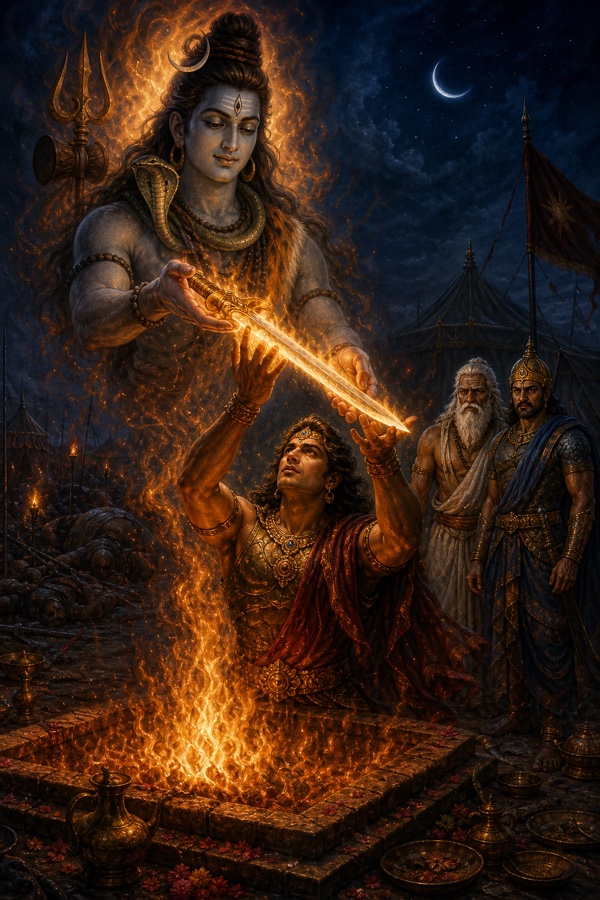
Having said that to Ashvatthama, Mahadeva gave him an excellent polished sword and entered his body. Filled with the god, Drona’s son blazed with energy, and with that strength drawn from godhead no one could stand against him in battle. Many unseen beings and Rakshasas went along on his right and on his left as he set out, like the lord Mahadeva himself, to enter the camp of his enemies.
The gist: At the gate a guardian swallows every weapon Ashvatthama has, and the sky fills with images of Krishna. Disarmed, he turns to Mahadeva, praises him by his names, and steps into the fire on a golden altar as the offering, while the god’s companions gather to watch. Mahadeva appears and says that he has guarded the Panchalas until now for Krishna’s sake and that their time has run out. He gives Ashvatthama a sword and enters his body.
Into the Camp and the End of Dhrishtadyumna
Kripa and Kritavarma stayed at the gate while the son of Drona went on toward the camp. Ashvatthama saw that they were ready to do their part, and it filled him with joy. He spoke to them in a whisper. “If the two of you put out your strength, you are enough to wipe out all the Kshatriyas there are. What then is this remnant of an army, and a remnant sunk in sleep? I will go into the camp and move through it like Yama, the lord of death. See to it, both of you, that no man gets past you alive.”
Then he went into the great camp of the Pandavas. He put away all fear and entered at a place where there was no gate. Once inside he went very softly, steering by signs, toward the quarters of Dhrishtadyumna. The Panchalas had done great things in the battle and were very tired. They slept in confidence, gathered together, one lying by the next. Drona’s son came into Dhrishtadyumna’s chamber and saw the prince of the Panchalas asleep in front of him. He lay on a costly bed spread with a beautiful sheet of silk. Wreaths of fine flowers were strewn over it, and it was scented with powdered incense.
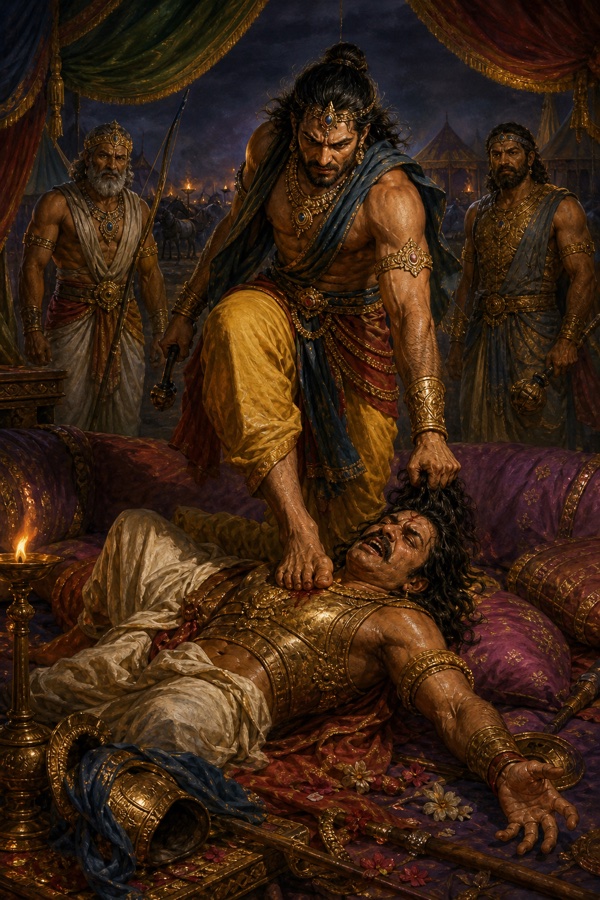
Ashvatthama woke him with a kick. The prince had been sleeping in trust, with no fear in him. He felt the kick, came awake, and knew the son of Drona standing over him. He started to rise from the bed. Ashvatthama took him by the hair of his head and pressed him down against the ground with both hands. Held down with that strength, and with fear and sleep both on him, the prince could not bring his own strength to bear. Ashvatthama struck him with his foot on the throat and on the chest while he twisted and roared, and set about killing him as an animal is killed. The Panchala prince tore at Ashvatthama with his nails. At last he said, low, “Teacher’s son, kill me with a weapon. Do not make it long. Let me go by your hand to the worlds of the righteous.”
He said that much and no more. The strength bearing down on him was too great, and the son of the Panchala king fell silent. Drona’s son had heard the blurred words. “Disgrace of your family, there is no world for men who kill their teachers,” he said. “For that reason, you of the wicked mind, you do not deserve to die by any weapon.”
While he was still speaking, Ashvatthama, in his rage, began to drive his heels hard into the vital parts of the man under him, and he killed him so, as a lion kills a maddened elephant. Dhrishtadyumna cried out while he was being killed, and the cries woke his wives and the guards who were in the tent. They saw someone crushing the prince with a force beyond a man’s, took the attacker for a being from outside nature, and for fear made no sound at all. By those means Ashvatthama sent him to Yama’s house. Then he went out, got up onto his fine chariot, and stood in it. Coming away from Dhrishtadyumna’s quarters he made every quarter of the sky ring with his roars, and he drove on to other parts of the camp to kill his enemies.
A sub-tale: Dhrishtadyumna, son of the Panchala king and commander of the Pandava forces, is the man who killed Drona after Drona had laid down his weapons. Ashvatthama told Kripa and Kritavarma beforehand what he intended: to kill him like an animal, so that he would not reach the worlds won by men who die under weapons. The prince asks for a weapon with his last words, and Ashvatthama refuses it, telling him that the killer of a teacher has no world to go to.
Slaughter Across the Camp
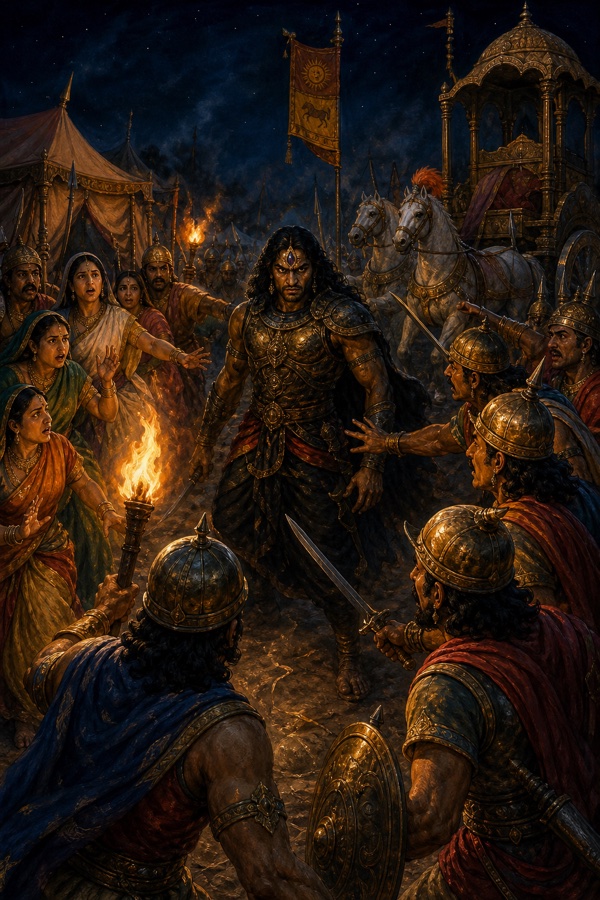
When the son of Drona had gone, the women and all the guards raised a loud cry of grief. The wives of Dhrishtadyumna saw their king lying dead and wept in great sorrow. At that wailing many Kshatriyas woke, put on their armor, and came to ask what the cries meant. The women were terrified at what they had seen of Ashvatthama, and in pitiful voices they begged the men to go after him at once. “Whether he is a Rakshasa or a man, we do not know what he is,” they said. “He has killed the Panchala king, and he is standing there.” At that those warriors quickly surrounded Drona’s son. He killed all of them with the weapon of Rudra.
With Dhrishtadyumna dead and those followers of his dead, he saw Uttamaujas asleep on his bed. He set his foot on the man’s throat and chest and killed him too, while Uttamaujas twisted in agony. Yudhamanyu came up. He believed a Rakshasa had killed his comrade, and he struck Drona’s son quickly in the chest with a mace. Ashvatthama rushed at him, seized him, brought him down to the ground, and killed him like an animal while he shrieked aloud.
From Yudhamanyu he went on against the other chariot fighters of the king, who were all asleep. They trembled and shrieked, and he killed them all, like animals at a sacrifice. Then he took up his sword and killed many more. He went along the paths of the camp one after another, a man skilled with the sword, and he found the companies in their quarters, the warriors in them unarmed, tired, and asleep, and he killed them in a moment. With that sword he cut down fighting men and horses and elephants. He was covered all over with blood, and he looked like Death himself sent out by Time. The strokes of his sword were of three kinds, and they fell again and again, and his enemies shook under them while the blood bathed him. Covered in blood, with the blazing sword in his hand, he moved through that fight in a shape that was terrible and beyond a man’s. Those who woke were stunned by the loud noise around them. They saw Drona’s son and looked into one another’s faces and trembled. The Kshatriyas who saw that shape believed he was a Rakshasa, and they shut their eyes.
The Killing of Draupadi’s Five Sons and Shikhandi, and the Vision of Death-Night
Ashvatthama went on through the lanes like Yama in that terrible shape, and at last he came on the sons of Draupadi and on what remained of the Somakas. The noise had alarmed the sons of Draupadi, and they had learned that Dhrishtadyumna was dead. They were great chariot fighters. They took their bows and, without fear, poured their arrows on the son of Drona. Their noise woke the Prabhadrakas, and with Shikhandi at their head the Prabhadrakas began to grind Ashvatthama with arrows as well. He saw the arrows coming down on him and gave a loud roar, and he wanted those chariot fighters dead. He remembered his father’s death and rage filled him. He got down from the floor of his chariot and rushed at them. He took up his bright shield with its thousand moons and his heavy celestial sword, which was worked with gold, and he ran at the sons of Draupadi and laid about him.
He struck Prativindhya in the belly, and Prativindhya fell to the ground dead. Sutasoma put a lance into the son of Drona and then rushed at him with his sword raised. Ashvatthama cut off Sutasoma’s arm with the sword still in its grip and struck him again in the side, and Sutasoma fell, dead. Shatanika, the son of Nakula, took up a chariot wheel in both hands and drove it hard against Ashvatthama’s chest. Ashvatthama came at him with force when the wheel had been thrown. Shatanika, badly shaken, fell to the ground, and Drona’s son cut off his head. Then Shrutakarma took up a spiked club and attacked. He ran at Drona’s son in fury and struck him hard on the left side of the forehead. Ashvatthama struck Shrutakarma in the face with his sword. Shrutakarma lost his senses and fell lifeless on the earth, his face disfigured. At the noise Shrutakirti came up, a great chariot fighter, and poured showers of arrows on Ashvatthama. Ashvatthama took the arrows on his shield and cut from its trunk his beautiful head, with the rings in its ears.
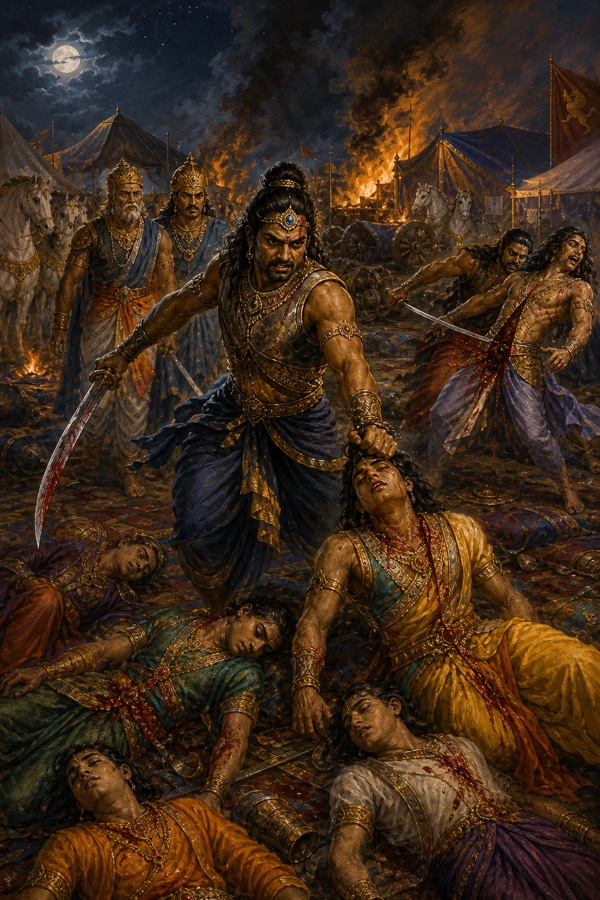
Then Shikhandi, the slayer of Bhishma, came at him with all the Prabhadrakas, from every side, with weapons of many kinds. Shikhandi put an arrow into Ashvatthama between the two eyebrows. Rage filled Drona’s son at that. He closed with Shikhandi and cut him in two with the sword. With Shikhandi dead he rushed in fury at the rest of the Prabhadrakas, and he went against what remained of Virata’s force as well. He made a heavy slaughter among the sons and the grandsons and the followers of Drupada, picking them out one after another. Then he ran at other fighting men and cut them down with his sword.
A key to reading this (Draupadi’s five sons): Five princes die here, in this order: Prativindhya, Sutasoma, Shatanika, Shrutakarma, and Shrutakirti. Only Shatanika is named with his father in this passage, as the son of Nakula. The list at their birth gives Prativindhya to Yudhishthira, Sutasoma to Bhima, Shrutakarma to Arjuna, Shatanika to Nakula, and Shrutasena to Sahadeva; Draupadi’s own list, spoken to Krishna in the forest, gives Shrutakirti to Arjuna and Shrutakarma to the youngest brother. Shikhandi, who was set in front of Arjuna when Bhishma fell and is called here the slayer of Bhishma, is cut in two the same night.
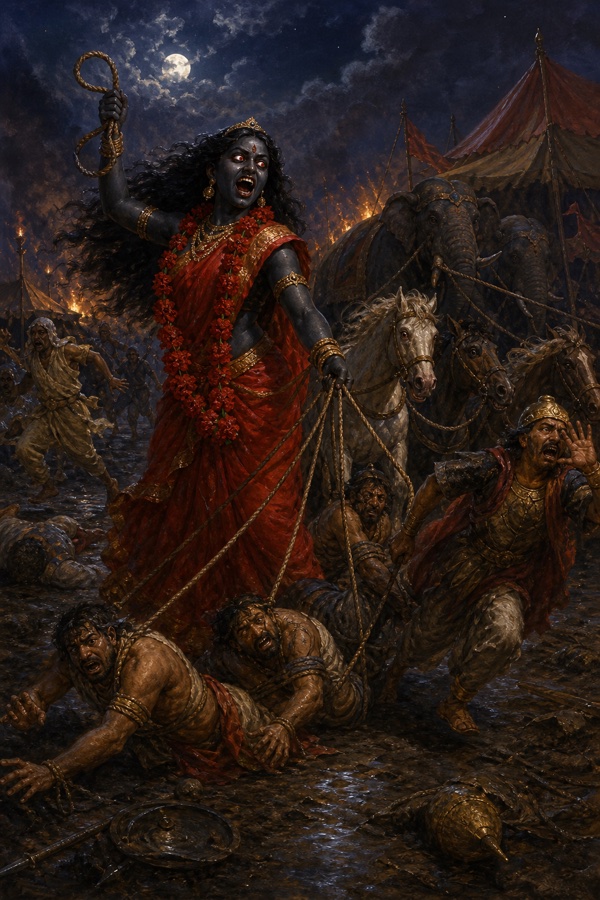
The warriors in the Pandava camp saw Death-Night herself that night, in bodily form. She was a black figure with a bloody mouth and bloody eyes. She wore crimson garlands and was smeared with crimson paste, and a single piece of red cloth was her whole dress. She had a noose in her hand and the look of an elderly woman, and she stood full in front of them, chanting a dismal note, about to lead away men and horses and elephants all bound in one stout cord. She seemed to be taking away spirits of many kinds, with their hair loose, tied together in the cord, and many great chariot fighters with them, stripped of their weapons. They had seen her before. On other days the best warriors of the Pandava camp used to see that figure in their dreams, leading the sleeping fighters away, and Drona’s son striking them from behind. The Pandava soldiers had seen the woman and Drona’s son in their dreams every night from the day the battle between the Kurus and the Pandavas began. Destiny had struck them already. Now Drona’s son struck them, and his roars filled all of them with terror. Those brave men remembered what they had seen in their dreams and knew it for the thing in front of them.
At the noise, Pandava bowmen woke in the camp in their hundreds and thousands. Ashvatthama cut off the legs of some and the hips of others, and some he pierced in the side, moving among them like the Destroyer set loose by Time. The ground was soon covered with men crushed out of shape, or trodden down by elephants and horses, and with others who roared in their pain. Many cried out loud: “What is this?” “Who is this?” “What is that noise?” “Who is doing what?” While they cried out, Drona’s son became their destroyer. He sent to Yama’s country all those Pandus and Srinjayas who had no armor and no weapons. The noise terrified many out of their sleep. Fear had them, sleep blinded them, their senses were gone, and they seemed to melt away. The thighs of many would not hold them, and many were so dazed that all their energy left them. Shrieking and afraid, they began to kill one another. Drona’s son got up once more onto his chariot with its terrible clatter, took his bow, and sent many to Yama’s house with his arrows. Others woke, brave men, and came toward Ashvatthama, and they were killed before they could reach him and so were offered up as victims to that Death-Night. He crushed many under the chariot as he drove through the camp, and he covered his enemies with shower on shower of arrows. Then again he went among them with his beautiful shield, marked with a hundred moons, and his sword that was the color of the sky. Drona’s son churned the camp of the Pandavas as an elephant churns a large lake.
A key to reading this (the dream of Kalaratri): Kalaratri is Death-Night. Every night since the first day of the war, the best fighters of the Pandava camp had dreamed of her, a woman with a noose leading the sleeping away in a cord while Drona’s son struck them from behind. On this night they see her standing awake before them, and they know her.
Darkness, Stampede, and Kripa and Kritavarma at the Gate
The noise woke many more. They were still heavy with sleep and with fear, their senses still clouded, and they ran here and there. Many shrieked in harsh voices and many shouted words that made no sense. Many could not find their weapons or their armor. The hair of many hung loose, and many did not know one another. Some rose from sleep and fell down again, exhausted, and some wandered about with no purpose. Elephants and horses broke their tethers and passed dung and urine. Many men huddled together in great confusion, and some of these lay down on the ground in their fear, and the animals of the camp crushed them where they lay. In the midst of this the Rakshasas roared aloud for joy. The noise that ghostly beings made in their gladness filled every quarter and the sky. The elephants and horses heard the wails, broke loose, and ran in every direction, crushing the fighting men of the camp, and the dust they raised as they ran made the night twice as dark. In that thick gloom the warriors lost their wits entirely. Fathers did not know their sons, and brothers did not know their brothers. Elephants attacked riderless elephants, horses attacked riderless horses, and they struck and broke and crushed the people who stood in their way. All order was gone. Men rushed at one another and killed one another, and knocked down those in their path and trampled them to pieces. Out of their senses, overcome with sleep, wrapped in darkness, driven on by fate, men killed their own comrades. The guards left the gates they were set to watch, and the men at the outposts left their posts, and they ran for their lives with no idea where they were going. They killed one another, and the killer did not know whom he had killed. They cried out for their fathers and their sons. As they fled, leaving friends and kinsmen behind, they called to one another by family and by name. Others fell to the ground crying “Oh!” and “Alas!” In the middle of that fight Drona’s son made out who they were, and he killed them all.
Other Kshatriyas, cut at from every side, lost their senses in their fear and tried to get away from the camp. The men who tried to leave it to save their lives were killed at the gate by Kritavarma and Kripa. They had no weapons, no gear, no armor. Their hair was loose. They joined their hands, and they lay shaking on the ground. The two Kuru warriors on their chariots spared none. Of all who got out of the camp, those two wicked men, Kripa and Kritavarma, let no one go. And then, to do what would please Drona’s son most, the two of them set fire to the Pandava camp in three places.
When the camp was alight, Ashvatthama, the joy of his fathers, went through it sword in hand, striking with great skill. Some of his enemies, brave men, rushed at him, and some ran this way and that. With his sword he took the lives of all of them. In his rage he brought some down cut in two, as stalks of sesame are cut. The ground was strewn with the fallen bodies of men and horses and elephants lying mixed together and crying out in pain. When thousands of men had dropped dead, headless trunks beyond counting stood up and fell again. Ashvatthama cut off arms that wore armlets and still held weapons, and heads, and thighs like the trunks of elephants, and hands, and feet. He hacked the backs of some. He cut off the heads of some. He made some turn away from the fight. Some he cut through at the middle. He lopped the ears from others, struck others on the shoulders, and drove the heads of some down into their bodies. As he went on like this, killing men in thousands, the deep night grew more terrible with the darkness that came down on it. The earth was terrible to see, strewn with thousands of human beings dead and dying and with horses and elephants past counting. Cut down by the son of Drona in his rage, his enemies fell on ground that was crowded now with Yakshas and Rakshasas and frightful with broken chariots and dead horses and dead elephants. Some called for their brothers, some for their fathers, some for their sons. And some said: “The sons of Dhritarashtra in all their rage could never do in battle what these Rakshasas of wicked deeds are doing to us in the hour of sleep. This slaughter goes on only because the sons of Pritha are away. Kunti’s son, who has Krishna for his protector, cannot be beaten by gods, Asuras, Gandharvas, Yakshas, or Rakshasas. He is devoted to Brahman, truthful in speech, self-restrained, compassionate toward all creatures. That son of Pritha, Arjuna, never kills a man who is asleep, or off his guard, or who has laid his weapons aside, or who has joined his hands to beg, or who is running away, or whose hair is loose. These are Rakshasas of wicked deeds who are doing this terrible thing to us.” Saying such things, many lay down.
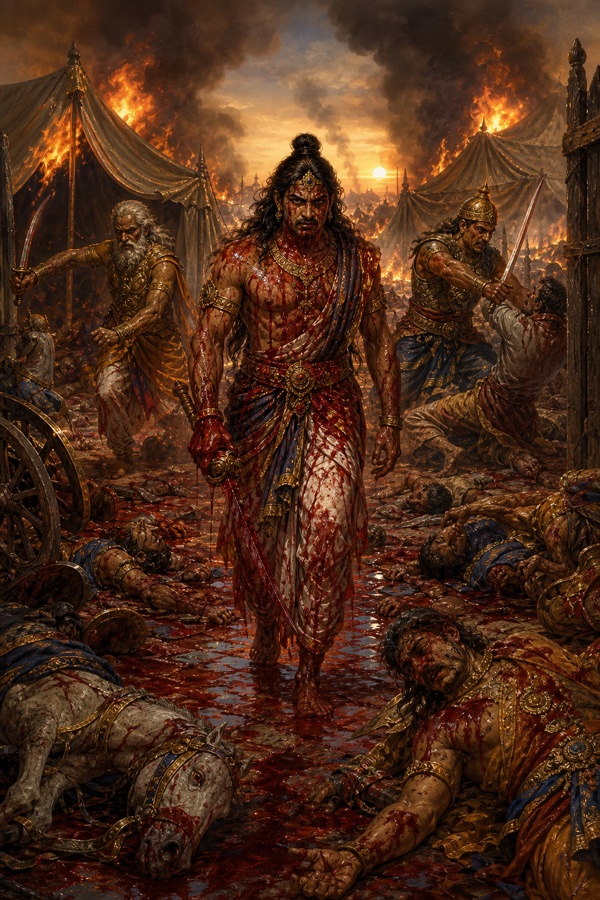
In a short time the great noise of human cries and groans died away. The ground was soaked with blood, and the thick, frightful dust soon settled and was gone. Thousands of men moving in agony, sunk in dread and despair, were killed by Ashvatthama as Rudra kills living creatures. Many who lay on the ground holding one another, and many who tried to run, and many who tried to hide, and many who fought, were all killed by the son of Drona. Burned by the raging flames and cut down by Ashvatthama, the men lost their senses and killed one another. Before half the night was gone, the son of Drona had sent the great host of the Pandavas to Yama’s house. That night, so terrible and so deadly to men and elephants and horses, filled with joy every creature that wanders in the dark. Rakshasas and Pishachas of many tribes were seen there, gorging on human flesh and drinking the blood that lay on the ground. They were fierce and tawny and terrible, with teeth like adamant, and dyed with blood. Their hair was matted, their thighs long and massive; they had five feet and great bellies, and their fingers were set backward. Harsh in temper and ugly in feature, they had loud and terrible voices, and rows of tinkling bells were tied to their bodies. Their throats were blue, and they were frightful to look at. Very cruel, impossible to look on without fear, and disgusted by nothing, they came there with their children and their wives. The Rakshasas who came were of many shapes. They drank the blood that ran in streams and were filled with joy and began to dance in separate bands. “This is excellent!” “This is pure!” “This is very sweet!” were the words they spoke. Other eaters of flesh, creatures that live on animal food, gorged on fat and marrow and bone and blood and then began on the soft parts of the corpses. Others drank the fat that flowed in streams and ran naked over the field. Still others, with faces of many kinds, very ferocious, eaters of the dead, came there in tens of thousands and in millions. Grim and gigantic Rakshasas of wicked deeds came in bands as large. Other ghostly beings came too, full of joy and gorged to the full, and were seen in the middle of that carnage. When morning dawned, Ashvatthama wished to leave the camp. He was bathed in human blood, and the hilt of his sword had stuck so fast in his grip that his hand and his sword were one thing. He had walked the road that good warriors never walk, and after that slaughter he looked like the blazing fire at the end of the yuga when it has burned all creatures to ash. He had done the deed as he had vowed, on a way no one treads, and the son of Drona forgot his grief for his father’s killing.
The Pandava camp had been perfectly still when Drona’s son entered it in the night, because everyone in it was buried in sleep. After the slaughter, when everything was quiet once more, he came out of it. He met his two companions, and full of joy he told them what he had done, and it gladdened them. The two of them, who were devoted to his good, gave him their own welcome news in return: how they had cut down Panchalas and Srinjayas in thousands at the gates. So that night brought terrible destruction on the Somakas, who had been off their guard and sunk in sleep. The course of Time cannot be resisted, Sanjaya told the king, and those who had destroyed the Kaurava host were now destroyed themselves. He told him, too, why the son of Drona, hard as he had striven to win the victory for Duryodhana, had done no such thing before. Fear of the sons of Pritha had kept him from it. He could do it now because they were away, and Krishna with them, and Satyaki; with those heroes present, who could have killed these men, even the lord Indra? And he had succeeded only because the men were all asleep. When the great slaughter was done, the three chariot fighters came together and cried, “Good fortune!” His two companions congratulated Ashvatthama and embraced him.
“All the Panchalas are dead, and all the sons of Draupadi,” Ashvatthama said in his great joy. “All the Somakas, and all that was left of the Matsyas, I have slaughtered. We have succeeded. Let us go without delay to the place where the king is. If he is still alive, we will give him this glad news.”
The gist: Ashvatthama kills Dhrishtadyumna with his feet and refuses him a weapon. He kills Uttamaujas and Yudhamanyu, the five sons of Draupadi, Shikhandi, and the house of Drupada, and goes through the waking camp with sword, bow, and chariot. Kripa and Kritavarma kill everyone who reaches the gate and set fire to the camp in three places. Before half the night is gone the Pandava host is dead, and Rakshasas and Pishachas feed on the field. At dawn Ashvatthama comes out with his sword fast in his hand, and the three set off to tell Duryodhana.
The Last News Brought to Duryodhana, and His Death
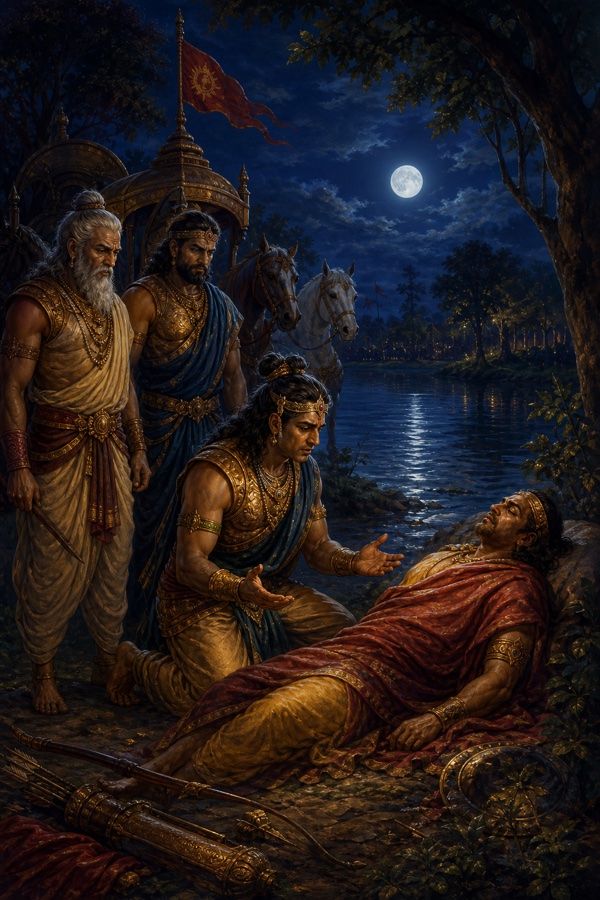
Having killed all the Panchalas and the sons of Draupadi, the three Kuru heroes came together to the place where Duryodhana lay, struck down by his enemy. They found that life had not yet wholly left the king, and they jumped down from their chariots and gathered around him. He lay there with his thighs broken. He was almost senseless, and his life was ebbing. He was vomiting blood at intervals, with his eyes turned down. Flesh-eating animals of terrible shapes were all about him, and wolves and hyenas, waiting a little way off to feed on his body. The king was keeping them back with great difficulty, those beasts that stood expecting to feast on him, and he was twisting on the ground in great pain. He lay bathed in his own blood. The three who were all that survived of his army, Ashvatthama and Kripa and Kritavarma, saw him so, and grief took them, and they sat down around him. They were covered with blood themselves and breathing hot, and with those three great chariot fighters about him the Kuru king looked like a sacrificial altar with three fires around it. They looked at the king lying in a state he had never deserved, and they wept in a sorrow they could not bear. They wiped the blood from his face with their hands. Then they spoke their laments where the king, lying on the battlefield, could hear them.
“There is nothing too hard for destiny to bring about,” Kripa said, “when King Duryodhana, who was lord of eleven akshauhinis, sleeps on the bare ground, struck down by his enemies and covered with blood. Look at him. He loved the mace, and that mace, bright with pure gold, still lies at the side of the king, whose own brightness is still like pure gold. In no battle did that mace ever leave him. Now that he is about to go up to heaven it does not leave him either. Look at it lying by him, like a loving wife beside her lord when he is stretched on his bed in the chamber of sleep. See what reversals Time brings. He used to walk at the head of every crowned king, and now, struck down, he eats the dust. He struck down many enemies once and laid them on the bare ground, and today the king of the Kurus lies on the bare ground himself, struck down by enemies. Hundreds of kings used to bow to him in fear, and today he lies on the field of battle with beasts of prey around him. The Brahmins used to wait on this lord for wealth. Today beasts of prey wait on him to feed on his body.”
Ashvatthama looked at the chief of the Kurus lying on the ground and made his own lament. “All men pointed to you as the first of bowmen. They said too that with the mace you, the pupil of Balarama, were like Kubera, the lord of treasures, himself. How then could Bhima find any opening in you? You were always strong and you had the skill. He is a man of wicked soul. Time must be stronger in this world than everything else, since we see even you struck down by Bhimasena in battle. How could that mean wretch Bhima bring you down unrighteously, you who knew every rule of righteousness? There is no resisting Time. Bhimasena called you out to a fair fight, and then he put out his strength and broke your thighs. Shame on that wretch Yudhishthira, who stood by while the head of a man unrighteously struck down in battle was touched with a foot! In every battle, as long as the world lasts, warriors will speak against Bhima. You were struck down unrighteously, there is no doubt of it. Balarama of the Yadus, that brave man, always used to say that no one is Duryodhana’s equal with the mace. He used to boast of you in every assembly. ‘Duryodhana of the Kurus is a worthy pupil of mine,’ he would say. You have gained the end that the great rishis have declared to be the high reward of a Kshatriya killed in battle with his face to the enemy. I do not grieve for you, Duryodhana. I grieve for your mother Gandhari and for your father, who are childless now. Broken with sorrow, they will have to wander the earth begging their food. Shame on Krishna of the Vrishnis, and on Arjuna with his wicked mind! They hold themselves to be men who know what is right, and both of them stood by, indifferent, while you were being killed. And the other Pandavas, shameless as they are, how will they speak of the way they brought about your death? You are very fortunate, son of Gandhari, since you were struck down on the field of battle while you advanced fairly against the enemy. What will become of Gandhari, who has no child now and has lost all her kinsmen? What will become of the blind king? Shame on Kritavarma, and on me, and on Kripa, that we have not gone to heaven with you, our king, at our head! Shame on us, the lowest of men, that we do not follow you, who granted every wish, who protected all men, who did good to all your subjects! By your power the houses of Kripa, and mine, and my father’s, and the houses of our dependents, are full of wealth. By your grace we and our friends and kinsmen have performed many great sacrifices, with gifts in plenty to the Brahmins. Where are sinful men like us to go now, when you have gone to heaven and taken all the kings of the earth with you? We three are lamenting like this because we do not follow you, who are about to reach the highest end. Without your company, without wealth, with our memories dwelling painfully on your prosperity, what will our lot be, since we do not go with you? We will have to wander the earth in grief, there is no doubt of it. Without you, where can we have peace, and where can we have happiness? When you go from this world and meet the great chariot fighters who went before you, pay them your respects for me, one after another, in the order of their rank and their years. Worship your teacher, the first of all who carry the bow, and tell him that I have killed Dhrishtadyumna. Embrace King Bahlika, that great chariot fighter, and the ruler of the Sindhus, and Somadatta, and Bhurishravas, and the other great kings who have gone ahead of you to heaven. Embrace them all for me, and ask after their welfare.”
He had said all this to a king who lay without his senses, his thighs broken. Ashvatthama looked at him once more and spoke again. “Duryodhana, if there is any life in you still, listen to words that are pleasant to hear. On the side of the Pandavas only seven are alive, and among the sons of Dhritarashtra only we three. The seven on their side are the five brothers and Krishna and Satyaki. On ours the three are myself and Kripa and Kritavarma. All the sons of Draupadi have been killed, and all the children of Dhrishtadyumna. All the Panchalas have been killed, and what was left of the Matsyas. See the vengeance that has been taken for what they did. The Pandavas have no children now. The men and the animals in their camp have all been killed while they were buried in sleep. I went into their camp in the night, king, and I killed Dhrishtadyumna, that man of sinful deeds, as one kills an animal.”
Those words were welcome to Duryodhana’s heart. He came back to his senses and answered. “What Bhishma, the son of Ganga, could not do, nor Karna, nor your father, you have done at last today, with Kripa and the Bhoja beside you. You have killed that low wretch who commanded the Pandava forces, and Shikhandi too. Because of this I count myself the equal of Indra himself. Good be with you all. May you prosper. All of us will meet again in heaven.”
The king of the Kurus said that and was silent. He put away his grief for all his slain kinsmen, and he gave up his life-breath. His soul went up to sacred heaven, and only his body stayed on the earth. So Duryodhana breathed his last. He had provoked the battle first, and at the last his enemies killed him. The three heroes embraced the king again and again and looked long at him, and then they went up onto their chariots. Sanjaya had heard the laments of Drona’s son, and he came away at early dawn toward the city. The armies of the Kurus and of the Pandavas had been destroyed in this way, he told Dhritarashtra, and that great and terrible slaughter had come of the king’s own evil policy. When Duryodhana had gone to heaven grief overcame Sanjaya, and the sight that the rishi Vyasa had given him was lost to him. The old king heard that his son was dead. He drew long, hot breaths and sank into deep trouble of mind.
The gist: The three find Duryodhana still alive, his thighs broken, keeping the beasts of prey off his body. Kripa and Ashvatthama lament over him, and Ashvatthama gives him messages for Drona, Bahlika, the ruler of the Sindhus, Somadatta, and Bhurishravas. Then he counts the living, seven on the Pandava side and three on theirs, and tells him of the night. Duryodhana says that with Dhrishtadyumna and Shikhandi dead he holds himself the equal of Indra, tells them they will meet in heaven, and dies. Sanjaya comes away at dawn, and the sight Vyasa gave him leaves him.
Yudhishthira’s Lament and Draupadi’s Fast Unto Death
When that night had passed, the driver of Dhrishtadyumna’s chariot brought King Yudhishthira word of the great slaughter done in the hour of sleep.
“The sons of Draupadi have been killed, king, and all the children of Drupada with them, while they lay off their guard and trustfully asleep in their own camp,” the driver said. “In the night your camp was wiped out by cruel Kritavarma, and by Kripa, and by sinful Ashvatthama. Those men killed men and elephants and horses in thousands with lances and darts and battle-axes and destroyed your army. A great wail went up from your camp while the army was being cut down like a forest under the axe. I am the only one left of that great force. I got away from Kritavarma with difficulty, at a moment when he was not watching.”
Yudhishthira, the son of Kunti, was a man who could bear a great deal. He heard this news and fell to the ground, struck down by grief for his sons. Satyaki stepped forward and caught the king in his arms. Bhimasena and Arjuna and the two sons of Madri reached out their arms to him as well.
When he had his senses again the son of Kunti lamented in great pain, and sorrow blurred his words. “We defeated the enemy, and in the end we are the ones defeated. The course of events is hard to make out even for those who have the inner sight. The enemies who were beaten have become the victors, and we, in our victory, are beaten. We killed brothers and friends, fathers and sons, well-wishers, kinsmen, and counselors. We defeated them all, and at the last we ourselves are defeated. Misery looks like prosperity and prosperity looks like misery. This victory of ours has taken the shape of defeat. I have won, and I am made to grieve like a wretch in pain. How can I count that a victory? In truth the enemy has defeated me twice over. We took on ourselves the sin of this victory, killing our kinsmen and friends, for the sake of those men, and after victory had crowned them they have been defeated by beaten enemies who were watchful. They had escaped even Karna, and through carelessness they have been killed. Karna had barbed arrows and nalikas for his teeth, the sword for his tongue, the bow for his gaping mouth, and the twang of the bowstring and the slap of palms for his roar, that angry Karna who never turned back from a battle and was a lion among men. Those princes crossed the great ocean that was Drona in boats made of their own excellent weapons. That ocean had chariots for its deep pools, showers of arrows for its waves, the ornaments of warriors for its gems, chariot horses for its animals, darts and swords for its fish, elephants for its alligators, bows for its whirlpools, great weapons for its foam, the signal of battle for the moonrise that swelled it, and the twang of the bowstring and the slap of palms for its roar. Even those princes have been killed through carelessness. There is no more powerful cause of death for men in this world than carelessness. Prosperity leaves a careless man on every side, and every kind of misery overtakes him. They had lived through the fire that was Bhishma. The tall standard with the fine top that stood on his chariot was the wreath of smoke that unfailingly marked that fire. Arrows were its flames, and wrath was the wind that fanned it. The twang of his formidable bow and the slap of his palms were its roar. Armor and weapons of many kinds were the libations poured into it, and the vast army of the enemy was the heap of dry forest grass it fell on. They endured that fierce fire, whose terrible energy was the great weapons in Bhishma’s hands, and at the last they have fallen through carelessness. A careless man can never gain knowledge, or the fruit of austerity, or prosperity, or great renown. See how Indra won great happiness after he killed all his enemies with care. See how the survivors among our enemies, through our carelessness, have killed so many sons and grandsons of kings, each of whom was truly like Indra himself. They have perished like merchants with a rich cargo who cross the great ocean and are then lost through carelessness in a shallow stream. Their bodies lie now on the bare ground, killed by those vengeful wretches, and they have gone up to heaven, there is no doubt of it. It is for the princess Draupadi that I grieve. She will be plunged in an ocean of grief today. When she hears that her brothers and her sons and her venerable father, the king of the Panchalas, have been killed, she will fall senseless to the ground. Her body will waste with grief and she will not rise again. She deserves happiness. What will become of her when she cannot bear the grief of such a blow? Cut to the quick by the killing of her sons and her brothers, she will be like one scorched by fire.”
His lament over, the Kuru king turned to Nakula. “Go and bring the unfortunate princess Draupadi here,” he said, “with all her kin on her mother’s side.”
Nakula accepted the order of that king, who was Yama’s equal in righteousness, and drove quickly on his chariot to the quarters where Draupadi was staying with all the wives of the Panchala king. When he had sent the son of Madri off, Yudhishthira, crushed by grief and with tears in his eyes, went with his friends to the field where his sons had fought, which still swarmed with creatures of many kinds. He entered that accursed ground, with its fierce sights everywhere, and saw his sons and his well-wishers and his friends all lying on the earth, covered with blood, their bodies hacked and their heads cut from their trunks. He was a man who put righteousness before everything, and the sight wounded him deeply. The chief of the Kurus began to weep aloud, and he fell to the ground senseless, and all who had come with him fell too.
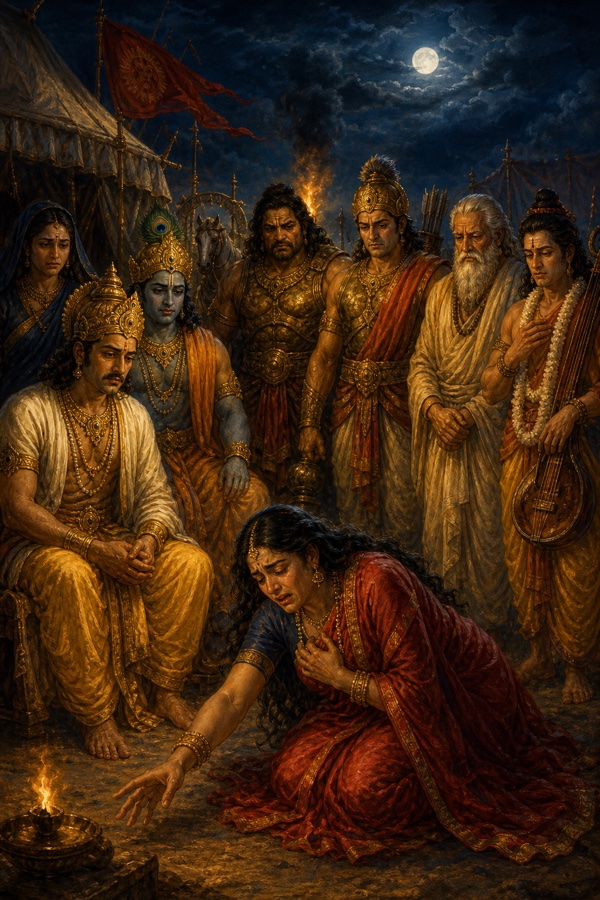
He had seen his sons and grandsons and friends all dead in battle, and great grief overwhelmed his soul. He remembered those sons and grandsons and brothers and allies, and a deep sorrow took hold of him. He was senseless and trembling, and his eyes were bathed in tears. His friends, full of fear for him themselves, began to comfort him. It was then that Nakula, who knew how to carry out an errand, arrived on his chariot bright as the sun with the princess Draupadi, who was in great distress. She had been staying at Upaplavya. The news that all her sons had been killed had reached her and shaken her to the heart. She came before Yudhishthira trembling like a plantain tree in the wind, and she fell down, broken by grief. Her face, with its eyes like two full-blown lotuses, was darkened by grief like the sun when darkness covers it. Bhima, quick to anger, whose strength had never been turned aside, saw her lying on the ground, came forward in haste, lifted her, and held her in his arms.
Bhimasena comforted her. The beautiful princess began to weep, and she spoke to the eldest son of Pandu with his brothers around him. “It is good fortune, king, that you have won the whole earth and will enjoy her, now that your brave sons have been slaughtered in keeping the Kshatriya’s duty. It is good fortune, son of Pritha, that you are happy at the thought of having won the whole earth. It is good fortune that your thoughts do not dwell on Subhadra’s son, who walked with the tread of a maddened elephant. It is good fortune that you do not remember, as I remembered at Upaplavya, your heroic sons cut down in keeping the Kshatriya’s duty. Son of Pritha, since I heard that those sleeping heroes were slaughtered by Drona’s son, that man of sinful deeds, grief burns me as if I stood in the middle of a fire. If Drona’s son is not made to reap the fruit of that sinful deed, if you do not put out your strength in battle and take the life of that wretch and the lives of all who follow him, then hear me, Pandavas. I will sit here in praya.”
With those words Draupadi, the daughter of Drupada, helpless in her grief, sat down beside the eldest son of Pandu, King Yudhishthira the just.
Yudhishthira saw his dear queen seated in praya and spoke to her. “You know what is right, my lady. All your sons and your brothers have met a noble death, righteously. You should not grieve for them. As for Drona’s son, he has gone to a distant forest. How will you make sure, princess, that he has fallen in battle?”
“I have heard that Drona’s son has a gem on his head that was born with him,” Draupadi answered. “I will see that gem brought to me when that wretch has been killed in battle. I will set it on your head, king, and then I will bear to live. That is my resolve.”
When she had said this to the royal son of Pandu, Draupadi went to Bhimasena and spoke to him with a high purpose. “Bhima, remember the duties of a Kshatriya and come to my rescue. Kill that man of sinful deeds as Indra killed Shambara. There is no one in this world who is your equal in strength. The whole world knows how you became the refuge of all the sons of Pritha at the town of Varanavata, in a time of great calamity. When Hidimba saw us, you were our refuge in the same way. In Virata’s city you rescued me in my distress from a great calamity, as Indra rescued his wife, the daughter of Puloma. As you did those great things in former days, kill the son of Drona now, and be happy.”
She said this and more, and the laments were piteous to hear. Bhimasena, the son of Kunti, a man of great strength, could not endure them. He mounted his great chariot, which was decked with gold, and took his fine bow with an arrow set on the string. He made Nakula his charioteer. Resolved to kill the son of Drona, he began to draw his bow and had the horses urged on without delay. They were as fast as the wind, and they went off at great speed. Bhima left the Pandava camp behind and followed fast along the track of Ashvatthama’s chariot.
A key to reading this (the praya vow and the head-gem): Praya is the vow of sitting down to die, abstaining from all food. Draupadi sits in it beside Yudhishthira until Ashvatthama is made to pay, and what she asks to see is the gem on his head, which was born with him. Ashvatthama himself later says what the gem does: its wearer has nothing to fear from weapons, disease, or hunger, from gods, Danavas, or Nagas, from Rakshasas or robbers.
The Story of the Brahmashira Weapon and Krishna’s Warning
When Bhimasena had gone, Krishna of the Yadus, whose eyes are like lotus petals, spoke to Yudhishthira. “This brother of yours, son of Pandu, is overwhelmed with grief at the slaughter of his sons, and he is going into battle alone, wanting to kill the son of Drona. Of all your brothers, Bhima is the dearest to you. You see him gone into great danger. Why do you not stir yourself? Drona, who took the cities of his enemies, taught his son the weapon called Brahmashira, which is able to burn up the whole world. That teacher, the first of all who carry the bow, was pleased with Arjuna and had given that very weapon to him. His only son could not bear that and begged it of him. He gave Ashvatthama the knowledge of the weapon unwillingly. Drona knew how restless his son was, and he knew every duty, and he laid this command on him: ‘Even in the greatest danger, child, in the middle of a battle, you must never use this weapon, and against human beings least of all.’ So the teacher spoke to his son. A little while later he spoke again. ‘It seems you will not walk in the path of the righteous,’ he said. Those were bitter words from a father. Ashvatthama heard them, despaired of every kind of prosperity, and began to wander the earth in grief.
“Then, while you were living in the forest, he came to Dwarka and settled there, and the Vrishnis treated him with honor. One day after he had made his home in Dwarka he came to me on the seashore. He had no companion with him and I had no one beside me. He smiled and said, ‘Krishna, my father, the teacher of the Bharatas, performed the hardest austerities and won from Agastya the weapon called Brahmashira, which gods and Gandharvas revere. It is with me now as much as it is with my father. Give me your discus, which can kill every enemy in battle, in exchange for that celestial weapon.’ He begged the discus of me with joined palms and pressed me hard. I wished to please him, and I told him, ‘Gods, Danavas, Gandharvas, men, birds, and snakes, all gathered together, are not equal to a hundredth part of my energy. I have this bow, this dart, this discus, and this mace. I will give you whichever of them you want from me. Keep the weapon you wish to give me. Take from among these weapons of mine whichever you are able to wield and to use in battle.’
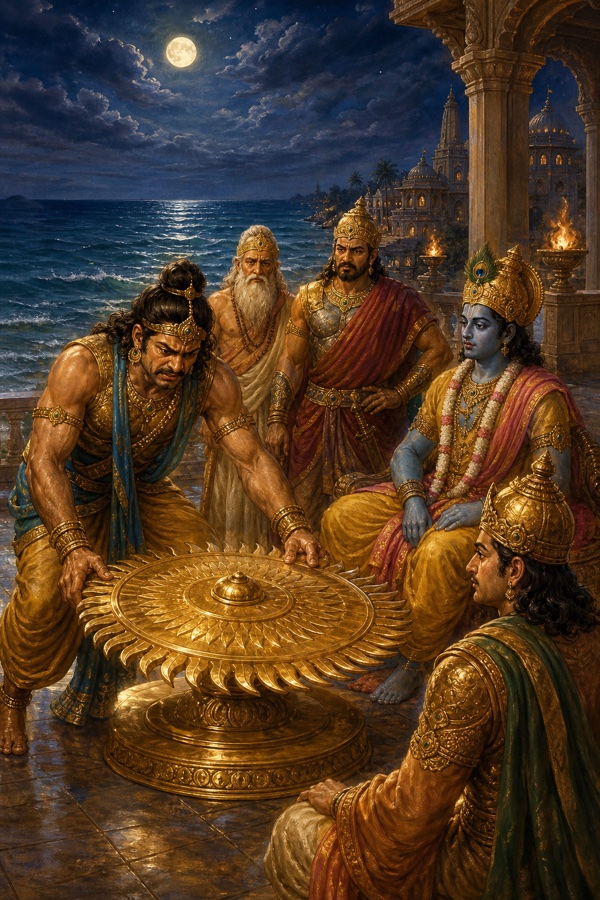
“The son of Drona, as if he were challenging me, asked for my discus, with its fine nave and its thousand spokes, made of iron and hard as the thunderbolt. ‘Take it,’ I said. He rose suddenly and seized the discus with his left hand. He could not even move it from the place where it lay. He made ready to take it with his right hand. He gripped it very firmly and put out all his strength, and still he could neither wield it nor move it. Drona’s son was filled with sorrow at that. When the effort had tired him out he stopped. When he had given the purpose up I spoke to him, anxious and dazed as he was. ‘There is a man who is always counted the first of all human beings,’ I said. ‘He carries the bow Gandiva, white horses are yoked to his chariot, and the prince of apes is the device on his standard. He wished to overcome in wrestling the god of gods himself, the blue-throated lord of Uma, and he pleased great Shankara by it. I have no dearer friend on earth than that Arjuna. There is nothing I would not give him, my wives and my children included. That dear friend of mine, whose acts are without stain, has never said to me such words as you have spoken, Brahmin. I have a son whom I gained by austerities, keeping strict brahmacharya for twelve years on the breast of Himavat, where I had gone for that purpose. He is Pradyumna, a son of great strength and a portion of Sanatkumara himself, born to me of my wife Rukmini, who had kept vows as strict as mine. Even he has never asked for this discus, which has no rival and which you in your small understanding have asked for. Balarama, strong as he is, has never said such words to me. Gada has not asked it of me, nor Samba. Not one of the great chariot fighters of the Vrishnis and the Andhakas who live in Dwarka has ever asked it of me. You are the son of the teacher of the Bharatas. All the Yadavas hold you in high respect. Let me ask you this, then. With whom would you fight, using this weapon?’
“Drona’s son answered me. ‘I meant to worship you, Krishna, and then to fight you. That is why I asked you for your discus, which gods and Danavas adore. If I had got it I would have been invincible in the world. I have failed to gain a wish that was almost beyond gaining, and I am going to leave you now. Speak fair words to me at parting. This terrible weapon is held by you, who are the first among all who are terrible. With this weapon you have no rival. No one else in this world is able to hold it.’ He said that to me, and he took many pairs of horses and much wealth and gems of many kinds, and he left Dwarka.
“He is wrathful, wicked of soul, restless, and very cruel. He knows the weapon called Brahmashira. Bhima must be protected from him.”
When he had said this, Krishna mounted his chariot, which carried every kind of powerful weapon. Two pairs of horses of the Kamboja breed were yoked to it, wearing garlands of gold. The shaft of that chariot was the color of the morning sun. The horse called Shaibya was yoked on the right and Sugriva on the left, and the pair behind them were Meghapushpa and Balahaka. A celestial standard stood on the chariot, made by the divine craftsman and set with gems and gold, as tall as the Maya of Vishnu, and on it Garuda, the son of Vinata, shone in great splendor. That enemy of snakes sat perched at the top of Krishna’s standard. Krishna mounted, and after him Arjuna and Yudhishthira, the king of the Kurus, went up into the same chariot. Seated beside the wielder of the bow Sharnga, the two sons of Pandu looked very fine, like the twin Ashvins seated beside Indra. Krishna urged the horses on, and they flew, drawing the chariot with the two Pandavas and the Yadu hero in it, and the noise of their rush was loud, like the noise of birds going through the air. They soon came up with Bhimasena, whose track they had followed. They met him, and they could not stop him. Full of wrath, he drove on fiercely toward the enemy, and with those firm bowmen looking on, his fast horses carried him to the bank of the river that Bhagiratha brought down, the Ganga.
A key to reading this (the Brahmashira): The Brahmashira is a weapon able to burn up the whole world. Drona won it from Agastya by the hardest austerities and gave it gladly to Arjuna, who never used it even in the greatest danger. He gave it unwillingly to his own son, with the command that it must never be used, least of all against human beings. Krishna tells Yudhishthira this as Bhima rides off alone, and he tells it together with the day at Dwarka when Ashvatthama tried to trade the weapon for the discus.
The Weapon From a Blade of Grass and the Sages Who Stepped Between
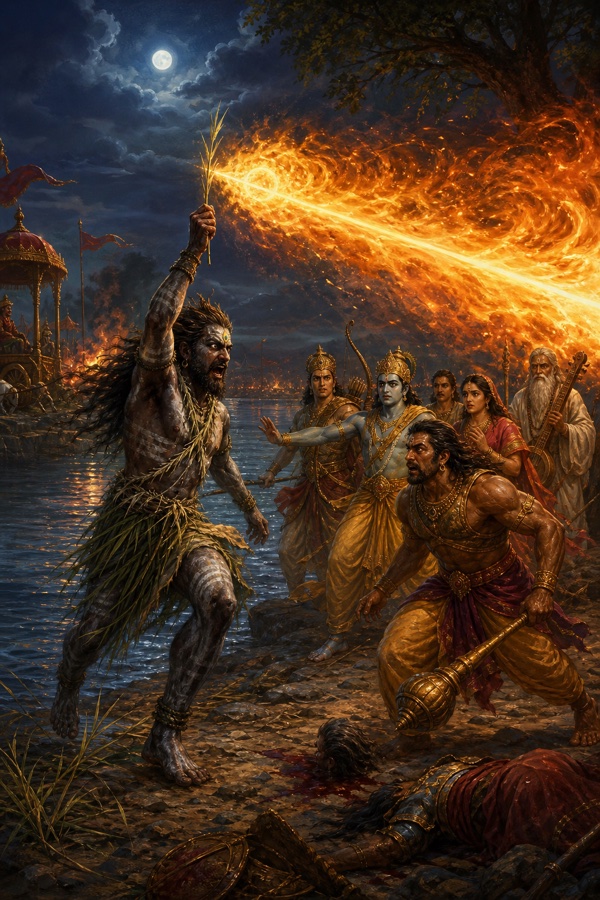
On that bank Bhima saw Vyasa, the dark-skinned sage who was born on an island, sitting near the edge of the water in the middle of many rishis. And he saw Drona’s son, that doer of wicked deeds, sitting beside them, covered with dust, dressed in a cloth made of kusha grass, his whole body smeared with clarified butter. Bhimasena took up his bow with an arrow fixed on it and rushed at Ashvatthama. “Wait! Wait!” he cried. Drona’s son saw that terrible bowman coming at him bow in hand, and the two brothers on Krishna’s chariot, and he was badly shaken and thought his hour had come. His spirit was one that could not be pressed down. He called to mind the high weapon he had from his father. He took up a blade of grass in his left hand. Fallen into great distress, he charged that blade of grass with the proper mantras and turned it into the powerful celestial weapon. He could not bear the arrows of the Pandavas and the presence of those wielders of celestial weapons, and in wrath he spoke terrible words: “For the destruction of the Pandavas.” Having said that, the son of Drona let the weapon go, to stun all the worlds. A fire was born in that blade of grass that seemed able to burn up the three worlds, like Yama the all-destroyer at the end of the yuga.
From the very first, Krishna had understood by signs what the son of Drona intended.
“Arjuna, son of Pandu,” he said, “the time has come to use the celestial weapon that is in your memory, the one Drona taught you. To protect yourself and your brothers, shoot in this battle the weapon that can neutralize all weapons.”
Arjuna got down quickly from the chariot with his bow, an arrow already fixed on the string. Under his breath he wished good to the son of his teacher, then to himself, then to all his brothers. He bowed to all the gods and to all his elders. Then he let the weapon go, thinking of the welfare of all the worlds, and said, “Let Ashvatthama’s weapon be neutralized by this weapon.”
The weapon the wielder of Gandiva had loosed so quickly blazed up with fierce flames, like the all-destroying fire that appears at the end of the yuga. The weapon that Drona’s son had shot blazed up in the same way with terrible flames inside a huge sphere of fire. Peal on peal of thunder was heard. Meteors fell in thousands. Every living creature was filled with dread. The whole sky seemed full of noise and took on a terrible look with those flames, and the whole earth shook, with her mountains and her waters and her trees.
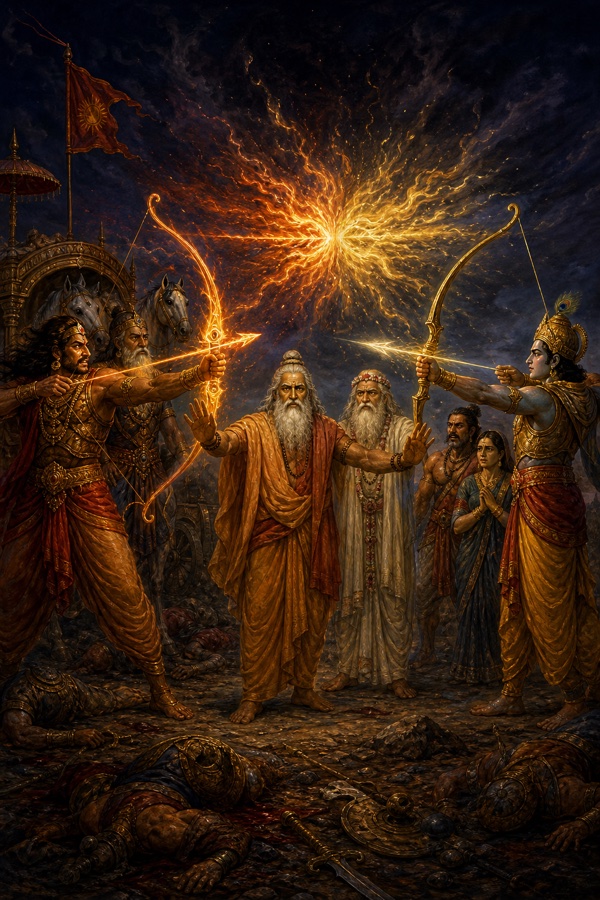
Then two great rishis showed themselves there, having seen the two weapons scorching the three worlds: Narada, who is the soul of every creature, and Vyasa, the grandfather of all the Bharata princes. They wished to quiet the two heroes, Ashvatthama and Arjuna. They knew every duty and wished the good of all creatures, and they went and stood in the middle, between the two blazing weapons. No force could overwhelm those two rishis, and they stood there between the weapons like two blazing fires. No living creature could have checked them, and gods and Danavas adored them. They did this to neutralize the energy of the two weapons and to do good to the whole world.
“The great chariot fighters who have fallen in this battle knew many kinds of weapons,” the two rishis said. “They never shot such a weapon at human beings. What rash thing is this, heroes, that you have done?”
The gist: Bhima finds Ashvatthama on the bank of the Ganga, sitting among rishis beside Vyasa. With Krishna, Arjuna, and Yudhishthira close behind, Ashvatthama charges a blade of grass with the Brahmashira and looses it “for the destruction of the Pandavas.” At Krishna’s word Arjuna looses the same weapon to neutralize it. The two blaze against each other, and Narada and Vyasa come and stand between them.
Arjuna Recalls His Weapon, Ashvatthama Cannot
The two rishis shone like fire. At the very sight of them Arjuna resolved at once to draw his celestial arrow back. He joined his hands and spoke to them. “I used this weapon saying, ‘Let it neutralize the enemy’s weapon.’ If I withdraw it, Drona’s son, that man of sinful deeds, will surely burn us all up with the energy of his own. You two are like gods. Find some means by which our welfare may be secured, and the welfare of the three worlds.”
Having said this, Arjuna drew his weapon back.
To draw that weapon back in battle is very hard even for the gods. Great Indra himself not excepted, there was no one other than the son of Pandu who could withdraw that high weapon once it had been let go. It was born of the energy of Brahman. No one whose soul is unclean can bring it back after it has been loosed. Only one who lives as a brahmachari can do it. If a man who has not kept the vow of brahmacharya shoots it and then tries to bring it back, it strikes off his own head and destroys him with everything he carries. Arjuna was a brahmachari and a keeper of vows. He had gained that weapon, which is almost beyond gaining, and he had never used it, even when he had fallen into the greatest danger. He kept the vow of truth, he had great courage, he lived as a brahmachari, and he was submissive and obedient to all his elders. That is why he was able to withdraw his weapon.
Drona’s son saw the two rishis standing in front of him, and he could not, by his own energy, withdraw his terrible weapon.
He could not take it back, and his heart sank. He spoke to the island-born rishi. “A great danger threatened me and I wished to protect my life. I let this weapon go out of fear of Bhimasena, holy one. This Bhimasena deals falsely, and he acted sinfully when he killed the son of Dhritarashtra in battle. That is why I let this weapon go, unclean of soul as I am. I dare not withdraw it now. I charged this irresistible celestial weapon with the energy of fire and loosed it for the destruction of the Pandavas. It was made for that end, and so it will take the lives of all the sons of Pandu. I called it up in battle and did this sinful thing in wrath.”
“Arjuna, the son of Pritha, knew the weapon called Brahmashira, child,” Vyasa said. “He shot it to turn your weapon aside, with no wrath in him and no wish to destroy you in battle, and he has withdrawn it again. He had this weapon from your father’s teaching, and with it in his hands he never fell away from a Kshatriya’s duties. Such is Arjuna’s patience and such is his honesty, and he knows every weapon besides. Why do you seek to bring about the destruction of such a man, with all his brothers? The country where the weapon called Brahmashira is turned aside by another high weapon suffers a drought for twelve years. The clouds do not pour a drop of water there for all that time. For that reason the son of Pandu, though he had the power, would not turn your weapon aside with his, because he wished to do good to living creatures. The Pandavas should be protected. You yourself should be protected. The kingdom should be protected. So withdraw this celestial weapon of yours. Put this wrath out of your heart and let the Pandavas be safe. The royal sage Yudhishthira never wishes to win a victory by any sinful act. Give them the gem that is on your head. When they have taken it, the Pandavas will grant you your life in return.”
A key to reading this (withdrawing the weapon and brahmacharya): Once the Brahmashira has been loosed, only a man who lives as a brahmachari can call it back; if any other man tries, it takes off his own head. Arjuna, who had kept that vow, recalls his. Ashvatthama, who calls his own soul unclean, finds he cannot. Vyasa adds what the weapon does to the land: where it is turned aside by another high weapon no rain falls for twelve years, and for that reason Arjuna would not use his to beat the other down.
The Weapon Turned Toward the Womb, and the Saving of Parikshit
“This gem of mine is worth more than all the wealth the Pandavas and the Kauravas have ever earned,” Drona’s son said. “The man who wears it has no fear of weapons, or disease, or hunger. He has no fear of gods or Danavas or Nagas. He need not dread Rakshasas, or robbers either. Those are the powers of my gem, and I cannot by any means part with it. All the same, holy one, what you say is what I must do. Here is the gem. Here am I. This blade of grass, though, charged as it is, will fall into the wombs of the Pandava women, because the weapon is high and powerful and cannot be made to fail. I am unable to withdraw it once it has been let go. I will throw it now into the wombs of the Pandava women. In everything else, holy one, I will obey your commands.”
“Do that, then,” Vyasa said. “Take up no other purpose. Throw this weapon into the wombs of the Pandava women, and stop there.”
The son of Drona heard the words of the island-born sage, and he threw that raised weapon into the wombs of the Pandava women.
Krishna understood that Drona’s son, that man of sinful deeds, had thrown the weapon, and he spoke to him with a cheerful heart. “A Brahmin of pious vows once saw Virata’s daughter, who is now Arjuna’s daughter-in-law, while she was at Upaplavya. He told her, ‘When the line of the Kurus is dying out, a son will be born to you, and for that reason your son will be called Parikshit.’ The words of that pious man will come true. The Pandavas will have a son called Parikshit.”
Krishna was still speaking when Drona’s son answered him in wrath. “What you say, Krishna, out of your partiality for the Pandavas, will not happen. My words cannot fail to be fulfilled. This weapon I have raised will fall on the child in the womb of Virata’s daughter, the very child you wish to protect.”
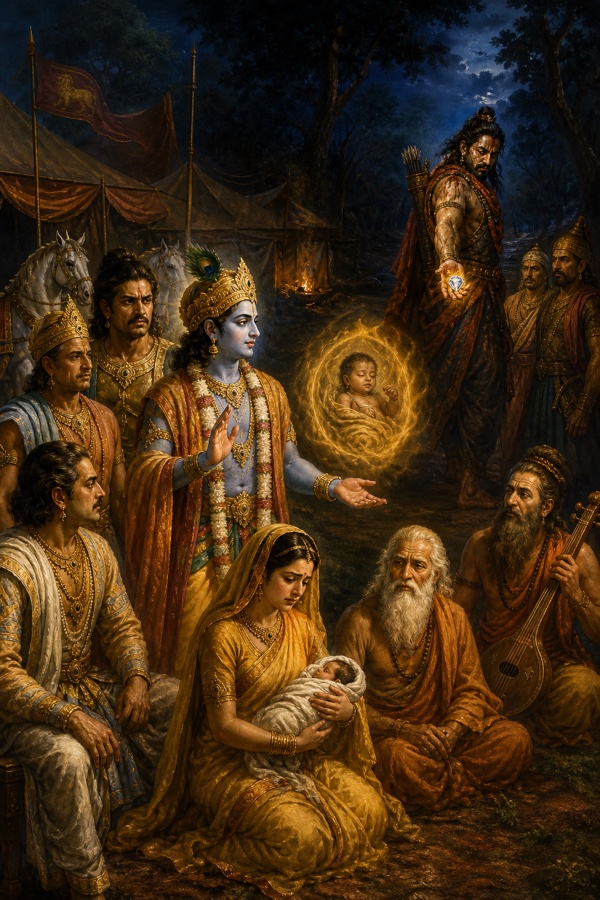
“The fall of this mighty weapon will not be fruitless,” Krishna said. “The child will die. And being dead, it will live again and have a long life. As for you, all wise men know you for a coward and a sinful wretch. You are always at sinful work, and you are a killer of children. For that reason you must bear the fruit of these sins. For three thousand years you will wander over this earth without a companion, unable to talk with anyone. Alone, with no one beside you, you will wander through many countries, and you will have no place among men. The stench of pus and blood will come from you. Forests that no one can enter and dreary wastes will be your home. You will wander the earth, sinful soul, with the weight of every disease on you. And Parikshit will grow to his full years. He will come to know the Vedas and to practice pious vows, and he will receive all the weapons from Kripa, the son of Sharadvat. Knowing all the high weapons and keeping all the duties of a Kshatriya, that righteous king will rule the earth for sixty years. More than that: the boy will become the king of the Kurus, known by the name of Parikshit, before your very eyes. Though the fire of your weapon burns him, I will bring him back to life. See the strength of my austerities and my truth, lowest of men.”
“You paid no regard to us and did this most cruel thing,” Vyasa said, “and this is how you behave though you are a good Brahmin by birth. So the excellent words that Devaki’s son has spoken will come true for you, there is no doubt of it, you who took up the Kshatriya’s ways.”
“With you among all men, holy one, I will live,” Ashvatthama said. “Let the words of this great man come true.”
Then Drona’s son gave his gem over to the Pandavas and went off to the forest before their eyes, with no gladness in him.
A key to reading this (the thread of Parikshit): The name Parikshit comes from the Brahmin’s words to Virata’s daughter Uttara at Upaplavya: her son will be born when the Kuru line is dying out, and he will be named for that. The weapon falls on the unborn child. Krishna says that the child will die and live again, that he himself will bring him back, and that Parikshit will learn his weapons from Kripa and rule for sixty years. On Ashvatthama he lays three thousand years of wandering alone, diseased, and unable to speak with anyone.
Draupadi Ends Her Vow, and the Gem Is Given Over
The Pandavas had killed and punished all their enemies. They put Krishna and the island-born Vyasa and the great ascetic Narada at their head, took the gem that had been born with Ashvatthama, and came back quickly to Draupadi, who was sitting in the vow of praya. Their horses were as fast as the wind and brought them back with Krishna to their camp. They got down quickly from their chariots. They were in deep pain themselves, and they saw Drupada’s daughter worn with sorrow. They came to the grieving princess, and the Pandavas and Krishna sat down around her.
Then Bhimasena, as the king wished, gave her the celestial gem. “This gem is yours, my lady,” he said. “The man who killed your sons has been defeated. Rise, put away your sorrow, and remember the duties of a Kshatriya woman. When Krishna was about to set out on his mission of peace, you said these words to him, dark-eyed lady: ‘I have no husbands. I have no sons, and no brothers. And you are not alive either, Govinda, since the king wants peace.’ Those were bitter words to say to Krishna, and they were words in keeping with the Kshatriya’s way. You ought to remember them now. Wretched Duryodhana, who stood between us and our sovereignty, has been killed. I have drunk the blood of Duhshasana while he lived. We have paid the debt we owed our enemy, and people will no longer be able to blame us when they talk. We defeated Drona’s son and we set him free, because he is a Brahmin and because of the respect that is owed to our dead teacher. His fame is destroyed, my lady. Only his body is left. He has been stripped of his gem, and on this earth he has been parted from his weapons.”
“I wished only to pay off our debt for the injury we suffered,” Draupadi said. “The teacher’s son deserves my reverence as the teacher himself does. Let the king bind this gem on his head.”
The king took the gem and set it on his head, because Draupadi wished it and because he held it to be a gift from his teacher. With that excellent celestial gem on his head he looked like a mountain with the moon above it. The princess Draupadi, grief-stricken as she was for the death of her sons, had great strength of mind, and she gave up her vow. Then King Yudhishthira put a question to Krishna. All his troops had been killed in the hour of sleep by those three chariot fighters, and he asked it in great grief. “Krishna, my sons were all great chariot fighters. How could sinful, wretched Ashvatthama, who has no great skill in battle, slaughter them? The children of Drupada were masters of weapons, men of great prowess, able to fight hundreds of thousands. How could Drona’s son kill them? How could he kill Dhrishtadyumna, before whom the great bowman Drona himself could not stand? What had the teacher’s son done, that he was able to kill all our men in battle single-handed?” Krishna answered him. “Drona’s son had sought the help of the highest of all the gods, eternal Mahadeva. That is how he killed so many, alone. If Mahadeva is pleased he can bestow even immortality. Girisha can give a man such valor that he could check Indra himself. I know Mahadeva truly, and I know what he did of old. He is the beginning, the middle, and the end of all creatures, and this whole universe acts and moves through his energy. The Grandsire, wishing to create living creatures, saw Rudra and said to him, ‘Create living creatures without delay.’ Rudra of the tawny locks said, ‘So be it,’ and went down into the water and practiced austerities for a long time, because he knew the defects of living creatures. The Grandsire waited for him a very long time. Then by an act of his will he called another being into existence to be the creator of all living things. That being saw Girisha sunk in the waters and said to his father, ‘If no being was born before me, I will create living creatures.’ His father answered, ‘There is no first-born being other than you. This Sthanu has gone down into the water. Go and create, and have no anxiety.’ So that being created many living creatures, with Daksha as the first of them, who created all these creatures of four kinds. As soon as they were created they ran at their father, hungry, wanting to eat him. He ran to the Grandsire for protection from his own offspring. ‘Protect me from these,’ he said, ‘and let food be assigned to them.’ The Grandsire assigned them herbs and plants and other growing things as their food, and to those that were strong he assigned the weaker creatures. With their food assigned, the new creatures went away to the regions they chose and multiplied gladly, each with its own kind. When they had multiplied and the Grandsire was well pleased, the first-born rose from the water and looked at the living creation. He saw that creatures of many kinds had been made and had multiplied by their own energy. Rudra was angry at the sight, and he caused his organ of generation to disappear into the bowels of the earth. Brahma soothed him with soft words and asked, ‘Sharva, what were you doing so long in the water? And why have you made your organ of generation disappear into the earth?’ The lord of the universe answered in wrath, ‘Someone else has created all these creatures. What use is this limb of mine now? By my austerities, Grandsire, I have created food for all these creatures. These herbs and plants will multiply as those who live on them multiply.’ Having said that, Bhava went away in gloom and rage to the foot of the Munjavat mountains to practice harder austerities.
“When the krita yuga had passed, the gods wished to perform a sacrifice and made ready for it as the Vedas direct. They gathered the clarified butter and the other things required, and they settled which of them should have shares in the offerings. They did not truly know Rudra, and they assigned no share to the divine Sthanu. Sthanu, dressed in deerskins, saw that he had been given no share and resolved to destroy that sacrifice, and for that purpose he made a bow. There are four kinds of sacrifice: the loka sacrifice, the sacrifice of special rites, the eternal household sacrifice, and the sacrifice that lies in the satisfaction a man takes in the five elements and their compounds. From these four the universe has sprung. Kapardin built his bow out of the first and the fourth. It was five cubits long. The sacred syllable vashat was its string, and the four parts of which a sacrifice consists were its ornaments. Mahadeva took up that bow in his rage and went to the place where the gods were sacrificing. They saw Rudra arrive dressed as a brahmachari with that bow in his hand, and the goddess Earth shrank in fear and the mountains shook. The wind stopped moving. Fire, though it was fed, did not blaze. The stars wandered off their courses in their anxiety, the sun grew dim, the disc of the moon lost its beauty, and thick darkness covered the whole sky. The gods were overwhelmed and did not know what to do. Their sacrifice stopped blazing, and they were all terrified. Then Rudra pierced the embodied Sacrifice in the heart with a fierce arrow. Sacrifice took the shape of a deer and fled with the god of fire. He reached heaven in that shape and blazed there in beauty, and Rudra chased him through the skies. With Sacrifice gone the gods lost their brightness and their senses. Then the three-eyed god in his rage broke the arms of Savitri with his bow and plucked out the eyes of Bhaga and the teeth of Pushan. The gods fled, and all the parts of the sacrifice fled, and some of them reeled as they ran and fell senseless. The blue-throated Rudra, having shaken them so, laughed aloud, whirled the horn of his bow, and held them paralyzed. The gods gave a cry, and at their command the string of the bow broke, and the bow sprang out straight. The gods then came to the god of gods, who had no bow now, and with the embodied Sacrifice they sought his protection and tried to please him. He was pleased. He threw his wrath into the water, where it took the form of fire and is forever consuming that element. He gave Savitri back his arms, Bhaga his eyes, and Pushan his teeth, and he restored the sacrifices themselves. The world was safe and whole once more. The gods assigned to Mahadeva all the libations of clarified butter as his share. When Mahadeva was angry, king, the whole world was shaken like that, and when he was pleased everything was safe. That god was pleased with Ashvatthama. That is why your sons, great chariot fighters as they were, could be killed by that warrior, and why so many other heroes, the Panchalas and all who followed them, could be killed by him. You should not let your mind dwell on it. The deed was done through the grace of Mahadeva. Drona’s son was not its doer. Do now what has to be done next.”
The gist: The Pandavas bring the gem back to Draupadi. Bhima gives it to her and tells her that Duryodhana is dead, that he has drunk Duhshasana’s blood, and that Ashvatthama has been stripped of gem and weapons and let live as a Brahmin and their teacher’s son. Draupadi has the king bind the gem on his head and gives up her vow. Yudhishthira then asks Krishna how one man could kill so many, and Krishna answers with the old acts of Mahadeva: how Rudra went under the water while another made the creatures, how he broke up the sacrifice of the gods when they gave him no share, and how the world was safe again once he was pleased. Mahadeva was pleased with Ashvatthama, Krishna says, and the night was done by his grace.
Source: the Mahabharata of Krishna-Dwaipayana Vyasa, Sauptika Parva and Aishika sub-parva, Sections 1 to 18. The Sanskrit e-text, the Gita Press Hindi edition, and Kisari Mohan Ganguli’s complete English translation were used to verify names, sequence, and principal events. Where the recensions differ, this English retelling follows Ganguli, and the Hindi edition follows Gita Press.
Source: the Mahabharata, Vedavyasa (Gita Press, Gorakhpur)
The same story, told elsewhere
- Ashvatthama’s Brahmastra
Srimad Bhagavatam (Book 1): Parikshit protected in the womb