← Collection
MahabharataThe difficult ground of dharma

Mahabharata · The Mace-Duel, and the Fall of Duryodhana

On this page
The Mahabharata · Shalya Parva
The destruction of the last of the Kaurava army, Duryodhana’s hiding in the lake, the mace-duel with Bhima, and Duryodhana’s fall from the rule-breaking blow to the thighs.

About 114 min read · 19,247 words

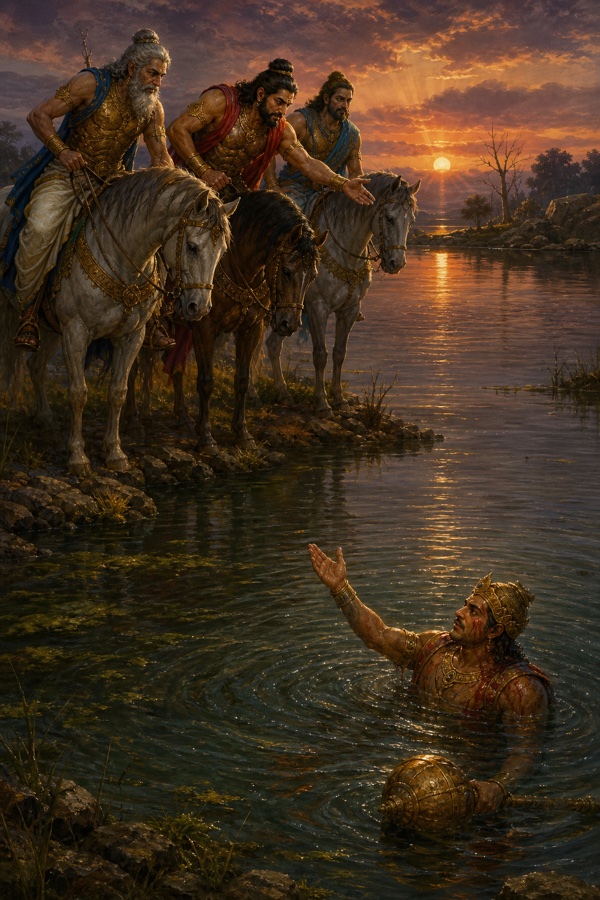
The wounded Duryodhana, hidden in the evening lake, raises a hand while the Pandavas on horseback lean forward on the bank to watch.

From within the waters of the lake, Duryodhana heard Yudhishthira’s words. Sanjaya was telling the tale, and Dhritarashtra was listening; but the evening being described was the dusk of the eighteenth day at Kurukshetra, when the whole Kaurava army had been ground to nothing and the son of Gandhari lay alone, weaponless, worn out, beneath the frozen sheet of the Dvaipayana lake. Yudhishthira’s call pierced that still water and sank all the way to him. “Rise, son of Gandhari, rise and fight us, Suyodhana! Alone, one at a time, take up your great mace and meet us! Today you must give up your life, even if Indra himself comes to your aid.” Those word-arrows were more than the tiger among men, your son, could bear. Like a great serpent lying deep in its hole, he began to draw long, hot breaths beneath the water.

The king rising from the lake

Struck again and again by those goading words, Duryodhana lost all patience, the way a high-bred horse cannot endure the whip. Churning the water with tremendous force, the hero rose from the lake like a king of elephants coming up out of a pool, breathing heavily in his rage, gripping that heavy mace, hard as adamant and cased in gold. Splitting the solidified water, your son came up shouldering his iron mace, like the sun rising to scorch everything with its rays. Endowed with great strength and great intelligence, your son began to handle that heavy weapon of iron, fitted with a sling of leather for the throwing of it.

The blood-soaked Duryodhana rises from the water with his mace lifted, while Krishna and the Pandavas stand watching on the bank.

Armed with the mace, like a crested mountain, or like the trident-bearing Rudra casting angry glances at living creatures, Duryodhana shed an effulgence around him like the scorching sun in the sky. Rising from the water and shouldering his mace, that mighty-armed subduer of foes looked to all the creatures there like the Destroyer himself gripping his bludgeon. The whole host of the Pancalas saw your royal son as the thunder-wielding Shakra, or the trident-bearing Hara. Yet at the sight of him rising from the water, the Pancalas and the Pandavas all began to rejoice and to seize each other’s hands. Your son took that behavior of the onlookers as an insult aimed at himself. Rolling his eyes in wrath, as if to burn the Pandavas with his glance, drawing his brow into three furrows and biting his lower lip again and again, he addressed the Pandavas with Keshava standing in their midst. “You Pandavas will bear the fruit of these taunts! Slain by me today, you will go, with the Pancalas, to the abode of Yama!”

Rising from the water, your son Duryodhana stood there, mace in hand, his limbs bathed in blood. Covered in blood and drenched with water, his body then looked like a mountain shedding water from within it. As he stood armed with the mace, the Pandavas took him for the angry son of Surya himself, gripping the bludgeon called Kinkara. In a voice deep as the clouds, or as a bull bellowing in joy, Duryodhana of great prowess, armed with his mace, summoned the Parthas to battle.

A key to reading this (place): The Dvaipayana lake is the body of water into which Duryodhana, after his defeat and the loss of his army, withdrew for shelter, freezing its surface by his own maya. In the Mahabharata tradition it is counted a sacred site near Kurukshetra; in modern geography it is placed in the Kurukshetra district of Haryana.

The condition of single combat

Duryodhana said, “Yudhishthira, you will have to meet me one at a time! It is not right that one hero should fight many at once, above all when that one warrior is without armor, worn out by exertion, drenched with water, mangled through all his limbs, and stripped of car and animals and troops! Let the gods in heaven watch me fight alone, with none of my equipment, robbed even of armor and weapons! I will surely fight all of you. And you shall be the judge, for you have the fitness to decide the rightness and wrongness of everything.”

The wounded Duryodhana lies on his back on the battlefield, Krishna and the Pandavas standing near, corpses scattered all around.

Yudhishthira answered, “Where was this knowledge of yours, Duryodhana, when many great car-warriors banded together and killed Abhimanyu in battle? The duties of a Kshatriya are cruel, heedless of every consideration, without a trace of pity! How else could you have killed Abhimanyu in those circumstances? You all knew the right; you were all heroes; you were all ready to lay down your lives in war! If your rule is that one should never be slain by many, then why, on your own counsel, was Abhimanyu slain by many? All creatures, caught in danger, forget the considerations of dharma, and then they take the gates of the other world to be shut against them. Put on armor, hero, and bind up your locks! Take everything else you need, Bharata! And I grant you one more boon: whichever of us five Pandavas you choose to fight, if you can kill him, you shall be king; and if you are killed, you go to heaven. Except your life, hero, name us any boon and we grant it.”

Then your son cased his body in armor of gold and set on his head a beautiful head-gear worked with pure gold. Clad in bright gold armor and wearing that head-gear, your son shone like a golden mountain-peak. In his mail, armed with the mace, decked with his other gear, Duryodhana stood on the field and said to all the Pandavas, “Let any one of you five brothers fight me with the mace! As for me, I am ready today to fight Sahadeva, or Bhima, or Nakula, or Phalguna, or you, bull of Bharata’s race, whichever it be! Granted the encounter, I will fight any one among you and surely win on the field! Today, with the help of my mace wrapped in cloth of gold, I will reach the far end of this bitter quarrel. In an encounter with the mace, I think there is no man to match me! With my mace I will kill all of you, one after another!”

A sub-tale: Duryodhana’s demand that they fight him one at a time is itself an echo of the wrong done to Abhimanyu inside the wheel-array. The Mahabharata does not hide the reversal here: the very rule Duryodhana now invokes is the rule his own side broke against a boy. Yudhishthira lays the contradiction back in his face, and at the same time grants that all creatures forget dharma when danger closes in, so the blame is never laid flatly on one side alone.

Vasudeva’s worry and Yudhishthira’s rashness

The wounded Duryodhana lies on the ground, Krishna speaks with a raised finger, and Bhima, Yudhishthira, and other warriors stand around him.

While Duryodhana was roaring in this way, Vasudeva, filled with wrath, spoke these words to Yudhishthira. “What rash thing is this you have said, king, that whoever kills one of us shall be king among the Kurus? If Duryodhana chooses you for the fight, or Arjuna, or Nakula, or Sahadeva, what then will follow? For thirteen years, king, hungry to kill Bhimasena, Duryodhana has practiced with the mace against a statue of iron! How then, bull of Bharata’s race, will our purpose be served? Out of pity, best of kings, you have acted with great rashness! At this moment I see no match for Duryodhana except Pritha’s son Vrikodara, and even Bhima’s practice with the mace has not been so great. You have once more let a wretched game of chance begin, like the one long ago between you and Shakuni. Bhima has might and prowess; king Suyodhana has skill. In a contest between might and skill, king, the one with skill always prevails. You have set such a foe in a position of ease and comfort, and placed yourself in a position of difficulty. This is how we have come into great danger.”

“Who would let go of a victory already in his grasp, having beaten down all his foes, with only one enemy left and that one caught in difficulty? I see no man in the world today, not even a god, who could beat the mace-armed Duryodhana in battle! Not you, not Bhima, not Nakula, not Sahadeva, not Phalguna, none of you is able to defeat Duryodhana in fair fight! King Duryodhana has great skill. Even if Duryodhana chose to fight Vrikodara among us in fair combat, our victory would still be in doubt.”

Bhimasena said, “Slayer of Madhu, delight of the Yadus, do not grieve! However hard this quarrel is to end, today I will bring it to its end! Without doubt I will kill Suyodhana in battle. It seems to me, Krishna, that the victory of Yudhishthira the just is certain! This mace of mine is heavier than Duryodhana’s by half again. Do not grieve, Madhava. I dare to fight him with the mace for my chosen weapon. Stand and watch this encounter, all of you, Janardana! What is Suyodhana to me? I could fight the three worlds, the very gods among them, armed with every kind of weapon!”

Hearing these words of Vrikodara, Vasudeva was filled with joy and praised Bhima warmly. “Leaning on you, mighty-armed one, Yudhishthira the just will surely win back his blazing prosperity once all his foes are slain! You have killed all the sons of Dhritarashtra in battle. At your hands many kings and princes and elephants have met their end. The Kalingas, the Magadhas, the Kauravas, the men of the west, the Gandharas, all have fallen in this terrible war, son of Pandu! Kill Duryodhana, son of Kunti, and give the earth with her oceans to Yudhishthira the just. But always fight the son of Dhritarashtra with care, son of Pritha. He has both skill and strength, and he takes constant delight in battle.” Then Satyaki praised the son of Pandu, and Yudhishthira with all the Pancalas and Pandavas approved those words of Bhima.

A key to reading this (the numbers, in modern terms): Duryodhana’s thirteen years of practice against an iron statue are the same thirteen years the Pandavas spent in the forest and in hiding. Through that whole stretch Duryodhana bent himself to a single aim, the mace-skill that would kill Bhima. That is why Krishna will not stake everything on Bhima’s raw strength: thirteen years of single-minded discipline can outweigh any natural power.

Bhima’s vow and the memory of old wounds
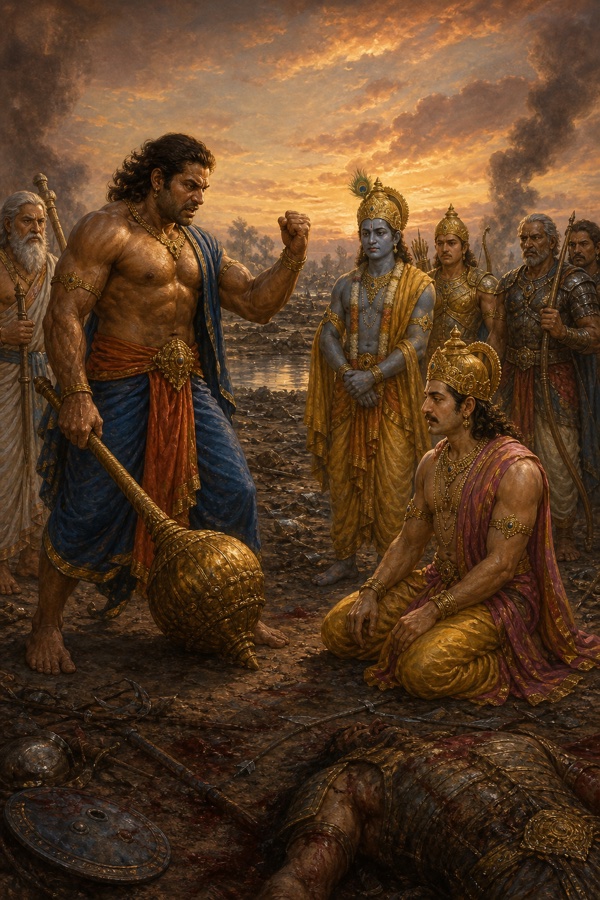
Bhima, fist clenched, denounces Duryodhana who kneels on the ground, while Krishna and other warriors stand watching gravely.

Then Bhima of terrible might spoke to Yudhishthira, who stood among the Srinjayas like the scorching sun. “Meeting him in battle, I dare to fight him! This lowest of men is not fit to beat me in war! Today I will vomit upon Suyodhana the wrath I have nursed so long in my heart, as Arjuna threw fire upon the forest of Khandava! Today, son of Pandu, I will pluck out the dart that has stuck so long in your heart! Laying this wretch low with my mace, I will make you happy. Today Suyodhana will give up his life, his prosperity, and his kingdom!”

Having said this, that prince of Bharata’s race, full of great energy, stood up for battle, like Shakra summoning Vritra. Unable to bear that challenge, your son, of great energy, moved to meet it, like one furious elephant charging another. The Pandavas saw your son come, armed with the mace, and thought of the crested peak of Kailasa. Seeing your mighty son stand alone like a prince of elephants cut off from the herd, the Pandavas were filled with delight. Standing there for battle like a very lion, Duryodhana had no fear, no alarm, no pain, no anxiety.

Seeing Duryodhana stand with his mace lifted like the crested peak of Kailasa, Bhimasena spoke to him. “Call to mind all the wrongs that king Dhritarashtra and you have done to us! Remember Varanavata! Remember how Draupadi, while in her season, was maltreated in the midst of the assembly, and how king Yudhishthira was cheated at dice on Shakuni’s counsel! See now, wicked soul, the terrible harvest of those acts and of all your other wrongs! It is because of you that the greatest of the Bharatas, the son of Ganga, the grandsire of us all, lies today on a bed of arrows! Drona too has been slain! Karna has been slain! Shalya of great valor has been slain! And that Shakuni, the very root of this quarrel, has been slain in battle! Your heroic brothers, your sons, with all your army, have been slain. And that Pratikamin, that wretch who seized Draupadi’s hair, he too has been slain! You alone are still alive, destroyer of your own race! You too I will kill today with my mace! Of this there is no doubt.”
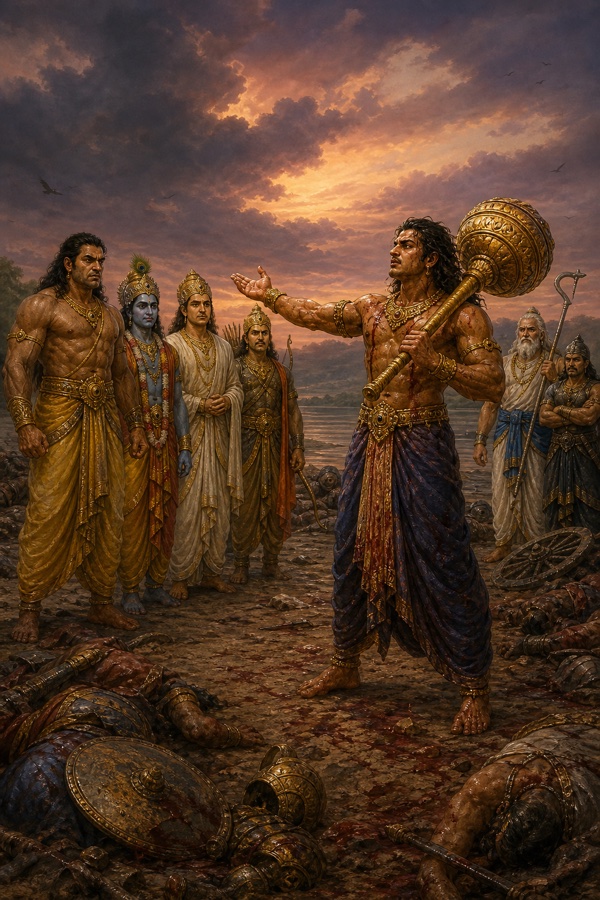
Duryodhana, mace on his shoulder, spreads his arms to challenge the Pandavas, corpses and broken weapons lying on the ground.

Duryodhana answered, “What use is all this talk? Fight me now! Today, Vrikodara, I will beat the desire for battle out of you! Why do you not see me standing here for an encounter with the mace? Do I not hold a fearsome mace like a peak of Himavat? What foe would dare to defeat me armed with this weapon? For all those wrongs of mine that you speak of, you could never do me the slightest harm! By my own strength I drove you into the forests, made you serve in another man’s house, forced you to hide in disguise! Our losses have been equal. If I fall in this battle, that will be highly praiseworthy; or perhaps Time itself will be the cause. Up to this day I have never been beaten in fair fight on the field. If you defeat me by deceit, your infamy will last forever! That deed will be full of wrong and disgrace, of this there is no doubt. Do not, son of Kunti, roar in vain like autumn clouds with no rain in them! Show now, in battle, all the strength you have!”

A sub-tale: Duryodhana’s warning here, that a victory won by deceit will carry infamy forever, stays lodged in the story like a thorn. The words he speaks now will come back only moments later, after the blow to the thighs, from his own mouth as a charge against Krishna. The Mahabharata plants this foreshadowing on purpose, so the reader knows the coming blow breaks the rule and that the story never declares it fair.

Balarama’s arrival
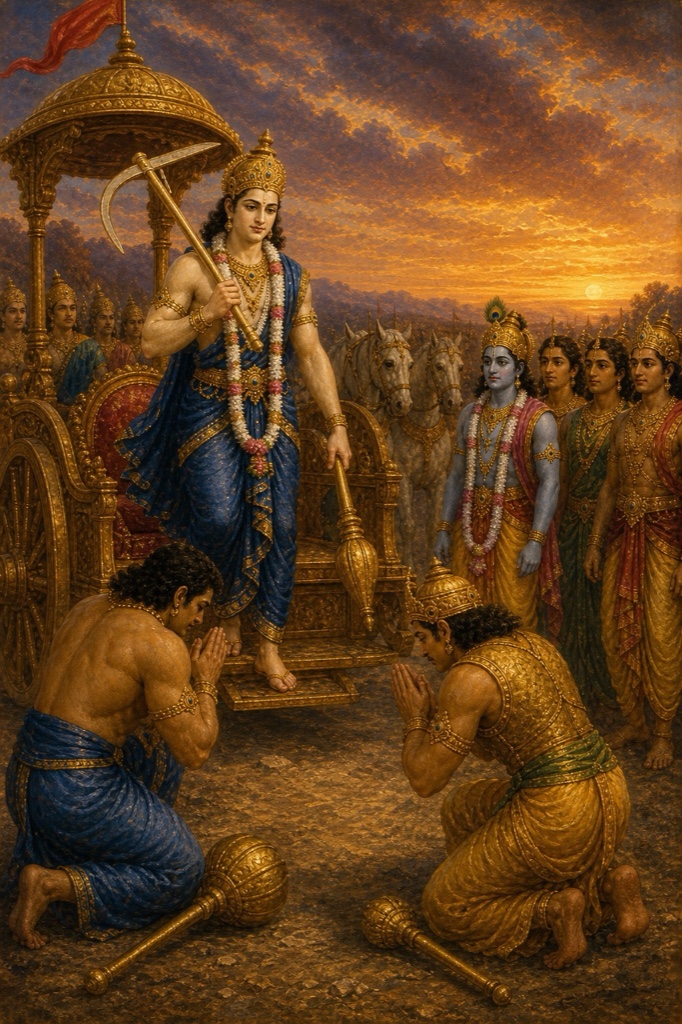
Before the plough-bearing Balarama, newly down from his chariot, Bhima and Duryodhana set their maces on the ground and bow with joined hands.

When that terrible fight was about to begin and all the high-souled Pandavas had taken their seats, Rama, whose banner bore the palmyra palm and who owns the plough for his weapon, having heard that the battle between his two students was at hand, arrived at that spot. Seeing him, the Pandavas with Keshava went forward in joy and welcomed him with the proper rites. Their worship over, they said, “Witness, Rama, the skill of your two students in battle!” Casting his eyes on Krishna and the Pandavas, and on Duryodhana of Kuru’s race standing there with his mace, Balarama said, “Two and forty days have passed since I left home. I set out under the constellation Pushya and have returned under Sravana. I wish, Madhava, to see this encounter with the mace between these two students of mine.”

At that time the two heroes, Duryodhana and Vrikodara, stood resplendent on the field, both armed with their maces. King Yudhishthira embraced the plough-bearer, asked after his welfare, and bade him welcome. The two Krishnas, Vasudeva and Arjuna, joyfully saluted the hero of the plough and embraced him. The two sons of Madri and the five sons of Draupadi saluted the son of Rohini of great strength and stood at a respectful distance. Bhimasena and your son, both with maces uplifted in their arms, did honor to Baladeva. The other kings bade him welcome, and all of them said, “Witness this battle, mighty-armed one!” Rama of immeasurable energy embraced the Pandavas and the Srinjayas and asked after the welfare of all the kings, and, embracing Janardana and Satyaki with affection, he smelled their heads. Clad in blue robes and fair of complexion, Rama shone amid those kings like the moon in the sky ringed by a company of stars.

A key to reading this (lineage): Balarama (Baladeva, Rama, the son of Rohini, Sankarshana) is Krishna’s elder brother and the mace-teacher of both Duryodhana and Bhima. For the great war he chose neutrality, taking neither the Kaurava side nor the Pandava. That is why he had set out on a pilgrimage along the Sarasvati, and now, having completed a journey of forty-two days (from the constellation Pushya to the constellation Sravana), he returns to watch the last duel between his two students. His neutrality is exactly what makes him the impartial judge of what follows.

A sub-tale: At the war’s outset Balarama had told Krishna that he would help neither Duryodhana nor the Pandavas and would go wherever he pleased. His Bhoja kinsman Kritavarma took Duryodhana’s side, and Vasudeva, along with Yuyudhana (Satyaki), took the Pandavas’. Balarama himself set out on a pilgrimage to the sacred waters of the Sarasvati, taking with him all the Yadavas, their priests, the sacred fire of Dwaraka, and gifts of gold and cattle and cloth, moving from Prabhasa to Kurukshetra, bathing at each site and giving to the Brahmanas at every step. It was from Narada that he heard the news of the carnage at Kurukshetra and of Duryodhana’s entry into the lake, and he mounted his car and came to see this final duel.

Toward the battlefield and Bhima’s second vow

Rama spoke to Yudhishthira in sweet and righteous words, words that were of the greatest good to heroes. “Best of kings, I have heard from the sages that Kurukshetra is a most holy and sin-cleansing place, equal to heaven itself, honored by gods and sages and high-souled Brahmanas! Those who cast off their bodies here, fighting on this field, are sure to dwell in heaven with Shakra himself! For this reason, king, I will go at once to Samantapanchaka. In the world of the gods that spot is called the northern altar of Brahma.” “So be it,” said Kunti’s son Yudhishthira, and set out for Samantapanchaka. King Duryodhana too took up his huge mace and went on foot, in wrath, with the Pandavas. As Duryodhana walked, armed with the mace and clad in armor, the gods in the sky praised him, crying, “Well done! Well done!” Samantapanchaka was an excellent holy ground on the southern bank of the Sarasvati. The ground there was free of sand, and so it was chosen for the fight.

Bhima and Duryodhana stand face to face with maces raised, while the onlookers, Krishna and Balarama among them, blow their conchs.

Clad in armor, gripping a mace of gigantic thickness, Bhima took on the form of the great Garuda. His head-gear bound on, his gold armor on his body, licking the corners of his mouth, his eyes red with wrath, breathing hard, your son shone on that field like the golden Sumeru. Duryodhana and Bhima, each with his mace lifted, challenged each other like two elephants, or two lions calling one another to battle. With their maces uplifted, the two looked like two mountains with tall summits on that field. Both were furious, both endowed with terrible prowess, both the intelligent students of the son of Rohini.

Then Duryodhana, amid his brothers and before the high-souled Krishna and Rama of immeasurable energy, spoke these proud words to Yudhishthira. “Guarded by the Kaikeyas, the Srinjayas, and the high-souled Pancalas, sit together with all those best of kings and watch this battle between me and Bhima!” Hearing this, all of them did so. In the midst of that gathering of kings, Baladeva, the elder brother of Keshava, clad in blue robes and fair of complexion, shone like the full moon ringed by a thousand stars.

Meanwhile Bhima said to Yudhishthira, “This wicked soul Suyodhana is not fit to beat me in battle! Today I will vomit upon this ruler of the Kurus the wrath I have kept so long in the secret places of my heart! Today, son of Pandu, I will pluck out the dart that has stuck in your heart! This stain upon the race of Kuru I will break today into a hundred pieces with this very mace! Never again will he enter the city named for the elephant! The snake loosed on us in our sleep, the poison in our food, our bodies thrown into the water at Pramanakoti, the attempt to burn us in the house of lac, our humiliation in the assembly, the plunder of all we owned, a full year of hidden life, our exile in the forest, best of the Bharatas, all of these sorrows I will end today!”

The mace-duel and ill omens

When the high-souled king of the Kurus challenged Bhima to the duel, many dreadful omens appeared. Fierce winds began to blow with loud, broken cries, and a rain of dust fell. Every quarter of the sky was wrapped in thick darkness. Thunderbolts of loud report fell on all sides, making great confusion and raising the hair on end. Hundreds of meteors burst from the sky with a loud noise and fell. Rahu swallowed the sun before its hour. The earth with its forests and trees shook hard. Hot winds blew, scattering hard, stony grit along the ground. The summits of mountains fell to earth. Animals of many forms were seen running everywhere. Fearsome jackals with blazing mouths howled on every side. The water in the wells swelled up of its own accord.

In the mace-duel the maces of Bhima and Duryodhana clash and scatter sparks, while Krishna and the warriors stand watching nearby.

Even after seeing these omens, Duryodhana challenged Bhima. The two ran at each other like two furious elephants. The blows of their maces made a sound like thunder. Each longed for victory, and the fight between them was as terrible as the fight of Indra and Prahlada, a thing to make the hair stand on end. Their every limb bathed in blood, those two heroes of great splendor, armed with maces, looked like two Kinsuka trees decked with flowers. After that fierce fighting had gone on for a while, both grew tired. Resting a little, they took up their fine maces again and began to ward off each other’s blows.

Both of them, guarding themselves with care, watched for the other’s opening, the moment of carelessness. Bhimasena made many kinds of circles and wheeling turns, advancing, drawing back, striking, warding off blows, moving to right and left, rushing straight at his foe, weaving feints to deceive him. Both were skilled in mace-combat. Both, drenched in blood, mangled and bruised, shone like two Kinsuka trees flowering on the breast of Himavat. Duryodhana adopted the right-hand circle, Bhima the left.

As Bhima wheeled in his circles, Duryodhana struck a sudden, sharp blow to one of his flanks. Struck by it, Bhima began to whirl his heavy mace to answer. The onlookers saw Bhima’s mace as terrible as the thunderbolt of Indra or the bludgeon of Yama. Seeing Bhima whirl his mace, your son lifted his own dreadful weapon and struck him again. The descent of your son’s mace made a sound so fierce that a flame leapt up in the sky. Wheeling through many kinds of turns, taking each motion at its proper moment, Suyodhana of great splendor once more seemed to gain the upper hand over Bhima. Seeing the force of the wind raised by the whirling of Duryodhana’s mace, a great fear settled into the hearts of all the Pandavas and Somakas.

Duryodhana's mace comes down on Bhima, who has fallen to his knees, throwing off sparks, while Krishna stands watching nearby.

Then, adopting the left-hand circle, whirling his mace, the resolute Suyodhana struck Kunti’s son on the head with a weapon of terrible speed. Struck by this blow of your son, Bhima did not so much as tremble, and all the onlookers were amazed. Then Bhima of terrible prowess hurled his heavy, blazing, gold-plated mace at Duryodhana; but fearless Duryodhana, with his quickness, escaped the blow. Thrown with full force yet falling to no purpose on the earth, the mace raised a sound like thunder, and the ground shook.

Adopting the manoeuvre called Kausika, leaping up again and again, gauging exactly the descent of Bhima’s mace, Duryodhana made it fail of its mark. Having thus outwitted Bhima, the mighty king of the Kurus struck him in wrath on the chest. Struck hard by your son in that dreadful battle, Bhimasena was for a moment nearly senseless and forgot what he was doing. In that moment the Somakas and Pandavas were seized with despair and lost heart. Enraged by the blow, Bhima fell upon Duryodhana again, as one elephant falls upon another.

Coming close to the king of the Kurus, Bhima, skilled in the use of the mace, took his aim and struck one of Duryodhana’s flanks. Stunned by the blow, Duryodhana fell to his knees on the ground. When that best of the Kurus went down on his knees, a great outcry rose among the Srinjayas. Hearing the outcry of the Srinjayas, your son was filled with wrath. Rising, breathing like a great serpent, as if to burn Bhima with his glance, he rushed at him as though this time he would crush his enemy’s very head. Duryodhana of great splendor struck Bhimasena on the head; but Bhima did not give way in the least, standing firm as a mountain. Struck so, Bhima, shedding streams of blood, looked like an elephant with rent temples flowing with rut.

Then the elder brother of Dhananjaya, that subduer of foes, lifting his iron mace, the slayer of heroes, struck with all his force, and the blow rang like thunder. Struck, your son fell to the earth, his whole body trembling, like a great Sala tree in the forest, decked with flowers, torn up by a violent wind. But when his senses returned, your son rose again, like an elephant coming up out of a pool; and that ever-wrathful great car-warrior, wheeling with great skill, struck Bhima who stood before him. At this Bhima, his limbs gone slack, fell to the earth. His armor split open. In the sky rose an outcry of gods and Apsaras, and a rain of fragrant flowers fell. In a moment his senses returned, and wiping the blood from his face, gathering great steadiness, with rolling eyes, steadying himself with a mighty effort, Vrikodara rose again.

A key to reading this (a concept): In mace-fighting the mandalas are circular tracks of movement, the right-hand circle and the left-hand circle, styles of attack and defense made while wheeling to one side or the other. Kausika and gomutraka are names of particular moves (crooked, zigzagging steps). The Mahabharata’s account makes it plain that both men were schooled alike; the only difference is that Duryodhana has more practice and skill, and Bhima more strength. This imbalance sets up the decisive turn that follows.

Arjuna’s question and Vasudeva’s signal

Seeing the battle between those two best of the Kurus blaze up like this, Arjuna asked Vasudeva, “Of these two, which is the better in your judgment? What quality lies in each? Tell me this, Janardana.”

Vasudeva said, “The two have had equal training. But Bhima has more strength, while the son of Dhritarashtra has more skill and has toiled harder. If Bhima fights fairly, he will never win. If he fights unfairly, then he can kill Duryodhana. The gods too, we have heard, defeated the Asuras with the help of deceit. Shakra won over Virochana by deceit; the slayer of Vala drained Vritra of his splendor by deceit. So let Bhimasena bring out his prowess with the help of a trick! At the time of the dice, Dhananjaya, Bhima vowed that in battle he would break Suyodhana’s thighs with his mace. Let this subduer of foes now keep that vow. Let him kill by deceit the deceitful king of the Kurus. If Bhima trusts only in his strength and fights fairly, king Yudhishthira will be in great danger.”

“I say to you again, son of Pandu, listen. It is by king Yudhishthira’s own fault that this danger has come upon us once more! Having accomplished the great work of slaying Bhishma and the other Kurus, having won victory and glory, the king had come near the end of the quarrel; and yet he has put himself again into a place of doubt and danger, staking the whole outcome of the war on the winning or losing of a single warrior. Suyodhana is skilled, brave, and resolute. We have heard this old saying of Usanas: ‘Always fear those broken warriors of a fleeing enemy who rally and return to battle, for they are resolute and have a single purpose. When they have cast off all hope of life and rush in fury, not even Shakra can stand against them.’ This Suyodhana fled, broken; his whole army had been slain; he hid himself in the depths of the lake. If mighty Bhima does not kill him by deceit, the son of Dhritarashtra will surely remain king!”

Krishna signals with a finger and Arjuna touches his own thigh, while behind them the mace-duel of Bhima and Duryodhana goes on.

Hearing these words of Keshava, Arjuna slapped his own left thigh before Bhimasena’s eyes. Reading the signal, Bhima began to wheel about with his mace uplifted, weaving many beautiful circles, many paired steps and other moves. Now the right-hand circle, now the left, now the crooked step called gomutraka, Bhima wheeled about, bewildering his foe. And your son, well-skilled in mace-combat, wheeled too with great quickness in his own beautiful turns, seeking to kill Bhima.

A sub-tale: Krishna’s counsel here is one of the most contested moral moments in the Mahabharata, and the story neither hides it nor softens it. Krishna himself admits that Bhima cannot win a fair mace-fight, and he justifies the trick by citing the gods. At the same time he names Yudhishthira’s offer, kill one of us and become king, as the original error. This is the very knot from which Balarama’s anger and Duryodhana’s accusation will later rise. The reader finds no simple contest of good against evil here. What the story offers is a tangled collision of dharma, of a vow, and of circumstance.

The thigh-blow and Duryodhana’s fall

Whirling their dreadful maces, smeared with sandal paste and other fragrant unguents, the two heroes, longing to reach the end of their quarrel, wheeled about in that battle like two angry Yamas. Each hungry to kill the other, those two best of men, of great prowess, fought like two Garudas each bent on seizing the same snake. As the king and Bhima wheeled in their beautiful circles, their maces clashed, and from those repeated clashes flew sparks of fire. Each struck the other with equal blows. Resting a little, filled again with wrath, lifting their maces, they fought on. When by repeated blows they had mangled each other, the battle grew terrible and altogether unrestrained.

During that encounter, when Vrikodara, as a ruse, seemed to leave himself open, Duryodhana, smiling a little, came forward. The mighty Vrikodara, well-skilled in battle, saw his foe come on and suddenly hurled his mace at him. Seeing the mace fly at him, your son moved away from that spot, and the weapon fell useless on the earth. Having warded off that blow, your son at once struck Bhimasena with his own weapon. From the great quantity of blood drawn by the blow, and from the violence of it, Bhimasena of immeasurable energy seemed to be stupefied. Duryodhana, however, did not know that the son of Pandu was in such distress at that moment. Deeply afflicted though he was, Bhima gathered all his patience and held himself steady. Duryodhana therefore took him to be unmoved and ready to return the blow, and so he did not strike him again.

Bhima's mace lands on Duryodhana's thighs and he, bleeding, is flung backward and falls.

Having rested a little, the valiant Bhimasena rushed with force at Duryodhana who stood near him. Seeing Bhima of immeasurable energy rush at him in wrath, your high-souled son set his heart on the manoeuvre called Avasthana to baffle the blow, and so he wished to jump upward to deceive Vrikodara. Bhimasena fully understood his foe’s intent. And so, rushing at him with a leonine roar, in the very instant when Duryodhana leapt up to escape the first blow, Bhima hurled his mace with great force at the thighs of the king of the Kurus.

That mace, carrying the force of the thunderbolt, hurled by Bhima of terrible deeds, broke both the handsome thighs of Duryodhana. The tiger among men, your son, his thighs broken, fell to the earth, making the ground ring with his fall. Fierce winds, with loud reports at intervals, began to blow. A rain of dust fell. The earth, with its trees and plants and mountains, trembled. On the fall of that foremost of all the kings of the earth, hot winds like fire blew with a loud noise and with thunderbolts falling again and again. As that lord of the earth fell, great meteors flashed and fell from the sky. Maghavat rained down blood and dust upon the fall of your son.

The blood-drenched Duryodhana drags himself along the ground, Bhima leans over him in anger, and jackals prowl nearby.

In the sky rose a loud outcry of Yakshas, Rakshasas, and Pisachas. At that terrible sound, thousands of animals and birds cried out more fearfully on every side. The horses and elephants and men of the remnant of the army cried aloud at the fall of your son. The blare of conchs and the peal of drums and cymbals rang out. From within the earth a terrible sound seemed to rise. On the fall of your son, headless creatures of dreadful shape, with many legs and many arms, began to dance and to cover the earth on every side. Warriors gripping standards or weapons trembled. Lakes and wells vomited blood. Rivers of swift current flowed backward. In that hour women seemed to look like men and men like women, when your son Duryodhana fell!

A key to reading this (a concept): The clear rule of mace-combat was that no blow may land below the navel. Bhima’s blow to the thighs breaks that rule, and the story does not conceal it. It underscores the wrong itself, through the downpour of ill omens, the rain of blood sent by Indra, and the dance of the headless creatures. On one side stand Bhima’s vow (sworn in the dice-hall, to break those thighs) and the curse of the sage Maitreya; on the other stands the rule of fair combat. The Mahabharata sets the two side by side and leaves the reader unsettled, and that is the source of its moral depth.

Bhima’s foot and Yudhishthira’s protest

Bhima sets his foot on the head of the fallen Duryodhana, while Krishna and the other warriors look on with reluctance.

Seeing Duryodhana felled to the earth like a great Sala tree, the Pandavas were filled with joy. The Somakas too, their hair standing on end, gazed at the king of the Kurus lying on the earth like a furious elephant struck down by a lion. Having felled him, the valiant Bhimasena went up to him and said, “O wretch, once you laughed at the disrobed Draupadi in the midst of the assembly, and, fool, you called us ‘Cow, Cow!’ Bear now the fruit of that insult!” And with that he touched the head of his fallen foe with his left foot. He set his foot on the head of that lion among kings.

Having crossed to the far shore of those bitter hostilities, Vrikodara said slowly, laughing, to Yudhishthira, Keshava, the Srinjayas, Dhananjaya, and the two sons of Madri: “See the sons of Dhritarashtra, who dragged Draupadi into the assembly while in her season and disrobed her there, now slain in battle by the Pandavas through the ascetic power of Yajnasena’s daughter! Those crooked-hearted sons of Dhritarashtra who called us ‘sesame seeds without kernel’ have all been slain with their kinsmen and followers! Now, whether we go to heaven or fall into hell, it makes no difference!” Then, lifting the mace that lay on his shoulder, he again touched with his left foot the head of the king who lay upon the earth.

Many righteous warriors among the Somakas, seeing Bhimasena’s foot set upon the head of that best of the Kurus, did not approve of it. While Vrikodara was thus boasting and dancing madly over your fallen son, king Yudhishthira said to him, “You have paid off your hostility and fulfilled your vow, by a fair act or an unfair one! Cease now, Bhima! Do not crush his head with your foot! Do no sin! Duryodhana is a king, and he is your kinsman too; he has fallen. This conduct of yours, sinless one, is not proper. Duryodhana was lord of eleven Akshauhinis, king of the Kurus. Do not touch a king and a kinsman with your foot, Bhima. His kinsmen are slain, his friends and counsellors are gone, his army destroyed; he has been struck down in battle; he deserves pity in every way, not insult. ‘Bhimasena is a man of righteous conduct,’ people used to say of you before! Why then, Bhimasena, do you insult the king in this way?”

Yudhishthira bends toward the wounded Duryodhana and reaches out a hand, while Bhima stands near with his mace.

Having said these words, his throat choked with tears, Yudhishthira, overcome with grief, went up to Duryodhana, that subduer of foes, and said, “Do not, my brother, give way to anger, nor grieve for yourself. Without doubt you are reaping the dreadful fruit of your own former deeds. Without doubt the Creator himself ordained this sorrowful end, that we should injure you and you injure us. Through your own fault, through greed and pride and folly, this great calamity has come upon you, Bharata! Having caused your friends, your brothers, your fathers, your sons, your grandsons to be slain, you now come to your own death. You are not to be pitied; your death, rather, is to be envied. It is we, Kaurava, who are to be pitied, we who will drag out a sorrowful life bereft of our dear friends and kinsmen. You depart from this world; you are sure to dwell in heaven; and we, counted as creatures of hell, will suffer the sharpest grief. The grieving widows of the sons of Dhritarashtra will surely curse us all.” And with that Dharma’s son, overcome with grief, began to draw long breaths and to lament.

Balarama’s anger and Krishna’s restraint

Seeing your son struck at the thighs, the mighty Rama grew furious. Raising his arms aloft, the hero of the plough said, in a voice of deep sorrow, in the midst of those kings: “Fie on Bhima, fie on Bhima! Fie, that in such a fair fight a blow has been struck below the navel! Never before has such an act as Vrikodara’s been seen in an encounter with the mace! No limb below the navel should be struck, this is the precept of the treatises! But this Bhima is an ignorant wretch, unversed in the truths of the treatises! And so he acts as he pleases!” Saying this, Rama gave way to great wrath, and, lifting his plough, rushed at Bhimasena. The form of that great hero, his arms uplifted, became like the vast mountain of Kailasa painted with many metals.

The enraged Balarama lunges with his raised plough and Krishna holds him back, locked in his arms, while the wounded Duryodhana lies on the ground.

But Keshava of great strength, ever bending toward humanity, seized the rushing Rama and held him fast in his massive, well-rounded arms. Those two best of heroes of the Yadu race, the one dark, the other fair, shone at that moment like the sun and the moon in the evening sky. To calm the angry Rama, Keshava said, “The Pandavas are our natural friends, the children of our own father’s sister! They were sorely wronged by their foes. To fulfill a vow is a man’s duty. Long ago, in the assembly, Bhima vowed that in the great war he would break Duryodhana’s thighs with his mace. The great sage Maitreya too, subduer of foes, had cursed Duryodhana, saying, ‘Bhima will break your thighs with his mace!’ For all this I see no fault in Bhima. Do not give way to wrath, slayer of Pralamba! Our bond with the Pandavas rests on birth and blood, and on the pull of our hearts. In their growth is our growth.”

Hearing these words of Vasudeva, the plough-bearer, who knew the rules of morality, said, “Morality is well practiced by the good. But two things always afflict it: the desire for Profit in the greedy, and the desire for Pleasure in the pleasure-bound. Whoever follows all three, morality, profit, and pleasure, without any one afflicting another, gains the greatest happiness. But because morality has been afflicted by Bhimasena, that harmony, Govinda, has been broken, whatever you may say to me.” Krishna answered, “You are always called free of wrath, righteous, and devoted to righteousness! So be calm, do not give way to wrath. Know that the age of Kali is at hand. Remember too the vow of the son of Pandu! Let the son of Pandu, then, be reckoned as one who has paid off the debt of his hostility and fulfilled his vow.”

Hearing this argument of Keshava, Rama’s wrath was not calmed; yet he grew composed, and said in that assembly, “By slaying the righteous king Suyodhana unfairly, the son of Pandu will be known in the world as a crooked warrior! And the righteous Duryodhana will attain eternal blessedness! The son of Dhritarashtra who has been struck down is a fair warrior. Having made every arrangement for the Sacrifice of battle, having undergone the rites of initiation on the field, and at last having poured his life as an offering upon the fire of his foes, Duryodhana has rightly completed his sacrifice, with the final ablution that is the winning of glory!” Saying this, the son of Rohini, like the crest of a white cloud, mounted his car and set out for Dwaraka.

A key to reading this (a concept): The avabhritha bath is the final ablution performed at the close of a Vedic sacrifice. Balarama turns Duryodhana’s death into the figure of a completed sacrifice: the war itself the yajna, the battlefield its initiation, the enemy its fire, and one’s own life the offering. Through this figure he declares Duryodhana the fair warrior and Bhima the trickster. The Mahabharata does not erase this view; it lets Balarama say aloud the very thing the winning side would rather not hear.

Duryodhana’s accusation and Krishna’s reply

After Rama’s departure for Dwaraka, the Pancalas, the Vrishnis, and the Pandavas grew somewhat downcast. Then Vasudeva, very cheerless, sunk in anxiety, his head bowed, went up to Yudhishthira and said, “Dharmaraja, why do you sanction this unrighteous act, that Bhima should crush with his foot the head of the senseless, fallen Duryodhana, whose every kinsman and friend has been slain? Knowing the ways of morality, king, why do you look on with indifference?”

Yudhishthira answered, “This act of Vrikodara’s, done in wrath, touching the king’s head with his foot, is not dear to me, Krishna, nor am I glad at this destruction of my own race! The sons of Dhritarashtra always deceived us by guile, spoke many harsh words to us, drove us again and again into exile in the forest. All the grief of those deeds lies heavy in Bhimasena’s heart. Weighing all this, kinsman of the Vrishnis, I looked on with indifference! Having slain the greedy, foolish Duryodhana, the slave of his own passions, let the son of Pandu satisfy his desire, be it right or be it wrong!”

Then Krishna said to the Pandavas and Pancalas, “Kings, it is not fitting to slay a slain foe again with such repeated harsh words. This dull-witted man has already been slain. This sinful, shameless, greedy wretch, ringed by sinful counsellors and heedless of wise friends, met his death even when Vidura, Drona, Kripa, and Sanjaya urged him again and again to give the Pandavas their paternal share, and he refused! He is now fit to be reckoned neither friend nor foe. What use is there in spending bitter words on one who has become a piece of wood? Kings, mount your cars quickly; we should leave this place.”

Hearing this rebuke of Krishna, king Duryodhana was filled with wrath and tried to rise. Supporting himself on both arms, sitting up on his haunches, his brow drawn tight, he cast an angry glance at Vasudeva. The form of Duryodhana, half-raised, looked, Bharata, like a poisonous snake shorn of its tail. Disregarding his sharp, unbearable pain, Duryodhana began to pierce Krishna with keen, bitter words:

“O son of Kansa’s slave, have you no shame! Have you forgotten that by the rules of the mace-duel I have been struck down most unfairly? It was you who caused this wrong, reminding Bhima with a hint about breaking my thighs! Did I not see when Arjuna, on your counsel, gave the hint to Bhima? Having had thousands of kings who always fought fairly slain by many kinds of deceit, do you feel no shame or loathing for those deeds? You had the grandsire slain by putting Shikhandi to the fore! By having an elephant named Ashvatthama killed, you made the preceptor Drona lay down his weapons! When Karna’s chariot wheel sank in the mire and he was struggling to free it, you had Karna slain! If you had fought me, and Karna, and Bhishma, and Drona by fair means, victory would never have been yours! By the most crooked and unrighteous of means you have caused many righteous kings, and us as well, to be slain!”

Vasudeva answered, “Son of Gandhari, you have been slain with your brothers, sons, kinsmen, friends, and followers only because of the sinful path you walked! It is by your own evil deeds that Bhishma and Drona were slain! Karna too was slain for following your example! Though I asked it of you, fool, you would not, out of greed, on Shakuni’s counsel, give the Pandavas their paternal share! You gave poison to Bhimasena, you tried to burn all the Pandavas with their mother in the house of lac, you persecuted Yajnasena’s daughter in her season in the midst of the assembly! Through Jayadratha you had Krishna maltreated! You surrounded a lone child, Abhimanyu, with many and slew that hero! It is for these faults, sinful man, that you have been slain! All the unrighteous deeds you charge to us were in truth done by you, out of your own sinful nature! You never listened to the counsels of Brihaspati and Usanas, never served the old, never heeded beneficial words! Bear now the fruit of your own deeds!”

Duryodhana said, “I have studied, I have made gifts by the ordinance, I have ruled the wide earth with her seas, I have stood upon the heads of my foes! Who is so fortunate as I? And that end which Kshatriyas faithful to their own dharma desire, death in battle, has become mine. Who then is so fortunate as I? Human enjoyments worthy of the very gods, such as other kings win only with difficulty, were mine! The highest prosperity I attained! Who then is so fortunate as I? With all my well-wishers and my younger brothers, hero of unfading glory, I am going to heaven! And you, your purposes unachieved, worn with grief, live on in this unhappy world!”

The dying Duryodhana lies on the ground, Krishna and the Pandavas blow their conchs, and in the distance three warriors walk away.

As these words of the wise king of the Kurus ended, a thick shower of fragrant flowers fell from the sky. The Gandharvas played many charming instruments. The Apsaras sang in chorus the glory of king Duryodhana. The Siddhas cried aloud, “Praise to king Duryodhana!” Fragrant, delightful breezes blew softly all around. Every quarter grew clear, and the firmament shone blue as lapis lazuli. Seeing these most wonderful things, and this honor offered to Duryodhana, the Pandavas with Vasudeva were ashamed. Hearing the cry of unseen beings that Bhishma, Drona, Karna, and Bhurishrava had been slain unrighteously, they were overcome with grief and wept.

Seeing the Pandavas full of anxiety and grief, Krishna said, in a voice deep as the clouds or the drum, “They were all great car-warriors, most swift in the use of weapons! Even had you put out all your prowess, you could never have slain them in fair fight! King Duryodhana too could not be slain in a fair duel; and this holds for all the great car-warriors headed by Bhishma! For your good I used my maya again and again, and had them slain by many devices. Had I not taken such crooked ways, neither victory would have been yours, nor kingdom, nor wealth! When the enemy’s numbers are great, they must be brought down by devices and stratagems. The gods themselves took this road when they slew the Asuras; so the road the gods have taken is open to all. We have succeeded. Evening has come; we should return to our tents and rest.” Hearing these words of Vasudeva, the Pandavas and Pancalas roared with joy like a company of lions, and all blew their conchs. And Krishna too, in his joy at seeing Duryodhana struck down in battle, blew Panchajanya.

The gist: In this chapter, after the destruction of the last of the Kaurava army, Duryodhana, hidden in the Dvaipayana lake, comes out at last under Yudhishthira’s taunts. With the condition of single combat, the mace-duel with Bhima begins. Krishna himself admits that Bhima cannot win a fair fight; at Arjuna’s signal toward the thigh, Bhima brings Duryodhana down with a rule-breaking blow to the thighs. The downpour of ill omens, Bhima’s flush of victory and his foot upon the head, Yudhishthira’s protest, Balarama’s anger and Krishna’s restraint of him, and Duryodhana’s charge against Krishna, followed at the end by the gods raining flowers upon that same fallen man: the story does not hide the wrong. It leaves the crack open, between victory and deceit, between a vow and a rule.

Narada’s news and Balarama’s return to the battlefield

On his way back from the pilgrimage, Baladeva, the plough-bearer (who takes the plough for his weapon, the elder brother of Krishna), came and sat at that holy ghat of the Yamuna where in ancient days Indra, Agni, and Aryaman had found great happiness. He had bathed there and sat down among the sages and the Siddhas to listen to their fine talk, when, wandering to that very spot, the divine sage Narada arrived. Covered with matted locks, clad in garments like rays of gold, bearing in his hand a staff of gold and a waterpot of the same gold, he came with a sweet-toned Vina made of tortoise-shell. Balarama rose and gave the sage of steady vows the honor due to him, and asked for news of all that had befallen the Kurus.

Narada, with his veena, speaks to the grieving Balarama, who bears plough and mace, while smoke rises from the battlefield behind them.

Narada, who knew every rule and usage, told him the whole terrible tale of the destruction of the Kurus, just as it had happened. The son of Rohini, in sorrowful words, asked again, “What is the state of the field? How are those kings now who had gathered there? Sage rich in penances, I have heard it all before, but my longing to hear it in full is great.”

Narada said, “Bhishma has fallen, Drona has fallen, and Jayadratha, king of the Sindhus. Karna the son of Vikartana has fallen too, with his sons, those great car-warriors. Son of Rohini, Bhurishrava has fallen, and Shalya the king of the Madras. And many other great heroes, ready to lay down their lives for Duryodhana’s victory, all those kings and princes who would not turn back from battle, have been struck down. Hear now, Madhava, who are still alive. In the army of Dhritarashtra’s son only three grinders of hosts remain, Kripa, Kritavarma, and Ashvatthama the son of Drona. And these, Rama, have fled from fear to the ten quarters. After Shalya’s fall and the flight of Kripa and the others, Duryodhana, in deep grief, went and hid in the depths of the Dvaipayana lake. Freezing its waters by his own maya, he lay down to rest at the bottom. There the Pandavas, with Krishna, came upon him and began to pierce him with harsh words.”

The wounded Duryodhana, sunk in the water, raises a hand as he answers, while Bhima, Krishna, and the Pandavas stand armed on the bank.

“Pierced from every side by those word-arrows, the mighty, heroic Duryodhana has risen from the lake with his heavy mace. Now he has come forward to fight Bhima. Their terrible encounter, Rama, is to take place this very day. If you feel any curiosity, do not tarry here, Madhava. Come, if you wish, and see that dreadful battle between your two students.”

Hearing these words of Narada, Balarama took a respectful leave of those best of the Brahmanas and sent back all who had come with him on the pilgrimage. He ordered his attendants, “Return, all of you, to Dwaraka.” Then he came down from that lord of mountains, that lovely hermitage called Plakshaprasravana. Having heard the sages discourse on the greatness of the sacred waters, Balarama of unfading fame sang this verse among the Brahmanas: “Where is such happiness as in a dwelling by the Sarasvati? Where such merit as in a dwelling by the Sarasvati? Men have gone to heaven, having drawn near the Sarasvati. Let all remember the Sarasvati always.” Casting his eyes again and again with joy upon the Sarasvati, that subduer of foes mounted an excellent car yoked with fine steeds. Then, journeying on that swift car, eager to see the coming duel between his two students, Balarama arrived at the field.

A key to reading this (who’s who): Balarama, Krishna’s elder brother, is the mace-teacher of both Duryodhana and Bhima. That is why his coming to the field is the coming of a neutral witness. His weapon is the plough (a farmer’s tool), which is why he is called Haladhara and Langali, the plough-bearer. The Dvaipayana lake is the water in which Duryodhana had hidden, seeking a last refuge.

The gist: The whole Kaurava army has been destroyed. Only Kripa, Kritavarma, and Ashvatthama survive, and they too have fled. Alone, Duryodhana hides in the lake, then rises under the Pandavas’ hard words, takes up his mace, and comes out to fight Bhima. Narada brings this news to Balarama, and the teacher, Balarama, reaches the field to watch the duel between his two students.

The two mace-warriors face to face: Yudhishthira’s welcome and the march to Samantapanchaka

Dhritarashtra said, in deep grief, “Sanjaya, when the mace-duel was about to take place and Balarama arrived there, how did my son fight with Bhima?”

Sanjaya said, “Seeing Balarama present, Bharata, your valiant son Duryodhana, eager for battle, was filled with joy. Seeing the plough-bearer, king Yudhishthira rose and did him due honor with great gladness. He gave him a seat and asked after his welfare. Then Balarama spoke to Yudhishthira those sweet and righteous words that were of great good to heroes: ‘Best of kings, I have heard from the sages that Kurukshetra is a most holy and sin-cleansing place, equal to heaven itself, honored by gods and sages and high-souled Brahmanas. Those men who cast off their bodies while fighting on this field are sure to dwell in heaven with Indra himself. For this reason, king, I will go at once to Samantapanchaka. In the world of the gods that spot is called the northern altar of Brahma. Whoever dies in battle on that most sacred of places in the three worlds surely attains heaven.’ Saying ‘So be it,’ Kunti’s brave son Yudhishthira set out for Samantapanchaka.”

Krishna, standing on a chariot, and a crowned prince point toward three warriors departing along the distant riverbank.

“King Duryodhana too took up his huge mace and moved forward on foot, in wrath, with the Pandavas. As Duryodhana walked, armed with the mace and clad in armor, the gods in the sky praised him, crying, ‘Blessed, blessed!’ The Charanas, swift as the wind, took joy at the sight of the king of the Kurus. Surrounded by the Pandavas, your son, the king of the Kurus, went forward with the tread of a furious elephant. The quarters were filled with the blare of conchs, the deep peal of drums, and the leonine roars of heroes. Turning his face westward, he reached the appointed spot and they spread out on every side. It was an excellent holy ground on the southern bank of the Sarasvati. The ground there was free of sand, and so it was chosen for the duel.”

“Clad in armor, gripping a mace of gigantic thickness, Bhima, king, took on the form of the mighty Garuda. His head-gear bound on his head, his gold armor on his body, licking the corners of his mouth, his eyes red with wrath, breathing hard, your son Duryodhana shone on that field like the golden Sumeru. Lifting his mace, the great king Duryodhana cast his glance on Bhimasena and challenged him to the duel, as one elephant challenges another. And so the valiant Bhima lifted his adamantine mace and challenged the king, as one lion challenges another. With maces uplifted, the two looked like two mountains with tall summits on that field.”

“Both were furious, both of terrible prowess. In mace-combat both were students of Balarama the son of Rohini, each the equal of the other in skill, like Maya and Vasava. Both of great strength, both of prowess like Varuna’s. Each seemed a Vasudeva, a Rama, a Ravana. They looked like Madhu and Kaitabha, like Sunda and Upasunda, like Rama and Ravana, or like Vali and Sugriva. Those subduers of foes seemed like Time and Death. Then the two ran at each other like two elephants mad with rut in autumn, fighting for a she-elephant. Each seemed to vomit the poison of his wrath upon the other, like two blazing serpents.”

“Then Duryodhana, king, among his brothers and before the high-souled Krishna and Balarama of immeasurable energy, spoke these proud words to Yudhishthira: ‘Guarded by the Kaikeyas, the Srinjayas, and the high-souled Pancalas, sit together, all of you, with these best of kings, and watch this battle between me and Bhima.’ Hearing Duryodhana’s words, they all sat down as he asked. Then that great gathering of kings sat, resplendent as an assembly of gods in heaven. In the midst of that assembly, the mighty-armed and handsome elder brother of Keshava, Balarama, when he sat, was honored on every side. Clad in blue robes and fair of complexion, Balarama shone among those kings like the full moon in the night ringed by a thousand stars.”

A key to reading this (place): Samantapanchaka is another name for Kurukshetra, called in the world of the gods the northern altar of Brahma. It is held that whoever gives up the body in battle there attains heaven. Wishing for exactly that merit, the two warriors choose, for their last duel, a sand-free holy ground on the southern bank of the Sarasvati.

The gist: Balarama arrives, and Yudhishthira honors him. The holy ground of Samantapanchaka is chosen, where death in battle brings heaven. The two mace-bearing heroes take their stand face to face, like mountains, like lions, like elephants in rut. Duryodhana asks everyone to sit as witnesses, and the assembly of kings arrays itself like an assembly of gods.

Bhima and Duryodhana trade word-arrows: the old insults remembered

Dhritarashtra said in grief, “Fie upon man, whose end is such! My son, sinless one, was lord of eleven chamus of troops. All the kings were under his command, and he had ruled the whole earth. Alas, that same son now goes to battle on foot, his mace on his shoulder! My poor son, once the protector of the world, is now himself without protection! What can this be but Destiny?”

Sanjaya said, “Duryodhana, deep-voiced as a cloud, roared like a bull in his joy and challenged Pritha’s son Bhima to battle. When the king of the Kurus called Bhima to the duel in this way, many dreadful omens appeared. Fierce winds began to blow with loud reports at intervals, and a rain of dust fell. Every quarter was drowned in thick darkness. Thunderbolts fell on all sides, raising the hair on end. Hundreds of meteors burst from the sky with a loud noise and fell. Rahu swallowed the sun before its hour. The earth, with its forests and trees, shook hard. Hot winds blew, scattering hard grit along the ground. The summits of mountains fell to earth. Dreadful jackals, with blazing mouths, howled on every side.”

“Seeing these omens, Bhima said to his elder brother Dharmaraja Yudhishthira, ‘This wicked soul Suyodhana is not fit to beat me in battle! Today I will vomit upon this king of the Kurus the wrath I have nursed so long in the secret chamber of my heart, as Arjuna threw fire upon the forest of Khandava! Today, son of Pandu, I will pluck out the spear that has stuck in your heart! Slaying this sinner of the race of Kuru with my mace, today I will hang a garland of glory around your neck! With this same mace I will break his body today into a hundred pieces. Never again will he enter the city of Hastinapura.’”

“‘The snake loosed on us in our sleep, the poison in our food, our bodies thrown into the water at Pramanakoti, the attempt to burn us in the house of lac, our humiliation in the assembly, the plunder of all we owned, a full year of hidden life, our exile in the forest, sinless one, all of these sorrows I will end today. This very day, in a single day, I will pay off all his debts. Today the life of this wicked son of Dhritarashtra has come to its end. After today he will never again see his mother and father.’ With these words, best of kings, Bhima of great splendor stood to battle with his mace, as Indra summons the Asura Vritra.”

The blood-stained Duryodhana, standing in the lake and holding his mace, turns back, while the Pandavas and Krishna call to him from the bank.

“Seeing Duryodhana stand with his mace lifted like the crested peak of Kailasa, Bhima, filled with wrath, spoke again: ‘Remember that wicked deed of yours and of king Dhritarashtra at Varanavata! Remember Draupadi, who was maltreated in her season in the crowded assembly! Remember how the king was cheated at dice by you and by Shakuni the son of Subala! Remember the great grief we bore for your sake in the forest and in the city of Virata! Today I will pay it all back. It is because of you that Bhishma the son of Ganga, struck down by Shikhandi the son of Yajnasena, lies on a bed of arrows! Drona too has been slain, and Karna, and Shalya of great prowess! Shakuni the son of Subala, the very root of this feud, has been slain! That base Pratikamin who seized Draupadi’s hair has been slain! All your heroic brothers, who fought with great prowess, have been slain! For your crimes these and many other kings have been slain! Today I will kill you too with my mace, of this there is not the least doubt.’”

“While Bhima was saying these words aloud, your fearless son of true prowess answered, ‘What use is all this long boasting? Fight, Vrikodara! Today I will wipe out your eagerness for battle! Duryodhana is not one to fear the likes of you as an ordinary man would! I too have long cherished this very wish! Long has this longing been in my heart! By good fortune the gods have granted it at last, a mace-duel with you! What use is long talk and empty boasting, wicked soul? Put your words into deeds. Do not delay in the least!’”

“Hearing Duryodhana’s words, the Somakas and the other kings present praised him warmly. Praised on every side, Duryodhana’s hair stood on end with joy, and he set his mind firmly on battle. Then the high-souled Vrikodara lifted his mace and rushed with force upon your son. The elephants there began to trumpet loudly and the horses to neigh again and again. The weapons of the Pandavas, eager for victory, blazed up of their own accord.”

A sub-tale: The old insults Bhima counts off are the very heart of the whole Mahabharata: the plot to burn them in the lac house, the snake loosed on them in their sleep, the poison in the food, the throwing of Bhima into the water at Pramanakoti, the fraud at dice and the stripping of Draupadi, then twelve years of forest exile and a year of hiding. This hoarded rage is the spear that Bhima speaks of drawing out of Yudhishthira’s heart. The duel is a reckoning for these insults as much as a trial of strength.

The gist: Bhima and Duryodhana pierce each other with hard words. Bhima counts off every past insult and repeats his vow to kill; Duryodhana, unafraid, challenges him to drop the talk and show the deed. Ill omens gather, and Bhima lifts his mace and charges.

The mace-duel begins: equal skill, equal blows

Sanjaya said, “Duryodhana of steady heart, seeing Bhimasena in that state, roared aloud and rushed at him with force. The two clashed like two bulls with their horns. The blows of their maces made a sound like thunder. The battle between those two, each longing for victory, was a thing to raise the hair on end, like the battle of Indra and Prahlada. Their every limb bathed in blood, those two high-souled heroes, armed with maces, looked like two Kinsuka trees decked with flowers. In the midst of that great and terrible fight the sky looked lovely, as if filled with fireflies.”

“That dreadful battle went on for a while, and both subduers of foes grew tired. Resting a little, they took up their fine maces again and began to ward off each other’s blows. When those two men of great strength closed again after their rest, they looked like two elephants in rut fighting for a she-elephant in her season. Seeing those two heroes, each armed with the mace and each the other’s equal in strength, the gods, Gandharvas, and men were filled with wonder. All creatures fell into doubt as to which of the two would win.”

“Those two cousins, both of the greatest strength, again sprang at each other, watching in wary silence for the other’s mistake. The onlookers, king, saw each with his uplifted mace, heavy, dreadful, and deadly, like the bludgeon of Yama or the thunderbolt of Indra. When Bhimasena whirled his mace, there came a loud and dreadful sound. Seeing his foe, the son of Pandu, whirl his mace with matchless speed, Duryodhana was filled with wonder. Truly, Bharata, when the heroic Vrikodara moved through his many kinds of motion, he made a most beautiful sight.”

“Both, careful in their own defense, wounded each other as they closed, like two cats fighting for a piece of meat. Bhimasena showed many kinds of moves, wheeling in fine circles, going forward, drawing back. He struck and warded off the strikes of his foe with wonderful quickness. Now he turned to the right, now to the left. He rushed straight at his foe. He wove feints to snare his foe. Ready to strike, he stood still until his foe left himself open. He wheeled around his foe and would not let his foe wheel around him. He ducked or leapt to escape the blows. He struck coming face to face, or drew back and struck from behind. Skilled in mace-combat, Bhima and Duryodhana moved, fought, and struck each other in this way.”

A key to reading this (a concept): In mace-combat the mandalas are circular tracks of movement, the right-hand circle and the left; the gomutraka is a zigzagging step; the yamaka is a paired step. These are all arts learned by rule, in which Balarama trained both men alike. That is why skill counts for even more than strength here.

The gist: The duel begins. With equal skill the two wheel in circles, striking and blocking, and blood-bathed they look like two Kinsuka trees in flower. They tire and rest, then close again. Even the gods are in doubt as to who will win.

Blow and counter-blow: now Duryodhana prevails, now Bhima

Sanjaya said, “Those two best of the Kurus wheeled about, warding off each other’s blows, as if they were at play. Showing their skill in arms, they fell suddenly upon each other with their weapons, like two elephants with their tusks. Covered in blood, king, they looked most beautiful on the field. That battle went on toward the close of day, before a great crowd, in dreadful fashion, like the battle of Vritra and Vasava. With maces uplifted the two began to wheel in circles. Duryodhana took the right-hand circle, Bhimasena the left.”

“As Bhima wheeled in his circles, Duryodhana struck a sudden, sharp blow to one of his flanks. Struck by your son, Bhima began to whirl his heavy mace to answer. The onlookers saw Bhimasena’s mace as dreadful as the thunderbolt of Indra or the bludgeon lifted by Yama. Seeing Bhima whirl his mace, your son lifted his own dreadful weapon and struck him again. The descent of your son’s mace, Bharata, made a loud sound. So swiftly it fell that a flame leapt up in the sky. Taking each motion at its proper moment, Suyodhana of great splendor once more seemed to gain the upper hand over Bhima.”

“Meanwhile Bhimasena’s huge mace, whirled with all his strength, gave out a loud sound and threw off smoke and sparks and flame. Seeing Bhima whirl his mace, Suyodhana too whirled his heavy, thunderbolt-like weapon, and looked most beautiful. Seeing the force of the wind raised by the whirling of Duryodhana’s mace, a great fear settled into the hearts of all the Pandavas and the Somakas.”

“Then your valiant son, wheeling in beautiful motion, sprang at Kunti’s son Bhima. Filled with wrath, Bhima struck the swift, gold-plated mace of the angry Duryodhana. From the clash of those two maces, like two thunderbolts striking from opposite quarters, rose a loud sound with sparks of fire. Bhimasena’s hurled mace, in its falling, made the earth tremble. Duryodhana, best of the Kurus, could not bear to see his own mace wasted in this attack. He was filled with fury, like one furious elephant at the sight of a rival elephant.”

“Taking the left-hand circle and whirling his mace, king, Suyodhana with firm resolve struck Kunti’s son Bhima on the head with his terrible weapon. Struck so by your son, king, Bhima did not tremble in the least, and all the onlookers were filled with wonder. That wonderful steadiness of Bhimasena, that he did not move an inch under so violent a blow, was praised by all the warriors present.”

“Then Bhima of terrible prowess hurled his heavy, blazing, gold-plated mace at Duryodhana. Fearless Duryodhana, with his quickness, escaped the blow, and the onlookers were greatly amazed. Bhima’s hurled mace, king, falling in vain, made a sound like thunder and shook the earth as it fell. Adopting the manoeuvre called Kausika, leaping up again and again, gauging exactly the descent of Bhima’s mace, Duryodhana made it fail. Having thus foiled Bhimasena, the mighty king of the Kurus struck him at last, in wrath, upon the chest. Under that violent blow of your son, Bhimasena was for a moment nearly senseless and could do nothing. In that moment, king, the Somakas and the Pandavas were filled with despair and gloom.”

“Enraged by the blow, Bhima then sprang at your son as one elephant springs at another. Mace uplifted, Bhima fell upon Duryodhana as a lion falls upon a wild elephant. Skilled in mace-combat, the son of Pandu came close to the king of the Kurus, took his aim, and whirled his weapon. Then Bhimasena struck one of Duryodhana’s flanks. Stunned by the blow, Duryodhana fell to his knees on the earth. When that best of the Kurus went down on his knees, a loud shout rose among the Srinjayas.”

“Hearing the outcry of the Srinjayas, best of men, your son was filled with wrath. The mighty-armed hero rose and hissed like a great serpent, and looked at Bhimasena as if to burn him with his glance. Then that best of the Kurus sprang at Bhimasena as though this time he would crush his enemy’s head in battle. Duryodhana of terrible prowess struck the high-souled Bhimasena on the forehead. But Bhima did not move an inch, standing firm as a mountain. Struck so, the son of Pritha, king, shedding streams of blood, looked as beautiful as an elephant with rent temples flowing with rut.”

“Then the elder brother of Dhananjaya, that slayer of foes, lifting his iron mace that made a sound like thunder and slew heroes, struck his foe with great force. Under Bhimasena’s blow your son fell, his whole body trembling, like a great Sala tree, decked with flowers, torn up by the force of a storm. Seeing your son laid low, the Pandavas were filled with joy and raised a loud shout. Coming to his senses, your son rose again, like an elephant out of a pool. That ever-wrathful king and great car-warrior wheeled again with great skill and struck Bhima who stood before him. At this the son of Pandu, Bhima, his limbs gone slack, fell to the earth.”

“Having felled Bhimasena by his prowess, the best of the Kurus roared like a lion. With the fall of his thunderbolt-like mace he had split Bhima’s armor. Then in the sky was heard a loud outcry of gods and Apsaras. The gods rained down flowers of great fragrance. Seeing Bhima felled to the earth, his strength gone and his armor laid open, a great fear settled into the hearts of our foes. In a moment his senses returned, and, wiping the blood from his face, gathering great steadiness, with rolling eyes, steadying himself with a mighty effort, Vrikodara rose again.”

The gist: The duel swings back and forth. Duryodhana strikes Bhima on the flank, the head, and the chest, and stuns him; everyone praises Bhima’s endurance. Then Bhima strikes Duryodhana on the flank and Duryodhana drops to his knees, but the roar of the Srinjayas stings him, and he rises in wrath, throws Bhima to the ground, and splits his armor. Each prevails by turns; victory stays uncertain.

Krishna’s counsel: skill against strength, and the vow of the thigh

Sanjaya said, “Seeing the battle between those two best of the Kurus blaze up like this, Arjuna said to Vasudeva, ‘Of these two, in your judgment, which is the better? What quality lies in each? Tell me this, Janardana.’”

“Vasudeva said, ‘The two have had equal training. But Bhima has more strength, while the son of Dhritarashtra has more skill and has toiled harder. If Bhima fights by the rules of fair combat, he will never win. But if he fights by a trick, then he can surely kill Duryodhana. We have heard that the gods defeated the Asuras by deceit alone. Shakra won over Virochana by deceit. Indra, the foe of Vala, drained Vritra of his splendor by deceit. So let Bhimasena bring out his prowess with the help of a trick!’”

“‘At the time of the dice, Dhananjaya, Bhima vowed that in battle he would break Suyodhana’s thighs with his mace. Let this slayer of foes keep that vow. This king of the Kurus is full of deceit; let him be slain by deceit in turn. If Bhima trusts only in his strength and fights fairly, king Yudhishthira will have to face great danger. I say to you again, son of Pandu, listen. It is by king Yudhishthira’s own fault that this danger has come upon us again! Having accomplished the great work of slaying Bhishma and the other Kurus, the king had won victory and glory and had come near the end of the quarrel. Even so, he has put himself again into a place of doubt and danger. It was great folly in Yudhishthira, son of Pandu, to stake the whole outcome of the war on the winning or losing of a single warrior!’”

“‘Suyodhana is skilled, brave, and resolute too. We have heard this old saying of Usanas, listen, I speak it with its true sense: “Always fear those broken warriors of an enemy’s host who flee to save their lives and then rally and return to battle, for they are resolute and have a single purpose! Those who cast off all hope of life and rush in fury, not even Shakra can withstand them.” This Suyodhana fled, broken. His whole army had been slain. He went and hid in the depths of the lake. Beaten, giving up hope of his kingdom, he wished to retire into the woods. What wise man would challenge such a one to a duel? For all we know, Duryodhana may yet snatch back the kingdom that was already ours! For a full thirteen years he has practiced the mace with great resolve! Even now, to kill Bhimasena, he leaps up and strikes crookedly! If mighty Bhima does not kill him by a trick, the son of Dhritarashtra will surely remain king!’”

“Hearing these words of the high-souled Keshava, Dhananjaya slapped his own left thigh before Bhimasena’s eyes. Reading the signal, Bhima began to wheel about with his mace uplifted, showing many beautiful circles, paired steps, and other moves. Now the right-hand circle, now the left, now the step called gomutraka, the son of Pandu wheeled about, king, bewildering his foe. And your son, well-skilled in mace-combat, wheeled too with great quickness in his own fine motion, seeking to kill Bhimasena.”

A key to reading this (moral complexity): Here the Mahabharata does not hide its moral tangle. Krishna says plainly that Bhima cannot win by fair combat, and so should take the help of a trick, exactly as the gods once defeated the Asuras by trickery. Through Arjuna he has Bhima given the signal toward the thigh, a prompt to strike below the waist, which openly breaks the rule of mace-combat. This is one of the central crises of dharma in the whole story, and it is not being softened here.

The gist: Arjuna asks who is the better man. Krishna says their training is equal, but Duryodhana is more skilled and has toiled harder; Bhima will not win by fair combat, so he should fight by a trick and fulfill his vow to break the thighs. He also points to Yudhishthira’s error, which had put everything back at stake. Taking the cue, Arjuna slaps his own thigh, and Bhima begins to bewilder Duryodhana with his wheeling steps.

The rule-breaking thigh-blow and Duryodhana’s fall

Sanjaya said, “Whirling their dreadful maces, smeared with sandal paste and fragrant unguents, the two heroes, longing to reach the end of their quarrel, wheeled about in that battle like two angry Yamas. Each hungry to kill the other, those two best of men, of great prowess, fought like two Garudas each bent on seizing the same snake. As the king and Bhima wheeled in their beautiful circles, their maces clashed, and from those repeated clashes sparks leapt up. Each struck the other with equal blows. They looked then, king, like two oceans lashed by a storm.”

“In the midst of that dreadful and violent close-quarter fight, the two subduers of foes grew tired. Resting a little, filled with wrath, lifting their maces, they closed with each other again. When by repeated blows of their maces they had wounded each other, the battle grew utterly terrible and wholly unrestrained. Those two heroes, with eyes like bulls and great quickness, struck each other in that duel with blows as violent as two buffaloes in the mire. Covered in blood from head to foot, all their limbs wounded and crushed, they looked like two Kinsuka trees flowering on the breast of the Himalaya.”

“During the fight, when Vrikodara, as a ruse, seemed to give Duryodhana an opening, Duryodhana, smiling a little, came forward. The mighty Vrikodara, well-skilled in battle, seeing his foe come on, suddenly hurled his mace at him. Seeing the mace fly at him, your son, king, moved away from that spot, and the weapon fell useless on the earth. Having warded off that blow, your son, best of the Kurus, at once struck Bhimasena with his weapon. From the great quantity of blood drawn by the blow, and from the force of it, Bhimasena of immeasurable splendor seemed to be stupefied. But Duryodhana did not know that the son of Pandu was in such distress at that moment. Deeply afflicted though he was, Bhima gathered all his patience and held himself steady. So Duryodhana took him to be unmoved and ready to return the blow, and did not strike him again.”

“Having rested a little, the valiant Bhimasena, king, rushed with force at Duryodhana who stood near. Seeing Bhimasena of immeasurable splendor rush at him in wrath, your high-souled son, Bharata, set his mind on the manoeuvre called Avasthana to baffle the blow. And so, king, he wished to leap upward to deceive Vrikodara. Bhimasena fully understood his foe’s intent. And so, springing at him with a leonine roar, he hurled his mace at the thighs of the king of the Kurus in the very moment when Duryodhana had leapt up to baffle the first blow. That hurled mace of Bhima, of terrible deeds, carrying the force of the thunderbolt, broke both the handsome thighs of Duryodhana.”

“That best of men, your son, when his thighs had been broken by Bhimasena, fell, making the earth ring with his fall. Fierce winds began to blow with loud reports at intervals. A rain of dust fell. The earth, with its trees and plants and mountains, trembled. On the fall of that crown-jewel of all the kings of the earth, violent and blazing winds blew with a loud noise and with thunderbolts falling again and again. Truly, when that lord of the earth fell, great meteors flashed and fell from the sky. A rain of blood and a rain of dust fell, Bharata! These Maghavat sent down upon the fall of your son.”

“In the sky, best of the Bharatas, was heard a loud outcry of Yakshas, Rakshasas, and Pisachas. At that terrible sound, thousands of animals and birds gave out still more dreadful cries on every side. The horses and elephants and men of the Pandava host who were left cried aloud at the fall of your son. The blare of conchs and the sound of drums and cymbals rose loud. From within the earth a terrible sound seemed to come. On the fall of your son, king, headless creatures of dreadful shape, with many legs and many arms, filling all beings with dread, began to dance and to cover the earth on every side. Warriors gripping standard or weapon, king, trembled at the fall of your son. Lakes and wells vomited blood. Rivers of swift current flowed backward. In that hour, king, when your son Duryodhana fell, women seemed to look like men and men like women. Seeing these strange omens, the Pancalas and the Pandavas were filled with anxiety.”

A key to reading this (a concept): The avasthana is the move in which a fighter springs upward to dodge his enemy’s blow. Duryodhana springs up by it; and in that very instant, while he is in the air, Bhima hurls his mace below the waist, at the thighs. The rule of mace-combat is that no blow may fall below the navel, so this blow plainly breaks the rule. This is the very moment Bhima had vowed in the dice-hall, and the very thing the sage Maitreya had cursed Duryodhana with.

The gist: The two tire again, close again, and are bathed in blood. Bhima, as a ruse, offers an opening; Duryodhana advances and strikes Bhima, nearly stunning him. Then Bhima rushes in, Duryodhana springs up in the avasthana move, and in that instant Bhima breaks the rule and hurls his mace at both thighs. The thighs shatter, and Duryodhana falls, making the earth ring. Dread omens spread on every side.

Bhima’s foot on the fallen king’s head, and Yudhishthira’s rebuke

Sanjaya said, “Seeing Duryodhana felled to the earth like a great Sala torn up by a storm, the Pandavas were filled with joy. The Somakas too, their hair standing on end, gazed at the king of the Kurus felled to the earth like a furious elephant struck down by a lion. Having felled Duryodhana, the valiant Bhimasena went up to the lord of the Kurus and said, ‘O wretch, once you laughed at the disrobed Draupadi in the assembly and called us, fool, “Cow, Cow!” Bear now the fruit of that insult!’ And with that he touched the head of his fallen foe with his left foot. He touched with his foot the head of that lion among kings. Then Bhimasena, grinder of hostile armies, his eyes red with wrath, spoke again: ‘Those who danced at us in insult, crying “Cow, Cow!” we shall now dance at, crying the same words! In us there is no guile, no fire, no fraud at dice! By the strength of our own arms we check and beat down our foes!’”

“Having crossed to the far shore of those dreadful hostilities, Vrikodara said slowly, laughing, to Yudhishthira, Keshava, the Srinjayas, Dhananjaya, and the two sons of Madri: ‘See the sons of Dhritarashtra, who dragged Draupadi into the assembly while in her season and stripped her there, now slain in battle by the Pandavas through the ascetic power of Yajnasena’s daughter! Those wicked-hearted sons of Dhritarashtra who called us “sesame seeds without kernel” have all been slain by our hands, with their kinsmen and followers! Now, whether we go to heaven or fall into hell, it makes no difference!’ Then, lifting the mace that lay on his shoulder, he again touched with his left foot the head of that king who lay upon the earth.”

“Among the Somakas were many best of warriors, all of righteous souls, and, seeing the foot of the joyful Bhimasena set upon the head of that best of the Kurus, they did not like it in the least. While Vrikodara, having felled your son, was thus boasting and dancing madly, king Yudhishthira said to him, ‘You have paid off your hostility and fulfilled your vow, by a fair act or an unfair one! Cease now, Bhima! Do not crush his head with your foot! Do no sin! Duryodhana is a king! And he is your kinsman too! He has fallen! This conduct of yours, sinless one, is not proper.’”

“‘Duryodhana was lord of eleven Akshauhinis. He was king of the Kurus. Do not, Bhima, touch a king and a kinsman with your foot. His kinsmen are slain. His friends and counsellors are gone. His army is destroyed. He has been struck down in battle. He is to be pitied in every way. His insult is not proper, for remember, he is a king. He is ruined. His kinsmen are slain. His brothers are slain. His sons too are slain. His funeral cake has been taken away. He is our brother. What you do to him is not proper. “Bhimasena is a man of righteous conduct,” people used to say of you before! Why then, Bhimasena, do you insult the king in this way?’”

“Having said these words to Bhimasena, his throat choked with tears, Yudhishthira, overcome with grief, went up to Duryodhana, that subduer of foes, and said, ‘My brother, you should not give way to anger, nor grieve for yourself. Without doubt you are reaping the dreadful fruit of your own former deeds. Without doubt the Creator himself ordained this sorrowful end, that we should injure you and you injure us, best of the Kurus! Through your own fault, through greed and pride and folly, Bharata, this great calamity has come upon you. Having caused your friends, your brothers, your elders, your sons, your grandsons, and others to be slain, you now come to your own death.’”

“‘Through your fault your brothers, all great car-warriors, and your kinsmen have been slain by us. I hold all this to be the work of unyielding Destiny. You are not to be pitied. Your death, rather, is to be envied. It is we who are to be pitied, Kaurava, we who must drag out a sorrowful life bereft of all our dear friends and kinsmen. Alas, how shall I look upon the widows of my brothers and sons and grandsons, crushed with grief, their senses gone in sorrow! You, king, depart from this world! You are sure to dwell in heaven! We, on the other hand, will be counted as creatures of hell, and will suffer the sharpest grief!’ Saying this, Dharma’s son Yudhishthira, overcome with grief, went on drawing long breaths and lamenting.”

The gist: Bhima touches the fallen Duryodhana’s head with his left foot and dances, throwing back at him the insult to Draupadi, the taunt of “Cow, Cow,” and “sesame seeds without kernel.” The righteous Somakas do not like it. Yudhishthira stops Bhima, forbids the insult by calling Duryodhana a king and a kinsman, then goes to Duryodhana himself and says that all of this is the fruit of his own acts and of fate, and that it is the surviving Pandavas who deserve pity.

Balarama’s anger and Krishna’s resolution

Dhritarashtra said, “Seeing the king of the Kurus struck down so unfairly, sage, what did the mighty Balarama say? Skilled in mace-combat and knowing all its rules, what did the son of Rohini do at that moment?”

Sanjaya said, “Seeing your son struck at the thighs, the mighty Rama grew furious. Raising his arms aloft, the hero of the plough said, in a voice of deep sorrow, in the midst of those kings, ‘Fie on Bhima, fie on Bhima! Alas, that in such a fair fight a blow has been struck below the navel! Such an act as Vrikodara’s has never before been seen in a mace-duel! No limb below the navel should be struck, this is the rule in the treatises! But this Bhima is ignorant, unversed in the meaning of the treatises! And so he acts as he pleases!’ Saying this, Rama came into great wrath. The mighty Balarama then lifted his plough and rushed at Bhimasena!”

“The form of that great hero, his arms uplifted, became then like the vast mountain of Kailasa painted with many metals. But Keshava of great strength, ever bending toward humbleness, seized the rushing Rama and held him in his stout, well-rounded arms. Those two best of heroes of the Yadu race, the one dark, the other fair, shone at that moment like the sun and the moon in the evening sky.”

“To calm the angry Rama, Keshava said, ‘When calamity comes upon oneself or one’s friends, one should understand that one’s own fall is near, and at such a time one should seek a remedy. The Pandavas of unsullied prowess are our natural friends. They are the children of our own father’s sister! They were sorely wronged by their foes! To fulfill one’s vow is a man’s duty. Long ago, in the assembly, Bhima vowed that in the great war he would break Duryodhana’s thighs with his mace. The great sage Maitreya too, subduer of foes, had cursed Duryodhana long before, saying, “Bhima will break your thighs with his mace!” For all this I see no fault in Bhima! Do not give way to wrath, slayer of Pralamba! Our bond with the Pandavas rests on birth and blood, and on the pull of our hearts. In their growth is our growth. So do not, best of men, give way to wrath!’”

“Hearing these words of Vasudeva, the plough-bearer, who knew the rules of dharma, said, ‘Dharma is well practiced by the good. But two things always afflict it: the desire for Profit, and the desire for Pleasure. Whoever follows all three, dharma, profit, and pleasure, without any one afflicting another, gains the greatest happiness. But because dharma has been afflicted by Bhimasena, that harmony has been broken, Govinda, whatever you may say to me!’”

“Krishna answered, ‘You are always called free of wrath, righteous, and devoted to righteousness! So be calm, do not give way to wrath! Know that the age of Kali is at hand. Remember too the vow of the son of Pandu! Let the son of Pandu, then, be reckoned as one who has paid off the debt of his hostility and fulfilled his vow!’”

“Sanjaya said, ‘Hearing this contentious speech from Keshava, king, Rama could not dispel his wrath, yet he grew composed. Then he said in that assembly, “By slaying the righteous king Suyodhana unfairly, the son of Pandu will be known in the world as a crooked warrior! And the righteous Duryodhana will attain eternal blessedness! The son of Dhritarashtra who has been struck down is a fair warrior. Having made every arrangement for the Sacrifice of battle, having undergone the rites of initiation on the field, and at last having poured his life as an offering upon the fire of his foes, Duryodhana has rightly completed his sacrifice, with the final ablution that is the winning of glory!” Saying this, the son of Rohini, like the crest of a white cloud, mounted his car and set out for Dwaraka. When Rama had departed for Dwaravati, the Pancalas, the Vrishnis, and the Pandavas grew somewhat downcast.’”

A sub-tale: Balarama’s anger is not sudden. He is the mace-teacher of both fighters, and for him the rules of the mace-duel are sacred. In his eyes a blow below the navel is a violation of the shastra, an adharma, and so he goes so far as to call Duryodhana the fair fighter and the victorious Pandava the crooked warrior. This is the moral depth of the Mahabharata, where even the most honored witness on the winning side calls the road to victory a wrong and turns away in displeasure to go home.

The gist: Seeing the blow to the thighs, the mace-teacher Balarama lifts his plough in anger and lunges at Bhima; Krishna holds him in his arms and reasons with him, citing Bhima’s vow and Maitreya’s curse, and saying that the age of Kali is near. Balarama’s anger is not calmed; calling Duryodhana faithful to fair combat and the Pandava crooked, he returns to Dwaraka.

Krishna and Duryodhana’s final dispute: the admission of trickery

Sanjaya said, “Then Vasudeva went up to Yudhishthira, who was very cheerless and full of anxiety, his head bowed, unable in his deep grief to do anything, and said, ‘Dharmaraja Yudhishthira, why do you sanction this unrighteous act, that Bhima should touch with his foot the head of the senseless, fallen Duryodhana, whose kinsmen and friends have all been slain? Knowing the ways of dharma, king, why do you look on with indifference?’”

“Yudhishthira said, ‘This act of Vrikodara’s, done in wrath, Krishna, touching the king’s head with his foot, is not dear to me, nor am I glad at this destruction of my own race! The sons of Dhritarashtra always deceived us by guile. They spoke many harsh words to us. They drove us again into exile in the forest. The great grief of all those deeds lies in Bhimasena’s heart. Weighing all this, kinsman of the Vrishnis, I looked on with indifference! Having slain the greedy, foolish Duryodhana, the slave of his own passions, let the son of Pandu satisfy his desire, be it dharma or adharma!’”

“Sanjaya said, ‘When Yudhishthira had said this, Vasudeva of the Yadu race said, with difficulty, “So be it.” Then, wishing always what was good for Bhima, he approved all the deeds Bhima had done in battle. Having felled your son in battle, the wrathful Bhimasena, his heart filled with joy, stood with joined hands before Yudhishthira and saluted him in proper form. With eyes bright with joy, proud of the victory he had won, Vrikodara of great splendor said to his elder brother, “King, today the earth is yours, without a quarrel to disturb her and with every thorn removed! Rule over her, king, and observe your dharma! The root of these hostilities, that wicked man full of deceit, lies slain upon the earth!”‘”

“Yudhishthira said, ‘The hostilities are over! King Suyodhana has been struck down! Guided by Krishna’s counsel, we have conquered the earth! By good fortune you have paid off your debt to your mother and to your wrath! By good fortune you are victorious, unconquered hero, and by good fortune your foe has been slain!’”

“Seeing Duryodhana slain by Bhimasena like a wild elephant slain by a lion, the Pandavas with Krishna were filled with joy. The Pancalas and Srinjayas too, at the fall of the king of the Kurus, waved their upper garments in the air and roared like lions. Many heroes said again and again to Bhimasena, ‘A hard and great deed you have done today in battle, felling the king of the Kurus, himself a great warrior, with your mace! This is like the slaying of Vritra by Indra himself!’”

“In the midst of those heroes Madhusudana said, ‘Rulers of men, it is not fitting to slay a slain foe again with such repeated harsh words. This dull-witted man has already been slain. This sinful, shameless, greedy wretch, ringed by sinful counsellors and ever turned away from the advice of wise friends, met his death when, though Vidura, Drona, Kripa, and Sanjaya urged him again and again, he refused to give the Pandavas their paternal share! He is now fit to be reckoned neither friend nor foe. What use in wasting bitter words on one who has become a piece of wood? Kings, mount your cars quickly; we should leave this place!’”

“Hearing this rebuke of Krishna, king, king Duryodhana was filled with wrath and tried to rise. Sitting up on his haunches, supported on both arms, his brow drawn tight, he cast an angry glance at Vasudeva. The form of Duryodhana, half-raised, Bharata, looked like a poisonous snake shorn of its tail. Disregarding his unbearable pain, Duryodhana began to pierce Vasudeva with keen, bitter words:”

“‘O son of Kansa’s slave, you have, it seems, no shame! Have you forgotten that by the rules of the mace-duel I was struck down most unfairly? It was you who caused this wrong, reminding Bhima with a hint to break my thighs! Did I not see when Arjuna, on your counsel, gave the hint to Bhima? Having had thousands of kings who always fought fairly slain by many kinds of unfair means, do you feel no shame or loathing for those deeds? You had the grandsire Bhishma slain by putting Shikhandi to the fore! By naming the death of an elephant called Ashvatthama, you made the preceptor Drona lay down his weapons! And when that hero was being slain unarmed, you did not stop the cruel Dhrishtadyumna! The dart that Karna had begged of Indra as a boon for the slaying of Arjuna, you made useless through Ghatotkaca! Who is more sinful than you?’”

“‘In the same way you had the mighty Bhurishrava slain by Satyaki, when one of his arms had been cut off and he sat under the Praya vow! Karna did a great feat to conquer Partha; but you made Aswasena, son of the serpent-king Takshaka, fail in his purpose! Then, when the wheel of Karna’s chariot sank in the mire and Karna, caught in calamity, was struggling to free it, you had that very Karna slain! If you had fought me, and Karna, and Bhishma, and Drona by fair means, victory would surely never have been yours. By the most crooked and unrighteous of means you have had many righteous kings, and us as well, slain!’”

“Vasudeva said, ‘Son of Gandhari, you have been slain, with your brothers, sons, kinsmen, friends, and followers, only because of the sinful path you walked! It is by your own evil deeds that those two heroes, Bhishma and Drona, were slain! Karna too was slain for following your example! Though I asked it of you, fool, you would not, out of greed, on Shakuni’s counsel, give the Pandavas their paternal share! You gave poison to Bhimasena! You tried, dull-witted man, to burn the Pandavas with their mother in the house of lac! At the dice you persecuted Yajnasena’s daughter in her season in the crowded assembly! Shameless as you were, even then you became fit to be slain!’”

“‘Through Shakuni the son of Subala, skilled at dice, you unfairly beat the righteous Yudhishthira, who was unskilled at the game! For that you have been slain! Then, through the sinful Jayadratha, Draupadi was maltreated on one occasion, when her lords the Pandavas had gone hunting toward the hermitage of Trinabindu! Abhimanyu, a child and alone, you surrounded with many and slew that hero. For that fault, sinful man, you have been slain! All the unrighteous deeds you charge to us were in truth done by you, out of your own sinful nature! You never listened to the counsels of Brihaspati and Usanas, never served the old, never heeded beneficial words! Bear now the fruit of your own deeds!’”

A key to reading this (moral complexity): This exchange is the moral heart of the Mahabharata, and it is not being hidden here. One by one Duryodhana counts off every wrong of the war: the screen of Shikhandi in the killing of Bhishma, the half-truth of “Ashvatthama is dead” in the killing of Drona, the killing of Karna in a disarmed moment, the killing of Bhurishrava while he sat under the Praya vow. Krishna answers him by turning to Duryodhana’s own earlier crimes rather than by denying the facts. Both sides hold a long list of wrongs; the story makes no one out to be simply innocent, and no one wholly guilty.

The gist: Krishna checks Yudhishthira over Bhima’s foot-blow, and Yudhishthira gives the past insults as the reason for his silence. Krishna approves all of Bhima’s acts. Then the dying Duryodhana rises and charges Krishna with every wrong of the war, and Krishna answers by counting off Duryodhana’s own sins, the poison, the lac house, the fraud at dice, the insult to Draupadi, the killing of Abhimanyu, and says that he was slain by his own deeds.

Duryodhana’s last declaration and the gods’ rain of flowers

Sanjaya said, “Duryodhana said, ‘I have studied the Vedas, I have made gifts by the ordinance, I have ruled the earth to her seas, I have stood upon the heads of my foes! Who is so fortunate as I? And that end which Kshatriyas faithful to their dharma desire, death in battle, has become mine. Who then is so fortunate as I? Human enjoyments worthy of the gods, hard for others to win, were mine. The highest prosperity I attained! Who then is so fortunate as I? With all my well-wishers and my younger brothers, hero of unfading glory, I go to heaven! And you all, your purposes unachieved, worn with grief, live on in this unhappy world!’”

“Sanjaya said, ‘As these words of the wise king of the Kurus ended, a thick shower of fragrant flowers fell from the sky. The Gandharvas played many charming instruments. The Apsaras sang in chorus the fame of king Duryodhana. The Siddhas cried aloud, “Victory to king Duryodhana!” Fragrant and delightful breezes blew softly all around. Every quarter grew clear, and the firmament shone blue as lapis lazuli. Seeing these most wonderful things, and this honor offered to Duryodhana, the Pandavas with Vasudeva were ashamed.’”

“Hearing the cry of unseen beings that Bhishma, Drona, Karna, and Bhurishrava had been slain unfairly, they were overcome with grief and wept. Seeing the Pandavas full of anxiety and grief, Krishna said to them, in a voice deep as the clouds or the drum, ‘They were all great car-warriors, most swift in the use of weapons! Even had you put out all your prowess, you could never have slain them in fair fight! King Duryodhana too could not be slain in a fair combat! The same is true of all the great car-warriors headed by Bhishma! For your good I used my maya again and again, and had them slain in battle by many devices. Had I not taken such crooked ways in battle, neither victory would have been yours, nor kingdom, nor wealth! Those four were of the highest souls and were counted Atirathas in the world. Even the guardians of the quarters could not have slain them in fair fight!’”

“‘In the same way the son of Dhritarashtra, though weary with his mace, could not have been slain in fair fight even by Yama with his bludgeon! So do not take it to heart that this foe of yours has been slain by a trick. When the enemy’s numbers are great, they must be brought down by devices and stratagems. The gods themselves took this road when they slew the Asuras. So the road the gods have taken may be taken by all. We have succeeded. Evening has come. We should return to our tents and rest.’ Hearing these words of Vasudeva, the Pandavas and Pancalas, filled with joy, roared like a company of lions. All blew their conchs, and Krishna too, in his joy at seeing Duryodhana struck down in battle, blew Panchajanya.”

A key to reading this (moral complexity): At Duryodhana’s death, the rain of flowers by gods and Gandharvas and the cry of “Victory to him” shame the Pandavas, because it is a sign that even the fallen enemy died in keeping with a Kshatriya’s dharma. To this Krishna makes an open admission of his maya, that none of Bhishma, Drona, Karna, or Duryodhana could have been slain by fair combat, and that deceit was unavoidable for victory. This confession keeps the Mahabharata from becoming a simple tale of triumph.

The gist: Duryodhana declares himself fortunate, that he gained the Vedas, gifts, a kingdom, and the war-death a Kshatriya desires, and that he goes to heaven with his well-wishers. The gods rain flowers and cry his victory; the Pandavas are shamed and grief-struck. Krishna openly admits that all four great car-warriors were unkillable by fair combat, and so were slain by maya, which is the road the gods themselves have taken.

Duryodhana’s message and Ashvatthama’s consecration as commander

Dhritarashtra said, “Kicked at the head, his thighs broken, prostrate on the earth, my proud son, what did he say then, Sanjaya? Tell me.”

Sanjaya said, “Listen, king, to what Duryodhana said when calamity overtook him. His thighs broken, covered with dust, the king gathered his flowing locks with great difficulty, casting his eyes on every side, and began to sigh like a snake. Filled with wrath, tears flowing from his eyes, he looked at me. Like a furious elephant he struck his arms against the earth for a while. Shaking his loose locks, gnashing his teeth, he began to censure the eldest brother of Yudhishthira. Breathing hard, he said to me:”

“‘Alas, I who had Santanu’s son Bhishma for my protector, and Karna, first of all wielders of weapons, and Gautama’s son Kripa, and Shakuni, and Drona, foremost of all wielders of arms, and Ashvatthama, and the heroic Shalya, and Kritavarma, alas, even I have come to this plight! It seems that Time is not to be overcome! I was lord of eleven chamus of troops, and yet I have come to this plight! Mighty-armed one, none can rise above Time! Those of my side who have escaped this battle with life should be told how I was struck down by Bhimasena against the rules of fair fight!’”

“‘Many very unfair and sinful acts were done to Bhurishrava, to Bhishma, and to Drona of great splendor. This is another most shameful act that the cruel Pandavas have done, for which, I am sure, they will earn the condemnation of all righteous men! What pleasure can a righteous man take in a victory won by wrong? What wise man would praise one who breaks the rules? What can be more astonishing than this, that Bhimasena in his wrath should touch with his foot the head of one like me, whose thighs are broken?’”

“‘I have performed sacrifices, supported my servants well, ruled the whole earth to her seas! I stood upon the heads of my living foes! I gave wealth to my kinsmen as I was able, and did what was pleasing to my friends. I withstood all my foes. Who is more fortunate than I? I studied the Vedas and made gifts by the ordinance. My life passed in happiness. By observing the dharma of my own order, I have earned many regions of blessedness hereafter. Who is more fortunate than I? By good fortune I was not beaten in battle and made to serve my foes as masters. By good fortune, lord, my swelling prosperity leaves me only after my death, to wait upon another! That death which good Kshatriyas faithful to their dharma desire has been won by me! Who is so fortunate as I? By good fortune I have been slain, as one slain while asleep or heedless, as one slain by poison, for I have been slain against the rules of fair fight, unrighteously!’”

“‘The highly blessed Ashvatthama, and Kritavarma of the Satwata race, and Kripa the son of Saradwat, should be told these words of mine: “Never place any trust in the Pandavas, those violators of rules, who have done many unrighteous acts!” By dying on the sacred field of Samantapanchaka, famous through the three worlds, I will surely obtain many eternal regions!’ Then, king, thousands of men, their eyes full of tears, hearing these laments of the king, fled in all directions. The whole earth, with its forests and seas, with all its creatures moving and unmoving, trembled hard and gave out a terrible sound.”

“The messengers went to Ashvatthama the son of Drona and told him the whole account of the mace-duel and the fall of the king. Hearing of Duryodhana’s fall, those great car-warriors, the remnant of the Kaurava army, badly wounded with keen shafts and maces and lances, those three, Ashvatthama, Kripa, and Kritavarma of the Satwata race, came quickly on their swift horses to the field. There they saw the son of Dhritarashtra prostrate on the earth like a great Sala tree laid low by a storm. They saw him writhing on the bare ground, drenched in blood, like a great forest elephant wounded by a hunter.”

Three warriors stand beside the wounded Duryodhana lying on the ground, a line of chariots visible departing in the distance.

“Dismounting from their cars, they ran to the king. Seeing Duryodhana, they all sat down on the earth around him. Then the son of Drona, king, with tearful eyes and breathing like a snake, said to that best of the Bharatas, ‘Truly nothing is stable in the world of men, since you, best of men, lie on the bare earth, stained with dust! You were the king who laid his commands on the whole earth! Why then, best of monarchs, do you lie alone in this lonely wilderness? I do not see Duhshasana beside you, nor the great car-warrior Karna, nor those hundreds of friends of yours!’”

“Hearing these grief-filled words of Ashvatthama, your son gave a fitting answer. He wiped his eyes with his hands and shed fresh tears of grief. Then the king said to Kripa and the other heroes, ‘This subjection of all creatures to death has been ordained by the Creator himself. Death comes to all in its time. That death has now come to me, before the eyes of you all! I who ruled the whole earth have come to this plight! By good fortune I never turned my back on battle, whatever calamity overtook me. By good fortune I have been slain by those sinful men, above all by the help of deceit. By good fortune I always showed courage and firmness in my hostilities. By good fortune I am slain in battle, along with all my kinsmen and friends.’”

“‘By good fortune I see you all escaped from this great slaughter, alive and unharmed. This is most dear to me. Do not, out of affection, grieve for my death. If the Vedas are any authority, I have surely earned many eternal regions! I am not ignorant of the glory of Krishna of immeasurable energy. He did not let me fall from the proper observance of Kshatriya duty. I have won him. Let no one grieve for me. You have done what men like you should do. You always strove for my success. But Destiny cannot be turned aside.’ Having said this much, the king, his eyes laved with tears, fell silent, overcome with agony.”

“Seeing the king in tears and grief, the son of Drona flamed up in wrath like the fire of the universal dissolution. Overwhelmed with rage, he squeezed his hand and, in a voice hoarse with tears, said to the king, ‘My father was slain by those wretches with a cruel contrivance. But that deed does not burn me as much as this plight of yours, king! Hear these words of mine, which I speak swearing by Truth itself and by all my acts of piety, my gifts, my religion, and the merit I have won. This very day, in the very presence of Vasudeva, I will send all the Pancalas to the abode of Yama with all my might! Grant me your leave, king!’”

“Hearing these words of the son of Drona, so dear to his heart, the king of the Kurus said to Kripa, ‘Preceptor, bring me a pot full of water without delay!’ At these words the best of Brahmanas, Kripa, brought a pot full of water and came to the king. Then your son said to Kripa, ‘Best of Brahmanas, if you wish to do me good, then at my command consecrate the son of Drona to the post of commander! At the king’s command even a Brahmana may fight, above all one who has adopted the ways of a Kshatriya! So say those learned in the scriptures!’”

“Hearing the king’s words, Kripa the son of Saradwat, at the king’s command, consecrated Ashvatthama the son of Drona to the post of commander! The consecration over, king, Ashvatthama embraced that best of kings and left the spot, making the ten quarters ring with his leonine roars. That best of kings, Duryodhana, drenched in blood, began to pass there that night so terrible to all creatures. Drawing quickly away from the field, king, those heroes, their hearts overcome with grief, sank into deep anxiety.”

A key to reading this (numbers and context): A chamu is a unit of army; eleven chamus mark the vast size of the Kaurava host (the whole Kaurava army numbered eleven akshauhinis). The Praya vow is a fast unto death in which a warrior lays down his weapons and sits, and to kill him then is held all the more shameful. This chapter is the end of the Shalya Parva; the consecration of Drona’s son Ashvatthama as commander, and his vow to destroy the Pancalas, ties straight into the next book, the Sauptika Parva, the night-slaughter.

The gist: Lying with his thighs broken, Duryodhana sends through Sanjaya his complaint of being slain by a wrong, his declaration of good fortune, and a warning never to trust the Pandavas. Kripa, Kritavarma, and Ashvatthama come to the field; in grief and rage Ashvatthama swears to destroy the Pancalas. Duryodhana has him consecrated commander, and, blood-soaked and alone, is left lying through that terrible night, while the three heroes, sunk in anxiety, draw away from the field.

Source: The Mahabharata (Krishna-Dwaipayana Vyasa), Shalya Parva; the Gita Press Gorakhpur tradition.

Based on: The Mahabharata, Vyasa (Gita Press, Gorakhpur)

हिन्दी