On this page
Five years have passed since Arjuna walked out of the Kamyaka forest with his hair matted, sent by his eldest brother to win the weapons of the gods, and his brothers have climbed to the summit of Mount Gandhamadana to wait for him. This is the stretch of the Vana Parva in which he comes back. He has learned in Indra’s heaven the weapons of Agni, Varuna, Soma, Vayu, Vishnu, Indra, Pashupati, Brahma, Parameshthi, Prajapati, Yama, Dhata, Savita, Tvashta, and Kubera, and he has a story to tell: the hunter on the mountain who turned out to be Shiva, the chariot ride to Amaravati, the thirty million Nivatakavachas in their city under the sea, and the golden city of Hiranyapura that drifted through the sky. From his return the story runs down out of the mountains: the Pandavas’ long descent, the cave where a serpent with the memory of a king wraps itself around Bhima and Yudhishthira must answer its questions to buy his brother back, the rains, the return to Kamyaka, Krishna’s arrival with Satyabhama, and at last the coming of the sage Markandeya, thin with austerity and older than any world he has lived in, who tells the Pandavas how Manu was towed through the flood by a fish, and what he himself saw when the universe was one sheet of water and a child sat on a banyan branch above it. Through all of it run the questions the Mahabharata never lets go of: what a man does and what is done to him, curse and release, dharma and the weight of fate.
Kubera’s Farewell and Dhaumya’s Survey of the Quarters
On the summit of Gandhamadana, with the bodies of his own Rakshasas still lying where Bhima had dropped them, Kubera, lord of wealth and master of the Guhyakas, sat on the painted Pushpaka that Vishvakarma had built for him and spoke to Yudhishthira as an elder speaks to a young king. Five things, he said, carry a man to success: patience, ability, the right place, the right time, and courage. In the Krita age men had all five. A Kshatriya who has patience, who understands what a place and a moment allow, and who knows every rule that binds mortal men can hold the world for a long while; the man who acts from anger and never sees his own fall coming, or who knows nothing of what a moment permits, is destroyed in this world and in the next. Bhima, he said without softening it, was fearless, careless of duty, proud, unforbearing, and a child in judgment, and Yudhishthira must rein him in. Then Kubera turned to kinder matters. Let the brothers go back to the hermitage of the sage Arshtishena and pass the dark fortnight there without fear; the Gandharvas of Alaka and of this mountain would guard them at his order, and his own servants would bring them meat and drink of every flavor. As Jishnu, Arjuna, had a claim on Indra’s protection, and Bhima on the Wind-god’s, and Yudhishthira on Dharma’s, and the strong twins on the Ashvins’, each being the son of that god, so all five of them had a claim on his. Then he told Yudhishthira the thing the brothers had been aching to hear. Arjuna, the brother born next after Bhima, master of statecraft and of every law that governs men, was safe and well in heaven. Everything the world counts as carrying a man toward heaven had been in Arjuna from his birth: self-restraint, charity, strength, intelligence, modesty, fortitude, and a surpassing energy. He had never once done a shameful thing out of weakness of spirit, and no one alive could say that Arjuna had told a lie. Honored by the gods, the ancestors, and the Gandharvas, he was learning the science of weapons in Indra’s own house. And there was a message from higher still. Santanu, the grandfather of Yudhishthira’s father, the emperor who had once brought every ruler of the earth under him by fair means, who on the banks of the Yamuna had honored the gods, the ancestors, and the Brahmins with seven grand horse-sacrifices and had gone to heaven for it, was watching the wielder of the Gandiva with pride, and from Indra’s own realm he had asked after his great-grandson’s welfare.
The words lifted the brothers. Yudhishthira set down his mace and his club, his sword and his bow, and bowed low to Kubera, and the lord of treasures, seeing him bent to the ground, gave him the blessing a warrior wants: may you break the pride of your enemies and make your friends glad. Live in this lovely country, he told them all, and the Yakshas will never cross a wish of yours. Arjuna, once the weapons are his, will come back soon; Indra himself will see him off. With that Kubera vanished from the mountain, and behind him thousands upon thousands of Yakshas and Rakshasas streamed away in vehicles spread with checkered cushions and set with jewels, and the sound of their going was the sound of a great flight of birds, his horses seeming to drag the sky along with them as they ate the air. At his command the dead Rakshasas were carried off the summit. Agastya had set a term to his curse long ago, and this was it: killed in battle, the Rakshasas were released from it. The survivors, who had come up the mountain that morning wanting blood, now waited on the Pandavas as hosts, and the brothers lived several nights in those dwellings in comfort.
A key to reading this (place): Gandhamadana is the mountain of Kubera’s pleasure-gardens, a place the poem treats as the outskirts of heaven, and the Pandavas have climbed to its summit to wait there for Arjuna. Mandara, Meru (the Mahameru of Dhaumya’s survey), and Kailasa belong to the same divine geography of the high Himalaya, and each of them will come around again in the story.
At sunrise, his morning rites finished, Dhaumya, the family priest who had walked every step of the exile with them, came to the Pandavas with the sage Arshtishena. The brothers bowed at the feet of both men and greeted all the Brahmins with folded hands. Then Dhaumya took Yudhishthira’s right hand, turned him toward the east, and read the quarters for him as a teacher reads a map. Mandara, the king of mountains, he said, lies across the earth all the way to the ocean, and this quarter of woods and forests and peaks belongs to Indra and to Kubera; the sages who know every duty call it the dwelling of those two kings. From here the sun rises, and the twice-born, the Siddhas, the Sadhyas, and the gods offer their worship to him as he climbs. The southern quarter is Yama’s, the king who knows dharma, lord of every living thing, and the spirits of the dead go that way to Samyamana, his holy and astonishing city, crowned with every prosperity. The wise call that mountain Asta, the mountain where the sun goes down; reaching it, the sun abides in truth. And in that same mountain, and in the fathomless sea, King Varuna keeps his watch over all creatures.
To the north, Dhaumya went on, shines the great Mahameru, auspicious, the refuge of those who know Brahman. Brahma holds his court there, and seated there Prajapati, the soul of all creatures, made everything that moves and everything that stands. Mahameru is the home of Brahma’s seven mind-born sons, of whom Daksha was the seventh, and there the seven celestial rishis, Vasishtha at their head, rise and set. Look at that bright summit, he told Yudhishthira: the Grandfather sits there among gods who are happy in the knowledge of the self. Next to Brahma’s house lies the region of the one the sages call the first cause and origin of all creatures, Narayana, who has no beginning and no end. That place is made of every energy there is, and even the gods cannot look at it; the realm of Vishnu outshines the sun and fire by its own light, and neither gods nor Danavas can bear to see it. It lies to the east of Meru, and there the self-born lord of creatures, having brought every being into existence, shines in his own grace. Not the Maharshis, not even the Brahmarshis, have a way in; only the yatis reach it, ascetics of strict self-command who by reverence and severe tapas attain Narayana Hari, and having reached that universal soul, free of ignorance and pride, they do not come back to this world. That region has no beginning, no decay, and no end, because it is the very substance of that god.
Then Dhaumya spoke of the sun. Every day the sun and the moon go around Meru, each coursing opposite to the other, and the other lights go around the king of mountains the same way. The sun that drives out darkness circles it and dims every other light; having set and passed through evening, he turns north, and coming near Meru again he faces east and goes on, intent on the good of all beings. The moon, with the stars, circles the mountain too, dividing the month into its sections as he arrives at each parva, and having gone around Meru and nourished all creatures he returns to Mandara. When the sun, wanting to bring the dew, goes south, winter falls on every creature; turning back from the south he draws the energy out of everything that moves and everything that stands, and men sweat and tire and grow drowsy and want only to sleep. Then, coming back by regions no one knows, he sends the rain and revives them, and having tended the world with shower, wind, and warmth he takes up his old course. So the sun turns without pause on the wheel of time, taking the energy of all beings and giving it back, dividing time into day and night, into kala and kashtha, and dealing out life and motion to everything that has been made.
The gist: Kubera pardons the slaughter, names the five things that carry a man to success, tells Yudhishthira to rein Bhima in, and brings the news the brothers had been starving for: Arjuna is safe in heaven, and their great-grandfather Santanu asks after them from Indra’s realm. Then he and his Yakshas leave the mountain, and the dead Rakshasas turn out to have been freed from Agastya’s curse. At dawn Dhaumya lays out the four quarters for Yudhishthira, the gods who rule them, the seats of Brahma and Narayana on Meru, and the sun’s unresting circuit, and the Pandavas settle in to wait for Arjuna through a month in which every day and night feels like a year.
Arjuna’s Return to Gandhamadana and His Tale of Heaven
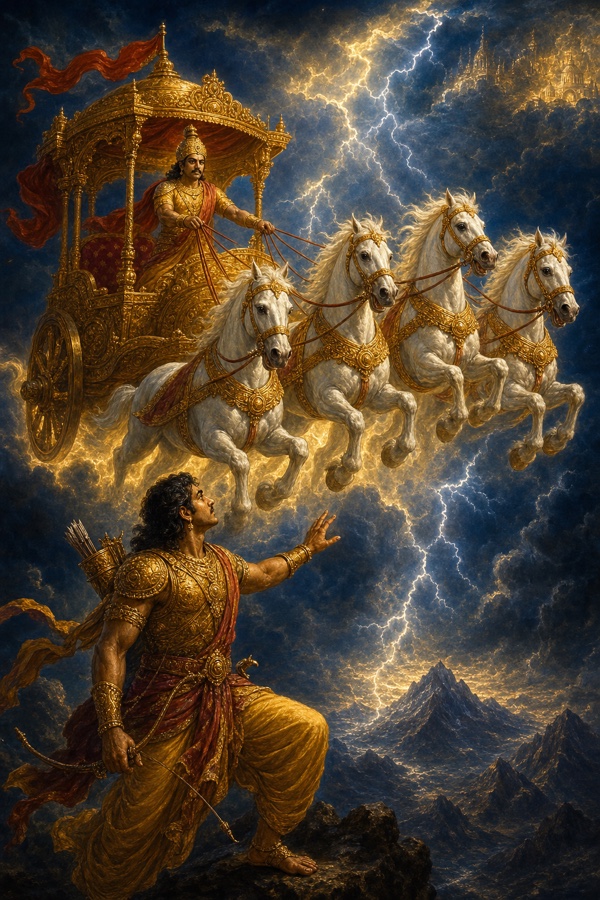
One day, while the brothers sat thinking of Arjuna, Indra’s chariot came out of the sky with no warning at all, yoked to horses that shone like lightning, Matali at the reins, and it lit the whole sky as it came, like tongues of smokeless fire or a great meteor wrapped in cloud. In it, wearing garlands and new-made ornaments, sat Arjuna, Kiriti, the diademed one. He came down onto the mountain blazing with the look of the thunderbolt’s wielder himself, and the first thing he did was bow at the feet of Dhaumya, and then at Yudhishthira’s; then he touched Bhima’s feet, and the twins bowed to him. He went to Draupadi and cheered her, and then he stood before his elder brother in the humble bearing of a younger son, and none of them could measure their joy, and he could not measure his, and he began to praise the king. The chariot itself was the one from which Indra, Namuchi’s killer, had wiped out seven phalanxes of the sons of Diti, and the brothers walked around it in reverence and honored Matali as they would have honored the king of the gods. Yudhishthira asked him in due form after the health of all the gods, and Matali greeted them, gave them counsel the way a father counsels his sons, mounted the peerless chariot, and went back to Indra.
When Matali had gone, Arjuna gave to his beloved, the mother of Sutasoma, the gems and ornaments Indra had presented to him, precious things with the splendor of the sun. Then, sitting among the foremost of the Kurus and the best of the Brahmins, bright as fire or the sun, he gave them the short version of everything: he had learned weapons from Indra, from Vayu, and from Shiva made manifest before him, and every god, Indra among them, had been pleased with him for his conduct and his concentration. That was all he told them that night. Having said this much of his years in heaven, Arjuna, whose deeds had no stain on them, slept in contentment beside the two sons of Madri.
The next day, when Arjuna and his brothers had paid their morning respects to Yudhishthira, a tremendous sound came down out of the world of the gods: instruments, the rattle of chariot wheels, the tolling of bells. Every beast and bird of prey in the forest cried out in its own voice. From every side, in chariots bright as the sun, hosts of Gandharvas and Apsaras came following the king of the gods, and Indra himself, Purandara, on a chariot yoked with horses trapped in burnished gold and roaring like clouds, blazing in beauty, came to the Pandavas and stepped down. Yudhishthira and his brothers went to him and honored him in the way the ordinance prescribes for a guest of such dignity. Then Arjuna, his hair still matted and the merit of his austerities on him, bowed to Purandara and stood before him in the humble bearing of a servant, and Yudhishthira, seeing his brother stand like that before the lord of the gods, breathed in the scent of the crown of his head and felt the highest happiness he had known in years. To that king swimming in joy Indra said only this: “You will rule the earth. Be blessed. Go back now to Kamyaka.” And he returned to his own place.
A key to reading this (a note): Matali is Indra’s charioteer, and a master of horses. Kiriti, Phalguna, Dhananjaya, Jishnu, Vibhatsu, and Savyasachi are all names for Arjuna, each earned or given for a reason. Indra too goes by many names in the story: Purandara, Maghavan, Shakra, Vasava, Marutvan, the thousand-eyed. Giving one character many names is the Mahabharata’s habit, and the name changes with what the moment wants to say about him.
After Indra had gone, Arjuna and his brothers and Draupadi paid their homage to Yudhishthira, and the king, breathing in the scent of Arjuna’s head, asked him in a voice that shook with joy to tell it all: how he had passed his time in heaven, how he had won the weapons, how he had pleased the lord of the gods, whether Indra and Rudra had given the weapons gladly, how he had seen Indra and the wielder of the Pinaka, and what service he had done that Indra should say he was gratified. Arjuna told him. At Yudhishthira’s command he had gone into the forest to practice austerity. From Kamyaka he went to Bhrigutunga and spent a night there in penance, and the next day a Brahmin met him and asked where he was going. Arjuna told him the truth of everything, and the Brahmin, pleased, praised him and said: keep at your austerities, and you will see the lord of the gods before long. So he climbed the Himalaya and began. The first month he lived on fruit and roots. The second month he lived on water. In the third month he ate nothing at all, and in the fourth he stood with his arms raised, and the wonder of it, he said, was that his strength never failed.
The Fight with Shiva in the Kirata’s Guise and the Winning of the Pashupata
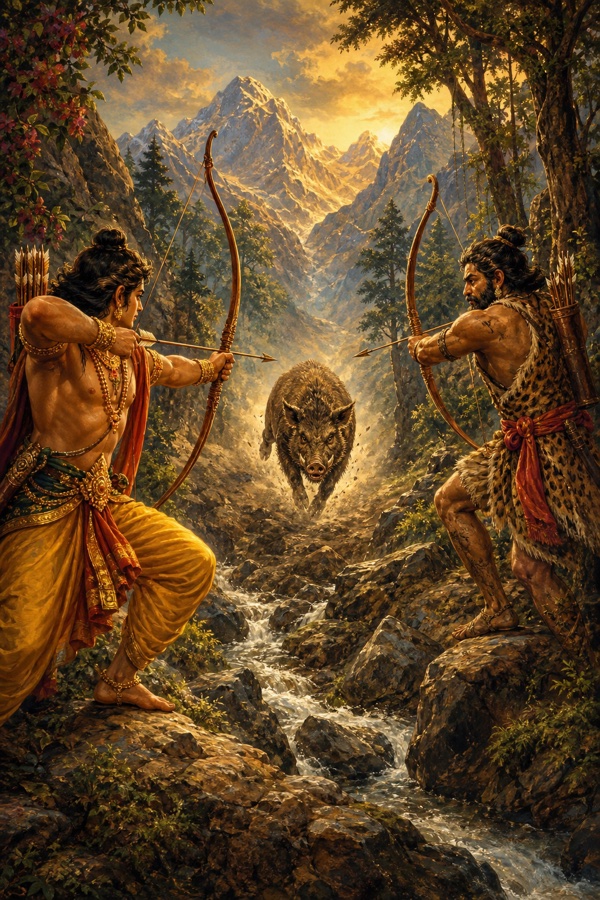
On the first day of the fifth month a creature came at him in the form of a boar, tearing up the earth with its snout, stamping the ground, rubbing its chest along the dirt, wheeling about in a terrible fury. Behind it came a great figure in the guise of a hunter, a Kirata of the mountains, carrying bow and arrows and a sword, with a crowd of women around him. Arjuna took up his bow and the two quivers that never empty and put an arrow into the beast, and in the same instant the hunter drew a strong bow and struck the animal harder still, as if to shake Arjuna’s mind loose. Then the Kirata spoke. Why, he demanded, had Arjuna broken the rules of hunting and shot an animal that he had already marked as his own? He would cut that pride down with sharpened shafts, and Arjuna should stand and wait for it. And the huge-bodied hunter ran at him and covered him with arrows the way a cloud covers a mountain with rain.
Arjuna answered with a mighty discharge of his own and then with steady arrows, their points aflame and charged with mantras, driving them into the hunter the way Indra splits a mountain with a thunderbolt. The hunter’s body began to multiply, a hundred of him, a thousand of him. Arjuna pierced every one, and every one flowed back into a single body. He struck at that; it became a small body with a huge head, then a huge body with a small head, and then its old shape again, and it came forward for the fight. When arrows could do nothing, Arjuna fixed the great weapon of the Wind-god to his bow and found, to his astonishment, that he could not discharge it. He covered the being with shafts again and loosed the Sthunakarna, the Varuna, the Salava, and the Asmavarsha weapons, and the hunter swallowed them all. Then Arjuna released the weapon presided over by Brahma, and when its blazing arrows heaped up around the hunter he only grew larger; the whole world sagged under the weapon’s energy and the sky and every quarter lit up, and the hunter turned that aside too, and a terrible fear took hold of Arjuna. He shot from his inexhaustible quivers and the hunter swallowed those arrows as well. So they wrestled, first with blows and then with open hands, and Arjuna, unable to move that being an inch, fell senseless to the ground. When he came to himself the hunter was laughing, and then hunter and woman had vanished together, and where they had stood the god was putting on another form, in unearthly raiment: his own.
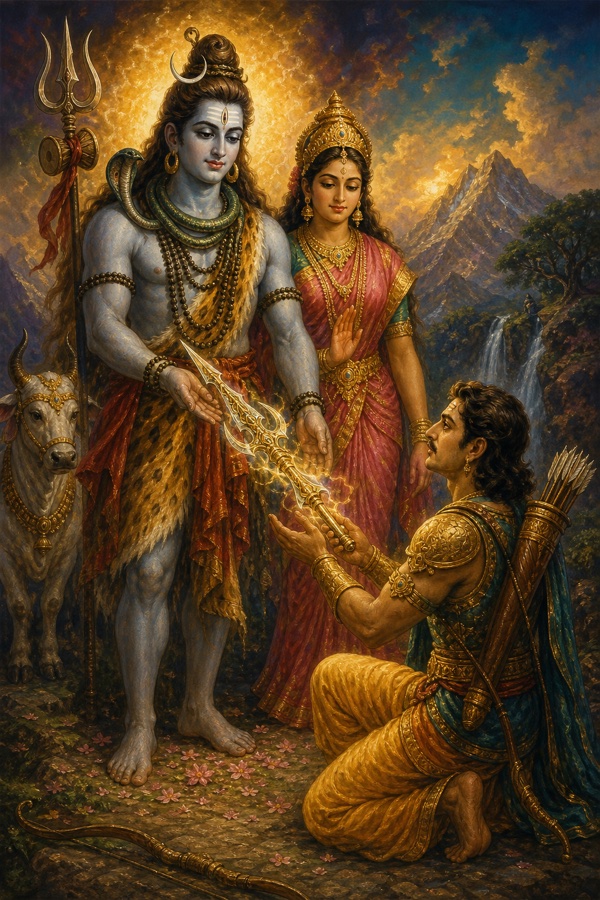
There before him, with Uma at his side, stood the manifest god whose emblem is the bull, who bears the Pinaka, who wears serpents, who takes what form he pleases: Mahadeva himself. He came toward Arjuna, who was still standing where the fight had left him, ready for more, and the wielder of the trident said, “I am pleased with you.” He lifted Arjuna’s bow and the two quivers that never empty and gave them back into his hands. “Ask for a boon. Tell me what I am to do for you; speak the wish that lives in your heart and I will grant it, anything except immortality.” Arjuna, whose mind was on one thing only, bowed and asked to learn every weapon that the god possessed. Then Tryambaka said, “I will give it. My own weapon, the Raudra, shall attend on you.” And well pleased, Mahadeva granted him the great weapon called Pashupata, and with the eternal weapon came its law. It must never be hurled at mortal men. Loosed at anyone of small energy it would burn the universe. Only when he was hard pressed, and only when every other weapon of his had been baffled, might he let it go. The weapon stood beside him then, manifest, of resistless force, a thing that no god or demon or Rakshasa could bear, and at the god’s command Arjuna sat down, and while he watched, Shiva vanished from the spot.
A sub-tale: What the Kirata disguise means. Mahadeva came as a hunter of the hills to put Arjuna to the test, and the quarrel over who had shot the boar first was the pretext for weighing the whole of Arjuna’s mastery of weapons and his endurance when weapon after weapon failed him. Well pleased at the end of it, the god gave him the Pashupata. A god comes down to test a man, and the man’s defeat, taken without complaint, is what opens the door to his reward.
By the grace of Tryambaka, Arjuna passed the night where the god had left him. In the morning, his rites done, the same Brahmin came back, and Arjuna told him everything, that he had met the divine Mahadeva. The Brahmin was overjoyed. Arjuna had seen the great god whom no one else can see, he said; soon he would mingle with Vaivasvata Yama and the other guardians of the worlds, and with Indra, and Indra would give him weapons. He embraced Arjuna again and again and went off where he pleased, shining like the sun. That evening a pure breeze rose that refreshed the whole world; along the foot of the Himalaya fresh, fragrant flowers opened; from every side came music and hymns to Indra, and troops of Apsaras and Gandharvas sang before the lord of the celestial hosts. The Maruts arrived in celestial chariots, and Indra’s followers, and the dwellers of heaven, and then Indra himself with Sachi and all the gods, in chariots drawn by finely decked horses. In that same moment Kubera showed himself to Arjuna in his splendor, and Arjuna saw Yama seated in the south, and Varuna and the lord of the gods each in his own region. They cheered him and spoke. “Savyasachi, look at us, the guardians of the worlds, seated here. For the work of the gods you have won the sight of Shankara. Now take weapons from all of us.” Arjuna bowed to them and accepted those mighty weapons with due care, and from that moment they counted him as one of their own.
The Journey to Indra’s World and the Burden of the Guru-Fee
When the Lokapalas had gone back to their own regions, Indra stayed a moment on his glorious chariot and spoke. “Phalguna, you must come to the celestial region. I knew before you arrived here that you would come, and that is why I showed myself to you. You have bathed in the tirthas and you have practiced severe austerities, so you are fit to go to heaven; you will have to practice still more, but go you must. Matali will carry you there at my command. The gods and the celestial sages already know you as their own.” Arjuna asked for one favor: that Indra become his teacher in arms. Indra looked at him. “Child, with the weapons learned you will do terrible deeds, and that is why you want them. Take them, then, since you want them.” Arjuna answered that he would never loose those divine weapons at mortal men unless every other weapon of his had failed, and that he asked for them so that he might win the regions that warriors win. That was the answer Indra had wanted. “I said it only to try you, Dhananjaya, and coming from my own son the answer becomes you. Come to my house and learn all the weapons of Vayu, of Agni, of the Vasus, of Varuna, of the Maruts, of the Siddhas, of Brahma, of the Gandharvas, of the Uragas, of the Rakshasas, of Vishnu, and of the Nairritas, and every weapon that is mine.” Then Indra vanished, and the sacred chariot came, Matali holding the reins.
Matali told him that the lord of the gods wished to see him, that he should make himself competent and then do his task, and that he was to come and see the regions won by merit, and come to heaven in this very body. Arjuna took leave of the Himalaya, walked around the mountain, and climbed into the chariot, and Matali, who knew more about horses than anyone alive, drove them off with the speed of thought or of the wind. As the chariot moved the charioteer looked at Arjuna’s face and could not hide his surprise. Even the lord of the gods, he said, was jolted at the first pull of these horses; Arjuna had sat through it without a tremor, and that seemed to Matali a thing beyond even Indra’s power. Then he rose into the sky and showed Arjuna the houses and palaces of the gods, regions that moved wherever they wished, the splendor of the Gandharvas and Apsaras and celestial sages, the gardens and groves called Nandana, and Indra’s own city, Amaravati, studded with jewels, its trees bearing whatever fruit anyone desired. No sun beats down there; no heat or cold or weariness touches anyone; the gods know neither sorrow nor faintness of spirit, neither weakness nor fatigue, neither anger nor greed; everyone who lives there is content. The trees are green the year round, in leaf and fruit and flower together; the lakes smell of lotus; the breeze is cool and sweet and pure and lifts the heart; the ground is worked with every kind of gem and strewn with blossoms, and the beasts and the birds of the air are beyond counting. There Arjuna saw the Vasus, the Rudras, the Sadhyas with the Maruts, the Adityas, and the two Ashvins, and honored them, and they blessed him with strength, valor, energy, fame, skill in arms, and victory in battle.
He went into that city that the Gandharvas and the gods adore and stood before the thousand-eyed lord of the gods with folded hands, and Indra, the most generous of givers, offered him half of his own seat and touched his body with affection. So Arjuna took up residence in heaven, among gods and Gandharvas of open hearts, to learn weapons. Chitrasena, the son of Vishvavasu, became his friend and taught him the whole science of the Gandharvas. He lived in Indra’s house with every want supplied, learning weapons, listening to songs and the clear sound of instruments, watching the foremost of the Apsaras dance; he did not neglect the arts, and learned them properly, and still his attention stayed fixed on arms, and Indra was pleased with that purpose. When Arjuna had become an adept and won his teacher’s confidence, Indra patted his head and told him that the gods themselves could not conquer him now, let alone imperfect mortals on the earth; he had become invulnerable and irrepressible and without an equal in a fight. The hair on the god’s body stood up as he spoke. He named what Arjuna had mastered: the five modes and the fifteen weapons, their discharge and their withdrawal, their re-discharge and re-withdrawal, the rites of expiation that go with them and the reviving of them when they are baffled. And now, he said, the time had come to pay the teacher’s fee; let Arjuna promise it, and then he would hear what it was.
Whatever lay in his power, Arjuna said, Indra should count as already done. Indra smiled. Nothing in the three worlds was beyond his power. His enemies, the Danavas called Nivatakavachas, lived in the womb of the ocean, thirty million of them, notorious, all alike in form and strength and splendor; Arjuna was to go there and kill them, and that would be the fee. Then Indra gave him the means. The celestial chariot with Matali to drive it, trapped with hair like the down of peacocks; the diadem he set on Arjuna’s head himself; ornaments for his body like Indra’s own; an impenetrable coat of mail, the best of its kind and easy to the touch; and a durable string fastened to the Gandiva. Arjuna climbed into the chariot on which, long ago, the lord of the gods had defeated Bali, the son of Virochana, and at the rattle of it the gods came running, thinking Indra himself was setting out, and asked Phalguna what he meant to do. He told them, and asked their blessing, and they praised him as they praise Purandara. On this chariot, they said, Maghavan had beaten Samvara and Namuchi, Vala and Vritra, Prahlada and Naraka, and thousands and millions and hundreds of millions of Daityas, and on it Arjuna would beat the Nivatakavachas as the self-possessed Maghavan once had. They gave him a conch, the best of conches, born in the deep, with which Indra had conquered the worlds, and its name was Devadatta. He took it for the sake of victory, and with conch and mail and arrows and bow he set out for the dreadful house of the Danavas, the gods still praising him as he went.
A key to reading this (the number in modern terms): The text counts the Nivatakavachas at thirty million, which the Hindi reckons as three crore, a demon host beyond any earthly army. They were asuras settled in the depths of the ocean who had won from Brahma the boon of a home there and of safety in any war with the gods, which is why the gods themselves had never managed to kill them. The Gandiva is Arjuna’s bow; Devadatta, from this day, is his conch.
The Slaughter of the Nivatakavachas
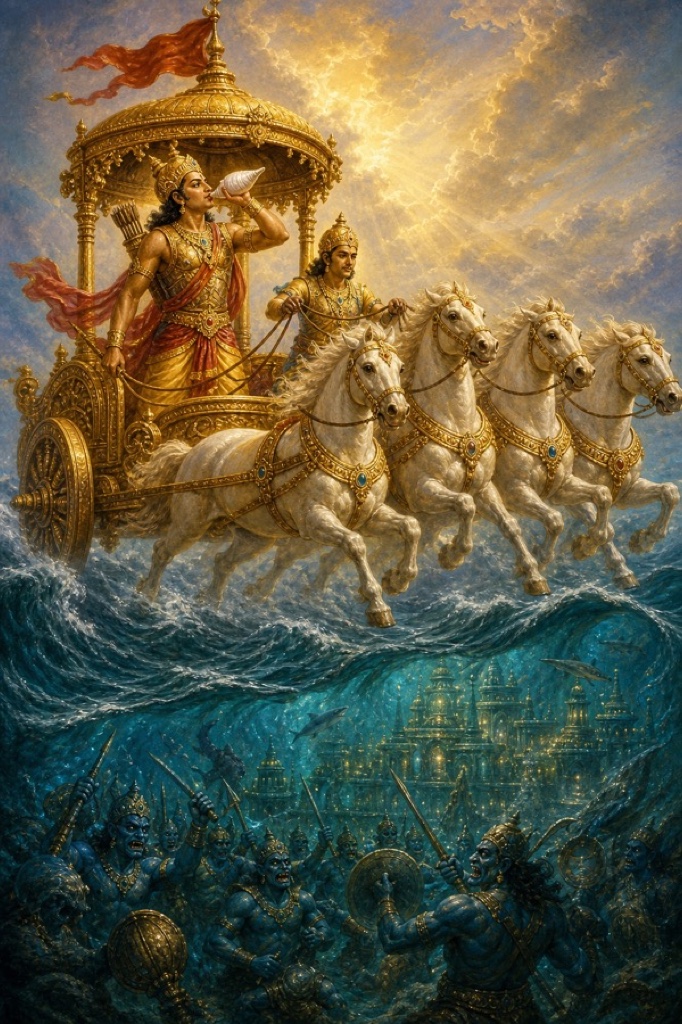
Arjuna came at last to the ocean, the inexhaustible lord of waters, and saw waves heaving up like moving cliffs, meeting and rolling apart; boats by the thousand filled with gems; timingilas and tortoises and makaras lying like rocks under the surface; thousands of shells sunk in the water and shining like stars through thin cloud; heaps of gems floating in the whirl of a violent wind. A short way off stood the city of the demons, thronged with Danavas. Matali went straight in, driving the chariot down beneath the earth and forcing it on, the thunder of his wheels frightening the city before they reached it. The Danavas heard that rumbling like a storm in the sky, took Arjuna for the lord of the gods, and were thrown into confusion. Afraid at heart, they stood holding bows and arrows, swords and javelins, axes and maces and clubs, set the city’s defenses, and shut the gates so that nothing could be seen. Then Arjuna lifted Devadatta, the conch of tremendous roars, and blew it again and again in high spirits, and the sound filled the sky and came back in echoes, and mighty beings hid themselves. Out came the Nivatakavachas, the sons of Diti, by the thousand, wearing ornaments and every kind of mail, carrying iron javelins and maces and clubs, hatchets and sabers, discs and sataghnis and bhushundis and swords worked with ornament. Matali thought hard about the course of the chariot and then guided the horses onto level ground, and so fast were they that Arjuna could see nothing, which he found strange. The Danavas set thousands of dissonant, misshapen instruments sounding, and at the noise fish the size of hills fled in their hundreds and thousands with their senses scattered. Then the demons flew at him with arrows by the hundred and the thousand, and the battle that would end the Nivatakavachas began. The Devarshis and Danavarshis, the Brahmarshis and the Siddhas came to watch, and the sages, wanting his victory, praised Arjuna in the same sweet words with which they had praised Indra in the war fought for Tara.
The Nivatakavachas charged in a body, blocked the chariot’s path, shouted, and ringed him in a shower of arrows; others with darts and hatchets threw spears and axes, and maces and clubs came down on the chariot without pause; grim-faced smiters ran at him with bows and sharpened weapons. Arjuna shot straight, swift arrows from the Gandiva and pierced each of them with ten, and the stone-whetted shafts drove them back. Matali sent the horses into every kind of movement at the speed of wind, and they trampled the sons of Diti; though hundreds upon hundreds of horses were yoked to that chariot, so deftly did Matali handle them that they moved as if they were a few. Under their hooves, under the wheels, under Arjuna’s volleys the Danavas fell by the hundred; others, killed with their bows still in their hands and their drivers dead, were carried about by their own horses. Then they came at him from every quarter with every weapon they knew, and Arjuna’s mind clouded; and even then he marked the marvel of Matali guiding those fiery horses with ease. He pierced them by the hundred and the thousand, and Indra’s heroic charioteer was glad to see it. Some died under the horses and the chariot; some gave up the fight; others, challenged and harried with arrows, answered with mighty showers of their own, and Arjuna burned them with swift weapons charged with Brahma’s mantras. Hard pressed, the asuras raged and poured clubs and darts and swords on him together. He took up Indra’s favorite weapon, the one named Maghavan, of fiery energy, and with it cut their tomaras and swords and tridents into a thousand pieces, cut off their arms, and pierced each of them with ten shafts. Arrows flew from the Gandiva like rows of black bees, and Matali admired it. Their shafts came at him too, and he cut them down with his own; struck, they covered him again; he neutralized the arrows with swift flaming weapons made to baffle arms and pierced them by the thousand, and blood ran from their torn bodies as water runs off mountaintops in the rains. Wounded by his straight-flying shafts, which had the touch of Indra’s thunderbolt, pierced in a hundred places, the strength of their arms failing, the Nivatakavachas turned to illusion.
It began with rocks the size of trees, a rain of crags that pressed him hard, and he crushed them with swift showers of arrows from Mahendra’s weapon, arrows like the thunderbolt itself; the crags went to powder, fire came out of the powder, and the rock-dust fell like masses of flame. When the rocks had been beaten off there came a mightier downpour of water, in currents thick as an axle, thousands of torrents out of the sky that covered the whole firmament and every quarter, and between the water and the wind and the roaring of the Daityas nothing could be seen. The showers touched heaven and earth together and fell without pause, and they bewildered him, until he discharged the dreadful flaming weapon he had learned from Indra, the Vishoshana, and the water dried. Then the Danavas spread illusions of fire and wind; he put out the flames with weapons of water and held the winds back with a great arm of rock. Irrepressible, they conjured everything at once, a horrifying downpour of rocks and dreadful weapons of fire and wind, and that afflicted him in the fight. And then the darkness came down, thick and dense and everywhere. The horses turned aside. Matali fell, and the golden lash dropped out of his hand to the earth, and in his fright he cried out again and again, “Where are you?” Terror took Arjuna when he heard that. Matali spoke fast. He had seen the war between gods and demons for the nectar, and the killing of Samvara, and the killing of Vritra, and the terrible fights with Virochana’s son and with Vala and Prahlada and others, and he had driven the lord of the gods through all of them, and never once in any of those dreadful battles had he lost his senses. The Grandfather, he said, must have ordained the destruction of every creature, because this battle could be for nothing else.
Arjuna steadied himself by his own effort and then steadied his charioteer. He would destroy the Danavas’ illusion, he told him, by the might of his arms and the power of his weapons and of the Gandiva; with illusion-making arms of his own he would clear this gloom and their horrible sorcery with it. “Do not be afraid, charioteer. Compose yourself.” For the good of the gods he created an illusion of arms that could bewilder every living thing, and the darkness broke, and at once the foremost of the asuras spread new illusions of their own, so that now the world showed itself and now it was swallowed in darkness, now it vanished from sight and now it lay under water. When it brightened, Matali took the front of the chariot with the horses well in hand and ranged that hair-raising field, and the Nivatakavachas came at Arjuna again, and he found his opening and began sending them to Yama’s house. Then they went invisible and fought by illusion alone, and he fought them with the energy of weapons he could see, and the shafts from the Gandiva took their heads at the places where each of them stood. Suddenly they dropped the illusion and went back into their city, and when everything was visible again he saw hundreds and thousands of the dead, and hundreds of shattered weapons and ornaments and limbs and coats of mail. The horses had no room to move from one place to another and rose with a bound into the sky. Then the invisible Nivatakavachas filled the sky with masses of crags, and other Danavas went down into the entrails of the earth and seized the horses’ legs and the chariot wheels, and rocks fell and kept falling until the place where Arjuna stood was like a cave in a mountain. Buried in crags, his horses pinned, Arjuna was in real distress, and Matali saw it. “Arjuna, Arjuna, do not be afraid. Send the thunderbolt.” He discharged the dreadful thunderbolt, the favorite weapon of the king of the gods, charging the Gandiva with mantras and aiming at the place of the crags, and the sharpened iron shafts with the thunderbolt’s touch went through every illusion and into the midst of the Nivatakavachas. Slaughtered by the thunder, those Danavas built like cliffs fell together to the earth in masses, and the shafts followed the ones who had dragged the horses under the earth and sent them to Yama’s house too. The whole quarter lay covered with dead and broken Nivatakavachas like scattered crags. And no injury, when he looked, had come to the horses, or the chariot, or Matali, or himself, which seemed to him a strange thing.
Matali smiled at him. “Not in the gods themselves, Arjuna, is there the prowess I have seen in you.” When the Danava hosts were destroyed all their women set up a wail in the city like cranes in autumn, and Arjuna drove in with Matali, the rattle of his chariot terrifying the wives of the Nivatakavachas; at the sight of those ten thousand horses the color of peacocks and that sun-bright chariot the women fled in swarms, and the ornaments falling from the frightened women made a sound like rocks tumbling down a mountainside, until at last they hid themselves in their golden palaces set with countless jewels. Looking at that city, finer than the city of the gods, Arjuna asked why the gods did not live in a place like it, since it seemed to him better than Purandara’s own. Matali told him. Long ago this had been the city of the lord of the gods. Then the Nivatakavachas, having performed the most rigid austerities and gratified the Grandfather, had asked for two boons and won them: that they might live here, and that they might be free from danger in any war with the gods, and they drove the gods out. Indra went to the self-created lord and asked him to do what was proper for the gods’ welfare, and the lord answered that in another body Indra himself would be the destroyer of these Danavas, and for that killing Indra had put these weapons into Arjuna’s hands. The gods had not been able to kill the ones Arjuna had just killed; in the fullness of time he had come here to destroy them, and he had. With the Danavas dead and their city subdued, Arjuna turned with Matali toward Indra’s world.
The gist: Indra names his teacher’s fee: the death of the Nivatakavachas, thirty million Danavas in a city under the sea. Arjuna forces the gates with the roar of Devadatta, kills them in the open with the Gandiva and the Maghavan weapon, beats their sorceries one by one (rock, water, fire, wind, and a darkness in which even Matali loses his nerve), and when they bury him in crags from above and seize his wheels from below, finishes them with the thunderbolt. Matali tells him the city was once Indra’s own, lost to the asuras by a boon of Brahma, and that Brahma had promised Indra its recovery in another body, which turns out to be Arjuna’s.
The Destruction of Hiranyapura and the Raudra Weapon
On the way back Arjuna saw something he had no name for: a great city moving through the sky at will, with the glow of fire or of the sun, made of every kind of jewel, its trees made of gems and hung with fruit and flower, full of sweet-voiced birds of no earthly kind. It had four gates with gateways and towers, it looked impossible to take, and it swarmed with cheerful asuras wearing garlands and carrying darts, two-edged swords, maces, bows, and clubs. He asked Matali what this wonder was. Matali told him. Once a Daitya’s daughter named Puloma and a mighty woman of the asura order named Kalaka had practiced severe austerities for a thousand celestial years, and at the end of them the self-created lord had granted their boons: that their offspring would never suffer misfortune; that gods, Rakshasas, and Pannagas would be unable to destroy them; and that they would have a blazing, surpassingly fair aerial city, furnished with every gem, invincible against gods, Maharshis, Yakshas, Gandharvas, Pannagas, asuras, and Rakshasas alike. This was that city, made by Brahma himself for the Kalakeyas, wanting for nothing, knowing neither grief nor disease. It was called Hiranyapura, the city of gold, and the Paulomas and the Kalakanjas lived in it and guarded it, and because no god could kill them they lived there cheerfully, without a care, every desire met. But Brahma had appointed its ruin long ago, at the hands of mortals. So Matali told Arjuna to bring down the mighty, irrepressible Kalakanjas with the thunderbolt.
Arjuna, hearing that neither gods nor asuras could destroy them, said cheerfully that Matali should take him straight to the city; there was no hater of the lord of the gods that he ought not to kill. Matali drove the celestial chariot to the edge of Hiranyapura, and the sons of Diti saw them coming and flew at them in a rush, in every kind of dress and ornament, in mail, and the foremost of the Danavas came on in fury with arrows and bhallas and clubs and two-edged swords and tomaras. Arjuna met that volley with a mighty shower of shafts of his own, calling on the strength of his learning, and wheeled the chariot around them until they were so confused that they shoved one another down and ran at one another. With flaming arrows he took their heads by the hundred. Hard pressed, the sons of Diti took shelter inside the city and, by the illusion proper to Danavas, lifted the whole city into the sky. Arjuna blocked their way with arrows, and by the strength of their boon the Daityas rode that sky-going city easily, wherever they pleased, like the sun; now it went down into the earth, now it rose, now it went crooked, now it sank under water. He attacked the city itself, that wanderer of the air that looked like Amaravati, with multitudes of shafts and with celestial weapons, and battered and broken by his straight iron arrows it fell to the earth. The Danavas, wounded by iron arrows with the speed of the thunderbolt, went about as destiny drove them, and Matali, as if falling in front, brought the sun-bright chariot swiftly down to the ground.
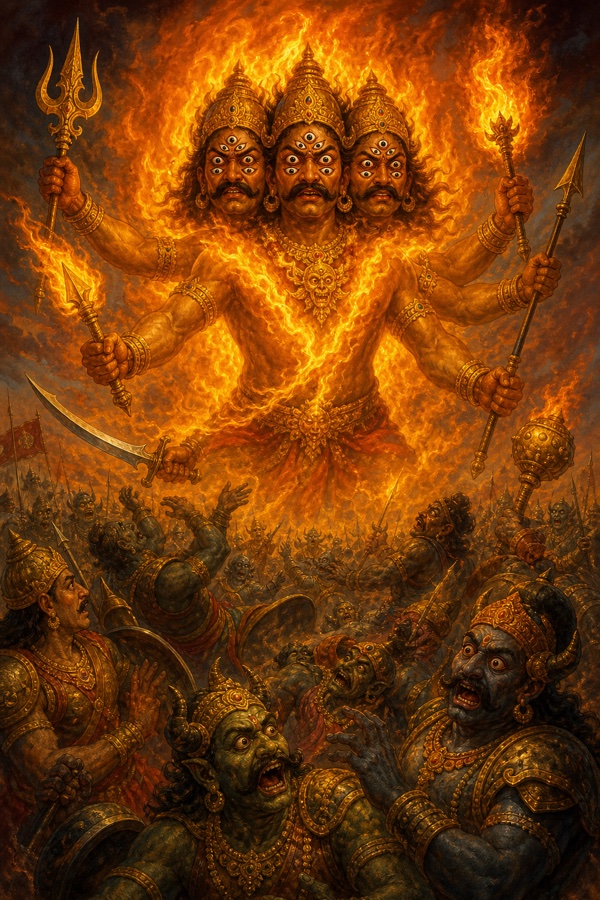
Then sixty thousand chariots closed around Arjuna, and the men in them were wrathful and eager to fight. He destroyed those with sharpened shafts fledged with vulture feathers, and they, thinking that no mortal could defeat their hosts, came on like the surges of the sea. Arjuna began fixing unearthly weapons to the string one by one, and the thousands of weapons those wonderfully skilled chariot-fighters shot at him opposed his unearthly arms by degrees, and he saw hundreds and thousands of mighty demons ranging the field in their chariots in every kind of maneuver, in variegated mail and standards and ornaments, and he confessed afterward that they delighted his mind. He could not hurt them with showers of arrows, and they could not hurt him. But they were beyond counting, and armed, and skilled in the fight, and pressed by so many he was in pain in that great encounter, and a terrible fear seized him. So he gathered himself. He bowed to Rudra, the god of gods, and said, “May welfare attend on all beings,” and fixed to the Gandiva the great weapon called Raudra, the destroyer of all foes. And he saw a male figure with three heads, nine eyes, three faces, and six arms, his hair flaming like fire or the sun, wearing for his dress great serpents that put out their tongues. Free from fear now, and bowing to the three-eyed Sarva of immeasurable energy, Arjuna let the dreadful and eternal Raudra go. The moment it flew, forms sprang out of it by the thousand: deer and lions, tigers and bears and buffaloes, serpents, cattle, sharabhas, elephants, apes in multitudes, bulls and boars, cats and dogs, spectres and every Bhurunda, vultures and Garudas and chamaras, every kind of leopard, mountains and seas, gods and sages, all the Gandharvas, ghosts with the Yakshas, the enemies of the gods, the Guhyakas, the Nairritas, elephant-mouthed sharks, owls, beings shaped like fish and horses, beings carrying swords and other weapons, Rakshasas with maces and clubs. The whole universe filled with these and with shapes past naming. Wounded again and again by beings of every appearance, some with three heads, some with four tusks, some with four mouths, some with four arms, with flesh and fat and bone and marrow on them, the Danavas were destroyed, and in a moment Arjuna finished the rest with other swarms of arrows of the essence of stone, flaming like fire or the sun, with the force of the thunderbolt. Seeing them cut down by the Gandiva, lifeless, thrown from the sky, he bowed once more to the god who destroyed Tripura.
Matali, who had watched the whole thing from the driver’s seat, saw the Danavas in their unearthly ornaments crushed by the Raudra and was filled with delight. He paid homage to Arjuna and said with folded hands that what Arjuna had just done the gods could not have borne, that in battle the lord of the gods himself could not have performed it, and that the sky-coursing city that gods and asuras alike could not destroy had been crushed by Arjuna’s own prowess and the energy of his austerities. When the flying city was destroyed and the Danavas dead, their wives came out of it crying like kurari birds, their hair loose, and fell on the ground wailing for sons and brothers and fathers, beating their breasts, their garlands and ornaments fallen away; and that city of the Danavas, full of lamentation, bereft of grace like a lake without its elephants or a forest without its trees, stopped being beautiful and then simply vanished, like a city built of cloud. Matali took Arjuna, in high spirits, straight from the field to the house of the lord of the gods, and there told Indra the whole of it in detail. Hearing of the destruction of Hiranyapura, the breaking of the illusion, and the slaughter of the Nivatakavachas, Indra with the Maruts was well pleased and cried, “Well done! Well done!” and with the gods cheered Arjuna again and again. The feat he had achieved, they said, was beyond gods and asuras; by killing Indra’s mighty enemies he had paid the teacher’s fee; in battle he would always stay calm and discharge his weapons without error, and neither gods nor Danavas nor Rakshasas nor Yakshas nor asuras nor Gandharvas nor birds nor serpents would stand against him; and Yudhishthira, by the might of Arjuna’s arms, would conquer and rule the earth.
A key to reading this (a note): The Raudra is the weapon Shiva promised Arjuna by that name in the Kirata episode before granting him the Pashupata, and its manifest form is the being with three heads, nine eyes, and six arms who appears when it is set to the bow. Arjuna uses it here in the work of the gods, against asuras whom the gods cannot kill, and only when every other weapon has failed and fear has touched him, which is exactly the condition Shiva laid down: never against men, and never before the last resort.
Then Indra, sure of him now and treating him as his own, spoke to Arjuna while the wounds of the demons’ cleaving shafts were still on him. Every celestial weapon was with him, so no man on earth could overpower him by any means; when he stood in the field, Bhishma and Drona and Kripa and Karna and Shakuni and the other Kshatriyas together would not amount to a sixteenth part of him. And Indra gave him a golden garland, and the conch Devadatta of mighty roars, and his own celestial mail, impenetrable, that guards the body; he set the diadem on Arjuna’s head himself, and presented him with unearthly clothes and unearthly ornaments, elegant and rare. Honored like that, Arjuna lived happily in Indra’s sacred house with the children of the Gandharvas, until Indra, well pleased, said with the gods around him: “Arjuna, the time has come for you to go; your brothers have been thinking of you.” So it was, he told Yudhishthira, remembering the quarrel born of the dice, that he had passed those five years in Indra’s house, and then he had come and found them all together on the summit of this lower range of Gandhamadana. Yudhishthira answered him with the word fortune on every breath: by fortune Arjuna had won the weapons; by fortune he had honored the master of the immortals; by fortune Sthanu with the goddess had shown himself and been gratified in battle; by fortune he had met the Lokapalas; by fortune they had all prospered, and by fortune he had come back. That day, Yudhishthira said, he felt as if the whole earth with its garland of cities were already won and the sons of Dhritarashtra already subdued. And now he wanted to see the celestial weapons with which Arjuna had killed the mighty Nivatakavachas. Tomorrow morning, Arjuna promised, he would see them all. And with the story of his coming told, Arjuna passed that night there with all his brothers.
The Display of the Weapons and Narada’s Prohibition
When the night had passed and Yudhishthira and his brothers had performed their morning duties, the king asked Arjuna, the delight of his mother, to show him the weapons with which he had beaten the Danavas. Arjuna, practicing strict purity, seated himself on the earth as though it were his chariot, with the mountain for its pole, the base of the axle where the axle would be, and a cluster of fine bamboos for the socket-pole; in the celestial armor of great luster he was resplendent, and he took up the Gandiva and the conch the gods had given him and began to show the celestial weapons in order. The instant they were set, the earth, pressed by his feet, shook with its trees; the rivers and the great sea grew troubled; rocks split; the air went still. The sun stopped shining, the fire stopped flaming, and the Vedas of the twice-born gave no light at all. The creatures that live inside the earth came up in torment and stood around him, trembling, hands folded, faces contorted, burned by those weapons, and begged him for their lives. The Brahmarshis and Siddhas and Maharshis appeared, and every moving creature; the foremost of the Devarshis, the gods, the Yakshas, the Rakshasas, the Gandharvas, the feathered tribes, and every ranger of the sky; the Grandfather, all the Lokapalas, and the divine Mahadeva, each with his followers. Vayu strewed unearthly blossoms of many colors over the son of Pandu, the Gandharvas at the gods’ bidding sang ballads, and hosts of Apsaras danced.
At that moment Narada arrived, sent by the gods, and spoke to Arjuna in sweet words. “Arjuna, Arjuna, do not discharge the celestial weapons. They should never be loosed when there is no fit object, and even when there is an object they should never be loosed unless you are sore pressed, for to discharge them without occasion is a great evil. Kept as you were taught to keep them, these mighty weapons will be your strength and your happiness; kept wrongly, they will become the means by which the three worlds are destroyed. Never do this again.” And to the king: “Ajatashatru, you will see these weapons yourself on the day Arjuna uses them to grind your enemies in battle.” So Arjuna was stopped, and the immortals and all who had come with them went back each to his own place, and when they had gone the Pandavas went on living pleasantly in that same forest, with Draupadi beside them.
The gist: Arjuna sets the divine weapons to the bow to show them to his brother, and the earth shakes, the sea churns, the sun and the fire go dim, and the creatures under the ground come up begging for their lives, while gods, sages, Brahma, and Shiva gather to watch. Narada arrives with an order from the gods: never loose these without occasion, never unless hard pressed, because handled wrongly they will destroy the three worlds. Yudhishthira will see them on the day they are used in earnest.
The Mountain Journey and the Serpent’s Grip
They stayed a while yet. Arjuna, whose whole mind was on arms, ranged the pleasure-gardens of the lord of treasures with his bow in his hand, and the brothers, lodged by King Kubera’s grace in a place no earthly prosperity could match, lived there in peace; with Arjuna in their company four years went by like a single night, and with the six before them that made ten years of the forest passed. Then Bhima, with Arjuna and the twins, sat down before the king and said what had to be said. It was only to keep Yudhishthira’s promise good and to serve his interests that they had stayed in the forest and had not gone to kill Suyodhana and all his followers; they deserved happiness and had been kept from it; this was the eleventh year they had lived like this, and the year of hiding could be got through easily if they deceived that man of evil mind and character. They had wandered the woods at his order with their pride set aside. Their enemies, lulled by having them so near, would never believe they had moved to a distant realm; a year undiscovered, and then revenge on the wicked Suyodhana with his followers, and the kingdom back. So let Dharmaraja come down to the earth. If they lived on in this region that was like heaven itself they would forget their sorrows, and his fame would vanish from the moving and the unmoving worlds like the scent of a flower. What he was receiving here from Kubera he could have at any time; let him turn his mind now to punishing the enemies who had wronged him. The wielder of the thunderbolt himself could not stand against Yudhishthira’s prowess; Krishna, whose banner bears Suparna, and Satyaki, the grandson of Shini, felt no pain even in a fight with the gods and worked for his welfare; Arjuna was peerless in strength, and so, Bhima said, was he; Krishna with the Yadavas was bent on his good, and so were Bhima and the heroic twins. They would meet the enemy and destroy him for the sake of his wealth and prosperity. Yudhishthira heard them out, understood their intent, and walked in reverence around Kubera’s abode; he took his leave of the palaces, the rivers, the lakes, and all the Rakshasas, looked back along the road he had come by, and prayed to the mountain that he might see it again with his friends when his task was done, his enemies dead, and his kingdom won, and come back to it to practice austerity with a quiet soul. Then he set out with his younger brothers and the Brahmins by the very road they had come. Ghatotkacha and his followers carried them over the mountain cascades, and the great rishi Lomasa, advising them as a father advises his son, went away glad to the sacred abode of the dwellers of heaven, and Arshtishena too gave them his counsel, and the Parthas went on alone, looking at lovely tirthas and hermitages and great lakes as they went.
Leaving that happy home in the mountain with its cascades, its birds, the elephants of the eight quarters, and the supernatural attendants of Kubera, all happiness went out of them; then Kailasa came into view, Kubera’s favorite mountain, looking like a bank of clouds, and their delight was very great. With swords and bows they went on, content, past ridges and defiles and dens of lions, over craggy causeways, past countless waterfalls and lowlands and great forests full of deer and birds and elephants, and woods and rivers and lakes and caves and caverns were their lodging by day and by night. Having crossed Kailasa in all its inconceivable grandeur they came to the surpassingly beautiful hermitage of Vrishaparva, and meeting that king and being received by him they were free of their depression, and they told him the whole story of their time in the mountains. After one night in his sacred house, where gods and Maharshis come, they went on to the jujube tree called Visala and made their quarters there, and then to the place of Narayana, where they lived without sorrow, looking at Kubera’s beloved lake that gods and Siddhas frequent, and crossed that ground with every grief given up, as spotless Brahmin rishis do when they win a home in the Nandana gardens. After a happy month at Badari they went by the track they had come by toward the realm of Subahu, king of the Kiratas, crossing the hard Himalayan country and the lands of China, Tukhara, Darada, and all the climes of Kulinda, rich in heaps of jewels, to Subahu’s capital. Subahu, hearing that those sons and grandsons of kings had reached his kingdom, came out to meet them in joy, and the Kurus welcomed him. There their charioteers, Visoka at their head, and their attendants, Indrasena and the others, and the superintendents and servants of the kitchen joined them again, and they rested one night. Then, taking all the chariots and chariot-men and sending Ghatotkacha and his followers home, they went to the great mountain near the Yamuna, and there, among waterfalls, on slopes of gray and orange under summits sheeted in snow, they found the great forest of Visakhayupa, like the forest of Chitraratha, full of boar and deer and birds, and made it their home. Hunting was their chief occupation, and they lived in that forest in peace for a year.
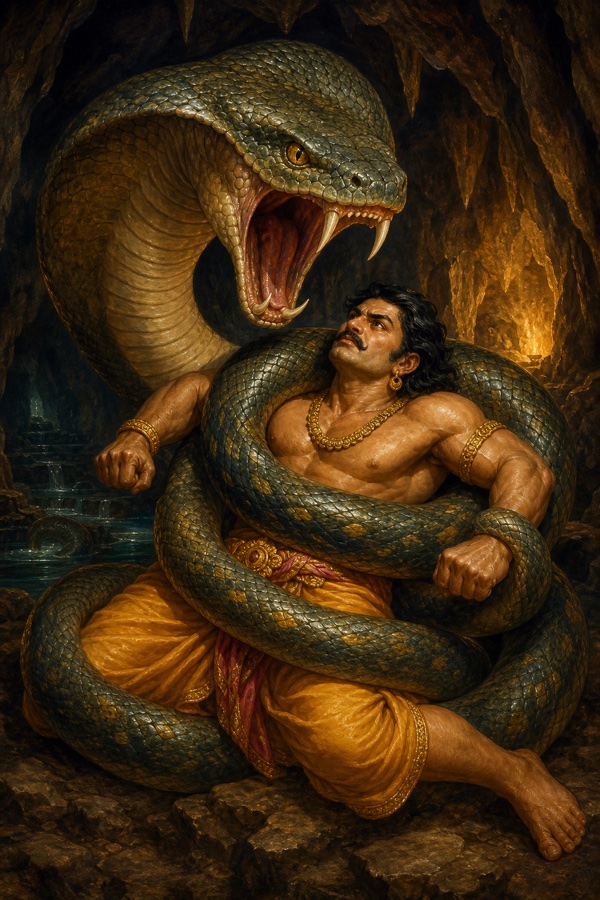
It was there, in a cave of that mountain, that Bhima, wandering with a heart full of distraction and grief, came upon a snake of enormous strength, half mad with hunger and as fierce to look at as death itself, and it was Yudhishthira, the best of pious men, who became his protector and pulled him out of the coils that had wrapped his whole body. When Janamejaya asked how it could have happened, how Bhima, who had the strength of ten thousand elephants, who had killed Yakshas and Rakshasas at Kubera’s lotus lake and challenged the lord of riches himself to single combat, could have been struck with panic by a snake, Vaishampayana told him the whole of it. While the brothers were living in those wonderful woods near Vrishaparva’s hermitage, Bhima had gone out roaming as he liked, bow in hand and a scimitar at his side, through a forest that gods and Gandharvas frequented, through Himalayan places where Devarshis and Siddhas came and hosts of Apsaras lived, loud with chakoras and chakravakas, jivajivakas and cuckoos and bhringarajas, shaded by trees soft with snow, under deodar forests that stood like traps for the clouds, past streams shining like lapis lazuli with ten thousand white ducks and swans on them, past tugna and kalikaya woods threaded with yellow sandal. He hunted the level and the barren tracts of the mountain with unpoisoned arrows, killed great boars with the force of his arms, killed antelope and buffalo, tore trees up by the roots and broke them for the noise of it, ran shouting over the tops of mountains, slapped his arms and clapped his hands and roared his war-cry, and leaped about those woods without fear or decay, so that lions and elephants left their lairs in fright at the sound of him. He went on foot like a creature of the woods, whooping strangely, terrifying everything; the snakes hid in their caves, and he followed them without hurry. And then he saw a serpent of colossal size living in a fastness of the mountain, its body filling the whole cave, a sight to lift the hair. It lay stretched like a hillock, gigantic in strength, its body speckled with spots and the color of turmeric, its mouth a deep copper-colored cavern with four teeth in it, its eyes glaring, its tongue forever licking the corners of its mouth, the terror of every living thing, the very image of Yama, and the hiss of its breath was like a rebuke to whoever came near. The moment Bhima drew close it flew into a rage, and that goat-devouring snake seized him. By the boon it had once received, the instant its coils closed on him Bhima lost all consciousness. His arms had the strength of ten thousand elephants together, and no one’s equaled them; and beaten by the snake he trembled, slowly, and could not exert himself, and with his lion’s shoulders and his mighty arms and all that strength, overpowered by the boon, he lost it all. He fought furiously to get free and could do nothing against that snake at all.
A key to reading this (lineage): This serpent is no ordinary creature. He is Nahusha, the royal sage, son of Ayu and fifth in descent from the Moon, who once ruled the three worlds, grew arrogant in that seat, insulted the Brahmins, and was turned into a snake by Agastya’s curse. The Pandavas descend from him, so the man in his coils is his own kinsman, and he says so, and means to eat him anyway.
Nahusha’s Curse and the Questions Put to Yudhishthira
Bhima, held fast, thought about the strange and mighty power of the thing that held him, and spoke to it. Who was it, he asked, and what did it mean to do with him? He was Bhimasena, son of Pandu, next after Yudhishthira the just, with the strength of ten thousand elephants in him; how had it overpowered him? He had met and killed lions and tigers and buffaloes and elephants past counting, and mighty Rakshasas and Pisachas and Nagas could not stand the force of his arms; had it some magic, or some boon, that he should be beaten though he fought with all he had? Now he was convinced that the strength of men was a lie, since a snake had made nothing of it. The serpent wound its body all the way around him, and freed only his plump arms, and answered. By good fortune, it said, the gods had given a hungry creature its food today after a long time, for life is dear to everyone with a body. But it would tell him how it had come by this snake’s form, because it wanted to be rid of the curse. Bhima had surely heard of the royal sage Nahusha, the son of Ayu, who carried on the line of Bhima’s own ancestors: that was who it was. For insulting the Brahmins it had come to this by Agastya’s curse. Bhima was its own kin, and lovely to look at, and ought not to be killed by it, and it would devour him today all the same; let him see what destiny arranges. Buffalo or elephant, nothing that came within its reach in the sixth part of the day escaped, and Bhima had not been taken by mere animal strength; the boon it had received had taken him. As it had fallen headlong from Indra’s throne it had begged Agastya to free it, and the sage, in compassion, had said that it would be freed after some time; it had fallen to the earth a snake, and its memory of its former life had never left it, and it still remembered what was said. Whoever understood the bond between the soul and the Supreme, the sage had said, and could answer the questions the snake put to him, would deliver it; and any being stronger than itself that it seized would at once lose its strength. Those compassionate Brahmins who loved it had said that and vanished, and so it lived, a serpent, doing terrible deeds in an unclean hell, waiting for the appointed time.
Bhima said he felt no anger, and did not blame himself. Sometimes men have the power to bring happiness and misery on and send them off, and sometimes they have not, and so a man ought not to fret; who can undo destiny by his own effort? He held destiny to be supreme and effort to be of no use, and here he was, struck down by destiny, the strength of his arms gone, fallen into this state without any visible cause. What he grieved for was his brothers, driven from their kingdom into the forest. This Himalaya was full of Yakshas and Rakshasas and hard to search; they would go frantic looking for him, and hearing that he was dead they would give up all effort, for it was his harsh talk that had kept them bound to their promise while he wanted the kingdom back. Or Arjuna, who knew every lore and whom gods and Rakshasas and Gandharvas could not beat, would go on without grief: that one could pull the gods themselves down from their seats single-handed, never mind the cheating gambler son of Dhritarashtra, hated by all men, full of arrogance and ignorance. And he grieved for his poor mother, who loved her sons and wanted their greatness to outstrip their enemies’, whose hopes in him would now come to nothing; and for the twins, Nakula and Sahadeva, manly as they were, who had always followed him and lived under the protection of his arms and would be broken by his death. So Bhima lamented at length, and bound in the snake’s body he could not stir. Back at the hermitage, meanwhile, Yudhishthira was watching evil omens gather and growing afraid. The horizons blazed. Jackals took station on the right of the hermitage and set up their unlucky howling. Hideous vartika birds with one wing, one eye, and one leg were seen vomiting blood with their faces to the sun. A dry, violent wind rose and drove the grit before it; every beast and bird cried out on the right; behind him the black crows cried “Go! Go!”; his right arm twitched, his chest and left leg shook of themselves, and his left eye contracted in a spasm that meant evil. Reading a great calamity in all of it, he asked Draupadi where Bhima was, and Panchali said he had gone out long ago. He told Arjuna to guard Draupadi and the twins to guard the Brahmins, and set out with Dhaumya on Bhima’s trail. Going east he found the leaders of elephant herds lying dead and the ground marked with Bhima’s footprints, then thousands of deer and hundreds of lions dead in the forest, and trees pulled down by the wind of Bhima’s thighs as he rushed after the deer, and by those marks he came to a place of dry winds and leafless scrub, brackish and waterless, thorny and gravelly, all stumps and shrubs, uneven and dangerous and hard to reach, and in a cave of the mountain he saw his younger brother, motionless, in the coils of that foremost of snakes.
Yudhishthira asked him how he had come to this, and who this best of serpents was, with a body like a mountain. This mighty being had caught him for food, Bhima said; it was the royal sage Nahusha, living as a snake. Yudhishthira turned to it. “Long-lived one, free my brother of immeasurable prowess; we will give you other food that will satisfy your hunger.” The serpent refused. It had this king’s son for its meal, come to its mouth of his own accord; Yudhishthira should go away and not stay here, or tomorrow he too would be its food; this was its law, that whoever came into its place became its meal, and Yudhishthira was in its quarter now; after a long time it had got his younger brother, and it would not let him go, and it wanted no other food. Yudhishthira pressed it. Whether it was a god, a demon, or an Uraga, let it tell him truly, since it was Yudhishthira who asked: why had it taken Bhima, and by what gift or what knowledge would it be satisfied, and what food could he give it, and how might it free him?
The serpent told him who it was: his own ancestor, the son of Ayu, fifth in descent from the Moon, the king famous under the name of Nahusha, who by sacrifice and austerity and Vedic study and self-restraint and prowess had won a lasting dominion over the three worlds, and when he had it, pride took him; thousands of Brahmins carried his chair, and drunk on supremacy he insulted them, and Agastya brought him to this. To this day the memory of that former birth had not left him. By that great sage’s favor he had got Yudhishthira’s younger brother for his meal in the sixth part of the day, and he would neither free him nor take any other food; but if Yudhishthira answered the questions it put to him today, it would let Bhima go. Ask, said Yudhishthira; if he could, he would answer, to gratify it, since it plainly knew all that a Brahmin should know. The serpent asked two things: who is a Brahmin, and what is the thing to be known? By Yudhishthira’s speech, it said, it took him for a man of high intelligence. Yudhishthira answered that the wise call that man a Brahmin in whom truth, charity, forgiveness, good conduct, benevolence, the observance of the rites of his order, and mercy are seen; and that the thing to be known is the supreme Brahman, in which there is neither happiness nor misery, and reaching which beings are no longer touched by misery. What did the serpent think? Truth, charity, forgiveness, benevolence, benignity, kindness, and the Veda that works the good of all four orders, the serpent said, are seen in a Shudra too; and as for a thing free of both happiness and misery, it saw no such thing anywhere. Yudhishthira held his ground. The marks found in a Shudra are absent from a Brahmin, and the marks of a Brahmin are absent from a Shudra; a Shudra is a Shudra by more than birth, and a Brahmin is a Brahmin by more than birth. The wise call him a Brahmin in whom those virtues are seen, and they call him a Shudra in whom they are absent, though he be a Brahmin born. And as for the serpent’s claim that nothing exists without both happiness and misery, that was indeed the common opinion; yet as there is no heat in cold and no cold in heat, could there be no thing in which the two cannot exist together? Then, said the serpent, if a Brahmin is known by his marks, the distinction of caste is useless as long as conduct is left out of it. Caste, Yudhishthira replied, is hard to fix in human society, because the four orders mix freely: men of every order beget children on women of every order, and speech and intercourse and birth and death are common to them all, and the rishis themselves bear witness to it when they open a sacrifice with the words, of whatever caste we may be, we celebrate the rite. So the wise have made conduct the chief requisite. A child’s natal rite is performed before the cord is cut, with his mother for his Savitri and his father for his priest, and he counts as a Shudra until he is initiated into the Vedas; and when doubt arose on this point, Svayambhuva Manu declared that the mixed castes are to be reckoned better than the pure ones if the pure, after their rites of purification, do not keep to good conduct. Whoever keeps to pure and virtuous conduct, Yudhishthira said, that is the man he had already named a Brahmin. The serpent was silent a moment. Having listened to a man who knew everything worth knowing, it said, how could it now eat his brother Vrikodara?
A key to reading this (a note): This exchange is one of the places where the Mahabharata ties Brahminhood to conduct and character. Yudhishthira’s position, argued point by point to a serpent that pushes back, is that truth, charity, forgiveness, and the rest are the true marks of a Brahmin, that birth alone settles nothing in either direction, and that since the orders have always mixed, conduct is the only test the wise can trust.
Now it was Yudhishthira who asked. What should a man do, he said to one so learned in the Vedas and Vedangas, to attain salvation? The serpent gave its belief: the man who gives alms to fit recipients, speaks kind words, tells the truth, and does no injury to any creature goes to heaven. Which stands higher, Yudhishthira asked, truth or alms-giving, and how do kind conduct and harmlessness weigh against each other? Their relative worth, the serpent answered, is known by the good they do. Truth is sometimes more praiseworthy than an act of charity, and some acts of charity are more commendable than true speech; harmlessness is sometimes seen to matter more than good speech, and the reverse is also seen. It all depends on effects. If Yudhishthira had anything else to ask, let him ask it all. So Yudhishthira asked how the bodiless soul’s passage to heaven, its perception through the senses, and its enjoyment of the unchanging fruit of its deeds could be understood. By his own acts, the serpent said, a man is seen to come to one of three conditions: human life, heavenly life, or birth among the lower animals. The man who is not slothful, who injures no one, who has charity and the other virtues, goes to heaven when he leaves the world of men; by doing the opposite, people are born again as men or as animals. In particular, the man ruled by anger and lust, given to greed and malice, falls from the human state and is born an animal; and animals in their turn are ordained to rise into the human state, and the cow and the horse and others are seen to reach even the divine state. So the sentient being moves through these conditions reaping the fruit of its acts, while the twice-born man of wisdom rests his soul in the everlasting Supreme. The embodied soul, chained by destiny and reaping its own acts, goes through birth after birth; and he who has lost his hold on his actions comes to know the unchanging destiny of all born beings.
Tell me truly and without confusion, Yudhishthira said, how that soul, once out of the body, becomes aware of sound, touch, form, flavor, and taste; does it perceive them all at once through the senses? The atman, the serpent answered, takes up its lodging in a body and shows itself through the organs of sense, and so becomes aware of what can be perceived. The senses, the mind, and the intellect assist the soul in perceiving, and are called the Karanas. The eternal soul, going out of its own sphere and helped by the mind, works through the senses, which are the receptacles of every perception, and perceives these things one after another. The mind of living creatures is the cause of all perception, and for that reason it cannot be aware of more than one thing at a time. And that soul, taking its seat in the space between the eyebrows, sends the high and the low intellect out to their different objects; what the yogis perceive after the intelligent principle has acted is the working of the soul made visible. Then tell me, said Yudhishthira, what distinguishes the mind from the intellect; that knowledge is laid down as the chief duty of those who meditate on the Supreme. Through illusion, the serpent said, the soul becomes subservient to the intellect, and the intellect, though it is known to serve the soul, then becomes the soul’s director. The intellect is brought into play by acts of perception; the mind exists of itself. The intellect causes no sensation, whether of pain or of pleasure; the mind does. That, it said, is the difference between them; and since Yudhishthira was learned in this too, what was his opinion?
Yudhishthira answered with a question of his own. The serpent had fine intelligence and knew everything worth knowing; why did it ask him? It had known all this, and done such wonderful deeds, and lived in heaven; how had illusion ever overpowered it? That was his great doubt. Prosperity, the serpent said, intoxicates even the wise and the brave, and those who live in luxury soon lose their reason; that was how it, too, drunk on prosperity, had fallen from its high state, and having come back to its senses it was now enlightening him. Yudhishthira had done it a good turn: by conversing with a pious man its painful curse had been expiated. Long ago, riding a celestial chariot through heaven and reveling in its pride, it had thought of nothing else, and had taken tribute from Brahmarshis, gods, Yakshas, Gandharvas, Rakshasas, Pannagas, and every dweller of the three worlds; such was the spell of its eyes that whatever creature it looked at lost its power on the instant. Thousands of Brahmarshis drew its chariot. That was the offense that brought it down. One day Agastya was among the ones drawing it, and Nahusha’s foot touched the sage’s body, and Agastya in anger pronounced the curse: ruin seize you; become a snake. Its glory left it, it fell from that excellent chariot, and as it fell it saw itself already turning into a snake, head downward, and begged the Brahmin to let the curse end, to forgive a man made foolish by infatuation. And Agastya, kindly, as it was being hurled down, had said this: the virtuous king Yudhishthira will save you from this curse, and when the horrible sin of pride is extinguished in you, you will attain salvation. Struck with wonder at the power of the sage’s austerity, Nahusha had put to Yudhishthira exactly those questions, about the Supreme Spirit and about Brahmins. Truth, charity, self-restraint, austerity, harmlessness, and constancy in virtue, it said, and never a man’s family or connections, are the means by which a man secures his salvation. Let this brother of his, the mighty Bhimasena, have good luck, and happiness abide with Yudhishthira; it must go to heaven again.
With that King Nahusha shed the serpent’s form, took on his celestial shape, and went back to heaven. The glorious and pious Yudhishthira went back to the hermitage with Dhaumya and his brother Bhima, and told the Brahmins who had gathered there everything, in detail. When they heard it, his three brothers, all the Brahmins, and the famous Draupadi were covered with shame, and those excellent Brahmins, who wanted only the Pandavas’ good, admonished Bhima for his foolhardiness and told him never to try such things again. And the Pandavas, past all measure glad to see the mighty Bhima out of danger, went on living there in peace.
The gist: Bhima, hunting alone, is seized in a mountain cave by a serpent whose boon drains the strength of anything it holds, and the serpent turns out to be Nahusha, the Pandavas’ own ancestor, cursed by Agastya for letting his foot touch the sage while Brahmins drew his chariot. The price of Bhima’s life is a set of questions on who a Brahmin is, what is worth knowing, how the soul perceives, and what parts mind from intellect, and Yudhishthira answers them all. Nahusha is freed and rises to heaven; Bhima comes home to a scolding from the Brahmins and to brothers who are simply glad to have him back.
The Rainy Season and the Return to the Kamyaka Forest
While they were still in that mountain country the rains came, the season that breaks the heat of summer and is a gladness to every creature that breathes. Black clouds gathered by the hundred and the thousand until they stood over the sky like domes, rumbling, shutting out the quarters, and they rained without a pause through the days and through the nights. The sun went out of the world; in its place the clean white blaze of lightning lit the hills. The earth drank and turned green, and the grass came up, and the gnats and the snakes moved through it in a happiness of their own. Then the water covered everything, and there was no longer any telling level ground from broken, or where a river ran, or where a tree or a hill had stood. Rivers that had been trickles swelled and ran with such force that they hissed like serpents through the woods, and in the forest tracts the boars and the stags and the birds cried out under the falling rain in a hundred voices. The chatakas ran about, the peacocks danced, the male kokilas called, and the frogs, mad with joy, were everywhere. So the rains passed over the Pandavas in all their changing shapes, loud with cloud, and behind them came autumn: geese and cranes filling the air, the meadows thick with grass, the rivers running clear, the sky and the stars sharp again. The nights were free of dust now and cool under a few last clouds, and the planets and the stars and the moon came out in their thousands. The pools and the rivers were full of cool water and dressed in lilies and white lotuses. And the Sarasvati ran near them, banks that looked like the sky itself, overgrown with cane, thick with holy bathing places, brimming and limpid, and the brothers who carried the great bows walked its banks and were glad. There, among sages who had given their lives to penance, they kept the holiest night of the year, the full moon of Kartika in the autumn, and let the season turn.
As soon as the dark fortnight began, the Pandavas went down into the Kamyaka forest, and Arjuna went with them this time, and their charioteers, and their cooks. The hosts of sages who lived there came out to receive them with honor, and the brothers settled into the forest with Draupadi and were at peace. Brahmins came to wait on them in that security, and one of them said a thing that lifted every head: the friend Arjuna loved best, the strong-armed, self-mastered son of the line of Sura, would soon be here, because Hari knew they had come down to Kamyaka, and Hari had always longed for the sight of them and always worked for their good. And Markandeya too, the Brahmin said, that rishi who had spent so many years in austerity, study, and penance, would before long come and meet them.
He was still speaking when they saw the chariot. It came toward them with the horses Saibya and Sugriva in the traces, and Krishna, the finest of all who ride a chariot, stood in it with Satyabhama beside him, the two of them looking like Indra with Sachi, the daughter of Puloman. The son of Devaki had come because he wanted to see the Kurus he held most righteous. He stepped down and bowed before Yudhishthira in the prescribed way, with pleasure in his heart, and before Bhima, the strongest of strong men; he paid his respects to Dhaumya, and the twins prostrated themselves before him. He embraced Arjuna of the curly hair, and spoke words of comfort to Draupadi, and then, seeing the beloved Arjuna come near after so long a time, he clasped him again, and again. Satyabhama, Krishna’s beloved consort, took Draupadi in her arms. Then the sons of Pandu, with their wife and their priests, paid their respects to Krishna, whose eyes were like the white lotus, and stood round him on every side; and Krishna standing with Arjuna had the beauty of Shiva, the great lord of every created thing, when he stands beside his son Kartikeya. Arjuna, the diadem on his head, gave Krishna, elder brother of Gada, the whole account of what had happened to him since they parted, and then asked the question he had carried all those years: how was Subhadra, and how was her son Abhimanyu? Krishna greeted Arjuna and the priest with the courtesies due to each, seated himself among them, and turned to King Yudhishthira with praise.
Dharma, Krishna told Yudhishthira, stands higher than the winning of kingdoms, and to practice it is itself a form of austerity; by obeying what duty prescribed, in truth and without guile, Yudhishthira had won both this world and the one to come. He had studied while he carried out the rites; he had mastered the whole science of arms; he had won wealth by the methods laid down for the warrior order and had performed every one of the time-honored sacrifices. He took no delight in the pleasures of the senses, never acted for enjoyment’s sake, never swerved from dharma out of greed for riches, and that was why the world called him the Virtuous King. With kingdoms and riches and every means of enjoyment in his hands, his delight had been giving, truth, austerity, faith, meditation, forbearance, and patience. And when the people of Kuru-jangala had watched Draupadi outraged in the assembly hall, who but Yudhishthira could have borne a thing so repugnant to dharma and to every usage? He would rule over men before long, Krishna said, with every desire fulfilled; and the Vrishnis stood ready to chastise the Kurus the moment the term Yudhishthira had bound himself to was complete. To Dhaumya, to Bhima and Yudhishthira and the twins and Draupadi, he said how fortunate it was that Arjuna had come back to them with the science of arms in his hands; and he told Draupadi, with his friends around him, how fortunate it was that she was safe and reunited with Arjuna. Then he told her about her sons. They were devoted to the study of arms, he said, well behaved, and modeled on their righteous friends. Her father and her brothers had offered them a kingdom and lands, but the boys found no joy in Drupada’s house or in their uncles’; they had gone to the Anarta country and taken the greatest delight there in the science of arms, and when they entered the city of the Vrishnis they had at once taken to the people. Subhadra watched over them as Draupadi herself would, or as the honored Kunti would, and perhaps more carefully still. Rukmini’s son was their teacher and their refuge, as he was the teacher of Aniruddha, Abhimanyu, Sunitha, and Bhanu, and a good teacher he was: lessons without end in the mace and the sword and the shield, in missiles, in driving a chariot and in riding a horse; and having trained them well and taught them the proper use of every weapon, he took satisfaction in what her sons and Abhimanyu could do. When they went out for sport, each boy was followed by chariots and horses and carriages and elephants. Then Krishna turned back to the king. The fighting men of the Dasarhas, the Kukuras, and the Andhakas would place themselves at Yudhishthira’s command and do whatever he wished; the army of the Madhus, irresistible as the wind, bowmen and horsemen and foot soldiers and chariots and elephants, with Balarama at its head, Balarama whose weapon is the plow, would arm itself at his word. Let Duryodhana, the vilest of sinful men, be sent with his friends and his followers down the road the lord of Saubha had taken. Yudhishthira might keep to the terms he had accepted in the hall; but when the Dasarha soldiers had cut the hostile force down, let Hastinapura be made ready for him, so that having wandered wherever he pleased, free of grief and washed of every fault, he could come home to that famous city set in the midst of a fine country. Yudhishthira took in the plan set before him so clearly by the best of men, applauded it, thought, and then answered with his palms joined. Keshava was the refuge of the sons of Pandu, of that there was no doubt, and their protector; when the time came he would do everything he had just described, and more. The twelve years in the lonely forests were being kept as they had promised, and when they had passed the year of living unrecognized in the prescribed way, the sons of Pandu would take refuge in him. That was as it should be for those who kept company with Krishna. They did not stray from the path of truth; with their charity and their piety, with their people and their wives and their kin, the sons of Pritha had their protector in him.
A key to reading this (lineage): Krishna is the foremost of the Dasarhas, the Vrishni house of the Yadu line, and the Kukuras and Andhakas he names are its allied clans. Draupadi’s five sons are at this time in the Anarta country, in the city of the Vrishnis, where Subhadra watches over them and Rukmini’s son Pradyumna, who also trains Aniruddha and Abhimanyu, is their master of arms. Satyabhama, who arrives with Krishna, is his beloved consort; the Sachi she is likened to is Indra’s queen.
Markandeya Arrives and the Teaching on the Fruit of Action
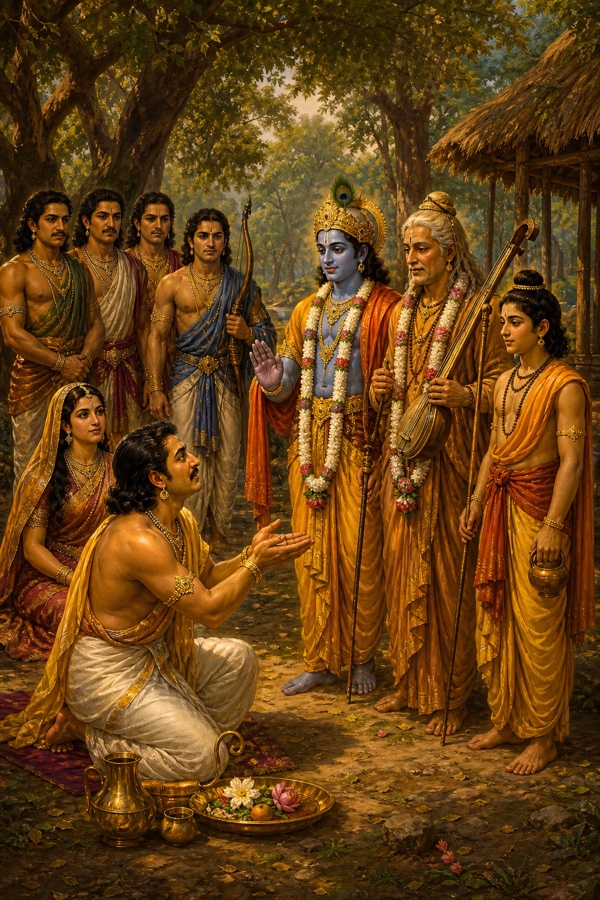
While Krishna and the king were still talking, Markandeya came. He had gone gray in the practice of penance and had seen many thousands of years go by, and yet there was no mark of age on him anywhere; deathless, beautiful, generous, a man of many virtues and a pious soul, he looked like someone of twenty-five. The Brahmins rose to honor him, and Krishna rose with the sons of Pandu, and when the wisest of sages had taken his seat among them in friendship, Krishna spoke for everyone there: the Pandavas, the assembled Brahmins, Draupadi, Satyabhama, and he himself all longed to hear Markandeya’s words, the holy stories of times gone by and the eternal rules of right conduct by which kings and women and sages lived. Then Narada arrived as well, the divine sage of the purified soul, on a visit to the sons of Pandu, and those men of superior mind honored him in the prescribed form, water for his feet and the offering called the arghya. Learning that they were about to hear Markandeya, Narada gave the arrangement his blessing, and the deathless one, knowing what the moment called for, said with a smile that the Brahmin should say to the sons of Pandu what he had been going to say. Wait a moment, Markandeya answered; a great deal would be told. So the Pandavas and the twice-born waited, looking at that great sage, who shone like the sun at noon. And Yudhishthira, seeing him willing to speak, set before him the question that would not leave him. Markandeya was ancient, he said, and knew the deeds of the gods and the demons, of the illustrious sages and of every king; they had held him worthy of worship and had long wanted his company, and here beside them sat Devaki’s son Krishna, who had come to visit them. When Yudhishthira looked at himself, fallen out of every happiness, and then looked at the sons of Dhritarashtra, evil in their lives and flourishing in every way, one idea kept rising in him: that it is man who does all acts, good and bad, and man who takes the fruit those acts bring forth. Where, then, was God the doer of anything? And how did a man’s actions find him, in this world or in some later life? How was an embodied creature joined to the good and evil deeds that came looking for him, after death or here? Was what they were suffering the fruit of the acts of this very life, or would this life’s acts bear their fruit only in the world to come? And where did the acts of a creature who had died go to rest?
Markandeya told him the question suited him, and was exactly what it should be; Yudhishthira knew everything there was to know and was asking for the form of the thing, and Markandeya would answer, if he listened with an attentive mind, how a man comes by happiness and misery in this world and in the next. In the beginning, he said, the Lord of Beings, himself the first thing born, made for every embodied creature a body that was stainless and pure and inclined by nature toward right. The men of that first time had all their desires fulfilled. They followed praiseworthy ways of life, spoke the truth, were godly and clean, and were the equals of the gods: they could rise into the sky whenever they pleased and come back, and go wherever they wished; they held their own death and their own life under their own command; they had few sufferings and no fear, no trouble, and could visit the gods and the great sages at will; they knew every righteous rule by heart, ruled themselves, and envied no one. They lived many thousands of years and had many thousands of sons. Then, in the course of time, they came to be confined to walking on the surface of the earth. Lust and anger had overpowered them; they lived by falsehood and trickery, sunk in greed and senselessness; and when those wicked men left their bodies, their unrighteous, unblessed deeds took them to hell by a crooked road. There they were burned, again and again, and again and again they came back to drag out a miserable existence in this strange world, their desires unfulfilled, their aims unaccomplished, their knowledge of no use to them. Their senses failed them; they were afraid of everything and a cause of suffering to others; they were marked by wicked deeds and born into low families; they grew wicked, and sick, and a terror to others, short-lived and sinful, reaping the fruit of what they had done; and coveting everything, they turned godless and indifferent in mind. The road every creature takes after death, Markandeya said, is settled by what it did in this world. Yudhishthira had asked where the treasure of a man’s acts, wise man or fool, is kept, and where he enjoys the fruit of his good and evil deeds, and this was the rule: with the subtle original body that God made for him, a man lays up a great store of merit and sin. At death he leaves the frail outer body and is born at once into another order of beings; he does not remain nonexistent for a single moment. In the new life his actions follow him as surely as a shadow, and as they ripen they make his lot happy or miserable. The wise man sees with the eye of the spirit that every creature is bound to an unalterable destiny by the Destroyer and cannot escape the ripening of its acts into good fortune or ill; and that, Markandeya said, is the doom of every creature sunk in spiritual ignorance.
Now, he said, let Yudhishthira hear the road taken by men of high spiritual perception. Such men have great austerity in them and know both the worldly and the sacred writings; they are diligent in their religious obligations and devoted to truth; they honor their teachers and their elders and practice yoga; they are forgiving, continent, energetic, pious, and endowed with nearly every virtue. Having conquered the passions they are subdued in mind, and through yoga they are free of disease, fear, and sorrow, and nothing troubles them. In whatever condition they find themselves, born mature or born immature or still lying in the womb, they see with the eye of the spirit the kinship of their own soul with the Supreme Spirit, and those great sages of settled, intuitive knowledge pass through this arena of action and return to the home of the gods. Men come by what they have through the grace of the gods of destiny or through their own acts, Markandeya said, and Yudhishthira should not think otherwise; and he himself regarded as the highest good what the world regarded as such. Some men are happy in this world and have nothing waiting for them in the next; some are unhappy here and are paid in the next; some are happy in both, and some in neither. The men of vast wealth who shine every day in their fine ornaments and give themselves to the pleasures of the flesh have their happiness here and none afterward. The men who give themselves to meditation and the study of the Vedas, who are diligent in austerity and wear down their bodies in the doing of their duties, who have mastered their passions and refuse to kill any living thing, have their happiness in the next world and go without it in this. Those who first live a pious life, then acquire wealth rightly in due time, then marry and perform the sacrifices, are blessed in both worlds. And the fools who neither seek knowledge nor practice austerity or charity, nor raise a family, nor even secure the pleasures of this world, are blessed in neither. But the Pandavas, he told them, were men of knowledge and of great power and strength and celestial energy; they had come from the other world and taken birth in this one to exterminate the wicked and to serve the purposes of the gods. Valiant, devoted to austerity and self-restraint and the ordinances of religion, fond of effort, they would do great deeds and gratify the gods and the rishis and the fathers, and in due course, by their own acts, they would reach the supreme region where all virtuous men live. Let no doubt cross Yudhishthira’s mind on account of these sufferings: the affliction itself was for his good.
A key to reading this (a note): Markandeya is a deathless rishi who has watched many dissolutions and many new creations turn over. The heart of what he tells Yudhishthira is plain. The store of a man’s acts travels with him in the subtle body from one birth into the next, where his deeds follow him like a shadow and ripen into his lot; the road a creature takes after death is laid by what it did, and men come by what they have through the gods of destiny and through their own acts together. The teaching ends where Yudhishthira’s question began, in the forest: the Pandavas were born for the work of the gods, and the affliction they are living through is part of that work.
Tales of the Greatness of Brahmins
When the Pandavas asked to hear of the greatness of Brahmins, Markandeya, of austere virtue and high spiritual energy, told them this. A strong-limbed, handsome young prince of the Haihaya race, a conqueror of hostile cities, went out hunting, and roaming a wilderness of great trees and thickets of grass he saw, not far off, a muni wearing the skin of a black antelope for his upper garment, and killed him for a deer. Sick at what he had done, his senses paralyzed with grief, he went to the more distinguished of the Haihaya chiefs, and the lotus-eyed prince told them what had happened. When they heard it and saw the body of the muni, who had lived on fruits and roots, they were sorely afflicted, and they all set out, asking here and there as they went, to learn whose son the muni might be. Before long they came to the hermitage of Arishtanemi, the son of Kashyapa, and saluting that great muni, so constant in austerity, they stood while he busied himself with receiving them, and said that by a freak of destiny they had ceased to deserve his welcome: they had killed a Brahmin. How, the rishi asked, had a Brahmin come to be killed by them, and where was he? Let them all witness the power of his austerities. They told him everything as it had happened and went back to the spot, and the body of the dead rishi was gone. They searched for it and came back ashamed, all perception gone from them, as if in a dream. Then the muni Tarkshya, for that was Arishtanemi’s other name, spoke to them. Could this be the Brahmin they had killed? This Brahmin, endowed with occult gifts from his spiritual exercises, was his own son, and there he stood. The princes were struck with bewilderment. What a marvel, they said; how had the dead come to life again? Was it the power of his austere virtue? They longed to hear it, if it could be told. Death, Tarkshya answered, had no power over them, and he would tell them briefly why. They performed their own sacred duties, so they had no fear of death. They spoke well of Brahmins and never thought ill of them, so death held no terror for them. They fed their guests with food and drink and their dependents with plenty, and ate only what was left, so they were not afraid of death. They were peaceful, austere, charitable, forbearing, fond of visiting sacred shrines, and they lived in sacred places and among men of great spiritual power, so death had no terror for them. That was all of it. Let them go home together, cured of every worldly vanity, and fear no sin. The princes said amen, saluted the great muni, and went joyfully back to their own country.
Then Markandeya told them of Atri and Vainya, and it began with a family conference in a hermitage. The royal sage Vainya was performing the horse-sacrifice, and Atri wanted to go to him for alms; then, from religious scruple, he gave up his wish for wealth, and after much thought decided to live in the woods, and called his wife and sons together and told them so: let them attain the tranquil, complete fruition of their desires, and let it please them to go quickly to the forest for a life of great merit. His wife argued from virtue too, and the other way. Let him go to the illustrious prince Vainya and beg vast riches; asked, that royal sage, in the middle of his sacrifice, would give; having received the wealth he could distribute it among his sons and servants and then go wherever he pleased, and that, as men who know religion have shown, was the higher virtue. Atri answered that the high-souled Gautama had told him Vainya was a pious prince devoted to truth, and also that there were Brahmins around the king who were jealous of him, so he did not dare go, for if he offered good counsel there, counsel that made for piety and the fulfillment of desire, they would contradict him with useless words. Still, he approved her advice, and he would go; Vainya would give him cattle and hoards of riches. So that man of great ascetic merit hurried to Vainya’s sacrifice, reached the altar, made his obeisance to the king, and praised him in well-meaning words: blessed was he, ruling the earth, the foremost of sovereigns; the munis praised him, and there was no one so versed in religious lore. At that the rishi Gautama, of great ascetic merit, answered indignantly that Atri should not repeat such nonsense and seemed to have lost his senses; in this world Mahendra, the lord of all created beings, was the foremost of sovereigns. As Indra, the lord of all creatures, rules over our destinies, Atri said, so does this king; it was Gautama who was mistaken, and Gautama who had lost his senses for want of spiritual perception. Gautama knew he was right, he said; Atri was flattering the king in the assembly of the people to win his favor, did not know what the highest virtue was or feel any need of it, and was like a child steeped in ignorance, for all his years. While the two men disputed like this before the munis engaged in Vainya’s sacrifice, the king asked what was the matter with them that they talked so loudly, and the pious Kashyapa, learned in all religious lore, went to the disputants and asked. Gautama put it to the assembly of great munis: Atri had said that Vainya was the ruler of our destinies, and great was their doubt on the point. The great-minded munis went at once to Sanatkumara, who was well versed in religion, to clear it, and Sanatkumara, having heard the particulars, gave them a ruling full of religious meaning. As fire helped by the wind burns down forests, so a Brahmin’s energy joined with a Kshatriya’s, or a Kshatriya’s with a Brahmin’s, destroys all enemies. The sovereign is the distinguished giver of laws and the protector of his subjects; he is like Indra as a protector of created beings, like Shukra as a propounder of morals, like Brihaspati as a counselor, and so he is also called the ruler of men’s destinies. Who would think it improper to worship the one to whom such names as preserver of created beings, emperor, lord of earth, and ruler of men are applied in praise? The king is styled the prime cause of social order, the watchman, the guide to salvation, the winner of battles, the cherisher of the true religion. The rishis, fearful of sin, entrusted temporal power to the Kshatriyas; as the sun among the gods in heaven dispels darkness by its light, so the king roots sin out of the earth. So the king’s greatness follows from the evidence of the sacred books, and the side that had spoken for the king must be pronounced right. Then the prince, highly pleased with the winning party, said joyfully to Atri, who had praised him, that Atri had made and styled him the greatest and most excellent of men and compared him to the gods, and that he would give him vast wealth of every kind, for he took Atri to be omniscient. He gave him, well dressed and well adorned as he was, a hundred millions of gold coins and ten bharas of gold, and Atri, of high austere virtue and great spiritual power, accepted every gift without any breach of propriety and went home. He gave the wealth to his sons, subdued himself, and went cheerfully to the forest to perform his penances.
After that Markandeya told them what Sarasvati had said when the intelligent muni Tarkshya questioned her. What was the best thing for a man to do here below, Tarkshya had asked that excellent lady, and how must he act so as never to leave the path of virtue; when and how must he offer oblations to the sacred fire, and when must he worship, so that virtue is not compromised; let her tell him all of it, so that instructed by her he might live in this world without passion, craving, or desire. Seeing him eager to learn and endowed with high intelligence, Sarasvati spoke to the Brahmin in pious and beneficial words. He who is engaged in the study of the Vedas and with sanctity and equanimity perceives the supreme Godhead in his proper sphere ascends to the celestial regions and attains supreme beatitude with the immortals. Many large, beautiful, pellucid, and sacred lakes are there, full of fish and flowers and golden lilies, like shrines, whose very sight assuages grief, and pious men, distinctively honored by virtuous, well-adorned, golden-complexioned Apsaras, live in contentment on their shores. He who gives cows to Brahmins attains the highest regions; by giving bullocks he reaches the solar regions; by giving clothes, the lunar world; by giving gold he attains the state of the immortals. He who gives a beautiful cow with a fine calf, easily milked, that does not run away, lives in the celestial regions for as many years as there are hairs on that animal’s body; he who gives a fine, strong, young bullock fit for the plow and for burdens reaches the regions attained by men who give ten cows. When a man bestows a well-caparisoned kapila cow with a brazen milk-pail and money given afterward, that cow, by her own distinguished qualities, becomes a giver of everything and comes to the side of the man who gave her away. He who gives cows reaps fruits beyond counting, measured by the hairs on the animal’s body, and saves his sons and grandsons and his ancestors to the seventh generation. He who presents to a Brahmin sesamum made up in the form of a cow, with horns of gold, with money besides and a brazen milk-pail, attains easily to the regions of the Vasus. By his own acts a man goes down into the dark lower regions, infested by the evil spirits of his own passions, like a ship tossed by the storm on the high seas, and the gift of cattle to Brahmins saves him in the next world. He who gives his daughter in marriage in the Brahma form, who bestows gifts of land on Brahmins, and who duly makes other presents attains the regions of Purandara. And the virtuous man who is constant in presenting oblations to the sacred fire for seven years sanctifies by his own action seven generations up and down. Tarkshya asked her then for the time-honored rules for keeping up the sacred fire, as the Vedas lay them down.
A sub-tale: Why death has no claim on the line of Arishtanemi. The reasons Tarkshya counts out to the Haihaya princes are all of one kind: keeping one’s own duties, goodwill toward Brahmins, feeding guests and dependents before oneself, a peaceful and austere temper, open-handed giving, living at holy places and among men of spiritual power. None of them is a spell against dying. Together they make a house in which death finds nothing to seize, and that is the sage’s whole answer to princes who came expecting a curse.
Vaivasvata Manu and the Fish
At Yudhishthira’s asking, Markandeya told the history of Vaivasvata Manu. Manu was a powerful and great rishi, the son of Vivasvat, equal to Brahma in glory, who far outdid his father and grandfather in strength, in power, in fortune, and in austerity. Standing on one leg with one hand raised, his head bent and his eyes fixed, he practiced a rigid and severe penance in the jujube forest called Visala for ten thousand years. One day, while he stood there in wet clothes with matted hair, a fish came to the bank of the Chirini and spoke to him. It was a helpless little fish, it said, afraid of the large ones, and would the great devotee think it worth his while to protect it from them, since it was the settled custom among fish that the strong prey on the weak; let him save it from drowning in this sea of terrors, and it would repay him. Manu was overcome with pity, lifted the fish out of the water with his own hands, and put it, its body glistening like moonlight, into an earthen water-vessel, where he tended it carefully like a child. It grew until there was no room for it in the vessel and asked him for a better dwelling; he carried it to a large tank and placed it there, and it grew for many long years, until there was no room to play in a tank two yojanas long and one wide. Then it asked to be taken to the Ganga, the favorite spouse of the ocean, and he carried it to the river and put it in with his own hands; and after a while, unable to move in the Ganga for its great bulk, it asked to be taken quickly to the sea. Manu lifted it out of the Ganga and carried it to the sea and set it there, and in spite of its bulk he carried it easily, and its touch and its smell were pleasant to him.
When it had been put into the sea the fish smiled and spoke. Manu had protected it with special care, and now let him listen to what he must do when the time was full. The dissolution of this whole world of moving and unmoving things was near; the time for the purging of the world was ripe; the terrible doom of everything that can move and everything that cannot was at hand, and so it would tell him what was good for him. He must build a strong, massive ark and furnish it with a long rope. On it he must go aboard with the seven rishis, and take with him all the different seeds that the Brahmins of old had enumerated, and preserve them there separately and with care. Once aboard he must wait for it, and it would come to him like a horned animal, and by that he would know it. It would go now; let him do as it instructed, for without its help he could not save himself from that fearful flood. Manu said he did not doubt a word of it and would do exactly so, and having instructed each other they parted. Manu gathered all the seeds as the fish had directed, and when the time came he set sail in an excellent vessel on the surging sea and thought of the fish; and the fish, knowing his mind, appeared with horns on its head, rising out of the ocean like a rock in the very form it had described to him, and he lowered the noose of the rope over its head.
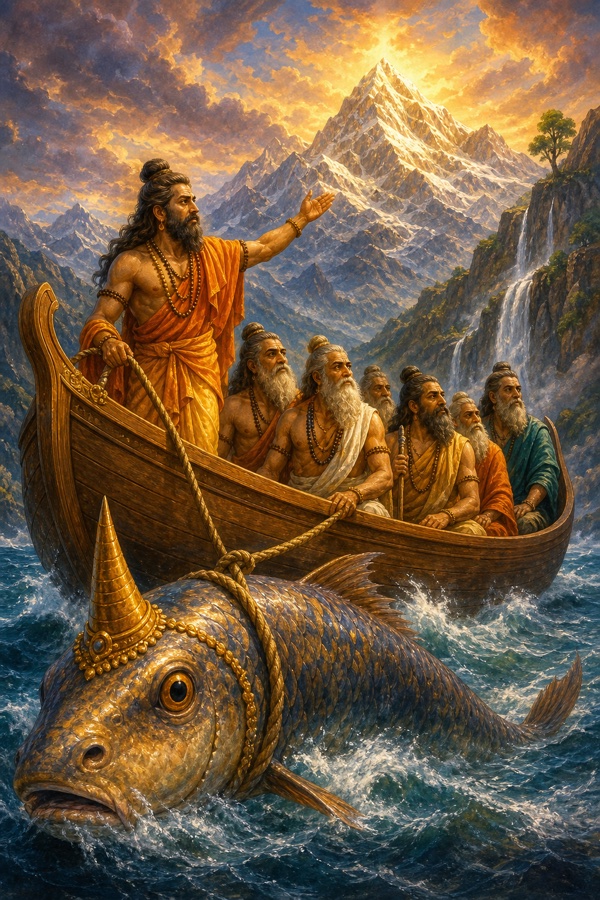
Held by the noose, the fish towed the ark with great force through the salt water and carried them on across a sea that roared and beat with billows. Tossed by the tempest on the great ocean the vessel reeled like a drunken woman, and neither land nor any of the four quarters could be told apart. Water was everywhere; the waters covered the heaven and the firmament; and when the world was flooded like that, only Manu, the seven rishis, and the fish could be seen. For many long years the fish dragged the boat diligently through the flood, and then it towed the vessel toward the highest peak of Himavat and told those aboard to tie it to the peak, and they tied the boat to the mountain at once. That high peak of Himavat is still called Naubandhana, the mooring of the ship. Then the fish spoke to the assembled rishis. It was Brahma, the lord of all creatures, than whom there is none greater; in the shape of a fish it had saved them from this cataclysm. Manu would create all beings again, gods, asuras, and men, every division of creation that moves and every one that does not; by severe austerity he would win the power to do it, and with the fish’s blessing illusion would have no hold on him. With that the fish vanished, and Vaivasvata Manu set himself to create the world. Illusion did overtake him in the work, so he practiced great asceticism, and armed with that merit he set about creating all beings again in their proper and exact order. This story, Markandeya told Yudhishthira, is celebrated as the Legend of the Fish, and hearing it destroys all sin; the man who listens every day to this first history of Manu attains happiness and everything he desires, and goes to heaven.
A key to reading this (place): Naubandhana is the peak of Himavat where Manu’s ark was tied fast at the height of the flood, and the name means the mooring of the ship; the epic says the peak still carries it. In the Vana Parva the fish that saves Manu declares itself to be Brahma, the lord of creatures, and the story is called the Legend of the Fish.
The Cycle of the Yugas and the Signs of the Kali Age
Then Yudhishthira, with all humility, put another question, and this one he approached slowly, because he was speaking to a man who had outlived worlds. Markandeya had seen many thousands of ages pass, he said; no one alive was as old, and no one equaled him in years except great-minded Brahma himself in his exalted place. When the universe went down into the great dissolution, when there was no sky left and no gods and no Danavas, it was Markandeya who worshiped Brahma; and when the cataclysm ended and the Grandsire woke, it was Markandeya alone who watched him fill the quarters with air, put the waters back in their place, and create the four orders of beings again in their due order. He had stood in the Grandsire’s presence with his soul rapt in meditation and wholly swallowed up in him; he had witnessed with his own eyes, many times over, the first acts of creation, and in the severity of his austerities he had surpassed the Prajapatis themselves. In the world to come he was counted nearest to Narayana, because he had opened his own pure, lotus-like heart, the one place where the many-formed Vishnu of universal knowledge can be seen, and had looked on the Supreme Creator with eyes of abstraction and renunciation again and again. That was why, by the grace of God, neither all-destroying Death nor the dotage that rots the body had any power over him. When there was no sun and no moon, no fire, no earth, no air, no sky, when the whole destroyed world looked like one vast ocean and the gods and the Asuras and the great serpents had been wiped out, and Brahma, lord of all creatures, sat down on a lotus and slept, Markandeya alone remained to worship him. He had seen all of it with his own eyes; nothing in any world had ever been unknown to him; and Yudhishthira longed to hear from him a discourse on the causes of things. Markandeya said he would explain everything, and first he bowed to that self-existent, primordial Being, eternal and undecaying and beyond thought, who holds every attribute and is free of them all. This Janardana, he said, looking at the man in yellow robes who sat among them, is the great mover and creator of everything, the soul and the framer of all things and the lord of all; he is called the Great, the Incomprehensible, the Wonderful, the Immaculate; without beginning and without end, he pervades every world, unchanging, undecaying, the creator of all and himself uncreated, the cause of all power, and his knowledge is greater than the knowledge of all the gods together.
After the dissolution of the universe, Markandeya went on, all this wonderful creation comes back into life, and it comes back in ages that have their measure. The Krita yuga is said to be four thousand years long, and it has a dawn and an evening of four hundred years each. The Treta is three thousand years, with a dawn and an evening of three hundred each. The one that comes next is called the Dvapara, two thousand years long, its dawn and its evening two hundred each. And the one called Kali is a thousand years, with a hundred years of dawn and a hundred of evening; the dawn of every age is the same length as its evening. When the Kali yuga is over, the Krita comes round again. One cycle of the four ages therefore comes to twelve thousand years, and a full thousand of those cycles make one day of Brahma. And when this whole universe is withdrawn and gathered back into its home, into the Creator himself, that vanishing of all things is what the learned call the universal destruction.
Toward the end of the last of those thousand years, when what remains of the cycle is short, men give themselves over to lying. Sacrifices and gifts and vows are no longer performed by the people who owe them; they are handed off to stand-ins. Brahmins do the work reserved for Shudras, and Shudras go after wealth, and the Kshatriyas take to the practice of religious rites. In the Kali age the Brahmins give up sacrifice and the study of the Vedas, lay aside the staff and the deerskin, and eat whatever is put before them; they give up prayer and meditation, and the Shudras take those up instead. The whole course of the world runs backward, and these, Markandeya said, are the signs that foretell the universal destruction. Then many Mleccha kings rule the earth, sinful men given to false speech, governing their subjects on false principles, and the Andhras, the Shakas, the Pulindas, the Yavanas, the Kambojas, the Bahlikas, and the Abhiras come into courage and into sovereignty over the earth. That is the state of the world on the evening of the Kali age. No Brahmin keeps to the duties of his order; the Kshatriyas and the Vaishyas follow practices contrary to theirs. Men become short-lived and weak in strength, in energy, and in prowess; small in body and small in might, they can barely tell the truth. Over great stretches of country the people dwindle away, and the regions of the earth, north and south, east and west, fill up with animals and beasts of prey. The very people who recite the Veda recite it in vain. Shudras hail Brahmins with a careless Bho, and Brahmins address Shudras as Respected Sir. Animals multiply beyond counting. Scents lose their sweetness and food its savor. Women bear children in numbers, small of stature and without manners or grace, and put their mouths to the uses of the organ of generation; famine eats the dwellings of men; the highways belong to women of ill fame, and wives in general turn against their husbands and lose their modesty. The cows give little milk; the trees, black with crows, bear few flowers and less fruit. Brahmins stained with the killing of Brahmins take gifts from kings who lie, and full of greed and ignorance, wearing the outward signs of religion, they go begging through the land and afflict the people. Householders, afraid of the burden of taxes, turn to deceit, and Brahmins in the false dress of ascetics, their nails and hair uncut, earn their wealth by trade; many of the twice-born, out of avarice, turn religious mendicant. Men live in ways contrary to the mode of life they have taken up, drink, defile their teachers’ beds, and want nothing that is not of this world, of the flesh and the blood. The hermitages of the ascetics fill up with sinful, insolent wretches praising lives of dependence. Indra sends no rain in its season, and the seed thrown on the earth does not all come up. Unholy in deed and in thought, men take pleasure in envy and malice; the earth fills with sin, and the man who turns virtuous in such a time does not live long. Merchants sell by false weights and false measures; the righteous fail and the sinful prosper; virtue loses her strength and sin grows all-powerful; the man devoted to virtue is poor and dies young, while the sinner lives long and wins riches. People sin in the very places of public amusement in the cities and the towns, and seek every end by sinful means, and having earned fortunes that are really small, they go drunk on the pride of wealth; many try to rob what was left in their keeping in trust and in secret, and say, shamelessly, that nothing was ever deposited. Beasts of prey and other animals and birds lie down in the pleasure grounds of the cities and in the sacred buildings. Girls of seven or eight conceive, boys of ten or twelve father children, and in his sixteenth year a man is overtaken by decrepitude and decay; life runs out almost before it has begun, so that the young behave like the old and the old show everything that belongs to youth. Women of loose conduct and evil manners deceive the best of husbands and forget themselves with menials and slaves and even with animals, and even the wives of heroes go after other men while their husbands are still alive.
A key to reading this (the numbers): One turn of the four ages, with their dawns and evenings, runs twelve thousand years, and a thousand such turns make one day of Brahma, at whose close the dissolution comes. Markandeya draws the Kali age through its signs: the orders of society trading places, foreign kings on the throne, bodies shrinking and lives shortening until a man is old at sixteen, false weights in the market, and rain that no longer comes in season. The signs are the evening of the age, the hour before the world is unmade.
The Vision of the Deluge and the Boy on the Banyan Leaf
Then Markandeya told them how the world ends, and he told it as a man tells what he has watched. Toward the close of those thousands of years that make up the four ages, when the lives of men have shrunk to almost nothing, a drought sets in and holds for many years, and men and creatures, small in strength and vitality by then, go hungry and die by the thousand. Then seven blazing suns stand in the sky together and drink up every drop of water on the earth, whatever runs in a river or lies in a sea, and everything that is wood or grass, the wet along with the dry, is burned to ash. On that earth already baked to cinders by the seven suns the fire called Samvartaka appears, driven by the winds. It bores down through the earth and breaks out in the nether regions, and the gods and the Danavas and the Yakshas feel terror in their hearts; it eats the underworld and everything on the surface and destroys all of it in a moment, and with that inauspicious wind behind it the Samvartaka fire consumes a world that stretches for hundreds and thousands of yojanas, until that lord of all things, blazing, has swallowed the universe with its gods and Asuras and Gandharvas and Yakshas and serpents and Rakshasas.
Then deep masses of cloud rise in the sky, like herds of elephants, wreathed in lightning that is wonderful to see. Some are the blue of the blue lotus and some the color of the water lily; some are the tint of lotus filaments, some purple, some yellow as turmeric, some the hue of a crow’s egg, some bright as lotus petals and some red as vermilion. Some have the shape of palaces and cities, some of herds of elephants, some of lizards, some of crocodiles and sharks. Terrible to look at, roaring, they cover the whole sky, and driven by the Supreme Lord they drown the earth with its mountains and its forests and its mines, pouring water in such quantity that the whole earth fills, and they put out that terrible fire. Urged on by the Lord, those clouds rain without a pause for twelve years. The ocean climbs over its continents; the mountains split into fragments; the earth sinks under the rising flood. Then, moved all at once by the force of the wind, the clouds drift across the whole face of the sky and are gone, and the Self-born Lord, the first cause of everything, who has his seat in the lotus, drinks in those terrible winds and goes to sleep.
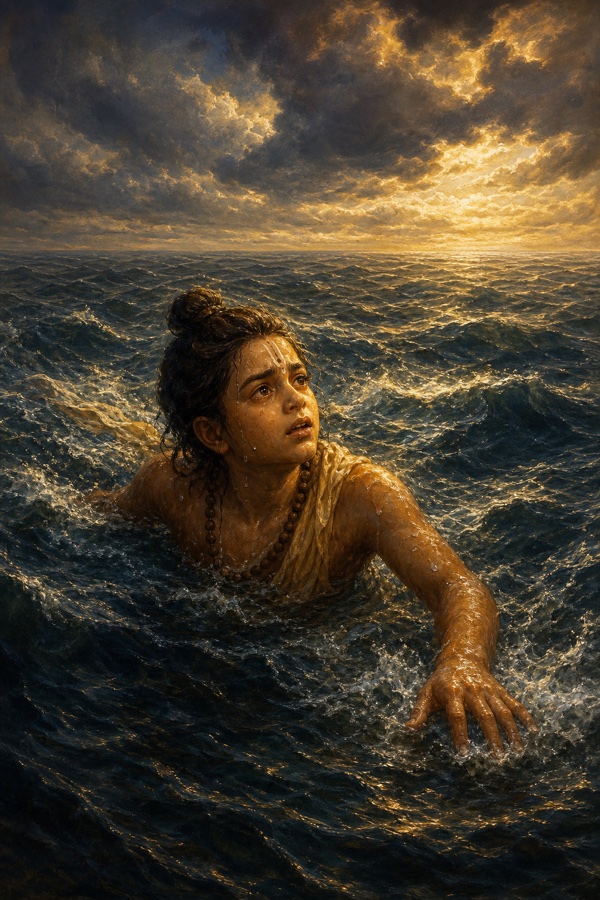
What came after that, Markandeya had lived. When the universe has become one dead sheet of water, when every creature that moves and every one that stands still has been destroyed, when the gods and the Asuras have ceased to be and the Yakshas and the Rakshasas are gone, when there is no man, no tree, no beast of prey, and no sky, he alone wanders on that water, in affliction, and his heart breaks because there is no living thing to see. He wanders that dreadful expanse without stopping, and he grows tired, and there is nowhere to rest. Then, after some time, he sees in those gathered waters a banyan tree, vast and wide-spreading, and on one of its far-reaching boughs, on a couch spread with a celestial bed, a boy is sitting, his face as fair as a lotus or the moon, his eyes as large as the petals of a full-blown lotus.
Wonder filled him. How could this boy be sitting here alone, when the world itself had been destroyed? Markandeya had full knowledge of the past, the present, and the future, and yet not even the meditation of an ascetic could tell him a single thing about this child. The boy shone with the light of the atasi flower and bore the Srivatsa mark on his breast, and he looked to Markandeya like the very house of Lakshmi. Then the boy with the lotus-petal eyes, blazing with splendor, spoke to him in words that were sweet to hear. “I know you are tired and want to rest. Markandeya of Bhrigu’s line, rest here as long as you wish. Enter my body and rest there. That is the place I have set aside for you. I am pleased with you.”
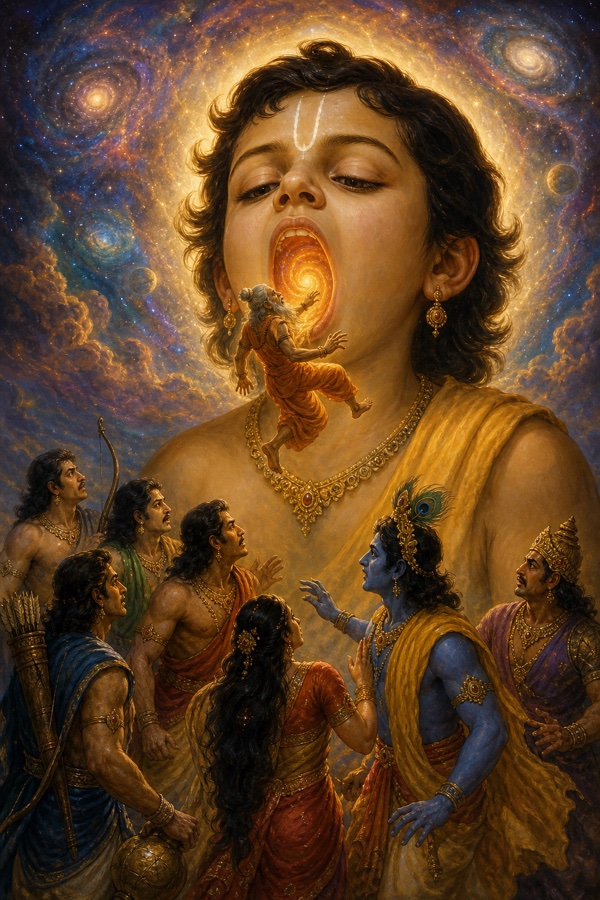
At those words a complete indifference came over Markandeya toward his long life and toward his very manhood. The boy suddenly opened his mouth, and Markandeya, as fate would have it, stripped of the power to move, went in. And inside the boy’s belly he saw the whole earth, crowded with cities and kingdoms. Wandering through it he saw the Ganga, the Yamuna, the Sarasvati, the Sindhu, the Godavari, the Narmada, the Kaveri, and many rivers besides, and the ocean, that mine of gems, full of crocodiles and sharks; the sky with the sun and the moon in it, blazing; the earth dressed in woods and gardens; Brahmins bent over their sacrifices, Kshatriyas working for the good of every order, Vaishyas at their farming, and Shudras in the service of the twice-born. He saw Himavat and Hemakuta, Nishada, and Shveta rich in silver, Gandhamadana, Mandara, the huge Nila, golden Meru, Mahendra, the Vindhyas, Malaya, and Paripatra, every one of them set with jewels, and lions and tigers and boars and every animal that lives on earth. He saw the whole company of the gods with Indra at their head, the Sadhyas, the Rudras, the Adityas, the Guhyakas, the fathers, the serpents and the Nagas, the birds, the Vasus, the Ashvins, the Gandharvas, the Apsaras, the Yakshas, the rishis, and the hordes of the Daityas and the Danavas, and the sons of Simhika and all the other enemies of the gods: whatever moves or stands still and can be seen on earth, all of it was inside that boy’s belly.
Living on fruit, Markandeya roamed that body for many centuries, over the entire universe that was there, and never once came to its limits. When he had failed to measure it, however anxiously he wandered, he took refuge in thought and in deed in that boon-giving, supreme god and acknowledged his supremacy, and the moment he had done so a gust of wind flung him out through the great being’s open mouth. And there on the same bough of the same banyan, in the form of a boy with the Srivatsa on his breast and dressed in yellow, sat the same being of measureless energy who had swallowed the whole universe. Pleased with him, the boy smiled and said that Markandeya, best of sages, had grown tired from dwelling a while inside his body, and that he would now speak to him. As the boy said it, a new sight came to the sage, and he saw himself possessed of true knowledge and set free from the illusions of the world.
Having witnessed the inexhaustible power of that being, Markandeya took the god’s revered, well-shaped feet, their soles bright as burnished copper, their toes a soft red, and set them with care on his own head; then he joined his palms and came near with reverence, and looked on that divine being with the lotus-petal eyes who is the soul of all things, and bowed, and asked. He wanted to know him, and this high and wondrous illusion of his. He had gone in through the mouth and had seen the entire universe in the belly, gods and Danavas and Rakshasas, Yakshas, Gandharvas, and Nagas, the whole world that moves and the whole world that does not; he had wandered through that body at a run without ceasing, and by the god’s grace his memory had not failed him; and he had come out at the god’s wish, and never at his own. Why did the god who was free of every fault stay here in the shape of a boy, with the whole universe swallowed? Why was the universe inside his body at all? How long would he remain? Out of a curiosity that was not improper in a Brahmin, Markandeya asked the lord of all the gods to tell him all of it, in every detail and exactly as it happens, because everything he had seen was wonderful and beyond thought.
The gist: Markandeya gave an eyewitness account of the dissolution: a drought of many years, seven suns drinking the rivers and seas, the Samvartaka fire boring down into the underworld, clouds in every color raining for twelve years until the ocean climbed over its shores and the earth sank, and then one dead expanse of water with the Self-born asleep on the lotus. On that water he found a banyan, and on one of its boughs a boy marked with the Srivatsa, and inside the boy’s belly the rivers, the mountains, the four orders of men, the gods, and the enemies of the gods, every creature of the earth. Flung out again after centuries, and given a new sight, the sage set the boy’s copper-bright feet on his head and asked him who he was.
The Flood-Water and the Child Seated on the Banyan
Now the sage told it in his own voice. Markandeya, a deathless rishi alive through many kalpas, sat among the Pandavas in the Kamyaka forest, with Krishna near him and Narada listening, and King Yudhishthira and his brothers and Draupadi with them, and he spoke as a man speaks of a thing he has done more than once. “When all this world becomes one dead expanse of water,” he said, “when every creature that moves and every one that stands still has been destroyed, when the gods and the Asuras cease to be, when the Yakshas and the Rakshasas are no more, when man is not, when the trees and the beasts of prey have disappeared, when the sky itself has ceased to exist, I alone wander there, in affliction. I go over that dreadful expanse of water and my heart is afflicted because I see no creature anywhere. I wander through that flood without stopping, and I grow tired, and I find no place to rest.”
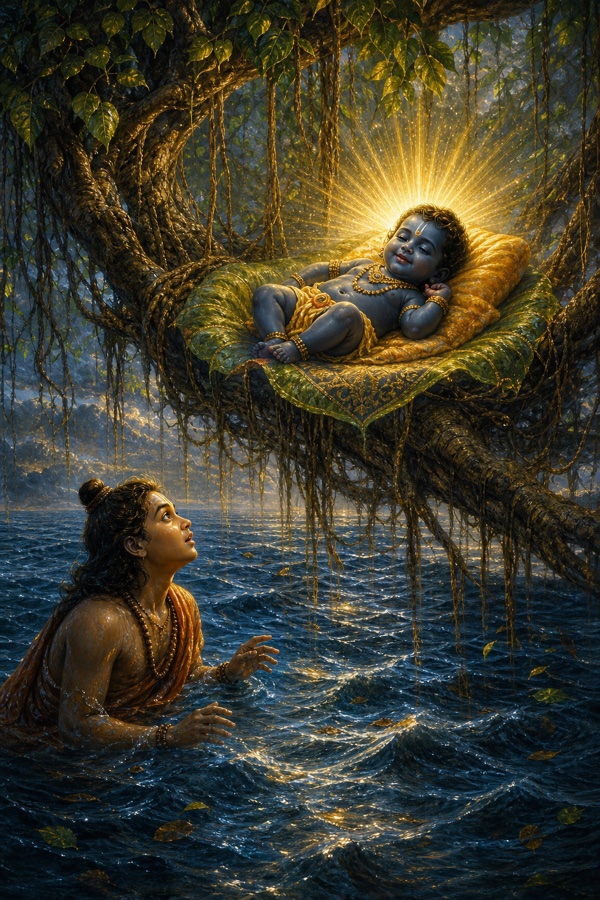
“Then, after some time, I see in that gathered waste of water a banyan tree, vast and wide-spreading. And on one of its far-reaching boughs, on a couch spread with a celestial bed, I see a boy, his face as fair as a lotus or the moon, his eyes as large as the petals of a full-blown lotus. At that sight wonder fills my heart. I ask myself, ‘How does this boy sit here alone, when the world itself has been destroyed?’ I have full knowledge of the past, the present, and the future, and still I cannot learn one thing about him, even by the meditation of an ascetic. He shines with the light of the atasi flower, and he bears the mark of the Srivatsa, and he seems to me to be the very house of Lakshmi herself.”
“Then that boy with the lotus-petal eyes, marked with the Srivatsa and blazing with splendor, speaks to me in words that are very pleasant to hear. ‘I know you are tired and want to rest. Markandeya of Bhrigu’s line, rest here as long as you wish. Enter my body and rest there. That is the place I have set aside for you. I am pleased with you.’ When the boy says this to me, a complete indifference takes hold of me toward my long life and toward my manhood alike. Then the boy suddenly opens his mouth, and as fate would have it, stripped of the power to move, I pass inside.”
A key to reading this (a note): This is the vision of the dissolution, the folding-away of creation at the close of a day of Brahma. The boy seated on the banyan bough above the flood is Narayana, who says so himself before the vision ends: he lies there in a child’s form, old as he is, until Brahma wakes. The rishi’s passage through the god’s mouth into a belly that holds the whole universe is the center of the vision, and Markandeya has seen it more than once; Yudhishthira says as much when he asks.
The Whole Universe Inside the Boy’s Belly
Markandeya said, “Once I have suddenly entered that boy’s belly, I see there the whole earth, crowded with cities and kingdoms. Wandering through the belly of that illustrious one, I see the Ganga, the Satadru, the Sita, the Yamuna, and the Kausiki; the Charmanvati and the Vetravati; the Chandrabhaga, the Sarasvati, the Sindhu, the Vipasa, and the Godavari; the Vasvokasara, the Nalini, and the Narmada; the Tamra, and the Venna of the delightful current and the sacred waters; the Suvenna, the Krishnavenna, the Irama, and the Mahanadi; the Vitasta, and that great river the Kaveri; and the Visalya and the Kimpuna too. These I see, and many other rivers that are on the earth. I see there the ocean, that mine of gems, the excellent home of the waters, alive with alligators and sharks. I see the sky, set with the sun and the moon, blazing with a light like the sun’s own fire. And I see the earth, graced with woods and forests.”
“In his belly I see many Brahmins bent over their many sacrifices; Kshatriyas working for the good of all the orders; Vaishyas busy in their farming; and Shudras devoted to the service of the twice-born. Roaming through that same belly I see Himavat and the mountains of Hemakuta; Nishada, and the mountains of Shveta rich in silver; the mountain Gandhamadana, and Mandara, and the huge mountains of Nila; the golden mountains of Meru, and Mahendra, and those excellent mountains the Vindhyas; and the mountains of Malaya and of Paripatra as well. These and many other mountains that stand on the earth I see within his belly, all of them set with jewels and gems, and lions and tigers and boars, and indeed every animal that lives on the earth.”
“Wandering on inside his belly I see the whole company of the gods with Shakra at their head; the Sadhyas, the Rudras, the Adityas, the Guhyakas, the fathers, the serpents and the Nagas, the feathered tribes, the Vasus, the Ashvins, the Gandharvas, the Apsaras, the Yakshas, the rishis, the hordes of the Daityas and the Danavas, and the Nagas again; and the sons of Simhika, and all the other enemies of the gods. Whatever moves or stands still and may be seen on the earth, all of it I see inside the belly of that high-souled being. Living on fruit, I dwell in his body for many centuries, roaming over the entire universe that is there, and never once do I come to the limits of his body.”
“When I have failed to measure the limits of that great being’s body, though I wander inside him without stopping and in great anxiety of mind, I seek the protection, in thought and in deed, of that boon-giving and supreme god, and I acknowledge his supremacy. And when I have done that, I am suddenly thrown out through the open mouth of that high-souled one on a gust of wind. Then I see, seated on the bough of that very banyan, that same being of immeasurable energy, in the form of a boy with the mark of the Srivatsa on his breast, having swallowed up the whole universe.”
A key to reading this (the numbers and place): The rivers Markandeya names are the rivers of the land itself, from the Sindhu and its tributaries in the northwest to the Godavari, the Krishnavenna, and the Kaveri in the south, and the mountains are its real ranges, Himavat and the Vindhyas among them; the epic sets the whole known earth inside one body, with the four orders of men at their work and the gods and the enemies of the gods side by side. The centuries the sage spends inside it, living on fruit and never reaching a limit, are the epic’s own measure of how large that body is.
Narayana’s Self-Declaration in His Own Voice
Markandeya said, “That boy of blazing splendor, the Srivatsa on his breast and yellow robes on his body, is pleased with me, and he smiles and says, ‘Markandeya, best of sages, you have grown tired from dwelling a while inside my body. Even so, I will speak to you.’ And as he says it, in that very moment, a new sight comes to me, and by it I see myself possessed of true knowledge and set free from the illusions of the world. Having witnessed the inexhaustible power of that being of measureless energy, I take his revered, well-shaped feet, their soles bright as burnished copper and their toes a soft red, and set them with care on my head; I join my palms and come near him with reverence, and I look on that divine being with eyes like the petals of the lotus who is the soul of all things, and I bow with joined hands and say to him, ‘I wish to know you, and this high and wondrous illusion of yours. I have entered your body through your mouth and I have seen the entire universe inside you: the gods, the Danavas and the Rakshasas, the Yakshas, the Gandharvas, and the Nagas, the whole world that moves and the whole world that stands still, all of it within your body. I have wandered through you at a run without ceasing, and by your grace my memory has not failed me. I have come out of your body at your wish and never at my own. You are free of every fault, and I want to know you. Why do you stay here in the form of a boy, with the entire universe swallowed? Why is the whole universe inside your body? How long will you stay here? Out of a curiosity that is not improper in a Brahmin, I want to hear all of it from you, in every detail and exactly as it happens, because everything I have seen is wonderful and beyond thought.’ And that god of gods, blazing, beautiful, the first of all speakers, consoles me as I need to be consoled, and answers.”
“The god says to me, ‘Brahmin, even the gods do not truly know me. But I am pleased with you, and so I will tell you how I made the universe. You are devoted to your ancestors and you have sought my protection; you have seen me with your own eyes, and your austerity is great. In ancient times I gave the waters the name Nara, and because the waters have always been my ayana, my home, I am called Narayana, the one whose home is the waters. I am Narayana, the source of all things, eternal, unchanging. I am the creator of all things and the destroyer of all. I am Vishnu, I am Brahma, and I am Shakra, the chief of the gods. I am King Vaishravana, and I am Yama, lord of the spirits of the dead. I am Shiva, I am Soma, and I am Kashyapa, lord of created things. I am the one called Dhatri and the one called Vidhatri, and I am Sacrifice itself in bodily form. Fire is my mouth, the earth is my feet, the sun and the moon are my eyes; heaven is the crown of my head, the sky and the quarters are my ears, and the waters are born of my sweat. Space with the quarters is my body, and the air is my mind. I have performed many hundreds of sacrifices with gifts in profusion. I am always present in the sacrifices of the gods, and those who know the Vedas and officiate at them make their offerings to me. On earth the Kshatriya chiefs who rule over men, when they sacrifice in hope of heaven, and the Vaishyas, when they sacrifice in hope of those happy regions, are all worshiping me in those rites.’”
“‘It is I who, taking the form of Sesha, hold up on my head this earth bounded by the four seas and decked with Meru and Mandara. It is I who, taking the form of a boar, raised this earth in the old days when it had sunk under the water. It is I who, becoming the fire that issues from the Mare’s Mouth in the deep, drink up the waters of the ocean and make them again. From my energy sprang, in their order, from my mouth and my arms and my thighs and my feet, the Brahmins, the Kshatriyas, the Vaishyas, and the Shudras. From me spring the Rik, the Sama, the Yajus, and the Atharva Vedas, and into me they all enter when the time comes. Brahmins devoted to austerity, who hold peace the highest attribute, whose souls are wholly under control, who want knowledge, who are free of lust and wrath and envy and unwedded to the things of the earth, whose sins are washed away, who are gentle and virtuous and without pride and know the Soul in full, all of them worship me in deep meditation. I am the flame called Samvartaka, and the wind that bears that name, and the sun that wears it, and the fire that carries it. Those things you see in the sky as stars, know them for the pores of my skin. The ocean, that mine of gems, and the four quarters, know them for my robes, my bed, and my home; I have laid them out to serve the purposes of the gods. And know that lust, wrath, joy, fear, and the clouding of the intellect are all forms of myself. Whatever men obtain by truth, by charity, by austerity, by peace and harmlessness toward every creature and other such fine deeds, they obtain by my arrangement. Governed by my ordinance, men wander inside my body with their senses overwhelmed by me; they move as I move them, and never as they will. Brahmins who have studied the Vedas through, whose souls are tranquil and whose wrath is subdued, win a high reward by their many sacrifices, a reward that men wicked in their deeds, sunk in greed, mean and disreputable, with souls unblessed and impure, can never reach. Know, then, Brahmin, that this reward, which comes to those whose souls are under control and which the ignorant and the foolish cannot obtain, which austerity alone can win, is the bearer of the highest merit.’”
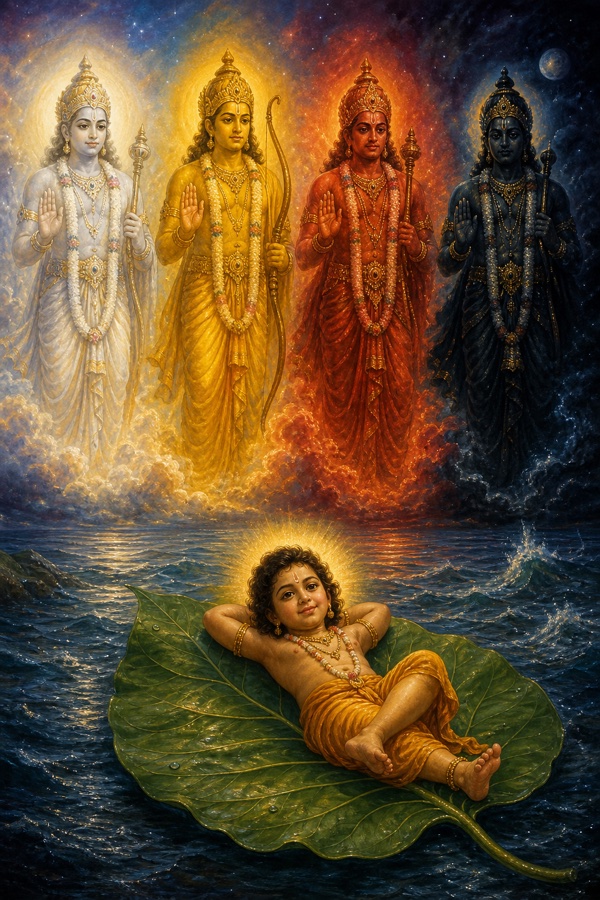
“‘And whenever virtue and right conduct decline and sin and wrong increase, I create myself in new forms. When fierce and malicious Daityas and Rakshasas whom even the foremost of the gods cannot kill are born on the earth, I take birth in the families of virtuous men, put on a human body, and restore peace by exterminating every evil. Moved by my own maya I create gods and men and Gandharvas and Rakshasas and all the things that do not move, and when the time comes I destroy them all myself. For the preservation of rectitude and right I take a human form, and when the season for action comes I take forms past conceiving. In the Krita age I am white, in the Treta yellow, in the Dvapara I have been red, and in the Kali age I am dark of hue; in the Kali age wrong makes up three parts of four, and right the fourth alone. And when the end of the age comes, I take the fierce form of Death and alone destroy the three worlds with everything in them that moves and everything that stands still.’”
“‘With three steps I cover the whole universe. I am the soul of the universe, the source of all happiness, the humbler of every pride; I am everywhere, I am infinite, I am the lord of the senses, and my prowess is great. Brahmin, I alone set the wheel of Time going; I am formless; I am the destroyer of all creatures, and the cause of every effort any creature makes. My soul runs through all my creatures, and no one knows me. In all the worlds it is I whom the pious and the devoted worship. Whatever pain you felt inside my belly, know that all of it was for your happiness and your good fortune, and whatever you have seen in the world, moving or unmoving, has been ordained by my Soul, the spring of all that exists. The Grandsire of all creatures is half of my body; I am called Narayana, and I carry the conch, the discus, and the mace. For a span a thousand times the length of the ages I, the Universal Soul, sleep, and all creatures lie senseless in that sleep, and I stay here, in the form of a boy though I am old, until Brahma wakes. I who am Brahma have been pleased with you and have granted you boons again and again, you whom the twice-born rishis worship. You looked on one vast expanse of water and saw that every moving and unmoving creature was gone, and melancholy took you; I knew it, and that is why I showed you the universe inside me. And while you were within my body, seeing the whole universe, wonder filled you and your senses left you, and that is why I brought you out so quickly through my mouth. I have now told you of that Soul which neither the gods nor the Asuras can comprehend. As long as the holy Brahma, that great ascetic, does not wake, you may live here happily and in trust. And when the Grandsire of all creatures wakes, then I alone will create every creature that has a body, and the sky, the earth, the light, the atmosphere, the water, and everything else that moves or stands still that you may have seen on the earth.’”
A sub-tale: “With three steps I cover the whole universe” points here to Vishnu’s dwarf form, Vamana. In that story Vishnu came as a small Brahmin to the sacrifice of the Daitya king Bali and asked him for three paces of ground; when the gift was granted he grew until his first stride covered the earth and his second the heavens, and the three worlds came back to the gods. Here the god speaking on the banyan claims the stride as his own, alongside the serpent Sesha that bears the earth and the boar that lifted it from the water: three forms he says he has taken, named in his own voice.
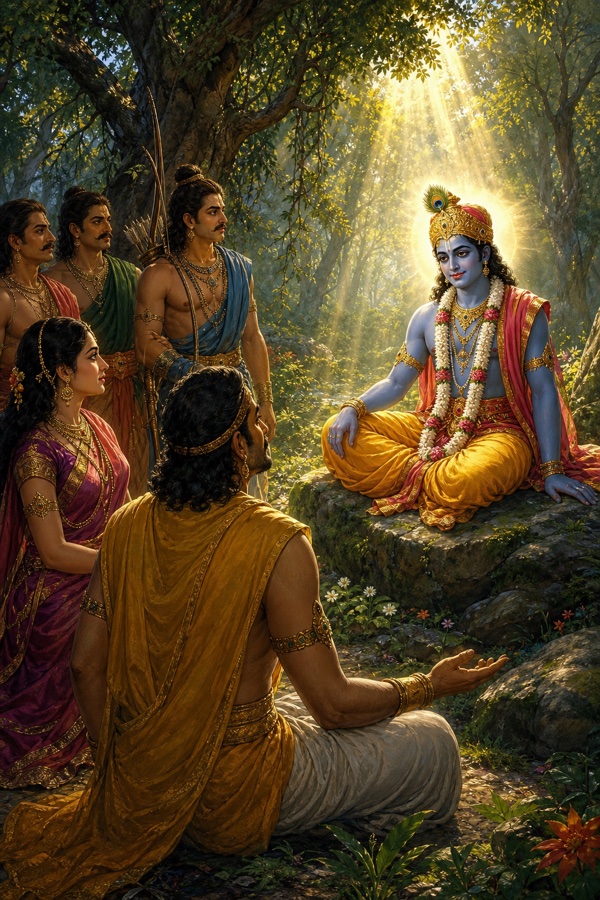
Markandeya said, “With those words the god was gone from my sight, and where the one sheet of water had been I watched this whole varied creation start into life again, the rivers and the mountains, the cities and the herds, every creature I had seen held inside his belly now standing in its own place under its own sky. I witnessed that at the end of an age. And the one I saw then, with his eyes as wide as lotus petals, is this same Janardana who sits among you today and has become your kinsman. It is by his boon that my memory never fails, that my life runs on past the lifetime of any world, and that death itself waits for my word. He is the ancient supreme Hari, whose soul no mind can measure, who has taken his birth as Krishna of the Vrishnis and moves through this world as if at play. He is Dhata and Vidhata, the one who orders and the one who disposes, the destroyer of everything that lasts, the one who carries the Shrivatsa curl on his breast, the lord of the lord of creatures, the highest of the high, whom men also call Govinda. When I look at him in his yellow robes, at this chief of the Vrishnis whom no one has ever defeated, the whole of it comes back to me. This Madhava is the father and the mother of every creature that breathes. Take shelter in him, all of you.” At that the sons of Pritha, the twins with them and Draupadi beside them, bowed low to Janardana, and Krishna, who had earned every honor they could give him, spoke to them gently until the fear of the flood had gone out of the clearing.
The gist: The boy on the banyan branch above the flood-water is Narayana, and inside his belly the rivers, the mountains, the worlds, and every living creature are kept safe while the universe sleeps. He told Markandeya his own nature in his own voice: he makes, he keeps, he destroys, and whenever dharma thins he comes down in a new form. Markandeya has recognized him. The Krishna sitting among the Pandavas in the forest is that same boy on the leaf.
The Prophecy of the Kali Age
Yudhishthira had one more question, and it reached past his own troubles into the future of the earth itself. He said, “What you have told us of the destruction and the rebirth of everything at the end of the age is full of wonder. But now I want to know about the Kali age. When dharma and right conduct have run out, what will be left? What strength will men have in that age, what food, what amusements? How long will a life last when the age is ending? And what is the limit at which the Krita age begins again? Tell me all of it in detail, for everything you tell is varied and delightful to hear.”
The question pleased the sage, and it pleased Krishna, and the sons of Pandu leaned in to listen. Markandeya said, “Hear what I have seen with my own eyes, what I have heard, and what I have known by the inner sight the god of gods gave me, and I will tell you the history of the world in its sinful age before that age has come. In the Krita age there was no deceit, no guile, no greed, and no coveting of what belonged to another, and dharma walked among men like a bull with all four of its legs under it. In the Treta, sin took one leg away and dharma stood on three. In the Dvapara, sin and dharma are mixed half and half, so dharma is said to stand on two. In the dark age of Kali, dharma lives beside men mixed with three parts of sin, and only a fourth of it remains to wait on them. Know this, Yudhishthira: with every age the span of a life, the energy of the body, the reach of the mind, and the strength of the arm all fall away.”
“In the Kali age Brahmins, Kshatriyas, Vaishyas, and Shudras will practice dharma as a fraud, and men will cheat their neighbors by spreading the net of virtue over the trap. Men with a false reputation for learning will shrink the truth and hide it by their acts. Their lives will be too short to gather much knowledge, their thin knowledge will leave them without wisdom, and into that emptiness greed will pour. Wedded to greed, anger, ignorance, and lust, men will nurse hatreds and want each other dead. Brahmins, Kshatriyas, and Vaishyas, their dharma shrunk and their austerity and truth gone, will sink to a level with the Shudras, and the lowest orders will climb into the middle station while those in the middle, without any doubt, come down to the lowest. That, Yudhishthira, will be the state of the world at the end of the age.”
“Robes of flax will be thought the finest in that time, and of all grains the kodo millet will be prized above the rest. Men will come to regard their wives as their only friends. They will live on fish and milk, on goats and sheep, because the cows will have died out. Even those who have always kept their vows will turn greedy, and set against one another, men will hunt for one another’s lives; cut loose from the age’s dharma, they will become atheists and thieves. They will dig up the banks of rivers with their spades and sow grain there, and even those places will turn barren under them. Men given to the rites for the gods and the ancestors will be avaricious and will seize and enjoy what belongs to others. The father will feed on what belongs to the son and the son on what belongs to the father, and men will enjoy what the scriptures forbid them to enjoy. Brahmins will speak of the Vedas with contempt, keep no vows, cloud their understanding with the science of disputation, give up the sacrifice and the fire offering, and, deceived by false reasoning, turn their hearts toward everything mean and low. Men will till the low lands and yoke cows and calves a year old to the plow and load them with burdens.”
“Sons will kill their fathers and fathers their sons and carry no shame for it; they will do it to ease their own anxieties and then boast of it. The whole world will fill with mleccha ways, mleccha notions, and mleccha rites; sacrifices will stop, joy will be nowhere, and the sound of public rejoicing will vanish. Men will rob the helpless, the friendless, and the wise. Small in strength and energy, ignorant, greedy, and sinful, they will accept with joy gifts that wicked men hand them with words of contempt. The kings of the earth, their hearts wedded to sin, ignorant and forever boasting of their wisdom, will challenge one another out of a wish to take one another’s lives, and the Kshatriyas at the end of that period will become the thorns of the earth. Swollen with greed, pride, and vanity, unable and unwilling to protect anyone, they will take pleasure in punishment alone; they will attack the good and the honest, attack them again, and feel nothing when their victims cry out, and they will rob those very people of their wives and their wealth. No one will ask for a girl in marriage and no one will give one away; the girls will choose their own lords when the end of the age comes. Kings sunk in ignorance and discontented with what they have will rob their subjects by every means they can find.”
“The right hand will deceive the left and the left the right. Men with a false name for learning will shrink the truth; the old will expose the folly of the young and the young will expose the dotage of the old. Cowards will pass for brave men and the brave will be cheerless as cowards, and toward the end of the age men will stop trusting one another altogether. Greedy and foolish, the whole world will eat one kind of food. Sin will swell and prosper while dharma fades. Brahmins, Kshatriyas, and Vaishyas will disappear and leave no remnant of their orders, and all men will become one undivided mass. Fathers will not forgive sons and sons will not forgive fathers, and when the end is near, wives will stop waiting on their husbands. Men will go looking for the countries where wheat and barley are the staple food. Men and women alike will become perfectly free in their behavior and will not tolerate one another’s acts. No one will gratify the gods with the offerings of the shraddha. No one will listen to another, and no one will accept anyone as a teacher.”
“A darkness of the mind will close over the whole earth, and a man’s life will be measured at sixteen years; at sixteen, death will come. Girls of five or six will bear children, and boys of seven or eight will become fathers. The wife will never be content with her husband nor the husband with his wife. No one will possess much, and people will falsely wear the marks of dharma while jealousy and malice fill the world. No one will give anything to anyone. The inhabited earth will be stricken with scarcity and famine, and the highways will fill with lustful men and women of bad name. Women will come to loathe their husbands. Without any doubt men will take up the ways of the mlecchas, eat anything without distinction, and turn cruel in every act. Driven by greed, they will cheat one another in buying and selling. Knowing nothing of the ordinances, they will perform rites and ceremonies as the mood takes them, and driven by their own dispositions they will act cruelly and speak ill of one another. They will destroy trees and gardens without a qualm. Every man will be anxious about how to live. Overcome by greed, men will kill Brahmins and seize and enjoy what their victims owned, and the twice-born, harried by Shudras and sick with fear, will wander the earth crying out with no one to protect them.”
“When men have begun to kill one another and turned wicked and fierce, with no regard left for any living thing, then the age will be ending. The best of the twice-born, hounded by robbers, will fly in terror like crows and take refuge in rivers, in mountains, in places no one can reach. Ground down by bad rulers and the weight of taxes, the foremost Brahmins will lose all patience in those terrible times and stoop to improper acts, even to becoming the servants of Shudras. Shudras will expound the scriptures, and Brahmins will wait on them and listen, and take their readings as the rule of their own duty. The low will become the high, and the course of things will run backward. Renouncing the gods, men will worship bones and relics set inside walls. The Shudras will stop serving the Brahmins, and in the hermitages of the great rishis, in the schools of the Brahmins, in the places sacred to the gods, in the sacrificial grounds and the holy tanks, the earth will be disfigured with tombs and pillars full of bones, and no temple to any god will stand among them. All of this will happen at the end of the age, and these are the signs by which you will know it is ending.”
“When men have become fierce and lost to dharma, eaters of flesh and drinkers of wine, the age is ending. When flowers grow inside flowers and fruits inside fruits, the age is ending. The clouds will rain out of season. Rites will no longer follow one another in their due order, and the Shudras will quarrel with the Brahmins. The earth will soon be full of mlecchas, and the Brahmins will scatter in every direction for fear of the tax collector. Every distinction of conduct and behavior between men will disappear, and people, burdened with offices and honors they never asked for, will run for the woods and live on fruit and roots. So afflicted will the world be that right conduct will show itself nowhere. Disciples will set their teachers’ instruction at nothing and try to injure them, and teachers reduced to poverty will be held in contempt. Friends, relatives, and kinsmen will do their friendly offices only for the wealth a man has in hand. When the end of the age comes, everyone will be in want. The quarters of the sky will be on fire, the stars and their groupings will lose their light, the planets and their conjunctions will turn hostile, the winds will blow confused and wild, and countless meteors will streak the sky in warning. The sun will rise with six other suns beside it. There will be din and uproar on every side, and fires everywhere. From its rising to its setting the sun will be wrapped in Rahu, and the thousand-eyed Indra will send rain when no rain is due. Crops will fail. Women will grow sharp in speech, pitiless, and fond of weeping, and will never abide by what their husbands say. Sons will kill their fathers and their mothers, and women, living without any check, will kill their husbands and their sons. Rahu will swallow the sun out of season, and fires will blaze up on every side. Travelers who ask for food, water, and shelter will be given none and will lie down by the roadside and stop asking. Crows, snakes, vultures, kites, and every other bird and beast will cry out in frightful, jarring voices. Men will cast off their friends, their relatives, and their servants. They will abandon the countries, the regions, the towns, and the cities where they lived and go looking for new ones, one after another, and the whole earth will wander, crying for a father, crying for a son, in voices that tear the heart.”
A key to reading this (in modern terms): The bull of dharma is a figure the sage draws himself: in the Krita age dharma stands whole on four legs, in the Treta on three, in the Dvapara on two, and in the Kali on one, so that a quarter of it is left to men. The word mleccha names conduct outside the Vedic way, coarse and untrained. What the sage describes, item by item, is a collapse in a fixed order: the varnas first, then the family, then trust itself, until the last sign is a whole earth on the road, calling for fathers and sons.
The Advent of Kalki and the Renewal of the Krita Age
Markandeya said, “When those terrible times have run their course, creation will begin again. Men will be made once more and divided into the four orders beginning with the Brahmins, and about that time, so that men may increase, Providence will turn favorable at its own pleasure. Then, when the sun, the moon, and Brihaspati enter one sign together with the constellation Pushya, the Krita age will begin anew. The clouds will rain in season, the stars and their conjunctions will turn auspicious, the planets will keep to their orbits and grow kindly, and on every side there will be prosperity and plenty, health and peace.”
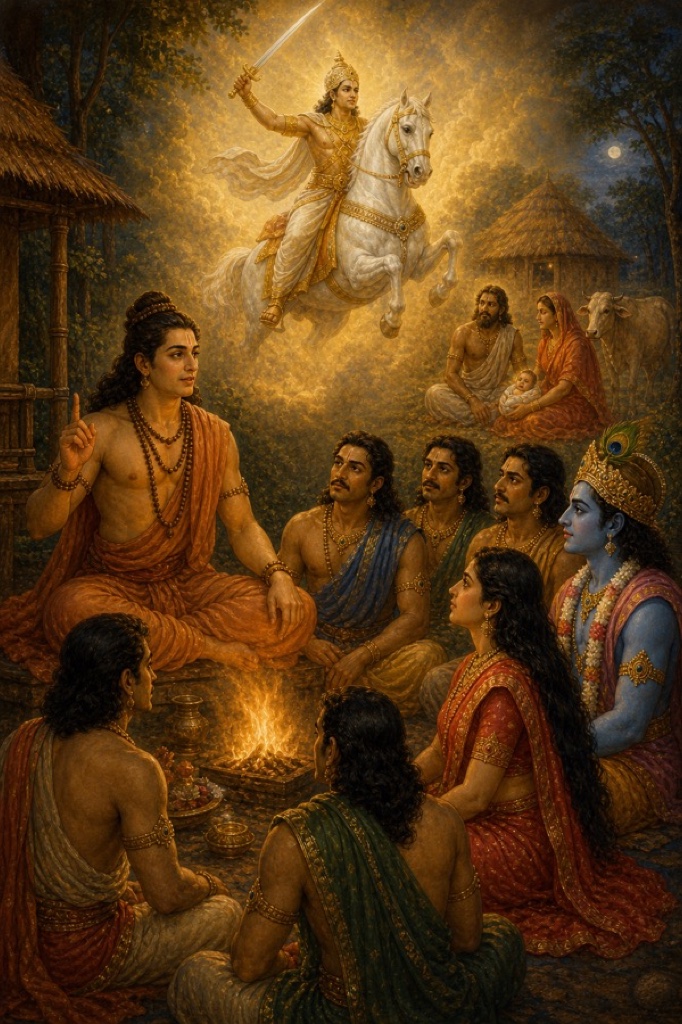
“At that time, commissioned by Time itself, a Brahmin named Kalki will take his birth. He will glorify Vishnu, and great energy, great intelligence, and great prowess will be his. He will be born in a town called Sambhala, into an auspicious Brahmin family, and vehicles and weapons, warriors and arms and coats of mail will be at his disposal the moment he thinks of them. He will be the king of kings, victorious always by the strength of dharma, and he will bring order and peace back to a world crowded with creatures and running against itself. Having appeared, that blazing Brahmin of mighty intellect will destroy all things; he will be the destroyer of everything that stands, and he will inaugurate a new age. Surrounded by Brahmins, he will root out the mlecchas wherever those low and despicable men have gone to ground.”
“When the thieves and robbers have been destroyed, Kalki will hold a great horse-sacrifice and give this earth away to the Brahmins in due form, and having set up again the blessed order the Self-born ordained, he will walk into a delightful forest, and the people of the earth will follow his example. When the Brahmins have finished with the thieves and robbers there will be plenty everywhere. As one country after another is brought under him, that tiger among Brahmins will plant deerskins, lances, and tridents in each and range over the earth, honored by the foremost Brahmins and showing them every regard, cutting down thieves and robbers all the while, and he will wipe them out amid cries of ‘Father!’ and ‘Mother!’ and ‘My son!’”
“When sin has been torn out by the root in that way and dharma flowers again with the coming of the Krita age, men will turn back to the rites of religion. In the age that sets in, well-planted gardens, sacrificial grounds, great tanks, seats of Brahmin learning, ponds, and temples will reappear everywhere, and the ceremonies and the sacrifices will begin again. The Brahmins will be good and honest; the twice-born given to austerity will become sages, and the hermitages that had filled with wretches will be homes again for men devoted to truth, and men in general will honor truth and practice it. Every seed sown in the earth will grow, and every crop will come up in every season. Men will give, and keep their vows and observances, and Brahmins devoted to meditation and sacrifice will be virtuous and cheerful, and the rulers of the earth will govern their kingdoms by dharma. In the Krita age the Vaishyas will be devoted to the work of their order; the Brahmins will keep to their six duties, study, teaching, offering sacrifice, officiating at the sacrifices of others, giving, and accepting gifts; the Kshatriyas will be devoted to feats of arms; and the Shudras will serve the three orders above them. These, Yudhishthira, are the courses of the Krita, the Treta, the Dvapara, and the age that follows. I have told you the spans of the several ages as they are commonly known, and everything of the past and the future as Vayu narrated it in the Purana that carries his name and that the rishis revere. Being deathless, I have watched the world take these courses many times, and everything I have seen and felt I have now told you.”
A key to reading this (lineage and place): Kalki is a Brahmin, born in the town of Sambhala into an auspicious family, whose arms and armies come to him the moment he thinks of them; the sage calls him the king of kings and the destroyer who opens a new age. Markandeya names his authority for the whole account: it is the history Vayu told in the Purana that bears his name, confirmed by what the sage himself has watched across more than one turning of the ages.
Markandeya said, “Now listen with your brothers to something more, to clear the doubts you hold about dharma. Keep your soul fixed always on dharma, for the man whose soul is set on dharma finds happiness both here and in the world beyond. And hear this auspicious counsel: never humiliate a Brahmin, because an angry Brahmin can destroy the three worlds by the strength of his vow.” The head of the Kurus heard this and asked the question a king in exile most needs answered. “If I am to protect my subjects, what course of conduct should I follow? How must I behave so that I never fall away from the duties of my order?” Markandeya said, “Be merciful to every creature and devoted to its good. Love every creature and scorn none. Be truthful in speech, humble, with your passions under full control, and always devoted to the protection of your people. Practice dharma and renounce sin; honor the ancestors and the gods; and whatever you have done through ignorance or carelessness, wash it away and expiate it by charity. Give up pride and vanity and take up humility and good conduct. Then subdue the whole earth, rejoice, and let happiness be yours. That is the conduct that accords with dharma. I have recited to you everything that was and everything that will be counted as dharma, and there is nothing of the past or the future that you do not now know. So do not take this present calamity of yours to heart, my son. The wise are never overwhelmed when Time bears down on them. Even the dwellers of heaven cannot rise above Time; Time afflicts every creature. And let no doubt cross your mind about the truth of what I have told you, for if you let doubt into your heart your dharma will shrink. You were born into the celebrated house of the Kurus. Practice what I have said in thought, in word, and in deed.”
Yudhishthira answered, “At your command I will act by every instruction you have given me, and every one of them is sweet to hear. I have no greed and no lust, no fear, no pride, and no vanity. I will follow all that you have told me.” The sons of Pandu had listened, and so had Krishna, the wielder of the Sharnga bow, and all the bulls among the Brahmins and everyone else gathered in that forest camp, and hearing the intelligent sage speak, they were filled with joy; and those blessed words out of the oldest time left their hearts full of wonder.
The gist: After the ruin of the Kali age, Kalki destroys adharma and the Krita age is set up again, so the wheel of the ages turns once more. Then Markandeya gives Yudhishthira the core of a king’s dharma, mercy, truth, humility, the protection of his people, reverence for Brahmins, and patience in the face of Time; and the exiled king, who has just heard the whole future of the earth, promises to keep it.
The Greatness of Brahmins: King Parikshit and the Frog-Princess
Janamejaya asked, “Tell me in full the greatness of the Brahmins, exactly as the great ascetic Markandeya expounded it to the sons of Pandu.” Vaishampayana said, “The eldest son of Pandu had put the request to Markandeya in those same words, to expound to him the greatness of the Brahmins, and the sage answered, ‘Hear, then, how Brahmins were dealt with in the old days,’ and began with a king who went hunting alone.”
“In Ayodhya there ruled a king of the Ikshvaku line named Parikshit. One day he rode out after deer, alone on his horse, and the animal he was chasing drew him on and on until the last trace of human habitation was far behind him. Worn out by the distance, hungry and thirsty, he came to a dark, dense forest in that unknown country, and riding into it he found a delightful lake. Horse and rider both bathed in it, and the king, refreshed, set some lotus stalks and fibers before his horse and sat down on the bank. As he lay there resting he heard strains of sweet music, and he wondered at it: ‘There is not one human footprint here. Whose singing is this, and where does it come from?’ Then he saw a girl of great beauty gathering flowers and singing as she gathered them, and she came toward him, and the king asked her, ‘Blessed one, who are you, and whose?’ She answered, ‘I am a maiden.’ The king said, ‘Then be mine.’ The girl said, ‘Give me a pledge. With it I can be yours; without it, no.’ He asked what the pledge was, and she said, ‘You will never make me set eyes on water.’ The king said, ‘So be it,’ and married her there beside the lake, and he took his joy of her, and then sat with her in silence, the two of them alone in that forest.”
“While the king was still there his troops caught up with him, and finding their monarch they stood around him, and Parikshit, cheered by the sight of his men, mounted a handsome vehicle with his new bride beside him and rode home to his capital. There he began to live with her in seclusion. Even those who had always been close to the king could no longer get an audience, and at last the chief minister questioned the women who waited on the king. ‘What is it you all do in there?’ he asked. They told him, ‘There is a woman of unrivaled beauty in there, and the king spends his days with her. He married her on a pledge that he would never show her water.’ The minister heard that, and he had an artificial forest laid out, tree after tree heavy with flowers and fruit, and toward one side of it, in a secluded spot, he had a great tank dug and filled with water as sweet as amrita, and the whole tank was roofed over with a net of pearls.”
“One day, alone with the king, the minister said, ‘There is a fine forest ready for you, and there is no water in it. Go and enjoy yourself there.’ At his minister’s word the king went into that forest with his adorable wife, and the two of them wandered through it, and when he was hungry and thirsty and spent with wandering he came upon a bower of madhavi creepers and went in with her, and inside the bower he saw the tank, its water clear and bright as nectar. He sat down on its bank with her, and he said to the woman he loved, ‘Go on, plunge into this water and be glad.’ She heard him, and she went into the tank, and she did not come up. The king searched for her and could find no trace. He ordered the tank baled dry, and when the water was gone he saw a frog sitting at the mouth of a burrow, and rage took him. He gave an order through the whole of his dominions: ‘Let frogs be killed everywhere. Whoever wants an audience with me must come before me with a tribute of dead frogs.’”
“The killing began, and it was terrible, and the frightened frogs went to their own king and told him everything. The king of the frogs put on the garb of an ascetic and came before Parikshit, and standing in front of the throne he said, ‘Do not give yourself over to wrath. Be gracious. It is not right for you to kill these innocent frogs.’ And he recited two verses to him: that a man of unfading glory should not kill frogs and should master his anger, that the prosperity and the ascetic merit of those whose souls are steeped in ignorance both waste away, that he should pledge himself to be angry with the frogs no longer, and that there was no need for such a sin and no purpose served by it. Parikshit, his soul full of grief for the wife he had lost, answered the chief of the frogs: ‘I will not forgive the frogs. I will kill them. My beloved was swallowed up by these wicked wretches, and they deserve to die at my hands forever. Do not plead for them, learned as you are.’ The frog-king, pained in his mind and his senses, said, ‘Be gracious. I am Ayu, the king of the frogs. The woman who was your wife is my daughter Sushobhana, and this is one more instance of her bad conduct. She has deceived many kings before you.’ The king said, ‘I want her still. Give her to me.’”
“The king of the frogs gave his daughter to Parikshit and told her, ‘Wait upon the king and serve him.’ Then, turning on her in anger, he added, ‘Since you have deceived so many kings with this untruthful conduct of yours, your offspring will show contempt to Brahmins.’ But Parikshit had her back, and once he had her he was so deeply in love with her companionable ways that he felt as if he had won the sovereignty of the three worlds. He bowed down to the king of the frogs and honored him in due form, and with his voice choked by joy and tears he said, ‘I have been favored indeed.’ The frog-king took leave of his daughter and went back to the place he had come from. In time the king had three sons by her, and they were named Sala, Dala, and Vala, and when the years had passed their father installed the eldest of them on the throne, set his heart on austerity, and went away into the forest.”
A key to reading this (lineage): This Parikshit is the Ayodhya king of the Ikshvaku line, a different man from the Parikshit who was Abhimanyu’s son and Arjuna’s grandson and who will one day sit on the throne of Hastinapura. The warning Ayu gives his daughter, that Sushobhana’s children will slight the Brahmins, is the seed of the tale that follows, for her sons Sala and Dala are about to treat the sage Vamadeva with exactly that contempt.
Greed for the Vami Horses and Vamadeva’s Curse
Markandeya said, “One day Sala was out hunting, and he saw a deer and went after it on his chariot, and he called to his charioteer, ‘Drive fast.’ The charioteer answered him, ‘Give this up. You will never catch this deer. If the Vami horses were yoked to your chariot, then you might take it.’ The king said, ‘Tell me everything about these Vami horses, or I will kill you.’ The charioteer was badly frightened, afraid of the king in front of him and of Vamadeva’s curse behind him, and he said nothing, and the king raised his scimitar and said, ‘Tell me now, or you die.’ Then, in fear of the king, the charioteer said, ‘The Vami horses belong to the sage Vamadeva. They are as swift as the mind.’ The king said, ‘Drive to Vamadeva’s hermitage.’”
“At the hermitage the king said to the rishi, ‘Holy one, a deer I have struck is getting away from me. Grant me your pair of Vami horses so that I can run it down.’ The rishi answered, ‘I give you my Vami pair. But when your purpose is served, send them back to me soon.’ The king took the horses with the rishi’s leave, yoked the Vami pair to his chariot, and went after the deer, and the moment the hermitage was out of sight he said to his charioteer, ‘Jewels of horses like these are wasted on Brahmins. They are not to be returned to Vamadeva.’ He took the deer, went back to his capital, and stabled the horses inside the inner apartments of the palace.”
“Meanwhile the rishi thought it over. ‘The prince is young. He has got hold of an excellent pair of animals and he is enjoying them, and he does not send them back. What a pity that is.’ He waited a month, and then he said to his disciple, ‘Go, Atreya, and tell the king that if he is done with the Vami horses he should return them to your teacher.’ Atreya went to the king and delivered the message, and the king replied, ‘A pair like this deserves to belong to kings. Brahmins do not deserve jewels of such value. What business do Brahmins have with horses? Go back and be content.’ Atreya went back and told his teacher every word of it, and at that bitter news Vamadeva’s heart filled with wrath, and he went in person to the king and asked him for his horses.”
“The king refused him. Vamadeva said, ‘Lord of the earth, give me my Vami horses. With them you accomplished a task that was all but beyond you. Do not break the practices that bind Brahmins and Kshatriyas, and do not bring death on yourself in Varuna’s terrible noose.’ The king answered, ‘Vamadeva, here is a couple of excellent bulls, well trained and docile, fit animals for Brahmins. Take them, great rishi, and go wherever you like. It is the Vedas, after all, that carry men like you.’ Vamadeva said, ‘The Vedas do carry men like us, in the world to come. In this world it is animals like these that carry me and men like me, and everyone else besides.’”
“The king said, ‘Then let four asses carry you, or four mules of the best kind, or four horses with the speed of the wind. Go with those. This pair of Vami horses belongs to the Kshatriyas. Understand that they are not yours.’ At that Vamadeva said, ‘Terrible vows have been ordained for Brahmins. If I have lived in their observance, then let four fierce and mighty Rakshasas of dreadful aspect and iron bodies, at my command, hunt you down to kill you, cut your body into four pieces, and carry the pieces off on their sharp lances.’ The king answered, ‘Any who know you for a Brahmin who wants my life in thought, word, and deed, let them, at my command, take up bright lances and swords and lay you and your disciples flat before me.’”
“Vamadeva said, ‘When you took my Vami horses you said, “I will return them.” Give me back my Vami horses, then, so that you can save your own life.’ The king said, ‘Hunting deer was never laid down for Brahmins. And for your untruth I will punish you.’ Vamadeva said, ‘A Brahmin cannot be punished, in thought or in word or in deed. The learned man who by his austerities comes to know a Brahmin for what he is never fails to rise to prominence in this world.’ And when Vamadeva had said that, four Rakshasas of dreadful aspect rose up with lances in their hands and came at the king to kill him, and the king cried out, ‘If all the descendants of Ikshvaku’s line, if my brother Dala, if all these Vaishyas acknowledge my rule, then I will not yield the Vami horses to Vamadeva, for such men can never be righteous.’ He was still saying it when the Rakshasas killed him, and the lord of the earth lay stretched on the ground.”
“The Ikshvakus learned that their king was dead, and they installed Dala on the throne. Then the Brahmin Vamadeva went to the kingdom and said to the new monarch, ‘Every sacred book declares that men should give to Brahmins. If you fear sin, give me the Vami horses now, without delay.’ Dala heard him and in his anger told his charioteer, ‘Bring me one of the arrows I keep, a handsome one, tempered with poison, so that Vamadeva, pierced with it, can lie writhing on the ground while the dogs tear him.’ Vamadeva answered, ‘I know that you have a son ten years old, Senajita, born of your queen. Driven by my word, kill that dear boy of yours now with your own frightful arrows.’”
“At Vamadeva’s word the arrow of fierce energy the king had loosed flew into the inner apartments and killed the prince there. Dala heard it and said, on the spot, ‘People of Ikshvaku’s line, I will do you a service. I will kill this Brahmin today and grind him to nothing. Bring me another arrow of the same power. Watch my prowess now.’ Vamadeva said, ‘This arrow of terrible aspect, tempered with poison, that you are aiming at me, you will not be able to aim, and you will not be able to shoot.’ And the king said, ‘Men of Ikshvaku, see me. I cannot loose the arrow I have taken up. I cannot bring about the death of this Brahmin. Let Vamadeva, blessed with a long life, live.’ Then Vamadeva said, ‘Touch your queen with this arrow, and you may cleanse yourself of the sin of trying to take a Brahmin’s life.’”
“King Dala did as he was told. Then the queen spoke to the sage herself. ‘Vamadeva, let me be able to instruct this wretched husband of mine day after day with words that lead to happiness, and let me always wait upon and serve the Brahmins, and by that win the sacred regions hereafter.’ Vamadeva heard her and said, ‘Lady of the beautiful eyes, you have saved this royal house. Ask an incomparable boon, and I will grant whatever you ask. Faultless one, rule these kinsmen of yours and this great kingdom of the Ikshvakus yourself.’ The princess answered, ‘Holy one, this is the boon I seek: that my husband be freed now from his sin, and that you keep the welfare of his son and his kinsmen in your thoughts.’ The sage said, ‘So be it.’ And King Dala, glad at heart, bowed to the sage with reverence and gave him back his Vami horses.”
The gist: Parikshit won the frog-princess Sushobhana and lost her to the water, and won her back, and the curse her father laid on her children ran true: their sons Sala and Dala refused to return Vamadeva’s Vami horses. Sala was killed by the sage’s Rakshasas with his refusal still in his mouth, and Dala’s own poisoned arrow, turned by Vamadeva’s word, killed his ten-year-old son. It was the queen who saved the house, by asking for her husband’s pardon and the sage’s protection for what remained of the line, and the horses went home at last in Dala’s own hands. The fire of an angry Brahmin, the sage tells Yudhishthira, stands above the strength of any Kshatriya, and a word given to a Brahmin has to be kept.
The Sage Vaka and Indra: The Sorrows and Joys of Immortality
Vaishampayana said, “The rishis, the Brahmins, and Yudhishthira then asked Markandeya how the rishi Vaka had come to live so long, and the sage put them off: the royal sage Vaka was a great ascetic and long of life, and there was no need to look into the reason. Yudhishthira the just, with his brothers around him, asked again. ‘We have heard that Vaka and Dalbhya are both great souls, that they cannot die, that they are revered everywhere and are the friends of the chief of the gods. Holy one, I want to hear of the meeting between Vaka and Indra, which is full of both joy and sorrow. Tell it to us briefly.’ So Markandeya told it.”
“When that horrible war between the gods and the Asuras was over, Indra became the ruler of the three worlds. The clouds rained in plenty. The people of the earth had harvests to spare and were good in their dispositions; devoted to dharma, they practiced it and lived in peace, and every man, keeping to the duties of his own order, was cheerful and content. The slayer of Vala looked at the creatures of the world in their happiness and was happy himself. Seated on the back of his elephant Airavata, he surveyed his contented subjects: the delightful hermitages of the rishis, the auspicious rivers, the prosperous towns, the villages and the farmlands in their plenty, kings devoted to dharma and skilled in ruling, and tanks and reservoirs, wells and lakes great and small, all brimming with water and honored by the best of the Brahmins in the keeping of their vows. Then the god of a hundred sacrifices came down to the earth and went toward a blessed hermitage on the shore of the sea, in the auspicious country of the east, a place thick with growing things and alive with animals and birds. And there the chief of the gods saw Vaka.”
“Vaka was overjoyed to see the ruler of the immortals, and he honored him with water for his feet, a carpet to sit on, the guest-offering, and fruit and roots. When the boon-giving lord of those who never grow old had settled himself at ease, he asked Vaka a question. ‘You have lived now for a hundred years. Tell me, what are the sorrows of those who cannot die?’ Vaka said, ‘To live with people one dislikes, to be parted from those one loves, to keep the company of the wicked: these are the evils the deathless have to bear. The deaths of sons and wives, of kinsmen and friends, and the pain of depending on others are among the greatest of evils, and a deathless life sees all of them. I know of no more pitiable sight in the world than a man without wealth being insulted by others. Families without dignity acquire it and families with dignity lose it; there are unions and there are partings, and the one who does not die watches every one of them. How those who have no family dignity and have prosperity win what they never had, all of that is before your very eyes.’”
“‘What could be more pitiable than the calamities and the reversals suffered by the gods, the Asuras, the Gandharvas, by men, by the snakes, by the Rakshasas? Men of good family suffer under the rule of the ill-born, and the poor are insulted by the rich; what is more pitiable than that? The world shows examples of these crooked dispensations past counting. The foolish and the ignorant are cheerful and happy while the learned and the wise suffer, and instances of misery and woe among men are everywhere you look. Those who live a deathless life are appointed to see all of it, and to suffer for what they see.’”
“Indra said, ‘Fortunate one, now tell me the other half. What are the joys of those who live deathless lives, the joys the gods and the rishis themselves hold dear?’ Vaka answered, ‘If a man, with no wicked friend beside him, cooks a few scanty vegetables in his own house at the eighth or the twelfth part of the day, there is nothing happier than that. The man for whom the days are not counted is never called a glutton. Happiness belongs to the one whose scanty vegetables are cooked at home: earned by his own effort, dependent on no one, eating even fruit and vegetables under his own roof, that man deserves respect. The one who eats in another man’s house the food that is handed to him with contempt, however rich and sweet that food may be, does a despicable thing.’”
“‘So the wise have settled it: shame on the food of the mean wretch who eats at another’s house like a dog or a Rakshasa. But if a good Brahmin, after he has fed his guests and his servants and made the offering to the ancestors, eats what is left, there is nothing happier than that. Nothing is sweeter or more sacred than the food a man takes after he has served the guest the first portion. Every mouthful the Brahmin eats after serving his guest earns him the merit of the gift of a thousand cows, and whatever sins he committed in his youth are washed away for certain. And when a Brahmin has been fed and honored with a gift, the water in his hands, touched by the water his host sprinkles, purges the host of all his sins on the instant.’ Indra spoke with Vaka of these things and of many others, and then the chief of the gods went back to heaven.”
The gist: Indra, at the height of his power and pleased with a world at peace, goes to a hermitage by the eastern sea to ask the one question a god might need a man to answer. Vaka tells him that the sorrow of a deathless life is to watch loved ones torn away again and again and to see every injustice the world can arrange, and that its joy is a simple, self-earned meal under one’s own roof, eaten after guests and ancestors have been served. A long life is sweet only when it is tied to independence and to giving.
The Greatness of Kshatriyas: Suhotra, Shibi, Yayati, Vrishadarbha
The Pandavas said to the sage, “You have told us the greatness of the Brahmins. Now we want to hear the greatness of the royal Kshatriyas.” Markandeya said, “Listen, then. A king of the Kuru line named Suhotra went on a visit to the great rishis, and as he was coming back from it he saw King Shibi, the son of Ushinara, seated on his chariot, coming the other way on the same road. Each came up before the other; each saluted the other as his years required; and then each of them, holding himself the other’s equal in every quality, refused to give way. At that moment Narada appeared, and seeing what had happened, the celestial rishi asked, ‘Why are you two standing here blocking each other’s road?’ Both of them answered him, ‘Holy one, do not put it that way. The sages of old declared that the road should be yielded to the one who is superior or the one who is abler. We two, standing here, are equal in every respect. Judged fairly, neither of us is the greater.’”
“Narada recited three verses to them. ‘Prince of the Kurus, the wicked man behaves wickedly even to the humble; the humble man behaves with humility and honesty even to the wicked. The honest man deals honestly even with the dishonest; why would he not deal honestly with the honest? The honest man counts a service done to him as a hundred times greater than it is. Is that not the rule among the gods themselves? Certainly it is the royal son of Ushinara whose goodness is greater than yours. Conquer the mean by charity, the untruthful by truth, the man of wicked deeds by forgiveness, and the dishonest by honesty. Both of you are large-hearted. Let one of you stand aside as these verses indicate.’ Then Narada fell silent, and the king of the Kuru line, having heard him, walked around Shibi in honor, praised his many achievements, gave him the road, and went on his way. That is how Narada declared the high blessedness of the royal Kshatriyas.”
Markandeya said, “Now listen to another story. One day King Yayati, the son of Nahusha, was sitting on his throne with his citizens around him when a Brahmin came to him seeking wealth for his teacher, and approaching the king he said, ‘I beg wealth of you for my preceptor, according to my covenant.’ The king said, ‘Holy one, tell me what your covenant is.’ The Brahmin said, ‘In this world, when men are asked for alms, they feel contempt for the one who asks. So I ask you first: with what feelings will you give me what I ask and what I have set my heart on?’ The king answered, ‘Once I have given a thing away I never boast of it. I never so much as listen to a request for what cannot be given. But a request for what can be given, I hear, and I give it, and giving it makes me happy every time. I will give you a thousand cows. The Brahmin who asks me for a gift is always dear to me. I am never angry with the one who begs of me, and I have never been sorry for anything I gave.’ And the Brahmin took his thousand cows from the king and went on his way.”
A sub-tale: There were two kings named Vrishadarbha and Seduka, both learned in dharma and both masters of the weapons of attack and defense. Seduka knew a thing about Vrishadarbha that Vrishadarbha had never said aloud: from boyhood he had held an unspoken vow to give the Brahmins no metal except gold and silver. One day a Brahmin who had completed his study of the Vedas came to Seduka, pronounced a blessing over him, and begged him for wealth for his teacher: ‘Give me a thousand horses.’ Seduka told him, ‘I cannot give you that for your teacher. Go instead to King Vrishadarbha, for he is a king of the highest virtue. Ask him, and he will grant your request. That is his unspoken vow.’ The Brahmin went to Vrishadarbha and asked him for a thousand horses, and the king, asked in that way, struck him with a whip. The Brahmin said, ‘I am innocent. Why do you attack me?’ and he was on the point of cursing the king when the king said, ‘Do you curse a man who does not give you what you ask? Is that proper conduct for a Brahmin?’ The Brahmin said, ‘King of kings, Seduka sent me to you; that is why I have come.’ Then the king said, ‘I will give you whatever tribute comes to me before the morning is out. How could I send away empty-handed a man I have whipped?’ And he gave that Brahmin the whole of the day’s takings, which came to more than the value of a thousand horses.
The gist: The greatness of the royal sages lies in their giving, their humility, and the way they keep faith with their own word. Suhotra yielded the road to Shibi, the better man, on Narada’s verses; Yayati gave a thousand cows and refused even to be asked for what he could not give; and Vrishadarbha, having whipped a Brahmin who asked for the one gift his vow forbade, handed him the whole of a day’s tribute, worth more than the horses he had refused.
The Pigeon and the Hawk: The Testing of King Shibi
Markandeya said, “One day the gods resolved among themselves to go down to the earth and try the goodness and the virtue of King Shibi, the son of Ushinara. Agni and Indra took the errand. Agni put on the form of a pigeon, Indra the form of a hawk, and the hawk came after the pigeon across the sky, and the pigeon dropped into the lap of King Shibi as he sat on his high seat. The king’s priest spoke first. ‘This pigeon has come to you for safety, in fear of the hawk and wanting to save its life. The learned say that a pigeon falling on a man’s body foretells a great danger. Let a king who understands omens give away wealth to save himself from the danger this one signals.’”
“Then the pigeon itself spoke. ‘In fear of the hawk and wanting to live, I have come to you for protection. I am a muni. I have taken the form of a pigeon and come to you as a seeker of refuge; I seek you as my life. Know me as one who has the Vedas by heart, who keeps the brahmacharya vow, who is master of himself and rich in austerity, who has never once spoken a harsh word to his teacher, who has every virtue and no sin. I recite the Vedas, I know their meters, I have studied them letter by letter. I am no pigeon. Do not give me up to the hawk. To surrender a learned and blameless Brahmin can never be a worthy gift.’ When the pigeon had finished, the hawk addressed the king. ‘Creatures do not come into the world in one fixed order. In the round of births you yourself may once have been fathered by this pigeon. But it is not proper for you to stand between me and my food by protecting him, even if he had been your father.’”
“The king said, ‘Has anyone before this ever seen birds speak the clear speech of men? Knowing what this pigeon says and what this hawk says, how are we to act by dharma today? The man who hands a frightened creature that has come to him for refuge over to its enemy gets no protection himself when he is in need of it. For him the very clouds withhold their rain in season, and the seeds he scatters do not grow. The man who gives up an afflicted creature that sought his shelter has to watch his own children die young. His ancestors can never dwell in heaven; the gods themselves refuse the ghee he pours into the fire. The gods with Indra at their head strike such a man with the thunderbolt. The food he eats is unsanctified, and his narrow soul soon falls out of heaven. Hawk, let the people of Shibi set before you a bull cooked with rice in place of this pigeon, and let them carry meat in abundance to the place where you live in joy.’”
“The hawk said, ‘I do not ask for a bull, nor for any other meat, nor for meat in greater quantity than this pigeon. The gods gave him to me. His death has been ordained, and so this creature is my food today. Give him up to me.’ The king answered, ‘Let my men take care, and carry the bull to you with every limb entire. Let that bull be the ransom of this frightened creature, and let it be carried to you before my eyes. Only do not kill this pigeon. I will give up my own life before I give up this pigeon. Do you not see, hawk, that this creature is like a sacrifice with the Soma pressed and ready? Blessed one, stop troubling yourself over him. I cannot, by any means, yield the pigeon to you. Or else, if it pleases you, command me to do some other thing for you, something agreeable to you, something the people of Shibi will bless me for with joy, and I promise you I will do whatever you tell me.’ At that appeal the hawk said, ‘If you give me flesh cut from your own right thigh, equal to the weight of this pigeon, then the pigeon is properly saved by you, and you will have done what pleases me and what the people of Shibi will praise.’”
“The king agreed. He cut a piece of flesh from his right thigh and set it in the scale against the pigeon, and the pigeon weighed heavier. He cut another piece, and the pigeon still weighed heavier. Then the king cut flesh from every part of his body and heaped it in the scale, and the pigeon was heavier than all of it together. So the king climbed onto the scale himself, and there was no grief in him as he did it. Seeing that, the hawk vanished, and the one word it left behind it was that the pigeon was saved.”
“The king asked the pigeon, ‘Let the people of Shibi know who this hawk was. Only the lord of the universe could have done what he did. Holy one, answer this question of mine.’ The pigeon said, ‘I am the smoke-bannered Agni, whom men also call Vaishvanara, and the hawk is Sachi’s lord, the one who carries the thunderbolt. You are a bull among men. We came to try you. These pieces of flesh that you cut from your own body with your sword to save me have left gashes on you, and I will make those marks auspicious and beautiful; they will be the color of gold and give off a sweet perfume. You will win great fame, honored by the gods and the rishis, and you will rule these subjects of yours for a long time, and a son will spring from your own flank who will be called Kapataroman. You will get that son out of your own body, and you will see him become the foremost of his line, blazing with renown, brave and beautiful.’”
The gist: Agni comes as the pigeon and Indra as the hawk, and the argument they put to Shibi is a true dilemma: the suppliant must be protected, and the hawk must eat. Shibi weighs out the flesh of his own body against the pigeon and, when the scale will not tip, climbs into it himself without a flicker of grief. The gods stop the test there and turn his wounds to gold. To hold the protection of a suppliant above one’s own life is the highest bound of a Kshatriya’s dharma.
Narada’s Test: Ashtaka, Pratardana, Vasumanas, and Shibi
Markandeya said, “Many kings came to the horse-sacrifice of King Ashtaka of Vishvamitra’s line, and among them came the king’s three brothers, Pratardana, Vasumanas, and Shibi, the son of Ushinara. When the sacrifice was complete, Ashtaka was driving off on his chariot with his brothers beside him when they saw Narada coming down the road, and they saluted the celestial rishi and said, ‘Ride with us on this chariot.’ Narada said, ‘So be it,’ and climbed up. One of the kings, having won the holy rishi’s goodwill, said, ‘Holy one, I want to ask you something.’ Narada said, ‘Ask.’ The king said, ‘All four of us are blessed with long lives, and we have every virtue. So we will be allowed to go to some heaven and stay there for a long time. But which of us will fall from it first?’ Narada answered, ‘This Ashtaka will come down first.’”
“‘For what cause?’ the questioner asked. Narada said, ‘I lived for a few days in Ashtaka’s house. One day he took me out of the town on his chariot, and there I saw thousands of cows, each herd a different color from the next. I asked Ashtaka whose they were, and he answered me, “I have given away these cows.” In that answer he sang his own praise. It is for that answer that Ashtaka will have to come down.’”
“Then one of them asked again, ‘Three of us, then, will stay in heaven. Which of us three will fall first?’ The rishi answered, ‘Pratardana.’ ‘For what cause?’ Narada said, ‘I lived for some days in Pratardana’s house as well, and one day he was carrying me on his chariot when a Brahmin came up and said, “Give me a horse.” Pratardana answered, “When I come back, I will give you one.” The Brahmin said, “Let it be given to me now,” and as he said it the king gave him the horse yoked at the right-hand wheel of the chariot. Another Brahmin came wanting a horse; the king said the same to him and gave him the horse yoked at the left wheel, and drove on. Then another Brahmin came wanting a horse, and the king unyoked the horse on the left front and gave it to him, and drove on. Then one more came. The king said, “When I return I will give you a horse,” and the Brahmin said, “Let it be given now,” and the king gave him the only horse he had left, and took hold of the yoke himself and began to draw the chariot. And as he pulled it he said, “Now there is nothing left for the Brahmins.” He had given, it is true, but he had given with a slight in his mouth, and for that speech he will fall from heaven.’”
“Of the two who remained, one asked, ‘Which of us two will fall?’ The rishi answered, ‘Vasumanas.’ ‘For what reason?’ Narada said, ‘In the course of my wanderings I came to the house of Vasumanas. The Brahmins there were performing the rite of blessing over a chariot made of flowers, and I went into the king’s presence, and when the Brahmins had finished the rite the flower-chariot stood revealed to them. I praised it, and the king said to me, “Holy one, you have praised this chariot. Let it be yours, then.” Some time later I went to Vasumanas again, when I had need of a chariot of that kind, and I admired it, and the king said, “It is yours.” I went a third time and admired the chariot again, and this time the king, showing the flower-chariot to the Brahmins, looked over at me and said, “Holy one, you have praised the flower-chariot enough.” He said only that, and he did not give me the chariot. For that, he will fall from heaven.’”
“Then one of them said, ‘Of the two who are to go with you, who goes and who falls?’ Narada answered, ‘Shibi goes, and I fall.’ ‘For what reason?’ the questioner asked, and Narada said, ‘Because I am not the equal of Shibi. One day a Brahmin came to Shibi and said, “Shibi, I have come to you for food.” Shibi answered him, “What am I to do? Give me your orders.” And the Brahmin said, “This son of yours, the one called Brihadgarbha, is to be killed, and you are to cook him for my food.”’”
“‘When I heard that, I waited to see what would follow. Shibi killed his son, cooked him according to the rites, set the food in a vessel, lifted the vessel onto his head, and went out looking for the Brahmin. While he was searching, someone told him, “The Brahmin you are looking for has gone into your city and is setting fire to your palace; in his rage he is burning your treasury, your arsenal, the women’s apartments, and your stables for the horses and the elephants.” Shibi heard all of it without a change of color. He went into the city and said to the Brahmin, “Holy one, the food is cooked.” The Brahmin said nothing; in his surprise he stood with his eyes on the ground. Shibi, wanting to please him, said, “Holy one, eat this.” The Brahmin looked at Shibi for a moment and said, “Eat it yourself.” Shibi said, “So be it,” and cheerfully took the vessel down from his head to eat, and then the Brahmin caught hold of Shibi’s hand and said, “You have conquered anger. There is nothing you would not give to the Brahmins.” With those words the Brahmin honored Shibi, and when Shibi looked in front of him, there stood his son, like a child of the gods, decked in ornaments, a fragrance rising from his body. Then the Brahmin, having done all this, showed himself, and it was Vidhata himself, the Ordainer, who had come in that guise to try the royal sage.’”
“‘When Vidhata had vanished, Shibi’s counselors asked him, “You knew all of this. Why did you do it?” And Shibi answered them, “Neither for fame nor for wealth nor from any wish for pleasure did I do this. There is no sin in this course, and that is why I follow it. The path the virtuous have walked is worthy of praise, and my heart always leans toward that path.”’ This high instance of Shibi’s blessedness I know,” Markandeya said, “and so I have told it to you as it should be told.”
A key to reading this (a note): Narada’s point is that the merit of a gift can be undone by the giver’s own mouth. Ashtaka boasted of his cows, Pratardana gave his last horse with a slight, and Vasumanas praised a chariot into a gift twice and then, on the third asking, withheld it with a word; each of those words will bring its speaker down from heaven. Shibi cooked his own son at a Brahmin’s command, walked through his burning city with the vessel on his head, and offered to eat the dish himself, and Narada, who watched it all, ranks himself below him. Shibi alone keeps his place.
Indradyumna and the Chain of the Long-Lived
The Pandavas and the rishis had been listening to a man who remembered the flood, and the question that came next was the natural one: was there anyone alive who was older than he was? Markandeya said, “There is, without any doubt. There was a royal sage named Indradyumna, and when the merit that held him in heaven had worn thin he fell out of it, crying as he fell, ‘My achievements are lost!’ He came down to me and asked, ‘Do you know me?’ I told him, ‘We who are anxious to gather merit keep no home of our own. We stay a single night in any village or town and move on, and the fasts and the vows we keep leave our bodies too weak to follow any worldly business on our own account, so a man like me cannot possibly know your deeds.’ He asked me then, ‘Is there anyone who has lived longer than you?’ I said, ‘On Himavat there lives an owl named Pravarakarna. He is older than I am, and he may know you. The part of the mountain where he lives is a long way from here.’”
“At that Indradyumna turned himself into a horse, and I rode on his back to the place where the owl lived, and the king put his question to the owl: ‘Do you know me?’ The owl seemed to think for a moment, and then he said, ‘I do not know you.’ The royal sage asked him, ‘Is there anyone older than you?’ and the owl answered, ‘There is a lake called Indradyumna, and in that lake lives a crane named Nadijangha. He is older than either of us. Ask him.’ So the king took the two of us, the owl and me, to the lake where the crane Nadijangha lived, and we asked the crane, ‘Do you know King Indradyumna?’ The crane, too, seemed to reflect a little before he spoke, and then he said, ‘I do not know King Indradyumna.’ We asked him whether anyone was older than he was, and he told us, ‘In this very lake lives a tortoise named Akupara. He is older than I am, and he may know something of this king. Ask Akupara.’ Then the crane sent word down into the water to the tortoise: ‘There is something we mean to ask you. Please come to us.’”
“The tortoise heard, and he came up out of the lake onto the stretch of bank where we were all standing, and we asked him, ‘Do you know this King Indradyumna?’ The tortoise thought for a moment. Then his eyes filled with tears and his heart was moved, and he trembled all over and nearly lost his senses, and with his hands joined he said, ‘Do I not know him? A thousand times over he set up the sacrificial stake when he kindled the sacred fires. This lake was trodden out of the ground by the hooves of the cows he gave away to the Brahmins when his sacrifice was complete, and I have lived here ever since.’”
“The tortoise had hardly finished when a chariot came down out of the celestial regions, and a voice out of the sky spoke to Indradyumna. ‘Come, and take the place in heaven that you have earned. Your achievements are great. Come gladly to your own place.’ And the voice went on with verses: ‘The report of a virtuous deed spreads across the earth and climbs to heaven, and as long as that report lasts, the doer is said to dwell in heaven. The man whose evil deeds are talked of is said to fall, and to live in the lower regions as long as that evil report lasts. So let a man be virtuous in what he does, if he means to gain heaven, and let him take refuge in virtue and give up a sinful heart.’ The king heard it, and before he set foot on the chariot he said, ‘Let this chariot wait here until I have taken these old ones back to the places I brought them from.’ He carried me and the owl Pravarakarna home to our own places, and then he rode that chariot to the place that was fit for him. I live long, and so I witness these things.”
That was how Markandeya told it to the sons of Pandu, and when he had finished they said to him, “Blessed are you. You did right by King Indradyumna, who had fallen from heaven, when you helped him win back his own sphere.” Markandeya answered them, “Krishna, Devaki’s son, did the same for the royal sage Nriga, who had sunk into hell; he raised him out of it and gave him heaven again.”
The gist: A king falls out of heaven because the fame of his deeds has run out, and the search for someone who still remembers him climbs a ladder of the long-lived: Markandeya, who has outlived a world; the owl Pravarakarna on Himavat; the crane Nadijangha in the lake; and at the top the tortoise Akupara, who lives in the hollow the king’s own gift-cows trod into the earth. The moment one living creature remembers what Indradyumna gave, the chariot comes down for him. What keeps a man in heaven is the memory of his good deeds among the living.
The Dharma of Giving and the Road to Yama’s World
Yudhishthira, who had just heard how Indradyumna won back heaven, wanted to know how a man earns his way there in the first place. “Tell me,” he said, “at what stage of life should a man give, if he is to win a place in the regions of Indra? In his years as a householder, or in boyhood, or in youth, or in old age? And what are the separate merits of giving at each of those stages?” Markandeya said, “A life can be wasted in four ways, and a gift in sixteen. His life is wasted who has no son; and his who lives outside the pale of dharma; and his who lives on another man’s food; and his who cooks for himself without giving any of it to the ancestors, the gods, and the guests, and eats before all of them.”
“As for gifts: a gift to a man who has fallen away from his vows, and a gift made out of wealth that was wrongly earned, are both wasted. A gift to a fallen Brahmin, a gift to a thief, a gift to a teacher who is a fraud, all wasted. A gift to a liar, to a sinner, to an ingrate; to a priest who officiates at the sacrifices of every class of people in a village; to a man who sells the Vedas; to a Brahmin who cooks for a Shudra; to a man who is a Brahmin by birth and has none of a Brahmin’s occupations: wasted, every one. A gift to a man who married a girl after she had come of age, a gift to women, a gift to a man who plays with snakes for a living, and a gift to a man in menial service are wasted as well. Those are the sixteen kinds of gift that bear no merit.”
“The man whose mind is clouded with darkness and who gives out of fear or out of anger enjoys the merit of that gift while he is still in his mother’s womb. The man who gives to Brahmins in any other frame of mind enjoys the fruit of it in his old age. So the man who wants to win the way to heaven should give to Brahmins, at every stage of his life and in every condition, whatever he wishes to give.” Yudhishthira asked, “The Brahmins accept gifts from all four orders. By what means do they save the givers, and themselves as well?” Markandeya said, “By japa, by mantras, by the fire offering, and by the study of the Vedas, the Brahmins build a boat out of the Veda itself, and in that boat they carry across both others and themselves. The gods are pleased with the man who pleases the Brahmins; a man may reach heaven at a Brahmin’s word. And you, Yudhishthira, will rise without any doubt to the regions of lasting bliss, for your worship of the ancestors and the gods and your reverence for the Brahmins.”
“The man who gives a guest water to wash his feet, butter to rub into his tired legs, a light in the hours of darkness, food, and a roof never has to stand before Yama. The sacred fires take no such pleasure in libations of ghee, in flowers, in sandal and scented pastes, as they take in a guest well entertained. At a shraddha, the meal offered for the ancestors, feed the Brahmins with care, and leave out the ones who are cursed or fallen; leave out those who are very fair or very dark, those with diseased nails, the lepers, the deceitful, the sons born in bastardy of widows or of women whose husbands still live, and those who keep themselves by the sword. A shraddha that deserves censure eats its performer the way fire eats fuel. Give to the able Brahmin who can rescue both the giver and himself; give to a man of good lineage who knows the Vedas, to a poor man, to a householder weighed down with wife and children, to a man who tends the sacred fire every day, and to a man who has done you no service; and give none of it to the affluent, for what merit is there in giving to a man who already has? One cow is to be given to one Brahmin. A single cow must never be given to many, because if the cow given to many is sold, the giver’s family is lost for three generations, and neither the giver nor the Brahmin who took it is saved. Eighty ratis of pure gold earn the merit of a hundred gold pieces forever. A strong bull fit for the plow rescues its giver from every difficulty and takes him at the last to heaven. Land given to a learned Brahmin fulfills every desire. No one enjoys land who has not given land, and no one rides who has not given a chariot; a man is born again into whatever he had in mind at the moment he gave. Gold was born of fire, the earth of Vishnu, and the cow of the sun, so the giver of gold, of land, and of cows reaches the regions of Agni, of Vishnu, and of the sun. Yet the gift of food runs deeper than any of these. The tired traveler with his feet gray with dust asks for the name of a man who might feed him, and the one who tells him that name earns as much as the giver of the food himself. Food is Prajapati; Prajapati is the year; the year is the sacrifice; and it is out of sacrifice that every creature that moves or stands still has come into being.”
“The giver of food walks first. Behind him comes the speaker of truth, and behind him the man who gives without being asked; but all three arrive at the same place.” Yudhishthira and his younger brothers, their curiosity fully awake now, asked the sage, “How far is Yama’s region from the world of men? How large is it, and how do men cross to it, and by what means? Tell us all of it.” Markandeya said, “What you ask touches a great mystery, sacred, and praised by the rishis, and because it belongs to dharma I will speak of it. The region of Yama lies eighty-six thousand yojanas from the abode of men. The way there runs through space; it has no water on it, and it is terrible to look at. Nowhere on that road is there the shade of a tree, nowhere a drop of water, nowhere a resting place where the traveler, worn out, can stop for a few moments. And along that road every man and woman and every living thing on earth is driven by force by the messengers of Yama.”
“Those who kept the commands of the grim king, and those who gave horses and other good conveyances to Brahmins, go along that road on those very animals and vehicles. Those who gave umbrellas go under umbrellas, shaded from the sun. Those who gave food go without hunger, while those who gave none go tormented by it. Those who gave robes go clothed, and those who gave none go naked. Those who gave gold go in happiness, wearing ornaments. Those who gave land go with every desire satisfied. Those who gave grain go without want. Those who gave houses ride in chariots. Those who gave something to drink go glad at heart, with no thirst on them. Those who gave lamps go with a light before them on the road. Those who gave cows go free of every sin. A man who fasted a whole month goes in a chariot drawn by swans; a man who fasted six nights, in a chariot drawn by peacocks; and a man who fasted three nights on a single meal, with no second, enters a region without disease or anxiety. Water has this virtue above the rest, that it brings happiness in Yama’s region: those who gave water find a river there named Pushpodaka, and the givers of water on earth drink cool draughts of nectar from that stream, while for those of evil deeds it runs with pus. That river serves every purpose. So honor these Brahmins who are with you. The traveler with weakened limbs and the dust of the highway on him asks the name of the man who gives food and comes to his house in hope; honor him with reverence, for he is a guest and a Brahmin, and the gods with Indra at their head walk behind him as he comes. Honored, he gladdens Indra and the gods; unhonored, he leaves them cheerless.”
A key to reading this (the number in modern terms): A yojana is commonly reckoned at eight or nine miles, so eighty-six thousand of them lie beyond any walking, and the sage’s point is that the road is unbearable for anyone whose gifts do not go ahead of him and meet him on the way. The river Pushpodaka takes its name from water and flowers; it is the reward of those who gave water on earth.
Purity, Tapas, and the Secret of Knowledge
Yudhishthira asked what purification there was by which a Brahmin might keep himself pure at all times. Markandeya said, “Purity is of three kinds: purity of speech, purity of deed, and the purity that comes from water, and the man who keeps all three reaches heaven without any doubt. The Brahmin who worships the goddess Sandhya at morning and at evening and recites with a collected mind the sacred Gayatri, the mother of the Vedas, is sanctified by her and freed of all his sins. If he accepts the whole earth with her oceans as a gift, he suffers no unhappiness on that account; the bodies in the sky, the sun among them, that were hostile to him turn favorable, and the favorable ones grow kinder still; and the terrible Rakshasas who live on flesh, huge and fierce as they are, cannot prevail against a Brahmin who keeps these purifications. Brahmins are like blazing fires. They incur no fault in teaching, in officiating at sacrifices, in accepting gifts. Whether a Brahmin knows the Vedas or is ignorant of them, whether he is pure or impure, he must never be insulted, because Brahmins are fire: as the fire that blazes on the cremation ground is never counted impure on that account, so the Brahmin, learned or ignorant, is always pure. He is great, and he is a very god. Cities adorned with walls and gates and palace after palace lose their beauty when they have no Brahmins in them. A city is any place where Brahmins who know the Vedas live, keeping the duties of their order, rich in learning and austerity; a wood, a pasture, any spot where learned Brahmins have settled is called a city, and that place becomes a tirtha too. Come before a king who gives protection, or a Brahmin rich in austerity, and honor them both, and your sins are purged on the spot. The learned have said that bathing at the sacred fords, reciting the names of the holy, and conversation with the good and the virtuous all deserve praise, and the honest count themselves sanctified by the company of men like themselves and by the water of pure and sacred talk.”
“Carrying the three staffs, the vow of silence, matted hair, a shaven crown, bark and deerskin on the body, vows, ablutions, the worship of fire, a home in the woods, a body worn thin: all of it is useless if the heart is not pure. Indulging the six senses is easy when purity is not sought in the thing enjoyed; abstinence is hard in itself, and without purity in the thing enjoyed it is hardly possible at all. Of the six senses, the mind alone, which moves at the least touch, is the most dangerous. The great-souled men who commit no sin in word, deed, heart, or soul are the ones who are said to undergo austerity, and those who let their bodies waste under fasts and penances are not. The man who has no kindness in him for his kinsmen is not free of sin even if his body is clean; that hardness of heart is the enemy of his austerity, for austerity is more than staying away from the pleasures of the world. The man who is always pure and adorned with virtue, who practices kindness all his life long, is a muni though he lives the life of a householder, and such a man is purged of every sin.”
“Fasts and the other penances cannot destroy sin, however much they weaken and dry out a body made of flesh and blood. The man whose heart is without holiness only tortures himself with penances he does not understand; he is never freed from his sins by them, and the fire he worships does not burn them away. It is by holiness and dharma alone that men reach the regions of the blessed, and only then do their fasts and vows have any power. Living on fruit and roots, the vow of silence, living on air, a shaven crown, giving up a fixed home, matted locks, lying under the open sky, daily fasts, the worship of fire, immersion in water, sleeping on the bare ground: by themselves these win nothing. It is those who have holiness who succeed, by knowledge and by deeds, in conquering disease and decay and death and in winning a high state. As seeds scorched by fire do not sprout, so the pains that knowledge has burned cannot touch the soul. This inert body, a block of wood once the soul has left it, is as short-lived as the froth of the sea. The man who wins sight of the soul, the soul that lives in every body, by the help of one line of the Vedas or half a line, needs nothing more. Some come to the knowledge that they are one with the Supreme Soul from two letters of the Vedas, some from hundreds and thousands of lines, and it is that knowledge of oneness that is the sure sign of release. The men of old, distinguished for their knowledge, said that neither this world nor the next nor any bliss belongs to the man who is torn by doubt. Give up dry disputation; take your stand on sruti and smriti, and seek with the help of your own reason the knowledge of the Undecaying One who has no second. The Vedas are the Supreme Soul; they are his body and they are the truth. The soul bounded by the animal body is unable to know him in whom all the Vedas merge; that Supreme Soul is known by the pure intellect. Austerity can win heaven, charity can win enjoyment, and bathing at the fords can wash sin away; complete release comes to no one except by knowledge.”
The gist: Every outward discipline the sage lists, the staffs, the matted hair, the fasts, the fire, the forest, counts for nothing where the heart is unkind, and a householder who is pure and compassionate all his life is a muni. Austerity buys heaven, charity buys enjoyment, and the fords wash sin, and Markandeya sets one thing above all three: release comes only by the knowledge that the soul and the Supreme Soul are one.
The Story of Dhundhumara: The Killing of Madhu and Kaitabha
Yudhishthira asked, “You know the whole host of the gods, the Danavas, and the Rakshasas; you know the royal genealogies and the eternal lines of the rishis, and there is nothing in this world you do not know. Tell me, then, why Kuvalashva, that unconquered king of Ikshvaku’s line, gave up his own name and took another, and came to be called Dhundhumara.” Markandeya said, “Listen, and I will tell you everything, for the story of Dhundhumara has a lesson in it. There was a celebrated rishi named Utanka, and his hermitage stood in a delightful wilderness. For years beyond counting Utanka practiced austerities of the severest kind, all to win the favor of Vishnu, and at last the Lord, pleased with his penances, stood before him. The rishi, in all humility, began to praise him. ‘All creatures, with the gods and the Asuras and mankind, all things that move and all that stand still, Brahma himself, the Vedas, and everything that can be known were made by you. The firmament is your head, the sun and the moon are your eyes, the winds are your breath and fire your energy; the quarters of the sky are your arms and the great ocean your belly; the hills and mountains are your thighs and the sky your hips; the earth is your feet and the plants the hairs on your body. Indra and Soma and Agni and Varuna, all the gods, the Asuras, and the great serpents wait on you in humility, praising you with hymns. Created things are pervaded by you. When you are pleased, the universe is at peace; when you are angry, terror runs through every soul. You are the dispeller of all fear and the one Supreme Being. With three steps you covered the three worlds; by you the Asuras were destroyed at the height of their power, and it is your anger that destroyed a hundred great Daitya chiefs. You are the maker and the destroyer of every creature, and it is by worshiping you that the gods have found their happiness.’”
“Vishnu said to him, ‘I am pleased with you. Ask the boon you want.’ Utanka said, ‘This has been boon enough for me, that I have seen Hari, the eternal being, the divine maker and lord of the universe.’ Vishnu said, ‘I am pleased with this freedom from every desire, and with your devotion, and still you must accept some boon from me.’ Pressed by Hari, Utanka joined his hands and asked, ‘If you are pleased with me, let my heart rest always on dharma, on truth, and on contentment, and let it turn always to you in devotion.’ The holy one said, ‘All of that will be yours through my grace. And a power of yoga will appear in you as well, and with it you will achieve a great thing for the dwellers of heaven and for the three worlds. Even now a great Asura named Dhundhu is performing penances of fierce austerity, and his object is the destruction of the three worlds. Hear who will kill him. A king of invincible energy and great prowess will be born in the line of Ikshvaku, and his name will be Brihadashva, and he will have a son named Kuvalashva, a man of great holiness and self-command and fame. That best of kings, furnished with a power of yoga that springs from me, and urged on by you, will be the killer of the Asura Dhundhu.’ With those words to the Brahmin, Vishnu vanished.”
“After the death of Ikshvaku a king of great virtue named Shashada came to the throne of Ayodhya and ruled the earth. From Shashada descended Kakutstha, a man of great energy, and Kakutstha had a son named Anenas, and Anenas a son named Prithu. Prithu’s son was Vishvagashva; from Vishvagashva sprang Adri, from Adri Yuvanashva, and from Yuvanashva Shravasta, who built the city that carries his name, Shravasti. From Shravasta descended Brihadashva, and Brihadashva’s son was Kuvalashva, and Kuvalashva had twenty-one thousand sons, every one of them fierce and powerful and trained in learning, and he outdid his father in every quality. When the time came, Brihadashva installed that brave and virtuous son on the throne, handed him the royal dignity, and made ready to go into the woods to practice austerity.”
“Utanka, that best of Brahmins, heard that the royal sage Brihadashva was about to leave for the woods, and he came to him, that foremost of all wielders of weapons, and set about turning him from it. ‘King, to protect the people is your duty, and it is your part to do it. Let us be free of anxiety through your grace; with a great soul like yours protecting her, the earth will be freed from every danger. Do not go to the woods. Great merit attaches to the protection of the people in this world, and no such merit can be had in the forest, so do not let your heart turn that way. The kings of old won a merit by protecting their subjects that nothing else has ever matched. A king should always protect his people. I cannot, at present, perform my own devotions in peace. Close to my hermitage there is a desert of sand called Ujjalaka, level and waterless, stretching many yojanas in length and breadth, and in that desert lives a chief of the Danavas named Dhundhu. He is the son of Madhu and Kaitabha, fierce and terrible and of great prowess, and he lives under the ground. Kill that Asura first, and then go to the woods. He lies still there in a penance of great austerity, and what he wants by it is sovereignty over the gods and over the three worlds. He has a boon from the Grandsire of all creatures, and by it he cannot be killed by gods or Daityas or Rakshasas or Gandharvas. Kill him, and blessings on you, and let your heart turn to nothing else, for by killing him you will do a great thing and win a fame that never dies. At the end of every year that wicked Asura, lying under his covering of sand, wakes and begins to breathe, and then the whole earth with her mountains and forests and woods begins to shake. His breath raises clouds of sand that shroud the very sun, and for seven days together the earth trembles and sparks and flames of fire mixed with smoke spread far around, and for all of that I cannot rest in my hermitage. Kill him for the good of the world; when he is dead the three worlds will be at peace. I fully believe you are able to do it, for Vishnu will add his own energy to yours. In days of old Vishnu granted this boon, that the king who killed this fierce and great Asura would be filled with the invincible energy of Vishnu himself. Carry that energy in you and kill this Daitya of fierce prowess, for Dhundhu is mighty, and no man of small energy could destroy him if he tried for a hundred years.’”
“Brihadashva, that unconquered royal sage, joined his hands and answered, ‘Brahmin, this visit of yours will not be wasted. This son of mine, Kuvalashva, is steady and active, and in prowess he has no equal on earth. Without any doubt he will do everything you want, with all his brave sons beside him, whose arms are like iron maces. Give me leave to retire, for I have laid down my weapons now.’ The muni of immeasurable energy said, ‘So be it,’ and Brihadashva charged his son to do whatever the high-souled Utanka commanded, and went away himself into an excellent forest.”
A sub-tale: Yudhishthira wanted to know who this Daitya was, whose son and whose grandson, for he had never heard of so mighty a Daitya before, and Markandeya told him how it had come about. When the world had become one broad sheet of water, and every creature that moved or stood still had perished, and the whole creation had come to its end, the eternal and unfading Vishnu, the source and maker of the universe, whom the munis crowned with success call the Supreme Lord, lay in the sleep of yoga on the wide hood of the serpent Shesha, and the serpent lay coiled around the whole earth. As the god slept on that bed, a lotus of great beauty, bright as the sun, sprang from his navel, and out of that lotus came the Grandsire Brahma, the lord of the worlds who is the four Vedas, with four forms and four faces, invincible by his own energy. Hari lay stretched for many a yojana on the hood of the snake, with his crown and the Kaustubha gem on him and purple silk about him, blazing like a thousand suns gathered into one. Two Danavas of great prowess, Madhu and Kaitabha, came upon him lying there, and saw the Grandsire with his lotus-leaf eyes seated on the lotus, and they wondered at it, and then they set about terrifying Brahma. Brahma, alarmed by their persistence, trembled on his seat, and as he trembled the stalk of the lotus trembled with him, and the trembling of the stalk woke Keshava. Govinda opened his eyes on those two mighty Danavas and said to them, ‘Welcome, mighty ones. I am pleased with you, and I will grant you excellent boons.’ The two proud Danavas laughed and answered Hrishikesha, ‘Ask boons of us, divine one. You are the Supreme Deity, and we are in a mood to grant you a boon. Ask us for anything that comes into your mind.’ The holy one said, ‘Then I will accept a boon from you, for there is one thing I want. You two are mighty, and there is no male being like either of you. Submit to being killed by me. That is what I want to accomplish for the good of the world.’ Madhu and Kaitabha said, ‘We have never spoken an untruth, not even in jest, let alone at any other time, and we have always stood firm in truth and dharma. In strength, in form, in beauty, in virtue, in austerity, in charity, in conduct, in goodness, in self-control, there is no one equal to either of us. A great danger has come upon us, Keshava. Do what you have said, for no one prevails over Time. And there is one thing we want done by you: you must kill us in a place that is wholly uncovered, and we want to become your sons. That is the boon we ask; let what you promised us first not turn false.’ The holy one answered, ‘Yes. I will do as you wish; everything will be as you want it.’ Then Govinda thought about it, and found no uncovered space anywhere; and when he could find no spot on the earth or in the sky that was not covered, that foremost of gods saw that his own thighs were wholly uncovered, and there, with his keen-edged discus, he cut off the heads of Madhu and Kaitabha. And Dhundhu, the Asura under the sands of Ujjalaka, was the son of those same Madhu and Kaitabha.
“Dhundhu, the son of Madhu and Kaitabha, was a being of great energy and prowess, and he undertook penances of great austerity: he stood upright on one leg until his body was nothing more than a mass of veins and arteries, and Brahma, gratified, gave him a boon. What he asked of the lord Prajapati was this: ‘Let no one among the gods, the Danavas, the Rakshasas, the serpents, and the Gandharvas be able to kill me.’ The Grandsire said, ‘Let it be as you wish. Go your way.’ The Danava set the god’s feet on his head, touched them with reverence, and went. With the boon in hand and the death of his father at Vishnu’s hands in his memory, he went straight at Vishnu, defeated the gods and the Gandharvas together, and began to harry all the celestials with Vishnu at their head. At last that wicked-souled Asura came to the sands of Ujjalaka and set about tormenting the hermitage of Utanka with everything he had, and there, in a cave under the sands, he lay in fierce and severe austerities with the destruction of the three worlds for his object, and his breathing shook the ground beside the hermitage of that rishi who had the splendor of fire.”
Kuvalashva’s Victory and the Name Dhundhumara
Markandeya said, “With Utanka beside him and all his sons around him, King Kuvalashva set out for that region with his troops, his twenty-one thousand sons, every one of them exceedingly powerful, marching at his back. At Utanka’s command, and out of his own wish to do good to the three worlds, the illustrious Vishnu filled the king with his own energy, and as that invincible hero went on his way a loud voice was heard in the sky: ‘This fortunate one, whom no one can kill, will be the destroyer of Dhundhu today.’ The gods began to shower celestial flowers on him. The kettledrums of heaven began to sound with no one playing them; cool breezes blew as the wise king marched, and the chief of the celestials sent down gentle showers to lay the dust on the roads. High over the place where the mighty Asura Dhundhu lay, the chariots of the gods could be seen, for the gods and the Gandharvas and the great rishis had come out of curiosity to watch the fight between Dhundhu and Kuvalashva.”
“Filled by Narayana with his own energy, King Kuvalashva and his sons surrounded that waste of sand and the king ordered it dug out, and for seven days the king’s sons dug, and then they saw the mighty Asura. His huge body lay in the sand, glowing with its own energy like the sun itself, and it covered the whole western region of the desert. The sons of Kuvalashva closed on him from every side and fell on him with sharp-pointed shafts and maces, heavy clubs and short clubs, axes and spiked iron clubs, darts, and bright keen-edged swords. The Danava, struck like that, rose up out of his sleep in a fury. He swallowed the weapons that were hurled at him, every one, and then he vomited out of his mouth fiery flames like the flames of the fire called Samvarta that appears at the end of a yuga, and with those flames he consumed every one of the king’s sons. As the Lord Kapila once consumed the sons of King Sagara, so that infuriated Asura, overwhelming the three worlds with the fire out of his mouth, did that terrible thing in a moment.”
“When all his sons had been consumed by the fire the Asura had vomited out in his rage, the king himself, a man of mighty energy, went forward to meet the Danava, who had come up to the fight out of his slumber like a second Kumbhakarna. Then from the king’s body a mighty stream of water began to flow, copious and unending, and that stream put out the flames the Asura threw. When the fire was quenched by the water that came out of his own body, the royal Kuvalashva, full of the force of yoga, burned that Daitya of wicked prowess to nothing with the celebrated weapon called Brahma, and so relieved the three worlds of their fear; and having burned that great Asura, the enemy of the gods and the killer of all his foes, the royal sage stood like a second lord of the three worlds.”
“From the time he killed the Asura Dhundhu, the high-souled Kuvalashva was known by the name Dhundhumara, and from that time he was held unconquerable in battle. The gods and the great rishis who had come to watch the fight were so pleased with him that they said, ‘Ask a boon of us.’ The king bowed to them, and full of joy he joined his hands and said, ‘Let me always be able to give wealth to the best of the Brahmins. Let me be unconquerable by any foe. Let there be friendship between me and Vishnu. Let me hold no ill will toward any creature. Let my heart turn always to dharma. And let me, at the last, dwell in heaven forever.’ The gods and the rishis and Utanka heard him with great satisfaction and said, ‘Let it be as you wish,’ and having blessed him in many other words as well, they went back to their own abodes. Though the slaughter had taken his sons, three sons of Kuvalashva were still left to him, Dridhashva and Kapilashva and Chandrashva, and it is from those three that the illustrious line of the kings of Ikshvaku’s race, all of them of immeasurable prowess, has come down. So the great Daitya Dhundhu, the son of Madhu and Kaitabha, was killed by Kuvalashva, and so the king came to be called Dhundhumara, and the name he took was literally true. The man who listens to this holy history of the glory of Vishnu becomes virtuous and gains children, and the one who hears it on the particular days of the moon is blessed with long life and great good fortune, and, freed from every anxiety, has no more fear of disease.”
The gist: Dhundhu, son of the Madhu and Kaitabha whom Vishnu beheaded on his own thighs, wins from Brahma a boon that no god, Danava, Rakshasa, serpent, or Gandharva can kill him, and lies under the sands of Ujjalaka breathing earthquakes. Kuvalashva, filled with Vishnu’s energy at Utanka’s word, digs him out in seven days and loses all twenty-one thousand of his sons to the fire from the Asura’s mouth in a single moment. A stream of water out of the king’s own body puts that fire out, and the Brahma weapon finishes the Asura. Three sons survive to carry the Ikshvaku line, and the king carries a new name that says exactly what he did: Dhundhumara.
The Dharma of the Faithful Wife, and Kaushika’s Mistake
Yudhishthira then put to Markandeya a hard question about dharma. “I want to hear from you of the high and excellent virtue of women. The sun, the moon, the wind, the earth, the fire, the father, the mother, the teacher: these and the other things the gods have ordained appear to us as deities in bodily form, and every one of them deserves our regard. So does the woman who worships one lord. The worship that chaste wives offer their husbands seems to me full of difficulty, and so does the worship that sons offer their mothers and fathers. I can see nothing harder than the severe virtue of chaste women, who keep every sense in check and their hearts under complete control and look on their husbands as gods; women devoted to one lord, who always speak the truth, who carry a child for ten full months and bring it into the world at great hazard and in great pain, and rear it with such love. And those who are set by the duties of their order to cruel work, and earn hatred for it, and still manage to do their duty, do what seems to me hardest of all; tell me too the truth about the duties of the Kshatriya order, for it is hard for those high-souled men to win virtue when their order obliges them to do what is cruel.” Markandeya said, “I will tell you all of it truly, hard as your question is to answer. Some hold the mother to be the greater and some the father; the mother, who brings forth the child and rears it, does the harder thing. Fathers, too, want children, and go after them by austerity, by worship of the gods, by prayers, by bearing cold and heat, by incantations and every other means, and when by those painful expedients they have the children that are so hard to come by, they are anxious ever after about what will become of their sons. Both the father and the mother want to see in their sons fame and achievement and prosperity and offspring and virtue, and the son who fulfills those hopes is a virtuous son, and the son with whom his father and his mother are satisfied wins eternal fame and eternal virtue here and hereafter. For women no sacrifice, no shraddha, and no fast carries any power. A woman wins heaven by serving her husband. Keep that in mind, and listen now to the duties of chaste women.”
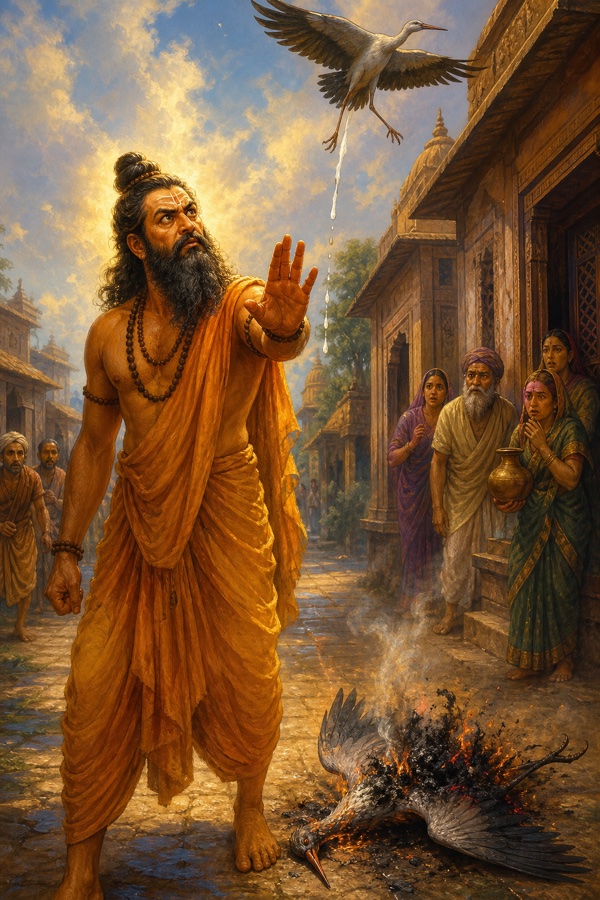
“There was once a virtuous ascetic named Kaushika, a Brahmin rich in austerity and devoted to the study of the Vedas, a very superior Brahmin who had studied all the Vedas with their Angas and the Upanishads. One day he was reciting the Vedas at the foot of a tree, and a she-crane sat on the top of that tree, and the crane fouled the Brahmin’s body. He looked up at her in fury, with the thought of doing her an injury, and as his angry glance fell on her she dropped out of the tree to the ground and lay there dead. The Brahmin saw her fall, and saw that there was no life in her, and pity took hold of him, and he began to grieve over the dead crane. ‘I have done a bad deed,’ he said, ‘driven by anger and malice.’”
“He said it over and over. Then, because the day had to go on, that learned Brahmin went into a village to beg his food, going from house to house among people of good family, and he came to a house he already knew, and at the door he said, ‘Give.’ A woman’s voice answered from inside, ‘Stay.’ The housewife was cleaning the vessel from which alms are given when her husband came suddenly into the house, worn down with hunger. The chaste housewife saw her lord, and she set the Brahmin out of her mind. She gave her husband water to wash his feet and his face, and a seat, and she put savory food and drink before him and stood humbly beside him, that black-eyed woman, ready for whatever he wanted. That was how she lived every day: she ate what was left on her husband’s plate, she shaped her conduct to his wishes, her whole heart leaned toward him, and along with that she kept the worship of the gods, looked after guests and servants and her husband’s parents, and was skilled in everything a household asks. She was still waiting on her lord when she caught sight of the Brahmin standing there for his alms, and she remembered that she had told him to wait, and she was ashamed. She took something for alms and went out to give it to him, and when she came before him the Brahmin said, ‘Best of women, blessed one, I am surprised at your conduct. You asked me to wait; you said “Stay”; and then you did not send me on my way.’”
“The Brahmin stood there blazing with wrath and with his own energy, and the chaste woman set about calming him. ‘Learned one, forgive me. My husband is my supreme god. He came home hungry and tired, and I was serving him.’ The Brahmin said, ‘So with you Brahmins do not come first? You set your husband above them? A householder, and you slight Brahmins? Indra himself bows down to them; what are men on earth beside that? Proud woman, do you not know, have you never heard, that Brahmins are like fire and can consume the whole earth?’ The woman answered him, ‘I am no she-crane. Cast off this anger of yours, rich as you are in austerity. Standing there as you are, what can you do to me with those angry looks? I do not slight Brahmins. In the energy of their souls they are like the gods themselves. Only forgive me this one fault, sinless one.’”
“She went on. ‘I know the energy and the high dignity of Brahmins who possess wisdom. The waters of the ocean were made salt and undrinkable by the wrath of Brahmins. I know the energy of munis whose souls are under complete control and who blaze with ascetic merit: the fire of their anger has not gone out in the forest of Dandaka to this day. It was for slighting Brahmins that the great Asura Vatapi, wicked and evil-minded, was digested when he came up against Agastya. We have heard how great the powers and the merits of high-souled Brahmins are. And as the twice-born are great in wrath, they are just as great in forgiveness, so forgive me this offense of mine. My heart leans toward the merit that springs from serving my husband, for I hold my husband to be the highest of all the gods, and the virtue I practice is the service of the one I count the highest deity. See what the merit of serving one’s husband can do: I know that you burned a she-crane with your anger. The anger a man nurses is the greatest enemy that man has. The gods know a man for a Brahmin who has cast off anger and passion; who always speaks the truth in this world; who always pleases his teacher; who, injured himself, never returns the injury; who has his senses under control and is virtuous and pure and devoted to the study of the Vedas, master of his anger and his lust; who knows dharma and has energy of mind, whose religion is wide and who looks on all as equal to himself; who studies and teaches, who sacrifices and officiates at the sacrifices of others, and who gives to the best of his means; who is liberal of soul, keeps the vow of brahmacharya, and is devoted to his studies, watchful over the Vedas. Whatever makes for the happiness of Brahmins is recited before such men. Their hearts, delighting in truth, never find joy in untruth. The study of the Vedas, tranquility of soul, simplicity of conduct, and restraint of the senses: these have been called the eternal duties of the Brahmin. Those who know dharma have said that truth and honesty are the highest virtue. Dharma that is eternal is hard to understand; whatever it is, it rests on truth. The ancients declared that dharma depends on sruti, and dharma as sruti sets it out is of many kinds, and therefore too subtle to grasp.’”
“‘You are versed in dharma, holy one, pure, and devoted to the study of the Vedas, and yet I think you do not know what dharma really is. If you truly do not know what the highest dharma is, go to the city of Mithila and ask a virtuous fowler who lives there. In Mithila there is a fowler who is truthful, who is devoted to the service of his parents, and who has his senses under complete control, and he will discourse to you on dharma. Blessings on you; go there if you like. And forgive me, faultless one, if what I have said is hard to hear, for those who want to acquire dharma cannot bring themselves to injure a woman.’ At the chaste woman’s words the Brahmin answered, ‘I am gratified with you, and blessings on you; my anger has passed, beautiful one. The reproofs you have given me will be of the highest advantage to me. I will go now, and do what will be so much to my benefit.’ Dismissed by her, Kaushika, that best of the twice-born, left her house and went back to his own hermitage, reproaching himself the whole way.”
“Kaushika could not stop thinking about that wonderful discourse of the woman’s. He went on reproaching himself; he looked like a man who has done something wrong; and meditating on the subtle ways of dharma, he said to himself, ‘I should take what that lady said with reverence, and I should go to Mithila. Without any doubt there lives in that city a fowler whose soul is under complete control and who knows the mysteries of dharma through and through. I will go this very day to that man rich in austerity and ask him about dharma.’ Her knowledge of the she-crane’s death and the excellent things she had said about dharma had settled his faith in her, and so, reflecting on all she had said and full of curiosity, he set out for Mithila. He crossed many forests and villages and towns, and at last he reached Mithila, which Janaka ruled, and saw the city hung with the flags of many creeds, resounding with the noise of sacrifices and festivities, furnished with splendid gateways. It abounded in palaces, it was protected on every side by walls, it had many splendid buildings to boast of; the streets and the roads were many and well laid out, and many of them were lined with shops, and the town was full of horses and chariots and elephants and warriors, and its citizens were all in health and joy and always at some festivity. The Brahmin saw a great deal else there as he went in. Then he asked after the virtuous fowler, and some of the twice-born answered him, and going to the place they pointed out, he saw the fowler seated in a butcher’s yard, selling venison and buffalo meat, with so large a crowd of buyers gathered around him that Kaushika stopped and stood at a distance.”
The gist: Kaushika, a Brahmin rich in austerity, burns a she-crane out of the tree with a glance of anger, and the same day a housewife who knows about the crane without being told keeps him waiting at her door while she serves her hungry husband. When he threatens her with a Brahmin’s fire she answers him with the fire’s own history, the ocean made salt, the Dandaka forest still burning, Vatapi digested by Agastya, and then names anger as a man’s greatest enemy and lists what the gods look for in a Brahmin. Her own dharma, she tells him, is the service of her husband, and for the dharma he does not yet know she sends him to a fowler in Mithila who sells meat for a living. He goes.
Source: the Mahabharata of Krishna-Dwaipayana Vyasa, Vana Parva, Sections 161 to 270. This first part carries Sections 161 to 206, from Kubera’s farewell on Gandhamadana to Kaushika’s arrival in Mithila. The Sanskrit e-text, the Gita Press Hindi edition, and Kisari Mohan Ganguli’s complete English translation were used to verify names, sequence, and principal events. Where the recensions differ, this English retelling follows Ganguli, and the Hindi edition follows Gita Press.
Based on: The Mahabharata, Vyasa (K. M. Ganguli’s English translation; Gita Press, Gorakhpur)