On this page
This is a story of the house of Kuru, set in the woods of Kamyaka, where the five Pandavas and Draupadi sat together on a clean, lonely stretch of grass, sunk in grief. Arjuna had gone to the world of Indra to obtain celestial weapons, and his absence closed every throat. In that hour Bhima said to Yudhishthira that the hero on whom all their lives depended had gone away at Yudhishthira’s own command, and that it was Yudhishthira’s addiction to dice that had brought them all to this ruin. Bhima said, too, that to answer fraud with fraud is not counted a sin, and that if given leave he would go that very day to Hastinapura and burn Duryodhana to ash. Yudhishthira smelled the crown of his brother’s head to calm him, and said that untruth was not in him. Into the middle of this exchange walked the great sage Brihadaswa, and Yudhishthira honored him with the offering of madhuparka and then, in an accent of deep sorrow, laid open his pain: was there any king on this earth more luckless than he. Brihadaswa smiled and said he would tell of a king who had suffered far more than Yudhishthira, and who had lost everything and then recovered everything. This is the tale of Nala and Damayanti, spoken to console the exiled Yudhishthira, defeated at dice.
Brihadaswa arrives and the tale begins
Brihadaswa said he would tell of a king even less fortunate than Yudhishthira. In the country of the Nishadhas there was a celebrated king named Virasena, whose son was called Nala, learned in both virtue and wealth. Nala was defeated by fraud at dice by Pushkara, and, fallen into calamity, went to live in the forest with his wife. In that time he had no servants, no chariot, no brother, no friend. Brihadaswa told Yudhishthira that he was surrounded by brothers heroic as the gods and by Brahmanas great as Brahma, and so it did not become him to grieve so deeply. Yudhishthira asked to hear the tale in full, and Brihadaswa began.
Nala was strong, handsome, and expert in the lore of horses. He stood at the head of all kings and blazed in his splendor like the sun. He was the king of the Nishadhas, a friend to Brahmanas, learned in the Vedas, and brave. He spoke the truth, he loved the game of dice, and he was master of a vast army. In the country of Vidarbha, meanwhile, there was a king named Bhima, mighty and possessed of every virtue, yet childless. Longing for offspring, he served with devotion, together with his queen, a Brahmana sage named Damana. Pleased, the sage Damana granted him a daughter like a jewel and three excellent sons. They were named, in turn, Damayanti, and Dama, Danta, and Damana. Damayanti became famous throughout the world for her beauty, her renown, and her good fortune. Such loveliness had never been seen or heard of among gods, among yakshas, or among mortals.
A key to reading this (lineage): Nishadha and Vidarbha are two separate kingdoms. Nala is the son of Virasena, king of the Nishadhas; Damayanti is the daughter of Bhima. Note that this Bhima is the king of Vidarbha, and not the Pandava Bhima. Pushkara is Nala’s brother, who will later win away Nala’s kingdom at dice.
Nala and Damayanti heard each other’s virtues praised again and again, and a love arose between them before they had ever met. One day Nala, seeing swans with wings of gold moving in his garden, caught one of them. The swan spoke in human speech and said, “O king, do not kill us. We will do you a good turn, and speak of you before Damayanti in such a way that she will never desire any other man for her husband.” Nala released the swan, and the flock flew off to the country of Vidarbha and alighted before Damayanti. The swan she chased led her to a private spot and said that among the Nishadhas there was a king named Nala, in beauty like the twin Aswins, without an equal among men. If she were to become his wife, her beauty and her life would find their purpose. Damayanti answered that the swan should say the same to Nala. The swan returned to the Nishadhas and told Nala everything.
The gist: Seeing Yudhishthira’s grief, Brihadaswa begins the tale of Nala. Nala, king of the Nishadhas, and Damayanti fell in love with each other’s virtues before they had ever met, and a swan with wings of gold became the go-between of that love.
The svayamvara is announced, and the gods set out
The words of the swan left Damayanti restless with longing for Nala. She sighed again and again, grew pale and listless, and wept day and night. Seeing her condition, her handmaids conveyed her distress to King Bhima through hints. Bhima understood that his daughter had come of age, and he resolved to hold Damayanti’s svayamvara. He sent invitations to every king on earth, and the kings came to Vidarbha with their elephants, horses, and armies. Bhima received them all with fitting honor.
Meanwhile the celestial sages Narada and Parvata, in the course of their wanderings, arrived in the world of Indra. Indra honored them and asked after their welfare. In conversation Indra asked why he no longer saw those heroic Kshatriya kings who once fought in battle without a thought for their lives and so attained heaven. Narada answered that the svayamvara of Damayanti king of Vidarbha, was about to be held, and that all the kings of the world were journeying there. Hearing this, the guardians of the world, together with Agni, said that they too would go. And so Indra, Agni, Varuna, and Yama, these four guardians of the world, mounted their vehicles and set out for Vidarbha.
A key to reading this (a concept): The Lokapalas are the gods who guard the directions and the world. Here there are four of them: Indra (king of the gods), Agni (the fire god), Varuna (lord of the waters), and Yama (god of death). All four desire Damayanti for themselves, and from this rises the extraordinary contest between god and mortal that runs through the tale.
On the way the gods saw Nala walking upon the earth, his beauty like that of the god of love himself. Amazed by his splendor, the guardians of the world left their chariots in the sky, came down to Nala, and said, “You are devoted to truth. Help us, and become our messenger.” Nala gave his word without knowing what it entailed, then folded his hands and asked who they were and what he must do. Indra named himself and the others, and said the four of them had come for Damayanti, and that Nala must carry to her their message: that she should choose one of the four as her husband. Nala folded his hands and said that he had come for that very purpose himself, and that a man who is himself in the grip of love can hardly plead another’s suit to a woman, and so he asked to be released from the task. But the gods said that, having given his word, he could not now draw back. Nala asked how he would enter the well-guarded inner chambers, and Indra assured him that he would find his way in.
By the power of the gods, Nala entered Damayanti’s palace unseen. There he beheld Damayanti, surrounded by her maids, her radiance dimming even the light of the moon. Nala’s love swelled, yet to guard his truth he held his mind in check. Damayanti smiled and asked who he was, and how he had entered her guarded chambers unseen. Nala gave his name and said that he had come as the messenger of the gods, Indra, Agni, Varuna, and Yama, who desired her, and that she should choose one of them.
The gist: Bhima announced Damayanti’s svayamvara. Indra, Agni, Varuna, and Yama, the four guardians of the world, also came for Damayanti, and they made Nala their messenger. Bound by his word, Nala carried the gods’ suit to Damayanti against his own love. Here is the first moral knot of the tale: the lover himself had to plead the case of his rivals.
Damayanti’s choice, and the boons of the gods
Damayanti bowed to the gods and, smiling, told Nala that she loved him alone, and that all she had was his. She said the voice of the swans was burning her, and it was for his sake that she had gathered so many kings. If Nala forsook her, she would turn to poison, fire, water, or the rope. But Nala said that when the guardians of the world themselves were present, how could she choose a mortal; she should turn her heart to those gods, to the dust of whose feet he was not even equal. A mortal who displeases the gods meets death, he said, and so she should choose those gods.
With her eyes filling with tears, Damayanti answered that she bowed to all the gods and yet chose Nala alone for her husband, and that this was the truth. Then she offered a blameless path: that Nala come to the svayamvara together with Indra and all the gods, and there, in the presence of the guardians of the world, she would choose him, so that no blame should fall on him. Nala returned and told the gods everything.
At the appointed sacred hour, King Bhima summoned the kings to the svayamvara. Into that hall, bright with golden pillars and a lofty portal arch, the kings entered like lions. Then Damayanti entered the assembly and stole the eyes and hearts of all. When the names of the kings were proclaimed, Damayanti saw five men alike in form, and could not tell which of them was Nala. The four gods had taken on Nala’s very shape. Troubled, she asked herself how she was to tell the gods apart from King Nala.
Then Damayanti folded her hands and, trembling, took refuge in the gods themselves, saying that from the moment she had heard the voice of the swans she had chosen Nala for her husband; by the strength of that truth, she prayed, let the gods reveal Nala. She begged the guardians of the world to take on their true forms so that she might know the righteous king. Seeing her firm devotion and the purity of her love for Nala, the gods revealed their marks. Then Damayanti saw that the gods stood free of sweat, without blinking, their garlands unfading, their bodies untouched by dust, their feet not touching the ground; while Nala had a shadow, his garlands were a little wilted, he was stained with dust and sweat, and he stood upon the earth with blinking eyes. Having told the gods apart from Nala, Damayanti, true to her word, chose Nala, and bashfully caught the hem of his garment and placed a floral wreath about his neck.
A key to reading this (a concept): The traditional marks by which a god is known are these: no sweat, no blinking of the eyes, an unfading garland, a body untouched by dust, and feet that do not touch the ground. A mortal is the opposite in every case. By these very differences Damayanti recognized Nala. This is the tender turning point of the tale, where the imperfect form of the mortal became the proof of his truth.
The moment Damayanti chose a mortal before the gods, the kings cried out in dismay, but the gods and the great sages praised Nala with cries of “Excellent! Excellent!” Nala, delighted, assured Damayanti that as long as life remained in his body, he would be hers alone. Pleased, the guardians of the world granted Nala eight boons. Indra granted that Nala would behold his godship at sacrifices and attain to blessed regions. Agni granted his own presence whenever Nala wished, and regions bright as himself. Yama granted subtle taste in food and pre-eminence in virtue. Varuna granted his presence at will and garlands of celestial fragrance. Thus each gave two boons, and the gods returned to heaven. Bhima celebrated the wedding of Nala and Damayanti. Nala returned to his own city and ruled in happiness, performing many sacrifices, among them the horse sacrifice. By Damayanti he had a son named Indrasena and a daughter named Indrasena.
The gist: Damayanti chose Nala even before the gods, recognizing him by the marks of a mortal. The four guardians of the world, well pleased, granted Nala eight boons. After the wedding Nala ruled in happiness and had two children. The gods accepted a mortal’s love and truth, yet from this very decision a new enmity was about to be born.
Kali’s grudge and the fraud at dice
As the guardians of the world were returning from the svayamvara, they met Kali on the road, coming with Dwapara. Indra asked where he was going, and Kali said he was going to Damayanti’s svayamvara to win her, for his heart was set on her. Indra smiled and said the svayamvara was already over, and that before their very eyes Damayanti had chosen Nala. Kali filled with rage and said that since she had chosen a mortal in the presence of the gods, she deserved a heavy doom. The gods answered that Damayanti had chosen Nala with their sanction, and that Nala was rich in every virtue; he was learned in the four Vedas, truthful, gentle to all creatures, and firm in his vows; the fool who sought to curse such a Nala would only curse himself and sink into the deep pit of hell. So saying, the gods went to heaven.
When the gods had gone, Kali told Dwapara that he could not hold back his anger; he would possess Nala, strip him of his kingdom, and Dwapara should help him by entering the dice. Having made this compact, Kali came to the country of the Nishadhas and dwelt there a long time, watching for a flaw. In the twelfth year he found one. One day, after answering the call of nature, Nala touched water and said his twilight prayers without first washing his feet, and through this lapse Kali entered his body.
A sub-tale: The tale makes clear here that Nala’s fall came from no sin of his. It came from a small opening seized by a Kali who had waited twelve years, a single moment of incomplete purification. The Mahabharata does not hide that the root cause of the disaster that struck Nala was the entry of an outside power rather than a fault of his own; and yet it also does not claim that Nala is wholly blameless, for his weakness for dice was there in him already.
Possessed by Kali, Nala’s mind sank into the game of dice. Kali went to Pushkara and told him to gamble with Nala, for with his help Pushkara would surely win and take the Nishadha kingdom. Dwapara too took his place as the chief die, called Vrisha. Pushkara challenged Nala to dice again and again, and when the challenge was made before Damayanti, the high-hearted Nala could not decline for long. Possessed by Kali, Nala began to lose his gold, his silver, his chariot, his horses, and his robes. No friend could restrain him, maddened as he was at the play. The citizens and councillors came to hold the king back, and the charioteer told Damayanti of it, but Nala, possessed by Kali, gave no answer to a single word of his queen. Thus for many months Nala and Pushkara gambled on, and Nala lost without cease.
The gist: Damayanti’s choosing of a mortal before the gods enraged Kali. After waiting twelve years, Kali seized on a small religious lapse of Nala’s to enter his body, and, joining with Pushkara and Dwapara, defeated Nala at dice. Here is an echo of Yudhishthira’s own story: the dice, the fraud, and the ruin of a kingdom.
Damayanti’s foresight, and the saving of the children
Seeing the king maddened at dice and heedless of his own loss, Damayanti grew afraid. She understood that he had lost everything. She called her trusted nurse Brihatsena and asked her to summon the councillors in Nala’s name and to tell them what had been lost and what remained. The councillors came, but the king paid no heed to Damayanti’s words. Ashamed, Damayanti returned to her chambers.
Then Damayanti had Brihatsena summon the charioteer Varshneya. In gentle words she told him that the king was in danger and that he should help; the more Nala lost to Pushkara, the greater grew his frenzy for the game, and he would listen to no one, not even to her. She told him to yoke Nala’s swift and beloved horses to the chariot and take their two children, Indrasena and Indrasena, to Kundina, the capital of Vidarbha, and leave them with her kin, then to stay there or go wherever he wished. Varshneya spoke of this to the king’s chief officers, and with their assent took the children by chariot to Vidarbha. Leaving the children, the chariot, and the horses there, and grieving for Nala, Varshneya made his way to Ayodhya and entered the service of King Rituparna as a charioteer.
A key to reading this (places): Kundina is the capital of Vidarbha, Damayanti’s childhood home. Ayodhya is the capital of the country of Kosala, where King Rituparna rules, and he will play a decisive part later in the tale. Varshneya’s going to Ayodhya is no accident but a thread of the story, for Nala too will arrive there.
After Varshneya had gone, Pushkara won Nala’s kingdom and all his remaining wealth. Laughing, Pushkara said that only Damayanti was left to stake, and that Nala might wager her if he wished. At this Nala’s heart nearly burst with rage, yet he spoke not a word. He took off every ornament from his body, and, wearing a single piece of cloth, his body all but bare, renounced all his wealth and left the city. Damayanti, clad in one garment, followed him. Pushkara proclaimed that whoever showed Nala any hospitality would be put to death, and so Nala lived three nights outside the city on water alone.
Tormented by hunger, Nala went in search of fruit and roots, Damayanti following behind. Then Nala saw some birds with plumage of golden hue and thought they would be his food and his wealth that day. He tried to cover them with his one garment, but the birds rose into the sky, bearing off the very cloth. Standing naked and forlorn, Nala heard them say that they were the dice, come so that he could not depart even with that last garment on. Stripped of his cloth, Nala pointed out to Damayanti again and again the roads to the southern country, to Vidarbha, and to Kosala. Drowned in tears, Damayanti said she could never leave Nala alone in such a state, for in every sorrow there is no better medicine than a wife. Nala said he did not wish to forsake her; he could forsake himself, he said, but not her. Then Damayanti said that if his mind was troubled they should both go together to Vidarbha, where her father would honor Nala. But Nala said that though that kingdom was as his own, he would not go there in this ruin, having once come there in glory.
The gist: With foresight Damayanti sent both children safely to Vidarbha. Pushkara won Nala’s whole kingdom and wealth; Nala left the city in a single garment, Damayanti with him, and the dice, come in the form of birds, carried off that last cloth. Nala’s pride keeps him from taking shelter in his father-in-law’s house.
Nala abandons Damayanti
Wrapped in a single garment between them, worn by hunger and thirst, the two wandered until they came to a shed for travelers. There Nala sat down upon the earth and, exhausted, lay down with Damayanti on the bare ground. Damayanti fell into deep sleep, but Nala’s mind was troubled and sleep would not come. Turning over the loss of his kingdom, the desertion of his friends, and the pain of the forest, he asked himself whether death was the better course, or the forsaking of his wife. He thought that if she were parted from him she might return to her kin, and that with him she would find only certain sorrow. His mind, worked upon by Kali, settled on abandoning Damayanti. She was blessed and full of energy, he thought, and no one on the road could do her harm.
Then, thinking of his own nakedness and of Damayanti’s single garment, he resolved to cut away half of it. Pacing the shed, he found a fine sword lying unsheathed, and with it he cut away half the cloth, threw the sword aside, and left the sleeping Damayanti. But his heart failed him and he came back; seeing her, he wept aloud. Again and again he went and returned; Kali dragged him away and love drew him back, as though his heart were being torn in two. At last, his reason overpowered by the touch of Kali, Nala left his sleeping wife in that lonely forest and went away.
A sub-tale: The tale neither hides Nala’s act nor simplifies it. It says plainly that Nala’s heart was full of love, and that a reason overpowered by Kali drove him to this terrible deed. Here the Mahabharata shows the fine line between a person’s moral weakness and an outside influence; Nala is at once an offender and a victim, and this is what makes his story so moving.
After Nala had gone, Damayanti woke and, not finding her husband, shrieked in terror. She cried out, “O king, how have you left your wife asleep in this lonely forest, you who gave your word before the guardians of the world?” She said she did not weep for herself; her lament was for the thought of how Nala would pass his days alone. Overcome with grief, she wandered here and there through the forest. Just then a huge and hungry serpent caught her in its coils. Even so, trapped, her weeping was still for Nala, never for herself. Hearing her cries, a hunter came and cut off the serpent’s head with his sharp weapon, and set Damayanti free.
The hunter sprinkled her with water and comforted her, and asked her story. But seeing that beautiful woman clad in half a garment, he was seized by desire and tried to force himself upon her. Damayanti, already broken by the loss of her husband and her kingdom, blazed up in anger and cursed him: since she had never even thought of anyone but Nala, let this base-minded hunter fall down lifeless. The moment she spoke, the hunter fell to the ground and died, like a tree consumed by fire.
The gist: His reason overpowered by Kali, torn between love and helplessness, Nala cut away half of Damayanti’s garment and left her sleeping. Waking, Damayanti lamented for Nala, never for herself. A hunter saved her from a serpent, but when he turned to lust, the fire of her chastity burned him with a curse.
Damayanti’s forest lament, and the grove of ascetics
Having slain the hunter, Damayanti went on through that fearful forest full of lions and tigers. She saw many mountains, rivers, trees, and creatures of every kind. Grieving for her husband, she sat upon a rock and lamented, crying out to the king of the Nishadhas, asking where he had gone, leaving her in this lonely wood. She prayed to the lion, the king of the forest, and then to a lofty mountain, to give her news of Nala. Naming herself the daughter of Bhima of Vidarbha and the wife of Nala of the Nishadhas, she asked again and again whether anyone had seen Nala. Getting no answer from the mountain, she set out toward the north.
After three days and nights she came to a matchless hermitage of ascetics, lovely as a grove of heaven. There ascetics like Vasishtha, Bhrigu, and Atri practiced their austerities, subsisting on water, on air, and on fallen leaves. Damayanti bowed to them, and the ascetics welcomed her and asked who she was, whether she was the goddess of the forest, of the mountain, or of the river. Damayanti said she was a mortal woman, the daughter of Bhima of Vidarbha and the wife of Nala of the Nishadhas, and told her whole story, including how her husband had been called to dice by cunning, base-minded men and stripped of his kingdom and his wealth.
To the lamenting Damayanti the truthful ascetics answered that by the power of their austerities they saw that the future would bring her happiness, and that she would soon behold Nala, freed of all sin, adorned with every jewel, ruling that same city, striking terror into his enemies and gladdening his friends. As they spoke, the ascetics, with their sacrificial fires and their whole hermitage, vanished from sight. Struck by this great wonder, Damayanti stood amazed, and wondered whether it had been a dream. Then she went on, and, seeing an Asoka tree, she said, “O Asoka, make your name true (for Asoka means the destroyer of grief), and free me from grief by giving me news of Nala.” Circling the tree three times, she pressed deeper into the forest.
A key to reading this (a concept): The word “Asoka” means “Free of grief” or “Destroyer of grief” (a + soka). Damayanti prays to the Asoka tree to live up to its name and take away her sorrow. This meaningful play on names is common in Sanskrit literature and deepens the feeling of the tale.
Farther on, Damayanti met a caravan of merchants, halted with their horses and elephants on a riverbank. Seeing her, soiled and dust-covered in half a garment, some fled in fear, and some took her for a goddess or a yakshi. Suchi, the leader of the merchants, said he had seen no man named Nala, and that the caravan was bound for the city of Subahu, the truthful king of the Chedis, for the sake of profit. Damayanti went along with the caravan in search of her husband.
One night, as the caravan slept on the bank of a lotus lake, a herd of wild elephants came there and, seeing the tame elephants of the caravan, fell upon them in a frenzy. In that assault many men, camels, and horses were killed, and in the stampede people trampled one another to death. The survivors laid the blame for the disaster on that maniac-like woman, on Damayanti, and, calling her a rakshasi or a yakshi, made ready to kill her. In fear and shame Damayanti fled into the forest, cursing her fate and wondering what sin of a past life had brought this on. With the surviving Brahmanas learned in the Vedas she came at last to the city of Subahu, king of the Chedis.
The gist: Wandering the forest, Damayanti received at the ascetics’ grove an assurance of reunion with Nala, but the grove vanished. Traveling with a merchant caravan, she survived an elephant attack that brought great destruction, for which she was blamed. At last she reached the city of Subahu, king of the Chedis.
Damayanti in the Chedi city, and Nala’s transformation by Karkotaka
Soiled and maniac-like, Damayanti was followed through the city by a crowd of children. From a palace window the queen-mother saw her and, amazed at her beauty, sent her nurse to bring her in. Damayanti gave herself out as a sairandhri, a well-born attendant, and said that her husband had lost everything at dice and gone to the forest, and that one day he had cut away half her garment as she slept and left her. She set certain conditions before the queen-mother: that she would not eat any leavings, would wash no one’s feet, and would speak with no strange man; that anyone who sought her should be punished, and one who pressed his suit should be put to death. Pleased, the queen-mother accepted every condition and made Damayanti the companion of her daughter Sunanda. Damayanti lived there in honor as a sairandhri.
A key to reading this (a concept): A “Sairandhri” is a well-born attendant who lives in a royal household as an honored servant without being a slave. Hiding her identity, Damayanti lives in this role in the Chedi city, much as Draupadi will later live as a sairandhri in the city of Virata during the year in hiding.
After leaving Damayanti, Nala had seen a raging forest fire in the woods. From the heart of the fire a voice called out, “O Nala, come here.” Saying “Fear not,” Nala went into the fire and saw a great serpent lying in coils. The serpent said that he was Karkotaka, who had deceived the great sage Narada and by his curse had been made immobile; the curse was that he would lie there until Nala carried him away, and wherever Nala set him down, there he would be freed of the curse. The serpent begged Nala to lift him up, saying he would become as small as a thumb and would do Nala good. Nala carried him out of the fire.
Reaching open ground, Karkotaka told Nala to walk on, counting a few steps, and that meanwhile he would do him a great service. As Nala counted his steps, at the tenth step the serpent bit him, and at once Nala’s form changed. Karkotaka took on his own true shape and explained that he had changed Nala’s form so that people would not know him; and that Kali, who had deceived Nala, would now dwell in Nala’s body tormented by the serpent’s venom. The serpent granted that Nala would fear neither beasts nor enemies, would feel no pain from the venom, and would be ever victorious in battle.
Karkotaka told Nala to go to Ayodhya and present himself to King Rituparna, skilled at dice, as “A charioteer named Bahuka.” That king would give him the science of dice in exchange for the lore of horses, and once Nala was expert at dice he would regain his prosperity, his wife, his children, and his kingdom. The serpent said, too, that whenever Nala wished to see his true form, he should think of him and put on a celestial garment, and his own form would return. Saying this and giving Nala two celestial garments, Karkotaka vanished.
The gist: Damayanti came to live in honor as a sairandhri in the Chedi city. Meanwhile the serpent Karkotaka bit Nala and changed his form so that he could not be known, and left Kali tormented by venom within him. The serpent showed Nala the way to Ayodhya, to serve Rituparna under the name of Bahuka and to gain the science of dice.
Nala as Bahuka, and the search for Damayanti
After the serpent vanished, Nala reached Ayodhya on the tenth day and told King Rituparna that his name was Bahuka, that he had no equal in the lore of horses, and that he was skilled also in cooking. Rituparna made him superintendent of his stables at a salary of 10,000 coins, and placed Varshneya and Jivala under him. Nala lived there in honor as Bahuka, but every evening, remembering Damayanti, he would recite a verse asking where that helpless woman, worn by hunger and thirst, could now be, and in whose care. One night Jivala asked whom he mourned, and Nala told his own sorrow as the story of an unknown man, of a fool who had forsaken his celebrated wife and now burned in remorse.
Meanwhile Bhima gave Brahmanas great wealth and sent them in every direction to search for Nala and Damayanti. One of them, a Brahmana named Sudeva, reached the Chedi city and recognized Damayanti, soiled and thin, seated with Sunanda in the palace. Between her eyebrows there was a birthmark, a mole, hidden under dust. Sudeva went to Damayanti and named himself a friend of her brother, and told her that her parents, her brother, and both her children were well, and that hundreds of Brahmanas were roaming the world in search of her. Recognizing Sudeva, Damayanti wept.
Seeing this, Sunanda told the queen-mother, who asked Sudeva for Damayanti’s story. Sudeva told her everything, and spoke of the mole between her eyebrows. Sunanda washed away the dust and revealed the mole, which shone out like the moon emerging from clouds. Then the queen-mother said, weeping, that by this mole she knew Damayanti to be her sister’s daughter; she and Damayanti’s mother were both daughters of Sudaman, king of the Dasarnas. Learning this, Damayanti bowed to her aunt, but asked leave to return to Vidarbha, to her children. The queen-mother gave her a fine litter, guards, and every provision, and sent her to Vidarbha, where her kin received her with honor.
A key to reading this (a concept): The birthmark between her eyebrows is Damayanti’s mark of recognition, set there by the Creator as a sign of good fortune. In the tale this mole is the key by which the queen-mother knows her as her sister’s daughter, an unexpected revealing of a blood tie.
Back in Vidarbha, Damayanti told her mother that if she wished her to live, she should try to find Nala. The mother told King Bhima, and he again sent Brahmanas in every direction. Damayanti had them repeat a special message in every assembly: “O beloved gambler, where have you gone, cutting away half my garment and forsaking your devoted and sleeping wife? At your command she waits for you in half a garment, burning with grief.” She asked that whoever answered these words be marked, and his name and dwelling learned, before they returned.
The gist: As Bahuka, Nala served Rituparna in Ayodhya and kept remembering Damayanti. Sudeva recognized Damayanti in the Chedi city by her mole, and she returned to Vidarbha. Then Damayanti spread a piercing message through the Brahmanas in every direction, one that only Nala could answer.
Parnada’s message, and the ruse of the second svayamvara
After a long time a Brahmana named Parnada returned to Vidarbha and told Damayanti that he had spoken those words before Rituparna in Ayodhya, but that neither the king nor his courtiers had answered; only a charioteer named Bahuka, short-armed and unsightly yet skilled at driving and cooking, had answered, sighing and weeping, that chaste women protect themselves even in calamity and do not grow angry, for the man who had forsaken her was overwhelmed by misfortune and stripped of every joy; a devoted wife should not be angry with one whose garment the birds had carried off while he searched for food, a man consumed by grief. Hearing this, Parnada had hurried back.
From these words Damayanti guessed that Bahuka was Nala. She told her mother in private that King Bhima must not learn her purpose, and that Sudeva should be sent to Ayodhya. She had Sudeva tell Rituparna that Damayanti was about to hold a second svayamvara, and that after sunrise the next day she would choose a second husband, since she did not know whether Nala was alive; so, if it were possible, let Rituparna come at once. With this word Sudeva went to Ayodhya.
A sub-tale: This second svayamvara is no true one but a clever device of Damayanti’s. She knows that only Nala could cross a hundred yojanas in a single day, for his lore of horses is without equal. This svayamvara is in truth a test: if Rituparna were to arrive in a single day, his charioteer would surely be Nala. This shrewdness of Damayanti’s is the decisive turn of the tale.
Hearing Sudeva’s message, Rituparna told Bahuka gently that he was skilled at training horses, and that if it were possible he wished to reach Damayanti’s svayamvara in a single day. At this Nala’s heart nearly broke with grief. He thought that perhaps Damayanti, driven by sorrow, was doing this, or that it was some device meant for him. He wondered whether a devoted wife and mother would truly do such a thing; to learn the truth, it was best to go. With folded hands, Bahuka accepted Rituparna’s command.
Nala went to the stables and chose horses that were lean yet strong, marked with good signs, born in the country of Sindhu, and swift as the wind. Rituparna said with some annoyance that such weak horses could never make so long a journey, but Bahuka showed by their whorls and marks that they were the finest. Nala yoked four excellent horses to the chariot. As Nala mounted, the horses sank to their knees on the ground. Then Nala soothed them, raised them by the reins, seated Varshneya on the chariot, and the horses rose into the sky with the speed of the wind. Watching his skill, Varshneya was amazed, and thought that this Bahuka might well be Nala himself, for his knowledge of horses was Nala’s, and the two were of the same age; but he told himself that great men in misfortune roam the earth in changed forms.
A key to reading this (numbers in modern terms): The “Yojana” is an ancient unit of distance, reckoned at roughly 8 to 13 kilometers. “A hundred yojanas in a day” thus means a journey of some 800 to 1,300 kilometers, possible only by Nala’s divine lore of horses. This nearly impossible speed is the ground of Damayanti’s test.
The gist: Through Parnada, Damayanti learned that Bahuka was Nala. She devised the ruse of a false second svayamvara, for only Nala could travel a hundred yojanas in a day. Rituparna set out from Ayodhya toward Vidarbha with Bahuka as his charioteer, and Bahuka’s skill with horses stirred suspicion in Varshneya’s mind.
The exchange of dice-lore, and the departure of Kali
Crossing rivers, mountains, and forests like a bird, they went on until Rituparna’s upper garment slipped and fell to the ground. He told Nala to hold the horses so that Varshneya could fetch it, but Nala said they had come a yojana past it, and it could not be recovered. Then Rituparna, seeing a vibhitaka tree laden with fruit, told Bahuka that he was highly skilled at calculation; the two branches of that tree bore 50 million leaves and 2,095 fruits, and the leaves and fruit fallen on the ground were 101 more than those on the tree.
Bahuka said he would test it by direct proof, and, stopping the chariot, he cut down the vibhitaka. When he counted, he was amazed to find the number just as the king had said. He asked to learn the science. Rituparna said that along with his knowledge of numbers he was skilled also at dice. Bahuka begged the king to give him this science and to take in exchange his lore of horses. Rituparna, seeing the value of Bahuka’s goodwill and of his lore of horses, agreed and gave Nala the science of dice, saying that the lore of horses should remain with Bahuka in trust.
The moment Nala gained the science of dice, Kali came out of his body, vomiting the fierce venom of Karkotaka from his mouth. Long tormented by Damayanti’s curse, Kali, as he came out, was freed at last from the fire of that curse. Nala wished to curse Kali in his wrath, but the frightened Kali said, with folded hands, that he should hold his anger; the mother of Indrasena, Damayanti, had cursed him when Nala forsook her, and ever since Kali had dwelt within Nala’s body, burning with the serpent’s venom. Kali said that if Nala did not curse him, then those who listened to Nala’s story with devotion would be free of fear from him. Hearing this, Nala restrained his wrath, and the frightened Kali entered the vibhitaka tree. From that moment the vibhitaka fell into disrepute. Freed of the touch of Kali, Nala rejoiced and pressed on toward Vidarbha, though he had not yet taken back his true form.
A key to reading this (a concept): The “Science of dice” is the deep knowledge of the game, the very lore for want of which Nala had lost. Note that Nala’s deliverance comes through knowledge rather than through war; the lore whose absence brought him down is the lore whose gaining lifts him up. At the end of the tale, Brihadaswa gives this same science to Yudhishthira, so that he too can never again be cheated.
The gist: On the road Rituparna showed his wonderful power of calculation, and Nala gained the science of dice in exchange for the lore of horses. The moment he gained it, Kali came out of Nala’s body and hid in the vibhitaka tree. Nala was now free of his misfortune, though his form was still changed.
Keshini’s test, and Damayanti’s suspicion
At dusk Rituparna reached Kundina, the capital of Vidarbha, and entered the city at Bhima’s invitation. Hearing the rattle of his chariot, like the roar of the clouds, Nala’s old horses, elephants, and peacocks cried out in joy. Damayanti too heard it and said that this chariot-sound was gladdening her heart as though Nala himself had come; if she could not see Nala, she would surely give up her life. But Bhima received Rituparna thinking he had come only to pay his respects, for there was no svayamvara there and no gathering of kings. Finding no sign of a svayamvara, Rituparna himself said only that he had come to salute Bhima.
After Rituparna had gone, Bahuka took the chariot to the stables, freed the horses, tended them, and sat down beside the chariot. Damayanti thought to herself that the chariot-sound was like Nala’s, yet Nala was nowhere to be seen; had Varshneya learned this art from Nala, or was Rituparna as skilled as Nala? Thinking so, she sent her messenger Keshini to test the charioteer.
Damayanti told Keshini to go to that unsightly, short-armed charioteer, ask after his welfare, and speak the words of Parnada, then bring back his answer with care. Keshini went and asked Bahuka on what errand and when he had set out. Bahuka said that the king of Kosala had heard from a Brahmana of Damayanti’s second svayamvara, and had come by horses that could cover a hundred yojanas with the speed of the wind; he was his charioteer. Keshini asked who Varshneya and Bahuka were, and Bahuka said that Varshneya had been Nala’s charioteer, who came to Rituparna after Nala left his kingdom, and that Bahuka himself, being skilled in the lore of horses, had been made charioteer and cook. When Keshini asked where Nala was, Bahuka said that no one knew Nala but Nala himself; he roamed the world unknown, in a changed form.
Then Keshini repeated the words of Parnada: “O beloved gambler, where have you gone, cutting away half my garment and forsaking your devoted and sleeping wife?” Hearing these words, Nala’s heart was pierced and his eyes filled with tears. Holding back his grief, he gave again the same answer, that chaste women protect themselves even in calamity and do not grow angry; a devoted wife should not be angry with a stricken man whose garment the birds had carried off while he searched for food. As he spoke, Nala could not hold back his tears. Keshini returned and told Damayanti all of it, and of Nala’s grief.
The gist: Rituparna reached Kundina, but found no sign of a svayamvara and was puzzled. From the chariot-sound Damayanti sensed Nala’s arrival, and sent Keshini to test Bahuka. Bahuka’s answers and his tears deepened Damayanti’s suspicion.
Recognition by signs, and Damayanti’s question
Having heard all this, Damayanti sent Keshini back to watch Bahuka in silence, and to note his response, especially when he asked for water or fire, by delaying, and to report whatever she saw that was human or beyond human. Keshini returned with many wonders. When Bahuka passed through a low doorway, he did not stoop; the doorway itself rose higher. Narrow openings widened at his approach. Empty vessels filled with water at his glance. When he held a handful of grass to the sun, fire blazed up; he touched fire and was not burned. Flowers pressed in his hand only opened wider and grew more fragrant.
Hearing of these acts, Damayanti concluded that this was Nala. She sent Keshini to fetch, without his knowing, some cooked meat that Bahuka had prepared. Damayanti, who had many times before tasted Nala’s cooking, knew from the taste that Bahuka was Nala, and wept with grief. Then she sent her two children with Keshini. Recognizing Indrasena and her brother, Nala, in the form of Bahuka, ran and caught them up in his arms and wept aloud over the children, who were like the children of the gods. Then, after showing his grief again and again, he suddenly set the children down and told Keshini that these twins seemed like his own, which was why the sight of them had brought tears; it would be best if she did not come again and again, for he was a stranger and a guest, and people might think otherwise.
A key to reading this (a concept): Through the boons of Karkotaka and of the guardians of the world, Nala holds an extraordinary command over water, fire, and nature; vessels fill without effort, fire blazes without kindling. These divine marks become for Damayanti the proof that Bahuka is Nala, for no ordinary charioteer could do such things.
Keshini told all this to Damayanti. Then Damayanti had her mother convey that she had tested Bahuka in many ways, and that only his appearance remained in doubt, and so she wished to test him herself: either let Bahuka be admitted to the palace, or let her go to him. The mother told Bhima, and with the king’s consent Damayanti had Nala summoned to her chamber.
Seeing Damayanti unexpectedly, Nala was overcome with grief and drowned in tears, and seeing Nala in such a state, Damayanti too was deeply pained. Clad in red cloth, her hair matted, covered in dust, Damayanti asked Bahuka whether he had ever seen a man who knew his duty leave his sleeping wife in the forest; who but Nala could have done such a thing. She asked why he had forsaken his ever-devoted wife, whom she had chosen even before the gods and who was also the mother of his children; where had gone the vow taken before the fire and the gods, that he would be hers forever. As she spoke, tears streamed from her eyes.
The gist: Keshini saw many of Nala’s divine marks, and the taste of the food he cooked and the tenderness that welled up in him at the sight of the children made Damayanti’s suspicion firm. At last she summoned Nala to her chamber and asked him directly why he had forsaken his devoted and sleeping wife.
The reunion, and Nala’s return to his own form
Shedding tears, Nala answered that neither the loss of the kingdom nor her desertion had been his own act; both were done through Kali. He said that Damayanti, grieving for him day and night in the forest, had herself cursed Kali, and that Kali, burning with that curse, had dwelt in Nala’s body like fire within fire; by his own austerity and self-control he had at last overcome that wretch, and now Kali had left him, which was why he had come, for her sake alone. Then he asked whether any other woman would forsake her devoted and loving husband and choose a second; at the king’s command, heralds had gone about proclaiming that the daughter of Bhima would choose a second husband of her own will, and hearing this the son of Rituparna’s line had come.
Hearing Nala’s lament, the frightened and trembling Damayanti folded her hands and said that he should find no fault in her; she had chosen him even over the gods. She told him that the Brahmanas had been sent in every direction with her words so that Nala might be found, and that Parnada had found him in the palace of Rituparna in Kosala; only when Nala answered had she devised her scheme, for no one but Nala could travel a hundred yojanas in a day with horses. Touching his feet, she swore that she had committed no sin even in thought, and said that if she had, let the wind, the sun, and the moon take her life.
Then from the sky the Wind-god said that Damayanti had done no wrong; she had well guarded the honor of her family, and he had been her protector these three years, and so was her witness; for Nala’s sake alone she had devised this matchless scheme, for no one but he could travel a hundred yojanas in a day. The Wind-god said that Nala had regained the daughter of Bhima and she had regained Nala, and so they should hold no doubt but be united. As he spoke, a shower of flowers fell, celestial drums sounded, and an auspicious breeze blew. Seeing these wonders, Nala cast away all his doubts about Damayanti.
Then Nala, remembering the serpent-king Karkotaka, put on the sacred garment and regained his own true form. Seeing her righteous husband in his own form, Damayanti embraced him and wept. Nala too embraced his devoted wife and children and felt the highest joy. The queen-mother told Bhima everything, and Bhima said that Nala should rest that day, and that the next day he would see him, after his bath and prayers, with Damayanti at his side. In the fourth year after the loss of his kingdom, Nala was reunited with his wife, and all his desires were fulfilled.
The gist: Nala confessed that the loss of the kingdom and the desertion of Damayanti had come through Kali, and that by Damayanti’s curse Kali had dwelt tormented within him. Damayanti swore to her innocence, and the Wind-god himself bore witness from the sky. Nala regained his true form by the garment Karkotaka had given, and in the fourth year the two were reunited.
The kingdom regained, and the tale’s conclusion
After passing one night in happiness, Nala the next day adorned himself with ornaments and, with Damayanti, presented himself before Bhima and bowed with humility. Bhima received him as a son and honored him. The citizens rejoiced at Nala’s coming and decked the city with flags, garlands, and flowers. When Rituparna heard that Bahuka had already been reunited with Damayanti, he summoned Nala and asked his forgiveness, in case he had unknowingly done any wrong; Nala too asked his forgiveness for having hidden his identity, and said that Rituparna had done him no harm, and was his friend and kinsman. Nala duly gave Rituparna his lore of horses, and Rituparna returned to his own city with another charioteer.
A month after Rituparna had gone, Nala took Bhima’s leave and set out for the country of the Nishadhas with a few followers, a single white chariot, 16 elephants, 50 horses, and 600 foot soldiers. Making the earth tremble, Nala entered the country of the Nishadhas, went to his brother Pushkara, and said that they should play again, for he had earned vast wealth; this time Damayanti and all he had would be his stake, and Pushkara’s kingdom Pushkara’s stake. He said also that if Pushkara did not care for dice, they should settle it in single combat with weapons, so that one of the two might find peace; to recover an ancestral kingdom by any means is a duty. Nala told Pushkara to choose one of the two, dice or battle.
Sure of his own victory, Pushkara laughed and said it was good fortune that Nala had earned wealth to stake again, and good fortune too that Damayanti’s ill luck had ended; that day he would win Damayanti and count himself blessed, for she had always dwelt in his heart. Hearing this insolent talk, Nala blazed with anger, and though his eyes were red with rage he said with a smile that the play should begin, and Pushkara could say what he liked after winning. Then the game began, and at a single throw Nala won back all his wealth and treasure, and Pushkara’s staked life as well.
Having won, Nala said with a smile that the whole kingdom, free of any thorn, was now his, and that Pushkara could not so much as look at Damayanti; with all his family he had become her slave. But Nala said that his earlier defeat had not been Pushkara’s doing; it had all been the work of Kali, and so he would not lay another’s fault on Pushkara. Nala granted Pushkara his life, gave him his share in the ancestral kingdom and all he needed, and said that his brotherly love was the same as before; let Pushkara live a hundred years. Nala embraced him again and again and gave him leave to go to his own city. Pushkara bowed and, with folded hands, wished Nala long life, and, after staying a month, returned to his own city.
A sub-tale: Here the moral depth of the Mahabharata stands clear. Nala could have killed Pushkara, yet he granted his brother his life and, laying the fault on Kali, forgave him. This forgiveness is the most dignified moment of the tale, where the victor chooses generosity over vengeance. And yet the tale does not hide that Pushkara had used fraud and had harbored a vile desire for Damayanti; without simplifying good and evil, it shows Nala’s generosity in its full context.
Having regained his kingdom, Nala entered his city and comforted his subjects. The people of the city and the country thrilled with joy, and the subjects with their officers said, with folded hands, that they had found their king again this day as the gods find their Indra. When the festivities began, Nala brought Damayanti with his army from her father’s house. Bhima honored his daughter and sent her forth. With his son and daughter and Damayanti come to him, Nala passed his days in joy like Indra in the garden of Nandana. Having regained his kingdom and grown famous among the kings of the island of Jambu, Nala once more ruled in righteousness and performed many sacrifices with abundant gifts to the Brahmanas.
Brihadaswa told Yudhishthira that in this way Nala had fallen with his wife into dire calamity through dice, and, bearing that suffering alone, had recovered his prosperity; whereas Yudhishthira was in this great forest with his brothers and Draupadi, surrounded by Brahmanas learned in the Vedas, and so had no cause to grieve so. He said that this tale of Nala, Damayanti, the serpent-king Karkotaka, and the royal sage Rituparna destroys sin and undoes the influence of Kali; whoever hears or tells it with devotion is never touched by calamity. He assured Yudhishthira that, reflecting on the uncertainty of human effort and the caprice of fate, men of self-possession neither rejoice nor grieve.
At the last Brihadaswa said that he would drive away Yudhishthira’s fear that some man skilled at dice would challenge him again, for he knew the whole science of dice and, being pleased with him, wished to give it to him. Glad at heart, Yudhishthira asked to learn it. Then that great ascetic gave the son of Pandu his dice-lore, and set out for the sacred ford of Hayasirsha for his bath.
The gist: Nala challenged Pushkara to a wager and won back his kingdom and wealth at a single throw, yet granted his brother his life and laid the fault of the earlier defeat on Kali. Having regained his kingdom and Damayanti, Nala ruled in righteousness. Brihadaswa consoled Yudhishthira with this tale, that fate is fickle yet patience and knowledge conquer calamity, and gave him too the science of dice, for want of which both Nala and Yudhishthira had been cheated.
Brihadaswa arrives, and a question that gnawed from within
The days were passing in the woods of Kamyaka, but the weight on Yudhishthira’s mind would not lift. The kingdom lost at dice, exile with his brothers, and the memory of the humiliation Draupadi had been made to swallow: none of it would let him rest. In that time a radiant sage named Brihadaswa, steeped in austerity, arrived. Yudhishthira seated him with due honor, washed his feet, offered him the guest-gift, and then opened the pain of his heart.
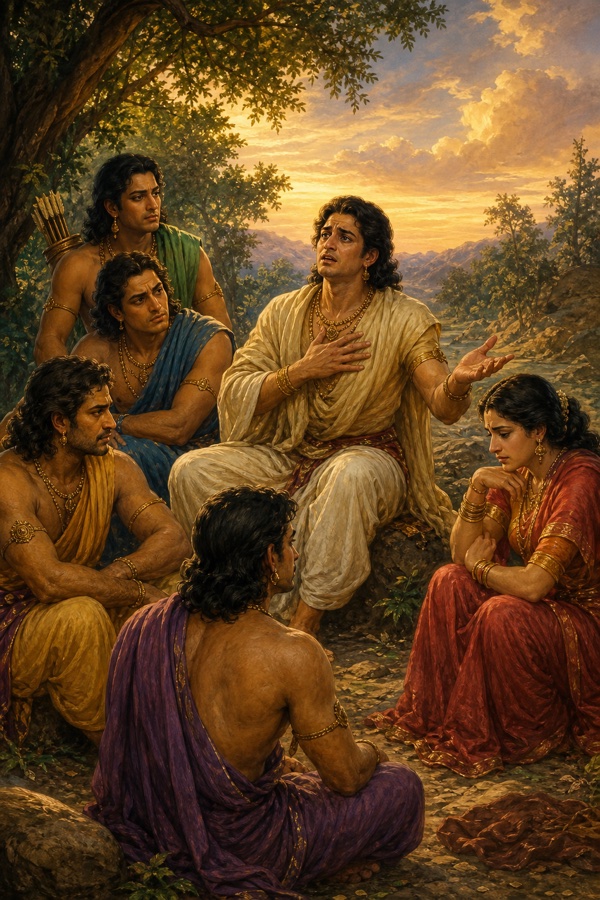
He said, “I think there is no man on this earth more luckless than I. My kingdom is gone, my wealth is gone, my kinsmen are scattered, and I wander from forest to forest.”
The sage smiled. “If you will listen, I will tell you of a king who fell into far greater sorrow than yours. He had no chariot, no servant, no brother, no friend. He lived alone in the forest with his wife. But you have brothers heroic as the gods, and Brahmanas great as Brahma are with you. It does not become you to grieve.”
Yudhishthira’s curiosity was stirred. “I wish to hear the tale of that king in full. Tell it, I pray.”
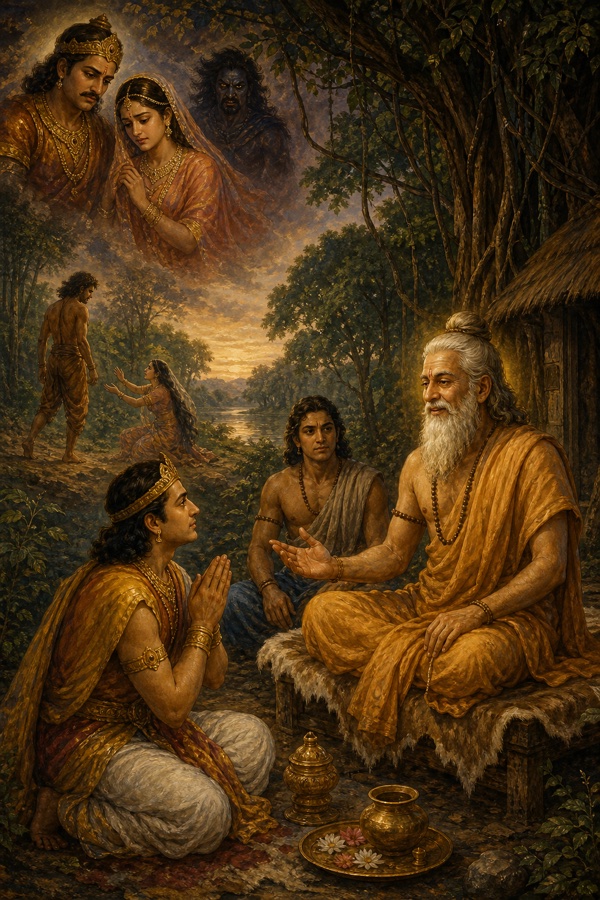
And then Brihadaswa began the tale that is still counted among the most vivid stories of surviving the dice and the reversals of fortune. This is the tale of Nala, king of the Nishadhas, and Damayanti.
A key to reading this (a tale within a tale): In the Mahabharata one character often tells another a story, to lighten the listener’s grief or to teach a lesson. Here Nala is Yudhishthira’s mirror: Nala too lost everything at dice, went into exile, and yet recovered it all in the end. The tale offers consolation and shows that reversal remains possible.
The gist: The sage Brihadaswa comes to console the grieving Yudhishthira in the forest and begins to tell him the tale of a king named Nala, who had fallen into an even greater calamity than his own.
Nala, king of the Nishadhas, and Damayanti of Vidarbha
In a country called Nishadha (an ancient realm of what is now central India) there was a king named Virasena. His son was Nala: strong, handsome, expert in the lore of horses, and endowed with every kind of virtue. Among all kings he stood as Indra stands among the gods, and in his splendor he was like the sun. He was a friend to Brahmanas, learned in the Vedas, and brave; he was truthful, and yet he had a particular liking for the game of dice. That single liking would one day become the deepest wound of his life.
In that same age, in the country of Vidarbha, there was a king named Bhima, fearsome in valor and loving to his people. But he was childless, and this grieved him. One day a Brahmana sage named Damana came to his court. King Bhima and his queen together served him so well that the sage was pleased and granted a boon: a daughter like a jewel and three sons. The daughter was named Damayanti, and the three sons Dama, Danta, and Damana. The names were given after the sage himself.
The fame of Damayanti’s beauty and good fortune spread through the whole world. In her youth, hundreds of maids and companions decked in ornaments served her like handmaids of Sachi, the wife of Indra. Such a beauty had never been seen or heard of among gods, among yakshas, or among mortals. Nala too had no equal in the three worlds; in beauty he was like the god of love himself.
The two had never seen each other, yet hearing their virtues sung again and again by the bards (who chant the merits of kings), a love awoke in their hearts before they had ever met, and that love grew stronger day by day.
A key to reading this (lineage and place): Nala is king of Nishadha. Damayanti is the daughter of Bhima, king of Vidarbha (this Bhima is a different man from the Pandava Bhima, only sharing the name). Both Nishadha and Vidarbha are held to be ancient realms of central India. Damayanti’s capital was Kundina.
The gist: Nala, king of the Nishadhas, and Damayanti of Vidarbha were each famed for their virtue and beauty; hearing about each other, they fell in love before they had ever met.
The swan with wings of gold: love’s messenger
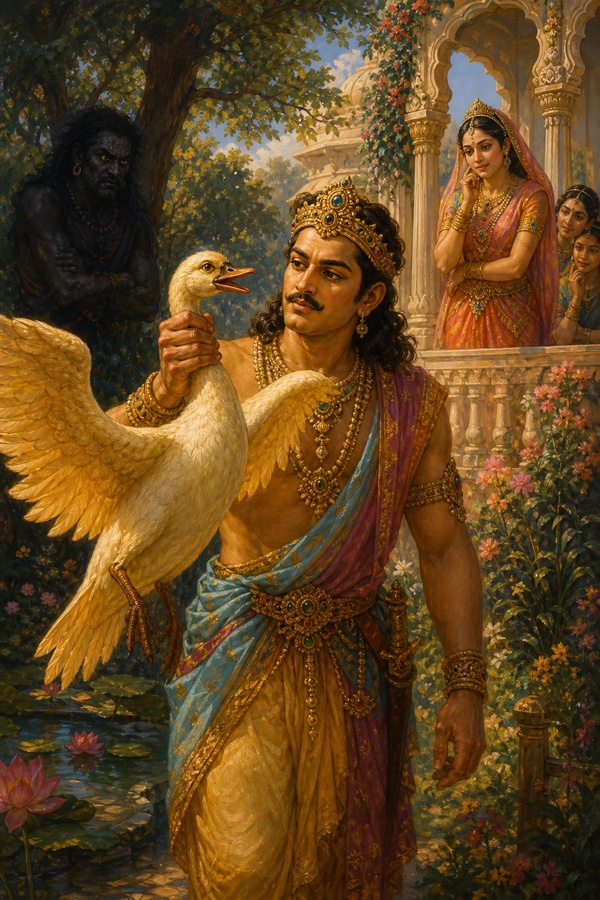
Unable to hold the rising longing in his heart, Nala took often to spending time alone in the garden beside the inner chambers. One day he saw there some swans with wings of gold moving about. With his own hands he caught one of them. Then that sky-going bird spoke in human speech: “O king, do not kill us. We will do you a dear service. We will sing your praises before Damayanti in such a way that she will never desire any other man for her husband.”
Hearing this, Nala released the swan. The whole flock flew off to the country of Vidarbha and alighted before Damayanti. Seeing those wondrous birds, Damayanti and her companions ran in delight to catch them. The swans scattered, and each maid ran after one. The swan that Damayanti chased led her to a private spot and spoke in human speech:
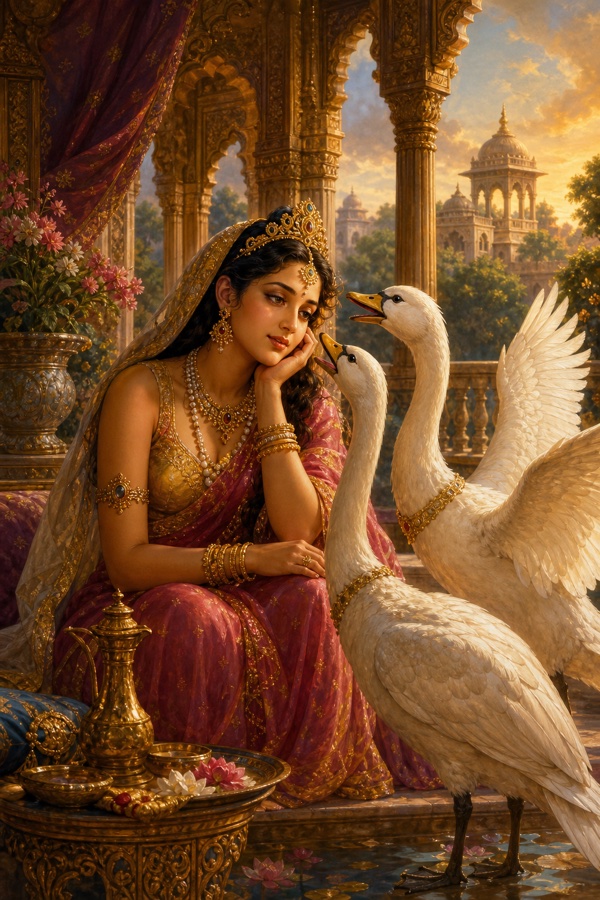
“O Damayanti, in the country of Nishadha there is a king named Nala. In beauty he is like the twin Aswins, and among men he has no equal. We have seen gods, gandharvas, nagas, rakshasas, and men, and we have never seen anyone like Nala. As you are a jewel among your kind, so is Nala the man. The union of the best with the best is the one that brings joy.”
Damayanti answered, “Say the same to Nala.” The swan said “So be it,” returned to the Nishadhas, and told Nala everything.
The gist: A swan with wings of gold became the messenger and carried between Nala and Damayanti the news of their mutual love, and the love of both grew firmer.
The svayamvara announced, and the coming of the gods
Hearing the words of the swan, Damayanti found no more peace. She sighed long and often, sank into worry, and grew pale and thin. No comfort in her bed, no taste for food; day and night she wept, crying “Alas!” The maids conveyed their daughter’s state to King Bhima through hints. The king understood that his daughter had come of marriageable age, and resolved that Damayanti’s svayamvara (the assembly in which a maiden chooses her own husband) should be held.
Bhima sent invitations to the kings of all the earth. The earth rang with the rumble of chariots, the trumpeting of elephants, and the neighing of horses; the kings came to Kundina with armies decked in ornaments and garlands. Bhima received them all with fitting honor.
Meanwhile the two great celestial sages Narada and Parvata, in their wanderings, reached the world of Indra. Indra honored them and asked after their welfare. In the course of talk Indra asked, “Why do those heroic Kshatriya kings no longer come, who once fought in battle without care for their lives and won a hero’s death and came to this heaven? Where are my dear guests?”
Narada told him, “O Maghavat, the svayamvara of Damayanti king of Vidarbha, is about to be held. All the kings and princes of the world are journeying there, for all wish to win Damayanti.” Hearing this, the guardians of the world (the gods who protect the directions), together with Agni, cried, “We too will go there.” And they all mounted their vehicles and set out for Vidarbha.
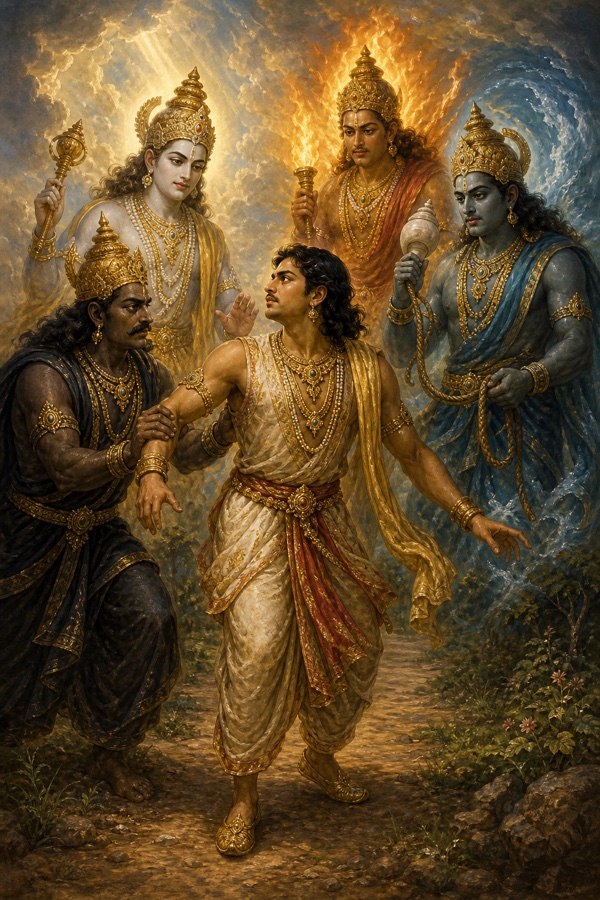
Nala too, his heart full of love for Damayanti, set out with a glad mind. On the road the gods saw him. Seeing that king, radiant as the sun and beautiful as the god of love, the guardians of the world were amazed and gave up their own resolve. They came down from the sky to Nala and said, “O Nala you are a keeper of truth. Help us. Be our messenger.”
A key to reading this (the four Lokapalas): The four gods who desire Damayanti in this tale are Indra (king of the gods), Agni (the fire god), Varuna (lord of the waters), and Yama (god of death). They are called the “Lokapalas,” the gods who guard the world and the directions. Their coming to Damayanti’s svayamvara is the seed of the whole tale that follows.
The gist: King Bhima announced Damayanti’s svayamvara; hearing of it from Narada, Indra, Agni, Varuna, and Yama also set out to win her, and on the road, seeing Nala, they asked him to become their messenger.
Nala goes to Damayanti as the messenger of the gods
Nala gave his word: “I will do it.” Then, folding his hands, he asked, “Who are you? And what must I do? Tell me truly.” Indra answered, “Know us as the immortal gods, come for Damayanti. I am Indra, this is Agni, this is Varuna, lord of the waters, and this is Yama. Go to Damayanti and give her news of our coming, and tell her to choose one of the four of us as her husband.”
Nala folded his hands and said, “I have come here for that very purpose myself. How can a man who is himself in the grip of love plead another’s suit to a woman? Forgive me.” But the gods said, “Having first said ‘I will do it,’ why do you now draw back? Go without delay.”
Nala raised another doubt: “The inner chambers are well guarded. How shall I go in?” Indra said, “You will be able to.” And indeed, by the power of the gods, Nala reached Damayanti’s palace without any guard seeing him. There he beheld Damayanti, surrounded by her maids, her radiance putting even the light of the moon to shame. Seeing her, Nala’s love welled up, yet to guard his truth he held his mind in check.
Amazed at his splendor, the maids rose from their seats. They wondered to themselves, “Who is this? Some god, yaksha, or gandharva?” But from shyness and wonder none could speak. Damayanti said with a smile, “Who are you, come here and waking love in my heart? And how have you reached this place unseen, when my inner chambers are well guarded and my father’s command is strict?”
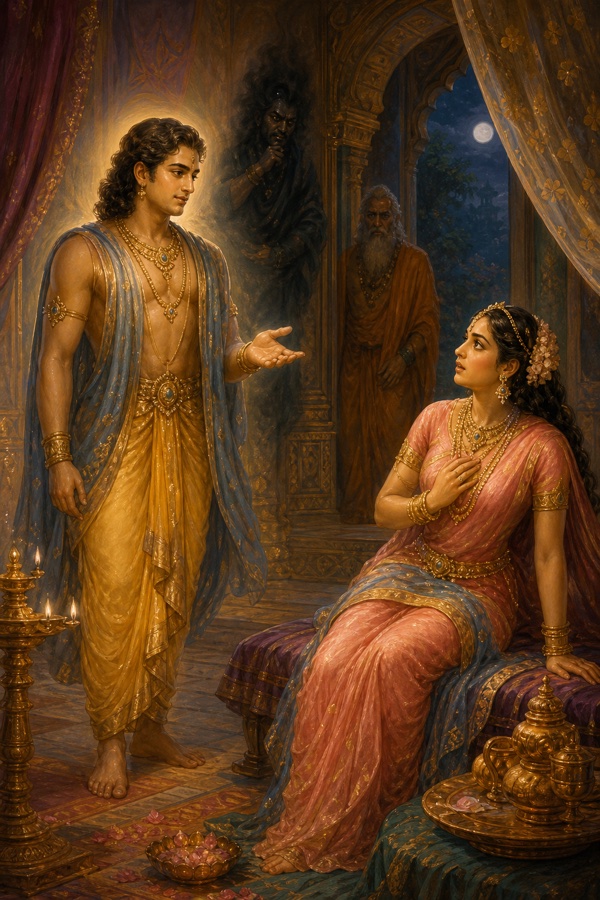
Nala answered, “My name is Nala. I have come as the messenger of the gods. Indra, Agni, Varuna, and Yama wish to win you. Choose one of them for your husband. It is by their power that I have come in here unseen.”
The gist: Keeping the word he had given the gods, Nala pressed down his own love and carried their message to Damayanti, that she should choose one of the four gods as her husband.
Damayanti’s resolve: a mortal, even before the gods
Damayanti bowed to the gods and, smiling, said to Nala, “O king, take me with due love, and command me in what I should do for you. I and all my wealth are yours. The voice of the swans is burning me. It is for your sake that I have gathered these kings here. If you forsake me, who worship you, then for your sake I will turn to poison, fire, water, or the rope.”
Nala tried to reason with her: “When the guardians of the world themselves are present, why do you choose a mortal? Turn your heart to those creators of the world, to the dust of whose feet I am not equal. A mortal who displeases the gods meets death. Save me, and choose the god.”
But Damayanti’s eyes filled with tears. She said, “Bowing to all the gods, I still choose you alone for my husband. This I say in truth.” To the trembling Damayanti, hands folded, Nala said, “I have given the gods my particular word; how can I serve my own end after coming with another’s message?”
Then in a voice drowned in tears Damayanti offered a blameless path: “O king, come to the svayamvara together with Indra and all the gods. There, before the guardians of the world, I will choose you. So no blame will fall on you.” Hearing this, Nala returned to the gods and told them everything.
A sub-tale: Note that the tale does not make Nala a simple hero. Nala comes as the messenger of the gods, and though he knows his own love, he speaks honestly on the gods’ behalf and even urges Damayanti to choose them. This is his dilemma of dharma: love and the given word stand face to face. Damayanti’s plan, to choose him at the svayamvara, finds a lawful way out of that dilemma.
The gist: Though Nala urged the gods’ suit again and again, Damayanti firmly resolved to choose Nala alone, and found a blameless plan: she would choose him at the svayamvara, in the very presence of the gods.
The svayamvara: five identical Nalas, and a plea to truth
At the appointed sacred hour, King Bhima summoned the kings to the svayamvara hall. Smitten with love, the kings entered that pavilion of golden pillars and lofty portal arches like lions entering mountain caves. Then Damayanti entered the assembly, stealing with her radiance the eyes and hearts of all.
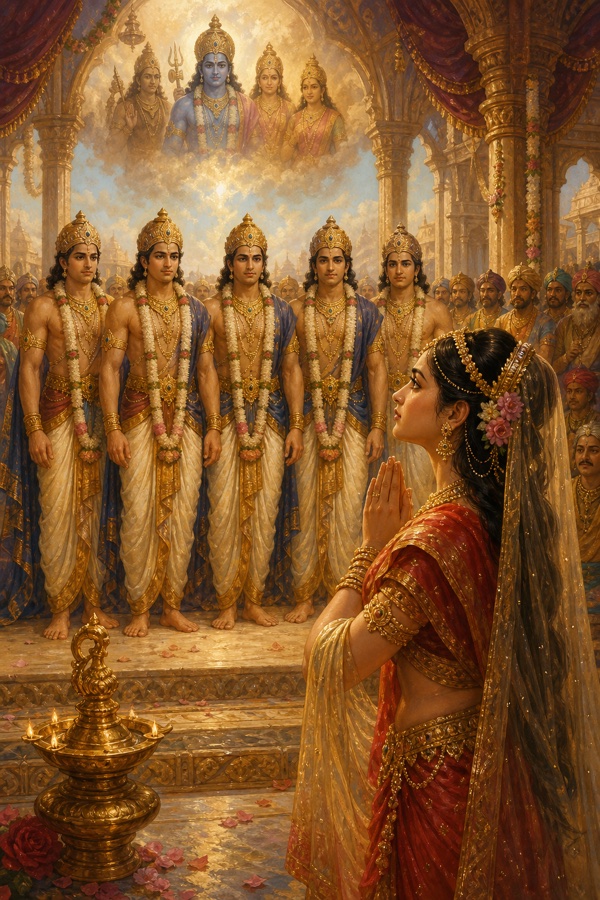
As the kings’ names were called, the daughter of Bhima saw a strange sight: five men who looked exactly alike. The four gods had taken on Nala’s very form. Damayanti was thrown into difficulty. “How am I to know which among these are gods and which is King Nala?” She recalled the marks of the gods she had heard of from her elders, but in the gods standing here those marks were not to be seen.
At last she took refuge in the gods themselves. With folded hands, trembling, bowing to them in mind and speech, she said, “Since I heard the voice of the swans, I have chosen the king of the Nishadhas for my husband. By the strength of that truth, O gods, reveal Nala to me. Never in thought or word have I swerved from him; by the strength of that truth, let him be revealed to me. O guardians of the world, take on your own true forms, that I may know that righteous king.”
Seeing her piteous plea and her unshakable love, the gods did as she asked. Then she saw them: free of sweat, with unblinking eyes, unfading garlands, untouched by dust, and standing without touching the ground. And Nala stood revealed with his shadow, his wilted garland, his body stained with dust and sweat, his eyelids blinking, his feet resting on the earth, wholly a mortal. Marking this difference between gods and mortal, Damayanti chose Nala according to her truth, and bashfully catching the hem of his garment, placed a lovely wreath about his neck.
The kings cried “Alas!”, but the gods and the great sages praised Nala, crying “Excellent! Excellent!” The pleased gods granted Nala eight boons: Indra, that he would behold him at sacrifices and attain to blessed regions; Agni, his presence whenever Nala wished, and regions bright as himself; Yama, subtle taste in food and pre-eminence in virtue; and Varuna, his presence at will and garlands of celestial fragrance. Thus each gave two boons, and then returned to heaven.
King Bhima gladly celebrated the wedding of Nala and Damayanti. Staying there a while, Nala took his queen and returned to his own city, and ruled in righteousness. He performed the horse sacrifice and many other sacrifices, and gave abundant gifts to the Brahmanas. By Damayanti he had a son named Indrasena and a daughter named Indrasena. The king ruled happily over an earth full of wealth and grain.
A key to reading this (marks of gods versus mortals): In Indian tales the traditional marks of the gods are held to be these: they do not sweat, they do not blink, their garlands do not wilt, dust does not settle on them, and they remain a little above the earth without touching it. By the absence of these very marks Damayanti recognizes Nala, who was fully a mortal.
The gist: At the svayamvara the gods took on Nala’s form, but Damayanti, by her plea to truth and the absence of the gods’ marks, recognized the true Nala and garlanded him; the gods gave their blessing and eight boons and departed, and Nala and Damayanti lived in happiness.
Kali’s wrath, and the twelve-year wait
As the guardians of the world returned from the svayamvara, they met Kali on the road, coming with Dwapara. (Here Kali and Dwapara appear as the presiding principles of the ages; Kali is the tendency that brings strife, fraud, and ruin.) Indra asked, “O Kali, where are you going with Dwapara?” Kali said, “To Damayanti’s svayamvara, for my heart is set on her; I will win her.”
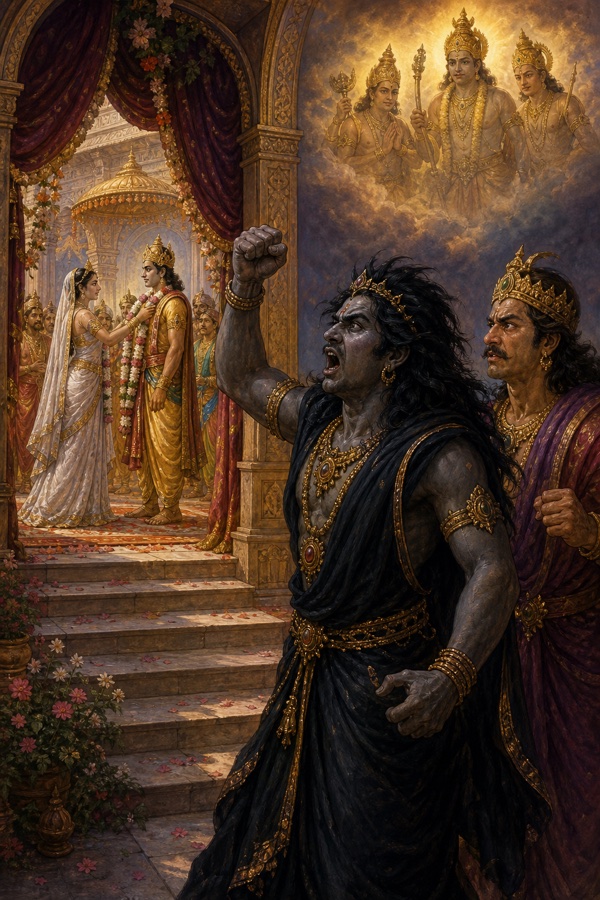
Indra said with a smile, “That svayamvara is already over. Before our very eyes Damayanti chose Nala.” Hearing this, Kali filled with rage: “Since she chose a mortal in the presence of the gods, she deserves a heavy doom.” The gods rebuked him: “It was with our sanction that Damayanti chose Nala. What maiden would not choose a king so full of every virtue? The fool who tries to curse Nala curses himself and sinks into the bottomless pit of hell.” So saying, the gods went to heaven.
But Kali could not hold back his anger. He said to Dwapara, “I will enter Nala and strip him of his kingdom. You enter the dice and help me.” Having made this compact, Kali came to the country of the Nishadhas and dwelt there, watching for a flaw (a lapse or opening).
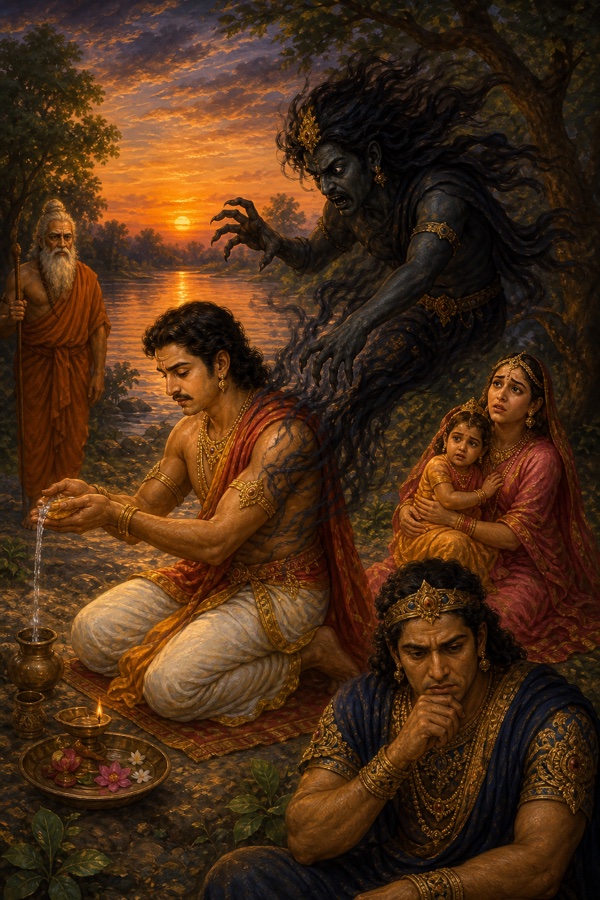
A full twelve years passed before Kali found a flaw. One day, after answering the call of nature, Nala touched water and said his twilight prayers, but forgot to wash his feet. Through this one lapse Kali entered him. Then Kali went to Nala’s brother Pushkara and said, “Play dice with Nala. With my help you will surely win, and take the kingdom, and rule the Nishadhas.” Dwapara too joined them, becoming the chief die, “Vrisha.”
A sub-tale: This tale ties deeply to Yudhishthira’s own episode of dice. Nala too was truthful, righteous, and full of virtue, yet his weakness was his attachment to dice. The tale does not simplify evil: the seed of the fall was already within Nala, and Kali only found the opening of a single lapse and let it bear fruit.
The gist: Enraged that Damayanti had chosen Nala, Kali watched for a flaw for twelve years, and on the occasion of one religious lapse of Nala’s entered his body and goaded his brother Pushkara to dice.
The game of dice: the loss of everything
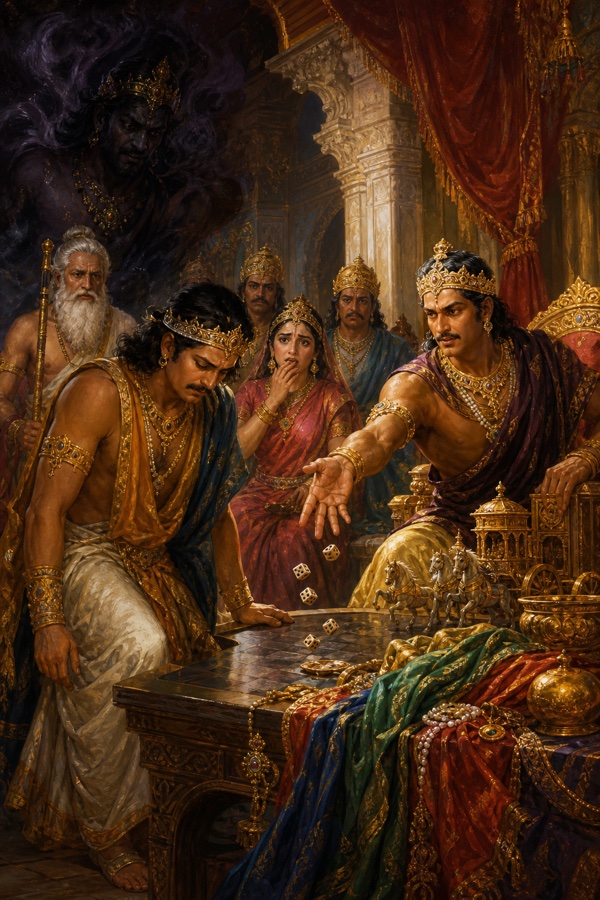
Pushkara challenged Nala to dice again and again. Challenged before Damayanti, the high-hearted Nala could not decline for long and set a time for the game. In the grip of Kali, Nala began to lose his gold, silver, chariot, horses, and robes. He grew so crazed at the dice that no friend could restrain him.
The citizens and councillors came in grief and stood at the gate to hold the king back. The charioteer said to Damayanti, “O queen, the people and the councillors are at the gate; beg the king to grant them an audience.” In a choked voice Damayanti spoke of this to Nala, but Nala, in the grip of Kali, gave not a word in answer. Ashamed and grieving, the people went home, saying, “He lives no longer.” Thus for many months the game between Nala and Pushkara went on, and Nala lost without cease.
Damayanti understood the gravity of the danger. Through her trusted nurse Brihatsena she summoned the councillors, but Nala paid them no heed. Then Damayanti called the charioteer Varshneya and said, “You know how the king has always been toward you. Now he is in danger. Yoke Nala’s swift and beloved horses to the chariot and take my two children, Indrasena and Indrasena, to Kundina. Leave them with my parents, and leave the chariot and horses there too; then stay there, or go wherever you wish.”
Varshneya consulted with the councillors, took the children to Vidarbha, left Indrasena and Indrasena there, and, grieving, took his leave. Wandering, he reached Ayodhya and entered the service of King Rituparna as a charioteer.
The gist: In the grip of Kali, Nala lost everything at dice; with foresight Damayanti sent both her children safely with the charioteer Varshneya to her childhood home of Kundina, and Varshneya went on to serve King Rituparna in Ayodhya.
From a kingdom to the forest
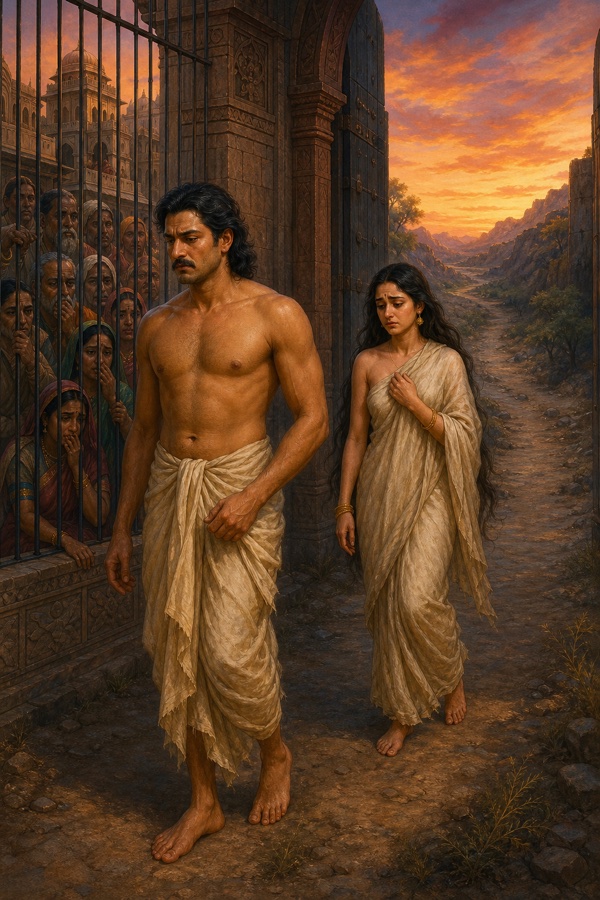
After Varshneya had gone, Pushkara won Nala’s kingdom and all his remaining wealth. Laughing, he said, “Play on. What stake have you left? Only Damayanti remains. Wager her, if you like.” Hearing this, Nala’s heart nearly burst with rage, yet he spoke not a word. Gazing at Pushkara in pain, he took off all his ornaments, and wearing a single garment, his body bare, renounced all his wealth and left the city. In a single garment, Damayanti followed him.
Pushkara had it proclaimed through the city that whoever helped Nala would be put to death. So, deserving of hospitality though he was, no citizen honored him. Outside the city Nala passed three nights on water alone. Then, tormented by hunger, he went in search of fruit and roots, Damayanti following behind.
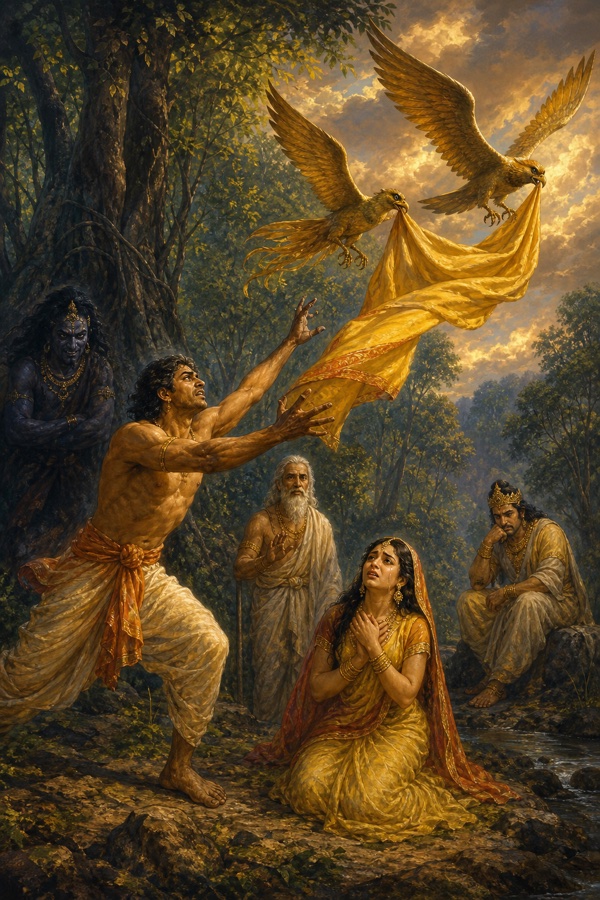
After some days Nala saw some birds with plumage like gold and thought, “These will be my food and my wealth today.” He threw his one garment over them, but the birds flew off into the sky with that very cloth. Standing naked and forlorn, Nala heard them say, “O small of sense, we are those very dice. We came to take your garment; it did not please us that you should go even with your cloth on.”
Stripped of his garment too, Nala said to Damayanti, “They through whose wrath my kingdom was lost, through whose power I could find no food even in hunger, they have now taken my cloth in the form of birds. Now hear my words for your own good. These many roads lead to the southern country, by Avanti and the Rikshavat mountains. This is the Vindhya mountain, there the river Payasvini flowing seaward, and there the hermitages of ascetics. This road leads to Vidarbha, and that to Kosala.” Nala said this again and again.
Drowned in tears, Damayanti said, “O king, my heart trembles to think of your purpose. Stripped of kingdom, wealth, and garment, worn by hunger and toil, how can I leave you in this lonely forest and go? In sorrow there is no medicine like a wife, the physicians themselves say.” Nala said, “It is true. I do not wish to forsake you; I can forsake myself, but not you.”
Damayanti asked, “If you do not wish to forsake me, why do you show me the road to Vidarbha again and again? I know you will not leave me, but your mind is troubled, and that is why I fear. If it is your wish that I go to my kin, then let us both go to Vidarbha together; there my father will honor you.” Nala answered, “Your father’s kingdom is as my own, but in this calamity how can I go there? Once I went there in glory; how can I now go in misery and add to your grief?” So saying, he comforted his wife, wrapped in half a garment.
The gist: Losing even his kingdom to Pushkara, Nala left the city in a single garment; the dice, in the form of birds, carried off that garment too, and now the two wandered the forest in half a garment. Nala kept showing Damayanti the road to her home, but she would not agree to leave him.
The desertion: one night’s dilemma
Worn by hunger and thirst, the two came to a travelers’ rest-house. Nala sat down on the earth and then, soiled and dust-covered, fell asleep there beside Damayanti. The innocent Damayanti sank into deep sleep, but grief and worry kept sleep from Nala. Turning over the loss of his kingdom, the parting from his friends, and the pain of the forest, his Kali-worked mind grew troubled.
He thought, “What shall I do? What if I do not? Is death the better course, or should I leave my wife? She is devoted to me and bears this suffering for my sake. Parted from me, she may perhaps reach her kin. Staying with me, she will have only sorrow; parted, she may one day find happiness.” Under the influence of Kali his mind fixed on forsaking Damayanti. He thought also, “This famed and fortunate woman, by her own energy, will not be harmed by anyone on the road.”
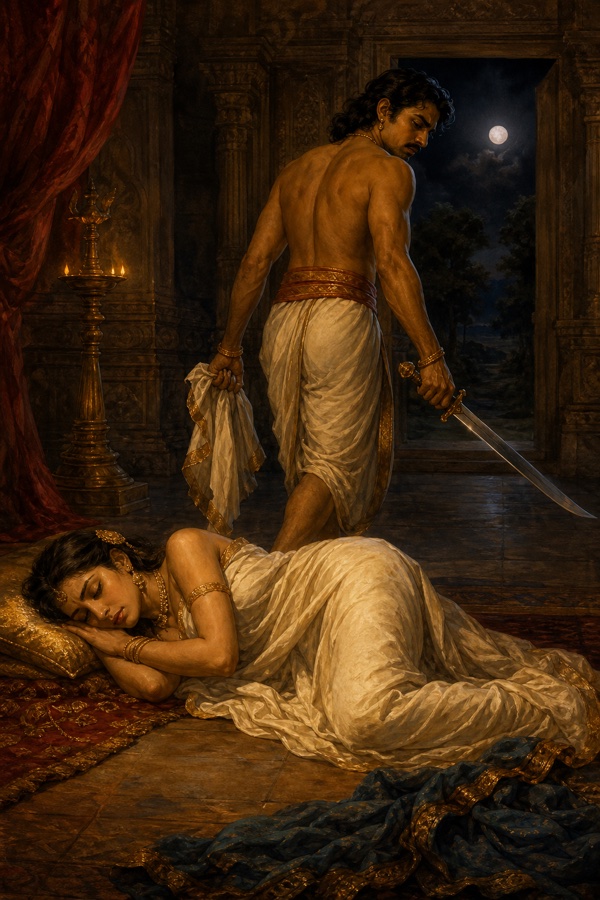
Then, seeing his own nakedness and Damayanti’s single garment, he thought to cut away half of it, but so that his beloved should not wake. Near the rest-house he found a fine unsheathed sword. With it he cut away half the cloth, threw the sword aside, and left the sleeping princess of Vidarbha. But his heart would not bear it; he came back, and, seeing her asleep, wept aloud.
He lamented, “Alas! She whom neither the wind nor the sun had ever seen sleeps today on the bare earth, like one forlorn. When she wakes in this severed cloth, alone, how will she wander this forest full of beasts and serpents? May the Adityas, the Vasus, the twin Aswins, and the Maruts protect you; may your chastity be your surest guard.” Compelled by Kali, he would go, and drawn by love he would return again and again to the rest-house. As though his heart were split in two, he swung within and without like a pendulum. At last, his senses lost to the touch of Kali, Nala left his sleeping wife and went away in grief.
A sub-tale: The tale does not excuse Nala here, yet it does not condemn him without mercy. It says plainly that this cruel deed was done under the influence of Kali, and yet that it was done by Nala’s own hand. That swinging heart, “Compelled by Kali he would go, drawn by love he would return,” is a mark of the moral complexity of the Mahabharata, where goodness and error live together in the same person.
The gist: Compelled by Kali, Nala cut away half the garment of the sleeping Damayanti and, going and returning again and again, at last left her alone in the lonely forest.
Damayanti’s lament, and the peril of the python
After Nala had gone, Damayanti woke with a start, and, not finding her husband, shrieked in terror: “O my lord! Have you forsaken me? I am undone in this desolate place. O truthful king, remember the word you gave before the guardians of the world. If this is some jest, enough of it; I am afraid, show yourself. I do not weep for myself; I weep at the thought of how you will pass your days alone.”
Burning with grief, Damayanti ran here and there, now rising, now sinking as if in a faint, now trembling, now weeping aloud. Then, as if cursing that unseen power, she said, “May that being through whose curse the innocent Nala suffers this woe bear a grief still greater than ours.”
As Damayanti sought her husband through the forest of beasts of prey, a huge and hungry python suddenly came upon her and caught her in its coils. Even so her weeping was for Nala, never for herself: “O lord, why do you not run to save me, seized and unprotected by this serpent? When you regain your senses and your wealth and remember me, what will your state be?”
Just then a hunter roaming the forest heard her lament and ran to the spot, cut off the serpent’s head with his sharp weapon, and set Damayanti free. He sprinkled her with water, gave her food, comforted her, and asked who she was and how she had come to this pass. Damayanti told him everything.
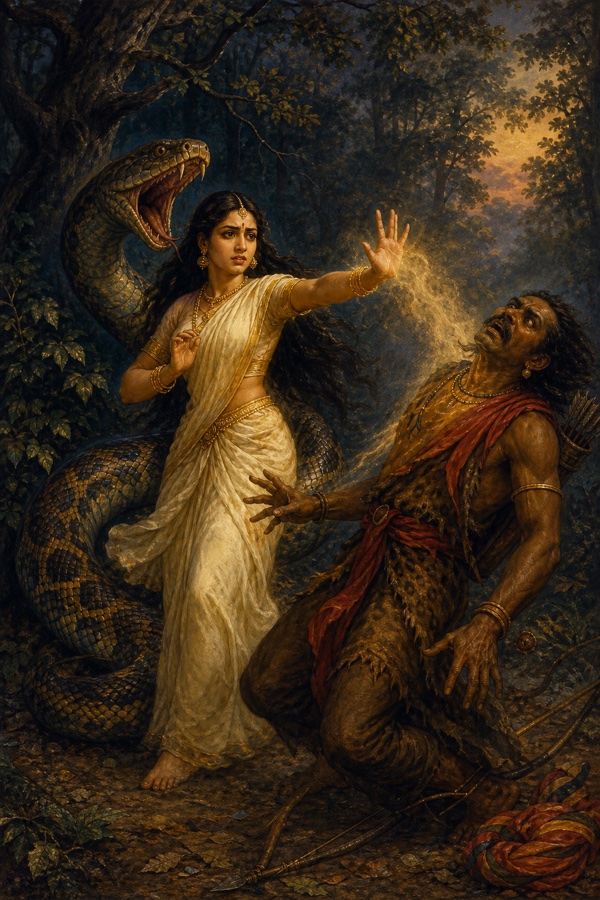
But seeing that peerless beauty wrapped in half a garment, the hunter was seized by desire and began to coax her with sweet words. Damayanti understood his vile intent and blazed up in anger. When the wretch tried to use force, Damayanti, already broken by the loss of her husband and her kingdom, cursed him: “If I have never even thought of anyone but Nala, let this base hunter fall lifeless this instant.” With the word, the hunter fell to the earth like a tree consumed by fire.
The gist: Alone in the forest, Damayanti searched for Nala with lamentation; a hunter saved her from a python, but when he turned on her with lust, the fire of her chastity burned him with a curse.
The grove of ascetics, the Asoka tree, and the ruin of the caravan
Having slain the hunter, Damayanti pressed on through that fearful forest loud with crickets, full of lions, leopards, tigers, bears, and countless trees and vines. Sitting on a rock, she lamented, and then began to ask the mountain and the lion, the king of the forest, for news of her husband, as though grief had forced her to speak to every living and unmoving thing.
After three days and nights she reached a matchless grove of ascetics, where austere sages like Vasishtha, Bhrigu, and Atri lived, some on water, some on air, some on fallen leaves. The ascetics welcomed her and asked who she was. Damayanti told her whole story and asked after Nala. By the power of their austerity the ascetics said, “The future will bring you happiness; you will soon regain Nala, free of calamity, decked with every jewel, ruling his own city.” So saying, those ascetics, with their hermitage and their fires, vanished from sight. Damayanti stood amazed, wondering whether it had been a dream.
Farther on, seeing a lovely Asoka tree, she prayed to it, “O Asoka, make your name true; for Asoka means the destroyer of grief. Have you seen my beloved Nala?” Circling the tree three times, she pressed deeper into the forest.
As she walked, she came upon a caravan of merchants (a band or caravan of traders) with horses and elephants, halted on the bank of a clear river. Seeing Damayanti, thin, soiled, and dust-covered in half a garment, some were afraid, some laughed, some were moved. She asked the leader of the caravan where they were bound. The leader said they were going toward the city of Subahu, king of the Chedis. Damayanti went along with the caravan, hoping to find her husband.
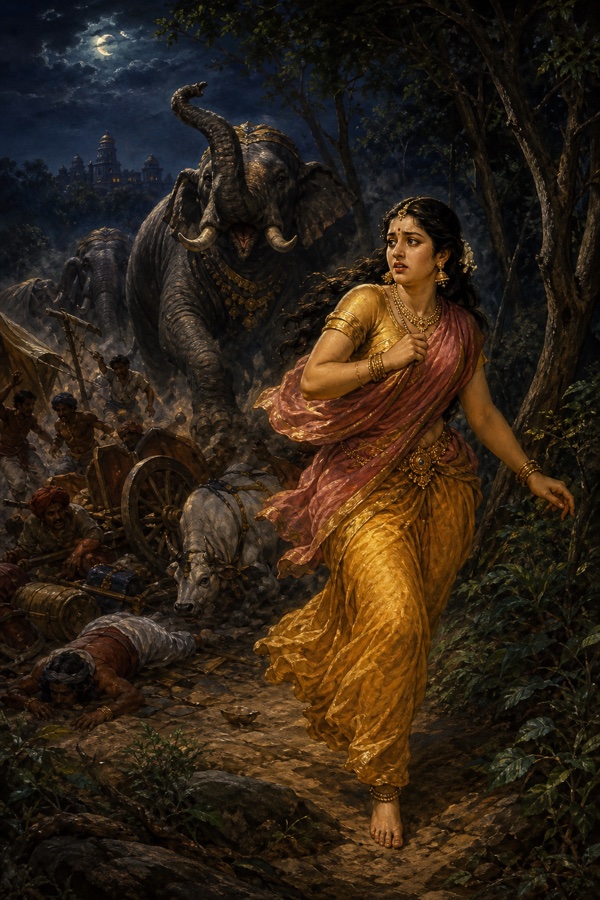
After some days the caravan halted for the night beside a great lake fragrant with lotuses. At midnight, when all lay asleep in exhaustion, a herd of wild elephants came to drink and, seeing the caravan’s tame elephants, fell upon them in a frenzy. Sleeping men were crushed; some by tusks, some by trunks, some by feet. Camels and horses died, and in the stampede people trampled one another to death. The cry went up, “Fire! Run!”
Damayanti woke in terror. The survivors said to one another, “This is the work of that maniac-like woman who joined us; she must be some rakshasi or yakshi.” They made ready to kill her with stones and sticks. In fear and shame Damayanti fled into the forest, cursing herself: “Alas! Through the sins of a former life this calamity has come upon me: my husband’s kingdom lost, my husband defeated by his own kin, parting from husband and son and daughter, and now the ruin of these innocent people too.”
The next day the surviving merchants went on, mourning their dead. With the Brahmanas learned in the Vedas who traveled among them, Damayanti reached by evening the great city of Subahu, the truthful king of the Chedis. Seeing her in half a garment, maniac-like, soiled with dust, the children of the city followed her in curiosity, and she came to a halt before the palace.
A sub-tale: The episode of the caravan’s ruin deepens Damayanti’s sense of guilt. She begins to hold herself the cause of this disaster, though it was no fault of hers. Here the tale touches that human nature which, in helpless sorrow, turns to look for fault in oneself, and reflects on fate and past deeds.
The gist: After the ascetics’ assurance and her prayer to the Asoka tree, Damayanti traveled with a merchant caravan, but the caravan was destroyed in an elephant attack; fleeing the survivors’ blame, she reached the city of Subahu, king of the Chedis.
Damayanti as a sairandhri in the Chedi city
From the palace terrace the queen-mother saw that radiant woman hemmed in by the crowd and said to her nurse, “Bring that forlorn, distressed woman to me; maniac-like though she seems, with her large eyes she is Lakshmi herself.” The nurse brought her to the terrace and asked who she was. Damayanti said only that she was a chaste woman of the human kind, a servant of good family, living on fruit and roots. She told of her husband’s virtues and his defeat at dice, and the abandonment in the forest, without giving her own name or Nala’s.
The queen-mother urged her to stay: “My men will search for your husband, or he may come here himself in his wanderings.” Damayanti agreed to stay on certain conditions: “I will eat no one’s leavings, wash no one’s feet, and speak with no strange man. If anyone seeks me, let him be punished by you; one who presses his suit, let him be put to death. And let me meet the Brahmanas who set out in search of my husband.” Pleased, the queen-mother accepted all, and kept Damayanti as the sairandhri (a well-born attendant living in a royal household) of her daughter Sunanda. Damayanti lived there at ease.
A key to reading this (sairandhri): A “Sairandhri” is a well-born attendant or companion who lives in a royal palace and is not a slave. Later, during the year in hiding, Draupadi herself becomes a sairandhri in the city of Virata, and so this episode grows all the more poignant for the exiled Pandavas.
The gist: Without recognizing her, the queen-mother of the Chedi city took Damayanti in; Damayanti agreed to live as the sairandhri of Princess Sunanda under strict vows of chastity.
The serpent Karkotaka, and Nala’s change of form
Meanwhile Nala, who had left Damayanti and gone on, saw a fierce forest fire blazing in those woods. From the heart of the fire someone cried again and again, “O Nala, come here.” Saying “Fear not,” Nala went into the fire and saw a great serpent lying in coils. Trembling, the serpent said, “O king, I am the serpent Karkotaka. I deceived the great sage Narada, and for this he cursed me to lie here immobile until a king named Nala should carry me away. Take me from here; I will be your friend.” Saying this, he became as small as a thumb.
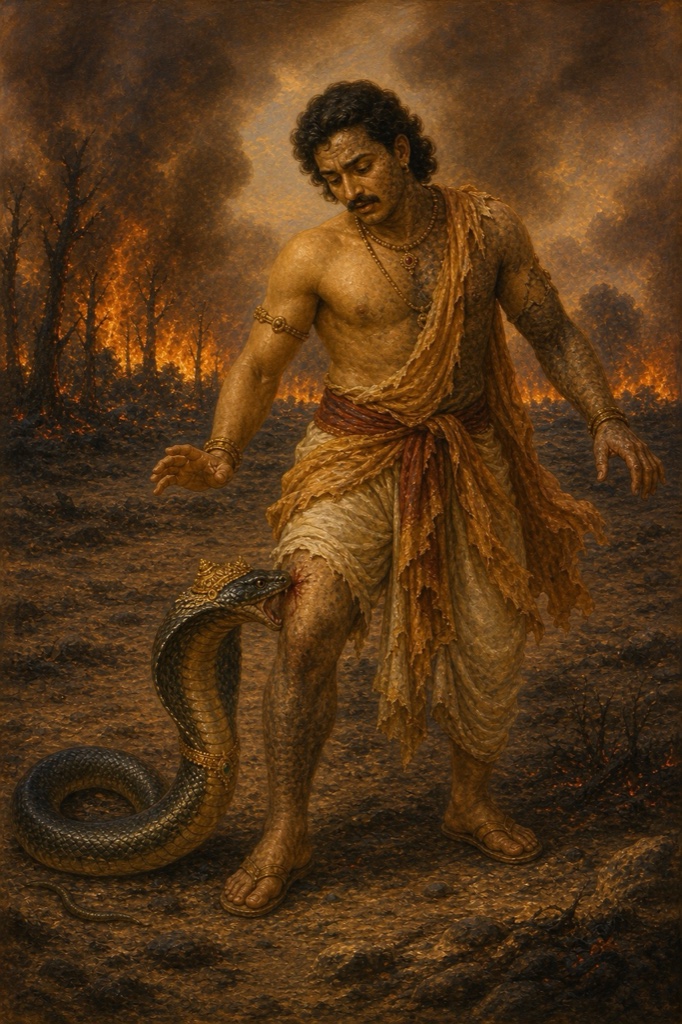
Nala carried him out of the fire. Then Karkotaka said, “Walk on, counting a few steps; I will do you a great service.” As Nala counted his steps, at the tenth step the serpent bit him, and at once Nala’s form changed. To the astonished Nala the serpent explained, “I have taken away your beauty so that people cannot know you. And the Kali who deceived you and cast you into sorrow will now dwell within you, tormented by my venom, until he leaves you. You will feel no pain from my venom; you will be ever victorious in battle.”
The serpent went on, “This very day go to Ayodhya and present yourself to King Rituparna, skilled at dice, as ‘a charioteer named Bahuka.’ That king will give you his science of dice and take from you your lore of horses. Once you are expert at dice, your welfare will follow; you will regain your wife, your children, and your kingdom. And when you wish to see your true form, remember me and put on this garment; your form will return at once.” Saying this and giving Nala two celestial garments, Karkotaka vanished.
A key to reading this (Kali and Karkotaka’s venom): Note that the serpent’s venom does not pain Nala; it pains the Kali seated within him. This is a fine sign: an outward calamity in truth burns the inner evil that had caused the fall. The eventual departure of Kali will become the path of Nala’s release.
The gist: When Nala saved the serpent Karkotaka from the forest fire, the serpent bit him and changed his form, setting the Kali within him to writhe with venom; the serpent sent Nala, as Bahuka, to King Rituparna in Ayodhya and gave him the celestial garments that would restore his form.
Nala in Ayodhya, in the form of Bahuka
When the serpent had vanished, Nala reached Ayodhya on the tenth day and said to King Rituparna, “My name is Bahuka. In the driving of horses I have no equal in the world; I am skilled also in cooking. Take me into your service.” Pleased, Rituparna made him superintendent of his stables at a salary of 10,000 coins, and placed Varshneya and Jivala under him. (This was that same Varshneya who had left Damayanti’s children in Vidarbha and come to Ayodhya.)
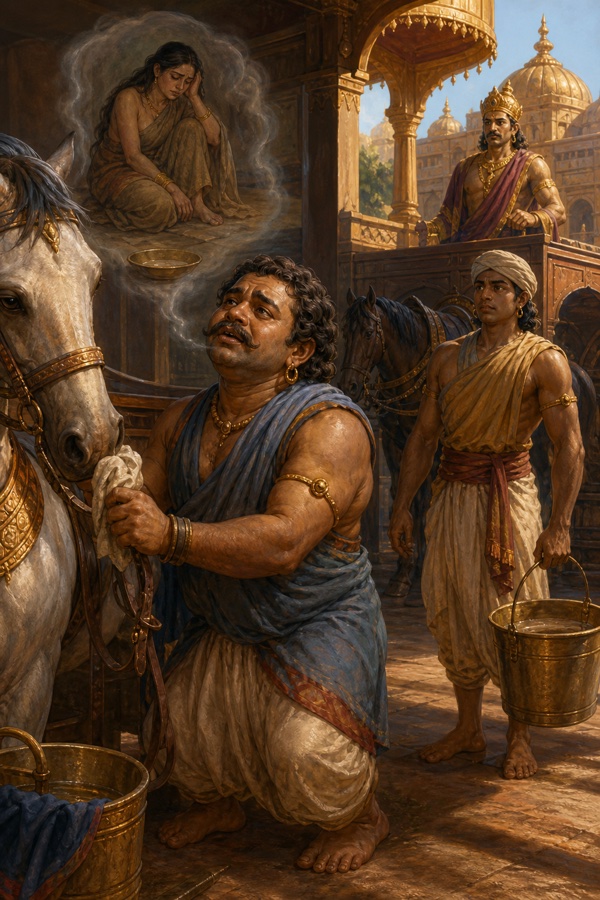
Living there, Nala would recite a verse every evening: “Where is that helpless woman now, worn by hunger and thirst and toil, remembering that wretch? And on whom does she now wait?” One night Jivala asked, “O Bahuka, for whom do you grieve like this?” Hiding his identity, Nala spoke in the third person: “A certain fool had a wife well known to many. He proved false to his word. For some reason he was parted from her, and now, burning day and night in grief, he remembers her. In calamity his wife had gone with him into the forest, but that man of small virtue forsook her.” Thus, remembering Damayanti, Nala lived there unknown.
The gist: As Bahuka, Nala became superintendent of King Rituparna’s stables in Ayodhya and, in secret, mourned Damayanti every day.
Sudeva’s search, and Damayanti’s recognition
Meanwhile King Bhima gave many Brahmanas great wealth and sent them in every direction to search for Nala and Damayanti, proclaiming that whoever brought them back would receive a thousand cows and a village. In his search a Brahmana named Sudeva reached the Chedi city and saw Damayanti seated with Sunanda in the palace. Though covered in dust, her beauty shone through like fire veiled in smoke. By many signs Sudeva knew her to be Damayanti.
Sudeva approached and said, “I am Sudeva, a friend of your brother, come to seek you at King Bhima’s wish. Your parents, your brother, your son, and your daughter are all well.” Recognizing Sudeva, Damayanti wept aloud. Seeing her weeping in private, Sunanda told the queen-mother.
The queen-mother came and asked Sudeva the whole story. Sudeva told her that this was Damayanti wife of Nala of the Nishadhas, who had left with her husband after he lost his kingdom at dice. Then he gave a decisive sign: “Between her eyebrows there is a lotus-like mole from birth, now hidden under dust.” Sunanda washed the dust from that spot, and the mole shone out like the moon emerging from clouds. Seeing it, Sunanda and the queen-mother wept and embraced Damayanti.
The queen-mother said in tears, “By this mole I know that you are my sister’s daughter. Your mother and I are both daughters of Sudaman, king of the Dasarnas; your mother was married to King Bhima, and I to Viravahu. I saw your birth in my father’s palace.” Damayanti bowed to her aunt and said that she now wished to go to Vidarbha, to her children. Gladly the queen-mother gave her a litter, guards, and every provision, and sent her honorably to Vidarbha, where her parents and all her kin received her with respect, and the pleased King Bhima gave Sudeva a thousand cows, wealth, and a village.
The gist: Sudeva, a Brahmana sent by King Bhima, recognized Damayanti by the birthmark between her eyebrows; it emerged that the queen-mother of Chedi was her aunt, and Damayanti returned in honor to her home in Vidarbha.
Damayanti’s stratagem: a verse, and a false second svayamvara
Back in Vidarbha, Damayanti told her mother, “If you want my life, try to find Nala.” King Bhima again sent Brahmanas out, and Damayanti taught them a special message to sing in every assembly: “O beloved gambler, where have you gone, cutting away half my garment and forsaking your loving wife asleep in the forest? At your command she waits for you in half a garment. O hero, you who know your duty, why did you grow so pitiless?” Damayanti said that whoever answered was to be marked, his name and dwelling learned, before they returned.
After a long time a Brahmana named Parnada returned and said, “O Damayanti, I repeated this message before Rituparna in Ayodhya, but neither the king nor any courtier answered. Later, though, Rituparna’s servant Bahuka, a short-armed, unsightly charioteer skilled with horses and in cooking, sighing and weeping again and again, said that a chaste woman does not grow angry even in calamity; that a wife should not be angry with a husband hemmed in by misfortune, hunger, and ill luck, one whose garment the birds carried off.”
Hearing this, Damayanti understood. She told her mother in private that King Bhima must not learn of it, and that Sudeva should be sent again to Ayodhya. She sent Sudeva to tell Rituparna, “Damayanti is holding a second svayamvara; after sunrise tomorrow she will choose a second husband, for she does not know whether Nala is alive. All the kings are going there.” This was a device, for only Nala could cross a hundred yojanas of road in a single day.
A key to reading this (the yojana and the test of a hundred yojanas): The “Yojana” is an ancient measure of distance, roughly a few kilometers. “A hundred yojanas in a day” means hundreds of kilometers, impossible without extraordinary skill with horses. Damayanti knew that only Nala could do this; so the “Second svayamvara” was in truth a snare to recognize Nala, and no real second marriage.
The gist: Bahuka (the hidden Nala) answered the verse Damayanti had taught; taking this as a sign, Damayanti devised the ruse of a false second svayamvara the next day, knowing that only Nala could cross a hundred yojanas in a single day.
The hundred-yojana journey: an exchange of lore, and the exit of Kali
Hearing Sudeva’s message, Rituparna said to Bahuka, “You are skilled in the lore of horses. If it is possible, take me to Damayanti’s svayamvara in a single day.” At this Nala’s heart nearly broke. He thought, “Will Damayanti truly choose another husband, or is this some device for my sake? My own offense was great. Whatever it is, I will go there and learn the truth.” So thinking, he accepted Rituparna’s command.
Nala chose from the stables four fine horses, lean yet strong, marked with good signs, born in the country of Sindhu and swift as the wind. At first Rituparna doubted that such lean horses could make so long a journey, but Nala explained their marks and yoked them to the chariot. As they mounted, the horses first sank to their knees, then, at Nala’s soothing, rose and flew into the sky. Watching this skill, Varshneya was amazed and thought to himself, “Can this be Nala himself? Bahuka’s knowledge is Nala’s own.”
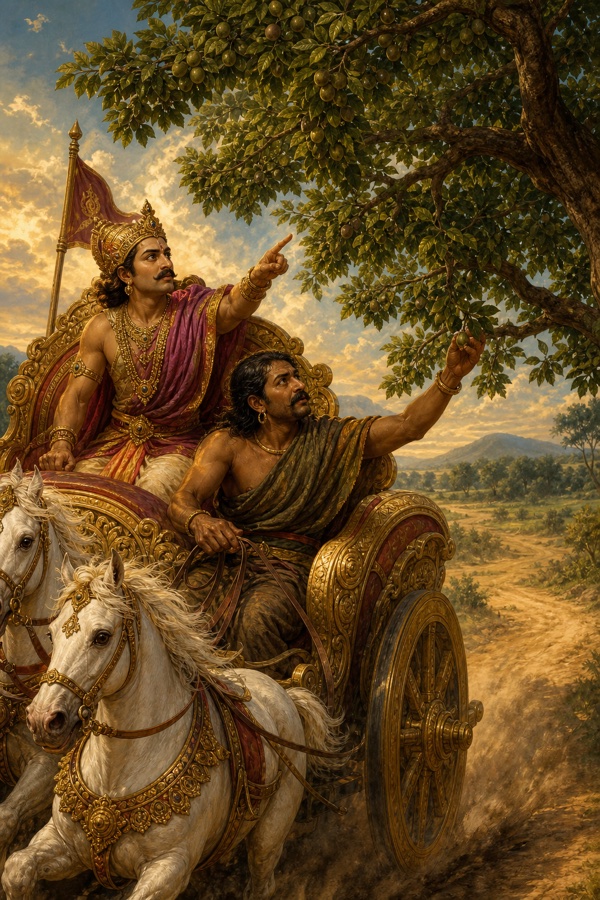
On the way Rituparna’s upper garment fell. He wished to have it fetched, but Nala said they had come a yojana past it and it could not be recovered. Farther on, seeing a vibhitaka tree laden with fruit, Rituparna said, “O Bahuka, behold my art of calculation: on two branches of this tree there are 50 million leaves and 2,095 fruits; those fallen on the ground are 101 more than those above.”
Nala did not believe it. Stopping the chariot, he cut down the branch and counted, and the number came out exactly as the king had said. Amazed, Nala said, “Teach me this art.” Rituparna said, “I am skilled in the science of numbers and also in the science of dice.” Nala said, “Then give me this science, and take my lore of horses in exchange.” Pressed by the need for haste and drawn by the lore of horses, Rituparna said “So be it” and gave Nala the science of dice.
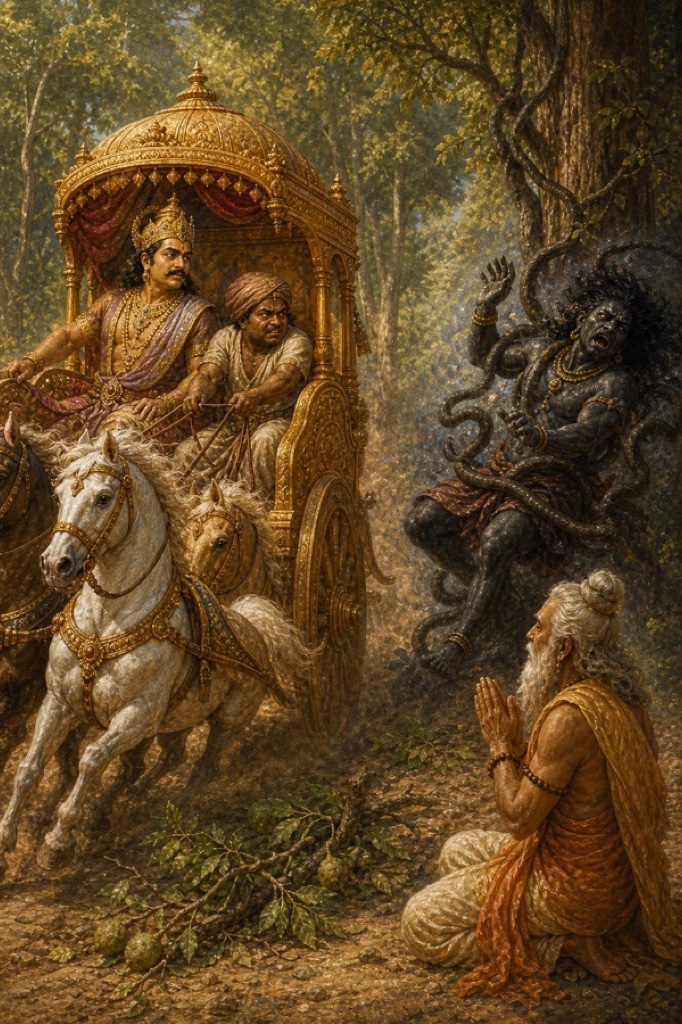
The moment Nala gained the science of dice, Kali came out of him, vomiting Karkotaka’s venom from his mouth. As the Kali who had burned with Damayanti’s curse came out, that fire of the curse left him too. In wrath Nala moved to curse Kali, but the frightened Kali said with folded hands, “Hold your anger, O king. By the curse of Indrasena’s mother I have burned in your body all this time. Do not curse me, who take refuge in you; those who listen to your story with care will be free of fear from me.” Hearing this, Nala held his anger, and Kali entered that vibhitaka tree. From that moment the vibhitaka was held unclean.
Free of Kali and full of joy, Nala drove the chariot swiftly toward Vidarbha. But he had not yet taken back his true form; he was still Bahuka.
A sub-tale: This episode opens a deep irony of the tale: Nala’s fall came through dice, and his deliverance comes through that same science of dice, gained from Rituparna. Attaining mastery in the very art where his weakness lay, he is freed of the bondage of Kali. To understand an evil at its root becomes the path of release from it.
The gist: On the hundred-yojana journey, Nala and Rituparna exchanged the lore of horses and the science of dice; the moment Nala gained the science of dice, Kali came out of his body, and Nala pressed on toward Vidarbha still in the form of Bahuka.
The rattle of the chariot at Kundina, and Damayanti’s test
At dusk Rituparna reached Kundina. The rattle of his chariot rang out in all ten directions. Nala’s old horses heard it and rejoiced as if Nala himself had come. To Damayanti too that cloud-like thunder seemed the sound of Nala’s chariot. The peacocks, elephants, and horses of the palace turned toward that sound and cried out in joy.
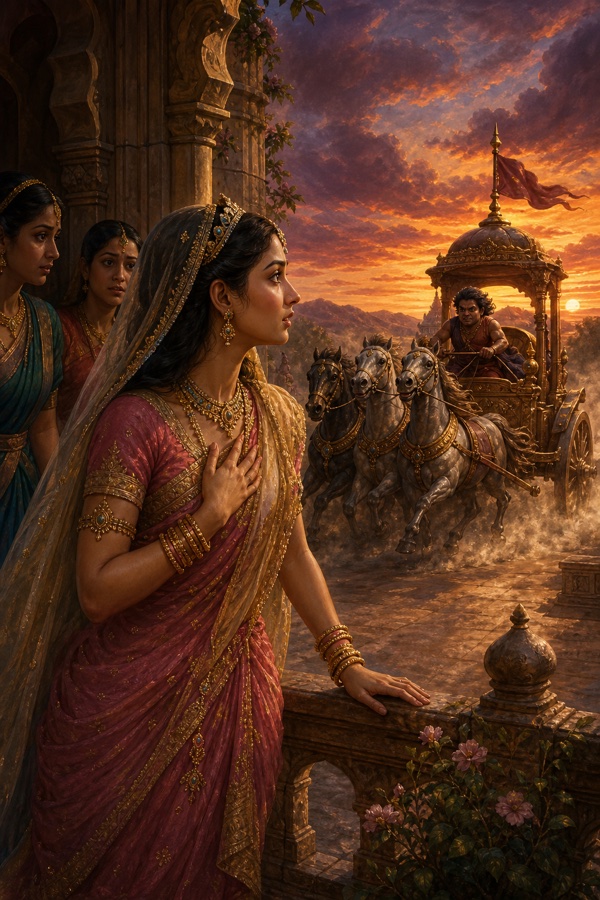
Damayanti cried out, “This chariot-rattle gladdens my heart; surely Nala has come. If today I do not see Nala, I shall not live.” She climbed to the terrace, but there on the chariot she saw Rituparna, Varshneya, and Bahuka, and not Nala. She thought, “Has Varshneya learned this art from Nala, or is Rituparna as skilled as Nala?”
King Bhima received Rituparna with honor, but Rituparna saw no sign of a svayamvara anywhere, nor any gathering of kings. Puzzled, he said only, “I have come to pay my respects to you.” Bhima wondered why anyone would cross a hundred yojanas only to pay respects, but he lodged Rituparna in a guest chamber.
Meanwhile Bahuka took the chariot to the stables, freed the horses, and sat down beside the chariot. Damayanti sent her companion Keshini: “Go, ask after the welfare of that unsightly, short-armed charioteer, speak to him the words of Parnada, and listen closely to his answer.” Keshini went and recited that same verse.
As he heard it, Nala’s eyes filled with tears. Holding back his grief, he gave again the same answer, that a chaste woman does not grow angry at her husband in calamity, for he was helpless and hemmed in by misfortune. Keshini returned and told Damayanti all.
The gist: From the chariot-sound Damayanti sensed Nala’s coming, but seeing Bahuka on the chariot she was thrown into doubt; hearing his answer to the verse sent through Keshini, her suspicion deepened.
Bahuka’s wonders, and the touch of the children
Damayanti sent Keshini again: “Watch his conduct in silence; when he asks for fire or water, delay in giving it, and tell me all you see, human or beyond human.” Keshini returned with wonders: “Such a self-controlled man I have never seen or heard of. He does not stoop; the doorways rise of themselves. Narrow openings widen. Empty vessels fill with water at his glance. A handful of grass held to the sun catches fire; he touches fire and is not burned. Flowers pressed in his hand open the wider instead of wilting.”
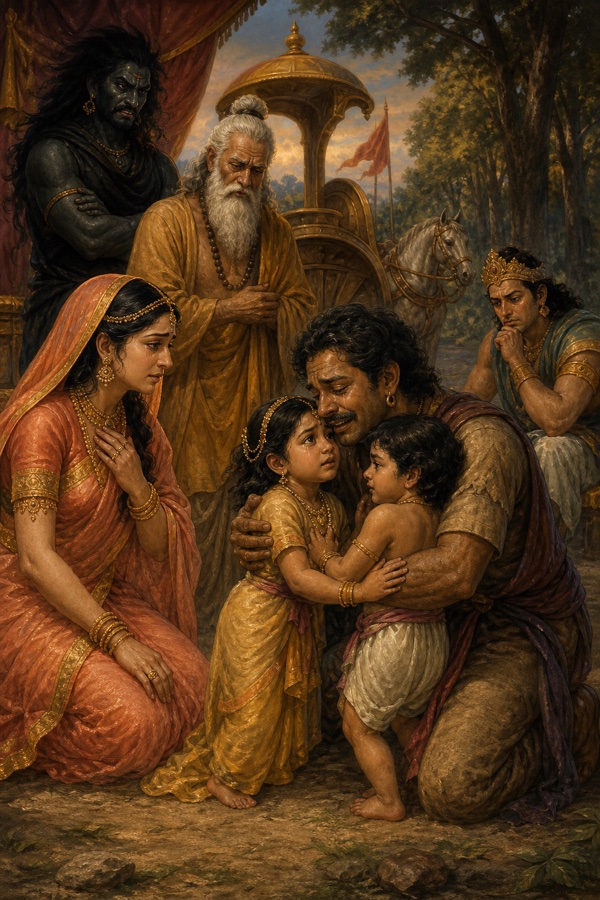
Hearing these signs, Damayanti took Bahuka to be Nala. She had Keshini fetch some meat that Bahuka had cooked. Having many times before tasted Nala’s cooking, Damayanti knew from the taste that this was Nala, and wept. Then she sent her two children, Indrasena and Indrasena, with Keshini to Bahuka. Recognizing the children, Nala ran, caught them up, and wept aloud. Then, suddenly setting them down and hiding his feeling, he said to Keshini, “These twins are like my own children; the sight of them filled my eyes with tears. If you come to me again and again, people will think otherwise, for we are strangers and guests.”
The gist: Through the many wonders Keshini saw, and the taste of the food Nala had cooked, Damayanti recognized Bahuka as Nala; at the sight of the children Nala broke down and wept, yet kept his identity hidden.
The reunion: the return of his form, and the witness of the Wind-god
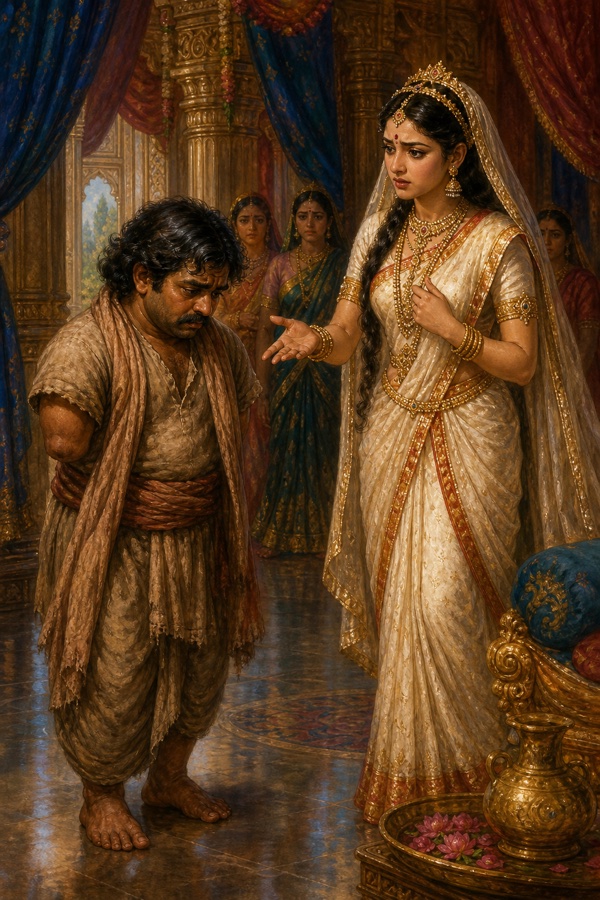
With the leave of both her parents, Damayanti had Bahuka summoned to her chamber. Seeing Nala before her, she said in grief, “O Bahuka, have you ever heard of a man who knew his duty and yet left his sleeping wife in the forest? Who but Nala could leave his innocent, weary wife in the woods? Where has that vow gone, taken before the fire and the gods, when he held my hand and said, ‘I am yours’?” As she spoke, tears streamed from her eyes.
Nala too, shedding tears, said, “O timid one, neither the loss of my kingdom nor your desertion was my act; both were done through Kali. The Kali you cursed in the forest dwelt within me, burning with your curse like fire within fire. By my own discipline I overcame that wretch; he has left me, and that is why I have come, for you alone. But, O timid one, would any other woman forsake her loving husband and choose a second, as you have? At the king’s command heralds went about proclaiming that Bhima’s daughter would choose a second husband, and hearing this the son of Rituparna’s line came here.”
Trembling, Damayanti folded her hands and said, “Find no fault in me. Passing over the gods themselves, I chose you. It was to bring you here that the Brahmanas sang my words in every direction, and Parnada found you in Kosala. Only you could travel a hundred yojanas in a day, and so I devised this scheme. Touching your feet, I swear I have committed no sin even in thought. If I have, let the all-witnessing wind take my life, let this sun and this moon take my life.”
Then from the sky the Wind-god said, “O Nala, I say truly, she has done no wrong. Damayanti has guarded the honor of her family and raised it higher. For three years we have been her protectors, and we are her witnesses. For your sake alone she devised this matchless scheme, for none but you can travel a hundred yojanas in a day. Now be united with your partner.” As the Wind-god spoke, a shower of flowers fell, celestial drums sounded, and an auspicious breeze blew.
Then Nala cast away all doubt and, remembering the serpent-king Karkotaka, put on the celestial garment and regained his true form. Seeing her righteous husband in his own form, Damayanti clung to him and wept, and Nala too embraced his wife and children and felt the highest joy. The queen-mother told King Bhima all the news. In the fourth year after the loss of his kingdom, Nala was reunited with his wife, and with every wish fulfilled found the highest happiness, as dry fields turn green with rain.
The gist: The Wind-god bore witness from the sky to Damayanti’s chastity; Nala regained his true form by the celestial garment Karkotaka had given, and in the fourth year after losing his kingdom the husband and wife were reunited.
The final wager with Pushkara, and the recovery of the kingdom
After a month in Vidarbha, Nala returned to the Nishadhas with a small force, a single white chariot, 16 elephants, 50 horses, and 600 foot soldiers. Going to Pushkara, he said, “We will play again. I have earned much wealth. Damayanti and all I have will be my stake, and your kingdom your stake. Or, if not dice, come, let us settle it in a single combat of arms. Choose one of the two.”
In the pride of his victory Pushkara laughed and said, “It is good that you have brought wealth to stake again. Today I will win Damayanti and keep her by me like an apsara; it is she who has dwelt in my heart.” Hearing this vile talk, Nala’s anger flared, but he held himself in check and said, “Play; say what you like after you win.”
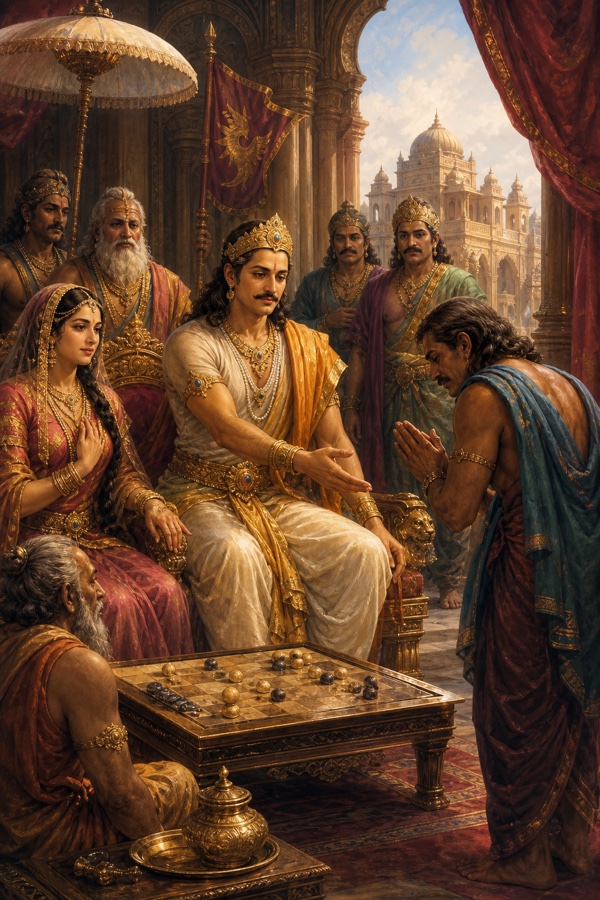
The game began, and at a single throw Nala won back all his wealth and kingdom, and the staked life of Pushkara as well. Then, smiling, Nala said, “This kingdom, free of any thorn, is now undisturbedly mine. You can no longer even look at Damayanti; with all your family you are now as her slave. But my first defeat was no fault of yours; it was all the work of Kali, and so I do not lay another’s fault on you. I grant you your life and your ancestral share. My brotherly love for you is the same as before. O brother, live a hundred years.”
Nala embraced Pushkara and gave him leave to go to his own city. Pushkara, folding his hands, said, “O king, you have given me both life and refuge; may your fame be immortal, may you live happily ten thousand years.” After a month with Nala, Pushkara returned to his own city with a glad heart.
A sub-tale: Here the tale shows a rare generosity. Nala had lost everything at dice, yet on winning he gives Pushkara back both his life and his share, and says that the true culprit was Kali, not Pushkara. This moment of forgiveness in place of vengeance raises Nala’s character higher after his fall.
The gist: Returning, Nala challenged Pushkara to a wager and won back his kingdom and wealth at a single throw, yet kept his brotherly love by granting Pushkara his life, his ancestral share, and his forgiveness.
The fruit of the tale, and consolation for Yudhishthira
Having regained his kingdom, Nala entered his decorated palace, and the people thrilled with joy. Then, with a great force, Nala brought Damayanti, with his son and daughter, honorably from Vidarbha. King Bhima too sent his daughter forth with respect. Famed among the kings of the island of Jambu, Nala once more ruled in righteousness and made abundant gifts and sacrifices.
Ending the tale, Brihadaswa said to Yudhishthira, “Thus did King Nala fall with his wife into dire calamity through dice, and then recover it all. But he was utterly alone, while you are with your heroic brothers, with Draupadi, and with Brahmanas learned in the Vedas. It does not become you to grieve. The effort of man and the will of fate are both uncertain; understanding this, one should feel neither too much joy in fortune nor too much grief in calamity. Whoever hears or tells this tale will not be touched by calamity, and the fear of Kali will stay far from him.”
Then the sage said, “And that fear which troubles you, that some man skilled at dice may challenge you again, I will drive away as well. I know the whole science of dice; being pleased with you, I give it to you.” Gladly Yudhishthira received the science, and Brihadaswa went to bathe in the sacred waters of Hayasirsha.
After he had gone, Yudhishthira heard from pilgrims and ascetics that his dear brother Arjuna was sunk in fierce austerities, living on air alone. Hearing this, the grieving Yudhishthira, in that vast forest, sought consolation in the company of Brahmanas who lived with him.
A key to reading this (the tale’s purpose): This tale is a double medicine for Yudhishthira. On one side it consoles him that Nala too lost everything and wandered alone, and then regained it all; on the other, Brihadaswa at the end gives Yudhishthira the science of dice and so removes his particular fear that someone will beat him at the game again. Tale and boon together give Yudhishthira the strength to go on.
The gist: Having regained Damayanti and his kingdom, Nala ruled in righteousness; Brihadaswa consoled Yudhishthira with this tale and gave him too the science of dice, which drove away his fear of the game.
Source: the Mahabharata of Krishna-Dwaipayana Vyasa, Vana Parva, Nalopakhyana, Sections 52-79. The Gita Press Hindi edition is the controlling witness. The Sanskrit e-text and an independent complete translation were used to verify names, sequence, and principal events. Where recensions differ, this retelling follows Gita Press.
Based on: The Mahabharata, Vedavyasa (Gita Press, Gorakhpur)