On this page
The twelve years of exile in the forest had been lived out to the end. The Pandavas had come back from the Kamyaka woods to the forest of Dvaitavana with everything that still belonged to them: their chariots and charioteers, their cattle, their followers, and the citizens who had gone into the wilderness behind them. Draupadi had been carried off and won back, and the king of the Saindhavas had been beaten for it. The sage Markandeya had sat among them and told the ancient stories of gods and rishis. Now the five brothers lived on what fruit the forest gave and kept the hard vows of their banishment, and one more year lay ahead of them, the thirteenth, which they would have to pass without a single person learning who they were. In that lull a trouble found them. It came on behalf of a Brahmin and it looked like plain bad luck. Before it was done, four of the five brothers would lie dead at the edge of a lake, and the eldest would stand alone in the water, answering for all of them.
The return to Dvaitavana, and a Brahmin’s calamity
Janamejaya, the Kuru king for whom this whole history was being told, wanted to know what came after the rescue. “They had been made to suffer the abduction of their wife,” he said, “and they had taken Draupadi back. What did the Pandavas do next?” Vaishampayana, who was telling it, took him to Dvaitavana. Yudhishthira, a king whose good name no misfortune had managed to dim, had felt that abduction as a deep wound, and when it was over he led his brothers out of Kamyaka and back to the forest they had lived in before, a lovely place to look at, crowded with trees and rich in sweet fruit and roots. There the sons of Pandu settled again with their wife. They ate sparingly, fruit and little else, and they held themselves to every vow they had taken.
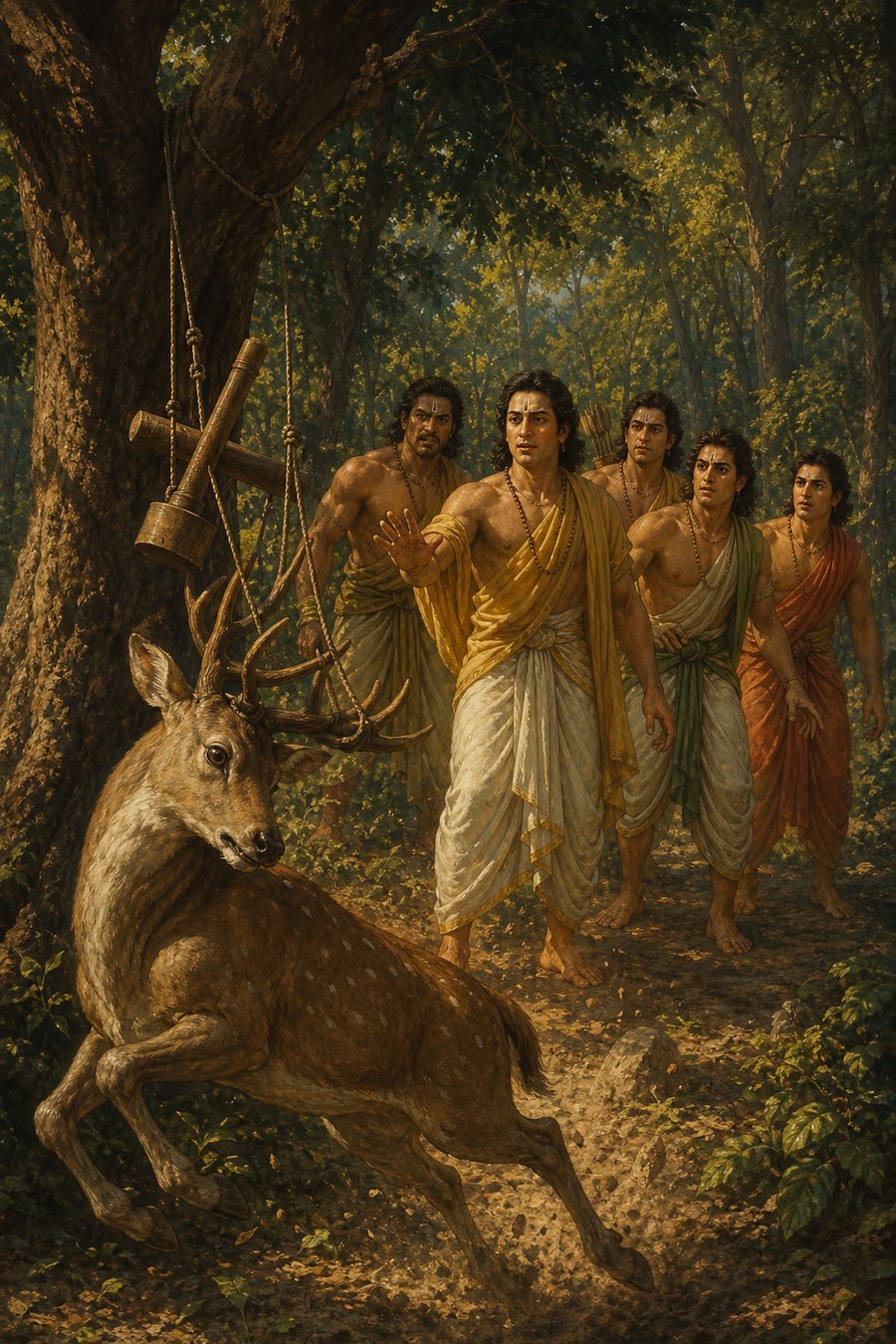
Vaishampayana promised the king the whole of what followed: the trouble those brothers went through in that forest for a Brahmin’s sake, and the happiness that was folded inside it. Yudhishthira, Bhimasena and Arjuna, the three sons of Kunti, and the two younger sons whom Madri had borne to Pandu, were all living at Dvaitavana under their vows when it began, and it began with an animal. A deer was butting about near a hermitage. A Brahmin who lived there, a man given over to austerities, had leaned his fire-making gear against a large tree: the two sticks from which a sacred fire is churned, and the churning staff that goes with them. The deer’s antlers went in among them and the whole bundle stuck fast. It was a powerful animal and a very quick one, and it left the hermitage in long bounds with the sticks and the staff riding on its head.
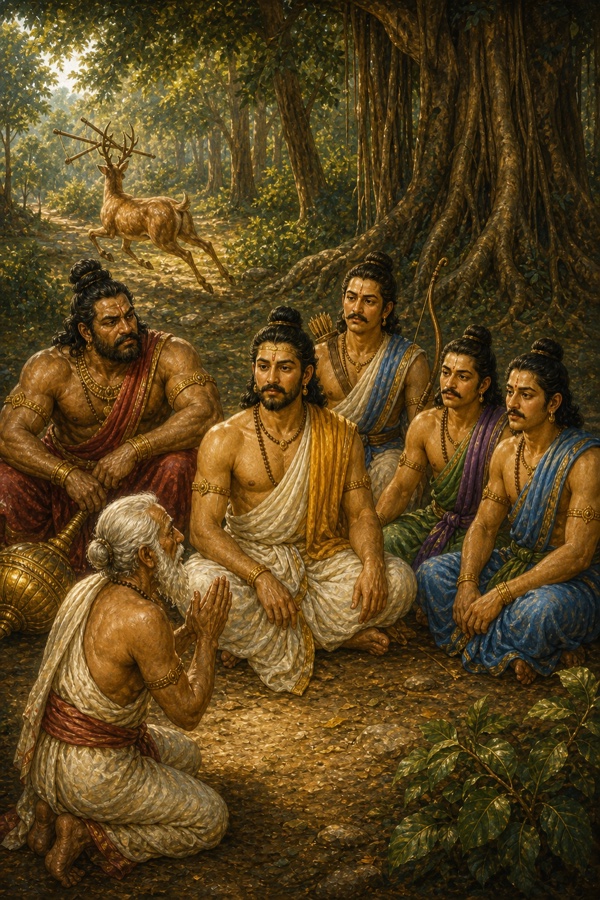
The Brahmin saw them go. Without those sticks there could be no Agnihotra, the worship he offered to Agni in his own fire and was bound never to let lapse, and the fear of that brought him to the Pandavas as fast as he could come. He found Yudhishthira, the king men called Ajatashatru, sitting in the forest among his brothers, and he came up to him in great distress. “A deer was butting about,” he said, “and my fire-sticks and my churning staff, which I had stood against a large tree, caught in its antlers. It is a strong animal and a fast one. It has gone out of the hermitage in long bounds and carried my things away with it. Follow it by its tracks, sons of Pandu, and bring them back to me, so that my Agnihotra does not stop.”
Yudhishthira took the Brahmin’s trouble to heart at once. He picked up his bow and went out, and his brothers went with him, all five of them buckling on their corselets and carrying their bows, intent on doing the Brahmin this service. They moved fast along the trail and soon caught sight of the deer no great way ahead. These were five of the great chariot-warriors of their age, and they loosed barbed arrows at it, and javelins, and darts, and nothing they sent would pierce it. They pressed on after it, straining to run it down and kill it, and in the middle of the chase the deer was suddenly no longer there to be seen.
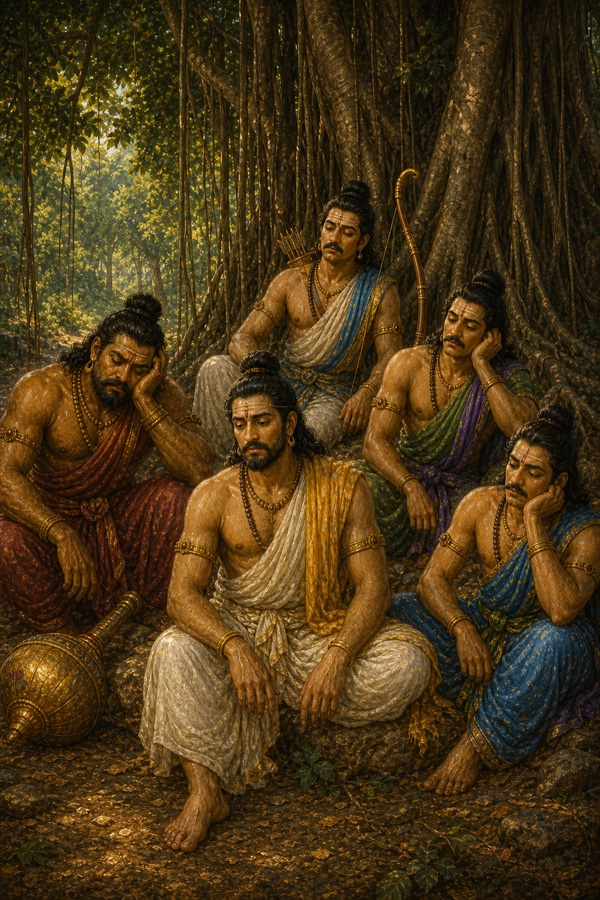
With the deer gone there was nothing left to follow. The brothers had done an honorable thing and failed at it, and they were tired, disappointed, and by now tormented by hunger and thirst. Deep in that forest they came to a banyan tree and sat down in its cool shade. It was Nakula who spoke. Sorrow had hold of him, and impatience pushed the words out, and he turned to his eldest brother, the head of their Kuru house. “In our family virtue has never been given up, and no wealth of ours was ever lost through arrogance. When any creature asked us for something, we never once said no. Why, then, has a disaster like this come to us now?”
A key to reading this (the fire-sticks and the Agnihotra): The two sticks and the churning staff are the Brahmin’s means of kindling his fire, and the Agnihotra is the fire worship he has to keep going without a break. With the sticks gone the rite would stop, and that is the whole of his plea: bring them back, so that my Agnihotra is not interrupted. Yudhishthira carries the plea with him to the end of the day. When a god offers him whatever he likes, the first thing he asks is that this Brahmin’s worship of Agni should go on unbroken.
The gist: With the twelve years in the forest lived out and Draupadi’s abduction not long behind them, the Pandavas are back in Dvaitavana when a deer runs off with a Brahmin’s fire-sticks and churning staff caught in its antlers. All five brothers arm and give chase. Their arrows, javelins and darts cannot pierce the animal, it vanishes in front of them, and they are left hungry and thirsty under a banyan, where Nakula asks why a family that never gave up virtue or refused a request should meet with such a thing.
The brothers reflect on the cause of the calamity
Yudhishthira did not pretend to know. “There is no limit to the calamities that can come,” he said. “Nobody can trace one back to its first cause or forward to its last. Only the lord of justice deals out the fruit of what is done well and what is done badly.” He was speaking of Dharma, the god whose son he was, and he had no way of knowing how near to that banyan the god was standing. Bhima had an answer of his own, and it was a name. “This has come on us because of the Pratikamin, that attendant of Duryodhana’s. He dragged Draupadi into the assembly hall as if she were a slave, and I did not kill him on the spot.”
Arjuna took the blame next. “It has come on us because of me. The charioteer’s son said things that bit through to the bone, and I let them pass and made him pay nothing for them.” He meant Karna. Then Sahadeva, the youngest, spoke to his eldest brother. “It has come on us because I did not kill Shakuni on the day he beat you at dice.” Three brothers had named three scores left unsettled, and none of the three answers could give them water.
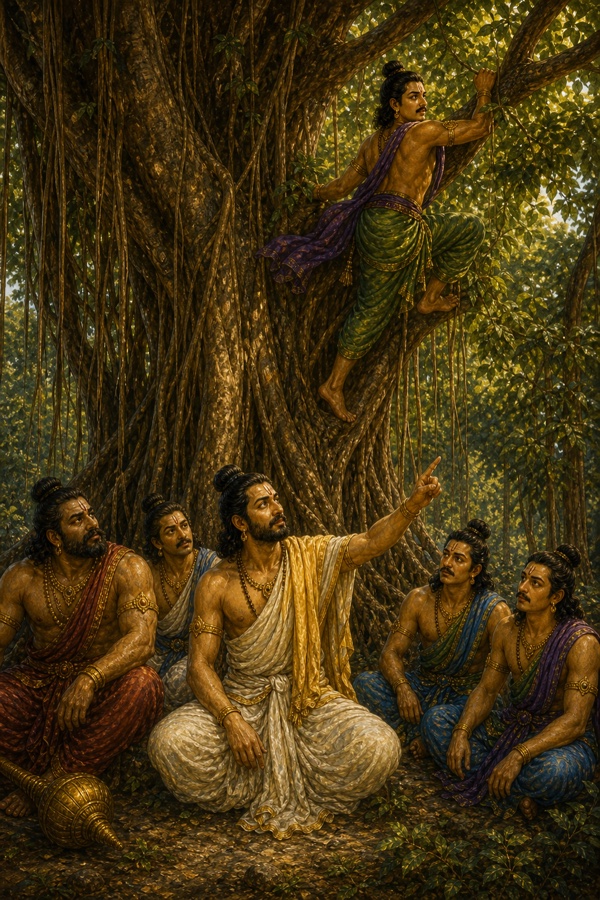
Yudhishthira let the three answers lie and turned to the need in front of him. “Nakula,” he said, “climb this tree and look out toward all ten points of the horizon. See whether there is water anywhere near us, or the kind of trees that grow on wet ground. Your brothers are worn out, child, and they are thirsty.” Nakula said, “So be it,” and went up the tree quickly. When he had looked all around, he called down to his eldest brother, “I can see a great many trees of the kind that grow at the water’s edge, and I can hear cranes calling. There is water somewhere here. There has to be.”
Yudhishthira, the son of Kunti, a man who held to the truth in everything he said, answered him gently. “Go, then, and bring water back for us in these quivers.” “So be it,” said Nakula again. At his eldest brother’s word he set off quickly toward the place where the water was, and it did not take him long to come upon it.
The gist: Under the banyan Nakula’s question gets four answers. Yudhishthira says that calamities have no limit, that their causes cannot be found out, and that the lord of justice alone deals out the fruit of virtue and of vice. Bhima blames his own failure to kill the Pratikamin who dragged Draupadi into the assembly, Arjuna his silence under the insults of the charioteer’s son, Sahadeva his failure to kill Shakuni at the dice. Then thirst settles the matter, and Nakula, who has seen waterside trees and heard cranes from the treetop, is sent to fetch water in the quivers.
The unseen voice at the lake, and the fall of the four brothers
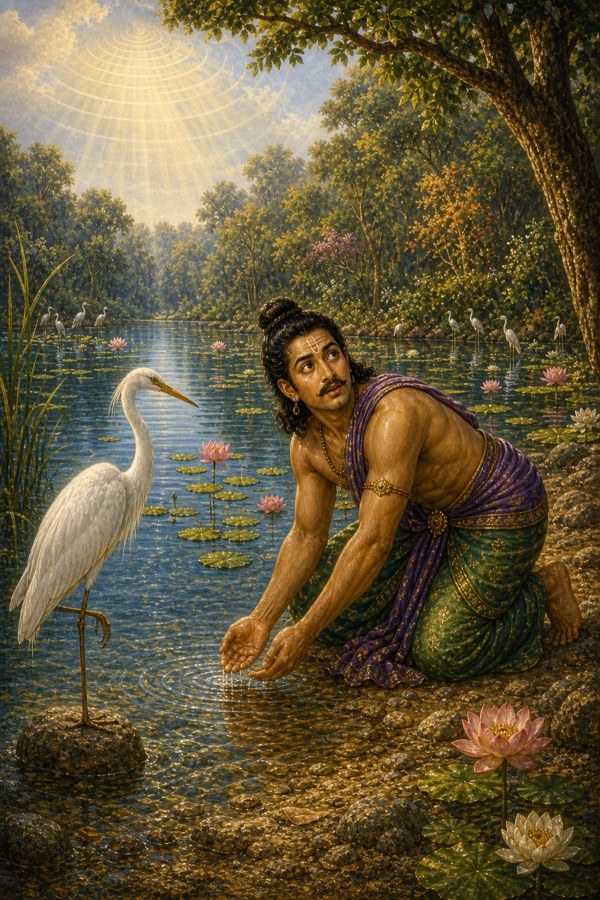
What he found was a lake as clear as crystal, with cranes living on it, and he went straight down to it to drink. Before he could, a voice spoke to him out of the sky. “Do not be rash, child. This lake was mine before you came to it. Answer my questions first. Then drink, and carry away as much as you need.” It had called him the son of Madri, as though it knew him. But Nakula’s thirst was past bearing. He paid the words no attention, he drank the cool water, and the moment he had drunk it he dropped down dead.
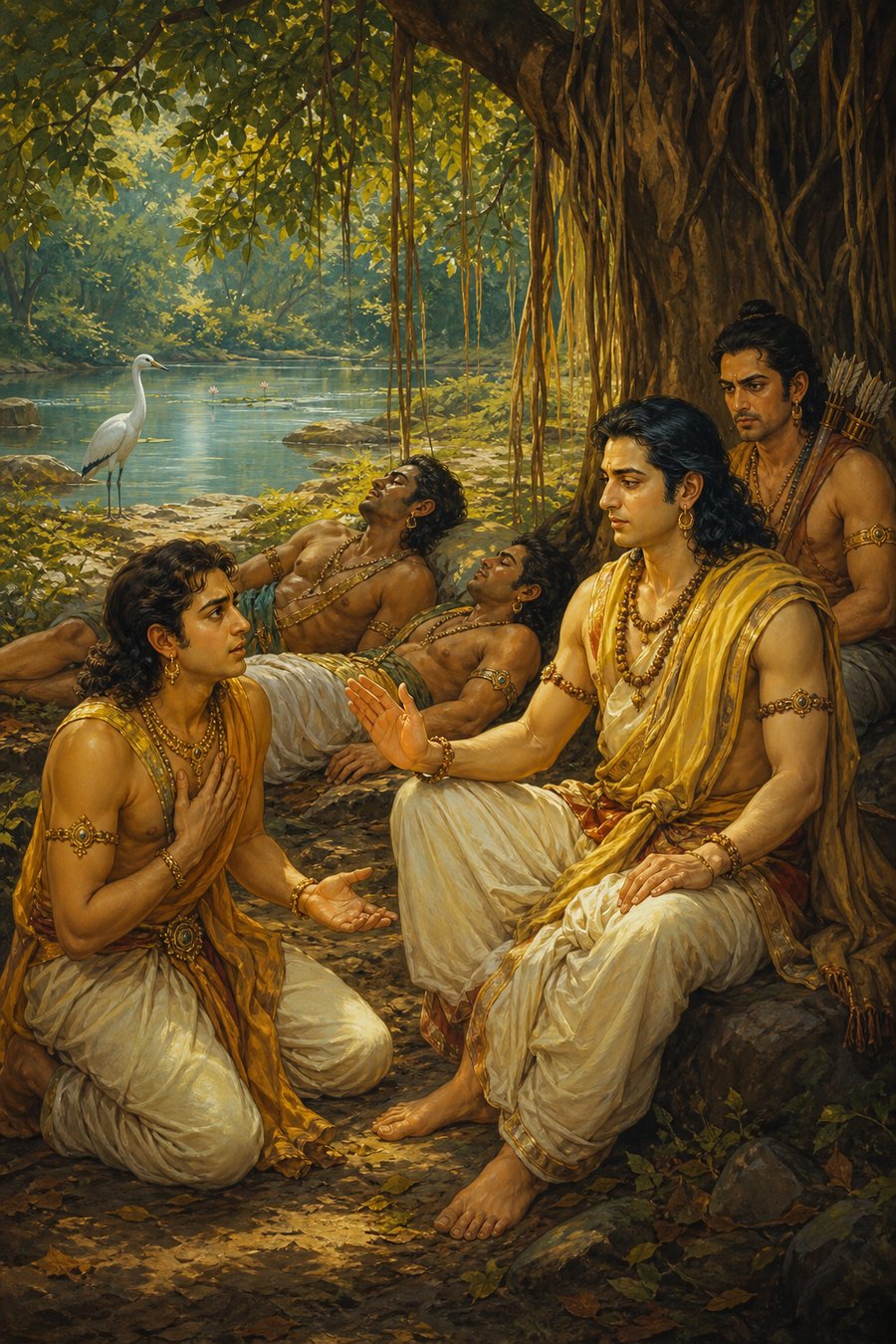
Under the banyan the wait grew long. Yudhishthira turned to Sahadeva, Nakula’s twin and a brave fighter in his own right. “Sahadeva, it is a long time since our brother left us, the one born just ahead of you. Go and bring back your mother’s other son, and bring the water with him.” “So be it,” said Sahadeva, and he went off the way Nakula had gone. He came to the place and saw his brother lying dead on the ground. Grief for him struck hard. But Sahadeva was suffering terribly from thirst as well, and he went on toward the water, and the voice spoke to him as it had spoken before. “Do not be rash, child. This lake was mine before you came to it. Answer my question first. Then drink of the water, and carry away as much as you may need.” Sahadeva was too thirsty to heed it. He drank, and having drunk, he dropped down dead.
Now two were gone, and Yudhishthira spoke to the third of his brothers, to Arjuna, the one men called Vijaya. “Vibhatsu, your two brothers have been gone a long time. Good fortune go with you. Bring them back, and bring water with them. When we are sunk in trouble, child, you are the one all of us shelter behind.” Arjuna was quick of mind and he went prepared, with his bow, his arrows, and his sword bare in his hand. This was the warrior whose chariot ran behind white horses, and he came to that lake and found his two younger brothers, strong men who had gone there only to fetch water, lying dead. They looked as if they were asleep. Grief went through him, and he raised his bow and searched the woods on every side for whoever had done it. In all that great forest he found no one.
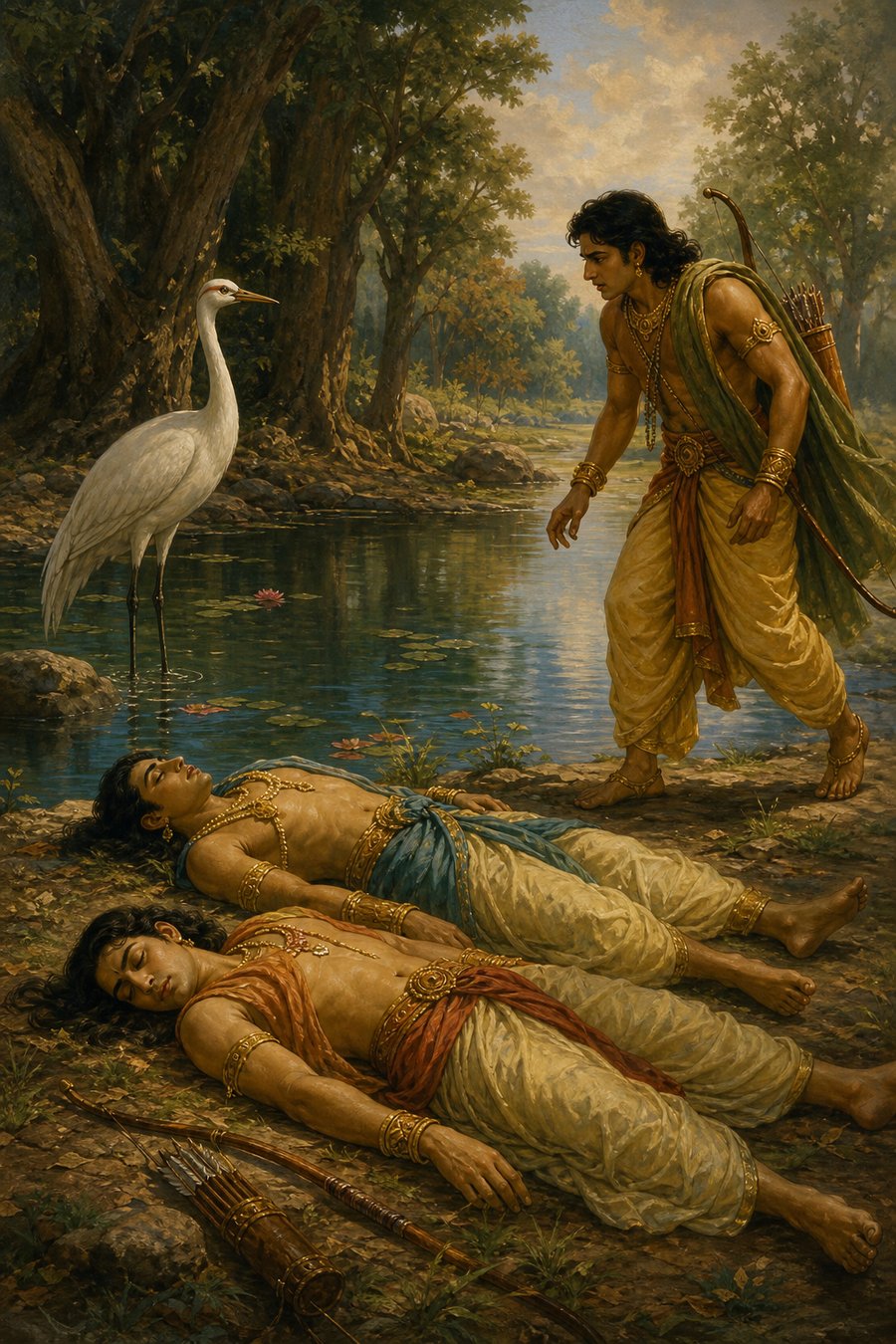
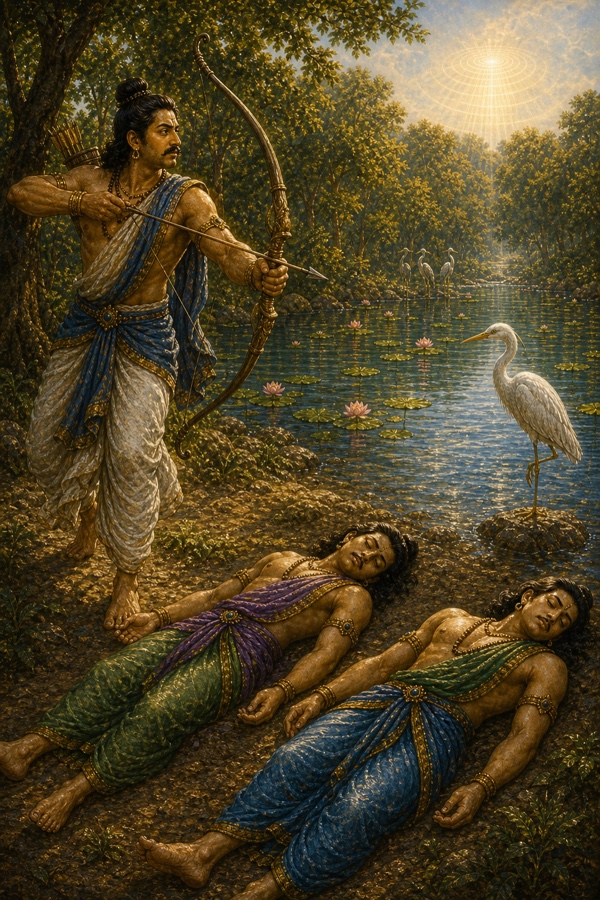
He was tired himself by then. Arjuna, who could draw a bow with his left hand as well as with his right, ran toward the water, and as he ran the words came down on him from the sky. “Why do you come near this water? You will never drink it by force. If you can answer the question I put to you, then and only then will you drink, and carry off as much as you need.” Arjuna had been forbidden by something he could not see, and he answered the way an archer answers. “Come out in front of me and forbid me then. Once my arrows have gone deep into you, you will not talk this way again.” With that he covered every side of him with arrows that had mantras spoken into them. He showed the skill for which he was known, hitting a mark he could not see by its sound alone. Tormented by thirst, he sent barbed darts and javelins and iron arrows after the voice, and rained into the sky more shafts than could be counted, of the kind that are never turned aside.
The Yaksha, still unseen, was unmoved by any of it. “What is the use of all this trouble, Arjuna? Drink only after you have answered my questions. If you drink without answering them, you will die the moment after.” Arjuna had been told as plainly as a man can be told. He was the archer who could draw with either hand, and neither hand had found anything to hit. He disregarded the words, he drank the water, and the moment after he dropped down dead.
Three had gone, and none had come back. Yudhishthira said to Bhimasena, “It is a long while now since Nakula and Sahadeva and Vibhatsu went to fetch water, and they have still not returned. Good fortune go with you. Bring them back, and bring the water.” “So be it,” said Bhima, and he set out for the place where those three strong brothers of his lay dead. He saw them. He was suffering from thirst himself, and even so the sight of them distressed him deeply. Bhima, in whom the strength of ten thousand elephants was said to live, judged that this was the work of some Yaksha or Rakshasa, and he reasoned as a fighter reasons. “I will certainly have to fight today,” he thought. “Let me quench this thirst first.” And he ran forward to drink.
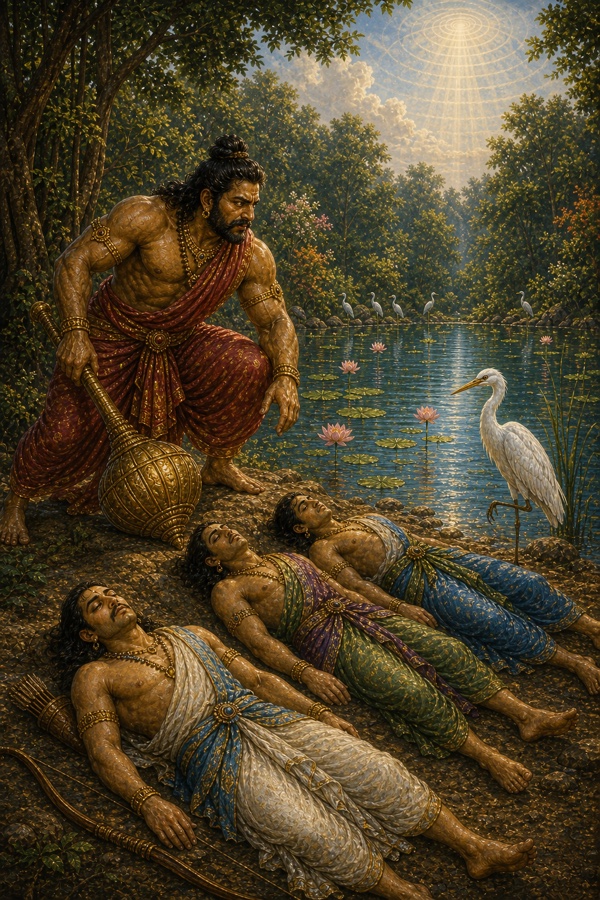
The Yaksha spoke to him as it had spoken to the twins. “Do not be rash, child. This lake was mine before you came to it. Answer my questions first. Then drink, and carry away as much water as you need.” The being behind that voice had a strength no one could have measured. Bhima gave its questions no answer at all. He drank, and as soon as he had drunk he fell dead on the spot where he stood. Under the banyan, one brother was left.
A sub-tale: All four heard the warning before they drank. Nakula was too thirsty to listen. Sahadeva saw his twin lying dead and was still too thirsty to listen. Arjuna told the voice to show itself, shot at the sound of it with arrows charged by mantras, was told a second time that he would die, and drank. Bhima guessed that a Yaksha or a Rakshasa was at work, expected a fight, and drank first so as to be fit for it. Each of them was asked to answer questions, and none of them offered to. That is the one thing left for the fifth brother to try.
The gist: Nakula finds a clear lake with cranes on it, hears a voice from the sky claim the lake and demand answers before he drinks, drinks anyway and falls dead. Sahadeva, sent after him, does the same. Arjuna searches the forest with his bow raised, challenges the unseen speaker, fills the sky with arrows, drinks and dies. Bhima takes it for the work of a Yaksha or a Rakshasa, means to drink before he fights, and dies as soon as he has drunk.
Yudhishthira reaches the lake, and grieves
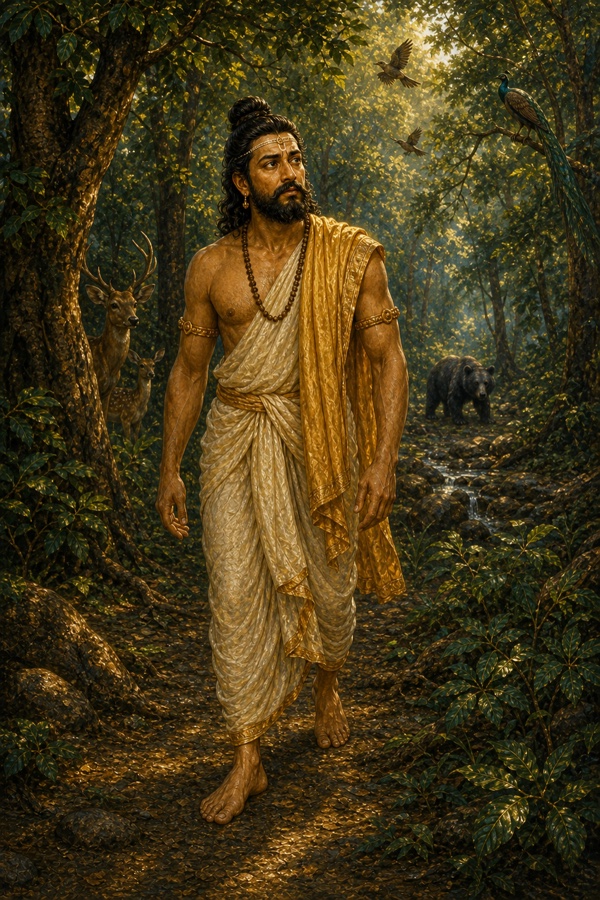
Yudhishthira waited. He told himself that his brothers had been gone a long time, and he waited a while longer, and again and again he asked himself the same things. “Why are the two sons of Madri so long? Why is the bearer of the Gandiva so long? And Bhima, with all that strength in him, why is he so long? I will go and look for them.” Having resolved on it, he got to his feet, a long-armed man with grief already burning in his heart. As he went, this king who was the son of Kunti turned the possibilities over one by one. “Is some malign power at work in this forest? Is it full of vicious animals? Have they all fallen because they slighted some mighty being? Or did they find no water in the place they went to first, and have they spent all this time searching the forest for it? What reason can there be that men like those do not come back?”
With such questions for company he went into that great forest, a king whose name stood above the names of other kings, walking alone. No human sound reached him there. Deer lived in it, and bears, and birds. The trees stood bright and green, and the whole wood hummed with black bees and rang with the notes of songbirds. He walked on, and then he saw the lake. It was so beautiful that it might have been made by the craftsman of the gods himself. Flowers the color of gold grew about it, with lotuses and sindhuvara, and its banks were thick with cane, with ketaka and karavira, and with pippala trees. Yudhishthira was worn out with toil, and he looked at that water and was struck with wonder. Then he saw what lay beside it.
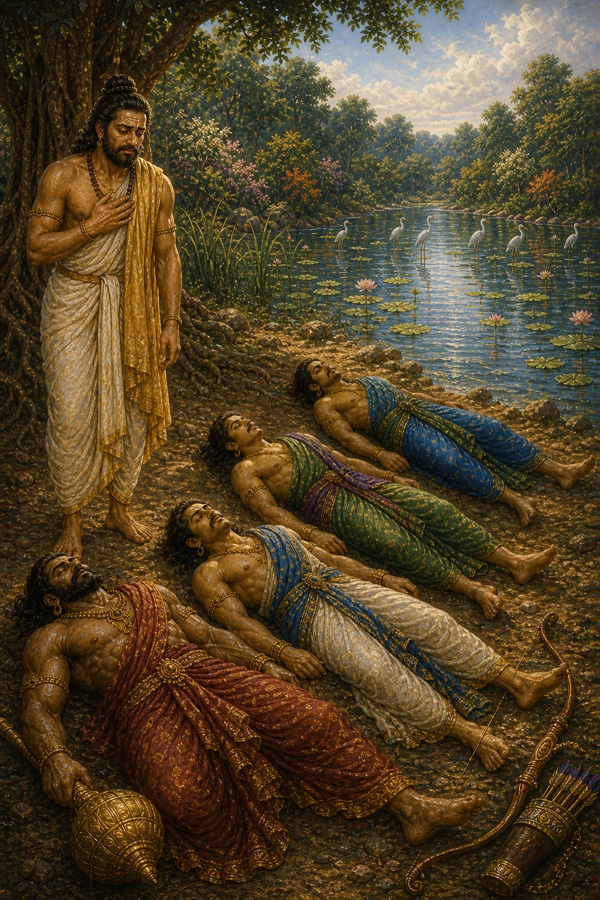
His brothers lay there dead. Each of the four had carried a glory like that of Indra himself, and they lay like the guardians of the world’s quarters, thrown down from their stations when an age comes to its end. He saw Arjuna dead, with his bow and his arrows dropped on the ground. He saw Bhimasena, and he saw the twins, motionless, with the life gone out of them. The king let out one long, hot breath, and the tears of his grief ran down and covered him.
He was the son of Dharma and a man of great strength, and now dread had hold of his heart, and he began to mourn them aloud, at length, speaking to each as though each could hear. “Vrikodara,” he said to Bhima, “you made a vow. You said, ‘In battle I will break the thighs of Duryodhana with my mace.’ You added to the glory of the Kurus, you with your great arms and your great heart, and now that you are dead all of that has come to nothing. The promises of men may fail. Why, then, have the words of the gods failed as well? Dhananjaya, when you lay in the room where your mother had given birth to you, the gods said, ‘Kunti, this son of yours will be no less than Indra of the thousand eyes.’ And in the northern Paripatra mountains every creature sang about you: ‘The fortune of this house, when its enemies have robbed it, will be won back by this one, and without delay. No one will be able to defeat him in battle, and there will be no one he is unable to defeat.’ How, then, has Jishnu, with all that strength in him, come under the power of death? Every misery we have borne until today, we bore leaning on Dhananjaya. Why does he lie on the ground and kill every hope I had?
“These were heroes, the strong sons of Kunti, Bhimasena and Dhananjaya. They were the ones who killed their enemies, always, and no weapon could stand against them. How have they come under the power of an enemy? This vile heart of mine must be made of adamant. I see the twins lying on the ground today, and it does not split. You stood above other men, all of you. You knew the sacred texts. You understood what a time and a place demanded. You had the merit of your austerities, and you performed every sacred rite as it ought to be performed. Why do you lie down with the deeds that were worthy of you still undone? Why do you lie senseless on the earth, with no wound on your bodies, unbeaten, with your vows untouched?”
They looked to him the way they used to look when they slept on the slopes of the mountains, in a sweet and easy sleep. The king, great-hearted as he was, was overwhelmed. Sweat ran down him, and grief brought him to a wretched state. “It is so,” he said. “It is even so.” Having admitted that much, this good king, drowning in his grief, set himself anxiously to find out what had caused the catastrophe. He was a strong man and a clear-minded one, with a sure sense of what belongs to a place and to a time, and for all that he could not settle on what he ought to do.
He mourned for a long time in that way. Then Yudhishthira, the son of Dharma, took hold of himself and began to think about who could have killed men like these. “There is no mark of a weapon on any of them,” he reasoned, “and there is no one’s footprint here. Whoever killed my brothers must be a being of great power. I will think this through with care. Or let me drink the water first, and then I shall know everything. It may be that Duryodhana, whose mind always runs crooked, had this water secretly placed here by the king of the Gandharvas. What man of sense can trust a wicked creature of evil passions, to whom good and evil are the same? Or it may be that the wicked man did this through secret messengers of his own.”
So his thoughts ran, first one way and then another, for his was a powerful mind. One thing he would not believe, and that was that the water had been tainted with poison. His brothers were dead, and yet the pallor of a corpse was on none of them. “The color in the faces of my brothers has not faded,” he thought. And the king reasoned further: “Each of these men had the force of a great waterfall. Who could have stopped them like this, unless it was Yama himself, who brings all things to their end when their time has come?” With that settled in his mind, he began his ablutions in the lake, and stepped down into the water.
A key to reading this (the matter of corpse-pallor): Yudhishthira reasons from what he can see. There are no weapon marks on the bodies and no footprints near them, so no ordinary attacker did this. The faces of the dead have kept their color and show no corpse-like pallor, so he rules out poison in the water, even while he suspects Duryodhana of a trick worked through the king of the Gandharvas or through secret messengers. What remains is a power on the scale of Yama, who ends all things in their time, and with that conclusion he walks into the lake.
The gist: Yudhishthira follows his brothers through a forest of deer, bears, birds and black bees to a lake that looks like the work of the craftsman of the gods, and finds all four lying dead beside it. He mourns Bhima’s vow to break Duryodhana’s thighs and the prophecies spoken at Arjuna’s birth, wonders that his own heart does not split at the sight of the twins, then steadies himself, rules out weapons and poison, and concludes that only Yama could have brought such men down. He steps into the water to bathe.
The Yaksha appears, and the condition
He was still going down into the lake when he heard the words from the sky. It was the Yaksha who spoke them, and this time the speaker gave an account of itself. “I am a crane, and I live on tiny fish. It is I who have sent your younger brothers into the power of the lord of the departed. If you do not answer the questions I put to you, you will make the fifth corpse. Do not be rash, child. This lake was mine before you came to it. Answer my questions first. Then drink, and carry away as much as you need.” It called him a prince and the son of Kunti, and it called him child.
Yudhishthira did not argue about the water. He wanted to know what he was talking to, and he began with the great companies of the gods. “Are you the chief of the Rudras, or of the Vasus, or of the Maruts? I ask you which god you are. No bird could have done this. Who is it that has thrown down four mighty mountains, Himavat and Paripatra and Vindhya and Malaya? It is a great feat that you have performed, you who are strongest among the strong. Gods could not stand against these four in a great battle, and neither could Gandharvas, or Asuras, or Rakshasas, and you have killed them. What you have done is a wonder past all wonders. I do not know what your business is, and I do not know what you intend. So a great curiosity has taken hold of me, and fear along with it. My mind is badly shaken, and my head is aching. I ask you with all respect: who are you, who live in this place?”
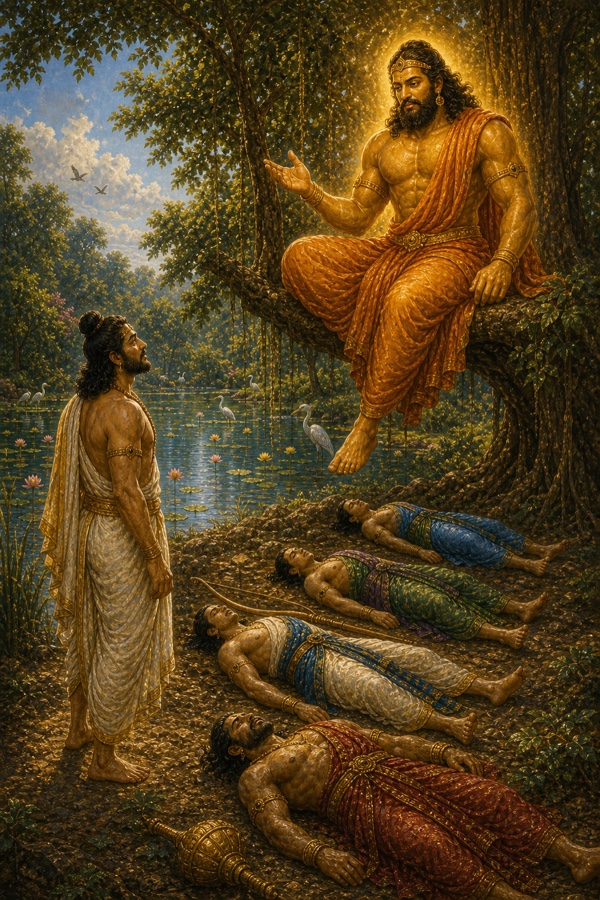
The voice answered him. “Good fortune to you. I am a Yaksha. I am no bird of the water. All these brothers of yours, with all their great strength, were killed by me.” They were hateful words, and the syllables they came in were harsh, and Vaishampayana told the king how Yudhishthira, having heard them, walked toward the one who had spoken and stood before him. Then he saw the Yaksha. Its eyes were unlike any eyes he knew. Its body was huge, as tall as a palmyra palm, and it shone like fire, or like the sun. Nothing could have withstood it. It was up in a tree, as massive as a mountain, and it was roaring, a roar as deep as the roar of the clouds.
“Your brothers were forbidden by me again and again,” the Yaksha said, “and still they would take the water by force. That is why I killed them. No one who wishes to live should drink this water. Do not be rash. This lake was mine before you came to it. Answer my questions first, and then take away as much as you like.” Yudhishthira gave it a king’s reply and a modest one. “Yaksha, I have no wish for what is already yours. And good men never approve of a man who praises himself, so I will make no boast. I will answer your questions as far as my understanding goes. Ask me.”
A key to reading this (who the Yaksha is): The speaker changes its account of itself as the day goes on. To the four younger brothers it is only a voice from the sky that owns the lake. To Yudhishthira it first calls itself a crane that lives on tiny fish, then a Yaksha and no water bird, and he sees it in a tree, tall as a palmyra palm and bright as fire. He doubts each account in turn. First he asks whether it leads the Rudras, the Vasus or the Maruts, and later whether it is the lord of the gods who carries the thunderbolt. Only when the brothers have risen does it tell him that it is the lord of justice, his own father, and that it was also the deer.
The gist: As Yudhishthira steps into the lake, the voice calls itself a crane, claims the four deaths, and warns him that he will be the fifth corpse unless he answers. He refuses to believe that a bird has felled men whom gods and Asuras could not face, and asks which god is speaking. The Yaksha then shows itself in a tree, huge and blazing, repeats that the brothers died for taking water by force, and sets its condition again. Yudhishthira says that he wants nothing that belongs to another, that he will not boast, and that he will answer as well as his understanding allows.
The questions begin: the sun, the Vedas, Brahmins and Kshatriyas
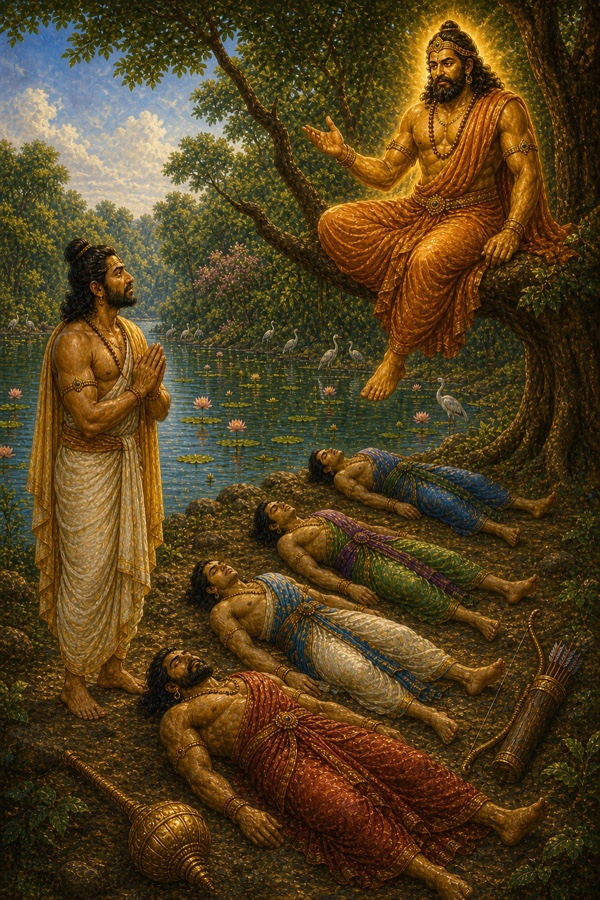
Four brothers lay dead on the bank and the fifth stood before the tree, and the Yaksha began where the day begins. “What is it that makes the sun rise? Who keeps him company? Who makes him set? And in whom is he established?” The questions came four at a time, in one breath, and Yudhishthira gave back four answers in the same order. “Brahma makes the sun rise. The gods keep him company. Dharma makes him set. And he is established in truth.”
The Yaksha went from the sun to the man who looks up at it. “By what does a man become learned? By what does he reach what is very great? How can he come to have a second beside him? And how does he gain intelligence?” Yudhishthira said, “By study of the Shrutis, the revealed word of the Vedas, a man becomes learned. By austerity he reaches what is very great. By intelligence he gains a second. And by serving the old he becomes wise.” The second he spoke of was a companion, and he meant that a steady understanding does for a man all that a helpful companion would do.
Then the questions turned to the orders of men, and first to the Brahmins, the keepers of the Vedas. “What is the godlike thing in Brahmins? What do they do that the pious do? What is human in them? And what do they do that the impious do?” Yudhishthira answered, “Their study of the Vedas is the godlike thing in them. Their austerity is what they share with the pious. That they must die is what is human in them. And slander is where they act as the impious act.”
The Yaksha asked the same four things about the Kshatriyas, the order of kings and fighting men to which the man standing in front of him belonged. “What is the godlike thing in Kshatriyas? What do they do that the pious do? What is human in them? And what do they do that the impious do?” Yudhishthira answered for his own kind as plainly as he had for the Brahmins. “Arrows and weapons are the godlike thing in them. The holding of sacrifices is what they share with the pious. That they can be afraid is what is human in them. And to refuse protection is where they act as the impious act.”
From men the Yaksha passed to the rite that Brahmins and Kshatriyas alike maintain. A sacrifice is carried on three kinds of mantra, the Sama, the Yajus and the Rik, and he asked for each of them. “What is the Sama of the sacrifice? What is its Yajus? What is the refuge of a sacrifice? And what is the one thing a sacrifice cannot do without?” Yudhishthira said, “Life is the Sama of the sacrifice. The mind is its Yajus. The Rik is the refuge of the sacrifice. And it is the Rik alone that a sacrifice cannot do without.”
A key to reading this (Sama, Yajus, Rik): In an outward sacrifice, the kind performed at a fire, mantras of the Sama, the Yajus and the Rik are all required. Yudhishthira is answering about another sacrifice, the inward one whose aim is pure knowledge. There a man’s life and his mind are as necessary as the mantras of the Sama and the Yajur Vedas are to the outward rite. And as no outward rite can be held without the Riks, on which it chiefly rests, the inward one cannot be held without prayerfulness, which is what the Rik stands for in his answer.
Next came the people who live by the soil. “What is worth most to those who till the ground? What is worth most to those who sow? What is worth most to those who want prosperity in this world? And what is worth most to those who bring forth?” Yudhishthira said, “To those who till the ground, the thing worth most is rain. To those who sow, it is seed. And to those who bring forth, it is offspring.”
The next one the Yaksha asked and finished in the same breath. “What of the person who enjoys every object of the senses, who has intelligence, whom the world regards and all beings like, and who, breathing as he does, still offers nothing to these five: the gods, his guests, his servants, the Pitris who are his dead forefathers, and his own self? He has breath in him, and he is not alive.” By the Yaksha’s reckoning, a man may be clever, admired and well liked, and if he gives nothing to any of those five he has only the look of a living man.
Then four comparisons. “What is weightier than the earth itself? What is higher than the heavens? What is swifter than the wind? And what is more numerous than grass?” Yudhishthira said, “The mother is weightier than the earth. The father is higher than heaven. The mind is swifter than the wind. And our thoughts are more numerous than grass.” He had two mothers of his own to weigh, and before the day ended he would be asked to do it.
The Yaksha followed with riddles of the kind a child might be set, and asked them in the same deep voice. “What does not close its eyes while it sleeps? What does not move after it is born? What has no heart? And what swells by its own force?” Yudhishthira named them one by one. “A fish does not close its eyes while it sleeps. An egg does not move after it is born. A stone has no heart. And a river swells by its own force.”
The gist: The first questions run from the sun to the riverbank. Yudhishthira says that Brahma raises the sun and Dharma sets it; that learning comes from the Shrutis, greatness from austerity, a companion from intelligence, and wisdom from serving the old; that study of the Vedas is the godlike thing in Brahmins, and arrows and weapons the godlike thing in Kshatriyas; that life, mind and the Rik make up the sacrifice; that a man who gives nothing to the gods, guests, servants, Pitris and himself breathes without living; and that the mother outweighs the earth while the father stands higher than heaven.
Questions of friendship, nectar, dharma, and renunciation
The first of the next four touched the man it was put to, who had been an exile for twelve years. “Who is the friend of the exile? Who is the friend of the householder? Who is the friend of the man who is ill? And who is the friend of the man about to die?” Yudhishthira said, “The friend of the exile in a distant land is his companion. The friend of the householder is his wife. The friend of the man who is ill is the physician. And the friend of the man about to die is charity.”
“Who is the guest of all creatures?” the Yaksha asked. “What is the eternal duty? What is amrita, the nectar? And what is this whole universe?” Yudhishthira said, “Agni is the guest of all creatures. The milk of cows is amrita. Homa, the offering poured into the fire with that milk, is the eternal duty. And this universe consists of air alone.” For the last of these he had the Shrutis behind him, which name air as the one element that runs through everything.
The next four went back up to the sky and came down again to the ground. “What is it that travels alone? What is it that is born again after its birth? What is the remedy against cold? And what is the largest field?” Yudhishthira said, “The sun travels alone. The moon takes birth anew. Fire is the remedy against cold. And the earth is the largest field.”
Now the questions shortened. “What is the highest refuge of virtue? What of fame? What of heaven? And what of happiness?” The answers shortened with them. “Generosity is the highest refuge of virtue. The gift, of fame. Truth, of heaven. And good conduct, of happiness.”
“What is the soul of a man?” the Yaksha asked. “Who is the friend that the gods have given him? What is his chief support? And what is his chief refuge?” Yudhishthira said, “A man’s son is his soul. His wife is the friend the gods have given him. The clouds are his chief support. And the gift is his chief refuge.”
“What is the best of all praiseworthy things? What is the most valuable of all a man’s possessions? What is the best of all gains? And what is the best of all kinds of happiness?” Yudhishthira, who had lost a kingdom and kept his learning, said, “The best of all praiseworthy things is skill. The best of all possessions is knowledge. The best of all gains is health. And contentment is the best of all kinds of happiness.”
Then the Yaksha asked the question on which the rest of the day would turn. “What is the highest duty in the world? What is the virtue that always bears fruit? What is the thing that, kept under control, leads to no regret? And who are those with whom an alliance cannot break?” Yudhishthira said, “The highest of duties is to do no injury. The rites laid down in the three Vedas always bear fruit. The mind, kept under control, leads to no regret. And an alliance with the good never breaks.”
The last four of this round were about letting go. “What does a man give up and become likable? What does he give up and never regret? What does he give up and become wealthy? And what does he give up and become happy?” Yudhishthira said, “Pride, once given up, makes a man likable. Anger, once given up, leaves no regret. Desire, once given up, makes him wealthy. And greed, once given up, makes him happy.”
A sub-tale: One answer in this round comes back before the day is over. Asked for the highest duty in the world, Yudhishthira says that it is to do no injury. When the Yaksha later lets him choose a single brother to live, he gives the same reason for his choice, calling the refusal to injure the highest virtue, and the Yaksha names exactly that as his ground for giving back all four.
The gist: The second round is about what a person can lean on. The exile has his companion, the householder his wife, the sick man his physician, the dying man his charity. Agni is the guest of every creature, the milk of cows is amrita, and the universe is air. Skill, knowledge, health and contentment are the best things to have; pride, anger, desire and greed are the things to give up; and the highest duty of all is to do no injury.
Questions of giving, death-in-life, and hell
The third round began with the giving of gifts. “For what does a man give to Brahmins? For what to mimes and dancers? For what to servants? And for what to a king?” Yudhishthira said, “It is for religious merit that a man gives to Brahmins. It is for fame that he gives to mimes and dancers. It is to support them that he gives to servants. And it is to be relieved of fear that he gives to kings.” The man who said the last of these was himself a king.
“What is the world wrapped in?” the Yaksha asked. “What is it that keeps a thing from showing itself? For what are friends forsaken? And for what does a man fail to reach heaven?” Yudhishthira said, “The world is wrapped in darkness. Darkness does not allow a thing to show itself. It is out of greed that friends are forsaken. And it is attachment to the world that keeps a man out of heaven.”
Then the Yaksha asked what leaves a thing as good as dead. “For what may a man be counted as dead? For what may a kingdom be counted as dead? For what may a shraddha, the rite for the departed, be counted as dead? And for what a sacrifice?” Yudhishthira said, “A man may be regarded as dead for want of wealth. A kingdom may be regarded as dead for want of a king. A shraddha performed with the help of a priest who has no learning may be regarded as dead. And a sacrifice in which there are no gifts to Brahmins is dead.”
Five questions came next, and with them, for the first time since the questioning began, the Yaksha spoke of the water. “What is the way? What has been spoken of as water? What as food? And what as poison? Tell us also the proper time for a shraddha, and then drink, and take away as much as you like.” Yudhishthira said, “Those who are good are the way. Space has been spoken of as water. The cow is food. A request is poison. And a Brahmin is regarded as the proper time for a shraddha. I do not know what you may think of all this, Yaksha.” He was answering out of the Vedas. The word the Yaksha had used for the way means a direction, and the direction a man should take is the one the good have taken. The Shrutis do speak of space as water. They speak of the cow as the only food, because the cow gives milk, the milk gives butter, the butter is poured into the fire, the fire offering brings the clouds, the clouds give rain, and the rain makes the seed sprout and yield food. And the rite for the departed has no hour fixed for it. It is to be performed whenever a good and able priest can be had.
A key to reading this (a dead kingdom, a dead sacrifice): Four things are called dead in Yudhishthira’s answer, and each is dead for want of the one thing that makes it what it is: a man for want of wealth, a kingdom for want of a king, a shraddha for want of a learned priest, a sacrifice for want of gifts to the Brahmins. The priest returns in the answer that follows, where a Brahmin is named as the proper time for a shraddha. The rite has no special season. It waits on a good and able priest, whenever one can be found.
The Yaksha did not say what he thought of it. He asked about four virtues. “What has been said to be the sign of asceticism? What is true restraint? What is forgiveness? And what is shame?” Yudhishthira said, “To stay in one’s own dharma is asceticism. The restraint of the mind is the true one among all restraints. Forgiveness is the enduring of enmity. And shame is withdrawing from every unworthy act.”
“What is said to be knowledge? What is tranquility? What is mercy? And what has been called simplicity?” Yudhishthira said, “True knowledge is knowledge of the divine. True tranquility is that of the heart. Mercy is wishing happiness to all. And simplicity is evenness of heart.” He gave these answers with four dead brothers lying in his sight and his own mind, by his own account, badly shaken.
From virtues the Yaksha went to their opposites. “What enemy is invincible? What is the incurable disease of man? What kind of man is called honest, and what kind dishonest?” Yudhishthira said, “Anger is the enemy no one conquers. Greed is the disease no one cures. The honest man is the one who wants the good of every creature, and the dishonest man is the one who has no mercy.”
“What is ignorance? And what is pride? What is to be understood by idleness? And what has been spoken of as grief?” Yudhishthira said, “True ignorance is to be unaware of one’s duties. Pride is a man’s sense that he is himself the one who acts, or the one who suffers, in life. Idleness is leaving one’s duties undone. And grief is ignorance.” A little while before, he had stood over his brothers in that very grief, unable to tell what had killed them.
“What have the rishis said that steadiness is? And patience? What is a real ablution? And what is charity?” Yudhishthira had come down into that lake to perform his ablutions, and he answered, “Steadiness is staying in one’s own dharma. True patience is the subduing of the senses. A true bath is the washing of the mind clean of all impurities. And charity is the protecting of all creatures.”
Five things were asked for in the next breath. “What man should be regarded as learned, and who should be called an atheist? Who is to be called ignorant? What is called desire, and what are its sources? And what is envy?” Yudhishthira said, “The learned man is the one who knows his duties. The atheist is the ignorant man, and the ignorant man is the atheist. Desire comes from the things a man may possess. And envy is nothing other than grief of heart.”
The Yaksha asked about pride a second time and was given a second answer. “What is pride, and what is hypocrisy? What is the grace of the gods, and what is wickedness?” Yudhishthira said, “Dull ignorance is pride. To raise religion like a banner is hypocrisy. The grace of the gods is the fruit of our gifts. And wickedness is speaking ill of others.”
Then the Yaksha set the three aims of a man’s life against one another. “Virtue, profit and desire are opposed to one another. How could things so hostile to each other exist together?” Yudhishthira said, “When a wife and virtue agree with each other, then all three that you have named may exist together.”
The Yaksha pressed him. “Who is the man condemned to everlasting hell? You must answer what I ask, and soon.” Yudhishthira named three men. “The man who calls a poor Brahmin to him with the promise of a gift, and then tells him there is nothing to give, goes to everlasting hell. So must the man who calls the Vedas false, or the scriptures, or the Brahmins, or the gods, or the rites held in honor of the Pitris. And so does the man who has wealth and, out of greed, never gives any of it away and never enjoys it himself, and says that he has none.”
The gist: The third round takes up giving, the things that are as good as dead, and the names of virtues and vices. Gifts go to Brahmins for merit, to performers for fame, to servants for their keep, to kings out of fear. A man without wealth, a kingdom without a king, a shraddha without a learned priest and a sacrifice without gifts are dead. Anger is the enemy that cannot be conquered and greed the disease that cannot be cured. Everlasting hell waits for the man who promises a poor Brahmin a gift and gives nothing, for the man who calls the Vedas, the gods and the rites of the Pitris false, and for the miser who denies his own wealth.
What makes a Brahmin, and the four final questions
The whole errand had begun with a Brahmin, and the Yaksha now asked what a Brahmin is. “By what does a person become a Brahmin: by birth, by conduct, by study, or by learning? Tell us with certainty.” Yudhishthira did not hesitate. “Listen, Yaksha. Birth is no cause of it, and study is no cause of it, and learning is no cause of it. Without any doubt, it is conduct that makes a Brahmin. Everyone should guard his conduct well, and a Brahmin most of all. The man who keeps his conduct whole is never broken himself. Teachers and their pupils, and in truth everyone who studies the scriptures, are to be counted as unlettered and worthless if they are given to wicked habits. The only learned man is the one who carries out his religious duties. Even a man who has studied all four Vedas is to be counted a wicked and worthless man, hardly to be told apart from a Shudra, if his conduct is wrong. The one who performs the Agnihotra and has his senses under control, he alone is called a Brahmin.” A Brahmin of exactly that kind was waiting at a hermitage for two fire-sticks and a churning staff.
“What does a man gain who speaks agreeable words?” the Yaksha asked. “What does he gain who always acts with judgment? What does he gain who has many friends? And what does he gain who is devoted to virtue?” Yudhishthira said, “The man who speaks agreeable words becomes agreeable to everyone. The man who acts with judgment gets whatever he seeks. The man who has many friends lives happily. And the man devoted to virtue reaches a happy state in the next world.”
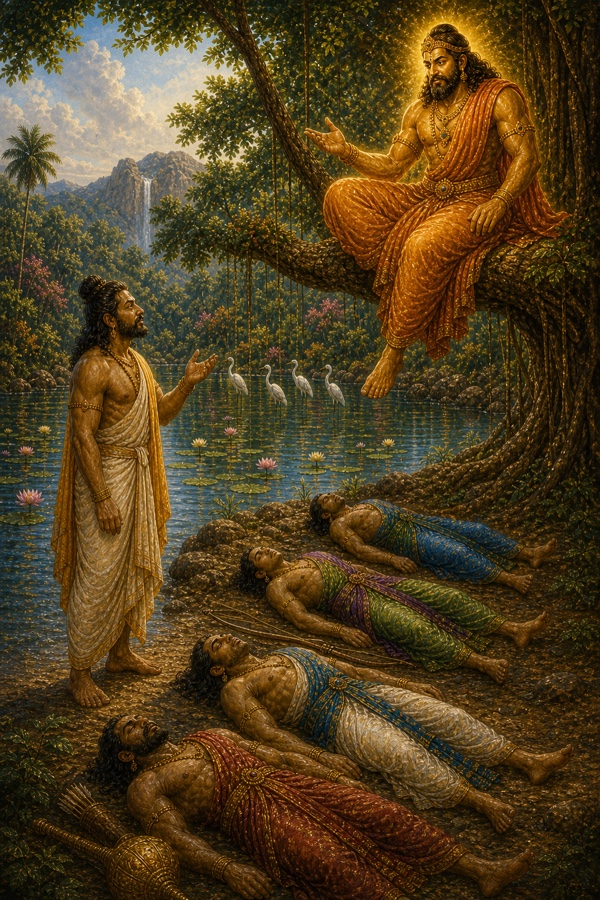
Then the Yaksha named a new prize. Until now it had been water. “Who is truly happy? What is most wonderful? What is the path? And what is the news? Answer these four questions of mine, and let your dead brothers live again.” Yudhishthira addressed it as the creature of water and land it had first claimed to be, and he answered all four. “A man who cooks in his own house, in the fifth or the sixth part of the day, with a few poor vegetables, who is in no one’s debt and who does not have to stir from home, is truly happy. Day after day countless creatures are going to the house of Yama, and those who remain behind believe that they themselves are immortal. What can be more wonderful than this? Argument leads to no certain conclusion. The Shrutis differ from one another. There is not even one rishi whose opinion can be accepted by all. The truth about religion and duty is hidden in caves. So the only path is the one along which the great have walked. This world, full of ignorance, is like a pan. The sun is the fire. The days and the nights are the fuel. The months and the seasons are the wooden ladle. Time is the cook, and he is cooking all creatures in that pan with these to help him. That is the news.”
“You have answered all my questions truly,” the Yaksha said. It had promised the brothers’ lives for four answers, and now it asked for two things more. “Tell us now who is truly a man, and what man truly possesses every kind of wealth.” Yudhishthira said, “The report of a man’s good deeds reaches heaven and spreads over the earth. As long as that report lasts, so long is he called a man. And the person to whom the agreeable and the disagreeable, happiness and misery, the past and the future, are the same, is said to possess every kind of wealth.”
A key to reading this (Time’s cooking pan): Yudhishthira’s news is a kitchen. The world, full of ignorance, is the pan. The sun is the fire under it, the days and nights are the fuel, the months and seasons are the wooden ladle, and Time is the cook, with every living creature in the pan. The answer stands beside the one he gives about the greatest wonder: that countless creatures go to the house of Yama day after day, and those left behind still believe themselves immortal.
A sub-tale: The four last answers come from a man in a particular position. He has spent twelve years in the forest, his kingdom was taken from him by deceit, and his four brothers are lying dead beside water he may not drink until he has answered. Asked who is happy, he describes someone who cooks a few vegetables under his own roof in the fifth or sixth part of the day, owes nothing, and need not leave home. Asked for the path, he passes over argument, the Shrutis that differ and the rishis who disagree, and points to the road the great have walked.
The gist: Yudhishthira says that conduct alone makes a Brahmin, and that a man who has studied all four Vedas and behaves badly is hardly to be told apart from a Shudra. The Yaksha then stakes the brothers’ lives on four last questions. The happy man is the one free of debt who eats plain food in his own home; the great wonder is that the living think themselves immortal; the path is the one the great have walked; the news is that Time is cooking all creatures. The Yaksha declares every answer true and asks two more, on who is truly a man and who possesses every kind of wealth.
The boon of one brother, and Yudhishthira’s evenhandedness
The Yaksha accepted this as it had accepted the rest. “You have answered truly who is a man, and what man possesses every kind of wealth. Therefore let one of your brothers get up alive. One only, whichever you may wish.” Four of them lay there, and it was offering him one. Yudhishthira did not take long over it. “This one, Yaksha. The one with the dark skin and the red eyes, who is tall as a great sala tree, whose chest is broad and whose arms are long. Let this Nakula get up alive.”
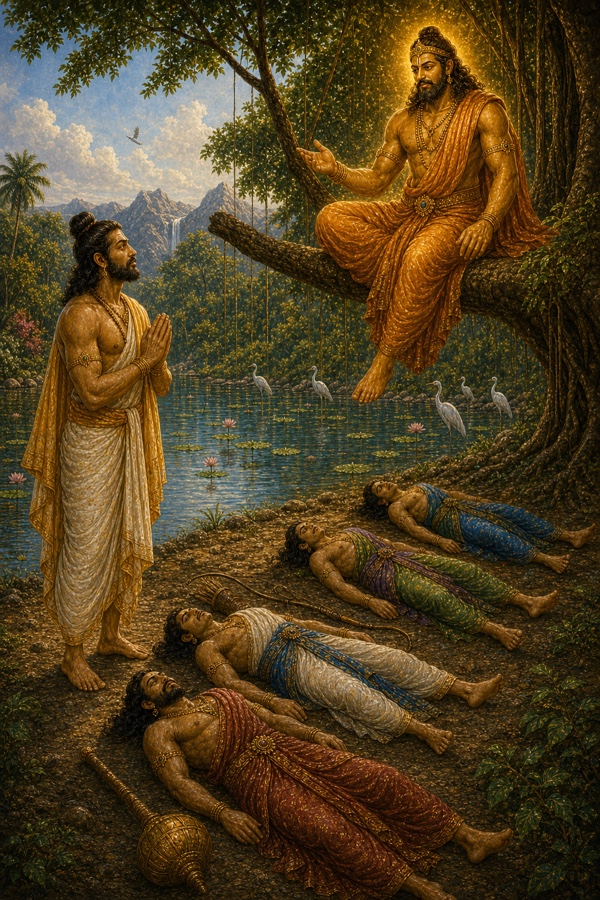
The Yaksha would not let the choice pass. “This Bhimasena is dear to you. This Arjuna is the one on whom all of you depend. Why, then, do you wish a half-brother to get up alive? Bhima has the strength of ten thousand elephants. How can you forsake him and wish Nakula to live? People have always said that this Bhima was dear to you. What is your motive, then, in wishing for a half-brother’s life? And Arjuna, the might of whose arm every son of Pandu reveres: why do you forsake him and wish Nakula to live?” It had set before him the two brothers whom a king with a kingdom to win back could least afford to lose, and it was asking him to explain himself.
Yudhishthira said, “If virtue is sacrificed, the man who sacrifices it is himself lost. And virtue cherishes the one who cherishes it. So I take care that virtue, being sacrificed, does not sacrifice us, and I never forsake it. To do no injury is the highest virtue. I hold it higher even than the highest thing a man can attain. That is the virtue I try to practice. Therefore let Nakula live, Yaksha. Let men know that their king is always virtuous. I will never depart from my duty. Therefore let Nakula live.”
He had a second reason, and it concerned two women. “My father had two wives, Kunti and Madri. Let both of them have children. That is what I wish. As Kunti is to me, so also is Madri. In my eyes there is no difference between them. I want to act equally toward my mothers. Therefore let Nakula live.” Kunti’s eldest son was standing there alive. Bhima and Arjuna were Kunti’s sons as well, and if one more brother was to breathe again, Yudhishthira meant him to be a son of Madri. The Yaksha said, “You hold the refusal to injure higher than both profit and pleasure. Therefore let all your brothers live.”
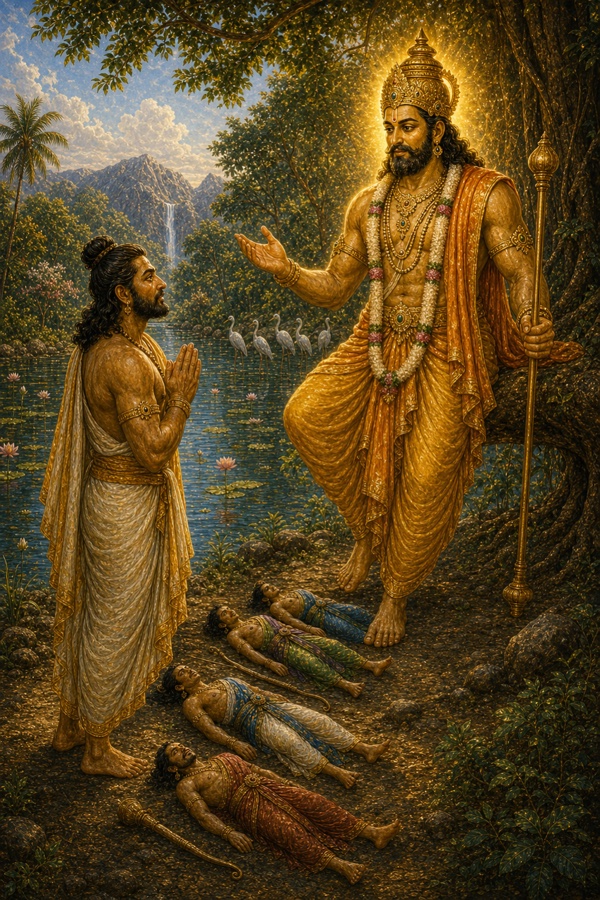
A sub-tale: The offer is of one life, and the Yaksha argues for the two obvious choices: Bhima, who is said to be dear to Yudhishthira and has the strength of ten thousand elephants, and Arjuna, on whom all the brothers depend. Yudhishthira gives two reasons for asking for Nakula. To do no injury is to him the highest virtue, and he will not forsake virtue. And his father had two wives: Kunti has a living son in him, so Madri should have one too. The Yaksha’s reply takes up the first reason. Because Yudhishthira ranks the refusal to injure above profit and pleasure, all four brothers are given back.
The gist: Offered the life of a single brother, Yudhishthira asks for Nakula, dark, red-eyed and tall as a sala tree. The Yaksha objects that Bhima is dear to him and that all of them depend on Arjuna. Yudhishthira replies that he will never forsake virtue, that to do no injury is the highest virtue, and that Kunti and Madri are equal in his eyes and each should have a son alive. The Yaksha then lets all his brothers live.
Dharmaraja reveals himself, and the three boons
At the Yaksha’s word the Pandavas got up, and in that same moment their hunger and their thirst left them. Yudhishthira looked at the being that had done it. It was standing in the pool now, on one leg. “Nothing can defeat you,” he said, “and you stand on one leg in this water, and I ask you which god you are, for I cannot take you for a Yaksha. Are you the chief of the Vasus, or of the Rudras, or the lord of the Maruts? Or are you the lord of the gods himself, who carries the thunderbolt? Each of these brothers of mine can fight a hundred thousand warriors, and I do not see the fighter who could kill all of them. I see, too, that their senses are fresh again, as if they had woken sweetly from sleep. Are you a friend of ours? Or are you our father himself?”
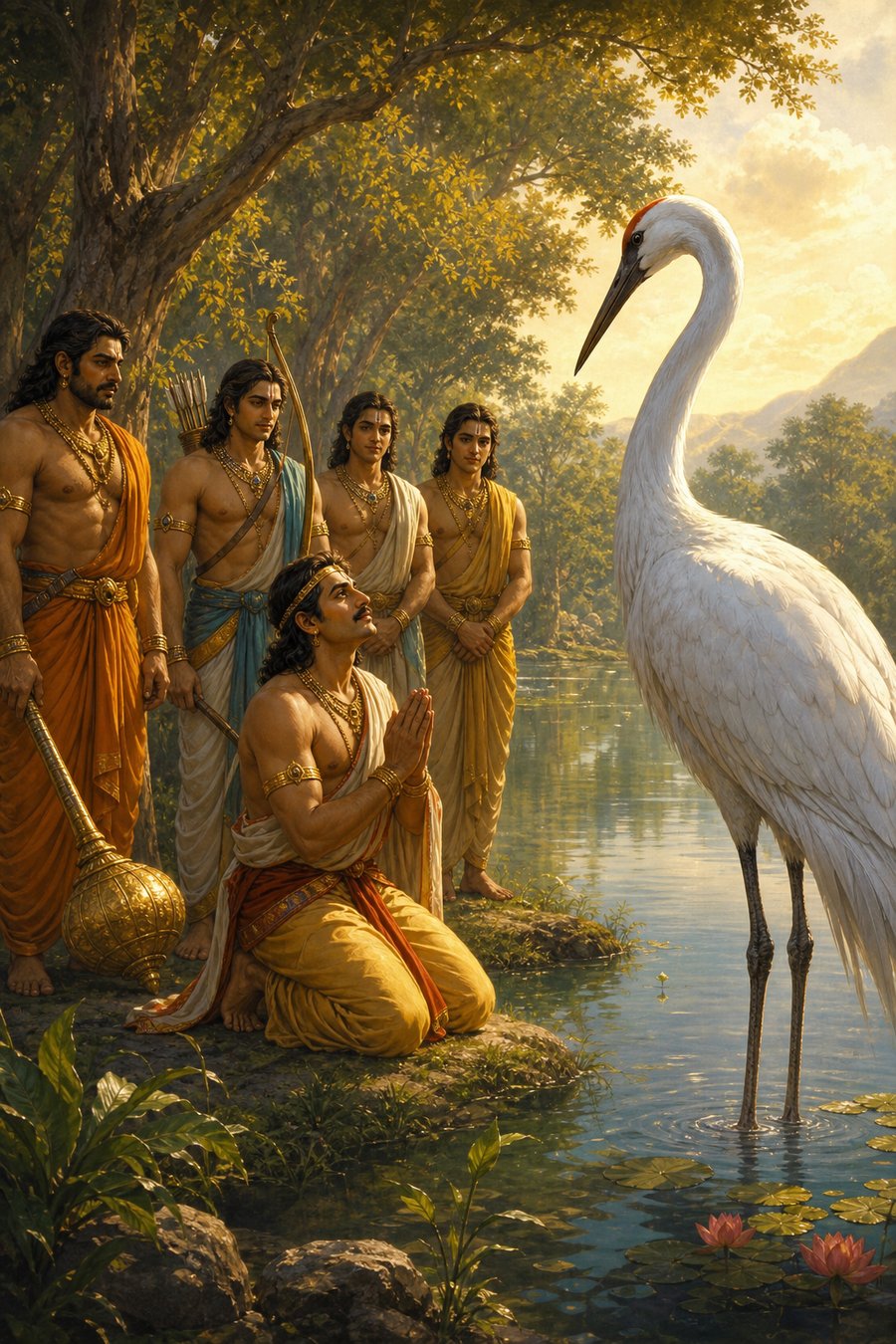
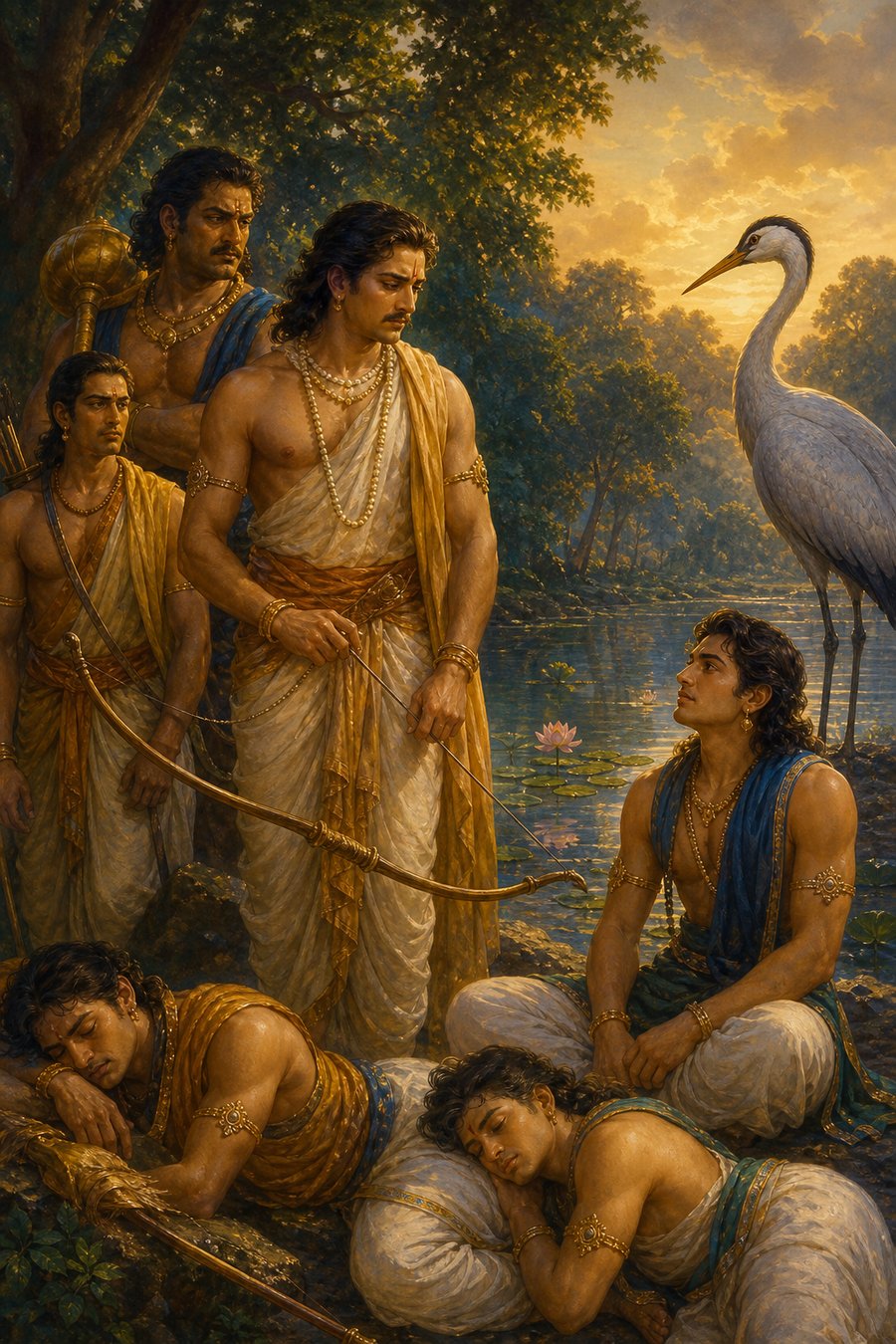
The Yaksha answered him, and the answer was yes. “Child, I am your father. I am the lord of justice, and my power is great. Know that I came here because I wished to see you. Fame, truth, self-restraint, purity, candor, modesty, steadiness, charity, austerities and brahmacharya: these are my body. The refusal to injure, impartiality, peace, penance, sanctity and freedom from malice: these are the doors by which I am reached. You are always dear to me. It is your good fortune that you are devoted to the five, and your good fortune also that you have conquered the six. Of those six, two appear in the first part of life, two in the middle part, and the remaining two at the end, to make men go on to the next world.”
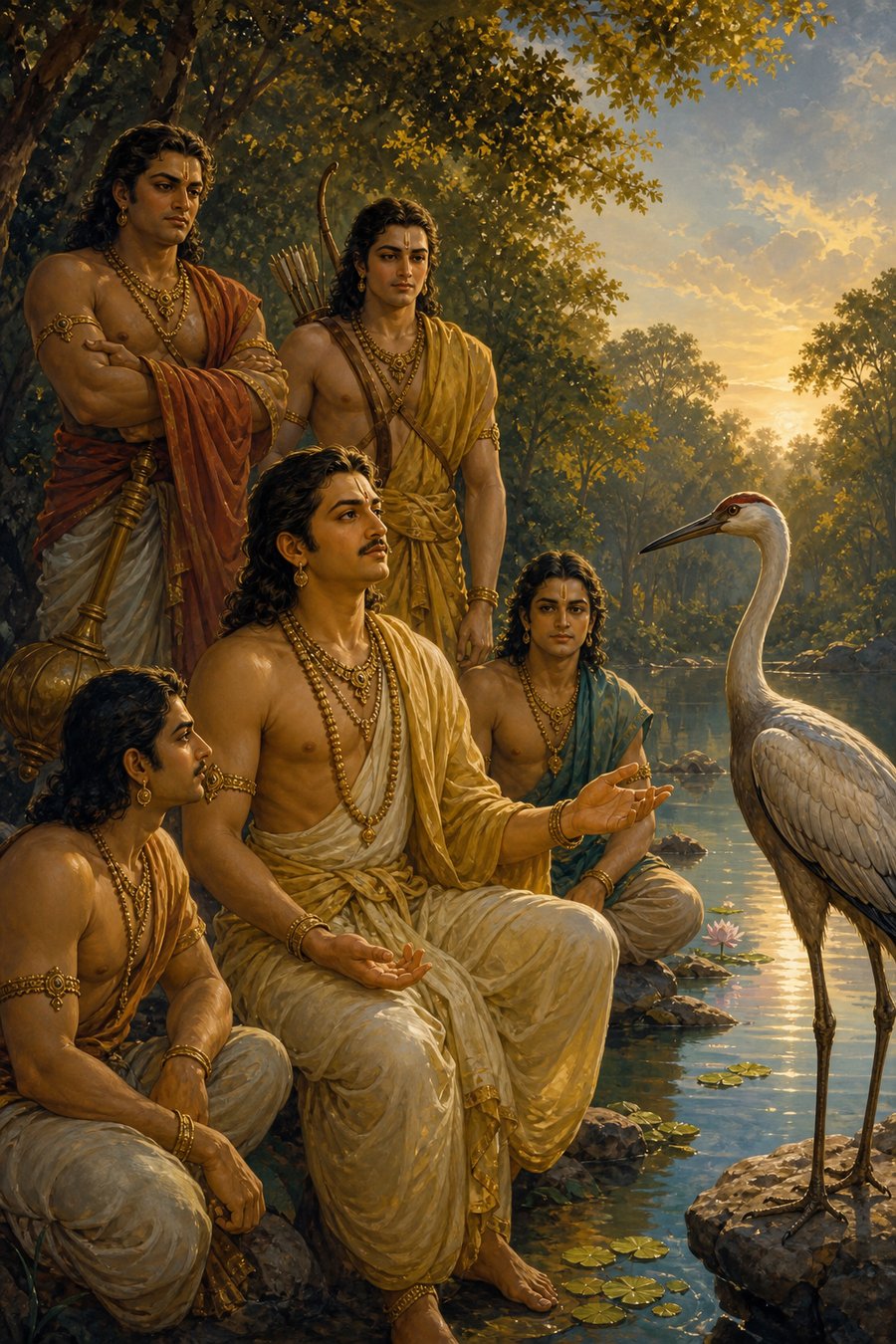
The god who had spent the day as a deer, a voice, a crane and a Yaksha went on in his own name. “Good fortune to you. I am the lord of justice, and I came here to test your merit. I have seen your harmlessness and I am well pleased with it. There is no fault in you, and I will give you boons. Ask me for them, for you are a king above kings. I will certainly grant them. Those who revere me never come to distress.” Yudhishthira’s first thought was for the man whose trouble had sent him out with his bow. “A deer was carrying away a Brahmin’s fire-sticks. So the first boon I ask is this: let that Brahmin’s worship of Agni not be interrupted.”
“It was I,” the Yaksha said. “To examine you I took the shape of a deer, and I was carrying off that Brahmin’s fire-sticks.” Then the god, who is worthy of all worship, granted what had been asked. “I give you this boon. Good fortune to you. You are like one of the immortals. Ask another.” Yudhishthira asked for the thing the coming year required. “We have spent these twelve years in the forest, and the thirteenth year has come. Wherever we pass this year, let no one recognize us.”
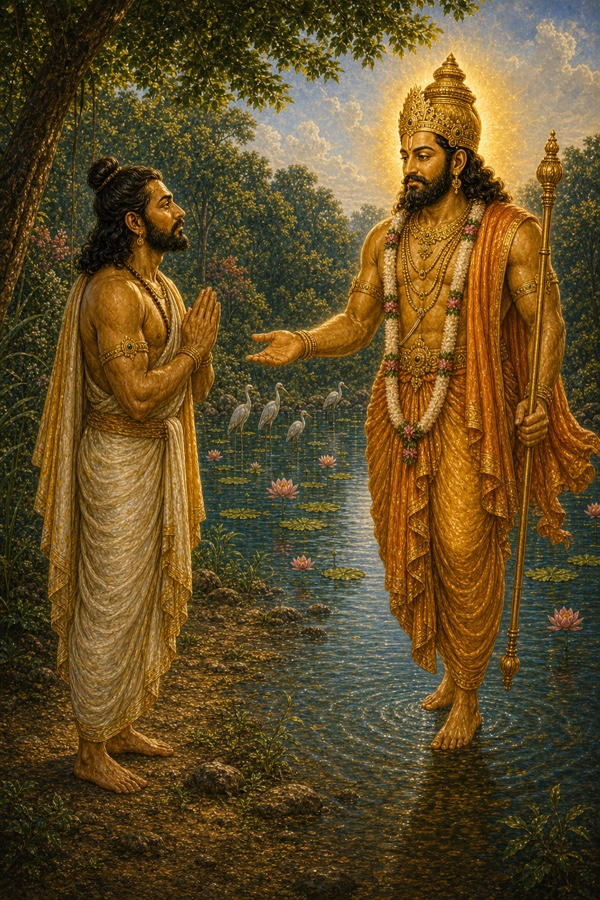
“I give you this boon as well,” the god replied. Then he reassured the son of Kunti, a man whose whole strength was his truthfulness. “Even if you range over this whole earth in your own proper forms, no one in the three worlds will recognize you. You are the men who carry on the Kuru line, and through my grace you will spend this thirteenth year in the kingdom of Virata, in secret, unrecognized. Every one of you will be able to take whatever form he likes, at will. Now give the Brahmin his fire-sticks. It was only to test you that I carried them off in the shape of a deer. And ask for another boon, gentle Yudhishthira, one that you would like. I will give it to you. I have granted you boons and I am still not satisfied. Accept a third from me, my son, a great one that has no equal. You were born of me, and Vidura was born of a portion of me.”
Yudhishthira said, “It is enough that I have seen you with my own senses, eternal god of gods that you are. Father, whatever boon you give me I will accept gladly. May I always conquer greed and folly and anger, and may my mind be devoted always to charity, truth and ascetic austerities.” He had been offered a boon without equal, and this was what he chose. The lord of justice said, “You have been endowed with these qualities by your very nature, Pandava, for you are the lord of justice himself. Have once more what you have asked for.”
A key to reading this (the five and the six): Dharma tells his son that he is devoted to the five and has conquered the six. The five are tranquility of mind, self-restraint, abstention from the pleasures of the senses, resignation, and the meditation of yoga. The six are hunger, thirst, sorrow, bluntness of feeling, the decay of age, and death. As the god says, they come two by two across a life: two in its first part, two in its middle, and the last two at its end, where they send a man on to the next world.
The gist: The Yaksha reveals who he is: the lord of justice, the father of Yudhishthira, who had also been the deer that carried off the fire-sticks, and who came to test his son. He grants three boons. The first is that the Brahmin’s worship of Agni shall go on unbroken. The second is that no one shall recognize the Pandavas in the thirteenth year, and to it the god adds that they will spend the year in Virata’s kingdom and that each of them may take any form at will. For the third, Yudhishthira asks that he may always conquer greed, folly and anger, and keep his mind on charity, truth and austerity.
The return of the fire-sticks, and the resolve of the thirteenth year
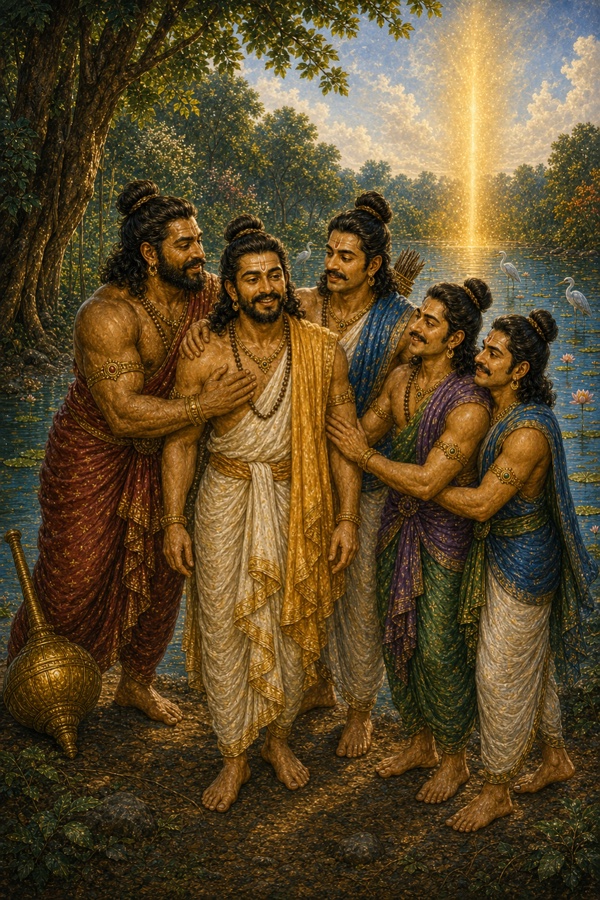
When he had said this, the lord of justice, on whom all the worlds fix their thought, vanished from that place. The Pandavas, who had lain in so sweet a sleep, found one another again. Their weariness was gone. They went back to the hermitage, and they gave the Brahmin his fire-sticks.
Whoever follows this celebrated story, the story of how the Pandavas came back to life and of how a father and a son, Dharma and Yudhishthira, met, gains perfect tranquility of mind, and sons and grandsons, and a life that stretches to a hundred years. And the mind of the man who lays this story to heart never takes delight in unrighteousness, or in dividing friends from one another, or in seizing what belongs to another person, or in dishonoring the wives of other men, or in foul thoughts.
The lord of justice had told them how the thirteenth year was to be spent: in disguise, with no one finding them out. The Pandavas were men who kept their vows and whose strength lay in their truthfulness, and they went and sat down before the ascetics who had been living with them through their exile in the forest, learned men under vows of their own, who had stayed out of regard for the brothers. They joined their hands. They had come to ask leave to spend the thirteenth year in the way that had been laid down for them, and Yudhishthira spoke for all five. “You know well that the sons of Dhritarashtra took our kingdom from us by deceit, and that they did us many other wrongs besides. We have passed twelve years in the forest in great hardship. Only the thirteenth year remains, the one we are to spend unrecognized. Give us your leave now to spend this year in concealment. Our enemies hate us bitterly: Duryodhana, and the wicked-minded Karna, and Shakuni, the son of Subala. If they were to discover us, they would do great wrong to the citizens and to our friends. Shall all of us, with the Brahmins, ever be established again in our own kingdom?”
When he had said this, King Yudhishthira, the pure-spirited son of Dharma, could go no further. Grief overwhelmed him, his voice choked on his tears, and he fainted. The Brahmins and his brothers together set about lifting his spirits. Then Dhaumya, the priest of the Pandavas, spoke to the king, and his words carried a great weight of meaning. “You are a learned man, and you are able to bear hardship. You are firm in your promises, and your senses are under your command. Men of that stamp are not overwhelmed by any calamity whatever. Even the great-hearted gods have wandered from place to place in disguise in order to overcome their enemies.
“Indra, to overcome his foes, lived in disguise in the hermitage of Giriprastha, in Nishadha, and so gained his end. Before he took birth in the womb of Aditi, Vishnu passed a long time unrecognized in the form of Hayagriva, the horse-necked one, in order to destroy the Daityas. Then he disguised himself in the form of a dwarf and by his prowess took the kingdom from Bali, and you have heard how that was done. You have heard, too, how Hutashana, the fire, went into the water and stayed concealed there, and so achieved the purpose of the gods. You know what duty is, and you have heard how Hari, to overcome his foes, entered into Shakra’s thunderbolt and lay concealed in it. You have heard of the service that the Brahmin rishi Aurva once performed for the gods while he stayed concealed in his mother’s womb. And Vivasvat, child, with all his splendid energy, lived in concealment in every part of the earth and in the end burned up all his foes entirely. And Vishnu of the terrible deeds lived disguised in the house of Dasharatha and killed the ten-necked one in battle. In this way great-hearted beings have stayed in disguise in one place and another before now, and have conquered their enemies in battle.”
Dhaumya’s words did what they were meant to do. Yudhishthira was a man of virtue, and leaning on his own wisdom and on the wisdom he had drawn from the scriptures, he recovered his composure. Then Bhimasena, long-armed and stronger than any strong man living, spoke to put heart into the king. “The bearer of the Gandiva has looked to your face for permission and has acted by his sense of duty, and to this day he has done nothing rash. Nakula and Sahadeva are fighters of terrible prowess, fully able to destroy the enemy, and I have always held them back. We will never turn aside from whatever you set us to do. Tell us what is to be done. We will conquer our enemies quickly.”
When Bhimasena had said this, the Brahmins pronounced their blessings on the sons of Pandu and then, with their leave, went away each to his own place. They were the greatest of ascetics and sages, men who knew the Vedas, and they went back to their homes wanting very much to see the Pandavas again. The five brothers were learned men, and their vows were all the equipment they carried. With Dhaumya beside them, and with Draupadi, the heroes set out. Each of them was the master of a separate science. All of them were skilled in mantras, and all of them knew when peace was to be made and when war was to be waged. They were about to enter a life in which no one would know them. The next day they went a single krosha, and then they sat down together to take counsel with one another.
A sub-tale: Dhaumya comforts Yudhishthira with precedents, and every one of them is a god or a rishi who won by hiding. Indra lived in disguise in the hermitage of Giriprastha in Nishadha. Vishnu passed a long time unrecognized as the horse-necked Hayagriva, took Bali’s kingdom in the form of a dwarf, and lived in the house of Dasharatha until he killed the ten-necked one. Fire hid in water. Hari lay concealed in Shakra’s thunderbolt. Aurva served the gods from inside his mother’s womb, and Vivasvat, concealed in every part of the earth, burned up his foes. Dhaumya’s argument is that concealment has been the road to victory before, and that a man as learned and as firm as Yudhishthira is not overwhelmed by calamity.
The gist: The lord of justice vanishes, the brothers return to the hermitage, and the Brahmin has his fire-sticks back. Asking the forest ascetics for leave to spend the thirteenth year in hiding, Yudhishthira faints from grief. Dhaumya steadies him with the disguises of Indra, Vishnu, Fire, Hari, Aurva and Vivasvat, and Bhima promises that the brothers will do whatever he commands and will soon conquer their enemies. The Brahmins bless them and go home. The five Pandavas set out with Dhaumya and Draupadi, go one krosha the next day, and sit down to take counsel, and there the Vana Parva ends.
Source: the Mahabharata of Krishna-Dwaipayana Vyasa, Vana Parva, Araneya sub-parva, Yaksha-prashna episode, Sections 309 to 313. The Sanskrit e-text, the Gita Press Hindi edition, and Kisari Mohan Ganguli’s complete English translation were used to verify names, sequence, and principal events. Where the recensions differ, this English retelling follows Ganguli, and the Hindi edition follows Gita Press.
Based on: The Mahabharata, Vyasa (K. M. Ganguli’s English translation; Gita Press, Gorakhpur)
The same story, elsewhere
- The Questions of the Yaksha · Vana Parva
A detailed standalone page on the Questions of the Yaksha (Vana Parva)