The Fruit
The experience of liberation · 4 padas, 78 sutras, 38 adhikaranas · the close of the whole text
The purpose of this book
The fourth book is named Phala, the fruit. After harmonization, non-contradiction, and the means, Badarayana now sets out the fruit that comes from the knowledge of Brahman. This closing book, the last seventy-eight of the work’s five hundred and fifty-five sutras, shows what the knower’s life becomes, how the knower leaves the body, and how liberation arrives.
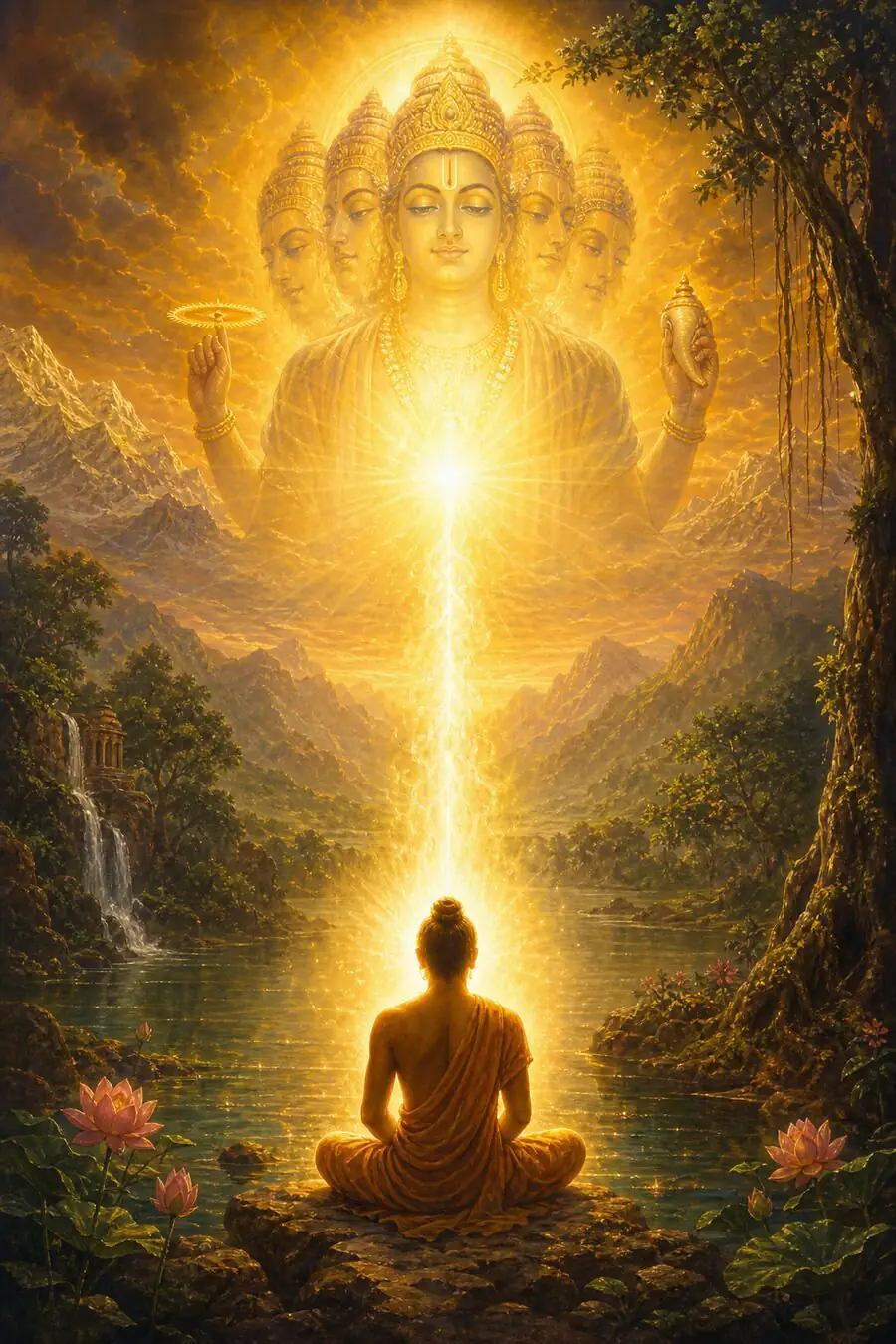
Pada 1 lays out the method of worship: avritti, the repeated practice of meditation, then posture and concentration, worship carried on until the last breath, and what happens to a person’s karma once knowledge dawns. Karma that has not yet begun to bear fruit is destroyed; prarabdha, the karma already in motion, wears away only by being lived through.
Pada 2 traces the inner journey of the jiva, the embodied self, at the moment the body is left: speech dissolving into mind, mind into breath, breath into the subtle body, one stage after another, the same for the knower and the ignorant up to the start of the way. There Shankara’s two knowers part. The meditator on the qualified Brahman leaves the heart by the hundred-and-first channel, the one that runs to the crown, and follows the sun’s rays; the knower of the attributeless Brahman does not leave at all, his breaths dissolve where they are, and being Brahman he is Brahman.
Pada 3 is the path of the gods, the devayana, a graded ascent that runs from the first flame all the way to Brahmaloka, each station a deity who leads the traveler on, and it weighs a single question: does the path end at the effected Brahman, Hiranyagarbha’s world, or at the highest Brahman? Shankara follows Badari: the path ends at the effected Brahman, and at the end of that world its dwellers reach the highest together with its ruler. This is release by stages. The highest Brahman is reached by no road, and the knower of it is released where he stands.
Pada 4 sets out the nature of the liberated jiva. Liberation is the surfacing of one’s own true nature, and nothing new is acquired. It then describes the lordship of the released in Brahmaloka, a will that needs no instrument, a body or none at will, many bodies at once, and the one power withheld from them, the making and running of the world (jagad-vyapara-varjam), and closes with the final word, anavrittih shabdat, no return, because scripture says so.
Direct realization of Brahman through avritti, the repeated practice of meditation; the place of posture and concentration; and, most fundamental of all, the way knowledge cuts through the wheel of karma. Of the three kinds of karma, sanchita (the stored-up mass), prarabdha (the karma already bearing fruit), and kriyamana (what is being done now), knowledge destroys the sanchita and the kriyamana still to come. Prarabdha has to be lived through, even by the knower.
4.1.1-4.1.2
Avritti adhikarana: the repetition of meditation
4.1.3
Atmatvopasana adhikarana: worshiping Brahman as the self
Is the Brahman these texts describe to be grasped as “I”, or as something other than me? The doubt has teeth. The Lord is free of all evil; the embodied self is the opposite of that, and a thing cannot be known as both. If the transmigrating self were the Lord’s Self, he would be no Lord and scripture would lose its point; if the Lord were the self of the embodied one, no one would be fit for works or for knowledge, and perception would be contradicted. Let the two be contemplated as one, the objector allows, the way Vishnu is contemplated in an image, with no claim that the image is Vishnu. Sutra 4.1.3 answers: as the Self, because the texts take it so and make the student take it so. The Jabala text, in a chapter on the highest Lord, says “you indeed am I, holy divinity; I indeed am you”; “I am Brahman” (Brihadaranyaka 1.4.10) says the same; and other texts make the student grasp it, “your Self is this, which is within all” (Brihadaranyaka 3.4.1), “he is your Self, the inner ruler, the immortal” (3.7.3), “that is the true, that is the Self, that you are” (Chandogya 6.8.7). These are no symbol meditations. A symbol text has one clause, “mind is Brahman”, “the sun is Brahman”; this text runs both ways, “I am you and you are I”, which is the form of identity, and scripture forbids the view of difference outright: “he who worships another deity, thinking he is one and I another, does not know” (Brihadaranyaka 1.4.10), “from death to death goes he who sees difference here” (4.4.19).
The contrary qualities are no obstacle, since the opposition is itself false. The Lord loses nothing by it, for scripture does not say the transmigrating self is the Lord’s self; it denies that the self transmigrates, and so teaches that the self is the Lord. Works and perception keep their field until knowledge rises, and the text “when all has become the Self for him, with what should he see another?” (Brihadaranyaka 4.5.15) says that with knowledge their authority ends, scripture’s included, as “then a father is no father, then the Vedas are no Vedas” (4.3.22) admits. Who then is the ignorant one? Shankara answers: the man who asks the question; and if he replies “I am the Lord, as scripture says”, then there is no one left who does not know. This is the practical form of the great sayings “tat tvam asi”, you are that (Chandogya 6.8.7), and “aham brahmasmi”, I am Brahman (Brihadaranyaka 1.4.10). Brahman is contemplated as one’s own true nature and never as an object standing outside oneself.
4.1.4
Pratika adhikarana: the symbol is not the self
A pratika is a support for meditation, a name, the mind, the sun, taken as Brahman: “let a man meditate on mind as Brahman” (Chandogya 3.18.1), “the sun is Brahman, this is the teaching” (3.19.1), “he who meditates on name as Brahman” (7.1.5). Is the Self to be seen in these too? The objector says yes: Brahman is the Self, scripture says so, and the symbols are Brahman’s effects, so they are of Brahman’s nature and of the Self’s. Sutra 4.1.4 answers “na pratike na hi sah”, not in the symbol, for that is not he: the meditator cannot take a name or a mind, things of another kind from himself, as his own Self. The argument from effects turns against itself: names and the rest are of Brahman’s nature only when their separate character is dissolved into it, and once that is dissolved there is no symbol left and nothing to meditate on. Teaching that Brahman is the Self depends on removing agency and the rest of the marks of samsara; enjoining a meditation depends on keeping them, so the one cannot be built on the other. Gold ornaments and gold figures are one only as gold.
The distinction is fine. The vision of Brahman may be laid upon a symbol, and the next sutra prescribes exactly that, yet the meditator never takes the symbol to be his own self, and the highest realization does not lie in the symbol.
4.1.5
Brahmadrishti adhikarana: the symbol is seen as Brahman
With the same texts in view a second doubt arises. “The sun is Brahman”, “mind is Brahman”: the two words stand in one case, and they name different things, so the sentence cannot be a plain statement, any more than “the ox is a horse”; and the coordination of cause and effect, as of clay and pot, will not serve, since that would dissolve the symbol and turn the texts into statements about the highest Self, which is no object of meditation. One idea is being laid on another, as in “the Brahmin is Agni Vaishvanara”. Which on which? The objector says there is no rule, since scripture gives none; or else the idea of the sun is laid on Brahman, because Brahman is then what is meditated on, and only meditation on Brahman is known to bear fruit. Sutra 4.1.5 decides the other way: the idea of Brahman is laid on the sun and the rest, “because of exaltation”. The lower is raised by the thought of the higher laid on it, as the king’s charioteer is spoken of as the king; the reverse lowers the king and gains nothing. The objector protests that worldly rules have no say where scripture rules. They have a say where scripture’s sense is in doubt, Shankara replies, and the words themselves settle it. “Sun” stands first and keeps its own sense; “Brahman” follows and carries “iti”, “as Brahman”, the mark of an idea laid on, exactly as “he sees the shell as silver” names a real shell and an imagined silver; and the completing clauses put the sun in the object case, “he who meditates on the sun as Brahman”, making the sun what is meditated on. Nor is the fruit lost. Brahman, the ruler of all, gives the fruit of meditation on the sun as a host gives to a guest (3.2.28), and Brahman is meditated on too, as Vishnu is meditated on in his image. The sun seen as Brahman, never Brahman seen as the sun: that is the rule.
4.1.6
Adityadimati adhikarana: the sun and the rest seen in the parts of a rite
The same question now falls on the meditations tied to the limbs of a rite: “he who glows up there, let a man meditate on him as the udgitha” (Chandogya 1.3.1), “let him meditate on the fivefold Saman in the worlds” (2.2.1), “this earth is the Rik, fire is the Saman” (1.6.1). Is the udgitha seen as the sun, or the sun as the udgitha? The objector finds no footing for a rule: Brahman was plainly higher than the sun, while the udgitha and the sun are both effects, with no rank between them. Or he argues for laying the udgitha on the sun: the udgitha is work, work bears fruit, so a sun seen as udgitha becomes work and bears fruit; “this Saman rests on this Rik” calls the earth Rik, which is possible only if the earth is seen as the Rik, since the charioteer may be called king and never the king charioteer; “in the worlds” is a locative, and the Saman is laid on the worlds as on a ground; and where “Brahman” came second and was laid on the sun named first, here the earth is named first and the hinkara second. Sutra 4.1.6 decides: the ideas of the sun and the rest are laid on the limbs of the rite, “because that accomplishes it”. The udgitha, refined by being seen as the sun, carries the rite to its unseen result, and “what one does with knowledge, faith and the Upanishad is more powerful” (Chandogya 1.1.10) says that knowledge makes the rite succeed; a meditation with a fruit of its own, like the fivefold Saman that wins the worlds, still belongs to the man entitled to the rite and bears its fruit through the rite, as the milking pail wins cattle only through the sacrifice it serves. Rank is there after all: the sun is a fruit of works, the udgitha is work, and a fruit outranks its means. The opening words, “let a man meditate on Om as the udgitha”, make the udgitha the object before any sun is mentioned; meditation is itself a kind of work and needs no borrowed status; “Rik” and “Saman” in the troublesome clause name earth and fire by implication, as even a charioteer may for some reason be called king; “just this earth is the Rik” states what the Rik is; the closing “he who knowing this sings the Saman” rests the knowledge on the limb; and “in the worlds” yields to the accusative “Saman”, the object of the meditation, so the worlds are laid on the Saman and the Saman is seen as their Self. Where both stand in the accusative, “let him meditate on the sevenfold Saman as the sun” (2.9.1), the introductions show the Saman as the thing meditated on. So the limbs of the rite carry the borrowed ideas, and they remain what the meditator holds in view.
4.1.7-4.1.10
Asina adhikarana: meditation is done seated
Meditations that belong to the limbs of a rite take their posture from the rite, and the direct knowledge of the Self takes no posture at all, since knowledge follows its object and nothing else. For every other meditation the question stands: may a man meditate standing, sitting or lying down as he pleases, or seated only? Meditation is a mental act, says the objector, so the body may do as it likes. Sutra 4.1.7 answers: seated, “because that is possible”. Meditation is the long holding of one line of thought, and a man cannot hold it walking or running, since movement scatters the mind; standing, his mind is busy keeping the body upright and unfit for anything subtle; lying down, sleep takes him unawares; seated, he escapes all three. Sutra 4.1.8 adds the word itself: “dhyana” names the sustained holding of a thought, and it is said of those whose gaze is fixed and whose limbs barely move, the heron on one leg, the wife whose husband is on a journey, and such stillness comes easily to one who sits. Sutra 4.1.9: scripture says “the earth meditates, as it were”, crediting meditation to the one thing that never moves. Sutra 4.1.10: smriti agrees, “having set a firm seat for himself in a clean place” (Gita 6.11), and the yoga shastra teaches the lotus and the other seated postures for the same reason. The knower whose seeing is complete is free of all this, and everyone else sits.
4.1.11
Ekagrata adhikarana: wherever the mind is one-pointed
Direction, place and time come next. Rites have their rules, facing east, in the forenoon, on ground that slopes east; the objector wants the like for meditation. Sutra 4.1.11 gives one rule only: wherever the mind gathers to a point, there, since nothing else makes a difference. Scripture fixes no quarter, hour or spot for meditation, because concentration can be had anywhere. The objector cites Shvetashvatara 2.10, “in a level, clean place, free of pebbles, fire and sand, of noise and standing water, pleasing to the mind, kind to the eye, in a cave or a sheltered spot”. Such particulars exist, Shankara grants, and the teacher, being kind, says none of them binds; the clause “pleasing to the mind” gives the whole measure away, since the place that pleases the mind is the place where it settles.
4.1.12
Aprayana adhikarana: worship until death
“A prayanat” means until the moment of death. The first adhikarana said that meditation is repeated; the sutra now draws a line through the kinds. Meditations that aim at direct knowledge end when the knowledge comes, as pounding ends when the husk is off the grain, since no injunction reaches the man who knows that Brahman, which no command can touch, is his Self. The doubt concerns the other meditations, the ones that aim at some exalted state to come: are they kept up for a while and then set down, or carried to the end of life? For a while, says the objector, since that satisfies the texts that enjoin repetition. Sutra 4.1.12 answers: until death, because scripture shows that the result is reached through the last meditation. Even works that bear fruit in another life need, at the moment of death, a cognition shaped like the fruit, “with knowledge he goes after that which is joined to that knowledge” (Brihadaranyaka 4.4.2), “whatever his thought, with that he enters prana, and prana joined with fire leads him to the world he conceived” (Prashna 3.10), and the caterpillar that reaches for the next blade before it lets go of the last (Brihadaranyaka 4.4.3) teaches the same; these meditations need no second cognition at death beyond their own repetition, so they run to the last breath. The Shatapatha says “with whatever thought he leaves this world”, and Chandogya 3.17.6 still has something to do at the end, “at the time of death let him take refuge in these three”.
The state of mind at the final moment decides the course to come. The Gita’s line “yam yam vapi smaran bhavam” (8.6), whatever being he remembers as he leaves the body, that he becomes, rests on this very principle, and “at the time of death, with a mind that does not waver” (8.10) says the same.
4.1.13
Tadadhigama adhikarana: knowledge frees one from past and future sin
With the supplement to the third book finished, the fruit of the knowledge of Brahman begins here, and the first question is what that knowledge does to sin. The Mimamsaka holds that no work perishes before it has given its fruit: scripture gives works their power, smriti says “work does not perish”, and a work that lapsed unenjoyed would make scripture false. Expiations prove nothing, since they may be read as acts tied to an occasion, like the offering enjoined when a householder’s house burns, and even if they do destroy sin, they are enjoined for that, while no text enjoins the knowledge of Brahman against sin. If the knower must then enjoy his works, let release wait, as fruits wait, on place, time and cause. Sutra 4.1.13 answers: on reaching Brahman, later sin does not cling and earlier sin is destroyed, because scripture declares both in chapters on the knowledge of Brahman, “as water does not cling to a lotus leaf, so no evil deed clings to him who knows this” (Chandogya 4.14.3), “as the tip of a reed thrown into fire is burned, so all his sins are burned” (5.24.3), “the knot of the heart is cut, all doubts are resolved, his works perish, when he who is high and low is seen” (Mundaka 2.2.8). The power of works is real and no one denies it; it is obstructed, as other powers are, and knowledge is one of the obstructions. “Work does not perish” states the general rule, and the general rule has exceptions scripture itself grants, “he passes beyond all sin, beyond the murder of a Brahmin, who offers the horse sacrifice and knows it thus” (Taittiriya Samhita 5.3.12.1); the expiations, enjoined on the occasion of an evil, have the removal of that evil for their fruit and no other. As for injunction, the meditations on the qualified Brahman are enjoined, and their completing texts promise lordship and the end of sin, which there is no reason to read as mere praise; the knowledge of the attributeless Brahman has no injunction and needs none, since the destruction of works follows from seeing that the Self is no agent. “That Brahman which never acts and never enjoys, I am; I was no agent before, I am none now, I shall be none later”: this is the knower’s cognition, later works find no agent to cling to, and earlier works, taken on through wrong knowledge, dissolve with it. Only so is release possible at all, since a chain of works running from beginningless time could never otherwise be cut, and release cannot depend on place and time as fruits do, since it would then end as fruits end.
4.1.14
Itarasamshlesha adhikarana: good works too fall away
Sin was the subject; good works might seem safe, being enjoined by the same scripture that teaches knowledge. Sutra 4.1.14 extends the ruling to them in so many words: of the other also, in the same way, there is non-clinging and destruction. Good works too would obstruct the fruit of knowledge by producing fruits of their own; scripture names both together, “he overcomes both” (Brihadaranyaka 4.4.22), “his works perish” (Mundaka 2.2.8) makes no distinction, and the ground of the destruction, the Self’s freedom from agency, holds for merit as for sin. Scripture even calls merit evil beside knowledge: “day and night do not cross that bank, nor good deeds nor evil deeds; all evils turn back from it” (Chandogya 8.4.1). “But at the fall”: the word “tu” presses the point. With both causes of bondage either unattached or destroyed, the man who knows is released as soon as the body falls.
4.1.15
Anarabdha adhikarana: only works not yet bearing fruit are destroyed
Does the destruction reach works whose fruit has already begun? All of them, the objector says, since “he overcomes both” draws no line. Sutra 4.1.15 draws it: only the earlier works whose effects have not begun, because scripture makes the body’s end the limit, “for him there is delay only so long as he is not freed from the body; then he is complete” (Chandogya 6.14.2). Works stored from earlier lives and from this life before knowledge rose are destroyed if their fruit has not started; the works that built the present body and have half spent themselves run on, or there would be nothing to hold the knower in a body and no waiting to speak of. The objector tries again: knowledge is no agent and destroys by its own nature, and fire among seeds does not burn some and spare others. Knowledge arises leaning on a body that begun works produced, Shankara replies, and once that lean has been taken the wheel runs down of itself, like the potter’s wheel after the hand lifts; knowledge destroys works by refuting wrong knowledge, and wrong knowledge, like the double moon a man goes on seeing after he knows there is one, lingers for a time on the strength of its impression. Besides, the knower’s continued life is no matter for argument: no one can deny another man the knowledge his own heart vouches for and in the same breath deny that he goes on in the body, and scripture and smriti describe the man who stands firm in knowledge. Knowledge destroys the works, good or evil, that have not begun to bear fruit, and leaves the ones that have to run their course.
4.1.16-4.1.17
Agnihotradi adhikarana: the agnihotra and the daily rites
The ruling on good works might seem to sweep in every good work alike. Sutra 4.1.16 pulls one class out: the agnihotra and the other works of permanent obligation serve the same end as knowledge, the word “tu” setting the sweep aside, since scripture shows it, “Brahmins seek to know him by Vedic study, by sacrifice, by gifts, by austerity, by fasting” (Brihadaranyaka 4.4.22). How can works and knowledge share an effect when their effects differ? Sour milk brings fever and poison brings death, yet sour milk with sugar nourishes and poison taken under a mantra does the same, and works joined with knowledge may reach what knowledge reaches. Release is nothing produced, the objector says, so it cannot be an effect of works. Works serve it from a distance, by helping knowledge arise, and that is all the sameness of effect claims; it holds for works done before knowledge rose, because the knower of the attributeless Brahman performs no future agnihotra, the attainment of a Self that no command touches lying outside the field of injunction, while in the meditations on the qualified Brahman agency remains and future rites remain with it, and even those, done without a view to reward, may be joined to knowledge. Which works then does 4.1.14 destroy, and which does the text of some shakha give away, “his sons take his inheritance, his friends his good works, his enemies his evil works”? Sutra 4.1.17 answers: there is another class, works done for a desired fruit, and those are the works 4.1.14 covers and the shakha gives away, and both teachers, Jaimini and Badarayana, agree that works done for a wish do nothing toward the rising of knowledge.
4.1.18
Vidyajnanasadhana adhikarana: works done without the meditations
The agnihotra is done in two ways, with its meditation or without, as “he who knowing this sacrifices” and “both perform it, he who knows this and he who does not” (Chandogya 1.1.10) show. Do only the rites joined with meditation help the seeker of release toward knowledge, or both kinds? Only the first, says the objector, since scripture and smriti rank them higher, “on the day he sacrifices, that day he overcomes death again, he who knows this” (Brihadaranyaka 1.5.3), and the Gita sets action far below the yoga of understanding (2.49). Sutra 4.1.18 answers with the text itself: “what he does with knowledge, with faith, with the Upanishad, that is more powerful”. The rite with meditation is stronger, as a Brahmin with learning is more than one without, and “more powerful” says that the rite without it has power of its own; “they seek to know him by sacrifice” names sacrifices without distinction. The settled view: every work of permanent obligation, with meditation or without, done before true knowledge rose, in this life or an earlier one, by one who desired release, wears away according to its strength the demerit that blocks the attainment of Brahman, and so serves that attainment under the nearer causes, hearing, reflection, faith and meditation.
4.1.19
Itarakshapana adhikarana: prarabdha ends by being lived out
The two others, the good and the evil works whose fruit has already begun, are not destroyed; sutra 4.1.19 says the knower exhausts them by enjoyment, fully, and then becomes one with Brahman, as “for him there is delay only so long as he is not freed from the body; then he is complete” (Chandogya 6.14.2) and “being Brahman he goes to Brahman” (Brihadaranyaka 4.4.6) say. The objector asks whether the seeing of plurality, which lingered after knowledge like the double moon, might linger after death as well. There is no cause left for it: before death the cause was the remainder of works to be enjoyed, and that is spent. Will a fresh set of works start a fresh enjoyment? Works grow from wrong knowledge, and perfect knowledge has burned the seed. When the works that had begun are spent, the man who knows stands in his own nature, alone. Nothing wears away by halves here; prarabdha is lived to its end, and the end is Brahman.
Read alongside
- The Brahma Sutra collection
- Book 1 (Harmonization)
- Book 2 (Non-contradiction)
- Book 3 (The Means)
- The Upanishads collection, especially Chandogya 4.15 and 5.10 (the path of the gods) and Brihadaranyaka 6.2 (the doctrine of the five fires)
- The Bhagavad Gita, Chapter 8 (remembrance at the last moment) and Chapter 15 (the supreme person)
- The Ashtavakra Gita, the most direct statement of the state of living liberation
The book opens on a small question with a long reach. The Upanishads say the Self is to be heard, thought over and reflected on (Brihadaranyaka 2.4.5), that a wise Brahmin should know it and then practice wisdom (Brihadaranyaka 4.4.21), that it is what a man must search out and understand (Chandogya 8.7.1), and Uddalaka tells Shvetaketu “that you are” nine times over (Chandogya 6.8.7 to 6.16.3). Is the mental act these texts call for done once, or again and again? The Mimamsaka answers once, as the prayaja offerings are made once: a single performance satisfies the text, and a repetition the text never asked for serves no scriptural purpose. If the text says hear, think, reflect, then hear once, think once, reflect once, and stop; where the text says simply “he knows” or “let him meditate”, do it once. Sutra 4.1.1 answers that the act is repeated, because the instruction is given more than once, and it adds the reason the Mimamsaka missed. Hearing, thinking and reflecting are aimed at direct seeing, and they are kept up until the seeing comes, as the pounding of rice is kept up until the husks fall away; a seen purpose fixes the measure. The words themselves carry repetition. A man is said to be devoted to a teacher or a king only when his mind stays on him; a wife whose husband is away is said to think of him only when she remembers him without a break; and the Upanishads use “knowing” and “meditating” for each other, opening with one and closing with the other (Chandogya 4.1.4 and 4.2.2; 3.18.1 and 3.18.6), so that even a text which speaks once asks for the sustained act. Sutra 4.1.2 adds a mark from within scripture: in the meditation on the udgitha, the text turns away a meditation on the sun because its fruit is one sun only, and enjoins meditation on the sun’s rays for the sake of many suns (Chandogya 1.5.1 to 1.5.2); repetition of meditations is a thing scripture already knows, and what holds for one meditation holds for all.
An objector from inside the school presses harder. Repetition may strengthen a meditation whose fruit is something to be produced; what can it add to the knowledge of the highest Brahman, which is already the Self, eternally pure, aware and free? If “that you are” does not give the knowledge when heard once, hearing it a hundred times will not give it either; if it needs reasoning, the reasoning works once; and if the answer is that one hearing yields only a general idea, as “this man is in pain” is known from his trembling while the pain itself stays unfelt, then a hundred hearings yield the same general idea. Chapters have parts and are learned part by part; Brahman has no parts, no genus and no mark, so there is nothing to take in by installments. Shankara grants the whole of it for one kind of student. He who grasps the sense of “that you are” at the first utterance needs no repetition, and for him knowledge, once risen, leaves no second stage. The other kind, whose grasp of “you” and “that” is clouded by ignorance, doubt and misreading, cannot take the sentence’s sense because he does not yet have the words’ sense, and for him text and reasoning are repeated to clear the words: “that” is the Brahman the whole section is about, unseen and seeing, unknown and knowing, unborn, undecaying, neither coarse nor fine; “you” is the inward self, traced through the sheaths from the body inward and found at last as awareness. This is what Uddalaka did, repeating the teaching each time his son asked to be taught further, and the student who thinks he has grasped a sentence and later finds he had grasped it badly knows that repetition does its work. The parts that ignorance lays on the partless Self, body, senses, mind, intellect, their objects, may also be set aside one at a time, a progression that leads up to the knowledge and forms no part of it. One care remains: the slow student must never be pushed into repetition as a duty he performs, since “this is to be done by me” is the very thought the sentence removes; he is helped with reasoning until the sense opens. Shankara’s ruling: the instruction that leads to the knowledge of Brahman may be repeated, and for the one who sees at once it need not be.