Convergence
All the Upanishads arrive at one and the same Brahman · 4 padas, 134 sutras, 39 adhikaranas
What this book does
Book 1 carries the name Samanvaya. Samanvaya means seating many different statements on one single center.
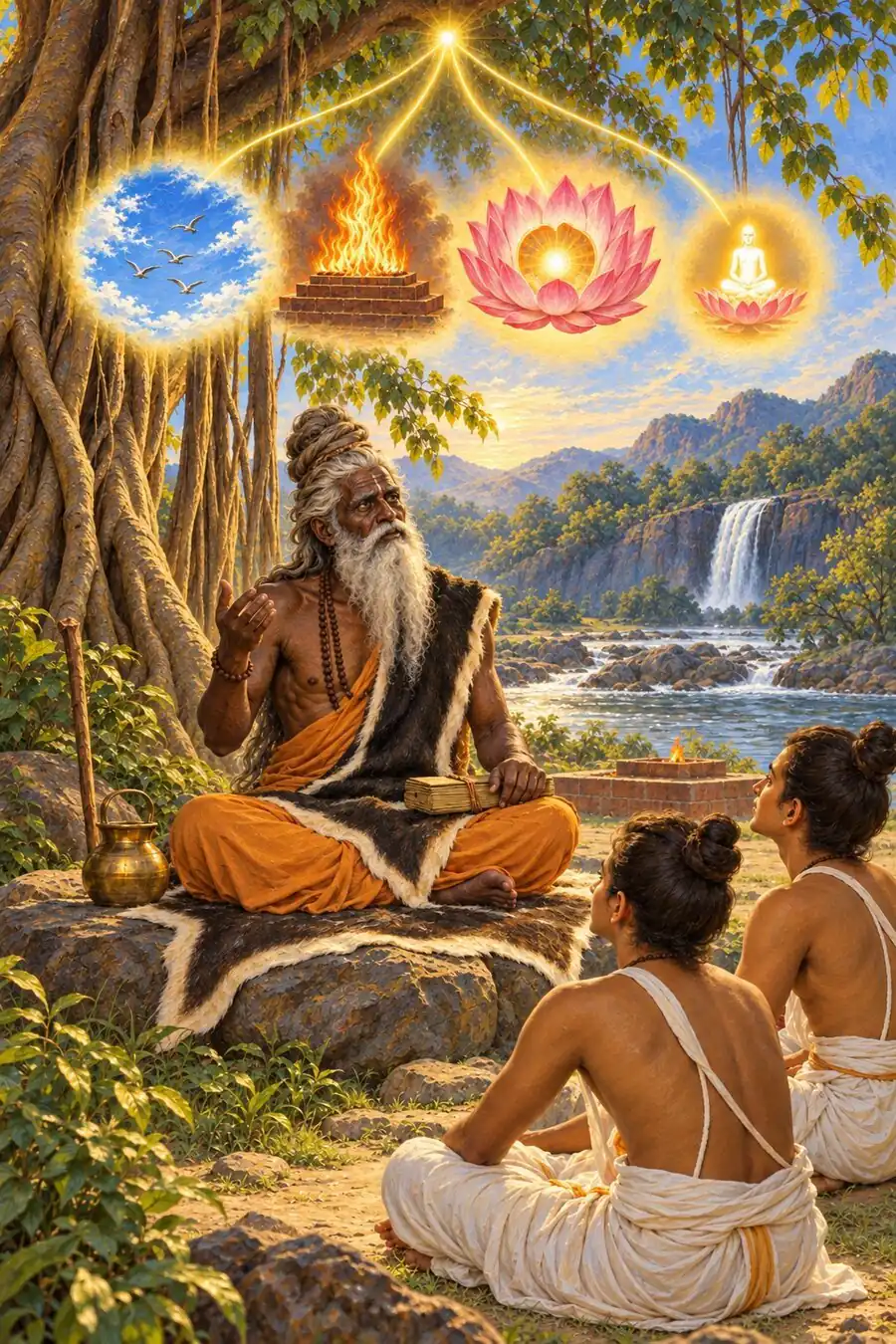
The question in front of Badarayana is this. The Upanishads are many, and each one speaks through its own images and stories. In one place the inner controller, in another space, in another Vaishvanara, in another the small cavity of the heart, in another the person no bigger than a thumb. So are these all separate principles, or many different descriptions of one and the same Brahman?
Badarayana’s answer is one Brahman. All of Book 1 proves exactly this, pada by pada, adhikarana by adhikarana. Each adhikarana settles on one Upanishadic statement and asks whom that statement is speaking about, and the answer comes back the same, Brahman.
Other schools, the Samkhya above all, say that some statements speak of pradhana (unconscious primal nature), not of Brahman. Badarayana answers these objections too within this book.
The first four sutras lay the ground: the eligibility to inquire into Brahman, the mark of Brahman, shastra as the one proof for knowledge of Brahman, and the pledge of convergence. In the remaining sutras Badarayana fits particular Upanishadic statements onto Brahman.
1.1.1
Jijnasa-adhikarana: the eligibility to inquire into Brahman
1.1.2
Janmadi-adhikarana: the mark of Brahman
That from which the birth, continuance and dissolution of this world proceed is Brahman. Four words, and they are a definition.
The objector asks how origin and end can define what is eternal; a thing’s dealings with other things do not say what it is. Shankara answers that this is a tatastha lakshana, a mark that stands at the edge and points, the way “the house with the crow on its roof” points out a house. The world spread out in names and forms, with its many agents and enjoyers, each fruit falling in its own place and time, in an order no mind could plan, cannot have come from unconscious matter, or from atoms, or from nothing, or from itself; it comes from an all-knowing, all-powerful cause. Brahman’s own nature, the svarupa lakshana, is “real, knowledge, infinite” (Taittiriya 2.1); the sutra starts from the mark because a thing is recognized by what it does before it is said what it is. And the mark is drawn from scripture: inference from the world’s design only supports what the Taittiriya says.
Context: Taittiriya 3.1.1, “that from which these beings are born, by which when born they live, into which they enter when they depart, seek to know that; that is Brahman,” which Varuna gives his son Bhrigu as the whole of the teaching. The sutra packs that sentence into four words.
1.1.3
Shastrayonitva-adhikarana: how Brahman is to be known
Because scripture is its womb. Two words, and Shankara reads them two ways and keeps both. Brahman is the source (yoni) of the vast scripture, Rig, Yajur, Sama and the rest, which no one could have breathed out who did not know everything, so the cause named in 1.1.2 is omniscient; and scripture is the source of our knowing Brahman, the means by which alone it is known.
The second reading answers an objection: if the world’s cause can be inferred from the world, as a potter from a pot, the Upanishads are not needed. Shankara replies that perception and inference each have their field, and Brahman lies in neither. The senses do not reach it; inference from the world would give a cause of some kind and nothing sure about its nature, since what one reasoner proves another overturns; and Brahman has no form, no sound, no mark for inference to seize. The Vedanta texts alone establish it, as the ritual texts alone establish dharma, and reasoning comes after, to help the texts be understood.
Context: Brihadaranyaka 2.4.10, the Vedas “breathed out” by the great being, and Mundaka 1.1.5, where the lower knowledge covers the four Vedas and the six limbs and the higher knowledge is that “by which the imperishable is reached.” The sutra stands on both.
1.1.4
Samanvaya-adhikarana: every Upanishad points to Brahman
But that, because of the convergence. The key sutra of the book, and the one that gives it its name. “That” is Brahman, the source and the object of scripture; “but” turns against an objection; “because of the convergence” (samanvaya) says that the Vedanta texts, read whole, with their openings and closings, their repetitions and their purposes, settle on Brahman as what they mean.
The objector is the Mimamsaka, for whom the Veda means only by commanding. A sentence that states a fact, he says, is empty unless it serves an injunction; so the Upanishads either tell the performer of rites who he is, or they enjoin a meditation, and the knowledge of Brahman is no purport of theirs, since an existing thing is learned from other means and the Veda is for what is to be done. Some older Vedantins half agreed, and made Brahman the object of a command to know it.
Shankara refuses both. Brahman is nothing to be done, and knowing it is no act that can be ordered, since knowledge follows the thing as seeing follows what stands before the eyes. The texts are far from idle: the moment a man knows “I am Brahman,” the sense of being a doer and a sufferer, which is the ground of every injunction, is gone, and that fruit, release, is seen at once. Release is no product of action, since whatever is made perishes; it is what eternally is. So the texts converge on one thing: “Being alone was this in the beginning, one without a second” (Chandogya 6.2.1), “in the beginning this was the Self alone” (Aitareya 1.1.1), “this Self is Brahman” (Brihadaranyaka 2.5.19), “all this is Brahman, the immortal” (Mundaka 2.2.11).
Context: Chandogya 6.2.1, Aitareya 1.1.1, Brihadaranyaka 2.5.19 and Mundaka 2.2.11 are the passages Shankara lines up; Brihadaranyaka 4.4.19, “there is no plurality here at all,” and Katha 2.1.11, “by the mind alone is this to be grasped,” point to the same single center.
1.1.5-1.1.11
Ikshati-adhikarana: the Samkhya pradhana is not Brahman
The first long adhikarana, seven sutras, and the first open fight with the Samkhya. Chandogya 6.2 says: “Being alone was this in the beginning, one without a second. It saw (aikshata): may I be many, may I grow forth. It sent forth fire.” Who saw?
The Samkhya says: the cause of the world is the pradhana, unconscious root matter of three strands, and the Upanishad agrees with us, since the mark of 1.1.2 fits it; as for “it saw,” that is a figure, as when one says the river bank “means” to fall. 1.1.5 answers: the cause saw; seeing is thinking; an unconscious thing does not think; so the cause is intelligent, and the pradhana, which has no word of scripture behind it (ashabdam), is out.
The next six sutras close the exits. 1.1.6: the seeing is no figure, since the same passage calls the cause “Self,” “that is the Self, you are that, Shvetaketu” (6.8.7), and no one calls unconscious matter the self of a conscious being. 1.1.7: release is taught for the one who rests on it, and no one would be told to rest on matter in order to be free. 1.1.8: nothing in the passage says the cause is to be discarded, as the pradhana would have to be. 1.1.9: in deep sleep the jiva “has gone to its own” (6.8.1), merged in its cause, and a self sinks back into its Self, never into matter. 1.1.10: all the Vedanta texts agree on an intelligent cause (gati-samanya). 1.1.11: and scripture says it outright, “he is the cause, the lord of the lords of the organs, and of him there is no parent and no lord” (Shvetashvatara 6.9), spoken of the all-knowing Lord.
Context: Chandogya 6 (Uddalaka and Shvetaketu) carries 1.1.5 to 1.1.9; 1.1.10 looks across all the Upanishads; 1.1.11 draws on the Shvetashvatara. Shankara ends by asking why the sutras go on if the cause is already settled, and answers: Brahman is taught in two ways, with adjuncts for meditation and without them for knowledge, and the sutras that follow sort the texts between the two.
1.1.12-1.1.19
Anandamaya-adhikarana: the sheath of bliss, and Brahman its support
Taittiriya 2.1 to 2.5 walks inward through five selves, each inside the last: a self made of food, which is the body; inside it one made of breath; inside that one made of mind; inside that one made of understanding; and inside that “another inner self, made of bliss,” with joy as its head, delight as its right side, great delight as its left, bliss as its trunk, and “Brahman as its tail, its support.” The chapter had opened on Brahman as “real, knowledge, without end.” So who is this self made of bliss, the anandamaya: that Brahman, or one more sheath laid over it? Shankara stages the debate twice. He first gives the reading of an earlier Vedantin, the vrittikara, which is also what the eight sutras seem to say on their surface. The anandamaya is Brahman, because bliss is named for it again and again through the chapter: “he alone causes bliss” (2.7), “now this is the examination of bliss” (2.8), “he who knows the bliss of Brahman fears nothing” (2.9); that is 1.1.12. The suffix maya, which in annamaya marks a product, here means abundance, as it does in “a sacrifice full of food” (1.1.13), and the one who causes bliss must himself abound in it (1.1.14). The Brahman the opening mantra praised is the one sung here (1.1.15). It cannot be the jiva, since the one who “desired, may I be many” did so before any body existed (1.1.16), and the chapter keeps the jiva apart from it as the taster from the taste (1.1.17).
Desire rules out the Samkhya pradhana, which cannot wish (1.1.18). And scripture teaches the jiva’s union with this very self once it is known: “when he finds fearless rest in the invisible, the bodiless, the undefined, then he has reached the fearless” (2.7), which is 1.1.19. So runs the first reading. Shankara then turns on it. Why should maya mean “made of” four times running and switch to “abounding in” at the fifth? If the Brahman of the opening mantra governs the chapter and forces the switch, it would make the food-self and the breath-self Brahman too. A thing with a head and two sides and a trunk is a thing with parts; the chapter closes on a Brahman “from which speech and mind turn back,” which has none. Abundance of bliss would leave room for a trace of its opposite, and the Chandogya’s bhuma, “where one sees nothing else,” leaves no such room. Joy differs from body to body, so a self made of joy is a different self in each body; Brahman is one in all. And what the chapter repeats is the bare word ananda, bliss, which the Brihadaranyaka also uses for Brahman outright, “Brahman is knowledge and bliss” (3.9.28); the full word anandamaya recurs only where the sheaths are listed as things to be reached, all of them effects. The passage itself says where Brahman stands: “Brahman is the tail, the support.” The verse that follows, “he who knows Brahman as non-existent becomes non-existent himself; he who knows Brahman as existent, him we know as existent,” speaks of Brahman alone and never of the bliss-self, and no one needs a warning verse about whether joy and delight exist.
So Shankara rereads the sutras as spoken of the Brahman in that tail-clause. 1.1.12: this support is the principal matter, since the verse repeats Brahman and nothing else. 1.1.13: if someone says the word “tail” makes it a mere limb, no; the text has been naming heads, sides, trunks and tails for five selves, the limb-word is carried along by that abundance of limb-talk, and the sutra before has already fixed Brahman as the chief matter. 1.1.14: Brahman is declared the cause of everything, the bliss-self included, “he created all that there is” (2.6), and a cause is no limb of its own effect. 1.1.15 to 1.1.19 are then read of the same Brahman: it is the one the mantra sang; it is not the jiva, since the desire before bodies belongs to the cause; the jiva is distinguished from it; desire shuts out the pradhana; and union with it is what the fearless rest of 2.7 teaches. What is decided: the anandamaya is the fifth and finest sheath, a product like the four before it, and the five are laid out only to lead the mind inward to what holds them up. Brahman is that support, without parts and without attributes. Ramanuja keeps the first reading, the self made of bliss as Brahman itself, and the popular teaching of five koshas with a bliss-self innermost follows him there.
1.1.20-1.1.21
Antar-adhikarana: the inner person within the sun is Brahman
Chandogya 1.6.6 to 1.6.8: “Now that person, bright as gold, who is seen within the sun, with golden beard and golden hair, golden to the tips of his nails, whose eyes are like a blue lotus; his name is Ut, for he has risen (udita) above all evil. Rik and Saman are his joints.” And the same person, the text goes on, is seen in the eye. Who is he?
The opponent says: a soul of high merit, raised by knowledge and works to lordship in the sun. He has a shape, a beard and hair of gold, and Brahman has none, “without sound, without touch, without form” (Katha 1.3.15); he has an abode, the sun and the eye, and Brahman “rests in its own greatness” (Chandogya 7.24.1); his power has a limit, “lord of the worlds beyond the sun and of the desires of the gods,” and Brahman’s has none. 1.1.20 answers: the one within is the Lord, because his qualities are declared. The name Ut is explained by freedom from all evil, and scripture grants that to the highest Self alone, “the Self free from evil” (Chandogya 8.7.1); “he is Rik, he is Saman, Uktha, Yajus, Brahman,” and “Rik and Saman are his joints,” can be said only of the Self of all; “all who sing to the vina sing him,” which is true of the Lord alone. The golden form is one the Lord takes for his worshipers, out of maya; the abode and the limit are set for meditation, since a thing may be given a place for the mind to rest on though it has none.
1.1.21 adds: there is another one, apart from the soul that animates the sun, because scripture declares the difference: “he who dwells in the sun and is within the sun, whom the sun does not know, whose body the sun is, who rules the sun from within, he is your Self, the ruler within, the immortal” (Brihadaranyaka 3.7.9). The person in the sun is that ruler within. So this golden person is no sun-god.
Context: Chandogya 1.6 and 1.7, where the sun is the outer symbol and the person in it the thing meant. Shankara reads this adhikarana as the first of those that teach the Brahman with qualities for meditation, once the anandamaya block has set the attributeless Brahman as the thing to be known.
1.1.22
Akasha-adhikarana: akasha is Brahman
Chandogya 1.9.1: “What is the goal of this world?” “Space (akasha),” he answered, “for all these beings arise from space alone and return into space; space is greater than these; space is their final rest.” Shalavatya had claimed to know the Udgitha’s deity, and Jaivali Pravahana corrects him with this. Which space?
The opponent says the element, since that is the word’s ordinary sense and a word is not to be bent when its plain sense will serve; element-space too can be called a cause, since air comes from it and fire from air (Taittiriya 2.1), and it is greater than the rest and their resting place by comparison. 1.1.22 answers: Brahman, because the marks of Brahman are given (tallingat). “All these beings arise from space alone”: every Vedanta text says beings arise from Brahman, and “alone” and “all” are empty if said of element-space, itself a product; “return into space” says the same; “greater than these” scripture gives only to the highest, “greater than the earth, greater than the sky, greater than heaven” (Chandogya 3.14.3); and Jaivali chose space because Shalavatya’s saman had an end and he wanted what has none, “without end,” which is Brahman’s mark. The word akasha is used of Brahman elsewhere, “if that bliss were not in akasha” (Taittiriya 2.7), “akasha is the revealer of names and forms” (Chandogya 8.14.1); and a word is fixed by what follows it even when it comes first, as “Agni studies his lesson” is at once understood of a boy named Agni.
Context: Chandogya 1.8 to 1.9, the dispute of the three Udgitha-knowers. The word akasha appears in the Chandogya sometimes for the element and sometimes for Brahman, and the sutra teaches how to read each place by its marks.
1.1.23
Prana-adhikarana: prana is Brahman
Chandogya 1.11.4 to 1.11.5, Ushasti Chakrayana on the deity of the prastava: “Which is that deity?” “Breath (prana). For all these beings merge into breath alone, and from breath they arise.” Breath, or Brahman?
The opponent says breath, the fivefold vital air, the word’s common sense; and the merging fits it, since “when a man sleeps, speech merges into breath, the eye into breath, the ear, the mind, and when he wakes they come out of breath again” (Shatapatha Brahmana 10.3.3.6), which anyone can watch; besides, the sun and food are the deities named next, for the udgitha and the pratihara, and they are no Brahman, so why should breath be? 1.1.23 answers: for the same reason as before (ata eva), the marks. In sleep only the senses sink into breath, while the text says all beings, bodies and senses and all, merge and emerge; that is the mark of the cause of all, and the cause of all is Brahman. Neighbors in a list prove nothing against a complementary sentence, and the word prana is used of Brahman elsewhere, “the mind is fastened to prana” (Chandogya 6.8.2), “the breath of breath” (Brihadaranyaka 4.4.18).
Context: Chandogya 1.10 and 1.11, the story of Ushasti, who taught the priests at a king’s sacrifice the deities of its three chants. Shankara remarks that this adhikarana and the one before it have the same shape: a word with a common meaning, a complementary sentence that gives it Brahman’s marks, and the decision that the marks win.
1.1.24-1.1.27
Jyotishcharana-adhikarana: the light is Brahman
Chandogya 3.13.7: “Now that light which shines above this heaven, higher than all, higher than everything, in the highest worlds beyond which there are none higher, that is the same light which is within a man.” Is the light the sun’s, or Brahman?
The opponent says physical light: light and darkness are plain words for what helps and what hinders the eye; “shines” is said of the sun; a light “above this heaven” has heaven for its edge, which fits an effect and never the Self of all; “the highest worlds” are many abodes; and the light “within a man” is the belly’s fire, known by its warmth and its sound (3.13.8), with a small reward attached, “he becomes conspicuous and celebrated,” where Brahman would earn release. 1.1.24 answers: Brahman, because of the feet. The verse just before (3.12.6) said, “such is its greatness, greater still is the Person; one foot of it is all beings, three feet of it the immortal in heaven.” That three-footed immortal in heaven is what “the light above this heaven” picks up, by its tie to heaven and by the relative “which”; to drop it and start on the sun would abandon a topic for no reason, and the Shandilya teaching that follows (3.14) is still about Brahman. Brahman may be called light, since it lights everything, “him shining, everything shines after” (Katha 2.2.15); a place, and even many places, may be given it for meditation; the belly’s fire is its symbol, as a name is; and the reward is small because here a Brahman with qualities is taught, as “he who knows this obtains wealth” is said of the Brahman that “eats all food” (Brihadaranyaka 4.4.24).
1.1.25: if someone says the earlier passage is about the Gayatri meter, “the Gayatri is all this that exists” (3.12.1), so that Brahman is no topic there, no; through the meter the mind is being pointed at Brahman, since no arrangement of syllables could be “all this,” and meditation on Brahman under the form of one of its effects is seen elsewhere, as when the Bahvrichas see it in the great hymn and the Adhvaryus in the fire. 1.1.26: only so can beings, earth, body and heart be called the Gayatri’s four feet, and only so does the verse “such is its greatness” have a place; the Purusha Sukta (Rig Veda 10.90.3) sings that verse of Brahman alone, and “the five men of Brahman” of 3.13.6 needs a Brahman already in view. 1.1.27: if someone says the two passages name heaven differently, an abode in one (“the immortal in heaven”) and a boundary in the other (“above this heaven”), there is no contradiction either way; a falcon on a treetop is said both to be on the tree and above it.
Context: Chandogya 3.12 and 3.13, the Gayatri meditation, and Rig Veda 10.90.3, “all beings are one quarter of him, three quarters the immortal in heaven.” The sutras settle that the meter, the verse and the light are one teaching.
1.1.28-1.1.31
Pratardana-adhikarana: prana once again as Brahman
Kaushitaki 3: Pratardana, son of Divodasa, comes to Indra’s house by fighting and strength, and Indra offers a boon; Pratardana says, “choose for me what you hold most beneficial for a man,” and Indra says, “Know me alone. I am prana, the intelligent self; meditate on me as life, as immortality” (3.2), and at the end, “that prana is the intelligent self, bliss, unaging, immortal” (3.8). The word is pulled four ways: toward the breath that “lays hold of this body and makes it rise,” toward the god who says “know me,” toward the soul that is “the speaker” behind speech, and toward Brahman, whose marks “bliss, unaging, immortal” are.
Against the opponent who takes it as breath, 1.1.28 answers: Brahman, from the connected sense (anugama) of the whole passage. Pratardana asked for the highest good of a man, and only knowledge of the highest Self gives that; “he who knows me, no deed of his harms his life, not theft, not the killing of a Brahmin” is true only of one whose works have burned away in knowing Brahman; air cannot be an intelligent self; and “he makes the man he would lead up do good deeds, and the man he would lead down do bad deeds; he is the guardian of the world, its king, its lord” (3.8) is said of Brahman or of no one.
1.1.29: if someone says Indra is speaking of himself (“I killed the three-headed son of Tvashtri; I gave the Arunmukhas to the wolves”) and a god is no Brahman, the chapter is too full of the inner self for that: “as long as prana dwells in this body, so long there is life”; the wheel whose rim rests on the spokes and the spokes on the hub, as objects rest on the senses and the senses on prana; “he is my Self, so let it be known.” 1.1.30: Indra speaks from the standpoint of scripture (shastra-drishti), seeing by a rishi’s insight that his self is the highest Self, as Vamadeva saw and said “I was Manu and the sun” (Rig Veda 4.26.1; Brihadaranyaka 1.4.10, “whichever god awoke to it became it”); the boast of cruel deeds is there to praise the knowledge, “though I do such things, not a hair of me is harmed, because I am Brahman.” 1.1.31: if someone says the marks of the soul (the speaker) and of the chief breath (what makes the body rise) are there too, no, for three reasons: taken literally they would make one passage enjoin three meditations, on soul, breath and Brahman, while its opening “know me alone” and its close “that prana is the intelligent self, bliss, unaging, immortal” show one topic; the word prana is accepted for Brahman wherever Brahman’s marks appear; and Brahman’s marks are tied to this very passage, since the ten objects and the ten powers can rest on nothing else. The breath’s work rests on Brahman and may be spoken of as his, “no mortal lives by the breath that goes up or the breath that goes down; we live by another in whom these two rest” (Katha 2.2.5), and the speaker behind speech is the soul only as Brahman under its adjuncts, “that which speech cannot express, by which speech is expressed, know that alone as Brahman” (Kena 1.5).
Context: Kaushitaki 3.1 to 3.8, Vamadeva’s hymn in Rig Veda 4.26.1, and Brihadaranyaka 1.4.10. Shankara also records the vrittikara’s reading of 1.1.31, that one meditation on Brahman is taught here under three aspects, as prana, as prajna and as itself, and lets it stand beside his own.
Read alongside
- The Brahma Sutra index
- The Upanishad collection, the source statement of every adhikarana is there
- The Bhagavad Gita, the smriti canon
- The Ashtavakra Gita, a direct statement of Advaita
- The Sri Rama Gita, Vedanta in brief
The first sutra of the whole work, and its doorway. Three words: now, therefore, the inquiry into Brahman. Each word is argued over. “Now” (atha) marks what must come before; “therefore” (atah) gives the reason; and “the inquiry into Brahman” names a desire to know that ends only in knowing.
After what, then? The Mimamsaka answers: after the study of ritual, since the Veda’s first half must be mastered before its second; and he adds that Brahman needs no inquiry in any case, being either already known as everyone’s own self or beyond knowing altogether. Shankara answers that the inquiry has nothing to do with rites and does not wait on them. What “now” takes for granted is a fourfold readiness: telling the lasting from the passing, dispassion toward the fruits of this world and the next, the six wealths (shama, dama, uparati, titiksha, shraddha, samadhana), and the longing for release. Whoever has these may inquire, whether or not he has studied the ritual; whoever lacks them cannot, however much ritual he knows.
Brahman is indeed known already, since no one thinks “I am not”; yet people disagree about what this self is, the body, the senses, the mind, a momentary flash of knowing, the void, an agent and enjoyer, a bare witness, a Lord above the soul, and so the inquiry is needed, and the texts are needed to settle it. “Therefore” gives the reason: because the fruits of rites perish, “as the world won by work perishes here, so the world won by merit perishes there” (Chandogya 8.1.6), while the knower of Brahman “reaches the highest” (Taittiriya 2.1). Sorrow at what passes is the seed of the question.
Context: Chandogya 7.1.3, “the knower of the Self crosses sorrow,” is the promise behind the inquiry; and Brihadaranyaka 2.4.5, “the Self is to be seen, to be heard, to be thought on, to be meditated on,” is the Upanishad’s own form of the same call.