On this page
The King From Whom the Earth Fled as a Cow
Janamejaya had asked Vaishampayana for one story in full: the birth of Prithu, and how that king milked the earth, and with what calves and what vessels the gods and the ancestral dead, the Rishis and the Daityas, the Nagas and the Yakshas and the mountains milked her after him, and why, before any of it, the angry Rishis had churned the arm of a king named Vena. Vaishampayana answered that he does not tell this story to the impure or the small-minded, to anyone who keeps no vows, to the ungrateful or to a man who injures living things; and that whoever hears the birth of Vena’s son, having first saluted the Brahmins of his day, is not left grieving over the wrongs he has done. Then he began where the fault began. Anga, a patriarch of the race of Atri and as powerful as Atri himself, was the protector of dharma in his age. His one son was Vena, born on Sunitha, and Sunitha was the daughter of Death. The boy drank in the defect of his mother’s father along with her milk. He deviated from his own duties, and when the throne came to him he preached freedom of conduct to the world: do as you please, there is no order above you.
Vena set up an order of his own against the Veda. Under his rule the study of the Vedas stopped, and the Vedic rites stopped with it, and the gods, who live on the Soma consecrated in yajnas, went without it. Then came the dreadful promise of the patriarch: no one in his kingdom would perform a homa or a yajna, not even at the hour of the world’s destruction. He told his people why. “I am the one worthy of being adored. I am the agent of the yajna, and I am the yajna itself. Dedicate every yajna and every homa to me.” Having said it, he took the share of the offerings that had belonged to the gods, and ate it.
The Patience of the Rishis, and Its Limit
The great Rishis saw him eat what had been the gods’ share, and they came to him with Marichi at their head. They spoke once, and said what they had to say in two breaths. “We are about to enter upon a diksha that will keep us at the sacrifice for many long years. Do not act against dharma while we do, Vena; the dharma we speak of is eternal. After Atri’s death you were born to be the patriarch in his place, and you made the contract then that you would govern the subjects.” That was the whole of their appeal: the rite they were about to undertake, and the word he had given.
Vena laughed at them. It was a wicked, ill-disposed laugh, and the words that followed it were worse. “Who else will be the founder of dharma? Whom am I supposed to listen to? Who on this earth is superior to me in learning, in energy, in prowess, in tapas, in truth? Every creature came out of me, and every form of worship most of all. You are stupid men with no consciousness in you, and that is why you do not know who I am. If I wish it, I can burn the earth down, or drown it under water. I can block heaven off from earth. There is nothing here to discuss.”
That was the answer, and there was no other coming. Pride and self-worship had sealed the man, and the noble Rishis, who had come to make him humble, saw that words would never do it. Anger rose in them, and they let it rise. They took hold of that immensely powerful king with their own hands and beat him, and then, still in their anger, they seized his left thigh and began to churn it.
The King Who Came From the Churning
What came out of the churned thigh was a man, very short and very dark. He stood where he had risen, stricken with fear, his arms folded in front of him, and Atri looked at that fear and said one word to him. “Nishida.” Sit down. He sat, and from him came the race that carries the word as its name, the Nishadas, the hunters of the forests, and from him too the fishermen of the rivers, a people begotten of the sins of Vena. Other peoples came of Vena the same way, the Tukharas, the Tumuras and the rest who live on the Vindhya mountain and take their pleasure in impiety.
Then the Rishis, their anger still hot, took Vena’s right arm and churned it as a man churns a stick of wood to kindle fire. From that arm Prithu came, and he came as the flame comes from the wood, burning with a radiance like the fire itself. He was born armed. In his hand was Ajagava, the first and finest of bows; at his back were heavenly arrows; over his body a coat of mail that threw back the light. At his birth every creature alive was filled with delight. And the birth reached back to the father. Vena went up to the celestial region, because a good son had been born to him, and Prithu, by the fact of being born, drew his father clear of the hell called Put, the hell kept for men who die leaving no son.
The oceans came, carrying all their jewels, and brought their water for his installation. Brahma himself came, and with him the Devas, the sons of Angiras, and every creature that moves and every one that stands still, and they installed the radiant son of Vena as lord of a wide kingdom. The leading Rishis, the men who knew the Vedas and every other shastra, consecrated him as the first king. The four kings Brahma had set over the quarters of the earth, Sudhanva in the east, Shankhapada in the south, Ketuman in the west and Hiranyaroma in the north, made him Lord Paramount over all of them in a Rajasuya performed by the rule of the Vedas. The people his father had left so dissatisfied were pleased with him, and because he was the object of their love they called him Raja. When he went out on the ocean the water grew hard as land under him; the mountains made way for him, and the branches of the trees were not broken as he passed. The earth grew easy to work and yielded food as soon as anyone thought of it. The cows gave milk whenever they were milked, and honey grew in every leaf.
In those same days, at the sacred yajna of Brahma, two men were born out of the rite itself: Suta, the highly intelligent, and the wise Magadha. The celestial saints called them and set them a task. “Sing the glories of this king. The work befits you, and this king is a fit subject for it.” The two of them looked at the Rishis and at the new king and answered with care. “We will gladly delight the gods and the Rishis with what we do. But we know nothing of this king’s actions, or his character, or his fame. How are we to chant his glories?” The Rishis had the answer ready. “Chant them by the deeds this powerful Prithu did in the previous kalpa.” And they told the singers what to sing: that this king speaks the truth, keeps his character and his promises, is modest and does good to all; that he is forgiving and powerful and represses the wicked; that he observes his duties, is grateful and merciful, that his words are always sweet and his respect goes to those who deserve it; that he performs yajnas, is devoted to the Brahmins, is quiet in temper and keeps the rules of society. So the first praise-song ever sung to a king was sung of deeds from an earlier world, and from that day the Sutas and the Magadhas have poured their benedictions over kings at the hour of praising. Prithu was so pleased with the eulogy that he gave Suta the province of Arupa, and to Magadha he gave the land that still carries his name, Magadha.
The Earth Is Milked
Then the great Rishis and the people said to one another, “Now the king will surely grant us our maintenance, and in abundance,” and at the saints’ word the subjects came before the son of Vena and asked him for their livelihood. It was a hard thing to ask for in that age. The earth was uneven then, ridged and pitted as she had been through the whole Manvantara of Chakshusha, and on such ground there had been no ordered division of cities and villages, no corn, no rearing of cattle, no agriculture and no trade. People lived with great difficulty on fruits and roots. The powerful king meant to do his people good, and there was only one who could feed them. He took up his bow and assailed the earth herself. She took the form of a cow and fled from Vena’s son in terror, and he went after her, the bow in his hand. She ran through the region of Brahma and through every other region there is, and wherever she turned she saw him already standing before her, bow raised, sharpened arrows at the string, blazing like the eternal fire that burns at the end of things, and the immortals themselves could not hold that king back.
Even in Brahma’s region she found no safety, and so the earth, whom the three worlds adore, stopped, folded her hands, and spoke to the son of Vena. “You should not perpetrate the iniquity of killing a woman. And without me, how will you protect your subjects? All the worlds rest on me; this universe is held up by me. Know this: when I am destroyed, every creature is destroyed with me. If it is the well-being of your subjects you want, killing me will not get it for you. Hear me. Work undertaken with the means to do it succeeds. Find the means by which you will protect your people. By killing me you cannot protect them, by any means at all. I will find the way myself; only restrain your anger. Even a woman of the lowest birth is not to be killed. Do not throw away your dharma.” The pious king heard her out, held his anger down, and answered her. “Whoever destroys many lives for the sake of one, on his own side or the other, commits a sin in this world. Whoever kills the one harmful being at whose death many become happy is touched by no sin, great or small. When the destruction of one wicked being secures the well-being of many, the act earns merit. So for the good of my subjects I will kill you. If you do not carry out this command of mine, on which the welfare of the world depends, I will kill you with this arrow for having neglected it, and I will bury my own self under the earth and hold my subjects up forever. You have always kept the pious rites. During my reign, give life to my subjects; you are able to protect them. Give milk for me, and I will draw back this dreadful arrow I have taken up for your destruction.” The earth answered, “I will carry out all you have said. Work undertaken along with its means always succeeds, so take up the means by which all your subjects can be protected. Here is my calf. Out of love for it I will give my milk. Level my surface everywhere, so that my milk can reach every place.”
Prithu set the end of his bow under the hills and uprooted them by the thousand, and the hills, torn up, multiplied greatly in number. Then Vena’s son leveled the surface of the earth. Through the Manvantara before this one, the Manvantara of Chakshusha, she had been even in some places and uneven in most, and that unevenness had kept the world raw. In it there had been neither truth nor untruth, neither avarice nor pride. With the coming of the Manvantara of Vaivasvata, agriculture and trade and the keeping of cattle began, and they began from Vena’s son Prithu. People looked at the places he had leveled and wanted to make their homes there, and the first settlements rose on flattened ground. Then Prithu made Svayambhuva Manu, the first Manu of all, into the calf, and with his own two hands the foremost of men milked the earth, and what flowed from her was corn of every kind. On that food, Vaishampayana told Janamejaya, the people are living to this day.
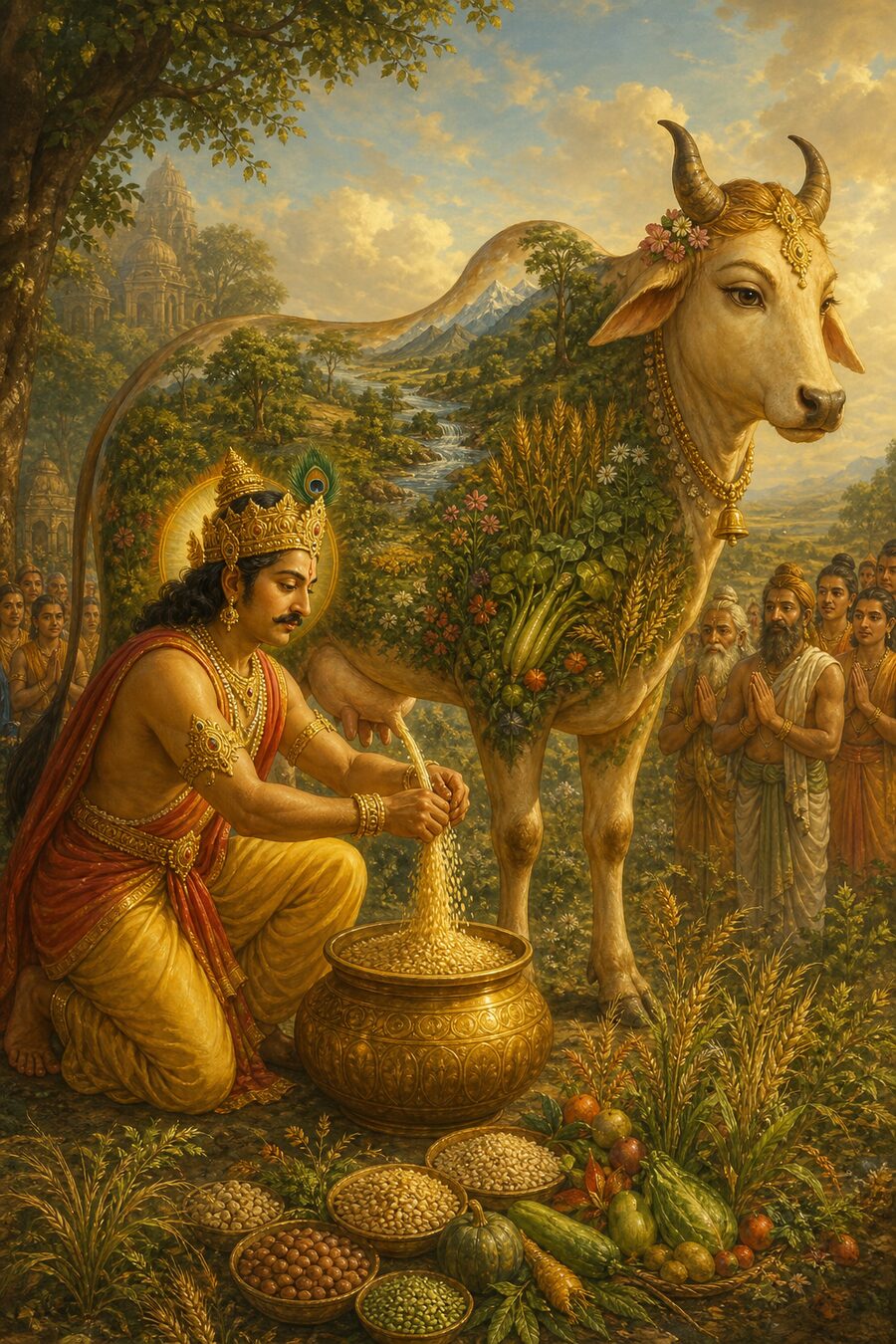
What the king had done once, the whole creation did after him, each order of beings choosing its own calf, its own milker and its own vessel, and each drawing from the earth the one thing it lives on. The Rishis milked her next: Soma was their calf, Brihaspati the son of Angiras drew the milk, the Vedas were their vessels, and the milk was undying devotion to Brahman. The celestials, with Purandara at their head, came with vessels of gold; Indra himself was the calf and the lord Sun the milker, and the milk came in a continuous stream, and on it the Devas live. The ancestral dead came with vessels of silver; Vivasvat’s son Yama was their calf, and Antaka, who ends the worlds, drew the milk. The Nagas made Takshaka their calf and cupped their palms for vessels, and the great Airavata Dhritarashtra milked for them, and what came was poison: the huge serpents live on it, give it out, and have it for their strength. The Asuras brought vessels of iron, with Virochana the son of Prahlada for their calf and the two-headed Madhu, priest of the Daityas, for their milker, and they drew out maya, the power of illusion that overpowers an enemy; that is why the Asuras are adept in illusion and so very strong. The Yakshas, with uncouth vessels, made Vaishravana their calf, and the three-headed ascetic Rajatanabha, father of Maninabha, milked out for them the art of vanishing from sight into another’s body; Narada said they live by it still. The Rakshasas and the Pishachas came for the sake of their children with the skulls of the dead for vessels, Sumali their calf and Rajatanabha again their milker, and blood came out for milk, and on that blood the Yakshas, Rakshasas, Pishachas and other ghosts keep their lives. The Gandharvas and the Apsaras made Chitraratha their calf, held out lotuses for vessels, and their sun-bright king Suruchi milked sweet perfume into them. The mountains milked her for herbs and for jewels of every kind, Himavan the calf, great Sumeru the milker, the other mountains the vessels, and by that milk the mountains go on growing. The trees milked her with palasha leaves for vessels, to bring scorched and burned trees and creepers back to life; the flowering shala drew the milk and the plaksha was the calf. So she gives whatever is desired of her and brings forth every grain, this purifying earth who sustains all and is the instrument of the birth and keeping of everything that moves and everything that stands. As far as the ocean she had been called Medini, because her whole surface was once soaked in the fat of the demons Madhu and Kaitabha, and Brahma and the others named her for it. Now, brought under the rule of Prithu the son of Vena and become his daughter, she took the name Prithivi, and divided and purified by him she filled with corn and mines and cities and provinces. Such a king was Vena’s son. Born of the eternal Brahma, he is to be adored by the great Brahmins learned in the Vedas and all their branches; by kings who want kingdoms; by warriors who want victory, for the fighter who goes out to battle after speaking the name of King Prithu wins through, with glory, even in the most dreadful fight; by the wealthy Vaishyas who carry on trade, since he gave livelihood to all; and by the pure Shudras who serve the other three varnas and wish for their own highest good. “I have described to you the calves and the milkers, the kinds of milk and the vessels,” Vaishampayana said to Janamejaya. “What more shall I tell you?” And the king, having heard this first great account of adharma and the dharma that answered it, asked him next for the Manvantaras.
Source: Harivamsha (the khila-parva of the Mahabharata), Harivamsha Parva, chapters 5 to 6; chapter numbers of the critical edition (P. L. Vaidya, Bhandarkar Oriental Research Institute, Pune). Told as story from chapters 4 to 6 of M. N. Dutt’s English translation (1897), which follows the vulgate text, keeping its sequence of events.
The same story, elsewhere
- King Vena and Prithu
Shrimad Bhagavatam (Skandha 4): Vena’s fall and the descent of Prithu