On this page
Yoga Vasistha · Story 12
Bali: The Minister Called Mind
After an age of dominion, Bali has tasted every pleasure the three worlds can offer, and the taste has gone out of all of it. From a balcony on the far polar peak of Meru he remembers a question he once put to his father, and the strange answer he received: a country with no sun in it, a king who does nothing, and a minister no weapon can touch. His teacher Shukracharya gives him a few words and leaves. What he does with them leaves his whole court standing at his door, and keeps him silent for a thousand years.
An Age of Years and One Unanswered Question
Vasistha had just told Rama to let no sprout of desire take root in him, and Rama, sitting at his feet in Dasharatha’s court, answered that the teaching had already done its work. "By your favor the great delusion of my many desires has cleared," he said, "the way the sky clears of its heavy clouds when the rains end and autumn comes. My soul is at rest, cool as a stone, and full of the light of what you have taught me. And still I am never full of hearing you. Tell me how Bali came to know the truth, and tell it whole. Holy teachers keep nothing back from the pupil who asks." Vasistha said: "Then listen, Rama, and follow Bali’s example. He found wisdom by looking into himself, and hearing how he did it will give you the same knowledge, the one that does not change."
The story begins under the ground. In the womb of the earth there is a region called Patala, and it goes down seven layers. Milk-white water goddesses live there, born of the ocean of milk, and the demon race has filled every gap and chasm of it with their children. In one quarter huge serpents with a hundred and a thousand heads hiss through parted tongues and long fangs. In another, demons the size of mountains stride about and seem to toss the globes of the worlds above their heads like sweets they mean to swallow. Elsewhere great elephants hold the earth up on their raised trunks and carry whole islands on their tusks. There are places of ghosts and shrieking devils, heaps of hellish bodies and rotting carcasses, and under all of it, down to the seventh layer, mines of gems and metals that never see the sun. One tract is holy with the dust from the feet of the divine Kapila, whom gods and demigods worship with their heads on the ground. In another, Shiva is present as a golden linga, and the women of the demons worship him there with heaped offerings and loud revelry. Over this whole realm Bali, the son of Virochana, reigned as king of the demons, and the demons carried his kingdom on the pillars of their arms. He had made the gods, the Vidyadharas, the serpents, and Indra himself wait at his feet like a train of vassals, and they were glad to serve him. Hari, who holds the jeweled worlds inside his own body and keeps every embodied creature alive, was his protector. His name alone made the cheeks of Airavata, Indra’s great elephant, go pale, the way a peacock’s cry turns a snake’s insides to water. The heat of his valor dried the seven oceans to seven beds of sand, as the fire at the end of a world does, and the smoke of his sacrificial fires drew rain back out of the sky as freely as the seas had fallen. When he frowned, the heads of mountains bent to the ground and the high skies came down low with water, like branches overloaded with fruit.
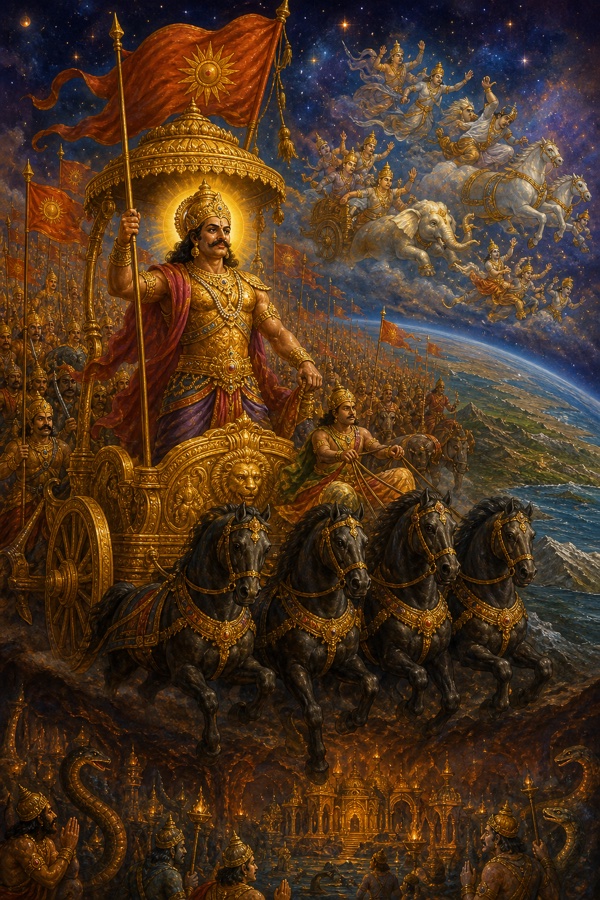
He had taken every treasure and every luxury of the world without much trouble, and after that he reigned for myriads of years. The ages slid past him like a river turning in a whirlpool. He watched the generations of gods, of demons, and of men rise in the three worlds and sink again, and rise again, and sink. He had tasted every enjoyment life holds, to the point of surfeit, and somewhere in the middle of all that variety a distaste set in, and after the distaste an uneasiness that no new pleasure could reach.
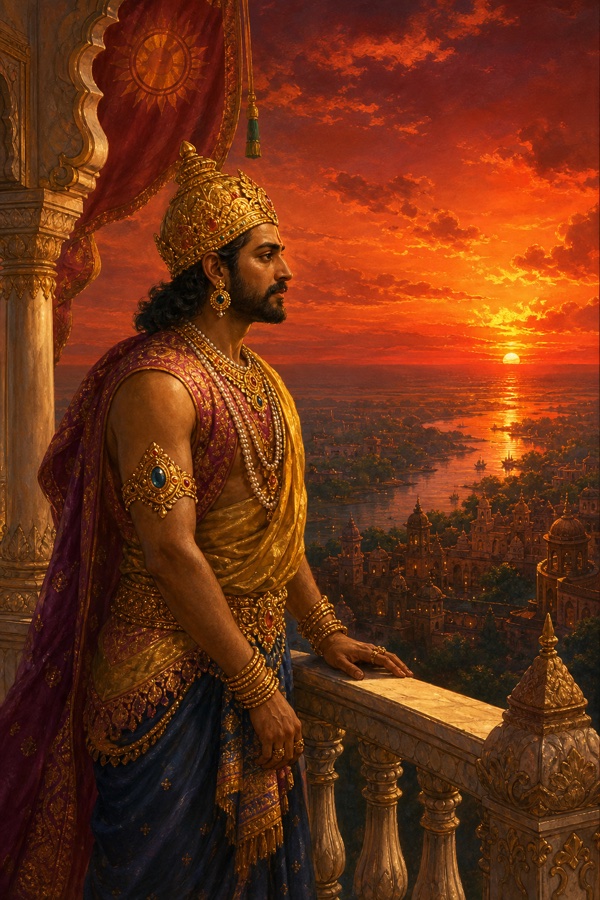
So he left. He went to the farthest polar peak of Meru, the mountain at the axis of the worlds, and sat on the balcony of one of its jeweled pinnacles with nothing to do, and looked at the condition of the world and the emptiness of a mortal life, his own included.
"How much longer," he thought, "must I rule this world with labor that never stops? How much longer must I keep wandering the triple world, birth after birth? What use is this sovereignty to me, the wonder of the three worlds, and what good is all this luxury that so delights the senses? Where is the lasting delight in pleasures that please for the present moment and have lost their taste, along with my appetite for them, by the next? The same rotation of days and nights in the same order. The same acts, repeated day after day. There is something shameful in it, something no one could call pleasant, to go on in one unvarying course for so long a time. The same embraces of the same beloved women, the same food taken day after day: these are amusements for playful boys. To a great mind they are disgraceful. What man of any taste would not sicken at tasting the same sweets over and over, the sweets he has eaten all along, which went flat and tasteless today? And what sensible man goes on with it without shame and remorse?"
He went on turning it over. "The turning days and nights bring the same round of duties, and doing again what has already been done looks as ridiculous to the wise as chewing meat that has already been chewed. There is no doing of a deed that is done, and no dying of a man already dead. Men’s actions are waves: they rise in order to fall, and fall in order to rise, and the water is where it was. Repeating the same act is the occupation of madmen, and the wise laugh at the man who recites the same chime again and again, like a boy running a verb through all its moods and tenses. Is there any action which, once completed, never comes back to be done again, and crowns the one who did it with full success at a single stroke? And even if this bustle of the world were to last only a short while, what good would we get from throwing ourselves into the commotion? The course of action has no end, like the endless repeats of children’s games; it is a hollow harping on one string, and the more it is played the more it rings with its own hollow sound. I see no gain in any of our actions which, once gained, would spare us further exertion. What can our actions bring us beyond objects of gratification for the senses? Nothing they bring is imperishable." With that the king of the demons sank into a trance, and for a while his mind went deep and still.
When he came back to himself he said aloud, "Ah. Now I remember what I once heard from my father." His brows lifted, and he let out what was moving in him. "Long ago I asked my father Virochana, who knew the spiritual science and the ways of the people of former and later ages. I asked him: what is that final state of being in which all our pains and pleasures stop, and after reaching which we have no more wandering through the world and no more passing through birth after birth? What is that last state toward which all our efforts point, where the mind is freed of its error and we get our full rest after all our wanderings? What is that best of gains which satisfies the craving of the soul, and what is that glorious object whose sight outshines everything else there is to see? All these luxuries and superfluities of the world do nothing for our real happiness. They lead the mind into error and corrupt the souls of even the wisest men. So, Father, show me that state of imperishable happiness, by which I may reach my everlasting rest."
"My father heard me out. He was sitting then in the shade of the kalpa tree of paradise, the wish-granting tree, whose flowers were fairer than moonlight and lay spread across the ground on every side, and in his sweet, honeyed voice he gave me this answer, to take my error away." What Virochana said that day, Bali now began to recall word by word, sitting alone on the roof of the world.
Virochana’s King and Minister
"There is an extensive country, my son," Virochana had said, "somewhere in this universe, with a spacious hollow in it wide enough to hold thousands of worlds and many more spheres besides. It has none of the wide oceans and seas and high mountains that this earth has. There are no forests there, no rivers and lakes, no holy places of pilgrimage such as you see here below.
"There is no land and no sky, none of the heavenly bodies that ride above us, no suns and no moons, no regents of the spheres and none of their inhabitants, neither gods nor demons. No races of Yakshas and Rakshasas, no tribes of plants and trees, no woods, no grass, nothing that moves and nothing that stands still, of all you see on the earth. No water, no land, no fire, no air. No sides of the compass, no region you could call above or below. No light and no shadow. No peoples, and none of the gods, neither Hari nor Indra nor Shiva, nor any of the lesser deities or demigods.
"There is a great sovereign of that place, and he is full of a light that cannot be described. He is the maker of everything and he pervades everything, he is all in all, and he is perfectly quiet in every place and every thing. He had chosen himself a minister, a clever administrator, who brought about what could not be done and kept every mishap from coming to pass. This minister neither ate nor drank, and he neither did nor knew anything except to mind his master’s wishes and carry them out. In every other respect he was as inert as a block of stone. He ran every piece of business for his master, and the master kept entirely out of it, enjoying his rest and his ease in seclusion and leaving all his affairs in the minister’s hands."
Bali had asked him then: "Tell me, sir, what place is that, with no population in it and no disease and no difficulty? Who knows that place, and how could anyone reach it? Who is this sovereign of such sovereign power, and who is this minister of such might? They stand apart from the world and yet they cannot be separated from it, and all our demon strength cannot conquer them. Tell me this marvelous story of the minister’s might, you whom the gods dread, and clear the doubt out of my mind. Tell me why we cannot conquer him."
"Know, my son," Virochana replied, "that this mighty minister cannot be overcome by the giant force of the Asuras, even with millions of demons fighting on their side. The thousand-eyed Indra cannot defeat him. Kuvera, the lord of riches, and Yama, the lord of death, who conquer everything, cannot. Neither the immortals nor the giants can overpower him by strength. Every weapon fails that is raised against him. Swords and mallets, spears and thunderbolts, discs and cudgels, hurled at him, break into pieces as if they had struck solid rock. No missile reaches him, no arm wounds him, no warrior’s skill can lay hold of him, and it is by that irresistible might of his that he has brought the gods and demigods under his rule.
"It was he who defeated our forefathers, the mighty Hiranyas, before the great Vishnu destroyed them. He it was who felled those big Asuras, the way a storm breaks down the sturdy, rocklike oaks. Narayana and the other gods, who were the teachers of men, were all foiled by him and shut up in the wombs of their mothers, to be born again as men. It is by his favor that Kama, the god with the flower bow and the five arrows, has been able to subdue the three worlds and boast that he is their only emperor.
"Gods and demigods, the intelligent and the foolish, the deformed and the hot-tempered, every one of them moves under his influence. And the wars between the gods and the Asuras, the wars that keep returning age after age, are this minister’s sport.
"There is only one who can manage him, and that is his lord, the silent soul. Without that lord he is either as dull as an immovable rock or as restless as the wind. It is only far along the road of spiritual knowledge that the soul feels any wish to subdue its minister at all, and he will not be governed by gentle measures; his nature does not allow it.
"You may call yourself valiant, my son, when you have conquered this greatest of giants in the three worlds, who has been worrying all people out of their breath. When the intellect rises, the world appears like a flower garden, like a lake of lotuses opening at sunrise; when it sets, the world is covered in darkness, as at sunset. It is only with the help of that intellect of yours, and by getting rid of your ignorance, that you can subdue this minister and be famous for your wisdom.
"By subduing this minister you become the subduer of the world, though you have conquered nothing in it. And while he is unsubdued you have no real mastery over the world, though you may be its master in name. So be diligent. Overcome him with your best and most ardent exertions, for the sake of your own perfection and your everlasting happiness.
"For the one who has been able to subdue this minister by superior might, it is easy to overcome the triple world and hold all its beings in his hand: the gods and the demons, the bodies of Nagas and men, the races of Yakshas and Rakshasas, the tribes of serpents and Kinnaras." Bali, who had conquered most of that list already, had listened to all of this and still did not know whom his father was talking about.
The Means of Subduing the Mind
"Tell me plainly, sir," he had said, "who this minister of such might is, and by what means so mighty a being can be vanquished and brought under control." Virochana answered: "Though that minister is invincible and stands above everyone in his strength, I will tell you the means by which he can be overcome, by you or by anyone else. Son, with the right means he is easily brought under; neglect them and he gets the upper hand of you, like snake venom that is not driven out in time by the right mantras and incantations. This ministerial mind, if it is brought up like a boy in the way he should go, leads a man into the presence of the sovereign soul, the way royal service advances a servant until he stands before his king.
"When the master appears, the minister vanishes from sight; when the minister disappears, one comes into full view of the king. As long as a man has not come into his king’s presence he cannot help serving the minister, and as long as he is busy in the minister’s service he cannot come to the sight of his king. Keep the king out of sight and the minister is seen wielding all his power; keep the minister out of view and the king alone stands in full view. So we must begin both exercises at once: approaching the sight of the king by degrees, and slighting the minister’s authority little by little. It must be by your continued manly exertion and diligent application that you work at both, in order to arrive at your own well-being. When your practice succeeds you are certain to reach that blissful country, and though you are a prince of the demons, nothing can bar your entrance. It is the abode of the blessed, whose desires are at rest and whose doubts are gone and whose hearts are full of a joy and calm that do not end.
"Now hear me explain, my son, what that place is that I called a country. It is the seat of liberation, moksha, where all our pains come to an end. The king of that place is the soul of divine essence, which stands above every other substance, and the mind is the wise minister that the soul has appointed. The mind holds the ideal world in its bosom and shows it afterward to the senses in sensible form, as a lump of clay holds the mold of the pot inside it and then shows itself as the pot, and as smoke carries the pattern of the cloud in its essence and then shapes the cloud’s shadowy forms across the sky. So when the mind is conquered, everything is subdued and brought under control. And the mind cannot be conquered without the right means." Bali asked: "What are these means, sir, for quelling the mind? Tell me plainly, so that I can use them to overcome this unconquerable barrier to bliss." Virochana said: "The means for subduing the mind are these: no reliance and no confidence in any external, sensible thing, and no desire for any temporal possession. That is the best expedient for removing the great delusion of this world and subduing the big elephant of the mind at one stroke. It is very easy and very practicable on one side, and arduous and impossible on the other; the constant habit of thinking this way makes it easy, and the lack of that habit makes it hard. It is the gradual habit of giving up our fondness for passing objects that shows itself in time as our resignation of the world, as steady watering at the roots makes a plant grow into a great tree. It is as hard to master anything, even for the cleverest man, without cultivating it for a time, as it is to reap a harvest from an unsown and unplowed field. Every embodied soul is doomed to rove the wilderness of the world for as long as its heart has not given up the objects of the senses. Without the habit of apathy there is no distaste for them, just as a man, however able-bodied, cannot travel abroad by sitting still at home. A firm resolve to abandon the props of life, and a habitual aversion to pleasures and enjoyments, carry a man forward into purity as a plant in open air grows to its full height.
"There is no good to be had on earth without a man’s own exertion. He must give up his pleasure, and the vexation of his spirit too, if he is to reap the fruit of his actions. People speak of a power here that they call destiny, and it has neither shape nor form of its own. It means whatever comes to pass; they also call it our lot, our fate. Men use the word for an accident they have no control over and submit to with passive obedience, and they use it to hold down their joy and grief at what cannot be avoided. But however fixed destiny is as fate, it is overcome and set aside by manly exertion; it happens again and again. As the delusion of a mirage is dispelled by light, so it is the exertion of manliness that upsets destiny, by bringing about whatever it wishes. If we look for the cause of the good or bad results of our actions, we find that they turn out as the mind wished to mold them. Whatever the mind desires and decrees becomes the destiny; there is nothing else you could point to and call destined or undestined. It is the mind that does all this. The mind employs destiny; it destines the destined acts of destiny. Life, the living soul, is spread through the hollow of the world like air through empty space. Destiny has no reality. It is a term invented to express fixity, as the word rock is used for stability. There is no fixed fate as long as the mind keeps its free will and its activity. When the mind is set at rest, what remains is the principle of the living soul, the jiva, and this is called the purusha, the embodied spirit, the source of the energies of body and mind. Whatever the living soul intends to do by its spiritual force takes place, and nothing else does. Rely on that spiritual power and your dependence on bodily nourishment is uprooted. And there is no hope of spiritual happiness until there is a distaste for temporal enjoyments. It is hard to attain the dignity of all-conquering self-sufficiency while a man still has the cowardly spirit of earthly cravings. While he swings in the cradle of worldly affairs it is hard for him to find rest in the bower of peaceful tranquility. You will not get rid of your serpentine desires, son, without continued practice of indifference to worldly affairs and unconcern with them."
Bali had pressed him. "Tell me, Father, how indifference to worldly enjoyments takes deep root in a man’s heart, and bears its fruit, the long life of the embodied spirit." Virochana said: "It is the sight of the inward spirit that produces indifference to worldly things, as the growth of the vine produces grapes in autumn. It is the sight of the inward spirit that produces our inner unconcern with the world, as the glance of the rising sun pours its luster into the cup of the lotus. So sharpen your intellect on the whetstone of right reasoning, and see the Supreme Spirit by withdrawing your mind from worldly enjoyments. There are two modes of intellectual enjoyment for those whose knowledge is still imperfect: one is book learning, the other comes from attending the lectures of a preceptor. Those a little advanced have the double advantage, reflection on what they have read and consultation with wise preceptors on practical points. And those who are accomplished in learning also have two duties: to profess the shastras by teaching them to others, and to practice indifference for themselves. When the soul is purified a man is fit for spiritual learning, as only clean linen takes a good dye. The mind is to be trained by degrees, like a boy on the path of learning: first by persuasion and good lectures, then by the teaching of the shastras, and last by discussion of their doctrines. After it has perfected its learning and scattered every difficulty and doubt, the mind shines like a piece of pure crystal and gives off a light like cool moonbeams. It then sees, with its complete knowledge and clear understanding, both the form of its God, the Spirit, and the body that is the seat of its enjoyments on earth. It keeps the Spirit before it constantly by understanding and reason, and these help it also to let go of its desire for worldly objects. The sight of the Spirit produces the absence of desires, and the absence of desires shows the Spirit’s light to its sight, so the two are related like the wick and the oil of a lamp, which together make the light and drive off the dark of the night. After relish for worldly enjoyments is lost and the Supreme Spirit is seen, the soul finds its lasting rest in the essence of the Supreme Brahman. Living souls that place their happiness in worldly objects can never taste true felicity unless they rest themselves wholly in the Supreme Spirit. Some delight may be had from acts of charity, from sacrifices and holy pilgrimage; none of these can give the everlasting rest of the Spirit. No one feels a distaste for pleasure unless he examines its nature and its effects in himself, and nothing can teach the way of seeing the soul unless the soul reflects on itself. Things that come to a man without his own exertion are of no good whatever, my boy, and there is no true happiness without resignation of earthly enjoyments. The supreme felicity of rest in the state of Brahman is to be had nowhere in this wide world, neither in this sphere nor anywhere beyond it. So look always to how your soul may find its rest in the divine Spirit, by relying on the exertion of your own manliness and setting aside your dependence on the accidents of destiny. The wise man detests all worldly enjoyments as the strong bolts on the door of bliss, and it is settled aversion to earthly pleasures that brings a man to his right reason. As the gathering gloom of the rain clouds is followed by the serenity of autumn skies, so clear reasoning comes after the detestation of enjoyments, and they fly before it. As the seas and the clouds of heaven help one another by lending their waters in turn, so apathy to pleasures and right reasoning produce each other by turns. And disbelief in destiny and engagement in manly exertion follow one from the other, as services returned follow from friendship. It must be with gritted teeth that you create a distaste even for the things you have acquired by legal means and in keeping with the custom of your country. You must first acquire your wealth by your own manly exertion, and then, by means of your wealth, gather good and clever men into your company. Association with the wise produces an aversion to the sensual enjoyments of life by waking the reasoning power, and its reward is a growth of knowledge and learning. These lead by degrees to that state of consummation which goes together with utter renunciation of worldly objects, and then it is by your reasoning that you reach the Supreme State of perfection, where you have your perfect rest and the holiness of your soul. You will fall no more into the mud of your misconceptions. You will be a pure essence, depending on nothing, and become as the venerable Shiva himself. So the steps to consummation are these: first the acquisition of wealth, according to the custom of caste and country; then its use in the service of the wise and learned; next your abandonment of the world; and after that your attainment of spiritual knowledge, by cultivating the powers of your reason."
That was what his father had told him, so long ago that the kalpa tree’s fallen flowers had seemed more remarkable than the words. On his balcony on Meru, Bali said: "In this manner my wise father advised me on this subject, and by good fortune I remember it now, when it can light my understanding. It is now that I feel my aversion to the enjoyments of life, and I am beginning to taste, by luck, the bliss of tranquility, cool and clear as the drink of heaven. I am tired of all my possessions, weary of this endless heaping up of wealth to feed desires that have no end. The lifelong care of the household has grown tiresome too. But how charming is this peace in my soul, even and cool all through itself. Here all our pleasures and pains are brought to meet on one level, in equality and indifference. I am unconcerned with anything, and delighted with my unconcern; I am gladdened within as if by the beams of the full moon, and I feel the full moon’s orb rising inside me. Oh, the trouble of getting riches, with the loud bustle of the world and the agitation of the mind, the heartburn and the fatigue of the body, the ceaseless anxiety and the affliction of the heart. The limbs and flesh of the body are smashed by labor, and all the bodily exercises that pleased me once now look like the long, lost labors of my old ignorance. I have seen every sight worth seeing, enjoyed enjoyments without limit, overcome every being. And what good have I had of it? There is only a reiteration of the very same things, there, here, and elsewhere, and nowhere do I find anything new that I had not seen or known before. Now I sit here in full possession of myself, having resigned every thing and the thought of it out of my mind, and I find that nothing whatever, not even its thought, forms any part of me. The best things in the heaven above, on the earth, and in these lower regions are reckoned to be their women, their gems, and their jewels, and every one of them is destroyed and wasted sooner or later by the cruel hand of time. I have acted foolishly all this time, waging a continuous struggle with the gods for the trifle of worldly possessions. What is this phantom of the world except a creation of the brain? What harm is there in forsaking it forever, when great souls take no delight in it at all? What a large portion of my life I have spent chasing trifles in the ignorant giddiness of my mind. My fickle, fluctuating desires have led me into so many acts of foolishness, in this world of odds and ends, and they fill me now with remorse and regret. But it is useless to be overwhelmed by sad thoughts of the past when I should be using my manly exertions to improve the present."
"It is by reflecting on the eternal cause of the endless infinity of souls within the soul that one attains perfect felicity, as the gods got their ambrosia from the ocean of milk. I must consult my preceptor Shukra about the ego, about the soul, about the spiritual vision of the soul of souls, and drive the ignorance out of me on these points. I must refer these questions to the most venerable Shukra, who is always kind to those he favors. By his advice I may be settled in the highest perfection, seeing the supreme spirit in my own spirit. The words of the wise are always full of meaning, and they bear the fruit one wants." He closed his eyes.
Shukracharya’s Answer
With his eyes shut, Bali thought of lotus-eyed Shukra in his heavenly abode: Shukracharya, son of Bhrigu, the preceptor of the demons as Brihaspati is preceptor of the gods. Shukra at that moment sat in deep meditation on the all-pervading spirit, and inside that meditation he came to know that his disciple Bali, in his own city, was remembering him. His soul was already one with what he meditated on, and he came. Bali knew his teacher’s body by its luster, the way a lotus knows the rising sun by its first beams. He bowed to his feet, seated him on a seat set with gems, and poured mandara flowers over him, until Shukra, resting from the labor of the journey, sat with offerings heaped on his body and mandara blossoms piled on his head. Then Bali spoke.
"Venerable sir, your gracious presence before me gives me the courage to speak, the way the morning sun sends all mankind out to its daily work. I have come to feel an aversion, sir, to every kind of worldly enjoyment; they breed the delusion of our souls. I want to know the truth about all this, so that my ignorance of myself may be dispelled. Tell me, sir, in short: what are these enjoyments good for, how far do they extend, and what am I, and you, and these people, in reality?"
Shukra answered: "I cannot tell you about it at length. I have to go soon to my place in the sky. Hear me, Bali, say this much briefly for now.
"There is, in reality, only the intellect, chit. All this existence besides is the intellect and full of the intellect. The mind is the intellect, and I, and you, and these people are all together that very intellect. If you are wise, know that you derive everything from this chit, the universal intellect; otherwise every gift of fortune is as useless to you as butter poured on ashes. To take the intellect as something thinkable, as an object of thought, is the snare of the mind. To hold it as free, as beyond being grasped, is what confers liberation on the soul. The ungraspable intellect is the universal soul itself, the sum of all doctrines. Know this for certain, look on everything as such, and see the spirit in your own spirit, in order to arrive at the state of the Infinite Spirit.
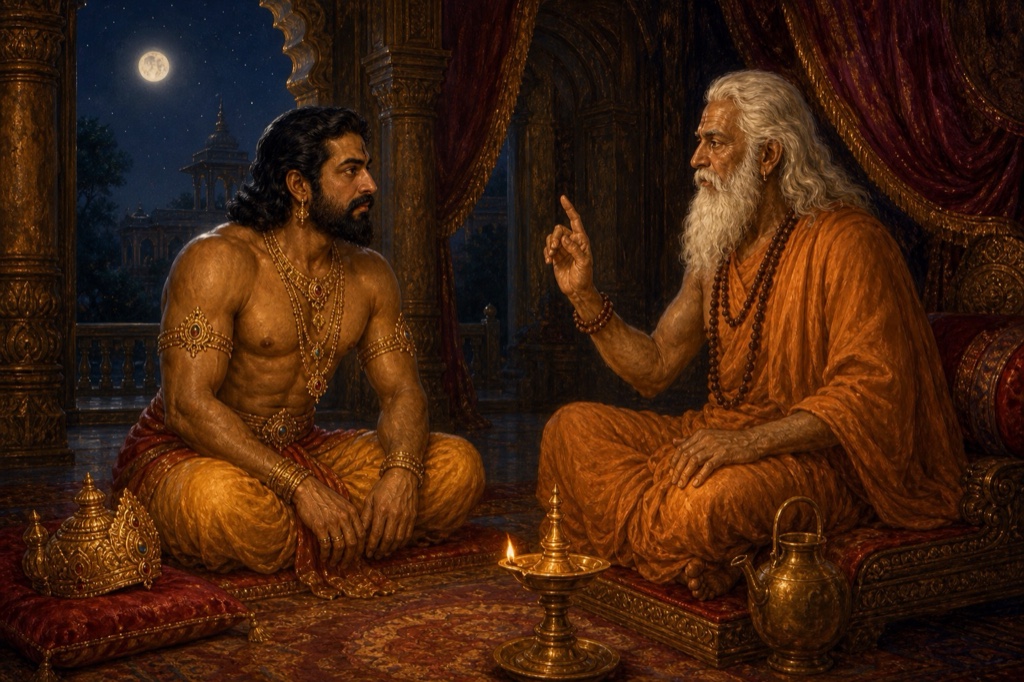
"I have to go this instant to the sky, where the seven munis are assembled, and carry on my divine service there. And I tell you, Bali: you must not of your own accord get rid of your duties as long as you are in this body of yours, however free your mind may be of everything." So saying, Shukra flew off like a bee dusted with the gold pollen of the lotus, up into the golden vault of heaven, along the watery road of the moving clouds, to where the circling planets were waiting to receive him.
After Shukra, son of Bhrigu and senior in the assembly of gods and demigods, had gone, Bali, the best among the intelligent, began to think it through for himself. "The seer has spoken the truth. The intellect composes the three worlds, and I am this intellect. It fills every quarter and shows itself in every act we do. It is the intellect that pervades the inside and the outside of every thing, and there is nothing anywhere that is without it.
"It is the intellect that perceives sunbeams and moonlight. Without that perceiving there would be no difference between them and darkness. If there were no intellect to know that this earth is land, there would be no distinction between earth and water, and the word earth would not apply to the ground. If the intellect did not understand the vast space as the quarters of the sky, and the mountains as great swellings on the earth, who would call the quarters and the mountains by those names? If the world were not known as the world and the void as void, who would tell them apart by the names in common use? If this big body were not perceived by the intellect, how could the bodies of embodied beings be called by their names at all? The intellect lives in every organ of sense. It dwells in the body, in the mind and all its desires. It is in the inner and the outer parts of the body, and it is all that exists and all that does not.
"The intellect makes up the whole of myself, by its feeling and knowing of everything I feel and know. Otherwise I could neither perceive nor conceive nor do anything with my body alone, without the intellect to guide it. What good is this body of mine, inert and insensible as a block of wood or stone? It is the intellect that makes my self, and the intelligent spirit is the universal soul. I am the intellect that lives in the sun and in the sky, and I am the intellect that dwells in the bodies of all beings. I am the same intellect that guides the gods and demigods, and dwells alike in everything that moves and everything that stands still. The intellect being the only existence, it is pointless to suppose anything else, and since there is nothing else, there can be no such thing as a friend or an enemy to us. What of it, if I, Bali, strike the head off a man’s body? I cannot injure the soul, which is everywhere and fills all space. Love and enmity are properties of the intellect, and they are not separated from it when it is separated from the body; the passions and feelings cannot be parted from the intellect, the soul. There is nothing to think of besides the intellect, and nothing to be had anywhere except from the spacious womb of the intellect, which holds all three worlds. Yet the passions and feelings, the mind and its powers, are mere attributes of the intellect and no part of its nature; it is a simple and pure essence, free of every attribute.
"The intellect, chit, is the ego, the omnipresent, all-pervading and ever-blissful soul, beyond every other attribute, without duality and without parts. The term chit, which men apply to the nameless power of intellection, is only a verbal symbol for the omniscient Intelligence that is manifest in all places. The ego is the Supreme Lord, always awake, seeing all things, showing no appearance of himself, purely transparent and beyond every visible form. All its attributes are lame, partial, and imperfect. Even time, with its phases and parts, is no fit attribute for it. What rises before us is only a glimpse of its light; the eternal and infinite light is beyond our comprehension. I must think of it only as the light in my own self, and know it apart from every other thinkable and every thought, and clear of every shade and color. I salute that self-same form of Intelligence, the power of intellection with no intelligible before it, at work in its own proper sphere. I salute that light of his within me, which represents every thing to me, which is beyond all thought, which is of the form of intellect and goes everywhere and fills all space. It is the quiet consciousness of all beings, the real intellect, sat-chit, the ego and the Great: the ego that is as infinite as space and yet smaller than an atom, and spread in everything alike.
"I am not subject to the states of pleasure and pain. I am conscious of myself and of no other existence besides myself; I am Intelligence without the intelligibles spread out before me. No worldly entity and no non-entity can work any change in me, neither the gaining of a thing nor the want of it. In my view there is nothing distinct from me, once all things are known as the produce of the same source. What a man gets or loses is no gain or loss to anyone, because the same ego always abides in all, and is the maker of all, and pervades everything. Whether I am any of these thinkable objects or not matters little to me, since the intellect is always one single thing, however endless its intelligibles are. I am in sorrow only for as long as my soul is not united with the supreme Spirit." And on that sentence Bali, the most discerning of men, fell into a deep meditation.
The Court Around a Silent King
He reflected on the half mantra of Om, the dot alone, the point above the syllable where sound stops, the emblem of the Infinite God, and sat quietly with all his desires and fancies lying dormant in him. He sat undaunted, holding down his thoughts and his power of thinking, his desires subdued, until he lost all consciousness of his meditation, and of being the meditator, and of any object meditated on. While Bali sat entranced like this at his gem-set window, his mind became illumined, like a lamp burning unshaken by any wind, and he stayed a long time in that steady posture, like a statue carved from stone. His mind was as clear as an autumn sky, with every desire and every anxiety cast out of it, and he was filled inside with his own spiritual light.
His demons grew impatient at this numbness in their king. They climbed in haste to his high crystal palace and stood at the door of his chamber. His ministers were there, Dimbha and the rest, and his generals, Kumuda and the rest. The princes were there, Sura and others, and his champions, Vritta and the rest; Hayagriva and the other captains of his armies, his friends Akraja and others, his associates Laduka and more, and his servants Valluka and many more. The gods Kuvera, Yama, and Indra, who paid him tribute, were there, and the Yakshas, Vidyadharas, and Nagas who rendered him service. The heavenly nymphs Rambha and Tilottama stood among the fanning and flapping damsels of his court, and the deputies of the different provinces and of the hill and maritime districts were in attendance, and with them the Siddhas who live in different parts of the three worlds, all waiting at that place to offer Bali their service.
They looked at him with reverence. His head hung down with the crown still on it, and his arms hung loose with the bracelets dangling from them. Seeing him so, the great Asuras made their obeisance in due form, and then stood stupefied with sorrow and fear, struck by turns with wonder and with joy at the sad state of their king. The ministers kept turning over what could be the matter with him, and the demons called on Shukra, their all-knowing preceptor, to explain the case. Quick as thought, they saw his shining figure standing plain before their eyes, as if a phantom of their own imagining had become solid.
The demons honored him, and Shukra took his seat on a couch and looked, in silent meditation, into the state of the king’s mind. For a while he simply sat and watched, with delight, how Bali’s mind had been freed of its errors by the exercise of its own reasoning. Then the illustrious preceptor, whose person outshone the brightness of the ocean of milk, smiled and spoke to the listening throng of demons. "Know this: your Bali has become an adept in spiritual knowledge and has fixed his seat in the holy light, by the working of his own intellect. Leave him alone. Let him stay as he is, nesting in himself, seeing the imperishable one within himself in his reverie. Look at him: the weary pilgrim has found his rest, and his mind is free of the errors of this false world. Do not disturb him with your talk; he is as cold as ice now. He has received the light of knowledge in the middle of the gloom of ignorance, as a waking man sees the full blaze of the sun once the darkness of his sleep has scattered at dawn.
"He will wake from his trance in time, and rise as the germ of a seed sprouts from its husk in its proper season. Go, all of you. Go from here and perform the duties your master assigned you. It will take a thousand years for Bali to wake from his trance." When Shukra, guru and guide of the demons, had spoken, they were filled with joy and grief by turns, and they cast their anxiety about him aside, as a tree lets its withered leaves go.
The Asuras left their king Bali to rest in his palace as he was, and went back to their respective offices, as they had been employed before. Then it was night. Men went back to their earthly homes, the serpents went into their holes, the stars came out in the sky, and the gods settled into their celestial domes. The regents of the quarters and the mountain tracts went to their own stations, and the beasts of the forest and the birds of the air fled and flew to their coverts and nests. The palace stood over all of it with one still figure at its window.
After a thousand years of the celestials had rolled by in Bali’s unconsciousness, he was roused to his senses by the beating of heavenly drums by the gods above. The moment he was awake his city was renewed with fresh beauty, as a bed of lotuses revives when the sun rises in the east. He saw no demons before him, and fell to thinking about what he had seen in his trance. "How charming it was," he said, "that cooling rapture of spiritual delight, in which my soul was wrapped for so short a time. How I long to go back into that happiness. These outward enjoyments, which I have relished to my fill, have stopped pleasing me at all. I do not find the waves of those delights even in the orb of the moon, as I felt them undulating in my soul while I was entranced and senseless."
He was on the point of going back under when the attendant demons broke in on him, as clouds come between the moon and the earth. He gave them a glancing look, bowed to the ground, and was about to close his eyes again in meditation when their gigantic bodies closed in around him, and there was no ignoring them. He reflected, and said to himself: "The intellect has no option in it, so there is nothing for me to desire. It is the mind, fond of pleasures, that runs after them in vain. Why should I desire my emancipation, when I am not confined by anything here and not attached to anything? It is a childish whim to go looking for liberation when I am not bound, and bound to nothing below. I have no desire for release and no fear of imprisonment, now that my ignorance has gone; what need have I of meditation, then, and what good is meditation to me? Meditation and the want of meditation are both mistakes of the mind. We must depend on our own manliness, and welcome whatever comes to us without rejoicing and without shrinking.
"I require neither thoughtfulness nor thoughtlessness, neither enjoyments nor the lack of them. I must stay unmoved and firm, like a man sane and sound. I have no longing for the spiritual and no craving for the temporal. I have neither to stay in the meditative mood nor to live in giddy worldliness. I am not dead, nor can I be said to be living. I am no reality in the way the body is one, and no unreality either; I am neither a material body nor a body of air. I am neither of this world nor of any other. I am the self-same ego, the Great. While I am in this world I will stay here, quietly; when I am not here, I abide calmly in the solace of my soul. What shall I do with my meditation, and what with all my royalty? Let anything come to pass as it may. I am nothing for this or for that, and nothing is mine. Though I have nothing to do, I must still do the duties that belong to my station in society."
Rule, Binding, and a Future Indra
Having settled that in his mind, Bali, the wisest of the wise, looked on the demons with pleasure, as the sun looks on the lotuses. With nods and glances of his eyes he received their homage, the way a passing wind carries off the scent of flowers. He let go of the object of his meditation and spoke to them about their respective offices under him. He honored the devas and his gurus with due respect, and greeted his friends and officers with his best regards. He honored all his servants and suitors with largesse, and he pleased the attendant maidens with gifts of every kind.
So he went on prospering in every department of his government, until at one time he made up his mind to perform a great sacrifice, a yajna. He satisfied every being with his great gifts and gratified the great gods and sages with due honor and veneration, and then he began the ceremony of the sacrifice under the guidance of Shukra and the chief gurus and priests.
Then Vishnu, the lord of Lakshmi, came to know that Bali no longer had any desire for earthly fruit, and he appeared at the sacrifice to crown Bali’s undertaking with success and give him the blessing he wanted.
And there he cunningly persuaded Bali to make a gift of the world to Indra, Vishnu’s elder brother, who was insatiably fond of every kind of enjoyment. Having tricked Bali by this artifice out of the three worlds, he shut him up in the nether world, the way men confine a monkey in a cave under the ground.
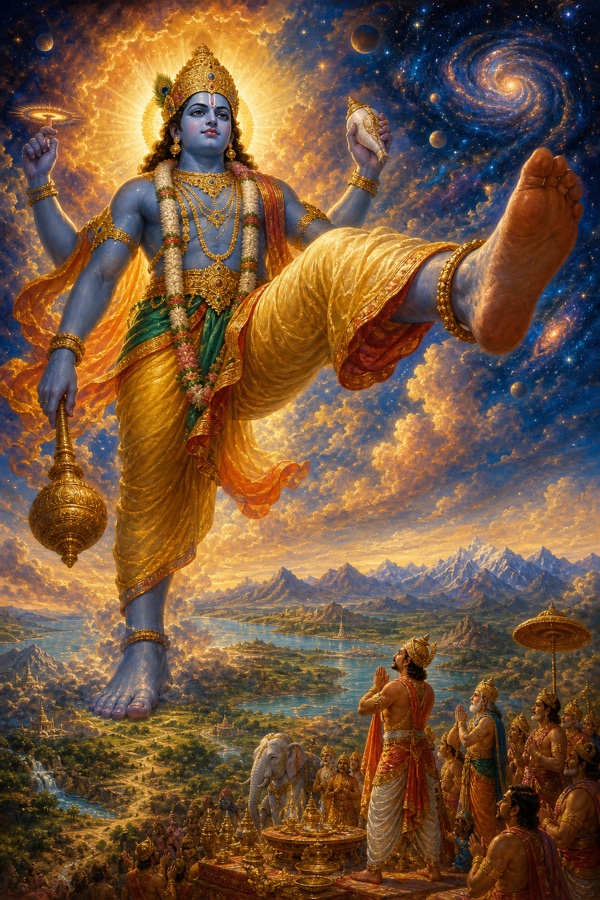
So Bali remains in his confinement to this day, Vasistha said, with his mind fixed in meditation, for the sake of attaining Indraship again in a future state of life. Living liberated, held in that cave under the earth, he looks on his former prosperity and his present adversity in the same light. His intelligence neither rises nor sets with his pleasure or his pain; it stays one and the same in its full brightness, like the disc of the sun in a painting. He had seen the repeated flux and reflux of worldly enjoyments, and from that he settled his mind in utter indifference about them. Through myriads of years, through all his births in the three worlds, he had overcome multitudes of the vicissitudes of life, and he found his rest at last in his utter disregard of all mortal things. He had felt thousands of comforts and disquiets, hundreds of pleasures and privations, and after his long experience of them he found his repose in perfect quiescence. Having forsaken the desire for enjoyments, Bali enjoys the fullness of his mind in the privation of his wants, and rejoices in the self-sufficiency of his soul in the loneliness of his cave under the ground.
After a course of many years Bali will regain his sovereignty of the world and govern it for a long time to his heart’s content, and rise to the dignity of Indra, lord of the gods. That elevation will not elate him, just as his fall from prosperity did not cast him down. He remains one and the same person in every state of his life, and enjoys the equanimity of his soul, which resembled the serenity of the sky.
"I have told you the whole story of how Bali reached true wisdom," Vasistha said, "and I advise you now, Rama, to follow his example, so that you rise to the same perfection. Learn as Bali did, by your own discernment, to think of yourself as the immortal and everlasting soul, and try to reach your oneness with the Supreme Unity by your own manliness. Bali, lord of the demons, held full authority over the three worlds for more than a millennium, and at the end he felt an utter distaste for all the enjoyments of life. So forego the enjoyments of life, Rama, which are certain to end in distaste and nausea, and take yourself to that true happiness which never goes flat. These visible sights are as various as they are tempting to the soul; they look as smooth and charming as a mountain seen from a distance, and they prove rough and rugged as you come near. Hold your mind back in the cavity of your heart from its flight after perishable enjoyments, in this life or the next, which are so alluring to men of common sense. Know yourself as the self-same intellect that shines like the sun through the universe and lights every object in nature, with no distinction and no partiality toward one or another. Know yourself, Rama, as the infinite spirit, the transcendent soul of all bodies, which has shown itself in manifold forms, and these are the bodies of the inner intellect. Know your soul as a thread passing through and woven into every thing in existence, like the string that connects all the links of creation, the gems of a necklace or the beads of a rosary. Know yourself as the unborn soul in its embodied form, which is never born and never dies, and never fall into the mistake of thinking the pure intellect subject to birth or death. Know your desires to be the causes of your birth, your life, your death, and your diseases; so shun your greed for enjoyments, and enjoy all things in the manner of the all-witnessing intellect. If you stay in the everlasting light of the sun of your intellect, you will find the phenomenal world to be a phantom from a dream. Never regret and never grieve over anything, and give no thought to your pleasures and pains, which do not touch your soul; you are the pure intellect and the all-pervading soul, which shows itself in every thing. Know the desirables, the enjoyments of the world, to be your evils, and the undesirable, the mortification of self, to be for your good, and shun the former by continued practice of the latter. By giving up your view of desirables and undesirables you will form a settled habit of indifference, and when that habit takes deep root in your heart you have no more to be reborn into the world. Pull your mind back from every thing it runs after, like a boy after bright baubles, and settle it in yourself, for your own good. By restraining the mind with your best exertions, and by your habit of self-control, you will subdue the rampant elephant of your mind and afterward reach your highest bliss. Do not become one of those ignorant fools who believe their bodies to be their real good, who are infatuated by sophistry and infidelity and deluded by impostors into gratifying their sensual appetites. Who is more ignorant in this world, and more subject to its evils, than the man who took his spiritual knowledge from a smatterer in theology, and leans on the dogmas of pretenders and false doctors of divinity? Scatter the cloud of false reasoning from the sky of your mind with the hurricane of right reasoning, which drives all darkness before it. And you cannot be said to have right reasoning until you come to the light and sight of the soul, both by your own exertion and by the grace of the Supreme Spirit. Neither the Veda nor the Vedanta, neither the science of logic nor any other shastra, can give you the light of the soul unless it appears of itself inside you. It is by your own self-culture, helped by my instruction and by divine grace, that you have gained your perfect knowledge and seem to be resting in the Supreme Spirit. There were three causes of your coming to spiritual light: first, your freedom from the knowledge of any duality; then the blaze of your inner luminary, the soul, by the grace of God; and last, the breadth of the knowledge you have taken from my instruction. You are freed now of your mental maladies, sane and sound, by abandoning your desires, by the removal of your doubts and errors, and by leaving behind the mist of your fondness for outer objects. As you get rid of the faults of your understanding, Rama, so you advance by degrees: in gaining knowledge, in cherishing resignation, in destroying your defects, in drinking in the bliss of ecstasy, in wandering in exultation, and in raising your soul to the sixth sphere. And all of that is still not enough, unless you attend to Brahmanhood itself."