On this page
The Jewel That Led Krishna to a Bear’s Cave
Vaishampayana had been laying out the houses of the Yadus for Janamejaya, line by line: the Andhakas down to Ahuka, whose son Devaka gave all seven of his daughters to Vasudeva, Devaki among them, and whose son Ugrasena fathered nine sons with Kamsa the eldest; then the line of Krostu, through Anamitra, whom no enemy ever held down, to Anamitra’s son Nighna. Nighna had two sons, Prasena and Satrajit, both of them breakers of hostile armies, and they lived in Dwarka in the full strength of the Vrishnis and the Andhakas. At these two brothers Vaishampayana slowed, because a test was coming for that prosperous house, the kind that is fought entirely with suspicion, and before it was over the character of Krishna himself would be in question.
Satrajit had obtained from the ocean the peerless celestial jewel called Syamantaka, and this is how. He worshiped the Sun, and the Sun was his friend, a friend he valued as he valued his own life. One morning, when the night had run out, that foremost of chariot-warriors mounted his chariot and drove to the bank of the ocean to bathe and to worship the god of rays, and as he worshiped, the lord Vivasvan, whom no one sees, appeared before him in a body of light. Satrajit looked at him and said, “I see you before me in the same round and blazing form I always see in the sky. You have come to me as a friend. What special favor have I had of you?” The Sun lifted from his own neck the jewel Syamantaka and put it into his hands, and with the jewel off him the king saw the god in his own form. He was glad, and the two of them talked for a moment, friend to friend. Then, as Vivasvan was turning to go, Satrajit asked once more. “Grant me this jewel, the one with which you light the worlds.” And Bhaskara gave it to him. Satrajit carried it into his city, and the whole people came out and followed him through the streets, certain that the Sun himself was walking there, and he left them wondering at the doors and went into the inner apartments. With great delight he gave the jewel to his brother Prasena. In the palace of the Vrishnis and the Andhakas the stone produced gold; by its power the god of rains poured in due season, and there was no fear of disease. Wealth like that draws eyes, and the Syamantaka began to draw a great many.
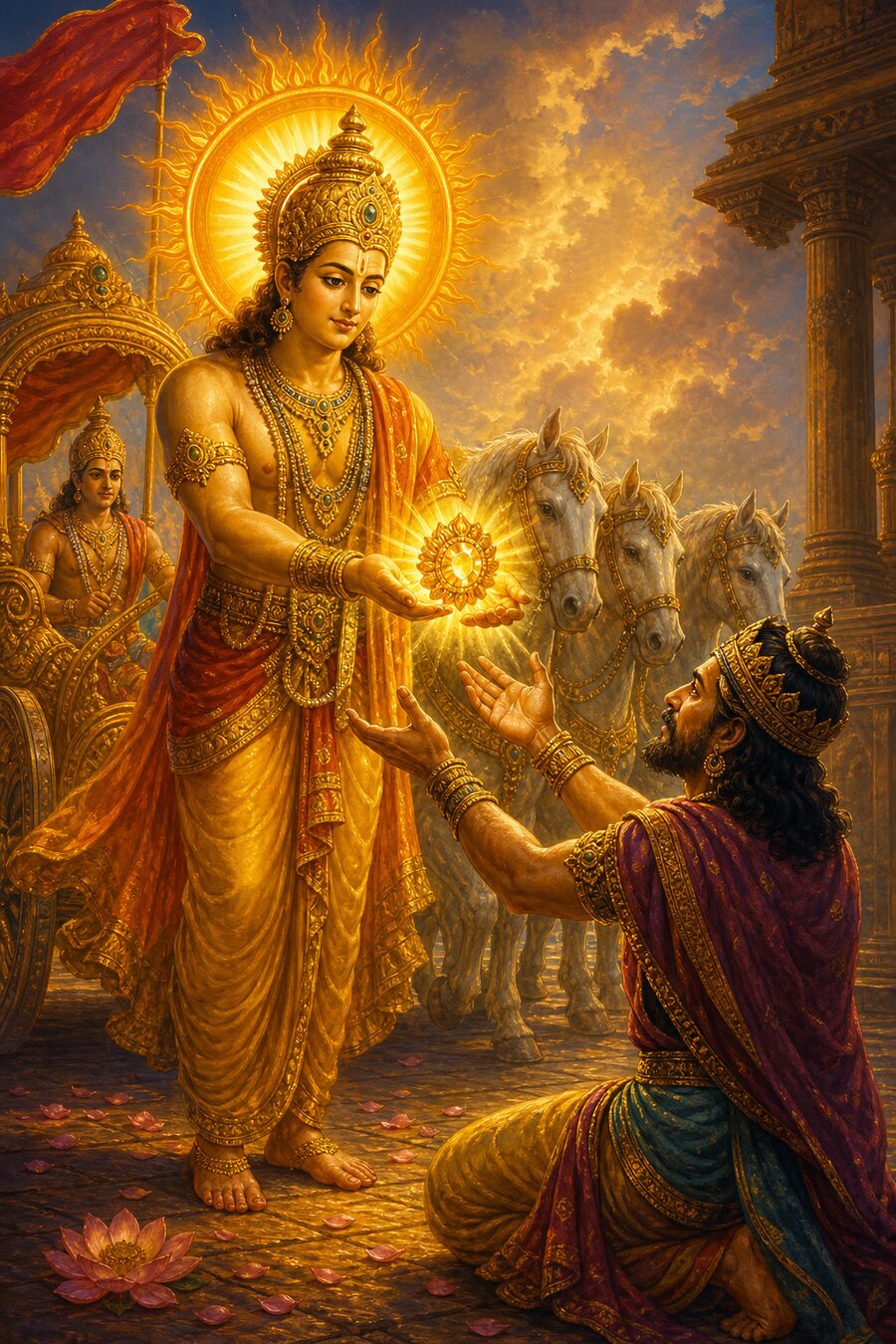
The Jewel Krishna Wanted
Govinda’s among them. Krishna grew desirous of that peerless jewel, wished to have it from Prasena, and never hid the wish; the whole house of the Yadavas knew he had a fancy for it. Wanting it was as far as he went. He could have taken it by force, and there was no one in Dwarka who could have stopped him, and he could have come by it through a trick; he did neither. He would not lay a hand on it, and he would not pilfer it. So the Syamantaka stayed on Prasena, and Krishna’s wish for it stayed out in the open where everyone had seen it. Everything that goes wrong next grows straight out of that.
A Hunt, a Lion, and a Bear
One day Prasena put the jewel on and rode out to hunt. In the forest a wild lion came at him, and it was for that Syamantaka that the lion killed him. The lion did not keep the stone long. As it ran with its prize a bear of enormous strength brought it down and killed it, took the jewel, and went into its den. Every part of this happened deep inside the forest, where no human eye watched any of it.
Outside the forest the facts looked simple. Prasena had ridden out wearing the jewel, and Prasena had not come home. When the news of his death reached Dwarka, the Vrishnis and the Andhakas looked at one another and thought of one man. They knew Krishna had a fancy for the Syamantaka, and now the one who had wanted it was the only link they could see between a dead prince and a missing stone, and the suspicion spread through both families: that a man as great as Krishna had gotten Prasena killed for the sake of a jewel and had quietly kept it. There is no shield against a charge like that.
In the Cave, Day After Day
Krishna knew what they were thinking, and he knew he was innocent, and he knew that force can shut a mouth and cannot reach into a mind to lift out a suspicion once it has taken root. So he made up his mind in one sentence: “I must bring the jewel.” He set out for the forest where Prasena had gone to hunt, and with his followers behind him he tracked the dead man’s steps, ransacking the mountains Rikshavan and Vindhya until the search had worn even him down. At last he found Prasena, and his horse, killed, and no jewel anywhere near them. Close by lay the lion, and the prints around it showed what had killed it: a bear. He followed the tracks of the running bear and searched them out to its den.
From inside the huge den came a woman’s voice. A nurse was playing with Jambavan’s son, dangling the jewel in front of him to stop his crying, and talking to him as nurses do. “The lion killed Prasena, and Jambavan killed the lion. So do not weep, my good boy. This Syamantaka belongs to you.” In those few words Krishna had the whole chain of it, and the name of the one who held the stone. He left all the Yadavas with his elder brother Baladeva at the mouth of the den. Then, in a form and a voice of great beauty, with the bow Sharnga in his hand, he went in without a sound, forced his way into the dark, and stood before the bear.
What followed, no one had expected. Govinda and Jambavan closed with each other and wrestled, and the wrestling did not stop. It ran on in that den for twenty-one days, neither of them willing to fall. At the mouth of the cave the Yadavas waited through those days with no word from inside and no sign of Krishna, and in the end Baladeva and the rest gave him up for dead, went back to Dwarka, and announced that Krishna had been slain.
Jambavan was immensely strong; Krishna beat him. Having vanquished the king of the bears he married his most beloved daughter, Jambavati, and he took the jewel, for one reason only, to clear himself of the charge. He saluted the king of the Rikshas, the father of his new wife, and came out of the den, and clothed in a great beauty he went back to the city of Dwarka.
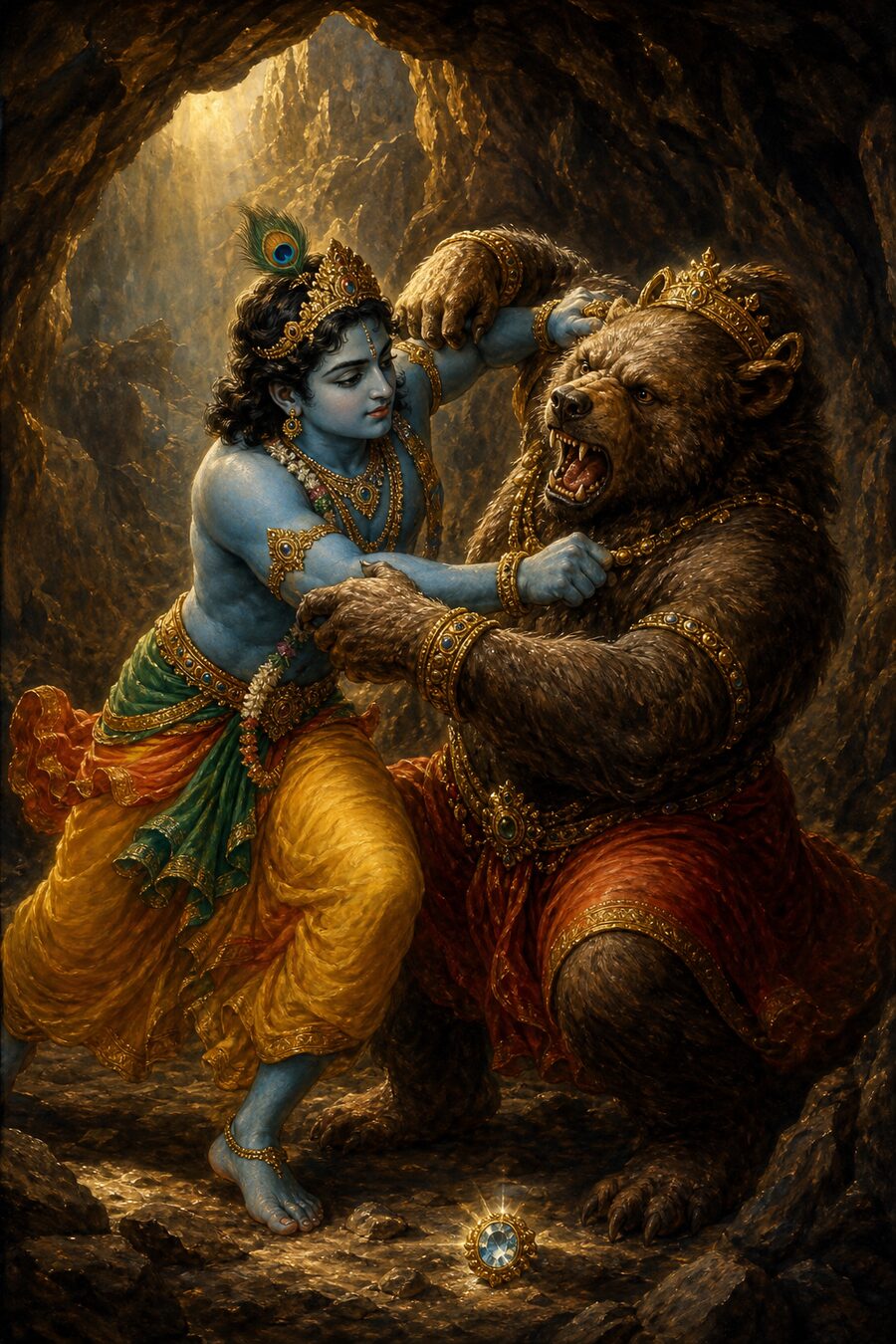
The Name Washed Clean
He came home carrying the very thing he was supposed to have killed for. In an assembly of the Satvatas, with all of them watching, he handed the Syamantaka to Satrajit. He named no thief and he raised no voice. The stone said everything for him. Krishna, the slayer of enemies, who had been accused on a false charge, had brought the jewel and cleared himself of the guilt, and the charge that had hung on his name through all those days loosened and fell.
Satrajit had ten wives, and they bore him a hundred sons, of whom three were well known, Bhangakara the eldest, the heroic Vatapati and Viyatsnata; and he had three daughters whose fame ran to every quarter, Satyabhama, the most excellent of women, Vratini of the firm vows, and Prasvapini. Satrajit married all three of them to Krishna. The Syamantaka stayed, for the present, where it had come from, in Satrajit’s own keeping.
Vaishampayana closed the account the way the old reciters closed it: whoever hears of this false accusation against Krishna, he said, suffers no such thing in his own life. Krishna had the strength to crush the whispering, and he had the right, being innocent. He chose to walk into the forest and settle the matter with facts, following the trail to its end and bringing the jewel back for every eye to see, until the accusation came apart on its own; there was no room in any of it for rage. The jewel’s own story was not over; it would pass from hand to hand through a murder and a long quarrel before it came to rest on another man’s breast. With that told, the stage of the Yadava line stood fully set, and Janamejaya’s next question went to the largest matter standing behind all of it: who was every bit of this for, and why had Vishnu come down to this earth at all?
Source: Harivamsha (the khila-parva of the Mahabharata), Harivamsha Parva, chapters 23 to 29; chapter numbers of the critical edition (P. L. Vaidya, Bhandarkar Oriental Research Institute, Pune). Told as story from chapters 37 to 38 of M. N. Dutt’s English translation (1897), which follows the vulgate text, keeping its sequence of events.
The same story, elsewhere
- The Syamantaka Jewel
Shrimad Bhagavatam (Skandha 10): the Syamantaka jewel and Jambavan