On this page
A Choice Made in Silence, and a Woman’s Claim to Her Own Life
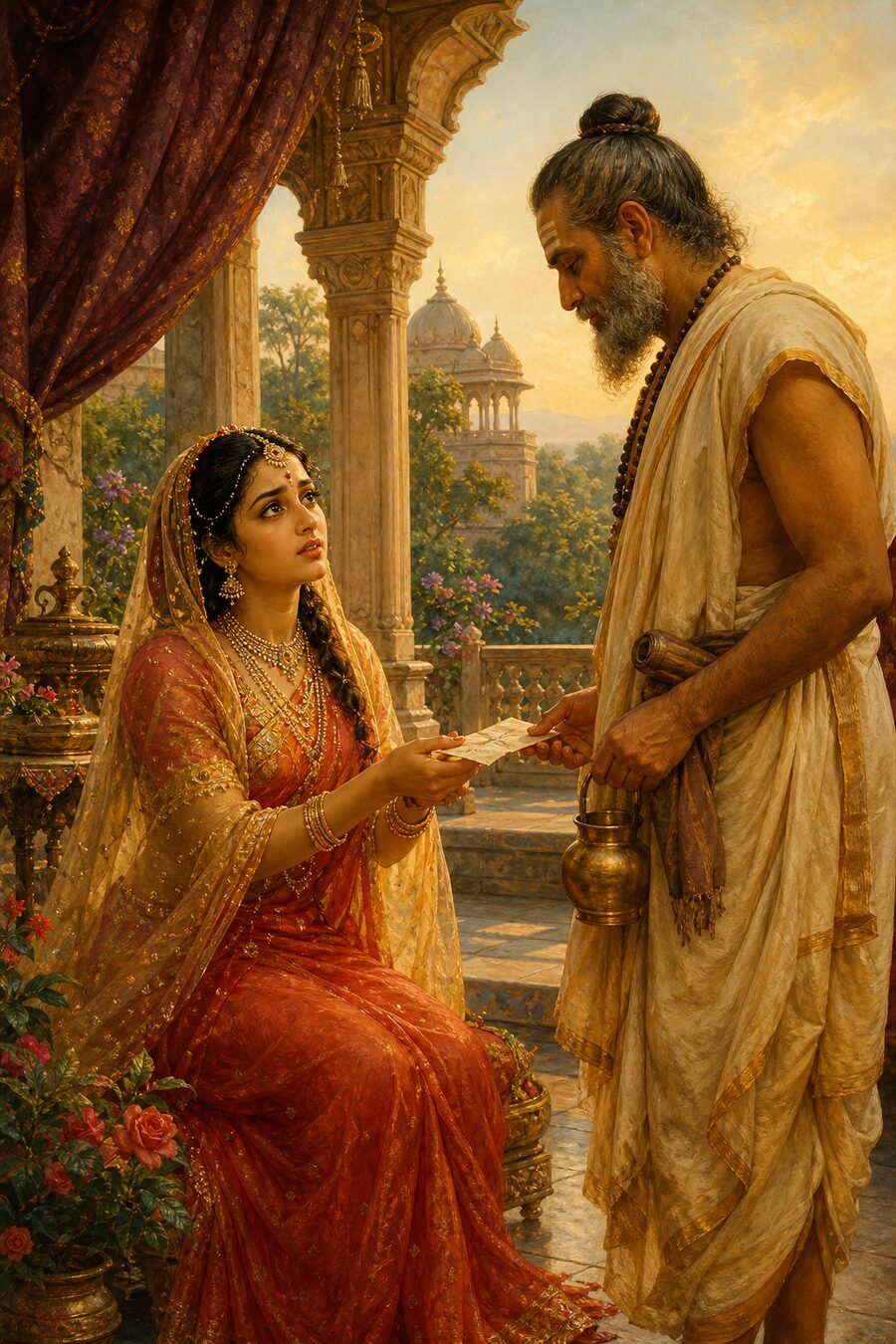
The story of Rukmini belongs to these Dwaraka years, and it begins with a proclamation. To gratify the king of the Chedis, Jarasandha of Magadha announced that a marriage would be celebrated, with gifts of gold coin and ornament, between king Shishupala and Bhishmaka’s daughter Rukmini, and he began rousing kings for a battle to go with it: Dantavakra’s son, Sudeva with his akshauhini, the king of Poundra, Ekalavya’s son, Venudari who hated Krishna, Anshuman, Kratha, Shrutarva, the kings of Kalinga and Gandhara and Kashi. The bride’s house was old. Vidarbha, son of the royal sage Yadava, had built his city south of the Vindhya, and from his sons came separate kingdoms and families; in Kaishika’s line was born Bhishmaka, whom people called Hiranyaroma, king of the Deccan, who ruled from his city of Kundina over the whole southern quarter that the sage Agastya presides over. He had a son, Rukmi, and a daughter, Rukmini. She had never once set eyes on Krishna. Yet word of Janardana’s energy and strength had reached her in her father’s house, and on hearing it she wished one thing, and said it to herself. “He only will be my husband.”
Krishna, for his part, had heard of Rukmini too, of a beauty said to have no match on earth, and as soon as he heard of it he desired her and asked for her. Her brother Rukmi refused him. Rukmi still grieved for Kamsa, and in his mind the man who had killed Kamsa was an enemy, and no enemy would have his sister, however he prayed for her. Then the emperor Jarasandha came asking. Kamsa had been his son-in-law, and since the death in the arena there had been a quarrel between him and the Vrishnis over Krishna. Shishupala, the Chedi prince whom Sunitha had handed over to him and whom he had brought up as his own son, had taken up that quarrel to please him. For this Shishupala the king of Magadha begged the maiden of Bhishmaka of the dreadful power, and Bhishmaka promised to give her to him. The wedding day was set.
Her Choice, and Her Brother’s Pride
Rukmini held no power in any of this, and one certainty. She had heard what Janardana was, and on that hearing she had settled whom she would marry, and the kings who were gathering to see her given to another man had no part in that decision. In her heart the matter was already closed.
Her brother had reasons of his own to feel untouchable. Rukmi was a formidable warrior. He had obtained divine weapons from Druma and the Brahma weapon from Rama, the son of Jamadagni, and whenever he met Krishna he liked to boast to him of his wonderful deeds. A man that certain of his own arm does not imagine he can be crossed, least of all in the matter of a sister.
The Chariot at the Temple
When the wedding drew near, the kings came to Vidarbha. Jarasandha came, with Shishupala and Dantavakra, and after him the Poundra king Vasudeva and the kings of Anga, Banga and Kalinga, and Rukmi went out before the city to honor them and welcome them in. Rama and Krishna came too, with the mighty Vrishni chariot warriors and their army, for the sake of their father’s sister Shrutashrava, who had married into the house of Chedi. Kratha, the king of Kaishika, received the Yadavas with due honor, and they camped outside the city. Everyone moved on the same assumption, that the thing was settled and only the ceremony remained.
On the day before the wedding, after the benedictory rites, Rukmini rode out from her father’s house, bearing every auspicious mark and shining in her beauty, in a chariot drawn by four horses and ringed with soldiers, to the house of Indra, where she was to worship Sachi, Indra’s queen. Krishna saw her near the temple. She was like the burning flame of a fire, like Shri herself come down from her lotus to be his wife, a woman of dark blue hue and large eyes, in a blue garment, her face like the moon, her black hair curling, her nails red, and though the gods themselves could not have seen her with their minds, Krishna saw her. Desire grew in him like a fire fed with clarified butter. He took counsel with Rama in front of the Vrishnis, and his mind was made up to carry her off.
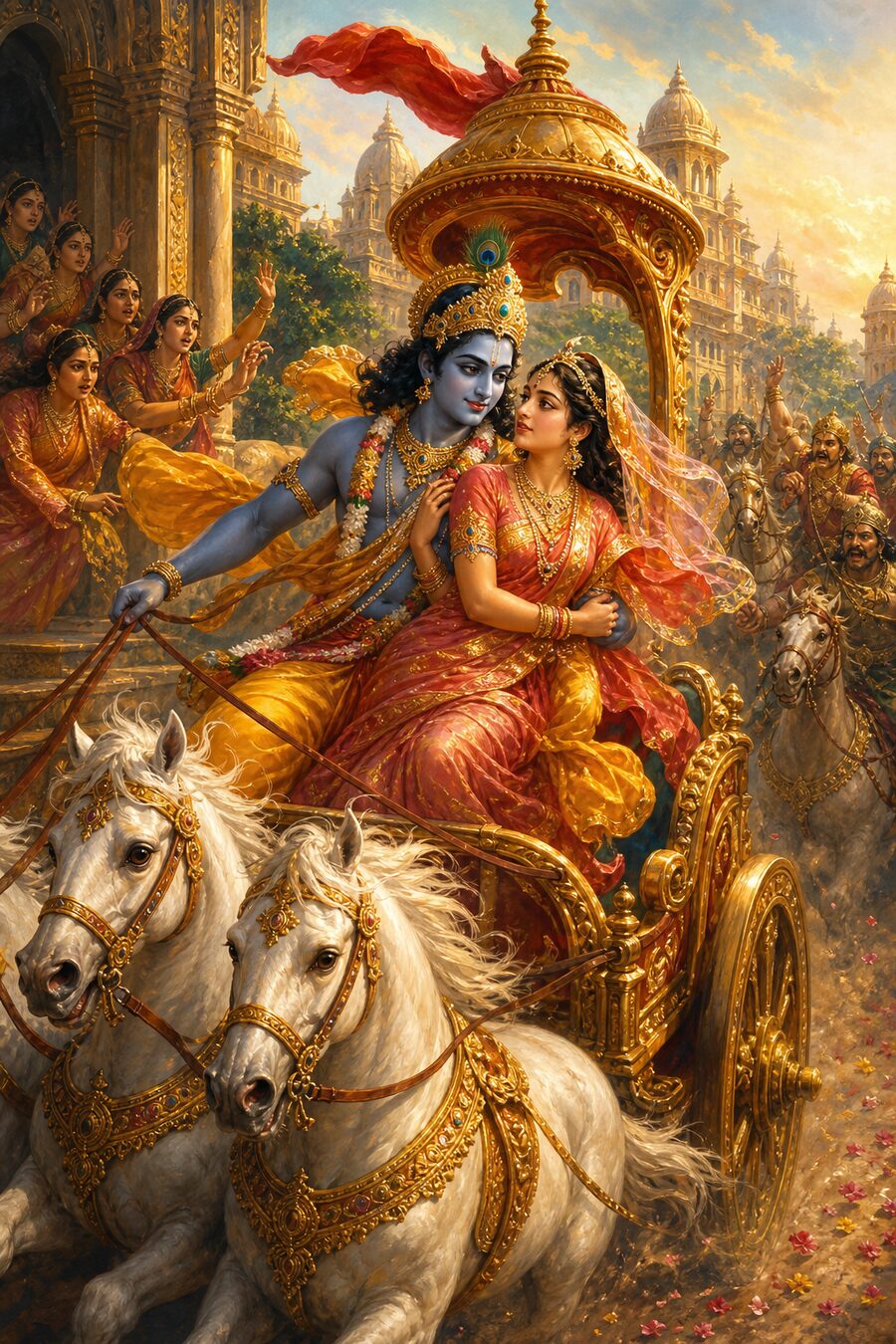
As Rukmini came out of the temple with her puja done, Janardana fell on her bodyguards and took her by force to his own chariot. Rama tore up a huge tree and began sending the men who rushed them off as guests to the house of Death, and at his command the Dasharhas armed themselves, and chariots with their flags flying, horses and elephants closed around him. Krishna left the war in his brother’s hands and in the hands of the Vrishni and Andhaka heroes, Yuyudhana, Akrura, Gada, Kritavarma and the rest, and drove hard for Dwaraka with Rukmini beside him. Dantavakra, Shishupala and Jarasandha came out in their mail in a fury to kill him, and the field broke into battle. Rama killed the king of Banga and his elephant with a tree, mounted his chariot, took up a bow and sent the Kaishikas to Yama’s house, and went for Jarasandha himself; the king of Magadha cut him with three arrows, Rama answered with eight and cut down his golden standard, and the two of them fought on under a rain of arrows while Krishna’s chariot drew away toward the west.
Rukmi’s Broken Pride
Rukmi could not live with it. Before Bhishmaka he swore his vow in anger. “I shall not return to the city of Kundina without slaying Krishna and bringing back Rukmini.” He mounted a chariot bristling with weapons and flags and set out at speed with a great army, and the kings of the Deccan followed him, Kratha and Anshuman, Shrutarva and the valiant Venudari. They had come a long way when they saw Govinda with his beloved near the river Narmada. Rukmi left his army standing and went forward alone to a duel of chariots. He pierced Krishna with sixty-four sharpened arrows, and Janardana wounded him in return with seventy, and then, for all his care, cut away his standard and took off his charioteer’s head. The Deccan kings saw him in trouble and closed around Krishna to kill him, Anshuman with ten arrows, Shrutarva with five, Venudari with seven; Krishna put an arrow in Anshuman’s breast that sat him down on his chariot, killed Shrutarva’s four horses, cut down Venudari’s standard and wounded his right arm, and when Kratha and Kaishika and the rest came at him he cut their arrows out of the air and wounded every one of them, and the army began to run. Rukmi, seeing it, drove five arrows into Krishna’s breast, three into his charioteer, and sundered his standard. Krishna cut his bow. Rukmi snatched up another and loosed celestial weapons at him; Krishna countered them with his own and with three arrows cut the second bow and the chariot beneath it. Rukmi leaped down with sword and shield. Krishna sheared the sword from his hand and drove three winged arrows into his chest, and Rukmi fell senseless to the earth with a sound that filled it, like a mighty demon struck down by a thunderbolt. The kings who were left saw him fall and fled.
Rukmini saw her brother lying motionless on the ground, and she fell at Vishnu’s feet for his life. Keshava raised her, held her, and consoled her, and he gave Rukmi his safety for her sake and drove on toward his own city. Behind him the Vrishnis under Rama, having beaten Jarasandha and the rest, set out gladly for Dwaraka. When Krishna was gone Shrutarva came back to the field, lifted Rukmi onto his own chariot and carried him to his city. Rukmi had failed to bring back his sister and his vow lay broken, and he was too proud and too sore to enter Kundina again; he built himself another city in Vidarbha, famous on earth as Bhojakata, and ruled the southern districts from there, while Bhishmaka of the mighty arms lived on in Kundina. When Rama and the Vrishni army came home, Krishna married Rukmini in Dwaraka with every due rite, and lived with her as Rama lived with Sita and as Indra lives with Sachi. Beautiful, good natured and chaste, accomplished in everything, Rukmini was the first wife of Krishna. She bore him ten sons, all great chariot warriors, Pradyumna first among them, and a daughter, Charumati. A woman had decided the course of her own life in silence and held to it against her father’s promise, her brother’s vow and a gathering of kings, and it stood.
Source: Harivamsha (the khila-parva of the Mahabharata), Vishnu Parva, chapters 87 to 90; chapter numbers of the critical edition (P. L. Vaidya, Bhandarkar Oriental Research Institute, Pune). Told as story from chapters 116 to 117 of M. N. Dutt’s English translation (1897), which follows the vulgate text, keeping its sequence of events.
The same story, elsewhere
- The Carrying-Away of Rukmini
The carrying-away of Rukmini in the Shrimad Bhagavatam (Skandha 10)