On this page
The Nurse Who Wore a Mother’s Love and Came to Deal Death
The girl Kamsa had swung by the legs and dashed against the stone had risen laughing into the night sky, four-armed, wine on her breath, and told him how he would die: when his enemy came for him she would tear his body open with her own hands and drink his hot blood. From that night Kamsa took her for the instrument of his death, and shame drove him in secret to his sister’s room. He told Devaki that he had destroyed her children one after another to escape the hand of death, and that death had now come at him from another quarter; that Time was the enemy of all living things and men like him only its instruments; and he laid his head at her feet like a son. Devaki, her face bathed in tears, forgave him. Then he went back into his own house with his heart consuming itself, his object baffled, his mind absent. Long before, on the day the Rishi Narada had left him laughing, he had given his demons their orders: Keshi, Pralamba, Dhenuka, Arishta, Putana, Kaliya, every one of them was to take whatever form it liked, range the whole world, destroy whoever stood against him, and keep watch over every woman who had conceived. Now the fear in him went looking for those orders.
Putana was Kamsa’s nurse, and she could take any form she pleased. Her errand lay on the bank of the Yamuna, near the hill Govardhana, in the village of cowherds where two boys were growing up in Nanda’s house: Sankarshana, the elder, born of Rohini, and Krishna, the younger, dark as a rain cloud, growing among the milkmen the way a cloud grows over the ocean, with nothing yet to show who he was. Vasudeva had warned Nanda the night he sent them: fear Kamsa above every other danger, he feels no mercy when he kills children. Nanda had not forgotten it. And in his yard stood the carriage that his son, asleep beneath it one morning while Yashoda bathed in the river, had kicked over with one small foot, a thing the boys of Vraja swore to and no grown man would believe. The wheel had been tied back on. The carriage stood where it had always stood.
The Disguise of Tenderness
It was past midnight when she came. Putana crossed into Vraja in the shape of a bird, shaking her great wings over the sleeping houses, and the beat of them carried the fear of death with it. As she entered the village she gave a roar like a tiger’s. Then she put the bird’s shape off and stood in Nanda’s yard as a woman, her breasts pressed hard with milk, mild to look at, exactly the kind of woman no one in a cowherd village would think to fear.
She found where the child slept, and she lay down under the wheel of the carriage, as though she were one more tired woman of the household bedding down where the night had found her. Then she waited. One by one the lamps went out behind the shut doors, the cattle fell quiet, the churning stopped, and when the last soul in Vraja had gone under she drew the infant to her and gave him her breast. This was deceit in its softest form, and the softest form is the most dangerous, because it comes wearing a mother’s love and carrying milk.
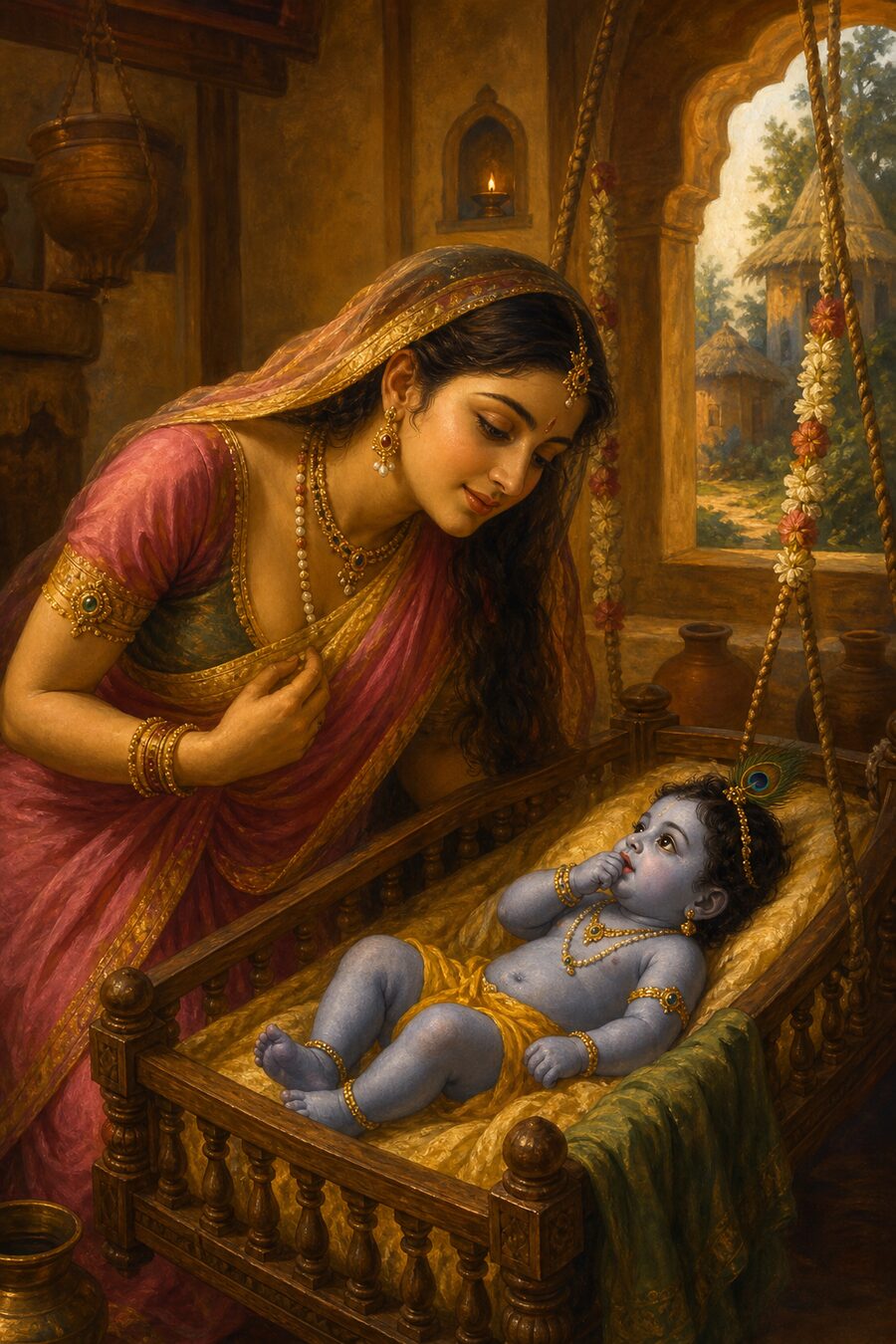
The One She Came to Kill Drew Out Her Life
The mouth she had set to her breast was no ordinary infant’s. Krishna took the milk, and as he drank he drew her vital breaths out along with it, one breath and then the next and then everything she lived by, in one long pull she had no power to break off. What had begun as a feeding stopped only when it was finished, and when it finished there was nothing left in Putana to drink.
Then the child set up a terrible sound, a cry that tore through the sleeping village from end to end. Her breast, where he had fed, was sundered, and she went down. The woman who had lain under the wheel lay stretched on the earth of the yard, her breath and her senses gone out of her, as if a thunderbolt had come down out of the clear night and crushed her where she lay.
What Vraja Could Not Explain
The sound woke Nanda, the other cowherds, and Yashoda, and they were all beside themselves with fear. Lamps were lit again. People came running into the yard and found a woman on the ground with her breast torn away and no consciousness left in her, as if something had come down on her out of the dark and broken her. “What is this? Who has done it?” With Nanda at their head the milkmen stood around her in a ring, and no one in the ring had an answer. They tried every explanation they knew and could not, by any means, find out the cause.
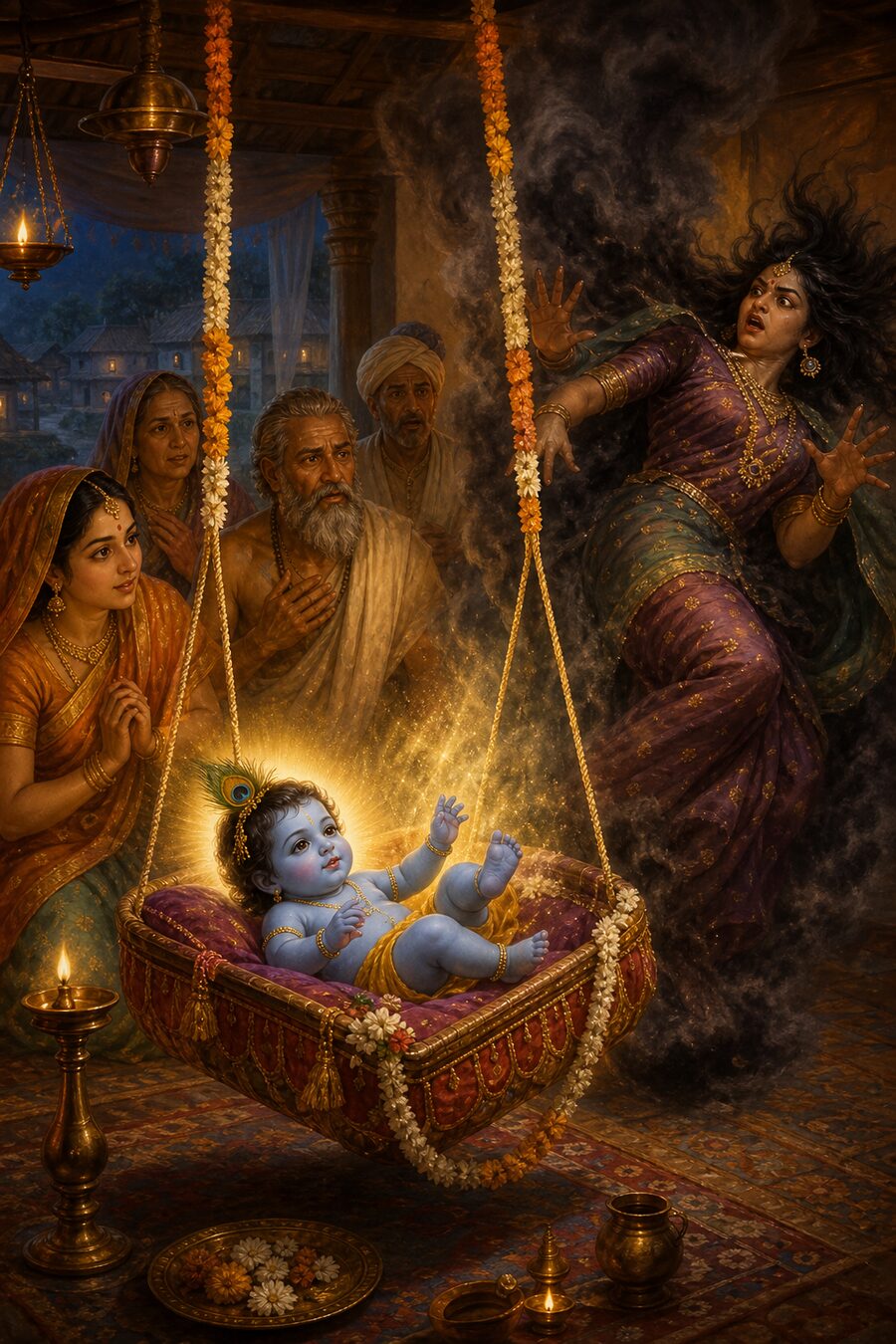
One by one, saying wonder, wonder under their breath, they went back to their houses, and no one in Vraja could have told you what had happened in Nanda’s yard or why. When the yard was empty again Nanda came to Yashoda and spoke to her low and with respect. “I am struck with wonder, and I have not been able to trace this to its cause. Whatever it may be, I am afraid. Is there any danger for my son?” Yashoda was frightened herself. “I was asleep with my son, and this terrible sound roused me. What took place before it, I do not know.” Nanda heard her out, and then he sat with his friends and turned it over, and the longer they turned it the larger the wonder grew, and under the wonder a name settled that no one spoke aloud. Mathura. Kamsa. The king Vasudeva had warned him against had reached into his own yard. No one looked at the child who had done all of it; they looked at the dead woman, and they were afraid. And Nanda’s carriage stood where it had stood, and under its wheel lay the second thing in that yard that the men of Vraja could not explain.
Source: Harivamsha (the khila-parva of the Mahabharata), Vishnu Parva, chapters 50 to 51; chapter numbers of the critical edition (P. L. Vaidya, Bhandarkar Oriental Research Institute, Pune). Told as story from M. N. Dutt’s English translation (1897), which follows the vulgate text, keeping its sequence of events.
The same story, elsewhere
- Putana
The account in the Shrimad Bhagavata (Skandha 10)