On this page
An Impregnable Fortress, Sixteen Thousand Captives, and Aditi’s Earrings
Dwarka stood at the height of its glory. After the humbling of Rukmi, Vishnu of the lotus eyes had come home to the city with the Yadavas around him; whatever wealth and jewels fell into his hands anywhere, he had the Rakshasas carry to his house, and the Asuras and Danavas and Daityas who had won boons and set themselves across his path in those days, Madhava of the long arms had destroyed, every one. But far in the east, on the shore of the blue ocean, sat an enemy of another order, the great foe of the king of the gods and the terror of heaven itself: Naraka, king of Pragjyotisha, whom the earth goddess Bhumi had borne, so that the world also called him Bhauma, the son of the earth. He stood always against the gods and the sages. Once he went to a place called Kasheru, and there, taking the form of an elephant, he ravished by force Chaturdashi, the beautiful daughter of Tvashta, the artificer of the gods; and that fool, with neither fear nor remorse in him, made his proclamation: “From this day the Rakshasas, the Daityas, and the Danavas will bring me every jewel the gods and men possess, everything the whole earth holds, and everything that lies in the ocean.” With that the son of the earth began to plunder riches and raiment of every kind, and none of it brought him any joy.
He spared no one. He looted wealth and gems, he oppressed the gods and the sages, and in his arrogance he laid hands on heaven itself: he tore away the earrings of Aditi, the mother of the gods, and took the gold-showering parasol of Varuna, the lord of the waters. His cruelest work he did against women. That mighty Asura carried off the daughters of the gods, of the Gandharvas, and of men, and the daughters of all seven orders of the Apsaras, sixteen thousand one hundred chaste maidens, each wearing the single braid of a woman who waits, and he built them a house on Mount Mani in Alaka, near the country of the Daitya Maru; there Maru’s ten daughters, those maidens, and the leading Rakshasas carried out the orders of the king of Pragjyotisha and worshiped him. All the Asuras gathered together could not have done the dreadful thing that this one great demon did alone. At his gates stood four warders terrible in battle: Hayagriva, Nisunda, Panchanada, and the great Asura Mura, swollen with the pride of a boon and with a thousand sons behind him; those warders, the dread of everyone who lived by pious deeds, would seize even the roads of the sky with their Rakshasas when the fighting began. It was for the destruction of this Naraka that Vasudeva of the Vrishni line had begotten on Devaki the long-armed Janardana, who bears the conch, the discus, the mace, and the sword, and it was after taking counsel among themselves that the gods had chosen Dwarka as the dwelling of that great Purusha, Madhava, whose prowess was known across the earth: the city ringed by the great ocean and set with five hills, which outshone even Indra’s city in beauty. In it stood an assembly hall like the assembly hall of the gods, a full yojana across, with vast doorways of gold, famous under the name Dasharha, and there the leading men of the Vrishnis and the Andhakas, with Rama and Krishna at their head, carried on the daily business of the city.
A Campaign on the Back of Garuda
One day, while the Yadavas sat in that hall, a wind carrying the fragrance of another world came in through the doorways, and flowers fell out of the sky. A moment later a great sound filled the air, wrapped in a net of light, and inside that light Vasava appeared, seated on his white elephant and ringed by the gods. Rama, Krishna, and the king Ugrasena went out with the other leading Yadavas and welcomed the king of the gods. He came down quickly from the great elephant and embraced Janardana, then Baladeva, then the king Ugrasena, then the other Yadavas in order of age and rank, and honored by Rama and Krishna he entered that splendid hall, took his seat, and accepted in due form the water of welcome and the other courtesies of a guest. Then the mighty Vasava laid his hand against his younger brother’s auspicious face and spoke to him in a tone of reassurance. “Son of Devaki, slayer of Madhu and of your enemies, hear why I have come to you. The great Asura Naraka, swollen with the boon Brahma gave him, has in his folly stolen the earrings of Aditi. He works always against the gods and the brahmins, and he watches for your weak points. Kill that sinful wretch. This mighty son of Vinata, Garuda, who can go anywhere, take on any strength, and lives always in the sky, will carry you there. Upendra, Bhumi’s son Naraka cannot be killed by any creature. Kill that sinner quickly, and come back.” So addressed by the king of the gods, the long-armed, lotus-eyed Keshava gave his word to kill Naraka.
He took up his conch, his discus, his mace, and his sword, mounted Garuda’s back with Satyabhama beside him, and set off at once with Shakra. Before the eyes of the leading Yadus, Keshava, borne by the mighty Garuda, crossed the seven regions of the wind gods and rose high. With distance the king of the gods on his great elephant and Janardana on Garuda came to look like the sun and the moon, and the Gandharvas and the Apsaras sang their glory in the sky until the two of them faded slowly from sight. Then Vasava, having told Krishna what he was to do, returned to his own abode, and Krishna turned toward the city of Pragjyotisha. Under the beating of Garuda’s wings the wind blew backward, and the travelers of the sky were pelted by clouds that roared. With the help of that sky-ranging bird Madhava reached the quarter he wanted in no time at all; he saw the warders from a distance and went straight to where they stood. At the gate of Mount Mani he saw elephants, horses, and chariot warriors, and six thousand nooses honed sharp as razors.
What the Danavas saw was this: Krishna in his beauty, four-armed, holding the conch, the discus, the mace, and the sword; a garland of wild flowers at his throat; on his breast the mystic mark Shrivatsa, like a moon; on his head a crown blazing like the sun or the moon with lightning beside it; a body like the blue ocean, and a yellow robe. And they heard the dreadful twang of his bow, like the fall of a thunderbolt, and they understood that Vishnu himself had come. The great Asura Mura, the image of Death, snatched up his spear worked with diamond and gold, ran at him, and hurled that enormous weapon. Vasudeva’s son saw it coming down like a burning firebrand and took up a gold-feathered arrow, and when he loosed that arrow, blazing like lightning, it cut the spear in two. His weapon broken, Mura, his eyes red with rage, lifted a huge club and flung it the way the king of the gods flings his thunderbolt; Keshava drew a crescent-headed shaft to his ear and cut that golden club through the middle, and with a bhalla he took the Danava’s head off. Having killed Mura and his companions and cut his nooses, Devaki’s son killed the mighty Rakshasa soldiers of Naraka.
He crossed the mountain and saw the Danava host beyond it: Nisunda, Hayagriva the son of Diti, and other champions skilled in every manner of fighting. Nisunda sprang onto his chariot, buckled on a strong celestial armor of gold, and blocked Keshava’s path with his weapons; he put ten arrows into the slayer of Keshi and Madhu and took seventy winged shafts in return, and his own arrows were cut out of the sky before they could reach their mark. Then his army closed around Keshava on every side. Though a net of arrows covered him, Janardana, the first of the gods, looked at those Danavas with rising anger and held their whole army off with a downpour of cloud-weapons and other shafts, and striking each of them with five arrows he pierced them to the vitals, and the Danava army, terrified, fled the field. Nisunda saw his men running and came back into the fight, and he covered Keshava with such a storm of arrows that neither the sun nor the sky nor the ten quarters could be seen. Then Hari, the foremost of Purushas, took up the divine weapon called Savitra and cut his arrows down. Having cleared the Danava’s shafts with his own, Krishna broke his parasol with one arrow and the pole of his chariot with three, killed his four horses with four, his charioteer with five, and cut down his standard with one, and then, with a bhalla sharpened and whetted to its keenest edge, he cut off the head of Nisunda, who in days gone by had fought the gods alone for a thousand years. Hayagriva, that foremost of Asuras, shining like a mountain, saw Nisunda dead and heaved up a huge rock and hurled it with all his strength, boasting as he threw; Vishnu, the first of all who know the use of weapons, loosed his divine cloud-weapon and broke the rock into seven pieces, and the stones fell to the earth.
Then, with huge arrows of many colors flying from the Sharnga bow, a battle broke out as dreadful as the war between the gods and the demons. Seated on Garuda, the long-armed Janardana set about destroying the Danavas: whoever came near Narayana was gashed by the great plowshare and killed with arrows and the sword; some, burned by the fire of the discus, fell out of the sky, and some came close and gave up their lives with their grim faces set. Some Asuras, cut and torn by Krishna’s arrows, still poured down shafts like clouds emptying themselves of rain, but with their bodies smeared in blood like kimshuka trees in flower, their weapons broken, and fear in them at last, they turned and ran. Then Hayagriva, the color of a storm cloud, his eyes red with anger, tore up a tree ten men high with the speed of the wind and flung it with such force, by the strength of his training, that the whole field heard it rip through the air. Janardana cut that tree into pieces with a thousand arrows in a moment and put one shaft into Hayagriva’s breast; burning like fire, it drove into the Danava’s chest, pierced his vitals, and came out the other side. So, in a walled city in the province of Lohitanga, Devaki’s son killed the grim and invincible Hayagriva, who had likewise fought the gods alone for a thousand years, and with him eight hundred thousand Danavas, and set out for the city of Pragjyotisha.
Keshava entered the shining city of Pragjyotisha, and after many encounters he killed Naraka’s follower, the great Asura Panchajana, and blew his conch, the Panchajanya; its deep note, like the muttering of clouds and the roar of a whirlpool, was heard in every part of the three worlds. At that sound the eyes of the hero Naraka went red with anger, and he mounted his celestial chariot and shone like the evening sun. The chariot ran on eight iron wheels; it was painted gold and red, with broad seats, with golden flags and pennons on golden staffs, its pole set with diamonds and pearls; a thousand horses drew it; it was covered with a net of iron, packed with weapons of every kind, and built of gold. Naraka’s face in that hour blazed like a firebrand. He looked magnificent in a breastplate white as the moon; a crown with the luster of the sun shone on his head, and in his ears glittered a pair of earrings. Out of the city behind him came the Daityas, the Danavas, and the Rakshasas in armor of every sort, tawny-skinned, grim-faced, huge-bodied, some with swords and shields, some with arrows and quivers, some with spears and some with lances; mounted on elephants and horses, those practiced fighters came out of the gates shaking the earth, and Naraka, ringed by Daityas, the very image of Death, rode forward hearing on every side the sound of thousands of bugles, conches, drums, and trumpets, like the rumble of clouds.
Those grim champions went together to where Krishna waited and fell on him, and their soldiers buried Vasudeva’s son under a downpour of arrows and filled the sky with spears, maces, lances, and shafts by the thousand. Swinging the Sharnga bow this way and that, its twang like the muttering of a cloud, Janardana, dark as a rain cloud himself, rained arrows on the Danavas until their mighty soldiers were in agony. A dreadful fight followed between him and those fierce Rakshasas, and wounded by Krishna’s arrows the Danavas broke: some with their arms shattered, some wounded in the head and neck, some cut in two by the discus, some with their breasts pierced by arrows; of the chariot warriors, the elephant riders, and the horsemen, some were cut in half and some wounded with arrows and lances, and that whole army of elephants, horses, and chariots was ground down.
Then came the fight between Krishna and Naraka, and it was terrible. Naraka, the terror of the gods, fought the foremost of Purushas, Madhusudana, as Madhu himself had once fought him. When that hero, the image of Death, lifted with reddened eyes a huge bow like Shakra’s own, Keshava took up an arrow like a fierce ray of the sun and filled his chariot with celestial weapons. The mighty Naraka raised an enormous weapon to stop Madhusudana, that master of war whose face shone like lightning; Krishna cut the weapon down with his discus and sent the charioteer to the house of Death with a single arrow. With ten arrows he wrecked the chariot, horses and standards and all, and with one more he cut away the mail from Naraka’s body. His horses dead, stripped of his armor like a snake that has shed its skin, the Danava hero snatched up a strong iron dart that gleamed like lightning and sent it whirling down, and Krishna of wonderful deeds, seeing that gold-covered dart about to fall, split it in two with his razor-edged weapon. The dreadful fight with that mighty, grim-faced Rakshasa, who had the finest weapons in the world, went on; then, after fighting Naraka for a moment longer, the dreadful Janardana cut him in two with his blazing discus. His body, severed by the discus, fell to the earth like a mountain peak struck by a thunderbolt, as if black clouds the color of Krishna had closed over the sun, and the head of Naraka, cut off by the discus, lay on the field like a mountain of ore split by lightning. When she saw her son dead, Bhumi came to Govinda with the pair of earrings in her hands and said, “Govinda, you play as a boy plays with his toys. The one you yourself gave, you have killed with your own hand. But accept these earrings, lord, for which you killed Naraka, and protect his children.”
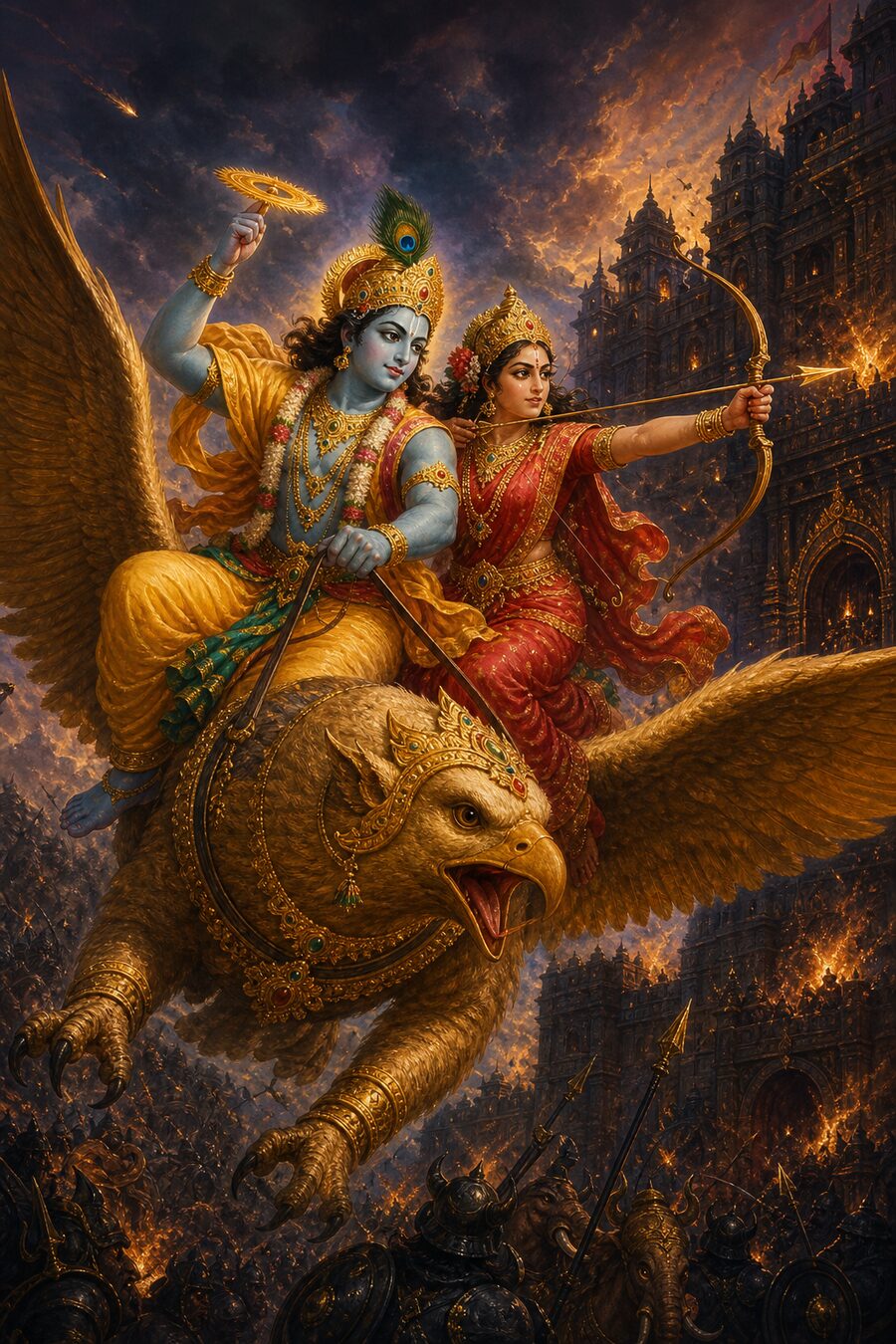
With Naraka dead, the son of the earth who had been as strong as Vasava, Vishnu, Indra’s younger brother, went through his house. In Naraka’s treasury Janardana saw diamonds, pearls, corals, sapphires, emeralds, and gems of every other kind; gold, heaps of jewels, and other precious things; a costly bed that shone like the moon; a lion throne that blazed like burning fire; and a huge and beautiful parasol the color of the rain clouds, with the luster of the moon and a staff of gold. There too, they say, stood the golden fountain of hundreds of thousands of streams that he had carried off from Varuna, and a collection of jewels such as had never been seen or heard of even in the palaces of Kubera, Yama, and Indra. With Naraka, Nisunda, and Hayagriva dead, the surviving warders of the treasury brought those priceless gems and the women of the inner apartments to Keshava, judging that they belonged to him now. The Daityas said, “Janardana, all these gems and riches, these goods made of coral, these beautiful flags worked with golden thread, these twenty thousand grim elephants that carry bows and tomaras and other weapons, forty thousand she-elephants, and eight hundred thousand horses of the finest breed have been brought for you. We will drive to the houses of the Andhakas and the Vrishnis as many cows as you desire, and we will send to the houses of the Yadavas the beds of fine workmanship, the seals, the beautiful birds, the sandal and aguru wood, and every other treasure in Naraka’s palace, gathered from the mountains or from the three worlds. All the riches and gems that once belonged to the gods, the Gandharvas, and the serpents are in Naraka’s houses now.” Hrishikesha, the slayer of Madhu, accepted all those jewels and examined them, and sent them off at once to Dwaravati in the hands of the Danavas; and taking for himself the parasol of Varuna that showers gold, he mounted Garuda, the best of birds, the living image of a cloud, and set out for Mani, the best of mountains.
The Women of Mount Mani
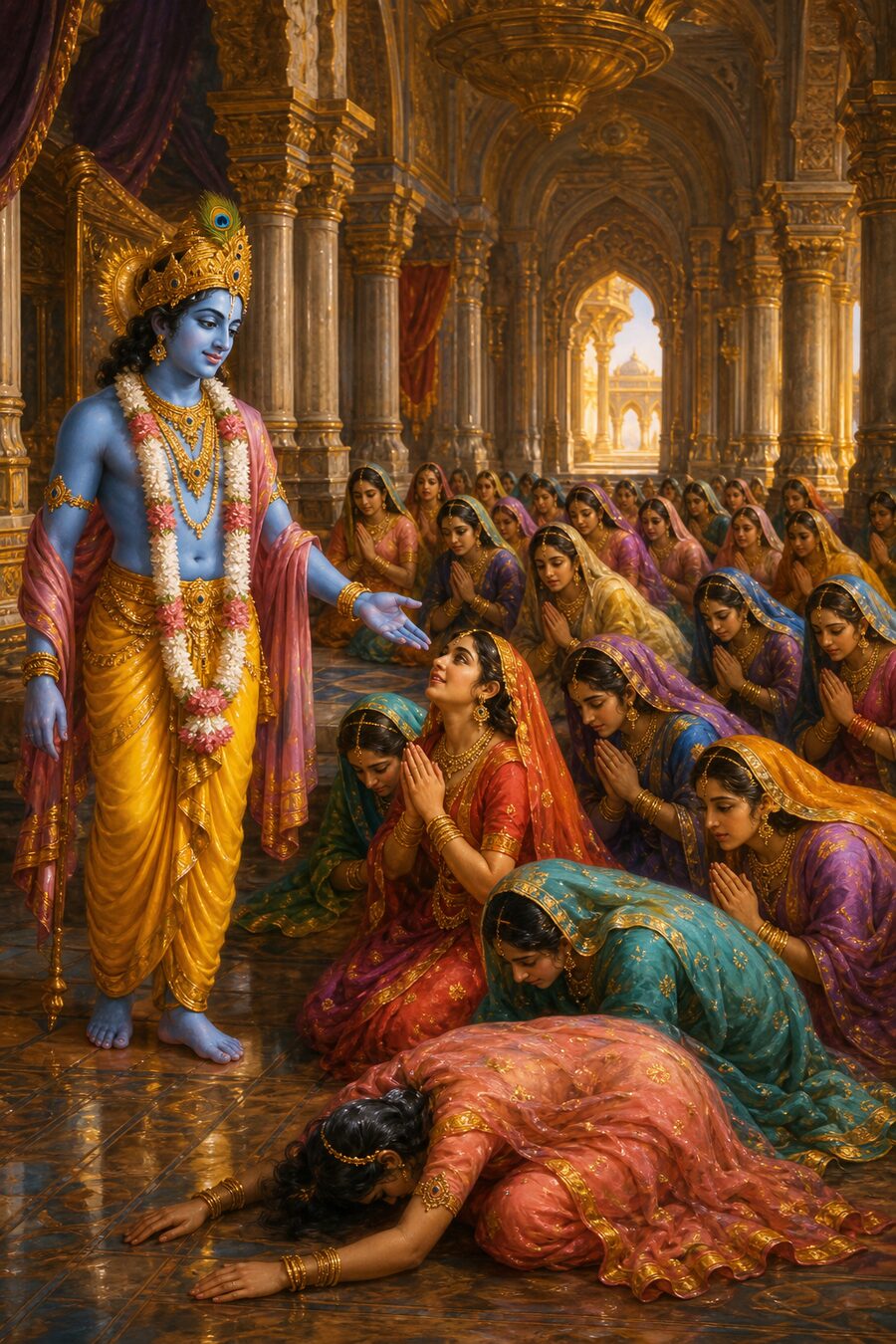
On Mount Mani Janardana saw gates, summits of sapphire decked with flags and doors, and the whole mountain, dressed in rows of palaces painted the color of gold, shining like a cloud lit from within by lightning. There Madhusudana saw the daughters of the Gandharvas and of the leading Asuras, pure, golden-skinned, whom Naraka had carried off by force and confined; stripped of every pleasure, they still lived there as if in the city of the gods, like celestial maidens, and because of Naraka’s power no one had been able to take them away. To look on the long-armed Krishna, the first of the Yadus, those maidens came to Janardana with folded hands, their senses under rule, their bodies worn thin with vows and fasting, dressed in silk, their hair in the single braid, and stood in a ring around him. They stood around Krishna without fear, because they had already learned of the deaths of the great Asuras Naraka, Mura, Hayagriva, and Nisunda; and the elderly men who had been their guards, old as they were, bowed to the scion of Yadu with folded hands. When they saw the moonlike face of the long-armed Krishna, those beautiful women were filled with love and wished to choose him for their husband, and with glad hearts they said, “What the divine sage Narada, who knows the hearts of all creatures, and the wind god told us long ago has all come true. They said that Narayana, the lord of the universe, the bearer of the conch, the discus, and the mace, would kill Bhumi’s son Naraka and very soon be our husband. Today we see our beloved lord, the slayer of his enemies, of whom we have been hearing forever. Oh, we are blessed today, to have seen this great god.” Vasava’s younger brother welcomed those lotus-eyed maidens gladly and comforted every one of them, and having received those women with due ceremony, the lotus-eyed Keshava took them all to Dwarka in a conveyance guarded by servants; and a great clamor went up from the Rakshasas, swift as the wind, as they carried it.
Then Vishnu, the strongest of the strong, tore up the loveliest and most brilliant summit of that best of mountains and mounted Garuda, the best of birds. That summit was like the clear sun and the moon; its gates were of jewels and gold; it teemed with birds, deer, animals of every kind, and elephants; it was dressed in trees and full of monkeys; it had broad rocks, boars, buffaloes, and antelopes; its tableland was fed by springs and grew trees of every sort; beasts and peacocks wandered over it, and it was wonderful past all understanding. Garuda, the king of birds, carried Janardana with his wife and that mountain peak with ease. With the beating of his strong wings that king of birds, huge as a mountain summit himself, raised a tumult on every side; under the weight of his feet mountain tops broke off, trees were uprooted, great clouds were scattered, and some of the clouds took on strange and wonderful forms. So, as Janardana wished, that bird fleet as the wind went beyond the paths of the sun and the moon.
To Aditi’s Lap
By slow stages Keshava, the destroyer of his enemies, came to the mountain Sumeru and saw the abodes of the gods, and passing the shining dwellings of the Vishvadevas, the Sadhyas, the Maruts, and the two Ashvins, and other holy regions, he reached the land of the gods and entered the palace of their king. Madhava came down from Garuda’s back and met the king of the gods there, and Indra welcomed him with great delight. Janardana, the foremost of men, gave Aditi’s pair of earrings into the king of the gods’ hands and saluted him, and was welcomed in return, he and his wife; and Shachi, Puloma’s daughter, received Satyabhama with every courtesy.
Then Vasava and Vasudeva’s son went with their wives to the prosperous house of Aditi, the mother of the gods, and there those two great gods saw the great Aditi seated in tapas with her worshipers gathered round her. Purandara, Aditi’s son and Shachi’s lord, went to his mother with Janardana before him, saluted her, put the pair of earrings into her hands, and told her the glorious deeds of Keshava. Aditi heard them and was glad, and she took both her sons onto her lap, welcomed them with auspicious blessings, and honored them. Then Puloma’s daughter and Satyabhama, with great joy and reverence, touched the feet of the goddess Aditi, and having welcomed them both with affection the illustrious mother of the gods said to Keshava, “My son, as this king of the gods is worshipful in all the worlds, so are you beyond the reach of death from any creature. This best of all your wives, the beautiful and pleasant-looking Satyabhama, celebrated in all the worlds, will be ever young and ever fortunate, and from her body will rise a charming, heavenly fragrance; Krishna, as long as you keep your human form, old age will not come near this wife of yours.” So honored by the mother of the gods, the mighty Krishna was honored by Vasava in turn with jewels of every kind, and with the king of the gods’ leave he mounted Vinata’s son with Satyabhama and, worshiped by the whole host of heaven, went wandering through the celestial gardens. The earrings that had been torn from his mother’s ears were back in her hands. And as he passed through Vasava’s garden on his way home, there went by before the long-armed Keshava’s eyes the sacred, fragrant Parijata of heaven, the tree that blossoms every day and that was destined, in time, to come down to the earth; but its story begins with a flower.
Source: Harivamsha (the khila-parva of the Mahabharata), Vishnu Parva, chapters 91 to 96; chapter numbers of the critical edition (P. L. Vaidya, Bhandarkar Oriental Research Institute, Pune). Told as story from chapters 120 to 121 of M. N. Dutt’s English translation (1897), which follows the vulgate text, keeping its sequence of events.
The same story, elsewhere
- Narakasura
The slaying of Narakasura in the Shrimad Bhagavatam (Skandha 10)