On this page
In That Pool of the Yamuna Where the Water Had Turned to Poison
Vrindavan was beautiful, and it had one dead corner. A deep lake of the Yamuna, a full yojana across, black and still as the open sea, sat a krosa north of the cowherd village, and nothing living could go near it. The water was poison. Birds that tried to cross the air above it fell out of the sky; grass that drifted onto its surface burned away in a breath; any animal that drank from it by mistake dropped where it stood. Even the gods kept their distance. A ring of poisoned trees smoked around its banks, and the sages who wanted the river for their morning water had to go elsewhere. To the people of Vraja that lake was a door into death, and they had learned to pretend it was not there.
The lake belonged to Kaliya, king of serpents, and he had come to the Yamuna from the sea. Garuda, the great bird who feeds on snakes, had frightened him out of the ocean, and in this deep pool Kaliya had found a kingdom no one would enter. His venom had fouled the whole reach of the river. Down in that dark water he lived without fear, certain that nothing in the world could stand against his poison, and that certainty had grown into the deepest intoxication in him, the arrogance that assumes the whole world must bow to its power.
The poisoned lake, and the leap
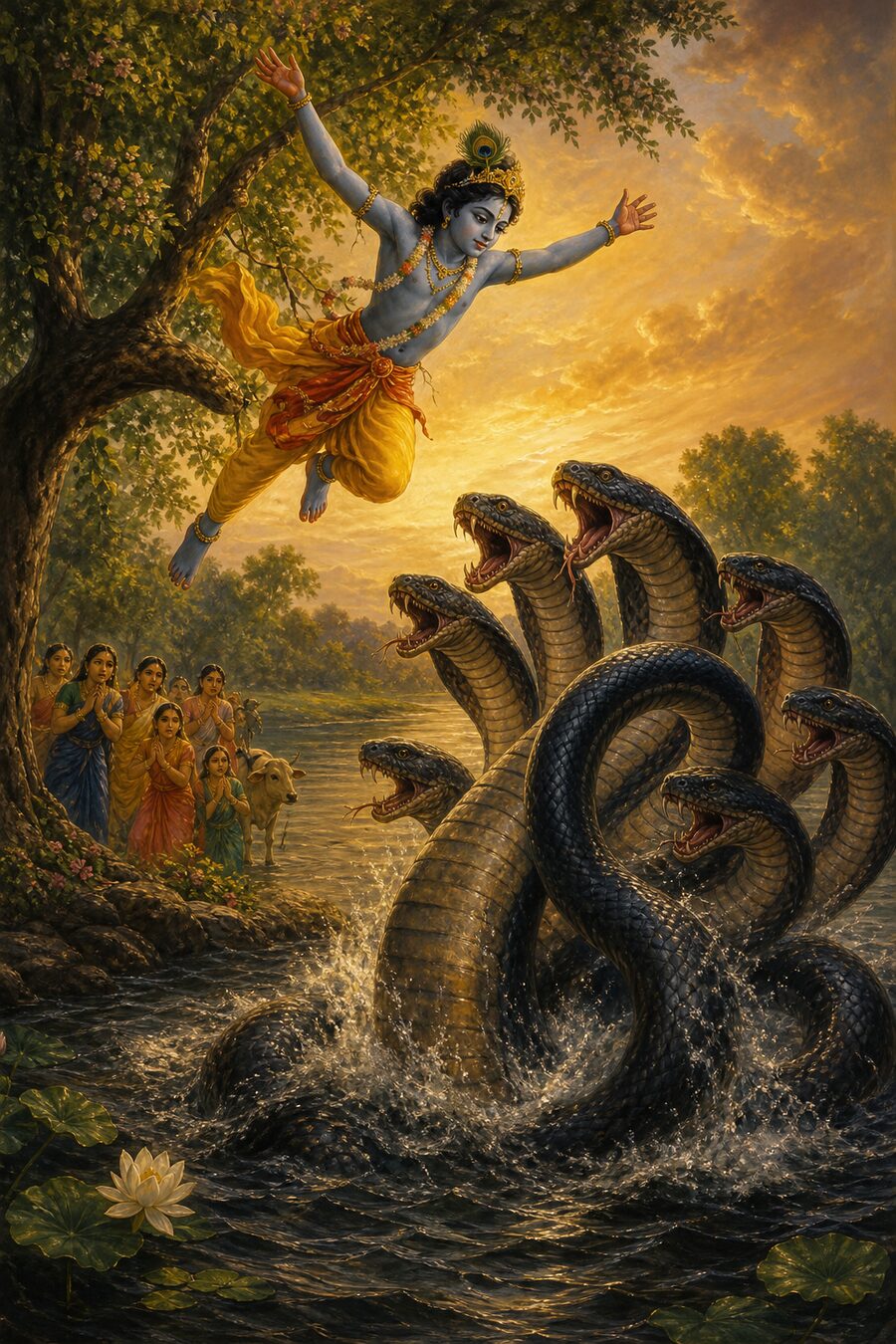
One day, grazing the cattle along the river, Krishna came out on the bank of the Yamuna. The river ran between trees hung with creepers, its landing stairs cut level and its water sweet, lilies and lotuses riding on it, swans and saras calling along the edges and chakravakas ranging in their pairs, and he walked beside it looking, and kept walking. Then, ahead of him, he saw the lake. Deep, vast, like a sky heaped with clouds, and around it the silence of a place that life has got up and left. He stood at the edge and looked into it, and he thought. Whose lake is this? The serpent king Kaliya, black as a heap of collyrium, the one he had heard of long before, who left the sea in fear of Garuda, must be living here. It was he who had fouled this Yamuna on her way to the ocean, and for fear of him no one lived here; his ministers held these banks for him, and two made roads ran along the two shores. He understood at once why no bird crossed here and no child played on these banks. And with that the thought rose in him that he had been born for. To break the wicked who keep to the wrong road, he had taken birth as a cowherd and lived among the cowherds. He would beat this serpent so that the water of the lake served the people of Vraja, so that pleasant winds blew here again and these landing stairs were fit to use. So, playing like a child, he would climb this kadamba, jump into the lake and master Kaliya, and everyone would know what strength was in these arms.
He tied his cloth tight, climbed the tall kadamba that leaned over the bank, and went up to the very top. Then he let out a roar like a lion and threw himself headlong into the black pool. The water heaved and flew up on every side like torn cloud. Far below, the serpent’s lair shook with the sound. On the bank the cowherd boys saw only the surface close over him, and they turned and ran weeping for the village, and what they said they said in low voices, as if the lake could hear them: Krishna in his foolishness has gone down into Kaliya’s lake, the serpent king is swallowing him, all of you come at once, and someone run and tell Nanda that the serpent is dragging him under. The word fell on Nanda like a thunderbolt. Grief broke him, and he ran for the lake. Behind him the whole of Vraja came pouring down to the water, the boys and the old men and the young women, and the young Balarama with them, and when they reached the edge of that dead black lake and saw no sign of the boy, the strength went out of their legs.
A dance on the hoods
Down in the depths Kaliya woke. Someone had come into his kingdom, into his poison, and dared him. He rose through the water cloud-dark and furious, his eyes red, his five hoods spread and burning like fire, five vast faces breaking the surface above the pool. The fire of his hoods lay over the whole lake. The water seemed to boil around him, and the Yamuna herself shrank back and ran the other way. When he saw Krishna sporting in his lake like a boy at play, he sent out of his mouths a wind full of the fire of his anger, sparks and smoke pouring from them, and the great trees that grew on the bank near him were eaten up in a moment, as if the end of a yuga had come to that one bend of the river. His son and his servant-serpents rose with him, spitting venom and smoke, and together they wound their coils around Krishna until he could not move a hand or a foot. He stood among them still as a mountain. Their poison broke against him and did him no harm.
On the bank the grief turned to open wailing, and shame and astonishment ran through it. Some cried, oh, my son; some cried, we are lost; some, in their terror, that they had all been killed. The women cried out to Yashoda. We are all killed. Look at your son in the power of the serpent king; he is trembling under that hood as if he were being churned. Your heart must be made of stone, that it does not break in two at the sight of him. See Nanda there at the edge of the lake, like a man who has lost his senses, his eyes fixed on his son’s face. We will follow you into this lake, into the serpents’ own house, before we go back to Vraja without Damodara. Without Krishna, Vraja will never look beautiful again, a day without its sun, a night without its moon, a cow with the bull taken from her. We will no more go home without him than a cow goes home without her calf. Only Balarama did not weep. Rohini’s son, who with Krishna was one mind, one body and one intelligence and who still stood there a separate person, alone knew what his brother was, and he called across the water in anger, steady and a little sharp. Krishna, you with the long arms, you who make the joy of the cowherds greater, finish this venomous serpent king now. Brother, all these kinsmen of ours have human understanding, and they are weeping for you because they take you for a human child.
At his brother’s word Krishna moved. He stretched, the coils that held him snapped like wet thread, and in the same motion he was up out of the water and onto the hoods. He caught hold of one great head with his hands, forced himself up onto the middle hood of the five, and began to dance. It was a dance in the fullest sense, weight and rhythm and perfect balance, and under his heels the burning hoods went pale and began to bleed. With every beat the venom was pressed out of the serpent, and with the venom went the arrogance. Kaliya began to choke. Blood and poison ran together from his mouths, and he understood at last that the boy standing on his heads was altogether beyond his power.
A life spared, and one condition
Then Kaliya himself spoke, and his voice came broken. Krishna, he said, I raised my anger against you without knowing you. Now you have beaten me and my venom is gone. Spare my life, and tell me whom I am to serve, I and my wife and my children and my friends, and we will serve. Krishna looked at the five hoods bowed before him and heard the distress in the voice, he whose own carrier is Garuda, the enemy of every serpent, and he answered as if there had never been any anger in him at all.
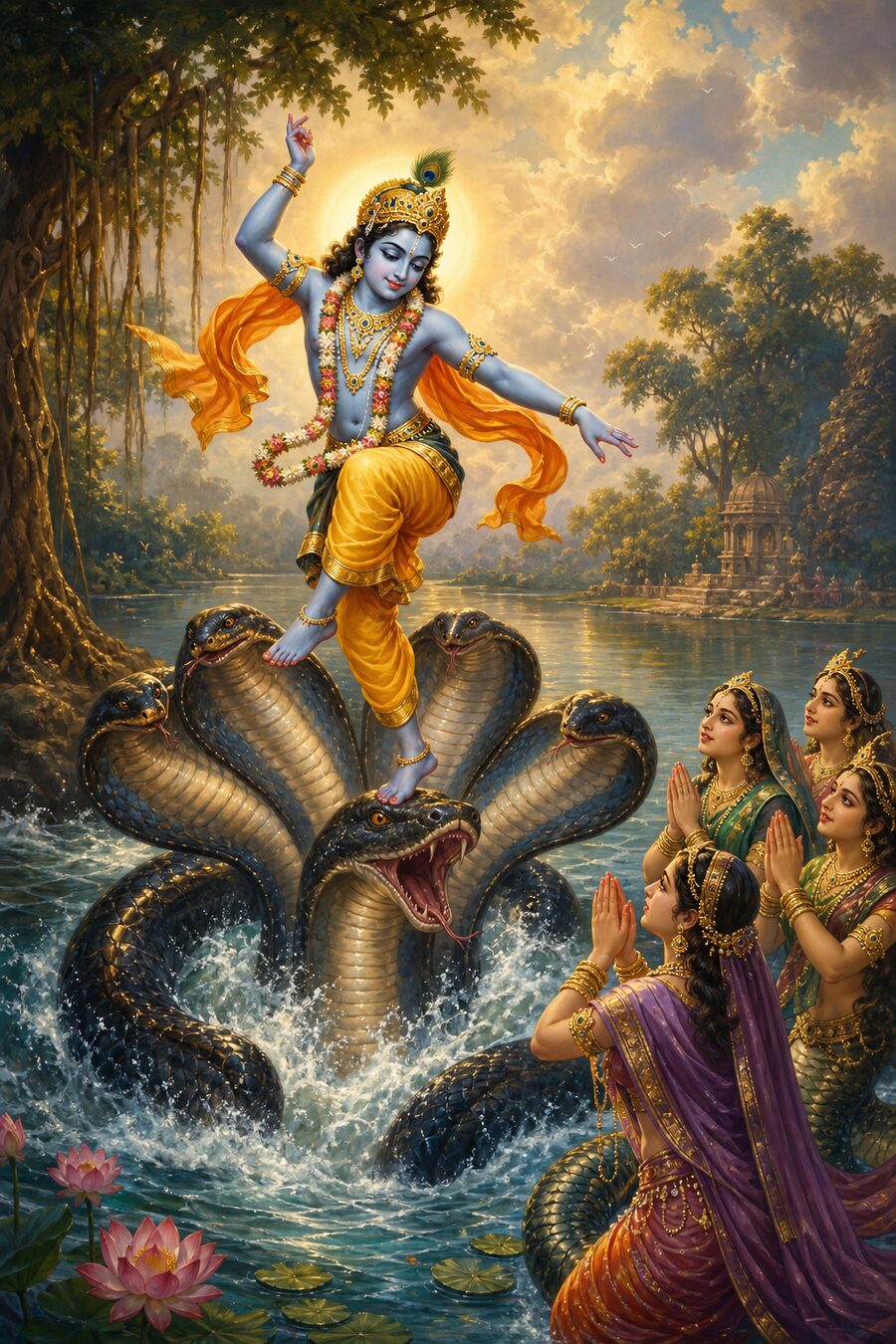
I will not have you living in this water of the Yamuna any longer, Krishna told him. Go back to the ocean, and take your wife and your kinsmen with you. After this, any of your sons or your servants who is seen in this water or on the land of this country will die by my hand. Let this water be wholesome for everyone now, and go yourself to the great deep. If you stay here after today, a calamity will come on you that will take your life. And do not fear Garuda in the sea: when he sees the print of my feet on your heads, he will let you live. Kaliya bowed, and carrying the marks of Krishna’s feet on his hoods he slipped away out of the lake in front of all the watching cowherds, and with his whole clan he made for the deep sea he had once fled.
The water cleared. Birds crossed the air above it again, and the cattle came down to the landing stairs to drink. Krishna walked up out of the pool onto the bank, and the milkmen crowded around him in their astonishment, walked the circle around him and sang his praise, half understanding what they had seen, sensing the fire in him the way you sense fire buried under ash. Then, with the forest at their backs, they turned to Nanda and said what was in all of them. You are fortunate, and the gods love you, to have such a son. From today this Krishna is the refuge of the cowherds in every danger and the protector of the cows in the shed. The water of the Yamuna has turned sweet and wholesome from end to end, and from now on our cattle will range every landing stair in peace. We are cowherds in truth, that we have lived all these days in Vraja and never known him, the way no one knows a fire under its ashes. And praising the deathless Krishna they went home to their hamlet the way the gods go into the garden of Chitraratha, and behind them the Yamuna ran on in her own channel, clean and sweet.
Source: Harivamsha (the khila-parva of the Mahabharata), Vishnu Parva, chapters 55 to 56; critical edition (P. L. Vaidya, Bhandarkar Oriental Research Institute, Pune). Told as story, following the original sequence of events.
The same story, elsewhere
- Kaliya the Serpent
Shrimad Bhagavatam (Skandha 10): the taming of the serpent Kaliya