On this page
The Day a Boy Lifted a Whole Mountain on One Finger
The rains were winding down over Vraja. Krishna and Balarama had spent the two wet months ranging the forest, and when the brothers came home they found all of Gokula caught up in some great preparation. Provisions were being gathered, the elders hurried from house to house, and the whole settlement hummed with the happy noise of a people getting ready for a feast. It was the time of Indra’s yajna, as it was every year when the clouds began to thin. Krishna watched it for a while with open curiosity, and then he asked. What is this festival of Shakra, he said, that has all of you so pleased?
One of the older herdsmen took the question seriously and answered it the way it had been answered for generations, father to son, further back than anyone could count. Listen, he said, and you will know why Indra’s flag is raised. Indra is king of the gods and master of the clouds. At his command, with his bow arched across them, the clouds bring down fresh rain, and out of that rain comes the grain. We live by that grain, and the gods are fed by it too. The grass it raises is what fattens our cows and bulls and calves, and wherever you see a cloud letting down its water you will find no bare ground and no hungry animal beneath it. Shakra milks the water out of the earth along the rays of the sun, and the clouds pour it back as a nectar. The great roar he lets loose from the clouds, the one the air carries for miles, is what people call thunder, and when the wind drives it the sound cracks like a bolt that can split a mountain. As Shiva goes about ringed by his goblins, so Indra stands in the sky ringed by clouds that run where he sends them, and they paint the heavens as he pleases, now like a foul day, now like scattered gold, now dark as kohl, now falling in soft drops. That is why the rains are fixed as the season of his worship. Kings and common people honor him in these months, and so do we.
Krishna heard him through to the end. Then he raised the question that would bring a god down out of the sky. We are herdsmen who range the forest, he said. Our living is the cows. If we must worship, then let us worship the cows, and the mountains, and the forests. The farmer lives by his plow and the merchant by his trade, and we live by the cow; that is the whole of it, and the scholars of the three Vedas say as much themselves. For each of us, the work that feeds us is our great god, the one worthy of our offerings, the one who does us good. The man who is kept alive by one hand and lays his worship in another calls down a double calamity on himself, once in this world and once more after death.
And look at who truly holds us up, he went on. The fields are kept safe by the plowing, the forests are kept alive by the fields, and the mountains stand behind the forests and hold them up. These mountains are the only refuge we have. I have heard that the mountains of this forest can take whatever shape they choose, that they walk their own slopes as lions with full manes and as tigers, the first of all clawed things, and frighten off the people who come to strip the woods, and that anyone who ruins a forest here is undone by them before long. The Brahmins offer a yajna built of mantras. The farmer should offer one to the furrow. And we who keep cows should offer ours to the mountain. There is no need for any further discussion.
Then he turned them to look at the autumn that was already walking in behind the rains. The clouds, emptied of water and lightning, drifted across the sky like a herd of elephants. The tanks and pools smiled with their rows of swans and shrank a little every day under the cries of the sarasa cranes. The rivers ran toward the ocean like wives going to their husbands, with chakravaka birds for their breasts and swans for their smiles. Along the Yamuna the banks were thick with mud and kasa flowers. The fields had turned blue with ripe kalama paddy. The peacocks had lost their arrogance, the moon had thrown off its cloudy robe and wandered the clear sky with a glad heart, and the cows were giving twice the milk they had given before. In an autumn like this one, Krishna said, we will worship that best of mountains, where white and red and blue birds make their homes and the branches are loaded with fruit, and above all we will worship the cows. Dress them with ornaments on their horns, with crowns of peacock feathers, with bells at their throats and the flowers of the season, and honor them for your own well-being. As the gods worship Shakra, so we will offer a yajna to the mountain. If you have any love for me at all, if I am your friend, then worship the cows. Keep no doubt about it in your hearts, and do what I ask without questioning why.
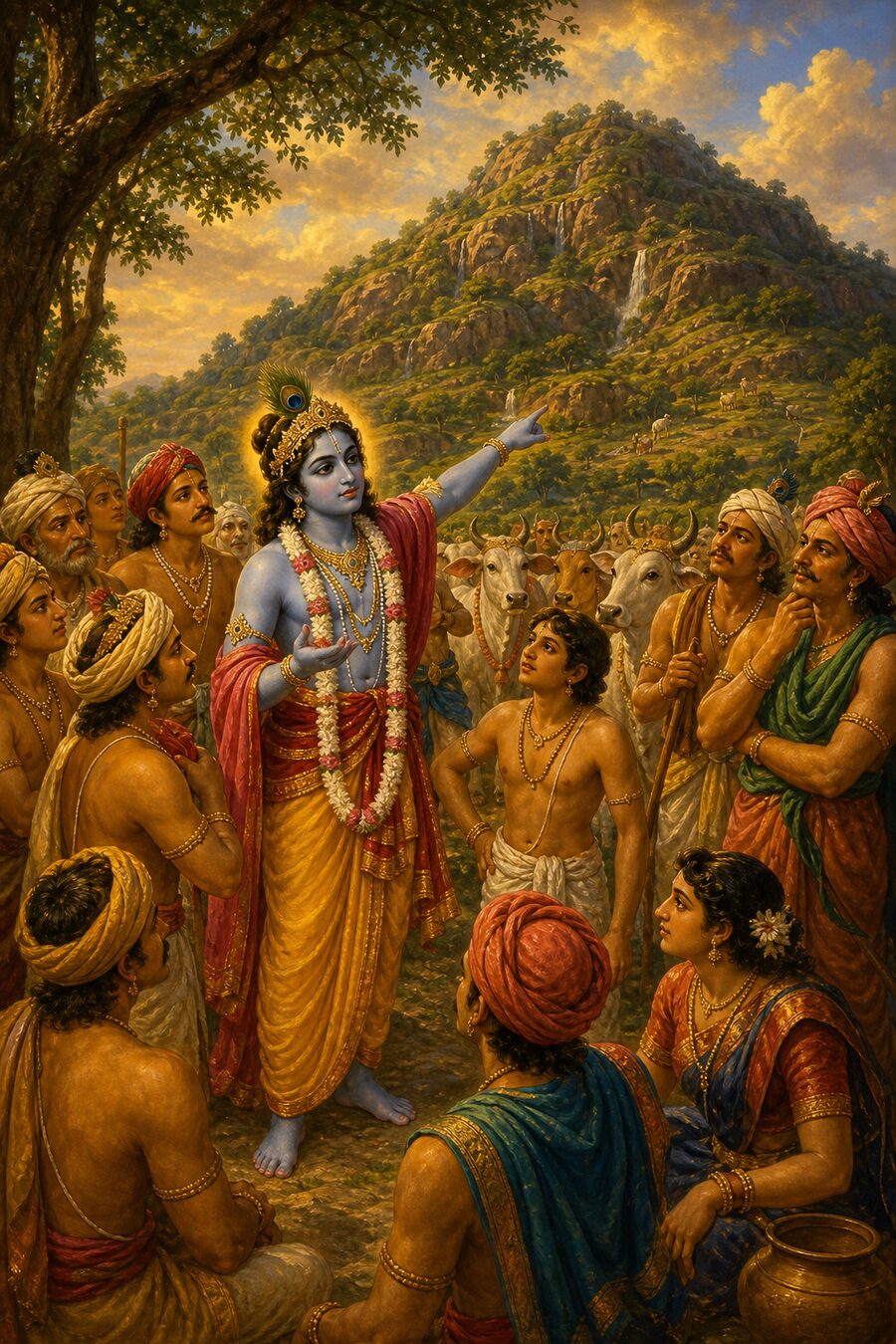
The worship of the mountain
Damodara’s words went into the herdsmen like nectar, and they answered without a moment’s hesitation. We are glad to see this understanding in you, they said, because it works toward more cows and a better life for all of us. Krishna, you are our road, our delight, and our refuge. You know what is in our hearts, you save us when disaster comes, and you are a friend to our friends. By your grace this whole settlement of Gokula lives free of its enemies, happy and full of good fortune, like the city of the gods. Since the day you were born we have watched you do things no one else could do, and heard you speak with a boldness that fills us with wonder. What Purandara is among the gods, you are among men, by your strength, your power, and your fame; you stand out among mortals the way the sun stands out among the gods, and you shine among us by your grace and beauty and your smile the way the moon does. In strength, in energy, in the feats of a boy’s years, only Kartikeya could be your match, and there is no one among men who could. The great ocean never crosses its own shore, and who could set aside your proposal for a yajna to the mountain? So let the Indra-yajna go, and let the Giriyajna you have called for be performed for the good of the cows and the cowherds. Let dishes of milk be cooked, let fine jars be set out at the drinking-place, let the channels and the troughs be filled with milk, and let enough food and drink be carried up the mountain that the herdsmen can spend three nights there.
The whole village lit up with joy, and the cows seemed to share it. To the sound of trumpets, the bellowing of the bulls, and the calling of the calves, the herdsmen went up the mountain with the gladness of people who have decided something together. Lakes of curd were made there, whirlpools of ghee, rivers of milk, and a heap of boiled rice the size of a hill. Hundreds of eating places were laid out. There were garlands, perfumes of every kind, and incense, and the articles of the rite were set out in their proper order, with the cowherd women standing bright among the men. At the auspicious hour the herdsmen, with the Brahmins, performed the Giriyajna. The Brahmins ate until they wanted nothing more, and went home speaking the verses of blessing.
Then the thing happened that no one had bargained for. The moment the yajna ended, a vast form rose on the summit of the mountain, adorned with celestial garlands and pastes, and with its own hands it took up the rice and the curd and the milk and feasted on all of it. The form was Krishna. By his own illusive power he had put on the shape of Govardhana, and while that huge figure on the hilltop ate the feast laid before the hill, the boy Krishna stood among the cowherds below, bowed with the rest of them, and worshiped his own hidden self. I am satisfied, the figure on the summit said, and smiled. The leading herdsmen, astonished, took refuge in that god, joined their hands, and asked him: lord, we are your devoted servants; command us, and tell us what to do.
The answer came in a voice that seemed to rise out of the mountain itself. If you have any compassion for the cows, it said, then worship me from this day. I am your first god, the one who wishes you well and grants whatever you desire, and it is by my favor that you have ten million precious cows in your keeping. Become mine, and I will see to your well-being in this forest and take my pleasure in your company as the gods take theirs in heaven. I will give Nanda and the other leading herdsmen wealth worth the having, the kind of wealth that belongs to people who keep cows. Now let the cows, with their calves beside them, walk around me, and I shall know the highest happiness there is.
So the cows and the bulls, in their herds, went around that best of mountains to adorn it. Garlands hung from their horns, chaplets crowned their heads, their legs were bound with bands of flowers, and countless cows circled it quickly and gladly. The herdsmen followed to keep them in order, their limbs painted with pastes of many colors, dressed in red and crimson and yellow, with armlets of peacock feathers, their hair tied back with cords, weapons in their hands. Some ran to turn the cattle, some danced for joy, and some rode the bulls. When the festival had run its course, the god standing on the hill vanished where he stood, and Krishna went back to Vraja with the cowherds. Young and old, all of them had seen the wonder of that day, and they went home singing the glories of Madhusudana.
Up in heaven Shakra took it as an insult, and he could not let it go. A whole village of cowherds, on the word of one boy, had set the king of the gods to one side and handed his festival to a hill. He called the Samvartaka clouds, the black herds that drown creation when an age comes to its end, and he gave them their orders. If you have any respect for your king, he told them, if you count it your duty to do what pleases me, then hear me. Everyone in Vrindavan has attached themselves to Damodara, and Nanda and the other herdsmen have turned against my festival. For seven nights, with rain and with wind, torment the cows that are the whole of their living, the cows for whose sake they are called gopas. I will ride Airavata myself and bring down a storm that blazes like thunder and lightning. Kill the cows and the people of Vraja with your floods and your gales, and do not leave them until every one of them has kissed the ground.
The sky broke open
Indra climbed onto Airavata, his great white elephant, and drove the storm down himself. Clouds the size of mountains, dark blue and rumbling, closed over the sky from every side with his bow arched across them, lightning running through them without pause, and they wrapped the day in darkness. Some of them were shaped like elephants, some like makaras, some like serpents, and they moved shoulder to shoulder as though a million elephants were crowding the sky. Then the ceiling broke. The water came down in ropes as thick as a man’s arm, in columns like the trunks of elephants, in shafts as straight as bamboo. People looked up and saw an ocean standing over their heads, bottomless and without a shore. The birds could not leave their nests for the roaring of those mountainous clouds, and the beasts of the forest bolted in every direction. The planets and the stars went out, and the sky, robbed of sun and moon, lost all its light. The ground of Vraja turned into a single tank. The peacocks shrieked, the smaller birds gave thin frightened cries, and the rivers swelled and tore the trees off their own banks and carried them away. The grass and the trees trembled as though the thunder were scolding them. The herdsmen said to one another that the end of the world had come, and that soon the whole earth would be one sheet of water.
The cows bore the worst of it. They stood rooted in the flood and bawled. Their bodies were soaked through, their legs and hooves would not move, their mouths hung slack, their hair stood on end, and their bellies and udders had shrunk to nothing. Some dropped from exhaustion, some fled in panic, some sank with their calves into the freezing water, and some, hollow with hunger and worn out in the legs, lay down and wrapped themselves around their calves. The tellers say that the cows and the calves, shaking, with wretched faces, turned toward Krishna and cried to him: save us, save us. The herdsmen left their drowning houses and ran to him. Save us, they cried. We gave up Indra’s worship because you asked us to, and now this doom has broken over our heads.
The sight of the cows in that misery, and of death standing over the cowherds, roused anger in sweet-spoken Krishna. He thought for a moment, and spoke to himself. I knew this would come. To shelter them from this rain I will tear up Govardhana, that best of mountains, woods and forests and all, and make it a refuge for the cows. Held up on my hand, this mountain, a very planet set down on the earth, will protect the cows and the herdsmen; there is no shadow of doubt in it. Then he turned to the people. Do not be afraid, he told them. This rain is the work of a wounded pride, and the answer to it is patience.
A canopy for seven days
With that resolve he showed what the strength of his arms could do. Krishna, whose prowess is truth itself, tore the hill from the earth with his hands and took it onto his left hand, and the mountain, wrapped in cloud, looked like a house because of its caves. As it came up, the rocks on its terraces shook loose and the trees went down. The thing that never moved rose into the sky with its summits whirling, its trees falling, its peaks trembling. The massed clouds poured their water down its flanks, the torrents pried its rocks loose, and the whole mountain shuddered without pause; where the clouds met its springs it looked as though the mountain had dressed itself in peacock feathers. Vidyadharas, Uragas, Gandharvas, and Apsaras called out to one another from every quarter that Govardhana had grown wings and was flying. From its torn root, with its thousand layers, white and crimson and dark minerals trickled down. Some of its summits slackened, some shattered, and the highest of them went up into the clouds. The trees shook with it and their flowers fell on every side. Great hooded serpents slid out of their holes, and the birds burst upward, then down, then up again, too frightened by the lifted mountain and the pounding rain to settle anywhere. The lions roared like clouds full of water, and the tigers like churning rods. Its even places and its broken places all shifted, until it looked like another mountain altogether, and under that endless downpour it hung in the sky like Tripura stunned by Rudra. Resting on the rod of Krishna’s hand, covered in dark blue clouds, that huge mountain looked like an umbrella, and the tellers say that the murmuring of the clouds sent Govardhana to sleep, and he laid his cave for a face on the pillow of Krishna’s arm.
Then, like Brahma himself guarding what he has made, he raised the mountain higher to protect the cowherds and set it on the tip of one finger, and he spoke with a smile. By a heavenly means beyond even the understanding of the gods, he said, I have built this house of stone, a refuge for the cows where no wind blows. Let the herds come in quickly and live here in peace. Divide the room among yourselves by your standing and by the size of your herds, and let the rain fall where it likes. This house I have made by uprooting the hill runs five kos in length and one in breadth. It could hold the three worlds, let alone Vraja.
Outside, the clouds growled and the cows bellowed, and over both rose the uproar of the herdsmen. The cowherds drew the cattle into rows and led them into the great cave of that best of mountains. The people of Vraja, afraid of the rain, came in with their carts and their vessels, and settled into the house of rock. And Krishna stood at the foot of the mountain like a pillar of stone rising from the ground, holding the hill on one hand the way you would steady a beloved guest, while the doom kept falling outside and found nothing left to fall on.
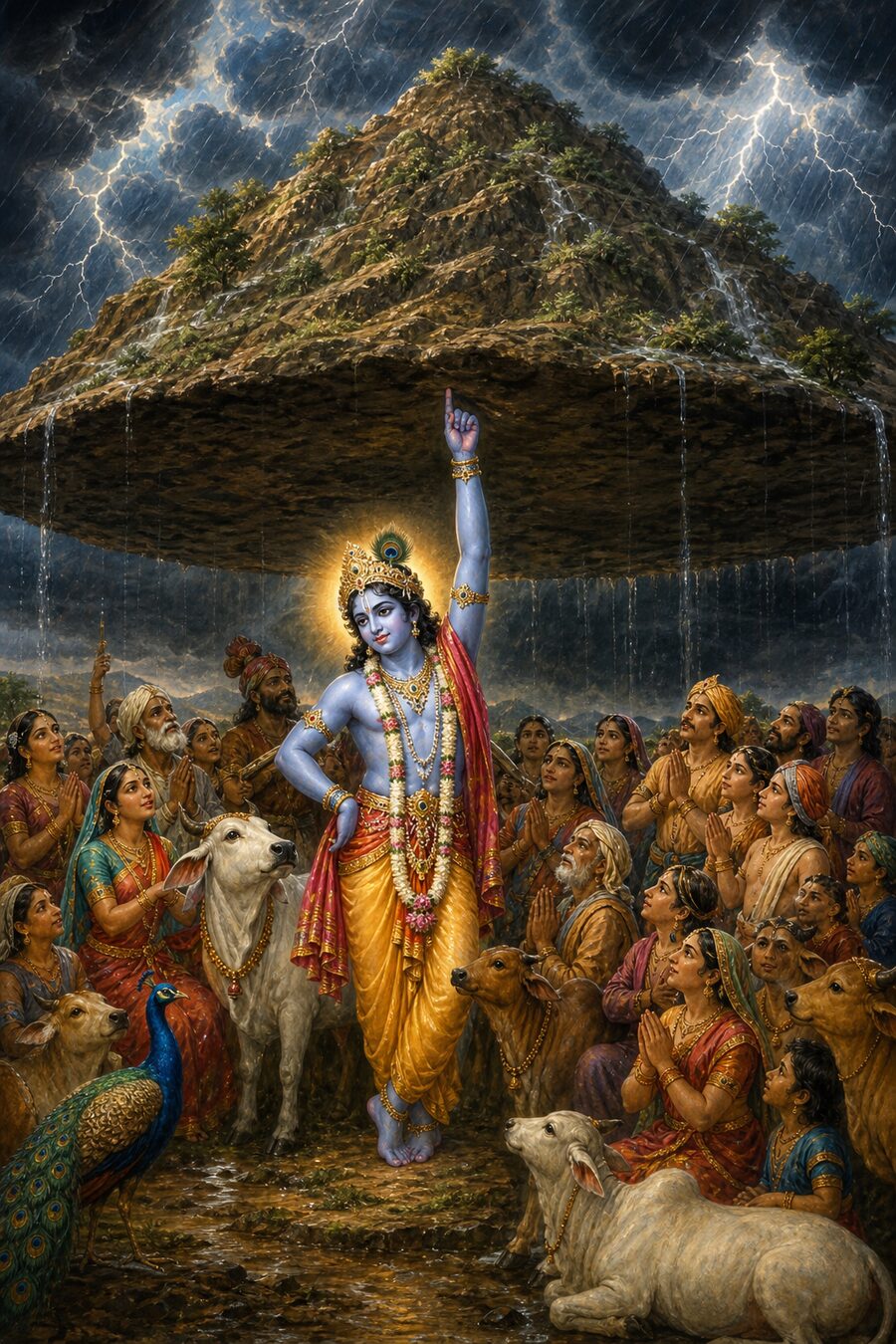
One day, two days, seven days. The rain did not stop, and for all of those days the boy stood without moving and without tiring, the mountain resting on his fingertip as though it had no weight at all. Beneath it the people were dry, safe, and astonished past speech. The one they called Nanda’s son was standing over them, seven nights awake, with a mountain for a roof.
Shatakratu watched from above as his seven nights of doom broke over one lifted mountain and came to nothing, and the boy beneath it neither tired nor flinched. Every word he had spoken to the clouds had been proved false. He ordered them to stop, and he went back up to heaven. The clouds drained out of the sky and left it clear, and the sun came up in its full strength. The cows and the herdsmen walked out by the same road they had walked in, and Krishna, with a glad heart, set that best of mountains back in its place for the good of all the worlds.
Yet the sight of Govardhana held up and the cows saved had planted something new in Purandara: wonder, and a wish to see this Krishna with his own eyes. He came down to earth on Airavata, the ichor running down the elephant’s temples, like a cloud that has emptied itself of rain. He found Krishna sitting at the foot of Govardhana in a cowherd’s dress, and saw in him the undying Vishnu, shining with his own light. Shakra, who has a thousand eyes, looked with all of them: the mark of Srivatsa on the chest, the color of a blue lotus, an immortal sitting at ease in the land of mortals. And Shakra was ashamed. Above the boy, unseen by anyone there, the king of birds, Garuda, eater of serpents, held his wings spread against the sun to shade him. Indra, the slayer of Bala, left his elephant behind and walked on foot toward the child who was playing in the forest at human games. A crown bright as the sun blazed on his brow, celestial earrings swung at his ears, and a necklace of Padmakanta jewels in five strands lay across his chest. Vasava, bearer of the thunderbolt, looked with his thousand eyes at Vasudeva, and as he came near Upendra he seemed to grow more beautiful, with his heavenly garlands and pastes. Then, in the sweet deep voice that rolls like the muttering of clouds and is used to giving the gods their orders, he spoke.
Krishna, he said, you of the long arms, joy of your kinsmen, what you have done out of love for your cows is past the power of the gods. I made those clouds, the ones that bring the dissolution of the world, and you saved the cows from them, and I am glad of it. Whose mind would not fill with wonder, seeing you hold this best of mountains in the sky like a house, by a yoga power born of yourself alone? My sacrifice was suppressed, and I was angry. So I sent down this excess of rain, seven nights of it, death to cattle, a rain that Devas and Danavas alike cannot withstand, and you, by your own power, put it down in front of my face. In your anger you settled the whole energy of Vishnu in this human form, and because that energy lives in you even as a man, the work of the gods looks finished already; while you stand at the head of their works and guide them, everything will be done and nothing will be left undone. Among the gods and in all the other worlds, you alone are eternal. I see no second being who could carry the weight you carried. As the best of wheels is set before the pole, so you set yourself to lift the gods out of their ocean of misery. As gold is among the metals, so this whole universe that the Grandfather made lives inside your body. A cripple cannot keep up with a runner, and so even the self-born Brahma cannot keep up with you in wisdom or in age. What the Himalaya is among mountains, what the great ocean is among waters, what Garuda is among birds, that you are among the gods.
Then Indra counted out the ladder of the worlds. Beneath everything lies the region of water, he said. Above it float the pillars of the earth, and above those is the world of men, then the sky, then the blazing region of the sun that is the gate of heaven, then the great realm of the gods where I sit as king, and above that Brahmaloka, where the Brahmarshis live and Soma and the other lights move about. Above all of these, set in the great ether, is Goloka. It is the first of all regions, and the Sadhyas guard it, and there you live, practicing a tapas we cannot learn even when we ask the Grandfather about it. This earth is the field of action for those who act, and beneath it lies the terrible place of the wicked. The sky is the refuge of everything that moves, as the wind does, and heaven is the refuge of the good who have mastered themselves and learned to forbear. Those who worship Brahma go to Brahmaloka. Goloka can be reached only by the cows; no one else wins it, however hard the austerity. It was to protect these very cows, Krishna, that you held up Govardhana and turned aside the disaster I sent. So I have come here at the asking of the Grandfather and the cows, and out of respect for you.
Krishna, I am Purandara, lord of the Bhutas and of the gods. I was born of Aditi, and I am your elder brother. Forgive me for showing off my own strength in the shape of clouds, when that strength is only an outflow of yours. Be at peace now in your own gentle power, and hear what Brahma and the cows have sent me to say. They are pleased with your heavenly deeds, with the hymns to your glory, and with the way you guard them, and this is their message. While you protect the great realm of Goloka and all the cows, our race will multiply through the bulls. Ranging where we please, we will give the farmers their bulls to bear their burdens, the gods their offering of havi, and Sri her ever-swelling harvest of grain. You are our teacher and our savior. Become our king and our lord, and today, with this golden jar of heavenly water that I have carried down with my own hands, anoint yourself.
I am the king of the gods, Indra went on, and you, though you are eternal, have today become the king of the cows. So the people of this world will sing of you as Govinda. As the rank of Indra was given to me, so you are the Indra of the cows, and the gods will know you by the name Upendra. Of the four months of my rains I give you the second half, the autumn. From today the first two months are mine; when the rains have passed, people will take down my flag and the worship will be yours. Then the peacocks, who grew proud under my clouds, will fall quiet, and every creature that cried out at the sight of a cloud will hold its peace. Agastya will range the southern sky like a bird, the sun of a thousand rays will press down on everything with his own heat, the frogs will stop their leaping, the banks of the rivers will fill with swans and sarasas, the cows will give their milk, the rivers will keep to the middle of their beds, the trees will bend with fruit, the sugarcane will rise, and the Vajapeya and the other great sacrifices will be undertaken. So the sacred autumn will come in, and then you will rise from your bed. Men on earth and the immortals in heaven will worship me as Mahendra and you as Upendra on the flagstaffs of the world, and whoever recites this great and eternal story of the two of us and bows to us will never be visited by misery.
Then the king of the gods, master of yoga, took those jars of heavenly water and poured them over Govinda. Seeing the eternal Krishna anointed, the cows that stand in heaven, and the bulls with them, sent down a rain of their own milk through the clouds. The clearing clouds let fall showers of nectar. Moon-bright drops of water slid from the trees. From the sky the gods raised a lion’s roar, poured down flowers, and blew their bugles, and the Maharshis, who live by the mantras, sang his glory in fitting verses. The body of the earth came up out of the one unbroken ocean that had covered it. The seas grew calm and lovely, the winds began to blow for the good of the world, and the sun and the moon and the stars took up their proper roads again. Kings were rid of their enemies, the calamity of the rain was over, the trees put on leaves and flowers of many colors, the deer ran glad through the forest, the elephants streamed with ichor, and the mountains shone with their trees and their ores. The land of mortals drank in that sweetness and was as satisfied as heaven.
When the royal anointing was over, with its showers of nectar from the sky, Purandara spoke again to the eternal Govinda, garlanded and seated in the sovereignty of the cows. The first work, he said, the making of you as king of the cows, is finished. Now hear the second reason I came. Kill Kamsa, kill that wretch of a horse Keshi, kill Arishta who is forever making trouble, and do it soon, and then take up the governing of your own kingdom. And from your father’s sister a portion of my own energy has been born as a son. His name is Arjuna. Make him your friend and protect him always; he will follow your counsel and come to great fame, the first bowman among the descendants of Bharata, made in your likeness, and never content with his own work unless you are beside him. The war of the Bharatas that is coming rests on the two of you, and when you stand together, every king will fall. I have told the gods and the rishis that the son I fathered on Kunti would be a master of weapons, the first of archers, the greatest of the Kurus; keeping to a Kshatriya’s duties, he alone can destroy a whole akshauhini of fighting kings, and no king and no god, save you, could weaken his bow or follow the path of his arrows. So at my asking teach him the knowledge of the spirit, and if you guard him in the great war, Death will not be able to lay a hand on him. Know Arjuna as me, and know me as your own self. I am your elder brother, and long ago, when you took the three worlds from Bali in three strides, you set me on the throne of the gods; I know that truth is your strength, and that the gods, holding you to your promise, have set you to the destruction of their enemies. When Kamsa is dead at your hands there will be a great war of kings; Arjuna will beat down men of superhuman deeds, and you will clothe him in glory. If truth, and I, and the gods are dear to you, do what I have asked. Krishna, who had made himself a keeper of cows, answered with a glad heart. Lord of Sachi, he said, I am happy to see you, and nothing you have said will be left undone. I know your heart. It is no secret to me that my father’s sister was given to the high-souled Pandu and bore Arjuna, and I know the rest of Pandu’s sons as well. I know that Pandu is dead by the curse that struck him like a thunderbolt, and that the sons of Dhritarashtra are hungry for war. Go back now to the city of the gods and gladden them. No enemy will be able to touch Arjuna while I stand in front of him. When the great war of the Bharatas has run its course, I will hand all the sons of Pandu back to Kunti unharmed, for his sake. I am bound by affection, and whatever your son Arjuna asks of me I will do as a servant does.
When he had heard these words from truthful Krishna, the king of the gods went home to the city of the immortals. And the beautiful boy who had held up Govardhana walked back into Vraja, where the whole village poured out to honor him.
Source: Harivamsha (the khila-parva of the Mahabharata), Vishnu Parva, chapters 60 to 63; chapter numbers of the critical edition (P. L. Vaidya, Bhandarkar Oriental Research Institute, Pune). Told as story from M. N. Dutt’s English translation (1897), which follows the vulgate text, keeping its sequence of events.
The same story, elsewhere
- Govardhana
The Govardhana episode of the Shrimad Bhagavatam (Skandha 10)