On this page
Rama gives the vulture, a low bird, the state that yogis beg for. The two brothers go on into a thick forest, searching for Sita. Farther on, seeing Rama come to her house, a woman is pleased at heart. She speaks of herself, and Rama says he acknowledges one bond, bhakti. Before she leaves her body, he asks her for news of Sita.
As Kabandha comes on the path, Rama strikes him down, and Kabandha tells of his curse. Rama speaks to him and explains his own dharma, and the gandharva goes to the sky in his own state. In Shabari’s hermitage she clings to the feet of the two, washes the feet, and seats them. To Rama she gives bulbs, roots, and fruit, and he eats them, praising them again and again. He tells her the ninefold bhakti item by item. He says that the state hard for hosts of yogis is easy for her today. He tells what fruit the sight of him gives, and asks about Sita. She tells him that at the lake of Pampa there will be friendship with Sugriva, and tells the whole story. By the fire of yoga, leaving her body, she merges in the Lord’s feet. Last comes a word to men, to give up what gives grief and love Rama’s feet with trust.
Kabandha, Shabari, and two brothers
The main figures in this episode
- Rama who gives the vulture the state that yogis beg for, and who goes on with his brother, searching for Sita. He strikes Kabandha down on the path, hears his curse, and speaks to him. He explains his own dharma to him. Giving him his state, he sets foot in Shabari’s hermitage. He eats what she gives him, and tells her that he acknowledges one bond, bhakti. He tells her the ninefold bhakti and asks her for news of Sita.
- Lakshmana one of the two brothers who go on searching for Sita. Shabari falls clinging to the feet of both brothers, dark and fair, and seats them.
- Kabandha who comes on the path and is struck down. He tells the whole story of his curse, and says that at the sight of Rama’s feet the sin is gone. When Rama has explained his own dharma to him, bowing his head at Rama’s feet, he goes to the sky, gaining his own state.
- Durvasa (spoken of) the one who gave Kabandha his curse, in Kabandha’s own words.
- Shabari who, seeing Rama come to her house and thinking of the sage’s words, is pleased at heart. She falls clinging to the brothers’ feet, washes the feet, and seats them. She gives Rama bulbs, roots, and fruit, stands with joined hands, and speaks of herself. She hears the ninefold bhakti and is asked for news of Sita. She tells Rama to go to the lake of Pampa and tells the whole story. Leaving her body by the fire of yoga, she merges in the Lord’s feet.
- The sage whose words Shabari thinks of, seeing Rama come to her house. The commentary names him Matanga.
- Shiva and Parvati who tell and hear the story. Shiva turns to Parvati to say who is ill-fated.
- Sita for whom the two brothers go on searching, and for news of whom Rama asks Shabari.
- Sugriva (spoken of) with whom, Shabari says, there will be friendship at the lake of Pampa, and who will tell it all.
- Tulsidas to whom the commentary gives the two lines that bid men give up works, unrighteousness, and creeds, and love Rama’s feet with trust.
The state that yogis beg for
Rama is soft of heart, most kind to the humble, and merciful without cause. He gave the vulture, a low bird and an eater of flesh, the state that yogis beg for.
Shiva, telling the story to Parvati, said, “Listen, Parvati. Ill-fated are those people who, leaving the Lord, love the things of sense.” Then the two brothers went on, searching for Sita and looking at the thick forest.
Kabandha on the path
The dense wood was crowded with creepers and trees. Many birds and beasts were there, and elephants and lions. As Kabandha came on the path, Rama struck him down. Kabandha told the whole story of his curse. “Durvasa gave me a curse. At the sight of your feet, Lord, that sin is gone.”
In the commentary’s reading Rama said to him, “Listen, gandharva, I tell you this. A foe of the brahmin line does not please me.”
In mind, deed, and word, leaving guile
Rama went on. “Whoever, leaving guile in mind, deed, and word, serves the brahmins, the gods of the earth, has me, with Brahma, Shiva, and all the gods, in his power. A brahmin cursing, striking, and speaking harshly is to be worshiped. So the saints sing. A brahmin without conduct and virtue is to be worshiped. A shudra with a host of virtues and skilled in knowledge is not.”
Telling his own dharma, Rama explained it to him. When Rama saw the gandharva’s love for Rama’s feet, the gandharva pleased his mind. Bowing his head at Rama’s feet, he went to the sky, gaining his own state. The commentary reads that state as his gandharva form.
In Shabari’s hermitage
Giving him that state, generous Rama set foot in Shabari’s hermitage. Seeing Rama come to her house, and thinking of the sage’s words, Shabari was pleased at heart. The commentary names the sage Matanga.
The two brothers had lotus eyes and long arms, a crown of matted hair on the head, and the forest garland on the breast. Dark and fair, they were beautiful. Shabari fell clinging to their feet. She was sunk in love, and no word came from her mouth. Again and again she bowed her head at the feet. With respect, taking water, she washed the feet. Then she seated the brothers on beautiful seats.
Bulbs, roots, and fruit
Shabari gave Rama bulbs, roots, and fruit, very sweet, having brought them. Rama ate them with love, praising them again and again.
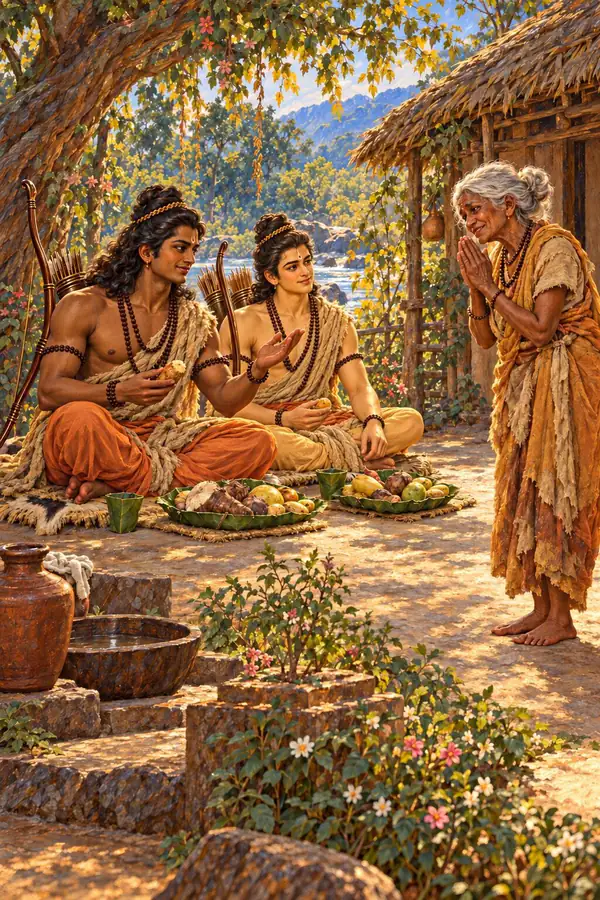
No fruit was tasted before it was given.
Shabari speaks of herself, and Rama of one bond
Joining her hands, Shabari stood before him. When she looked at Rama, her love grew greatly. “How shall I praise you? I am of low birth and very slow of wit. Lower than the low, most low, are women. Among them I am dull of wit, destroyer of sin.”
Rama said, “Listen, lady, to the word. I acknowledge one bond, that of bhakti. Birth, rank, family, dharma, greatness, wealth, strength, kin, virtue, and quick wit. With these, how does a man without bhakti look? As a cloud without water is seen.”
The ninefold bhakti, the first and the second
Rama went on. “I tell you the ninefold bhakti. Listen with care and hold it in your mind. The first bhakti is the company of the saints. The second is love for the telling of my story.”
The third and the fourth
Rama went on. “Service of the guru’s lotus feet, without pride, is the third bhakti. The fourth bhakti is to sing my host of virtues, leaving guile.”
The fifth and the sixth
Rama went on. “Repeating my mantra, and firm trust in me, is the fifth, worship, which the Vedas make known. The sixth is self-control, conduct, dispassion from many works, and being ever engaged in the dharma of the good.”
The seventh and the eighth
Rama went on. “The seventh is to see the world alike, as full of me, and to count the saints greater than me. The eighth is contentment with whatever comes, and seeing no fault in others even in a dream.”
The ninth, and the state made easy
Rama went on. “The ninth is simplicity, without deceit toward all, reliance on me in the heart, and neither gladness nor wretchedness. Whoever has even one of these nine, woman or man, moving or unmoving, anyone, that one, lady, is most dear to me. In you every kind of bhakti is firm. The state that hosts of yogis find hard to reach has become easy for you today.”
Toward the lake of Pampa
Rama went on. “The fruit of the sight of me, supreme and matchless, is that the living being gains its own natural form. Lady, if you know news of Sita, who walks like a fine elephant, tell it.”
Shabari said, “Go to the lake of Pampa, Rama. There will be friendship with Sugriva. He will tell it all, lord. Though you know, you ask, steady of wit.” Bowing her head again and again at Rama’s feet, she told the whole story with love.
Having told the whole story and looked at the Lord’s face, she held his feet in her heart. Leaving her body by the fire of yoga, she merged in the Lord’s feet, from where there is no returning. “Men, give up the many kinds of works, unrighteousness, and the many creeds, all giving grief. With trust, says the servant Tulsi, love Rama’s feet.” The commentary gives these two lines to Tulsidas.
Kabandha, Shabari, and the way to Pampa
Rama gave the vulture the state yogis beg for, and the two brothers went on into the thick forest. On the path Rama struck Kabandha down, and Kabandha told of Durvasa’s curse and of the sin gone at the sight of Rama’s feet. Rama spoke to him and explained his own dharma to him. The gandharva went to the sky with his own state gained. At her hermitage Shabari fell at the brothers’ feet, washed the feet, and seated the brothers. She gave Rama bulbs, roots, and fruit, and he ate them, praising them. She spoke of herself. Rama said he acknowledges one bond, bhakti, and told her the ninefold bhakti one by one. He said that every kind was firm in her, told of the fruit of the sight of him, and asked for news of Sita. She told him of the lake of Pampa, where friendship with Sugriva would be, and told him to go there. She told the whole story. Her body left by the fire of yoga, she was merged in the Lord’s feet. The next episode opens on the narration’s word to the most dull mind, which wants happiness, forgetting such a Lord.
The same story, elsewhere: Valmiki’s Ramayana, chapter 14: Jatayu, Kabandha, and Shabari.
Source: the Gita Press edition of Tulsidas’s Ramcharitmanas, Aranyakand, doha 33 to 35, with the chaupais and chhand before doha 36, read with Hanuman Prasad Poddar’s Hindi commentary.