On this page
Yoga Vasistha · Story 18
Suraghu and Parigha: From Kingship to Natural Samadhi
Suraghu could protect his mountain kingdom only by making judgments that caused pain. Mandavya gave him a disciplined way to examine the ruler, the realm, the body, and the mind. Years later, his old friend Parigha returned from a thousand-year austerity with one exacting question: could Suraghu’s clarity remain unbroken while he governed, spoke, and acted?
The Burden of Judgment
Vasistha asked Rama to listen to an account from the northern mountains. Near Kailasa, among the high country of the Himalaya, lived the Haimajata Kiratas. Rivers crossed their land, the Ganga flowed through the sacred geography around them, and lotus lakes supported birds and animals. Their king was Suraghu.
He possessed the strength expected of a ruler and the judgment needed to protect a difficult country. Enemy forts had fallen to him. Wealth, soldiers, servants, family, and the institutions of government stood under his care in a jeweled royal residence. Suraghu’s defining problem arose from the work of government itself.
He rewarded conduct that sustained the kingdom and punished theft and other offenses. Each decision had a human consequence. A person subjected to royal punishment suffered, and Suraghu understood that pain by comparison with his own. He considered whether generosity could spare his subjects such distress. The thought failed as a policy. If deserved restraint disappeared, those who harmed others would remain unchecked and public order would weaken.
Severity created one danger, and misplaced leniency created another. The king could neither abandon the people exposed to wrongdoing nor ignore the suffering of an offender. Favor and restraint, anugraha and nigraha, belonged to the same office. His uncertainty concerned the mind that applied them. How could he judge without being carried by pleasure, anger, pity, approval, or resentment?
Suraghu wanted equanimity that would survive agreeable and disagreeable circumstances. A ruler carried by praise, injury, gain, and loss could turn justice into a vehicle for his own agitation. He needed to understand who acted through the office of king and what remained steady while action changed.
The question stayed with him until the sage Mandavya arrived during his travels. Suraghu received him with the formal welcome due to a revered guest, then spoke directly of his anxiety. Every act of favor or punishment seemed capable of renewing partiality. He asked for a means by which his intelligence could meet unequal circumstances with equal vision.
Mandavya’s Method
Mandavya placed the remedy within Suraghu’s own effort. Mental weakness, he explained, subsides through wisdom grounded in knowledge of the Self. Such wisdom matures through dispassion, attentive hearing, reflection, sustained contemplation, and repeated inquiry.
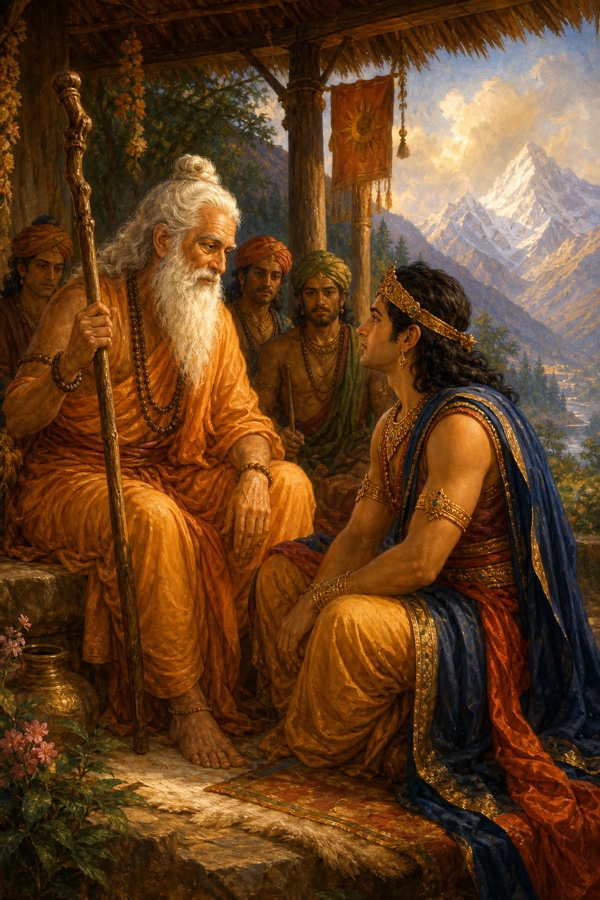
The condition of that inner faculty shapes the experienced world. A heart consumed by craving encounters heat and danger everywhere. A mind made clear through knowledge experiences the same field with composure. Heaven, earth, the lower regions, air, space, mountains, rivers, countries, and time all enter experience as contents known in consciousness. Mandavya compared the mind’s formative power with a vast tree opening from a small banyan seed and fragrance spreading from within a flower.
His instruction did not erase Suraghu’s original dilemma. It directed attention toward the source of its instability. The king was to ask: Who am I? What are the senses? What is this world? To whom are birth and death attributed? Which part of the decision maker changes with hope and fear, and what knows those changes?
Mandavya also described the expected change with care. Mind and sensory activity would continue. Their old authority would recede. A person established in self-knowledge can encounter elation, disappointment, attraction, and aversion without allowing them to determine the whole field of judgment. The aim was steady discernment, supported by direct understanding, through every condition in which the king might have to act.
When the instruction was complete, Mandavya returned to his hermitage. Suraghu now possessed a method he could apply to everything he called himself and his own.
From Kingdom to Consciousness
Suraghu sat in a quiet and suitable place and began with the widest circle of possession. Meru was neither his identity nor his property in any permanent sense. The world, mountains, and earth followed their own order. The Kirata territory existed through causes larger than one king’s life. Its continued administration mattered, though no claim of ownership could make the realm identical with the consciousness that knew it.
He narrowed the field to his capital. Elephants, horses, temples, wealth, pleasures, servants, army, wife, and children all stood in real relationships of duty and use. Convention and circumstance allowed him to say, “I am king” and “this is my kingdom.” Those statements organized public life. They did not establish the nature of the Self. A role could carry binding responsibilities while remaining an object of awareness.
The examination reached his body. Hands and feet performed their functions. Blood, flesh, and bone belonged to the body’s material composition. Organs of action moved, and organs of perception received their objects. Every organ and substance could be noticed. Each changed with use and time. Suraghu could find no single part that contained the knower of all the parts.
Mind, intellect, memory, and ego required a subtler inquiry. An intention arose, remained for a period, and faded. A judgment could alter when new knowledge appeared. Memories returned and withdrew. The ego gathered these events under the word “I,” yet the ego’s claim was also something that could be observed. Whatever appeared as an object of knowledge could not, by itself, account for the awareness in which it appeared.
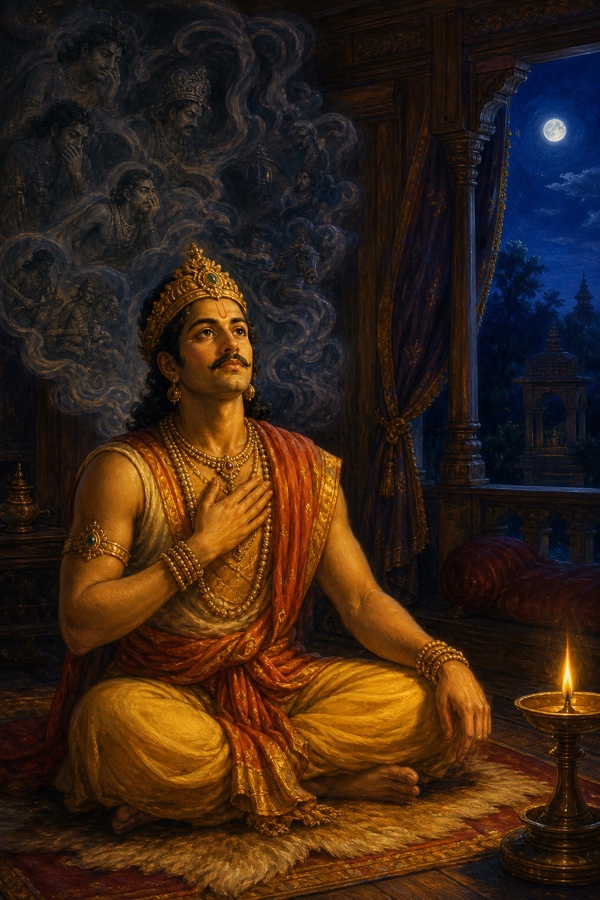
Even the statement “I am a conscious individual” remained incomplete. The idea of an individual knower preserves a division between knower and known. Suraghu looked toward the condition in which that division was itself disclosed. When object, knowing act, and personal claimant were examined together, pure consciousness remained free of every boundary that had been assigned to it.
He recognized this non-objectifiable consciousness as his nature. The gods, living beings, worlds, and planes of existence were all known within its expanse. Forms and modifications appeared through it, while none could enclose it. The ruler who had been seeking a stable center saw that awareness had remained present through every change of office, body, mood, and thought.
His old distress had depended upon the claims “I act,” “I possess,” “I enjoy,” and “I suffer.” As those claims loosened, favor, punishment, pleasure, and grief took their proper place within a wider field of awareness.
Rule After Inquiry
Vasistha says that Suraghu became established in the supreme state through this inquiry. He continued to administer favor and restraint. Duties arrived at their proper time, and he completed them with an even mind. Happiness, despondency, and jealousy ceased to seize command of his decisions.
The maturity of his achievement recalled Visvamitra’s celebrated rise, through austerity, from warrior ruler to brahman sage. Suraghu’s office did not change. He remained king and demonstrated his understanding in the work already entrusted to him.
His equanimity did not produce administrative weakness. He protected subjects, servants, and family, applied appropriate restraint, and carried out the work belonging to the crown. Water remains water as it crosses high and low ground. Suraghu’s knowledge likewise continued through the different conditions of rule.
Suraghu had become a jivanmukta, one liberated while living. He walked, sat, breathed, perceived, spoke, and acted. The claims of personal authorship and possession no longer took root in those activities. His freedom existed within embodied life and public responsibility.
After a long period of enlightened rule, the king relinquished the body and became one with Brahman. His passing was like ice melting under sunlight, a river entering the sea, and the space inside a broken pot opening without boundary into the space everywhere.
Vasistha then returned to an earlier time, after Suraghu’s realization and before his bodily death. His old friend Parigha came to visit the living, liberated ruler in Suraghu’s own royal residence.
The King Who Became Parnada
Parigha ruled the Persian realm, the Parsika country. He and Suraghu had been close friends long before either attained self-knowledge. Distance separated them for a great span of time, while each faced a crisis within his own kingdom.
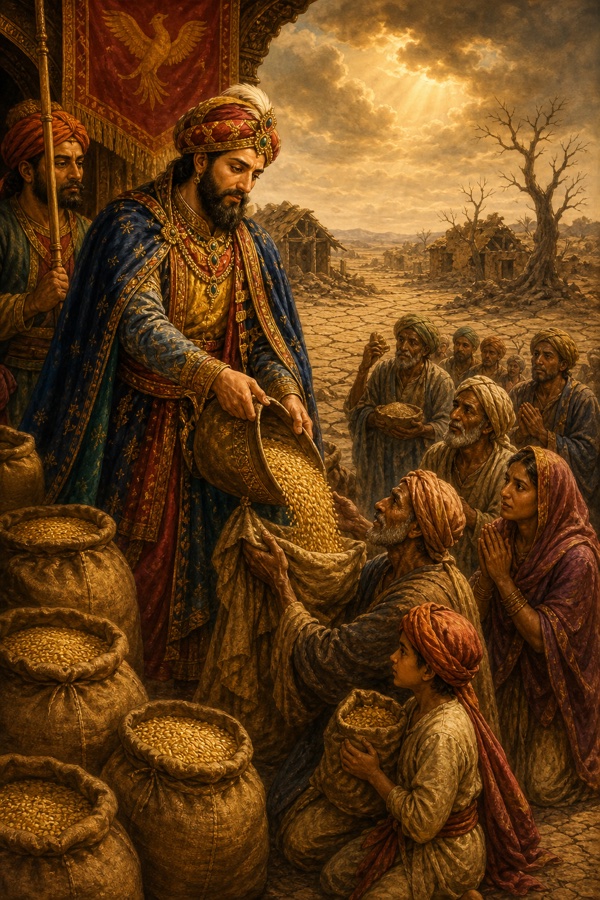
A severe failure of rain struck Parigha’s realm amid accumulated wrongdoing among the subjects. Crops and food failed. Many people died from hunger, fire, and violent quarrels. Families dispersed, and inhabitants left settled places in search of survival.
Parigha used the means available to relieve his people. His efforts could not halt the destruction. The famine revealed a limit that royal power could not cross, and the suffering of the population filled him with grief. He left the entire kingdom and went quickly to a remote forest unknown to its city dwellers.
In a mountain cave, he restrained the senses and undertook severe austerity. When fruit was unavailable, he ate dry leaves that had fallen naturally to the ground. This diet continued long enough for great ascetics to call him Parnada, “one who eats leaves.”
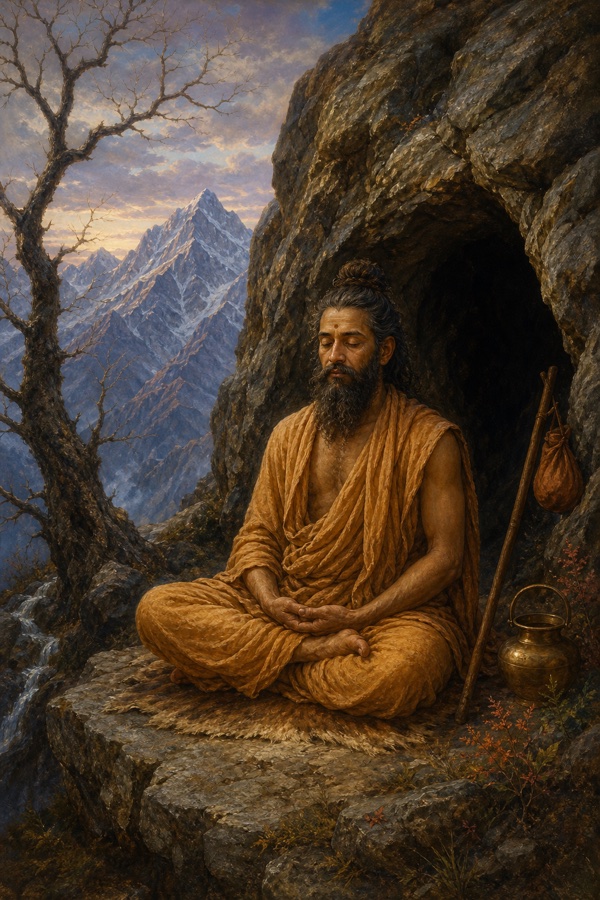
Parigha maintained his practice for one thousand years. Through austerity, contemplation, inner purification, and divine grace, he attained self-knowledge. Desire and aversion subsided. Like Suraghu, he became a jivanmukta.
Parnada later moved freely among siddhas and sages and became known across Jambudvipa as a royal seer. His wanderings eventually brought him into the Haimajata country. There he entered the jeweled residence of Suraghu, the friend he had known before famine and renunciation had changed the course of his life.
Suraghu recognized him and rose from his seat. The two men honored one another, embraced, and sat together like the sun and moon present upon one mountain. Parigha recalled their former conversations, games, and shared affairs. He spoke of Mandavya’s guidance in Suraghu’s life and of the austerity and divine grace through which his own understanding had matured.
The visitor asked first about the whole life before him. Was Suraghu’s rest in the Self firm? Was his body free of affliction? Were his subjects, servants, sons, wife, wealth, grain, city, and fields in proper order? Did his reputation continue through villages and distant directions? These questions placed realization inside the king’s existing relationships. Parigha expected self-knowledge and responsible government to be visible in the same life.
Suraghu called the reunion the finest evidence of his own good fortune. The arrival of a discerning friend had made the royal residence auspicious. Their long separation had ended, and they spoke at length about their earlier lives, present condition, and understanding of the Self. Parigha then gave the reunion its governing question.
Does Samadhi Survive Action?
Parigha asked whether Suraghu practiced the supreme repose free from sankalpa, the intentions and projections through which mind builds a world of things to seek or avoid. He spoke of samadhi, contemplative absorption, as though it were entered at one time and left at another.
Suraghu examined that assumption. For a knower of reality, he said, inward composure remains present during silence and during activity. The changing posture of the body does not determine the continuity of knowledge. A person may sit in the lotus posture with folded hands and remain inwardly driven by expectation. Outward stillness alone cannot establish repose in the Self.
The governing sign of samadhi is clear knowledge of reality. It consumes the hopes and desires that keep the ego searching for completion among objects. Its qualities are lasting sufficiency, accurate perception, freedom from egoic appropriation, equanimity amid changing conditions, and release from the compulsions to acquire or reject.
Once self-knowledge has matured, Suraghu continued, this composure does not vanish when the sage begins to speak or act. Time does not abandon its movement. Fire does not lose heat. Ice retains coolness, and a river remains a current while it flows. In the same way, awareness established in its nature does not forget itself as activities appear.
Suraghu could receive a guest, ask after a friend, govern a country, and settle questions without departing from the clarity reached through inquiry. Every sight, sound, thought, and decision arose within the same consciousness. If nothing stood outside that consciousness as an independent reality, the language of leaving samadhi could describe a change in practice, though it could not describe a break in the Self.
Parigha heard the distinction and recognized its result in his friend. He praised Suraghu’s calm intelligence, purity, inward satisfaction, and freedom from ego, desire, and aversion. The praise confirmed that their reunion had become an examination between two people able to understand the state under discussion.
Nothing Independent to Grasp
Suraghu closed the exchange by asking what, within the visible world, possessed an independent essence that made it necessary to acquire. Food could answer hunger, law could protect a community, and a royal residence could receive a guest. Desire began when a limited form was asked to provide permanent completeness, and aversion grew when its loss was treated as damage to the Self.
Duration does not change this conclusion. Some forms disappear quickly and are judged trivial. Others endure for a long time and acquire importance. Every such form still arises, alters, and ends within time. The Self through which short and long duration are known is not measured by either interval.
Sound, touch, form, taste, and smell draw the senses. Mountains appear immense, oceans extend beyond ordinary sight, and forests contain countless trunks and leaves. Their scale does not grant them a separate consciousness or a permanent claim upon the observer. Discernment allows each thing to be known within its limits.
As attachment subsides, craving loses its support. Suraghu urged his friend to remain established in the pure Self, free from the insistent movements of desire, aversion, acquisition, and refusal. A mind in which conditioning tendencies have grown quiet reaches peace without having to withdraw from every appropriate act.
Parigha accepted the answer. Their conversation closed in the recognition that steady clarity could accompany movement, speech, government, and duty.