On this page
Yoga Vasistha · Story 13
Vitahavya: Samadhi, Return, and Liberation
A sage sits down in a cave on the Vindhya range, argues his own mind into silence, and stays seated while three hundred years of rain bury him to the shoulders. The strange part of the story begins afterward. He wakes inside a body he no longer needs, rides a ray of the sun to ask for help, is dug out by an elephant made of cloud, and then lives on for years as a free man before saying goodbye, one by one, to everything that ever accompanied him. Rama wants to know what any of it proves, and Vasistha tells him.
The Dark Hut in Vindhya
Vasistha was still speaking of Samvarta, the sage who knew the soul and had reasoned his way to it. "That is how Samvarta argued with himself," he told Rama, "and he gave me that reasoning on the Vindhya mountain. Shut the world out of your sight, he said, and put your understanding to work on pure reasoning. That is how you cross this ocean. Now hear another way of looking at it, Rama. Hear how the great sage Vitahavya gave up his offerings to the fire and stood without fear on what he knew of the soul." In Dasharatha’s court the young prince sat in despair at a world he saw as nothing but loss, and his teacher was answering him with lives: one man after another who had looked at the same world and found a way through it.
Vitahavya had wandered the forests in earlier years, and then settled in a cave of the Vindhya range, a cavern as wide as the cave of Meru under the sun’s path. He was a man of the sacrifice; his days had been built around the altar, the kindling, the measured oblations poured into the flame. Over time he grew sick of them. The rites, he found, only bewildered the people who performed them; they bred difficulty and disease in those they were supposed to heal. So he set his aim on the one thing that does not alter, the stillness of samadhi, and let his cares for the rotting world fall away as he went on living.
He built himself a hut of leaves, cut from the branches of plantain trees, and strewed its floor with black stones and sweetened it with fragrant earth. Inside he spread a deerskin, the clean seat of holy men, and sat down on it as a rainless cloud sits in a clear sky. He crossed his legs in padmasana, took hold of his heels with the fingers of both hands, and held his head high and unmoving, like the fixed peak of a mountain. He closed his eyes to everything around him and drew his mind down into his chest, the way the setting sun gathers its beams into the hollows of Meru. The inner and outer senses were stopped. And then, with the senses quiet and his mind clean of guile, he began to watch what the mind did.
What it did was run. "I have shut every outer door," he said to himself, "and still, with all my strength, I cannot stop the course of my mind. It is as restless as a leaf on moving water, floating and dancing on every wave. It drives the senses toward their objects the way a charioteer drives his horses, and the senses drive it back in turn, tossing it up and down like a juggler’s balls. I have given up the use of my outer faculties, and still it chases them, running toward the very objects I pull it away from. From the pot to the picture, from the picture to the chariot, it leaps from thing to thing the way a monkey leaps from branch to branch. Let me look, then, at the five senses and their organs, since these are the passages the mind runs through."
So he turned on the senses first. "My wretched senses, what counsel can bring you to your senses, when you roll about as restlessly as the swell of the sea? Do not disturb me any more with your fickleness. I remember well what trains of trouble your inconstancy has dragged me through. What are you, after all, but passages that carry outer sensation in to the mind? In yourselves you are dull and base, no better than waves on the sea or water in a mirage. You have no substance of your own and no light of the spirit in you; your efforts are the efforts of blind men, and they end in the pit. It is the conscious soul alone that witnesses the objects you bring. Without it you are busy for nothing. You show yourselves off like the circle a whirled firebrand draws, like the snake someone sees in a rope, and you have no more essence than those have. The all-knowing soul knows the eyes and the ears; the eyes and ears know nothing of the soul and are as far from it as heaven from hell. A traveler fears snakes and the twice-born fear demons in the wild; so the intellect fears your company and keeps away from you for its own safety. And yet, unseen, it directs you to your work from a distance, the way the distant sun in heaven directs the day’s work of everyone on earth."
Then he turned on the mind itself. "And you, my mind. You wander about like a beggar trying to fill his belly. You play the Charvaka, the materialist who makes a god of the body and binds himself to its service. Stop roving the world in search of nothing but your own ruin. It is a false claim of yours that you are as intelligent as intelligence itself, that you are the intellect; the two of you are too different in nature to be the same thing. It is an empty boast that you live, that you are life, that you are the ego. Those belong to the soul, and you have none of them. Egoism produces the knowledge ‘I am the ego,’ and you are not even that. You are nothing except a creature of false imagination, and the sooner you give that up the better. The conscious intellect exists without beginning or end, and nothing else exists beside it. What are you, then, in this body, that you take the name of mind? To think you both act and are acted upon is as wrong as believing poison and nectar are one thing; opposites cannot meet. Do not make yourself ridiculous, you who depend on the organs of the body, by claiming to be both agent and patient when you are a dull thing, as everyone knows. What have you to do with enjoyments, or they with you, that you want them to come to you? You are inert. Without the soul you have no friend and no enemy. The unreal does not exist, and your existence is as unreal as the redness in a crystal set beside a red flower. Knowledge, action and feeling belong to the soul; none of them is yours. If you were the eternal Mind you would be one with the eternal soul, and the painful way you keep changing shows that you are not."
"Now that you know your action and your suffering are both false, hear how I cleared myself of those impressions by my own reasoning. You are an inert unreality; that much is beyond doubt. And the activity of an inactive nothing is as false as the dancing of a demon in a story or the dancing of stones. So you depend for every movement on the Supreme Spirit, and it is useless to pretend you live or do anything by yourself. Whatever is done by another’s power is credited to that other and never to the tool. The harvest cut by the sickle is the farmer’s work, not the sickle’s. The man who kills with a weapon is the killer; nobody blames the sword and lets the murderer go. The one who eats and drinks is the eater and the drinker, not the plate and the cup that held the food. You are wholly inactive by nature and are moved by the all-wise Intellect. It is the soul that perceives everything by itself, and you, ignorant mind, only borrow the title of perceiver. The Supreme Soul wakes you and informs you without pause, the way the ignorant need constant instruction from their betters. The essence of the soul is plain to everyone in the form of intelligence, and that is where you get your power and your very name. You were produced by some power of the soul and have stayed ignorant all along, until you melt like snow under the sunshine of knowledge of the soul. So, my ignorant mind, you are dead now under my knowledge of the soul. Stop boasting that you are a particle of your spiritual origin; the boast only brings you sorrow. The idea that an unreal mind exists is as false as a plant sprouting from the light of a magic lantern. There is only the true knowledge that comes directly from God. Everything else is error." Vasistha broke off to tell Rama, as he had before, that the worlds are no display of divine power; they are the Intellect representing itself in images, like the glittering of waves on the sea.
Vitahavya went on. "If you were full of intelligence like the Intellect, there would be no difference between you and the Supreme, and you would have no cause for sorrow. The divine mind is all-knowing, present everywhere, of every form at all times, and whoever attains it obtains everything. There is no ‘you’ and no ‘he’ except the great Brahman, who is manifest everywhere; we have a sense of ourselves without any effort on our part, and that itself shows a divinity stirring in us. If you are the soul, then the soul is all there is here and nothing else. If you are anything other than the soul, you are nothing, because all of nature is the body of the universal soul. The three worlds are made of that soul, and beside it nothing exists. Either you are the soul or you are nothing. ‘Now I am this,’ as a boy; ‘now I am that,’ as an old man; ‘these things are mine and those are another’s’: these are thoughts chasing one another across the mind, and you are nothing positive in any of them. The claim is as false as the horns of a hare. We know of no third thing between the intellect and the body where the mind could be placed, as we know of no place between sunlight and shade where a man could rest. What we call the mind is that something we get by the light of truth after the veil of darkness is lifted from our eyes; it is our consciousness, and nothing more. So, foolish mind, you neither act nor suffer; you are the calm self-awareness of Brahman that knows only ‘I am what I am.’ Cast off your ignorance and know yourself as a condition of the soul itself. Yes, the mind is spoken of as the inner instrument by which the soul is known; that is a way of explaining the unknown by something familiar, the way a man sees his own face by its reflection in a glass. An instrument has no action without an actor. Without the reaper the sickle cuts nothing; without the swordsman the sword has no power anywhere in its body to wound. So, my friend, you have no power and no agency of your own, and you trouble yourself for nothing. The Lord, who works of his own free will, is not to be pitied as you are, who are bound to labor. Your boast of serving the soul comes from ignorance. The Lord is independent of all desire, full and satisfied in himself forever; he fills everything with his unity by manifesting himself, with no labor of creation, and that unity admits no duality even in imagination. All this is his magnificence, and the foolish mind craves it in vain, like a poor man longing for the princely pomp displayed in front of him. You may hope to draw divine blessing by being intimate with the divine soul, and there will never be more intimacy between the soul and the mind than between a flower and its fruit. Two things are intimate when one agrees with the other in all its properties, and that is exactly what is missing here: the soul is immortal, calm and quiet, and the mind is a mortal, restless thing. Your changing appearances, your endless occupations, your readiness for every new invention, and above all your states of happiness and misery, say plainly that your nature is different from the source you came from. Things of one kind relate, as milk relates to curd; things of different kinds relate, as milk mixes with water; between contraries there is no relation at all, and that is how it stands between the soul and the mind. Apply yourself with all your force to meditation on the soul, then, or you are doomed to suffer for brooding on the visible world in your inner recesses. Forget yourself, forget the mind and the bodily organs, and find your rest in the soul."
"Where does this activity come from, then," he asked, "if the mind is a nothing, a flower in the sky, extinct the moment its thoughts and desires are extinct? The soul is as empty of activity as the sky is empty of parts. It is only the divine spirit that shows itself in many shapes within itself. It bursts out as oceans with its own waters and foams in froth from the heaving of its own breath; it shines in the luster of all things by its own light. There is no other active principle anywhere, as there is no burning torch to be found in the sea; the inert body, the mind and the soul have no active force in any of them. Nothing is more real or more plain than what we are conscious of in our consciousness, and beside that self-evident One there is no ‘this is another’ and ‘this is not,’ no ‘this is good’ and ‘this is bad.’ It is no unreal ideal like gardens in the sky. It is samvid, consciousness itself, that extends all around us, and never samvedya, the object of consciousness. Why entertain the suppositions ‘this is I, that is another’ in an existence that admits no supposition? In one unlimited, all-extending, undefinable expanse of soul there is no distinction of this from that, and to ascribe any attribute to it is like supposing water in a mirage or writing in the sky. My honest mind, if by the purity of your nature you can free yourself from the unrealities of the world, and become lit with the light of the soul that fills everything with its essence and is the inner being of all beings, you will set me at rest from the uneasiness of my ignorance and the miseries of this world and this miserable life." What he said after that to his senses, Vasistha told Rama, he said in silence, and the teacher repeated it openly so the prince could hear it. The senses, Vitahavya told them, had misery for their very essence, and he asked them to give up their natures for the sake of his happiness. A disturbed mind receives feeling and sensation the way a sea receives wild rivers and breaks back into the land in a hundred inlets; sensitive minds burst out in pride and egoism, clashing like clouds and raining hail on other people’s heads. The cares of fortune and misfortune are cankers in the breast, boring into the heart as if to tear it up by the roots; they come with hiccoughs and heavy breathing, with groaning in the lungs like owls hooting in hollow, moss-topped trees; white hair hangs on the head like hoarfrost, and apish wishes lurk in the caves of the chest. Avarice is a dancing stork clattering her sharp bills to lure a man and then pulling out his eyes and his entrails. Lust is a filthy cock scratching the heart for its dunghill and crowing on every side. Through the long dark nights of ignorance the passions bark in the breast like Vetalas in a charnel ground, and these appetites disturb our rest like Pisachas showing themselves in the dark. The man who has shed that gloom sees everything in clear light and opens like a lotus at dawn; his heart is a sky with the fog gone out of it; brotherly love grows in him like the trees of spring; he regains his freshness the way a burnt forest greens again. Hermits in the woods are freed from the fear of transmigration and attended by joys no words can describe. "Either let your soul be dead to your desires," he told himself, "or let your desires be dead in your soul; you are happy either way. Do not delay the choice, and know that it is better to keep your mind and kill its cares and desires than to kill your mind with them. Life is a precious treasure and nobody likes to lose it, and I tell you the truth all the same: this life is a dream, and you are nothing in reality. Reason points to the one unchanging Being at all times; it is sheer irrationality that tells you of your own existence, as it is the lack of light that shows you darkness. It was in your irrationality, my friend, that you passed all this time in the idea of a separate self, so caught by your calamities and your delusive desires that you were taken by the devil as boys are taken by fancied ghosts. It is reason that has woken you from your dullness, so bow to reason above everything, the only enlightener of hearts and souls. When desire is cleared from your heart you will find yourself the lord of all; your desires will fly from you under the rule of reason whether you like it or not, as the dark of night flies from daylight. If your mind is set at rest and made extinct in this life, it will never be revived in another. When I rest in my spiritual state I seem to be in the fourth and highest heaven, and so I discard my mind and its mental world forever. The soul alone is the self-existent being; I feel myself to be that soul and nothing else, present everywhere, shining with its own light in the clear sphere of the heart. It has no counterpart and is beyond imagination and description; so I think of myself as that soul itself, a wave in the water of that deep and limitless ocean, with no image standing between." When he rested in silence in that soul within himself, beyond everything knowable and the same as his own consciousness, he found his desires and passions, his vitality and his sensibility, all gone quiet in him.
Three Hundred Years and Many Lives
Having reasoned all this through, Vitahavya renounced every worldly desire and sat down in trance in a cave of the Vindhya mountains. His body stopped moving; its pulses died away; and his soul shot out into its own intellectual delight, so that he sat in his devotion, calm and quiet, like a still ocean. His heart went cold and his breathing stopped. He remained there like a fire that has burned through its fuel and gone out. With his mind drawn back from every sensible object and fixed on the one thing it meditated on, his eyes closed under the faint flutter of their lids, and what little keen sight remained rested on the tip of his nose, so that each eye looked like the half-open bud of a lotus. Head, neck and body stood straight in one line, and he had the look of a statue cut in relief into the rock.
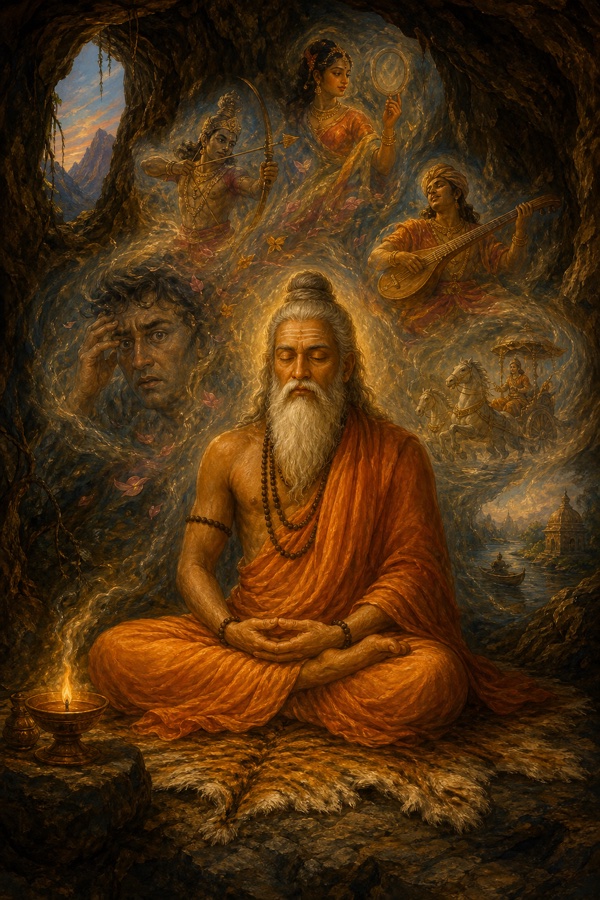
Sitting in that posture, his attention fixed wholly on the supreme soul, he passed centuries in the Vindhya cave as if they were half a moment. Time is counted by the succession of thoughts, and he had none to count by; he never noticed how long it had been. He had found his freedom in that listless state, and his life did not leave him. Nothing could rouse him. The loud roar of rain clouds could not break the yoga-nidra he had settled into; nor could the shouts and shots of soldiers and huntsmen along the borders of the forest, nor the cries of beasts and birds, nor the growl and snarl of the tigers and elephants on the hills. Lions roared, waterfalls crashed, thunder cracked, people clamored around him; furious sarabhas howled, the earth shook and split, the woods caught fire and crackled, waves and torrents broke on the shore; flood water came down on the rocks, torrent dashed against torrent, wildfire roared and scorched. None of it touched his repose.
He breathed only when he chose to and to no purpose, the way time flows on forever to no good of its own. Currents of rain water washed over his cave on every side like the waves of the sea. In a short while the floods carried mud in with them, and the mud rose around him in the mountain cave where he sat. He kept his seat in that dreary cell, buried to the shoulders, his head raised like a stone on the cold stiff rock of his body.
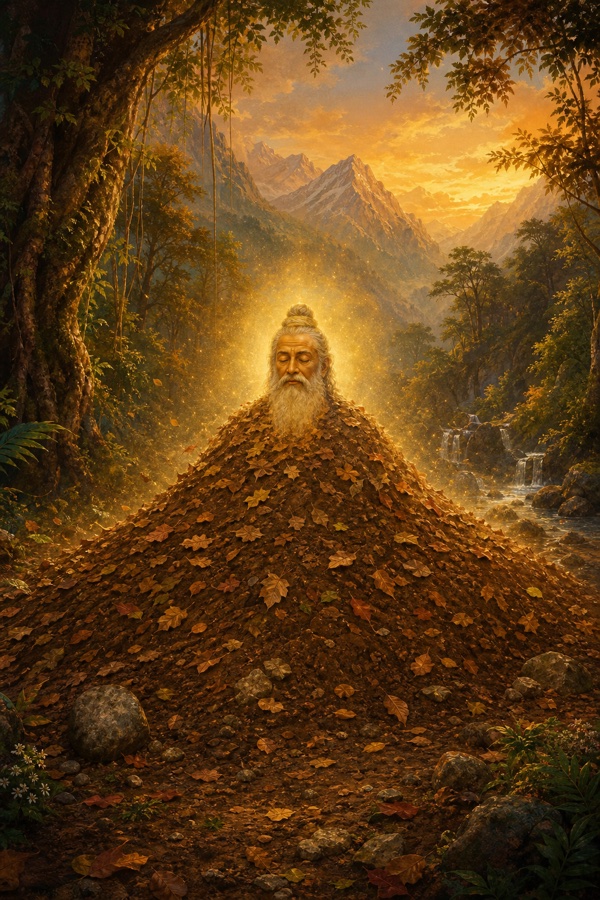
Three centuries passed over him that way. Then his soul woke toward light under the pain of the rains in his mountain cell. The oppressed body took on its spiritual form, the lingadeha, a living subtle body like air or light, alive without any breathing in or out of the vital air. Growing finer and finer by its own imagination, this body became the form of the inner mind, and that mind was felt to live within the heart.
There it began to dream itself other lives. It thought of itself as a pure, living liberated sage, and in that state it seemed to pass a hundred years in the shade of a Kadamba tree in the lovely groves of Mount Kailasa. It seemed to take the form of a Vidyadhara for a century, free of every disease that troubles human beings. Then it thought of becoming the great Indra, served by the gods, and passed five full yugas in that form.
Rama stopped him. "Let me ask you something. How could the sage’s mind conceive of itself as Indra or as a Vidyadhara, when it had never seen either? And how could it hold the whole breadth of Kailasa and all those ages inside the small space of a cell? That is impossible in nature." "The Intellect comprehends everything and pervades everything," Vasistha answered, "and wherever it exerts its power in any form, it takes that form at once by its own nature. That is how the undivided Intellect shows itself in so many forms across the whole creation. It is its nature to appear in whatever form it represents to itself, to become whatever it pleases, in any place and at any time. So this sage, who had no person left to be, saw himself in all sorts of forms and persons in all the worlds, in the wide sphere of his consciousness, within the narrow space of his heart. A man of perfect understanding has turned his desires into indifference, and desires are like the seeds of trees: once singed by the fire of intelligence they produce no sprout of action." Vitahavya thought himself an attendant of Siva, the god who wears the crescent moon on his forehead, and in that life he came to know every science and everything past, present and future. Everyone sees on the outside exactly what is stamped on the inside of his mind; and this sage, freed in his lifetime from the impression of his own personality, was at liberty to take on any personality he chose.
"I believe," Rama said, "that a living liberated man who sits like this gains the freedom of his soul even while he is shut up in the prison of his body. That was the case with this self-liberated sage." "How can the living liberated be confined by a body," Vasistha said, "when they remain in the form of Brahman in the outer temple of his creation, which is as pure and tranquil as air? Wherever empty, airy consciousness represents itself in some form, it finds itself spread out there in that form. So many ideal worlds appear before us, and all of them are full of the presence of the all-pervading spirit of God."
And so Vitahavya, shut in his cave and sunk in the mire, saw in the intellect of his great soul multitudes of worlds and countless creations that had never taken shape. Having first thought himself the celestial Indra, he afterward thought himself an earthly king, getting ready to ride out to some forest on a hunt. The sage who had taken himself for the swan of Brahma now became a chief among the Dasa huntsmen in the forests of Kailasa. The one who had been a prince in the land of Surashtra now found himself a forester in a village of the Andhras.
"If the sage was enjoying heavenly bliss in his mind," Rama asked, "what need had he to take all these imagined forms? Nobody would trade spiritual delight for bodily enjoyment, even in thought." "Why do you ask that, Rama," Vasistha said, "when you have been told again and again that this world is a false creation of the divine mind? The creations of the sage’s mind were exactly the same. The universe the divine Intellect creates is as unsubstantial as empty air, and the ideal world of the human mind is a delusion, so the two are alike. In truth neither that world nor this one is anything real, and neither you nor I have any essence in this world without essence, which is filled only with the essence of God. The one is as the other at all times, past, present and future; the whole visible world is a fabric of the mind, and the mind is only a copy of the Intellect. So it is with all creation, however it looks: it is the transcendent emptiness, though it seems as firm as diamond. It is from its own ignorance that the mind shows itself as the birth, growth and extinction of things, which are only the rising, swinging and sinking of waves on the ocean of eternal emptiness. Everything sits in the empty sphere of the Intellect, and the mind, its representative, perceives it as a firm and extended cosmos, though in reality it has no extension at all."
"Now tell me what became of the sage in his mansion in the cavern," Rama said. "How did he lift his body out of it, and what did his long, hard devotion gain him?" At last, Vasistha said, the sage’s mind became as wide as the divine mind, and he beheld the divine soul in its full glory within his own. In his meditation he saw the first dawning light of the intellect, and it showed him, as if from memory, the scenes of his former states of existence: the various bodies he had passed through in earlier lives, the things that had passed and gone, and the things that were living now beside his present body in the cell. And he found that body lying in the cave like an insect, and wanted to lift it above the surrounding mud and mire. It was covered with the dirt the rain water had carried in and heaped over its back. He saw it shut in the prison of the cave, loads of clay on its back and its limbs fettered by the shrubs the torrents had swept in. With his clear understanding he decided to raise the imprisoned body out of the cave, and he made effort after effort, by force of his breathing, to work it free. With all his trying, he found it was beyond his bodily powers to get himself out and walk on the ground.
Surya Sends Pingala
So he turned to the spiritual power his devotion had earned him, and used it to raise his spirit toward the orb of the sun. He thought it over first. Either the golden rays of the sun would lift him up, or he would take his disembodied liberation by letting his soul loose from the bonds of the body. "I lose nothing by losing the exertions and exercise of this body," he said in his elevated mind. "I only loosen myself from my bonds and go to my state of blessedness." He stayed a while longer on the earth in that thoughtful mood, and then said, "Neither leaving this body nor keeping it is any gain or loss to me. As we give up one body we take up another; the difference is only that one is big and heavy and the other minute and light."
"Let me mount this golden ray of the sun, then, the pingala, and fly through the open air. Carried on the vehicle of light, I will enter the body of the sun. I will go in as my own shadow in the ethereal mirror of the sun, and this airy breath of mine will carry me to that orb." He rose on the air in his puryashtaka, the subtle body of eight parts, the way heat passes out through the mouth of a bellows. And the sun, who is a muni and has a mind as any living being has, saw a great sage in this state within his own breast. Seeing him, the high-minded sun called to memory the sage’s past acts of devotion and remembered the body lying in its cell in the Vindhya country. As he traveled through the ethereal regions he came to know everything the sage had done, and he saw the body lying senseless in the cave, covered under grass and stones.
He ordered his chief attendant to go and lift the body of the sage, whose soul had now taken its spiritual form. The sage in his aerial shape saluted the adorable sun with a reverent mind, and the sun recognized him and received him with every honor. Then Vitahavya entered the body of the solar attendant Pingala, who was already on his way down from heaven to the cell among the lovely groves of the Vindhya range.
Pingala came into the Vindhya grove as a cloud. The cloud took the shape of a huge elephant, and the elephant cleared the earth from the surface of the cave with the long nails of its toes. Then with its trunk it drew out the body of the sage, the way a stork pulls a lotus stalk up out of the mud. The sage’s subtle body left Pingala’s form for its own. After his long wandering in the regions of the air, like a bird in the sky, he had found his own body at last, and he entered it as a bird enters its nest. He and Pingala took leave of each other with mutual salutations and hurried off to their own callings in their shining forms, the one flying up into the air, the other going to a lake to wash.
In the clear water the body shone like a star, like sunbeams under the surface, and when it came up it showed above the water like a lotus in full bloom. He climbed out as a young elephant climbs out after its sport in some muddy pool, and offered his adoration to the sun, who had restored his body and his mind to their luminous states.
After that the sage spent some time on the bank of that Vindhya lake. What filled him was universal benevolence, fellow feeling and kindness, joined to his peace and tranquility, his wisdom and inner bliss, and above all his seclusion, his retirement from society and his unconcern with the concerns of the world.
At the end of the day he thought again of taking up his accustomed meditation, and he entered a spacious cave in the Vindhya. He went on examining the soul there, his command over the organs restored, and weighed the reality and unreality of things in his mind. "I find," he said, "that these organs of sense, which were under my control before, have been set loose again in the exercise of their functions. I will stop thinking about the existence and nonexistence of things, and lean wholly, in this steady posture, on that Being to whom the being and not-being of things is truly known. I will stay awake inwardly, and outwardly appear dead and asleep; sensible in my insensibility, like the quiet living soul; vigilant and supine at once in my quiet. Waking as if asleep and sleeping as if awake, I will remain in the stillness of turiya, which is neither dead nor alive. I will keep apart from all things like a rock, apart even from my mind, and dwell in the bosom of the all-pervading soul, at rest with the universal spirit and free of every disease." Having thought this through, he sat in meditation for six days and nights, and at the end of them he was roused the way a traveler wakes from a short nap on the road.
A Long Life Free in the World
His devotion had reached its consummation, and this great devotee passed the long life that remained to him in the state of living liberation. He took delight in nothing and hated nothing; he felt no sorrow over anything and no pleasure in anything. Walking or sitting, he was free of thought about any of it; his heart was empty of cares, and he talked with his own mind whenever he pleased.
"Look," he said to it, "lord of my senses. Look at the unsullied, undecaying joy you enjoy in this tranquility, and tell me if there is a greater felicity anywhere on earth. So, my mind, fleetest of all things, hold in your flight and your excitability, and rely on your cool composure for lasting happiness. And you, my roguish senses, my perverted organs, you have nothing to do with me. The stiffness of the outer organs is the cause of their failure, and the willfulness of the mind is the cause of its disappointment, and neither one has any power to protect me from harm. Those who believe the senses are the same as the soul are as deluded as a man who takes a rope for a snake. To take what is not the self for the self is to take an unreality for a reality. Want of reason makes the mistake, and right reason removes it."
"You, my senses, and you, my mind, and my living soul are different things, and all of you are separate from the unity of Brahman. The mind is the active principle and the intellect is passive, and the one has no relation to the other. It is their union that produces an effect, the way the wood that grows in the forest, the rope made of flax or hide, the axe made of iron and the carpenter working for wages all combine to build a house. Such an accidental conjunction of different things becomes the efficient cause of effects that none of them could produce alone. So it is with every act of the body, speech and the rest: they are brought about by the chance, simultaneous union of the different organs and the mind, without any of them being used up or impaired. When the forgetfulness of sleep and death is itself forgotten, and memory wakes again on reviving and waking, what was inactive is brought back into act."
In this way the great devotee went on with his reflections for many years in that solitary cell of the Vindhya mountain. Freed of ignorance and far from temptation, he lived in perfect happiness there, always considering how to prevent his soul from passing into another body. Seeing the natures of things in their true light, he avoided whatever wore a false appearance, and for fear of being misled by appearances he took shelter in meditation on what things are in themselves. He had his choice of what he liked over what he disliked, and he was indifferent to both; his mind had risen above everything desirable and everything detestable in life. Having renounced the world, its ties and the society of men, and set himself beyond the bonds of repeated birth and action, he became one with the bodiless unity and drank the nectar of spiritual delight. He seemed to sit in his lonely abstraction in the golden grotto of the Sahya mountain, looking down on the tangled paths of the world below without any wish to walk them or mix in their treacherous company.
Then, sitting upright, he began to say goodbye. "Be passionless, my impassioned heart, and rest at peace, my intolerant spirit. I bid you farewell, enjoyments of the world, that tempted me to taste your bitter pleasures through countless births and transmigrations. Pleasures that deluded me so long, like the indulgences of boys: see me now placed beyond your reach by the absence of desire, in my holy, heaven-born nirvana. I hail you, spiritual delight, that made me forget my old pleasures; and I thank you, pains, that drove me to the inquiry into the soul with such ardor. It is through you, sour misery, that this blissful state has been revealed to me, and you have my thanks for bringing me under the cool shade of heavenly delight. I thank you, Adversity, for revealing the felicity of my soul to me; and I bless you, my friend, for showing me the vanity of worldly life."
"My body, so intimately joined with me, I see that our union was only temporary, like the short-lived friendship of self-interested men who desert a generous friend in a moment. So I have been deserted by all my bodies in my many past births, and so my soul has deserted them all as it passed through one living form after another. Even now my body is bringing its own ruin on itself, by being slighted by the soul as the soul advances in knowledge. It is no fault of mine that the body is discontented at my contentment, that it is worn down by my abstinence and broken by my poverty. Do not grieve, my churlish avarice, that I have grown averse to gain; and forgive me, my fond desires, that I have become so empty of wishes and taken to the virtue of vairagya. I have given myself to indifference and I mean to thrive in it, and I ask you, restless concupiscence, to have nothing more to do with me. And I bid my last farewell to you, deity of piety and pious deeds, so that I need never again bind myself to the performance of acts; acts bring only passing results and no lasting one. I have been lifted from the pit of hell and set in heaven, and I say goodbye to the arbor of pleasures that grows in the soil of wicked acts and bears the torments of hell for fruit. Farewell to the tree of sin, whose flowers are our punishment, by which I was doomed to birth after birth in lower forms."
"I bow to that unseen form of delusion, which spoke in the sweet voice of a sounding bamboo and covered itself in a garment of leaves. I bow to you, my holy cell, my companion in this devotion and the one refuge of this weak body of mine after its weary journey over the rough roads of the world. You were my kind companion and the remover of all my desires; you were my only shelter when I fled from all the dangers and difficulties of the world. And you, my pilgrim’s staff, the support of my aged body and arm: I found my best friend in you, for easing my fatigue and guiding my steps in this dangerous, cavernous retreat. I thank you too, my aged body, the prop of my life even in this old age of yours, when you are reduced to ribs covering bloodless entrails and shriveled veins and arteries. Go now, my dilapidated body, with whatever pith and marrow remain in you; and away with you, excrements, that needed my washing and purifying again and again."
"I say goodbye to all my acts and dealings in the world, the destined causes of my births and my born companions in every one of them. And next I bid you farewell, my vital airs, who kept me company through all my various births, and from whom I will soon fly away. How often we have traveled together to foreign parts and rested in the valleys and groves of the mountains; how long we played about the cities, and how often we lived in mountain retreats. How many times we ran off in different directions, busy with the many occupations of life. There was no time and no place in all the space of the universe when and where we did not live together."
"In truth I have never done anything or seen anything, never given or taken anything, apart from you. And now I say goodbye to you, my friend, because I must soon part from you. Everything in the world has its growth and its decay, and all things are bound to rise and fall by turns; union and separation are the unavoidable course of nature."
He had spoken to his heart, his pleasures and his pains, his body, his wishes, his piety, his cell, his staff, his acts and his breath. There was nothing left in that cave that he had not thanked and released. What remained were the powers themselves, sight and smell and breath and hearing and taste, and these he now began sending home.
Om and the Return to Sources
"Let this light that is visible to my sight go back into the sun it came from, and let the sweet scents that come to my smelling mix again with the flowers that breathed them out. Let my vital breath and its oscillation join the ethereal air, and let all the sounds I hear return from my ears to the empty sphere. Let my taste go back to the orb of the moon it sprang from. Let me be as quiet as the sea after Mandara has churned it, as the cool hour of evening after the sun has gone down. Let me be as silent as a dumb autumn cloud, as still as creation after the great deluge at the end of a kalpa; let me be without thought, as the mind is when it rests on the dot of Om and the soul rests in the supreme soul. Let me be as cold as a fire reduced to ashes and as extinct as a lamp that has no oil left in it. Here I sit, empty of all action and out of the sight of every living being. I am free of every thought of worldly things and resting in the peace of my soul, which is seated in my cranium."
Then, repeating the sacred syllable Om aloud and reflecting on the whole universe contained in it, the sage found his inner peace; his thoughts were gone and he was free of desire. He considered the matras, the measures of sound that make up the utterance of that syllable; then he set all its attributes aside and meditated only on the reality of the pure and imperishable One. He withdrew his mind from the inner and outer organs, from the grosser and finer feelings, from the sensibilities of heart and body; he dismissed whatever is in the three worlds and turned all his desires to indifference. He stayed unmoving in his body, rapt in abstraction, full in himself as the full moon, as still as Mount Mandara after the churning was done, as motionless as a potter’s wheel at rest, as calm as an ocean with no wave and no wind. His mind was like a clear sky with neither sunshine nor darkness in it, his heart bright without sun or moon or stars, his intellect unclouded by the smoke and dust and cloud of ignorance, his soul as clear as the autumn sky. Then he raised his voice from the chest to the topmost pranava in the crown of his head, and his mind passed beyond the region of the sensations, the way wind rises past the layer where fragrance stays. The darkness fled from his mind as the gloom of night is driven off by morning, as the first touch of wisdom puts out the sparks of anger in the breast. He beheld within himself the reflection of a flood of light, and found it ceaseless in its brightness, unlike the light of the sun and the lamps, which darkness keeps overtaking. Having come to that ineffable, inextinguishable brightness, he found his mental powers burned up in its glare in an instant, as straw is consumed by the touch of fire.
In a short while he lost his consciousness even of that light, as a newborn child loses, in no time, whatever it has perceived with any of its senses. In the twinkling of an eye, or half of that, the sage stopped the course of his thought, as a running wind stops in a moment. He stayed as fixed as a rock, his gaze mute and inattentive on whatever passed before him, holding his life in him like a sleeper who dreams without moving; a patient spectator, pashyanti. Next he was lost in sushupti, the insensibility of deep sleep, and through it he reached the final felicity of turiya, where nothing remains to be kept except that absolute felicity. He was joyful in his joylessness and alive without any liveliness; he remained as something in his nothingness and blazed in the middle of obscurity. He was intelligent in his spirit without the intelligence of the senses; he was, as the Sruti says, neither this nor that, neither the one nor the other, and so he became what no words can express. He became that transparent substance which is transcendentally pure and purifying, that all-pervading something which is joined to nothing. He was the emptiness of the Vacuists and the Brahman of the Brahmists, the Knowledge of the gnostics and the omniscience of the scientists. He was like the Purusha of the Sankhyas and the Ishvara of the Yoga philosophers; he was the Siva of the Sivites, who wear the crescent moon on their foreheads, and the Time of those who worship time. He was the same as the soul of souls of the psychologists and the no-soul of the physicists, the Midmost of the Madhyamikas, who hold that there is neither beginning nor end, and the All of the even-minded pantheists. He was identified with the central truth of every religion and the essence of every creed, and he was one with the all-essential, universal Reality. He was that unimpaired light which is seen in all luminous bodies, and one with the inward light he perceived glowing within himself. He became the very thing that is one and many, that is all and yet nothing, that is simple and combined with everything, that is Tat Sat, that which is. In short, he remained as the one undecaying being without beginning, one and many, simple and without parts, purer than the pure ether, the Lord God of all.
After Vitahavya had passed beyond the bounds of nature and crossed this ocean of misery, he quieted the last fluctuations of his mind as well, having already restrained the actions of his body. Becalmed, brought to a state of perfect inertness, he was absorbed in his final rest the way a drop of rain water or a fleck of a wave mixes into the main ocean. Sitting on in his torpor, his body grew thin and lean without food or function, and it decayed fast, like a fading lotus in winter that gets no more of the water it needs. His vital breaths fled the tree of his body, its lungs and arteries, and entered the cavity of the heart, like birds let out of a net and flying to their nests. The body of flesh and bone and sense organs stayed where it was, under the shady branches of that woodland retreat, and his spirit roved beyond the bounds of the elemental worlds above. His individual intellect was absorbed in the ocean of the universal Intellect, as particles of a metal are fused together into the same metal. So the soul of the sage found its rest in its own intrinsic nature, the supreme soul.
"So I have told you, Rama, how the sage came to rest in his torpid quietude. All of it is full of instruction, and you must consider well the hidden meaning in it. Know that by your own good gifts and perfections you will be able to reach that state of beatitude. Weigh everything I have told you already and everything I will tell you now and later. As I have known and considered all these things through my long life, by my experience of the past and my knowledge of present and future events, so will you. Have the clear sight of this sage, as I have shown it to you, and know that it is by transcendental knowledge alone that you can win your freedom in both worlds. The light of knowledge dispels the darkness of ignorance and destroys the mist of false fears and sorrows, and knowledge alone is the cause of that consummation, which nothing else can bring about. See how Vitahavya destroyed all his desires by means of knowledge, and how he cleared the mountain of his mind of every poisonous plant of worldliness. See how his conscious knowledge of other spheres let the seer penetrate the orb of the sun on the wings of its rays, and then return, by remembrance, to redeem his buried body from its cave of earth. This sage was the mind personified, and it is the mind that is personified in the visible forms of I, you, he and this other. The mind is also this world, which consists in it and is not known to exist without it. Knowing this transcendent truth, freed from the faults of passion and feeling and far removed from the frailties of the world, the silent sage followed the dictates of his mind and attained by it the endless bliss of his soul. You must imitate this sage, Rama, if you are to know the nature of the soul and all that is worth knowing; and to know these things you must be passionless, without fear and without any perturbation of spirit at any time. As the sage seemed to pass many millions of years in cheerful meditation, so you must habituate yourself to silent contemplation without any discontent in your mind. There have been many more great sages in their own times and places who reached perfection the same way, and they are worth your imitation. The soul cannot be reached by pain or pleasure; it is everlasting and everywhere; and nobody, Rama, has any cause to grieve for it. Many people living in this world understand the nature of the soul well enough, and none of them is as sorry for the misery of human souls as you are. Stay quiet and cheerful, with a great and even mind, and know yourself to be imperishable, without change and without rebirth. No living liberated man like you is ever moved to sorrow or mirth by the turns of life, any more than a lion is moved from his composure like a peacock at the change of the seasons." Rama had been listening with a question gathering in him, and now he asked it. "Sir, this discourse of yours raises a doubt in me, and I want you to scatter it like a cloud in autumn."
What Samadhi Does and Does Not Prove
"Tell me, Sir: why are the bodies of the living liberated never seen to mount into the sky?" "Know, Rama," Vasistha said, "that the power to climb into the sky and fly through the air belongs by nature to bodies made for flight, the birds and the insects, as rising belongs to fire and to the spirits of the air. All the different motions you see going in different directions follow the natural tendencies of bodies, and no man of the spirit ever wants them; he would gain no good whatever from moving his body about. Flight is in no way desirable to the living liberated soul, when the power to fly is so easily picked up by unspiritual, unliberated, ignorant people through all sorts of physical and artificial means, the proper practices, mantras and the rest. Flying is no business of the spiritual man, who is concerned only with his knowledge of the soul; he is content with that knowledge and his union with the supreme soul, and does not meddle with the practices of the ignorant practitioners of false yoga. Know every earthly contrivance for the child of worldliness and the offspring of spiritual ignorance, and tell me what man of the spirit would be fool enough to plunge himself into that. Whoever walks the road of ignorance, scheming and meditating for his temporal welfare, is blind to the future welfare of his soul and runs against the course of the holy sage. The wise and the unwise alike can get the power of flying, by long practice of yoga or by any of those other arts and expedients, mantras and so on. The spiritual man stays aloof and far from all of it, with no desire for any such thing; he is content in himself, and finds his rest in the supreme soul, and beyond that he has nothing in view. He has no aerial journey in mind, no supernatural power, no worldly enjoyment; he does not look for glory or honor on earth, and he neither wants to live nor fears to die. He is always content and quiet in his soul, with no desires and no attachments in his mind; he is of the form of empty air, and his spiritual knowledge is the idol of his soul. He has no dread of adversity or calamity, no feeling of pleasure or pain; he is fully satisfied in his deprivation of everything, and unconcerned about his own life and death, remaining as the living dead. He stays unmoved through every even and odd, as the ocean stands still under all the outpourings of the rivers, and he goes on meditating on the divine spirit and adoring it in his own spirit. He has no need to acquire or hoard any wealth, and no need to ask anyone for his support."
"The unspiritual man who aims at supernatural powers has to sacrifice the means of his own perfection to get them. Everything is accomplished by applying its proper means, and what is ordained to happen that way cannot be undone, even by the three-eyed god Siva himself. So flying depends on the application of the right means and never on will alone, and nothing can change the nature of things, any more than you can change the coolness of moonbeams. Let a being be all-knowing or much-knowing, all-powerful or much-powerful, a Hari or a Hara: nobody has the power to set aside the settled law of nature, which has mortals walking on the earth and immortals in the sky. It depends on the nature of things, Rama, on the combination of time and circumstance and the application of the proper means and mantras, whether a mortal flies through the air or an immortal comes down to earth. So it is the property of certain drugs, gems and mantras to destroy the destructive power of poison, of wine to intoxicate the drinker, of emetics to cause vomiting. Everything has by nature the power to produce some effect, according to how it is applied, in what mode and manner. So nobody who is unacquainted with these things can fly, and the man full of spiritual knowledge has no need of them. All knowledge of the properties of things and their application for bringing about certain ends is of no use to the spiritual man for reaching the spirit. Whoever wants supernatural powers can gain them by long practice, but what need has the knower of God of those practices or those powers? It is after he is free of the net of desires that the spiritual man reaches his spiritual state; how, then, could he harbor a desire that goes against it? Everyone works along the course his heart’s desires lead him, and whether he is learned or not, he reaps the reward of his efforts in due time. Vitahavya never tried to acquire any supernatural power. Every effort of his aimed at spiritual perfection, and he got it by his devotion in the forest. Getting supernatural powers is neither impossible nor even hard, if a man persists in practicing and applying the proper means to those ends. Whatever success anyone has in reaching his object is owed wholly to his own exertion, and may be called the fruit of the tree of his own labor. And those successes are of no use to the great-minded men who have known the One worth knowing in themselves, and have made an end of their worldly desires."
"Sir, I have one more question for you to explain," Rama said. "Why did the ravenous beasts of the wild not devour the sage’s corpse-like body? Why did it not rot under the earth it was buried in? And how did his bodiless, liberated soul, absorbed in the sunlight, come back to take up that broken-down body again, buried as it was in a mountain cave?" "The conscious soul that believes itself embodied in its mortal body," Vasistha said, "coiled in its desires and bound by its affections, is subject here to both the feeling of pleasure and the pangs of pain. The intelligent soul that relies on its pure consciousness, free of the net of desire, keeps only its subtle spiritual body, which no beast or bird can devour and no dust or rust destroy. Now hear why the body of a yogi is not subject to the accidents of decay and corruption for many hundreds of years. Whenever the mind is occupied with the thought of anything, it is at once assimilated to the nature of that thing and takes its form upon itself. On seeing or thinking of an enemy it turns to enmity, and on the visit or the memory of a friend it turns to friendliness. On seeing a hill or a tree or a passer-by that bears it neither enmity nor friendship, it stays equally indifferent and unchanged. It is sweetened by relishing sweets and embittered by tasting the bitter; it grows fond of the sweet and averse to whatever is sour and unpalatable. So when a ravenous beast comes into the sight of a dispassionate yogi, its envious nature is changed to dispassion, and it leaves off doing him any harm. The malicious creature, freed of its malice in the company of that even-minded man, does no harm to anyone, the way an indifferent traveler has no business breaking the straggling branches by the roadside that rude rustics lop off for fuel. Taken away from the yogi’s side, the savage beast resumes its ravenous nature again in the company of the wild beasts of the forest. That is why the envious beasts of the forest, the tigers, lions and bears, and the reptiles and creeping insects of the earth, did not molest the quiet body of the sage, however long they lurked and crept about it."
"And the reason the body was not reduced to the dust of the earth is this. There is a silent conscience that dwells in common in all existing bodies, animal, vegetable and mineral, and lives in them as in the person of a dumb creature, and it would not let them injure the innocent body of the sage lying flat on the ground. The spiritualized body of a yogi is seen moving about on earth like the shadow of something floating on water. The sage’s spiritual body, rarefied above the elemental bodies by the virtue of his knowledge, had become incorruptible by nature. And hear one more reason, Rama. It is motion that is the cause of destruction, as the beating of the heart is the cause of life. The breathing of the vital breaths sets the arteries vibrating, and when that stops, the body becomes as still as a stone. The man who has lost the pulsations of his heart and his vital breath has lost both his vitality and his mortality, and has become like the stones, which are neither dead nor alive. When the inner and outer pulsations of the body are at a stop, know, Rama, that the inner parts are not liable to any change. The motion of the body stopped and the action of the heart ceased, the humors of the body turn as stiff and inert as the solid mountain of Meru. So the want of fluctuation is what causes the steadiness of everything in the world, and the bodies of sages are known to be as quiet as blocks of wood and stone. The bodies of yogis, therefore, remain entire for thousands of years, and like clouds in the sky and stones under water they are neither soiled nor rotted at any time."
"That is how this sage, who knew the truth and the knowable better than anyone, left his earthy body to find the rest of his soul in the supreme spirit. Great-minded men who are dispassionate, and know what is chiefly to be known above everything else, pass beyond the bounds of this earth and even of their bodies, and take on an independent form of their own. They are then perfect masters of themselves, their minds well governed by right understanding; they are not affected by the influence of destiny or by the acts of their past lives, and they are not moved by desires of any kind. The minds of consummate yogis are of the nature of destiny, because they bring about whatever they think of as easily as if it were an accident, the crow landing just as the palm fruit falls. So it was with this sage: no sooner had he thought of recovering his body than he found it there before his eyes, as if by chance. When the soul gives up its earthly frame after the fruits of its past actions have been used up, it takes a spiritual form, which is the state of its disembodied liberation, and in that independent state it enjoys perfect liberty. The mind freed of its desires is released from all its bonds and takes the spiritual form of the pure soul; then it accomplishes at once whatever it wishes to do, and becomes as all-powerful as the great Lord of all."
"After the sage Vitahavya had subdued his heart and mind by his reasoning," Vasistha went on, "the qualities of universal benevolence and love of all beings arose in him, since nothing selfish was left." "How can you say," Rama asked, "that benevolence sprang up in the mind of the sage after it had been wholly absorbed into itself by its own reasoning? A man wholly insensible of himself cannot have any regard for others. Tell me, how can feelings of universal love and friendliness arise in a heart that is wholly cold and quiet, or in a mind entranced in the divine spirit?" "There are two kinds of numbness of the mind," Vasistha said. "One is its coma in the living body, and the other is its deadness after the material body is dead and gone; the first, swarupa, still has its form, and the second, arupa, has none. Possessing a mind is the cause of woe and its extinction is the spring of happiness, so a man should wear away the essence of his mind until it is wholly extinct. The mind caught in the net of the world’s vain desires is subject to repeated births, and those are the sources of endless woe. How can we expect our distress to lessen while the mind is mistress of the body? It is when the mind sets that the world appears to vanish. Know the mind to be the root of all the miseries of life, and its desires the sprouts of the forest of our calamities." "Whose mind is extinct, Sir, and what is the manner of this extinction?" Rama asked. "How is it brought on, and what is the nature of this annihilation?" "I have told you before, Rama, what the mind is; now hear how its impulses are extinguished. Know that mind to be paralyzed and dead which is not shaken from its steadiness by pleasure and pain, and stays unmoved as a rock at the gentle breath of our breathing. Know that mind to be as good as dead which has lost the sense of its individuality from others, and is not degraded from the loftiness of its universality to the meanness of its own personality. Know that mind to be dead and cold which is not moved by difficulties and dangers, not excited by pride, not elated by festivity and not depressed by poverty, which never loses its serene temper at any reverse of fortune. This, Rama, is what is meant by the death of the mind and the numbness of the heart, and it is the inseparable property of those who are liberated in their lifetime. Know mindfulness for foolishness and mindlessness for true wisdom; it is on the extinction of its affections that the pure essence of the mind comes to light. The mind full of benevolent qualities has its best wishes for every living being in nature; it is freed from the pains of rebirth, and it is called the living liberated mind. The swarupa, the personal mind, is the one that still has a notion of its own personality as distinct from its body, and that is the mind of those liberated in their lifetime. When the living liberated man loses the individuality of his mind, and grows as glad as moonlight within himself through his universal benevolence, his mind expands until it seems present everywhere at all times. Mindless of himself, he becomes as cool-hearted as a plant growing in a cold climate, where it blooms with its mild virtues like the blossoms of a winter plant. The arupa, the impersonal mind, is the coolness of the disembodied soul, which is liberated even from the consciousness of personality. All the excellent virtues that live in the embodied soul are lost and drowned in the disembodied soul once it is freed of the knowledge of its own personality. In disembodied liberation the mind loses its formal existence too, and nothing of it remains. There is no more merit or demerit in it, no beauty or deformity; it neither shines nor sets, and there is no consciousness of pain or pleasure in it. It has no sense of light or darkness, of day and night, of space or sky or direction. Its desires and efforts are lost with its essence, and no trace remains of its entity or its nullity. It does not twinkle like a star or shine like the sun and moon, and there is nothing it can be likened to in its transparency. Minds that have freed themselves of every worldly care, and have got out of the province of their thoughts as well, rove in this freedom as the winds wander in empty space, set in perfect bliss beyond the trouble of rajas and tamas, dissolved in the unity of God."
Rama had one more thing to ask. "I see the vast rock of Brahma filling the infinite vault of emptiness," he said, "bearing the countless worlds on it as its forests, with the starry frame for flowers and the gods and demigods for birds. The flashes of lightning are its blossoms and the dark clouds are the leaves of its trees; the seasons and the sun and moon ripen these groves with handsome fruit. The seven seas are the aqueducts at the foot of this forest and the rivers are its channels, and the fourteen worlds are its regions, peopled with every kind of being. This wilderness of the world is caught in the wide-spread net of cupidity, which covers the minds of people the way a vine covers the floor of a vineyard. Disease and death are its two branches, bearing plentiful fruit of weal and woe, and our ignorance waters this tree to its full growth. Now tell me, Sir, what is the seed that produced this tree, and what is the seed of that seed? Tell me the original seed of the whole tree of the world, in short, so that I may understand." "Know, Rama," Vasistha answered, "that the body is the seed of this tree of the world. The seed of the body is the desire hidden in its heart, which shoots up in sprouts of good and bad acts, thick with fruit and flower, flourishing as fast as the paddy fields in autumn. The mind, which is the seed of the body, is subject to all its desires and their slave; its treasury holds alternate plenty and poverty, and its casket holds the gems of pleasure and pain. It is the mind that spreads this network of reality and unreality, as it stretches the fretwork of truth and falsehood in dreams. As a dying man sees in his imagination the messengers of death standing before him, so the mind presents the figure of the unreal body as a reality; every form that appears in these worlds is a formation of the mind, as pots and toys are the work of clay. And there are two seeds again that give rise to the tree of the mind: one is the breathing of the vital breath, and the other is thinking, the fixed train of its thought. When the vital air vibrates through the lungs and arteries, the mind is conscious of its existence; when the breath stops circulating, the mind goes insensible and the heart’s blood stops. It is by the vibrations of breath and the action of the heart that the mind perceives the existence of the world, which is as false as the blue of the sky in empty space. When those vibrations fail to rouse the sleeping mind, it is said to enjoy its peace; otherwise they only move the body and mind, as the wires move the dolls in a puppet show. It is a great good, Rama, to shut one’s consciousness up inside oneself, as the fragrance of a flower is shut in its seed vessel, and this is done by stopping the breath through the practice of pranayama, as shutting out the air keeps a scent from spreading. The yogi conducts his pranayama and his dhyana by the directions of his guide and the precepts of the shastras, and restraint of breath comes with peace and evenness of mind. And learn the other cause of the mind’s restlessness: its insatiable concupiscence, the fixed desire to possess something without any thought of what it is or what will come of it. The intensity of a man’s thought of getting something produces it before him, in disregard of everything else he remembers; infatuated by his present desire, he believes himself to be what it paints him. The man who has no desire of gain to cause his repeated birth and death is called the living liberated, though he goes about his busy career like a potter’s wheel. They too are called the living liberated who do not taste the pleasure of desire, and remain like fried seeds, never sprouting into new births. So there are two seeds of the mind, Rama, the vital breath and desire; though they are of different natures, the death of either puts out both, as the pond and the pipe are the joint causes of a water supply. The germ of rebirth is contained in desire as the future plant is contained in the seed and the oil is inbred in the sesamum. Desire unfolds the seed of the mind as moisture swells a sprout; the pulsation of the breath wakes the senses, and sensation, touching the heart strings, moves the mind to perceive. The infant mind, produced this way by fluctuating desire and fluctuating breath, becomes conscious of itself as separate and independent of its causes. And behind both of them is samvedya, intelligence; because there is intelligence in us, we have both our vitality and our desires. That intelligence springs from samvid, consciousness, when consciousness forsakes its universality and keeps its individuality. Know your intelligence, then, to be the same as your consciousness, and the seed of the mind and its desires, both of which die away with their root, like a plant pulled up by the roots." "How is it possible, Sir," Rama asked, "to be unconscious and yet not inert?" "That is called sensible unconsciousness," Vasistha said, "which dwells on nothing beside itself, and which, though it lives, is insensible of everything else while fully sensible of its own existence. A man is called unconscious and yet not inert who has no visible object in his consciousness, and who discharges his duties and all the affairs of his life without attaching his mind to them. His mind is insensible of the objects of perception and clear with the impressions of the knowable, and such a man is the living liberated too. When the indifferent soul thinks of nothing in itself and rests in its calm composure, like a young child or a deaf and dumb man in possession of his inner consciousness, it comes into its wisdom and is no longer liable to the turmoils of this life or the doom of future births. The adept who rests that way, having given up all his desires, perceives a calm delight pervading his inmost soul, as blueness spreads over the sky. Moving or sitting, feeling or smelling, he seems always to abide and do everything in the holy spirit. As a tiny seed produces a great tree spreading wide into the sky, so the tiny mind produces these ideal worlds, which fill the empty space of the universe and look real to the eye. When the conscious soul entertains the idea of some figure in itself, by imagination, memory or hope, that idea becomes the seed of its reproduction, and it is born in the very form it had in view. Whatever form it dotes on, that form it takes, and it cannot be rid of it as long as it cherishes its affection for it. The soul is no god and no demigod, no Yaksha and no Rakshasa, no man and no Kinnara; it is by its original delusion, maya, that it plays its part like a player on the stage of the world. As a player shows himself in various shapes and then returns to his own form, and as the silkworm binds itself in the cocoon of its own making and then breaks out of it by itself, so the soul resumes its first purity by its own self-consciousness. Our consciousness is like the water of the great deep, surrounding the four quarters of the world and the huge mountains in it; heaven and earth, air and sky, hills and seas and rivers are its surges and waves and eddies. The seed of that consciousness is the divine Spirit, the inner being of all beings, which produces it as the sun’s heat produces light and as fire throws off sparks. Give up the particulars, Rama, and seek the universal One, the same in and common to all existence; renounce the doctrines that hold time and space and atoms to be eternal, and rely on the one Being into which all the others resolve. He is the heaviest of the heavy and the lightest of the light, the remotest of the remote and the nearest of the near, brighter than the brightest and darker than the darkest. He is something that is as nothing, and exists as if he did not exist; he is manifest in all and yet invisible; and that is what I am, and yet I am not the same. Try with all your strength to find your rest in that supreme state. There is no higher state for a man to desire. It is the knowledge of that holy and unchangeable Spirit that brings rest and peace to the mind. Know that all-pervading soul, be identified with the pure Intellect, and you are free of every restraint."