
The night had worn away and morning was coming down over Lanka. The bears and the monkeys had taken up their posts again at the four gates of the city. Inside the walls Ravana called his warriors together and gave them a hard sentence to carry. Anyone whose heart wavered in front of the enemy should run now, because there was no good in walking into a fight and then showing his back. He had built this feud, he told them, on the strength of his own arms, and the enemy who had climbed up to his gates would get his answer from him alone. With that he had his chariot made ready, a chariot that moved with the speed of the wind. Every instrument of war sounded at once, and his warriors, each of them strong past any measure, went out like a storm of black kohl rising off the ground. In that same hour the omens came, and they came past counting. Weapons slid out of hands. Fighters toppled from their chariots. Horses and elephants screamed and broke from the ranks. Jackals and vultures cried, dogs barked without end, and owls called in voices so dreadful that they seemed to be the messengers of Death reading out its summons. Ravana counted none of it. The pride he took in his own arms stood between his eyes and the signs.
The army of the rakshasas poured out, vast beyond reckoning, in its four divisions of foot and horse and elephant and chariot, with mounts and vehicles of every kind, and above it banners and flags in more colors than the eye could sort. Herds of elephants in rut moved like monsoon clouds driven by the wind. Under the tread of that host the sea grew troubled and the mountains swayed. The dust climbed until the sun was hidden. Kettledrums, trumpets, and the shehnai played the maru, the raga of battle that gladdens a fighter’s blood, and every warrior roared like a lion and shouted out the measure of his own strength. Ravana gave his order. His men were to crush the rabble of bears and monkeys; the two princes he would kill himself. The moment that word reached the monkeys they came running with the name of Raghubir on their lips, Rama, hero of the line of Raghu, and they came huge and terrible as Death, armed with nothing besides their nails and their teeth and whatever hill or great tree they could tear loose. The cry of victory went up on both sides, Rama’s name on this one, Ravana’s on that, and each warrior picked out his match across the field and closed with him.
In the middle of that uproar Vibhishana’s gaze caught on two points and would not come free. On that side, Ravana, high on the adorned chariot that ran with the wind’s speed. On this side, Rama, standing on the bare ground, on foot. Vibhishana is Ravana’s younger brother. He has seen that chariot, that army, and the strength of those arms from inside Lanka. The feet at which he laid down everything he had are standing today on naked earth, and in front of them is everything whose measure he knows too well. Tulsidas binds the moment in a single word, adhira, unsteadied. Vibhishana’s composure gave way.
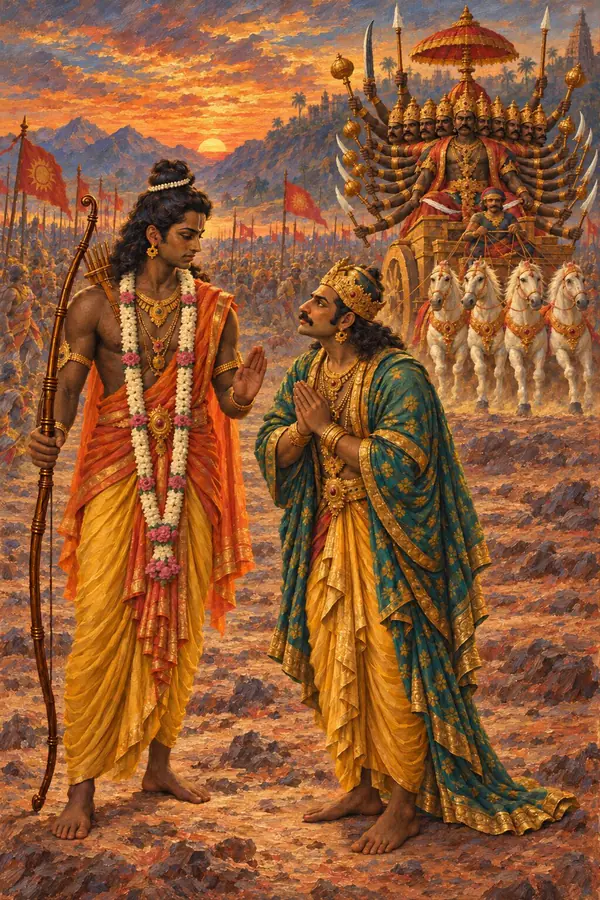
Ravana on a chariot, the hero of the Raghus with none. Seeing it, Vibhishana lost his steadiness. Tulsidas gives the cause of the doubt in the same breath as the doubt itself. The love was great, and out of that greatness the doubt rose. Whatever we hold dearest, every danger that moves toward it looks larger to us than it is. The doubt had grown out of that very caring, and so Vibhishana does not hide it. He bows at Rama’s feet and speaks with great affection. Lord, you have no chariot, no armor to guard your body, no shoes on your feet. On a field where the chariot gives a fighter height and speed, where armor closes around his body, and where shoes carry his feet over ground strewn with stones and broken weapons, you stand with none of these. That warrior is strong. By what means will you defeat him?
The question carries the fear of a servant who wants to pull his master back from a danger standing in plain view. And the one who answers, Tulsidas names here as Kripanidhan, the treasury of grace. Vibhishana had called him Lord. Rama, answering, calls him friend. He says it to a brother born in the rakshasa line, a man who walked away from his own house to come to him, and he says it in the middle of a battlefield. This is the first part of the answer, and it is the ground on which everything that follows will stand.
Listen, friend, says the treasury of grace. The chariot by which victory is won is another chariot altogether. Syandana, the word Tulsidas uses, means simply a chariot, yet the one Rama now begins to speak of belongs to a different order from the one Ravana rides. Vibhishana had counted three things missing, a chariot, armor, and shoes. Rama denies none of them. He says only that the chariot by which victory comes is no chariot the eye can see. The seed of the whole teaching sits in that single sentence. What the wheels of that other chariot are, what flies from its mast, which horses draw it and whose hands hold the reins, Rama will open one piece at a time. For now the roar of the battle is on every side, and in the middle of it a servant is bowed at his master’s feet, and the master has called him friend.
Source: Tulsidas, Ramcharitmanas, Lanka Kanda