On this page
Sri Rama on the Seashore
The sea was roaring, and across it lay Lanka. Ravana had carried Janaki away, and Sri Rama, the descent of Vishnu upon the earth, had come to stand at the edge of that salt water with Sugriva and an army of eighteen padma of vanaras at his side. The water ran out to the horizon and did not stop there. One anxiety filled his mind: how to cross this boundless ocean, and by what means to overcome that arrogant king.
As he turned the question over, thirst came upon Sri Rama. He asked for water, the vanaras brought him sweet water, and, pleased, he took it into his hands. Yet before he could drink a single sip, a memory rose in him, put there by Shiva’s own will. “I have not yet had the darshan of my lord, Bhagavan Shankara. How then can I accept this water?” Saying this, he did not drink it, and set it aside. An army was waiting on his word and the ocean would not part, and still he would not take a mouthful of water out of turn.
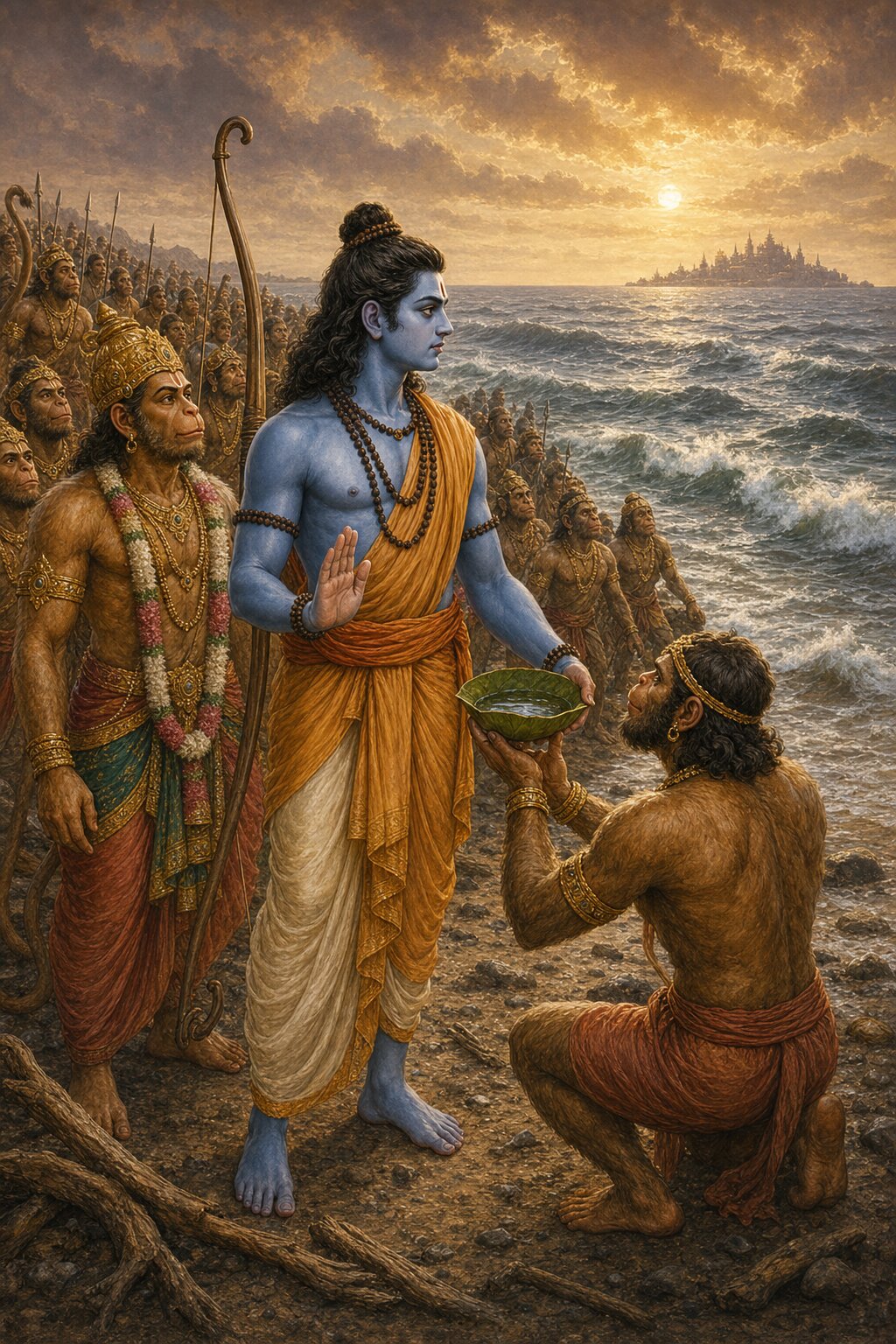
Then, on that very spot, Raghunandana shaped a linga of earth. With the sixteen rites of worship, beginning with the invocation, performed in due order and with great love, he honored Shankara and prayed from a devoted heart. “My lord, Deva Maheshwara, keeper of the finest vows, come to my aid. You are the one who carries his people across; look now at what stands in front of me to be crossed. This ocean has no floor to it, and the army I have is a company of monkeys, a fickle instrument of war. Without your help, the success of my task is exceedingly hard to win. Ravana too is your devotee, unconquerable by all, forever swollen with pride from the boon you granted him. He is a great warrior who has already subdued the three worlds. And I too am your servant, wholly bound to your will. Sadashiva, weigh this, and take my side.”
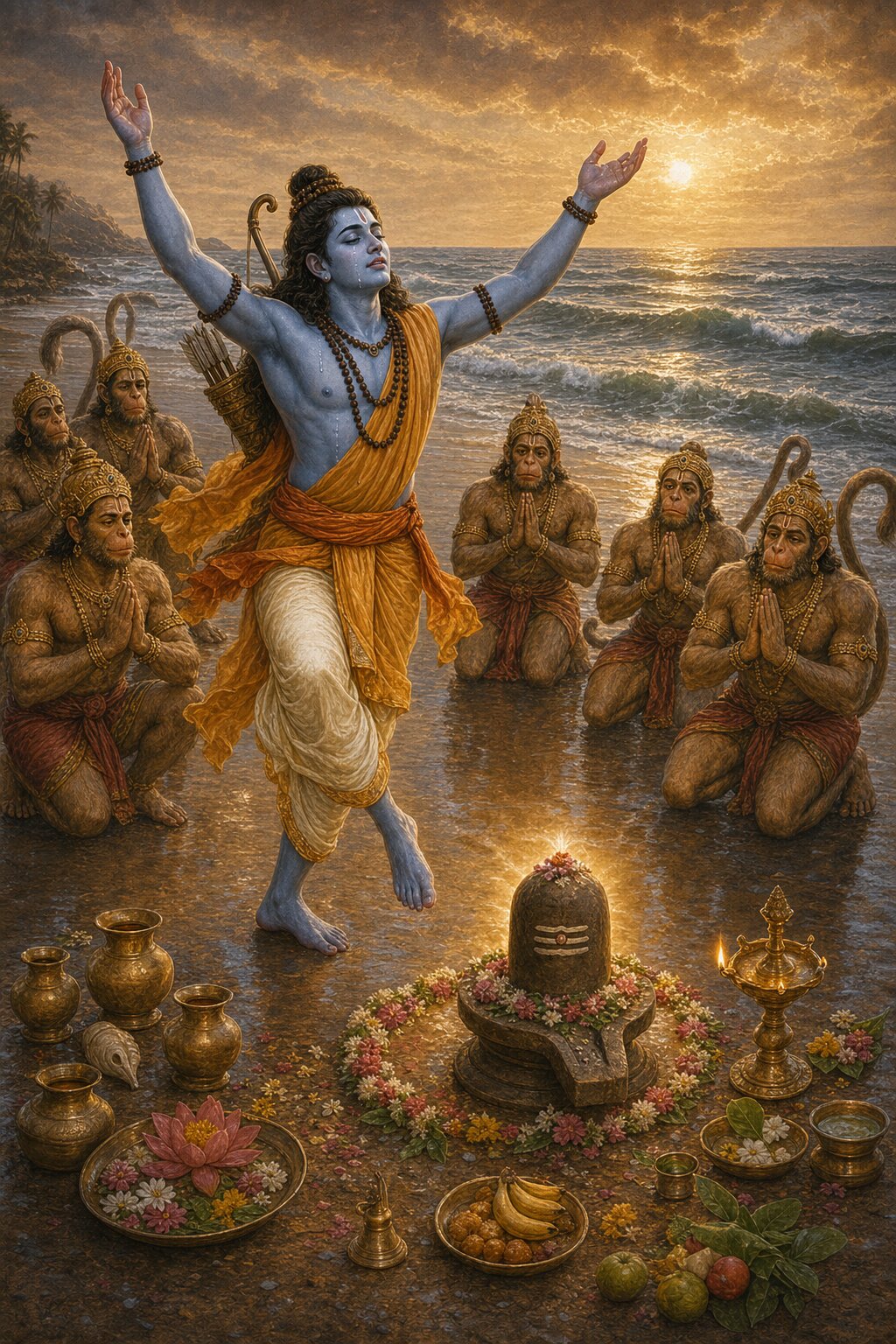
His prayer and prostration done, Sri Rama raised his voice in a cry of “Jaya Shankara,” and lost himself in the repetition of the mantra and in meditation. Then he worshiped once more, and before his lord, his heart melting with love, he began to dance. The prince of Ayodhya danced on the sand in front of an image he had shaped with his own hands, and eighteen padma of soldiers stood and watched him do it. Bhagavan Shankara was greatly pleased by this, and the radiant Maheshwara appeared on that spot, taking the pure form the scriptures describe, with Parvati at his left side and his attendants around him. All who beheld that form were made holy.
Maheshwara said, “Sri Rama, may all be well with you. Ask for a boon.” With praises of many kinds and with reverent bows, Sri Rama asked for victory over Ravana in Lanka, and Shiva, delighted at such devotion, told him to go and be victorious, and granted him the boon of victory. He had what he had come to that shore for. Folding his hands, Sri Rama entreated him again. “My lord Shankara, if you are pleased with me, then dwell here forever, to sanctify the people of the world and for the good of all.”
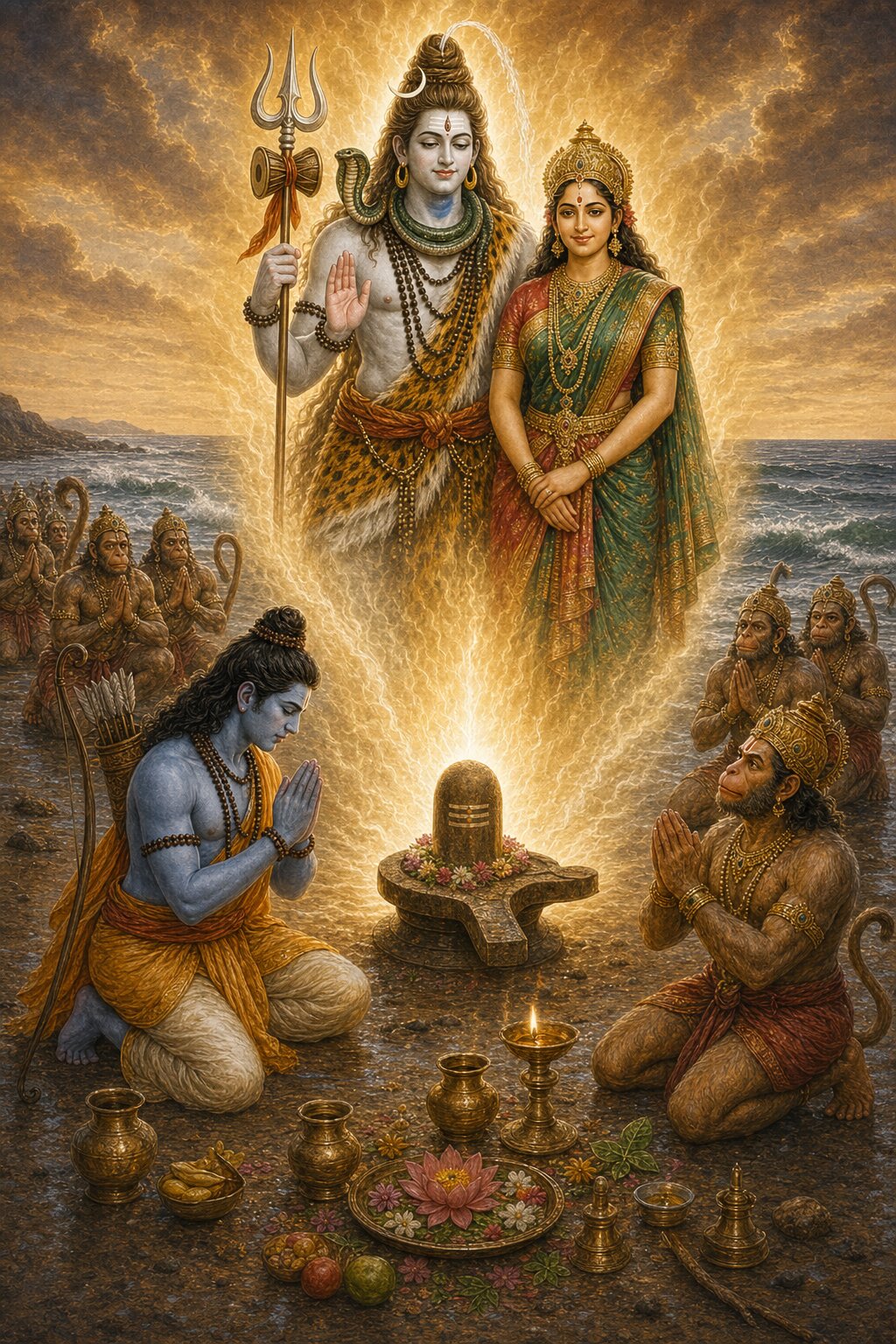
The moment Sri Rama spoke these words, Bhagavan Shiva settled there in the form of a jyotirlinga, at the very place where the bridge would go out. Across the three worlds he became renowned by the name Rameshwar. By his power alone Sri Rama crossed the boundless ocean with ease, swiftly destroyed Ravana and the other rakshasas, and won back his beloved Sita. From that time the matchless glory of Rameshwar spread across this earth. Whoever bathes this Shiva with the holy water of the Ganga in devotion is freed while still living; having enjoyed the rare pleasures of the world, rare even to the gods, and gained the highest knowledge at the last, he attains the liberation of kaivalya.
Ghushma’s Devotion and Ghushmeshwar
Now hear of the southern land, where a noble mountain named Revagiri stands, wondrous to look upon and holy for all time. Near it, in the line of Bharadvaja, lived an eminent Brahmin named Sudharma, first among the knowers of Brahman, who kept his sacrificial fires burning, taught his disciples, said the sandhya prayers three times a day, and gave away freely what came to him. His dear wife was named Sudeha, ever devoted to the observance of Shiva’s dharma, skilled in the running of the home, and lovely as Lakshmi to look upon. The couple followed the path of the Vedas and were devotees of Shiva, yet they had no son. The years went by and none came.
This weighed on Sudeha, and she grieved within. Neighbors and others taunted her: the woman with a son has an heir, and the barren woman has only the king waiting to take her estate, so what has she to be proud of? Again and again she prayed to her husband for a son. He kept reasoning with her, that what is destined will happen and no amount of wanting moves it, but her heart would not be consoled. At last she settled on a plan and married her younger sister Ghushma to Sudharma. He agreed to it with one warning: when this girl bears a son, you will not be able to bear her. Never, said Sudeha; she is my own sister. Ghushma was a great devotee of Shiva. Each day she would make a hundred and one lingas of earth and worship them, then carry them to a nearby pond and release them into the water, and a hundred thousand of them had gone into that water before anything came of it. By her devotion, and by the grace of Shiva, Ghushma bore a son endowed with the qualities of Rudra.
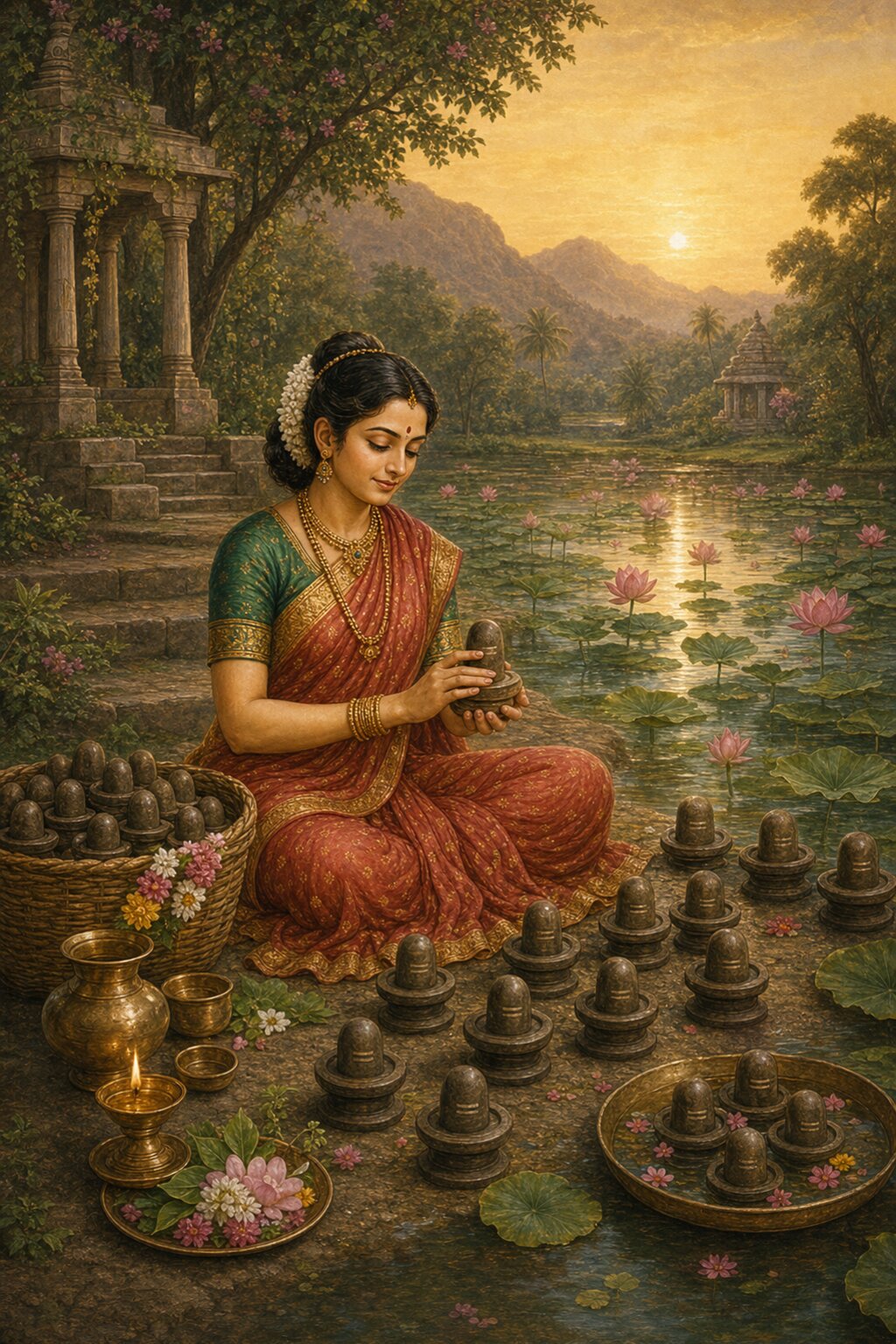
Once the son was born, Ghushma’s standing rose a little, and from this the fire of envy began to smolder in Sudeha’s heart. Ghushma had handed the boy straight over: he is your son, she said, not mine. The child called Sudeha mother, and still the dirt would not wash out of her mind. In time the son married, and when the daughter-in-law came into the house and called her mother-in-law, Sudeha burned all the more. Her mind turned corrupt. This fire goes out only in Ghushma’s tears, she told herself; so I will kill the boy tonight, and whatever comes after will come. One night she cut the sleeping young man to pieces with a knife as his wife slept beside him, carried the severed limbs away, and threw them into the very pond where Ghushma released her earthen lingas each day. Then she came back and slept in peace.
Morning came. Ghushma rose and set to her worship as on every other day, Sudharma to his daily rites, and Sudeha too went about the housework with a light heart, for the fire of jealousy in her breast had burned itself out. Then the daughter-in-law saw her husband’s bed, soaked in blood, with pieces of a body scattered upon it. Wailing, she ran to her mother-in-law. “Noble lady! Where has your son gone? His bed is drenched in blood, and fragments of his limbs lie upon it. Alas, who has done this wicked thing?” Sudeha too made a show of grief, crying out in mourning, while within she was filled with delight. Everyone in that house was doing exactly what they did every morning, and one of them had done this.
Even on hearing this, Ghushma did not waver in the least from her daily worship of the earthen lingas. Until her observance was complete, she showed not even the eagerness to look upon her son, and her husband was of the same mind. When the worship ended at midday, she turned her gaze to that dreadful bed of her son’s, and still she let no grief touch her heart. She began to think. “The one who gave me this son will himself protect him. He loves his devotees, he is death even to Death itself, he is the refuge of the good. He alone, the lord Sarveshwara Shambhu, is my protector. Like one who strings a garland, he who joins the beads is the very one who parts them; what will my worrying accomplish now?” The wailing went on in one room and the mantra went on in the other, and neither of them interrupted the other.
Holding to this steadiness, taking up the earthen lingas as before and uttering the names of Shiva, she went to the edge of the pond. She placed the lingas in the water, and as she turned to leave, she saw her own son standing alive at the very edge of that pond. I have come to my mother, he said; I died, and the power of your virtue and the mercy of Shiva have brought me back. Seeing him living stirred in Ghushma neither joy nor sorrow; she stayed as composed as before. In that same moment Maheshwara, in his form of pure light, well pleased with her, appeared before her.
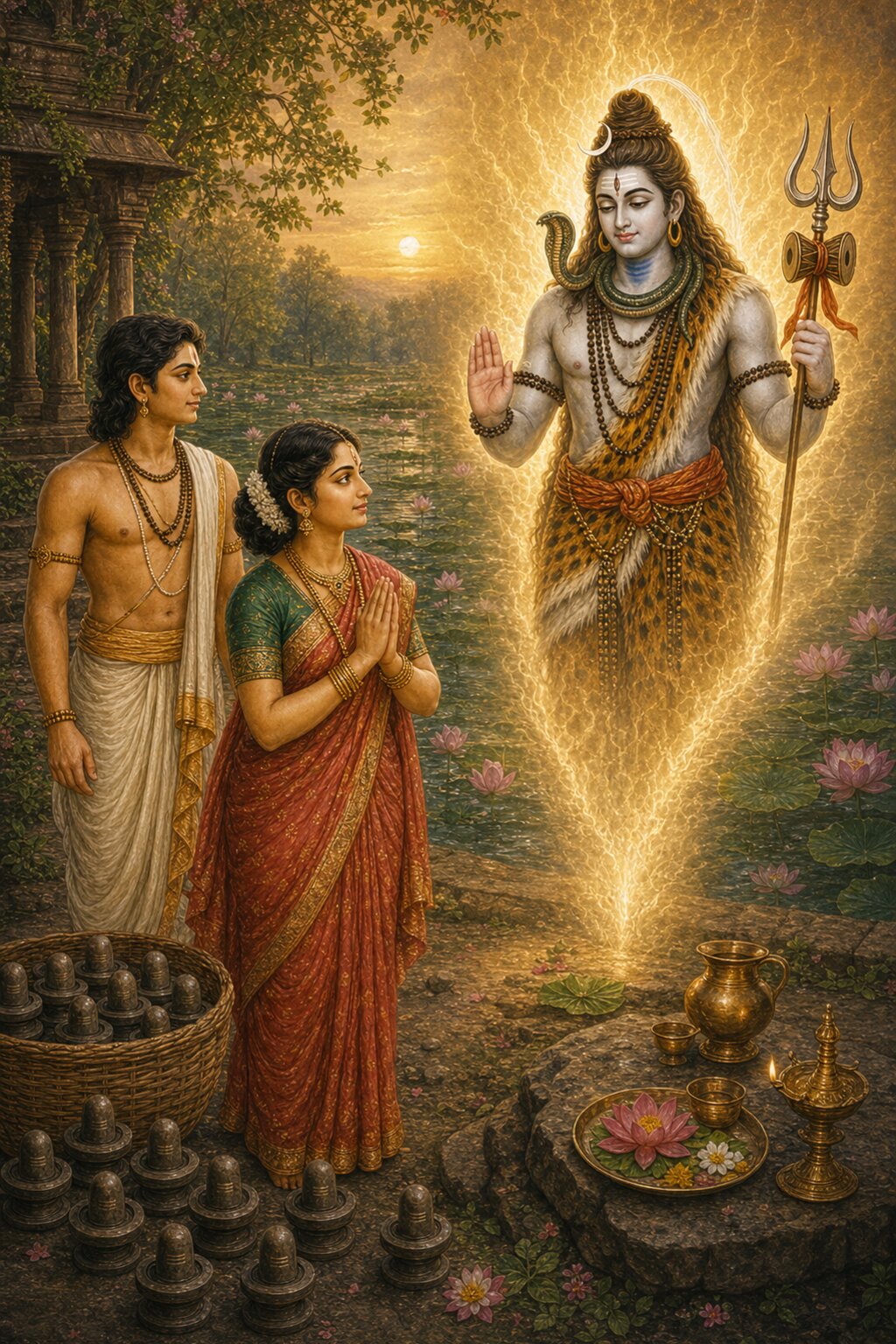
Shiva spoke. “Sumati, I am pleased with you. Ask for a boon. That wicked co-wife of yours killed this boy; I will strike her down with my trident.” He was offering her the death of the woman who had cut up her child, and he offered it before she had asked for anything at all. Ghushma bowed and said, “Lord, this Sudeha is my elder sister. Protect her.” Shiva said, “She has done you a grievous wrong, so why do you offer her a kindness in return? One who commits so vile a deed deserves death.”
Ghushma answered, “Deva, no sin can stand before the mere sight of you. In gaining your darshan just now, her sin has been burned to ash. When someone offers kindness even to the one who wronged them, from the sight of such a person sin flees a great distance. These are your own wonderful words, my lord, and I have heard them; let it not go otherwise now. Let whoever did the evil deed bear its fruit if it must be so; even then I would not wish it upon her.” At this devotion and this generous spirit, Maheshwara, the ocean of mercy, was more pleased still, and said, “Daughter, ask for another boon as well. Your devotion delights me, and so does a nature with no crookedness anywhere in it.” Ghushma said, “Lord, if you must grant a boon, then dwell here forever for the protection of the people, and let your fame carry my own name.”
Maheshwara, pleased, said, “I will dwell here forever, called Ghushmesha after your very name, and I will be the giver of liberation to my devotees. Let my linga stand here auspicious and famous, and let this lake be a storehouse of lingas for as long as it holds water. Let it be renowned across the three worlds by the name Shivalaya, and let it grant every desire at the mere sight of it. Sumati, in your line sons will be born for a hundred and one generations, all blessed with beautiful wives, ample wealth, and a full span of years, clever, learned, and generous, and heirs to both enjoyment and moksha.”
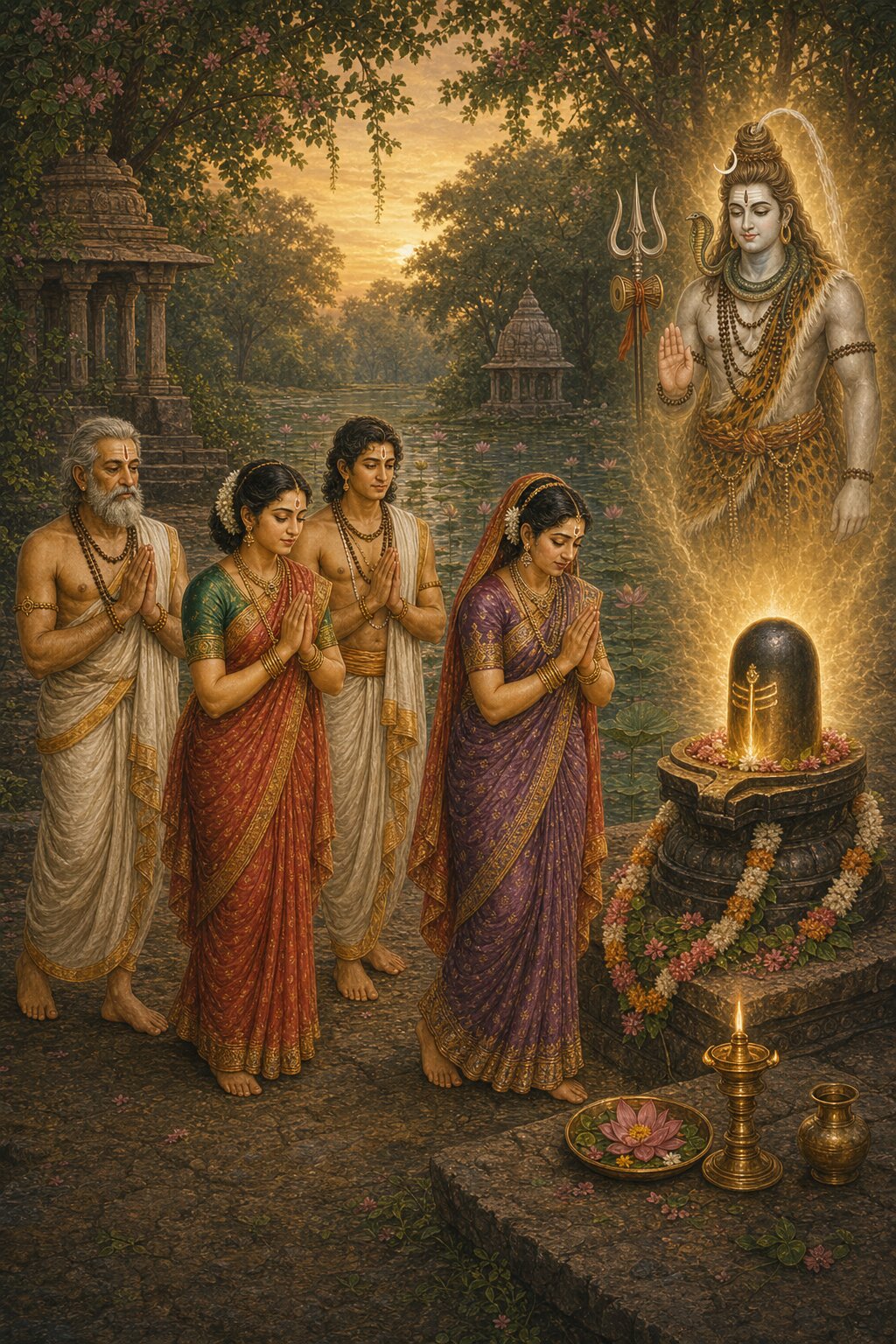
So saying, Bhagavan Shiva settled there in the form of a jyotirlinga. He became renowned by the name Ghushmesha, and the lake took the name Shivalaya. Sudharma, Ghushma, and Sudeha, all three, came and walked the sunwise circuit around that linga, worshiped it, and, washing the stains from their hearts, were reconciled with one another. Seeing her son alive, Sudeha was deeply ashamed; she begged forgiveness of her husband and of Ghushma and made atonement for her sin. The sister she had wronged had already asked, before anyone asked her to, that she be spared. In this way the Ghushmeshwar linga came forth, whose darshan and worship forever increase one’s happiness. Here the glory of the twelve jyotirlingas comes to its close, those lingas that fulfill every desire and grant both enjoyment and moksha.
Source: Shiva Purana (Gita Press, Sankshipta Shivapurananka), Kotirudra Samhita