On this page
Three brothers sat in penance in a cavern of Mount Meru, and the fire of that penance burned so fierce that at the last the Grandsire Brahma himself had to descend. They were the sons of Tarakasura, whose father had already fallen at the hands of Kartikeya, the commander of the gods’ army: Tarakaksha the eldest, Vidyunmali the middle one, Kamalaksha the youngest, all three of equal strength. Through summer they lit fires on all four sides and stood among them under an open sun until they dropped senseless. Through the rains they let the downpour break on their bare heads. A hundred years on a single foot. A thousand taking in nothing but air. A thousand more standing on their heads. When the hour came to ask for a boon, the same word rose to the lips of all three, the word every asura before them had asked for, immortality.
Brahma shook his head. ‘Asuras, immortality can be granted to no one. Whatever is born dies, and is born again; no one in this world walks free of age and death. Shiva, who destroys Death himself, and Vishnu stand outside that law, and all else that breathes is mortal. Ask instead for some rare boon beyond the reach of gods and asuras alike, and choose for yourselves the manner of your own dying.’
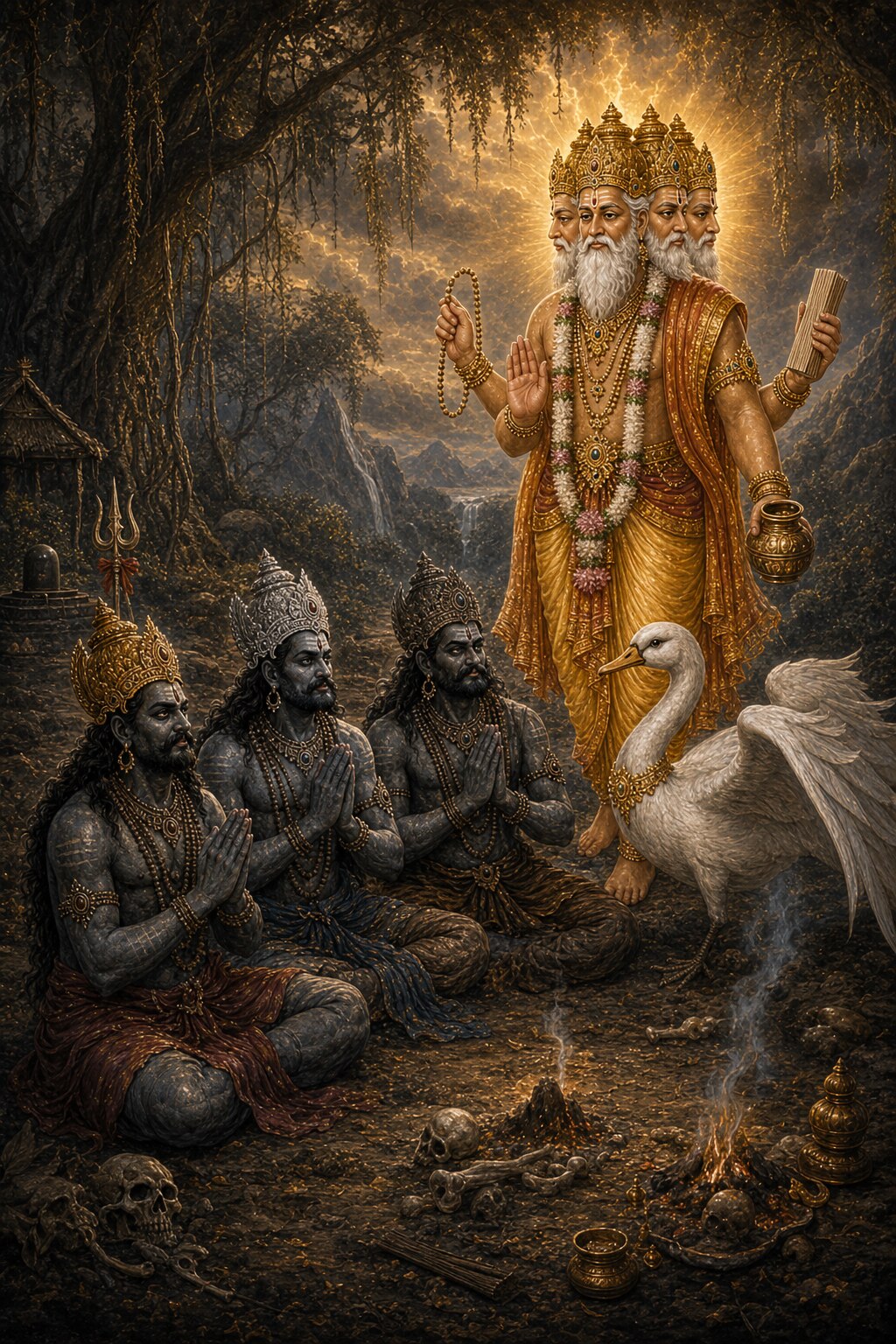
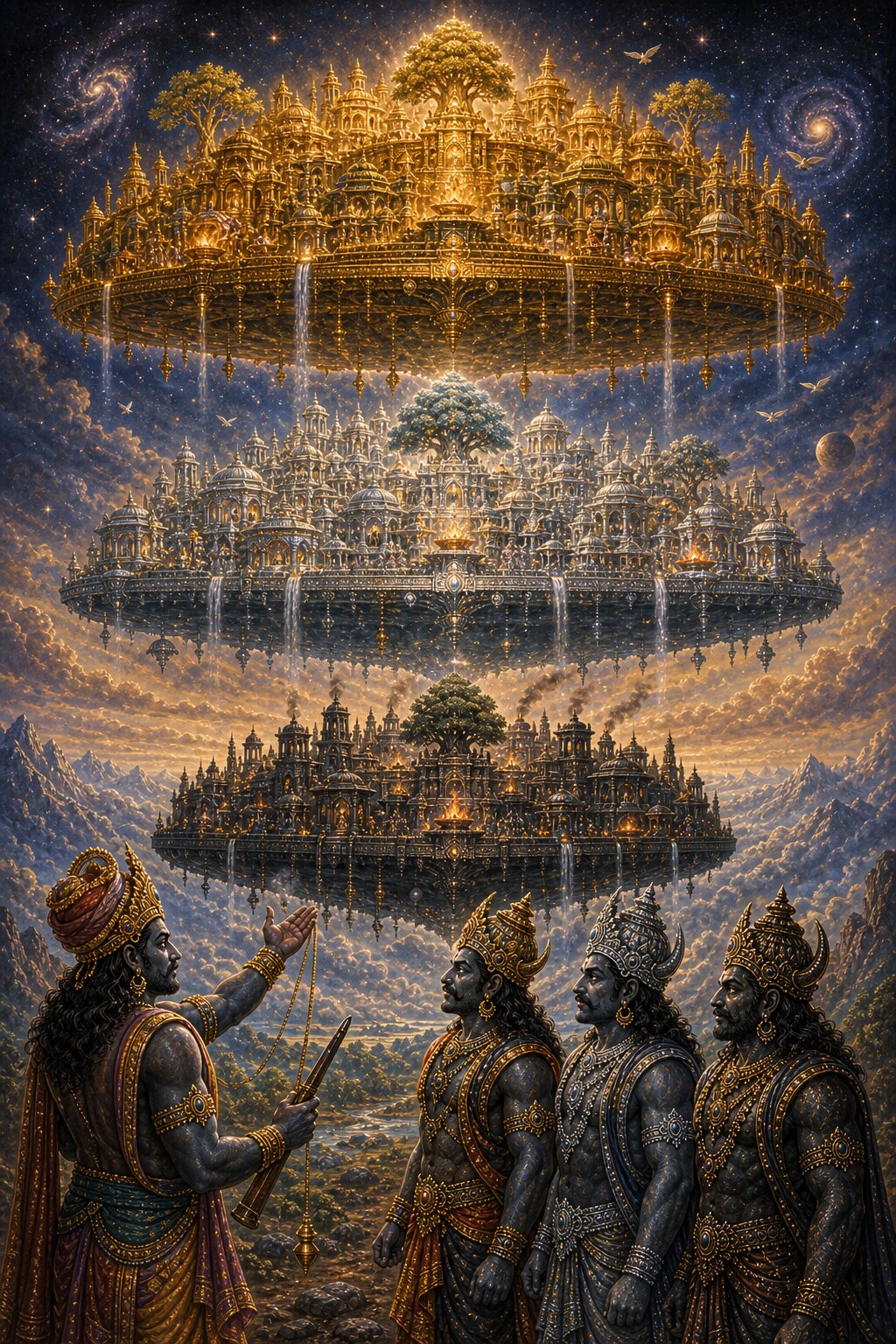
Now watch the cunning of the asuras. We have no house, they said, where men as valorous as we are can live at ease. So Tarakaksha asked for a city of gold that not even the gods could breach; Kamalaksha asked for one of silver; Vidyunmali for one of steel, set with lodestone and hard as the thunderbolt. Then came the conditions, and the shrewdness is all in the conditions. The three cities would drift apart through the sky, hidden from sight, and would come together into one fortress only after a thousand years had run out, only at midday in the hour called Abhijit, only while the moon stood in Pushya, and only while the Pushkara and Avarta clouds, the clouds that drown the world at its ending, poured down rain out of a firmament in which nobody could see them. In that one moment, and in no other, their destruction could come only if Shankara himself sat in some impossible chariot and pierced all three cities with a single extraordinary arrow. The reckoning behind it was quiet and shrewd: Shiva holds no enmity toward us, he is the one we worship, so how could he ever burn us to ash? Brahma remembered Shiva, said, so it shall be, and ordered Maya the danava to build the three cities.
Three Cities, One Empire
Patient Maya raised them by the strength of his own penance: for Tarakaksha a golden fortress in the heavens, for Kamalaksha a silver one in the middle air, and for Vidyunmali one of steel upon the earth. He settled the sons of Taraka inside them wishing them well, and they took every enjoyment the worlds had to give. There were kalpavriksha trees that grant every wish, elephants and horses past counting, palaces studded with gems, divine minarets like the summits of Kailasa. Flying craft set with padmaraga stones moved in every direction, bright as the disc of the sun. And listen, these cities held far more than pleasure. There were temples of Rudra. In every single house the fire-offering was made at its hour. There were schools for the study of the Veda, halls for the yajna, wives devoted to their husbands, brahmanas learned in the sacred texts. Those blue-haired daityas were learned, fond of battle, and made pure in their valor by the worship of Brahma and Shiva. From these cities they pressed down upon all three worlds and ruled at their pleasure, and a long age passed.
The Shield of Merit
The tormented gods came to Brahma and set the whole of it before him: the sons of Taraka and Maya the asura had thrown the dwellers of heaven into anguish. Brahma heard them out and answered plainly. It was I who raised them to this height, he said, so it would not be right for them to die by my hand, and even now their store of merit still glows within Tripura. Come, let us pray to Shiva. So they all went to the god whose banner bears the bull, and when the praises were done they said, ‘Mahadeva, the three sons of Taraka have defeated the gods, Indra among them. All three worlds bow to them. They seize for themselves the shares of every sacrifice, and while they stand there is no virtuous act left that we are able to perform. Protect us.’
And here lies the strangest knot in the whole story. Shiva did not lift a weapon. ‘The one who presides over Tripura today presides on merit, and a soul rich in merit is not struck at by anyone with sense. I know the misery of the gods and how deep it runs. I know too that those asuras can be killed by neither gods nor demons. I may be hardy and powerful in battle, yet how could I knowingly turn malice on my own friends? Brahma himself has said that a great sin attends even a casual act of malice. Weigh it. The killer of a Brahmin, the man lost to wine, the thief, the one who violates his sacred rites, each of these has a road back, an atonement, an amends. For the ungrateful there is none. Those asuras are my devotees. As long as they continue in their devotion to me, their killing is impossible. Take this reasoning to Vishnu.’ So the gods went to Vishnu, and Vishnu set in motion an arrangement by which the asuras turned away from the eternal dharma and fell into misconduct. Worship, rites for the ancestors, sacrifice, vows, pilgrimage, charity, all of it went dark. Delusion and Alakshmi, the bringer of ruin, came and settled in those cities; Lakshmi, the fortune their penance had earned, departed; and the strength of the daitya king with his brothers, and of Maya, drained away.
Now all the gods, Brahma and Vishnu among them, reached Kailasa. Praises were sung; Vishnu chanted the Rudra mantra fifteen million times. Pleased, Shiva came down upon his bull, stepped off Nandi to embrace Vishnu, and turned a kind look upon them all with one hand resting on the bull. Then the matter stalled once more. Every intention of the gods was already known to him, he said, and so was the power of Vishnu’s magic and of the clever Narada. Then he asked the question that stopped the room. They have been made to abandon their own excellent virtue under false persuasion; why do Vishnu, or someone else, not simply kill them now? Even Hari’s face fell. Then Brahma spoke with folded hands, ‘Supreme Lord, there is no sin in this for you. It was by your own bidding that they were deluded. Now they have turned from devotion, and no one else can slay them. A king who punishes the wicked in accordance with dharma takes on no sin by it. Pull out this thorn. The great sages, Indra, the sacrifice, the Veda, we ourselves and Vishnu, all of us depend on you. You are the sovereign emperor of the gods, Vishnu your heir apparent, I your family priest, and Shukra, who carries out your behests, your royal officer.’
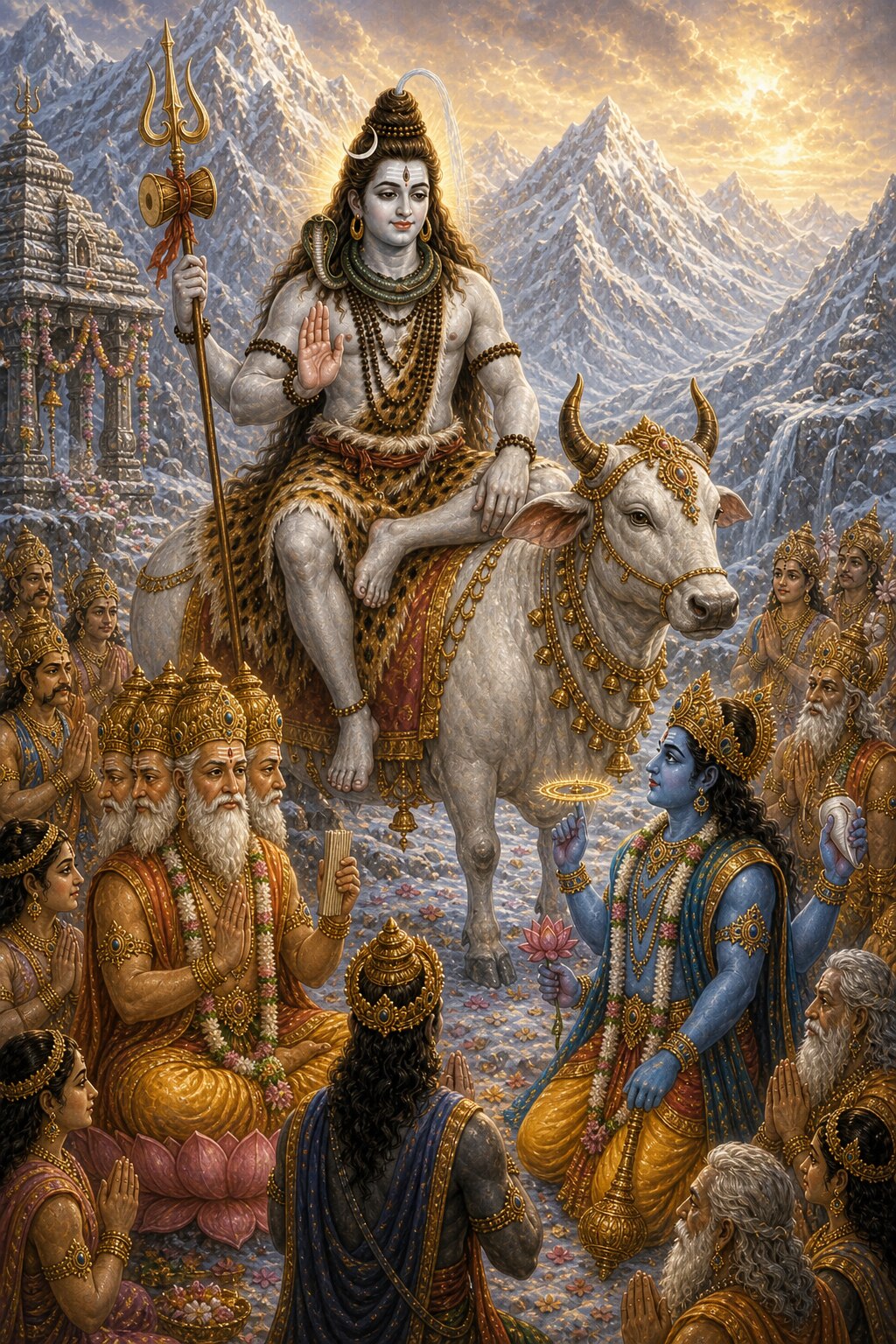
Shiva was pleased, and then a fresh obstacle arrived, smiling. ‘Brahman, if I am to be proclaimed emperor of the gods, where are the trappings that mark such a lordship? I have no divine chariot and no charioteer, and none of those bows and arrows that carry a battle. Give me a chariot to sit in, put a bow and arrows in my hands, and I could kill asuras of any strength with a settled mind.’ The gods and the sages heard it and their spirits sank. Then Hari steadied them. Propitiating the great is no easy task, he said; the difficulty always comes first, and the lord is pleased only once he has seen what your resolve is made of. Then he gave them a mantra, syllable by syllable: “om namah shubham shubham kuru kuru shivaya namah om”, Om, homage; bring about the good, bring about the good; homage to Shiva, Om. Repeat it ten million times with Shiva in your mind, he told them, and Shiva will carry out the task. So the gods stood where they were and chanted, Shiva, Shiva, ten million times, and Brahma and Hari chanted with them. Then Shiva came into direct view in his own form. ‘I am delighted by your japa. Ask for a boon.’ The gods asked for one thing only, the destruction of Tripura. Maheshvara said, ‘Consider Tripura already destroyed. Now make ready the chariot, the charioteer, the divine bow, and the excellent arrows.’
The Chariot of All the Gods
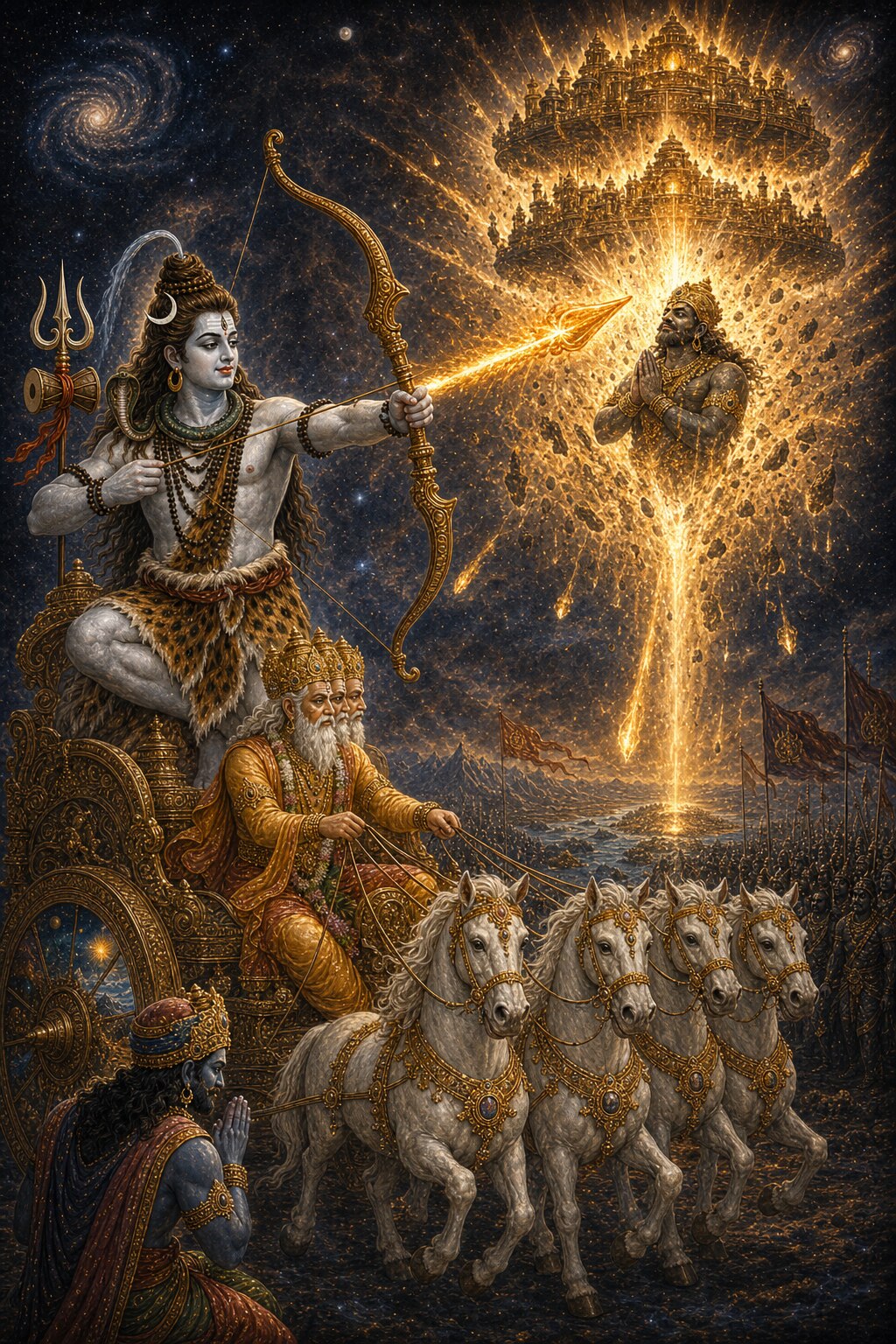
Then, at Shiva’s command, Vishvakarma built a chariot the like of which was never built again. It was golden, and every element in existence had gone into its making. Its right wheel was the sun, with twelve spokes over which the twelve Adityas presided; its left wheel was the moon, with sixteen spokes that were the sixteen digits of the moon, and all the asterisms brightened that side. The six seasons were the rims of those wheels, the middle air its front, Mount Mandara its inner seat, the mountains of sunrise and sunset its two poleshafts, the great Meru its support. The year was its speed, and the smallest divisions of time went into its poles. Ananta of the thousand hoods was its fittings, the four quarters its pedestals, the clouds led by Pushkara its gem-studded banners, the four oceans its bullocks. The rivers led by Ganga took beautiful female forms and waved the fly-whisks; the seven courses of the wind were its golden steps. Brahma himself held the reins as charioteer, and Pranava, the sacred syllable, was his long whip. The lord of mountains was the bow, the lord of serpents its string, and Sarasvati in the form of the Vedas the bell upon that bow. And the arrow? The arrow was Vishnu himself, Agni its steel point, the four Vedas the horses yoked to draw it. Whatever thing existed in the whole universe, all of it found a place in that chariot.
Brahma yoked the Vedas as the horses, handed the chariot over to Shiva, and asked him to mount. Shambhu climbed aboard, and the moment he did, the horses that were the Vedas pitched headlong to the ground. The earth quaked. The mountains went tremulous. Shesha, unable to carry that weight, began to tremble beneath the world. Then Vishnu took the form of a lordly bull, went under the chariot, and held it steady for a moment; in the next instant the blazing power of Mahesha beat him down, and even that bull had to kneel and crawl. Then the lord touched the bridle himself and settled the horses, and Brahma drove those Veda-formed steeds toward the three cities with the velocity of mind and wind.
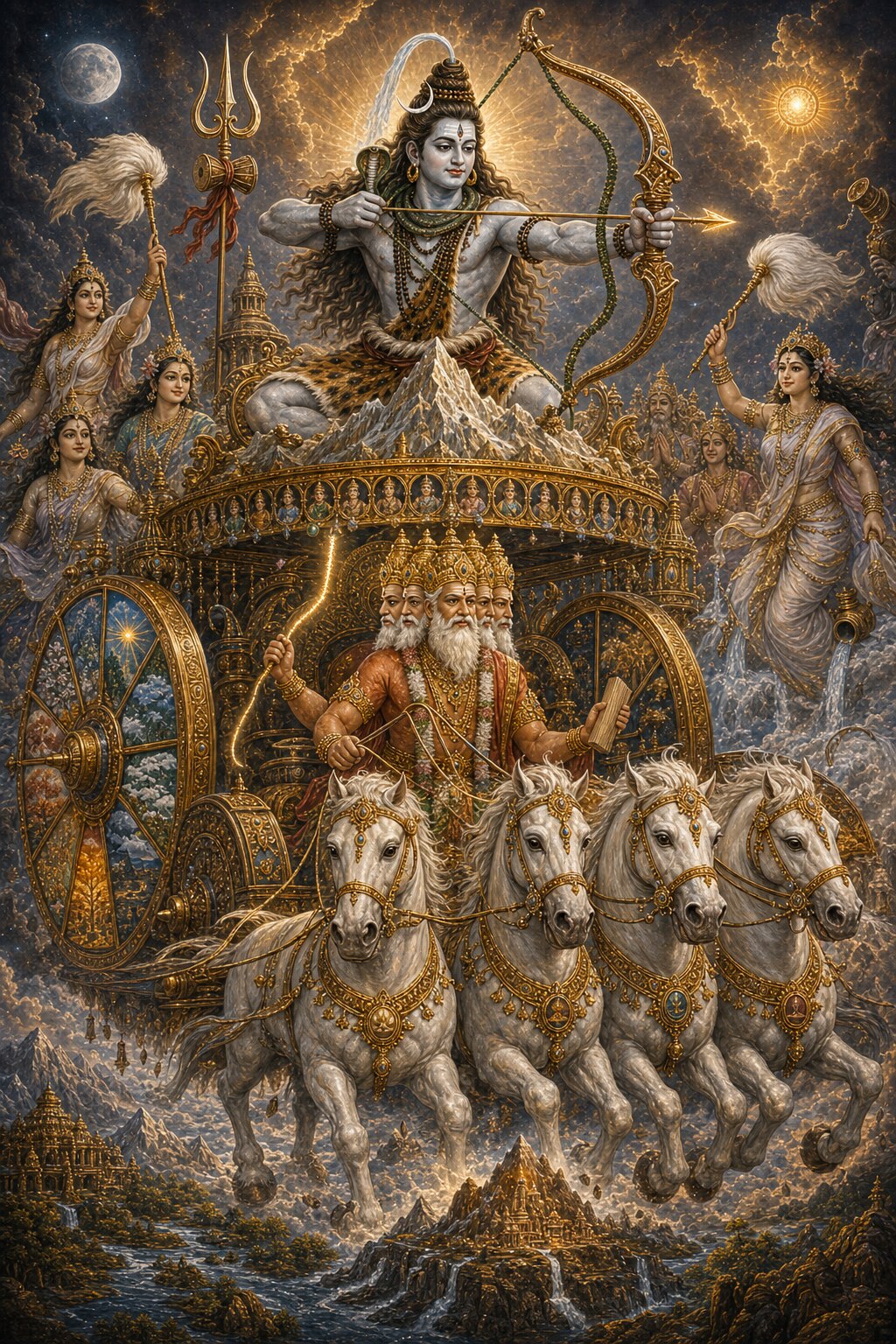
On the way Rudra spoke. ‘Give me the lordship of the beasts. The great asuras can be killed once you have taken separate animalhood upon yourselves, gods and all, and not otherwise.’ The thought of becoming beasts made the hearts of the gods sink. Reading it, the god of gods laughed. ‘You will not fall by this animalhood. Hear the way out of it and practice it. Whoever performs the divine Pashupata rite is released from the state of the beast; I promise you that. Whoever renders me service without a break, or serves for twelve years, is relieved of it also.’ Vishnu, Brahma, and the gods said, so be it. So the greatest of the gods became the beasts of Mahadeva, and Shiva became lord of the beasts, the one who unties their nooses, and from that day the name Pashupati, which bestows welfare, spread through all the worlds. Then amid cries of victory the march went forward. The gods rode out resplendent as the sun on elephants, horses, lions, bulls, and chariots, huge as mountains and armed with plowshares and mortars and iron clubs and uprooted trees. Siddhas and charanas moving through the sky rained down flowers. Bhringi, chief of all the ganas, went speedily toward the three cities, and countless ganas thronged around Maheshvara, every one of them able to burn the whole world by a thought.
The Arrow of the Abhijit Muhurta
Standing at the crest of the chariot, Shambhu drew himself into the pratyalidha stance of the archer and held it a hundred thousand years: the bow strung well and raised near his head, the arrow fixed, the fingers clenched hard at the grip, the eyes locked and unmoving. But what was this? The three cities would not come into the path of his aim at all; Ganesha was seated upon the tip of his thumb, sending a steady ache through it. Then, from the firmament, the odd-eyed lord standing there with bow and arrow heard an auspicious voice. ‘Lord of the master of the universe, you will not kill the Tripuras as long as the lord Ganesha goes unadored.’ The bearer of the trident summoned Bhadrakali and worshiped the elephant-faced god with full ceremony, and when Vinayaka stood pleased before him the three cities showed clear against the sky. The Purana itself pauses here and asks how it can be proper to say that the great lord, the supreme Brahman whom all others worship, achieved his success by another god’s grace. And then it answers, simply: in the deeds of that giver of boons everything happens in play.
Away in the sky the thousand years came to their end, the moon moved into Pushya, and the three cities became one. A tumultuous shout of joy rose from the gods, and Brahma and Vishnu called out, ‘Maheshvara, the hour to slay the asuras has come; loose the arrow and reduce the three cities to ashes before they drift apart again.’ The Abhijit muhurta was passing. Shiva strung the bow tight, fixed the venerated Pashupata to it, and looked at the Tripuras once with contempt, for he could have burned all three worlds with a single glance. Then he made a twanging sound impossible to bear, announced his own name to the great asuras, and loosed the arrow, blazing with the refulgence of countless suns.
Vishnu constituted that arrow and Agni was its steel head, and it blazed forth and burned the asuras who lived in the three cities, and in the burning it took their sins away. The three cities fell to the earth as ash. Hundreds of asuras who had turned from the worship of Shiva burned in the fire the arrow made and cried out in their distress. And out of that same fire rose the gentlest note in the whole story. Tarakaksha burned along with his two brothers, and burning, he remembered his lord, and lamenting in a hundred ways he appealed to him with his mind alone. ‘Shiva, you are known to be pleased with us, and if in some hour to come you burn us, you will burn us with our kinsfolk beside us; let it be by the truth of that. What is difficult for the gods and inaccessible to the asuras has been secured by us. In whatever birth we take, let our minds be purified by our thoughts of you.’ At Shiva’s bidding the fire reduced them to ash even as they muttered it. Woman, man, child, elder, nothing escaped, the way everything is burned at the end of a kalpa. One alone was spared, Maya, the imperishable Vishvakarma of the asuras. And those who had sought refuge in Shiva when adversity came were saved by his brilliance; those who had worshiped him with all their kin passed by the power of that worship into Ganapati’s region.
After the Ashes
Tripura had burned, yet the fierce form of Shankara still blazed, dazzling the ten quarters, a match for the fire at the hour of dissolution. Indra, Vishnu, and the rest fell silent and bewildered. The sages standing all around said nothing and only bowed. The gods, afraid, turned their eyes toward Parvati, the daughter of Himavat, standing at his side; even Brahma and Vishnu shrank back, and prayed from inside their fear. With their praises they all asked for a single boon, ‘Whenever the shadow of sorrow falls upon the gods, may you appear and destroy it, again and again.’ Growing calm, Shiva said, ‘So it shall always be.’ At that very moment Maya the danava came, spared by the strength of grace, and threw himself at Shiva’s feet; his throat filled with love. Shiva said, ‘Best of the danavas, I am delighted. Ask for a boon.’ Maya asked for no kingdom and no revenge. Permanent devotion, he said; the company of your devotees forever; compassion toward the distressed; and let no demoniac instinct ever enter me again, and let me stay fearless and engrossed in your worship. Maheshvara said, ‘You are my devotee, and you are blessed. Go with your family and kinsmen to the realm of Vitala, more beautiful than heaven itself; stay there without fear, and at my bidding the nature of the asura will never again enter you.’ Maya bowed his head and went down to Vitala.
Then Mahadeva vanished, along with Parvati, his sons, and his ganas, and the moment he disappeared the bow, the arrow, and the chariot made of all the gods vanished too. Brahma, who had asked for one thing only at the end of it, to remain Shiva’s charioteer always, went back to his own region; and Vishnu, the gods, the sages, and the gandharvas returned to theirs, singing the glory of Shankara as they went. From that day the world has called him the enemy of the three cities, Tripurari. One arrow, three cities, and that voice of devotion rising out of the ashes, this is the treasure the story leaves in your hands.
Source: Shiva Purana (Gita Press, Sankshipta Shivapurananka), Rudra Samhita (Yuddha Khanda)