On this page
On the sacred shore of Pushkar, an ascetic had held his seat for a hundred thousand years without moving. His lips never stopped shaping the Krishna mantra. When that long chanting had run its course, a blazing radiance broke from his forehead and spread through every quarter of the sky. The brilliance grew so unbearable that the gods, the sages, and even the Manus were scorched by it and rose to their feet in distress.
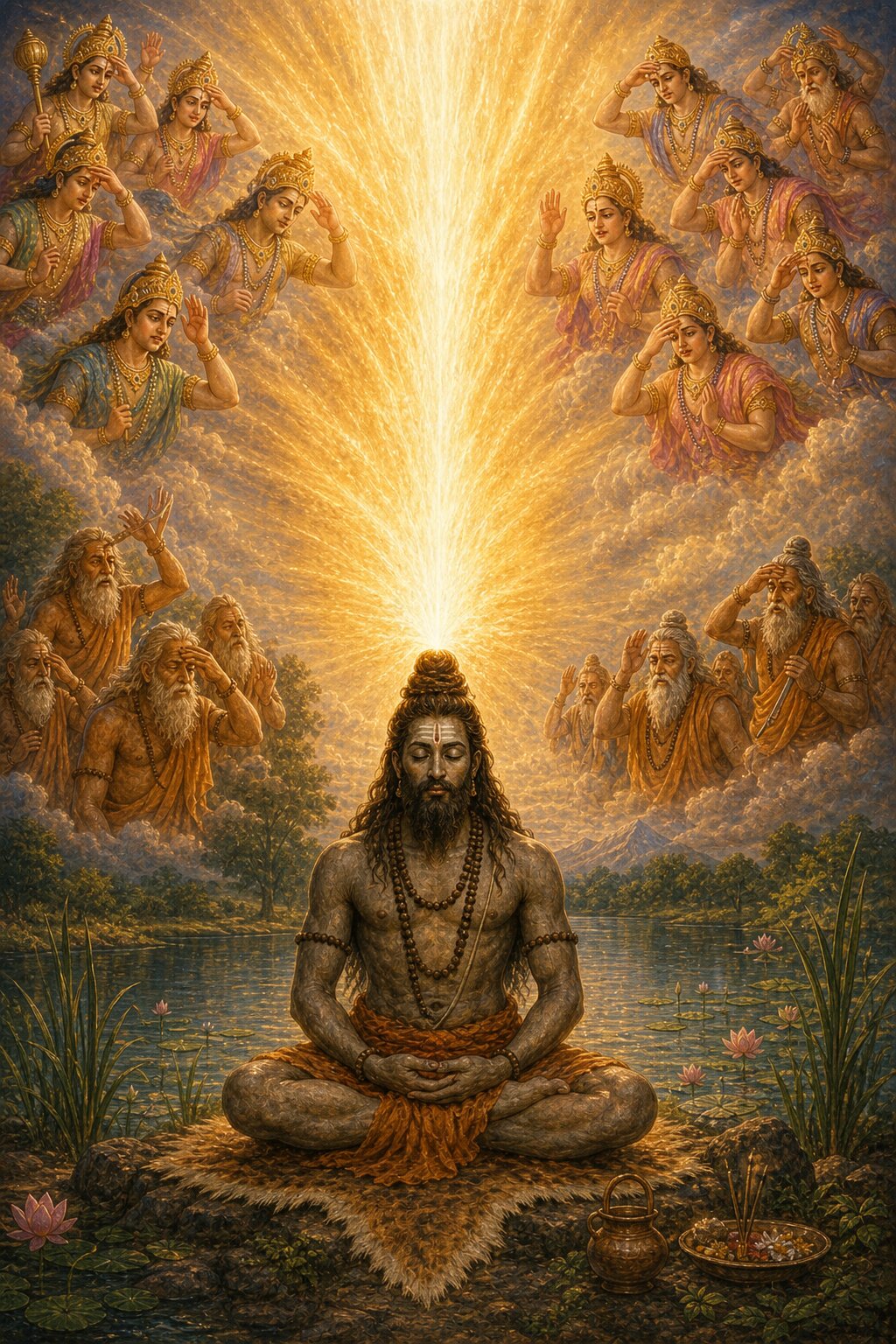
Who this ascetic was, Sanatkumara related to Vyasa. From Brahma came his son Marichi; from Marichi, Kashyapa; and among the wives of Kashyapa was Danu, chaste and tenderly cherished, who bore him many powerful sons. One of them was Viprachitti, and Viprachitti’s son was Dambha, a man who had mastered his senses and worshiped Vishnu above all. For a long age no son came to him. So he went to his preceptor Shukracharya, took the Krishna mantra from him as his initiation, carried it to Pushkar, and there began this ferocious penance.
The gods’ alarm and Vishnu’s boon
Unnerved by the radiance, the gods put Indra at their head and went to Brahma, and Brahma took them with him to Vaikuntha, where Lord Vishnu sat bearing conch, discus, mace, and lotus. Folding their hands, the gods cried out, “God of gods, we do not know where this fire has risen from or by what radiance we have been scorched. We come to you as your refuge; protect us.” Vishnu answered with a smile. “Be calm, and do not be afraid. No deluge is coming; the hour of dissolution has not yet arrived. This radiance belongs to my devotee Dambha, who does penance out of longing for a son. I will grant him a boon and quiet it.” The gods took heart and went back to their own abodes.
With that, Vishnu came in person to Pushkar, stood before Dambha, who was still repeating his name, and said, “Ask for your boon.” The danava bowed with great devotion and threw himself at his feet. “Lotus-eyed one, lord of Lakshmi, take pity on me. Give me a heroic son who will be your devotee, whom no one in the three worlds can defeat.” Vishnu granted it, made him leave off his penance, and vanished. Dambha bowed toward the quarter into which he had gone and went home with his desire realized.
Some time later Dambha’s wife conceived, and she lit the inner apartments of the house with her own brilliance. The foremost among Krishna’s cowherd comrades was named Sudama, and he lay under a curse that Radha herself had pronounced on him; it was he who entered that womb. When the time came, a radiant boy was born. His father summoned the sages, had the rites performed in due order, and on an auspicious day gave him the name Shankhachuda. In his father’s house the child grew like the moon in its waxing fortnight and learned every branch of knowledge while still a boy.
When he came of age, on the counsel of the sage Jaigishavya, Shankhachuda too went to Pushkar. He gathered his mind, held his senses still, and muttered the mantra of Brahma his preceptor had given him. Brahma came quickly and said, “Tell me the boon you wish to choose.” Bowing humbly, he said, “Lord, let me become invincible to the gods.” Brahma said, “Be it so,” and gave him the divine amulet of Shrikrishna, the most auspicious of all auspicious things in the universe, that yields victory everywhere. Then he gave a command. “Go now to Badari. Dharmadhvaja’s daughter Tulasi is performing austerities there. Go and marry her.” Brahma vanished as he watched, and Shankhachuda tied that amulet round his neck and set out.
Tulasi at Badari
At Badarikashrama he came, as though by chance, to the place where the daughter of Dharmadhvaja sat lost in penance. She was smiling, bedecked in every ornament, and she cast a loving glance at him. Her beauty was ravishing. He stopped near her and spoke sweetly. “Lovely one, who are you? Whose daughter? What are you doing, sitting here in silence?” Tulasi replied, “I am the daughter of Dharmadhvaja, given to austerity, and I stay in this hermitage doing my penance. Who are you? Go peacefully to your own place. The whole class of women is fascinating; it clouds the mind of even Brahma, and it is a fetter to the devout.”
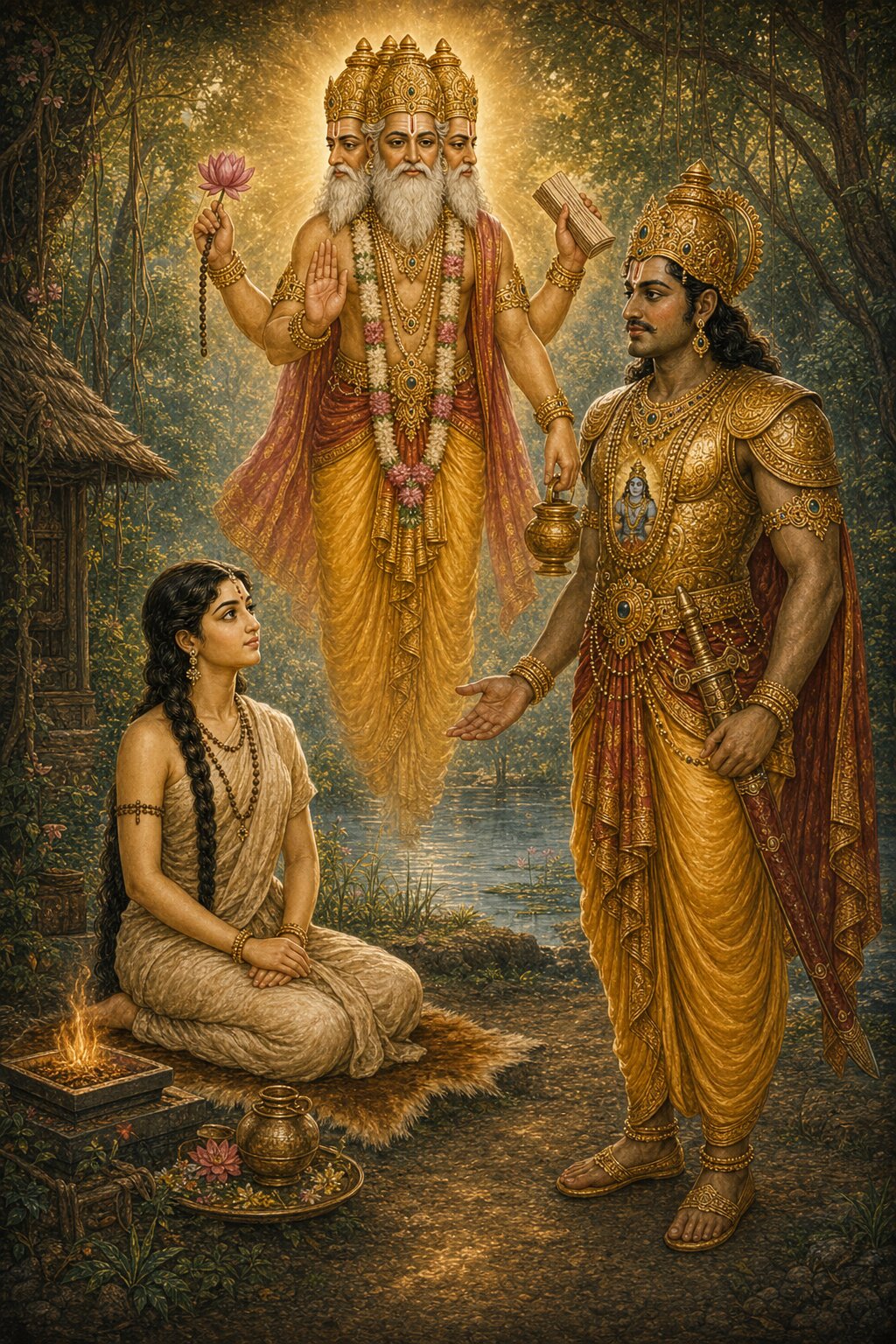
At this Shankhachuda smiled. “Lady, what you say now is not entirely false; it is partly true as well. Now listen to me. Among all the faithful wives in the world, you stand foremost. I am no lusty man of sinful nature, and I do not think you are either. I come to you at the behest of Brahma, and I shall take your hand by the gandharva rite. Have you not even heard my name? I am Shankhachuda, the router of the gods, son of Dambha in the line of Danu. In an earlier age I was Sudama, the cowherd, a comrade of Krishna; under Radha’s curse I have been born a danava now. By Krishna’s favor the memory of my former life stays with me.”
Hearing these truthful words, spoken respectfully by the king of the danavas, Tulasi was delighted and said with a smile, “Noble one, today you have overcome me with the purity of your thought. Blessed in this world is the man whom a woman does not overwhelm. Let him keep every sacred rite; if a woman has overpowered him he becomes impure and unclean, and so he remains, and gods and ancestors alike reproach him. I was only testing you, for a woman must weigh her bridegroom before she woos him.”
Even as she was saying it, Brahma, maker of the worlds, came there and spoke. “Shankhachuda, why do you hold discussion with her? Take her hand by the gandharva rite. You are a jewel among men, and she a jewel among devoted wives, and the union of an intelligent woman with an intelligent man cannot be anything except virtuous. Chaste lady, why test so good a husband? He can suppress gods, asuras, and danavas alike. Delight in his company for a long age. When his body falls he will find Krishna again in Goloka, and you will find the four-armed Lord in Vaikuntha.” With this blessing Brahma departed. Shankhachuda married Tulasi and brought her home.
The demon kingdom and the gods’ plea
The moment Shankhachuda returned, the danavas and daityas broke into celebration. They came to him with their preceptor, bowed, and stayed at his side; and Shukracharya, after telling him the old tales of the enmity between gods and danavas, anointed him king over the whole realm of the danavas. Then the mighty one marched on Indra’s city, and the gods could not endure his brilliance and fled to hide in the caves of the mountains, their luster gone out of them like a frozen sea. He stripped them of every dominion, took for himself the shares of the yajna, and carried out by his own strength the offices of Kubera, Soma, Surya, Agni, Yama, and Vayu. Under him there was no famine, no plague, no pestilence, and no planet stood inauspicious. The earth gave up plants and healing herbs without being tilled, the oceans yielded gems, the rivers ran clear. In all three worlds only the gods were wretched. Though born in a demon’s womb, he had none of a demon’s mind; he was Krishna’s ardent devotee, gentle by nature, born a danava only because of an old curse.
Robbed of their kingdom, the gods went first to Brahma and then, with him, to Vaikuntha, where they praised Vishnu and wept. Vishnu laughed, because he knew it all already, and opened the secret to them. “In his former birth Shankhachuda was Sudama, my cowherd devotee. In Goloka, near Shivaloka, Krishna tends the cows at Shiva’s own behest, and Radha is there, the mother of the universe, and the cowherds born of her follow the two of them. Radha’s curse made Sudama a danava to his distress. Krishna has already ordained his death by Rudra’s trident; leaving the demon’s body, he will become Krishna’s attendant once more. So do not be afraid. Come, let us both go to Shankara for refuge.”
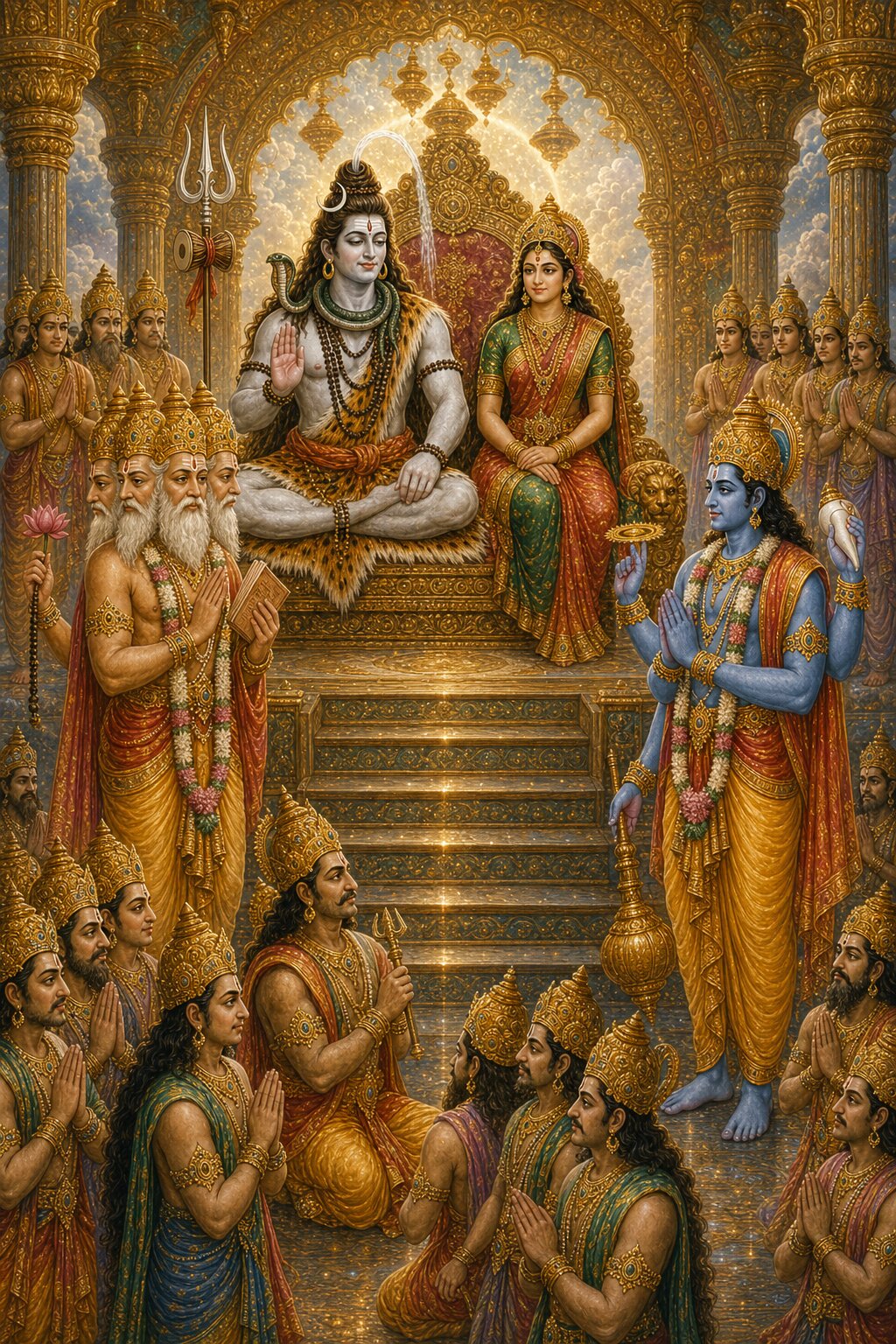
Brahma and Vishnu reached Shivaloka, where Shankara sat with Uma upon a jeweled throne. Folding their hands, the two of them offered praise. “Friend of the helpless, tender to those who take refuge, deliver us.” Shankara smiled, for the whole story of Shankhachuda was already known to him. “I will slay him together with his soldiers; of this there is not the slightest doubt.”
These words filled the gods with the deepest joy. Then Shankara made his beloved Chitraratha, king of the gandharvas, his envoy and sent him to Shankhachuda with counsel drawn from shruti and smriti. But Shankhachuda would not agree to return the kingdom without a fight, and he said, “Without doing battle with Maheshvara I will surrender neither the kingdom nor the dominions. Let Rudra do as he thinks fit.”
Shiva’s march and the battle
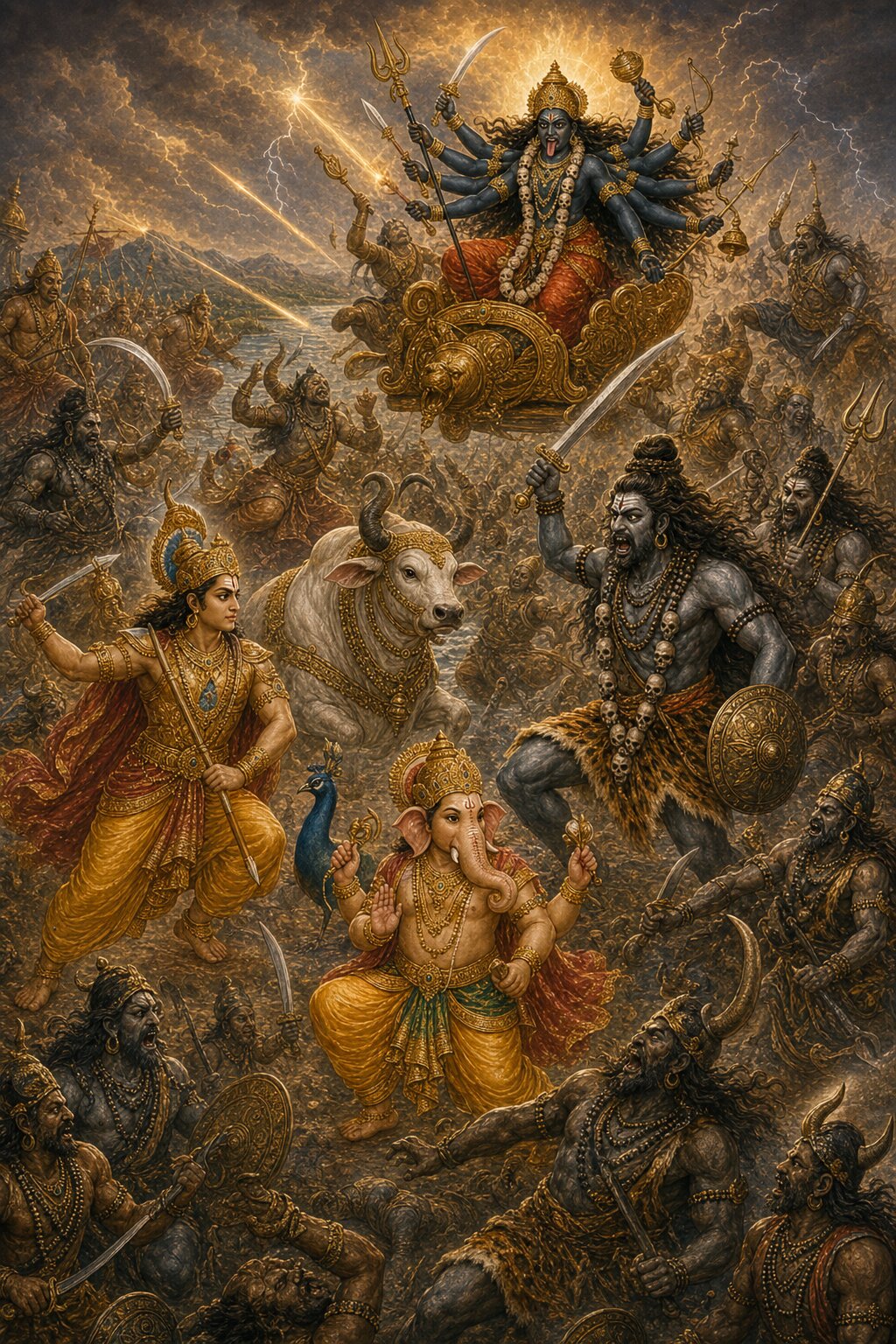
When the envoy returned with this reply, anger rose in Shankara. He ordered Virabhadra, Nandi, Kshetrapala, and the eight Bhairavas to arm themselves and stand ready. Prince Kartikeya and Ganesha came too, clad in armor, and Bhadrakali mounted her celestial chariot with her army and a wealth of divine weapons. Millions of ganas, the eleven Rudras, the eight Vasus, Indra, the twelve Adityas, and the other gods came on behind Maheshvara, and drum-bearers followed them in their hundreds. Shiva came and stood beneath a splendid banyan tree.
On the other side, Shankhachuda said to Tulasi, “My lady, having heard news of war from the mouth of Shambhu’s envoy, I am ready to go; give me your leave.” Then he completed his morning rites, gave generous gifts, anointed his son upon the throne, steadied the weeping Tulasi, put on his armor, and set out for battle, a man who knew his duty and had been deluded by destiny. With his army he took his stand on the bank of the Pushpabhadra, facing Shiva’s host.
Shankhachuda too sent an envoy, and the envoy put the case sharply: why should the lord of gods and asuras alike take a side, when victory would add nothing to his fame and defeat would cost him everything? Maheshvara laughed and answered sweetly. “We are subservient to our devotees; we are never independent, and we are no one’s partisan. Hari fought Madhu and Kaitabha because Brahma had asked it first. Hiranyakashipu was slain for the sake of Prahlada, at the gods’ request. I burned the Tripuras at the request of the gods, and Parvati, the mother of all, killed Shumbha and the rest at the request of the gods. Today the gods have sought refuge in Brahma, and Brahma with Vishnu has sought refuge in me.” Hearing this, Shankhachuda gladly accepted the fight.
Then a terrible battle broke out. Indra closed with Vrishaparva, Surya with Viprachitti, and Vishnu with Dambha; the eleven Rudras grappled with eleven demon champions. On the field Bhadrakali gave so fearsome a lion’s roar that the danavas fell senseless where they stood. She hurled fire as fierce as the flame of dissolution and he put it out sportively with the Vaishnava missile. She loosed the Narayana weapon, and it gathered its whole power on seeing him, and he fell flat upon the ground and bowed to it until it turned away. She invoked the Brahmastra, and he bowed and fell before that too, and so stopped it. Then he discharged divine missiles at her, and she opened her mouth wide, swallowed them, and laughed. So it went for a long while, with gods and danavas standing by as onlookers.
Armor, chastity, and the trident
At that moment a voice sounded from the sky and stopped her hand as she reached for the Pashupata arrow: this danava’s death will not come even by that unfailing missile. She rushed at him to devour him; he held her off with the missile of Rudra and vanished from sight. Unable to see him, she crushed his chariot and killed his charioteer with her fist. He returned and flung a wheel blazing like the fire of dissolution at her; she caught it in her left hand and swallowed it. Then the Goddess struck him with her fist, and the king of the danavas whirled about and fainted. He rose again at once and would not fight her with his arms, for he took her to be a woman like his own mother. She seized him, whirled him round, and tossed him high, and he fell far off, got up, and bowed to her. Then the voice sent Bhadrakali back from the fight.
Now Shankara himself rode Nandi onto the field, taking Virabhadra and the Bhairavas with him, and entered the battle ground looking like the annihilator with a body. The instant he saw Shiva, Shankhachuda stepped down from his chariot, fell full length upon the earth like a staff, and bowed in devotion. Then he climbed back onto his chariot, took up his bow, and a rain of weapons began to fall between the two of them. Then the voice from the sky spoke again. “Vyomakesha, you could destroy the whole universe in a trice, and what doubt could there be about one danava? Still, the limit the Vedas set should not be disregarded. As long as this man’s wife keeps her chastity whole and as long as he wears the Krishna-kavacha, his death is not possible.”
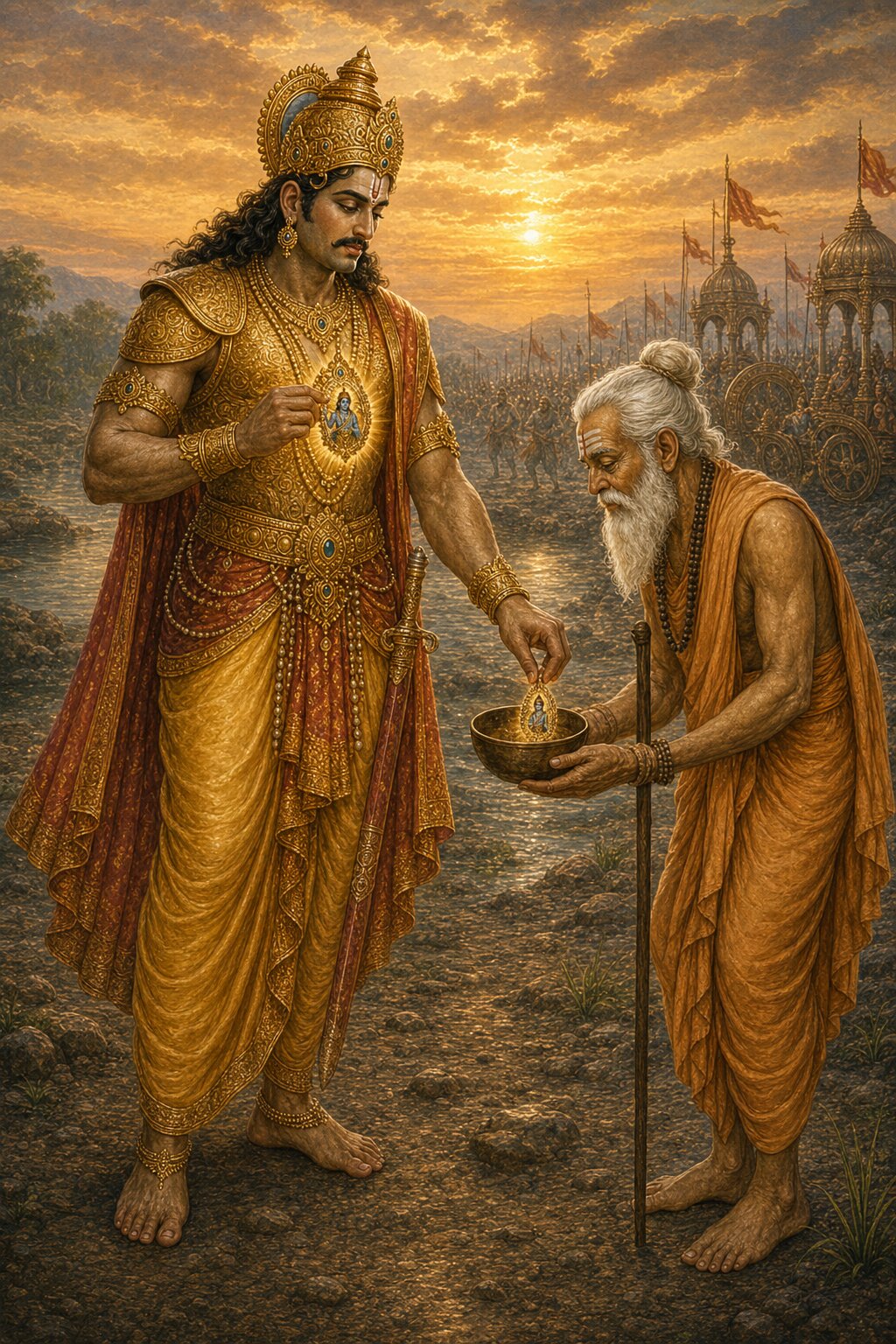
At Shiva’s prompting, Vishnu put on the guise of an aged Brahmin, approached Shankhachuda, and asked for alms without naming them, waiting first for the promise. The king gave it with pleasure in his face, and then the Brahmin named what he wanted: the armor. Shankhachuda, devoted to Brahmins and true to his word, handed over that divine amulet, his own vital breath, as though it were nothing. Then Hari took on Shankhachuda’s very form, went to Tulasi, and took from her the chastity she had kept. Meanwhile the lord of the danavas came before Shiva without his armor, and Shiva took up the trident to kill him. That trident had a name, Vijaya. It was a thousand dhanus long and a hundred hastas wide, refulgent as ten million midday suns, never once ineffective. It whirled a while above his head, fell at Shiva’s behest, and reduced him to ash. Its work done, it returned by the path of the sky. Kettledrums rang out in heaven, flowers rained down upon Shiva, and Shankhachuda regained his former form as an attendant of Krishna.
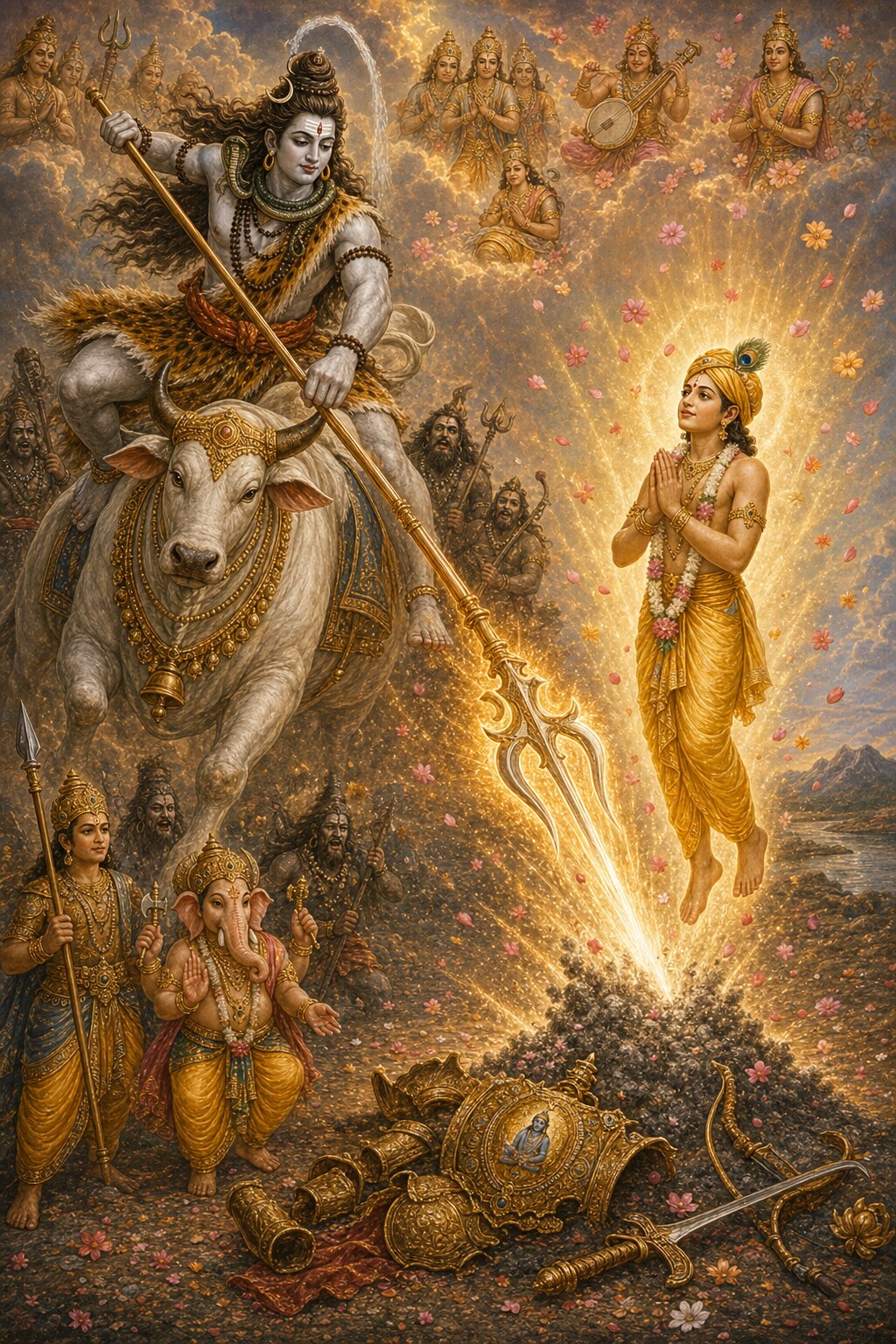
Every conch shell in the world is formed from Shankhachuda’s bones. The water of the conch is dear beyond measure to Hari and Lakshmi and is held auspicious for all the gods and for everyone connected with Vishnu; to Shankara alone it is never offered. Having slain Shankhachuda in this way, Shankara returned to Shivaloka with Uma, Skanda, and his ganas. Vishnu went to Vaikuntha, Krishna was content, and the universe came back to itself: the earth freed of obstacles, the sky pure, and a perfect peace over the world.
Source: Shiva Purana (Gita Press, Sankshipta Shivapurananka), Rudra Samhita, fifth (Battle) Khanda