On this page
On Kailasa, those were sweet days. Shiva and Parvati would watch the childhood play of their two sons and lose themselves in love. On one side stood six-faced Kartikeya, whom some called Shadanana and others Skanda; on the other stood elephant-faced Ganesha, whose intelligence had no measure. Both boys served their mother and father with devotion in their hearts, and the more Shiva and Parvati watched them, the more their tenderness grew from day to day, like the moon through the bright fortnight. It was this very episode that Brahma once recounted, when Narada asked him about it.
Two sons, one rivalry
One day Shiva and his consort sat together in private and began to weigh a matter between themselves. Both our sons have grown old enough to marry now; how should their weddings best be arranged? Shadanana is as dear to us as Ganesha, and both equally beloved. Sunk in this thought, and moved by their own divine play, the two sat there glad and worried in the same breath, which is the condition of parents everywhere.
Both sons guessed at once what was on their parents’ minds, and inside them too a longing for marriage awoke. Then a rivalry sprang up between the pair. I will marry first, said one; no, I will marry first, said the other, and they went at it again and again. Hearing this from their sons, that couple who are the lords of the world were filled with wonder, and, taking the help of a worldly custom, they called both boys close.
The contest here is over whose wedding should come first.
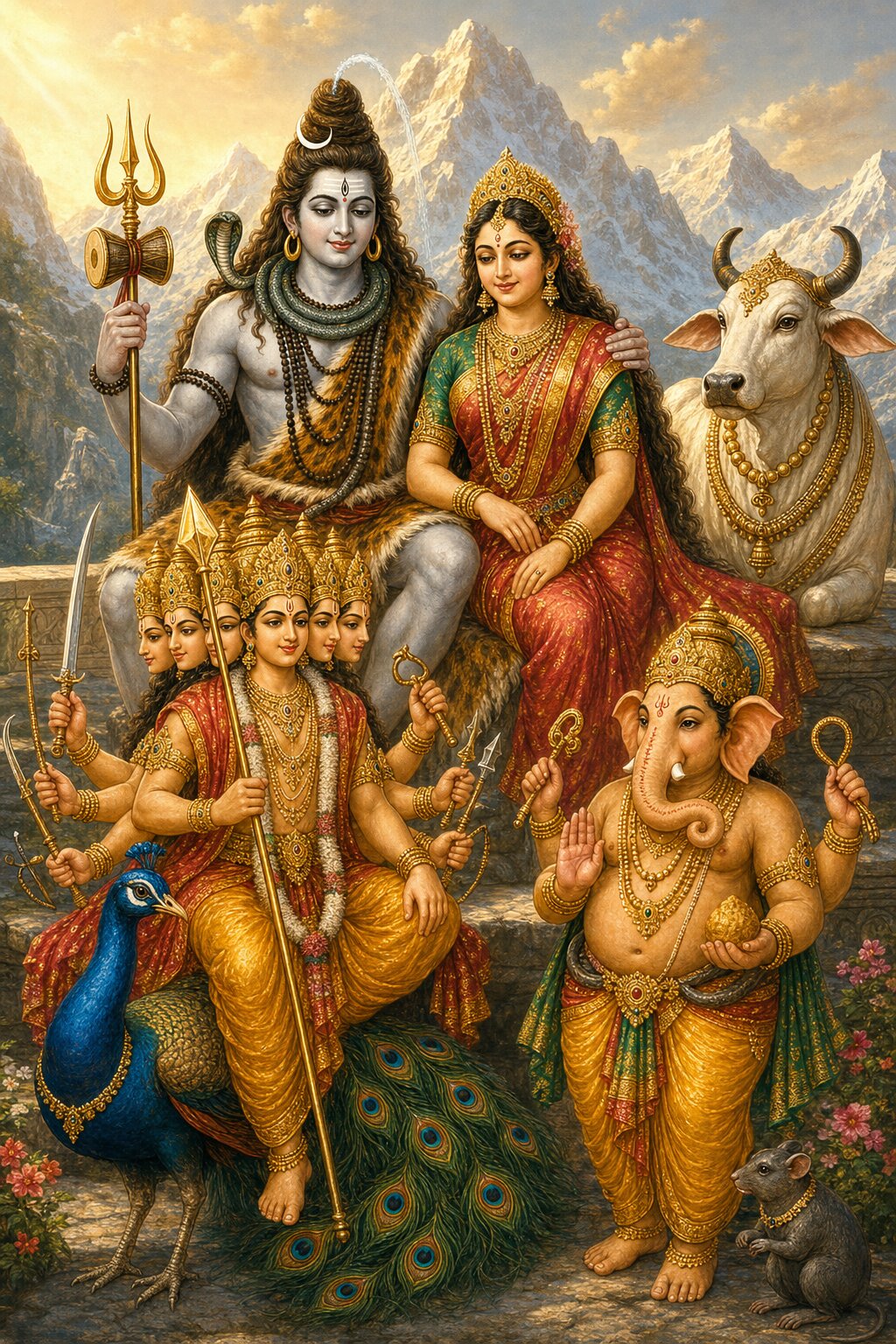
Shiva and Parvati said, listen, our dear sons. We have already settled on a rule, one that will bring happiness to you both. You are equally dear to us, with no special love shown to either; so for the matter of marriage we have set a single condition. Whoever circles the whole earth and returns first, his wedding will be performed first.
The condition: circling the earth
The moment he heard this, mighty Kartikeya, born in the reeds, rose at once from his place and set off to circle the earth. But Ganesha, whose intelligence ran deep, stayed standing exactly where he was and watched his brother go. He began to think to himself: what should I do now, where should I go? This circling is not something I can manage. After walking a single kos my feet will refuse to go farther. How then will I ever find happiness by wandering the whole earth?
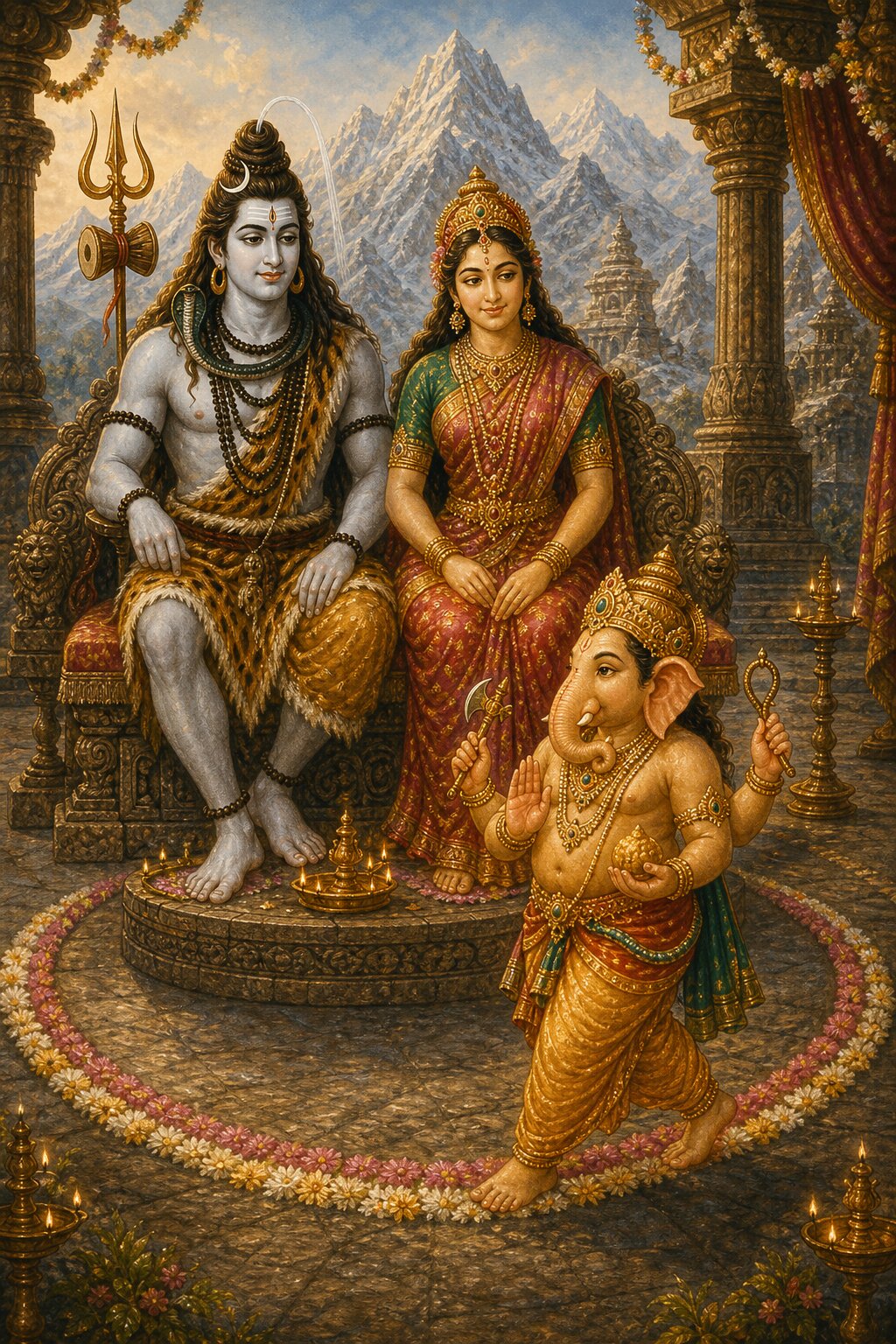
Hear now what Ganesha did after this reflection. He returned home, bathed by the proper rites, and said to his parents: Father, Mother! I have set two seats here for your worship. Be seated on them, both of you, and let my wish be fulfilled.
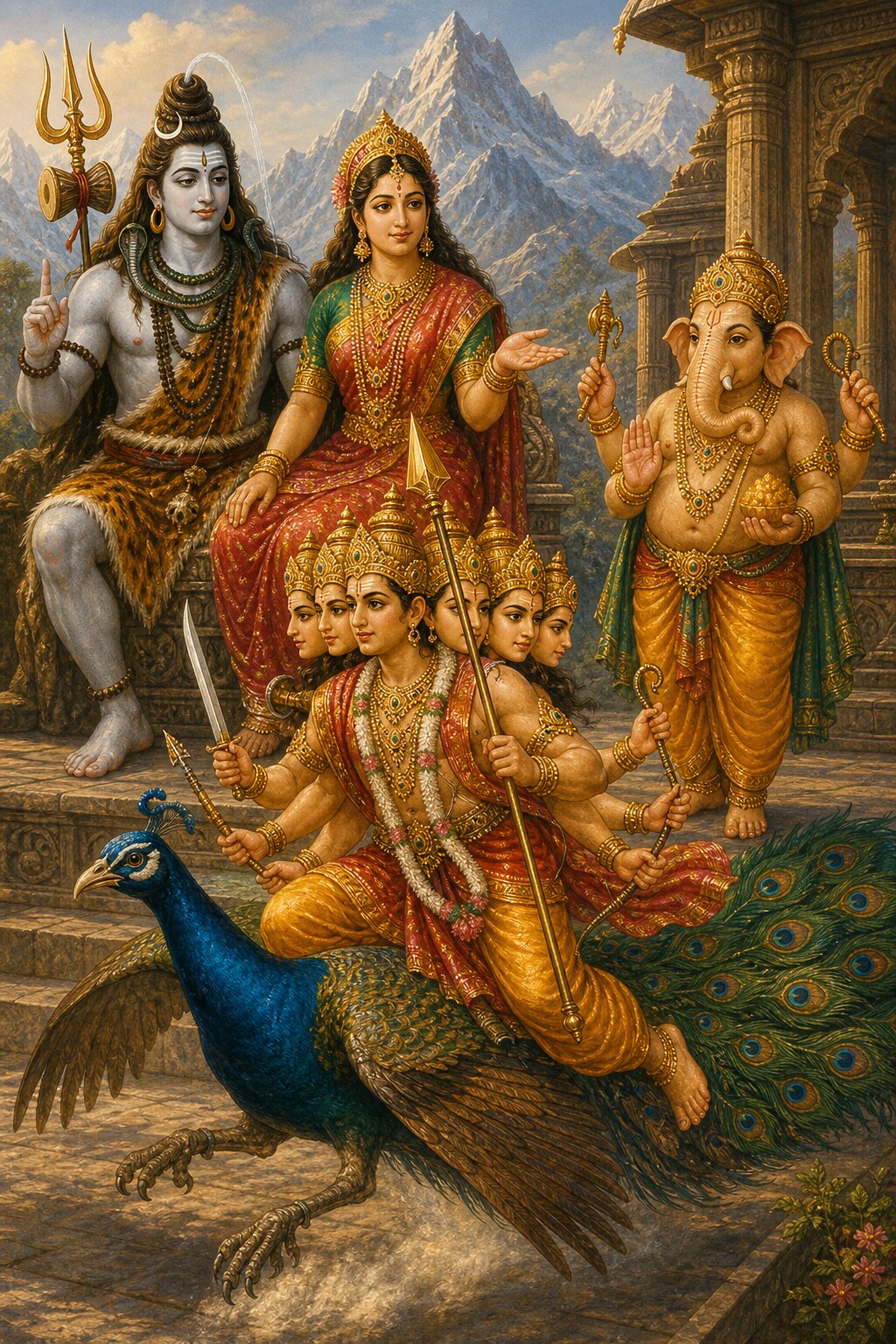
Hearing Ganesha’s words, Parvati and the Supreme Lord took their seats to receive the worship. Ganesha worshiped them by the proper rites, circled them seven times, and bowed to them seven times. Then, palms joined and steeped in love, Ganesha, that ocean of intelligence, praised his mother and father and said: O Mother, O Father! Now hear my excellent proposal, and perform my auspicious wedding at once.
Mother and father are the pilgrimage
Keeping up their play, the parents answered: Son! First go and circle this whole earth yourself, its forests and all. Kumara has already set out; you go too, and return before him, and then your wedding will be performed first.
Ganesha, firm about the rule, heard this and spoke with a touch of indignation: O Mother, O Father! You are both supreme, the very form of dharma, and possessed of vast intelligence; so, in keeping with dharma, hear what I say. I have already circled the earth seven times, so why do you speak to me like this?
Playing their game once more, Shiva and Parvati said: Son! When did you ever circle this vast earth, the earth that stretches to the oceans, crowded with great forests, made of seven continents?
Then Ganesha of the vast intelligence said: Mother and Father! With my intelligence I worshiped the two of you, Shiva and Parvati, and circled you, and by that alone my circling of the earth to the very oceans was completed. The words found in the Vedas and the shastras, which are the embodied form of dharma, are they true or false? They say that the son who worships his mother and father and circles them gains the fruit of wandering the entire earth. And the son who leaves his mother and father at home to set out on a pilgrimage takes on the sin of having killed them, because for a son the lotus feet of his parents are themselves the greatest tirtha (holy place). Other holy places must be sought at a distance, and reaching them is most of the labor. This one is near, it is easy, and it makes a man virtuous where he stands. For a son and for a wife the tirtha is inside the house. The visible form of dharma stands right here. If this teaching is held to be false, then the Vedas too must be held false, and the form of you that the Vedas describe would be counted false as well. So either perform my wedding at once, or declare that the Vedas and shastras are false. You are both the form of dharma; consider it well and do whatever seems most excellent to you.
Having said this much, Ganesha, first among the wise, fell silent. Shiva and Parvati, the lords of the world, were astonished to hear their son’s words, and, praising his truthfulness and his marvelous intelligence, they said: Son! You are endowed with great inner strength, and from it this pure intelligence has risen in you. What you say is entirely true. When a person’s intelligence awakens in a time of crisis, his sorrow dissolves the way darkness dissolves the moment the sun rises. The one who has intelligence is the strong one; where is strength for the one without it? A hare no bigger than a hand once talked a proud lion down a well. Every duty that the Vedas, the shastras, and the Puranas lay down for a child, you have carried out in full. What you have done, who else could do? We accept your word; now we will do nothing against it.
Siddhi and Buddhi
Having spoken this way, they comforted Ganesha, that ocean of intelligence, and began to plan his wedding. Meanwhile, when the Prajapati Vishvarupa, glad of mind, learned of Shiva’s effort in this, he thought it over and was filled with great joy. He had two supremely beautiful daughters, named Siddhi and Buddhi. Shankara and Girija settled Ganesha’s marriage with these two maidens. In keeping with Parvati’s wish, Vishvakarma brought the wedding to completion. The sages and the gods felt the highest delight to see it, and the happiness Ganesha found on gaining his two wives cannot be described.
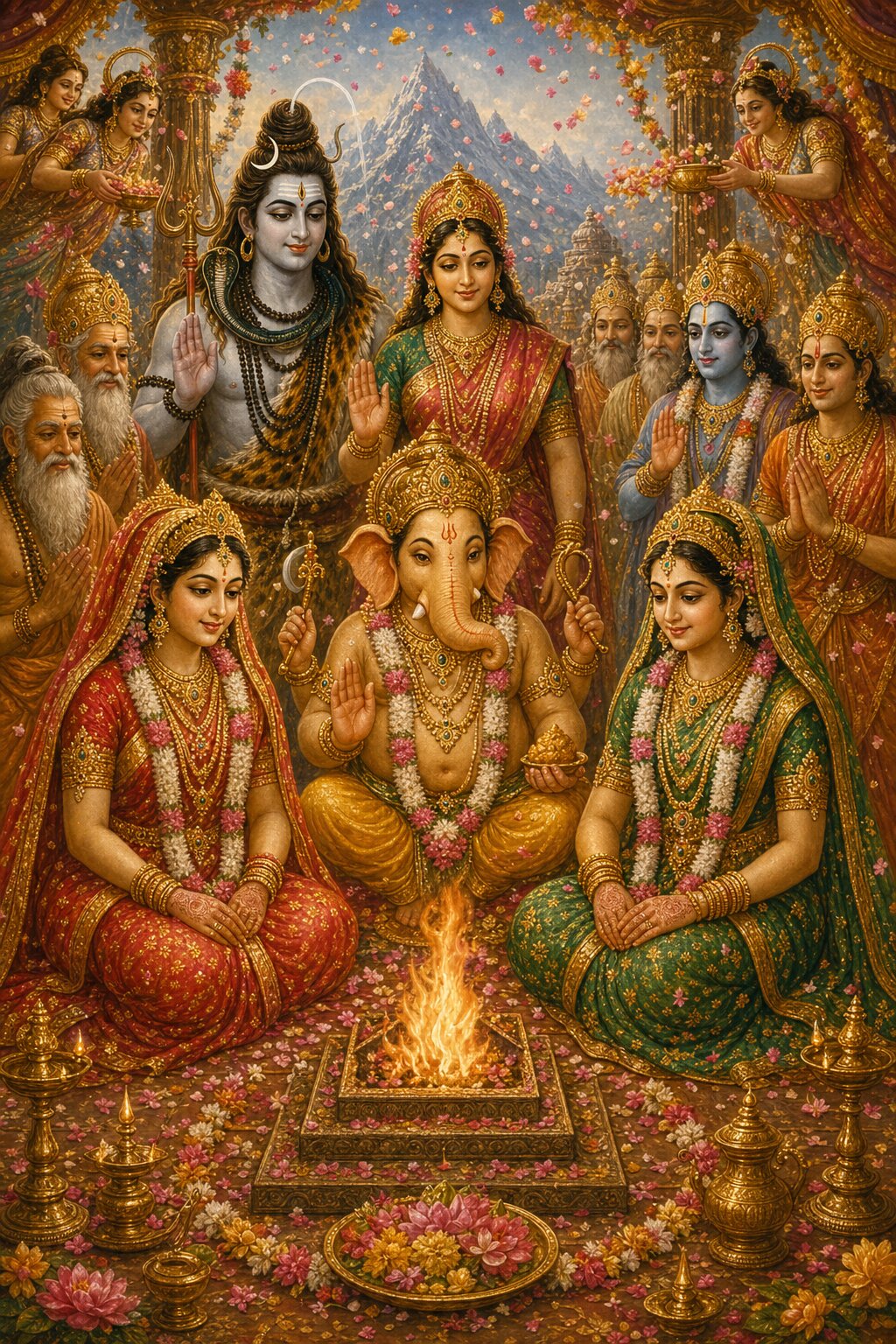
Some time later, two divine sons were born to Ganesha from these two wives. The one born from the womb of Siddhi was named Kshema; and the supremely handsome son who came from the womb of Buddhi was called Labha. In this way Ganesha, enjoying happiness beyond thought, settled into his home.
Mount Krauncha and Mallikarjuna
Meanwhile the other son, Swamikartika, returned from completing his circling of the earth. At that very moment Narada came out to meet him, and what Narada said, he said because Shiva had put it into his mind to say. “I am telling you the truth and no lie, and there is no mischief in me and no rivalry. What your parents have done, no one else in this world would ever do. They sent you away on a pretext, to walk around the earth, and while you were walking it they held Ganesha’s wedding. He has two wives now, Siddhi and Buddhi, the daughters of Prajapati Vishvarupa, and two sons off them, Kshema of Siddhi and Labha of Buddhi, and he is sitting in his happiness at this moment exactly as your parents intended. You crossed every ocean and every forest on the whole earth on a crooked errand, and this is what it bought you. Consider it. If parents take to deceiving, if the very ones we are taught to trust take to deceiving, what is left to keep anyone else honest? If a mother gives her son poison, if a father sells his son, if a king helps himself to what his subjects own, who is there to complain to, and about whom? They have not done well by you. A man of sense never looks again at the face of the one who has done him such a turn. This is what the Vedas say, and the Smritis, and the sacred texts, and I have now laid it in front of you. Do as you like.” Then Narada stopped talking. The instant he heard it, a great agitation rose in Kumara’s heart. He bowed to his father, and then he went. His mother and father tried hard to hold him back. Why go, they said, when we forbid it? He said no. “I will not stay here one moment longer, where deception has been worked on me and the love has been left out.” And he set off toward Mount Krauncha.
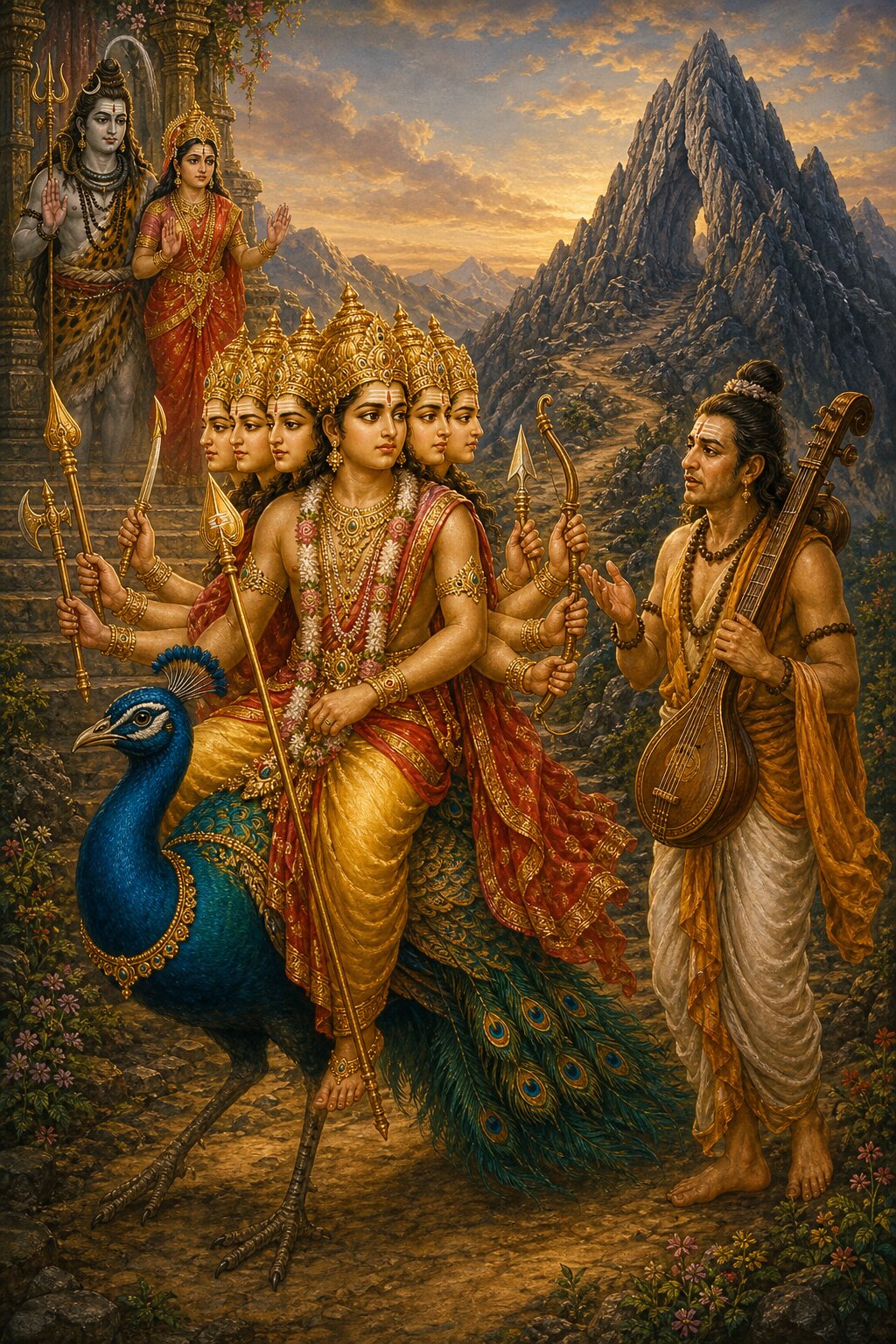
From that day on, the celibate youth of Shiva’s son Swamikartika became famous through the three worlds. This form of his bestows what is auspicious, carries away all sins, and grants the power of the highest brahmacharya (celibacy). On the full moon of Kartika, the gods, the sages, the sacred tirthas, and the munis always go to Mount Krauncha for the darshan of Kumara. The person who takes the darshan of Swamikartika on the day of the Kartika full moon, in the conjunction of the Krittika constellation, has all his sins destroyed and receives the fruit his heart desires.
Uma, for her part, was struck with great grief at her separation from Skanda. Humbly she said to her lord: My lord! Take us along and let us go there too. Then, to bring his beloved happiness, Shankara himself came to that mountain in a portion of his being and was established there in the form of the joy-giving Mallikarjuna jyotirlinga. He is the refuge of the virtuous and fulfills every wish of his devotees; even today he abides on that mountain with his consort. And when Kumara learned that his mother and father had come to the very mountain he had chosen, the last thread in him let go and he made ready to move on again. The gods and the sages asked him to stay. He stayed, three yojanas off, and no nearer.
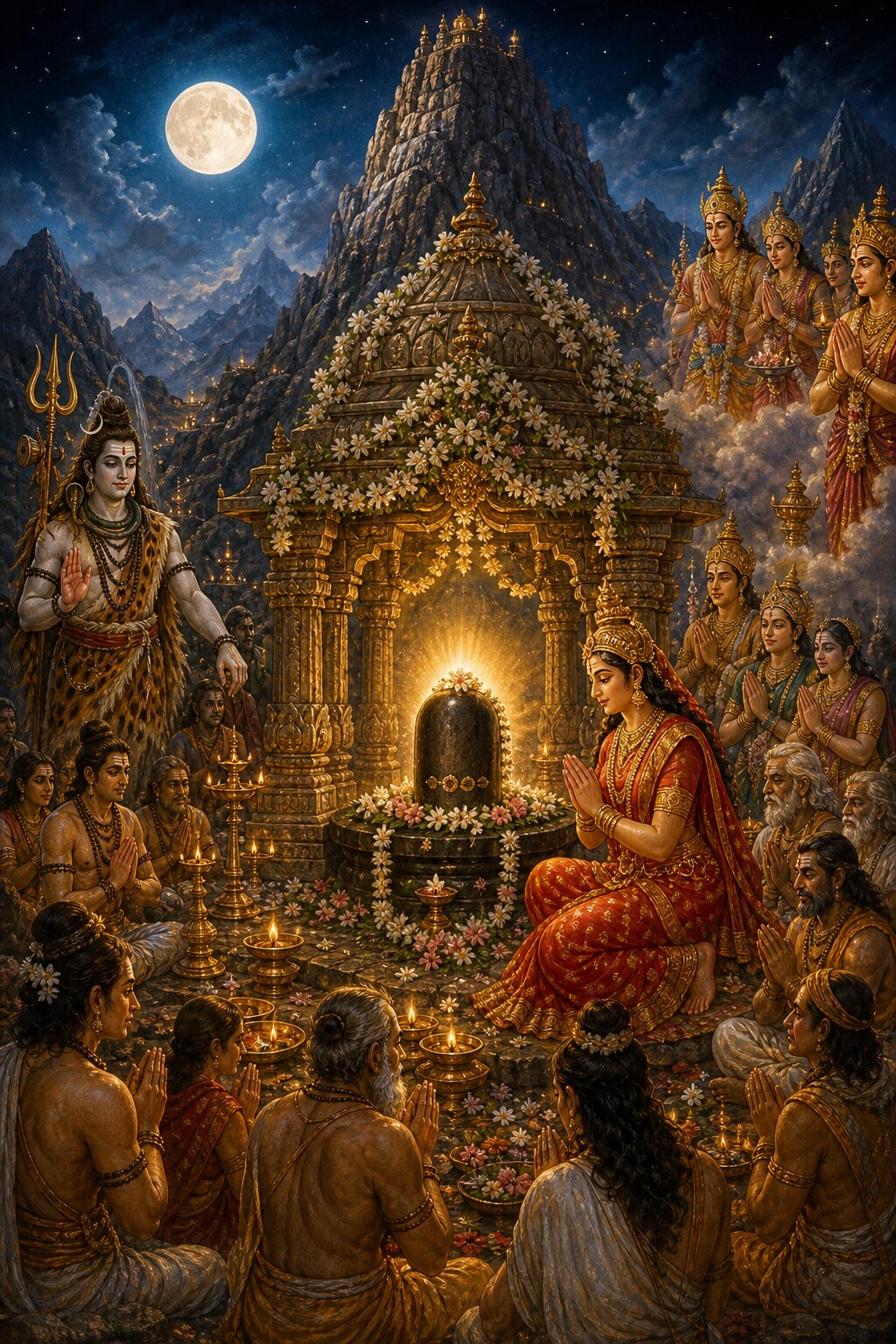
Bound by their love for their son, the two of them, Shiva and Parvati, go to see Kumara on every festival day. Love for him gets the better of them on those days, and they make the journey he will not make. On the day of the new moon Shambhu himself goes there, and on the day of the full moon Parvati goes.
Whoever reads or teaches, hears or recites this account of Swamikartika and Ganesha finds all his wishes fulfilled. This matchless narrative destroys sins, increases fame and happiness, grants long life, multiplies sons and grandsons, frees the sick of their sickness and the frightened of their fear, keeps ghosts and goblins from troubling a man, kindles love between Shiva and Parvati, and deepens devotion to Shiva. Let those who seek moksha (liberation) and the devotees who ask nothing for themselves always listen to it.
Source: Shiva Purana (Gita Press, Sankshipta Shivapurananka), Rudra Samhita (Kumara Khanda)