On this page
The gods no longer set foot on the stairways of heaven. Where Indra’s throne had once stood, a demon now sat at his ease, and the three worlds trembled at the flick of one eyebrow. When Narada asked the grandfather Brahma why the marriage of Parvati had become so urgent a matter, Brahma began the story that runs back to the birth of Tarakasura. He told of the fierce austerity that demon had performed: a hundred years with his arms held up, standing on one leg, staring into the sun; a hundred more balanced on the tip of a single toe; a hundred taking nothing but water and a hundred taking nothing but air; a hundred hanging head downward from a branch with the smoke of a fire in his lungs. He told of how the heat coming off that penance rose in a column from the demon’s head and began to eat the worlds of the gods, until Brahma himself walked out to the forest and offered him anything he wanted. He told of the exact boon Tarakasura desired, and asked for, and got: that no one in all creation should stand equal to him in strength, and that if ever a son born of Shiva should take command of an army and turn a weapon against him, then, and only then, let him die. The demon wrote his own death into his own boon and walked away satisfied. And Brahma told of how he had then conquered gods and demons alike and installed himself in the very office of Indra.
The three worlds in one fist
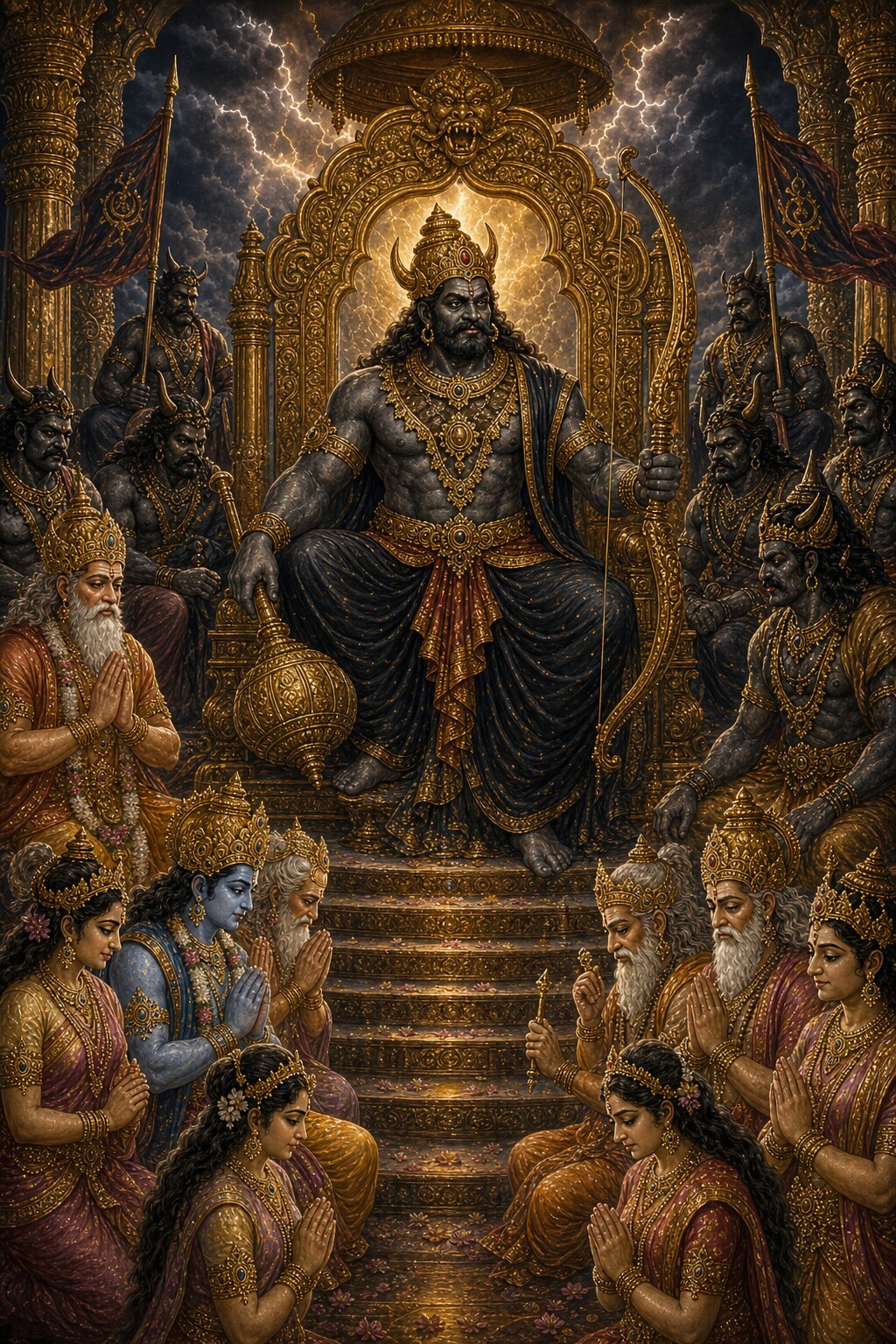
Brahma tells the tale. Shukra, the preceptor of the demons, gave his blessing, and Tarakasura was crowned king of the three worlds. Once he had bent them to his will and seated himself as Indra, no ruler anywhere remained his equal. Master of his senses, sole lord of the triple universe, the demon governed in a strange and startling fashion. Anything fine that his eye happened to fall on, he took, and the three worlds were emptied of everything worth having. Indra gave up Airavata. Kubera gave up his nine treasures, Varuna his white horses, the sages the wish-granting Kamadhenu, and the sun surrendered Uchchaihshravas; the oceans carried up their gems to him unasked, out of fear. The earth put out whatever his subjects wanted without waiting to be plowed. The sun burned mildly so as not to trouble him, the moon kept its full light where he could see it, and the wind blew the way he preferred. He stripped every god of his office and set demons in their places. The Vidyadharas and all the other celestial races he seized and harnessed to his own labors. Those who had once been called lords of the worlds now stood before a single demon with their hands folded in submission.
The gods’ plea
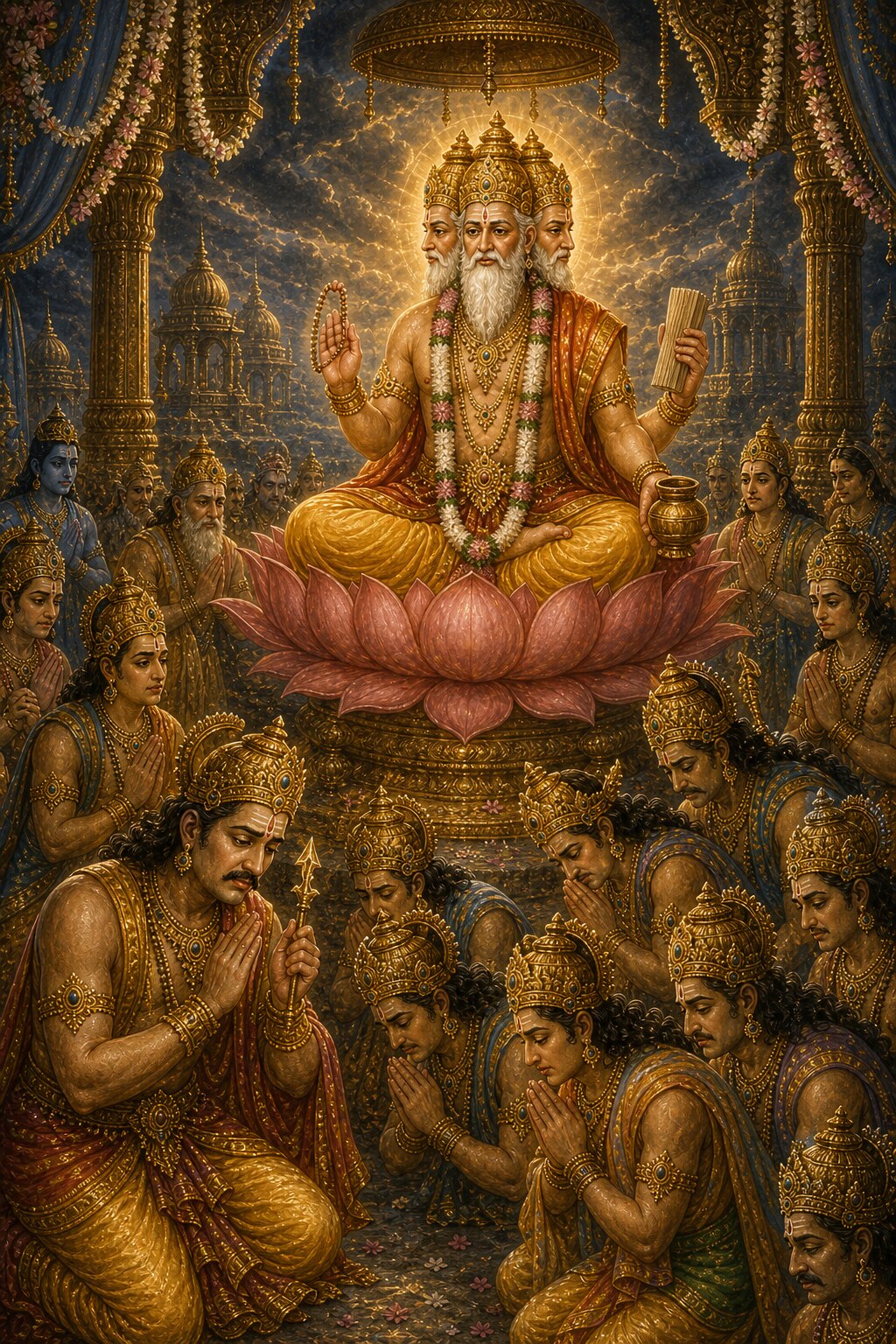
At such a time, Indra and all the gods, tormented by Tarakasura and brought to helplessness and grief, came to us for refuge. Every one of them bowed to me, the lord of creatures, praised us with deep devotion, and laid out the tale of their terrible suffering. They said, “Lord, you are our recourse, you are the one who instructs us in our duty, you are our sustainer and our deliverer. He hunts us by day and he hunts us by night, and wherever we run to, we arrive and find Taraka already in it. Agni, Yama, Varuna, Nirriti, Vayu, the guardians of the quarters, every one of them answers to him now. Not one is his own master any longer. They wait on him with their whole retinues behind them, the way hired men wait on a householder, and we are all of us his servants. Our women, the companies of apsaras, he has taken. No sacrifice is lit anywhere. No ascetic sits in penance. Charity and right conduct have all but gone out of the worlds. His commander is Krauncha, a demon of no particular distinction, and he has gone down into the nether worlds and is grinding the people there. Heaven is not ours to return to; name any place and we will go and live in it. All of us gods are burning in a fire named Tarakasura, and that fire refuses to go out.”
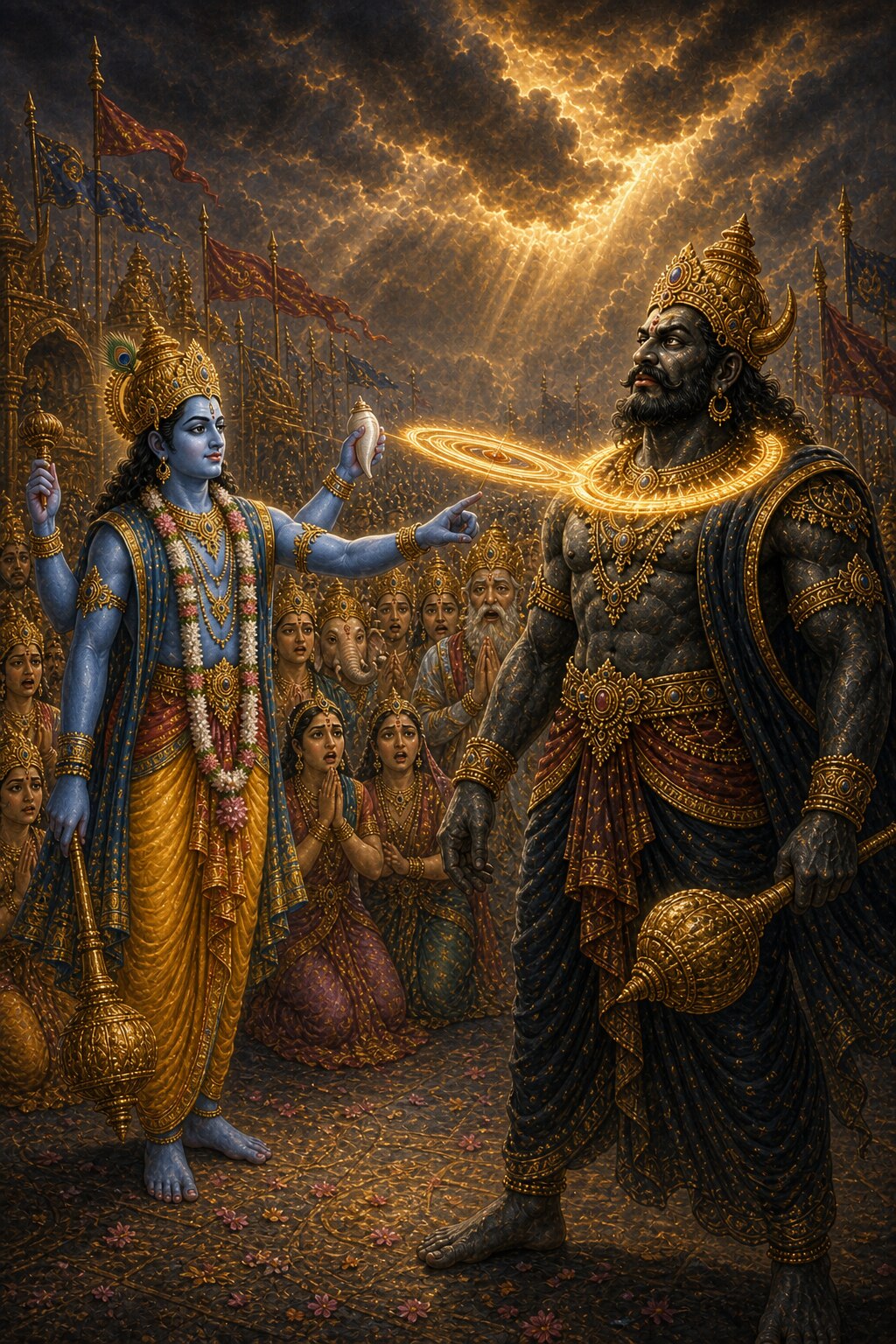
“As in the fever of sannipata the strongest medicine loses its power and falls away spent, so this demon has turned every one of our harshest measures to nothing; we have used them all on him and they came back to us weak. One hope of victory remained to us, the Sudarshana discus of Lord Vishnu. Even that discus, striking his throat, was blunted. Coming to rest at his neck, it looked as though someone had draped the demon in a garland of flowers.” As they said this, the eyes of the gods were lowered and their voices shook.
The one remedy
Hearing what the gods said, we gave them counsel fit for the hour. We said, “Gods, everything this demon is, he is by a boon of ours. For that reason it is not right that he be felled by our own hands. A man who has watered a tree of poison with his own hands and raised it high is held unfit to be the one who takes an axe to it. Lord Shankara alone is equal to accomplishing your whole purpose, yet even at your asking he cannot himself go out against this demon. The demon Tarak will perish by his own sin. Do exactly as we instruct you now. By the power of our own boon, neither we nor Lord Vishnu nor Lord Shankara can kill him. No other hero, and not all the gods gathered together, can slay him; this we tell you as truth.”
Then we opened the secret on which the whole plan rested. We said, “If a son be born from the seed of Lord Shiva, he and he alone can slay Tarak, no other. Best of the gods, do now the thing we prescribe, and by the grace of Mahadeva it will surely come to pass.”
We reminded them, “In an earlier age, Sati, the daughter of Daksha, who gave up her body at Daksha’s yajna, has now been born again as Parvati, from the womb of Mena, the wife of Himalaya. This much is already known to you all. Mahadeva will certainly take that daughter’s hand in marriage. Even so, gods, you too must strive toward it. Work in such a way that Lord Shankara may place his seed in that daughter of Mena, in Parvati.”
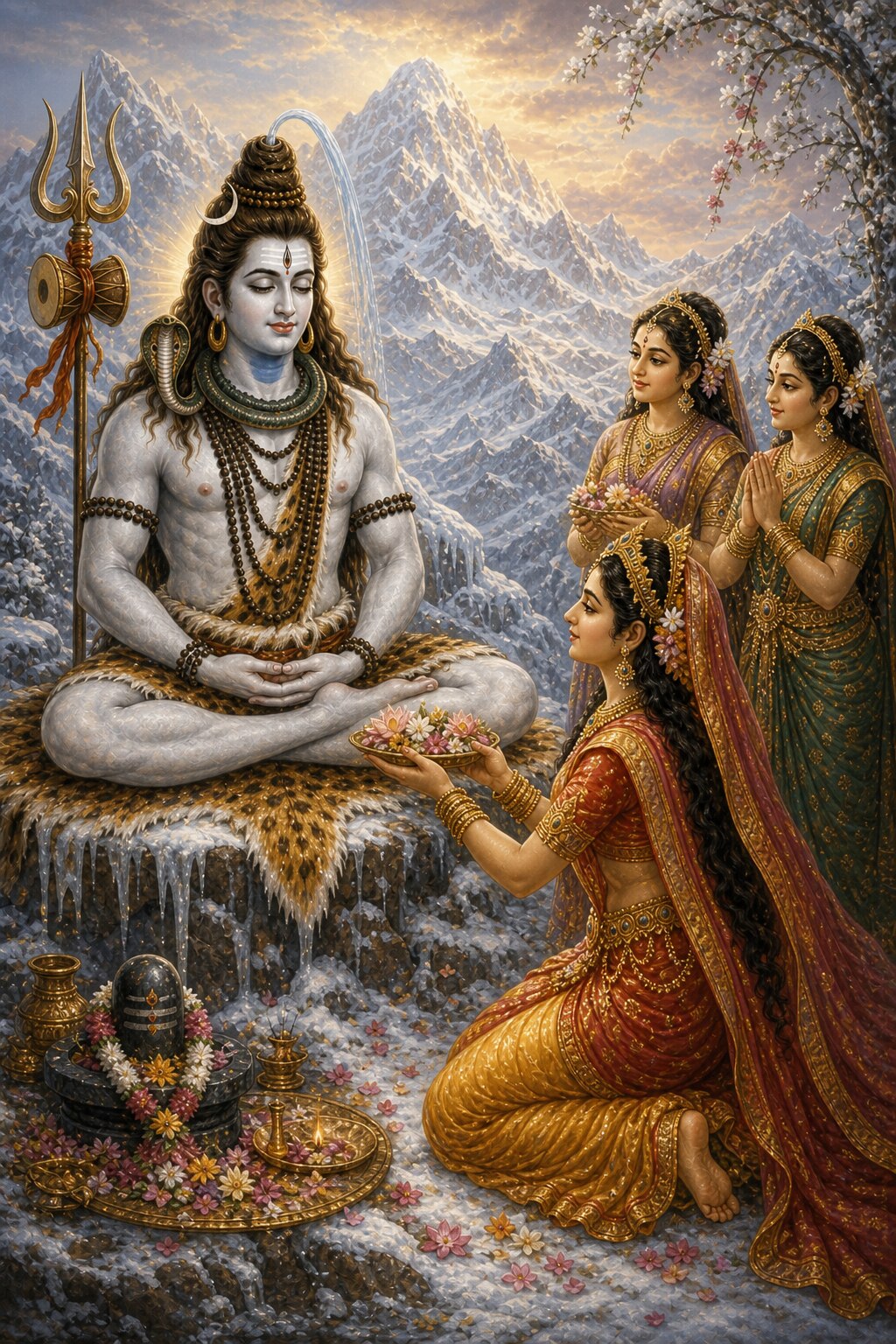
We explained to them the nature of Shiva. Lord Shankara is urdhvareta; his energy is forever drawn upward. To turn that energy downward, Parvati alone has the power, and no other woman can accomplish it by her own strength. That daughter of the mountain king has now entered her youth, and every day she serves Mahadeva as he sits in austerity upon Himalaya. At the word of her father Himavan, Kali attends the meditating Shiva with two companions, steadfast in her service. The loveliest being in the three worlds, Parvati stays before Shiva and worships him without fail, and still the meditating Maheshvara does not stir even in mind from his meditation; the thought of so much as looking toward Parvati never rises in him.
“For that reason,” we said, “gods, make haste to contrive some means by which a desire may wake in the mind of Chandrashekhara Shiva to take Kali as his wife. As for the demon, we will go to him ourselves and try to move Tarakasura from his obstinacy. Now return, all of you, each to his own place.”
Reasoning with Tarak
Having said this much to the gods, we went at once to Tarakasura, called him near with great affection, and spoke. “Tarak,” we said, “this heaven is the essence of our own radiance, and at present you are ruling it. You have begun to crave a great deal more than you bargained for on the day you sat down in that penance. The boon we granted you was a smaller thing than this; we never gave you the kingdom of heaven. Therefore, best of demons, leave heaven and rule instead upon the earth. Every pleasure and every office worthy of the gods will come to you there with ease. There is no need to think otherwise in this.”
Having counseled the demon in this way, and calling to mind the Goddess and Shiva, we vanished from that place. Tarakasura too left heaven and came down to earth, and settling in Shonitapura he began to rule. On their side, the gods accepted our word, bowed to us, and returned with Indra to Indraloka, watchful and glad at heart. When they arrived, they took counsel among themselves and said to Indra, the king of the gods, with affection, “Lord, by whatever means a longing for Parvati may wake in Shiva’s mind, all that effort which Brahma has described is now yours to undertake.”
Having laid the whole account before Indra, the king of the gods, in this manner, the gods went gladly to their several places, and from that day they bent themselves to a single end: that by some means Shiva and Parvati should be married, and that the son should be born whose coming Tarak had written into his own boon with his own mouth.
Source: Shiva Purana (Gita Press, Sankshipta Shivapurana edition), Rudra Samhita, third (Parvati) section