On this page
High on the Himalaya, on a peak where even the snow seems to hold its breath, the lord of yogis, Shiva, sat lost in the deepest austerity. He wanted nothing from it. Each day, at her father’s command, Parvati, daughter of the mountain-king, climbed to that place with two companions at her side and her arms full of the season’s flowers, and laid them out for his worship. The loveliest maiden in all three worlds stood before him morning after morning, and Maheshwara, sunk in meditation, never once let the thought of looking her way enter his mind. In heaven, meanwhile, there was uproar. Tarakasura could be killed only one way, by the hand of a boy born of Shiva’s seed. Yet how was a son to arrive in the house of one who sat beyond all desire?
The King of Heaven’s Plea
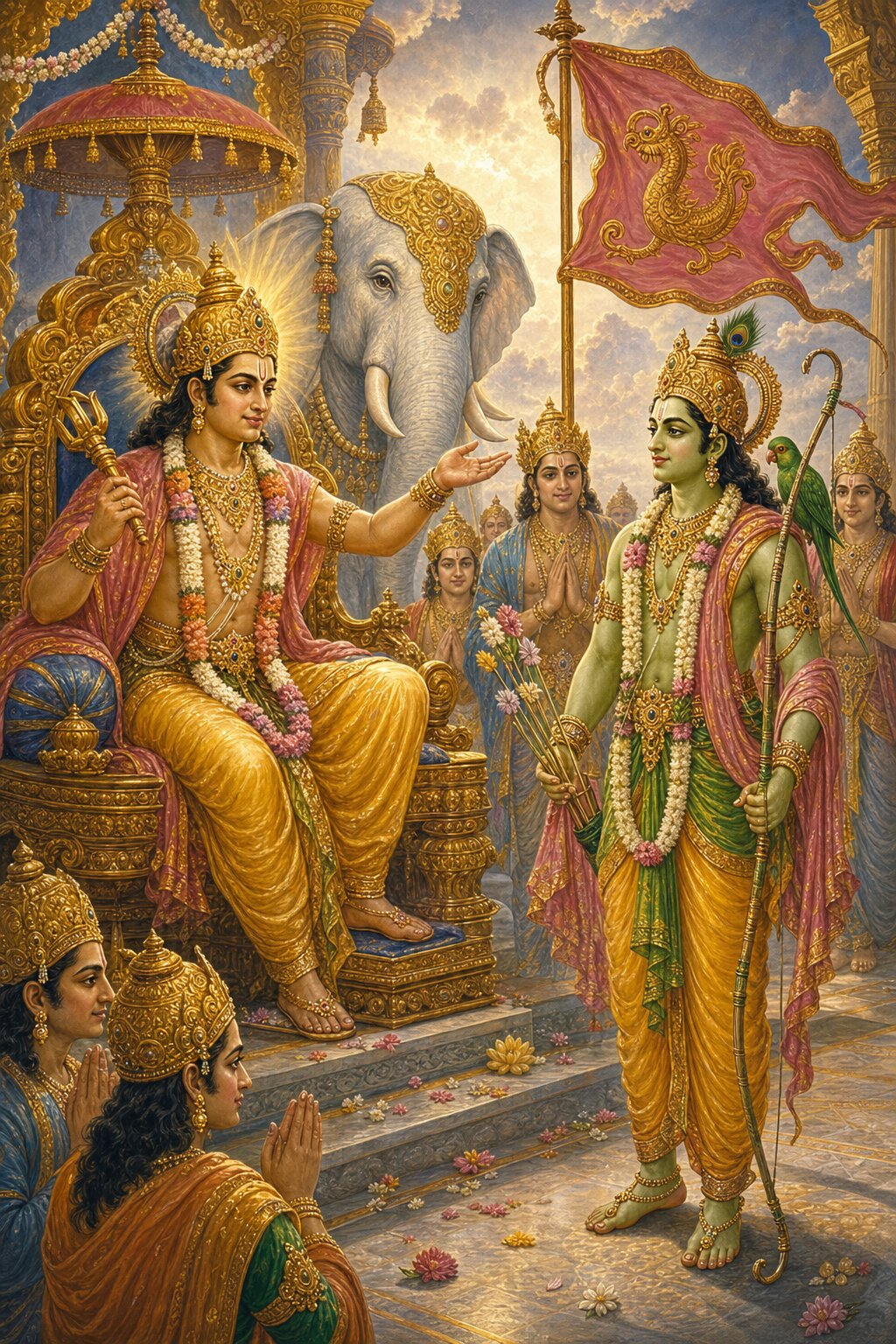
Brahma turns to Narada and says, listen. Once the gods had gone back to their own realms, Indra, tormented by the demon Taraka, called Kamadeva to mind. The moment he did, Madana stood before him, and Rati his wife and Vasanta his friend stood there with him, for those three went nowhere apart. He had brought the three worlds under his hand and carried himself like one who had, yet he folded his palms and asked why he had been remembered, saying that whatever it was, he was already here to do it. Indra praised him for the answer, then spoke. “My friend, a turn of fate has brought a suffering upon me that nothing can cure, and no one but you can lift it. A giver is tested in a famine, a warrior on the battlefield, and a friend in the hour of ruin. Today, then, will be your test. And every god in heaven shares in this errand with me.”
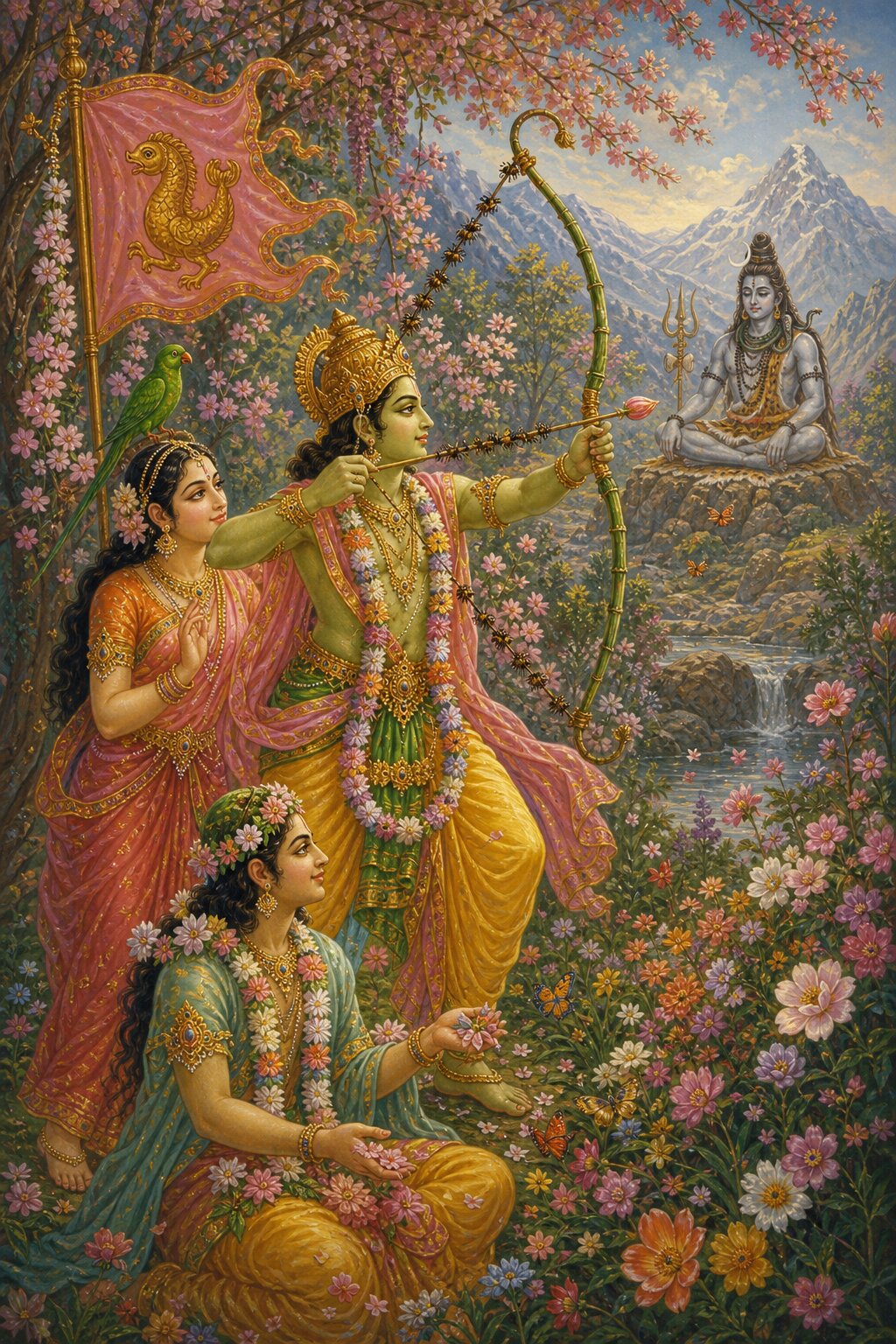
Kamadeva smiled, the fish on his banner riding above him, then spoke in a voice deep and full of affection. “King of heaven, what talk is this? A true friend shows himself in the deed; talk of it settles nothing. This enemy of yours who performs some terrible austerity to seize your throne, I will break him from that austerity completely. Set your thunderbolt aside, and every other weapon in the armory of heaven; what work is left for them while I stand here? Gods, sages, demons, I bring them down with one sidelong glance from a beautiful woman, and human beings I do not trouble to count. I can send Brahma astray. I can send Vishnu astray. I could make even Shiva fall. Five arrows I carry and every one of them is a flower, my bow is a flower, and the string of it is a line of bees. Rati is my strength, Vasanta my minister, the moon with its storehouse of nectar my friend, love itself my commander, and the small gestures and glances of longing are my whole army. Every one of them soft, every one of them gentle, and so am I. The wise man sets each task upon whoever is fit to accomplish it. So place on my shoulders whatever work suits me.”
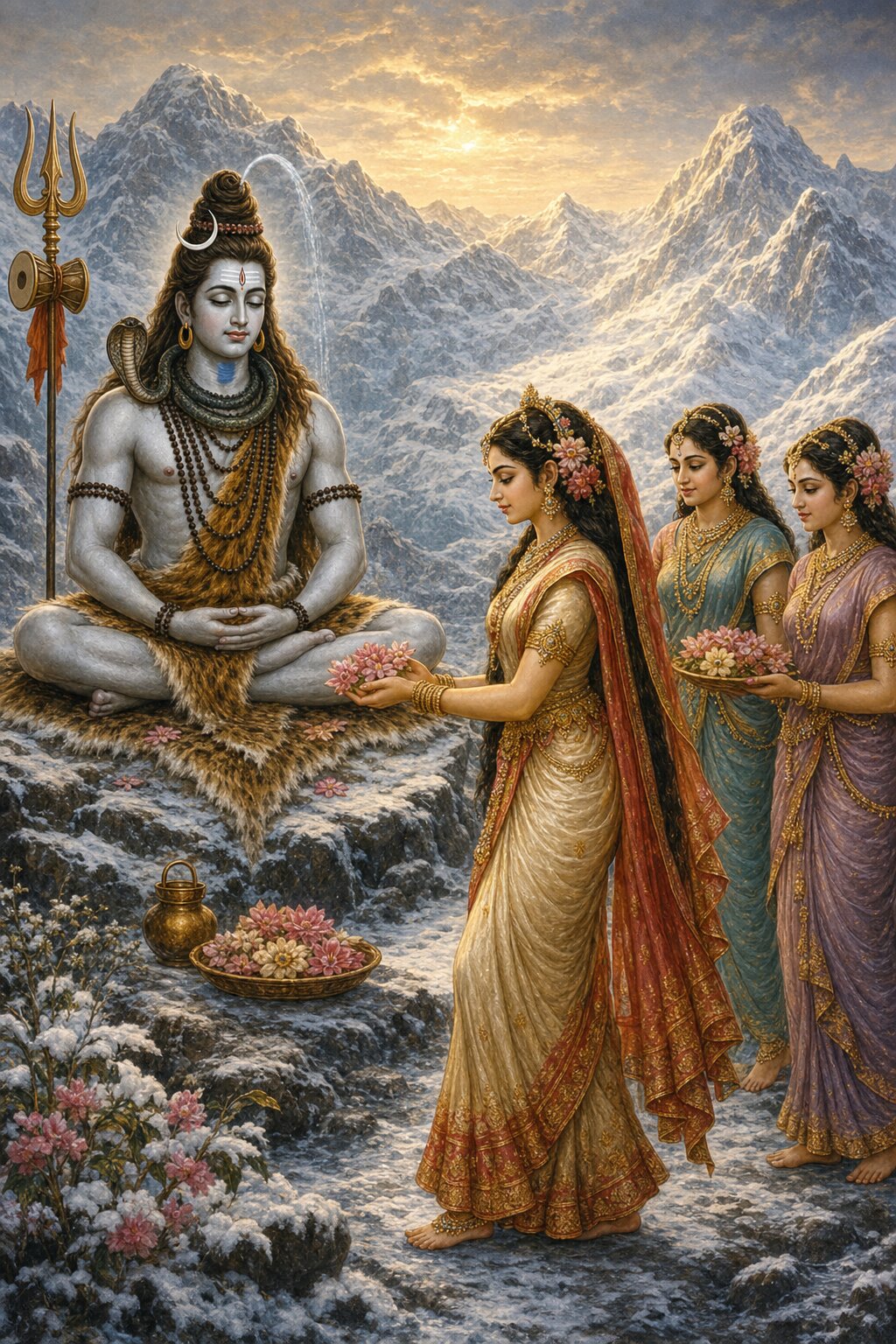
Indra was overjoyed. He said, “Dear Manobhava, you alone have the power to accomplish what I have set my mind on. A mighty demon named Taraka has won an astonishing boon from Brahma and become invincible, and he torments the whole world. Rites go unfinished, the gods are wretched, and the sages with them. We fought him once with everything we had, and every weapon of every god came back to us useless. Varuna’s noose snapped. Even the Sudarshana of Vishnu turned blunt against his throat. Brahma has told us that his death will come by the hand of a boy born from the seed of lord Shambhu. Lord Shambhu sits in austerity upon Himalaya, king of mountains. He is our master too, a sovereign lord who bows to no desire; he wants nothing at all from that penance, and that is what makes it so hard to reach into. Parvati stays near him with her two companions and serves him, and all her effort is aimed at winning Mahadeva as her husband. Yet Shiva holds his mind under perfect restraint. Mara, by whatever means, wake in him a deep longing for Parvati. Do this, and you will have fulfilled your purpose; all our sorrow will end, and your glory will spread through the worlds and endure.”
At these words Kamadeva’s face opened like a lotus. “This work I will do, have no doubt of it.” Brahma says that Kama, bewildered by the maya of Shiva, took up that burden at once. He had heard the name Shambhu spoken plainly and it had cost him nothing to hear it; the one who had brought down the greatest of beings could not see for himself who the target was this time. Taking his wife Rati and his comrade Vasanta, he went in high spirits to the place where Shiva, lord of yogis, sat in austerity.
The Fire of the Third Eye
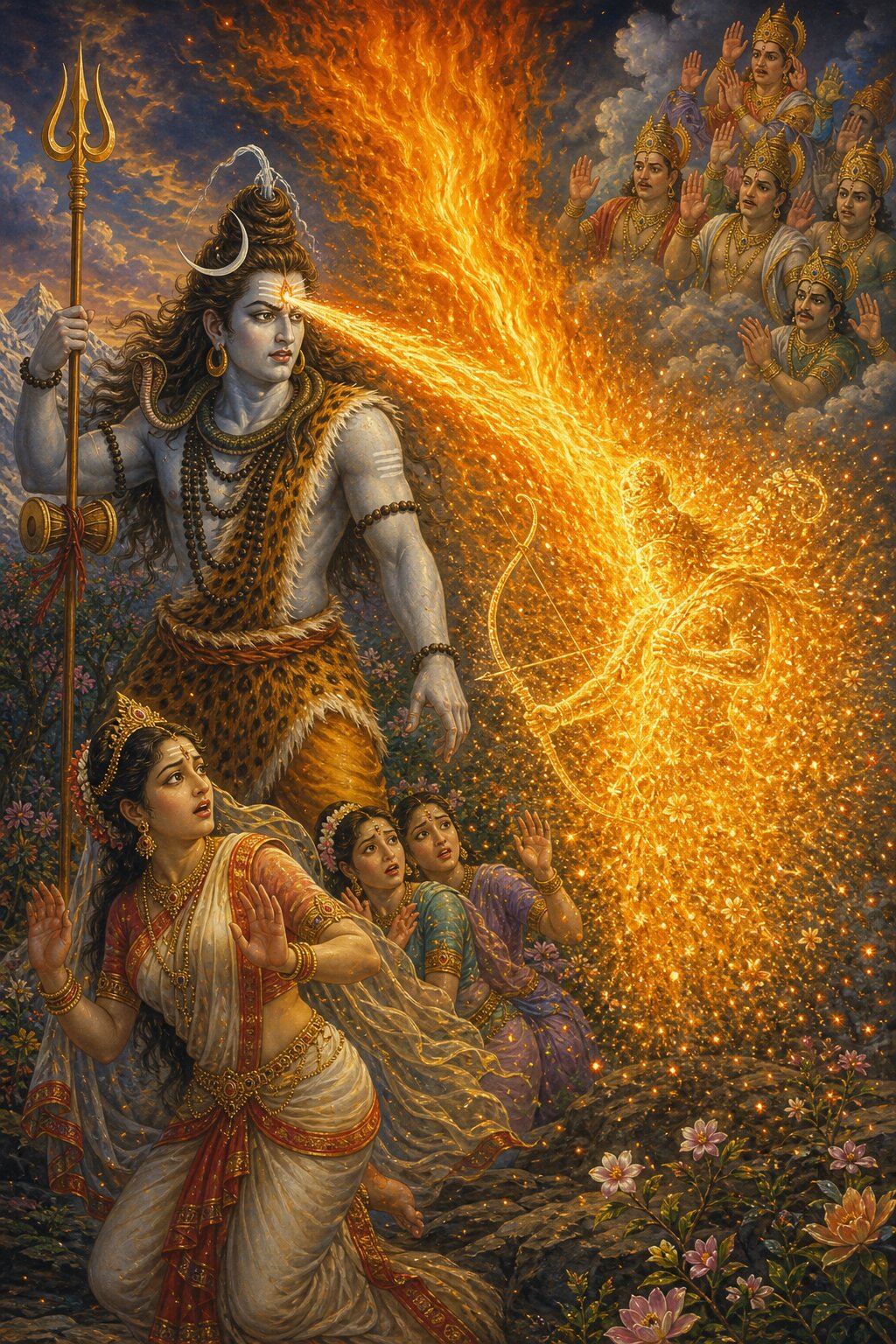
When he arrived, Kama went to work on the grove before he went to work on the god. He let Vasanta loose, and spring came down on that mountain months out of its season. Mango and ashoka broke into bloom, water lilies opened with bees swinging above them, cuckoos called from everywhere at once, moonlight lay across the snow like a messenger running between lovers, and a soft wind went through the forest sages and left them aching. Shiva saw the season arrive at the wrong time, thought it a strange thing, and went on with his penance without breaking stride. So Kama took his place at Shiva’s left hand with Rati beside him and the mango-blossom arrow already fitted to the string, and he studied that seated figure for a way in, and found none. The god who lives inside every mind stood outside this one, locked out, and the fear came to him then. It came late. Just then Parvati climbed to the grove with her two maids and her flowers, and at her approach Shiva opened his eyes for a moment. It was all Kama needed. Into that moment he sent the arrow named Harshana, and listen, it took effect. In Shankara’s mind an attraction toward Parvati began to stir, and his composure began to slip. The story is often told in the world that no arrow ever touched Mahadeva, yet the Shiva Purana states plainly that the great yogi’s steadiness wavered first. Seeing this loss of his own composure, he was struck with amazement and began to reflect within himself: I was absorbed in the highest austerity, so where has this disturbance come from? What wretched creature has stirred this agitation in my mind? He had let his mind run after a woman who was not his, and by his own reckoning he had stepped outside the bounds the Vedas set.
Reflecting so, Maheshwara looked out toward the directions, suspicion awake in him now. Just then his gaze fell to his left, where Madana stood with his bowstring drawn. That doomed Madana, in the pride of his power, was about to loose another arrow, and the pride had emptied his head of sense. The instant Girisha’s eyes found him, fury rose in him. On his side, Kama rose up into the air with the bow in his hands and released his unfailing weapon at Shankara, a weapon held to be almost impossible to ward off. Yet upon Shiva even the unfailing failed; the moment it reached the enraged lord, it went still. Seeing before him the conqueror of death, Manmatha trembled and began to call upon Indra and the other gods. The instant he called, all the gods arrived, bowed to Shambhu, and began to sing his praise.
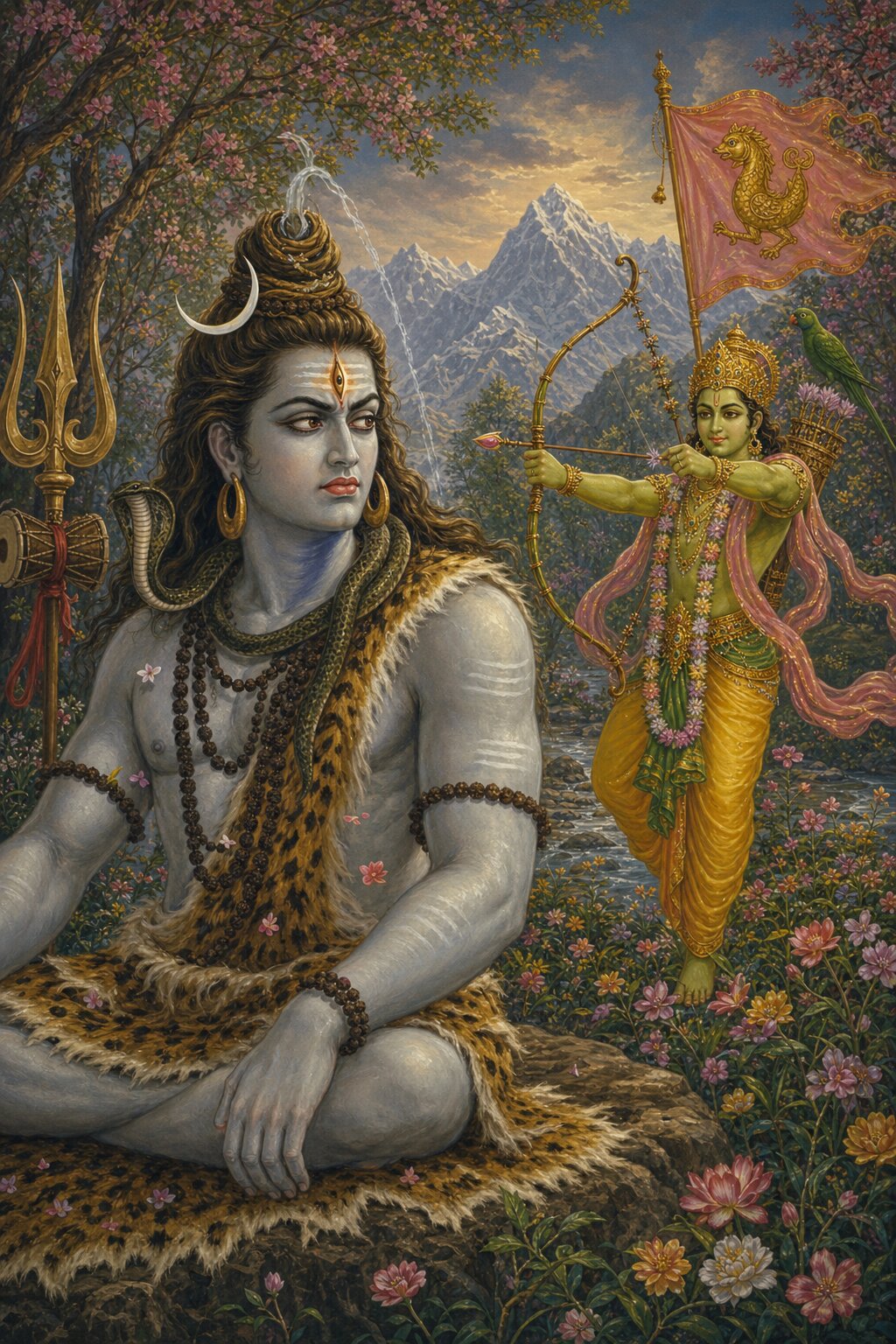
The gods were still in the midst of their praise when, from the third eye set in the middle of the forehead of the enraged lord Hara, a vast and terrible fire broke out all at once. The flames climbed upward, roaring as they burned, and their glow looked like the fire of universal dissolution. The fire leapt into the sky, fell upon the earth, then spread, wheeling in every direction. The words “Lord, forgive him, forgive him” had scarcely left the mouths of the gods when that fire burned Kamadeva to ash. The gods were seized with anguish, and crying out, alas, what has happened, they wept and wailed. And what became of Parvati in that hour, hear that too. She had climbed the mountain that morning with flowers in her hands, and she was standing a few steps away when the fire ate the god of love. Her whole body went white; had you cut her, no blood would have come. Taking her companions with her, she returned to her own palace.
Rati’s Lament
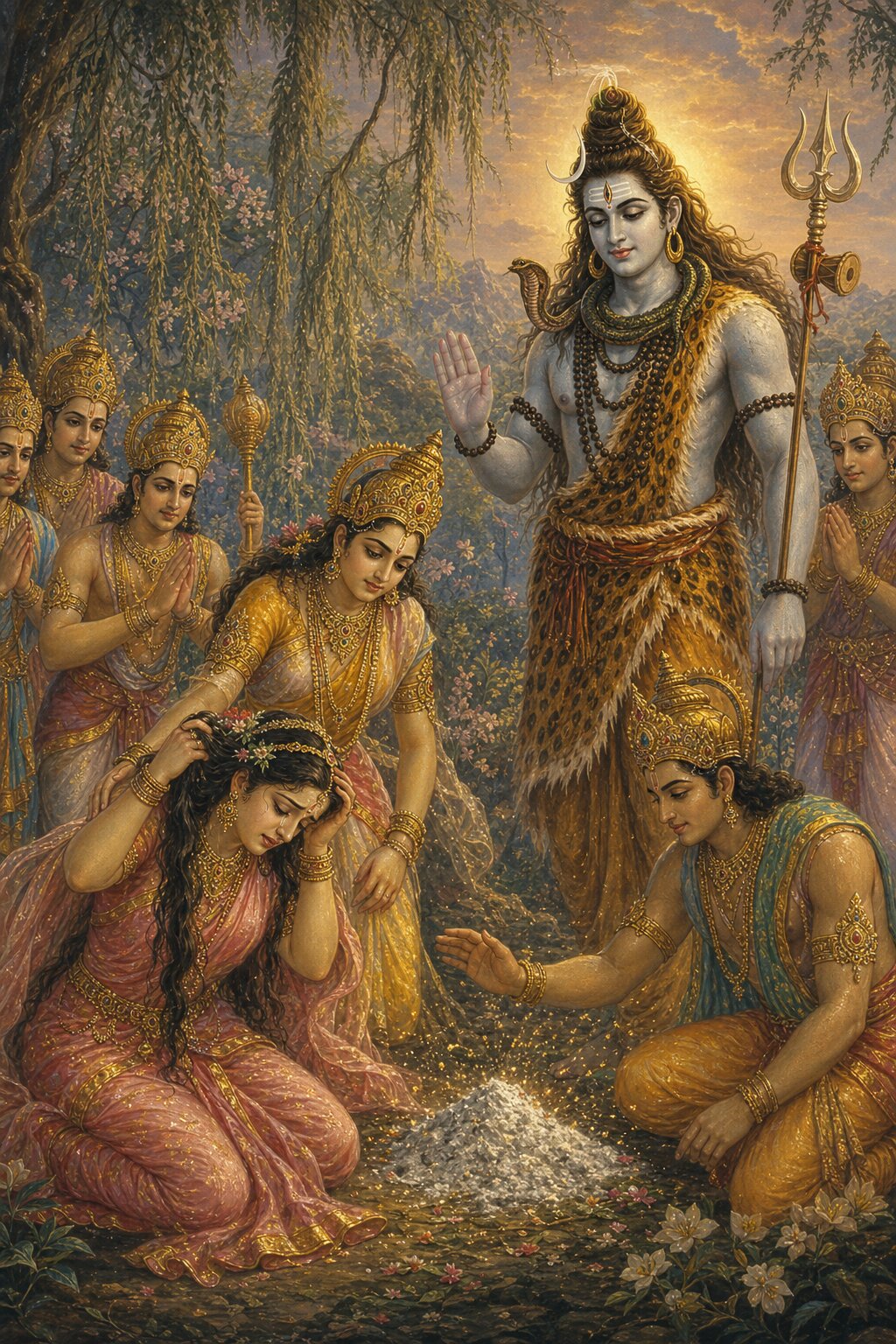
When Kamadeva burned, Rati lay senseless on the spot for a moment, as though she too had died. When she came to, her lament burst out. “Alas, what am I to do? Where am I to go? What have the gods done? They called him here with their own mouths, and then they had my bold lord destroyed. O my husband, O Smara, O dearer to me than the breath in my body, O beloved of my life, what has happened here?” She flung her arms and beat her feet against the ground and tore the hair from her head. Hearing her lament, the forest-dwellers grieved, and the beasts with them, and even the trees and the other rooted, motionless creatures grew sorrowful.
Then the gods, calling Mahadeva to mind, came to Rati and said, “Gather a little of the ash of Kama’s body and keep it with care. Hold your fear down and set aside your grief. Mahadeva, master of us all, will bring Kamadeva back to life, and you will have your beloved again. No one gives happiness to another, and no one gives sorrow. Each soul reaps the fruit of its own deeds. In blaming the gods, you grieve for nothing.”
Then they came before lord Shiva and, pleasing him with their devotion, said, “Lord, Maheshwara, tender to all who take refuge in you, in what Kama did there was no selfish motive of his own. Tormented by the wicked Tarakasura, we gods together set him to this task. Master, Shankara, do not take it otherwise. The chaste and faithful Rati laments all alone in deep sorrow; give her comfort. Look once at her and you will see us standing behind her, half dead ourselves. And Maheshwara, if in this anger you have truly killed Kamadeva, then we can only understand that you mean to destroy all living beings, the gods among them, here and now.”
The Promise of Pradyumna
Hearing this word of the gods, lord Shiva was pleased and said, “Gods and sages, what has come from my anger cannot be undone. Even so, Rati’s mighty husband Kama will remain Ananga, without a body, only until Krishna, lord of Rukmini, takes birth on the earth. When Krishna, living in Dwarka, fathers a son, Kama too will be born from the womb of Rukmini. At that time his name will be Pradyumna, of this there is no doubt. The moment he is born, the demon Shambara will carry the infant off, cast him into the sea, and then, thinking him dead, return to his own city. Rati, until that time, live in peace in the city of Shambara. There you will regain your husband, Pradyumna. There he will find you, and in battle he will slay the demon Shambara, and taking you and the demon’s wealth, he will return to his own city. This word of mine will prove entirely true.”
Hearing this, a measure of gladness rose in the hearts of the gods. Joining both hands, they made their plea. “God of gods, Mahadeva, ocean of compassion, lord, grant Kamadeva his life again, and protect the life of Rati.” Then Shiva, the compassionate lord, was pleased once more and said, “Gods, I am well pleased. I will bring Kama alive in every being’s heart. He will move through the world forever as one of my own host. Now go, all of you, to your own realms; I will end your sorrow completely.” Having said this, Rudra vanished from before the gods even as they watched.
The astonishment of the gods lifted, and every one of them was glad. Trusting the word of Rudra, they carried his promise back to Rati and said it over to her until her heart steadied, and then they went each to his own realm. And Rati, wife of Kama? She set out alone for the city of Shambara that Shiva had named, a widow walking into the house of the demon who had not yet committed his crime, and there she began to wait for the time Rudra had spoken of. Consider it. The very eye whose fire took away the body of Kama, by its own word, settled him in every being’s heart. He lost the one form he had and got every heart in the world instead, and he has been harder to escape ever since.
Source: Shiva Purana (Gita Press, Sankshipta Shivapurananka), Rudra Samhita (Parvati Khanda)