On this page
In a splendid cave of the Malaya mountain, with the celestial Ganga running close enough past its mouth to be heard from inside, stood a hermitage of divine splendor. Narada settled onto his seat there, kept silence, drew his breath down through pranayama until it barely stirred, held his understanding clear of every stain, and sank into samadhi. Out of that stillness rose the realization in which a man says I am Brahman and finds he is looking straight at it.
When word of it reached him, Indra, king of the gods, shook. This sage wants my kingdom, he thought; one day he will go to Brahma and ask for it. So he summoned Kamadeva, the god of desire, who came at once with Rati his wife and Vasanta, the spring, beside him. Friend, Indra said, you have broken the pride of ascetics beyond counting for me; every year this throne stands is a year you gave me. Go break this one. The two poured out every art they possessed, yet not one seed of disturbance stirred in Narada, and the only pride broken that day was their own. Beaten, they withdrew. The reason lay in the ground itself. On this same soil Lord Shankara had once performed his tapas, and here he had burned Kamadeva to ash. Rati had begged for her husband back, and Shankara had granted it with a boundary attached: Kamadeva would live again, and within sight of this spot, in every direction a man standing here can see, no arrow of his would ever land. Narada never grasped this secret. He stayed until his penance had run its course, rose certain that he had conquered desire by his own strength, and let an empty pride grow in him.
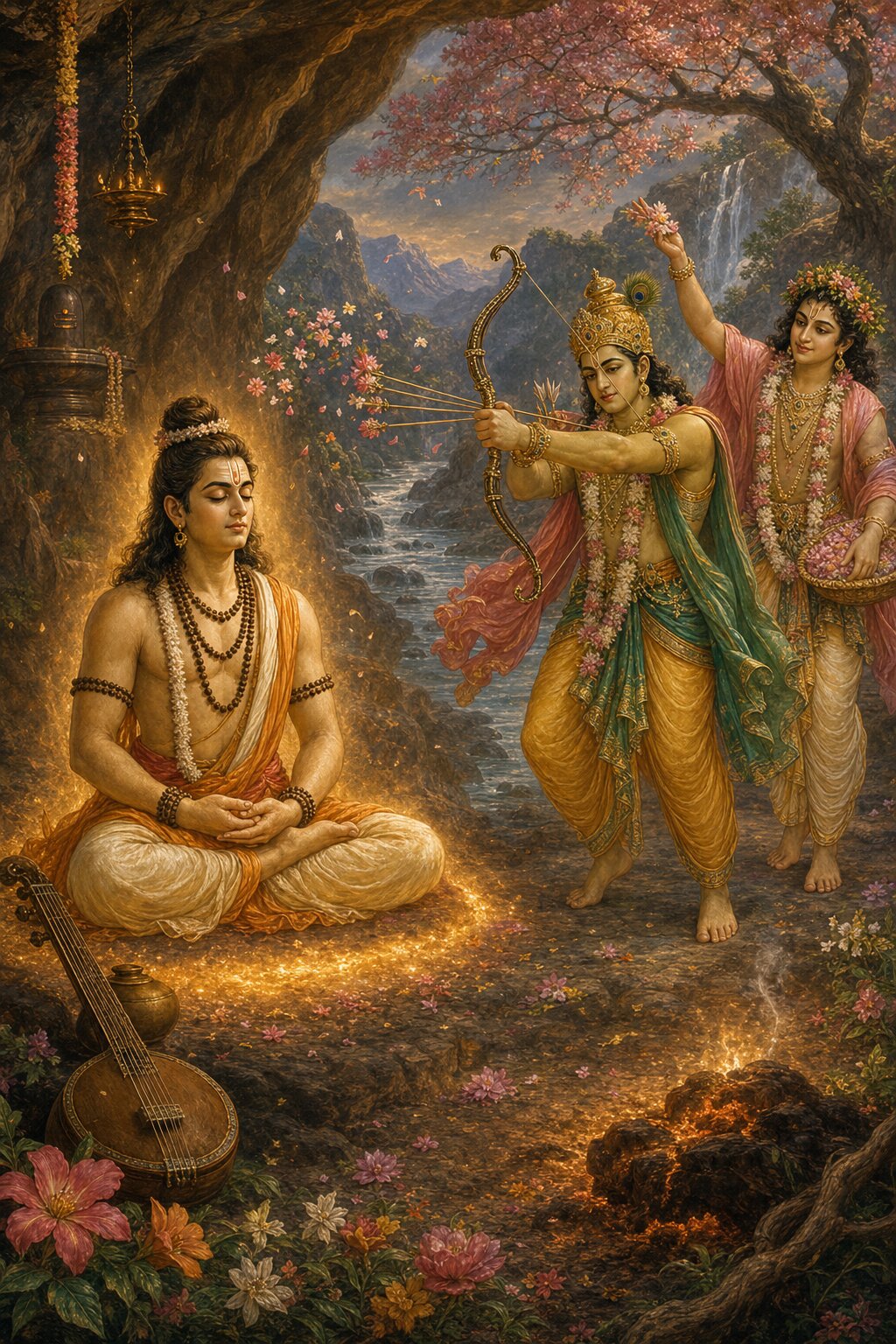
The Boast in the Three Worlds
Flushed with that intoxication, the sage went straight to Kailasa and laid the whole tale before Rudra as if the feat had come from his own strength, bowing to the conqueror of Kamadeva and then speaking to him as an equal. Lord Shankara answered him with affection. “You are a man of great learning. Yet hear one thing from me with care. From this day, do not tell this story anywhere, and even if you are asked for it, do not repeat what you have just told me. Before Lord Vishnu above all, do not so much as speak its name. This account is best kept hidden. I say it plainly because you are dear to me.”
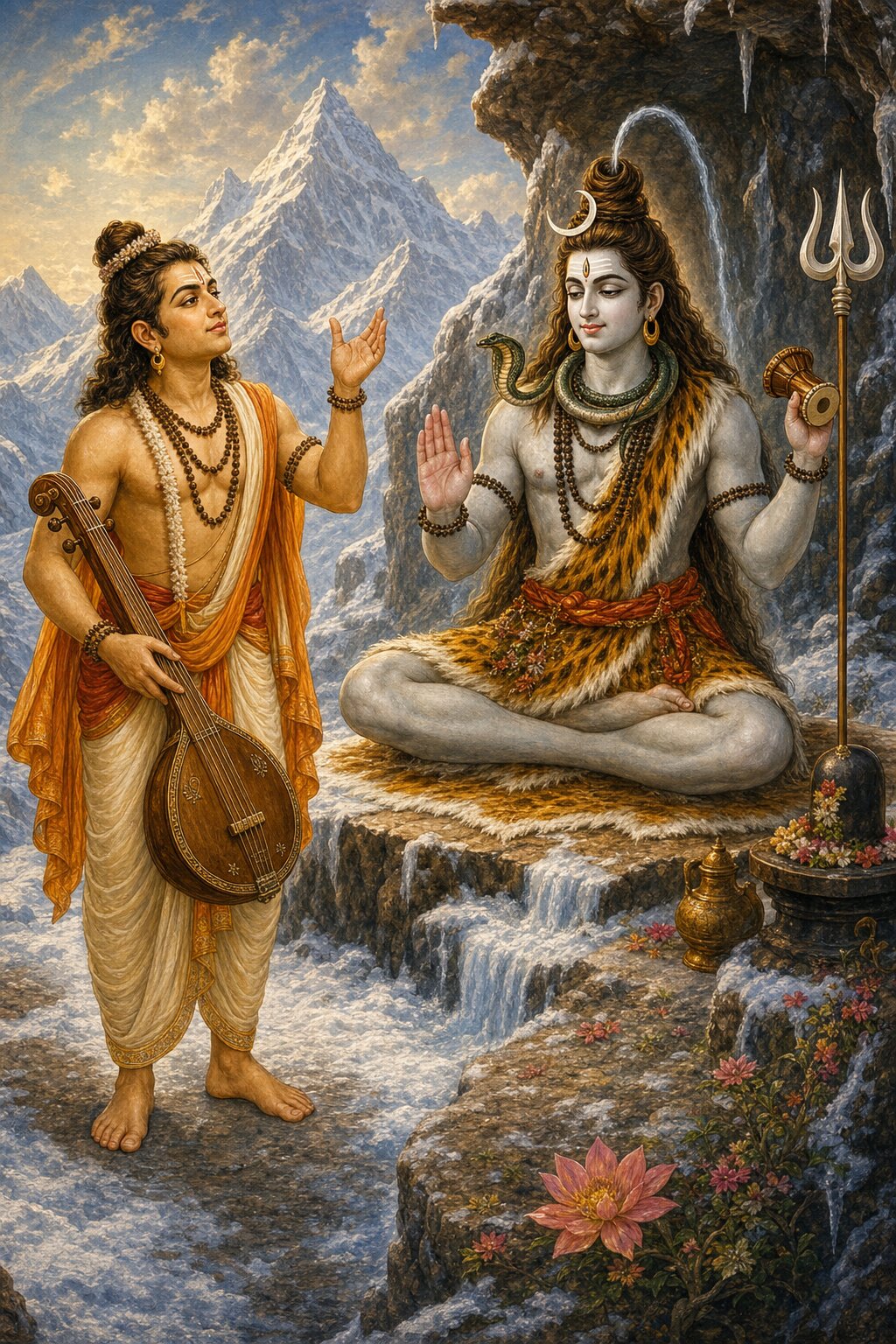
Shiva put it to him in many ways, and not one of them landed. Narada remained caught in the very maya that had let him believe the conquest of desire was his own doing, and so the counsel Shiva offered did not strike him as anything meant for his good. He traveled from there to Brahmaloka and said to his father Brahma, “Father, by the power of my austerity I have defeated Kamadeva.” Brahma remembered the feet of Shiva, and in that remembering he saw the whole truth standing behind his son’s account, and he too forbade him to say such a thing. Narada was foremost among the wise, and it made no difference; the sprout of arrogance had rooted where advice could not reach. Yet whom does a man heed when maya has already carried off his judgment? Before long he arrived in Vaikuntha, eager to repeat the same tale before Vishnu.
Vishnu saw him coming and knew what was coming with him. He rose with deep respect, drew him to his heart, settled him comfortably, and then, holding the feet of Shiva in his mind, chose words meant to break the arrogance he could already see. “Foremost of sages, you are blessed. Where have you traveled from?” Narada glowed at that and told the story, every word laced with self-regard. Vishnu understood its real cause. He bowed his head where the sage could not see and praised Parameshvara with his palms joined, and when he opened his eyes he knew what Shiva intended. “Sage, you are blessed, a storehouse of austerities. Lust takes root only in a man with no devotion in him. You are vowed to celibacy without a break, endowed with knowledge, devoted to non-attachment. How could the fever of desire ever find a way into you?” At this praise Narada laughed, inwardly, and bowing low he said, “Lord, when your grace rests upon me, what power can poor Kamadeva hope to show?” With that the sage departed, well pleased with himself.
The City of Maya
The moment the sage was gone, by Shiva’s will Lord Shrihari brought forth his maya. Across the road Narada was walking he raised a city a hundred yojanas wide, lovelier than heaven itself, its markets heaped with everything a person could want, its streets carrying men and women of all four varnas. A king of great wealth named Shilanidhi ruled there, and he had proclaimed a swayamvara for his daughter, to which princes had come from all four quarters, each of them dressed to be looked at.
Enchanted by such a city, Narada felt something wake in him that he had spent a lifetime believing was dead, and he came quickly to the gate of King Shilanidhi. The king honored the sage, seated him on a throne studded with precious gems, then summoned his lovely daughter Shrimati and had her kneel and touch the sage’s feet. Narada looked at her and lost his place in the conversation. “King, who is this?” The king answered with his palms joined. “Sage, she is my daughter Shrimati, known through all three worlds by the name Vishvamohini, the enchantress of the world. She has come of marriageable age, she has every charm and every accomplishment, and the swayamvara is upon us. Read her destiny for us, everything her stars carry. Tell us what sort of husband she will get.”
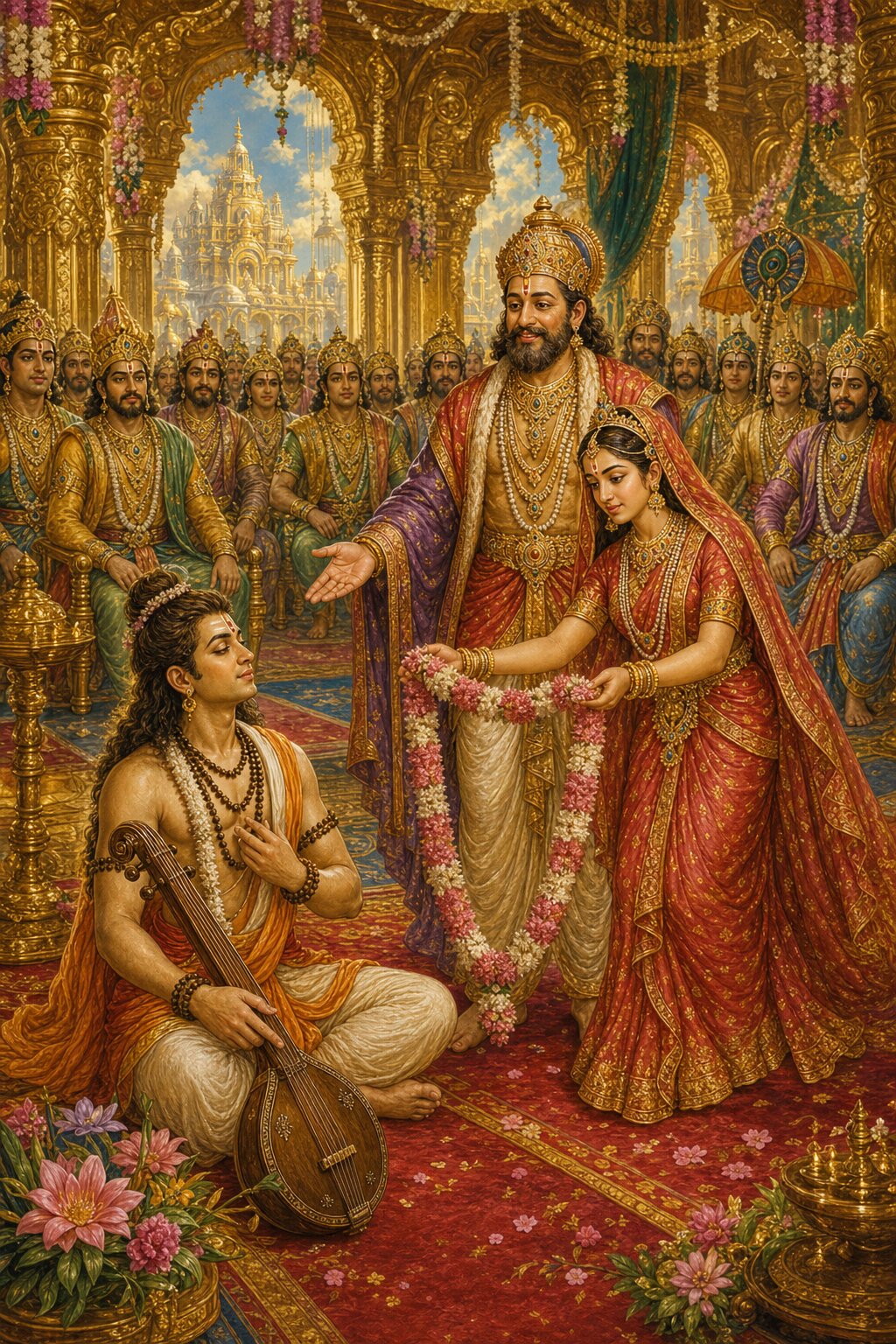
By the time the king finished asking, desire had already taken the sage and he wanted her for himself. He praised the maiden without restraint. “Great king, your daughter is fortunate and blessed like Lakshmi, an abode of every good quality. Her husband will be a god in his splendor, lord of all, unvanquished, valiant, the equal of Lord Shankara himself, and a match for Kamadeva.” He left after saying it, yet his mind circled one thought alone: how does a girl pass over so many kings and choose him and him only? Beauty is what draws a woman, he told himself. And out of that a single scheme arrived. Troubled by desire, he hurried back to Vaikuntha, drew Vishnu aside, told him the whole matter, and begged with folded hands. “Thousands of princes have come, and she will never put that garland on this neck as it stands. Lord, I am your servant. Grant me your form, so that Princess Shrimati is certain to choose me.”
The Face of a Monkey
At Narada’s plea the Lord laughed, and behind the laugh he was holding the overwhelming power of Shiva in his mind. “Sage, go to that place,” he said. “As a skilled physician works the good of a patient in the gravest pain, so I will work your good, for you are dear to me beyond others.” Then he gave the sage exactly what had been asked for. Every limb he shaped in the likeness of his own, and on that body he set the face of Hari. Hari is a name Vishnu answers to. It is also a name that belongs to monkeys. The Lord vanished on the spot. Narada, consoled and delighted, walked away wearing Hari’s form and counting himself a man whose every wish had been granted, and of what the Lord had truly done to him he had not the faintest sense.
The sage soon arrived at the swayamvara hall, decorated to a standard that made it shine like a second council chamber of Indra. Seated among the guests, he told himself the same sentence over and over: she will choose me, because I wear a form like Vishnu’s own. He had no notion of how hideous his face had turned. Everyone else in the hall saw him in his familiar form, and not one of them knew the difference. Only two knew, ganas of Lord Shankara seated there in the guise of Brahmins, sent to guard the sage. Taking him for a fool, they settled in near him and talked in the voices men use when they mean to be overheard: a body as splendid as Vishnu’s, and set on it the face of a monkey, deformed and awful, and Kama has him so completely he means to marry the princess. Narada, lost in desire, paid no heed to what they were truly saying. His eyes stayed on Shrimati and would not move.
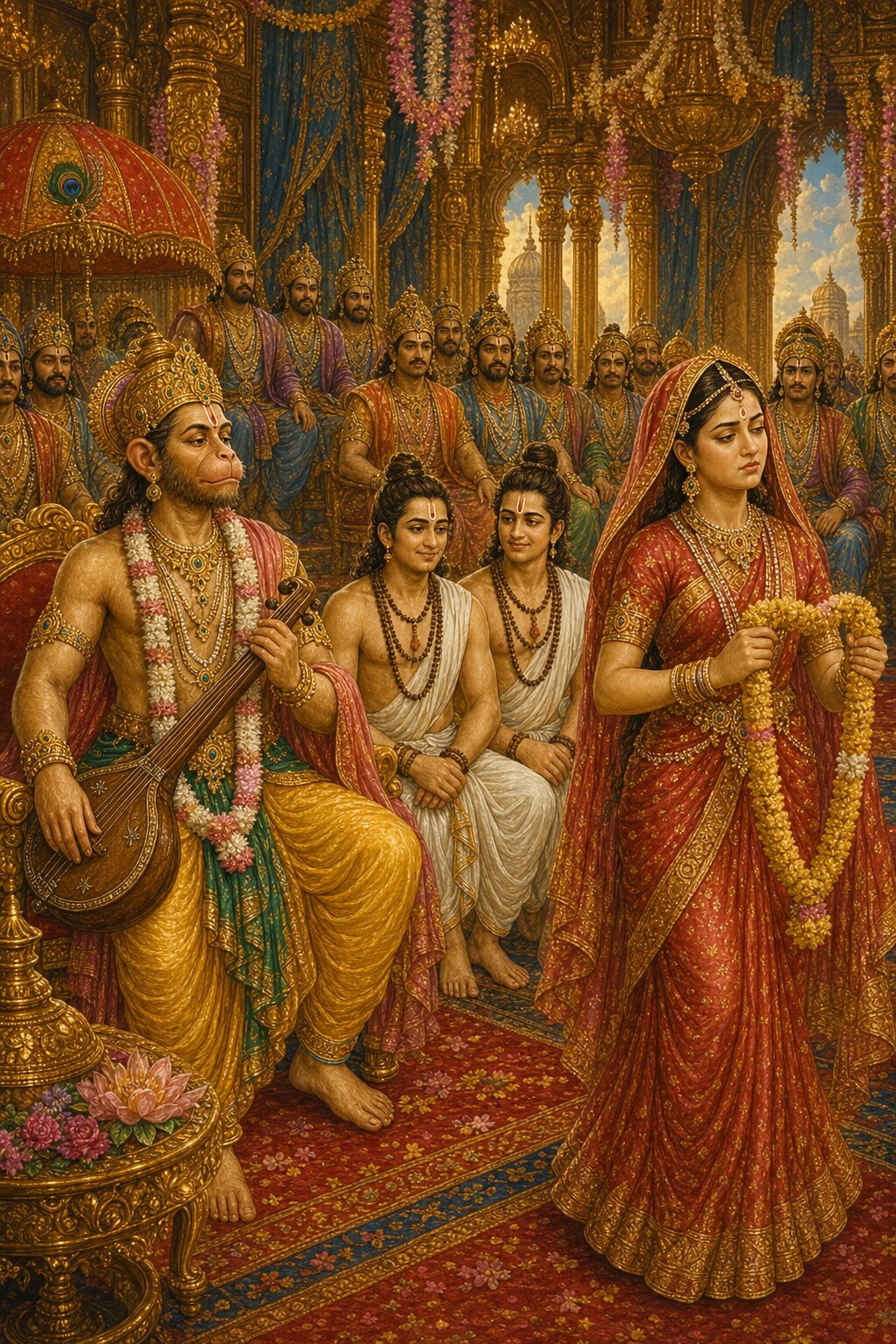
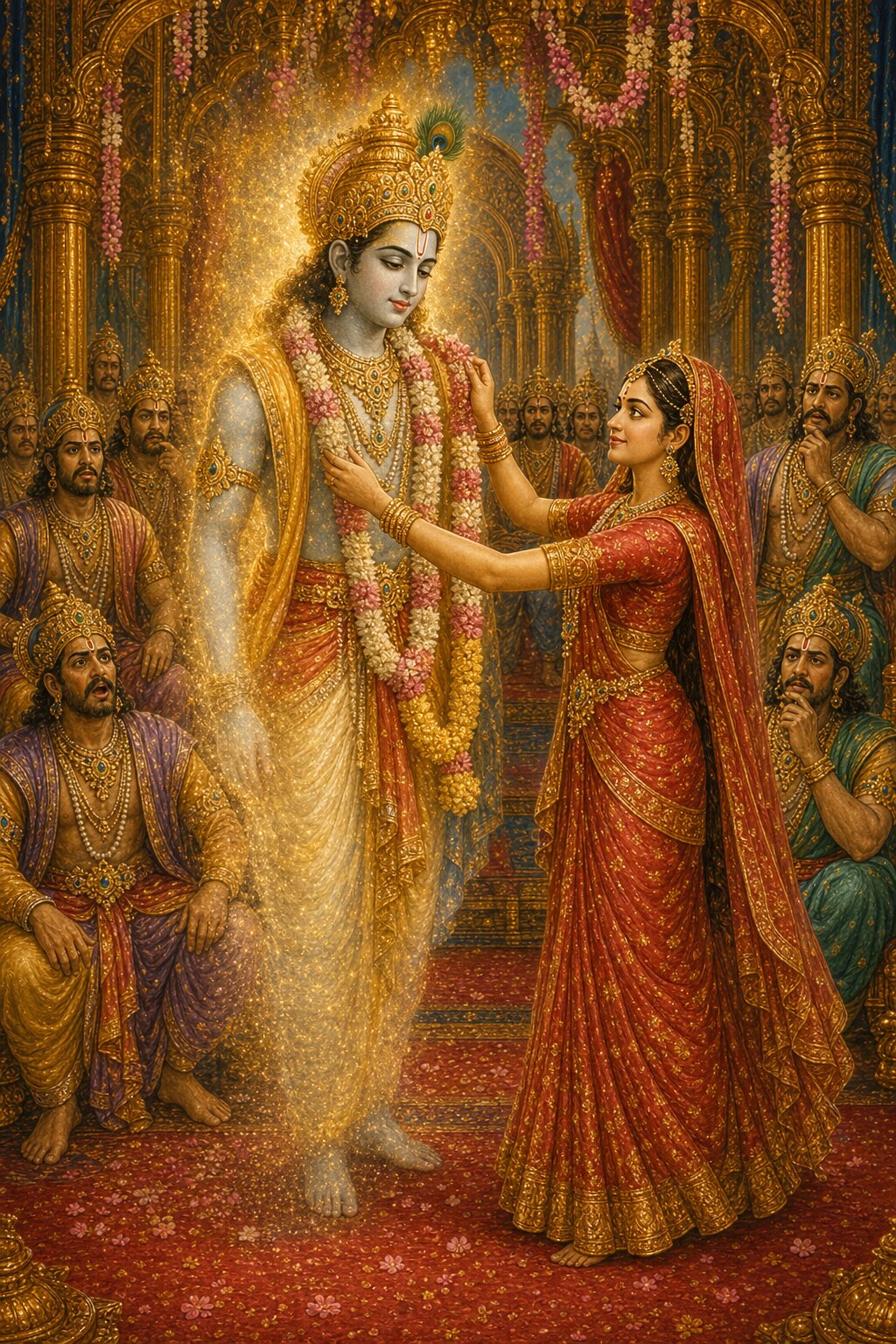
Meanwhile the lovely princess entered the hall, a golden garland in her hands, ringed by her women, and standing in the middle of that gathering she shone as though Lakshmi herself had walked in. She moved through the assembly in search of a groom to her liking. Her eyes reached Narada: a monkey’s face, set upon a body like Vishnu’s. Anger went through her, and she turned away in displeasure and walked on, distressed in her mind. She finished the circle and found no man worthy of her, and by then she was afraid. She stopped in the middle of the hall, stood in silence, and laid the victory garland on no one. At that moment Lord Vishnu himself came into the hall in the form of a king. Not one person there saw him; her gaze alone found him. The instant she beheld the Lord her face lit with joy, and she placed the garland at once around his neck. Vishnu, still in that king’s form, took the maiden with him and was gone from the hall in the same breath, back to his own abode.
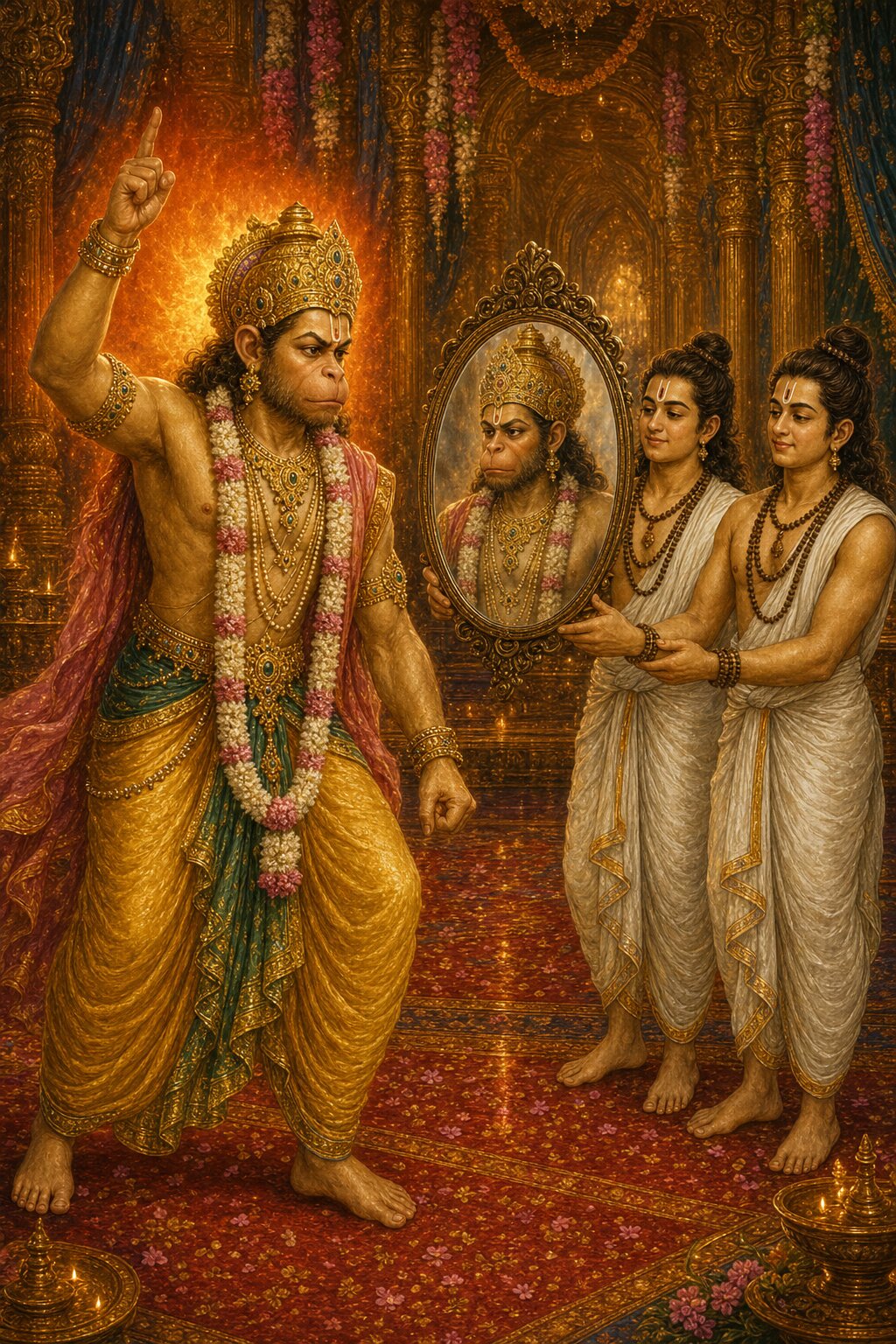
On the other side, every prince was left crestfallen, and Narada was seized by the anguish of a desire that now had nowhere to go. Then the two shiva-ganas in their Brahmin disguise spoke. “Narada, you let desire bewitch you for nothing, hoping to win the princess by the power of your looks. Your effort is finished. Take a mirror and see for yourself that hateful monkey face of yours.” The words filled Narada with disbelief. He found a mirror, he looked, and the monkey face in it was his own, and fury went up in him like a struck light. Still under maya’s spell, he cursed the two ganas. “You have mocked me, a Brahmin. For this, be born as rakshasas from the seed of a Brahmin. Though Brahmins beget you, your forms will be those of demons.” Even at these words the two ganas held their peace, knowing the sage bewitched, and treating it all as Shiva’s will they went away from there untroubled, and sat down in their own place, and went on singing Shiva’s praise.
The Curse on Vishnu
The curse spoken, Narada went to water and looked at himself in it, and his face came back to him whole and ordinary, exactly as it had always been. Shiva willed that too. Anything else would have woken him, and he was not meant to wake yet, so the sleep of his delusion held. What surfaced instead was a certainty: Hari had done this to him. The thought took hold like a lit fire, and with his wisdom gone out of him he reached Vaikuntha and let loose bitter words. “Hari, you are a master of deceit. You hold the whole world in your spell, and you cannot endure to see another rise. Long ago you took the shape of Mohini and made the asuras drink varuni, the liquor, and kept the nectar of amrita from their lips. Had Maheshvara Rudra not shown mercy and swallowed the poison, your whole web of maya would have unraveled that very day. Trickery is what you love best. Today I will teach you a lesson that will keep you from ever doing such a thing again.”
Then, drawing on the fire of his brahmanic power and sick with rage, Narada pronounced his curse. “Vishnu, you have driven me to torment over a woman. So take birth in that same human form you wore while you worked your trick on me, and bear the grief of it there as a man. The monkeys whose likeness you set upon my face, let them be the ones who come to your help in that hour. You gave me the sorrow of losing a woman, so may that same sorrow of separation fall on you, and may your condition be the condition of men blinded by ignorance.”
The Maya Lifts, the Pride Dissolves
Vishnu took the curse in silence, remembering the glory of Shambhu and praising his maya even as it was laid on him. And Shambhu, the author of the great cosmic play, drew back the Vishvamohini maya that had bewildered even the wise Narada. It went out of the sage the way a fever goes. Clear judgment and his old knowledge returned, and every trace of his torment fell away. What he felt first was astonishment at himself, and behind it came a remorse with no floor under it. He reproached himself without end, and even in the middle of it he was praising the maya of Shiva, which could carry off a wise man this far. Understanding that the whole of it had been a delusion born of maya, Narada threw himself at the feet of Lord Shrihari.
The Lord lifted him and held him to his chest, and then the sage got the words out. “Master, maya had bewitched me and turned my mind astray, and so I flung harsh words at you and even laid a curse on you. Lord, unmake that curse. I have committed a grave offense, and now I am surely bound for hell. Tell me some penance by which this sin of mine may be destroyed.” He said it and went down at Vishnu’s feet a second time, and this time his mind was clean and the repentance in it was real.
Vishnu answered in a gentle voice. “Dear one, do not grieve, for you are among the finest of my devotees, and hell is not where you are going. This curse will come to pass only by the will of Lord Shiva. Blinded by pride, you would not listen to my words, and for that very fault Shiva has given you this outcome, since it is he who awards the fruit of every action there is. Fix it firmly in your mind that all of this has unfolded by the will of Lord Shiva alone. Parameshvara Shankara, the lord of all, is the one who strips away pride. He is the Parabrahma Paramatma, existence and knowledge and bliss, beyond rajas and sattva and tamas, who takes up his own maya and appears in the forms of Brahma, Vishnu, and Mahesha. Serving him, Brahma creates. Serving him, I sustain. And in his manifestation as Rudra he forever brings it to an end.”
Then he offered a fair remedy. “Let go of every doubt and sing the glory of Lord Shankara. Recite his hymn of a hundred names with undivided devotion, and worship him each day, and the japa of it will finish your sins where they stand. The name of Shiva is a wildfire that burns whole mountains of sin to ash with ease. A man scorched by his own sins has one thing to drink, and it is the nectar of that name; whoever takes refuge in the raft of it crosses the ocean of worldly existence. Walk the holy places of Shiva first. Then go to Anandavana, the city of Kashi, and worship Vishvanatha there, and every doubt left in you will go. After that, at my bidding, go to Brahmaloka and ask your father the greatness of Shiva, and Brahma will tell it and give you the hymn of a hundred names himself.” Having given this counsel full of love, Lord Vishnu remembered Shrishiva and vanished.
The very austerity that had made Narada unconquerable across the three worlds became, in its intoxication, the thing that led him to a monkey’s face. And the curse he cast in anger did not fade away when his judgment came back. By Shiva’s will it became the seed of the day Vishnu would take birth in human form, lose a woman, and find his help among the very monkeys whose face he had once handed to a sage. Through this samhita the whole episode bends toward the glory of Shiva, so completely that Vishnu himself sets Narada on the road of Shiva’s worship.
Source: Shiva Purana (Gita Press, Sankshipta Shivapurananka), Rudra Samhita (the first Srishti Khanda)