On this page
Parvati had won Mahadeva through the sheer force of her austerity, and even so she would not simply take his hand and set off for Kailasa. She folded her palms and said, “My lord, go as a suitor to the house of my father Himavan, and ask for me by the proper rite. Only then will this marriage be honored throughout the world.” Shiva smiled. Ever tender toward those who love him, he granted her wish and sent the seven sages, with Arundhati at their side, to the home of the Himalaya.
The Seven Sages’ Proposal
The lord of mountains honored those sages, rich in penance, with the prescribed worship, then folded his hands and asked what errand had brought them. The seven sages spoke of Shiva’s greatness. Brahma, Vishnu, and Rudra, they said, are three splendors of that one supreme Shiva; and Sati, who had cast off her body at Daksha’s sacrifice and been born as Parvati in the house of Himavan and Mena, had been Shiva’s wife through birth after birth. “Lord of mountains, place your daughter’s hand in Rudra’s,” they said, and they named the fine hour in the month of Margashirsha when the moon would stand with Rohini and every auspicious planet would keep watch over the ascendant. Himavan turned to the other mountains and asked them what he should do. What is there to discuss, said Meru and Mainaka and the rest of them; she came into the world for Shiva, and to Shiva she must be given. Arundhati, telling many old tales, brought Mena to understanding. Then every last doubt left Himavan, and he said with joy, “From this day my body, my wife Mena, my sons and daughters, and all my wealth and power belong to Lord Shiva alone.” In this way he pledged Parvati’s hand. He hung his daughter with ornaments and laid the whole of it in the lap of the sages: these are what I have to give with her. You are the giver, the sages answered, and Shiva is the beggar at the door, and the alms is the goddess Parvati herself; what better thing than that was ever done? Then, following the custom of the country, they rubbed turmeric and saffron into the mountain king’s moustache.
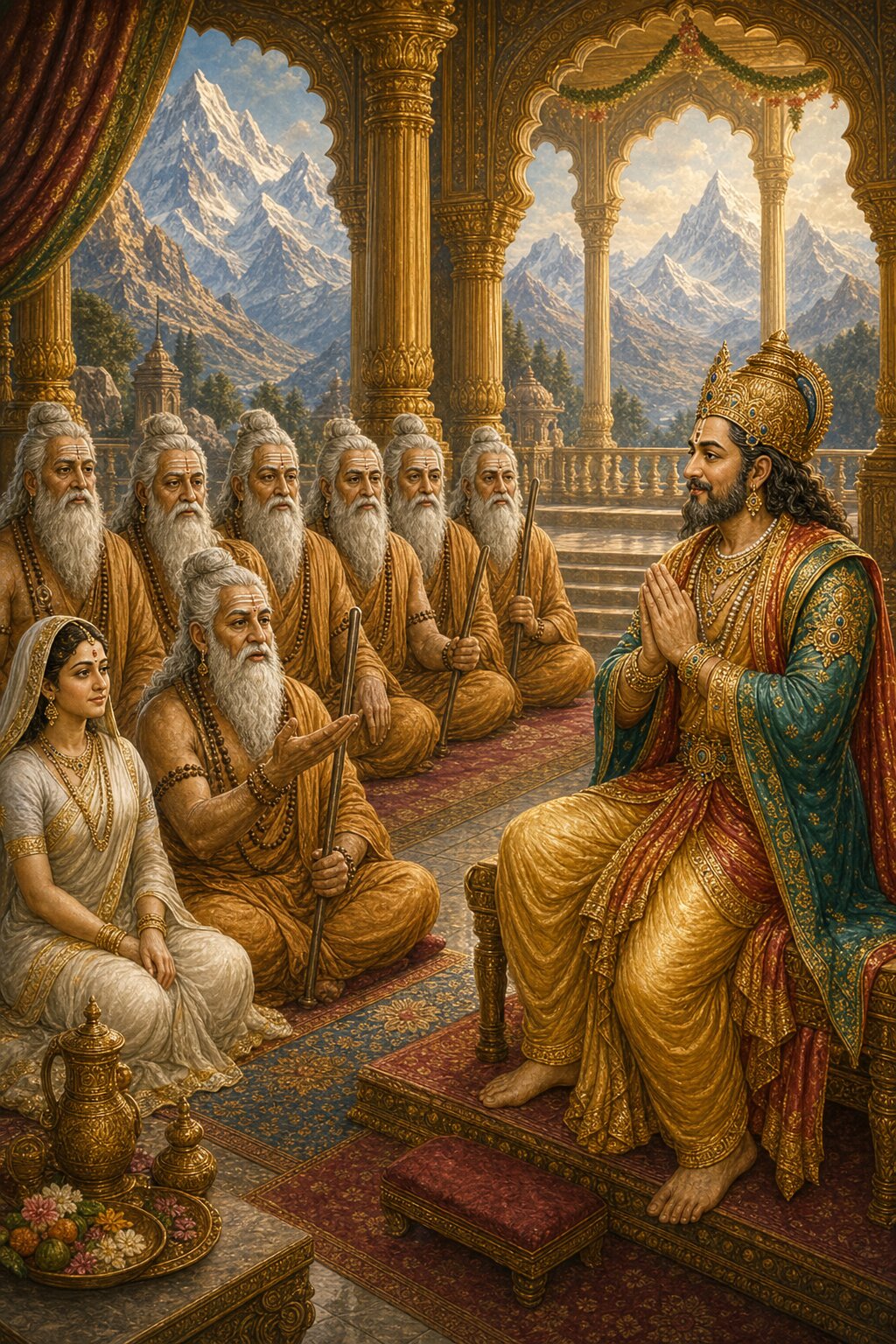
The seven sages returned to Kailasa and told Shiva that the betrothal was settled, and that he should now come for the wedding in the Vedic manner, and marry Parvati by the custom, for the sake of a son. Following the custom of the world, Shiva said with a laugh, “A wedding I have never seen nor heard of; you yourselves must tell me its rite.” The sages laughed too and said, “First, with all respect, summon Vishnu with his attendants, Brahma with his sons, and Indra, and all the sages, the yakshas, gandharvas, kinnaras, siddhas, vidyadharas, and apsaras. Together they will see your work accomplished.” With that they returned to their own abode.
The Preparations and Vishvakarma’s Pavilion
Meanwhile Himavan had his family priest Garga write out the marriage horoscope, sent it to Kailasa by the hands of his kinsmen, and set about gathering the wedding provisions. Rice, beaten rice, jaggery, sugar, salt, flour, milk, curd, ghee, and countless cooked delicacies were heaped up until the dry goods rose like mountains and the liquids stood in tanks built to hold them, and there were side dishes made to the taste of Shiva’s ganas. For Shiva’s hosts and for the gods, costly cloth purified in fire, gold, silver, and jewels were laid out. Receiving the invitation, the mountains took on divine forms and came with their wives and their gifts, Mandara and Malaya, Gandhamadana and Krauncha, Vindhya and Mahendra, the sunrise mountain and the sunset mountain, and Kailasa itself; and the rivers Godavari, Yamuna, Sarasvati, Ganga, and Narmada, the daughter of Rudra, also took the shapes of celestial men and women and arrived to see the wedding. The roads were watered and swept, plantain stems bound with silk cords stood at every door, and mango leaves and jasmine hung across the lanes. The city so filled with banners and pennants, with festoons and canopies, that even the sun grew hard to glimpse.
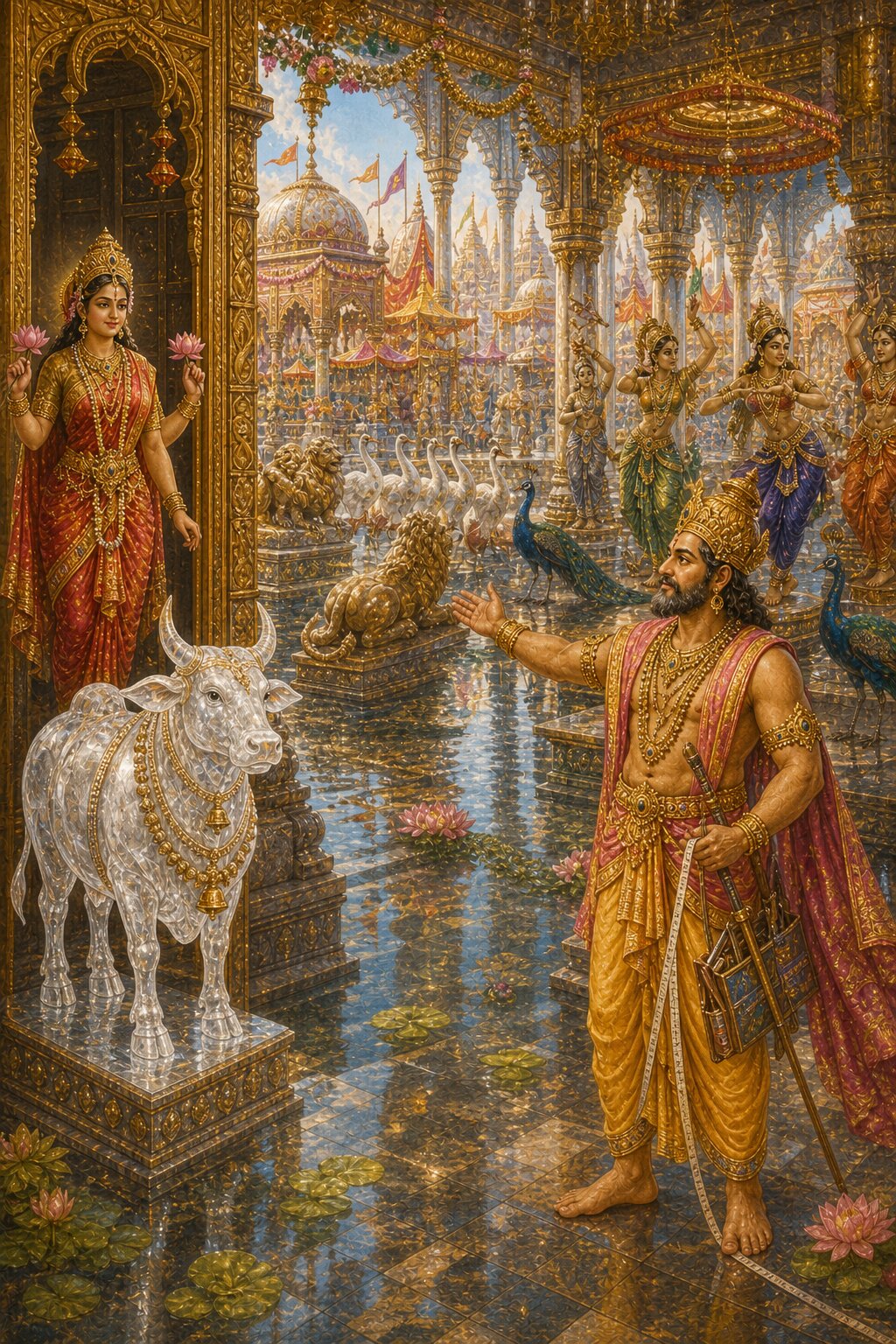
Then Vishvakarma raised a wondrous pavilion, ten thousand yojanas wide. Its floor shimmered so like water that even a clever man could not tell where water lay and where dry ground. Here stood lifelike lions, there rows of cranes, and elsewhere artificial peacocks and dancing women who stole the hearts of everyone who looked, and gatekeepers with their bows already raised. At the gateway stood Mahalakshmi, who might have risen from the milk ocean that moment, and a crystal-bright artificial Nandi, with the flying chariot Pushpaka above him, and two saffron elephants with four tusks each. Vishvakarma shaped statues of Vishnu with Garuda, of Brahma reciting the hymns among his sons, of Indra on Airavata, and of the guardians of the quarters, so vivid that even the gods were fooled. Then, for the guest-deities to lodge in, he built whole celestial worlds: Satyaloka for Brahma, Vaikuntha for Vishnu, a mansion of full splendor for Indra, and a lovely house marked with the emblems of Shiva. He worked fast, and he worked for love, since it was Shiva who had made him what he was.
The Strange Wedding Procession
On Kailasa the gods gathered. The seven mother-goddesses set about adorning Shiva with ornaments, yet his own natural form became the ornament. The moon took its seat where a crown would sit, the third eye on his brow became an auspicious mark, the serpents at his ears turned into jeweled earrings, every other serpent on him became the right jewel for the limb it lay along, the ash smeared over his body grew fragrant as sandal paste, and the elephant hide became a divine silken robe, until he stood there as though he had taken all his wealth out of himself. Then Vishnu made one request: let the rites follow the Grihya Sutras exactly, since whatever is done at this wedding will be done at every wedding in the world forever after. So the sages performed the blessing rites, tied the auspicious thread at Shiva’s wrist, and worshiped the planets with Vedic mantras, and the procession set out.
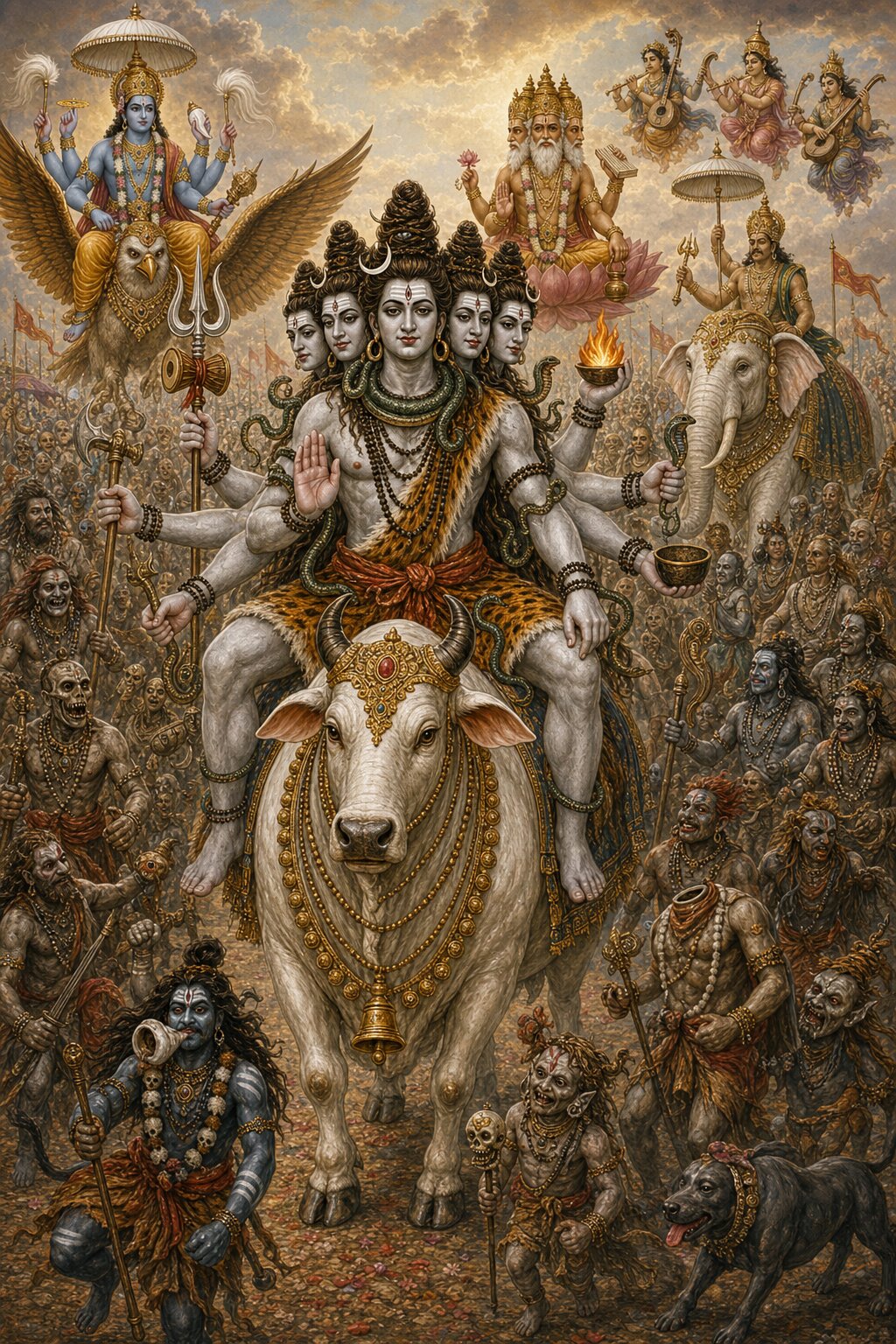
Shiva kept some of his hosts behind and took the rest with him. Shankhakarna, Kapala, Mahakala, Bhringiriti, and the other lords of the ganas, along with Nandi and Bhairava, came with tens of millions of ghosts and goblins; some came across the earth, some up through the netherworlds, and some down out of the seven heavens. Some among them had many faces, some many arms; some had no mouth at all, and some had mouths set on their backs; some were eyeless, some had eyes past counting, and some had no head. All wore crowns of matted hair and rudraksha beads and were smeared with ash, and the three eyes and the blue throat of their lord were on them too. In the middle rode Vishnu on Garuda, a parasol raised above him and yak-tail whisks waving at either side; Brahma came with the Vedas, Indra on Airavata, and the gandharvas Tumburu, Narada, Haha, and Huhu played their instruments as they walked. The world-mothers Gayatri, Savitri, and Lakshmi came along as well. Chandika walked dancing in the guise of a sister, riding a ghost, wearing serpents for her ornaments and balancing a golden waterpot on her head, and she left eleven crores of Shiva’s own ganas trailing behind her. Shiva rode at the center of it on his bull, the bull the Vedas call Dharma, and the great voice of the kettledrums rang out, working the welfare of the world.
Mena’s Fear
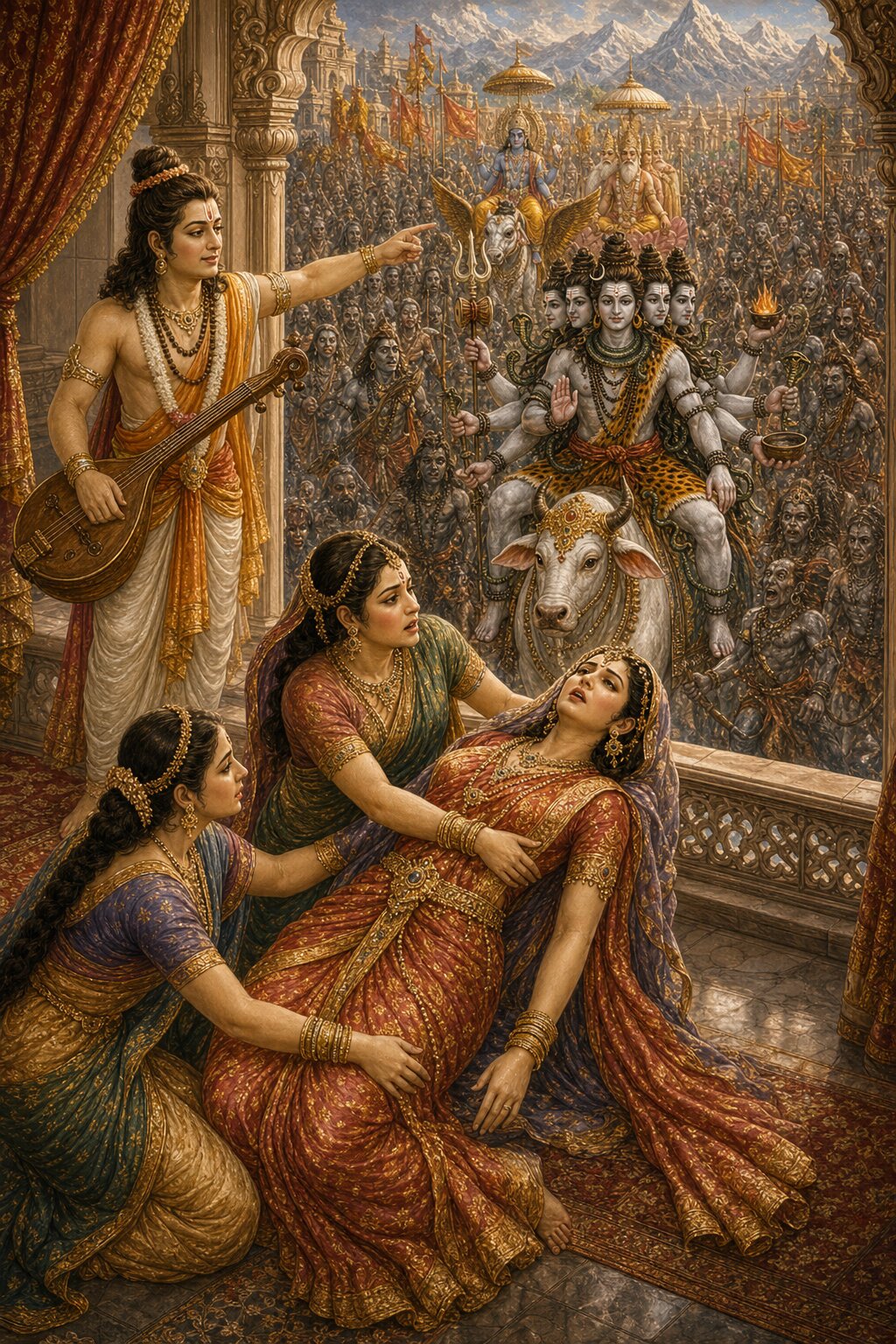
Himavan went out to receive the procession and bowed to Shiva riding his bull, and to Vishnu and Brahma. Up in her mansion, Mena called Narada to her and asked him to point out the bridegroom. Shiva, who knew what was in her, had arranged the order of the march himself and told the gods to go by one at a time and leave him for last. The Vasus passed, and Mena said, is this Shiva, and Narada said, this is only a servant of his. Then Manigriva with the yakshas at twice the brightness of the Vasus, then Agni, then Yama, Nirriti, Varuna, Vayu, Kubera, Ishana, each one twice the blaze of the one before, and at every one of them Mena said, this is Shiva, and every time the answer came back, no. Then Indra, then the moon, then the sun, then Brihaspati, then Brahma; and Mena grew glad in her heart, thinking that if the servants alone were this beautiful, the master must be lovely beyond imagining. When she saw Vishnu in his yellow silk, dark as a rain cloud, with the beauty of numberless Kamadevas in him, her eyes lost their footing and she felt certain she had found the groom. That is Vishnu, Narada told her, who is managing the wedding party; the bridegroom is better than this one, and I have no words that will hold him. Just then Narada pointed his finger at the true Shiva, standing among the terrifying hosts: five faces, three eyes in each, ten arms, a skull in one hand, matted hair and the moon on his head, a tiger skin, and serpents over every limb. At the sight, the heart of Shiva’s mother-in-law filled with grief, and she fell to the ground like a creeper cut from its root. “What is this that I see? I clung to my own folly and have been cheated,” cried Mena, and she fainted away.
When she came to herself she began to lament. First she cursed Narada and Arundhati, then she looked at her daughter and said, “Oh, this foolish girl has given gold and bought glass, has let a swan fly free and raised a crow in its cage, has passed over the sun and caught a firefly.” She swore she would throw Parvati from a mountain peak or drown her in the ocean before she gave her to this figure, and that if she did give her, she would abandon her own body. Then Parvati said calmly, “Mother, this Rudra is the cause of all that comes into being; he is God himself, and there is none greater than he. Vishnu and Brahma serve him. In mind, in word, and in deed I have chosen Hara alone, and now I will choose no other bridegroom. Do as you wish.” The gods, and then Himavan, and at the last Vishnu himself explained to Mena that Shiva is without form and with form, plain of aspect and beautiful of aspect, and that everything you see, from Brahma down to the smallest insect, is his shape. Mena’s heart softened somewhat, yet she did not let go of her insistence. “If Lord Shiva will take on a beautiful body, only then will I give my daughter.”
The Beautiful Form and the Wedding
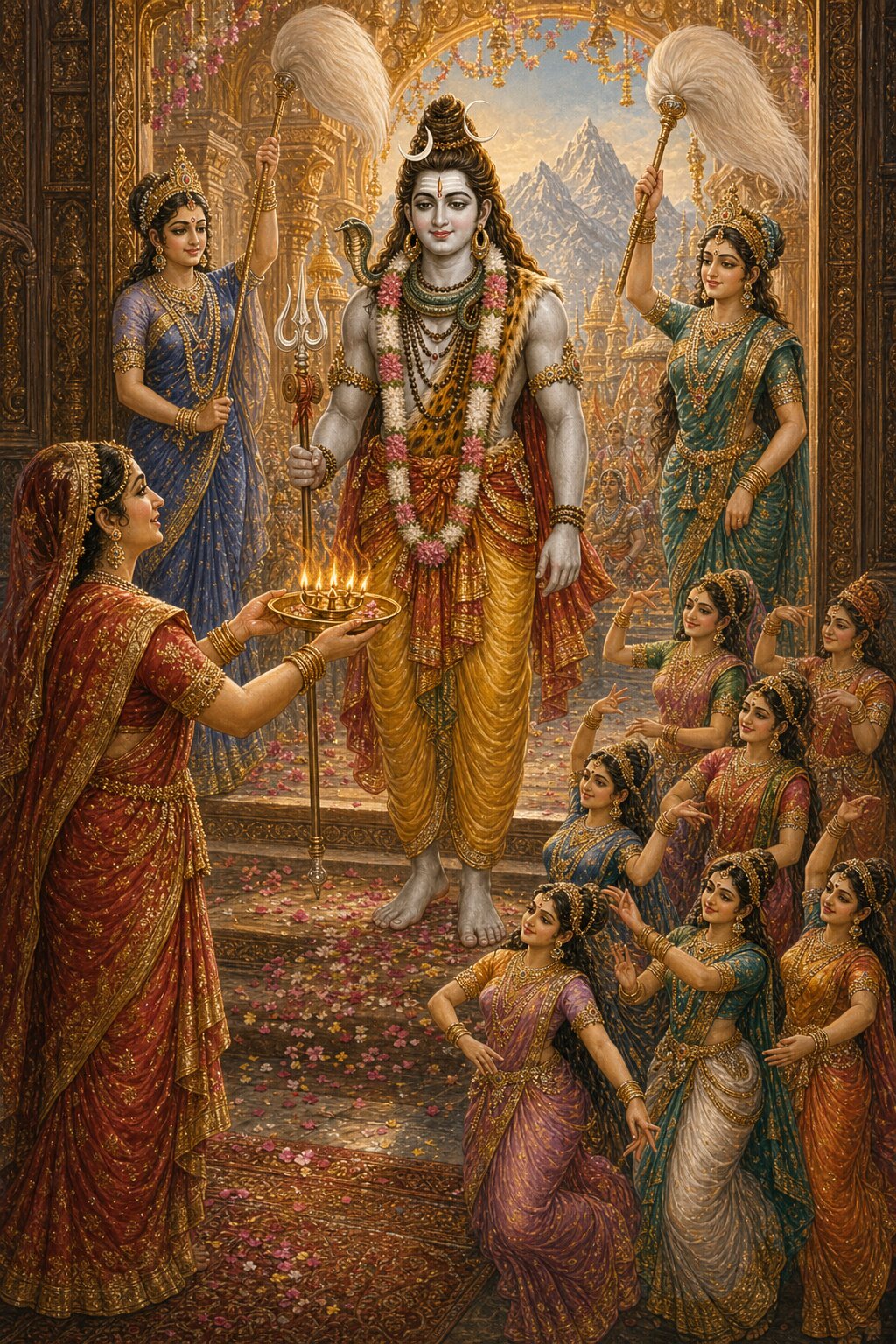
Then Shiva revealed his supremely beautiful divine form. Ganga and Yamuna began to wave the whisks, and the eight siddhis danced before him. Seeing that form, Mena stood for a moment as still as a woman painted in a picture, then, filled with joy, she began to beg forgiveness for her earlier scorn. The women of the city dropped their work and came running, and the sight of that enchanting form made them count their lives fulfilled. At the gateway Mena performed the lamp ceremony of welcome for the bridegroom.
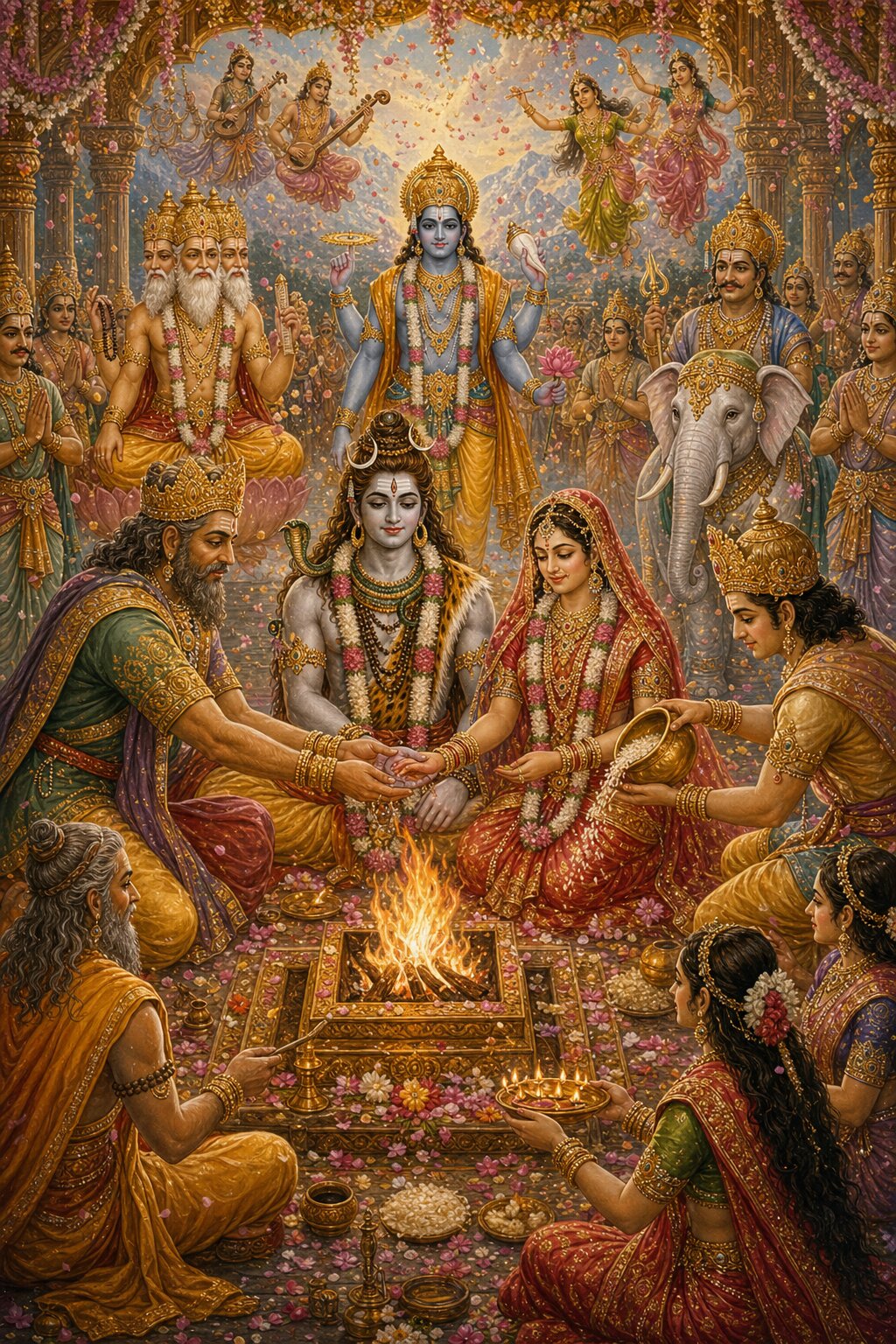
At the time of the wedding, when Himavan, urged on by Garga, asked for the bridegroom’s lineage and family and name and his branch of the Veda, Shiva turned his face away and stood there with nothing to say, and the gods and the sages watched him stand there. Then Narada struck his vina. They all told him to stop, the mountain king and Vishnu and Brahma together, and he would not stop, and at last he said what he had come to say: Shiva has no lineage, no family, and no name; Vishnu does not know his gotra and Brahma does not know it, Brahma who flew up and never found the top of that pillar of light and Vishnu who went down and never found its foot; he is made of sound, and sound alone is his family, and sound came before even the form he wears. The mountains pressed Himavan to stand by his word. Satisfied, the lord of mountains recited this mantra of the giving of the bride: इमां कन्यां तुभ्यमहं ददामि परमेश्वर। भार्यार्थं परिगृह्णीष्व प्रसीद सकलेश्वर॥ (This maiden I give to you, Supreme Lord; receive her as your wife, and be gracious, Lord of all.) And he placed Shivaa’s hand in Shiva’s. Reciting the Vedic mantras, Mahadeva took Girija’s lotus hand in his own. Cries of victory rang through the three worlds, the gandharvas sang, and the apsaras danced. By Brahma’s command the sacred fire was established; Parvati’s brother Mainaka poured parched grain into his sister’s cupped hands; the bride and groom made their offering and circled the fire. Shiva gave Brahma a full vessel, gave cows to the teachers, and distributed gold and jewels to the Brahmins, and Himavan sent his daughter away with a hundred thousand cows and elephants past counting.
In the nuptial chamber the women untied the knot that had bound the couple’s garments together, and sixteen celestial women, among them Sarasvati, Lakshmi, Arundhati, and Rati, came to look upon the newlyweds. Then Rati laid the ashes of Kamadeva before Shiva, in the very bag she had carried them in, and prayed through her tears that he restore to life the husband he had once burned to ash. Every soul in the three worlds is happy at your wedding and I alone am not, she said; and until my husband walks again, your own delight with Parvati will never be whole. Sarasvati and the other women wept with her and asked the same. His heart melting with pity, Shiva turned one merciful glance on the ashes, and Kamadeva came up out of them with his bow and his arrows and his old smile. Well pleased, Shiva told him to ask for a boon; Kama asked to be forgiven what he had done, and for love toward Shiva’s people, and for devotion at his feet. Then the bride and groom fed each other sweets.
The Farewell
The wedding party stayed for several days, and Himavan washed the feet of Shiva and Vishnu and Brahma with his own hands and fed them all until no one could name what he had eaten, while the women of the city stood around them laughing and singing the cheerful insults that the custom asks for at a wedding. On the fourth day the rite of the fourth day was performed in full, the rite without which the wedding sacrifice remains incomplete. Again and again Himavan pressed the gods to stay, but in the end, when the seven sages counseled him, he agreed to see the party off. As Shiva, with the whole company of gods, made ready for the journey to Kailasa, Mena began to weep aloud and said to that ocean of compassion, “Merciful one, cherish and care well for my Shivaa; forgive her faults as well, and forgive a thousand of them, since you are so easily pleased. Birth after birth this girl has been a devotee at your feet; nothing pleases her but her lord Mahadeva, and asleep or awake she thinks of nothing else. The moment she hears talk of devotion to you, her eyes fill with tears, and if she hears you slighted she falls so silent it is as though she has died.” With these words Mena gave her daughter into Shiva’s keeping and fainted away. Mahadeva consoled her. Then, with the gods and the daughters of the gods, that great procession set out toward Kailasa, and the minds of all were fixed on the thought of Shiva. Himavan, lord of mountains, walked far along with the party, then folded his hands, took his leave, and returned to his home. In this way the daughter of the king of mountains became the very own of Shankara, the dweller upon the mountain.
Source: Shiva Purana (Gita Press, Sankshipta Shivapurana Anka), Rudra Samhita (Parvati Khanda)