On this page
Listen, says Brahma to the divine sage Narada. Once the gods had returned to their several realms, Lord Shankara settled into deep meditation, resolved to test the austerities of Parvati. He who yields to those who love him, even Rudra, was stirred from that meditation, astonished by the mountain-king’s daughter and the sheer weight of her penance. Then Hara called to mind the seven sages, Vasishtha and the rest, and the moment he thought of them all seven arrived, their faces bright, congratulating themselves on their own good fortune. We are blessed to have been remembered, they said, bowing; command us as you would your own servants. Smiling, Shiva said, O seven sages, you are my benefactors, and there are no cleverer heads anywhere. The mountain-king’s daughter Parvati performs austerities on the peak called Gauri to win me as her husband. She has put every other desire out of her, her maids attend her, and her mind does not move. Go there at my command, and with love in your hearts test the firmness of her resolve. You are to speak words wholly steeped in guile; harbor no doubt about this.
The test of the seven sages
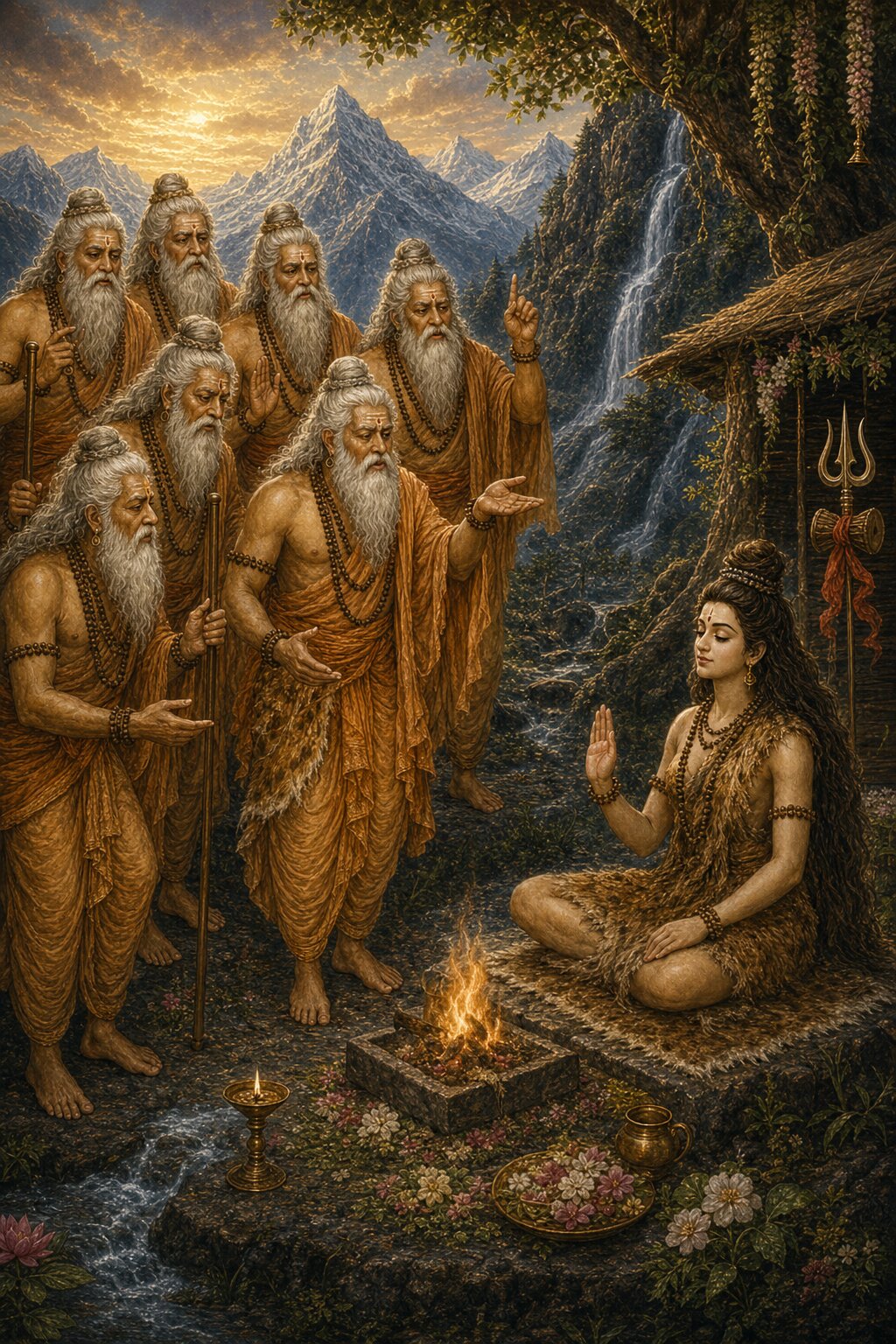
The seven sages came at once to the place where the Mother of the worlds sat radiant, like austerity itself given a body and brought to perfection. She welcomed them and worshiped them where they stood, and they bowed their heads to her in their own minds before they asked aloud, O daughter of the mountain-king, for what do you perform these austerities, and what fruit do you hope to win? Though the matter was hers to keep private, Parvati told them the truth. You will laugh at me, she said, for the thing I want is beyond getting, and I know it, and I am going to say it anyway. Great among sages, I received the teaching of the divine sage Narada, and I perform this penance carrying a single wish, that Lord Rudra become my husband. My mind is set on a task it cannot manage; it is trying to build a high wall on the surface of water. My mind is a bird that flies stubbornly through the sky with no wings at all; only Shankara, the storehouse of mercy, can fulfill it.
At this the sages laughed and began to speak words full of guile and falsehood. Daughter of the mountain-king, the divine sage Narada thinks himself a scholar for nothing; with cunning and deceit he casts a spell over the minds of others. He counseled the sons of Daksha, gone west to the holy lake to perform penance, in such a way that they never came home again; and when their father begot a thousand more and sent them to the same water, Narada went after those too, and not one of them came back either. He laid waste the household of Chitraketu, lord of the Vidyadharas. He made a disciple of Prahlada and so brought great suffering on him from Hiranyakashipu. Whoever sits and listens to that sweet reasoning of his ends by putting down his house and picking up a begging bowl. His skin is white and shining and his soul is filthy, and we know it because we keep his company; from a distance a man will call the stork a gentle bird that would never take a fish. Fallen under his sway, you too have taken up this cruel penance. Young one, the Rudra for whom you do this is forever indifferent, an enemy of desire; he has no home anywhere, and no one can trace his lineage. Once before he married the virtuous Sati, yet within a few days he could not sustain the union and cast her off. How is any woman to live out her life with such a bridegroom? Turn back and go home. The bridegroom worthy of you is Vishnu, dweller in Vaikuntha, crowned with every virtue, and it is to him that we will see you married.
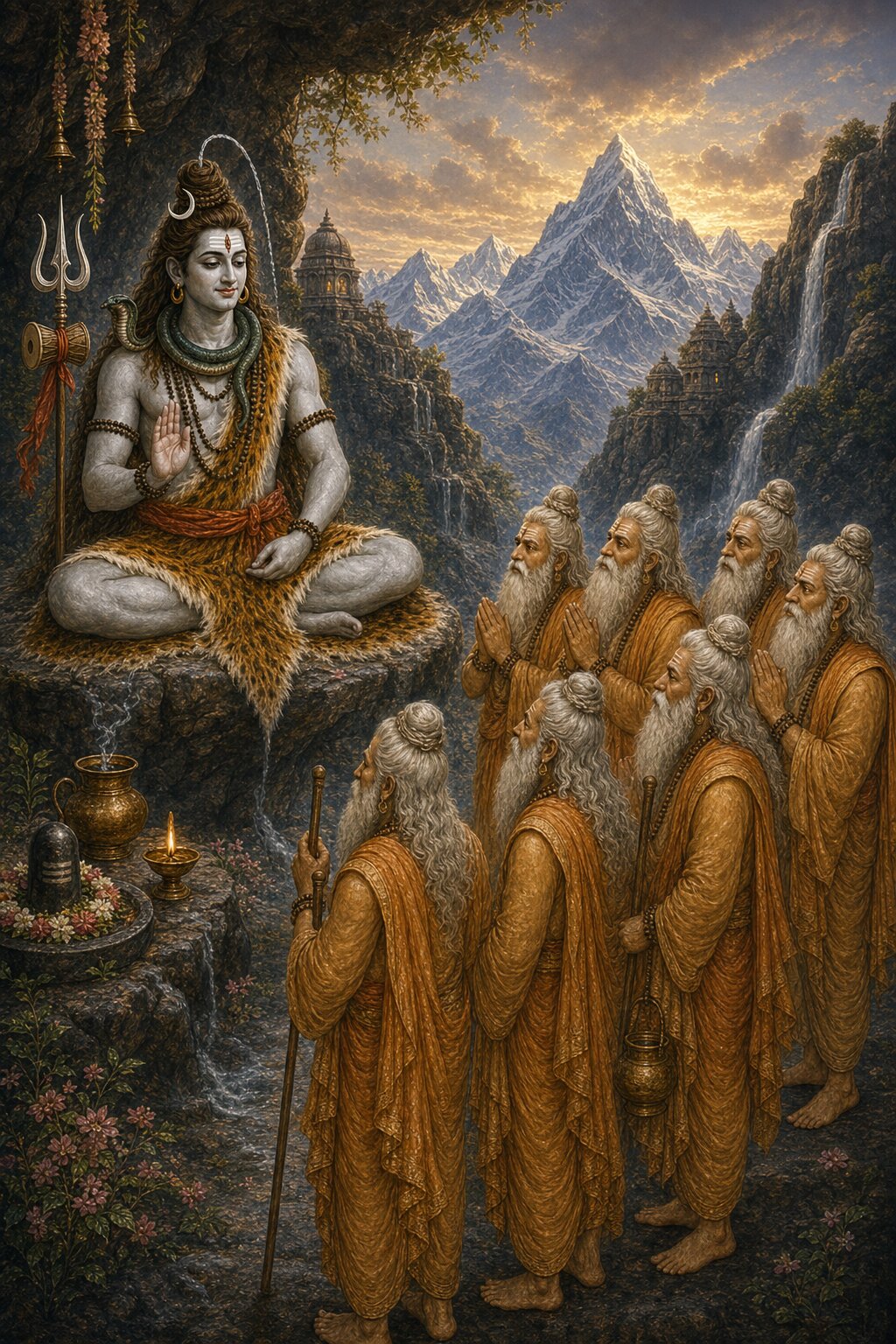
The Mother of the worlds laughed and said, Great among sages, you have spoken as your own understanding allows, yet my resolve will not loosen. I was born of a mountain, and the hardness is in the body I was given. The teaching of the divine sage is the highest good for me, and I will never let it go; those who hold a preceptor’s word to be true find happiness here and hereafter, and those who keep a private doubt about it find misery everywhere they go. When you praise Vishnu as the house of every noble quality I do not contradict a word of it. But hear why Sadashiva goes without attributes. Shiva is the supreme Brahman in visible form, changeless; he wears the guise of a wandering ascetic only for the sake of his devotees, and makes no display of lordship, and so he carries himself as the great yogis carry themselves, bliss itself walking as an Avadhuta. A taste for ornament belongs to creatures smeared with maya, never to Brahman. Nor does he give his grace for creed or caste; it was my own preceptor’s grace that let me know him at all. If Shiva will not marry me, I will remain unwed forever, and I will never choose another. Though the sun should rise in the west, though Meru should shift from its place, though fire should take on coolness and the lotus bloom on bare stone, even then my resolve cannot break. This I say in truth. Knowing her certainty, the seven sages raised a cry of victory, gave their blessing, and returned to Shiva, and told him the whole account.
The matted-hair Brahmin
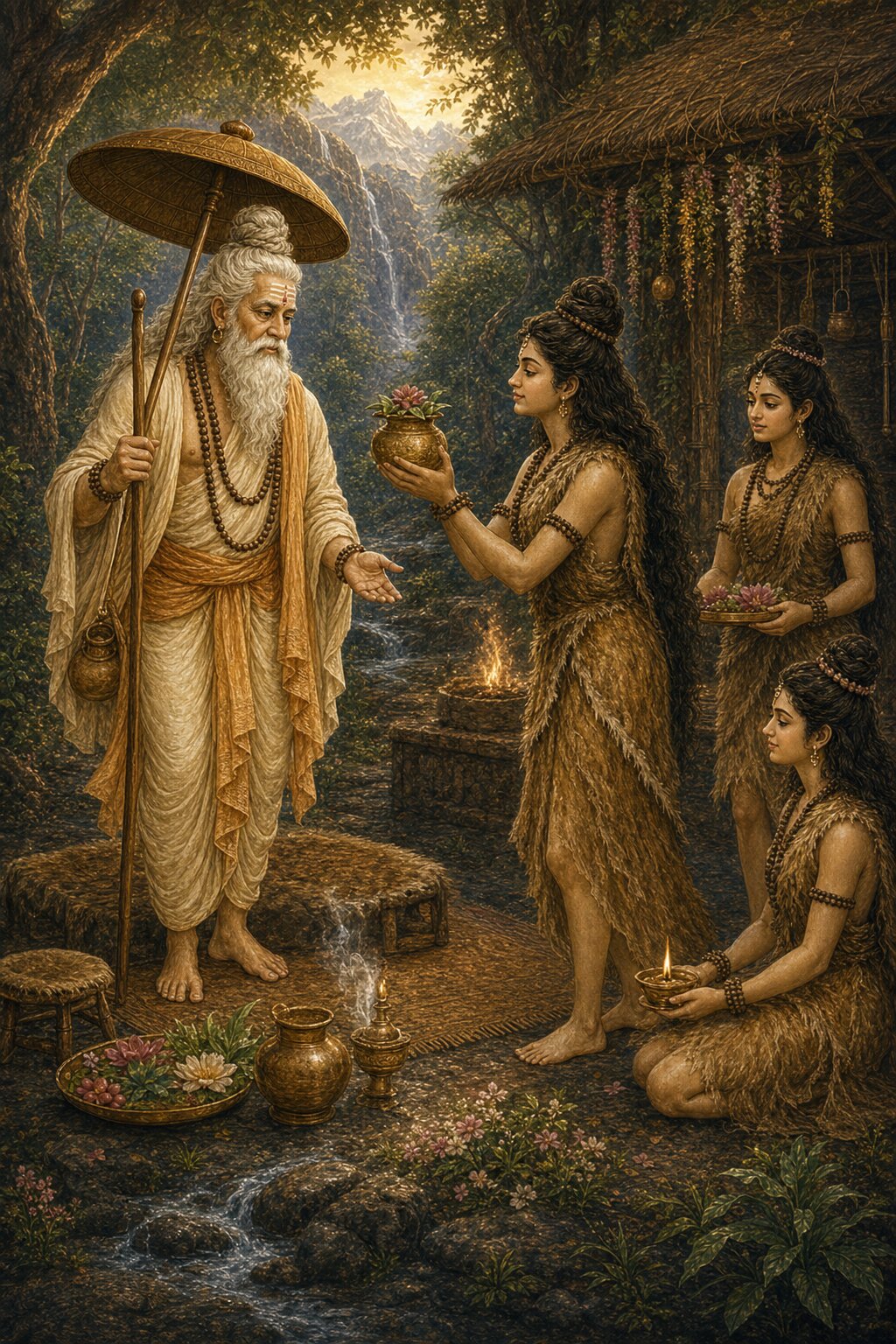
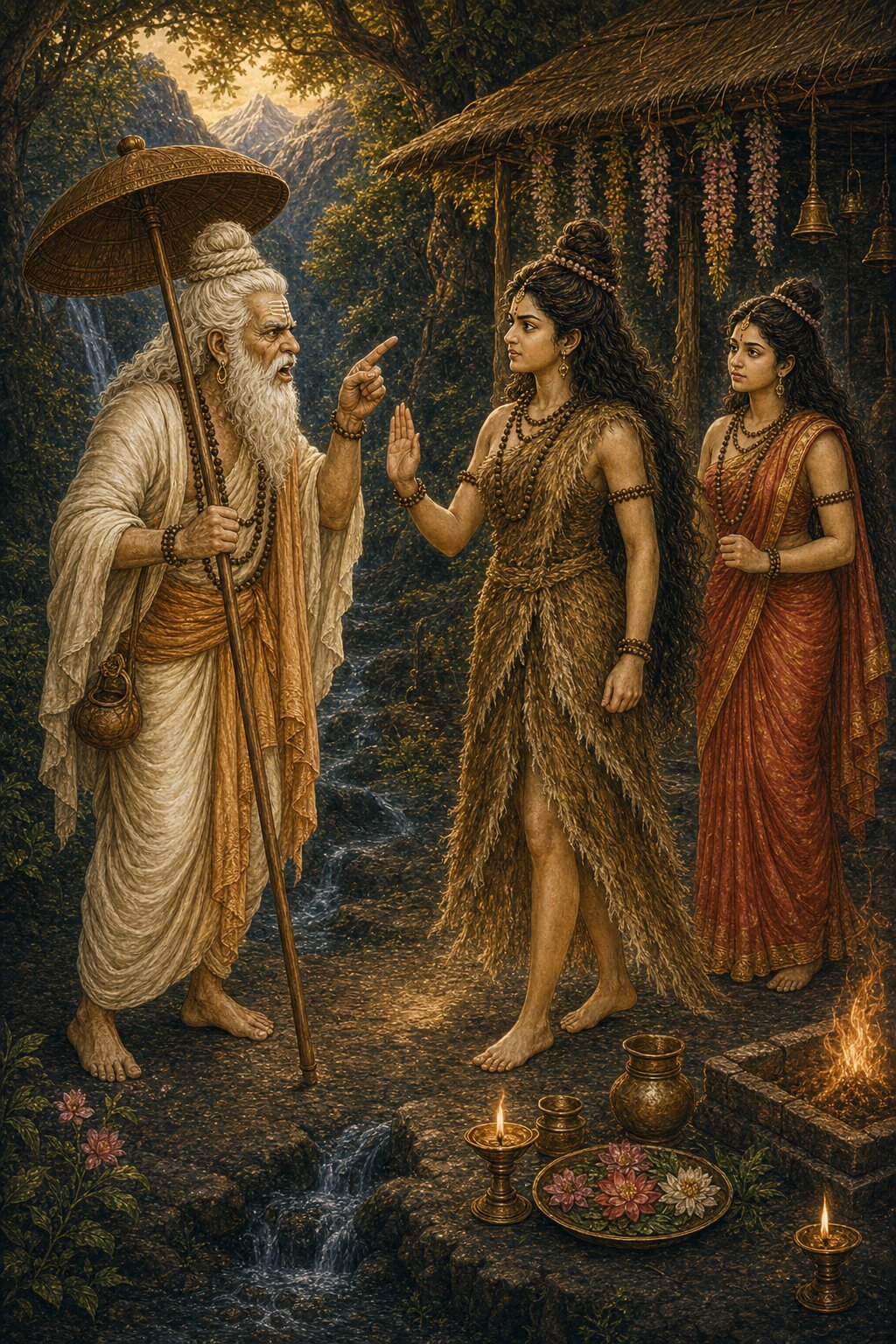
Now Lord Shankara himself resolved to test the goddess’s penance in person. On the pretext of the test, and to look on her once more, he took the form of a matted-haired ascetic and went into the forest, the form of a very old Brahmin ablaze with his own radiance, a staff in one hand and a parasol above him. In the hermitage he saw the goddess seated upon an altar, ringed by her companions, luminous as one pure phase of the moon. Parvati honored the radiant Brahmin with every article of worship, each of them made ready and set out as it should be, and asked after his wellbeing with warmth, Who are you, and from where have you come? You light up this whole forest with your splendor.
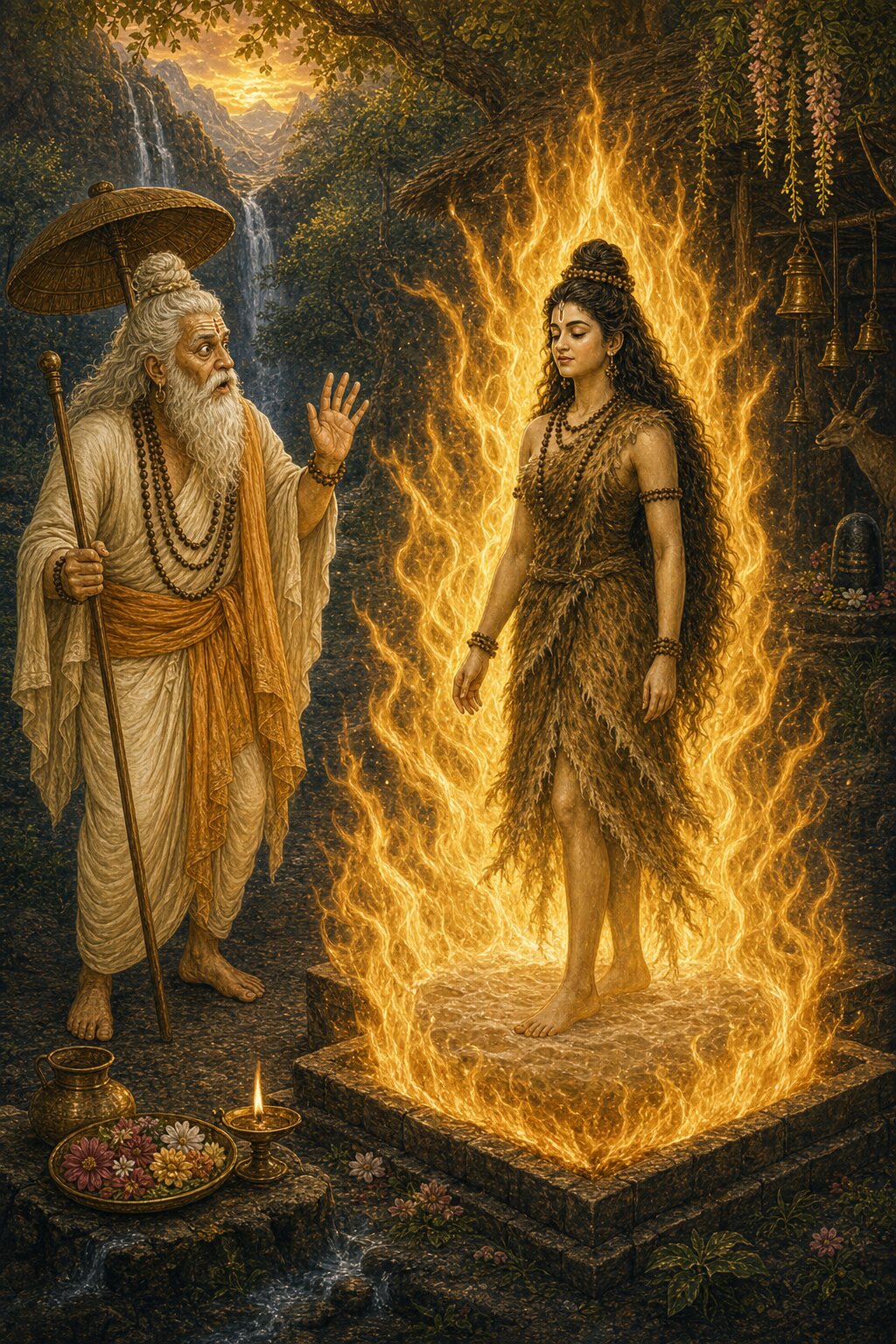
The Brahmin said, I am an old Brahmin who wanders as he pleases, pure of mind, given to austerity and to the good of others. But who are you, whose daughter, and why do you perform in this lonely forest a penance rare even for sages? You are no child and you are no old woman; you are a young woman with every auspicious sign on you, and yet you are unmarried and out here at this. Are you the wife of some ascetic who would not feed you or house you and walked off to live somewhere else? What family were you born into, and who is your father? All this penance is going to waste. Are you Gayatri, mother of the Vedas, or Lakshmi, or Saraswati? Parvati answered, Best of Brahmins, I am neither Gayatri, nor Lakshmi, nor Saraswati. At this time I am Parvati, daughter of Himachala. In an earlier birth I was Sati, daughter of the Prajapati Daksha; one day my father spoke ill of my husband, and in anger I gave up my body through yoga. In this birth too Shiva was mine, yet after he burned Kamadeva to ash he left me and went his way. Scorched by his absence, I came to the bank of the Ganga to perform penance, and though I have practiced it for a long age I have not won my beloved. Now I will enter the fire, since Shiva has not accepted me; but wherever I am born, in that life too I will choose him alone as my husband.
With these words Parvati stepped into the fire before the Brahmin’s very eyes, though again and again he tried to stop her. Yet by the power of the ascetic’s penance, the moment she entered, the flame turned as cool as a smear of sandal paste. She stayed within the fire for a breath, and as she began to rise from it, Shiva in his Brahmin’s guise laughed and spoke again, Ah, gentle lady, your penance is beyond my understanding. The fire did not burn your body; that is the success of your austerity. Yet even now your wish is unfulfilled; that is its failure. Tell me truly what you long for. You had a jewel in your hand and you threw it away to pick up base metal, and your beauty is going for nothing. Parvati prompted her companion Vijaya to answer. Vijaya said, Holy one, my friend is the daughter of Himachala, famed by the names Parvati and Kali. She has passed over Indra and the gods, and Vishnu and Brahma, and desires no one but Shiva; for three thousand years she has done penance for this alone, to win Pinakapani as her husband. She planted these trees you see, and every one has come into flower and fruit. She does it at the bidding of Narada, to make her beauty bear fruit, to raise the name of her father’s line, and to give Kamadeva back his life. The Brahmin laughed and said, In this I sense a jest; if it is true, let Parvati say so herself.
Shiva slanders Shiva
Then Parvati said, Best of Brahmins, what my friend has told you is true; in thought, in word, and in deed I have chosen Shiva as my husband. I know the prize is hard to win, and still I do penance in the conviction of my heart. Hearing this, the Brahmin rose to leave. I wanted to know what this lady is starving herself for, he said, and now I have it from her own mouth. What you ought to do is not for me to say, and your friendship is of no further use to me; I wish you a happy future, and I will go. Parvati bowed and said, Best of Brahmins, stay, and tell me what is for my good. So the Brahmin paused and said, If you are holding me back in earnest, and you truly wish to hear it, then I will lay the whole of it out and you may get some sense from it. Goddess, I know Mahadeva in every way, and therefore I tell you the plain truth, listen. Mahadeva, whose banner bears the bull, keeps ash smeared over his whole body; matted locks crown his head, a tiger’s hide serves him for a loincloth and an elephant’s skin for a shawl. In his hand is a beggar’s skull-bowl, snakes coil about his limbs, he grows strong on the poison he has swallowed, he eats what no one should eat, his eyes are ugly and fearsome, and he has as many as ten arms. When, where, and from whom he was born has to this day never come to light; he keeps forever apart from home and household, stark naked, and takes ghosts and goblins for company. For what reason would you take such a one for your husband? Where has your good sense gone?
You are a jewel among women, and your father is king of all the mountains. Why then would you take, in place of a gold coin, a piece of glass just as large? To leave fine sandal and smear your limbs with mud, to trade the blaze of the sun for the glimmer of a firefly, to throw off good silk and pull on a hide, to walk out of a house and into a forest, to give up a treasury of gems to gain a lump of iron, this is no worthy wish. You pass over the guardians of the quarters and run after this one, and no custom of the world explains it. Set your eyes, wide as opened lotuses, beside those three ugly eyes of his; your one moon of a face beside the five of his; the plaited hair that lies along your back with a serpent’s gloss beside those matted ropes he is so proud of; the sandal paste on your limbs beside the ash of the funeral pyre on his; your silk beside his elephant hide; the lovely necklace at your throat beside the garland of human skulls at his. In your father’s house the drums are sweet and tuned; he has that little damaru, and after it the horn, and no one has ever called that sound auspicious. If he had any wealth, why would he go about sky-clad? For a mount he has one old bull, and nothing else. Of the qualities a bride looks for, he possesses not a single one. Even Kamadeva, dearest to you, was burned to ash by him, and then he insulted you as well, walking away and leaving you where you stood. It was for this that Daksha did not invite his daughter Sati to his yajna, because she was the wife of a skull-bearing beggar; he called every god and left out Shambhu alone, and it was from that insult that Sati gave up her very life. In him no caste can be seen, no learning, no wisdom; fiends are his helpers and poison sits in his throat. This match holds no appeal for me; turn your mind away from that worthless thing. After that, do as you wish; I have nothing more to say.
Parvati’s reply
At this Parvati grew angry in her heart at the man who slandered her lord, and she said, Old father, until now I took you for some wise and holy soul who had come my way, but now your true metal shows through. You told me you knew Shiva; had that been true, you would not speak words against all reason. Maheshwara sometimes puts on a wondrous guise by the power of his play, yet in truth he is the supreme Brahman, the Highest Self made visible. Shiva is Brahman without attributes, who has taken on attributes for a purpose; when every quality is his own nature, what caste or lineage could he have, and what would learning add to the one in whom all learning rests? At the dawn of the kalpa it was Shambhu who granted the whole of the Vedas to Vishnu the moment he was born. By worship of him the soul conquers death, and for this his name Mrityunjaya, conqueror of death, is famed through the three worlds. By his grace alone Vishnu gained his Vishnu-hood, Brahma his Brahma-hood, and the gods their godhood. When the lord of the gods wants to look at him, he must first make his peace with the goblins at the door, or the batons come down and the crown comes off. A man may be poor through seven lives together, and let him serve Shiva and nothing will stand in the way of his fortune again.
For him before whom the eight siddhis stand with heads bowed, what thing could be hard to win? The ash that the gods take up when it falls from his body and set upon their own heads, how could that be impure? The touch of Shiva’s limbs makes even an impure thing pure, and though he keeps company with everything the world calls inauspicious, the mere thought of him turns a life auspicious. People are made clean simply by looking at the man who carries that name in his mouth. Whoever slanders Shiva without knowing his truth sees the merit gathered across a whole lifetime burned to ash. Here you have slandered Mahadeva, and I have honored you, so I too have taken on a share of the sin. Then, angrier still, she said, You wicked man, you claimed to know Shankara, yet surely you have never known that eternal Shiva. How would a face turned outward, as yours is, ever find him? Say of Rudra whatever you will; that ever-changeless Shiva is still the god I most desire. Even Brahma and Vishnu cannot be the equal of Hara, and lesser gods still less, for they are forever subject to time. Having weighed this with a clear mind, it is for that Lord of all that I do penance in the forest.
Having said so much, Parvati turned back to her meditation on Shiva. The moment the Brahmin rose to say something more, Parvati, who would hear no more of his slander, said to her companion Vijaya, Friend, take pains to stop this base Brahmin; he will only slander Shiva again. The one who slanders takes on a share of the sin, and so does the one who listens. A man who talks so of Shiva has earned whatever Shiva’s attendants would do to him, and only his brahminhood stands between him and it; let him be left where he is. After the sight of such a man a person should go and bathe with his clothes still on him. We ought not even to look at his face; come, let us go this very moment to some other place, so that no chance is left to speak again with this ignorant man.
The vision face to face
The instant Parvati lifted her foot to go elsewhere, Lord Shiva appeared in his own true form and caught his beloved by the hand. He gave her his darshan in the very form she had held in meditation all those years, that same beautiful form, put on now exactly as she had shaped it within. Parvati, overcome with shyness, lowered her face.
Shiva said, Beloved, where would you go, leaving me behind? Never again will I forsake you. I am pleased; ask for a boon, for there is nothing I would withhold from you. Goddess, from this day I am your servant, bought at the price of your austerities, bought by your beauty; without you a single moment passes like an age. Set aside your shyness, for you are my eternal wife; think it through with that sharp mind of yours and you will see it. Following the play of the world, I who am your own tested you again and again in many ways; forgive me this fault. In all three worlds I see no other so full of love as you; I am wholly in your keeping, and there is no wish of yours I will not answer. You are my wife and I am your bridegroom; and now, before long, I will take you to my dwelling, the noble mountain Kailasa.
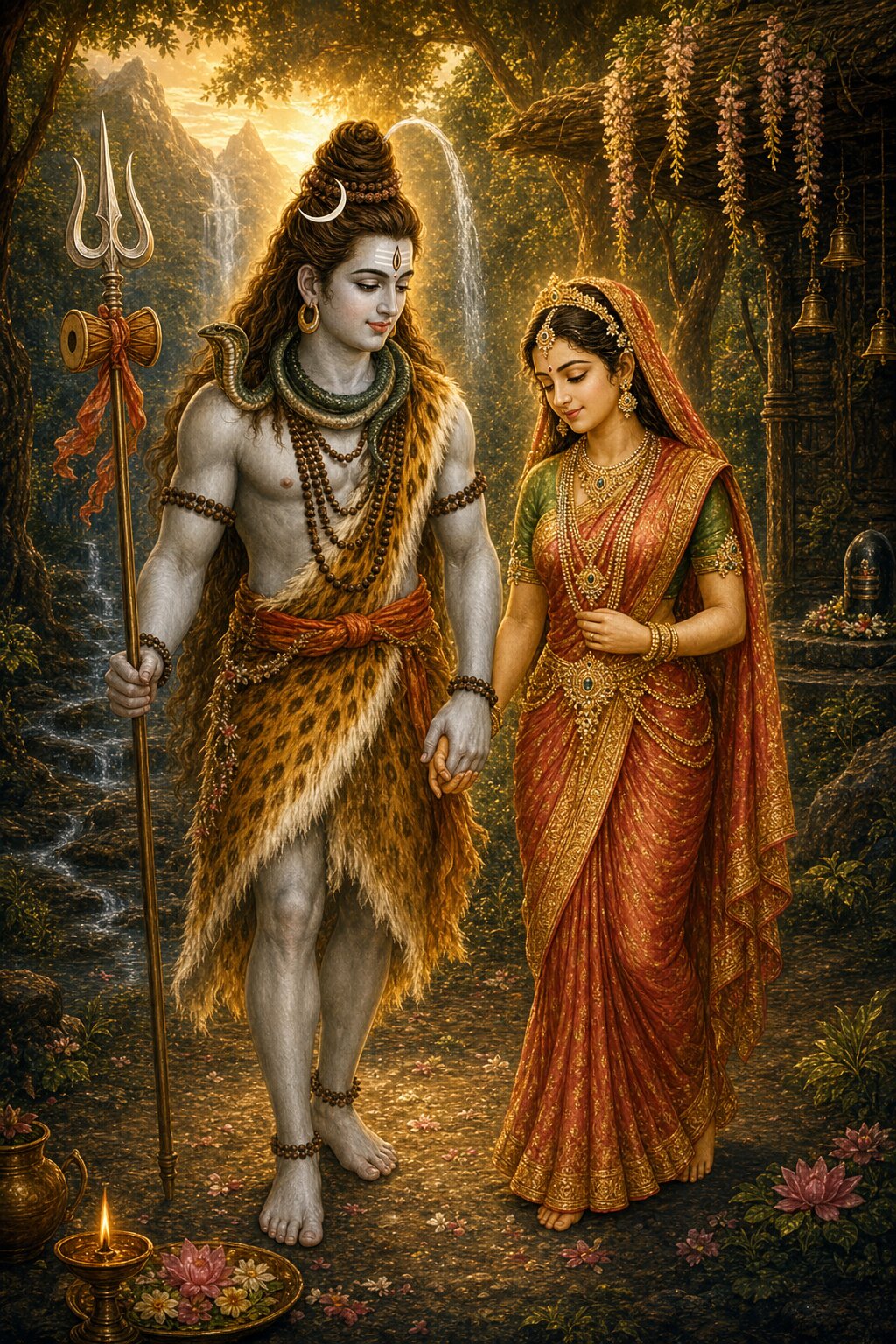
At these words from the God of gods, and at the sight of that face, Parvati was flooded with joy. All the hardship her penance had bred fell away, all her weariness lifted; for once a creature gains the fruit of its labor, every earlier toil is undone. Then she asked her lord, standing close beside her, to hold their wedding in due form at the house of Himalaya, but that is the next story.
Source: Shiva Purana (Gita Press, abridged Shiva Purana edition), Rudra Samhita (Parvati Khanda)