On this page
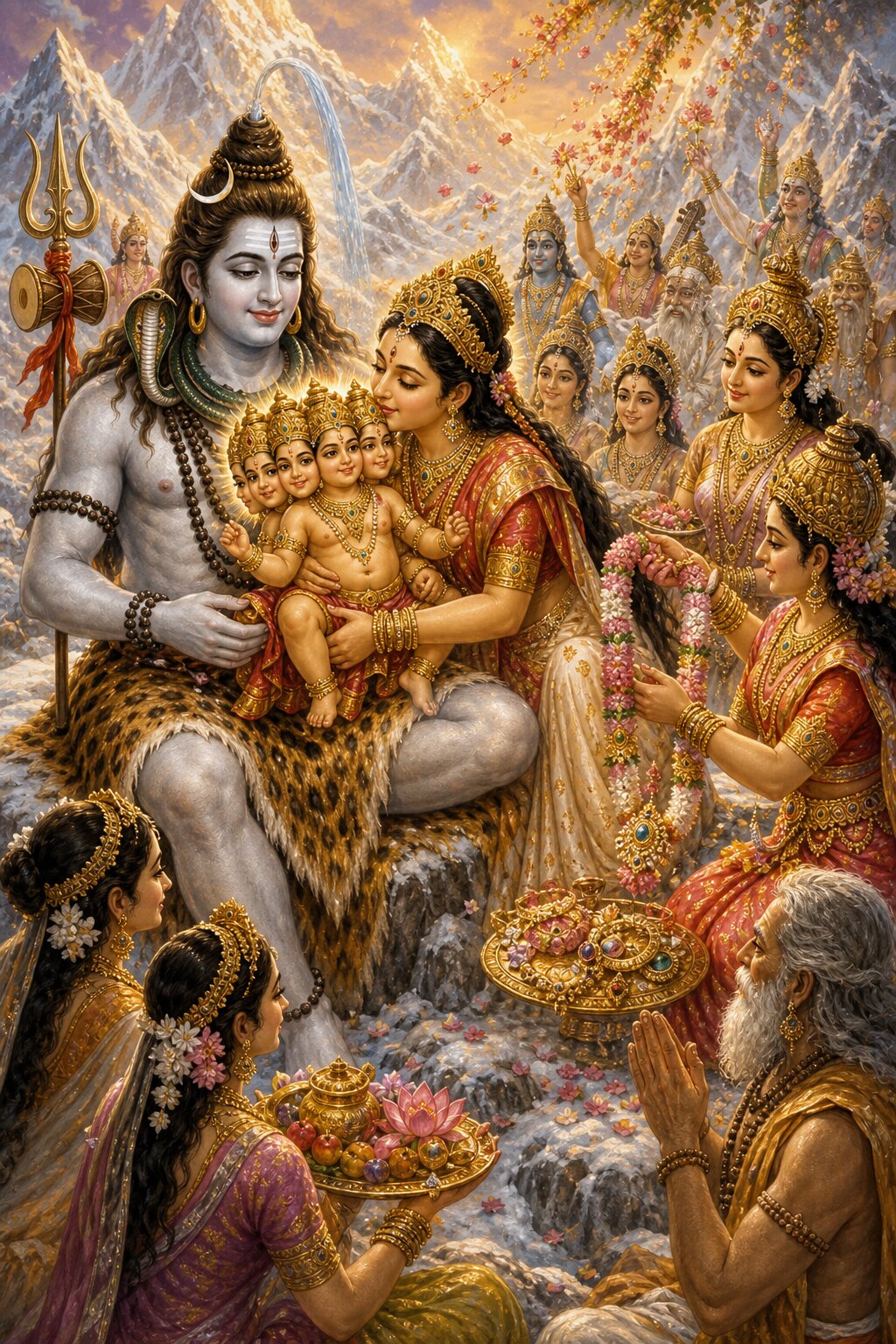
On Kailasa that morning the snow itself seemed to be celebrating. The gods had come climbing the slopes with a child in their arms, a tiny body crowned with six faces, and on all six a single smile had opened at once. Lord Shankara spread his arms and settled the boy into his lap. Consider it for a moment. The one whose wrath sets the worlds shaking had turned his lap, in that hour, into a cradle.
The whole account had opened with a question from Narada. He had asked Brahma how this son of Shiva, the god forever content within his own atman (the self), had come to be born, and how Tarakasura had met his death. So Brahma told the story: how the Kumara appeared, how six women, the Krittikas and the rest, raised him, how he put out six faces at once so that not one of the six should go without him at her breast, and came to be called Kartikeya because the Krittikas had cradled him, and how the gods brought him into the service of Shankara and Parvati.
The gods brought the boy gifts of every kind: treasures, branches of learning, powers, weapons of war. Shiva gave him the trident, the bow Pinaka, an axe, and the Pasupata arrow that ends worlds. Brahma gave the sacred thread and the Vedas, the Gayatri, the water-pot, and the Brahmastra. Indra brought a lordly elephant and his own thunderbolt, Varuna a white umbrella and a necklace of gems, the sun a chariot as quick as thought and a coat of mail to go with it, Yama his staff, the moon a vessel of nectar, Kubera a mace. Agni came forward and gave him a spear, and nobody in that bright crowd had the least idea what the spear was for. The ocean of milk sent up its gems and an anklet worked with them, and Himavat divine cloth and ornaments. Garuda gave his own son, the peacock Chitrabarhana, who would carry the boy the rest of his days, and Aruna gave a powerful cock named Tamrachuda. Parvati’s heart could not hold all the love that rose in it; she kissed the Kumara and gave him the highest sovereignty, and made him deathless besides. Lakshmi offered a vast and lovely necklace, and Savitri handed over every perfected art she knew. A great festival broke out across Kailasa, and the joy of Shiva and Parvati knew no far shore.
The gods’ plea and the voice from the sky
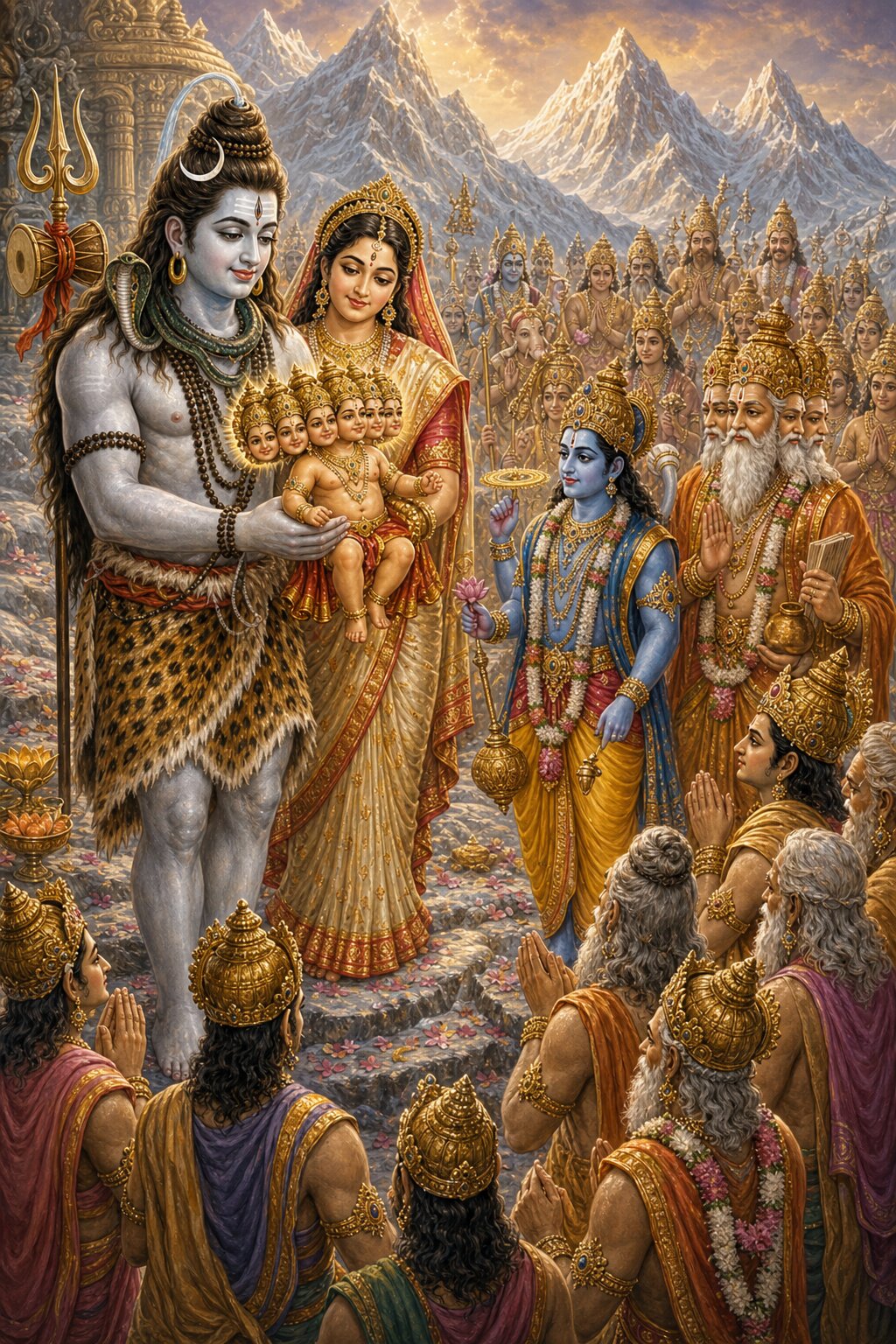
In the middle of that festival Shiva turned to Vishnu and Brahma and the rest of the gods, laughing, and said that he was delighted in every particular and that they should choose whatever boons they wished. Out of everything in his gift, the gods folded their hands and asked him for his son. “Lord! Tarakasura is fated to die at the Kumara’s hands alone. That is the reason this whole splendid history has come to pass, your marriage to Parvati and the birth of the Kumara both. For the happiness of us all, give him your leave. This very day we will arm ourselves and set out for the war.”
Hearing this, the heart of Lord Shankara grew moist with compassion. In that very instant he handed his son over to the gods for the killing of Taraka. After that there was no holding back. Brahma, Vishnu, and all the gods put Guha at their head and set off at once from the mountain, every one of them certain that this boy would surely strike Taraka down. Elsewhere the mighty Taraka heard that the war was being readied and marched out just as quickly with a vast army of his own. When the gods saw his surging host they were astonished for a moment, then filled themselves with resolve and gave their lion-roars again and again. Just then, moved by Lord Shankara, a voice spoke from the sky. “Gods! You have come out to fight with the Kumara as your leader, and for that reason you will conquer the daityas in this battle and carry the day.” The fear left the gods, and with the Kumara at their front they hurried, all eagerness, to the confluence of the Mahi and the sea.
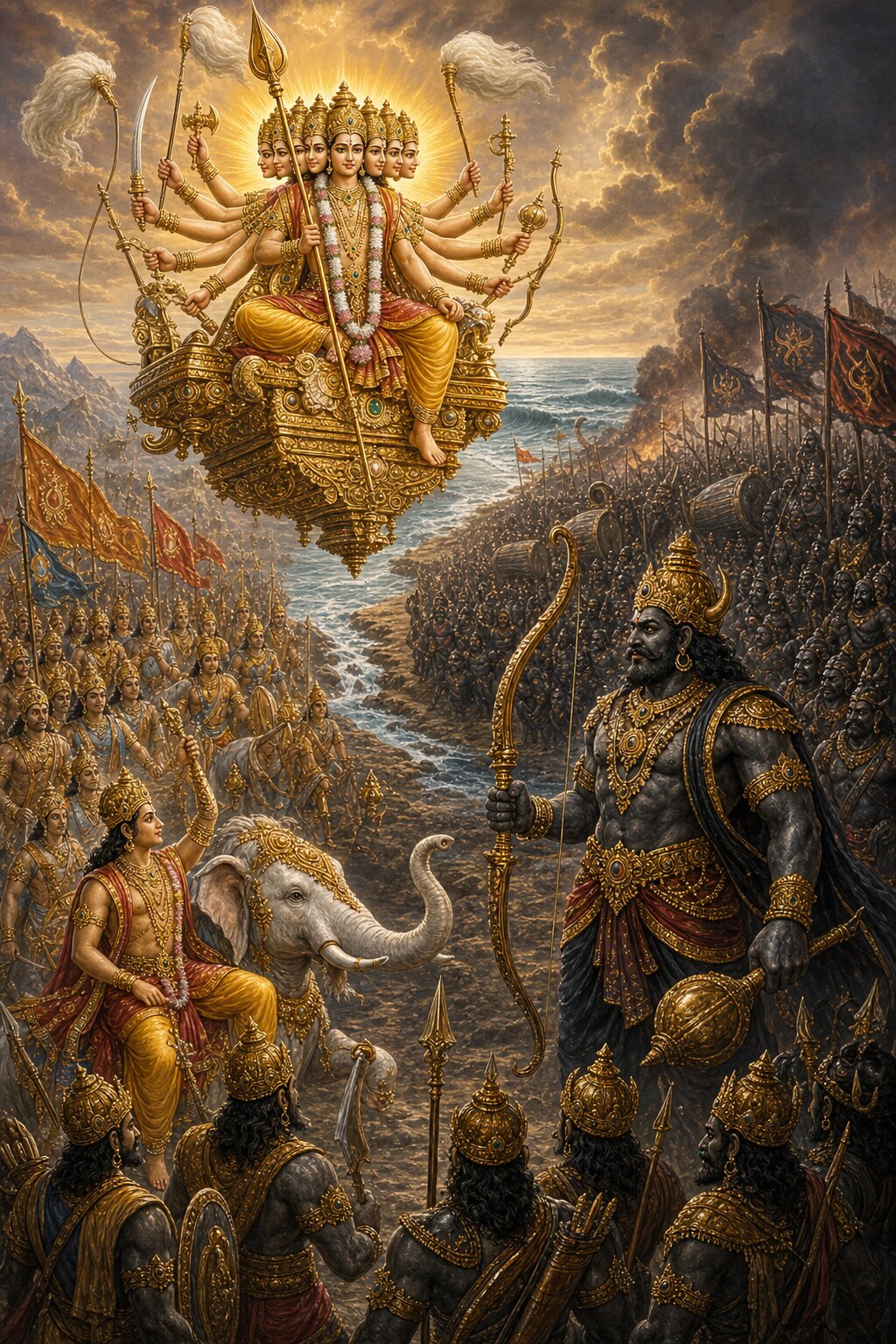
The battlefield where the Mahi meets the sea
Taraka too came storming up to the same spot with a huge army, and quickly. At his arrival the war-drums thundered like the clouds at the end of an age, the daityas slapped their arms and bellowed, and the earth shook under the pounding of their feet. Even in that terrible uproar the gods stood unafraid and set themselves shoulder to shoulder to take on Tarakasura. Indra, king of the gods, seated the Kumara on the royal elephant and stood at the very front with the guardians of the worlds. Dundubhis and bheris and turyas went up, lutes and flutes and mridangas under them, and the gandharvas sang the songs men sing going into a war. Then the Kumara gave that elephant back to Mahendra and mounted instead an astonishing sky-chariot that blazed with jewels of every kind. Shining yak-tail fans were being waved over him, and over his head they raised the white umbrella Varuna had given him on the day of the gifts, its gems throwing down a light like the light of numberless moons at once. His splendor was such that even on a field of war the eyes kept settling on him.
Then the clash broke open between gods and daityas, and in a moment the whole field lay carpeted with headless trunks and severed heads. Swords took arms off at the shoulder, maces went through chests, nooses dragged men down and spears finished them, and here and there a trunk with no head on it went on dancing a few steps with the arrows still standing in its hands. Blood ran in streams in a hundred places. Ghosts and goblins came to the edges of it, and the jackals and the vultures came, and they ate. When Tarakasura pressed forward with speed, Indra and the other gods planted themselves in his path. Just then Virabhadra, born of Lord Shiva’s wrath, came forward in a fury with the mighty hosts of the Pramathas, pushed all the gods behind him, and stood face to face with Taraka himself. The Pramathas and the asuras locked into a grappling melee, and a fearsome fight broke out between Virabhadra and Taraka. Partway through, the asura army abandoned the field and fled. Seeing his own forces scattering, Taraka in his rage took on ten thousand arms and began cutting the gods and the Pramathas down one after another. Then Virabhadra fixed his mind on Shiva’s feet and lifted a trident so magnificent that its radiance set the horizons and the sky ablaze.
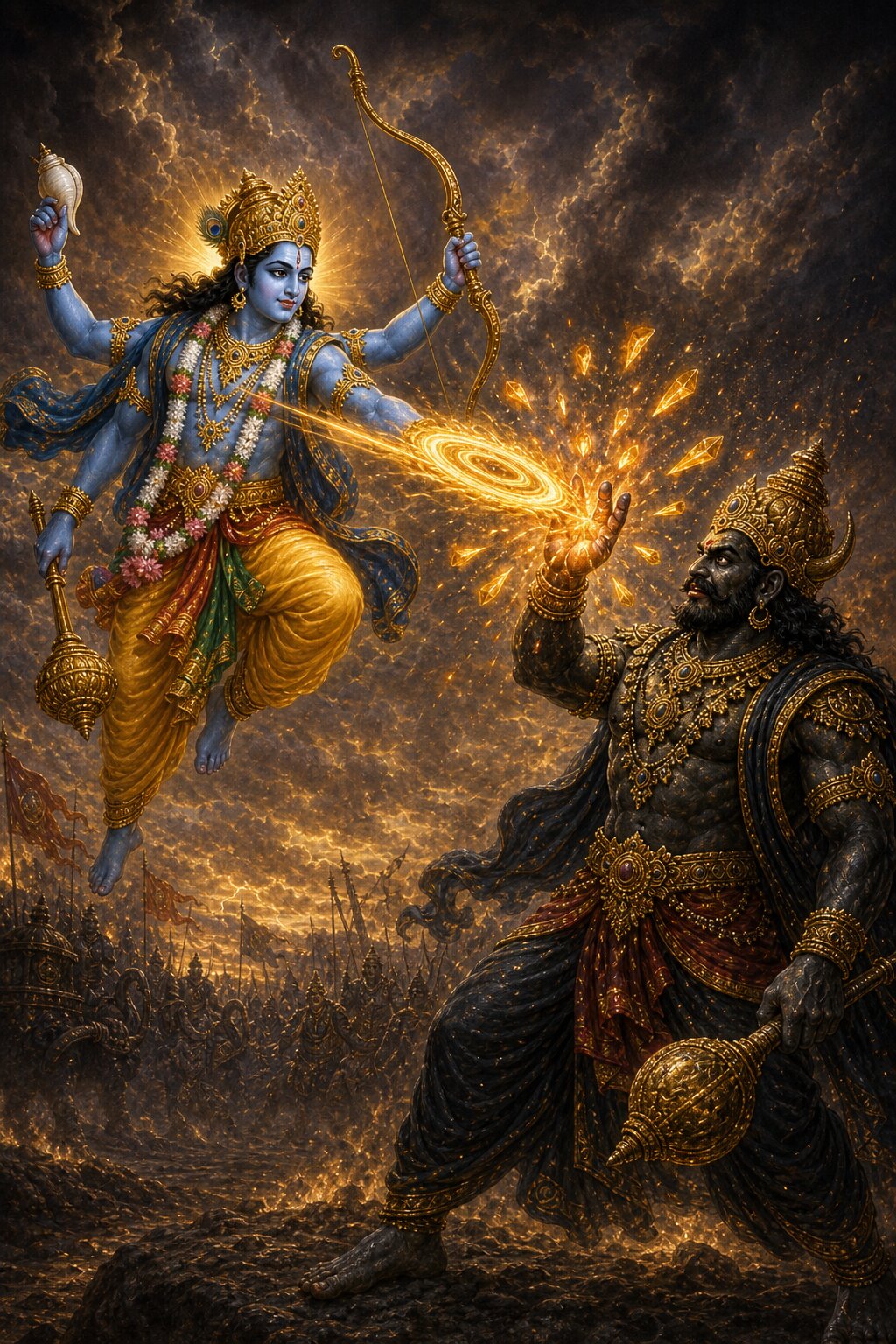
And here you must hear a curious turn in the story. At exactly the right moment Lord Kartika, a master of great and surprising play, sent word through Virabahu and had the fight stopped, and at his command Virabhadra withdrew from the field. Now Taraka flared up all the more. He was versed in every kind of weapon, and he began raining arrows on the gods and showed such prowess that even all of them together could not stand against him. Seeing this, Lord Achyuta was seized with anger. Shri Hari took up the Sudarshana discus and the Sharnga bow and fell upon the great daitya Taraka, and before everyone’s eyes a thrilling, enormous battle unfolded between the two. Achyuta gave a lion-roar and hurled his discus, blazing like leaping flames, at the daitya king. Struck by it, Taraka dropped to the ground. But that mountain of strength rose again at once and, with his own power, broke the discus into pieces. The two mighty ones grappled with each other on the field of war.
Brahma’s command and the slaying of Taraka
Then Brahma spoke. “Lord Kartika, son of Shankara! You are the god of gods. This pointless fight between Vishnu and Tarakasura does no one credit, for the asura will not meet his death at Vishnu’s hands. He grew immensely strong on a boon he won from me, and apart from you there is no one who can kill this sinner. Look at Indra. Look at Vishnu. They are shaken through, and the gods and the Ganas with them. This demon put down Indra and the guardians of the quarters long ago, and the heat of his penance has reached even Vishnu and made him afraid; the whole of the three worlds went under him once already. They are fighting again today for one reason, and the reason is that you are standing here. You are no boy and you are no youth. You are the lord of all. Son of Parvati! Ready yourself quickly. It was for the destruction of Taraka that you were born of Shankara in the first place.”
Hearing this, the Kumara Kartikeya burst into a great laugh and said, delighted, “So be it. It shall be exactly so.” Then, resolved on the killing of Taraka, he stepped down from his sky-chariot and went forward on foot. When the mighty son of Shiva ran ahead on foot with his gleaming spear (shakti) in hand, that weapon looked like some great meteor flashing like lightning. Not a trace of unease was in his mind, and his strength ran deeper than any measure could reach.
Seeing the six-faced one coming on, fierce and entirely unshaken, Taraka turned to the gods and laughed. “So this is the Kumara who destroys his enemies? I will fight him alone, and I alone will kill all these heroes, the Pramatha hosts, the world-guardians, and these gods who have Shri Hari for their leader. And what shamelessness is this, to stand a child in front of me and take cover behind him? Very well. I will kill the child too, and you may carry that home with the rest of it. Or let the child walk away from here now and keep his life.” Then, having spat out his insults, the asura threw himself into a savage fight, and in the spending of them he had spent something of his own that he would want back before the hour was out. The Kumara called to mind the lotus feet of Shiva, set his heart on the killing of Taraka, and, roaring in a surge of fury, planted himself for battle. The gods sent up cries of victory, and the divine sages began to sing his praises.
Then began the kind of battle that was almost unbearable, immense in its terror, and enough to frighten every living being. Both were consummate masters of the spear, shifting their stances, roaring, striking at each other with feint after feint. Each put his spear into the other’s heart and each twisted clear of the other’s point, two lions matched down to the last measure. They reached for the mantras, Vaitalika, Khecharaka, Praptika, and fought on with that power running in the shafts, and the blades went at heads and necks, thighs and knees, hips and chests and backs, and neither of them could find the opening he wanted. Gods, gandharvas, and kinnaras stood in silence and watched, and among themselves they were passing the only question left: which of these two is going to win? Such wonder spread over everything that the wind stopped moving, the sun’s brilliance went pale, and the whole earth with its woods and forests, and the mountains too, trembled. At this moment the Himalaya and the other mountains, overcome with tenderness, came there to guard the Kumara. The son of Shankara and Girija consoled them. “Great and fortunate mountains! Do not grieve, there is nothing to worry about. This very day, before all your eyes, we will finish off this sinner.”
Having steadied their hearts this way, the Kumara bowed to Girija and Shambhu and raised his radiant spear in his hand, and in that hour his splendor was a marvel. Then the Kumara, filled with the fiery power of Shankara, drove that spear into Tarakasura, the tormentor of all the worlds. It was the spear Agni had laid in his hands on the day of the gifts, when the whole of Kailasa was laughing and nobody thought to ask what it was for. Under the blow every limb of Taraka was cut apart, and that overlord of the asura hosts suddenly crashed to the ground. Before everyone’s eyes his life-breath flew off like a bird. And hear this as well: on that fallen hero, now emptied of life, the great warrior Kumara did not strike a second time.
The moment the daitya king died, the gods put a great many asuras to the sword. Thousands of daityas became guests of death, while many others cupped their hands in surrender and came running to the Kumara’s own shelter, crying “Pahi, pahi, save us, protect us,” and many more burrowed down into the netherworld in hope of saving their lives. The whole daitya army was destroyed, and with Tarakasura slain, every world was left without a thorn to trouble it.
Victory, boons, and the return to Kailasa
When word of the victory reached him, Lord Shankara was delighted and came there with Parvati and his hosts. He took his son up onto his lap and held him a while, saying nothing. Then Parvati’s heart could not contain its love; she took her son, radiant as the sun, into her lap and lavished her tenderness on him. The Himalaya, along with his sons and his kin and his servants, sang the praises of Shambhu, Parvati, and Guha. The gods, sages, siddhas, and charanas took up their hymns, flowers came down in a shower, the chiefs of the gandharvas sang and the dancers of heaven danced, instruments of every sort struck up, cries of victory rang out, and Brahma and Indra and the rest set the Kumara in front of them and performed the rite of Nirajana over him with love, and such a festival of triumph was kept there that the place filled with song and the deep chanting of the Vedas. After that Lord Rudra departed for Kailasa with Bhavani, mother of the world.
Here, at the sight of Taraka’s death, a smile opened on the face of every living being. Vishnu and the other gods began to praise the Kumara with devotion. “God! It is you, and you alone, who have killed Taraka, the foremost of the danavas. We bow to you.” Then the Kumara, well pleased, gave the gods fresh boons one by one, and to the praising mountains he said, “Bearers of the earth! You will be worthy of worship for all who practice tapas (austerity), and worthy of service for the diligent and the wise. And this best of mountains, Himavan, who is my maternal grandfather, will from this day be a giver of fruits to those who practice tapas.”
Then the gods said, “Kumara! By killing the asura king you have made the whole world, moving and unmoving, happy. Now go to your mother and father, to Kailasa, the dwelling of Shiva.” After that, mounting a sky-chariot with all the gods, the Kumara Skanda reached Kailasa. Shiva and Parvati celebrated with great joy, and after giving the gods boons and the gift of fearlessness, they sent them off, and the gods went to their several worlds recounting the lovely glory of Shiva, Parvati, and the Kumara. The Supreme Lord Shiva too settled happily on Kailasa with Parvati, the Kumara, and his hosts. Brahma said to Narada, “This entire history of the Kumara, steeped in devotion to Shiva, joy-giving and divine, I have now told you in full.”
In the tellings that circulate among people, Taraka dies straight at the Kumara’s hands. The Shiva Purana sets an earlier episode before that, the clash of Virabhadra and then of Shri Hari himself with Taraka, and it is that sequence that has been kept here.
Source: Shiva Purana (Gita Press, abridged Shiva Purana volume), Rudra Samhita (Kumara Khanda)